
This Sunday is the feast of Pentecost, fifty days from Passover (hence the name), in the Jewish calendar the festival of Shavuot (‘weeks’), one of the three great pilgrim festivals (with Passover and Sukkot, ‘Tabernacles’). It was the beginning of the wheat harvest, but also celebrated the giving of the Torah on Sinai, and so had new significance in the light of Jesus. Where the Torah was our guide for living faithfully to God, now the Spirit not only shows us what obedience is, but empowers us to live in obedience. And those who receive the Spirit are now the first harvest (the ‘firstfruits’, 2 Thess 2.13, James 1.18, Rev 14.4), as the Spirit is the first harvest (Romans 8.23) of the wonderful things to come when Jesus returns, and shapes us in the life of Jesus, himself the first harvest of the resurrection from the dead (1 Cor 15.20).
The passages set in the lectionary are Acts 2.1–21 and John 14.8–17, and I suspect most will be preaching from Acts 2. It is a long passage, and there is much to say about it. Against some popular readings, we need to note that the wind and fire were not literal but similes for Luke. There is powerful symbolic resonance with the ‘tongues as of fire’ being one thing which is divided amongst them, and these ‘tongues’ give them ‘tongues’, that is, languages, to speak. Fire in Scripture is a symbol of purification, and this denotes the presence of the Holy Spirit. The language of ‘as the Spirit gave…’ resonates with Paul’s language of the Spirit giving gifts in 1 Cor 12.
We also need to pay attention to Luke’s use of numerical composition—not a strange modern imposition on the text, but a natural way of writing in the ancient world where people wrote slowly and carefully, and where manuscripts were copied out by hand and paid for by the word. Both Luke’s listing of 17 regions from which the disperse Jews had been gathered (see the eschatological importance of the Messiah ‘gathering’ his people here), and his careful structuring of his account of Peter’s speech to reflect the gematria value of Jesus’ name are significant. And of course all this is happening in the ‘last days’ fufilling the prophecy of Joel 2; we have been in the ‘end times’ since Pentecost!
Below I offer a range of resources: first, my commentary on the passage published previously; then some links to other comment on this text; and then video discussion of both the Acts 2 reading and John 14—which, despite its common use at funerals, is not about Jesus preparing a place for us to go when we die!
This is indeed a feast!
This Sunday is the Feast of Pentecost, when we remember, celebrate, and re-engage with the first giving of the Spirit at Pentecost as recounted in Acts 2., and the lectionary reading in this Year C is, as every year, Acts 2.1–21. Although it is a comparatively long reading, in one sense it is not long enough, since we do not hear the whole of Peter’s speech, nor do we hear the response to it!
With any of these annual celebrations, we are always confronted with the question of whether there is anything fresh to say. Commentators note that this is one of the most pored over passages in the whole New Testament—and in fact it is laden with theological significance in just about every verse. There are some puzzles which few have solved (and I will offer a solution to one of them!) and of course we need to remember that, whenever we are preaching, there are people listening who might not have reflected on this passage before. And after I had done my reading and preparation for this post, I realised that I had written on this previously—but what I planned was quite different from what I wrote before! So there is hope!
I also found it sobering to work with a different—and older—commentary on this passage, Howard Marshall’s Tyndale Commentary, first published in 1980 but revised in 2008, and given to me as a gift when I started theological study by my sending church in 1990. It is full of insight and application, and I think for that reason has not been replaced in the revision of the series (for which I wrote my commentary on Revelation). I would thoroughly recommend it.
Pentecost is often called ‘the birthday of the church’. Marshall notes (p 67) that the Pentecost narrative occupies the same place in Acts as the birth narrative occupies in Luke’s gospel. But we can go further: there is a striking parallel between the words of Gabriel to Mary, and the words of Jesus to the disciples.
The angel answered, “The Holy Spirit will come on you, and the power of the Most High will overshadow you” (Luke 1.35).
‘But you will receive power when the Holy Spirit has come upon you…’ (Acts 1.8)
In both cases, the Spirit will ‘come upon’ Mary or the disciples (and note, Acts 1.14, that Mary was amongst the disciples at Pentecost—she has seen this all before!), this will be accompanied by ‘receiving power’, and then something new will be brought to birth. There are earlier parallels here in descriptions of the people of God, awaiting deliverance by God from oppression in exile, as being in the ‘pains of childbirth’ (Isaiah 66.7f, Micah 4.10) and this is picked up by the image of the people of God awaiting the messiah in Rev 12.2. Paul also makes use of the image, though in a remarkable way, in Gal 4.19, where he tells the Galatians that he is in the pains of childbirth until Christ is born in them. The image is also used by Jesus in the ‘little apocalypse’ in relation to the longing for the age to come (Matt 24.8).
‘When the day of Pentecost came, they were all together in one place’ (Acts 2.1). The ‘they…all’ here must refer back to the 120 referred to in Acts 1.15, rather than just the twelve apostles who are mentioned as the ones Jesus taught in Acts 1.2 and those standing with Peter in Acts 2.14. This implies that women, including Mary, were amongst those receiving the Spirit, and that in turn makes sense of Peter’s mention of Joel’s promise that the Spirit will be poured out on ‘sons and daughters…even on…men and women’ (Acts 2.17–18). It appears that, for Luke, the gift of the Spirit is given without distinction to men and women, as we might have expected from the way he describes women and men in the ministry of Jesus in his gospel.
It turns out that the ‘one place’ they are in (verse 1) is a ‘house’ (oikos, verse 2). This term can refer to any kind of domestic dwelling, and though it is used metaphorically to refer to the Jerusalem Temple (as the ‘house of God’) there is no suggestion that this is the reference here. But what is interesting is the implication that, at some point between verse 2 and verse 14, when Peter stands to give his speech of explanation, the group have moved from the enclosed space out into the public square, to engage with those who are questioning the meaning of the events. What a contrast to the post-resurrection accounts, where they have hidden in a locked room ‘for fear of the Jewish leaders’! The coming of the Spirit dispels fear and leads God’s people out into proclamation!
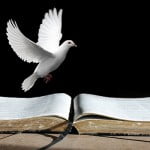
Marshall notes that, contrary to most visual depictions (which always, of necessity, involve literalising a text), the coming of the Spirit is like a rushing wind, and the Spirit on each is as if (or ‘seemed to be like’, TNIV) tongues of fire—not literally so in either case. There are allusions here to OT theophanies, such as 2 Sam 22.16, Job 37.10 and Ezek 13.13, and especially the appearance of God at Sinai (Ex 19.18). We miss in English the double meaning of the Greek pneuma as both ‘wind’ and ‘Spirit’, which Jesus in John 3 makes much of in his dialogue with Nicodemus, and the link with the ‘breath of life’ that animates the first Adam in Gen 2.7 (that Paul draws on in 1 Cor 15.45). But the primary allusion is to the promise of John the Baptist that Jesus would ‘baptise you with the Holy Spirit and fire’ (Luke 3.16). This becomes a powerful Christological statement, which only makes sense with a Trinitarian understanding of God: the Spirit (presence and power) of God is sent by Jesus who baptises and fills his followers with the Spirit, who comes from the Father.
The outward and visible signs (wind, fire, speaking in tongues) point to an inward and spiritual reality, which is expressed by the language of ‘filling’. Although this appears to be an impersonal metaphor, likening the Spirit to inanimate realities such as water and air, in contrast to the personal metaphors of ‘Father’ and ‘Son’, it is used all through the New Testament in several ways.
The word is used when people are given an initial endowment of the Spirit to fit them for God’s service (Acts 9.17, Luke 1.15) and also when they are inspired to make important utterances (Acts 4.8, 13, 13.9); related words are used to describe the continuous process of being filled with the Spirit (Acts 13.52, Eph 5.18) or the corresponding state of being full (Acts 6.3, 7.55, 11.24, Luke 4.1). These references indicate that a person already filled with the spirit can receive a fresh filling for a specific task, or a continuous filling. (Marshall, p 69).
Or, as graphically put by Michael Green in a sermon I heard as an undergraduate: ‘Why do I need to be filled again? Because I leak!’
Though the language of ‘filling’ can indicate initial, repeated and ongoing experiences, the word ‘baptism’ cannot (contrary to some mainline Pentecostal teaching). The word ‘baptize’ is never used for anything other than an initial experience. But the range of others words (including ‘pouring out’, Acts 2.17, 10.45) and ‘receiving’ (Acts 10.47) indicate that Luke sees this reality of the Spirit as something that is normative for both the beginning and the continuation of the life of discipleship.
The description of those residing in Jerusalem is both fascinating and puzzling—but offers some surprising insights. First, Luke notes that these were ‘devout’ people (Acts 2.5), in keeping with his emphasis that Jesus came to call both ‘sinners to repentance’ (Luke 5.32) and the devout to see their hopes of deliverance fulfilled. For Luke, it is simply nonsense to suggest that Jesus didn’t mix with, appeal to, or work with ‘the religious’; his problem is with those who are complacent and hypocritical.
The speech that Luke composes and places on the lips of these visitors is, of course, an artifice, as are in some sense all the speeches in Acts; they are (like all gospel material) far too short to be realistic. But what they are is Luke’s summary of the key points of what was said, recorded (inevitably) through his interpretive lens. In this case, he presents the conversation amongst the crowd as a kind of Greek chorus, in which they all speak in unison.
Commentators universally note that the number and ordering of the places mentioned is a puzzle to which no-one has a convincing answer. There is actually some sense of order; the first group are broadly speaking in the East of the Roman Empire; then we move to Judea and head north through central Turkey; then we move to the West of Turkey and North Africa; then further West to Rome, but with a jump south to Arabia. And of course there are many omissions in each direction.
But if the order makes little sense, the number is significant. The list is grouped to mention 4 + 4 (v 9) + 2 + 3 (v 10) + 4 = 17. Our attention is drawn to this by the odd separation of ‘Jews and proselytes’ from Rome, making what would have been 16 names into 17. Why does this matter? Because of the connection with Ezekiel’s prophecy of the water flowing from the temple, and the importance of 153 in the catch of fish in John 21. As I cite in the discussion of John 21:
In Ezekiel 47, we see baptismal waters flowing from the overturned Bronze Sea of the Temple, flowing out to the boundaries of the Land. Remember that Jesus claims to be the source of such living waters. In Ezekiel 47:9, we are told that “very many fish” will live in the (formerly) Dead Sea as a result of these living waters. In verse 10 we read, “And it will come about that fishermen will stand beside it; from En-Gedi to En-Eglaim there will be a place for spreading of nets. Their fish will be acording to their kinds, like the fish of the Great [Mediterranean] Sea, very many.”
The Dead Sea is the boundary of the new land after the exile, and a place of contact with gentiles. The fishes are clearly gentile nations. The fact that the sea is formerly dead and now is brought to life surely indicates the influence of Restoration Israel over the nations before Christ, and points to the greater influence of the Kingdom after Pentecost.
Now, it is well known that Hebrew letters are also numbers: the first nine letters being 1-9, the next nine being 10-90, and the last five being 100-400. “Coding” words with numbers is called gematria. If we substract the “En” from En-Gedi and En-Eglaim, since “en” means “spring,” then the following emerges:
Gedi = 17 (ג = 3; ד = 4; י = 10)
Eglaim = 153 (ע = 70; ג = 3; ל = 30; י = 10; מ = 40)
Again, this seems too close to the mark to be a coincidence. Once again, we have the number 17 (Gedi, mentioned first) and its relative 153 (Eglaim, mentioned second 1) connecting to the evangelization of the gentiles, symbolized by fishing.
Conclusion: The number 153 represents the totality of the nations of the world, which will be drawn in the New Creation.
John, in his story of the fishing trip in John 21, makes use of his ‘double meaning’ of the literal and the symbolic to teach us that the gospel will reach all the world. Luke, using his historiographical account of Pentecost, tells us the same thing. The deliberate listing of the range of places both anticipates the areas where the gospel will reach, but also hints at the means; we later read about Jews being dispersed from Jerusalem, who ‘accidentally’ share the good news of Jesus the Jewish messiah with gentiles in Acts 8.4. Truly, salvation has gone out from the Jews (John 4.22).
(Possibly inadvertently, the lectionary points to us making this connection between Acts and John, by suggesting in Year A that we should also read John 7.37-39, which includes the obscure saying of Jesus, ‘as Scripture has said, out of his stomach/side will flow rivers of living water’. I agree with Richard Bauckham that this is an allusion to Jesus as the new temple of Ezekiel’s vision, from whom the Spirit flows, symbolised by the water flowing with the blood in John 19.34.)
Marshall argues (p 68) that this is not, as commonly preached, an ‘undoing’ of the confusion of Babel (Gen 11), since Luke offers no echoes of any OT text from that episode. I would also note that undoing Babel would imply eliminating linguistic difference and giving everyone a single language to speak. In fact, the gospel does something quite different—uniting people in one community whilst retaining their different ethnic, social and cultural differences, expressed in the four-fold phrase ‘every tribe, language, people and nation’ that we find seven times in the Book of Revelation.
Marshall also dismisses the idea that the giving of the Spirit contrasts with the gift of the law, which is also celebrated at the festival of Pentecost. I think this is just a convenient way of reading a kind of antinomianism into the New Testament; both Jesus and Paul see the gospel as a fulfilling not an abolition of the law, and both are just as concerned about outward expressions of devotion and obedience as they are about the inward reality of intimacy with God made real by the Spirit.
There are three important things to note about Peter’s speech from Acts 2.14 onwards. The first is that he sees the gift of the Spirit as neither an incidental consequence of Jesus’ death and resurrection nor a temporary thing for a limited period of time. Rather, he uses the language of Joel to claim that we are now in a new era, where the future age has broken into the present. ‘This’, the outpouring of the Spirit with its accompanying signs, ‘is that’ about which Joel wrote.
Peter’s speech as set out by Luke includes two intriguing changes. First, the times ‘after this’ (LXX Joel 3.1) has now become ‘the last days’; and ‘wonders in heaven, and on earth, blood and fire’ has become ‘wonders in heaven and signs on earth’. Luke’s Peter is clearly linking the gift of the Spirit with the hoped for ‘day of the Lord’ at the end of the age. Just as Jesus has preached the coming of the kingdom, breaking in as the new age and reality whilst the old age has not yet passed away, so Peter describes the coming of the Spirit as another aspect of that partially realised eschatology.
(We find a similar dynamic in Rev 6.12, where the age to come marked by the sun darkening, the moon turning to blood, and stars falling, breaks into the world with the opening of the sixth seal.)
So the gift of the Spirit is not a flash in the pan, but the coming of the new age—a first fruits of the new reality, poured out at the Festival of First Fruits at Pentecost.
Secondly, it is in every way focussed on what God has done in the person of Jesus. Peter’s speech is structured in two parallel parts:
| Subject | Part 1 (vv14b–24) | Part 2 (vv 24–36) |
| Opening scripture | From Joel 2 about the Spirit poured out in the last days | From Psalm 16 about ‘your holy one will not see decay’ |
| Account of what happened to Jesus | His ministry of signs and wonders | His death and resurrection |
| God’s action and the response called for | God raised him up | God exalted him to his right hand and poured out the Spirit |
The late Martyn Menken, in his book on Numerical Literary Techniques in John, comments in passing that Luke also uses numerical composition in his gospel and Acts, and this is a prime example.
There are also several instances of isopsephia in Acts, where the number of syllables of an episode or speech is equal to the numerical value of an important name or word occurring in or related to the passage in question (such as we found concerning John 1.1-18, where both the number of syllables and the numerical value of monogenes are 496). Peter’s speech in Acts 2.14-b-36 is made up of two equal halves: 444 syllables in 2.14b-24, and again 444 syllables in 2.25-36. Their sum, 888, is the numerical value of the name Iesous, a number which was famous in this quality in the second century, witness Irenaeus’ Aversus Haereses 1.15.2.
In other words, this is all about Jesus.
But third, it is also worth noting the constant interplay here between God as Father, Jesus, and the Spirit. The resurrection of Jesus and the pouring out of the Spirit were both things done by God and both testify that Jesus is both Lord and Messiah. So how should we respond to what God is doing? Believe in Jesus and receive the Spirit.
Thus Pentecost involves a profound personal experience that transforms fear into courage and hope. It turns the believers from looking in to looking outward, and enables them to offer a message of life to all people, so that the Spirit can form the people of God into a multi-cultural, multi-lingual and diverse group centred around the worship and proclamation of God as Father, Son and Spirit.
I hope that, in all this, you can find something new to explore this Pentecost Sunday!
For my other reflections on Pentecost, see:
- ‘The many meanings of Pentecost‘ which groups themes together;
- ‘What we should expect from God at Pentecost‘ which outlines a sermon I previously preached, and
- ‘The dynamism of Pentecost‘ which looks at all the different movements in the account of Pentecost.
Come and join Ian and James as they discuss all these things…
And if you want to preach on John 14, the written commentary can be found here, and the video discussion here:
 Buy me a Coffee









Marvelous, thanks.
Some of it, personally, turned the clock back to times of filling.
Glory to God, the Shekina, Holy, Glory of His Presence, His Presence, his love being poured out into our ‘hearts’ being a longitudinal canonical theme.
Where have those days gone in the church. If Michael Green was the source of the quotation, it was picked up and used, across denominations.
Uplifting, thanks.
And all of this is dependent upon, resultant, on the Ascension, a fulfilment, of Prophet, Priest and King, Christ’s offices, New Creation, first fruits (and inversion of the order of creation, starting with humanity). And a removal of the curse, to grant re-entry into the Temple-Garden presence of God, but more so, and magnified.)
Thanks very much for these comments, Ian.
The list of places in vss 9 – 11 may be organised in a circular form but more importantly I think also includes places in every direction from Jerusalem. The smallest group is those from the south – ‘Egypt and parts of Libya.’ Is that because the Jewish communities there were only on the coastal strip and/or very little was known about the hinterland, which is largely desert anyway?
I have long thought that there is what we might call ‘salvation geography’ in Scripture alongside ‘salvation history.’
Ian writes: “Against some popular readings, we need to note that the wind and fire were not literal but similes for Luke. There is powerful symbolic resonance with the ‘tongues as of fire’ being one thing which is divided amongst them, and these ‘tongues’ give them ‘tongues’, that is, languages, to speak.”
This may be going a bit further than Marshall, who says the event was ‘supernatural’ and ‘analogical – as of fire’ (p. 68). Note that Acts 2.3 states ‘there appeared [ophthesan] to them … tongues as of fire’, so Luke is talking about a physical manifestation (the same verb is used in Luke 24.34). I haven’t checked the ‘big’ commentaries, but as a onetime classics teacher, I can’t avoid the observation that heads crowned with supernatural (non-burning) flame (as a sign of divine choice and destiny) are a familiar trope in Latin literature, especially in Livy’s Ab Urbe Condita (the choice of Servius Tullius to be king of Rome) and in Aeneid 2 (Aeneas’s son Ascanius is designated ancestor of the Romans).
It intrigues me also that Luke mentions the healing of a man called Aeneas in Acts 9.33-35, and I have sometimes wondered if Luke was familiar with the epic which Augustus had decreed was to be foundational in the education of Roman boys. Centuries later, in his Confessions, Augustus described his own journey to Carthage and then to Rome as mirroring the journey of the hero of his school days.
James
One of those (I would affirm) whom you describe as the “big” , FF Bruce, in his commentary on Acts 2:3 (The New Bible Commentary Revised) describes the phonemon thus: “Suddenly the Holy Spirit took possession of them while *visible and audible* signs accompanied theeffusion of the promised heavenly gift.” However elsewhere in (a) his Greek commentary[Tyndale] he speaks of it as “a mystical experience” [P81] and (b) in his MMS commentary (quoting Charles Wesley’s ‘O thou who camest’) he expresses its significance in the following way: ” When this (the Pentecostal phenomenon) has been grasped, the difficulty of determining what the disciples really saw* appears very unimportant.”
Clearly, there exist ambiguities between the second and third interpretations and the first. But even here, Bruce transcends the desire to reproduce the manifestations as symbolic. Taking this a stage further and given the association you make (rightly in my estimation) between Acts 2:3 and Luke 24: 34, are we then to assume that the resurrection appearance of Jesus was in all probability primarily symbolic and in no way literal?
Colin, I have Bruce’s Greek commentary too, and he does seem to treat the ‘tongues of fire’ as an actual visual phenomenon not to be explained away naturalistically. Luke 24.37-43 (eating fish) indicates that the appearance of the risen Christ was not a subjective vision either. This agrees with John 20 (the appearance to Thomas).
James, I’m sure you are right. The problem I have is related to the chronology of the editions. Some of them (like me) go back to the year dot. Did the various authors modify their judgements over a period of time?
On reflection however I feel that that would not have been true of FF Bruce! His thoroughness would have ensured a constancy of output.
Best wishes! C
I wonder, Was the burning bush “symbolical” or mystical or similes?
Why did Moses want to investigate it? Did the burning bush only
appeared to be on, something that seemed to be, fire?
Why was the fire non – combustible?
What happened when the three Israelites
were thrown into a furnace why where they not consumed
For those who fired up the furnace to several times hotter
than normal practice; where they piling up similes or symbols or what?
All of which happened before either Greek or Roman were twinkles in eyes.
What shall we say of Deut, 4:24 or Deut, 9:3?
What is Power?
What is this “power”, after that the Holy Spirit came upon them.
What the nature of the power? What was /is its purpose?
Why was it needed or required?
Why, as Paul says, are we given “a spirit of power”? to what purpose?
For an interesting word study on the Power
See https://pioneernt.com/2010/02/01/word-study-31-power/
On power and authority perhaps look at
.bobyandian.com/bible-topics/power-and-authority
What is missing from this piece is the reason behind the way the Holy Spirit manifested itself at Pentecost. We are given to understand, from several other places in the New Testament, that when we come to believe in Him, we receive the Holy Spirit as a deposit guaranteeing what is to come, but this is not what was happening at Pentecost. The Spirit came upon some believers in a way that gave them an especial strengthening for their God given tasks and an example of one of these tasks is Stephen the Martyr (Acts 7) who stood up and preached a sermon which convicted people of their sins. The reaction of those listening (stoning him to death) shows that the sermon really hit its mark. I wonder how many today are prepared to stand up, fearlessly, preaching the Word, through which people are convicted of their sins – knowing full well (as Stephen did) what the consequences would be.
So the Spiritual gifts that believers were endowed with through the Holy Spirit at Pentecost were for a purpose – which was to strengthen them so that they would proclaim The Word fearlessly, whatever the consequences – along with the accompanying signs, whereby God indicated that these were His people and that they had to be taken seriously.
So the statement ‘Pentecost involves a profound personal experience that transforms fear into courage and hope’ is true as far as it goes – but is meaningless if it is not connected with the basic teaching ‘all have sinned and have fallen short of the glory of God’ (Romans 3:23), we continue to sin even after we have come to Him (Romans 7:14-25) and the ‘courage and hope’ are meaningless if not connected with a willingness to take the consequences when people are convicted of their sins through the part we play in proclaiming the gospel message.