The end-times Spirit comes at Pentecost in Acts 2

This Sunday is the feast of Pentecost, fifty days from Passover (hence the name), in the Jewish calendar the festival of Shavuot (‘weeks’), one of the three great pilgrim festivals (with Passover and Sukkot, ‘Tabernacles’). It was the beginning of the wheat harvest, but also celebrated the giving of the Torah on Sinai, and so had new significance in the light of Jesus. Where the Torah was our guide for living faithfully to God, now the Spirit not only shows us what obedience is, but empowers us to live in obedience. And those who receive the Spirit are now the first harvest (the ‘firstfruits’, 2 Thess 2.13, James 1.18, Rev 14.4), as the Spirit is the first harvest (Romans 8.23) of the wonderful things to come when Jesus returns, and shapes us in the life of Jesus, himself the first harvest of the resurrection from the dead (1 Cor 15.20).

The passages set in the lectionary are Acts 2.1–21, John 7 or 20, and 1 Corinthians 12. You can find written commentary on 1 Corinthians 12 here, and video discussion of it here.

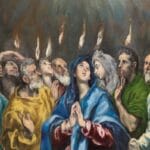
The reading from Acts 2 is a long passage, and there is much to say about it. Against some popular readings, we need to note that the wind and fire were not literal but similes for Luke. There is powerful symbolic resonance with the ‘tongues as of fire’ being one thing which is divided amongst them, and these ‘tongues’ give them ‘tongues’, that is, languages, to speak. Fire in Scripture is a symbol of purification, and this denotes the presence of the Holy Spirit. The language of ‘as the Spirit gave…’ resonates with Paul’s language of the Spirit giving gifts in 1 Cor 12.

The spiritual gifts in 1 Corinthians 12

The lectionary New Testament readings for the Pentecost, this coming Sunday, are 1 Corinthians 12.3b-13, Acts 2.1-21, and John 20.19-23—but the first or second reading must be from Acts. So I suspect most churches will read Acts and 1 Corinthians 12. Written commentary on Acts 2 can be found here, and video discussion here.

Here I offer commentary on 1 Corinthians 12, with the link to the video discussion at the end.

What we call Paul’s first letter to the Corinthians is clearly part of an exchange with the faith community there, since Paul makes reference to the previous correspondence back and forth; we actually have Paul’s second and fourth letters (depending on how you reconstruct the exchange). This because significant at key points in this letter, as Paul makes it clear that he is responding to questions asked or issues raised by the Corinthians themselves—but of course we don’t know what they have said, and can only speculate. It is an important window into Paul’s exercise of authority; I wonder if today, in a Church of England church, we could imagine the congregation challenging and questioning their bishop in an exchange of correspondence!