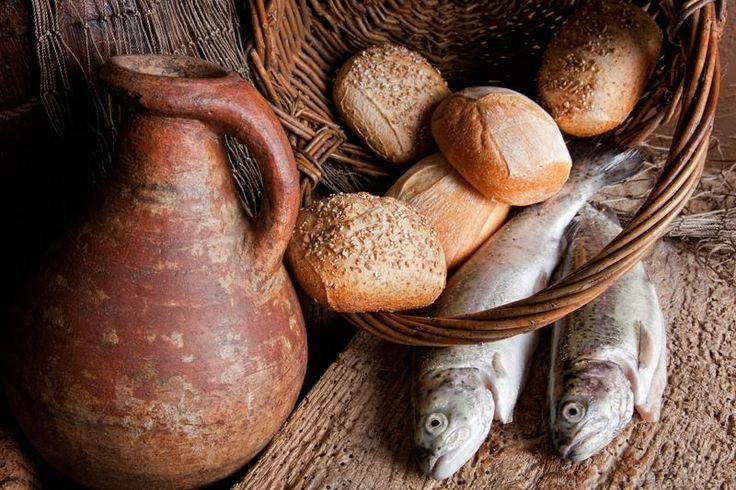
The feeding of the 5,000 in Matthew is much briefer than in the other gospels. But he draws extensively on images from the Old Testament, and focuses on Jesus, the one who invites us, provides for us, and invites us to follow him.
The Sunday lectionary reading for the Trinity 9 in Year A is Matt 14.13–21.
The epistle is the fascinating and pivotal passage in Paul, Romans 9.1–5 (though you need to read on to the next couple of verses). The video discussion of that passage can be found here, and is also linked at the end of this article.
We have now moved beyond the third section of Jesus’ teaching in Matthew, on the kingdom of heaven in chapter 13, and are immersed once more in Jesus’ ministry and engagement with those around him, which extends to the end of chapter 17, before we reach the fourth section of teaching in chapter 18.
Here, as elsewhere, Matthew is much more compressed in his account that either Mark or Luke. There is a wealth of textual and emotional detail to consider here, and it is a good example of how concise the biblical texts often are, and therefore how carefully and patiently we need to ponder them.
The passage immediately preceding this episode, in all three Synoptic gospels, is the feast at which Herod Antipas presents John the Baptist’s head on a platter to his wife’s daughter. There is some irony in this juxtaposition; as R T France puts it (NICNT, p 558): ‘We move from Antipas’ lavish but degenerate feast to one with a simpler menu but a more wholesome atmosphere.’ In preaching, it would be interesting to reflect on the kind of feast offered by Jesus as a contrast to other feasts that are available.
In Mark and Luke, Antipas’ feast fills the gap between the disciples being sent out on mission and returning, whilst John fills this time by describing Jesus’ ministry in Jerusalem. But Matthew has told us about the mission earlier, in chapter 10, and so his focus here is solely on Jesus’ response to the news of John the Baptist’s grisly execution. There is a triple emphasis on Jesus action; he ‘withdrew’, ‘by himself’, and ‘to a lonely place’ (eremos, solitary, lonely, deserted). In Mark, this respite is partly for the disciple’s sake, as they take time out to recover from the exertions of ministry. But here, surely, there is a hint of Jesus’ reaction to the death of his relation and his predecessor. ‘Withdrawal’ is a favourite motif of Matthew; the magi withdraw from returning to Herod the Great in Matt 2.12; Joseph withdraws first to Egypt and then to Galilee in Matt 2.14, 22; and Jesus withdraws to Galilee, out of the territory of Herod Antipas, when John is first arrested in Matt 4.12. He surely sees the danger in open confrontation with political power, and knows that the moment for that has not yet come—but he also surely sees in John’s death an anticipation of his own destiny.
We might assume that Jesus really is on his own. But you need a crew to sail a boat, and the other gospels imply that the twelve disciples are with him.
Despite the emotional news about John, despite his own need for rest and his own concern for the disciples, when Jesus sees the crowd he has compassion on them, as he has before (Matt 9.36) and will have again (Matt 15.32, the feeding of the four thousand). The verb splanchnizomai (related to the origins of our word ‘spleen’) suggests being moved in one’s guts or stomach, believed in the ancient world to be the seat of the emotions. When Paul uses the related noun in Phil 1.8, the AV translates it ‘I yearn for you with the bowels of Christ’. It suggests a deep, spontaneous response, and for Jesus this overrules any sense of self-interest; he immediately shelves his own plans in favour of the needs of the crowds. In Mark 6.34 his response to these ‘lost sheep’ is to teach them; here in Matthew he heals the sick; the gospels all testify that he did both, and the accounts reflect the gospel writers’ different concerns.
Despite the traditional site of Tabgha, just west of Capernaum, marked by the Church of the Loaves and Fishes, the location is more likely to be east of the Jordan river near Bethsaida as Luke 9.10 informs us. There is a nice ‘undesigned coincidence‘ here, pointing to historical reliability: the account of the Fourth Gospel does not mention the location, but does mention that Jesus asked Greek-speaking Philip for information (John 6.5); and earlier in the gospel we learned that Philip was from the Greek-speaking region of Bethsaida (John 1.44). (There is a question of how the crowd, on foot, crossed the Jordan river; but we do not have enough archaeological detail to know whether there was a bridge or ford at the time.)
Although Matthew is more abbreviated than all the other gospels, so that we have no detail here of the money that would be needed (Mark 6.37), the discussion with Philip (John 6.5), or the little boy bringing his picnic (John 6.9—isn’t it interesting that the so-called spiritual gospel very often has the life-like vivid details that make the narratives seem so real?!), the main elements of the story are remarkably consistent across all four gospels.
For the disciples, there comes a point where their responsibilities end, ministry is finished, and the people need to be despatched so that they can have their own time. ‘Send the crowds away…’ But Jesus not only sees his ministry continuing, he invites the disciples to be involved in it and take responsibility, and sees it extending to provide for physical needs of the crowd and not merely the spiritual.
There doesn’t appear to be anything symbolic about the ‘five loaves and two fish’; this is just the number they had. Once more, the Fourth Gospel provides the detail that they were ‘barley’ loaves, the regular fare of the lower end of society (beware projecting our ideas of comparative poverty on a very different economy). The loaf would be something like our modern-day pitta breads, and assumed to be food for one. So whilst this offering is more than enough for one person, it would not even do for the Twelve, let alone the five thousand. Some years ago, William Barclay popularised the idea that there was nothing miraculous here in the multiplication of the loaves and fish, but that when the crowd saw the generosity of the boy, they were moved to share what they had in fact themselves brought—’the biggest miracle of all [is] one which changed not loaves and fishes, but men and women’. But this idea has no support whatsoever in the text itself, and is driven by a sceptical materialism.
It is entirely characteristic of Jesus that his miraculous power makes use of what is already there. Rather than produce food from nothing, he makes use of the loaves and the fish, just as at Cana he does not produce wine from nowhere but turns water into wine. Jesus’ miracles are consistently supernatural, working with and beyond nature, rather than antinatural. Jesus is no conjurer of magic tricks.
Matthew does not include Mark’s detail of the almost regimental organisation of the people, as they sit in ‘hundreds and fifties’ (Mark 6.40), nor the detail of the ‘green grass’ indicating that this was early in the year (Mark 6.39). But his abbreviated account does put Jesus centre stage and clearly in command. He commands the disciples, directs the people, and takes control.
Much has been made of the four-fold action of Jesus in ‘taking, blessing, breaking and giving’, and there are some very clear parallels between this narrative and Matthew’s narrative of the Last Supper—apart from the repeat of the four-fold actions, both take place in the evening, with people sitting (though is Jesus sitting here?), and there is an emphasis on ‘all’ eating. But three things need also to be noted.
First, all these are natural actions that we might expect; how else could the people be organised and eat other than sitting down? And the actions of Jesus are what any first century Jew would do.
Secondly, there is no doubt, reading in context as a narrative about observant Jews, that the ‘blessing’ is of God and not of the bread. This is confirmed by the interchangeable use in the gospels, in this account and in the Last Supper, of the verbs eucharisteo (‘to thank’) and eulogeo (‘to bless’). The blessing is of God (in Jewish liturgy the Berakhah) for providing food to nourish us, and this Jewish use of ‘blessing’ has been resurrected in contemporary Anglican liturgies (‘Let us bless the Lord’). It sounds odd, because it is really the equivalent of what we would now express as ‘praising’ or ‘thanking’ God.
Thirdly, the primary allusions here are not to later, ritualised church practice, but to previous episodes in Scripture. Crossing the water, arriving in a wilderness, organising the people into companies, sharing bread, having more than enough, gathering what is left—all these remind us of the provision of manna in the desert under the leadership of Moses. There are also strong parallels with the prophetic actions of Elisha in 2 Kings 4.42–44, when a large group are fed with a few barley loaves. Both here and in the Last Supper we see Jesus, in Jewish context and using Jewish customs, anticipating the heavenly banquet in parallel with his teaching about the kingdom of heaven, feeding the people with both words and bread.
There is no obvious precedent or symbolism in the number ‘five thousand’; the number is memorable enough in English because of the alliteration of the ‘Feeding of the Five Fousand’. Matthew alone notes that this number referred to the men alone, not counting ‘women and children’ who presumably were there also. There is, however, symbolic significance to the twelve baskets of surplus food, corresponding to the twelve tribes of Israel, though that is no reason to think this was imagined rather than actual. Jesus will provide for all of Israel, though his feast will also include many others, as we have already been informed (Matt 8.11).
It is tempting, particular in the first half of this passage, to read this in an anthropocentric way, that is, to read it as an example for us. We are not to be self-centred, limited and pre-occupied as the disciples are, but we are to be, like Jesus, compassionate, boundless, and generous beyond measure to those around us, to the lost sheep that cross our paths day in and day out. But the problem with this is, apart from making us rather than Jesus the centre of the story, we will experience a ‘hardening of the oughteries’ where our reading and preaching focus on what we and others ought to do, and it will lead to exhaustion and despair rather than grace and hope.
But the second half pulls us back to where our focus should be—on the person of Jesus at the centre of the narrative. He is the one who graciously meets our needs rather than focussing on his own; he is the one who empties himself, making himself a compassionate servant who brings insight and healing. He is the host at the messianic feast, where all are invited to eat and be satisfied.
 If we do bring ourselves into the picture, it is only to ask: how will we respond to such a one, when he invites us to leave everything to ‘come, follow me’?
For further reflection on how to read and interpret the Bible well, you might be interested in my Grove booklet How to Interpret the Bible: Four Essential Questions.
There is no video discussion of the gospel passage, but you can join James and Ian discussing Romans 9 here:
 Buy me a Coffee






The video is so clear. The consanguineous union basis of the Mosaic covenant is not the fulfilment of the Abrahamic promise.
So why would we think (as per Tom Wright) that the new covenant is a ‘renewal’ of that Mosaic covenant — something Scripture never claims (indeed it is a fact denied in Galatians and Hebrews?) — when the new covenant works on a totally different basis with a totally different end point —an apocalyptic new heavens and new earth.
And notice how ‘sarx’ translated as ‘flesh’ in Romans 9 means ‘family’ as it does in Philippians 3:5 (as argued by James Dunn).
Surely ‘family’ should be the ‘go to’ first option for the translation of sarx and never ‘sinful nature’ — that the 2011 NIV persisted with in Romans 7.
Thanks. I think the difficult is that ‘sarx’ has three broad ranges of meaning:
1. Human nature
2. Family relation
3. Sinful human nature.
It is difficult when translations make a contested decision on which—so I prefer ones that just say ‘flesh’ even though it is jarring to modern ears!
Where does Tom talk specifically about the Mosaic covenant? In Romans Paul’s whole argument hinges around Abraham precisely because he received the promise prior to circumcision and the law…!
Hi Ian,
Tom Wright uses covenant renewal language directly in’ Jesus and the Victory of God’ (1996) and ‘Paul and the Faithfulness of God’ (2013).
In the ‘Climax the Covenant’ (1993) he sees a continuous covenantal story but a change of administration in the NT. That is the Presbyterian view specifically articulated in the Westminster Confession which many Anglicans embrace.
Yes, ‘sarx’ has a broad semantic domain and I think it can include the concept of simply the frailty of human flesh — which Jesus embraced in the incarnation (Romans 8:3?).
But I am sure you realise that concept of a sinful nature, and the translation of ‘sarx’ as ‘sinful nature’, is controversial in biblical theology and many think that the 2011 NIV, which I think cut 20 of its 22 translations of such — should have removed them all!
And, more specifically, in ‘The Day the Revolution Began’ (2016):
‘At the new passover … God purifies his people in and through the shed blood of Jesus so that the [Mosaic] covenant may be renewed, and not just renewed, but now effective for the whole world’ (p. 333).
I think we have had this converation before on the blog. The concept is a fundamental influence in Wright’s theology — or has been. It seems more recently he has embraced some of Michael Heiser’s work.
After prolonged teaching a crowd of many thousands Jesus wanted to
feed them well knowing that a morsel of food would arrive
This episode was not unique to Jesus as Elisha had already done this miracle
Elisha fed 100 people through a miracle from God using only 20 small loaves of barley bread and some fresh grain, as told in 2 Kings 4:42-44, a man brought the food to Elisha as a gift from the first harvest fruits.
: A visitor from Baal Shalishah brought 20 barley loaves and a sack of fresh grain. Elisha told his servant to give the food to the 100 men. The servant asked how such a small amount could feed so many.
Elisha repeated the command, stating that the Lord promised everyone would eat and have food left over.
Elisha was in many respects a type of our Blessed Lord. In his peaceful,
non-ascetic life, in his mild and gentle character, in his constant circuits,
in his many miracles of mercy,
in the healing virtue which abode in his bodily frame 2 Kings 13:21, he resembled, more than any other prophet, the Messiah, of whom all prophets were more or less shadows and figures.
The people knew their prophets well, perhaps this miracle cemented His Teaching confirming him to be as a Prophet which resulted in the people subsequently following on after him en masse.
There is a marvellous paper telling the story through several works of art to great effect on the subject of Feasts
@ https://www.robertjmorgan.com/outlines-and-illustrations/the-story-of-the-feeding-of-the-5000/
As John subsequently reported “of His fullness have all we received”
Shalom.
Just a short reflection – this was the subject of the sermon at my church on Sunday. It happened to coincide with the anniversary of the rector’s ordination, so we had a special guest preacher and he chose to relate the story of the feeding of the five thousand to priestly ministry. He argued that the story of the feeding of the five thousand was a lesson for all those who felt called to ministry. People sometimes go into ministry thinking of all the talents and aptitudes they have and intend to bring to bear. They quickly learn that it’s more like the feeding of the five thousand. Just like those who produced a few barley loaves and a couple of dried fish, what you have to offer is laughably inadequate in the face of the need that confronts you. But what you find is that inadequate offering can, with God, become an abundance. And over time, what you have to offer becomes less and less, and the loaves become crumbs, and then there’s just dust, and all that’s left is the overflowing abundance of Jesus Christ.
It is a vivid image—but surely not just limited to the ordained…?
Yes – but we had a particular focus given the anniversary.
and I am paraphrasing/summarising/highlighting a 20 minute sermon into a few sentences.
There is an amazing account of a Barley loaf destroying
A massive invading army @ Judges 7:9-18
Gideon’s faith wobbled a bit when he was left with only an army of 300.
God told him in effect “don’t worry, you also have a Barley loaf to do the hard work”
That really turbocharged Gideon’s faith!
The Remnant won the day as they also had “this treasure in earthen vessels that the excellency of the power may be of God, and not of us. 2Cor 4:7
The primary moral lesson of Gideon’s story is that God’s power is
made perfect in human weakness.
Rather than relying on human strength or numbers, true success
comes from trusting God.
Despite his fears and humble background, Gideon was able to accomplish monumental tasks when he surrendered to divine direction and fought
God’s battles in God’s ways, whatever the issues overwhelming us may be. Shalom