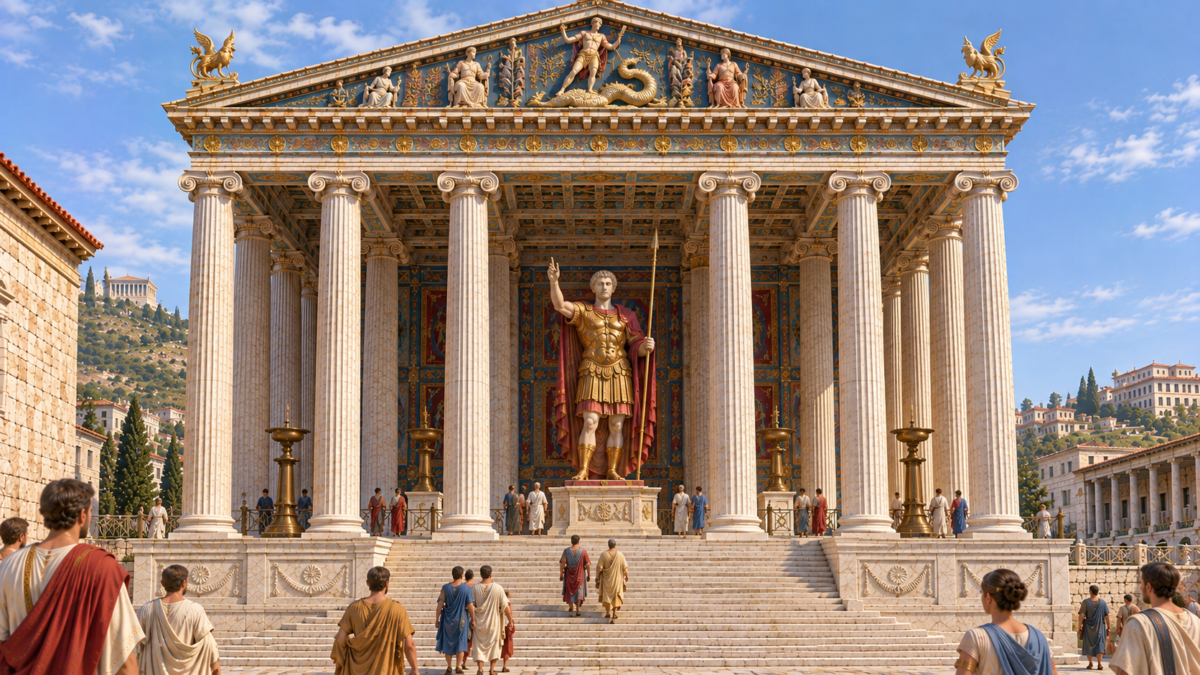
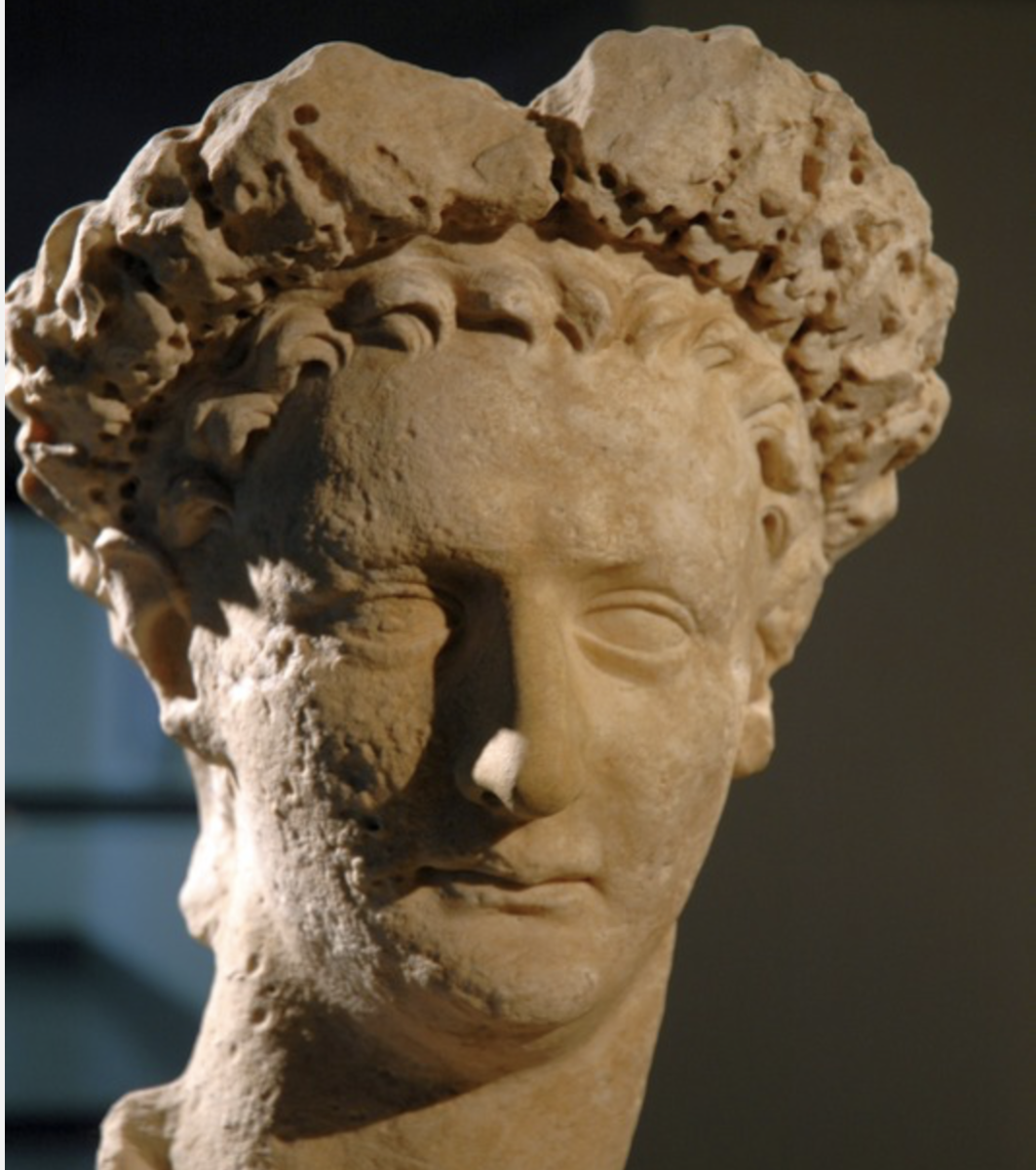
In the Ephesus Museum in Selcuk there is the head and left forearm of a colossal acrolith (a statue with stone head and limbs and body of wood) which is labelled there (and in the ruins of Ephesus) as a statue of Domitian. However, I think there is a strong case for believing this is a statue of Domitian’s older brother Titus—and this discussion throws significant light on how we read Revelation in the light of archeological evidence.
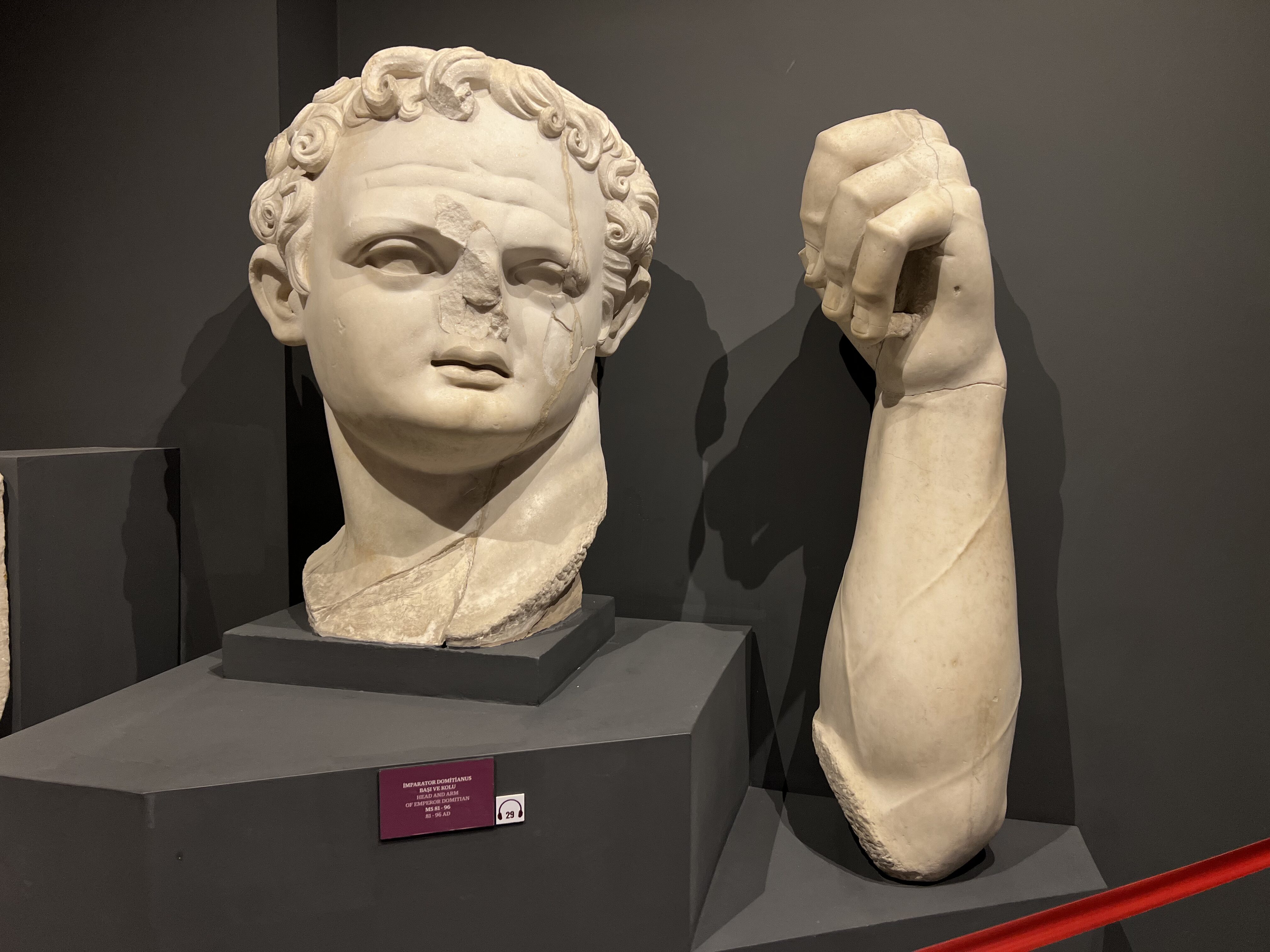
In the Ephesus Museum in Selçuk, in the room given over to the imperial cult, there is a marble head of colossal size, displayed next to a left forearm whose fist is clenched around a now-missing spear shaft. The label is clear enough: in Turkish and English it reads “Head and arm of Emperor Domitian, AD 81–96.” The same identification runs through guidebooks, tour talks and a good number of commentaries on Revelation, where the picture of Domitian towering over the cult of Ephesus has become a ready illustration of the “image of the beast” in Rev 13.14–15.
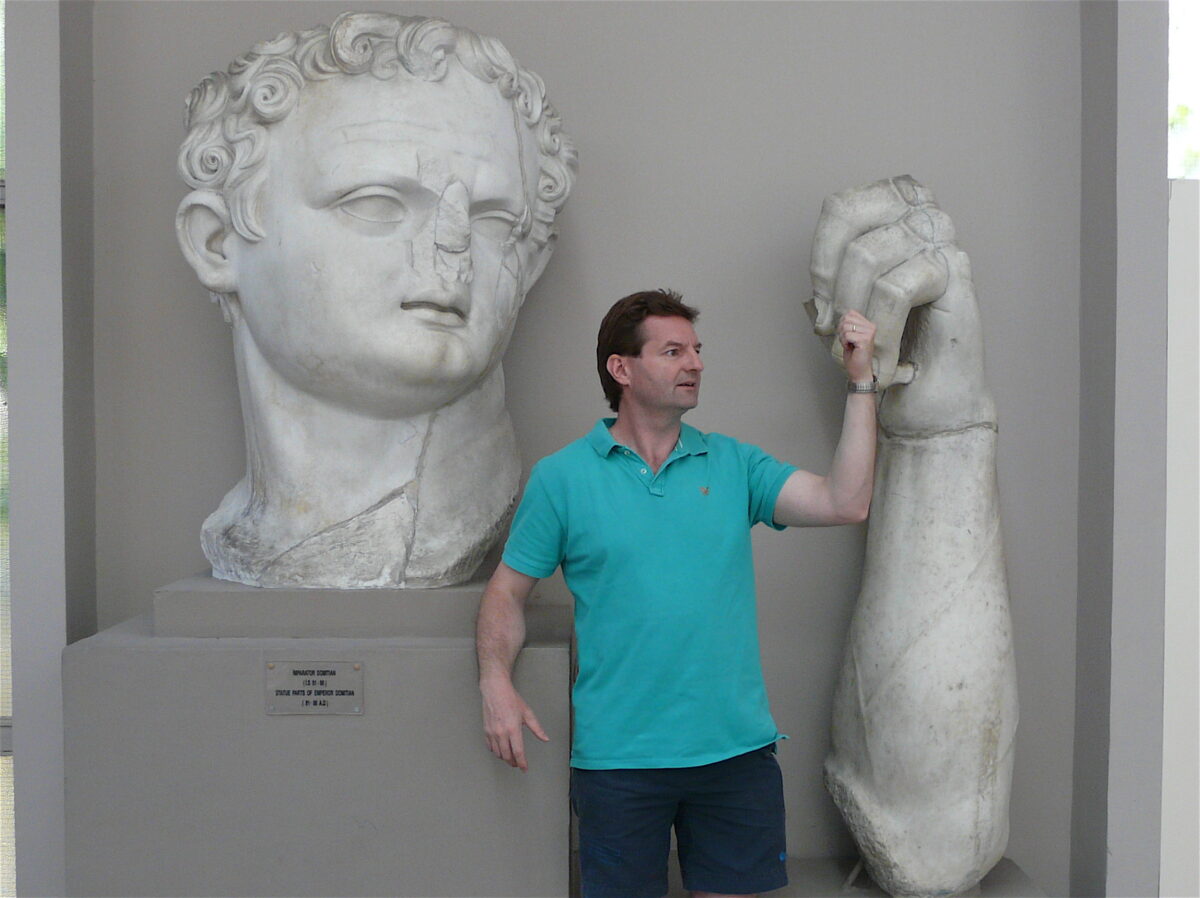
I first visited this statue in April 2009, and was not convinced that the label was correct. On the basis of that, I presented a paper to that effect at the British New Testament conference in September that year.
Having stood in front of it again (in April and September this year), I remain convinced that this is not Domitian. The face looks to me much more like that of Domitian’s elder brother Titus, emperor briefly from 79 to 81. In what follows I set out why, by comparing the Ephesus head with portraits of the two brothers whose identity does not depend on a collector’s label, in both statuary and on coins. This process is not always straightforward, since the provenance of all statues varies, and there is a danger of circularity—someone labelling one statue as Domitian because it looks like others!
I then ask what difference the identification makes to our understanding of the Flavian dynasty, to the significance of the temple at Ephesus, and to the way we read Revelation as anti-imperial polemic.
The find and the temple
The head and forearm were found in 1930 by the Austrian excavator Josef Keil, in the vaulted substructures of the terrace that carried the Flavian imperial temple in the upper city of Ephesus. Keil identified the head as Domitian, and the label has followed him ever since. The statue was acrolithic, which is to say that the head and extremities were of marble while the body was of wood, long since perished. (These are more common than we often realise—but you can see that it is the case here, since the edges of the forearm and neck are finished, rather than broken.) The fist has a channel for a spear or sceptre. Estimates of the original height vary, from around five metres to more than seven, so something between three and four times life size. (I measure myself against it, and reckon it is 3.7 times life-size, so would have been around 6.8m tall.)
The temple itself was dedicated in AD 89/90. It is still often called the “Temple of Domitian”, but that is misleading. As Steven Friesen showed some time ago (originally in his Twice Neokoros: Ephesus, Asia and the Cult of the Flavian Imperial Family and also in Imperial Cults and the Revelation of John), it was a temple of the Sebastoi, the Greek equivalent of Augusti, and so a cult of the Flavian imperial family as a whole. It was built by the province of Asia, with the emperor’s permission, and its foundation made Ephesus neokoros, temple-warden of a provincial imperial cult, for the first time. (Note that, in Rev 13:14, it is the ‘inhabitants of the earth’ who erect the statue of the beast.) A series of dedications set up by the cities of Asia, including Aphrodisias, mark it as a civic and provincial project. After Domitian’s assassination in 96 and the condemnation of his memory (damnatio memoriae), his name was chiselled out of these inscriptions, and in several cases the dedication was redirected to the deified Vespasian, his father—but the cult carried on.
The identification of the head has been disputed for decades. Georg Daltrop and Max Wegner, in the Flavian volume of Das römische Herrscherbild (1966), argued from the physiognomy that it represents Titus. Friesen, reviewing the question, notes that other art historians still hold to Domitian. The museum label, then, records Keil’s first judgement rather than a settled conclusion.
What the brothers looked like
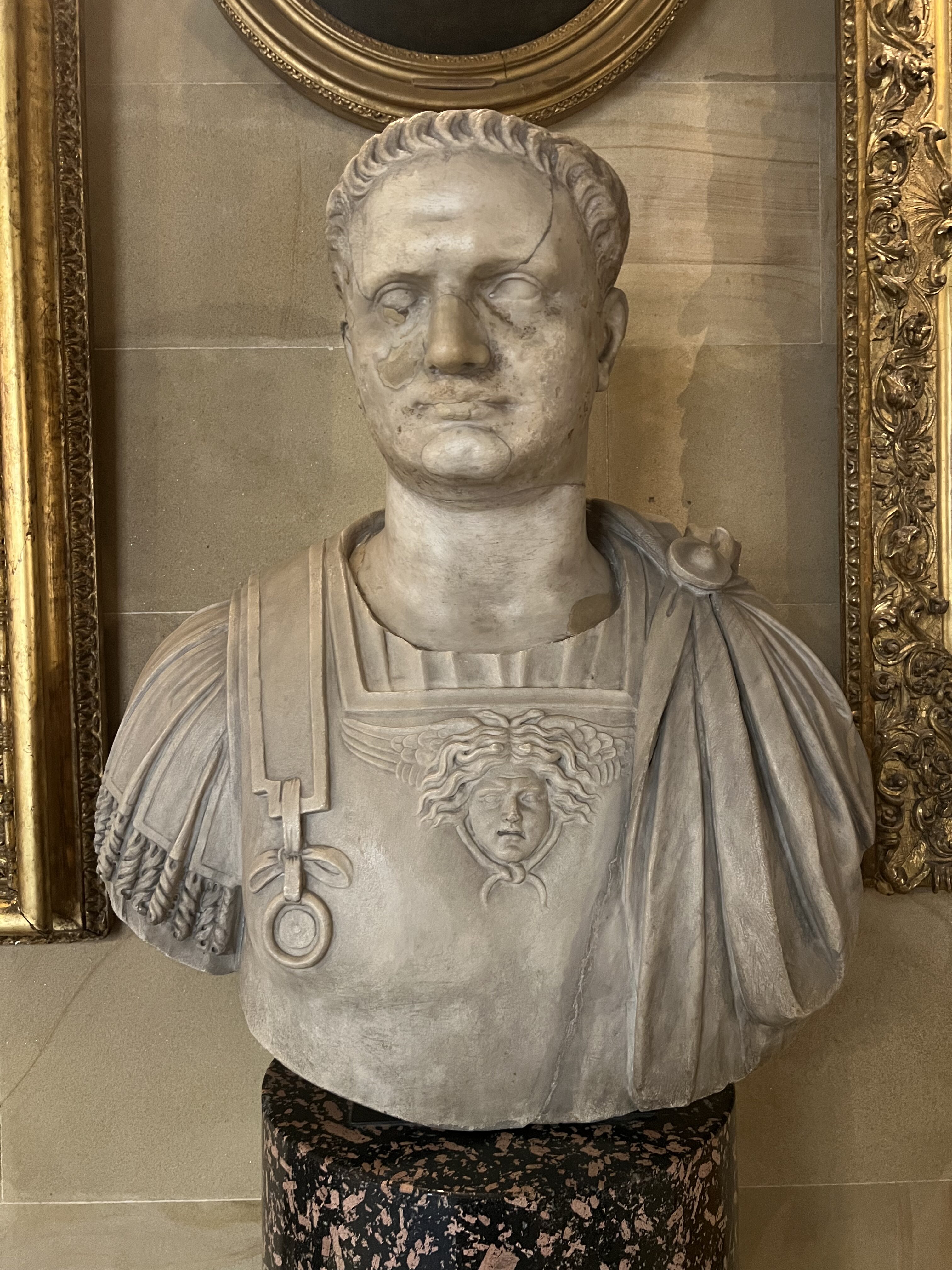
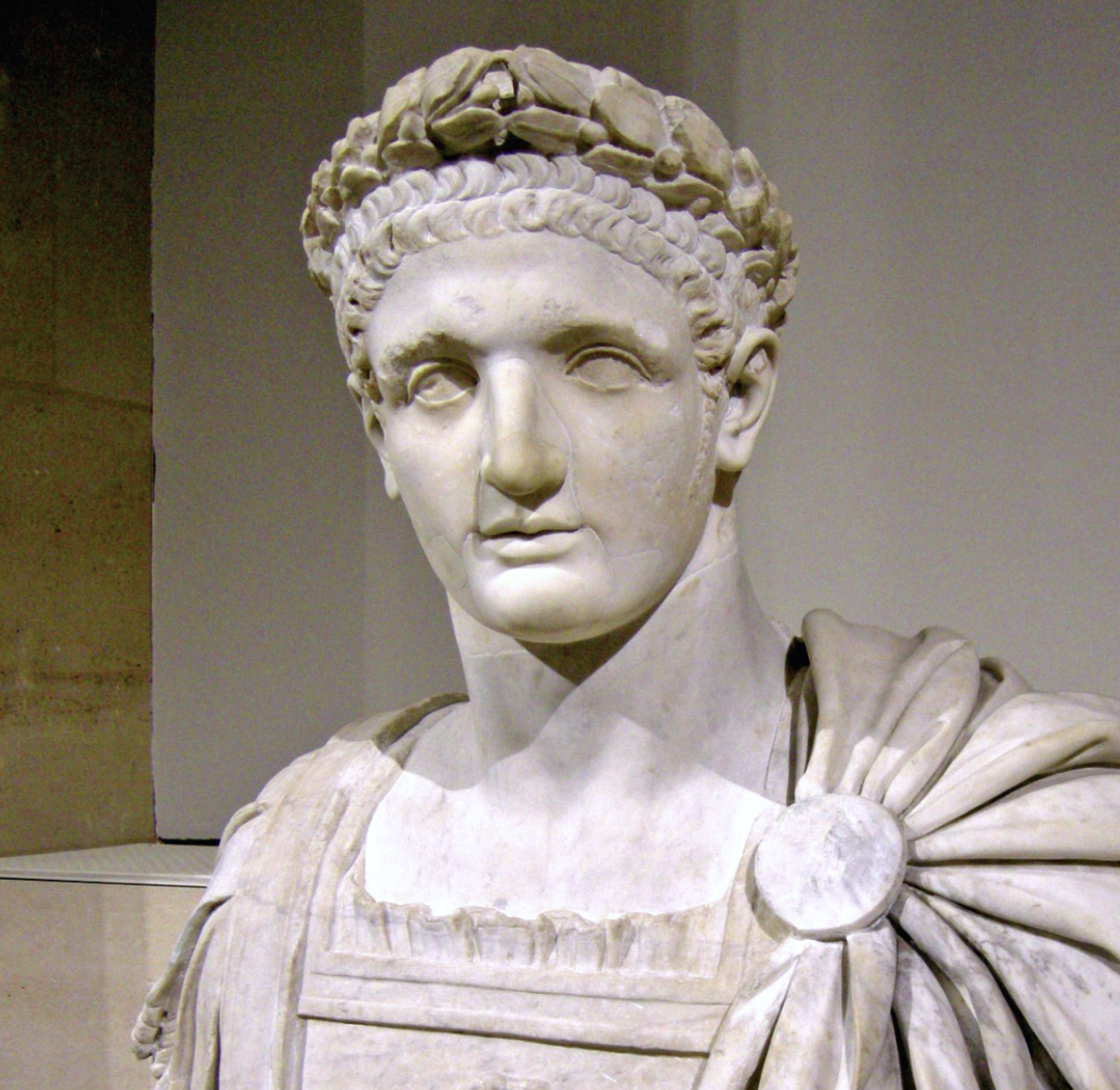
Any comparison depends on knowing what the two emperors looked like, and that is less straightforward than it seems. Many of the best-known portraits came to their museums through Renaissance and Grand Tour collections, and the name attached to them was given by a collector or dealer. The busts of “Domitian” in the Louvre (from the Albani collection, the example that first provoked my interest) and at Chatsworth (see right; photographed last week) are good examples. Both have the cuirass, gorgoneion and brooch-pinned cloak that eighteenth-century restorers liked to add to ancient heads, and both have restored noses. Heads from the Farnese collection in Naples and the Glyptothek in Munich have similar histories. They might well be correct, but they cannot be used to establish the type beyond doubt.
So I have limited the comparison to portraits whose identity rests on an inscription, a findspot or an independent historical context.
| Portrait | Subject | Basis of identification | What it shows |
| Coins, AD 69–81 | Titus | Named in the legend | Broad, square face; heavy jowl; short thick neck; a close cap of short, dense curls |
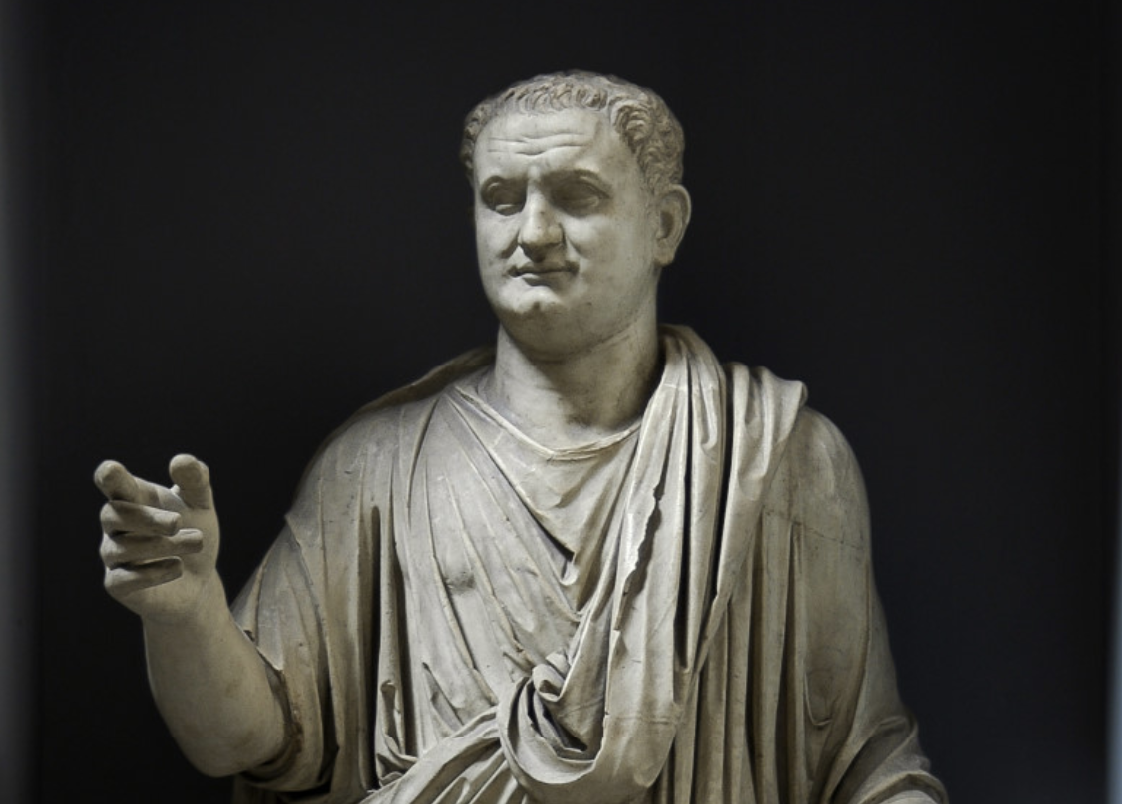
| Togate statue, Vatican Braccio Nuovo inv. 2282 | Titus | Found in 1828 near the Lateran, deliberately buried together with a statue of his daughter Julia | An ancient head, inserted separately, showing Titus at a fairly advanced age, with a fleshy face |
| Cuirassed statue from Herculaneum, Naples MANN 6059 | Titus | Bourbon excavations of the so-called basilica; dated 79–81 | The same heavy, square features |
| Arch of Titus, Rome | Titus | Inscription and context | Faces too damaged to help |
| Coins, AD 69–96 | Domitian | Named in the legend | Long oval face; aquiline nose; slightly overhanging upper lip; from the early 80s, stepped rows of curls over the forehead |
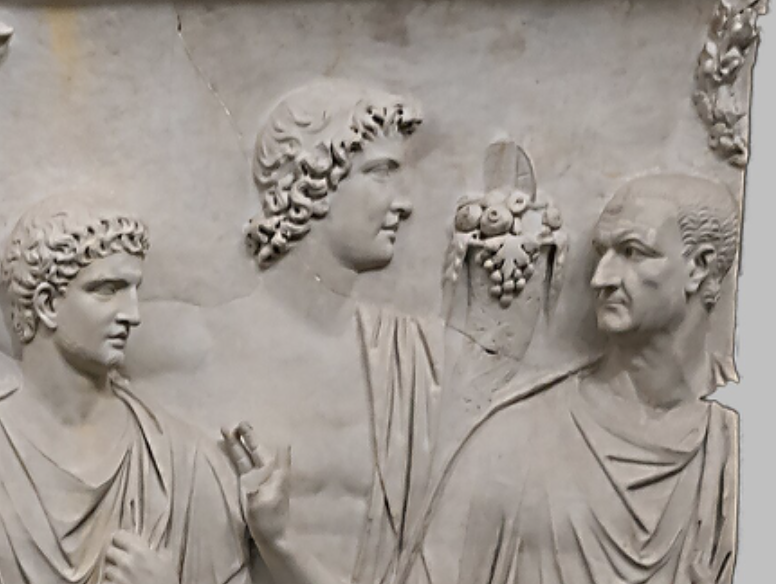
| Cancelleria Relief B, Vatican | Domitian as Caesar | Excavated in Rome in the late 1930s; greets Vespasian on his return in AD 70 | Unrecut, but idealised; John Henderson remarks that it looks little like Domitian |
| Cancelleria Relief A, Vatican | Domitian | Same find; head recut as Nerva after 96 | Face largely lost; some traces |
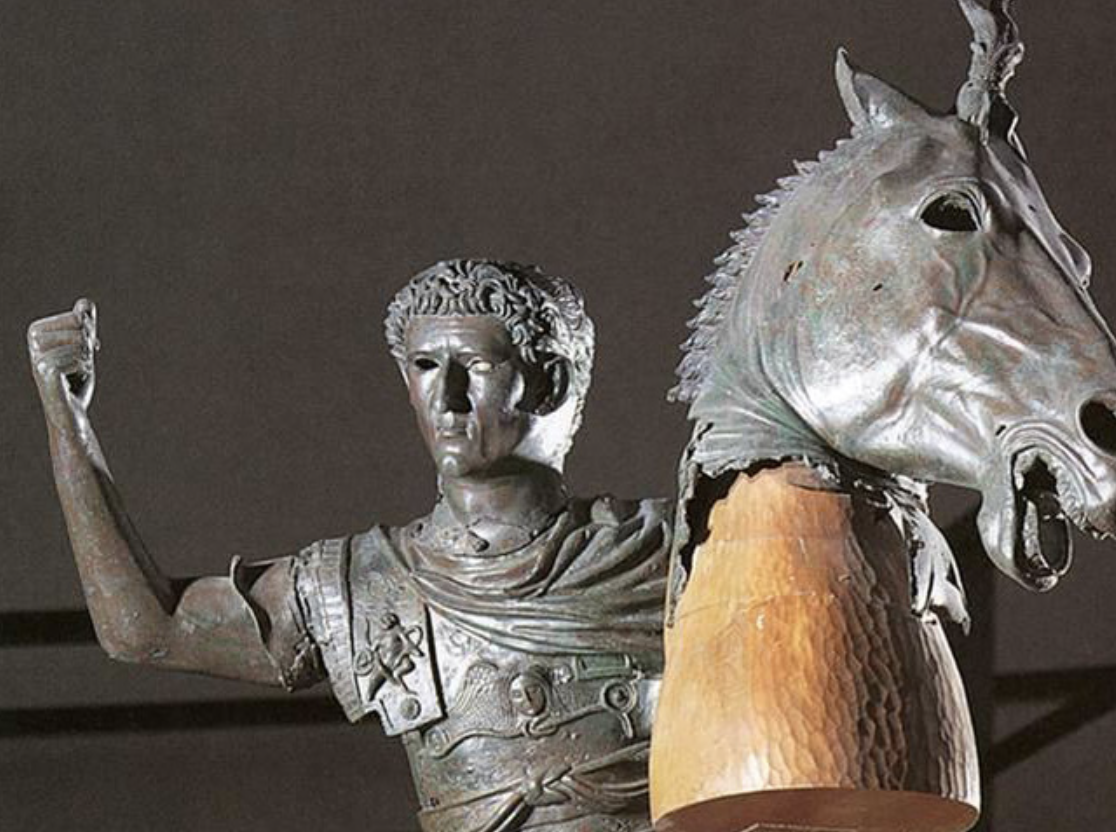
| Equestrian bronze from the Augustales building at Misenum, Baia inv. 155743 | Domitian | Excavated 1968; face cut away and replaced with Nerva’s | Hair behind the seam is original and reproduces his third portrait type |
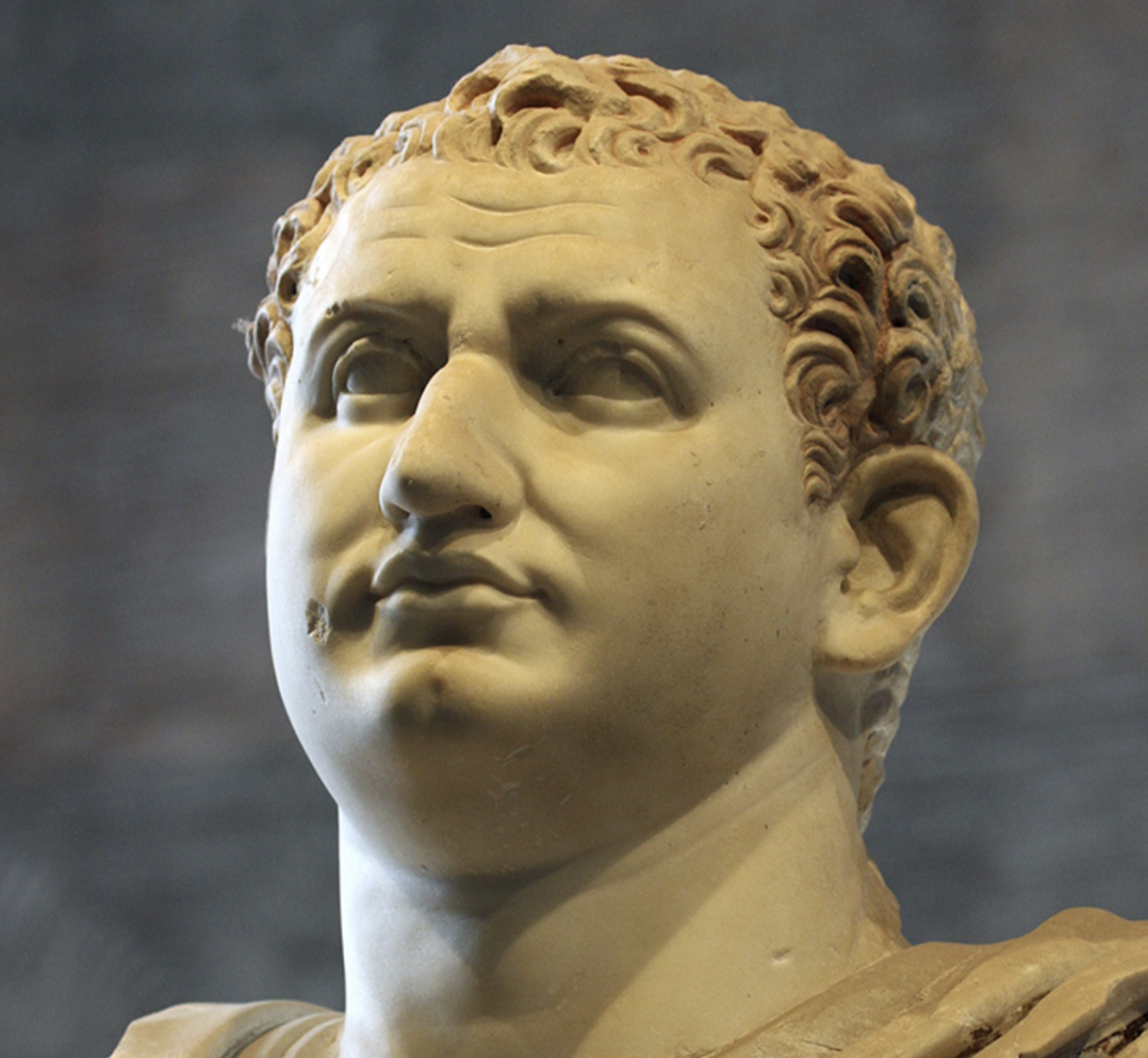
| Head in the Palazzo Massimo, Rome | Domitian | Museo Nazionale Romano; findspot still to be confirmed | Long face; strong aquiline nose; overhanging upper lip; stepped crescent curls under a wreath |
The written sources fit this picture. Suetonius describes Titus as short and somewhat paunchy (Titus 3). Domitian he describes as tall and handsome in youth, but later bald, and so sensitive about it that he wrote a book on the care of the hair (Domitian 18). The elaborate frontal coiffure of his later portraits is the sculptors’ answer to the baldness.
|
|
|
|
|
|
Placing the Ephesus head
Set against these two groups, the Ephesus head sits with Titus on five of the six features that survive.
| Feature | Ephesus head | Titus | Domitian |
| Face shape | Nearly circular and broad | Broad, square and fleshy | Long oval |
| Forehead | Three deep horizontal furrows | Creased with age | Smooth and idealised |
| Cheeks and jaw | Heavy pouches and a double chin | Heavy jowl and double chin | Firm cheeks and a neat chin |
| Neck | Short and thick | Short and thick | Longer |
| Mouth | Small, with full parted lips | Small, with a full lower lip | Small, with the upper lip overhanging |
| Nose | Lost | Aquiline | Strongly aquiline |
| Hair | Large, deeply drilled curls standing out all round the face | Short, dense curls | Stepped rows of flat crescent curls |
The most distinctive features of Domitian’s face are the hooked nose and the overhanging upper lip. On the Ephesus statue, the nose has gone, but the lip is clearly not of Domitian. The forehead seems to me decisive. The head was carved for a cult statue in the lifetime of Domitian, a man notably concerned with his image, and his approved portrait type never shows wrinkles. It is hard to imagine a provincial workshop adding three deep furrows to the brow of the reigning emperor. It is easy to imagine them on Titus, whose portraits show him as a mature and heavy-set man.
Two other issues are worth mentioning. The first is the hair. A full surround of elaborate curls is closer in spirit to Domitian’s later coiffure than to Titus’s shorter curls. But the Ephesus curls are large, free-standing corkscrews. The securely Domitianic hair, on the Misenum bronze and the Palazzo Massimo head, is made of flatter crescent locks arranged in tiers. The Ephesus treatment looks more like the work of a colossal sculptor carving for a viewer several metres below than an attempt at either brother’s type.
The second is the context. Domitian was emperor when the temple was dedicated, and the fragments were found discarded in the vaults. That could fit the toppling of his statue after 96. But in a temple of the Sebastoi, a colossal image of the deified Titus is just what we would expect a loyal province to provide in 89/90. Unlike a statue of Domitian, it had no reason to come down in 96, and it could have reached the vaults through any later destruction of the temple.
The coins, however, leave us in little doubt.
The evidence of the coins
Denarii are the firmest evidence we have, since the legend names the emperor and his titles fix the date.
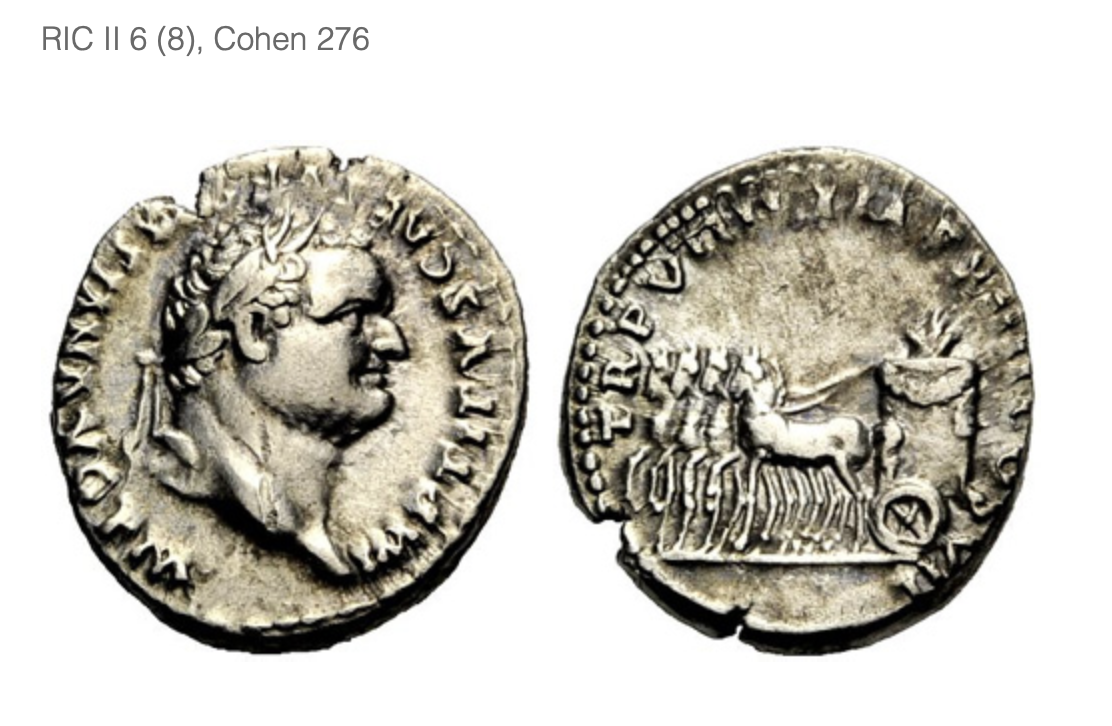
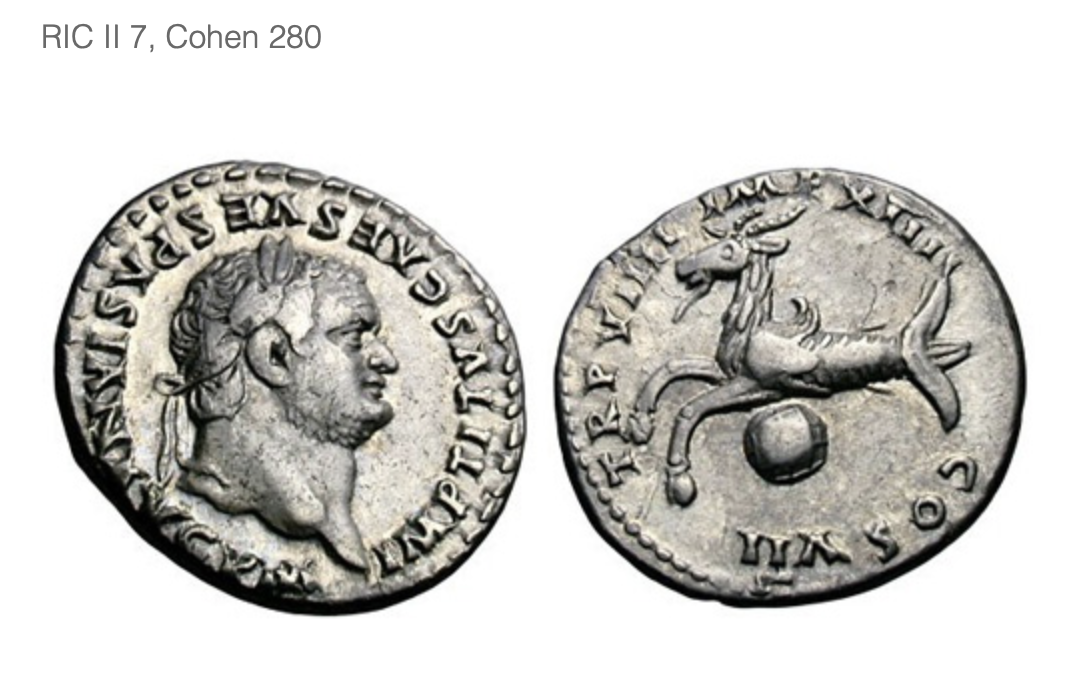
Three denarii of Titus from AD 79–80 (RIC II 1, RIC II 6 and RIC II 7) show the same face on three different dies. The head is round and heavy. The jowl hangs low, with a deep fold beneath the jaw, and the neck is a thick column dropping almost straight from the chin. The nose is short and fleshy, and the brow is creased.
Three denarii of Domitian from his first year as emperor, AD 81 (RIC II 3, RIC II 16 and RIC II 22), show a different man. The neck is long and slender, the face a lean oval with a firm jawline, and the nose longer and straighter—a good match with the authenticated statues of Domitian. On the earliest of them the engraver seems to have leaned on his predecessor’s portrait, as often happens at the start of a reign, but even there the neck is slimmer and the jowl has gone. By the end of the year Domitian’s own type is fixed, with a distinct fringe of locks over the forehead, and it never returns to the heavy build of his brother.
|  |  |
| 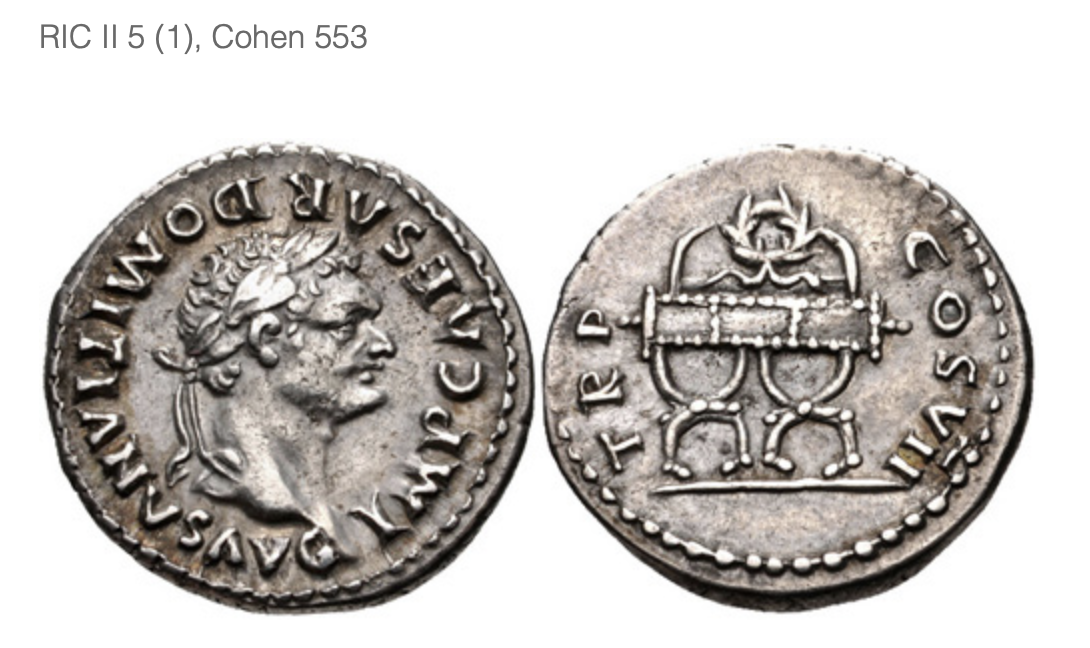 | 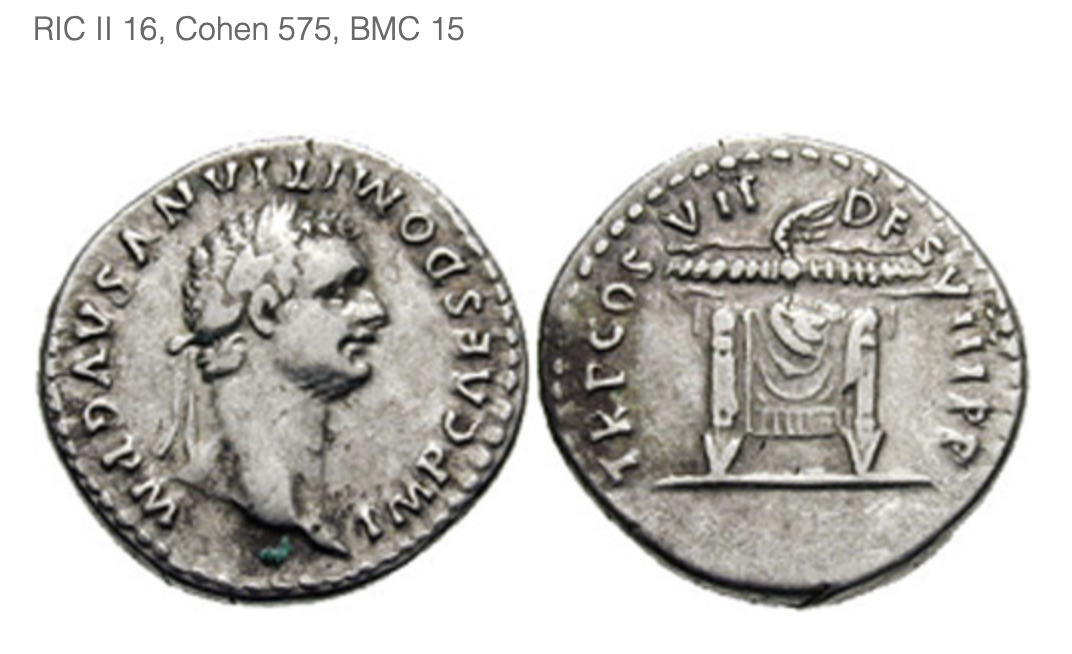 |
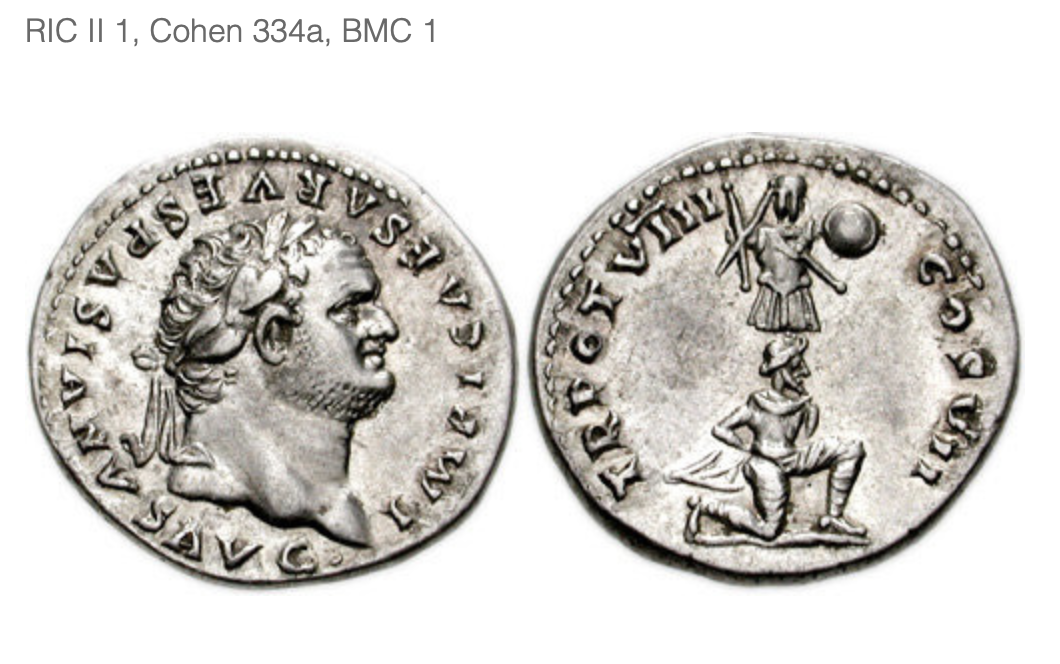
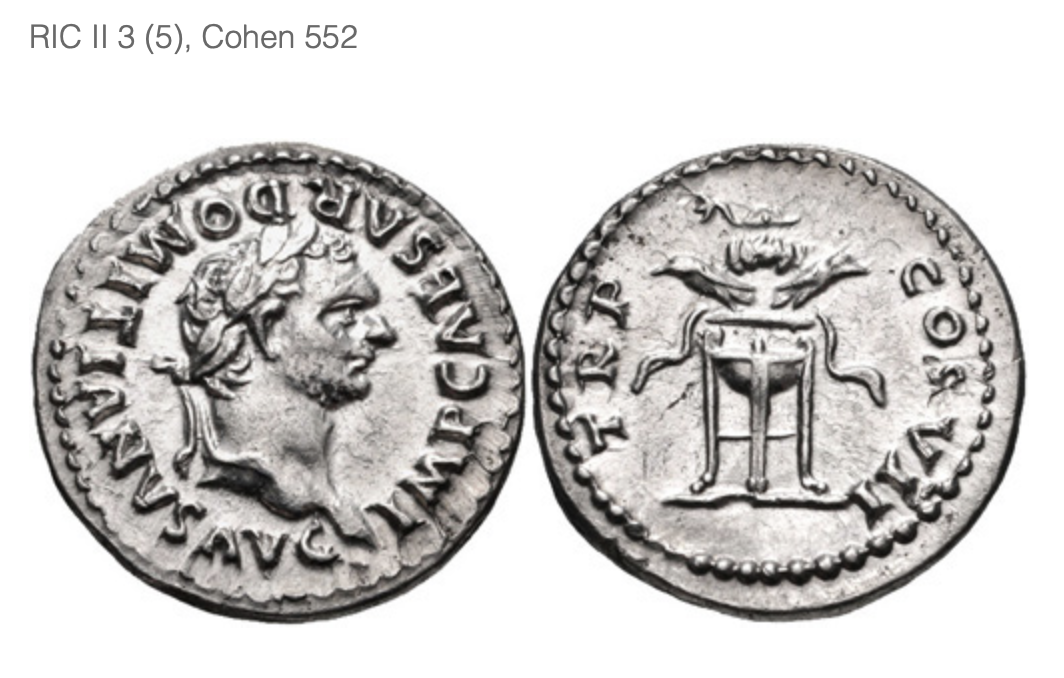
Compared with these, the colossus is unmistakably of Titus. The coins also answer the argument from the hair. Titus’s coin portraits show a dense mass of short curls over the whole head. A sculptor working at three or four times life size, for a viewer several metres below, could easily turn that into the bold corkscrews of the Ephesus head.
The reverses add something too. RIC II 1, struck in the first months of Titus’s reign, shows a Jewish captive kneeling at the foot of a trophy. RIC II 7 shows the Capricorn on a globe, the emblem of Augustus, laying claim to his inheritance and to rule of the world. Domitian’s first issues then continue his brother’s religious series, with the tripod, ravens and dolphin of RIC II 3 and the thunderbolt on the throne of Jupiter of RIC II 16, before Minerva, his own patron goddess, takes over in RIC II 22. Even on his coins, Domitian began his reign as the one who continues Titus’s work and legacy.
The dynasty and the temple
If the statue is Titus, the temple does not become any less imperial. But its centre of gravity shifts, from a living emperor’s self-promotion to a dynasty of gods with Domitian as their heir.
The literary sources make much of the rivalry between the brothers. Suetonius has Domitian complaining that he had been cheated of a share in power under Vespasian’s will, plotting against Titus throughout his reign, and leaving him to die. He adds, pointedly, that once Titus was dead Domitian gave him no honour except deification, and often disparaged him (Domitian 2). Dio hints at something worse (66.26). Yet deification was precisely the honour that mattered. Domitian built the cult of the divi into his whole programme in Rome. The Arch of Titus, with its dedication Divo Tito and its relief of the spoils of Jerusalem, the Porticus Divorum, and the Templum Gentis Flaviae all belong to it. His legitimacy rested on being divi filius and divi frater, son and brother of gods.
A colossal Titus at Ephesus fits that public face rather than the private rivalry. It suggests that in the provinces Domitian’s image was built on the family claim more than on his own person. And because the temple was a provincial initiative, the choice of Titus for a cult image would tell us how the elite of Asia read the emperor’s wishes. That is arguably more revealing than anything Domitian chose for himself.
The identification also makes sense of an absence. If the temple housed a group of Flavian cult statues, a colossal Domitian would have been removed and broken up after 96, when his name was cut from the dedications. Titus could stay. The surviving head need not mean that Domitian was missing from the temple. It might be what remains once he had been taken out, which would make the old name “Temple of Domitian” more misleading still.
Reading Revelation
What difference does this make to Revelation? I think there are three consequences, and they do not all pull in the same direction.
Institutions, not individuals
First, the head can no longer serve as a portrait of Domitian’s megalomania. The older picture of a living tyrant demanding worship and persecuting those who refused has already been dismantled, notably by Leonard Thompson (in The Book of Revelation. Apocalypse and Empire, 1990, which was published just as I started my PhD research). In its place, the work of Simon Price and Steven Friesen has shown imperial cult to be something promoted from below, by provincial and civic elites competing for honour. A colossal Titus, commissioned by the province, fits that account. It also fits Revelation remarkably well. In Rev 13.12–15 it is the second beast, the beast from the land, which forces people to make the image and then enforces its worship. That looks less like a monarch than a priesthood or a local establishment.
This shifts the focus of John’s critique away from a particular emperor and towards a system, and those who sustain it. It is entirely consistent with the way John handles Daniel. Daniel’s beasts are already explicitly kingdoms rather than individual rulers (Dan 7.17, Dan 7.23). John then fuses Daniel’s four beasts into a single composite creature, like a leopard, with the feet of a bear and the mouth of a lion, bearing ten horns (Rev 13.1–2). Four successive empires become one figure of imperial power as such, gathered up in Rome. Rev 17.9–11 does something similar by layering its interpretations. The seven heads are both seven hills and seven kings, and the eighth king “belongs to the seven”. The heads come and go, but the beast persists. The same is true of Babylon in Rev 18, which is judged through the laments of the kings, merchants and seafarers who lived off her. She is a political economy, not a person.
The form of the messages to the churches points the same way. (They are not letters, since the whole of Revelation is the letter: Rev 1.4–5, Rev 22.21). As David Aune showed, they take the form of royal or imperial edicts, opening with tade legei, “thus says”, which is both the formula of a royal decree and the prophetic “thus says the Lord” of the Septuagint. The church in Ephesus lived in the shadow of the province’s new imperial temple. It hears a proclamation from a different sovereign, “the one who holds the seven stars in his right hand” (Rev 2.1), the ruler of the kings of the earth (Rev 1.5), who promises access to the tree of life in the paradise of God (Rev 2.7). The message never mentions imperial cult. Its form already declares who the real emperor is.
The destroyer of the Temple
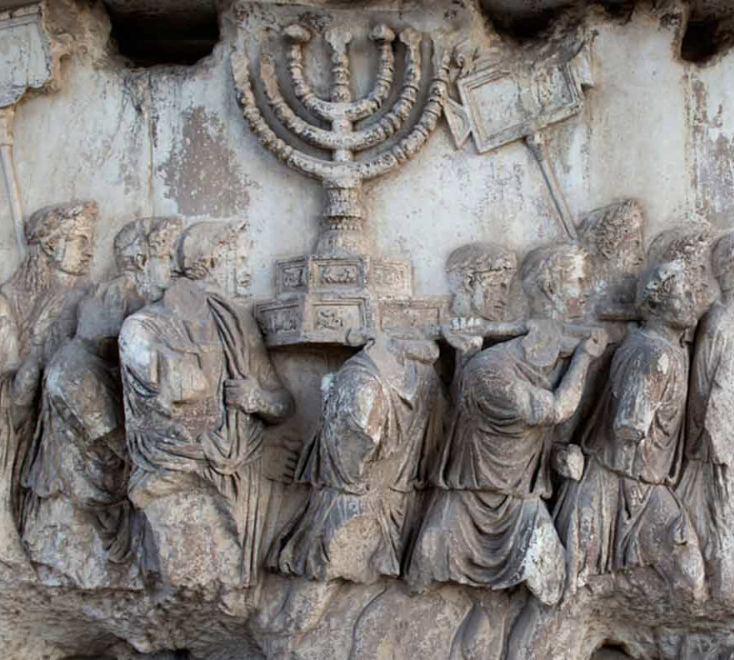 Secondly, a Titus identification gives the image a sharper Jewish edge. Titus was the one who destroyed the Temple in Jerusalem in AD 70. A cult image of him, three or four times life size, worshipped in a new temple in the leading city of Asia, would present the destroyer of God’s house enthroned in a house of his own. For the Jewish community in Ephesus, and for Christians shaped by the Scriptures of Israel, that is a powerfully provocative image. It belongs alongside the Iudaea capta coinage, the spoils carved on the Arch of Titus, and the Jewish tax diverted to Jupiter Capitolinus, which Domitian exacted harshly. It gives concrete colour to the trampling of the holy city in Rev 11.1–2. And it throws into relief the city of Rev 21.22, which has no temple at all, “for its temple is the Lord God the Almighty and the Lamb”.
The ruler who was and is not
Thirdly, a deified Titus resonates with Revelation’s language about a ruler who dies and yet lives. The image is made for “the beast that was wounded by the sword and yet lived” (Rev 13.14). The beast “was, and is not, and is about to come” (Rev 17.8), a parody of the God “who is and who was and who is to come” (Rev 1.4, Rev 1.8, Rev 4.8). The usual background here is Nero, whether the legend of his return or the empire’s recovery from the civil wars of 68–69 under the Flavians. But a cult image of a dead emperor made a god, kept present by his successor, shows the same pattern—Titus ‘lives on’ in his brother Domitian. Imperial power dies and yet continues to claim worship, laying hold of an eternity that belongs to God alone.
None of this means that John ignores individuals. The number of the beast is “the number of a man” (Rev 13.18), and the most persuasive reading still takes it to point to Nero. But Nero functions as a type, the figure in whom the character of the beast was seen most nakedly, and whose pattern recurs: if you want to understand the nature of the Empire, look at Nero. The question becomes not which emperor John had in view, but which pattern of power he was exposing, naming the figure in whom it had shown itself most plainly. None of these things are given to tell us the date of the book; John did not need to tell his readers what chronos they lived in, but what kairos.
Conclusion
I think I have here demonstrated convincingly that the colossal head in Selçuk is better identified as Titus than as Domitian. Its face matches the securely identified portraits of the elder brother and departs from those of the younger in just the features that matter most.
If that is right, the temple at Ephesus emerges more clearly as what its dedications say it was, a provincial cult of a deified dynasty, in which Domitian’s own standing rested on his father and brother. And Revelation’s beasts look less like caricatures of one hated emperor and more like an exposure of the whole apparatus of imperial power, the city that sustained it, and the local elites who made its image and enforced its worship. That, I suspect, is what John was doing all along.
Reflection: on temples and statues
In examining this statue and its location, two things have impressed themselves upon me.
First, as I have previously noted, the equivalent level of income in even the most prosperous region of the Roman Empire was, on average, poorer than the poorest countries in the modern world. In that context, the investment in the lavish building of a temple was a remarkable display of what we would call egomaniacal oppressive control. It is a statement of physical power, and though of course its construction would have created employment for many (though a large number of those would have been slaves), the contrast with the ordinary poverty of life is almost unimaginable.
Secondly, we might have a fascination with the ancient wonders, and might lament the loss of the ones that were destroyed, and the demolition of wonderful buildings. But we only do so because we are detached from their meaning and the role in confirming the dominance of imperial power. When Saddam Hussein was deposed in Iraq, and his statues toppled, no-one was lamenting the loss of art.
A note on the illustration at top
I have attempted, using AI, to imagine the statue in situ in the Temple of the Sebastoi as viewed from the Upper Agora in Ephesus. However, using a free image creator had its limitations! The statue is coloured in the usual way, and holds a spear as it would have done. The pediment, also coloured, includes an image of the Apollo-Leto myth, beloved of Domitian and the narrative behind Revelation 12.
The statue would, in reality, have been further back in the temple, and as we have seen likely been accompanied by another, actually of Domitian! The people in the temple are too small; by my measurement the statue would have been around 6.8 m tall, and the temple columns between 10 and 11 m tall, so the people would be nearly twice the height shown in comparison.
References
- Aune, David E. “The Form and Function of the Proclamations to the Seven Churches (Revelation 2–3).” New Testament Studies 36 (1990), 182–204.
- Bergmann, Marianne, and Paul Zanker. “Damnatio memoriae. Umgearbeitete Nero- und Domitiansporträts.” Jahrbuch des Deutschen Archäologischen Instituts 96 (1981).
- Daltrop, Georg, Ulrich Hausmann and Max Wegner. Die Flavier. Vespasian, Titus, Domitian, Nerva, Julia Titi, Domitilla, Domitia. Das römische Herrscherbild II.1. Berlin, 1966.
- Friesen, Steven J. Twice Neokoros. Ephesus, Asia and the Cult of the Flavian Imperial Family. Leiden, Brill, 1993.
- Friesen, Steven J. Imperial Cults and the Apocalypse of John. Reading Revelation in the Ruins. Oxford, OUP, 2001.
- Price, S. R. F. Rituals and Power. The Roman Imperial Cult in Asia Minor. Cambridge, CUP, 1984.
- Thompson, Leonard L. The Book of Revelation. Apocalypse and Empire. Oxford, OUP, 1990.
- Suetonius, Titus 3; Domitian 2, 18. Dio Cassius 66.26.

“The question becomes not which emperor John had in view, but which pattern of power he was exposing, naming the figure in whom it had shown itself most plainly.”
Is this your main point, Ian? if so, this is a very good way of examining the text of Revelation.
Yes it is. I make that point repeatedly in commenting on the ‘deciphering’ of 666: it is about Nero(n) Caesar, but not about him as an individual, but about his embodiment of all that Empire means.
Hope you enjoyed the exploration!
I did/do. I did not know the head and arm were part of a wooden body. I imagine the colossus of Rhodes was the object of parody in Revelation’s depiction of the mighty Angel. The One on the throne overwrites the popular imagination of the semitransparent ivory clad Zeus Olympia. So, what part of Revelation mocks blockhead and his wooden body?
Zenodorus’s colossal statue of Nero himself will have been the more immediate and relevant parody (or rather fall guy) in Rev 10’s angel bestriding land and sea, because the Nero statue referenced the Rhodes by bestriding land and sea
(probably not also having one arm up and one arm down, which if you read carefully is something the Rhodes statue shares with the angel -but during the period of the Nero’s construction this may have been an informed guess about what its appearance would be).
The second similarity between the Nero and Rev 10 is the shining face,
and the third is the booming voice, as Rev 13 references Vitellius’s priestcraft that fakes a speaking statue, or else projects what would be likely to happen in the future priestly use of the statue.
Note that the entire work is called apocalypsis which means unveiling (as of a statue). There is as in Mark a constant thread that Jesus (whose appearance is laid out just a few verses later) outshoots the emperor (the principle being the revenge, payback and recompense spoken of in Rev 18). As well as having a more magnificent unveiling he also has a more magnificent white horse, a higher status in the league of kings and judgment of nations, a more glorious appearance etc..
Finally the statue reference comes at an apposite point in the review of history (an apocalyptic feature). Of course, the statue of Nero was constructed over quite a period and by the time of the only unveiling we know about, 75, Nero was already persona non grata and his original features had been adapted so that they were now, Dio tells us, ambiguous to the sight as between himself, a Flavian (Vespasian or the similarly round faced Titus) and Sol Invictus or Apollo, but the statue was because of its size already a prominent presence in the years of its construction ie post 64 fire. To construct it anywhere other than the intended resting place of Nero’s domus aurea portico would have been impossible given that it later took 24 elephants to move it to stand by the Colosseum to which (such was the statue’s fame) it gave its name as something even more ‘colossal’. Thus it towered over the Romans in their daily forum visits even while under construction.
The writer (John the Elder) focuses on Rome, though because the martyred John the Apostle had charge specifically of the Asia Minor churches, the focus is on them for the portion of the work that constitutes his testament.
Unveiling a statue is new to me too, thanks. I now see Jesus on the white horse stepping out from a shroud of cloud. Being able to see with the minds’ eye of the first century reader/hearer brings me closer to their world view.
This article is a superb contribution to scholarship, and I look forward to digesting it more fully.
There seems to be a deal of scholarly conjecture here.
Was John just a cultural pamphleteer that we can easily dismiss ?
The experience of the ancient Jews was a national chastening of immense proportions that rid them forever from the scourge of Idol worship in Babylon captivity, completely.
They were called to be a Light to the Nations [In which they failed miserable ]
Jeremiah was singled out to be “a prophet to the Nations;
Much the same as the Church at Pentecost.
They knew that ultimately the idol of the Nations would be shattered with a great shattering.
John may well have the cultural idol of Emperor worship in mind that the kingdom of heaven would shatter that particular iteration.
The cry “ Babylon is fallen”! will sound forth.
We have seen in our own time the toppling of National Dictator statues and images [some notable ones remain]
In the end the Church which is the body of Christ will be Overcomers.
Indeed, we can sing “Jesus we celebrate your Victory”.
We are called to be a Light to the Gentiles.
We are urged not to fall as the Nation of Israel through unbelief in neglecting the Sovereignty of God. Shalom.
‘Was John just a cultural pamphleteer that we can easily dismiss ?
Who is suggesting that? I am not sure how your comment is engaging with the content of the article.
The deification and worship of Roman, pagan occupiers can be seen in the Gospels.
Here is a glimpse, from today:
https://learn.ligonier.org/podcasts/things-unseen-with-sinclair-ferguson/the-turning-point-in-jesus-ministry
Revelation, expands, symbolically and methaphorically on the behind the scenes enormity of King Jesus contrasting everlasting universal victory, through the ignonimity of death, but the glory of his being raised and ascension.
No statues, no graven images of him, as he is enthroned in our lives. His Kingdom rules beyond death, not finite but infinite, eternal.
Did Jesus reference the nations idol in Babylon?
Jesus used rock and stone imagery to describe the fate of those who reject or oppose Him, specifically stating that anyone who stumbles over or is struck by this stone will be broken or crushed. Matthew 21:44: Luke 20:17–18:
This symbolises Christ’s ultimate, inescapable authority and the severe, final judgement of God upon those who actively oppose Him. This might prompt the church to warn men to
“Flee from the Wrath to come”
Fall on the stone or be crushed by it.
For Christ is set for the rise and fall of many.
This is the word of the Lord.
Shalom.
‘Was John just a cultural pamphleteer that we can easily dismiss ?
was a question not a suggestion,
Along with the particular references to Emperor
deification and idols /statues of John’s time [ie what it meant for people at the time]
What does it mean for us today ? was a broadening of the subject.
As to not engaging with the article or question you propose, how often here do people fly off at a tangent ?
I will make this my last click for today.
Now I do think it’s time for a Coffee. Shalom.
Yes perhaps it is. I really welcome debate and discussion here, but your comments don’t seem to engage at all!
That statue may very well have been of Titus, but surely the ‘beast’ in Rev refers to Nero, not Titus. Not only do we have 666 = Nero (John chooses to be very specific rather than speaking generically and expected his Jewish/Greek readers to understand the specific reference) but
‘the beast that was wounded by the sword and yet lived’ fits with Nero who died by suicide using a sword, whilst Titus died after just 2 years in power from an infection. And we know there was a rumour about Nero coming back.
If Nero is the one being emphasized, rather than later emperors such as Titus and Domitian, could that imply an earlier date of writing than the 90s?
Another question, did John’s readers believe from reading Rev that Babylon/Rome (and the empire) was going to be destroyed by God? Clearly that didnt happen, though I suppose one could argue by the 4th century the acceptance of Christianity was Rome’s downfall.
Both Rev and John have immediate and total victory over the powers of darkness in every aspect, finding it unthinkable that there should be even the minutest struggle. This is a distinctive that unites the two.
Even campaigns that sound like they took aeons to prepare are thwarted in less than a second (Rev 20.9).
I think all the recent movement has been in favour of a date comparable to the one Edmundson and Robinson suggested (strong focus on 69, writing in early 70), in that you will not find enthusiastic new papers calling for a 95-96 dating, & will find only that dating, from the textbooks, being still defended, not without arguments. There are of course more than 2 options. Numerous recent authors fall in this ’69’ category, e.g. van Kooten, Journal for the Study of the NT, 2007.
Peter, timescales. Biblical timescale are not to be reduced to one lifetime, one generation, as if all that has to happened will do so within the limits of one’s life so that history begins with my birth and ends on my death.
Haven’t Christian through all ages, era’s looked for expected even, the return of Jesus in their lifetime?
Has it not been said that God has all of eternity in which to answer prayer as he is outside time .
Peter, that is actually my point. As I say in the article:
None of this means that John ignores individuals. The number of the beast is “the number of a man” (Rev 13.18), and the most persuasive reading still takes it to point to Nero. But Nero functions as a type, the figure in whom the character of the beast was seen most nakedly, and whose pattern recurs: if you want to understand the nature of the Empire, look at Nero. The question becomes not which emperor John had in view, but which pattern of power he was exposing, naming the figure in whom it had shown itself most plainly.
‘In that context, the investment in the lavish building of a temple was a remarkable display of what we would call egomaniacal oppressive control.’
On a much lower level, that would explain the recent Republican downfall – seeing $millions being spent on the President’s House while the people struggle to live day-to-day under ever-increasing costs.
Just a thought.
Plus ca change…
…which is why Revelation is always relevant.
That might explain 0.001% of the results
The cost of living was the main reason, brought on by the conflict with Iran and tariffs. But seeing your President spend generously on the White House didnt help.
I’m a little unsure where Ian’s well developed research and reasoning takes us with regard to understanding and interpreting the book of Revelation. But my dullness is too commonplace.
To draw any Revelation inferences from Roman Temples and and their statues and for example the raising the statues, wouldn’t it be necessary for John to have visited (some of) these sites and taken in all that is now being revealed, reasoned over through scholarship.
Maybe John in Revelation is seeing and hearing better and more than he had in first hand reality experienced!
Did John travel with Paul or others in the spread of the gospel and visit these places?
The way Revelation is regularly reckoned the answer would seem to be yes, at least so far as the letters to the churches are concerned. Then there would be cumulative theological extrapolation and symbolic interpretation alongside Old Testament and New Testament allusions
My ignorance is again displayed.
How can John have *not* visited these places? How could anyone have avoided these temples and statues? They were central to every city.
Isn’t that an argument from the specific (as per your research and reasoning) to the general, the environs of gospels and New Testament geography?
Does anyone have any reliable sources to the history of the island of Patmos when John was there, especially temples?
It seems that there were a number of temples at that time dovoted to different gods/godesses/ and emporer.
Is it assumed, or historically correct, that the reason for him being there was his opposition to the cult of emperor.
Where did he travel from before reaching Patmos?
It also seems that after John left Patmos, Ephesus was his destination.
Does anyone have any reliable sources to the history of the island of Patmos when John was there, especially temples?
It seems that there were a number of temples at that time dovoted to different gods/godesses/ and emperor.
Is it assumed, or historically correct, that the reason for him being there was his opposition to the cult of emperor.
Where did he travel from before reaching Patmos?
It also seems that after John left Patmos, Ephesus was his destination.
Have you read Mary Beard’s “Twelve Caesars” on the problems of identifying faces?
No. What does she say?
OK, checked it out.
She highlights lack of labels and findspots, danger of circularity, re-carving, family resemblance, and the two-dimensional nature of coins.
I think I have addressed all those here? I have selected images with reliable provenance, and there is in fact coherence between these statues and the coins.
That makes me feel the conclusion is pretty secure.
(She also makes the point that the identification of the acrolith as eg Titus, and the question of how faithfully its surviving head represents his actual appearance, are related but distinct archaeological questions. I don’t need to prove that this is what Titus looks like, only that people looking at this will have thought this is an image of Titus.)
Do you agree?
As in those days, so in ours.
Human leaders and power wielders have and continue to arrogate divinity to themselves. Each year around November 11th we remember the result.
Emperors, whether called that or not, proclaim power to save.
Antiochus, Caesar, Flavians Hapsburgs, French Revolutionaries, Hohenzollern, Lenin, Stalin, Mao, PolPot, Hitler, Mugabe, Xi, Lee: each proclaimed themselves gods. The result always leads to war, as their idols demand blood and sacrifice.
And their corporate symbol nearly always a woman riding a beast or the sea. A Neriad, Britannia, statue of Liberty, etc.
Great post and discussion identifying the bust as Titus, not Domitian. I agree completely. You do not mention that a statue of Vespasian would also installed in the temple, so the whole Flavian dynasty would then be represented. You cite the equestrian statue of Domitian found at Misenum; however, nude statues of the deified Vespasian and Titus were also found in the same Augustales monument (see Laird, Civic Monuments, p. 157 fig. 62). Titus’ head there could also be used for comparandum. Reading about Domitian, I hadn’t realized that damnatio memoriae didn’t result in the destruction of his statues. Apparently they were too valuable, so they were repurposed as happened to his head changed to Nerva’s at Misenum, which you mention (Laird, p. 157 fig. 64). Thanks again for this stimulating discussion!
thanks Mark. That is very interesting about the Augusta’s—I will look it up.
(See you in Denver)