The General Synod of the Church of England began its next five-year session (‘quinquennium’) yesterday (my fourth, and likely my last), and given the fractious debates that marked the last five years, the question of unity was never far away.
The prayer of Jesus in John 17 was in the background of the Archbishop of Canterbury’s presidential address to General Synod. Sarah Mullally reminded members that Jesus prayed for our unity before he went to the cross, and went on, ‘He did not pray for us to all agree about everything—though he did pray that we would be one’. There is much in the address to welcome, and I will come back to it.
If I was given sixpence every time I heard someone quote John 17.21, ‘…that they might be one…’, then I’d have a lot of change that I wouldn’t know what to do with. The phrase became something like the motto of the twentieth-century ecumenical movement, and in 1995 John Paul II took the title of his encyclical on Christian unity, Ut Unum Sint, from the Latin of this verse. It is commonly suggested that, in this, Jesus’ ‘high priestly prayer’, we see his last desire expressed to his heavenly Father, and that desire is for his people to have visible unity.
We must therefore take this seriously, and make it a priority above other issues since, after all, it was so important to Jesus that it formed his final wish. But does John 17 support the distinction between agreement and oneness in the way that Sarah Mullally suggested?
It is worth looking at the prayer a little more closely, and putting it in its context both in John’s gospel and amongst the gospels as a whole. The prayer forms the climax of the Last Supper discourse in John—but of course John himself mentions no supper, but instead focusses on the washing of the disciples’ feet by Jesus. This reminds us that we need to read John in one hand with the synoptics, and particularly Mark, in the other; the two fill out each other and give each other context. So we read that, after this prayer of John 17, Jesus goes out [to Gethsemane] in John 18.1, but we need to turn to Mark 14.32 to know the name of the place and what happens there.
It is also worth noting from the outset that the longer form of Jesus’ speech in John is not, in itself, a reason to treat the synoptics as more historical, and John more of a theological construction of what Jesus said. Even the speeches in John are relatively short, and all the teaching of Jesus recorded in the synoptics would take mere hours to recite, so we must treat them as (quite possibly reliable) summaries of longer and more extensive teaching.
Turning to the prayer itself, we find many of the earlier themes and ideas in John drawn together. First, we meet the notions of ‘hour’ and ‘glory’; John has from the beginning been interested in days and hours, and in Cana Jesus tells Mary that ‘my hour has not yet come’ (John 2.4) and yet, in the miracle and in anticipation of what is to follow here, ‘Jesus did the first of his signs…and revealed his glory’ (John 2.11). Now he can say, ‘Father, the hour has come; glorify your Son’ (John 17.1), and the glory he asks for is the glory he had with the Father before the world existed (John 17.5).
Then we have the interrelated ideas of life and truth. Eternal life is to know the true God (John 17.3), whom Jesus alone reveals. In the prologue in John 1, we have already been introduced to the light who was life for the world from the beginning of creation. And that light is constantly linked with testimony—of John, of Jesus’ disciples, and of Jesus himself. The idea of the work of the Son being aligned with the work of the Father takes us back to the idea that ‘my Father is always working’ in John 5.17 and that the work demanded of us is faith—believing in what Jesus teaches (John 6.29).
The distinction of the disciples from the world touches on John’s ambiguous theology of ‘world’—it is the object of God’s love (John 3.16) but is also opposed to God and the things of God (John 15.18), so that (paradoxically) to love the world is to hate God (1 John 2.15). This contrast between the disciples and the world reflects Jesus’ own relationship with the world (John 17.16); though the world ‘came into being through him, it did not know him’ (John 1.10) and ‘his own people [both the Jews and all humanity] did not receive him’ (John 1.11). His own ministry and kingdom do not have their origin in the world—that is the real meaning of Jesus’ statement to Pilate in John 18.36, often mistranslated as ‘of this world’ rather than ‘from (ek) this world’, as if the kingdom did not have an impact on earthly structures of power.
Even so, Jesus does not ask the Father to take his disciples out of the world (John 17.15). The question of where Jesus ‘remains’ or stays or abides has been of interest from the disciples’ first encounter, when they ask, ‘Rabbi, where are you staying/abiding?’ (John 1.38). We now learn that Jesus abides in the Father, and we need to abide in him, and that he will no longer abide in this world but is going to the Father. (This idea of movement from the Father’s side, down to the incarnation, and up again back to the Father is neither late nor uniquely Johannine, since we find the same movement in Phil 2.5–11 and in 2 Cor 8.9.)
Now we begin to approach the heart of the prayer, where the statement about unity comes. Jesus’ key concern is for the protection of the disciples in the midst of the world in which they remain but to which they do not belong. ‘Holy Father, keep them in your name’ (John 17.11)—and it is striking that the first mention of unity in the prayer comes here, as the purpose of this keeping, ‘so that they may be one, as we are one’. Unity is first of all something the Father gives as he keeps his people, not something they achieve. Then comes the second request, ‘Make them holy in the truth; your word is truth’ (John 17.17).
The language of truth goes to the heart of a key theme in John; as Andrew Lincoln and Mark Stibbe have pointed out, the whole of John can be understood as a form of trial narrative, with witnesses called to testify to the truth of Jesus’ claims and identity, and the Father even called to the witness stand (John 8.18). That is why the conflict is so sharp with the ‘leaders of the Jews’ in chapters 5 to 8, because they are the prosecuting counsel, and that is why John’s account of the crucifixion naturally includes the extended dialogue with Pilate (conveyed to us by one of the servants there) which is not included in the synoptics.
‘Your word’ here cannot refer to Jesus himself, even within the ‘logos’ Christology of John, not least because Jesus has already talked of the cleansing and sanctifying work of his words, that is, his teaching of truth, in relation to abiding in the vine (John 15.3). To be holy involves remaining in the person and work of Jesus, and remaining in his teaching which reveals the truth about us, God and the world. And this holiness is for the sake of testimony, since Jesus sends them into the world as the Father sent him, and sanctifies himself for their sake ‘so that they too may be made holy in truth’ (John 17.18–19).
It is into this context that Jesus then longs for the unity of his people. And we should notice whom he is praying for. ‘I ask not only on behalf of these, but also on behalf of those who will believe in me through their word’ (John 17.20). Those who come later are joined to the first disciples through the apostolic testimony, so the unity they share is unity with that word, not apart from it. Ernst Käsemann made this point forcefully in his classic study of John 17, The Testament of Jesus, arguing that for John the unity of the church is grounded in the word Jesus has given and cannot be separated from it.
The parallel with the unity between Jesus and the Father cannot be exact, not least with the hindsight we have following the Nicene expressions of our understanding of the Trinity. But John has already shown us what this oneness looks like. When Jesus says ‘I and the Father are one’ (John 10.30), the word is neuter (hen, ‘one thing’) and not masculine, and the context is the shared action of Father and Son in keeping the sheep safe. The Son does nothing on his own, but only what he sees the Father doing (John 5.19); he seeks not his own will but the will of the one who sent him (John 5.30).
So it is about the unity of commitment, will and understanding; just as Jesus does the will and work of the Father, and just as the Father’s testimony is completely unified with the testimony of Jesus, so his disciples are to have that one commitment to true testimony which reveals the truth of God—and which will then lead many who have not themselves been witnesses of Jesus also to believe (John 20.31). And it is a unity with God before it is a unity with one another, since they are to be one ‘in us’ (en hēmin, John 17.21).
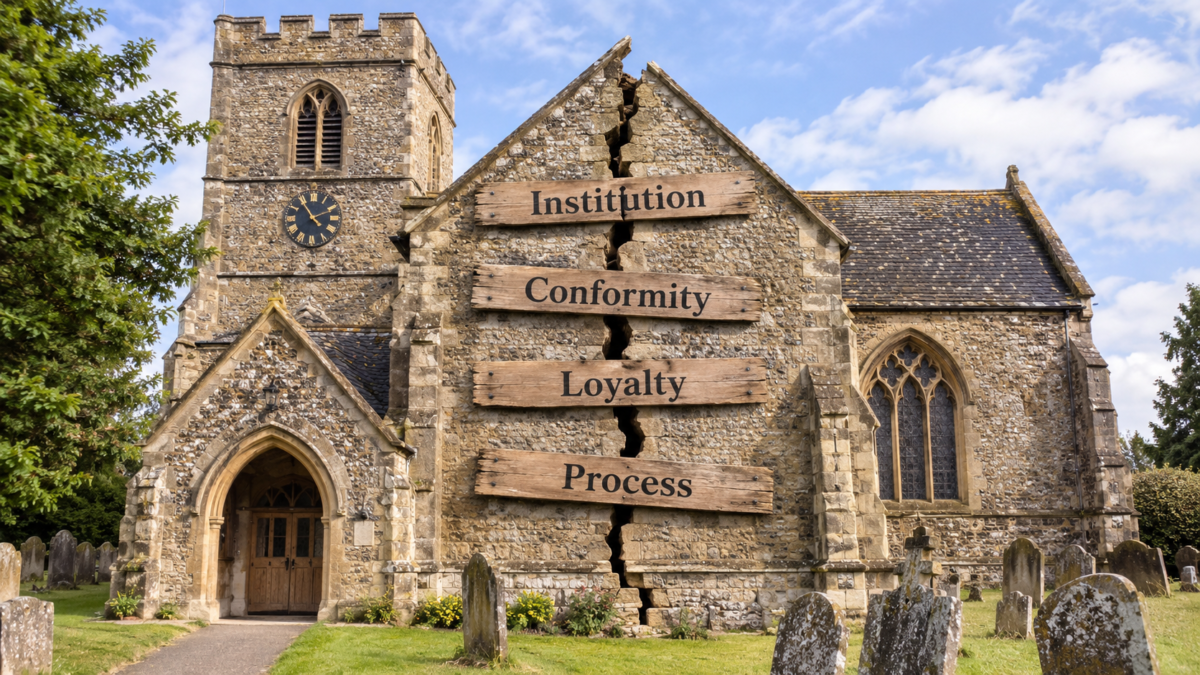
We need to take seriously the purpose of this unity, which the prayer spells out twice. They are to be one ‘so that the world may believe that you sent me’ (John 17.21), and ‘so that the world may know that you sent me and have loved them even as you loved me’ (John 17.23). Those who quote this verse are quite right that the unity Jesus prays for has a missional purpose. But what kind of unity will persuade the world of this? The world is not being invited to admire an institution that manages to hold together, but to believe something true, that the Father has sent the Son. A unity can bear witness to that truth only if it is a unity in that truth. There is no sense here that the unity of the believers in and of itself, disconnected from the truth, plays any role in the conviction of the world.
Two further phrases point the same way. ‘The glory that you have given me I have given them, so that they may be one, as we are one’ (John 17.22); unity depends on a gift, and in John ‘glory’ is the revelation of who God is in Jesus. And Jesus prays that they may be ‘completely one’, literally ‘perfected into one’ (teteleiōmenoi eis hen, John 17.23). The perfect passive participle describes something God does and brings to completion, and so looks forward as well as back. The unity of Jesus’ people is not first of all a matter of our management.
Some will respond that the emphasis here falls on love, and so it does. The world is to know that the Father has loved the disciples as he loved the Son (John 17.23), and the prayer ends with Jesus’ longing ‘that the love with which you have loved me may be in them, and I in them’ (John 17.26). This echoes the new commandment, ‘By this everyone will know that you are my disciples, if you have love for one another’ (John 13.35). But in John love and truth are never set against each other. Love for Jesus is shown in keeping his commandments (John 14.15) and his word (John 14.23), and the elder writes to those he loves ‘in truth’, rejoicing to find them ‘walking in the truth’ (2 John 1–4). To appeal to love as a reason to set truth aside is to pull apart what John holds together.
Jesus finishes the prayer with an inclusio return to the theme of glory (John 17.24), but does so with a unique address to God as ‘righteous Father’ (John 17.25)—only the third time John uses the term ‘righteous’ (after John 5.30 and John 7.24) and the only time in the New Testament that God is described in this way. It fits the trial setting of the whole gospel; the world has not known the Father, but Jesus has, and his disciples have come to know that the Father sent him, and the righteous Father is the judge who will vindicate their testimony.
So Jesus’ prayer for unity is tightly bound with concerns for the truth, for holiness, for the distinctive testimony of his people over against the world to which they do not belong, leading to the revelation of the glory of God and by which, through faithful testimony, many in the world will come to believe that Jesus is the only true revelation of the Father who loves them and draws them to himself.
The Spirit is not named in John 17, but the farewell discourse has already told us how this unity in the truth will be sustained once Jesus has gone. The Spirit is the ‘Spirit of truth’ (John 14.17; John 15.26), who will guide the disciples into all the truth, taking what belongs to Jesus and declaring it to them (John 16.13–15). The Spirit testifies about Jesus, and the disciples testify alongside him (John 15.26–27), so that it is the Spirit who holds Jesus’ people together in the truth.
And of course we find very similar inter-relationships between these concerns elsewhere. In the oft-cited example of the Council of Acts 15, it is striking that the understanding of the new experience of seeing the Spirit poured out on the Gentiles (Acts 15.8) is interpreted by means of discerning God’s purposes in Scripture (Acts 15.15–18, citing Amos 9.11–12), and (most notably for us) is then recognised by all of God’s people in unanimity (Acts 15.25), so that they can say ‘it seemed good to the Holy Spirit and to us’ (Acts 15.28).
The accord with Scripture and the unified reception by the people both attest to the truth of the interpretation. And the agreement they reached concerned both belief and behaviour, since the letter to the Gentile churches set out how they were to live (Acts 15.20; Acts 15.29). Yet Luke does not paint an idealised picture. Within a few verses Paul and Barnabas part company after a sharp disagreement over whether to take John Mark with them (Acts 15.39). The church could be of one mind on the question that touched the gospel, and still disagree, even painfully, on a matter that did not.
And all this brings us back to the Archbishop’s address. Much of what she said about unity is welcome. She is right that unity is a gift of God, received through grace and faith, and not something we manufacture; John 17 bears that out, since the Father keeps his people in his name so that they may be one (John 17.11), and Jesus gives them his glory for the same purpose (John 17.22). She is right, too, that the way Christians handle disagreement is part of our witness. And she is right that Jesus did not pray that we would agree about everything; Paul and Barnabas did not, and the church survived it.
But the contrast between agreeing and being one is not one that John 17 allows us to draw so easily. The disciples for whom Jesus prays are those who ‘have kept your word’ (John 17.6), who have received the words the Father gave him and ‘have believed that you sent me’ (John 17.8), and those who come after them believe ‘through their word’ (John 17.20). The faith through which unity is given always has content in John; it is believing that something is true. And the holiness Jesus prays for takes shape in how we live, since those who love him keep his commandments (John 14.15).
So the oneness of John 17 is a unity in belief and in behaviour, held together in love. That does not mean agreeing about everything, but it does mean agreeing about some things—and the question the Church of England has not yet settled is which things those are. Acts 15 gives us a pointer, since the church there reached one mind on both what God had done and how believers should then live.
I doubt that the Archbishop would want to say that unity has no connection with what we believe or how we live. But language that sets oneness against agreement, without saying where agreement matters, is in danger of being heard that way. And it leaves Synod without the very help it most needs from this passage. Earlier in the ‘farewell discourse’, Jesus says:
As the Father has loved me, so have I loved you. Now remain in my love. 10 If you keep my commands, you will remain in my love, just as I have kept my Father’s commands and remain in his love…You are my friends if you do what I command. (John 15.9-10, 14)
Love, friendship, intimacy, and obedience belong together, and in the teaching of Jesus, and in our lives as his followers, these cannot be separated.
Perhaps this is an object lesson in the dangers of the ‘memory verse’ approach to reading Scripture, by which we isolate one phrase from its immediate and wider context, and so lose important elements which it needs in order to be understood properly.
The Church of England needs to hold together unity with obedience, the friendship of Jesus with a readiness to obey his commands, if our unity is to actually endure the challenges of the next five years.