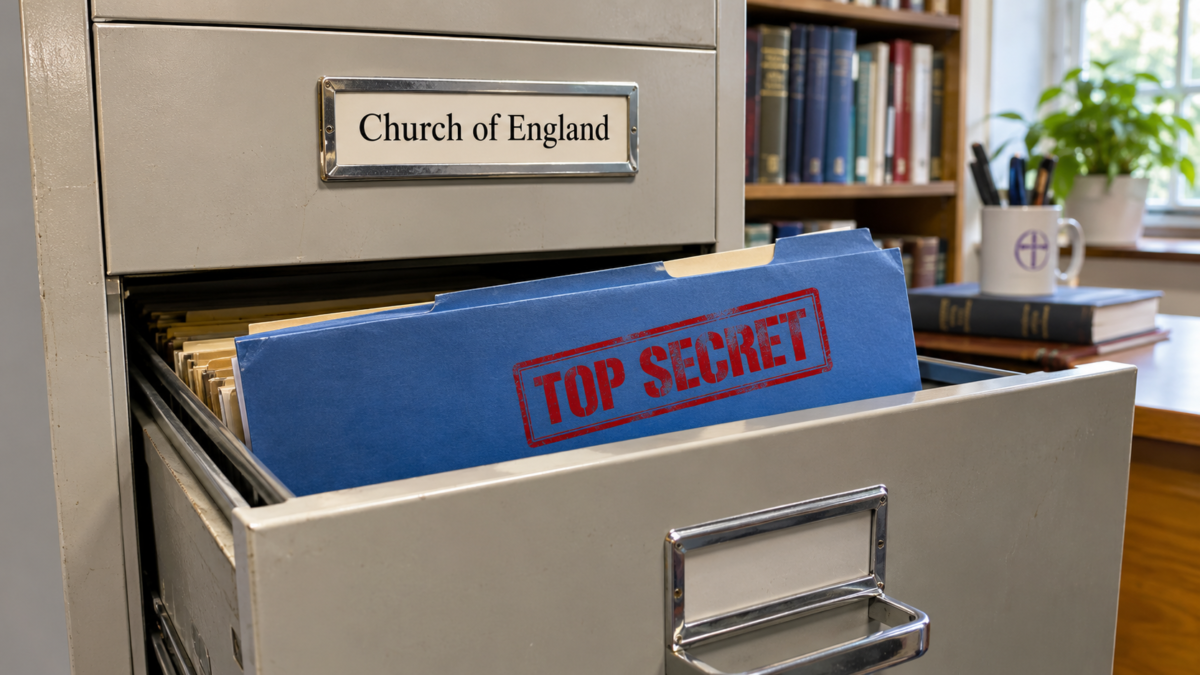
If you are ordained in the Church of England, there is a file about you. It sits in your bishop’s office, usually in a blue card folder. It will follow you from diocese to diocese for the whole of your ministry, and it will be kept for 75 years after you die.
So, if you are a cleric, a few questions for you:
- Have you ever seen your blue file?
- Do you know what is in it?
- Has anyone ever told you when something was added to it?
- Have you ever been asked for your side of the story before a note about you went in?
- Were you given a privacy notice when you arrived in your diocese, and did you read it?
- Were you asked for your views when the rules governing the file were rewritten?
I suspect that for most clergy the answer to every one of these is no. And the rules have just been rewritten. In June 2026 the House of Bishops approved a new Clergy File Policy (version 4.3), with Policy Guidance, practical guidance and ten appendices of templates. Together they run to more than 60 pages, and they are now on the Church of England website.
I have been reading it carefully. Every cleric should know what it says, because it governs what is said about them, who gets to read it, and for how long.
What is in it
The Guidance lists the “mandatory” documents, which “must be retained on the file for the life of the file and never removed”. Where they exist, these include:
- your date of birth, a copy of your birth certificate or passport, and evidence of any divorce;
- a full CV since leaving school, with explanations for any gaps;
- your selection papers and references from before ordination;
- applications, references and Clergy Current Status Letters (CCSLs) for every post you have held;
- your ministerial development reviews;
- records of sickness absence, ill health and occupational health reports;
- records of leave, including maternity, paternity and adoption leave;
- a record of any financial problems, resolved or unresolved, and any discretionary grants over £100;
- housing records, including any eviction notices;
- capability and grievance records;
- for any informal complaint, the complaint itself, witness statements, your answer “if any”, and the bishop’s decision;
- every formal complaint under the Clergy Discipline Measure, in a sealed envelope, whatever the outcome;
- safeguarding file notes, DBS details and training records;
- a summary of any settlement agreement.
On top of that, a “File Note” can be made of “any interchange or behaviour which may be relevant to the ministry, wellbeing or conduct of the cleric”. It is hard to think of anything that would fall outside that. For example, there is an explicit reference (p 4) to the care that should be taken when recording details of family members or household.
Five files in one folder
The reason the policy is so long and so complicated is that the blue file is trying to be several quite different records at once. It appears to me to be all of these (I speak with some experience as a former personnel manager, though of long ago):
- an HR personnel file, covering appointments, terms of service, capability, grievance and health;
- a pastoral record, covering wellbeing, counselling, bereavement, money and housing;
- a disciplinary court record, holding CDM papers and Return to Ministry reports;
- a safeguarding record, holding allegations, DBS checks and training;
- a canonical record of your orders, from selection to Letters of Orders to any relinquishment.
(For bishops and deans it is also a historical archive, kept permanently.)
Each of these has its own law and its own proper rules about who may see what, and for how long. Because the policy insists on a single file per cleric, it manages the differences with a system of sealed envelopes, each with different rules about who may open it. The envelopes are a sign of the problem: blue files hold together things that do not belong together.
Two features of clergy life make it more complicated still. Clergy have no employer, so each bishop is a separate data controller, and the file is the only thing that travels with you. And orders are for life, so there is no natural end date, as there is when someone leaves a job. Retention is therefore pegged to your death, and almost everything accumulates for the whole of your ministry.
Inconsistencies and errors
This is a document telling bishops how to handle the most sensitive information about people’s lives. You might expect it to be carefully checked. In several places the different parts of it contradict each other.
- Confidential references sent abroad. The Guidance says CCSLs “can be sent outside the UK without informing the data subject of any safeguards” (p 22). The model privacy notice, which goes to clergy, says they “cannot be sent outside the UK without informing the data subject of any safeguards” (p 62). One of them is wrong.
- Subject access to CDM papers. The Policy says these “must not” be included in a subject access request “unless the Data Controller chooses” (p 10). The Guidance says they should not be disclosed “without obtaining appropriate legal advice”, and admits that which exemption applies “will depend on the given circumstances” (p 5).
- Untested misconduct allegations. The Policy keeps old “Part 2” pastoral discipline records only if they contain “proven evidence of misconduct” or led to proceedings (p 11). The Guidance says “Part 2 misconduct” records must be kept “whether formal proceedings have been instigated or not”, sealed and treated like formal complaints (p 8).
- Capability records. The Policy says records of capability proceedings should be destroyed once the cleric leaves the post (Policy, p. 8). The mandatory list keeps a “record of how capability issues have arisen and been addressed” for the life of the file (Guidance, p. 13). It never says how the two relate, or what survives the destruction.
- The data protection complaints procedure. The Guidance calls a link to it “optional” in the same sentence in which it calls it “a statutory requirement” (Guidance, p 5).
There are also problems with the law as stated:
- the Policy claims CDM data is exempt from Article 5 of the UK GDPR, when the statutory exemption covers Article 5 only so far as it matches the individual rights, and does not switch off accuracy, storage limitation or security;
- the exemption relied on (Data Protection Act 2018, Schedule 2, para 14) concerns judicial proceedings, and part of it depends on likely prejudice, which is hard to show once a case is over, and impossible where nothing was ever brought;
- the privacy notice cites “contract” as a lawful basis, though most clergy are office holders without a contract of employment.
And there is a lot of simple carelessness:
- there are two paragraphs numbered 73;
- paragraph 55 refers to the capability paragraphs as 22 to 25, when they are 20 to 23;
- the Guidance gives the definitions as paragraphs “10 and 11” in one place (p 3) and “9 and 10” in another (p 20), when they are actually 12 and 13;
- file note templates are said to be in Appendices 5 and 6, though Appendix 5 is a checklist; and
- a document approved in June 2026 says that “in 2025 a pilot programme is underway” (p 20).
(There is also irritating grammatical carelessness. “This Policy is applicable to, and must be followed by, all parties who hold and are responsible for Clergy Files, for instance: archbishops and bishops.” Not “for instance” but “that is to say” as there are no others.)
None of these is a scandal on its own. But together they tell you how carefully the text was checked before the House of Bishops approved it—and how carefully users themselves have read it.
Strengths and weaknesses
It is worth saying first why a policy like this matters. The Independent Inquiry into Child Sexual Abuse heard repeatedly about clergy files that were incomplete, scattered, or quietly cleaned before being passed on. Some of the Church’s worst failures happened because one bishop did not know what another bishop knew. A consistent national policy is a good thing in principle.
Strengths
The policy does several things well:
- it aims at consistent practice across 42 dioceses, where before there was a great deal of variation;
- it says clearly that unsuccessful job applications, and criminal records that have been “filtered” under the rehabilitation rules, must not be kept;
- it marks genuine legal obligations in blue boxes, separating them from advice, which is a good idea;
- it keeps CDM papers away from auditors and independent reviewers, which protects due process;
- its practical guidance on security, file notes, cross-referencing and the safe transfer of files is sensible and usable;
- it recognises that the move between dioceses is where files go missing or get stripped, and builds checklists around it.
Weaknesses
But the weaknesses are serious:
- the alphabetical structure scatters the rules on complaints across six different headings, so the question that matters most to clergy is the hardest to answer;
- it uses “must” both for legal duties and for mere expectations, so a cleric cannot easily tell which of the bishop’s obligations are actually binding;
- it claims data protection exemptions more widely than the law appears to allow; and
- its retention rule is grossly disproportionate.
That last point needs spelling out. The retention period of 75 years begins at “permanent end of ministry”, which is defined as death, or relinquishment or lifelong prohibition where no return is practically possible. Retirement does not count. So your overdraft note, your divorce papers, your sick leave and a complaint against you that was dismissed are all carried from parish to parish for the whole of your ministry, then kept for three generations after your funeral.
The justification given is the IICSA recommendation. But that recommendation concerned records of child sexual abuse allegations, not a person’s entire employment and pastoral history. Stretching it to cover everything is hard to reconcile with the data protection principles of minimisation and storage limitation.
How it compares with an ordinary employee
The contrast with an ordinary employer is striking:
| Typical employer | Clergy File Policy | |
| Who holds the file | HR department | The bishop personally, who is also pastor, judge and referee |
| Does it move with you? | No; a new employer gets a reference | Yes; the whole file goes to the next diocese |
| Disciplinary warnings | Usually expire and are disregarded | Formal and informal complaints kept for life, whatever the outcome |
| Health records | Held separately, need to know | Held in the main file, all mandatory |
| Retention | Usually about six years after leaving | 75 years after death |
Clergy are not ordinary employees, and some portability and longer retention of safeguarding material is justified. But it is hard to see why a bishop in Carlisle needs to know about a curate’s overdraft in Truro thirty years earlier.
Complaints, information and appeal
The deepest problem with the policy is not what it keeps, but what it gives the cleric in return. The answer, in short, is almost nothing.
Vexatious complaints
The Clergy Discipline Measure has a process of preliminary scrutiny, designed to weed out complaints that are trivial, vexatious or malicious. The file policy then undoes much of that protection. Consider what happens to a complaint against you that goes nowhere:
- a formal complaint that was dismissed is kept in a sealed envelope for the life of the file (the worked example in the Guidance is an envelope labelled “Dismissed”);
- an informal complaint must be recorded, with the complaint itself and any witness statements, and kept permanently, subject only to the bishop’s judgement about “very minor” matters;
- there is no category for a complaint found to be malicious, and no provision to remove one;
- the Guidance wants everything kept together so that the bishop reviewing the file for a CCSL can “see everything in one place”.
So an unfounded allegation remains in view of every future bishop who writes a CCSL about you. And you cannot see the CCSL, because confidential references are exempt from subject access.
There is a genuine point on the other side. Safeguarding practice rightly says that concerns which are not proven should not simply vanish, since patterns matter. But other sectors have found a middle way, and the Church has not.
Information
The policy contains no requirement:
- to tell you when a file note or complaint is added to your file;
- to give you a copy of it; or
- to seek your response before it is filed.
The Guidance lists your answer to an informal complaint as something to keep “if any”, which assumes you might never have been asked, or if asked, might not have replied. The only checking the policy invites you to do is updating your contact details.
Your route to finding out what is held is a subject access request. But the material that matters most (CDM papers, “Part 2 misconduct” records, CCSLs and references) is declared exempt. Untested allegations that never went near a tribunal end up sealed alongside judicial papers, and so out of your sight.
I have asked a group of fellow clergy whether they have ever seen their file, ever been informed about it, or ever been consulted on any of its content. Not one person had done any of these. In fact, one of them pointed out that asking to see your Blue File might be interpreted as a cause for concern—and noted in your Blue File. One person requested to see their file, but was strongly discouraged from doing so, and relented.
Appeal and right of reply
There is no mechanism in the policy for you:
- to add your own statement to a note about you, so that it travels with the note;
- to have the outcome of a complaint recorded as unfounded or malicious, rather than simply “dismissed”;
- to challenge what is on your file before anyone other than the bishop who holds it.
Your data protection rights (rectification, restriction, objection) help with factual errors. They do little for a fair but one-sided record of someone else’s opinion. A complaint about how your data is handled goes first to the bishop, who is the data controller, and then to the Information Commissioner. There is nothing in between.
What schools already do
The contrast with statutory guidance for schools is telling. Paragraph 98 of the policy, on safeguarding records, closely echoes the wording of Keeping Children Safe in Education. But it leaves out the protections that guidance gives to the person accused. In schools:
- the summary of an allegation kept on file is given to the person concerned, where children’s social care or the police agree;
- allegations found to be malicious or false are removed from personnel records, unless the person consents to them being kept;
- unsubstantiated, unfounded or malicious allegations are not referred to in references.
The Church seems to have borrowed the duty to record but left behind the safeguards for the accused.
How it was made
So who decided all this, and how? The document names the House of Bishops as both the approving body and the owner of the policy. Its seven named authors appear to be a mix of national church staff and people from bishops’ offices. There is no name from the House of Bishops who has taken responsibility for this.
As far as the public record shows, the route was this:
- in March 2024 the House discussed a draft privacy notice for clergy blue files, at a confidential meeting whose summary was later published;
- in October 2024 the House received an update on the new policy, framed around safeguarding, safer recruitment and record keeping;
- the policy was then trialled from July to December 2025;
- the policy’s own revision history records amendments from the House’s May 2026 meeting;
- the House approved the final version in June 2026, and it was posted online some months later.
Notice what is missing. It never went to General Synod. It is House of Bishops policy, not legislation, and not a statutory code of the kind that governs discipline or safeguarding. Yet it says it “must be followed by” all file holders, and it shapes the rights of every cleric in the Church.
The House’s deliberations were largely private. The public summary of the May 2026 meeting does not mention clergy files at all. The agenda was published, but not the papers.
And I can find no evidence that clergy themselves were consulted. Perhaps the House of Clergy, or the clergy section of Unite, or clergy more widely were asked their views, and it simply was not published. If so, it would be good to know. The “feedback from trial period” mentioned in the revision history appears to have come from those who hold the files.
So the people who hold the files wrote the rules about the files, and approved them in private. The people the files are about appear to have had no formal voice. That goes a long way to explaining why the policy is so thorough about what bishops must keep, and so thin about what clergy may see and challenge.
There is a deep irony here. At the same May 2026 meeting, the House discussed research on “trust and trustworthiness in the Church of England” and an item on “strengthening accountability for Bishops and clergy”. Accountability is meant to run in both directions.
I think I need to add a comment of personal reflection here. When I went through this document—and took help and advice from others—I sincerely hoped I was wrong. If I have missed something here, do please, dear reader, feel free to correct me.
But what I cannot avoid concluding is that this is the product of an institution that still does not understand the primary issue of trust, which does not put the welfare of clergy at the centre of its policies, and still largely fails to have its leaders act as good shepherds to the shepherds of the flock. The primary concern here is not the well-being of clergy, but the protection of the institution.
I saw exactly the same in the campaign to restore the clergy pension and stipend; despite widespread support in Synod, not one single bishop has ever offered any help in implementing the changes. In fact one archbishop approached me candidly to say ‘Thank you for your work; I have done nothing about this.’ I simply replied ‘I know.’
I struggle to understand why this is so difficult. It is about basic pastoral care.
What needs to change
None of this requires the Church to choose between safeguarding and fairness. Schools, hospitals and employers manage both. If the House of Bishops wants a process that clergy can trust, the changes needed are clear.
- Tell clergy what is held. Every cleric should receive the privacy notice and a plain summary of what their file contains, with a standing offer to view everything that is not genuinely exempt.
- Notify and copy. Any file note about conduct, or any complaint, should be shared with the cleric within a set time, as schools already do.
- Give a right of reply. Clergy should be able to attach their own statement to any note about them, and that statement should travel with it.
- Record outcomes honestly. Allegations should be marked as substantiated, unsubstantiated, unfounded or malicious; malicious ones should be removed, and unfounded ones should not shape a CCSL.
- Make retention proportionate. Safeguarding records can follow the IICSA recommendation, but HR, financial and pastoral material should expire after a set period, as it does for everyone else.
- Stop treating untested allegations as judicial records. Data protection exemptions should be applied case by case, as the law requires, and “Part 2 misconduct” material should never be sealed from the person it concerns.
- Provide an independent route of challenge. Clergy need somewhere to contest what is on their file other than the bishop who holds it;
- Fix the errors. Above all, the contradictions in the privacy notice that has already gone out to clergy.
- Consult properly. A revised policy should be published in draft, put to the House of Clergy and to clergy representatives, and ideally brought to General Synod, with its data protection impact assessment made public.
- Align it with the Clergy Conduct Measure. The Guidance itself admits its complaints section will need revising when the new Measure comes into force, which is the obvious moment to do all of the above.
The blue file exists, rightly, so that the Church never again fails to pass on what it knows about a risk to others. But a file that a cleric cannot see, cannot answer and cannot challenge, that records every accusation whatever its outcome, and that follows them to the grave and beyond, does not build trust. It builds fear.
If you are ordained, ask your bishop’s office for a copy of the privacy notice, and consider making a subject access request for your own file—or simply asked to view it. You might be surprised at what you find. And if you are a member of General Synod, ask the House of Bishops who was consulted, and why clergy were not.
The Clergy File Policy and Guidance 2026 and its appendices can be downloaded from the Church of England website.




Somewhere in Bishop Patricks office is an extra large blue folder (or maybe multiple folders, likely a whole cabinet) containing physical printouts of every article, comment and Facebook post on Psephizo. 🙂
In all seriousness, this is very strange. I think you probably are right to be worried, and to want some clarifications.
It would frustrate me immensely if the Baptist Union’s system mirrored this, and though I strongly suspect it doesn’t (Baptists are historically the very opposite of deferential, and would likely have kicked up a huge storm if the BU wasn’t allowing right of response, and made life difficult for the associations) I have nevertheless been motivated to check. I’m interested in how we compare.
Mat – they keep a record of the number of people who fell asleep during your sermons …..
Not enough paper in the world. ^^
Is this why they are setting up data centres everywhere?
Funnily enough, in the early days I did print out my articles and filed them in a folder. I have NO idea why I thought there was any point to that.
I remember the BBC’s Robin Day – a fearsome interviewer at the time – saying to a politician, “You said at the Brighton Conference – AND DON’T TRY TO DENY IT!” So maybe we SHOULD keep everything!
Keeping them (your writings) is a record of what you have produced in case you need to refer to them for consistency or you might need to explain a change of heart.
You certainly have researched the subject of clergy records very thoroughly; it will be interesting to see what the Bishops do about it. Maybe the issue should lead to creating a HR department to help consistency across the Church of England? (It would take a load off the Bishops and hopefully clarify what their role is in the structures.)
(Personally, I think the House of Lords should be abolished with instead an increase in the number of MPs, each of whom would need to have lived in the constituency for at least five years prior to an election.)
But my server keeps a record of them all…
But my server keeps a record of them all…
You should not assume that anything you store on a disk that you do not personally own will remain accessible to you (or, for that matter, anything you store on a disk that you do personally own but that is not backed up).
You don’t to store on paper, but you must, absolutely must, ensure that you have at least two copies (and preferably also a third at a separate location) under your own control at all times.
Under gdpr , one has the right to see the file.
I wonder if clergy should do this more and more, so that asking becomes not a thing anymore.
“Please bring my blue file with you to my annual review.”
But according to C of E policy, you do not have the right to see all of it. And you have no right of reply to any of it, as far as I can see…
But compelling dioceses to disclose additions, perhaps on an annual basis, might be good.
As a “Retired with PTO “…. what’s this Diocesan annual review?
Only retired for 11+ plus years… so maybe a tad early.. It’s not as if those with PTO do much in the National scene..
Good question, Ian. However, you should have an annual review with your ‘Designated Responsible Person’, usually an incumbent in the PTO Diocese.
I suspect that is rare. Our MDRs are only every two years—for licensed clergy.
Doesn’t gdpr only apply to public bodies?
No, GDPR applies to pretty much all organisations. Public bodies are subject to more stringent requirements regarding paper records than are other organisations, but the basic rules apply to everything from the corner shop to the National Trust.
It’s a vexatious complainant paradise, and quite a few people know this.
…and many of us have experienced it…
Are you listening to the “Archers ” currently? It’s the hot topic.
So sorry to read this, but I certainly can relate.
A wise colleague once pointed out to me that under GDPR the transfer of the blue file has to be consented to when clergy move diocese, so when I moved some years ago, and they asked permission, I said ‘I cannot give consent without knowing the contents’ – and they allowed me to go and collect a copy of the whole thing. There were frightening things in it (eg a grumpy retired GP writing to my then Bishop saying I was displaying lots of signs of mental illness). Interestingly, with my more recent move, they didn’t ask for permission again…
Were you given the right of reply to any of it?
No – but I didn’t pursue it either
I’m not sure your colleague, wise though they may be, was correct.
Consent is not the only legal basis organisations have to share data with one another, and I’d be very surprised if dioceses were actually relying on it for this. I’d be looking at Legitimate Interest or Public Task for Article 6 and Substantial Public Interest (safeguarding of children and adults at risk) for Article 9. I suspect, however, that the data retained would fall foul of the requirement to keep only data that is necessary for the stated purpose and for as long as it is needed.
If Fr Ian’s analysis above is correct it looks like the Bishops have attempted to dress their existing processes in GDPR finery without checking whether the clothes actually fit. They are not doing “privacy by design”.
So much I agree with and this one most of all…’But what I cannot avoid concluding is that this is the product of an institution that still does not understand the primary issue of trust, which does not put the welfare of clergy at the centre of its policies, and still largely fails to have its leaders act as good shepherds to the shepherds of the flock. The primary concern here is not the well-being of clergy, but the protection of the institution’ Amen amen amen!
Well, I felt this was all a bit depressing—so I would love for anyone to prove I am wrong here…
“ At the […] May 2026 meeting, the House discussed research on “trust and trustworthiness in the Church of England” and an item on “strengthening accountability for Bishops and clergy”. Accountability is meant to run in both directions.”
The HoB is meeting next month on Zoom and, as is my right under the Standing Orders, I have requested a link. Anyone else fancy joining?
Secretive. Providing a secret service.
Undershepherds , unlike Jesus.
Other than that, the system flouts the rules of natural justice.
Here is an overview:
https://lawbhoomi.com/principles-of-natural-justice/
“But what I cannot avoid concluding is that this is the product of an institution that still does not understand the primary issue of trust, which does not put the welfare of clergy at the centre of its policies, and still largely fails to have its leaders act as good shepherds to the shepherds of the flock. The primary concern here is not the well-being of clergy, but the protection of the institution.”
Just depressing. But thank you for the analysis.
Ian – you ask if CEECA (‘clergy section of Unite’) were consulted in the review. As far as I’m aware (I’m no longer on the CEECA committee now I’m retired) the answer is No. We should have been.
Back in 2016 when I was chair we did some work on Blue Files and I can assure you that as a Union we’re very aware they exist and also of the limitations on rights of access and reply. Personally I think this is as important in its own realm for clergy as the Pensions and Stipends review you also successfully initiated.
As a Union Rep I often see too much of the sharp end of clergy life – but vexatious complaints mishandled and the absence of any effective right of reply in many proper processes (not least Safeguarding) are one of things that make the job increasingly unattractive across the board.
And maybe also why the number of clergy joining CEECA (net gain, not just joiners) averages 17 every month over the past year and over 20 a month in the past 5 years.
Thanks Peter. I worried as much.
Why didn’t anyone ask?
If you mean ‘ask about the emerging new guidance’ I’m not sure we knew enough yo know to ask. But I’m assured by colleagues still in regular conversation with the CoE central bodies that whilst general concerns have been raised and ‘noted’ but there has been no substantive response.
‘I think this is as important in its own realm for clergy as the Pensions and Stipends review you also successfully initiated.’
Me too …
Thank you, Ian.
How does the file ‘travel’ when clergy move from being an office holder in parish ministry to a salaried post with a contract of employment in other than a diocesan context? Does the job-holder then come under the UK’s employment legislation? Would their change in status enable them to have proper access to their file?
Thinking out aloud, I wonder how our sisters and brothers in Christ in holy orders in the Evangelische Kirche in Mitteldeutschland would respond if their records were similarly maintained.
The person would still have a licence, so the file would travel to the diocese in which the licence (or PTO) is held.
Thank you, Ian,
Would that mean notwithstanding that they would then be ’employed’ that the usual laws of employment would not apply to them accessing this data?
I’m pointing our three clergy GS members to your post.
Ian Paul – were you aware of these blue files before you decided on the C. of E. for your ministry? If so, then why the C. of E.?
No, of course not.
Because the C of E is a Reformed Protestant church where the Bible is the final authority, and where worship is (rightly) liturgical.
…. because the whole business of secret blue files is something that directly contradicts basic Christian values (openness and honesty, fair play) – and means that proclaiming the gospel is seriously hampered.
Actually, it does look like the beginning of a John LeCarre novel – the bishop gets the goods on the clergy, has it all written down in a nice blue file – and can use it for blackmail, if convenient.
Then the Church needs another reformation…!
It’s coming. It’s called persecution. It wil be Jesus, not sleeeping on the job but purifying his bride – tipping the nominal believers off the fence and getting rid of the liberal heretics. What will survive of the Church of England is up to God.
I can only repeat that at the Unite The Kingdom carol service last year, the presenters reeled off a list as long as your arm of denominations they recommended; and if there were any they did not recommend, they mentioned only one: the national church, to whom the optics of associating with this working class movement carrying out a peaceful normal carol service were just too much, and it was (smelling salts!) a priority to position themselves in opposition to them by active demonstration. However, this was not the national church per se but just some of its vocal liberal activists, some in high places (hence the platform perspective was justified) who remain disproportionately vocal.
They did not list denominations for the sake of giving a list of who was U and who was non-U, but for the reason that they wanted participants to go to church if they were not doing so already, and were listing recommendations.
I can attest that such a scenario is quite common.
Working for the NHS for many decades a similar file was kept In the closet on all medics;
who compiled it, what it contained and who had access to its content, how it was exploited God alone knows .
It was ever thus, and will be ever thus.
Therefore whatsoever ye have spoken in darkness shall be heard in the light; and that which ye have spoken in the ear in closets shall be proclaimed upon the housetops. Luke 12:3
The light of the body is the eye: therefore when thine eye is single, thy whole body also is full of light; but when thine eye is evil, thy body also is full of darkness. Luke 11:34.
Luke 11:35 Take heed therefore that the light which is in thee be not darkness.
“They have more to be afraid of than the Servants/Children of Light who walk in the
Light . Justice is coming down the pipe, this is our heritage.
Shalom.
Thanks Ian, although a genuinely disturbing read. Yet again, I read something that reinforces my sense of relief at being retired. The thought that my entire blue file will still be ‘current’ some time in the 22nd century feels like a plot device from the kind of science fiction I enjoy reading. It’s also a bit ridiculous.
A close clergy friend accepted a post without being told anything about the dreadful bullying suffered by the previous incumbent; they were forced to leave within a few months after undergoing similar treatment. The Archdeacon concerned then compounded the pain by including unsubstantiated and borderline libellous accusations from the perpetrators of the bullying in their reference for another post, where an offer of the post was withdrawn as a result. Happily it was reinstated later once the full facts were explained, but it was a horrible experience for my friend. I now wonder what their blue file contains.
I have two suggestions somewhat related to the blue file issue:
1. There should be a ‘duty of candour’ for senior staff when giving information for posts, where serious issues have to be disclosed to potential applicants. Some clergy relish a challenge and can get stuck in, others (who have perhaps had previous damaging experiences) can then be protected from further harm.
2. All senior staff references for new posts must be shared with the applicant before being sent, with the right of correction of fact and challenge of opinion.
My friend would have been spared a great deal of pain and heartache if this had been in place at the time.
This issue underlines once again the imbalance of power between bishops and clergy, and why I hung on to freehold as long as I possibly could.
Goodness!
Yes, a right of reply is the thing that is missing from all these…
This is worse than it seems.
The only individual who was on the scene 100% of the time (or anywhere near that) is the individual being spoken about behind their back.
Second, the only individual who understands their own train of thought and motivations and actions is the individual in question.
Third, all preachers know that a high percentage of what they say in THAT context is often misunderstood, even if they are masters of clarity. This is likely to be the case in other contexts too.
This individual, by far the most knowledgeable, is also by far the least likely to be asked for their input.
Screwtapean.
Even if completely and maliciously fictitious, a vexatious complaint (or three) would be guaranteed to last 100 years on file.
And as one cannot prove a negative, it would be a case of there MAY be no smoke without fire.
Knowledge of (a) the fact that safeguarding emphasis means that all complaints (including the completely and deliberately fictitious) are treated with the utmost seriousness and (b) the logical principle that one cannot prove a negative can be a launchpad for the most malicious and vexatious (and actually worst) individuals to do their worst with impunity, as puppet masters. So the worse the individual is, the more they rule.
Appalling.
In response to your initial questions, here in the Diocese of Coventry we were sent a privacy notice by the Bishop’s Office earlier this year. It was deemed that we had consented to it if we had not responded within a certain time frame. I did respond, as some of the things it detailed seemed highly intrusive.
“It was deemed that we had consented to it if we had not responded within a certain time frame.”
Not being a lawyer…. I’d still wonder if that was good enough to conclude “consent ” has been given. I’m certain it would not in all circumstances… “You didn’t say “no”” comes to mind.
A use for clergy chapter! Ask fellow clerics whether they’ve received the letter and understood it!
If a privacy notice is under GDPR, my understanding is that ‘consent’ has to be explicitly given, it cannot be assumed
I’m Methodist (and in the USA), not Church of England, but I got the idea years ago that the hierarchy had files on all of us pastors. That was never acknowledged, never spoken of openly. Maybe the scariest thing a District Superintendent ever told me was, “I feel like I know you pretty well.” I only superficially knew him and had no reason to believe he knew me well at all. I heard comments from him and others in his position over the years that led me to suspect their supposed knowledge came from secret files. I also heard things that I knew weren’t true (it was probable that “knowledge” about someone with a similar name had been filed as about me).
The whole thing is clearly a highly unsatisfactory mess.
For my part, I would like to know on what lawful basis all of this information is held. I can see that safeguarding is a legitimate public interest purpose under UK GDPR, but what of all the rest? The bishop is not an employer, so what is the precise mechanism for allowing all this highly sensitive data to be held and shared? There may be one, but I can’t see where the policy tells us what it is.
There may also be a problem with sharing data between bishops and also between bishops and non-bishops. The policy cautions against sharing data with “non-CoE bodies” (para 49), but that assumes that there is one organization called the Church of England in contrast. But there isn’t. All dioceses are independent bodies, and all bishops are corporations sole. So how does that sharing work in compliance with the law on anything more than safeguarding? The comparison with schools is instructive – they are all independent of each other, so don’t share their personnel files.
And finally, it is simply not true that CDM matters are covered by the judicial exemption, unless they actually involved a judge (as in a Bishop’s Tribunal). All stages before a Tribunal is empanelled are not judicial. The President of Tribunal’s decisions are not judicial, so a fortiori neither are any decisons taken before the President gets involved.
Bernard, I don’t agree that “all stages before a [CDM] Tribunal is empanelled are not judicial. The President of Tribunal’s decision are not judicial.” They may not be routinely published (as are Tribunal decisions on the C of E website) but they are significant – equivalent to interlocutory decisions in civil litigation – affecting the conduct of the complaint.
Although not routinely published, the formal position, as communicated in an e-mail to an archdeacon by the secretary to the President in 2020, is “From our perspective, we treat decisions of the President as confidential. So we do not share decisions with the media or anyone except the parties themselves. However, it is entirely up to the parties what use they make of the decision or parts thereof. The bishop is free to do what he wishes with the decision, including making that public if he sees fit.”
Hence, the decision of the then PoT, Dame Sarah Asplin, not to refer the ‘hairgate’ allegation against Martyn Percy to a tribunal, was published on the Thinking Anglicans website. By contrast, an important 20-page decision of the Deputy President, ruling on when and in what circumstances a partial admission to a CDM complaint can be accepted by the designated officer, remains under wraps. Proper transparency of process would see all these decisions published, subject, where appropriate, to redaction or delay pending the outcome of any tribunal hearing that might otherwise be prejudiced.
A tribunal can be more widely defined than the narrower system of recognized tribunals and it could be argued that it could include processes which give rise to a claim.
Even wikki gives this definition from the Oxford Companion to Law (1980) by David M. walker:
A tribunal is. ‘any person or institution with authority to judge, adjudicate on, or determine claims or disputes, whether or not it is called a tribunal in its title. ‘
As such, it is suggested that the system of collation of personal files, contents, disclosure, longevity, destruction along with CDM’s would fall within the fairness principles governing tribunals, judicial systems and processes and natural justice.
It is wondered if specialist legal advice was obtained?
It has been established in the High Court that decisions of the President of Tribunals are amenable to judicial review. Judicial decisions are not subject to JR. Therefore there President does not act in a judicial capacity.
No one would think for a second that disciplinary processes in secular employment (whether public or private sector) were judicial matters. Why should the Church be any different?
Bernard,
As a former solicitor, I’m lost off.
Maybe it’s the terminology used and the fact that I’ve not been in the law for over 25 years and although drawing on memory of having studied Administrative law, and employment law (with a little practice, some key principles remain. I have no knowledge of church law. Although I helped a friend (as ‘McKenzie friend’)
Methodist presbyter at her CDM hearing (where it had first to be argued that she had a right to be independently helped at the hearing.)
First, a tribunal is correctly de facto defined as per Wikki. It does not have to be part of the Courts and Tribunal system in England and Wales.
In employment law it is fundamental that disciplinary and dismissal processes are fair. That involves various applications in collection and collation of evidence and right of reply and representation. Various decisions and judgements are made along the way which in their nature are ‘tribunal’.
If the decision is contested there is a process to appeal, and the appellate ‘tribunal’ will hear the contest. That Tribunal will make a judgement, setting out reasons. It is that judgment which can, if conditions are fulfilled, be Judicially reviewed.
It is the process which must be fair.
And, a general principle in Administrative law used to be that the judgement/decision in the exercise of delegated discretionary power/authority can not be reviewed by the courts unless reasons for the decision are also given. If reasons are given, they may reviewed by the Courts.
But enough, I have always sought to understand, but here I haven’t.
Bernard, I’m sorry to have to correct you, but the President (a senior secular judge – currently Lord Justice Males) does act in a judicial capacity when making decisions as President of Tribunals. The difference from disciplinary processes in secular employment is that the CDM process is governed by a Measure – equivalent to an Act of Parliament – and rules made thereunder.
Being established by a Measure is precisely what makes the President a public body, and therefore subject to judicial review. Acting in a judicial capacity would block that. But when I attempted a JR, Mrs Justice Lang found that “A claim for judicial review may be made in respect of a decision of the President of Tribunals under section 17(4) of the Measure.” Although the JR attempt failed, it established that CDM processes [up to and] including section 17(4) – the last act before a tribunal is empanelled – are not judicial acts.
Bernard
Is not what you described as being established, obiter dictum, rather than ratio descdendi?
What was the Judicial Review Judge asked to review, to determine?
There seem to be two strands here.
1. Delegated legislation. From the Measure, the President’s decision is subject to Judicial Review.
The President’s decision is the last, end point in internal church processes of ‘appeal’.
2. The processes leading up to that point, may not, per se, be subject to judicial review, but if they have been challenged as unfair, and the President has been asked to adjudicate thereon, the decision on that point of unfairness becomes Reviewable.
As a slight aside, aren’t diocese legal entities of themselves.
Bernard, I’m aware that you had no option but to pursue this matter to the very end, but it illustrates the point, which is far from facile, that going to the law, is and ought to be the last resort.
Well done for your fortitide and perseverance in a matter that was deeply personal affecting but was much wider.
Do you know whether as a result, there has been any change in internal church processes?
Geoff,
the quotation comes from Mrs Justice Lang setting out the legal framework, so it’s not obiter.
You’re probably right that decisions earlier in the process are not subject to JR, but that’s not my point. My point is just that they are not *judical* acts, and therefore do not qualify from the exemption from Subject Access requests. All CDM materials prior to a Tribunal being empanelled ought to be disclosed. It is evident that there have been no changes to the process, as the policy Ian discusses does not accurately refelct the law.
On your aside, my understanding is that dioceses don’t exist as legal entities. The Bishop is a legal entity, and the Diocesan Board of Finance is, but the “diocese” simpliciter doesn’t exist – it cannot be sued.
Thanks Bernard,
It is the lack of disclosure that is so egregious, which in effect put the church outside, beyond, the good principles of legal and judicial systems in England and Wales, rather than an exemplar of good practice.
One thing that seems disappointing is the lack of a consultative process, open to all concerned, in the development of policy. Apart from anything else, such consultation can often bring very salient points to the surface, not to mention, perspectives that may not immediately be felt in the same way by those working on the policy.
I also feel that, generally, it is open and transparent if a draft version can be presented to General Synod, and if needs be, debated. Again, this may raise thoughts and ideas that had not been thought through. In a way, consultation is an expression of respect. ‘We are developing policy about you. You ought to be involved, so your voice can be heard.’
One of the problems is that the ICO (the part that deals with complaints from the public) does not really have teeth. However, if there were numerous complaints about the data (mis)handling of dioceses, it might get handed over to the investigative arm of the ICO and action might be taken.
Thank you for this thread. I was based for a while in a small town of two parishes in rural Nottinghamshire. I tended (still do) to keep myself to myself – but I felt from time to time that a neighboring priest – on Synod and well connected – was the source of such information as the Diocese and/or bishop held on me. I never learned the game and never sought to.
Now long retired.
This is all so depressing, on a regular basis I mIght add.
Do we need a new reformation? How might it look or
appear ?
Perhaps through a woman?
Today our House Group was considering the account
of the Prophetess Huldah and King Josiah’s Reforms.
Huldah is reckoned by ancient and modern commentators As the mother of the
canonisation of the written Scriptures.
She was contemporaneous with Jeremiah and Zachariah.
She is well worth reading in the Ancient Jewish Commentaries e.g.
In Brief –
The Shalvi/Hyman Encyclopaedia of Jewish Women
@ https://jwa.org/encyclopedia/article/huldah-bible
Or for the strong
https://www.sefaria.org/topics/huldah?tab=notable-sources An excerpt from
The Sefaria Midrash Rabbah, 2022 @
.sefaria.org/Shir_HaShirim_Rabbah.1.1.1?lang=bi
The latter commentaries are, as many modern ones, – a bit of a Curates Egg.
Often very enlightening and probably known
too Jesus….
[ “You have heard what has been said but I say unto you …]
Or Paul – “To the Jews belong the Oracles of God”
Well worth an evening of your time. Shalom.
Thank you Ian for drawing all this to wider attention. It immediately reminded me of my concern with the HoB PTO Policy and Guidance documents (CofE website, 2025, 2026). These are also characterised by a principal concern with the institution and its needs and – maybe unwittingly – insufficient care for PTO’d clergy. The overall tone is to treat the latter as risks to be managed than as resources to be nurtured.
The Church asks those whom it ordains to accept obligations that continue beyond retirement from office. Canonical obedience, discipline and safeguarding accountability do not cease at 70. A revised PTO framework should express the corresponding institutional relationship through mutual accountability: the cleric accountable to the bishop for the safe and faithful exercise of ministry, and the bishop accountable for exercising authority justly, pastorally and proportionately.
I have raised these matters, in some detail, with the Church House lead, UNITE’S Faithworkers Branch, the Retired Clergy Association and my bishop. Similar representations should be made i.r.t weaknesses you have identified in clergy files.
Sounds like this needs some action too.
So you are supposed to kowtow to liberal bishops after you retire? Challenge them by publishing an inflammatory article about their heresies and hypocrisy.
The loyalty expressed in an Oath is to the office of bishop and church doctrine … it’s not to the individual holding it. If he or she is heretical or in error no obedience can be demanded.
Not kowtow at all.. though clergy may feel vulnerable
Reading a recent article on the inner workings
of the Civil Service, the foibles and follies of
the dear old Lady are playground stuff in comparison.
Perhaps those in the “know” may demur and say
they are in fact sisters, and working the system is de rigour amongst the leaders and the led.
An Hercules might be hard pushed to engineer
a solution.
However, one must not dismiss the Sovereignty
of God just yet.
Article noted @
.dailymail.com/debate/article-16291339/six-years-woke-workshy-civil-service-Britain.html Shalom.
The whole problem, for me, hinges on ignorance.
In the current climate of grumbling, murmurings and complaining, where folks are likely to die in the Wilderness, is an ignorance of what the Church is as a Royal Priesthood, a Holy Nation.
An ignorance as to a high priest of the order
of Melchisedek, and of priests unto God .
The Roman church based it’s thinking on the Jewish Model of priesthood with a “high”
Priest and priests,
The Reformed church maintained vestiges of Rome.
In some respects, Rome has the right idea,
but the wrong understanding and the wrong application of priesthood.
Remembering that it was Israel which suffered because of the Priesthood .
Perhaps a long languid soak in the book of Hebrews might address the situation.
Or for an excellent commentary /Summary on Hebrews and the Priesthood, whether
sacerdotal or the priesthood of all believers, might benefit or see @
“Ministry to the Lord “ austinsparks.net.
Priesthood is a great honour, a ministry of Peace and Rest,
A great joy and delightful calling and purpose for all God’s saints Shalom.
I was a Licensed Lay Minister for about thirty years until 2019 when I was exiled from the Anglican Church by the local bishop. He had received a complaint against me and (I believe) reported me to the diocesan safeguarding team for “harassment”. Despite my urging he refused point blank to interview any witnesses who would have confirmed that I was in fact trying to stop the complainant from harassing a third party. I was forced to leave my church and, instead joined a local URC church, but they would not approve me as a lay minister because of what was in my file. My church life has therefore been completely destroyed because the bishop took the word of the complainant as true without carrying out any kind of investigation. If the C of E can behave like that to one of its long time ministers, what hope is there for the future?