1. The traditional picture
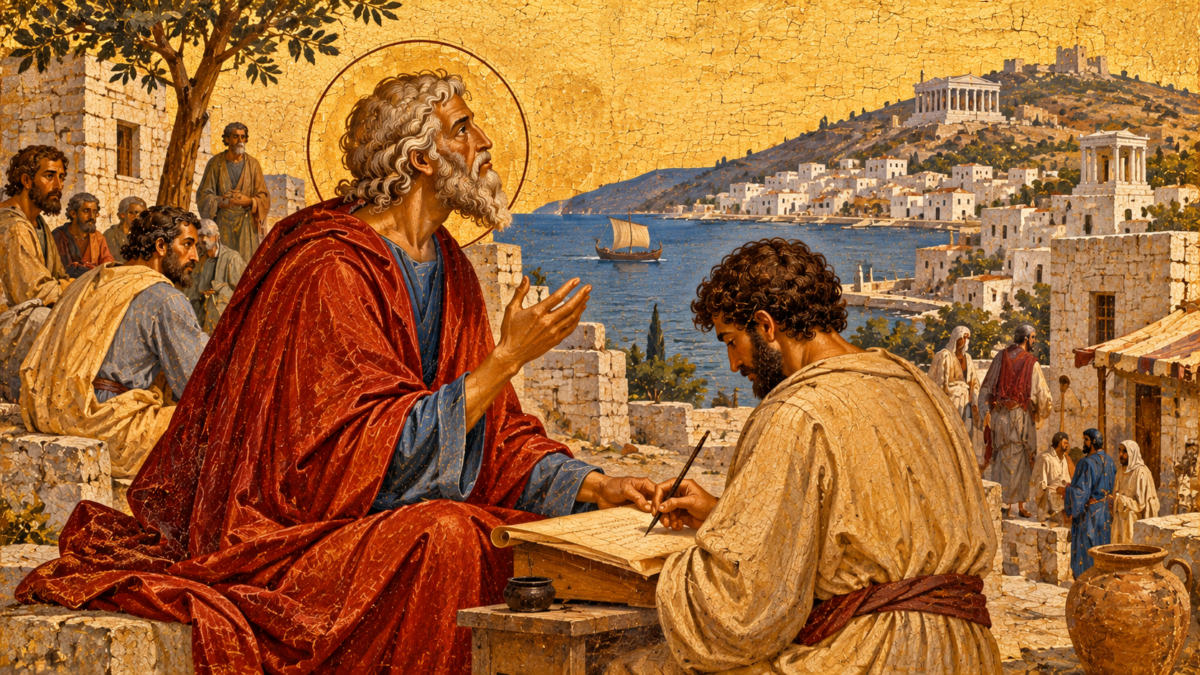
Visitors to the island of Patmos, off the coast of modern Turkey, are always taken (as we were in June 2025) to the Cave of the Apocalypse, below the monastery of St John (which is itself spectacular), and shown the fissure in the rock through which the voice of God spoke, and the ledge where John’s disciple Prochorus wrote down what he dictated. They are usually told that Domitian banished John here, that Rome sent its criminals to the island, and that the apostle laboured in the mines.
It is a powerful picture of the aged apostle alone on a barren rock, cut off from the churches he loves, who receives visions of the end of the world—and it has shaped how many people read Revelation as a whole. In this reading, Revelation is primarily a message of encouragement in the face of persecution.
But how much of that is in the text? What does the evidence about Roman exile—and Patmos itself—tell us about John’s situation? And how might this affect the way we read the book?
2. What does John actually say?
After his opening greeting, John tells us where he was in a single sentence.
I, John, your brother and partner in the tribulation and kingdom and patient endurance that are in Jesus, came to be on the island called Patmos because of the word of God and the testimony of Jesus. (Rev 1.9)
We need to notice three things.
First, John does not say that he was sent, banished or condemned. The verb is the simple ἐγενόμην, ‘I came to be’, and he uses it again in the next verse, where he ‘came to be in the Spirit on the Lord’s day’ (Rev 1.10). If he had been formally sentenced, he has chosen not to mention it. (All these are held together in John’s Greek, as he uses the preposition ἐν five times—he is in tribulation, in Jesus, in the island, in the Spirit, in the Lord’s day).
Secondly, the phrase ‘because of the word of God and the testimony of Jesus’ (διὰ τὸν λόγον τοῦ θεοῦ καὶ τὴν μαρτυρίαν Ἰησοῦ) is more ambiguous than it looks. With the accusative, διά normally means ‘on account of’—but it can mean ‘for the purpose of, for the sake of’. A good example is Mark 2.27, where the Sabbath is ‘for’ humanity, not ‘because of’ humanity (τὸ σάββατον διὰ τὸν ἄνθρωπον ἐγένετο).
The closest parallels within Revelation point to suffering for faithful witness, since the martyrs are slain ‘because of the word of God and because of the testimony which they had’ (Rev 6.9) and beheaded ‘because of the testimony of Jesus and because of the word of God’ (Rev 20.4). But in Rev 1.2 the same pair describes the content of the revelation itself, so some have read Rev 1.9 as saying that John was on Patmos in order to receive it. (Note the pairing of ‘word of God’ and ‘testimony [of Jesus]’ occurs four times, but never the same way twice—as is characteristic of Revelation.) The causal reading is perhaps more natural, but the ambiguity here might well be deliberate. John’s presence on the island and the revelation he received there are clearly bound together.
Thirdly, John is also his readers’ ‘partner in the tribulation’ (συγκοινωνὸς ἐν τῇ θλίψει; compare John 16.33 and Acts 14.22), and the messages to the assemblies show what that involved: slander and the threat of prison in Smyrna (Rev 2.9–10); a martyr in Pergamum (Rev 2.13); pressure to conform in Thyatira (Rev 2.20). That fits official pressure, but does not require a formal sentence. And it is curious that John needs to name ‘the island called Patmos’ for readers a short sail away, when he often uses ‘called’ for names that carry more than their surface meaning (Rev 11.8; Rev 12.9). We will come back to that.
So exile might be a reasonable inference from what John says, but it is only an inference.
3. How the story grew
If we turn to the early Christian writers, we find that the details of John’s exile grow over time. The earliest witnesses say surprisingly little, and the most dramatic claims come latest.
- Irenaeus (c. 180) says that the vision was seen ‘not long ago, almost in our own generation, towards the end of the reign of Domitian’ (Against Heresies 5.30.3). This remains the majority view—but note that he says nothing about exile.
- Clement of Alexandria (c. 200) says that John returned from Patmos to Ephesus ‘after the death of the tyrant’ (Who is the Rich Man that Shall be Saved? 42).
- Tertullian (c. 200) places the sentence in Rome, where John was plunged into boiling oil and emerged unharmed, and was then ‘relegated to an island’ (in insulam relegatur, Prescription against Heretics 36). The boiling oil is legend, but the legal term is precise, and it is the milder form of exile (more on this below).
- Origen (c. 240) says that tradition has the emperor condemning John, but notes that John himself does not say who condemned him (Commentary on Matthew 16.6).
- Victorinus (late 3rd century) says John was ‘condemned to the mines’ (in metallo damnatus) (Commentary on the Apocalypse 10.11), the origin of the ‘hard labour’ tradition.
- Eusebius and Jerome bring the pieces together, with John returning to Ephesus when Nerva recalled Domitian’s exiles (Church History 3.18.1; 3.20.8–9; Lives of Illustrious Men 9).
- The Acts of John attributed to Prochorus (5th century) supplies the cave, the scribe and much of what pilgrims are told today.
Although we might be tempted to give authority to such accounts, the language of formal condemnation comes from writers some distance from the events, and the harshest version, with John in the mines, is also the latest. And as we shall see, there were no mines on Patmos.
4. What did Roman exile involve?
My reason for exploring this issue was the prompt from a throwaway comment by Dr Mark Wilson in a paper he gave at the IBR session on Revelation—‘We know all about Roman exile.’ We do indeed have a good deal of evidence, from the jurists (especially Digest 48.22), from Tacitus, Suetonius and Cassius Dio, and from exiles such as Cicero, Ovid and Seneca who wrote about it. Three things stand out.
First, exile came in different forms. Relegatio was the milder one, in which the person kept their citizenship and usually their property, and could be confined to an island. Deportatio was for life and brought loss of citizenship and property. A provincial governor could impose relegatio, including to an island in his own province, but deportation needed the emperor (Ulpian, Digest 48.22.6–7). Patmos belonged to Miletus, and so lay within the province of Asia. The proconsul could have sent John there without any involvement from Rome, which fits both Tertullian’s legal term and Origen’s caution.
Secondly, exile was mostly for people of standing. The honestiores were exiled; ordinary people were sent to the mines, the beasts or the cross for the same offences. The Sentences of Paul (Sententiae Pauli 5.21.2) prescribes deportation for people of standing who introduce new religions that unsettle people’s minds, and death for others (5.21.2). So if John was exiled, either he had some social standing, or this was an administrative removal rather than a formal sentence, or later tradition has dignified his situation. None of these fits the picture of the outcast in a mine.
Thirdly, exiles were not always alone. At one extreme, Gyaros was a byword for desolation, and Tiberius moved one exile from there to Cythnus because Gyaros was harsh and uninhabited (Tacitus, Annals 3.69). At the other extreme, some exiles lived so comfortably that in AD 12 Augustus capped what they could take with them. They were allowed no more than one merchant ship and two smaller vessels, twenty slaves or freedmen, and property worth half a million sesterces (Cassius Dio 56.27.2–3).
That cap tells us that exiles routinely took households with them, and there is plenty of other evidence of family and friends going too.
- Tacitus counts it among the few virtues of AD 69 that wives followed their husbands into exile (Histories 1.3).
- Egnatia Maximilla followed her husband Glitius Gallus, at first with her fortune intact (Annals 15.71).
- Fannia went into exile twice with her husband Helvidius Priscus (Pliny, Letters 7.19.4)
So John may well have had companions, contact with the mainland, and the means to write. The book is full of the command to ‘write’ (Rev 1.11; Rev 1.19; Rev 14.13; Rev 21.5), and John is once told not to write (Rev 10.4), which suggests he was writing as he went. Its careful structure and dense use of the Old Testament look like composition over time (as I explore in the introduction to my TNTC commentary). A scribe is possible, and the Prochorus tradition might reflect the memory of someone with him, but I doubt anyone polished the Greek. Its distinctive grammar is too consistent, and often looks deliberate, as when John refuses to decline the divine name after ‘from’ (ἀπὸ ὁ ὢν καὶ ὁ ἦν καὶ ὁ ἐρχόμενος, Rev 1.4).
5. What was Patmos like?
Ancient writers mention Patmos only in passing (Thucydides 3.33.3; Strabo 10.5.13; Pliny, Natural History 4.69), and no non-Christian source calls it a place of exile. The guidebook claim that Rome used it as a penal settlement seems to be the Christian tradition read back into Roman policy.
The inscriptions and archaeology tell us more. Giacomo Manganaro published most of the inscriptions in his study of the ‘Milesian islands’ (1963–64), and H. D. Saffrey brought them to bear on Revelation in the Revue Biblique (1975).
- The acropolis on Kastelli, above the harbour, has fortification walls from the late fourth century BC, with finds showing continuous use into the fourth century AD.
- A first-century BC proclamation honours a Milesian garrison commander (phrourarchos), the means by which Miletus governed its islands.
- A late Hellenistic gymnasium decree honours a gymnasiarch and mentions torch races.
- Dedications to Artemis Patmia were found at Skala, one made ‘in accordance with dreams’ (καθʼ ὕπνους).
- A verse inscription honours Vera, priestess of Artemis, born on Patmos but raised in Argos.
- Funerary monuments across the island point to settled families through the Hellenistic and Roman periods.
We cannot put a precise figure on the population. But the picture that emerges is of a small, functioning Greek community, centred on the harbour at Skala and the town below Kastelli. It had a civic life, an athletic tradition, local cults and families with wider horizons. It sat on the sea routes between Miletus, Ephesus and the west, so that a scroll could reach the seven assemblies without much difficulty. And there is no trace of mines or of a penal settlement. Patmos was small and on the edge of things, but it was neither empty nor primitive.
6. The island of Leto’s daughter
The two main gods of Patmos were Artemis Patmia and Apollo Karneios, and the monastery is said to stand on the site of Artemis’ temple. The Vera inscription calls Patmos ‘the most venerable island of Leto’s daughter’, and I suspect that is what the island was ‘called’ by those who lived there.
Artemis and Apollo were the twin children of Leto, and the story of their birth is one of the clearest pagan parallels to Rev 12. In the version preserved by Hyginus (Fables 140), the dragon Python learns that Leto’s child will destroy him, and so pursues her while she is pregnant. She is carried away to safety, at Poseidon’s command, and gives birth to Apollo and Artemis on an island; a few days later Apollo returns and kills the dragon. In Rev 12, a woman clothed with the sun is about to give birth, a great red dragon stands ready to devour her child, the child is snatched up to God, and the woman is given the wings of the great eagle to escape into the wilderness, while the earth swallows the flood that the dragon pours out after her (Rev 12.1–17). Adela Yarbro Collins showed long ago how closely John’s narrative tracks the Leto myth, and her case does not depend on Patmos at all.
But the local setting sharpens it. The people of Ephesus claimed that Leto had given birth to Artemis and Apollo not on Delos (adjacent to Patmos) but in the grove of Ortygia, outside their city, and celebrated it with an annual festival (Strabo 14.1.20; Tacitus, Annals 3.61). And the myth had political force, since Augustus adopted Apollo as his patron and Nero posed as Apollo the lyre-player (Suetonius, Nero 25).
So John, on the island of Leto’s daughter, within sight of the coast where the Ephesians celebrated her birth, retells the story. In his version the child is the Messiah who will ‘shepherd all the nations with a rod of iron’ (Rev 12.5, citing Ps 2.9), the dragon is ‘the ancient serpent, called the devil and Satan’ (Rev 12.9), and the dragon’s agent is a beast who looks remarkably like the emperor (Rev 13). The true dragon-slayer is not Apollo, nor the emperor who claims his mantle, but the Lamb.
Two other details might be relevant.
- The king of the locusts is called ‘Apollyon’, the Destroyer (Rev 9.11). The play on Apollo’s name is hard to miss, and the locust was one of Apollo’s symbols (Pausanias 1.24.8).
- The dedication ‘in accordance with dreams’ points to people seeking revelation from the goddess. On her island, John ‘came to be in the Spirit’ (Rev 1.10).
Now, the inscriptions are probably later than Revelation, but they reflect an older cult which we know was widespread in the region, and Rev 12 draws at least as deeply on the Old Testament (Gen 3.15; Isa 27.1; Exod 19.4; Dan 7). The local cult does not explain Rev 12, but John’s first readers would surely have heard the resonance.
7. Why does this matter?
In place of the lonely old man on a barren rock, we have a church leader under pressure, probably removed from Ephesus by the provincial authorities, living in a small Greek town with a harbour, a gymnasium and a temple to Artemis. He might well have had companions and contact with the mainland, and he wrote carefully, over time, for congregations a short voyage away. This has three key implications for the way we read the book.
First, this challenges the idea of John being a mere ‘secretary’ who hurriedly transcribes a series of startling visions that he sees. The main reasons for rejecting this construction is the actual data of the text (as I argue in the introduction in my commentary). This would be impossible if John was doing hard labour in a mine—but the more realistic reconstruction of his situation allows for this.
Secondly, it implies that Revelation is not so much about surviving tribulation, but challenging compromise. This text is less a comfort for the persecution, and more a challenge to the complacent. We can see this fairly clearly simply by reading the royal proclamations to the seven assemblies in chapters 2 and 3. If they were intended to give comfort to the persecuted, they don’t do a very good job!
Thirdly, this makes Revelation less an escapist vision from the margins and more a pastoral and prophetic text, written from within the everyday pressures its readers faced. John takes the stories the cities of Asia told about their gods and emperors, stories celebrated on the very island where he found himself, and retells them so that they point to Jesus.
Faithful witness, then as now, means understanding the stories that shape the people around us, and telling a better one of the grace of God in the person of Jesus by the power of the Spirit.
Further reading
- H. D. Saffrey, ‘Relire l’Apocalypse à Patmos’, Revue Biblique 82 (1975)
- Ian Boxall, Patmos in the Reception History of the Apocalypse (Oxford, 2013)
- Adela Yarbro Collins, The Combat Myth in the Book of Revelation (Missoula, 1976)
- Steven Friesen, Imperial Cults and the Apocalypse of John (Oxford, 2001)
- Richard Bauckham, The Climax of Prophecy (Edinburgh, 1993)
- Ian Paul Revelation (Tyndale NT Commentary, 2018)