
PLEASE NOTE: I am very sorry—but the trip is now full for 2026.
If you would like to be added to a reserve list in the case of a cancellation (there are four places that still need final confirmation), or you would like to be sent information for the 2027 trip when plans are available, please register on this form here.
I am planning to lead a study trip to western Turkey next year, from Tuesday 28th April to Thursday 7th May 2026 inclusive visiting Istanbul and the seven cities of Revelation, plus some other sites of archaeological importance. It is a great time of year to go, as the weather is warm but not too hot, the sites are less busy, and for those in ministry it avoids the major church festivals. Going midweek to midweek also means only missing one Sunday.
Who is it for?
 This trip will be of interest to Christians who want to understand the Book of Revelation, and the context in which it was written, as well as the world of the first century so they can read the New Testament better. It will also be of interest to anyone in Christian ministry who wants to grow in understanding and be able to read and teach these texts better. I am also research active, so those with an academic interest will also be catered for with additional question and answer sessions.
We will be walking, at a steady pace, for a couple of hours each day, so you need to be comfortable with that. You should also be comfortable with climbing two flights of stairs; the ground is sometimes uneven and steps are involved.
What is the itinerary? (click on the links for details of destinations and hotels)
| Date | Location | Itinerary |
|---|---|---|
| Tuesday 28th April | Istanbul | Fly into Istanbul. Transfer to your hotel. Dinner and overnight at the Akgun Hotel in Istanbul |
| Wed 29th April | Istanbul | Hippodrome Square, Blue Mosque, Hagia Sophia, Archeological Museum, Grand Bazaar. Dinner and overnight at the Akgun Hotel in Istanbul |
| Thurs 30th April | Istanbul to Izmir | Spice Bazaar, Bosphorus boat trip. Coach transfer to Izmir in the afternoon. Dinner and overnight at the Kaya Thermal Hotel in Izmir |
| Friday 1st May | Pergamum and Thyatira | Pergamum Acropolis, the Asklepion (in the lower city) and Thyatira. Dinner and overnight at the Kaya Thermal Hotel in Izmir |
| Sat 2nd May | Smyrna, Sardis, and Philadelphia | Smyrna Agora, Sardis Gymnasion, Synagogue and the Temple of Artemis, then to Philadelphia. Dinner and overnight at the Adempira Hotel in Pamukkale |
| Sunday 3rd May | Laodicea and Hierapolis | Optional early morning hot air balloon flight over Pamukkale (paid separately). Loadicea and Hierapolis. Dinner and overnight at the Adempira hotel in Pamukkale. |
| Monday 4th May | Aphrodisias and Miletus | Drive to Aphrodisias, site and museum. Then on to Miletus site and museum. Dinner and overnight at the Korumar hotel in Kusadasi. |
| Tuesday 5th May | Ephesus and the Selcuk museum | Ephesus with Terrace Houses, Basilica of St John and the Selcuk archeological museum plus carpet makers cooperative with lunch. Dinner and overnight at the Korumar hotel in Kusadasi. |
| Wed 6th May | Patmos | Optional day trip to Patmos by a privately chartered ferry (paid separately) if the weather permits. Otherwise a day off at our resort hotel. Dinner and overnight at the Korumar hotel in Kusadasi. |
| Thurs 7th May | Izmir | Drive to Izmir for return flights |
The trip has been designed to optimise travel times, and visit sites in the best order. Details of each of the sites can be found below.

What is the purpose?
There are three goals for the trip. First, it is a study trip, so we will be learning about the sites with Hakan Bashar, an expert on the history of the area and the sites with 38 years’ experience of guiding, and I will be giving short talks on a range of issues relating to the Book of Revelation, how to read it well, and how understanding the sites helps us in this.
Secondly, it is a retreat and pilgrimage. It is always a powerful spiritual experience to visit the places mentioned in the New Testament, and to read passages from it in the places to which it was written. There will be time throughout for prayer and reflection. There is always a strong sense of fellowship with fellow travellers.
Thirdly it is a holiday. We will be staying in high quality hotels (check the links in the itinerary above), and the timing has been planned to allow you to relax and enjoy these, especially in Pamukkale (which was historically a spa resort) and in Kusadasi, where the hotel overlooks the sea and offers sea swimming as well as its own pool.
What is the cost?
The cost of the trip is £1,795 including half board, all ticket entries, and all tips (usually expected for guides and drivers).
The cost does not include your own flight to Istanbul and home from Izmir, which you will need to book yourself, and the internal flight from Istanbul to Izmir on Thursday afternoon which you will also need to book, for which there are plenty of options at around £30—we will recommend which flight to book nearer the time.
The optional dawn balloon flight over Pamukkale on the Sunday (this year was £160), and the optional charter boat trip to Patmos, are also additional. Exact prices for these will be given nearer the time.
You will also need to book travel insurance that includes end supplier failure insurance (ESFI), available from all the major providers, which will cost around £30, or can be bought as an add-on to existing policies for around £10. This is because I am working directly with a Turkish tour operator, Tekser, who are not covered by the usual ABTA or ATOL.
We anticipated that two people will share a room. If you are travelling alone and would prefer to have your own room, there is a single room supplement of £430.
We don’t believe that you will find a better value trip of this sort anywhere else!
How do I book?
Very sorry—the trip is now full for 2026. If you would like to be added to a reserve list in the case of a cancellation (there are four places that still need final confirmation), or you would like to be sent information for the 2027 trip when plans are available, please register on this form here.
Complete the webform here and pay your deposit (link on the form) to secure your place. Bookings must be made by 1st October (though places are limited, and first come, first booked) and the balanced paid, by bank transfer, by Monday 2nd February.
Recommendations
Here is a selection of comments from those who came with me this year.
This trip gave a superb insight into the world of the first Christians, and I’ve come back with a new lens through which to read Acts, the epistles and Revelation. The tour was well paced, and the frequent bite-size briefings from Ian and the Turkish tour guide were excellent, helping us to understand how the geography and prevailing culture would have been experienced by the early church (Debbie Buggs, lay member of General Synod).
A wonderful opportunity to stand in the cities that Jesus addressed in Revelation, to understand the cultural pressures the churches faced, and to hear the marvellous insights of Hakan Bashar and Ian Paul as they unlock the archaeology of the sites and the theology of Revelation. Highly recommended! (Nigel Taylor, Church of England minister)
I enjoyed every aspect of the trip—the places we visited, their significance, the teaching at each place, and the group of people we were with. The Book of Revelation became a whole lot less intimidating. I feel significantly better equipped to read it and understand it than I did before, and trip made a big contribution to that! (Lesley Mackintosh, retired GP)
Visiting so many biblical sites in provided meaningful context for and a rich connection with many familiar New Testament passages. Ian Paul deepened our understanding of the biblical texts with his careful scholarship, as well as being an enthusiastic supplier of many fascinating and diverse historical details. The tour will definitely not disappoint! (Corinne Brixton, Church of England minister)
I felt very fortunate and privileged to have been part of the journey—it really did feel like a “trip of a lifetime,” and I’m sure I’ll remember it with great fondness and continue reflecting on the experience for many years to come. And we had a great group of fellow pilgrims on the trip. Hakan Bashar was a fantastic, knowledgeable, and very entertaining guide to the history and archeology of the sites. Ian’s insights and scholarship were excellent, and he took the time to answer many questions—it was greatly appreciated. Having a Revelation specialist on board undoubtedly contributed to it being such a special trip. (Simon Curran, school teacher)
Inspiring… educational… insightful… sociable… prayerful… and thoroughly enjoyable…. My recent tour of Turkey and Greece with Peter Walker and Ian Paul surpassed my expectations. Especially appreciated the experience, scholarship (and humour!) of all the tour leaders who helped connect the history and archaeology of the sites we visited with the testimony of Scripture and the reality of Christian living then and now. Came away with many new insights to better understand the historical and cultural contexts in which parts of the New Testament were written with lots to consider for their meaning today—for me personally, the church and our own culture. Valued the prayerful and reflective way the tour was led with time to read Scripture ‘in situ’, pray and reflect. Enjoyed the fellowship created amongst our group with lots of opportunities to share conversation, questions, learning and experience. Great food, cold beers, hotels, coffees, swimming pools, sun, and a little bit of “tourist time” all added to the trip. The trip is proving a valuable part of my sabbatical and well worth the investment of time and money to participate. Thank you to all concerned. (Martin Cannam, Church of England minister)
The trip with Ian to see these NT churches was excellent. You really get a sense of the local flavour of each site which helps draw out aspects of the Bible that easily get passed over. Ian was a great guide because he was able to weave historical and theological aspects of each setting together. I went as a specialist to learn more, but it was great because the tour allowed space for those with a great range of background and interests. I absolutely recommend it for anyone who has the chance to go. (Prof Dr Ben Blackwell, Principal, Westminster Theological Centre)
Itinerary details
 Pergamum was a powerful ancient city, rivalling both Smyrna and Ephesus for status in the region in the first century. The upper city form a spectacular acropolis, with views over the modern city and surrounding planes, and is now reached by cablecar—saving a climb! It is notable for its remarkable theatre, the steepest in the ancient world, and the remains of the temple of Trajan, whose white limestone shines out against the natural black basalt of the area, and illustrates the dominance of the imperial cult in civic life. The Asclepion in the lower city has its own theatre, and the ruins give a powerful insight into the importance of healing cults in the ancient world.
 Thyatira is the site of modern Akhisar, so the ruins of the ancient city have largely been built over. However, a number of inscriptions have been found which demonstrate the power and importance of trade guilds, and their role in pagan worship and the social fabric of the city; more guilds are known of here than in any other ancient city. This throws light on both the religious and the social pressures face by the first followers of Jesus.
 Smyrna competed with Ephesus and Pergamum to be the principle city of the region, and Izmir continues to be a major city in Western Turkey today. It was known as the crown of Asia, and its coins had crowns on them to celebrate the games that were held there every other year. The modern city covers most of the ancient remains, but the agora (marketplace) remains an open space, and around it the basement walkways, and their water channels, can still be explored, along with Roman mosaics, and later Ottoman grave markers.
 Sardis is a spectacular site, with many features that have been excavated and reconstructed since there is no modern occupation of the area. The acropolis (which we see but don’t climb) is a sheer pinnacle, only taken by siege because the defenders were asleep (see Rev 3.2). The Temple of Artemis covers a huge area, with colossal columns, a number of which have been reassembled, after falling because of tremors in the area.
 In the main part of the city are shops with signs of early Christian occupation, parts of a very large gymnasium (the entrance is shown to the right here), and a substantial synagogue which has been extensively excavated and restored in recent years. It demonstrates the significant Jewish population in these areas, and the importance of the Jewish community in civic life. We can see why Paul always went first to synagogues in cities in this region whenever he could.
We visit Philadelphia on our way from Sardis to Laodicea, as would those travelling on the trade route and the person delivering copies of John’s apocalyptic, prophetic letter, to complete the seven cities. There are no first century ruins here, as the modern city of Alasehir covers any remains. But the massive columns of a Byzantine church sit within a garden area.
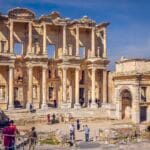
 Laodicea is a large and impressive site, with no occupation after the ancient period, which has been significantly excavated and restored over the last 15 years. It includes an impressive main street, temples, two theatres (one restored and one yet to be), and a stadium. There is clear evidence, from clay pipes and the water distribution centre, of the lukewarm water that came into the city from its aqueduct (see Rev 3.16). It also includes the restored remains of an early Byzantine church with mosaics and an impressive baptistry. And there is a cafe by the entrance for the convenience of visitors!
 Hierapolis was an ancient spa city, a centre of therapy and healing, from which it became very rich. It continues as a spa resort to this day, still drawing on the hot water coming up through the earth, and carrying dissolved calcium carbonate which precipitates to form the spectacular travertine terraces. There are extensive ruins of the ancient city, an impressive theatre, and a museum—and you can paddle in the hot water and enjoy the full effect in the thermal spa of our hotel! Those going on the optional early morning balloon flight will enjoy a stunning bird’s eye view of the terraces.
 Aphrodisias is another extensive site, well excavated, with numerous temples. It includes an enormous stadium, probably the best preserved of its kind, and a small odeon where the city council met. Most interesting for reading Revelation and the New Testament is the Sebasteion which was lined with statues personifying both imperial power (and the different emperors) and the nations that had been conquered and how submitted to Roman rule. It offers a fascinating background to reading Revelation 12 in particular.
 Miletus was an important port in the first century, where Paul met the Ephesian elders in Acts 20, though now some distance from the sea due to the change in the shoreline with the silting of river mouths (though the agora is still quite boggy in the winter). It has an impressive theatre which is notable for the inscriptions in the seating setting different sections aside for different groups, including clearly marked ‘For the Jews and the godfearers’. The placing of an imperial altar in the courtyard in front of the council chamber demonstrates in the civic space the way that Roman power took centre stage.
Ephesus is a spectacular site with extensive excavations—though with excavation work continuing. It is important not only in Revelation but in the ministry of Paul in Acts. It was one of the largest cities in the ancient world, with a population of 250,000, and vied with Smyrna and Pergamum to be the premier city in the province, and the most loyal subject to Rome. Its theatre could seat around 24,000 people. We will visit the usual sites, including the Basilica of St John, but also the recently excavated terrace houses which other tours often miss.
 The Selcuk Museum contains many artefacts from ancient Ephesus which give further insight into the culture and life of the first century. It includes parts of the monumental statue from the agora, often thought to be of Domitian but more likely an image of Titus.

The museum is not large—but has an ice cream stall outside, Hakan’s favourite in all of Turkey!
 Buy me a Coffee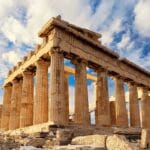




No vomiting at Laodicea please!
For the history of the seven towns before Jesus’ time, may I recommend Colin Hemer’s book “The Letters to the Seven Churches of Asia in Their Local Setting” and, for an excellent shorter summary of the same, the relevant volume of William Barclay’s Daily Study Bible.
There is also David Pawson’s fine set of lectures on the letters to the seven churches:
https://www.youtube.com/playlist?list=PLOSVESt7kC_x6_ompKMSiLbaHOmhNmXvf
Yes, except that Hemer gets carried away with some of the local allusions, and does not always allow for other factors in shaping the text. I discuss this in one of my talks on the trip.
The letter to Pergamum raises a question: is it meaningful to speak of where Satan has an earthly base at any given moment? I notice that emperor-worship, which took such a toll of the early church, began at Pergamum.
It is obvious that some belief systems hostile to Jews and serious Christians sometimes get an inexplicable boost in their activities, which one might attribute to Satan. Nazism in the 1930s, for instance. In that case it is not hard to see where the epicentre was in the high middle ages and where it is today.
I think it is reasonable to believe that there can be particular places where Satan’s influence appears to be most strong. Don’t you?
To me the geography of Pergamum still spoke the memory of a dark threat as it towered over the area around it. A busy and large temple can’t have been comfortable to any Christians below it.
Yes indeed, and you do get a sense of the power expressed in the buildings when you are there…
Seeing all that “infrastructure ” drives home the all pervasive and thus the dominating evil that Christians faced. Seeing it in person can’t be beaten.
I am glad to see the country has reverted to the name of ‘Turkey’ instead of ‘Türkiye’ as it was last year.
Well, if I was going to Central Europe, I am sure I would mention Germany and not Deutschland…!
Schade ….
I was fortunate to be able to visit Ephesus some years ago and stand in that amazing theatre. The acoustics were everything the guide books say about Greek theatres. The whole site was wonderful to see, even the “house of the Virgin Mary”. Also interesting that the city is now some way inland as the harbour silted up over the centuries.
Yes, though this year the theatre was being repaired, so we could not go in. I am hoping it will be open next year!
Ach, schade noch einmal. If you do get in next year, I’m sure you won’t upset the silversmiths of Ephesus!
We loved all the shops selling ‘Genuine Fakes’, mainly Gucci and Chanel. Maybe they do Pauline manuscripts as well? (Asking for a museum.)
Yes, I took a photo of one of their signs!
If the 2026 trip is anything like this year’s ‘In the Steps of Paul & John’ with Ian and Peter, I wholeheartedly recommend it. A wonderful group which bonded well over a shared passion for discovering the historical and geographical setting of God’s word in Revelation, Acts and Paul’s letters. The whole trip combined the best of a scripturally focused retreat, with a prayerful pilgrimage and the relaxation of a holiday. Add in some great food, quality conversation and teaching, a few jokes and the beautiful scenery of Turkey I say – Go for it!
Thanks Adam! It was great to have you on the trip this year!
Here hear! I’d do it all over again but next time I’d go to the desolate, top right corner of Patmos to get a feeling of what it must have been like for John praying towards Ephesus.
It was great to have you with us!
We’re in!
Out of interest, are the hotels Christian-run, or will there be the opportunity to support the local Christian community and businesses? I occasionally hear stories about the church under pressure in Turkey, and in a majority Muslim country they need all the encouragement they can get, so was hoping we get the chance to support them/meet with them somehow?
Thanks for the suggestion—and great that you are joining us!
Yes, last time we had some brief meetings, but I think we should do more. I have some links in Izmir, and can form some in Istanbul. If you have any, do let me know.
Is it worth reading Nick Page’s Revelation Road as preparation?
I read it before I went on a longer stay on Patmos in 2024 and I dipped into it again before the trip in 2025. I found it helpful – but frustrating because it made me really want to see the Acropolis site and I wasn’t sure I ever found it. Worth it? for me, personally, I liked the extra ‘colour’ it gave to the island but its more conversational than a guide book. It’s background reading (good, especially if Patmos is more to a visitor than seeing just one more Greek island).
What do the proper academics think of the book?
Signed up for the trip, but concerned to have nothing further
Email coming later today!