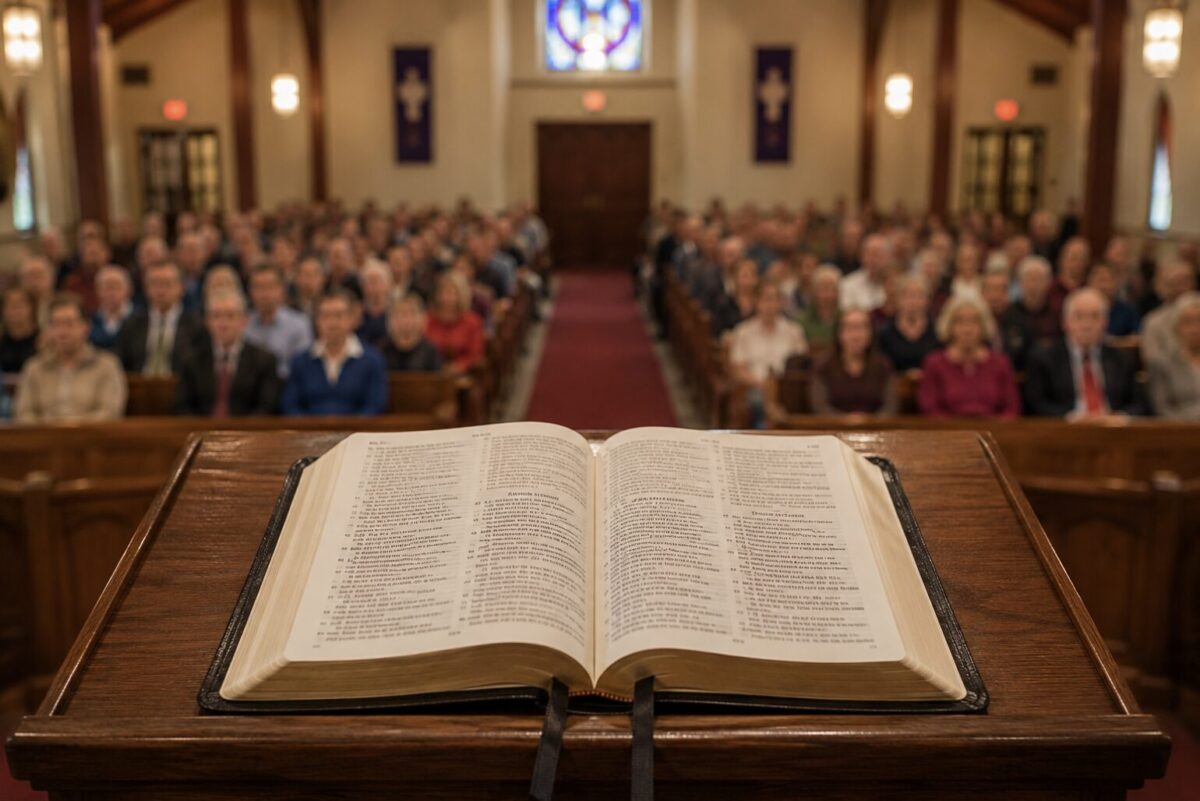
Who should read the Bible aloud in church as part of our services? Should the preacher do it, or someone else? Is it more important that it is done well, or that our readers are representative of the community? How are they perceived beyond the church, and does that matter?
In an online discussion group I am part of, someone raised the question about who should read the Scriptures as part of the public service of worship. (Note that, to communicate what this is about, I used the title ‘read the Bible in church’, though I don’t like using the phrase ‘in church’ as there are better ways of talking about who we are as the gathered people of God!)
The person asking the question noted that, in Scripture, reading is often done by someone of standing, and that, as preacher, they like to read the passage they are preaching on.
On the first question: because our Bibles are less of a single book and more of a library of books developed over time, we do have reference within Scripture to the reading of Scripture—that is, reference in later parts of Scripture to the reading of earlier parts.
- Moses commands that the law he has been given by God is read aloud to all the people (Deut 31.11).
- After the destruction of Ai, Joshua renews the covenant with God, and this includes reading all of the law of Moses (Joshua 8.34).
- When the ‘book of the law’ is rediscovered under the reign of Josiah, it is read in public (2 Kings 23.1–2).
- After the return and rebuilding of Jerusalem under Ezra and Nehemiah, a key moment is when the book of ‘the law of God’ is read to all the people (Nehemiah 8.8).
What is striking here is that, on each occasion, the reading is done by a key figure of importance—the Levites in Deut 31.8, Joshua, the king Josiah, and Ezra. The importance of the reading is signified by the importance of the reader.
However, these are special occasions, and the reading of Torah became a regular habit in second temple-era synagogue worship. So in Luke 4.16, Jesus stood up to read from the scroll that the synagogue assistant handed him. (It is worth noting that, in this case, the reader and the ‘preacher’ are the same person…)
We know from Acts that it was the practice to read from both the law (Torah) (Acts 15.21) but also from the prophets (Nevi’im) (Acts 13.15), and so likely also from the third section of the Hebrew Bible, the writings (Ketuvim). It is not specified who did this, but it is likely that it was by respected adult males, organised by synagogue officials. Visiting teachers, like Jesus and Paul, were invited to then speak.
Given the importance of this practice in a Jewish context, it is then striking that it became the practice of the early Jesus communities to treat Paul’s letters in a similar way: Paul commands in the strongest terms that his letter is read to the Thessalonians (1 Thess 5.27); the letter to the Colossians should also be read aloud by the nearby Laodiceans (Col 4.16); and John assumes that his apocalyptic prophetic letter will be read in each assembly in a similar way (Rev 1.3). These letters sit alongside the Scriptures as being read in the assemblies.
Revelation gives us the clearest insight into the social dynamics of the reading of Scripture, though it is slightly obscured in older translations.
Blessed is the one who reads aloud the words of this prophecy, and blessed are those who hear it and take to heart what is written in it, because the time is near. (Rev 1.3)
The word ‘aloud’ is omitted in some translations, but this must be what John means. The verb ἀναγινώσκω means ‘to read,’ but in cultural context this would be assumed to be ‘aloud’ because reading silently to oneself is a modern practice in an era of widespread literacy. And in Rev 1.3, there is ‘one’ person who reads, and many who hear it.
It is usually argued that formal literacy in the Roman Empire was around 10–15%, but this all depends on what you mean by ‘literacy’. A trader who could not read formal scrolls would need to be able to keep accounts—does that count as ‘literate’? And religious groups, like Jews, would be highly literate in their own religious texts.
But overall, first century culture was much more corporate and oral than ours. Written texts were hard to read, since (for reasons of economy), there would normally not be spaces between words and paragraphs, as we have in modern writing. So both writing (by trained scribes like Tertius, Rom 16.22) and reading (by lectors) would be specialist activities.
But in an age of widespread literacy today, does the same apply?
First, we need to do it! We need to have scripture read aloud when we meet together. This might sound a bizarre comment to make—but I continue to be astonished to find, as I travel from one church to another, what a rare and stripped down practice is our reading of scripture.
In more ‘traditional’ services, there would often have been three readings in the past, including a reading from the Old Testament, an epistle, and a gospel reading. Nowadays, many ‘evangelical’ churches have just one reading, and it is often short! We need to take more seriously again Paul’s injunction to Timothy:
Devote yourself to the public reading of Scripture… (1 Tim 4.13)
There are many reasons for us to listen to the scriptures being read aloud, rather than reading them. For one, Jesus’ teaching in the gospels when first given was done orally. And then the summary account of this teaching in the written gospel was also delivered orally, as were Paul’s letters and the other writings of the New Testament. That means that they were written to be delivered in this way! So we miss the impact of them if we do not hear them read.
Why, then, do we put the text on projection screens? These serve to fragment the text, decontextualise it, and prevent us engaging with the person reading. Much better to read from our print Bibles; better still simply to listen. From a view point of neuroscience, something different happens to us when we listen to something being read (well) compared with when we read it ourselves. Think of the experience of going to the theatre compared with reading the script of a play!
But if we are going to take listening seriously, then it means that the reading needs to be done well. Why do we find it so easy to make the Bible sound boring when read aloud? Did anyone ever accuse Jesus (or Paul, or John) of being boring?! Reflection on this some years ago made me take a very different approach to reading a long passage (Matt 25.31–46, the so-called parable of the sheep and the goats) to an all-age congregation.
It looked far too long to just read, so I decided to do what Jesus did—to simply teach, to ‘perform’ the passage. I set aside an hour and a half on the Saturday evening to learn the passage, and on the Sunday morning simply removed my collar, rolled up my sleeves, and without any announcement, started: ‘When the Son of Man comes in his glory, and his angels with him…’ I learnt four important things:
- Jesus’ teaching is far from dull! Everyone was gripped; those on my left were particularly engaged by the second half of the passage. The children did not move a muscle.
- Jesus’ teaching is very easy to memorise, because it is very carefully structured. The ‘least of these my brothers and sisters’ are described by six terms, which come in three pairs, and are referred to with increasing brevity in the four repetitions (two by the king, two in response by each of the groups of sheep or goats).
- It is easier to remember things than I thought. Nearly 30 years on, I can still remember the passage more or less word for word. Memory is a muscle which gets stronger with use.
- Memorising the passage was a powerful way of dwelling in it, and as a result I completely changed my mind on what the passage was all about, as I explain here.
All these things came from ‘reading’ well, and my preparation for it.
This, then, brings us back to the question of doing it well. For those leading our sung worship, we assume that they have had some sense of vocation, that they have been trained, and that they have gained a level of competence so that it is done well, and in such a way as to enable the congregation to worship in song without drawing undue attention to the musicians.
So why don’t we think the same way about the reading of Scripture?
Why don’t we offer training in how to do this well? There are some great resources out there, including this Grove booklet, How to Read the Bible in Church. In the blurb we read:
Christians believe that the Bible is the word of God – yet often the way we approach it in church does not reflect that high importance. The readings may sound boring, be inaudible, or be read without expression or any understanding of the context of a passage. This ‘how to’ booklet looks at the whole range of ‘why’s and ‘how’s of reading the Bible in church. It offers an exciting range of creative approaches – all tried and tested – as well as careful training on the basics of reading well. It will be of interest to anyone concerned that Scripture should be ‘alive and active’ for those listening.
I am curious as to why there is less interest in this kind of thing now than there has been in the past. I wonder why?
Three final questions arise. The first is to note that, outside the church, people take notice of those who have roles within the church. If someone is known as a person who has the responsibility of reading the Bible in public in worship, others will assume that they are trusted and respected in the community of faith—and so to some extent they are seen as representative. We need to take that seriously when thinking about who is reading.
Secondly, where our church communities are diverse in terms of culture, ethnicity, age, and background, we should surely want those involved in ‘up-front ministry’ to reflect this. So we will need to think about whom we call, train, and deploy in this ministry of reading Scripture.
Thirdly, in our discussion online about who should read, and in light of the tendency in some traditions for the pastor or preacher to read the Bible passage as part of their address, Jeremy Duff made a really important point about separating the reading of Scripture from its interpretation.
Focusing on the question of whether it should be the *preacher* or not (which is different from the ‘qualifications’ or otherwise of the person who reads) I would strongly say NO.
It is vital that we maintain and teach our folks the difference between the scriptures and our commentary on them. The preacher is the second of those. A different voice makes that difference, and indeed in traditional churches they have been read from different places to emphasise that difference even more.
I am worried when I read someone saying ‘as the preacher I know what it means and want to read it with the emphasis to support what I am going to say the passage means’. For me that is leaning towards authoritarianism and the preacher (the minister, the priest etc) controlling the interpretation of scripture and we are nudging away from our reformation heritage.
No the scripture is read. That is primary. Everyone hearing it is an equal interpretator (the ploughboy knows the scriptures as well as the pope). One authorised minister who has had the luxury of time in the week to prepare, then leads us in the interpretation (eg preaches).
But to retain the bulwark against interpreting the bible being taken from the people to be the work of an expert class, we do all we can to emphasise the distinction between the scriptures and the interpretation of them.
Even worse IMHO is the modern practice of not having a separate bible reading and the preacher just weaving it into their sermon, as if scripture is something they use to make their point.
(That is all completely separate from whether it is good or not to have certain people trained to read well. It’s about the separation on each occasion of scripture and commentary.)
And of course this argument follows exactly the practice in Nehemiah 8, where Ezra reads from the book of the law, but the interpretation is done separately by the Levites. And their goal should be ours:
…The Levites helped the people to understand the Law, while the people remained in their places. They read from the book, from the Law of God, clearly, and they gave the sense, so that the people understood the reading. (Neh 8.7–8)
As a result ‘all the people were attentive’.
 Buy me a Coffee











An ancillary question? Is the congregation in listening well, to open up the pew bibles, (yes, we still have them) and read along with the Reader?
And keep it open during the preaching?
Sometimes I do listen better, without an open bible.
But I do like to keep it open and read during and alongside the preaching, as has been noted numerous times on this site, some key scriptures in interpretation, lie outside the set passages.
As for holding attention, is not some/most of it down to the listener, unless the listener is Eutychus!? Or it is a list of names and numbers.
One of the liveliest and most culturally appropriate ‘readings’ of scripture I’ve encountered was by a Presbyterian minister in Wales who clearly learned the passage pretty much by heart (certainly digested it) and then delivered it in both English and Welsh, alternating and repeating phrases (all without losing his way!) Another was a deaf student who signed Bible passages using BSL. It’s amazing what emerges from a passage when physically acted!
Of course one has to consider power when thinking about who reads. Historically power has been exercised to exclude laity, women, children, lesser educated and differently abled people from proclaiming scripture at various times. A powerful rendition of the Good Samaritan story that sticks in my memory 25 years later is a dramatisation of the story by a person with Downs Syndrome. I don’t remember many readings of sermons 25 years later!
A minor point: the reader should not read out the section headings inserted by the translators.
Or perhaps, as I have done to make a point, say something like “the translators have given this the title….”
Agreed. Although there are (presumably inspired) headings to many of the Psalms.
I believe it is helpful to explain in a short sentence what the passage is, before one begins reading it out. Permission should be sought for this, of course. Ther is also the questio of what to say at the end: “This is the word of the Lord” or “Thanks be to God” or “Here endeth the lesson” or nothing at all (which can be dramatically very effective).
Yes… i keep working on that one with readers! And the occasional habit of saying “good morning ” to the congregation before they start!
Pauses are essential in reading as they are in conversation.
Please give a brief introduction like Jesus speaking to his disciples or the crowds.
The lectionary selects verses it agrees with and can mislead hearers. That is dangerous.
“Think of the experience of going to the theatre compared with reading the script of a play!”
Thanks for that Ian. Very memorable.
The book of Ruth reads to me like a play, by the way. I wonder if it was written down to be performed?
Or Job?
Yep. job is very much a good example. I wonder how and where books like Ruth and Job were performed. In the open air, or just within palace walls. Also Revelation. I wonder what the minimum persons would be to perform it as theatre. How many orators? How many acrobats standing on each other to perform the angel with the little scroll? Ian has thought about this, tell us please!
I’ve not yet come across a reading from the front from a Reader’s Version of the Bible, a one with the verse numbers removed. Highly unlikely following the set lectionary chapter and verses. And even when following a whole book.
Maybe it is a version to be only read as individuals.
BTW, as individuals, do many read aloud, to self? Do we read more attentively, slow down and digest better?
Written texts were hard to read, since (for reasons of economy), there would normally not be spaces between words and paragraphs, as we have in modern writing.
And, worse, there was no punctuation. Imagine Finnegan’s Wake without even the spaces between the words.
Why, then, do we put the text on projection screens? These serve to fragment the text, decontextualise it, and prevent us engaging with the person reading. Much better to read from our print Bibles; better still simply to listen.
Not all churches project the script, but it can be helpful because (1) so many readers chosen are poor it it, and (2) you are guaranteed to get the same English translation on the screen as is being read out, which is not necessarily the case if you bring your own Bible.
I prefer reading a (slightly) different text from that being read – gives greater depth to the meaning.
Decades ago there wasn’t much training for court advocacy for solicitors. There were some books. One was excellent, written by a barrister with great experience.
He counselled against, highly polished speech and oratory, which would put off ordinary folk in the jury.
One other challenge from a Shakespearean actor, of old, David Garrick, was that reading and preaching should be as though it was believed!
Yes and Amen to this.
And, projection the text or not, a Bible in every seat. None of the “50% cover will do”. Bible Hungry people should be everywhere… and encouraged to be that.
Opening a Bible should be encouraged and expected as part of discipleship growth.
Anybody of good standing who reads well should do it. But (Ian) I don’t believe the subject needs a book or a course about it. You should train your eye to be a few words ahead of your tongue, you should understand the passage so that you can read it with comprehension, and – above all – you should practice reading it out loud several times beforehand at home, in order to identify and deal with the stumbling points.
Possibly. But it does appear that people need help…
Yes, that’s why I wrote that you should train your eye to be slightly ahead of your tongue, you should understand the passage, and most importantly you should read it out loud several times beforehand at home. If you still prove to be a poor reader then it isn’t for you, and good congregation leaders will recognise this without condemnation. Is there really more to it than that?
Neh 8: did the Levites read what Ezra had just read? // several trained folk reading and explaining to groups what the Vicar had read to the congregation but not explained?
I am amazed how many Anglican churches have no Bibles in their pews, or lock them away in cupboards. At least the congregation should have the choice whether or not to follow the reading. Their absence sends out a wider message about how much that church really values the word of God
Amen!
I’m amazed that they often had the Ten Commandments on the wall when Jesus said that the greatest commands in the Law were to love God with all your heart, soul and mind, and after that to love your neighbor as yourself.
All very valid comments
I am reminded of a dear saint, non-descript, always quiet, easily disregarded.
However, when in public reading of the Scriptures the hairs of one’s neck stood up when she read, always awesome.
She spoke as very God.
Like Paul said … We are therefore Christ’s ambassadors, as though God were making his appeal through us. “as though God did beseech you by us” KJ
Like any ministry one needs to be prepared in mind and spirit to minister the Word in this manner.
So often we hear readers who do not seem to have read the passage beforehand, stumbling and inarticulate.
Much like the proverb – Proverbs 10:26
As vinegar to the teeth, and as smoke to the eyes, so is the sluggard to them that send him.
A discerning oversight should take steps not to send out such a messenger.
I believe it to be a gift of Ministry, not just to fulfil a Rota at the whim of a Rota compiler.
Good examples will often inspire others to emulate them. It does happen.
Something of an aside: how about audio Bibles? Are they well read? Any recommendations?
I generally don’t take to someone trying to change their voice for different people in the passage as would an actor. And as we sometimes see and hear actors or famous people read the 9 lessons TV broadcasts at Christmas.
What about the Hebrews 4:12-13.
Is there a need for any embellishments?
I recommend David Suchet reading the (whole) NIV. He’s English not American and he reads well. A few years ago I bought the boxed set of six CDROMs. I sometimes listen to it specifically to learn how to pronounce some complicated names in a passage. Seeing people guess the pronunciation in real time in church can be painful.
AI currently doesn’t read with comprehension and can be wooden, but I reckon it will be fine in a few years and you can pick your preferred accent and male/female voice.
Incidentally I think different trnslations are best for different books of the Bible. For Paul you want as simple words as possible and modern English, becauase he is an ideas man. For Psalms you want Coverdale’s translation in BCP or King James, because this is poetry and that is the language of Shakespearean England. For the 18 psalms that he translated, try John Milton.
Jesus Christ is the word of God being referred to in Hebrews 4.
This article has given me lots to think about!
I am frequently called upon to Read the Bible in a midweek Holy Communion Service.
Fortunately, I am trained as a Secondary Education Teacher with a very strong Voice! But I never know, which portion of Scripture, that I will be asked to Read! Until 5 minutes previously….
Oh! Is it not planned ahead…??
I read scripture in a church service once a month, it is an important way of involving members of the congregation in the service
Hello,
I’m a church planter in Phnom Penh, Cambodia and I found this article really helpful! I’m having trouble accessing the link “How to Read the Bible in church.” Could someone please fix it.
Thanks,
Will
It is here:
https://grovebooks.co.uk/product/w-177-how-to-read-the-bible-in-church-2003/
In more ‘traditional’ services, there would often have been three readings in the past, including a reading from the Old Testament, an epistle, and a gospel reading.
No need for the past tense. Some of us still do this. It can be a shock to the system when you move from an evangelical setting to something more high church (as I did) to see just how much Scripture infuses everything.
The other distinction you’ll find in more catholic settings is the Gospel being taken into the congregation to be read. This is done by the priest and everyone stands and turns towards them. If you to really elevate the importance of what is being read, there’s nothing better than that sort of symbolism.
In my own church we decided to change things around a few years ago. We kept the Gospel reading by the priest. But dropped the two Old and New Testament readings to pick just one (nearly always the New Testament one) but combined it with a recitation of one of the Psalms. The Psalm is read as a call and response between the reader and the congregation (verse by verse) with the organist playing something underneath. One of the effects has been to improve the general standard of reading. Everyone who reads goes through the experience of doing the Psalms where the music and set up slows your pace and encourages you to project. That and seeing the priest read the Gospels every week (and the clergy ought to be fine with public reading) means everyone’s got a good template for how to do it well without a lot of formal training.
Indeed. CW eucharist contains a lot of scripture. And when the gospel is taken to the people, there is no need to read along in a pew bible or on a screen. We are being enjoined to ‘hear the word of the Lord’s.
Thanks. But the question is: is this powerful symbolism, or empty symbolism?
My experience is that people seem to think that standing and turning is all that they need to do! They then forget to listen and act on it!
Despite the differences, you will find people in evangelical churches generally have much better biblical understanding and knowledge.
It’s always possible to empty a symbol of meaning. But just because it’s sometimes done badly, that doesn’t mean there’s no value in doing it well. Nothing is in isolation. Reading Scripture isn’t actually separate from preaching. The liturgy of the word is not separate from the liturgy of the eucharist.
We are physical beings in a physical world, and will be again. We shouldn’t be afraid or ashamed of physical action in worship.
For sure. But we need to beware of doing actions which end up replacing the thing they are supposed to encourage.
I was, for some time, in a previous church, responsible for choosing the Bible readers. I deliberately chose people who were not
‘platform people’ to encourage them, and others, that ministry was not for the select self-confident few. I would go through with them many of the practical points Ian mentions; speaking with clear enunciation, appropriate pauses, use of the microphone, practicing reading it out loud at home through the week, and then get them to stand at one end of the church hall and read the chosen passage to me standing at the other end.
After the actual service, as well as feeling relieved, many were ‘chuffed’ that they’d done it (that’s a Northern expression for a sense of a achievement and delight)
Peter
I loved hearing your description of how you presented the Matthew 25 parable. Everything you said about it is true: so much of Scripture was orally transmitted before it was ever written down; even what was written first was meant to be heard aloud; it is easier to internalize than most people think; and the hearing can be a powerful encounter with the Word, freed from the limitation of a text on a page (as blessed as we are to have widely available printed Bibles!).
You were doing biblical storytelling! There is a whole group of us devoted to the practice, the Network of Biblical Storytellers, and you might appreciate knowing more – https://nbsint.org/about-nbsi
Thanks!
Maybe I’m being fussy, but I really hate it to see people reading the Bible text from their phone or a sheet of paper. It just looks too trivial. There really should be a lectern Bible there. Any any church that calls itself evangelical but doesn’t do a weekly OT reading should have a good think about what the word means.
The congregation reading together a psalm section is a good way to start worship.
Interesting about the sheet of paper – I print the reading out so I can put in pauses, breaths etc – even a reminder to look up occasionally!
Also, I add the sentence about the reading from the Church Bulletin because it adds a bit of context and some people have commented on how they appreciate it.
However, I take your comment about the ‘triviality’ aspect – so in future, I will put my paper on the Bible before the service starts. Thanks
What about children reading?
I’m with James in his comment.
Gone are the days, not really so long ago, when there used to be huge Bibles living on lecturns.
Reading from print- out sheets or from phones/pads could be from anywhere. Try reading aloud some of Revelation without it being clearly taken from the Bible and it could be taken from……?
From memory, Bonhoeffer wrote in Life Together that the Bible should be read without any particular emphasis, to let the Holy Spirit provide His own emphasis to each listener. Unsurprisingly, a (German) colleague who is into drama strongly disagreed.
Picking up Jeremy’s quoted comment: “Even worse IMHO is the modern practice of not having a separate bible reading and the preacher just weaving it into their sermon, as if scripture is something they use to make their point.”
I think there’s a middle way. When preaching I generally get people thinking about the topic in some way from contemporary life, and say what question we’re going to look at together. Then I give the context for the passage (sometimes it only needs a sentence; if it’s OT then it might need a paragraph or two), and then I’ll pray and at that point someone else reads it. I then pick up with the commentary/exegesis.
Thanks. That is an interesting and creative way to integrate reading and preaching. I might pinch that!