
I was fascinating to learn, on social media and in personal conversation, that my friend and General Synod colleague Kate Wharton has for several years been writing out the Bible by hand in personal notebooks. So I asked her about the project.
IP: What has this project involved? How much time has it taken so far—and what got you started on this in the first place?
KW: It was something I decided to do during lockdown, although I didn’t actually begin writing until 2021. I got the inspiration from a friend’s social media where she had talked about doing something similar, though I think her intention was just to do one of the gospels at first. I didn’t know when I started quite what my plan was, but it developed as I went along.
It’s hard to answer when people ask me how long it’s taken, because of course it hasn’t been neatly arranged time that I can measure. Rather it’s been 20 minutes here, and 2 hours there, sometimes doing it several days in a row and sometimes weeks going past when I don’t do any at all.
Of course, all in all, it’s a big investment of time. If I ever make it to the end of the whole Bible, it will have cost me a huge amount of time, and of expenditure on notebooks and fountain pen cartridges – not to mention a sore wrist! But it has absolutely been worth it, and I’m so very glad that I started.
IP: What have been the practical challenges? How have you organized yourself—and what has it been like doing so much writing by hand when so often now we type things instead of writing?
KW: I like writing, and it’s certainly something we don’t do so much of any more, in a world where we type most things on a phone or laptop. But I still like sending people handwritten cards, and I like writing a journal, and I like nice stationery!
Once I had made the decision that I wanted actually to start writing – and I’d decided that first off I would just attempt the four gospels – I did some research to find nice notebooks. I wanted something that I could have personalised to say what I was doing, so that they would be nice keepsakes. I also bought a new fountain pen! Of course it was hard the first time to work out how much paper it would actually take up – I kept having to order more and more notebooks, and I still wonder what the online seller must make of all my orders! It turns out that you do need an awful lot of notebooks for a project like this.
I also had to make the decision as to which Bible translation to use, and I didn’t find this easy. I have different preferences for different purposes! In the end, I settled on the NIV, simply because it’s the translation I grew up with and so am the most familiar with.
I actually completed the four gospels surprisingly quickly – I started in March 2021 and finished in June 2021. I don’t think it would have been so fast if we hadn’t still been in and out of lockdowns at the time! I enjoyed it so much that I decided to write some more, and had to decide then what to do next. The most logical thing seemed to be to do the rest of the New Testament, so that’s what I did – I bought lots more notebooks, started with Acts, and basically kept going until I got to the end of Revelation.
Once the New Testament was finished, I just didn’t really feel like I could stop! I did appreciate that the Old Testament is loooong! I accepted that it might take me many more years. But it had been such an enjoyable and enriching project that I decided to go for it. I decided that it was only me challenging myself, there was no deadline, so it didn’t matter if it took years to finish! I decided that I wouldn’t do the Old Testament in book order, though. I did Psalms and Proverbs first (and to be honest only decided to do the whole OT once I’d finished them). After that, I did the Pentateuch. And then I had to have a serious sit down with a pen and paper to work out how I was going to group all the rest of the books, how many more notebooks I would need (there are always more notebooks…), and what order I would do them in.
Since then I’ve just been ploughing on! I’m currently in a set of notebooks that once completed will hold the books of 1 & 2 Samuel, 1 & 2 Kings, and 1 & 2 Chronicles.
IP: Have some parts of the Bible been easier to write out than others? Why?
KW: There are a few different ways to answer that. One answer is that I’ve found the parts of the Bible I know best the easiest, because they were so familiar, and so in practical terms I had to check back to the text less often, and could hold longer portions in my mind as I wrote. Another answer is that I found some of the parts I knew less well really interesting, because they obviously became more familiar as I wrote. And, because we often read the Bible in smallish segments, whether in our own devotional reading or study, or in church liturgy, there was something wonderful about reading and writing longer segments, and setting things in a wider context.
That said, I do know which parts I’ve found hardest – and that’s been the genealogies with lots of names, and/or the parts with lists of items and numbers. They became fairly repetitive so that I had to keep on checking I’d spelled them correctly, and not missed out any of the numbers.
IP: How has this exercise affected the way you read the Bible? Has it changed anything about your approach to interpretation? Have you discovered new things?
KW: We sometimes talk about the Bible as a library rather than a book, and we talk about the different types of literature contained within it, and we study how different parts fit together geographically or chronologically or whatever. Even though I’ve only tackled one book at a time, and in a fairly random order, I think this exercise has helped me to revisit those concepts, and to see the Bible as a library (a lovely multicoloured one, as all my notebooks line up in order!), but also as a whole entity, one book with lots of beautiful and individual sections.
I think for the epistles, this exercise helped me to see them as whole letters. I don’t know if that sounds silly – of course I was already aware they were letters! But reading them in longer chunks somehow enabled them to come together in my mind in a different way, and I could almost imagine them being written, sent, and read. Similarly, reading dialogue, or action – so the gospels, or Acts, for example – made it all come so much more alive. I don’t speak aloud as I’m doing it, but there’s something about the brain first reading the words on the page, and then forming them again with a pen, that embeds them and makes them come more alive than simply reading would.
I’m an extrovert and an external processor, but I live alone, and I think that one of the reasons I value journalling is that there’s something about writing out my thoughts and feelings which is a little bit like telling them to another person – writing something down helps me to process it more than just thinking about it. I think the writing out of the Bible does something similar – it brings it to life in a different way from anything I’ve experienced before.
Another thing I’ve noticed is the (positive) repetition and reinforcement of certain themes and concepts – so, reading the four gospels one after the other so close together, and now reading 1 & 2 Samuel, 1 & 2 Kings, and 1 & 2 Chronicles in order, I’m seeing themes and patterns and overlaps in all sorts of new ways.
IP: What impact has this exercise had on your spiritual life? Has it been something that has fed you as a spiritual discipline?
KW: I have definitely read the Bible more than I would otherwise have done. It’s an entirely different way of engaging with the Bible, so it doesn’t replace any of my existing ways, but it has added in a whole new one. I still read the Bible in order to prepare sermons. I still read the Bible as part of my daily devotional life. I still read the Bible with commentaries for my own theological study.
But now, in addition, I read the Bible in order that I might then write it out. It somehow feels that it engages my brain with the scriptures in a whole new way, one that I would have missed entirely were it not for doing this exercise. I have absolutely been fed and nourished by scripture in a way that I would entirely have missed out on were it not for this exercise, and I’m so grateful for that.
IP: There has been much work done recently exploring issue around writing in the first century, and the importance of scribes and amanuenses for our reading of the New Testament. Has writing by hand done anything to make you feel closer to these processes by which the texts were first created?
KW: Yes! There’s something about writing by hand, with pen and paper, that feels timeless. Of course in many ways what I’m doing now is very different from what the scribes were doing then, but there are also some similarities. I certainly have an awful lot of sympathy for any mistakes that were made – and am frankly astonished that there weren’t more!
IP: What would you say to anyone who is thinking of doing it for themselves? What would you recommend?
KW: I’d say that if it’s something you’d like to do, then go for it! It isn’t a competition, there are no rules, so just do it in a way that works for you. You might do one or two books and decide that’s enough. Or you might do what I’ve done and decide just to keep going. I would say have a think though about how you’d like it to work out if you did do it all – so it might seem trivial, but think about what sorts of books you’d like to use, how you’d like them to look when they’re eventually finished and sitting on your shelf. And definitely think about what pen you’ll use, and what you’ll do when you make a mistake.
This certainly isn’t for everyone – it will absolutely take up hours of your life, and it’s not cheap! But if you’re wondering about giving it a go – do it!
 Revd Kate Wharton is Vicar of St. Bartholomew’s Church in Roby, Liverpool, and a member of General Synod. In 2021 she was elected ‘Prolocutor of the Lower House of the Convocation of York’ (basically Chair of the House of Clergy in the north). She is the author of Single Minded: Being single and whole and living life to the full and has also contributed chapters to Awesome Voices, 7 Reasons Your Church Needs More Men, and Healthy Faith and the Coronavirus.
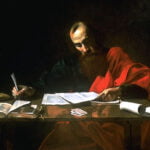
Since talking to Kate, I have discovered that ‘Scripture writing’ appears to be a big thing in the States. You can find more about it at the website of Rebekah Matt; she includes an explanation of what it is and the different ways to do it here, and a discussion between her and a friend who have done it here. I am not sure I have found any men doing it; is this something women enjoy and find helpful more than men? I’m grateful to Rebekah for permission to use the photo at the top, which comes from her website.
 Buy me a Coffee























Absolutely fascinating reading
Yes. I agree and echo much of the experience.
There are a number of resources that help do this, if the prospect of a bible and a blank notebook are daunting. My father picked some up for me before he passed away, and so I have a number of the New Testament letters completed, Luke, John and Acts, and Psalms. I also have my Father’s complete copies of James, Proverbs, and Genesis/Exodus, which are a lovely thing to have received, especially as his penmanship (if not his spelling) was so much better than mine. 😉
It’s an exercise I heartily recommend.
Wow, that is really fascinating! I had not thought of this as a legacy.
What a beautiful article – thanks Kate for this and Ian for spotting the article-to-be-written.
Well done Kate.
“there was something wonderful about reading and writing longer segment”
Ive long been an advocate of reading big chunks of scripture rather than the (relative) dipping that we can end up with. And doing it without a determination to “find something ” or for sermon preparation. It does build up a more coherent picture of the whole thing and, I believe, a better use of the term “this is the word of the Lord”.
Marvellous Kate !
Whether reading, listening or writing the Bible;
“The entrance of your word gives Light”,
it’s not about what we get out of it but what it gets into us.
It puts me in mind of my late teens; I was gifted the Complete Commentary of Mathew Henry, on which I “ cut my teeth”, to this day I marvel at the time and work it must have taken him.
And all with a quill pen, by candle-light and no Concordance!
And still a go to for many today.
Shalom.
The link between writing and thinking/learning is strong, albeit not well known or acknowledged. This is a great idea. I hope that Kate went to commentaries on bits that were hard to understand.
Yes, I am sure you are right.
There’s a growing body of research on this. Writing is not just a communication tool, it’s a powerful cognitive one. Whether through handwriting, thoughtful drafting, or metacognitive reflection, writing helps organise, clarify, and deepen our thinking.
Francis Bacon said it long ago: ‘Writing (maketh) an exact man’ (or woman). It compels us to express ourselves according to the rules of grammar, style and orthography. Outside of mathematics, which is itself a highly organised language and grammar, no system of education which does not require a large body of extended writing making a cumulative argument is worthy of the name of education.
And even simply copying out another person’s writings has great value because you walk in that person’s footsteps and more deeply absorb their thoughts. This must have been the experience of those ancient and medieval scribes who transmitted the Scriptures to us.
The thought occures to me that the Apostles and their teachings
are the Scribes of The Kingdom of God, teaching it’s “laws” through their writtings.
Another aspect of audio listening to the Scriptures is of course the Lectionary Readings to the gathered church.
Originally it is thought that this began in the time of the Restoration of the 2ND Temple; see EZRA.Ch. 10
The current Lectionary is based on a RC Version with 4 passages read each Sunday and high days.
i.e. from the OT, Psalms, Gospels and Epistles.
Perhaps reading all of these was considered too lengthy for modern-day people so reduced too just 2 readings.? In the AC a Semon is preached, usually the Gospel reading, thus limiting or diminishing focus on “the whole council of God”
Such comprehensive reading publicly was a feature of Repentance and the Restoration and flourishing of the Second Temple. Can we learn from this individually and collectively ?
Reading the bible aloud is recommended as another help to
feeding on God.
Two thoughts.
1 At first blush, an enthused, what an excellent idea. Are there any practical suggestions for notebook type and size and paper quality? I might give it a go notwithstanding some infirmity.
2. And then, a party pooper, valedictory thought. Isn’t this a lengthy project in breach of Bible copyright, not to be copied, without permission?
I have written out the New Testament, using various fountain pens. Currently I’m writing out the Psalms again, with Zentangle decoration down the side of each page it’s an excuse to use nice notebooks and pens, plus I enjoy the meditative side of it. I’m very good at speed reading things, so this forces me to slow down and actively consider each word. That said, I have no intention of tackling the whole of the Old Testament. Maybe some of the prophets, one day…
What is ‘Zantangle’…?
It’s a meditative, artistic doodling craft. Patterns that can used in many different ways. Some people create stunning abstract art using the approved patterns (there are thousands now). Officially the art is created on a 91mm square piece of card, but people do their own thing. I use it rather like a Celtic knotwork border would look, but with different patterns. It is freehand, but there’s always the temptation to go for geometric precision. The philosophy is that there are no mistakes, just opportunities for evolving patterns.
“I think for the epistles, this exercise helped me to see them as whole letters. I don’t know if that sounds silly – of course I was already aware they were letters! But reading them in longer chunks somehow enabled them to come together in my mind in a different way”
In the past couple of years I’ve completely changed how I read the epistles because of this observation. It only occurred to me when doing a Bible study with my rector who asked us about what made Psalms different to the rest of the Bible, and my answer was that the individual Psalms were contained ideas that didn’t flow from one to the other. But it made me think that the epistles really were letters, and written to be read as a whole. So if you want to understand a passage you need to read the whole letter to get the context of the argument. Now if I’m pointed to a passage in an epistle, I’ll first sit down to read the whole letter through without stopping (and some people may have noticed I only point to chapters when drawing on Scripture in a discussion, not chapter and verse, for similar reasons).
Aside:
One other aspect of writing out the Bible by hand (no particular spiritual insight just interesting) is that you can go back and see how your handwriting shifts over time as you get more practiced or more tired, or just change and adjust with time. My godmother was part of the team who created the St John’s Bible (a project to create a hand written and hand illuminated Bible for the first time in 500 years), which is also the first Bible where we know exactly who wrote out what section and when, and can see not only how different scribes have subtly different styles (even when following a single laid out design) but how those styles shift for the same person over time.
Thanks. Yes, seeing things written as a whole to be read as a whole (as well as studied in detail) is massive.
Personally, I have found the Readers Edition of the ESV,which omits verse numbers, helps I that regard.
I have read, if recalled correctly, that one well regarded preacher of old read a whole ‘book’ more than 30 times before preaching on a particular passage!
Ah, I only have JB Phillips. That looks like something I want. Thanks
Thanks for this – just come across it today.
We did this in York in 2023 as a city-wide church & schools project – hand-writing the 4 gospels (3778 verses!), with at least 1 illustration per chapter:
https://www.yorkpress.co.uk/news/23977725.king-charles-iii-thanks-school-pupils-york-gospels-2023/
“Children and students from 14 primary schools, three secondary schools and both universities, and others from more than 20 local church and community groups in the city, joined together to write the book”
Individuals found the experience both instructive and moving, as well as it being a great way both of bringing people together within each church and seeing different churches working together.
How fascinating! What a wonderful idea!