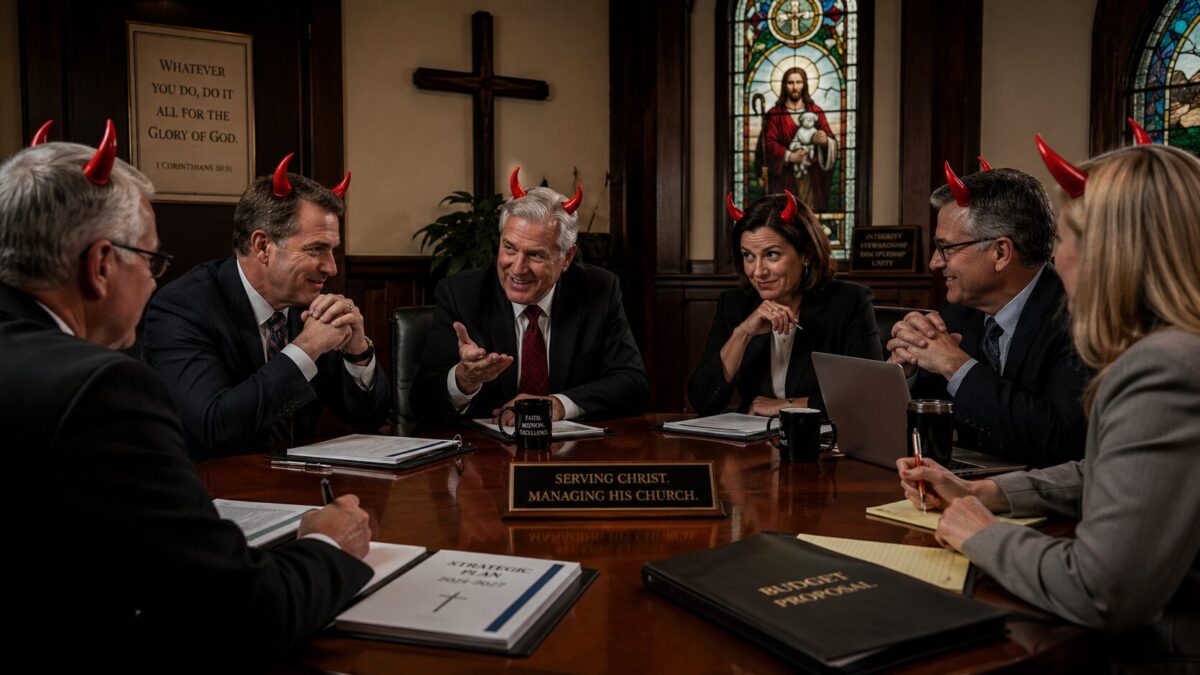
Former Archbishop of Canterbury Rowan Williams has made a rather startling remark about Church bureaucracy. He was in a conversation at Unherd about evil and the demonic in culture—especially “the erosion of standards of truthfulness in public life and the normalisation of violence in word and deed”. And he was also worried about a church “too preoccupied with strategy — with schemes for solving problems — and not preoccupied enough with its own integrity as a community of witness and prayer.” Was this, too, demonic? “In a word, yes”, explaining that the diabolical is a “pull to the destructive and towards a kind of idolatry of the self and the corporate self and its well-being and security and control.”
At one level, I find William’s engagement here very refreshing, in that it takes seriously the spiritual dimension to the realities of the world around us. But his comments also highlight the problems that immediately arise in deploying this language in public debate. The interviewer, Freddie Sayers, challenges him:
The example Lord Williams gave was Pete Hegseth invoking the will of God in the Iran military campaign. I ask him: by using the word “demonic” is he not guilty of demonising his political opponents? He might have said that Hegseth was misguided, perhaps not very intelligent, or making a grave mistake. But to call him demonic is to suggest something different, which is that he is animated by a malign spirit.
“Animated by a malign spirit,” Lord Williams confirms, “which is not necessarily Pete Hegseth. I’m rather old fashioned in believing in the Devil. I actually do believe that there are malign forces in the universe and that people who may not have consciously malign or diabolical designs can be manipulated and exploited by those destructive forces. When I call something demonic, I’m not saying that we demonise any individual — God forbid — but that we recognise the diabolical as an element of gratuitous destructiveness which finds a way in where it finds a leak.”
The danger here is that we really do (almost literally!) demonise those we disagree with, and sidestep the needed rational and reflective engagement. In our current state of debate on social media, I am not quite sure that we need more of this.
I know very well that Williams intensely dislikes bureaucracy and ‘managerialism’; I learnt it from him in personal conversation, but also from observation when I joined the Archbishops’ Council just over ten years ago. The Council then appeared to have inherited a fairly chaotic set-up, and despite significant improvements, I still have major questions about its effectiveness.
To make sense of Williams’ comment, we first need to recognise that there are four kinds of bureaucracy: the necessary; the effective; the needless; and the damaging.
Some bureaucracy is necessary. The Church of England is not a gathered community of the committed; it is the steward of 16,000 parishes, thousands of listed buildings, hundreds of schools, and a legal and financial architecture of extraordinary complexity. Someone has to manage the pension fund. Someone has to sign off on the faculty application for the leaking roof. That is not to say this is all done well at the moment; those administering the bureaucracy often need to be better connected with those affected by it. And there is real scope for simplifying it.
And much of this is driven by where we are as a culture. Safeguarding failures — catastrophic, real, and genuinely evil — demanded new systems and new oversight. Employment law changed. Charity law changed. The expectations of insurers, auditors, and regulators changed. Much of what looks like bureaucratic sprawl from the outside is, on examination, the church trying to behave responsibly in a world that holds institutions to account in ways it simply did not fifty years ago.
I think it might be possible to say that there is something evil in this cultural change—in that it is driven by a lack of trust and openness that was taken for granted a generation ago. But that cannot be said of our response to this culture.
So what of effective bureaucracy? Williams’s critique appears to assume that the structural and the spiritual are necessarily in tension. This is a very Anglican sort of anxiety, but it is not obviously true. The early Methodists were extraordinarily organised. The Catholic religious orders that evangelised medieval Europe ran on rules, rotas, and hierarchy. The Jesuits, arguably the most effective missionary movement in Christian history, were essentially a spiritual army with a chain of command. Structure does not preclude evangelism. What precludes evangelism is a failure of nerve, a loss of confidence in the Gospel, and a reluctance to speak plainly about what the church actually believes. Those pathologies are not caused by having too many diocesan committees (though these might be a symptom). They run much deeper.
The key question here is whether the bureaucracy is serving the goals of the gospel, or hindering them. A common complaint is that the process of application for funds for mission initiatives (from the ‘Strategic Mission and Ministry Investment Board’) is too demanding—too bureaucratic. But the aim of the process is to ensure that those applying have really thought through what they are trying to do, and that this is based on evidence—as all charitable expenditure needs to be. This is a guard not merely against lack of trust, but against our tendency to kid ourselves that we are doing the right thing before we have asked serious questions of ourselves. It is intended to be bureaucracy that serves the mission goal, even if it sometimes fails to do that.
Paul tells his readers in Corinth that ‘I planted, Apollos watered, but God gave the growth’ (1 Cor 3.6). Can we think strategically about our planting and our watering—and still believe that God alone gives the growth? This is where we encounter the possibility of needless bureaucracy, which is closely related to the damaging.
Williams is right that organisations develop interests of their own, that process can become an end rather than a means, and that caution can calcify into timidity. These are real dangers that we need to be alert to. A recent survey of how clergy use their time found that, on average, they spend more time on admin than preparing their sermons. Is that because of an evil culture of bureaucracy, or because clergy are easily drawn from the important to the merely urgent? Or is it a collusion of the two? As I travel around different churches, my impression is that some other denominations seem to be able to engage in mission with much less bureaucracy than the Church of England. What can we learn from them?
The remedy is not to abandon structure, or attack it as demonic; it is to keep structure in its proper place — accountable to mission, transparent in its costs, ruthlessly pruned when it genuinely fails to serve.
And if we are going to prune, perhaps we should begin at the top? Why do we have as many bishops, archdeacons, and duplicate diocesan structures as we had when the C of E was twice the size it is now? Williams is certainly right on one point: we need to be preoccupied with our “own integrity as a community of witness and prayer.” Would appointing bishops who actually believe the doctrine of their own church be a good place to start?
 Buy me a Coffee











CS Lewis in A Preface to Paradise Lost and Screwtape Letters envisaged the devil as a CEO/director type figure.
Ooh! I didn’t know he had written a Preface to Paradise Lost. How long is it and where can I find it, please?
It is book length, in print from William Collins (HarperCollins).
Thank you. I shall order it.
It is refreshingly reader-response. I never thought I would say that, as I do not normally rate reader-response criticism. At the time when he wrote, lit crit was in its infancy, and he was quite different from the other proto literary critics who were often very theoretical. His work breathes appreciation of the poetry and narrative.
Thr founding work of lit crit is generally taken to be Aristotle’s Poetics. He is known to have written a further section about Tragedy which to general frustration is lost, although it involves the ‘catharsis of pity and fear’; scholars have debated the meaning of ‘catharsis’ to this day. The plot of Umberto Eco’s Name of the Rose involves finding a copy of this missing work.
Actually the section was about Comedy, not Tragedy.
Anthony: you can download ‘A Preface to Paradise Lost’ for free from Internet Archive.
A great source of many old books for free.
Yes, I wrote on Aristotle’s Poetics and its ‘battle of epic and tragedy’ for the Gaisford Greek Essay competition in Oxford, 1990.
The great sourcebook is Russell and Winterbottom, Ancient Literary Criticism.
Not much deconstruction or semiotics there, PTL.
James,
Thank you for the reminder. I have read Aristotle’s Poetics in English but a very long time ago.
I know of the IUnternet ARchive but didn’t know that Lewis’s book on Paradise Lost was in the unusual category of being available to read and download freely despite being less than 100 years old.
Paradise Lost does not come alive for me via reading, but hearing it read out by someone who understands metre is stunning.
Well I never. The unmentionable demonic has been mentioned, outed by a senior CoE figure.
And instead of closing it down by centering on structures it is an opportunity open it up, bring it into the light, with a Christian theological piece on the devil and the demonic and doctrine of demons.
Then it will no longer remain ‘unheard’.
In this particular post I think that both are looking in the wrong direction.
The difficulties will not be resolved by tinkering with a said Organisation, better Management, nor will Praying more.
We need focus, in part, on the Organism
St. John rightly says “ The whole world lieth in the evil one” His time is short and he will be even more vile “having great fury.”
God himself pours out judgement on the Nations, Wars and famines etc. See Habakkuk, in the Bible war is often described within the context of preserving a holy people.and what of Num.21 v 14 ?
The demonic was evident amongst the disciples on several occasions, Peter, James and John.
What of the Organism? That would require another post. Suffice to mention in Chapter 3 – The Way of Spiritual Strength” in the Ways of God @ austin-sparks.net/pdf/The Ways of God – T. Austin-Sparks.pdf
Featuring the wars of the Uncircumcised Philistines
and the[organic] Circumcised of/in heart King David, seems germaine to the point. Shalom
.Furthermore; Again many think that they can “see”
all the follies failings and even sins of the “others”
and ever ready to broadcast them.
Jesus said “I did not come to condemn the World but that the world might be saved through me”.
It is heart surgery that is required . Shalom
Here is an opening and closing biblical trajectory. Conflict. Behind enemy occupied territory. (C.S. Lewis).
https://learn.ligonier.org/podcasts/things-unseen-with-sinclair-ferguson/worthy-is-the-lamb
Reality continued. And even here, in our Lord’s prayer:
https://learn.ligonier.org/podcasts/things-unseen-with-sinclair-ferguson/lead-us-not-into-temptation
Indeed Geoff @
May 1, 2026 at 11:38 am Thank you for the links
Looking unto Jesus is much better than hand wringing
and at 11:21 am Often repeated but not often believed.
I am well aware that there are volitional entities without physical bodies that are evil, and are too easily confused with our own fallen spirits. But I reckon that church bureaucracies mostly manage to muck things up without any supernatural help. The difference from the Methodists is in salary and accountability. I don’t think anybody at Church House ever gets sacked for making bad decisions.
The problem is that bureaucracies and hierarchies look after their own interests before they look after the interests of those they are supposedly working for. There weren’t a great many paedophile priests in the Roman Catholic church in Western countries, but just about every diocese had them and essentially every bishop covered up their activities and shuffled these men around or across dioceses instead of reporting them to the secular authorities; there to continue their foul activity. The hierarchy was not useless; it was far worse than useless. I have no reason to suppose this principle is different in the CoE, and I suggest that the attempt in the last 20 years to redefine what the holy scriptures call sin – an attempt strongest in the House of Bishops – emanates ultimately from Satan.
Perhaps all this is why, in the New Testament, there is no hierarchy above the congregation in each town once its founding apostolos had moved on.
Weren’t there elders and other recognised leaders in the early church? Isn’t that a hierarchy?
By ‘above the congregation’ I meant ‘above and not part of it’; apologies for the ambiguity.
What’s going on in the Council of Jerusalem if there’s no hierarchy above the town congregations?
This was a council of apostles, each of whom had authority over the congregations they founded during their lifetime. I dispute that they could (spiritually speaking) – or ever tried to – hand on that authority in any apostolic succession.
How did Clement become bishop of Rome? Why was he writing to the church in Corinth?
There should not be one man as an episkopos. The NT is clear that each congregation is governed by a council of episkopoi.
James – I dunno, but I’m sure that W.S. Gilbert has written a song about it (Clement in all probability rose to the top of the tree on a career path similar to that of Sir Joseph Porter).
It’s not clear that Clement (as such, or exclusively) was writing to the church in Corinth. The letter is often called The letter of the Romans to the Corinthians.
Slightly off subject but I know of churches which strongly believe Christians can be afflicted by demons in various ways, often responsible for health problems. They argue that dealing with the demonic for new converts was the norm in the early church but this aspect is largely ignored now. As is dealing with demonic afflictions amongst current believers.
Comments?
It is a topic on which books have been written, but is unlikely to be discussed on this blog, Peter. And it is another topic that generates a lot of sometimes heated disagreement.
It seems that demonic reality may only be recognized after, but not before conversion.
Although demonic activity may be discussed, and taught, in ‘quasi-church’ healing settings, didn’t the CoE have a Bishop who would get involved in exortisms? In the distant past I recall reading that there would be prayers for deliverance at the same time of water baptisms, but I don’t know whether that is correct.
Baptism & “Deliverence” …It is correct and, if you “know ” can still spot it.
The “Signing of the Cross” comes before the actual baptism, including in Infant Baptism. I think this is that remnant of tackling evil spirits…. though i doubt that many of those present (or dare I say ” administering “) understand this.
Whether it should be is another thing.
Some naive longstanding Christians argue theologically that a demon cannot inhabit a committed Christian. On the basis both of what I have seen and on theological grounds I disagree: I believe the demon can be attached to a person’s old self or sarx, the word inadequately translated today as ‘flesh’. That said, I am wary of trigger-happy Christians who are obsessed with deliverance ministry.
Obviously I must be “naive and longstanding “…. and would theologically disagree with you… or at least your interpretation of things. I don’t have an issue with the niggling on/ damage of some troublesome demonic power but “inhabit” I’m unconvinced. Doesn’t that imply a dualism with the Holy Spirit’s baptised presence in a Christian? Does his presence tolerate a fake lord?
Otherwise I agree that some Christians are trigger happy, seeing demons under every bed and unnecessarily surrendering to their neutered-by-the-cross power. We need not be afraid of this crashing ground foe.
Blessings… Ian
Satan is still able to arrange our bodily death, via persecution. It can be difficult not to be afraid of that when you have a wife, children, etc, even if it applies only to the old self. The Christian attitude is to have stronger faith, and to let your loved ones work out their own faith in fear and trembling. I am not going to disagree with the New Testament, but it is not an easy path.
Does the Anglican Church teach that the Devil is an individual or is the term a metaphor for evil in general?
For what is the official Anglican position, I’ll let our blog host or someone else answer. You can find vicars of either opinion but the New Testament is clear that Satan is a specific volitional entity.
An adaptation of the Calvinist idea of the perseverance of the saints?
rhusai hemas apo tou ponerou
‘Deliver us from the evil one’
we pray whenever we obey the Lord’s command to do so thus.
Presumably we are all, individually and corporately, vulnerable to the predations and corruptions which the devil would inflict upon us, and thus need to appeal for the Father’s daily protection and salvation?
“The key question here is whether the bureaucracy is serving the goals of the gospel, or hindering them. ”
Yes to this. Organisation/bureaucracy is a useful servant but a bad master. It can be disconnected to the people-life of a diocese /parish and appear to believe that growth of the Kingdom is a matter of a management structure “imposed on” rather than “responding to”. That’s not to say the local might need a shake-up or shape- up but, Anglican-wise, the Diocese is the supporting act not the top dog. Too often Christians can be seen as mere resources for the plans of others. It may not be meant but the outcome can be the same… poor ownership at the coal face.
“A common complaint is that the process of application for funds for mission initiatives (from the ‘Strategic Mission and Ministry Investment Board’) is too demanding—too bureaucratic.”
… a common complaint was that the system can be complicated and easier for the middle class to access. It may have changed… may….
The contrast between the Demonic and theSatanic is vast
indeed of a different order.
.Demonic: Evil spirits, Unclean spirits, Fallen angels, Principalities, Powers
Satanic: Adversary, Devil, Ruler of this world, The Tempter, Beelzebul
the Satanic says “Has God said…”
Hi Alan. Do you know if the Anglican Church teaches that the Devil is an individual or is the term used as a metaphor for evil in general?
We need bureaucracy to manage safeguarding, navigate the rules the Church has to deal with and help manage buildings. It also should free bishops and clergy to focus more on their work of ministry. it should not grow too large though and the Parish should always remain the first priority for church funds, both Parish share and centrally. The number of suffragen bishops certainly could be reduced
Gary
No.
Hi Alan.
No, the Anglican Church does not teach that the Devil is an individual (being)?
Gary
In answere to your question I said no, I do not know what the
Anglican position is on your query .
So you believe that when the Christian Scriptures reference “Satan” or “the Devil” it is speaking allegorically of Evil, in general, not an individual with that name. That sounds very rational.
So if Satan/the Devil is an allegory for Evil, how do you explain this passage from the Gospel of Matthew:
Then Jesus was led up by the Spirit into the wilderness to be tempted by the devil. 2 And when He had fasted forty days and forty nights, afterward He was hungry. 3 Now when the tempter came to Him, he said, “If You are the Son of God, command that these stones become bread.” 4 But He answered and said, “It is written, ‘Man shall not live by bread alone, but by every word that proceeds from the mouth of God.’ ”
5 Then the devil took Him up into the holy city, set Him on the pinnacle of the temple, 6 and said to Him, “If You are the Son of God, throw Yourself down. For it is written: ‘He shall give His angels charge over you,’ and, ‘In their hands they shall bear you up, Lest you dash your foot against a stone.’ ” 7 Jesus said to him, “It is written again, ‘You shall not [a]tempt the Lord your God.’ ” 8 Again, the devil took Him up on an exceedingly high mountain, and showed Him all the kingdoms of the world and their glory. 9 And he said to Him, “All these things I will give You if You will fall down and worship me.” 10 Then Jesus said to him, [b]“Away with you, Satan! For it is written, ‘You shall worship the Lord your God, and Him only you shall serve.’ ”
11 Then the devil left Him, and behold, angels came and ministered to Him.
Is this passage allegorical? If so, what clues in the text inform you that Jesus figurately met “evil” in the desert; he never encountered or communicated with a literal being named “the Devil”?
You didn’t read Alan’s answer.
Yes, I misunderstood what Alan was saying. My bad.
Do you know the position of the Church of England on this issue, Peter: Is the Devil a distinct individual or a metaphor for Evil?
“While the Church of England has not officially declared the Devil non-existent in its doctrine, top clergy and liturgical committees have, as of 2014–2015 and in subsequent discussions, moved to treat the Devil as a metaphor or optional concept rather than a literal, personified entity.
The General Synod in 2014 approved changes to baptismal services, which allow clergy to omit traditional vows that require parents and godparents to “renounce the devil and all his works,” replacing them with vows to “turn away from sin” and “reject evil”.”
Source: “The World”, July 15, 2014
-The Church of England unofficially declared the non-existence of witches in 1735.
-The Church of England unofficially replaced the Holy “GHOST” with the Holy “Spirit” in its services and liturgies in the 1960s.
-The Church of England unofficially declared the non-existence of the Devil in 2014.
One has to wonder: Which supernatural being in the Bible will the Church of England unofficially declare non-existent next?
You seem to be doing your utmost her to get Christians to argue with each other.
What spirit is inspiring you…?
The spirit of objective, rational, truth discovery.
You want rational? Look at a mathematical theorem. It begins from axioms and proceeds to consequences using excellent reasoning. But where do the axioms come from?
Imagine the following conversation involving yourself and a Hindu:
Anthony: So you believe in a monkey god (Hanuman). Is that rational?
Hindu: You want rational? Look at a mathematical theorem. It begins from axioms and proceeds to consequences using excellent reasoning. But where do the axioms come from?
Silly, evasive answer, right?
“The Church of England unofficially replaced the Holy “GHOST” with the Holy “Spirit” in its services and liturgies in the 1960s.”
I’m utterly puzzled as to what you think this changes?
He thinks that ‘Holy Spirit’ is a reference to Lagavulin – and that they tried to brighten up the communion services by serving a good single malt instead of alcohol-free wine.
t’s obvious that churches should use red wine or red grape juice (‘oinos’ is not necessarily alcoholic) wherever possible; but the key point is that it be red, like blood, and I’m sure God was okay with red berries in mediaeval northern Russia where wine was unlikely to be available. I despair of churches that serve some golden fortified wine (and hierarchies that think it’s okay).
Anthony – well, of course the hierarchies think it’s OK – because they’re the ones who get to drink it! (I’m thinking of the lovely Vino Santo that they have in Italy – which is fortified and a golden colour. It gets its name because it’s what they use for communion wine – where the laity only get the wafer and the priest has to drink all of it)
Indeed Gary, such is the nature of the Satanic [Yes, has God said?]
Another feature is the subtility of the Satanic from the beginning.
ISAIAH 56 VS 10&11
But “We are not ignorant of his devices” 2 Cor 2:11. Shalom
I personally applaud the Church of England for its (albeit subtle) efforts to discourage belief in the evil supernatural characters of the Bible: witches, warlocks, demons, ghosts, and devils.
Only one evil “character” to go: Hell.
The hope is that Anglicanism will soon abandon ALL ties with the ancient belief that invisible supernatural beings punish/torment humans for their thoughts (beliefs). I and other Free Thinkers will then consider The Church of England innocuous.
Punishment is inevitable when people choose selfishness, even when, as is always part of the picture, that punishment is self inflicted. Surely you agree with that?
Do I believe that humans should be punished for selfishness? Absolutely not. I believe in personal liberty! Humans should only be punished when they injure or violate the rights of others.
An innocuous organisation is pointless, but is obviously going to be liked by those who don’t want to be accountable for their selfish actions.
Promoting peace, harmony, justice, human dignity, and greater well-being for all is not pointless.
What is the outworking of justice to your mind?
We Free Thinkers approach justice through a lens of human reason, secular ethics, and individual autonomy, prioritizing empirical fairness over dogma, tradition, or religious command. Because freethought emphasizes that authority should not be accepted blindly, their views on justice often focus on equality, the protection of rights, and systemic fairness.
Gary:
But here’s the problem for you “free thinkers”:
Absent a belief in a transcendent Judge who establishes the meaning of morality and rewards virtue and punishes evil, you cannot:
1. assert human equality because empirically and manifestly we are not equal;
2. assert that “rights” exist and are not just a creation of our minds (a cultural invention);
3. derive an idea of “fairness” that is universally obvious and agreed.
The trouble with you “free thinkers” is that you haven’t thought hard enough and understood what Nietzsche was saying in “The Genealogy of Morals”. You still have too many residual Christian ideas hanging around in your minds that you are (rightly) afraid to let go of. Read Nietzsche and you’ll understand what I am saying,
Evil, as frequently noted in the field of Christian apologetics, is an impersonal topic, one of the of the realities that atheists have most difficulty with.
The question is: What is evil?
Theists define evil as: Any action or belief that offends our deity.
Free Thinkers define evil as: anti-social and criminal behavior.
(Anti-social behavior refers to actions that harm, distress, or violate the rights of others, ranging from nuisance behavior to criminal acts.)
Gary,
You are not a free thinker, that you think you are, and neither are you a lawyer to distiguish between a crime and a civil case, let alone to engage in jurisprudence, nor discussions relating to the classic question of law v morals. Modernism v postmodernism; absolute, objective v relative, subjectivism. Evidence v opinion. Opinion v opinion. Culture v culture. Philosophy v science v Scientism. Three wise monkeys: do they agree?
To Geoff: The wisest person in the Emperor’s court was not a lawyer, clergyman, or philosopher. It was a small child who refused to be bamboozled by the sophisticated sounding arguments of clever conmen.
-invisible thread does not exist.
-the Devil does not exist.
-humans virgins are never impregnated by (holy) ghosts.
-humans never walk on water.
-brain dead corpses never reanimate to levitate into the clouds.
“A free thinker is a person who forms opinions and beliefs based on reason, logic, and empirical evidence, rather than relying on authority, tradition, religious dogma, or societal conformity. They are skeptics who prioritize critical thinking, who are open to new concepts, often questioning mainstream, religious, or political beliefs to determine truth for themselves”.
–
Gary: real Free Thinkers – and not pale cultural Christians like yourself – understand that “rights” is an absurd idea without any enpirical existence. “Rights” are a hangover from Christian morality (that human beings are made in the imago Dei) and natural law thinking – which is ultimately religious in origin. Real free thinkers – who follow Richard Dawkins and Evolution by Natural Selection- understand that morality is simply an invention of human minds. You are not a real Free Thinker. You are a semi-Christian agnostic with residual Christian ideas, but without a philosophical foundation for them.
To James: The concept of fairness originated in Greek philosophy, which predates Christianity by many centuries. In reality, fairness is a “pagan” concept adopted by Christianity.
“Theists define evil as: Any action or belief that offends our deity.”
Some “theists ” might. But for Christians that’s significantly weak. Evil destroys human beings… that’s the “offending” behaviour… which has consequences in all directions.
Hmm, I wonder if in all this we’re missing a foundation point. We are sinners, yes sinners saved by grace. Grace that is working through the sanctifying work of the Holy Spirit. I’m nearly 80 and have walked (stumbled along?) with the Lord since I was 15. I now realise that the core of Christian maturity is to realise that, yes, I am a sinner and Satan’s assaults are still full-on.
My disappointment when I first read the interview with Rowan Williams was that there was no acknowledgement of the realities of Romans 7. Has anyone ever read a diocesan letter (for example) that has talked of ‘lostness’ and ‘sinfulness’; the need for personal repentance – try reading the BCP pre-communion service folks.
In all when a there’s a gathering for church-stuff there needs to be room for personal and togethering prayer for the Lord’s covering (to use a phrase I haven’t heard for ages). Sorry to be thought judgmental but when a committee of CoE leadership, many of whom just don’t believe in personal sin and coming wrath what out comes might we expect.
Blessings – let’s pray for each other . . . ‘but deliver is from evil’
My
So the sole real world example of “evil” given by the former AoC is Pete Hegseth offering a prayer for victory? As “evil” goes it seems like pretty small beer compared to the violent words and deeds of a certain religion whose adherents, in its latest iteration, have brought unspeakable hell upon thousands of British girls, and abroad to many hundreds of Jewish ones a short time ago, appealing to the example of their Prophet. Similar to the eccentric obsession of some in the US over “Christian nationalism” when actual real world religious nationalism proudly exists worldwide, unabashedly frank about its ultimate goal of global domination. Little question that a favorite tactic of evil (or if you prefer, the Evil One) is sowing confusion in discernment.
Indeed.
John R I suspect that this contribution would, for some, not fit the category postulated above of “rational and reflective argument”!. But it does illuminate issues which evangelical Christianity is studiously avoiding. These topics that you have highlighted, not to mention the virtual omission of open debate on the diabolical treatment of so many of Iran’s citizens at the hands of the regime, serve to remind us of the virtual avoidance of *any* serious debate.
For a variety of reasons, of course, Israel is an easier target to criticize and denegrate. Moreovever , any Jewish citizen of the UK would find a statement on a previous post irritating at least: “”Jesus invites us to become part of ‘the multinational Israel of God’ to which the OT points in anticipation .”
Colin,
I really do wonder who you think Jesus is, and his place in the Protestant canon of scripture let alone what salvation is and who achieved it, in the Triunity of God?
The Gospel of Jesus is offensive and glorious at the same time.
Well of course a Jewish person may find that irritating as many are very insular, but that doesnt make the statement false.
But Iran must not be allowed to develop a nuclear weapon as the current regime WILL use it against the land of Israel. Their purpose is to destroy Israel and create chaos around the world (hence its worldwide terrorism), to usher in the time of their 12th Imam. Some conflicts are justified. As is this one.
Peter – I’d recommend Peter Oborne’s book ‘A Dangerous Delusion: Why the West is Wrong about Nuclear Iran’ (which is short, to the point and you can easily get it on kindle). There are several points of interest: Iran claimed that they didn’t want to develop a nuclear weapon and, indeed, the previous Ayatolla chappie (the one whom the Americans killed) had declared a fatwa against nuclear weapons (they’re usually serious about their fatwas). In the non proliferation treaty (which Iran claimed they were adhering to) there is provision for enriched uranium for peaceful purposes (i.e. developing nuclear power).
More generally: if Iran has a regime that the UK/USA don’t like very much then it’s actually their own fault. There were free and fair elections back in 1951 which led to a government that wanted to nationalise their oil industry (and ensure that the profits went to Iran rather than BP). The Americans (encouraged by the British) intervened and replaced the government with a corrupt Shah – which was a recipe for disaster – and for the revolution which led to Ayatollah (don’t) Khomeni (closer) etc … etc …
I’m just picking up bits and pieces here and there – and I always found Peter Oborne reliable when he wrote for The Telegraph.
Another book I enjoyed about Iran: Michael Axworthy’s book Iran: Empire of the Mind and I think his perspective is worth taking on board. He corroborates what I read in Peter Oborne’s book about the promising democratically elected government getting kicked out by UK/USA because they were threatening to take back control of their own oil.
Some Iranians in our church in the UK want to see a return of the Shah’s family and they are upset that the church is not engaging in a political stance, though we have one senior Iranian who held a senior position in the Iranian military, decades ago before conversion, whose cause for life is now propogating the Gospel, in the public and education and care sectors, not the politics of Iran. He is very clear over the difference between Christianity and Islam
Good to see you back here Jock.
But I wouldnt believe much the Iran regime says, just as I rarely believe what the Russian regime says. So Iran claiming this, that or the other is pretty meaningless. Until this recent conflict, it seems no western military expert knew that Iran already had missiles capable of travelling as far as the UK. They were all shocked. What other secrets is Iran keeping?
Yes western governments can act selfishly. I suppose all governments do that. And Iran is now using oil as a bargaining tool so that the US stops the conflict. But that is worth the price if it means Iran is incapable of developing its own nuclear weapons. It hasnt allowed the IAEA inspectors in for a number of years. For civil purposes you only need uranium enrichment of 3-4%. For medicinal, about 11%. Yet the head of the IAEA recently said they believe Iran has already enriched to at least 60%, well on the way to weapons-grade. Why? It seems to me their purpose is obvious.
Geoff and Peter – yes, from what I read in Michael Axworthy, Iran (i.e. the population at large) is extremely secular. Attendance at Friday prayer seems to be almost non-existent (he quoted 1.4 percent). It seems ripe for a Christian spiritual awakening.
(Axworthy also points out that Iran isn’t Arab in any meaningful way – the mentality seems to be quite different).
I can understand that some Iranians might like to see the return of the Shah, because the current regime is so awful, but two wrongs don’t make a right. (Think: people in the UK were utterly disillusioned by the corrupt Conservatives, so they gave Labour a thumping majority – and now they discover that Labour is worse). Again, from Axworthy’s book, it’s useful to read about the developments in the 1960’s and 70’s which led to the Shah being deposed. Unfortunately (as is always the case) when there is violent revolution and the people are worked up into a frenzy of indignation, you don’t expect the ‘good guys’ to feature and take control.
I get the impression that the country may well have been heading in the direction of regime change, until the Americans started bombing them – and then suddenly people who would never have dreamed of supporting the Ayatollah and the current regime find themselves closing ranks. The other thing is the very unhelpful sanctions that have been imposed against Iran, which are designed to hurt ordinary Iranians – and which give the regime an excuse for bad economic performance.
The trouble is that the UK and USA have behaved so abominably that it is very difficult to see how anybody from Iran is going to take seriously any witness by anybody from the UK or USA. So any missionary work and Christian witness is going to have to come from elsewhere.
The Iranian regime may be bad, but it’s not nearly as bad as other regimes in the region that the UK/USA seem to be supporting – the difference being that the other regimes co-operate in terms of oil policy etc …. so I’m not really prepared to swallow the line of government-friendly media (e.g. bbc, Times, Telegraph, Guardian) and I reckon that Peter Oborne is more trustworthy.
Jock, the idea that Iran wants a nuclear program to generate electricity, given that the country is awash with oil which you can burn in power stations much more cheaply, is delusional.
Radioisotopes for medical use are by comparison negligible in amount, and inexpensive.
Does Oborne (or can you) address this point?
I recommend the YouTube channel of Iranian ex-pat Mahyar Tousi for information from inside Iran about what the people think. He is secular.
Anthony – no – Oborne doesn’t address this point at all – his concern is international law, what it states, who is adhering to it – and who isn’t.
I think it was Thatcher (of all people) who once pointed out that international law may be deficient, but it’s all we’ve got and disregarding it is something we do at our peril.
But Oborne does take the fatwah against nuclear weapons, issued by the Ayatollah, very seriously.
I’ll look up the youtube channel you point to – and many thanks – because my current source of information on Iran is Michael Axworthy’s book – and informed and interesting though he is, the name doesn’t exactly look Persian – I’d like information that isn’t filtered through ‘Anglo-Saxon’ eyes.
Anyway, he goes deep into the history of the country and takes the view (based on centuries of history and culture) that the current regime doesn’t sit naturally with the Iranian psyche – which would be much better adapted to a much greater level of religious tolerance.
I’m rather sceptical of the notion of ‘international law’. There are only international *treaties* and their signatories. When I hear talk of ‘international law’, I ask which code of law passed by what body, and who it binds under what agreement. Questions to which there are well-defined answers for national codes of law.
I consider it possible that the late Ayatollah Khamenei was lying about not developing a nuclear weapon. People mysteriously seem to think that national leaders don’t lie. But in Islam, the practice is called kitman or taqiyyah. To repeat my point: why would Iran want a peaceful nuclear program to generate electricity, given that the country is awash with oil which you can burn in power stations much more cheaply?
I believe that Iran is suffering population decline and is witnessing the closing of many mosques. Its people are largely secular but seem unable to challenge the Shi’ite Twelver sect that grips power.
The earliest scenes in the Book of Genesis seem to have taken place in Iran, and the Persians played key roles in the histories of both Athens (as baddies) and Jerusalem (as goodies) – the twin roots of Western Civilisation. I would absolutely love to visit the place as a history tourist and pay my respects to an ancient and influential people. What do you think my odds are?
Anthony – ha! well, if you’re going on a fact-finding mission about what life is like inside an Iranian jail – and you want to spend a lot of time there to do meticulous research, then probably a very good plan – otherwise I don’t think I’d recommend it.
The rulers seem to be of questionable sanity – and they seem quite trigger-happy about locking up people with UK passports who have gone there for a spot of tourism ….
(Mind you, not the only country on the planet – not by any means – with rulers of questionable sanity ….)
British businessman Roger Cooper arrived home in spring 1991 after five years in prison in Iran on trumped-up charges of espionage. Asked what kept him going, Cooper replied: “Anyone who, like me, has been educated in an English public school and served in the ranks of the British army is quite at home in a Third World prison.”
John Rogitz – is the ‘certain religion’ you write of the one that Jeffrey Epstein, Peter Mandelson and Andrew Mountbatten-Windsor subscribe to? (bringing ‘unspeakable hell’ upon thousands of girls)
Re reading this post;-
I do find the general tone of the post rather disappointing.
The solution to this particular Anglican dilemma seems to be change everything, have less but better overseers’ [ who know the difference between the Satanic and the Demonic?] Pray more[harder?] and Organize better. evangelise more.
Why would God trust His precious souls to so dysfunctional a house ?
It may seem commendable to contend for and defend one’s Denomination but indicates for me a low theology of The Church.
In vogue at the moment are initiatives to “Listen to God”; all very commendable because God is always speaking [“My sheep hear My Voice”]
However Jesus counsels in Mark 4:24
“Take heed how ye hear: with what measure ye mete, it shall be measured to you: and unto you that hear shall more be given.
Pay attention, wake up, sit upright [AK version]
How you respond will depend on whether your hearing will improve overall.
What is the Church for? The clues are in Ephesians.
Or see “The Goings of God” Intro. and Chapter One
@ austin-Sparks.net/english/books/goings_of_god_the.html
Shalom.
Earlier I posed the question “what is the Church For”?.
Many can see the deficiences of Churches [the negatives] but
“What then is the Glory of the Church”? [the positives]
How is the Church being built up and edified as opposed to the
“foolish woman who pulls down her own house” who is clamourous and nieve.
I mention Tom Austin-Sparks book The Goings of God quite simply because his grasp of the positives is phenomenal’
See chapter 3 of that book where he covers the purpose and glory of the church from the book Revelation . If there is a better expositor capable of edifieing the Church I have yet to meet him/her.
Shalom.
“Why do we have as many bishops, archdeacons, and duplicate diocesan structures as we had when the C of E was twice the size it is now?”
My mantra for years.
The reason: Who makes the decisions? The hierarchy.
They won’t vote to make themselves or their friends redundant, so nothing will happen until bankrupcy looms and panic sets in.
I live in Liverpool diocese. We could easily combine Liverpool, Manchester and Blackburn, with one diocesan and a few suffragans plus one central office. It won’t happen in my lifetime.
I write this having spent part of yesterday’s Bank Holiday catching up with some admin! The truth is that I am all-too-often one of those clergy who spends more time on admin that preparing a sermon each week. But then, like many, I have no administrator. Last year, our diocese did a survey of clergy well-being. A number of the responses to that expressed the desire for more support with admin. Of course, some churches are able to provide such support, but most aren’t.
And it isn’t just clergy who struggle with growing administrative demands: lay leaders are weighed down by it too. Treasurers, in particular, have to deal with ever-growing complexity in dealing with banks, and I know wardens who have just stopped reading the e-mails from the diocese because they feel overwhelmed by them.
I recall a conversation with a bishop some years ago in which he expressed concern that the growing requirements of compliance with legislation would sink some parishes. I fear he may end up being proven to have been right.
(a continuation of a conversation thread above)
Democratic secular humanism does not appeal to an ethereal moral code. We believe that morality is a human construction. We believe that the best moral standard is based on respect for the individual human, promoting his/her ability to flourish, limited only by the principle of respecting the flourishment (happiness) of others. Finding that balance is not always an easy task.
Rights are a human creation.
Rights *are* a creation of the human mind.
Ancient (pre-Christian) Greek philosophy is the origin of the concept of fairness, not Christianity.