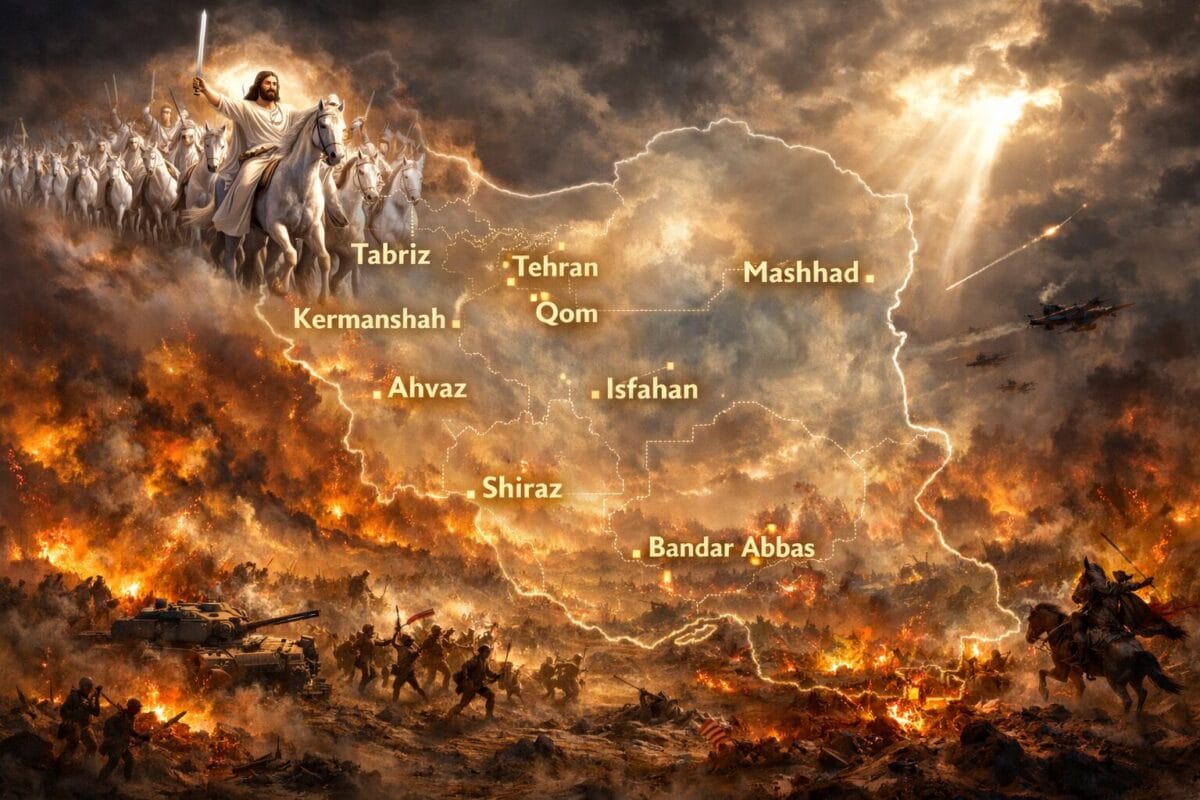
It has been reported that US troops have been told that the war in Iran is the beginning of the final Battle of Armageddon that will lead to the return of Jesus. It has come out through complaints made to the Military Religious Freedom Foundation (MRFF):
One complainant, identified as a noncommissioned officer (NCO) in a unit that could be deployed “at any moment to join” operations against Iran, told MRFF in a complaint viewed by the Guardian that their commander had “urged us to tell our troops that this was ‘all part of God’s divine plan’ and he specifically referenced numerous citations out of the Book of Revelation referring to Armageddon and the imminent return of Jesus Christ”.
Important correction here: The ultimate source of this is UNlikely to be Pete Hegseth, the US Defence Secretary, who is a member of the conservative Communion of Reformed Evangelical Churches. The reason why there is likely to be little connection is that I understand that CREC takes a postmillennial view of Jesus return. For more on MRFF, see the comment of John Rogitz below.
So, could the current conflict be connected with Armageddon, the return of Jesus, and the end of the world? The short answer is: no.
But it is worth exploring a longer answer. To do this we need to know: what is Armageddon? Why do some people connect current events with this idea in the Book of Revelation? Why is the Book of Revelation susceptible to these kinds of readings? What does it actually teach about the return of Jesus?
‘Armageddon’ is mentioned once, in one verse of the Book of Revelation—which is in itself remarkable. The idea has a grip on both the popular imagination, and in certain Christian circles, out of all proportion to its presence in Scripture. This illustrates the remarkable power and influence that the Book of Revelation has had both within the church and in the wider world—which is why we actually need to engage with it.
The context of its mention is in the bridge between the sixth bowl judgement and the seventh in Revelation 16. The three sequences of seven—opening the seven seals in chapter 6, trumpeting the seven trumpets in chapters 8 and 9, and pouring out of the seven bowls in chapter 16—all appear to run in parallel; they share points of structure, and they all conclude with the End of the World in the seventh of the sequence.
Here is the text about the sixth bowl:
16.12 The sixth angel poured out his bowl on the great river Euphrates, and its water was dried up to prepare the way for the kings from the East. 13 Then I saw three evil spirits that looked like frogs; they came out of the mouth of the dragon, out of the mouth of the beast and out of the mouth of the false prophet. 14 They are demonic spirits that perform signs, and they go out to the kings of the whole world, to gather them for the battle on the great day of God Almighty. 15 “Look, I come like a thief! Blessed are those who stay awake and keep their clothes on, so that they may not go naked and be shamefully exposed.” 16 Then they gathered the kings together to the place that in Hebrew is called Armageddon.
John often transliterates from Hebrew to Greek in the text of Revelation; his transliteration of the Hebrew term Hallelujah (‘Praise Yahweh!’) in Rev 19.1 is the only reason that you know the word. (Others are Amen, Abaddon in Rev 9.11, and Satan.)
The word is a Greek transliteration of the Hebrew har Megiddo, meaning ‘the mount of Megiddo’. Megiddo was one of the pre-Israelite cities in Canaan, and one that the Canaanites held on to during the settlement of the land (Judg. 1:27), and it was associated with Deborah’s victory over Israel’s enemies (Judg. 5:19). It became one of Solomon’s fortified cities (1 Kings 9:15) because of its strategic location adjacent to Mount Carmel on the south side of the Jezreel valley, a frequent site of battles because of the large open plain extending north from Megiddo and the strategic route that ran along the valley from the Jordan to the Mediterranean Sea. Solomon appears to have stabled horses there, suggesting it was used for cavalry and chariots, and the age of the city meant that it was built on an artificial tel or mound created by previous generations of building. Jezreel (and Megiddo with it) became proverbial for decisive battles that could destroy kingdoms (2 Kings 9:27; 2 Chron. 35:22; Zech. 12:11) and that is its significance here.
So why would anyone in the modern world think that John is writing, 2,000 years ago, about events in our time—the distant future for him?
 There have been four main approaches to reading Revelation: ‘idealist’, which sees the text as teaching timeless truths about God; ‘preterist’ which sees the text as only teaching about John’s immediate context, and nothing more; ‘church historical’, which reads Revelation as depicting all of history since Jesus came; and ‘futurist’, which sees it as talking only about the last few years before Jesus’ return—which of course is the time of the reader. (No Christians have ever thought that they were in the middle of history, and that the coming of Jesus was going to be hundreds of years hence…!) (For more detail on each of these, see the Introduction: 12: Approaches to Revelation’s Interpretation, pp 48–51 in my Tyndale Commentary.)
The reading suggested by the claims about Iran and Armageddon comes from a particular outlook known as Dispensationalist Premillennialism. Renewal of a belief in a literal thousand years came with the complex dispensational schemes created by John Nelson Derby around 1830, one of the founders of the movement known as the Plymouth Brethren. This approach takes a strictly futurist view of Revelation, and within it there are different schemes to relate the seven-year period of ‘tribulation’, the rapture of the saints (in effect a secret first coming of Jesus involving believers being taken up to heaven), which might come at the beginning, in the middle, or at the end of the seven years, and the final return of Jesus. The difficulty with this reading is that it does not attend to John’s use of the language of ‘tribulation’ (suffering), it attempts to take the text literally but often reads it allegorically, and it imports misreadings of Paul (in the form of the ‘rapture’) into Revelation’s text. It is, nevertheless, one of the most widespread approaches within Protestantism globally.
There are many problems with this approach to the New Testament in general as well as the Book of Revelation. For one thing, ‘tribulation’ is something that all followers of Jesus will experience; it is not an ‘end times’ period of seven years (this is mentioned nowhere) which Christians will escape from. For another, the ‘rapture’ is not taught at all in the New Testament! And all the writers of the New Testament appear to believe that ‘the end times’ began with Jesus’ ascension and the sending of the Spirit at Pentecost; Peter says this as the beginning of his speech in Acts 2.16:
No, this is what was spoken by the prophet Joel: “‘In the last days, God says, I will pour out my Spirit on all people…
(For a fuller explanation of all these ‘end times’ issues, see my Grove booklet Kingdom, Hope and the End of the World.)
But there are specific reasons why Revelation itself resists this kind of ‘futurist’ reading, and cannot be a prediction of specific events in our world.
First, John locates himself very specifically in relation to the people he is writing to. He is their ‘brother and companion in tribulation…’ in Rev 1.9. He names the seven cities he is writing to, and when passing on the messages from the risen Jesus, consistently names them in the order that you would visit them if travelling in a circle, clockwise, on major trade routes. These are real people in real cities facing real situations in their world, not symbols of future ages for reading by distant people John does not know. And the messages—and the whole of Revelation—is saturated with allusions to features of their world.
Secondly, John actually locates himself and his readers in the ‘end times’ between the sixth and seventh seal, between the sixth and seventh trumpets, and between the sixth and seventh bowl, by his use of the term ‘woe’. The word comes 14 times in Revelation (and John composes this text very carefully; lots of words come with special frequencies like this); the first seven come in the announcement of the three woes in Rev 8 and 9, and the last six come in the mourning of the kings of the earth, the merchants, and the sea captains at the destruction of Babylon in chapter 18.
But the mention by the eagle of the three woes in Rev 8.13 creates a mystery. The first ‘woe’ is the trumpeting of the fifth trumpet; the second ‘woe’ is the trumpeting of the sixth trumpet; but the third ‘woe’ is never announced. Some commentators follow this sequence, and claim that the third ‘woe’ must be the trumpeting of the seventh trumpet—but John does not say that, and it cannot be so since this signals the rejoicing that the kingdom has finally come (Rev 11.15).
The only other mention of ‘woe’ comes in Rev 12.12:
Therefore, rejoice, O heavens and you who dwell in them! But woe to you, O earth and sea, for the devil has come down to you in great wrath, because he knows that his time is short!
This is the time when Jesus has won the victory by his death and resurrection, and Satan has been dethroned—in other words, the times since Jesus first came.
Thirdly, and decisively, at the end of John’s prophetic, apocalyptic letter, he records a final command from an angel:
Then he [the angel] told me, “Do not seal up the words of the prophecy of this scroll, because the time is near.” (Rev 22.10)
What does this verse mean? It cannot be read in isolation from the parallel verse in Daniel 12.4 and 9–10:
But you, Daniel, close up and seal the words of the scroll until the time of the end. Many will go here and there to increase knowledge….Go your way, Daniel, because the words are closed up and sealed until the time of the end. Many will be purified, made spotless and refined, but the wicked will continue to be wicked. None of the wicked will understand, but those who are wise will understand.
(We can see the allusion to Daniel 12 in Rev 22 by the echo in 22.11 of the phrase from Daniel ‘the wicked will continue to be wicked.’)
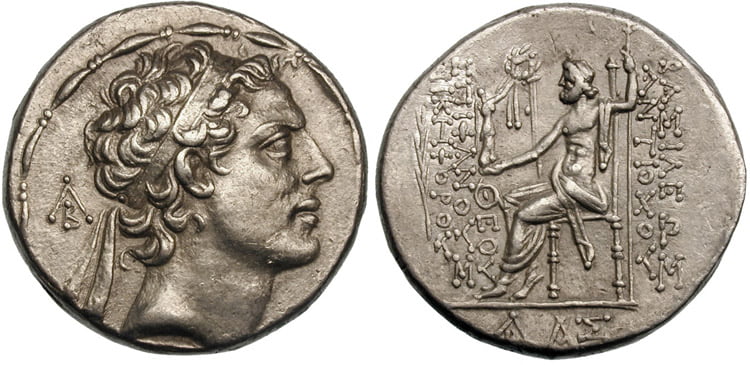 What does this mean? In Daniel, the stories are set in the sixth century BC, with Daniel in exile in Babylon. But most commentators agree that the stories refer to the Antiochene crisis in 167 BC, when Antiochus IV Epiphanes sacrificed unclean animals in the temple, and event which led to the Maccabean revolt described in 1 and 2 Maccabees. Some scholars would see this as vaticinium ex eventu, a literary device where Daniel appears to foresee what is to come, though the text is actually written in the second century. Others would see it as an ‘authentic’ predictive text, where the second-century BC future was revealed to sixth-century BC Daniel. But either way, the point is that the events being referred to are many years after the setting of the story being told. Hence the words of the vision must be ‘sealed’ (in this case for around 400 years), until they become relevant to the readers.
What does Rev 22.10 then say? The exact opposite. The words of John’s vision report must not be sealed; the events being referred to are not many years after the setting in which John is writing. The beast of Rev 13 is not some future, eschatological figure who will come many centuries hence, but (in the form of Roman Imperial power) is already demonstrating his strength.
Revelation is deeply relevant to us, since John is offering a worked example of how to remain faithful to Jesus in an alien culture and live well in the light of the certain hope of his return. But it is not relevant to us because it is ‘predicting’ our age. It is written for us, even though it is not written to us.
(If you want to know how every age for the last 2,000 years has managed to think that Revelation was written to them, the key is in the nature of Revelation’s metaphorical language, which I explore here.)
So what does the language of Armageddon in Rev 16.16 actually tell us about evil, God’s victory, judgement, and the end of the world? Three vital things!
First, there is a strong sense in which the three sequences of seven seals, seven trumpets, and seven bowls feel as though there is an intensification of the depiction of the evil there is in the world, and the need for God’s judgement to come. It is fascinating to see, then, that within the bowls sequence there is a sudden and unexpected interjection about the nature of judgement and God’s response to evil:
Then I heard the angel in charge of the waters say: “You are just in these judgments, you who are and who were, the Holy One, because you have so judged; for they have shed the blood of your people and your prophets, and you have given them blood to drink as they deserve.” And I heard the altar respond: “Yes, Lord God Almighty, true and just are your judgments.” (Rev 16.5–7).
In other words, however we read the judgement language in this book, if we do not read it as an exercise of God’s justice and his just judgements, when we have read it wrong.
In relation to Iran and the current conflict, we must therefore turn to Christian Just War theory in thinking about this conflict. Is the conflict in pursuit of a just cause, as a last resort (Jus ad bellum)? Is the combat being pursued in a just way, seeking to minimise non-combatant casualties, and avoiding unnecessary collateral damage (Jus in bello)? And will it lead to a just peace (Jus post bellum)? Note that it is the Book of Revelation itself which presses us to ask such questions!
Secondly, when Jesus comes, and God does hold evil to account, restore all things, renew the creation, and come to comfort his people—we will have no warning at all. In the verse immediately before the mention of Armageddon, Jesus himself appears to interject into the text:
“Behold, I am coming like a thief! Blessed is the one who stays awake, keeping his garments on, that he may not go about naked and be seen exposed!” (Rev 16.15).
Most English translations add the inverted commas, since this interjection is out of sequence with what John is writing.
It is almost as if Jesus himself is anticipating that, years hence, some people will misread this language, and think that some powerful individual will be ‘anointed to usher in Armageddon and the return of Jesus’. No, says Jesus, you cannot do that—because I will come at a time that no-one expects!
And this is exactly what Jesus himself teaches in Matthew 24. Having talked about ‘this hour’ of the destruction of Jerusalem in AD70 (up to Matt 24.35) he then turns to discussing ‘that hour’ of his final return. And his message? ‘Nobody knows!’ There will be no signs, no warnings, no ‘end times countdown’. The master who has gone away will come back ‘at an hour they do not expect’ (Matt 24.50) and our only job is to keep busy with the work of the kingdom, serving others and proclaiming the good news of Jesus.
Thirdly, what is most striking about Armageddon in Rev 16.16 is that there is no battle! The text moves immediately on from the assembling of the forces of evil to the return of Jesus, and all we hear is ‘It is done!’ (Rev 16.17). Evil vanishes as quickly as darkness disappears when we pull back the curtains in a room to bring in the daylight.
The same is true in the recapitulation of this in Rev 19.11–21, in the vision of the rider on the white horse. There appears to be a battle, as Jesus comes with the ‘armies of heaven’ to confront the nations who have followed the beast. But no battle is described! The victory is instant! And the weapon Jesus wields is not one of violence, and is not in his hand; it is the word of truth that comes from his mouth. And John is quite explicit about this:
And the rest were slain by the sword that came from the mouth of him who was sitting on the horse, and all the birds were gorged with their flesh (Rev 19.21)
As I note in my commentary: It is striking that the rest, which refers to the human participants of the kings and their armies, do not suffer the destruction that is meted out on the imperial system symbolised by the beast or the structures of local power symbolised by the beast from the land/false prophet. Though they are killed with the sword coming out of the mouth of the rider, this cannot refer to actual death, since the kings of the earth return in 21:24 to bring their splendour into the holy city, and the nations who were deceived by the beast ‘will walk by its light’. As with the false teachers in Pergamum (2:16), this war is a polemical battle for truth in which the one who is Faithful and True will always triumph. To be left unburied with the birds consuming one’s mortal remains was thought to be the ultimate indignity (Deut. 28:26; Jer. 7:33) but this too must be symbolic. The false beliefs into which the nations were deceived will not be afforded even the dignity of a decent burial.
Whatever we make of the violent imagery in the Book of Revelation, one thing we can be clear about: it is not with the weapons of war or the will of those waging it that we will see the return of Jesus.
 He will come when we do not expect it, and when he does, heaven will come to earth, and God will be present with his people. Evil, violence, and oppression will end, and God will be with us, to wipe every tear from our eye.
And I heard a loud voice from the throne saying, “Look! God’s dwelling place is now among the people, and he will dwell with them. They will be his people, and God himself will be with them and be their God. ‘He will wipe every tear from their eyes. There will be no more death’ or mourning or crying or pain, for the old order of things has passed away.” (Rev 21.3–4)
If you would like to engage with Revelation better in a small group, then alongside my commentary and my Grove booklets you might be interested in this six-session group study guide I wrote for IVP and LICC.
 Buy me a Coffee











(At the time of this comment, I’m not sure what is happening at the end of the post! Are you “still writing” it?)
Yesterday Facebook was kind enough to put in my feed something from Benjamin Cremer (who I had not come across before) making basically the same points that you are. For instance, he says “Revelation is not a coded forecast of 21st-century geopolitics”, and points out that although the kings gather, there is no battle.
An interesting phrase follows this: Revelation is written “in the prophetic genre of apocalyptic resistance literature”. By prophetic, I assume he means that it is not the prediction of events in the (distant) future, rather, in the words of Jonathan Sachs, “words from God through men.” It is the use of “resistance”. I wonder how other examples of the rather loose genre can be regarded as writing about resistance under conditions of oppression.
And, having made my comment, I see your post has grown!
Yes. I finished writing at 9.05, but published it earlier in order to ensure that it was sent out to my email list on time!
Clearly prophetic- hopefully not apocalyptic!
Yes, I have seen Cremer’s comment too. How weird that I have never come across someone with 120k followers, who is writing on Revelation! Oh well.
(He does not appear to have published anything in book form on this though. Appears mostly to do podcasts.)
It is astonishing – however, mainstream scholarship also under-represents preterism, which is accordingly over-represented on the web, including some quite scholarly work.
Also, I agree that the term ‘prophetic’ is often misunderstood, and needs clarification.
Brilliant.
I have seen a number of people making this point, but I would draw particular attention to the work of Helen Paynter, director of the Centre for the study of the Bible and Violence (the CSBV) who made a similar post earlier this week.
https://www.csbvbristol.org.uk/2026/03/03/armageddon-the-bombing-of-iran-and-the-irresponsible-use-of-revelation/
It is good to see scholars and writers from across the traditions condemning such irresponsible use of scripture.
Mat
The Roman troops wintered in Caesarea Maritima throughout the Jewish War, and were also based there while Vespasian was awaiting military advice from Rome from the succession of Nero’s successors. Hence they spent most of their time there.
Christians were concentrated elsewhere and rumours spread about what the Romans could be up to, or planning, there. Rumours partly involving cahoots with the kings from the East. The propinquity of the valley of Jezreel, quintessential scene of OT massacres, will not have escaped speculators.
Thank you; this is a very apt piece, not because of current events themselves but because of some seriously misleading ideas emanating from some Christian sources in the light of what’s happening. In reality we are seeing at least a temporarily enlarged geopolitical expression of exactly the same lust for power and money which has plagued humanity since the fall.
We Christians really do need to ask God for wisdom (and he will give it!) when discerning what should be our understanding of and reaction to serious events whether they be local or global. I doubt that those reactions should ever include surprise, hysteria, or support for any suspension of justice.
And drawing attention to ‘our only job… to keep busy with the work of the kingdom, serving others and proclaiming the good news of Jesus’ is surely exactly right.
Hello.
Your words are encouraging, but I think your reading of where we are right now in the progress towards the End Times is wrong. So, too, would be that of Hegseth and others like him… but all that in good time.
For the moment: A number of remarks.
Firstly, I have a strong disagreement with those who regard any kind of apocalyptic prophetic Scripture as belonging to a ”tradition”. Particularly, the Revelation given to John sat in rarified company: with only the Book of Daniel, and some select utterings of the Kingdom-era prophets that had been committed to posterity. If there were some hagiographers or pseudo epigraphists who, later, emulated the nature of John’s Revelation, then such persons are / were guilty of ”’adding to” that which God had decreed. As such, they ought to be ignored. Conversely, those legitimate prophets who spoke and wrote beforehand paid the price for their loyalty: most of them were martyred, and their words – when fulfilled – were revered as truthful. What are you saying, Mr Paul, that there aren’t person who God has chosen to reveal the future to Mankind? Only persons who just write ”encouraging” literature to help fellow believers get through tough times? Just because there are liars… however pious they might want to be… doesn’t mean that weren’t and aren’t legitimate vessels who speak the words of the events to happen in the future.
Which brings me to another point: There is a vast difference between ‘tribulation’ and THE Tribulation. John’s words in Revelation weren’t just a bunch of encouraging ‘feel good’ utterances, which he claimed were given to him by Jesus. That would be blasphemy. He was given them as a distinct set of statements that were to transcend the centuries between his time, and that of the End Times. They weren’t just ”prophetic” in the sense of ”here’s something to encourage the body of believers”, but ‘prophetic’ in the sense of ”here’s something that you will struggle to understand… just as Daniel struggled… but are to stand as testament that God does not do anything unless he reveals it to his servants first.”
Your interpretation… one that verges on the Preterist, and could be in danger of having the smell of Supersessionism about it… is wrong. Plain wrong. The time frame that John presents, for a start, doesn’t jibe with the audience’s experiences. The Revelation to John was given around the year 95 AD. While Domitian did indeed persecute the church, with intensifications of that by the end of his reign in 96 AD, by the time the text reached what is presumed to be his intended audience (the 7 churches of Asia), the persecutions would have already been dwindling or over. So why all the stuff about Seals, and Trumpets and Bowls? Surely it would have been sufficient to merely say: ”Hang in there: Jesus loves you. He warned you about this kind of thing, so don’t be surprised.” ?
Next, you claim: ”the ‘rapture’ is not taught at all in the New Testament” That is simply downright wrong. Please spare us all the ‘The Word Rapture Is Not In The New Testament’. Neither is the word ‘Church’. It was written in Greek, for a start. We’re not that stupid, and we won’t stand for such a blatantly wrong remark. The Apostle Paul most certainly speaks of a ‘mystery’ where a certain generation would be ‘caught up’ to be with Jesus… Caught up in a way that distinguished it from all others before and in his own time. Paul made the error that he thought it would be his own generation. In this, he was not alone. Most of the Apostles also thought that, too. Indeed, most of the Apostles still didn’t realise that when Jesus answered their question: ”Will you at this time restore the Kingdom to Israel?” with ”It is not for you to know the times and occasions”, that He was informing them that there had been a pause on the progression of the 70 Weeks prophecy as given in Daniel. Daniel: a prophet whom Jesus spoke of as authoritative. I’d hazard a guess that most people, including many Christians, still don’t get it: We are living in a Grand Hiatus of the progression of those 70 Weeks. Jesus indeed died (and rose again) at the end of the 69th Week, as prophesied, and the Apostles thought there’d be another 7 years immediately following. That there was ”delay” in those years, didn’t detract the early Church from thinking that there was indeed a final reckoning to come… a time of all the horrors that Jesus had foretold in the Olivet Discourse. Those horrors did NOT come with the destruction of Jerusalem. Otherwise, why else would John be bothered to produce the Revelation which he claimed was the very words of Christ Himself? The only answer is obvious: Jesus was informing the Church that the Times of The Gentiles had ensued. The 70 Weeks allocation of years for God’s fulfilment of His promises to the Jews, as given in prophecies given to Daniel, would indeed eventuate: but not yet. Any Jewish believer in Christ at John’s time would have (eventually) worked that out, the moment they realised that the duration of the Tribulation of which John speaks, is exactly the Final Seven Years as spoken of for Daniel.
Your other claim, regarding the chronological context of the Book of Revelation: ”No Christians have ever thought that they were in the middle of history, and that the coming of Jesus was going to be hundreds of years hence…!
That is not correct either. Many Christians over the last few hundred, if not thousand, years have indeed thought exactly that. Those who realise that they are in the Time of The Gentiles… and also realise that the Gospel is / was a long way from being preached to the furthest ends of the Earth, to all nations and tongues, knew exactly that: That they were indeed in the ‘middle of history’, and that Jesus’ Second Coming was very far off.
Your further claim: that ”…the complex dispensational schemes [were] created by John Nelson Derby around 1830.” is not entirely wrong, nor entirely correct. This objection has been voiced many times. Repetition doesn’t make it correct.
John Nelson Darby revived the Futurist interpretation of the Book of Revelation, along with a renewed emphasis on the pre-Tribulation Rapture, as part of that understanding. He did not ”create” the futurist understanding, nor did he ”create” the dispensational schemes, so much as realised them. Any careful Christian would do the same. First… stop regarding the Book of Revelation as mere ”encouragment” or ”apocalypse tradition” literature, and see it for what it is: 100% God-given prophecy. One would only need to work from the premises of the fastidious selectivity of the 7 churches who received specific messages in the opening chapters of Revelation. Darby’s thinking aligned with that of earlier commentators: Why those particular churches? There were dozens, if not hundreds, of churches to choose from at that time? What significance did they have? And why in that particular order? And why include such exhortations, encouragements and censorings in a book that was primarily intended to be prophetic/future orientated in the first place? Some intelligent, coherent answer is required: not some ad-hoc extraction about moral behaviour and faithfulness.
The entire interpretation of Revelation as … at the end of the day… just another in a long line of ‘encouragment during tribulation’ literature is wrong. It is prophecy, and prophecy for our day: The End Times.
As regards Pete Hegseth’s remarks about the invasion of Iran as being part of … or catalystic to, the Battle of Armageddon…. just because he is wrong, doesn’t mean all else I have said is wrong.
The battles over Iran right now are merely part of the ”wars and rumours of wars” that Jesus said would occur over the ages. Would one have called WWII precipitant of Armageddon? Maybe in despair, but not in wisdom.
We are in the Last Days. Not the ”last days” as some understand them: days ever since Pentecost. No Christian before this current generation would have been so stupid as to think that. The return of the Jews to their ancient land is the signal that the Last Days, the End Times, have begun. Only a Preterist or a Supersessionist would dismiss such a return as being prophetic. Only such a Christian would see Israel today as a ‘Zionist entity’ … an ‘illegitimate” state. Israel is God’s signal to the world. We are in the Last Days. The Times of the Gentiles are soon to end. The final 7 Years of God’s promises to Daniel, and the fulfilment of God’s irrevocable promise to Abraham will ensue.
‘There is a vast difference between ‘tribulation’ and THE Tribulation’ Sorry, it is exactly the same word in Greek. There is no difference.
‘”the ‘rapture’ is not taught at all in the New Testament” That is simply downright wrong. Please spare us all the ‘The Word Rapture Is Not In The New Testament’. Neither is the word ‘Church’. It was written in Greek, for a start.’
There is a respectable Greek word translated ‘church’; it is ekklesia. I demonstrate clearly here why the Rapture is an invention that completely misreads the NT: https://www.psephizo.com/biblical-studies/why-i-want-to-be-left-behind/
‘We are in the Last Days.’ Peter clearly believed he was in the Last Days too. Do you think Peter was wrong?
Where does Revelation or anyone in the NT mention ‘seven years’?
I cannot find anything you say actually in the Bible. Perhaps that does not matter…??!
To be fair the timing of the killing of the messiah was given to Daniel and the calculation can work out at Spring AD33, just when many scholars believe Jesus was executed. So that is definitely in the Bible!
Can you show your working here?
Mark Storm I reckon is correct.
Speaking of Greek……the translations of ‘fearful sights from the heavens and the powers of the heavens will be shaken’ into modern English are ‘monsters’ or ‘scarecrows’.
That mens’ hearts will fail for these things coming upon (or perhaps from below!) is not symbolic; men will have heart attacks when this ‘stuff’ kicks off, so to speak. None of this occurred in John’s day, right? This doesn’t even take into account the extreme existential dangers of transhumanism and Artificial intelligence (some of this crap is growing every 12 hours!).
And if this Israel isn’t the ‘correct’ one, then why would God fool us into thinking it is?
Why would these Arabs hate that nation if they were impostors? Ever stop and think?
You will see. No one knows the timing, but when things calm with this Iran business and Israel is no longer pestered by Iran’s gangs of Hezbollah, etc, Russia and Turkey and the rest of the crew will march on Israel. Guaranteed.
Has that ever happened?
I can only deduce from this comment that you don’t read Greek.
Ian draws attention to the difference between the scroll in Daniel 12 and that in Revelation 22:10. The words are sealed up in the scroll so that they cannot be read (what else can this mean?) until the time of the end. However, we know what those words are. It must follow that the scroll has now been unsealed, which means that the time of the end referred to has already been reached. (And that time would probably be the time of the Antiochene crisis).
In contrast, the words of Revelation are not sealed “for the time is near”. The time of the applicability of the words in the book includes the first readers and hearers of the words (Rev 1:3). The core message to these people does seem to “endure patiently and bear up” and “hold fast until I come.” We can do that because, to use the title of Richard Bewes’ excellent little book about the message of Revelation, “The Lamb Wins.”
Ian
“(No Christians have ever thought that they were in the middle of history, and that the coming of Jesus was going to be hundreds of years hence…!) ”
Actually one of the spurs of ‘dispensationalism’ was that the Scottish church in the late 18th/early 19thC was largely ‘postmillennial’ – they believed Jesus would return AFTER a millennial period of great blessing on earth, followed by a final rebellion. They either saw this version of the Millennium as not yet started or perhaps only just started. It was initially the Scottish cleric Edward Irving who saw that this rather destroyed any sense of urgency about the Second Coming and reacted rather too far in the opposite direction, preaching a potentially ‘any second now’ return of Jesus, to be followed by the Millennium.
This became popular, but as people started having ‘prophetic conferences’ to explore the ideas, a bit of a problem showed up; there were lots of clearly unfulfilled prophecies which at the same time didn’t seem to fit the blessed Millennial period. If Jesus indeed might return ‘any second now’, when and where would those prophecies be fulfilled?
The actual Biblical answer to that is in I Thess, where Paul tempers Christians who had got over-enthusiastic by saying in effect “You can step down from red alert to amber alert until you see the man of lawlessness” and by implication the same would apply to any prophecy that needed fulfilment before the Second Advent.
However the emotive idea of the ‘any second now’ Return had by then become so taken for granted that Irving’s followers would not accept a delay – so Darby and others came up with the radical idea that the ‘any second now’ Return would not be the End – it would be the (nominally secret!?!?) removal of the Church, with everyone else left behind to face the Tribulation and the Antichrist. Also during that period they then envisaged a return of the Jews to Israel….
Following this Tribulation period Jesus would return more publicly with the Church, to usher in the Millennium.
There will NOT be a ‘Rapture’ of the kind envisaged in this scheme. But note that ‘Rapture’ would be the Latin rendering of the idea in I Thess that the Church would be ‘caught up’ to meet the returning Jesus.
Yes, except that postmillennialists *do* see themselves in the ‘last days’, in that, in some sense, Jesus ‘comes’ to inaugurate the 1000 years.
Indeed. Mark 1:14 uses the Greek perfect tense for “the kingdom (better: kingship) of God has drawn near.” That tense is often used for an event which was in the past but with implications for the present. There was a time when the kingdom was not near. But and event happened when it drew near. That event must be the incarnation.
It may signify the end of the Baptist/forerunner dispensation and the start of the heralded-one dispensation, i.e. an event of 30 years later, of a nature to cause excitement at that time.
” it would be the (nominally secret!?!?) removal of the Church, with everyone else left behind to face the Tribulation and the Antichrist.:
Darby invented nothing. There are hints of a ‘rapture’ or ‘evacuation’ event in the Old Testament. The tribulation saints who will have their heads cut off will be left behind clearly.
Ken Johnson the scholar has info on this even the early church ‘fathers’.
” But note that ‘Rapture’ would be the Latin rendering of the idea in I Thess that the Church would be ‘caught up’ to meet the returning Jesus.”
No, he doesn’t return to Earth, catch them up in the air first, and then down he goes to Earth and lets them off where they were minutes or seconds earlier. What???
Even the ‘dark side’ has a version of this rapture event. New Age channelers for years have been predicting some sort of even where ships come and remove millions of people. These dark entities are prepping the world for it.
And, at the 2nd coming, why would Christians join the rest of the planet in ‘mourning’ because of Christ’s return? Wouldn’t they be celebrating? No verses exist for this. This must mean they were already taken out of here!
As Rev 5.10 says clearly: ‘they will reign with him *on earth* forever.’ We meet Jesus in the air, to come with him to a renewed earth forever.
I don’t think Darby invented the idea out of thin air (no pun intended) but there are no antecedents, and the whole idea of the rapture is based on a very obvious misreading of Matt 24.40. It is the wicked who are ‘taken away’ both at the flood and in the parousia.
I am a pre Millennial, and rapture read as ever I’ll be ! I am interested in dispensationalism pre J N Darby. The Puritan’s had a strong sense of it and you only have to look at our ”Chief of Men” Oliver Cromwell. Englishmen were looking forward to the ”hope of Israel”. Of course the hope of Israel came in May 1948. I remember when doing an essay at University, I was pulled up on my belief in this idea (of Israel’s still involvement in yet to be and working out in prophecy today). I had a Plymouth Brethren background and I think cambridge wasn’t the place to relay my understanding. My lecturer was quite nice about it; but it came as a surprise when I realised not everyone interpreted Ezekiel 38/39 in the wau we were taught at chapel. God bless all.
apologies for spelling mistakes etc. !
I guess that if you are living in the Middle East at the current moment, you would be thinking ‘ Armageddon out of here!”
So what if I can’t spell “Armageddon”? It’s not the end of the world is it?
Author unknown….
Boom Boom! (with apocalogies to Basil Brush)
that is why the Rapture is so useful surely ?
The report of U.S. troops being told this is Armageddon is sourced to a foundation that sees anti-Semitism and “Islamophobia” flourishing in the U.S. military on the part of “gangs of fundamentalist Christian monsters” but never Islamophobia on the part of Muslims. It is so anti-Christian that it claimed the Fort Hood shooting by a uniformed Muslim was really the understandable result of Christian provocation. It has sued Christian chaplains for uttering prayers is does not like and Christian officers for doing nothing more than confessing their faith in public. Although its founder is Jewish, a Jewish military support group has called its claims of anti-semitism in the US military groundless. Perhaps this foundation is also the source of the article’s startling claim that the originator of the Armageddon talk is “likely” Pete Hegseth, apparently based on nothing more than his association with an evangelical Christian church.
Thanks for that important corrective John. I have revised the article; I had not twigged that CREC are actually postmillennial, so if Hesgeth believes that, he would disagree with the comment.
Thanks for the heads-up on MRFF as well…
Hegseth, not Hesgeth.
Thanks!
Plus hardly anything about the mass murder of young and old by the Iranian terror apparatus here or anywhere ?
Typo: vaticimium ex eventu – the first “m” should be an “n.”
Thanks for the piece!
It should! Thanks.
The irony is that this IS very much part of Iran’s eschatology.
The Iranian government is perhaps unique around the world in that it believes it’s role is to usher in world conditions so that the 12th Imam, a messiah figure within Shiite theology, can return. That is why the Iran government really wants to destroy Israel out of existence, and any other perceived enemies (ie the West). They actively want destruction, which is why they have been trying to develop nuclear weapons – nothing to do with defending themselves, just the destruction of Israel and others.
I therefore agree with the US’s actions, at least in destroying Iran’s capabilities. The world cannot live with such a mindset.
It is do with their theology as General Gordon found out in Khartoum. The Ayatollah is a Shi’ite, in more ways than one.
(No Christians have ever thought that they were in the middle of history, and that the coming of Jesus was going to be hundreds of years hence…!
Nonsense, Ian! Catholic postmillennialists for a thousand years of the church era expected Christ to return once the whole world had gone Catholic, and with the worldwide expansion of the Spanish Empire in the 16th century it looked entirely plausible and just a matter of a few more centuries. And protestant “dominion theology” today takes the same view and is content to wait for evangelicals to take over the world. Today many American Christians believe this, just as in the 19th century, at the peak of the British Empire, London was said by some British cranks to be the New Jerusalem.
Anthony: the liberal American magazine ‘The Christian Century’ was founded c. 1900 with the belief that the 20th century would see the inevitable spread of enlightened liberal Protestant Christianity around the world, an idea you also see in Germans of that time, like Ernst Troeltsch and Adolf von Harnack. Most of the Catholics I grew up with also believed the world would gradually turn Catholic, while Protestants contracepted and aborted themselves into oblivion. Beginning in 1914, things didn’t quite turn out that way, but millennialism has usually been a fringe option among Catholics, especially those concerned with ‘the secrets of Fatima’.
Given that it is clearly Zionism which lies behind the current carnage being wrought against Iran, there is a moral question – not least for Christians – about support for that ideology and the injustice implicit in forging a ‘Greater Israel’ by military means.
Some of us would describe ‘Christian Zionism’ as an oxymoron for some well argued theological reasons, so it is sobering to observe the extent to which politicians in the mostly Christian USA (and many evangelical churches there) have become psychologically and financially captured by Zionism. Clearly huge efforts have been made by Israel over decades to forge this odd kind of blind loyalty (subservience?) but the latest events could change global politics and economics fundamentally. As usual it will be the poor who will suffer the most, but the normal assumptions of general Western immunity from pain could prove to be very far from the mark.
Given there is little or no direct element of self defence in any of this on the part of the Zionist cause, it’s surprising to hear so little from Christians who one might expect to be speaking truth to power. If we are witnessing silence through fear (of ‘anti-Semitism’ charges?), that would be a far from noble stance for those who preach fearlessness, truth and justice as inherent to the Christian gospel. I realise global politics are notably complicated but there are some issues here where right and wrong are rather patently on display. I wonder what God will be thinking…
I prefer to call myself a Zionist Christian, because my primary identity is Christian. Theologically I take this viewpoint from my view of the covenant with Abraham, which scripture is explicit ran only down through Isaac and Jacob/Israel. The question is: is this covenant, like the covenant with Noah (promising no second universal flood), still in force after the Crucifixion-and-Resurrection; or is it like the covenant with Moses (and its animal sacrifices), and obsolete? Paul tackles this question head-on in Romans 11: the covenant with Abraham is still in force. And it promises the area roughly corresponding to Mandatory Palestine to the Israelites for as long as the earth endures, and as long as God permits them to have hegemony there. It is *not* conditional on faith, which you and I know means today faith in Jesus Christ; it is conditional only on a continuing tradition of circumcision. I welcome discussion of these points.
Coming at it from the human point of view:
1. Under Obama Iran cut a deal with the US (and some other nations) – Iran would not develop nuclear weapons and the USA would lift/not impose sanctions. Iran has spectacularly reneged on its side. Trump has repeatedly and publicly warned them that he would not permit Iranian nukes. Ask yourself why Iran wants them, and who they might be used against in conjunction with ICBMs.
2. Modern bombs are directable very accurately, all targets in the current campaign have been military, and I very much doubt that the death toll is remotely approaching the tens of thousands that the regime mowed down with machine guns for protesting peaceably in the streets of Teheran and other cities a few weeks ago.
Anthony: the Iranian Islamic obsession with destroying the Zionist entity should cause some cognitive dissonance to those vocal secular leftists in the West who have got into bed with Hamas, chanting ‘From the river to the sea’.
For while you could make a ‘nationalist’ argument about the rights of the ‘Palestinian people’ being dispossessed of their ancestral homelands, what possible reason other than religious mania could there be for Iran’s obsession with Israel? The Iranians are neither Arabs not neighbours of Israel, and indeed before the Iranian Revolution, they had good relations with Israel and Iranian Jews had prominent and successful lives. Everything went sour with the mystical Shia revolution, and the growing obsession with becoming the hegemons of the Islamic world, through money and armaments.
However, modern western leftism is in thrall to Islam and not capable to thinking coherently about this.
No Christians have ever thought that they were in the middle of history, and that the coming of Jesus was going to be hundreds of years hence…!
ministrymagazine.org RESEARCH: Martin Luther and the End of the World
Luther lived in a stormy age, seething with new ideas and revolutionary concepts and groaning with the agonies of a laborious re birth (renaissance). Luther stood in the midst of the tempest that resulted in many ideological and armed conflicts; but what caused the greatest anxiety to his age, especially 1528-30, was the constant menace of, the Mohammedan on slaught. This threat had been hovering over the West ever since the Mohammedans succeeded, in 711, in entering Europe by the western gate of Spain; and the situation became alarming when later the seemingly irresistible pressure from the East placed Europe in a huge pincer which threatened to crush it. As the Turks approached Vienna the mounting anxiety was reflected in Luther’s writings and talks. This caused him to preach a crusade against the Turks.2 (By the way, he applied Gog and Magog to the Turks.)
“Address to the Christian Nobility (1520) he said, “I verily believe that the judgment day is at the door, though men are-thinking least about it.” 9 After the Diet of Worms he was imprisoned at Wartburg, where he translated the New Testament, and again he expressed his conviction that the end of all things was at hand. It would be easy to give further statements on Luther’s very firm belief that he was living in the last day.
So it was with Luther, who said, “Wars at the present time are of such a character as to make former wars appear as a mere child’s play.” 13 As another sign he mentions storms as they were never reported before. “There are such storms and tempests and waters rolling as have never before been seen or heard.”
When asked if the end of the world came within days said
“I will still plant an apple tree”
John Wesley on the other hand
.wordpress.com/2018/06/30/wesleys-eschatological-optimism/
{Gives a good recounting of end times views through recent ages.}
John Wesley believed the evangelical awakening taking place in and around the Methodist movement signalled the beginning of the end of human history. The movement of God’s spirit would continually grow stronger and more expansive until Jesus returned. Borrowing a phrase from the Puritans. Wesley described it as God’s “latter day glory.” Unlike previous outpourings of the Spirit, Wesley believed this one would persist until all the world encountered the warm-hearted, holiness-oriented Christianity being experienced in the awakening. The Holy Spirit would spread scriptural holiness not only to nominally-Christian Protestants, but to Catholic and Orthodox as well. Convinced by the power of the Holy Spirit and the evidence of truly transformed Christian lives, even Muslims, indigenous people, and followers of other religions would come to believe in Jesus. It was Christian unbelief, disobedience and hypocrisy standing in the way of their conversion. The movement might be slow, face setbacks and often be hidden from view, but God would not stop until the whole world was awakened to true faith and holiness.
For the record, I think Wesley’s postmillennial outlook was overly optimistic. I do not doubt that the Spirit of God was driving the Wesleyan revival in the English world throughout the 18th century. As we all do, however, he mistook the part of the world he could see for the whole. It is a natural human tendency to put ourselves at the centre of things and to believe what is happening now will happen forever.
Perhaps current events might wake up the Church to warn people to
“Flee from the wrath to come
The present judgement is nothing compared to “God’s” judgement of the nations!
If two eminent worthies could not discern the times what chance does
jonny – come -lately have?
There have been four main approaches to reading Revelation: ‘idealist’, which sees the text as teaching timeless truths about God; ‘preterist’ which sees the text as only teaching about John’s immediate context, and nothing more; ‘church historical’, which reads Revelation as depicting all of history since Jesus came; and ‘futurist’, which sees it as talking only about the last few years before Jesus’ return… The reading suggested by the claims about Iran and Armageddon comes from a particular outlook known as Dispensationalist Premillennialism. Renewal of a belief in a literal thousand years came with the complex dispensational schemes created by John Nelson Derby around 1830, one of the founders of the movement known as the Plymouth Brethren. This approach takes a strictly futurist view of Revelation, and within it there are different schemes to relate the seven-year period of ‘tribulation’, the rapture of the saints (in effect a secret first coming of Jesus involving believers being taken up to heaven), which might come at the beginning, in the middle, or at the end of the seven years, and the final return of Jesus.
Ian, you have accurately named four major approaches to the Book of Revelation, but have assumed that any given commentator fits the entire book into just one approach. I believe that some parts do indeed herald the return on a timescale of, roughly, decades, of the return in open power to this earth of Jesus Christ; but not all parts. The letters to the seven churches, at least, deal with the time of writing.
I dispute, ardently, that the futurist viewpoint of most of the midsection of Revelation belongs to Darby’s Dispensational Premillennialism. I am against dispensationalism. I take a *covenantal* premillennialist view, and you can see some of this in my reply to Don Benson a little above. Nor do I accept Darby’s timing of the Rapture, which I believe happens a few seconds before Jesus touches down in glory on the Mount of Olives.
Please do not suppose that everybody who takes a futurist view of the seals, trumpets and bowls is a dispensationalist and a pre-trib rapture believer. I am a counter-example, and I am far from alone.
Thanks. I don’t say that all futurists are dispensational premillennialists; I say that all dispensational premillennialists are futurists.
But I also think that futurist readings are mistaken, in the sense of reading the main bulk of Revelation as lying in the distant future.
And I think all the main readings of the millennium are wrong.
I don’t say that all futurists are dispensational premillennialists; I say that all dispensational premillennialists are futurists.
That is a true statement, but what I regret is that you don’t engage with the covenantal view, which I have set out as clearly as I am able to in this thread.
I do in my commentary.
Perhaps you would summarise that part of it for the benefit of Psephizo readers?
But you wrote, Ian, that “The reading suggested by the claims about Iran and Armageddon comes from a particular outlook known as Dispensationalist Premillennialism.” I dispute that covenantal premillennialists such as myself got it from dispensational premillennialists. I got it from a book that espouses covenantal premillennialism; its author uses exegesis of scripture and asserts that premillennialism was the church’s main view for its first few centuries. Augustine of Hippo was the most influential (though not the first) postmillennialist.
Again, I wish you would discuss your view of the Olivet discourse and the Book of Revelation with Jewish believers in Jesus living in the Holy Land.
I am not sure what difference that would make.
The key issues in the Olivet discourse is Matt 24.34: ‘This generation will not pass away until all these things have happened’. And ‘generation’ here means ‘the people alive I am speaking to’.
How do you avoid that meaning that up till then, everything Jesus is describing happens within the lifetime of his first hearers?
I think you mean verse 34 (not 40) of Matthew ch.24, and I do accept that this verse is a challenge to my viewpoint. I’ll give my answer to your question, but I’d also be glad of your answers to mine. This reminds me of discussion between evangelicals who are scientists, and fundamentalists, over Genesis 1. Each side is able to ask the other difficult questions while ignoring the difficulties with their own position. The way forward comes by acknowledging each other’s good faith and being prepared to try to answer difficult questions, while accepting that agreement might not immediately emerge.
I believe that, in his words, Jesus is mingling the answers to both questions that he was explicitly asked in verse 3. It is not unusual for OT prophets to see differing events ahead and warn of them in a single paragraph. (Why would he not say explicitly, “I’ll answer only the first question”?) I take the view that ‘genea’, generation, refers to the era in which the Pharisees deny him, i.e. the ‘church era’ which ends with his Second Coming. If you look at Jesus’ use of ‘genea’ throughout Matthew’s gospel it refers far more to a mindset than to the Jews born during his time on earth. That mindset continues, sadly, among the ultra-Orthodox. There may also be some wordplay between ‘genea’ and ‘genetai’ in v34.
Please now respond to my questions just higher up the thread; plus, if you believe that Jesus coming with great glory in v30 refers to the view from heaven at his Ascension, who are the peoples of the earth who mourned the event?
Yes, sorry Matt 24.34.
How can Jesus be ‘mingling his answers’ to the two questions when a. there is no evidence for that, and b. he says ‘all this will happen in a generation’. You are claiming that when he says ‘all this will happen’ what he really means is ‘only some of these things will happen’. I don’t think that is credible!
You are not at liberty to ‘take the view’ that ‘genea’ means ‘church age’. That is not what the word means! It means a generation, or around 40 years. That is its meaning at every point.
The ‘peoples of the earth’ are not that; Jesus/Matthew is here quoting from Zechariah 21, which says ‘the tribes of the land’. The Greek is αἱ φυλαὶ τῆς γῆς which cannot mean ‘nations’; ESV translates it correctly. Too many of our translation traditions translated badly, since the editors are forcing the text into being about the parousia when it cannot be.
I am not sure what questions you have asked I have not answered…?
Me: “I wish you would discuss your view of the Olivet discourse and the Book of Revelation with Jewish believers in Jesus living in the Holy Land.”
You: “I am not sure what diference that would make.”
We all have to be willing to have our exegeses challenged in good-faith discussion with other believers, and I believe you would find it difficult to brush aside their view so readily as you brush aside the views of other gentiles of that viewpoint.
I am not ‘brushing aside’ anything! I am asking what they would bring to the reading of the verses up to the decisive ‘Amen, I say to you, all this will happen within one generation’.
(sorry I made this as a new comment at the bottom but see now it should have been a reply here)
Thank you Ian as always.
On Matthew 24:34… If ‘this [αὕται] generation’ must refer to ‘this present generation’ then must ‘all these [αὕται] things’ refer to things that Jesus can gesture to in that moment? Clearly not; ‘all these things’ refers to the things of which he speaks. Then why couldn’t ‘this generation’ mean ‘this [future, final] generation of which I speak’?
(Inb4: yes when Jesus elsewhere says ‘this generation’ it always means the one then present. Granted. But Heb 3:10 shows that grammatically it doesn’t always have to mean that.)
Peace
Thanks—but I don’t think I understand your comment.
‘This generation’ is the people he is speaking to. ‘These things’ are what he has been describing in the preceding verses.
So Jesus appears to say—very emphatically—that what he has just described is *not* some distant future events, but the immediate future facing his hearers.
In fact, he could hardly make it clearer…!
Ian
But the ‘tribes in the land’ (only Judah, really) didn’t mourn the coming of Jesus to heaven at the Ascension, did they? in fact they didn’t even see it. So that doesn’t fit.
When around AD70 did all nations hate Christians (Matt 24:9)? When around then were the sun and moon darkened and when did the stars fall from the sky (Matt 24:29)? David Wilson suggested answers to those questions elsewhere on this thread but I gave reasons agianst them.
And why did Jesus supposedly duck one of the two questions in Matt 24:3 without saying that he was answering only one?
It sems to me that the Olivet discourse is mainly (not exclusively) about the eschatological fate of God’s covenant peoples (Christians and Jews) whereas Revelation fills out what will happen to the entire world.
Anthony, both in Matt 24 and Rev 1, this is a quotation from Zech 12, and you cannot understand its use without understanding its source.
It is specifically about the ‘siege of Jerusalem’, and how God will come both in judgement and grace to his people. ‘They will look on me, whom they have pierced’ is clearly understood now as referring to Jesus’ crucifixion. And Israel’s response is that they will all mourn. That certainly happened at the destruction of Jerusalem, which Jesus said in Luke 19 was judgement on the people—but also in Acts 2, at pentecost, when Jews have come from all over the world, and in response to Peter’s sermon are ‘cut to the heart’ as they realise what they have done.
The whole of Acts is an account of how the followers of Jesus are opposed by both Jew and Gentile.
The language of ‘stars falling’ is standard first-century language for powers and authorities collapsing. It is the kind of thing that Mary talks about in the Magnificent in less apocalyptic language, and identical to what Peter says IS happening at Pentecost.
Jesus didn’t duck the second question: he answers it from v 36: ‘Now, about THAT day or hour…’
If you think the ‘Olivet discourse is mainly (not exclusively) about the eschatological fate’, then, again, you are ignoring Jesus own words: ‘ALL these things will happen in this generation’. I don’t see how you are taking that into account at all. Jesus really could not make it any clearer!!
I’m sorry you think there are no problems with your interpretation and plenty with mine. I think we can both ask each other difficult questions. Your comments about the signbs in the sky are excessive Greek-minded spiritualising that Jews don’t go in for.
But I have just offered a specific response to each of your questions!
I don’t understand your comment about ‘spiritualising’. The cosmic language is straight out of Isaiah and Joel—and Peter cites it as explaining what is happening at Pentecost. He says very clearly: ‘This is that…’.
So it is Peter himself who supports the idea that Jesus is using this language to talk about the breaking in of God’s kingdom and the turning of the ages.
This is indeed eschatological language—but as Paul says in 1 Cor 10, they were ones on whom ‘the end of the ages has come.’
It is the ‘realised’ aspect of ‘partially realised eschatology’.
‘This generation will not pass away’… how about the generation born of the Holy Spirit? That is why I suggest the church era.
You may think this is implausible and you are free to, but equally I think some of your interpretations are implausible.
I do not suggest that the satars will physically all fall to earhth as little lightbulbs, but I do suggest that the sky will be totally darkened and that the sun, moon and stars (including planets) will not be visible through this darkness. As for Joel, some of his prophecies relate to the Second Coming and not just to Pentecost. For example, “blood and fire and pillars of smoke” (dreadfully mistranslated as ‘billows of smoke’; the Hebrew word refers to the way the fronds spread out on a palm tree, and a thought-for-thought translation would be ‘mushroom clouds of smoke’… is it not obvious what this is and that the end has to come fairly soon after man has invented weapons capable of annihilating himself?)
And which of the ‘peoples of the land’ saw Jesus coming [to heaven] with great glory in the first century AD, and where did they record it?
Babylon is burning
18:10 Standing afar off for the fear of her torment, saying, Alas, alas that great city Babylon, that mighty city! for in one hour is thy judgment come.
18:11 And the merchants of the earth shall weep and mourn over her; for no man buys their merchandise any more:
8:17 For in one hour so great riches is come to nought. And every shipmaster, and all the company in ships, and sailors, and as many as trade by sea, stood afar off, [Rev. 18 vs 10-24]
General ignorance of the holy Scriptures, the economy of God
and middle eastern history.
We imagine that our generation is the acme of wisdom and understanding, according to academics, when in fact we are not the head but the tail of God’s economy, we are the feet of iron and clay.
Does anyone think that justice, in its real sense, is now being served on a nation that has exported death and destruction for decades or centuries ?
In God’s economy it will not, nor is not, Evangelicals who will
Inaugurate Armageddon but the Lord of hosts, the warrior angels.
18:20 Rejoice over her, thou heaven, and ye holy apostles and prophets; for God hath avenged you on her.
could the current conflict be connected with Armageddon, the return of Jesus, and the end of the world? The short answer is: no.
We all know of ‘Israel nuts’ and ‘eschatology nuts’ in the church who speak of these things almost to the exclusion of the gospel. But my answer is: “Probably not, but one day some such conflict will widen into that.”
I am not convinced that the text supports that. There will be no ‘signs of the end’; Jesus comes like a thief in the night.
Look at the Olivet discourse, though.
That is all about 70. ‘This generation will not pass away until ALL these things have happened. ‘
On the Mt of Olives the disciples asked him two questions: “when will this happen, and what will be the sign of your coming and of the end of the age?” (Matt 234:3). You think he only answered one of the two without saying so? When around AD70 did all nations hate Christians (Matt 24:9)? When around then were the sun and moon darkened and when did the stars fall from the sky (Matt 24:29)? Who described those things and in what writing?
Anthony, you asked “when around then were the sun and moon darkened and when did the stars fall from the sky?” The first two of these are eclipses of the sun and moon, and the last are meteor showers, or perhaps meteorites. (It is a physical impossibility for actual stars to fall to the earth given their relative size.) These known phenomena in the skies were associated with significant events on Earth.
Eclipses of the moon happen frequently and are unexceptional; even if the ancients didn’t know the explanation, they would know that the moon always reappears. There was no total solar eclipse of the sun in the Near or Middle East in AD70. (There was a partial solar eclipse in March 71AD, nine months later, but so what?) And who wrote of those things in relation to the destruction of the Temple and Jerusalem?
“Secondly, John actually locates himself and his readers in the ‘end times’ between the sixth and seventh seal, between the sixth and seventh trumpets, and between the sixth and seventh bowl, by his use of the term ‘woe’.”
I agree and accept that the sequences of sevens are (in a sense) a ‘historical timeline’, with the seventh event in each sequence being a future one, thus placing John and his listeners somewhere between the 6th and 7th event. I think your commentary makes this point very well. I am not sure how the pattern of ‘woes’ specifically demonstrates this though. Or are you saying that the pattern of woes, in addition to the sequencing of the sevens, is what enables us to place John as writing about his contemporary circumstances.
I am struggling to see how how the latter demonstrates the former. Forgive me if I’ve misunderstood you.
Thanks. I think there is lots of evidence in the text as to whom John is addressing (his peers, not some distant future audience).
But even agreeing on this, ISTM that there is still some debate to have about where, chronologically, in the sequences of sevens, where John locates himself and his readers.
I think the observation about the woes makes it really clear—that John sees himself ‘in the end times’ as Peter does at Pentecost. Otherwise, he could be talking to his peers—but perhaps locating himself eg at the beginning of these sequences.
Do you think that is already evident from other data in the text…?
“I think the observation about the woes makes it really clear—that John sees himself ‘in the end times’ as Peter does at Pentecost. Otherwise, he could be talking to his peers—but perhaps locating himself eg at the beginning of these sequences.”
Ah, I see your point. Yes, I agree about Peter completely, and I think that this is just as true for the way the New Testament speaks of tribulation, as you also point out here and elsewhere.
“Do you think that is already evident from other data in the text…?”
As for where John is positioned more precisely, I am not enough of a scholar to be able to articulate this fully, but I have always read Revelation as if John is making a live news report, but playing all the roles simultaneously.
He’s the foreign correspondent, the boots on the ground, seeing and reporting in real-time the things he’s observing. The vision he has is narrow, and visceral; contemporary.
He’s also the voice in his earpiece providing the arial and editorial view of the wider strategic and geographic picture. The vision he receives on the ground is contextualised, and put in relation to other events and places. I think this is the role in the narrative played by the Angelic guide.
He’s also the studio expert, providing historical background, framing, retrospective analysis and prediction. The expert only makes any sense where they are in continuity with the other two voices.
I don’t think you can place John in a single spot, because he is in three at once, and therein lies the perennial trickiness of your question. 🙂
This is brilliant
I just want to say thanks you for this.
We don’t agree on everything but I greatly value your contribution to this debate. Someone, like you, coming from a conservative background has the ability to speak into this in a way that others do not. And it is refreshing to see engagement with the actual Bible texts, rather than ideas with no obvious connection to those texts. I would expect nothing else from you – but we don’t get it everywhere.
I was also interested in your aside on Pete Hegseth. His church may not subscribe to premillennial ideas but I fear he may not have got that memo. These ideas seem to have seeped into the DNA of the Trump administration and his pronouncements don’t feel at lot like just war theory
Thanks Andy. Can you offer any evidence on the belief of Pete Hesgeth? I have found none. In fact, most of the commentary from others on the theological motivation of policy makers in the White House appears to be speculative rather than informed…?
Frankly, no. At least no positive evidence. All that I can offer is the observation that he seems relaxed about the reported use of Armageddon in briefings by military officers. There seems to be some decent evidence for those briefings and no push back on them.
I am not aware of any report of such briefings, except through the complaints reported by the MRFF, who was founded by someone with an explicitly anti-Christian agenda.
Are you aware of any other sources?
Sorry to take so long to respond. I went to watch football match. I wish that I hadn’t!
The reports that I have seen do not all come directly from MRFF. But I suspect that this is the source. However, where else could the information come from? I doubt that the military itself would divulge any such information in a time of war. And the agenda of the organisation doesn’t mean that the information is false – any more than it does for casualty figures in Gaza.
I guess that I am taking a negative inference from the silence of the administration on this question. If the information is false, then they could say so. They’re quick enough to do this on many other matter. If it has some substance then they could distance themselves from it. They are not doing that either.
None of this is proof positive. But this administration is usually on the front foot if they wish to counter accusations.
Luther lived in a stormy age, seething with new ideas and revolutionary concepts and groaning with the agonies of a laborious re birth (renaissance). Luther stood in the midst of the tempest that resulted in many ideological and armed conflicts; but what caused the greatest anxiety to his age, especially 1528-30, was the constant menace of, the Mohammedan on slaught. This threat had been hovering over the West ever since the Mohammedans succeeded, in 711, in entering Europe by the western gate of Spain; and the situation became alarming when later the seemingly irresistible pressure from the East placed Europe in a huge pincer which threatened to crush it. As the Turks approached Vienna the mounting anxiety was reflected in Luther’s writings and talks. This caused him to preach a crusade against the Turks.2 (By the way, he applied Gog and Magog to the Turks.)
Luther was so impressed by the precarious- ness of the times in 1528 that he expected the end to come before he had time to finish the translation of the Old Testament. For this reason he proposed to translate first of all the book of Daniel, which was to be brought as soon as possible before “the poor Christians” of these “last times” before everything perished.
The imminence of the end was indeed uppermost in his mind: “Things are going toward their end.” And he added, “I hope the last day will not be long delayed, not over a hundred years.” 3
Like Melanchthon and other religious re formers of his day, Luther manifested great interest in Bible chronology. He shared the usual very old view that the world would stand six thousand years. Since it took seven days for the creation of the world, and since a day is like a thousand years, the world would stand six thousand years before the seven-thousandth year, which .was to be the millennium, a period of rest. But then, Luther was so impressed by the impending doom that he opined that the end might come in the midst of the sixth millennium. According to Luther’s computation, the world was 5,500 years old in the year 1540, which was to be about the right time for the end of all things to occur.6
It would be easy to give further statements on Luther’s very firm belief that he was living in the last day.
In 1544, shortly before his death, he wrote to a friend that he had nothing else to say than that he was hoping for Christ’s return that same year. “It appears to me as if the world itself were approaching its end and, as the Psalmist says, is waxing old. … So there is nothing to hope for, except the day of our great God.” u On another occasion he said that the world could not last until 1548.
ACTS 1 V7 Berean Standard Bible
Jesus replied, “It is not for you to know times or seasons that the Father has fixed by His own authority
This, by the Jews, is said to be one of the seven things hid from men –
“Seven things are hid from the children of men, and these are they; the day of death, and the day of consolation, and the depth of judgment, and a man knows not what is in the heart of his neighbour, nor with what he shall be rewarded, and “when the kingdom of the house of David shall return”, and when the kingdom of Persia shall fall.
T. Bab. Pesachim, fol. 54. 2. Vid. Bereshit Rabba, sect. 65. fol. 57. 4. (l) Apud R. Sol. Jarchi in Gen. ii. 2.
You wrote:
“Important correction here: The ultimate source of this is UNlikely to be Pete Hesgeth, the US Defence Secretary,…”
NOTE: His name is Hegseth, not Hesgeth.
There was a photo on the front page of yesterday’s Daily Telehraph newspaper of a prayer meeting at the White House with the POTUs at the centre sitting at a table, with pastors standing over and around him, some with hands on him. It didn’t come across as a multi-faith prayer gathering.
Not sure of your point here, Geoff.
I don’t have much time for this theology as a magic spell approach. As if God could be commanded by man choosing to bring forward Armageddon (putting to one side whether that’s even the correct reading of the text). God is not our puppet to command.
Besides, even if you thought you were ushering in the Second Coming in this way, why be so giddy about it? Christ’s resurrection and our hope would not be possible without Christ’s crucifixion, but you’re not supposed to be want to be Judas Iscariot.
But do you have any time to reflect on the psychological, sociological, and theological reason why these kinds of readings arise—and how we might counter them?
I suppose they flatter the ego – like conspiracy theories (and if we’re being theological, maybe Gnosticism) – here is a special code that only some people know about or can crack. Therefore, if you’re in on the secret you’re a special person. Is there an overlap with Calvinist views on predestination (John Nelson Darby was an advocate)? Those similarly flatter the ego, by telling people that they have been picked out of the general population by God. So whilst the rhetoric emphasises your unworthiness, the actual theology is telling you that you are extremely special and elevated above other people.
Excellent and much needed scholarship. The observation that “Armageddon” appears just once in scripture, and that no actual battle is described, is exactly the kind of analysis that biblical scholarship at its best can offer. The Daniel/Revelation sealing contrast is particularly strong and genuinely very illuminating.
Thanks.
Interesting how the ‘sealing’ connection is not noticed…
Thank you Ian as always.
On Matthew 24:34… If ‘this [αὕται] generation’ must refer to ‘this present generation’ then must ‘all these [αὕται] things’ refer to things that Jesus can gesture to in that moment? Clearly not; ‘all these things’ refers to the things of which he speaks. Then why couldn’t ‘this generation’ mean ‘this [future, final] generation of which I speak’?
(Inb4: yes when Jesus elsewhere says ‘this generation’ it always means the one then present. Granted. But Heb 3:10 shows that grammatically it doesn’t always have to mean that.)
Peace
Thanks—but I don’t think I understand your comment.
‘This generation’ is the people he is speaking to. ‘These things’ are what he has been describing in the preceding verses.
So Jesus appears to say—very emphatically—that what he has just described is *not* some distant future events, but the immediate future facing his hearers.
In fact, he could hardly make it clearer…!
you use alot of big words to be so blind, like all who read this should take your interuptation as the gospel. no man knows the day or time , but obvioulsy you are blinded by what u think is being truth. the bible says he will give people signs, well here is yours- you’re an idiot.
Thank you for that kind and helpful word—not!
Jesus does say that no-one will know the day or hour—because there will be no signs.
What ‘you lot’ here are trying to do is read carefully what Jesus actually says.
I am surprised you’ve let this comment stand. 🙂
I am also surprised that this article didn’t generate as much interaction as I thought it might. I was half expecting a 400-comment marathon.
This is something of an afterthought to some of the comments, but I am always struck by how the discourse about eschatological timing (in the Gospels at least) always seems to prioritise Matthew 24 over Mark 13, even though they clearly both record the same discourse. I am not quite sure why this is.
Reading them together it is clear that the disciple’s question(s) is/are famed slightly differently in each, but the essential narrative pattern of the response is near-identical: Jesus first answers them about the signs of coming judgement on Jerusalem, an event which they have literally just discussed and which sets the context for the whole discourse, and then, as part of his wider answer to the disciple’s concern about the future, looks forwards (about *that day*) to the date and timing of His return. Jesus frames His prophetic judgement on the unfaithfulness and rejection by ethnic Israel alongside the pastoral urgency that it will necessitate for his followers, who will have to live through the consequences of this judgement.
It feels forced to make the entire passage solely about the future, or solely about the past (from our perspective) when so plainly in grammar and structure the discourse is concerned with both.
I love Ian Paul. I read his Premier news piece on US troops allegedly being told this was the ”end of days”. Allegedly ? Hearsay ?
Simply we know there is some prophecy yet to be fulfilled. It will centre around Israel. It will involve the return of our Lord Jesus Christ.
Now Dr Paul must know the best Millennialist is a Pan Millennialist surely ? It’ll all pan out all right in the end.
But seriously, watch the Middle East God’s prophetic time clock is ticking (as from May 1948) . God bless all.
I am glad you love me! Thank you!
I am a Pro Millennialist—I am all for it!
The only trouble with your comment is that Jesus says clearly that is it completely wrong: ‘no-one knows that day or the hour’…or the month or the year. ‘He will come at a time when NO-ONE expects’.
The only prophetic time clock there is pointed to ‘the end times’ and ‘the last days’ in AD33 when Jesus was raised and the Spirit was poured out.
Paul writes to the Corinthians that they are the ones ‘on whom the end of ages has come.’
It really could not be clearer!
Dave Alan
When Edward Irving started the hare that became ‘Dispensationalism’ he was smply preaching that the Second Coming was to be expected “any second now”, and would lead directly to the Millennium, and this became a popular idea. However, when people started studying the scriptures to learn more they rapidly cameacross lots of clearly AS YET UNFULFILLED prophecies which didn’t fit between an any second now return and the Millennium, and they started puzzling where these prophecies could fit…. One of these was the return of Israel to the Land….
In many ways theanswer is given by Paul in I Thessalonians where he writes to people who were shall we say overenthused by the Return, and he basically says there is at least one prophecy – about the ‘Man of Lawlessness’ that must be fulfilled before Jesus returns, and in effect they should go back from Red to Amber Alert till they see that fulfilled. Logically that should also be applied to other cases of prophecy that need fulfilment before the Return.
Unfortunately people had become so ‘hyped up’ about the “any second now” Return that they wouldn’t accept that idea, indeed probably didn’t even properly consider that possibility. Instead it seems they cast around to find a way to keep the “any second now” Return but find a place for the unfulfilled bits. John Nelson Darby and some of the ‘prophets’ from Irving’s experiments with a spiritual gifts movement came up with the structure we all now know of a Return which would not be ‘the End’ but would ‘rapture the Church’ to save them from the horrors of Tribulation, Antichrist etc. After an actual or metaphorical seven years of said Tribulation Jesus would return WITH the Church to usher in the Millennium.
In this revised scheme Israel would return to the Land AFTER the Rapture, build a new Temple, be converted to Jesus en masse, etc. Amusingly believers in this scheme should logically in May 1948 have said “Oh no!! We’ve been ‘left behind’!!”
I’m not actually satisfied that modern Israel has much place. Bearing in mind that the NT rather clearly teaches that theChurch is Israel (not ‘replacing’ but rather ‘in continuity’ as Gentiles were adopted into the family of Abraham, and that effectively the Church is portrayed as the ‘Third Temple’, Jews rejecting Jesus as Messiah have effectively cut themselves out of the covenant including entitlement to the Land.
What about timing in your interpretation, Ian? You say that Jesus coming in great glory refers to his coming TO heaven, mission accomplished, not FROM heaven at His Second Coming. You also say that the Olivet discourse refers to the destruction of Jerusalem and the Temple in AD70. But Jesus came to heaven in great glory in AD33 (or so), an entire generation earlier.
The Olivet discourse refers to everything from 33 to 70.
And how can the ‘coming of the Son of Man’ refer to anything other than Jesus’ ascension when it uses the *exact same words* in Greek as Dan 7.13? And there is zero mention of the parousia?
But the peoples of the world do not see Jesus coming to heaven in great glory in AD33, do they? They’d never even heard of him.
And how about Acts 1:11, which literally could not state more clearly that Jesus will come back to earth as a reversal of the videotape of what they had just seen, his ascension into heaven?
What do ‘the peoples of the earth’ have to do with it?
The phrase in Matt 24.30 is a quotation from Zech 12 and says ‘all the tribes of the land’.
Jesus will come back ‘on the clouds’ which is a symbol of the presence of God.
Fascinating thread – I have just got around to reading it. My particular interest also lies in comparing the Olivet Discourse with Revelation – but adding in Lk.17 – using Aland’s synopsis and a spatio-temporal approach for Revelation. I agree that the first parts of those Gospel chapters refer to pre-70 AD times and they are the ‘this generation’ who rejected Christ (Lk. 17:25), however ‘this generation’ (Lk. 21:29-33, Mt. 24:32-36, Mk 13:28-32) has a different context and the second phrase refers to the “Parousia-generation” – as do the second parts of those chapters. I suggest the first parts correspond to the Seals and the second to the Trumpets and Bowls (yes, I think they are linear – shock, horror!). The Seals are never ending, the Trumpets’ intervals and durations are unknown and the Bowls are extremely short lived. The ‘times of the Gentiles’ (Lk. 21:24) is the Silence of the seventh seal (8:1), in my opinion.
To help me understand the relative relationships, I put the chapters into Excel – the outcome is a diagram on my website ( https://revelationmacrostructure.com/towards-6-gospels/ ) which may be of interest to others.
I can understand why John’s generation were looking forward to the coming of Christ (they were experiencing the ‘Great Tribulation’ of the Seals, Rev. 7:14) but what particularly interests me at the moment is why later generations are so keen for the Parousia to happen. ‘Wars and rumours of wars’ I can accept (because I have had limited experience of them) but (thanks to Revelation) am I the only person who does not want to live through the torments of the (probably) last Trumpets and the Bowls, before Christ appears? I simply cannot sing ‘Come, Lord Jesus’ about an event that will be associated with horrors – if not for me or mine, then for others.
I know it’s all apocalyptic (in the true sense of the word) but how do people cope with half a story that had very real-world implications (for John and his generation) without worrying that the second half will affect the Parousia-generation. It seems wrong to discount everything as ‘just’ being ‘spiritual’ or way off in the future. I know every generation must repent, endure any hardships and remain faithful – but how do others cope with their own eschatological-anxiety, or that of others? How do you talk about or preach ‘Come, Lord Jesus’, in its Gospel/ Revelation context?