
John Hudghton writes: Jesus and the Rat King
I am sometimes shocked at how little knowledge there is amongst clergy and congregations of the geopolitical context of Jesus’ ministry. Maybe there is too much busy-ness and too much to read, but it does strike me that there is more awareness of subsequent theology and ecclesiastical history than there is of the essential foundational context. This short piece may fill in a lot of gaps very quickly.
We reveal: who the rat king was; how he started off; what claim he wanted to stake with Rome and how that worked out. We consider both the good and bad aspects of his rule. We examine his military: who they were; where they came from; what they might have looked like and how they performed. We also look at how the king related to the neighbouring Roman authorities.
Next, we see how Jesus related to the king of Galilee and Perea – there, if you didn’t before, you now know who the rat king is. How Jesus’ influence undermined the cultural authority of Herod Antipas. How Jesus infiltrated the structures of Antipas’ administration and its enforcement. How he addressed him. How Herod viewed Jesus.
We note Luke’s special interest in the relationship between Jesus and Antipas. Along the way we highlight the conflict of Herod with John the Baptist. We also ask the question, “has a lack of attention to detail of context, or just a plain lack of integrity, produced a particular gospel commentary on sexual ethics?”
There is a postscript and three brief reflections on the relevance of this material for Christians today.
Antipas – shaky foundations
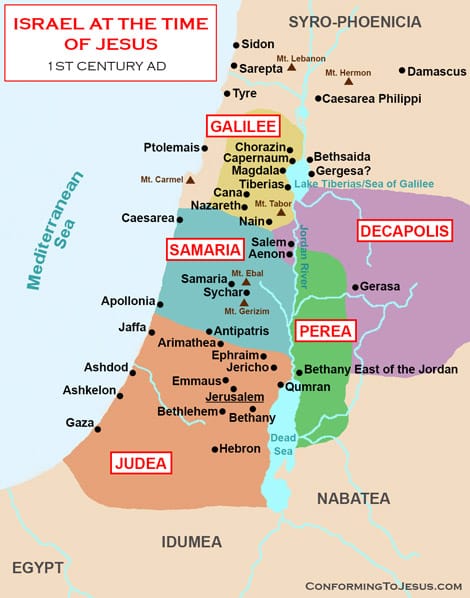 We all know Jesus commenced his ministry in Galilee but did you know his baptism took place in the region of Perea (modern day Jordan)? Perea and Galilee were ruled by Herod Antipas, one of the sons of the late Herod the Great. The regions were not geographically contiguous but separated by the (Roman client) Decapolis city states.
Antipas was a Tetrarch, he ruled a quarter of his Father’s previous empire. Antipas harboured greater ambitions though, wanting the whole of his late father’s kingdom. In 4BC he went to Rome, petitioning Augustus to achieve a land grab. Antipas argued that an earlier will, naming him sole heir, should stand. He claimed his father was not in his right mind when he wrote his final will. (When was he?) Herod The Great wrote SIX wills, the last being only five days before his death in 4BC. However, Augustus was having none of this and assigned Galilee and Perea to Antipas and made Archelaus Ethnarch of Judea, Idumea and Samaria.
Not only did the Herods have to suffer the humiliation of asking Rome for permission to rule but they were also up against a petition from fifty ambassadors of the Jews who urged Augustus to abolish the monarchy, detailing a catalogue of scandalous Herodian misdeeds and cruelty. They appealed for the Jews to be allowed to live according to their own laws, under the suzerainty of the Roman governor of Syria
Further humiliation descended through serious revolts in Galilee and Judea which the Herodian forces could not extinguish. Rome propped up the regime, intervening brutally and decisively. Publius Quinctilius Varus deployed 2-3 first line legions from Syria, destroying the capitol Sepphoris, selling the entire population (2,000-4,300) into slavery and other settlements razed with accompanying brutality. When his forces breached the temple and concluded the operation, Varus had 2,000 of the leaders of the rebellion crucified in Jerusalem. When Jesus talked about taking up your cross, those listening, knew it was not merely a metaphor for having a difficult time.
Antipas – a builder
 Eventually the refugees of war returned. There was much work to be had rebuilding the region. A “tekton” such as Joseph, would have found plenty of employment. Antipas attempted to emulate the building prowess of his father. In 6-9AD he rebuilt Sepphoris, sparing no expense, renaming it “Autokratoris” in honour of Tiberias. In 13AD Antipas developed, walled and fortified Betharamphtha in Peraea renaming it “Julias” in honour of Livia (Julia), the mother of Emperor Tiberius. His crowning glory came around 18AD on the western shore of the Sea of Galilee, he constructed a new capital, Tiberias and named it honouring the emperor. It included a royal palace, a stadium and a theatre. Not only was the sycophancy nauseating to many Jews but its construction was also controversial because it was, in part, built on an ancient graveyard, causing ritual impurity issues.
To his credit, Antipas did not emulate some of the pagan friendly activities of Herod the Great. Unlike his father, he did not build pagan temples, even in his most Romanised developments.
Antipas – alliances and marriages
In 4BC Antipas married the Nabataean princess Phasaelis, securing (for a time) the political border with the neighbouring non-Roman Nabatea. This was security for both Antipas and Rome who used the kingdom as a buffer state. However, in 23AD, he visited his half-brother Herod II (known as Phillip) in Rome and fell in love with Phillip’s wife who was also niece to Antipas. Antipas divorced Phasaelis to marry Herodias. (Nothing like keeping it in the family!) This didn’t go down well at all with the spurned wife, the Nabatean court and especially King Aretas. Phasaelis quietly returned to Petra but hostilities broke out over territorial issues, previously ameliorated through the marriage, culminating in a major attack by King Aretas in 36AD.
Generally, compared to Herod the Great, Antipas was (relatively speaking) better liked by the local population. He was not as domineering towards them, he had a greater sensitivity to Jewish issues which gained him some favour but diplomatic relations were lacking and he was still a despot.
Antipas – military.
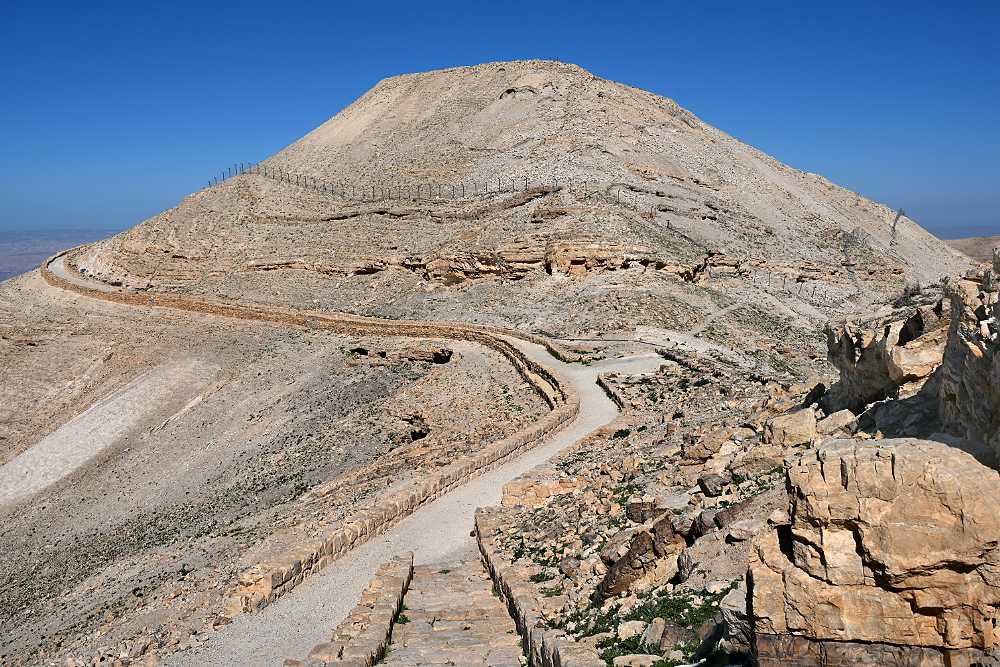
Machaerus was the foreboding fortress inherited from his father, who had rebuilt it from its Hasmonean origins. In typical Herodian fashion, it dominated the skyline, was decorated lavishly and sent a very visible threat to anyone who might consider invasion from outside or rebellion from within. It stood as a warning to Antipas’ Nabatean neighbours.
Ethnically Antipas’ military consisted of foreign mercenaries, Hellenised Jews and, until the fall out, Nabateans. His army emulated Roman organisation, structure and equipment. It sufficed to deal with the occasional low level border dispute and local policing matters but appeared to lack both the quality and numbers to make it a powerful and effective fighting force. When the Nabatean King Aretas launched his vengeful 36AD major offensive against Antipas, Antipas’ army suffered a humiliating and total defeat. “All the gear but no idea” comes to mind. Gross humiliation came when Antipas had to appeal to Emperor Tiberias for military intervention. There were no Imperial troops or garrisons in Galilee and Perea, they were deployed from Syria – again!
Antipas and Pilate
Luke 23:12 observes longstanding enmity that existed between Antipas and Pilate. What might have been the quarrel?
Initially, perhaps, the failure of Antipas to gain the whole of his Father’s Kingdom. Judea, Idumea and Samaria had gone to Archelaus but his despotism caused so much trouble with the locals that Ceasar thought it better for Rome to rule the regions directly. Pilate’s authority over these lands and the gem of Jerusalem was something Antipas coveted.
Antipas was complicated. Despite his Roman sycophancy and Hellenization, he was at least half Idumean-Jewish. He was also half Samaritan through his mother Malthace! While Judaism was a permitted and tolerated religion at this time, many Romans despised it as a religion and the Jews as a race. Romans often viewed Jewish customs as eccentric or superstitious, with intellectual elites often displaying what we might call today “Judeophobia”. The rebellions of 4BC and the failure of Herodian forces to subdue these, would not have helped endear any of them to Imperial Rome.
Issues over jurisdiction created antagonism. For security reasons, Pilate had killed some Galileans while they were offering sacrifices in Jerusalem, “mixing their blood with their sacrifices” (Luke 13:1). Because these were subjects of Antipas, this act was, at the least, undiplomatic and the cause of friction. Despite his Hellenised culture, Antipas was no fool and knew how such inflammatory events, in the most sacred and holy place of Judaism, would be viewed by the Jewish population.
It gets better though; Philo of Alexandria recalls a separate incident (around 31AD) where Pilate placed votive shields dedicated to Tiberius in Herod’s palace in Jerusalem—anathema to the Jews! Antipas and his brothers protested this action, leading to a reprimand for Pilate from Emperor Tiberius, who ordered the removal of the shields, adding to their mutual loathing. (Philo, Embassy 299–305)
The friction begins.
Like many, John the Baptist and his ilk will not have been impressed by the Herodian bloodline, its track-record of Hellenization; despotism; kleptocracy; alliance with Rome and scheming power plays. John openly criticised Herod’s dubious marital arrangement, for which Antipas arrested and imprisoned him in Machereus.
The sources differ, Josephus saying that Herod had intended to put him to death because he feared he was gathering a rebellion (Antiquities 18.5.2). The Gospels, particularly Mark, give a far more nuanced view:
Herod feared John and protected him, knowing him to be a righteous and holy man. When Herod heard John, he was greatly puzzled; yet he liked to listen to him. (Mark 6:20)
Matthew gives his insight into why John was not immediately terminated, “although he wanted to put him to death, he feared the multitude, because they counted him as a prophet” (Matthew 14:5).
What might Antipas have thought about his officials, tax collectors and soldiers taking counsel from John the Baptist, indeed being baptised by him just 16 miles from Machaerus? “
Even tax collectors came to be baptised. “Teacher,” they asked, “what should we do?” “Don’t collect any more than you are required to,” he told them. Then some soldiers asked him, “And what should we do?” He replied, “Don’t extort money and don’t accuse people falsely—be content with your pay.” (Luke 3:12-14)
Did Antipas know that some in his employ were looking to John for spiritual life changing leadership and authority?
The tension mounts
Jesus was baptised by John the Baptist. He initially performed a similar ministry to the Baptist, inherited many disciples of John and communicated with John in prison before his execution.
Jesus also ministered to and influenced the Herodian military. Many have misunderstood Luke 7:1-10. It is often portrayed as Jesus healing a “centurion’s” servant. It is a lazy historical assumption which is often made through the Biblical translations and an ignorance of the precise geo-political context that this man was a Roman centurion. In fact, Rome had no direct jurisdiction or continuing military presence in Capernaum.
The Greek word which is (inappropriately?) translated in some versions as centurion is ἑκατοντάρχης (hekatontarche) “commander of a hundred.” It does not necessarily denote imperial connection but that this was a middle ranking officer of a rank equivalent to today’s major. As we have previously noted, Herod’s army organisationally emulated the Roman military. This was not a Roman centurion; he was one of Antipas’ middle ranking officers. As a god-fearing foreigner, not only had this generous man found faith in the God of the Jews, (both those whom he served alongside and within the community where he quartered) but had also found faith in Jesus.
We may forgive an unschooled lay person for making such a mistake. Clergy should know their scriptures better but those who profess a level of scholarship are really without excuse. Yet some choose to do this, some perhaps with an ulterior motive? The “queer” school of theology like to present this as an occasion of a typical Roman relationship of pederasty between the centurion and the “pais”—child or servant.
There are many who have written in support of this, yet ignoring the actual geo-political context. They take huge assumptive leaps to try to establish a sexual relationship in their forced reading of the text, yet miss out important facts. The first being that, while homosexuality was accepted in Roman society, romantic relationships between Imperial troops and their subordinates were severely punishable disciplinary offences. The second being this officer was NOT a Roman centurion and was a benefactor of the Jewish synagogue, no doubt venerating its culture and moral standards which would NOT have included homosexual practice. The Pederasty interpretation of the text is not even tenuous, it is clearly wrong.
Furthermore this would have been an impossible scenario even if the community were Hellenised Jews – which in Capernaum they were not. Even Hellenised Jews maintained a strict Torah based sexual ethic which forbade homosexual practice. This whole scenario proposed by the “queer” school of theology is an outright lie.
What we do have though is evidence in Luke’s Gospel of how Jesus’ ministry is demonstrated as penetrating Herod’s military, very much like we saw John the Baptist’s ministry drawing soldiers under his influence. It goes further, as we move through the previous event in Luke 7, now to Luke 8. Jesus’ influence is in touching distance of Herod’s administration, even reaching his very court. This, evidenced in Luke 8:2-3, where Johanna, wife of Chuza, is cited as one healed of disease or demonisation and is attested as being one who gave financial support to Jesus and his mission.
Wow! Chuza, is “the manager of Herod’s household.” This is deep covert penetration and serves as a subtle undermining of Antipas’ authority. In Luke 24:1-12 The same Johanna is a primary witness of the resurrected Lord. There is something of a theme here, which Luke particularly, continues to develop in his Gospel. Placing a random Roman centurion in Herodian territory in Luke 7 makes no sense at all.
All three of the synoptics record the growing awareness of Herod to the ministry of Jesus. In Luke he is curious and anxious:
Herod said, “I beheaded John. Who, then, is this I hear such things about?” And he tried to see him. (Luke 9:9)
In Matthew he suspects it is John the Baptist:
At that time Herod the tetrarch heard the reports about Jesus, and he said to his attendants, “This is John the Baptist; he has risen from the dead! That is why miraculous powers are at work in him.”( Matthew 14:1-2)
In Mark Herod believes Jesus could be a resurrected John:
King Herod heard about this, for Jesus’ name had become well known. Some were saying, “John the Baptist has been raised from the dead, and that is why miraculous powers are at work in him.” Others said, “He is Elijah.” And still others claimed, “He is a prophet, like one of the prophets of long ago.” But when Herod heard this, he said, “John, whom I beheaded, has been raised from the dead!” (Mark 6:14-16)
The rat and Jesus clash
Jesus is no ally or fan of Herod. Mark 8:15 makes this perfectly clear, “beware of the yeast of the Pharisees and that of Herod”. Two very different yeasts, each to be avoided. Specifically, that of Herod, was the worst of Romano-Hellenistic culture with which he surrounded himself. Yes, the lax observance of the Torah, the dropping of standards, in contrast to the radicalisation of such standards, which was the yeast of the Pharisees. Even normal Hellenised Jews maintained the sexual morality of the Torah – some scholars say they codified it! The yeast metaphor was extremely familiar to Jews, who were used to re-enacting the Passover events of cleansing themselves and their houses of the yeast pollutant of Egypt.
Luke records the Pharisees warning to Jesus as he was making his way to Jerusalem:
At that time some Pharisees came to Jesus and said to him, “Leave this place and go somewhere else. Herod wants to kill you” (Luke 13:31).
Jesus’ attitude towards Antipas is uncompromising as he issues this powerful cutting insult in response:
He replied, “Go tell that fox, ‘I will keep on driving out demons and healing people today and tomorrow and on the third day I will reach my goal.’” (Luke 13:32).
Using the word “fox” was not a term of endearment. It was not used like many called General Irwin Rommel “The Desert Fox” because he was cunning, creative, wily. No, the term “fox” was a brazen insult – a huge term of abuse. It contrasted with what great military rulers of the day were titled, “lions”. The use of the term “fox” was more akin to a scavenger who cleaned up after the kill of the lions. They were most definitely second rate, living off the spoils of others, opportunist, tin pot leaders lacking integrity. In the West today, we might even call such people a “rat”. Moreover, Jesus used the word ἀλώπηξ (alopex) – the female form – vixen we would say today. A further insult (sorry ladies) and maybe a suggestion that the power behind the throne was Herodias, rather than Antipas? It was a fair description of Antipas who had no substantial military power of his own and who was totally dependant on Roman military prowess for his very existence as a King.
The final piece in this jigsaw is during Jesus’ arrest in Luke 23:1-12. Again, a part of Luke’s exclusive narrative of the relationship between Jesus and Antipas, Jesus is handed over to Pilate by the religious leadership in Jerusalem, seeking his execution. Pilate in his enquiries gathers that Jesus is a Galilean, so on this occasion, follows diplomatic protocol and sends him to Herod Antipas who he knows is in Jerusalem for the feast of Passover. Herod is delighted in the extreme to meet Jesus for the first time in person. He asks questions, hopes to see a miracle but Jesus refuses to answer even a single question Antipas puts to him.
When no answers or signs are forthcoming, the inquisition turns to abuse: “Herod and his soldiers ridiculed and mocked him.” While Luke 23:11 doesn’t detail specific blows, the term empaizō (mock) frequently carries the connotation of “maltreatment” that often-included physical sport in a first-century military context. No doubt Herod made sure the insult Jesus had previously issued was repaid in full. Dressing him in an elegant robe they sent him back to Pilate facing his scourging and crucifixion.
Postscript
We all should know that Publius Quinctilius Varus, who led the brutal punitive invasion of Galilee and Judea in 4BC, died in September AD 9. As a Roman general and politician, he committed suicide during the Battle of the Teutoburg Forest to avoid capture after his three legions were ambushed and defeated by Germanic tribes.
Did you also know that neither Pilate nor Herod survived in office much beyond the crucifixion of Jesus? Pilate was removed in 36 or 37AD after his cack-handed treatment of Samaritans. Lucius Vitellius the Elder, the Roman legate (governor) of Syria, ordered Pilate to Rome to stand trial before Tiberius, but fortunately for him the emperor died before he arrived. Pilate’s history ends most probably in obscurity despite attempts to portray him as either committing suicide or finding faith. Antipas is exiled by Caligula in 39AD, victim of the scheming Herodian trait that finds him (most probably falsely) accused by his spendthrift nephew, Agrippa, of treason, aiming to inherit his uncle’s empire and wealth.
Meanwhile the early church worshipping the resurrected Jesus was established in the lands of Galilee and Perea and despite persecution still exists today. Jesus’ influence spread, infiltrated and permeated not just the local fiefdoms but the entire Roman empire and culture.
Reflections
I am fascinated how Pilate and Antipas became friends following this incident. Yes, Pilate had respected Antipas and Antipas had respected Pilate on a small matter but not much had substantially changed. They had found common cause in dealing with a complex and difficult situation, problematical to both, in different ways of course.
Sometimes those with very different interests can find common cause: Rival Greek city states against Persia; Western allies and the Soviets against the Nazis; or in more current thought, Left wing “progressives” and conservative Islamists against western democracy and the remains of Christendom. Political scientists describe this as having “Superordinate goals” or “Negative Solidarity”. Something of this nature occurred between Pilate and Antipas.
Politeness and “correct” language trumps the prophetic
I find it interesting how Jesus used such powerful insults in comparison to the politeness of so much of English Christianity. A full strength, no holds barred, thoroughly disrespectful public insult was the prophetic message Jesus sent to Antipas. Some would say “Not very Christian of him, was it?” It wasn’t the only time he would use devastating insults against those he opposed. Yet a cleric in the C of E might face disciplinary action for perhaps calling a man who claims to have transitioned their sex to being a woman, “a bloke” or for referring to those crossing the channel without prior permission or documentation in small boats, “illegals”, shorthand of course for illegal migrants.
There is a far greater likelihood of a cleric being disciplined, for using “unclerical” language on the grounds of “conduct unbecoming or inappropriate to the office and work of a clerk in Holy Orders” than there is of one being prosecuted for heresy or substantial heteropraxis. Oh yes, you can preach nonsense, you can live in sexually immoral ways (as long as you are not heterosexual) but you must not use bad language or insult anyone. I’m not sure how long Jesus would have lasted in a church that had its priorities so topsy turvey, plenty of Bishops would have slapped him with a CDM. Perhaps they would have breathed a sigh of relief as he was led away to Pilate?
Finally, this leads me on to the leaven of Herod. Analogously it has not just been “Hellenisation” that has occurred in many of the established churches of the West. Even the Hellenised Jews maintained conventional sexual ethics and had strict rules of affinity regarding who could marry whom. The leaven of Herod sounds very much like what has infiltrated the “progressive” church of the West, much of which has abandoned Christian orthodox moral standards in favour of those of cultural Marxism or liberalism. It has ingested the leaven of Herod, going beyond adopting the trappings of contemporary culture – to surrendering core values.
The leaven of Herod: its immorality; the conniving manoeuvres of its leaders; its silencing of the prophets who dare raise their voices; the cowardly surrender of its values to the dominant spirits of the age and the comfort of living off the remains of Christendom under the suzerainty of the establishment. This is the leaven motivating many senior ecclesiastical leaders and shaping church policy. However, it has gone much further, embodying far worse than that of Antipas – but instead the leaven of Herod the Great himself through its accommodation of multi or inter faith practices.
Perhaps if the fundamentals of the context in which Jesus ministered and how he related to that context, had been properly taught during the theological education of our current leaders, we would not be in the mess we are in today?

Revd John Hudghton is a retired Anglican clergyman, having been ordained for 42 years. He is married with six adult children and 14 grandchildren. He lives on the Yorkshire coast and currently enjoys allotmenteering and motorcycling, and is one of the leaders of Bikers Church UK.
 Buy me a Coffee



















An interesting narrative for those who don’t know the history touched on in Luke’s gospel. Pity it’s utterly spoilt by the nasty polemic at the end. It is to be hoped that clergy would be disciplined for using bigoted and inflammatory rhetoric. The former would, of course, have safeguarding implications; the latter is simply racist and misleading.
Where is the “bigotry”?
John has his eyes wide open but sadly that is not the case for many God bless you
Quite simply. You can believe that biological sex is immutability and that women are beings with certain biological markers without calling trans women “blokes”. You can believe that immigration should be more closely regulated without calling people “illegal”, especially when governments have closed the legal routes for asylum seekers who are then bound to use illegal routes. This rhetoric also implies that most refugees/asylum seekers enter the UK in small boats. They do not.
Such rhetoric is not blunt, but offensive and ignorant.
The ‘TW’ that you say is very far from being an agreed term. This has been said so often. Yet you are still using it as an agreed term. So far is it from being an agreed term, that it is a phrase never used apart from in the period starting about 20 years ago.
Why can’t men be identified according to biological markers the same as women are? Of course they can be.
I didn’t claim that it was an agreed term. But most civilised people have been using it for over 70 years. Maybe more.
Neither men nor women are identified by biological markers. Male and female are identified by some – sometimes shifting – biological markers.
No, not ‘civilised people’ but people who have bought into (or been bullied into) current reality-denying gender identity politics.
Most civilised people have been using it for 70 years???
This is a complete falsehood. And in several different ways.
First, vanishingly few people used it at all other than in the last 20 years.
Second, it is precisely the uncivilised who are in favour of beautiful young bodies being mutilated. And also in favour of tender young minds being confused at a foundational stage. I (and anyone civilised) can’t imagine or dream up any worse nightmare than that.
Third, the reason we reject this phrase is fourfold:
First, it speaks of something that does not exist unless you manipulate it into existence.
And second, it is used and asserted, as Ian says, in a bullying and dishonestly preemptive way that tries to force others to treat it as agreed reality.
Third, those using the phrase thus are actually well aware that their interlocutors do *not* consider it as agreed reality, but (accurately) as the reverse: namely, something that only muscled its way into culture for a tiny minority of that culture’s history.
Fourth, when imposing this phrase aggressively on the discussion, they do not even bother to argue for its coherence, thus showing the paucity of points in favour of its having any.
I have been using the term since 1971 when Jan Morris transitioned. I read excerpts from her book in 1971 when she transitioned. I’m sure people were using it or similar terms before then when people like Rebecca Cowell transitioned.
As you know, it all depends what you mean by ‘people’. This is a world of billions, so you can always find some people who do or say most imaginable things. But what you said was – ‘Most civilised people have been using it for over 70 years.’. Most civilised people had never even devoted much thought to such a thing for most of that time period, even if they had heard of it at all.
If you look at 1971, it was an age when people were determined to be as rebellious and transgressive as possible. Just after the Theatres Act, Roy Jenkins etc..
You seem to be misguided on what 1971 was really like. Perhaps you are too young to remember.
But, as I said, civilised people use the term trans woman. It is a word common in public discourse and thus easily understood. No one is forcing you to use it. But may I suggest that you use a term which is respectful and kind. That shouldn’t be difficult for a Christian.
Where is your evidence about what you say of ‘civilised people’? I think it is untrue. Campaigners who work against the decivilisation of the family are precisely the least likely people to fall for this language.
What you mean by being kind is falling in line with untrue things that others are bullying acceptance of. In this odd sense of ‘kind’, dictators are the ‘kindest’ people.
I go into great detail about a Christmastide-1972 perception in WATTTC? Have been interested for a while in Festival of Light.
On the first, do yo deny that “trans women” are biological males?
On the second, have you not been watching the BBC the last two days?
It rather depends on what you mean by ‘biological’ males.
No, I haven’t been watching any news channel. I’ve been in the rather lovely space that is SST.
I mean the sex that normally produces small motile gametes. Is there another definition?
The term ‘biological males’ is entirely correct but its use in place of ‘males’ denies one of the main entities in existence the chance of having its own noun.
This is the same pattern we see through a lot of woke discourse. For the word ‘family’, for example. It is always the best things of all that get hijacked, as though the woke fraternity/sorority want to quash anything wholesome as soon as they see it.
Hundreds of thousands of nouns exist. Where a key entity has none, and is treated as a subcategory, particularly when it had always naturally been a full category before, alarm bells start ringing.
‘normally’ is doing a lot of heavy lifting here. Yes. It usually applies to males. It doesn’t define men. And many trans women do not produce sperm.
Biological categories are rather fluid.
As are gender categories.
“Trans women” is a pernicious, dishonest and anti-scientific term. It implies that the persons who use it of themselves are actually some kind of women (just ss we talk about “tall women”, “Jewish women” etc whrn in fact they are blokes with peculiar beliefs or desires about themselves which are untrue. Speaking the truth is the first duty in all public discourse. Sexual politics is largely based on lies and rebellion against God’s creation. It is the enemy of Christianity.
Penny writes: “It rather depends on what you mean by ‘biological’ males.”
Enough of this war on science! Even a Year 9 kid knows about XY chromosomes – or at least they used to.
Men with gender dysphoria need help and understanding, beginning with reality. They do not belong in women’s toilets, women’s prisons and female sports teams.
Repeating a lie a million times (or even for 70 years in some recondite circle in California) does not make it true, any more than Goebbels did with his repeated lies.
As I have said before, you are a safeguarding danger and it’s a pity if you are an incumbent.
Well, it’s a good thing you’ll never be a bishop, Penny – although maybe Archbishop Liz Stuart will ordain you.
I imagine our Lord would fail “safeguarding training” in the Church of England today.
Penny writes:
“‘normally’ is doing a lot of heavy lifting here. Yes. It usually applies to males. It doesn’t define men.”
– no, ‘normally’ is a normal word. Sperm-production ALWAYS applies to males, NEVER to females. It doesn’t define men but it is part of the definition. The absence of a certain characteristic (e.g. a dog with three legs) only means that an accident or a maldevelopment has occurred. A castrated man doesn’t stop being a man because he calls himself Christine.
“And many trans women do not produce sperm.”
Actually, NO women produce sperm. ‘Trans women’ are not women, any more than the Desert Rats were rodents. Avoid the error of reification or or defining something into existence. That’s a trick of language, not fact.
“Biological categories are rather fluid.” No, they’re not. Boys can’t become girls and girls can’t become boys. John Money was wrong, disastrously so.
“As are gender categories.”
The fevered brains of lesbian Marxists in Berkeley could come up with anything and they did. But facts don’t care about that. Nature, like conscience, takes revenge.
Given that this is the common sense (and scientific) understanding held by the vast majority of people there have ever been, it follows that the vast majority of people qualify in PCD’s eyes as safeguarding risks.
Christopher
Most people are not safeguarding risks because most people (no doubt much to your chagrin) accept trans women as women.
Secondly, it is perfectly possible to believe that trans women are not women – I met someone at SST who does not – and to be respectful and thoughtful. James is neither and no gender queer person would be safe in ‘his’ church.
You’re still using, as though it were common property, the misleading phrase that is incoherent, very far from universal, and very far from being agreed upon even in those cultures where it is heard.
Penny, beginning as a teenager I have roughly 50 years experience serving in churches and para-church organisations, schools and universities and never once had so much as an eyebrow raised at me over “safeguarding”, so I will take the judgment of pastoral and professional superiors who actually know me over your censure of someone you have never met.
Fortunately I don’t take your irrational beliefs seriously, although they have caused great harm in schools, hospitals and women’s sports. Rosie Duffield and J. K. Rowling are perfectly correct on this score, and I have told Rosie this myself.
Over the years I have also seen four families of churchgoers (and all in positions of leadership, two ordained) broken because one partner left to begin a homosexual relationship, so I’m not without some knowledge of the world of sexual brokenness. And I will not be tricked into your bizarre anti-science and anti-Christian belief that men who would like to be women are women. Gender dysphoria is a distressing but rare condition yet one that is causing immense distress to women and girls across the western world because of the dishonesty peddled by atheists.
Christopher
It really doesn’t matter in the least if you and some others don’t agree that trans women is a valid term. It is used and understood by the majority. That’s how language works. You don’t get to control the discourse. Unfortunate for you. Better for the majority.
James
I didn’t mention sexual infidelity. Which is always harmful.
Fortunately, gender euphoria is the usual result of transition with good and appropriate support. Hence the number of happy and fulfilled genderqueer Christians.
I have no vocation to be a priest or a bishop. But my views would be the same if I had.
Your use of inverted commas simply indicates that you have no idea about safeguarding. Jesus does and it’s long overdue that the Church learns to follow Him in this (as in other matters).
Penny,
‘Gender euphoria’ is a lie. Gender dysphoria is a terrible mental malady, leading half of those afflicted with it to attempt suicide at least once in their life. Drastic surgery makes little difference if any to these sad statistics. That is why Paul McHugh, psychiatrist-in-chief at Johns Hopkins Hospital, stopped o. k.’ing these operations – they didn’t help. You can read Dr McHugh’s account of his experience online in ‘First Things’ 2004, entitled ‘Surgical Sex’.
Too many people are living with mutilated bodies as a result of well meaning actions.
Then there is the horror of autogynephilia which even you would recognise as a sickness – something that is leading to women being raped in prison.
I answer you directly because you are very direct in your attacks on me. This doesn’t bother me because I am answerable to God, not to you, and I judge your grasp of Christianity to be selective and self-contradictory, in a way that is typical of postmodern liberalism. I agree that you do not have a vocation to be a priest or a bishop.
Which majority is that? A massive minority for anyone not labouring under the impression that every age apart from their own (ages of which they know little) must be sadly lacking by virtue of not being early twenty first century (!).
Once again, passive conformity to the eccentric norms of one tiny culture in one tiny period. Which coincidentally is one’s own. And media imposed norms at that.
But of course any majority, including culture specific and imaginary majorities, must always be right. It is never a matter of evidence.
Clearly, you have never spoken to anyone experiencing gender euphoria.
And autogynephilia is an imaginary condition created by the discredited Ray Blanchard.
Whatever doesn’t fit the narrative is “discredited” – of course.
Penny, I suggest you read Dr McHugh’s article. As the former psychiatrist in chief of Johns Hopkins Hospital, he knows a lot more about psychiatry and human development than I do, and possibly even you.
The suicide statistics of men who have had their genitals amputated and other surgery remain very high. Reality remains stubbornly resistant to sociopolitical propaganda (and censorship, such as ‘discredited’), even while the contemporary currents try to sweep us down evil pathways: the left wants to drive us into trans-sexualism, the right into transhumanism. The God of creation and nature says no.
Penny, you need to discover the true God of the Bible and give up the false Feuerbachian projection you follow. This is why I and many others here cannot take you seriously as a Christian.
There is a difference between private dialogue with such people, and public discussion about them and their role in society.
James
Fortunately you don’t get to decide who’s a Christian. And nor do I. Pete Hegseth is a Christian. I abhor his theology, but it comes out of certain Christian traditions.
Penny:
I don’t get to say who is a Christian, only who is evidently orthodox and balanced. Paul’s letters are full of admonitions about immaturity and false teaching among the churches he started; he is not saying these persons are not Christians, only that they have a long way to go in maturity and right understanding. So I do get to say who I should take seriously as a Christian, based on their grasp of Christian truth and their conduct toward others. Rest assured, I will never be seeking pastoral advice from Pete Hegseth. And one or two others.
I also take Paul McHugh seriously as a psychiatrist and a physician.
Here is a link to his article on trans-sexual surgery and autogynephilia that you have been studiously avoiding. You will not want to read it but a few here will.
https://firstthings.com/surgical-sex/
James
Oh. I see we’re playing the I’m orthodox, you’re unorthodox, she’s a heretic game.
Anyway, thanks for the link but I don’t waste my time reading neocon ideology.
‘Neocon’ could not possibly be used by intelligent people. It is saying that a stance is less permissible at one date than at another. If the stance is true, dates are irrelevant and we have chronological snobbery.
Penny:
I didn’t think you’d want to read the words of the psychiatrist-in-chief of one of the most prestigious hospitals in the world.
Above all, do not let any doubts into your fortress.
James, sort of like ignoring what Bible translation consultants might have to say about language in communication? 🙂
Yes, that’s what I thought too. What I take to be the bitterness of the author stands out at the end and leaves a nasty taste.
It does.
How would that make his words any less true? Or doesn’t truth matter? Debate is only between truth lovers.
People are right to be extremely bitter or angry if precious young lives are unnecessarily mutilated. If anyone is blasé or indifferent about such a thing, that is appalling.
Debate is between any people who want to argue a point. It is generally pointless. And truth seekers are, I hope, truthful In which case they don’t make claims about unnecessary mutilation.
‘Debate…is generally pointless.’
So what is the purpose of your debating on here, if that is your untrue belief?
What is untrue when we speak of unnecessary mutilation? Is all mutilation necessary, then?
Christopher
I comment. I rarely debate. Not much point when people firmly adhere to their ideologies.
A) it’s not mutilation
B) surgery is not unnecessary
C) surgery is not performed on minors
What nonsense. You know very well no-one ever said C). Is mention of C) a diversionary tactic? C) is of no relevance.
You are apparently saying that scars right across where breasts or genitals used to be is ‘not mutilation’.
Your A) and B) are bald assertions, and therefore useless in debate. Is this because no argument exists to support them?
This relates to the author’s contemporary lessons drawn.
When I reached the end of the article but before I reached the comments, I guessed who the first commenter would be, and the likely subject. I’m off to buy a lottery ticket.
Yes, it was sadly predictable. Good luck!
Really interesting article.
I wonder if Herod is our only Biblical example of something like our contemporary who-cares-about-society-our-love-conquers-all falling in love story?
Thank you. Sohnds lime it is worth further exploration.
Oh dear, should have used a spell checker.
John, just wanted to say how thoroughly absorbing this was. Thank you very much.
Thanl you Christopher, that is kind.
Really fascinating and challenging article. Has John Hudghton written any books?
Perhaps this could form the chapter of one?
In the interests of historical accuracy, I don’t think it was Trajan who recalled Pilate, but Tiberius.
Corrected!
I would sincerely hope that no respectable publisher would touch such material with a barge pole.
Why?
Because it’s ignorant and bigoted. The polemic, that is, not the history, which is interesting but which is hardly new information.
I wonder how many ordinands in the C of E are familiar with it?
Ian
If they are not, that is a great pity. It was taught on a diploma course I did at KCL a long time ago.
A helpful pushback against the queer theology interpretation of ‘pais’; not a line of argument I’ve heard before despite many decades in the trenches on the issue. Thank you. I guess the mistake is the same as assuming that an officer in the army of a Maharajah in India under the British Empire is British just because he has a British army style rank.
Actually the parallel with British India is more broadly illuminating; our rule there saw varying degrees of autonomy and indirect rule as well as direct rule, as was seen in the Roman Empire in this area.
I think your analogy is a good one. Thank yo for such a constructive observation
Don’t think a convincing case has actually been made that “This whole scenario proposed by the “queer” school of theology is an outright lie” though.
The ‘commander’ may not be Roman, but he certainly isn’t Jewish. Why else does he need the Jewish elders to make the case for him? And why would Jesus say he is not “in Israel”. If he’s a prominent man in Capernaum then the disciples know exactly who he is – a number of them are local to the town (Peter himself lives in Capernaum according to Mark 1). And the pleading isn’t for a man who is a good Jewish man or even one who observes the Torah, rather it’s a for a man who loves the nation and built the synagogue.
In any case the rest of the time we have these sorts of historical debates, we’re told that homosexual practice was rife across the Mediterranean cultures with the Jews being unusual in disapproving of it. Well, you can’t have it both ways. If homosexuality really is rife across all the cultures, then it doesn’t matter if the commander is Roman or not. If it really turns on him being specifically Roman, then you can’t argue homosexuality is rife across the cultures.
Indeed. Not to mention that the “queer’ school of theology is wholly imaginary 🙂
Nobody ever said he was Jewish. There were plenty of non-Jews in ‘Galilee of the Gentiles’ and even more in the Decapolis and Peraea- why, there were even big pig herds there, as we know from the Gospels. The soldier may well have been a godfearer.
I don’t know what point you’re trying to make in your second paragraph. There is no evidence at all that the soldier had a pederastic relationship with his young servant. That is an idea popularised by Theissen but without any foundation. But it is true that the Jews universally had a horror of homosexuality – the first century evidence is unanimous on this – while pagan cultures, whether Greek or Roman, were with varying degrees accepting of homosexuality and not a few writers considered the love of beardless boys to be superior to the messy, demanding love of women. You can see this repeatedly in the salacious epigrams of Martial in which sophisticated Roman men move easily from their wives to their preferred boy lovers.
Yes, lots of fascinating material, and maybe now I shall remember the differences between all the Herods! The map is also very helpful.
I’m not quite clear how left wing progressives are allying against western democracy (although of course we shouldn’t idolise democracy either.) Jesus did also say “blessed are the meek,” and didn’t clarify how this meshes with his (as you say) extremely robust language to some of his opponents, especially in the gospel of John.
That is definitely worth exploring Penelope. Thank you for your useful comment.
And Jesus was Not polemic?
Jesus was frequently polemic in the Bible, using harsh language to criticize religious leaders, challenge social norms, and confront hypocrisy. He strongly rebuked the Pharisees and scribes, calling them “blind fools,” “whitewashed tombs,” and a “brood of vipers”. His teachings and actions, such as healing on the Sabbath, created intense controversy and division etc,etc….
The problem when people identify their language and actions with Jesus is that all too often you end up with Trump rather than Aquinas.
He hasn’t done that. He has noted that people don’t like polemic, even though Jesus used it. I think you have proved his point.
I haven’t used any polemic. I have used fairly strong language to describe a tendency to blaspheme against God’s creation.
No, to contradict your gender identity ideology.
Quite right Alan. It appears some only want polemics to go in one direction. Thank you for your helpful comment.
Very interesting and informative. This ties up a lot of loose ends for me, and fills out the picture of society in Jesus’ time. Thank you.
Thank you Stephen. I am pleased this was useful.
Yes John
Context is everything. What a world that Jesus entered into! And we think that We have problems?
You may find grist for your mill @ Dr Donald Boyd blog, he is the Leader of the Scottish Christian Party @ https://donaldboyd.org/2013/07/16/what-is-the-leaven-of-herod/
Do go on to read some of the accompanying comments and two further blog offerings
On 17 Jan 2023: the leaven of Herod puts civil law above God’s law, but there are religious leaders who exalt “the tradition of the elders” Mat 15:2 above the commandment of God Mat 15:3.
16 Jan 2026: political commentators are beginning to see that moral judgment has been replaced by “the rules”.
Perhaps avoiding focusing on “issues” one might compare and contrast this with the Leven of the Kingdom which exploded on the feast day of Pentecost, more powerful than the leven of the triumvate of scoundrels’ and much more edifying for the Church.
Good preparation for Pentecost Sunday, Thanks John.
I shall take a look. Thank you Alan.
PS I am reminded of Paul’s exhortations
1 COR 5:6 Your glorying is not good. Know ye not that a little leaven leaveneth the whole lump?
5:7 Purge out therefore the old leaven, that ye may be a new lump, as ye are unleavened. For even Christ our passover is sacrificed for us:
5:8 Therefore let us keep the feast, not with old leaven, neither with the leaven of malice and wickedness; but with the unleavened bread of sincerity and truth.
And
GAL. 5:7 Ye did run well; who did hinder you that ye should not obey the truth?
5:8 This persuasion cometh not of him that calleth you.
5:9 A little leaven leaveneth the whole lump.
5:10 I have confidence in you through the Lord, that ye will be none otherwise minded: but he that troubleth you shall bear his judgment, whosoever he be.
The inference being to examine ourselves { rather than everyone else} to see whether we be of the Faith. Shalom.
Indeed so!
Thank you John H, for grounding this in history and grounding Jesus as Jesus of history.
BTW, is the biker’s club the same as CMA by a different name? I suppose it is down to history!
Thank you Geoff. I am pleased this was useful.
Bikers Church is not the same as CMA – Christian Motorcyclist Association, although some are members of both. I am not in CMA – not that I have a problem with it, but while in parish ministry I was too busy then and strangely in retirement I am still busy. I mainly ride and associate with the Yorkshire Coast Classic Motorcycle Riders group – a secular group of bikers who lead me astray into cafes and coffee shops and who are a great and fun bunch.
We have a member of CMA at church. He frequently wears a black leather waist coat, with a huge white cross on the back even when he arrives in a Nissan! He spends a lot of time with them.
We also have someone at church who had a motorbike touring-business, ministry in a N African, largely Islam Country.
Yes the facts of History
The triumvate of scoundrels, Putin and Trump, gay theology,
apostasising churches, Et al are mere blots on the landscape compared to the Kingdom of Heaven :And this gospel of the kingdom shall be preached in all the world for a witness unto all nations; and then shall the end come.Mat 24:14
Well, Alan.
Just wondering.
Do you believe the person, flesh and blood Jesus of history as revealed in the Gospels? I’m really unsure that you do, as you regularly seek to avoid the point and bring out a diversion, when Jesus of history is mentioned. Faith is faith in a Person, not faith in faith. Saved by Jesus of history.
Otherwise, we embark on the Albert Schweitzer Jesus of faith trajectory which finds expression in various ways today. Even by a methodist dentist friend who was a disciple of Schweitzer.
Just wondering, Alan.
I think we share a perspective on this Alan.
“Recalled to Rome by Trajan to stand trial but fortunately for him Trajan died before he arrived”. I think you mean Tiberius. Trajan hadn’t even been born then.
The second of these “Trajan”s has now been corrected, but the first remains.
I believe it was actually the governor of Syria – can’t recall his name – who sent Pilate back to Rome to face Tiberias on charges of treason. A journey he must have faced with some trepidation given the times and Tiberias’ successor!
Lucius Vitellius the Elder, the Roman legate (governor) of Syria, who ordered Pilate back.
Corrected in the article.
Have I been so long time with you, and yet hast thou not known me?
I have a great admiration for the grace of God in you.
Rather I adore the Jesus of History. He is the Resurrection and The Life!
He is my life! He is the beginning of life [eternal] through His death
And the end of life, victorious, Overcoming and glorious. which He has gifted me
to share and enjoy, all this and heaven too!
I don’t just worship a Christ on a cross But a complete risen Christ of Glory.
I have known several who have believed in the historical Jesus but did not have This Life;
which was Christ’s view of those many religious scoundrels in His times who had a corrupt leven.
If you have this life then “rest with us” as Paul might say. Shalom.
Thanks Alan.
At Bible College, along with their theology, we also studied OT and NT General, both of which sought to locate theology and biblical events in their political, geographical and historical contexts. For me they were the most enjoyable elements of the course. Our lecturers included one Elizabeth Clark who set us “gobbets” in the exams – Biblical passages on which we had to write about all that we could see in the text. She encouraged us to use the acronym “LAUGH” to find something to do with literature, archaeology, geography and history. The “U” was for universal – a catch-all for anything else interesting.
I still use this system today and John’s article adds “more grist to the mill” of the benefit of seeing the Bible in its wider contexts. Thanks, John and Ian.
How interesting. LAUGH is worth remembering.
What a useful acronym. Glad my article has been of use. Thank you for your positive comment.
Jesus was surrounded by enemies, the church is not only surrounded but the enemies are through the doors and windows and blinded the pew dwellers, some try to defend their church to little avail, no one is listening,they are pulling down the house!
This reminds me of the Elisha incident in 2 Kings 6
The king of Syria wanted to conquer Israel and take Elisha captive
6:14 Therefore sent he thither horses, and chariots, and a great host: and they came by night, and compassed the city about. [where Elisha lived]
6:15 And when the servant of the man of God was risen early, and gone forth, behold, an host compassed the city both with horses and chariots. And his servant said unto him, Alas, my master! how shall we do?
6:16 And he answered, Fear not: for they that be with us are more than they that be with them.
6:17 And Elisha prayed, and said, LORD, I pray thee, open his eyes, that he may see. And the LORD opened the eyes of the young man; and he saw: and, behold, the mountain was full of horses and chariots of fire round about Elisha. Shalom.
This was the second such incident in Elisha’s life. He was a man in and at rest.
In contemporary Spanish, ‘vixen’ is used in declamatory slang meaning ‘whore’. It’s also used as a shut-down reply to an awkward question. I remember a TV interview with Spain’s then deputy prime minister, Alfonso Guerra, whose bluntness bore similarities to the style of a former UK deputy PM, John Prescott. Guerra replied to a challenging question, ‘¡No doy una zorra! Meaning ‘I don’t give a …’ (Fill in the dots for yourselves!)
I had never heard of that one. Makes you wonder… Thanks for a useful comment.
Is not Luke’s telling of the parable of the Minas (not Talents) where the king has the delegation put to death not drawing a distinction between early Kingdoms and the Kingdom of Heaven?
Thank you to all who constructively engaged in the discussion, whether we agreed or not and thank you to all who have sent best wishes and notes of appreciation. My apologies for any inaccuracies that may have crept in.
I do not reply to those who are merely engaged in trolling a clearly conservative blog and whose contribution is mainly to name call. However it is fun filling in the bingo card of insults….still got Nazi and Fascist to go. Some like to acclaim “thinking allowed” but it seems only when the thinking is of their kind of thinking. I thought name calling was against the rules of the comment policy and even though I have plenty of retorts at hand, I shall not lower myself to engage in pointless slanging matches.
Bitter? Now that was not on my bingo card but those who know me would testify I had a good ministry in the C of E doing the things I was called to do, seeing The Lord’s power at work, beyond my wildest dreams. In retirement my ministry continues without the C of E and I am very comfortable and content with this. It is the most fulfilling thing on earth to see people 1. Come to faith and have a living and saving relationship with Jesus 2. Become a genuine disciple of Jesus. I am most privileged seeing this happen and there is little more important to me ministry wise. It is particularly great watching it happen to unexpected people in unexpected ways.
For information – not by any way of an excuse – I wrote this while suffering the worst effects of a horrible C.Difficile infection, and it was a painful, bizarre but blessed experience.
John H
Thank you for this very interesting article. I read Gerd Theissen’s “The Shadow of the Galilean” back in the 1980s and that was the first time I came across the theory that the centurion’s pais was his paederastic lover. The last time I heard this claim was from Liz Stuart (remember her?) of Winchester, who clearly got it from Theissen.
I confess I have lazily assumed the soldiers in the Gospels were ‘Roman’ rather than Herod’s own men. Can you point me to a discussion of this? Cornelius in Acts is surely in the Roman army?
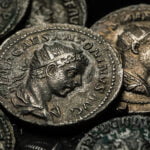
I’d like to add my thanks to John for this fascinating account of the life and times of Antipas. To boast, I speak as one who made a little connection myself. Some coins were found from Antipas’ time, with his face on the obverse – and a picture of reeds on the reverse. This suggests that jesus’ reference to “a reed shaken by the wind” (Matt 11:7, Luke 7:24) might be an unfavourable oblique reference to Antipas, perhaps as a ruler blown about by different opinion. It is then in parallel with the following “a man dressed in soft clothing? Behold, those who wear soft clothing are in kings’ houses”. The contrast is between Antipas and John the Baptist, imprisoned by him.
Ad fontes should be our motto. Can you recommend further reading in this area?
This is a connection made much of by Theissen.
John, you really need to think about writing a book about your thoughts long ministry and experiences. A lot of people would find it fascinating to read particularly as you do not appear to be your ‘average’ vicar!
Do you have any plans to do so?
PS
Maybe call it “Anglicans M.C.”
However, I was also saddened by the ending. It seemed to me to be switch from elucidating the complexities of geo-politics in early-mid first century, to the regretably binary opposition of so much contempory discourse – which is not really the right word.
I hear from some quarters today much talk of the ‘Hebraic thought’ (good) vs. ‘Hellenic thought’ (bad), and the conflict between them. I am beginning to do reading on the Second Temple era, and it becomes clear very quickly that there is a lot of complexity in this time with significant differences in the ideas that were current. There was no single ‘Judaism’ at the time. We can see a little of this in the NT. I think it is better to think of a multi-dimensional spectrum of ideas/ideologies.
The same is true of Greek thought. Aristotle’s classical theism has no connection, that I know, to the pagan pantheon. It is suggested that when Paul writes:
“For [God’s] invisible attributes, namely, his eternal power and divine nature, have been clearly perceived, ever since the creation of the world,”
he is saying this knowing Greek theism. Also, he favourably referenced Greek philosophy in talking to the Athenians.
Fundamentally, the Christian Gospel introduces something which is contrary to Hebraic and Hellenistic thinking. The Cross is a stumbling block to Jews and foolishness to Greeks. Both are, in some way, both right and wrong.
Then we should also remember, as Tom Holland has so ably demonstrated, that the ideas to which many ‘traditional’ Christians are opposed, have roots in precisely the offence and foolishness of the Cross.
Regarding your last comments, I would suggest it was typically the Jewish religious conservatives at the time that Jesus was often furious with and impolite to, not the ordinary person. He tended to treat them with grace and compassion, not condemnation. Like the woman caught in adultery, when all those around her were ready to condemn, Jesus showed up their hypocrisy and refused to condemn her before them (even if not original to John this may still be a true story). Or the Samaritan woman at the well, opening her eyes to who He was. He knew full well about her sexual history and openly said it, yet still did not use condemning words. Or the prostitutes. Using words such as ‘illegals’ or insisting on referring to a trans ‘woman’ as a ‘bloke’ shows a dismissive attitude and a lack of compassion. Neither of which clergy should have.
Regarding ἀλώπηξ , I believe the word means ‘fox’, not ‘vixen’ – the author is confusing grammatical gender with biological sex. The same word is used in Matt 8:20, where there is no suggestion that female foxes are in mind. As far as I can ascertain, Greek does not have a separate word for ‘vixen’. Similarly, the English word ‘fox’ can refer to either sex.
I agree. ‘alopex’ is a feminine noun in ancient Greek, as its equivalent in modern Greek and ‘vulpes’ in Latin and is used equally of female and male animals. There is no indication that Jesus is calling Herod a vixen. Metaphorically the word denotes cunning and slyness, which can be pejorative but also a grudging compliment (‘shrewd’). So not the strongest of pejorative terms – ‘blind leaders of the blind’ and ‘whited sepulchres’ is sterner stuff.
I think Casey retranslates ‘jackal’ on the basis that jackals were known there and foxes were not.