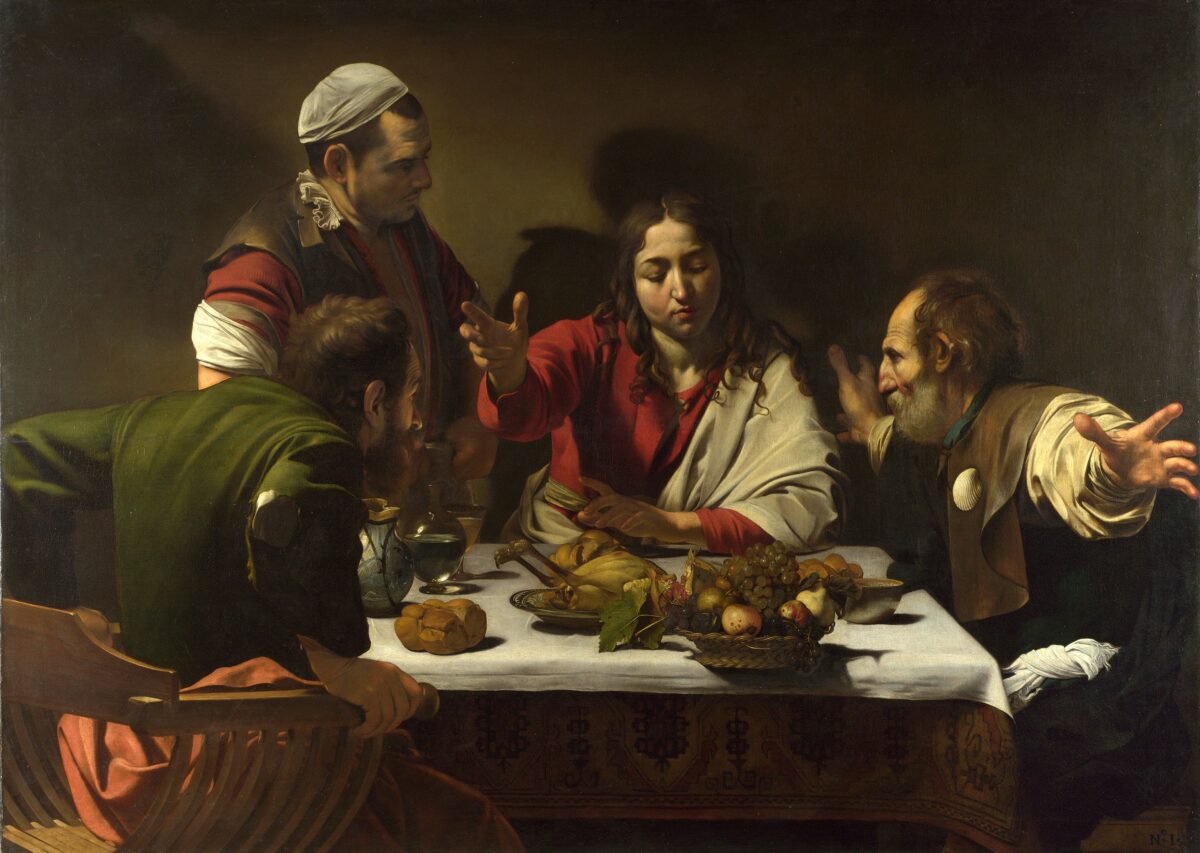
The lectionary readings for the Third Sunday in Easter ignore the particular gospel for the year, and instead cycle round Luke 24 and John 21: in Year B we have the second half of Luke 24, Jesus meeting the group of frightened disciples; in Year C, the miraculous catch of fish in John 21; and in this Year A the story in the first half of Luke 24 of the disciples meeting Jesus on the road to Emmaus.
(The epistle is 1 Peter 1.17–23, and you can watch the video discussion here. The video for this reading is here; both are linked at the end.)
The narrative is long and detailed, and (like the long detailed narratives at the start of Luke) contributes to this being the longest of the four gospels, a good 1,000 words longer than Matthew (even though it has fewer chapters).
But it is also wonderfully engaging, not only beautifully structured, but full of irony and humour as well.
The story of the road to Emmaus is one of the most powerful stories in the Bible and certainly one of Luke’s greatest achievements as a storyteller (Mikeal Parsons, Paideia commentary, p 349).
The story has a clear sense of movement, which we can see by noting how many times travelling, walking, stopping and journeying on is mentioned; the idea of the disciples being on a journey fits with a large theme of Luke’s gospel, in which he has organised the whole central section of Jesus’ teaching and ministry as part of a journey to Jerusalem from Luke 9.51 to 19.48. But there is an implied ironic reversal: in the main part of the gospel, Jesus is on a journey, and the question is whether the (potential and actual) disciples will join with him; here, the disciples are on a journey, in many sense in the wrong direction, and it is Jesus who joins them, the result of which is a change in their direction of travel.
Most commentators notice the chiastic structure of the story (a pattern of inverted parallelism), but Joel Green’s (in his NICNT commentary) is the most detailed:

If Green is right, then though the recognition by the disciples is a key moment for them, the story in fact pivots around the fact that Jesus is in fact alive and comes to join them on the road.
For many readers, the story seems to bring together the classic pairing of word and sacrament, as Jesus both opens the Scriptures and then is ‘recognised in the breaking of the bread’. But reading the story carefully, in the context of Luke’s whole narrative, suggests something different.
The previous episode, in the first 12 verses of Luke 24, correlate quite closely with the account of the empty tomb in John 20, though with different emphases. Luke and John agree that women went to the tomb first, that they reported what they had found to the male disciples, that Peter ran to the tomb, bent down, and saw the linen strips. But Luke emphasises the role of the group of women (as he has done earlier in his account), and the negative response of the men; they think that what the women say is ‘utter nonsense’ using the very strong word leros, and they ‘disbelieved them’, using the verb apistueo that is cognate with the description of Thomas’s response in John 20.27.
Luke is quite careful in his identification of the time and the place. The journey takes place ‘on the same day’ as the previous events, that is, on the Sunday when Jesus was raised. The village of Emmaus has never been confidently identified from either archaeology or manuscript evidence, but Luke specifies that it is 60 stadia, or about seven miles, from Jerusalem. It is perfectly possible to imagine that, for disconsolate disciples, wearily trudging along, this journey could easily take the best part of the day—but that the return journey could be completed in less than two hours by them when excited and motivated.
The story unfolds carefully. The two disciples are unnamed at the beginning, and then, as the story progresses, we learn in Luke 24.18 that one of them is called Cleopas. This appears to be the same person whose wife (or possibly daughter, ‘Mary of Cl[e]opas’) remains at the cross in John 19.25, and that has led to speculation that the other disciple is indeed this Mary. This would fit with Luke’s repeated use of male-female pairs throughout his gospel—but he does not specify this, which would be odd if it were the case. Perhaps the second person remains unnamed deliberately, so that you, the reader, can put yourself in the story alongside Cleopas.
We are told that they were ‘talking and discussing’ ‘all the things that had happened’. The emphasis here is that they are debating with each other, and trying to puzzled out what they cannot yet make sense of. It is only in the conversation with Jesus that we learn the content of ‘all the things’ in summary form.
Luke is emphatic: it is ‘Jesus himself’ who draws near; interestingly, the language of ‘drawing near’ is exactly the same language Jesus has used about the ‘drawing near’ of the kingdom of God at the beginning of his own preaching (Mark 1.15). That they ‘were kept from recognising him’ doesn’t suggest that Jesus changed his form in any sense; again, it is a common theme in Jesus’ resurrection appearances (compare Mary Magdalene’s experience in John 20.14).
At this point, the text is full of vivid detail, pathos and irony. Jesus’ enquiry appears to the discussion which is holding their sense of grief, and it all pours out—so much so that they are stopped in their tracks and look downcast. And the wonderful irony is that they ask ‘Are you the only one who does not know…?’ when of course they are addressing the only one who really does know!
The summary of what has happened is characteristic of Luke; throughout Acts we find a range of summaries of the events around Jesus and the meaning of the gospel. This summary has several interesting features.
First, Jesus is described as ‘of Nazareth’, which is his consistent title when referred to as a miracle worker. The language of ‘powerful in word and deed’ expresses the common expectation of a leader in the Roman world—but also expresses Luke’s particular interests in describing Jesus. He has a distinctive interest in questions of the exercise of spiritual power in ministry, and consistently emphasises the combination of words and deeds. His second volume summarises the gospel as the account of ‘what Jesus began to do and teach’ (Acts 1.1), and then offers an account of Jesus’ continuing action and teaching through the apostles and the early Christian community.
Then this summary is clear that Jesus’ death is the responsibility of the leaders, and not of the people as a whole, whose response to him was divided. There is a consistent focus on the redemption of Israel, something that marked the beginning of Luke’s gospel (‘the glory of your people Israel’ Luke 2.32; ‘the falling and rising of many in Israel’ Luke 2.34, ‘the consolation of Jerusalem’ Luke 2.38) and continues into the beginning of Acts (‘Are you going to restore the kingdom to Israel?’ Acts 1.6). The women went to the tomb, found it empty, and saw angels; the men went, checked for themselves, but saw no-one.
Jesus’ response and rebuke to them is key: he does not refer to the evidence they have seen; nor does he refer back to the predictions he himself made that this would happen. Instead, he turns to the Scriptures of Israel. Although many English translations simply say ‘He explained to them all that was in the Scriptures concerning himself…’ as if either his name was somehow hidden, and just needed pointing out, or that his listed the supposedly 365 prophetic texts that he fulfilled (as I was once told), something more profound is going on here. The verb used is diehermeneuo, a compound verb from which we get our term ‘hermeneutics’. Jesus is interpreting the Scriptures of Israel in the light of his own story. The gospels are consistently emphatic (in their different ways, as is Paul) that Jesus is the fulfilment of the Scriptures of Israel—something that sets them apart from the other, non-canonical and ‘gnostic’ ‘gospels’. So the Scriptures make sense of Jesus—but Jesus is also the only way to make sense of the Scriptures. His own life calls for a reinterpretation and a re-reading of the Old Testament. Joel Green puts it like this:
Evident above all, then, is the need for revelation, which comes for Luke not so much via angelic intervention (but this is hardly out of the question—v 23), but through a hermeneutical process of comprehending the purpose of God in the correlation of Jesus’ career with the Scriptures of Israel. What has happened with Jesus can be understood only in light of the Scriptures, yet the Scriptures themselves can be understood only in the light of what has happened with Jesus. These two are mutually informing. (NICNT p 844)
And it is this revelation—not just of Israel’s story, but of the way that Jesus fulfils it (as he first claimed at the synagogue in Luke 4)—which has caused their ‘hearts to burn within’ them (Luke 24.32).
There is further irony and drama in the next section of the story. Jesus makes as though he is travelling on, as though perhaps testing the reaction of the two disciples. They invite him to stay, meno, to ‘abide’ or remain, an idea that is present all through John’s Gospel which begins with disciples asking ‘Where do you abide’ (John 1.38) and ends with Jesus inviting the disciples to ‘abide in me’ (John 15.4). It is widely suggested that the events at the meal table have strong ‘eucharistic’ overtones, and that Jesus being ‘made known in the breaking of the bread’ is a pointer to Jesus’ continued ‘real presence’ in Communion (the Eucharist, or the Mass).
The different emphasis of Protestant and Catholic readings is expressed well in this post, contrasting the depiction of the story in the art of Robert Zund and the better-known picture of the supper at Emmaus by Caravaggio:
Caravaggio’s incomparable painting captures that precise instant of the disciples recognizing Jesus just before he vanishes, that sudden astonishment. They have had a supernatural experience. Christ himself is present.
Robert Zund’s painting depicts the experience of a Protestant worship service: a sermon, a teaching from Scripture. It has a certain careful comfort to it. Caravaggio depicts the experience of the Mass.
He captures the sacrament, the miracle of the Eucharist.
It was not Christ’s teaching about himself as the fulfillment of Scripture that astonished the disciples, even though they admitted that their hearts burned within them while he spoke. It was his presence. But they did not recognize his presence in the Scripture teaching. They recognized it “in the breaking of the bread.”
But is that really what Luke is suggesting? Luke does not show very much interest in eucharistic theology within his gospel, and the actions of taking the bread, giving thanks, breaking it and giving it to them corresponds not to Luke’s account of the Last Supper, but to the feeding of the five thousand in Luke 9.12–17. It is striking that, for Luke, it is that event which is associated with the recognition of Jesus’ identity; immediately after it, Peter makes his declaration ‘You are God’s Messiah’ (Luke 9.20).
That ‘their eyes were opened’ parallels the action of Jesus on the road in ‘opening the scriptures’, and it is back to this that they immediately refer. When Jesus meets them again in Jerusalem, the same pattern is repeated: ‘He opened their minds so that they could understand the scriptures’ (Luke 24.45). Seeing here a theology of eucharistic revelation is to read later theological concerns back into the story.
Immediately, they leave the place they were intending to stay, and return to Jerusalem. The impulse to share good news needs no command or training, but simply flows from the excitement of their new discovery; ‘the inward journey must always lead outward’ (Parsons, Paideia, p 357). Malcolm Guite expresses the transformation of the encounter beautifully in his two sonnets on Emmaus:
Emmaus 1
And do you ask what I am speaking of
Although you know the whole tale of my heart;
Its longing and its loss, its hopeless love?
You walk beside me now and take my part
As though a stranger, one who doesn’t know
The pit of disappointment, the despair
The jolts and shudders of my letting go,
My aching for the one who isn’t there.
And yet you know my darkness from within,
My cry of dereliction is your own,
You bore the isolation of my sin
Alone, that I need never be alone.
Now you reveal the meaning of my story
That I, who burn with shame, might blaze with glory.
Emmaus 2
We thought that everything was lost and gone,
Disaster on disaster overtook us
The night we left our Jesus all alone
And we were scattered, and our faith forsook us.
But oh that foul Friday proved far worse,
For we had hoped that he had been the one,
Till crucifixion proved he was a curse,
And on the cross our hopes were all undone.
Oh foolish foolish heart why do you grieve?
Here is good news and comfort to your soul:
Open your mind to scripture and believe
He bore the curse for you to make you whole
The living God was numbered with the dead
That He might bring you Life in broken bread.
(The picture at the top is the remarkable ‘Supper at Emmaus‘ by Caravaggio which can be seen at the National Gallery in London.)
Come and join James and Ian as they discuss this passage, and the epistle from 1 Peter 1:
 Buy me a Coffee













Thank you for this. I always wonder if the opening of the hymn “Abide with me (fast falls the eventide)” is inspired by the conversation at Emmaus.
Yes, l think l have sometimes wondered that.
I’m sure it is. And also it was common practice to weave biblical allusions into superior-quality 18th century and Victorian hymns; and even to have a single verse that was a hymn’s launchpad, as one would have a text for a sermon.
“Perhaps the second person remains unnamed deliberately, so that you, the reader, can put yourself in the story alongside Cleopas.”
A great tip for an Ignatian approach to preaching this Sunday. I do find the congregation benefits from being drawn into a sermon, rather than listening to a talk. If only I could do this more often……and better!
One query re verse 34: the rest of the disciples told the returning pair, “It is true; the Lord has risen; he has appeared to Simon.” None of the gospels refer to a singular appearance to Simon before any of the others; they all say he appeared to the women in the garden first and subsequently to the whole group (minus Thomas). A strange comment by Luke.
But he does add 1Cor material at other times too, E.g. ‘Do this in remembrance of me’. And could have been involved in the collection together of Paul’s letters.
Thanks as ever for a brilliant exposition which will filter into my Sunday sermon, I am sure.
I’m feeling a bit challenged about the link to communion which I have probably made about 20 times when the Emmaus story comes round:
‘the actions of taking the bread, giving thanks, breaking it and giving it to them corresponds not to Luke’s account of the Last Supper, but to the feeding of the five thousand in Luke 9.12–17.’
Isn’t Luke 24.30 cognate with both 22.19 and 9.16? Or is the use of ‘eucharistesas’ in 22.19 rather than ‘eulogesen’ a crucial distinguisher?
I had always seen Luke 24.30 as the first occasion of the eucharistic anemnesis Jesus commands and enables in Luke 22.19.
But does ‘en te klasei tou artou’ simply mean ‘at the moment of the breaking of the bread’ rather than ‘because of the breaking of the bread’?
This is one of the main passages of scripture, that draws out preaching Jesus from all the scriptures, from the OT.
What is certain is that the person of Jesus, should be central to preaching this passage. Also central to the new covenant is Jesus as fully God and fully man, otherwise there is no Good News, no Gospel.
Here is a link and example of the Impartiality of God mentioned in 1 Peter 1 { the accompanying lectionary reading.}
They were certainly not apostles, but they returned to Jerusalem later and reported to the eleven. it says in the narrative, that they told all these things to: “the eleven…
The Lord was not confining Himself to the “important” people. Here were two of the rest, whatever that might mean, people of all shades and grades. He had gone down that way – it would seem out of the way, because they were certainly out of the way, they had to get back into the way to come into the full value of things. when they had their eyes opened, it was as though they had never known the Bible at all.
He had gone out of the way for people like that, just the ordinary people, and what a thing for ordinary people!
He had shown that the Cross, while it was in the plan of God for a purpose, really, it was not an end, but a beginning.
But after He had expounded the full meaning of the Cross… ought not, ought not the Christ to suffer and to enter into His glory.” The full meaning of the Cross; the Life side; the glory side; and ultimately the Resurrection side
He had given them that. Their eyes were opened; deliberately opened.
Expound the scriptures, analyse the books of the Bible; give it like that, it may at least cause a few heart to “burn within them”
Then, there comes a crisis, a deep crisis: of the Cross, yes, for an end; an end that has its place and an essential place, but the crisis of the Cross, or the climax of the Cross, is a new beginning, a thorough going transformation. It is where the eyes of the Common pew dweller are opened and mission prepared for.
” ….. to open the eyes of the blind” Shalom.
The ministry of Jesus was to “recovering of sight to the blind” Luke 4:18
The ministry call of Paul was … “To open their eyes, and to turn them from darkness to light, and from the power of Satan unto God, that they may receive forgiveness of sins, and inheritance among them which are sanctified by faith that is in me. Acts 26 : 18
As we prepare our hearts for the upcoming day of
Pentecost, unlike the tradition of the elders of Lenten praxis;
The opening of the Holy Scriptures, the opening of our understanding and the opening of our eyes of the Resurrected Glorified Lord must be well established in us prior to the day of His Power
if we are to fulfil His and our ministry to “open the eyes of the blind”. May He anoint us with His Anointing. Shalom
Jesus fulfilled that literally, not just spiritually. He literally made blind people see, some for the first time.
When does that happen today?
The appearance on the Road to Emmaus is truly a beautiful story, but is it historical or simply a wonderful allegory? This story is not mentioned by any other Gospel author nor is it listed in the list of appearances in the Early Creed of First Corinthians 15.
Hello Gary,
It has detail of reality, of eye witness account, not a mere fictional story invented by a community of faith.
Maybe the Creeds are recited in skeptical unbelief, under cover of a closed- system- material- world-view- philosophy.
Without a bodily resurrection of Jesus, we are all wasting our time in religiosity and belief systems.
Is that you back, on this blog after a long time away, Gary; an atheist medic from the USA? One of three fundamental atheists that inhabitted the blog of David Robertson a few years back.
And, actually, the disciples weren’t expecting the resurrection!
So if a story has detail of reality, we should believe it, even if there is no corroboration of the story. Ok. What about this story:
This little child Jesus when he was five years old was playing at the ford of a brook: and he gathered together the waters that flowed there into pools, and made them straightway clean, and commanded them by his word alone. 2 And having made soft clay, he fashioned thereof twelve sparrows. And it was the Sabbath when he did these things (or made them). And there were also many other little children playing with him.
3 And a certain Jew when he saw what Jesus did, playing upon the Sabbath day, departed straightway and told his father Joseph: Lo, thy child is at the brook, and he hath taken clay and fashioned twelve little birds, and hath polluted the Sabbath day. 4 And Joseph came to the place and saw: and cried out to him, saying: Wherefore doest thou these things on the Sabbath, which it is not lawful to do? But Jesus clapped his hands together and cried out to the sparrows and said to them: Go! and the sparrows took their flight and went away chirping. 5 And when the Jews saw it they were amazed, and departed and told their chief men that which they had seen Jesus do.
III. 1 But the son of Annas the scribe was standing there with Joseph; and he took a branch of a willow and dispersed the waters which Jesus had gathered together. 2 And when Jesus saw what was done, he was wroth and said unto him: O evil, ungodly, and foolish one, what hurt did the pools and the waters do thee? behold, now also thou shalt be withered like a tree, and shalt not bear leaves, neither root, nor fruit. 3 And straightway that lad withered up wholly, but Jesus departed and went unto Joseph’s house. But the parents of him that was withered took him up, bewailing his youth, and brought him to Joseph, and accused him ‘for that thou hast such a child which doeth such deeds.’
So are you Gary, the fundamentalist atheist, medic from the USA, Gary?
Bored and playing your games again, are you?
But the entire question is the date. If one compares a made-up story of Jesus I penned yesterday with a story written when eyewitnesses still lived, then the point becomes obvious. You cannot flatten all dates together as though time did not exist. That is as basic a mistake as one can get, though one that is frequently found in discussion of apocryphal gospels. The achronological perspective you voice has not ever had, and could never have, a place in scholarly discussion, which is historical.
though if John really was written in the 90s (debateable), then presumably most or all of the eyewitnesses were likely dead.
Are you saying that if a story arises while the characters within that story are still alive, the story must be true?
Of course not, Gary. The very fact that you make this all-or-nothing, when the majority of things in life are not all-or-nothing, invalidates your perspective.
Peter – John is before the 90s. But in the case of John, the likely author is himself anyway an eyewitness (namely, Peter’s escort into the high priest’s territory), let alone being alive at the time of eyewitnesses. Even Papias was alive at the time of some eyewitnesses.
the gospel of Thomas depicts Jesus more like the kid from the Omen than the Son of Man, cursing and killing other kids, on one occasion just because he bumped into him. In the Gospels from the 1st century, written much closer to the events described, Jesus is portrayed as only showing grace and healing towards the afflicted during his time on earth, the opposite of that gospel’s portrayal. Thus fulfilling Isaiah.
“In the Gospels from the 1st century, written much closer to the events described…”
Does a short time period between an alleged event and the writing of a written account detailing that alleged event automatically ensure that the event occurred?
It just makes it likelier. This is a matter of percentage likelihoods. Can your future comments proceed on that basis rather than the nonsensical and clearly false if-not-100%-then-0% that you have employed here.
George Washington died in 1799. In 1806 a book was published claiming that a 6-year-old Washington used a hatchet to cut down his father’s English cherry tree and confessed when asked, saying “I can’t tell a lie, Pa”. This story was taught as fact in US public schools for most of the 19th and 20th centuries.
You are correct that an account written closer in time to the alleged event by an eyewitness to that event is usually of better quality as evidence in court than an account written much later. However, an account written by an anonymous source who admits he was not an eyewitness himself, and, whose purpose in writing is unknown (selling copies of his book, promoting an agenda such as evangelization, etc..), who claims he is quoting eyewitness sources but never identifies those sources, written within a short period of time of an alleged event, is of questionable value as eyewitness testimony.
The Washington and the Cherry Tree Story was invented by none other than one of Washington’s biographers, Mason Locke Weems. Why would he do that? He was supposedly writing the historically accurate biography of Washington, yet he added a completely fictitious story to the biography! How did he get away with it? Surely some of Washington’s family and childhood friends were still alive in 1806 when the book was published. Skeptics only needed to make the short trip to Virginia to ask Washington’s surviving relatives if they had ever heard this story to know if it was true or false. Yet, even with the existence of several members of Washington’s family in 1806, this fictitious story spread like wildfire and persisted in American culture for almost 200 years!
Is this scenario the same origin of the Appearance on the Emmaus Road Story??
Hi Gary
Meny commentators see it as literal but may serve as an allegory.
Interestingly, Ortlund sees an allusion along redemptive-historical grounds, suggesting that Luke’s concern is to highlight the new creation.
Similarly, Wright in his brief treatment of the passage in The Resurrection of the Son of God points out that the Genesis 3 eating is the first meal of the original creation, the Luke 24 passage the first meal of the new creation.
Though their eyes were opened they became separated from God and incurred His censure and His sentence.
Eph 4:18 Having the understanding darkened, being alienated from the life of God through the ignorance that is in them, because of the blindness of their heart:
Here a mild reproof and a revelation and restoring of true seeing
In Revelation Jesus invites a failing blind church
“…to buy eye salve that they may see…”
Such preparation during this 40 days post resurrection and before Pentecost period seems like sensible advice if the ministry and mission of the church might, along with the anointing of Power and utterance see eyes being opened; this chimes with Paul in his prayer for the Ephesians
“Eph 1:18 The eyes of your understanding being enlightened; that ye may know what is the hope of his calling, and what the riches of the glory of his inheritance in the saints,
Col 1:9 For this cause we also, since the day we heard it, do not cease to pray for you, and to desire that ye might be filled with the knowledge of his will in all wisdom and spiritual understanding;
It seems to me to be a season of/for prayerful preparation;
2 Tim 2:7 Consider what I say; and the Lord give thee understanding in all things. Shalom
My only point is this: A story which is not corroborated by another independent source is only a story, no matter how beautiful and theologically compelling it may be.
Gary, they are eyewitness accounts that could have been verify at that time, Gary, in space, place and time, corroborated. Indeed, there were two witnesses here and even more to the resurrection. Evidence that demands a verdict. It is the supernatural that you reject, in your presuppositional, closed material world system, scientism that rejects the supernatural.
And at core it is the supernatural aspect of the encounter that you reject and denounce.
There is nothing new in your reiterative comments.
The scriptures attest to the historicity of the distinctive Gospel accounts.
And the burden of proof that it didn’t happen is yours.
Hi Geoff. As an FYI, I have come to the realization that evidence does not change most minds when it comes to religion and politics.
It’s a slow day, so I thought I would pop in and visit my Kiwi friends down under. I’m not here to debate the historicity of the resurrection of Jesus. But I couldn’t pass up commenting on basic critical thinking skills in regards to this specific ancient story.
Basic critical skills!
Just to make sure Gary, that your basic critical skills haven’t taken you in the wrong direction – this blog is based in Nottingham, England, not down under, New Zealand.
The 9 medics and n accountants and mathematicians and a tutorial of teachers at our largely professional class church, have had their critical skills, enhanced, sharpened.
Your secular gods, career, intellect and more, will desert you. Your need is to turn to Jesus. Who is preventing you from seeing who he really is, fully God, fully man, dying in your place, that you be raised in resurrection life, starting now, ‘not me o my pie in the sky’. Eternal life is knowing Jesus and our Father I personal relationship, encounter.
Be Surprised by Joy!
Another independent source? I should think that for whole swathes of history (perhaps the majority of history?) entirely true stories are likelier to have a total of one source than any other total.
Who is the source for the Emmaus Road Story?
Cleopas if anyone.
Can you provide a copy of Cleopas’ testimony? No. Can you provide the testimony of someone who claims to have interviewed Cleopas about this event. No. Can you provide the author of Luke’s source for this alleged event? No.
We have zero documented eyewitness testimony of this event. All we have is a **story** by an author who claims in his opening statement to have obtained ALL his information from eyewitness sources, but, he never once tells us who these sources are.
So can we determine the historicity of the Emmaus Road Appearance Story. No. It may have happened. It may be an allegory (fiction) told for theological purposes. We will never know.
If you want to claim that a group or groups of eyewitnesses saw a resurrected body the basic standard of evidence requires you to provide at least *two* independent sources describing at least one of these alleged appearances.
Gary,
That is not how witness testimony in Court works. ‘Independence’ is not required. A prosecution case may only have one police witness, or one witness who is an ordinary member of the public (such as a victim).You or me for instance, on questions of fact, what we saw/ heard/ physically experienced, as long as it was relevant (logically probative of the fact in issue) and, as always, your or mine opininion in the matter would be excluded as inadmissible, as irrelevant.
Hope that helps with your critical thinking!
Please provide the eyewitness statement of Cleopas regarding this alleged event.
Gary,
I thought you didn’t want to go down the historicity road. Cleopas is the eyewitness!
And it is now akin to a document of public record,!
What is your date of birth Gary? A rhetorical question. How would you know if people at your birth were not available to ask?
And the point is, is that Cleopas, would have been available to ask!
Similarly, in England and Wales, under a Criminal Justice Act, statements from witnesses may be produced AS evidence of the truth contained therein.
Again, hope that helps with your critical thinking.
I have today received a letter from a medical consultant. It contains a factual error. Which can be corrected, both by me and my GP. But it would stand as ‘hearsay’ fact on my health record if not corrected.
Cleopas’s account as written in the scriptures could have been could have been corrected if untrue, otherwise it becomes ‘true hearsay’ witness statement, that is the true account of what has been told to the writer.
All the laws and rules relating to evidence seek to determine, ‘reliability’.
The scripture is uncorrectable, and a reliable witness account, of the truth of what took place
Hope that enhances, challenges, your critical thinking skills.
“Cleopas is the eyewitness!”
If so, provide a document with his undisputed testimony. You can’t. The author of Luke doesn’t even claim to have obtained Cleopas’ testimony. For all we know, the author of Luke (believed) he obtained this information directly from the Holy Spiri , or, he invented this uncorroborated story for theological purposes, never intending for people long after his death to assume it was a true story.
“That is not how witness testimony in Court works. ‘Independence’ is not required. A prosecution case may only have one police witness, or one witness who is an ordinary member of the public (such as a victim).”
Ok, please present the undisputed testimony of ONE eyewitness to the Emmaus Road Appearance.
But that kind of evidence does not exist for 99% of ancient documents, as you well know. What makes the Emmaus Road account special in that respect?
Researchers could only go by the accounts of (preferably, and where possible) those who were there – but that does not mean they reproduced their testimonies word for word.
We have one source for the Emmaus Road Story. Therefore, we have zero corroboration of this alleged event. It could be fact, it could be fiction. How would we know?
Maybe the author of Luke invented this story for theological purposes. Can you concede that possibility?
just because it is not corroborated by another independent source does not mean it is ‘only a story’ as the story may still be a true account.
You are absolutely correct, Peter. This uncorroborated story may be 100% historical fact. However, it may also be 100% fiction since there is no corroboration.
Gary,
The Gospel is corroboration! Of Cleopas. It is an independent witness!
It is akin to a ‘document of public record’ such as a birth certificate.
You have closed down your critical thinking from a fixed atheistic mindset.
Gary, the burden of proof is yours.
That isn’t how the real world operates, Geoff. Just because a story exists in a written source doesn’t mean we are obligated to believe it.
Do you hold the same standard for all historical claims or just those of your own faith? Let’s imagine that religion X possesses one ancient text which claims that several thousand years ago a cow spoke in a human language to a crowd of onlookers. Would you accept this claim as fact since it exists in a written document?
Be honest Gary. If there was a 2nd independent eyewitness claiming the same, you still wouldn’t believe Jesus was resurrected from the dead. So your demand is pretty much meaningless.
I do not need to believe in resurrections to accept as fact two independent, corroborating sources describing the same post-crucifixion sighting of Jesus. I would probably come to the conclusion that Jesus was not dead when he was taken down from the cross and placed in his tomb, but that would not negate the good evidence of a post-crucifixion sighting of a man who everyone assumed was dead.
Supernatural events cannot be proven or disproven. Multiple, independent, corroborating sightings of a human being at one specific time and place is an entirely different matter.
At this distance, how can you tell what is and is not independent?
Even most Christian scholars believe that the authors of Matthew and Luke/Acts had access to Mark’s gospel. Some scholars believe the author of Luke/Acts had access to Mark and Matthew’s gospels. Scholars are divided as to whether the author of John had access to the Synoptics.
First Corinthians 15 is an independent source but it does not provide details regarding any specific alleged post-mortem appearance.
Essentially, we have multiple claims of individuals and groups receiving appearances of a resurrected Jesus, but no single appearance claim is corroborated.
You are treating ‘the Synoptics’ as a group. They are indeed a group visavis wording and dependence. But they are not at all, logically, required to be a group (as opposed to three individual documents) visavis the sort of relationship they have or don’t have to John, as your wording requires them to be. Therefore your third sentence makes no sense.
Your first sentence also makes no sense, since you are treating ‘Christian scholars’ as firstly uniform and secondly undeniably biased. They are neither.
Your final claim about nothing being corroborated is also untrue. The appearance to Simon is mentioned in 1 Cor and Luke. The appearance to a larger group including the 12 is mentioned in 1 Cor, John and Luke, all of whom agree that it comes next in sequence after the initial appearance to individuals only.
Very good. So you reject expert opinion. That is good for me to know. I will refrain from appealing to expert opinion in future discussions with you.
You are correct that references to an appearance to Simon are mentioned in First Corinthians 15 and Luke, but the question must be asked: Did the author of Luke have access to First Corinthians 15? If he did, then his story of an appearance to Simon is probably not independent. If the Gospel of Luke was written several decades after Paul wrote First Corinthians, it would be very likely that the author of Luke had access to Paul’s writings or had at least heard the list of alleged witnesses found in First Corinthians.
On Luke and 1 Cor I have already made the same point above.
Luke was the closest companion to Paul, who was of an age with Jesus. So he would often have learnt things like this through conversation as well as documents.
What expert opinion do I reject?
You think there is always a consensus of expert opinion?
It is not possible for expert opinion to be respected when it is logically incoherent.
NT PhDs are not in any case below the level of expert opinion formers.
“Luke was the closest companion to Paul, who was of an age with Jesus. So he would often have learnt things like this through conversation as well as documents.”
The identity of the author of Luke/Acts is disputed.
But even if it was Luke, Paul’s traveling companion, it is even more likely that Luke’s account of Jesus appearing first to Peter in his gospel and then to the Twelve is not from an independent source. Luke most probably obtained this information from Paul years earlier, leaving us with only one source for this claim: Paul
And where did Paul get this information? Answer: He never tells us!
Christians assume that Paul discussed his Jesus appearance experience with Peter and James when Paul visited Jerusalem for two weeks. They also assume that Peter and James then shared their individual Jesus appearance experiences with Paul. There is no record of this ever occurring. It may have happened, sure. But all we can say for sure is that Paul claimed to have that met with Peter and James for two weeks. Paul tells us nothing about what they discussed. Maybe the three men discussed their individual sightings of Jesus…as a bright light. Individual witnesses claiming to have seen a dead person alone on different occasions is not good evidence. Corroboration is impossible. Each alleged individual appearance could be the result of hysteria, an hallucination, or outright fabrication.
We need good evidence of a **group** sighting of the back-from-the-dead Jesus. And in order to be good evidence, we need at least two independent sources giving specific details about the same event. Christianity does not have this. Christians cannot provide one specific post-mortem appearance of Jesus described in detail by two undisputed independent sources.
That’s a big problem!
Just because multiple sources claim that Jesus appeared to Peter and then the Twelve is not evidence he did, if we cannot corroborate specific details of these alleged events from two or more independent sources.
If multiple independent sources are ‘not evidence’, nothing is.
Multiple independent sources describing the same event with nearly identical details is EXCELLENT evidence, Christopher. Does Christianity have this type of evidence for even one of the alleged post-mortem appearances of Jesus? No.
All you have provided are two ancient sources which say that the first appearance was to Peter and the second to the Twelve. That’s it. You haven’t proven these two sources are independent of each other. You have provided any corroborating details related to these two alleged appearances. “Luke” may well have obtained his information from Paul who heard it from X, who heard it from Y, etc., etc..
You’re going round in circles. Ancient evidence almost never provides what you require. But you omit to mention this every time you comment.
AI: When an ancient claim has no independent corroboration, it is rarely accepted as absolute fact. Instead, it is usually categorized as plausible, probable, unlikely, or false using the principles of the Historical Method. If a source cannot be verified, it is kept in a “maybe” category pending new, future archaeological evidence.
Gary: That is why you will not find any pericope from the Gospels in the world history textbook of your local public university. If these textbooks mention Jesus of Nazareth at all, it will be in very general terms such as: he existed, he was a teacher and alleged healer, he was baptized by John the Baptist, and was crucified by the Romans.
If any “fact” about Jesus should be recorded in public university history textbooks it should be his triumphal entry into Jerusalem.
The Gospel of John 12: “The next day the great crowd that had come to the festival heard that Jesus was coming to Jerusalem. 13 So they took branches of palm trees and went out to meet him, shouting,
“Hosanna!
Blessed is the one who comes in the name of the Lord—
the King of Israel!” ”
A great [Jewish] crowd greets Jesus, a Jewish prophet, as the King of Israel as he rides into the Roman occupied city of Jerusalem. Yet this alleged event is not found in any public university history textbook as a fact. Why? There are no supernatural aspects too this story, so conservative Christians can’t accuse historians of bias against the supernatural. So why is this event not mentioned as fact in history text books??
Read Sanders for a distillation of what we can speak of as ‘fact’ (The Historical Figure of Jesus’, or ‘Jesus and Judaism’). He treats the temple cleansing as a firmer fact than the Entry (and it certainly looks to be factual, as history books often recognise) which he bizarrely sees as a sotto voce semi-nonevent.
Why does Gary/Christopher Shell require two identities? It’s clearly one person.
And he believes in God……….but his God is trapped betwen his ears.
Since this one person has a 100% record of internally disagreeing with himself, they must be a double-headed Tweedledum/-dee.
You refer to posting a made up story that was actually posted by “Gary”.
You’ve lost me there.
Who David,
Just who is your God. How do you know him. And what does it mean to know him? How does it happen? In experience? The Jesus of history? Or the Jesus of faith? On what is that faith based? Fictional stories, allegory, parable, metaphor, or combinations? Or Gospel historical reality, the real Jesus : the real Triune God of Christianity?
It began at one of the darkest times of my life, when my parents took me with them to a Christian centre for some respite. I wandered around feeling sorry for myself but became struck by divorcees, widows and people in wheelchairs going into the chapel to praise God. They had something I didn’t. I sought out a friend of the family, who prayed for me. That set off a series of experiences that I can only explain as from God. The most intense was when all the pain I had experienced in my 20 years came to the fore, and I had an imagination/vision of Christ on the floor being nailed to the cross. I immediately picked up the hammer and gave the nails an extra bash. I was immediately and (obviously unexpectedly) overwhelmed by divine love. Since then, I have received many insights from beyond myself (I have learnt to recognise projections from within and can now usually distinguish those from God’s prompting).
It is a real blessing having you on this site to stop us getting too cosy. I pray your enquiring mind will, before long, lead to you experiencing what so many of us experience.
Thank you David,
I was converted as a 47 year old atheist solicitor on a CoE Alpha Course held in my GP’s home, an old rectory.
At root was an existentialist crisis brought on through the hideous death of my mother, then a number of years later, the death of my dad.
Dad died in hospital after strokes. All medication had been withdrawn and he was in a single bed bay at the top of a nightingale ward.
I had read large chunks of Gideon’s NT+Psalms and the pertinent indexed scriptures, which I found in the bedside table. The last one I can recall reading was in John’s Gospel and breakfast on the beach with the risen Jesus and Jesus conversation with Peter, John 21 Peter asked about John, and Jesus replied to the effect: never mind about John, it’s non of your business: you. follow me. It was as if I was being addressed personally…
It was about 2am. My wife was sitting on one side of the bed opposite. Dad was dying and in distress and I couldn’t stand it, stood up walked to the end of the bed, silently asking God to ‘deliver him up’.
I didn’t really know what I was asking, a God I wasn’t sure existed, but when I got to the end of the bed, Dad was sitting upright, his eyes wide open, with a wide smile. Dad, you look wonderful. Yes, he said. (He couldn’t speak before that). Dad do you feel wonderful? Yes, he said.
Well I didn’t know what was happening. Was dad dying? I got the night nurse from the station in the middle of the ward. Dad repeated the same, and confirmed he would have medication to make him feel better.
I was stunned went to the stairwell at the end of the ward. But I was jealous of dad, not of his dying, but he had something I’d been searching for all my life: Peace and three simple thoughts came to mind: do I have to wait just before I died? what would happened if there was no one the pray for me? What if I got knocked down by a bus?
This was told to the local CoE minister who carried out Dad’s funeral. He suggested I go on an Alpha Course.
And it was through that, I came to know, experience the peace of God beyond understanding and God’s love pored out into my heart.
Has it all been hunky-dory glory from that time? Certainly not. My wife and I were both awakened to a battle we knew nothing about previously- the reality of a spiritual battle.
And to the reality of the doctrine of scripture, nothwithstanding Biblical scholarship, Bultmann et al to the contrary. The tome, New Evidence that Demands a Verdict and the book, He Walked Among Us, both by Josh McDowell, were and still are extremely helpful in countering much biblical criticism.
His short book on Bible Study was also helpful from which a couple a acronisms could be formulated.
As it happens, I know one CoE clergyman who was converted at a Billy Graham rally in England and went on to work with Josh McDowell in the USA, before returning.
odd comment.
Eh? How so? Addressing questions of fact and not, as you would seek, contemporary story telling, putting self emotively at the centre?
They are two different people! Please elaborate.
What was your encounter with the Risen Jesus like? Please explain.
Surprised by Joy.
Please give a brief story of your conversion.
Gary – most historians would reject your idea that Jesus survived crucifixion and yet, even though near death, was proclaimed the Lord of life! The so-called swoon theory is hardly ever put forward today as an explanation.
You might find the possibility of the miraculous as, well, impossible, but I find your naturalistic explanation as laughable. Sorry.
You are assuming that the Empty Tomb Story is true. I am not.
I believe it is an historical fact that Jesus of Nazareth lived, was crucified by the Romans, and that at some point in time after his crucifixion and presumed death his followers believed he appeared to them in some fashion. Not even Gary Habermas claims that the discovery of an empty rock tomb three days after the crucifixion is an historical fact.
Therefore I believe that it is possible (but highly, highly improbable) that Jesus was not dead when taken down from the cross. But, however improbable this scenario might be, it is much more probable in the real world than a once in history corpse reanimation.
Gary,
Yours are presuppositions and mere opinion from a closed material world view supposition built on your secular God’s that are all too finite.
The evidential burden of proof is yours, that it didn’t happen as written in the gospels. You can not prove a negative while you by-pass, without any substantive answer, the points made in respect of written evidence. It is a way of thinking from a subject, law that you are not familiar with and are closed -off from with a closed mind.
So much for you saying you didn’t want to get into the historicity of the episode. And if that is correct, what are you here for?
The God you don’t believe is far too small too finite, limited who couldn’t become incarnate, who couldn’t bodily resurrect the dead to life. In fact, all too human as is the God of the philosophy of science, scientism, your God by any other name, a counterfeit.
Peter is right in his conclusion of your position. Even more so as evidenced by the history of your comments on David Roberstson’s blog over a good number of years, alongside two others.
Do see it as part of you calling to seek to deconvert believers? If so why?
To me it has the opposite effect. It enhances faith in the Triune God of Christianity.
I have given a brief description of my conversion, in a comment made to David Sherman.
“Yours are presuppositions and mere opinion from a closed material world view supposition built on your secular God’s that are all too finite.”
If we followed your advice, we would consider a supernatural explanation for every odd event in life, whether that odd event is the discovery of an open and empty grave in the local cemetery, the discovery of an empty bank vault on a Monday morning, or the discovery that your car keys are missing from the night stand where you last put them. Not even Christians do that. I will bet that you don’t do that. Natural explanations are always at the top of your list for these odd events. Yet you expect us to make an exception for your religion’s supernatural claims and put a supernatural explanation for these alleged events ahead of all possible naturalistic explanations.
Is the Swoon Theory implausible? Yes, very. But is it impossible? No.
I assume a natural explanation for all odd events, but I allow for the (very slim) possibility that some events might have a non-natural cause. The supernatural cannot be proven or disproven. For that reason, I accept its improbable, but yet possible existence. That is rational. Your insistence that we place a supernatural explanation above all natural explanations just for *your* religion’s claims is silly and irrational. Do you do this for the odd claims in other world religions? No. I’ll bet you don’t. If you are like most Christian apologists, you assume that the authors of odd claims in other religions are liars or mentally deranged.
It is you who is inconsistent, my Christian friend.
Gary,
There are too many fallacies to list, though no more so than staw man Gary.
What is deeply significant is what you chose not to respond to
The manner of my Dad’s health was independently witnessed!
Thanks for opportunity to engaged both my witness testimony to the supernatural God of Christianity, of conversion and God given critical faculties.
Turn to Jesus for life, resurrected, eternal life now John 17.
Why wouldn’t you want the reality set out in Ephesians 1-2
Goodnight, Gary.
I read your testimony, Geoff. I’m very sorry about your parents’ poor health and ultimate deaths. As someone who has also lost both his parents, one of them to a slow death from cancer, I know how witnessing one’s parents suffering can be emotionally draining and devastating. However, I don’t see anything in your story that could not be explained naturally.
You found great peace and comfort in the supernatural claims of your new belief system. That is something a non-supernaturalist worldview like mine cannot give. But how do you explain the fact that many converts to Islam say the same wonderful things about their conversion to faith in Allah? This fact indicates that feeling peace and comfort is not a reliable sign of the truthfulness of one’s beliefs.
It was a supetnatural answer to prayer. And to say otherwise without any evidence is to insult my intelligence and is mere opinion. What I have set out as fact was attested to by wife, male nurse and self.
Your opinon is an arrogant insult to my intelligence.
There are answers to your questions and you know that as they have been raised so many times. But true to form you just bang on without answering questions. Tedious.
You are lost and locked into your finite closed material world view, with critical skills that are thereby limited.
Just why are you? What is it about Christ that rattles, unsettles you, goads you. Why does it matter to you?
Turn to Him. You need him above all.
Stop kic
Millions of devout Hindus pray to a god with the head of an elephant, believing that he too has answered many prayer requests with spectacular, unexplainable miracles. Yet you and your fellow Christians reject these miracle claims, chalking them up to hysteria or lies.
Question: Is it possible that the Emmaus Road Appearance Story is an allegory, similar to “Matthew’s” allegory of dead saints returned to life and shaken alive out of their graves by an earthquake?
While there are other explanations that mesh with the whole canon of scripture, Gary, I think Alan Kempson has answered your question in one of the earlier comments.
Certainly there are people who comment who would and recite and subscribe to the Creeds.
Bye Gary. May you know the blessings of personally knowing Jesus, enjoying God, now and into eternity.
Excellent. So we can agree that the Emmaus Road Story may be historical and it may be allegory (fiction). That is the rational conclusion regarding uncorroborated tales.
Thank you for the discussion.
Gary,
Yours is a witness to the wrong conclusion. Different genres, cns of conduction, biblical -theological hermenuics: all bare witness to the Way, the Truth, the Life, the IAm God Jesus.
WHERE DO WE START?
This is from Christian theologian, Bible scholar, author Dr Andrew Wilson’s, short book/let, Unbreakable: What the Son of God Said About the Word of God.
The introduction: WHERE DO WE START?
“Books on the Bible, in general, start from one of three places.
1. Questions and problems people have with the Scripture, and go through them one by one, explaining how best to think about them. I get that.
The Bible contains puzzling details (swapping sandals in the middle of a love story), and upsetting stories (destroying Canaanite cities), and dramatic miracles (parting the Red Sea, really?), and factual difficulties (how did Judas die, again?), and unpopular teachings (sex is meant only for one man and one woman in marriage), and confusing canon (what on earth is the apocrypha, and why don’t we read it?) and so on.
Therefore most of us have questions about the Bible – big difficult questions- and engaging with them is very important.
But, if we start from there, we risk putting ourselves on the defensive and our questions (which are different, as it happens, from the questions many cultures have asked) are the most important thing on the table. The chances are they are not. So that’s not where this book begins.
2. Others begin with what the Bible says about the Bible. As circular as that may sound, it’s actually quite sensible, because all beliefs have to start somewhere: you trust reason because its rational, you trust experience because it fits with your experience, you trust the Bible because it’s biblical, and so on.
Personally, though, I don’t tend to do that, mainly because it looks suspiciously random ( as in, why didn’t we start with the Quran as our ultimate authority, or the Bhagavad Gita, or for that matter the Daily Mail?).
So that’s not where this book will start either.
3. Instead, this book will use Jesus as the starting point. (That’s controversial, I know.)
Ultimately, you see, our trust in the Bible stems from our trust in Jesus Christ: the man who is God, the King of the world, the crucified, risen and exalted rescuer. I don’t trust Jesus because I trust the Bible; I trust Bible because I trust in Jesus. I love him, and have decided to follow him, so if he talks and acts as if the Bible is trustworthy, authoritative, good and helpful and powerful, I will too…even if some of my questions remain unanswered, or my answers remain unpopular.
Don’t worry we’ll get to some of the big questions, and witness of the rest of the Bible, as we go.
BUT we Begin where the gospel does, and where Christianity does.
WE BEGIN WITH JESUS.”
Endnote . .. If you are wondering how anyone could trust Jesus without first believing the Bible is all true, either ready little book, If God Then What, or ask any global Christian who doesn’t even own a Bible. You might be surprised?”
Critical thinking expanding. There is so much more to new life in Christ Jesus, born again, from above that you know nothing about Gary. Sadly so. It is of eternal significance. Turn to Jesus. He is yours if you will have Him. A union with God the Son, God the Father, God the Holy Spirit in One.
I too was once a Bible thumper, Geoff. I know the thrill of feeling Jesus dwelling within me…until I realized one sad day that it was only a comforting delusion. You have no good evidence that Jesus lives within you. Zero. Feelings and perceptions are not reliable indicators of truth. And your perceived miracles are nothing more than statistical chance until proven otherwise.
Just because a belief makes you feel good doesn’t mean it is true.
Gary,
I’m uncertain that you have read with any understanding, comprehension, especially with your straw man bible basher comment. Did you read the abstract from Andrew Wilson’s book?
Maybe you were, unbelieving reader, basher, without the vital born again from above relationship with God the Father, through Jesus the Son and the indwelling Holy Spirit in union. Maybe you weren’t converted? It’s all about Jesus.
Gary, remind me, just why are you here, with your closed system, unrenewed mind and hobbled, limited, critical thinking.
Truth is not only propositional, with it’s correspondence to what is, it is a Person. Jesus.
Ephesians 1+ 2 sets out the reality.
Tragically, you are lost in your own fixed mindset. You truly need Jesus, if you will have him, now and into eternity.
“Truth is not only propositional, with it’s correspondence to what is, it is a Person: Allah/Lord Ganesha/Lord Jesus, etc.
Every religion on the planet claims to possess ultimate truth. They can’t all be correct, Geoff. Objective truth requires objective evidence.
I enjoy debating this topic. That is why I am here.
Agreed, But that is such a bland comment. Never heard that one before.
They are not the same God.
You clearly have no interest in Jesus with your diversion tactics.
This site is not a one for such a debate. And there is much written, books upon books. Why were you a Bible thumper? Not born again it seems.
But you are not really here for debate. You weren’t in the past and are not now as Peter, above. has correctly called it.
You are time wasting. And are not really interested in debate at all.
No one else is interested in this. Our host isn’t and it is not the purpose of his blog.
Read some books and argue with them! There’s nothing new in your comments reiterated over the years on David Roberston’s wee flea, blog.
You will continue to worship your own secular counterfeit gods which I have no interest in.
Thank you for your honesty, Geoff. I will not respond to you further.
If anyone else is interested in continuing the discussion regarding the historicity of the Emmaus Road Story, I would enjoy the discussion.
Luke as a whole, particularly from the mnai parable till the end, is shaped by Joseph material (Gen 37-50) in the way it is told. (Luke is a sevenfold template – Samuel; Ezekiel; Isa 61 init; Deut 28; Elijah & Elisha; Deut 26; Joseph – of the common Joshuanic type wherein, as with the marches round Jericho, the seventh of the seven is sevenfold, which in this case means that Joseph impinges on all 7 sections, or throughout the gospel.) Emmaus is a good example.
Dg130 The two travellers’ sequence of movements mirror those of Joseph’s brothers in a threefold pattern. First, they are going home out of the main city. Second, they do not intend an immediate return. Third, they do however execute an immediate and speedy return when things abruptly change.
The entire remainder (Dg131-142) evinces a common sequence of Joseph disguise and selfrevelation = Jesus’s disguise and selfrevelation:
Dg131 A stranger interlocutor appears who is actually the protagonist all along.
Dg132 The others are kept from recognising him.
Dg133 They tell a tale of woe (including skuthroopoi 24.17 cf Gen40.7). The two main biblical ‘Why the long faces?’ contexts are these two. The word is a NT hapax. Also tetaragmenoi is used in Gen 40.6, Luke 24.38. Both the two references to the two prisoners’ sadness are thus reproduced.
Dg134 He feigns ignorance, plays along, plays the part.
Dg135 He speaks of his own doxa, understood as a status attained on entering a new location (I owe this to Nicholas Lunn’s paper).
Dg136 There is a recognition/revelation scene. Both use epiginooskoo (Luke 24.16; Luke 24.35 also has simple ginooskoo). The Genesis has anagnoorizoo as well – for this, cf Acts 7.13 anegnooristhee, another NT hapax.
Dg137 Joseph is alive! cf ‘The Lord is risen indeed!’
Dg138 Both combine legoo and zaoo in this context (Luke 24.23 cf Gen 45.26).
Dg139 In both, Sim[e]on is with the Master alone before his being renuited with all the others of the band of 12.
Dg140 The amazed response to the report that the protagonist is alive is expressed in the verb existeemi (Gen 45.26, Luke 24.22). – Lunn.
Dg 141 They did not believe (Gen 45.26, Lk 24.11,41) for joy or implied joy (Gen 45.26 [also 45.14,16], Luke 24.41).
Dg142 In both this part of the narrative is the overall climax.
(Note also the importance of the meal in both contexts.)
Central details like ‘Emmaus’, ‘Cleopas’, journey of two people – are not Joseph-related.
Note too Luke’s tendency to include orally obtained material (and ithe inevitability of this given his milieu).
My Swiss friends tell me that Robert Zund was a Roman Catholic and not a member of the Reformed church