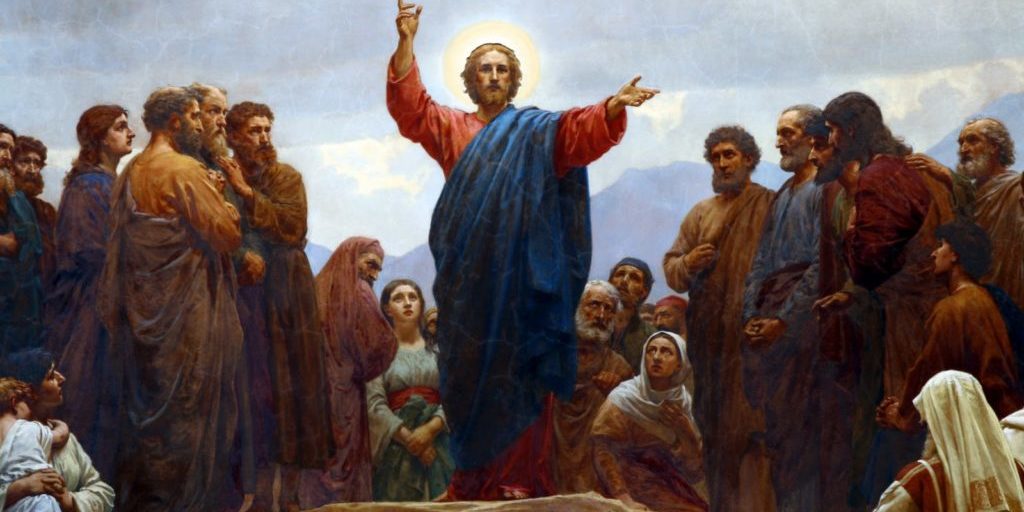
The Sunday gospel lectionary reading for Trinity Sunday in this Year A is Matt 28.16–20. As with the readings in Years B and C, it is short and compact. (See below for commentary on this, and here for video discussion of it, and here for video discussion of the epistle from 2 Cor 13, both also linked at the end.)
But many will not preach on this passage! For some reason, this is the one Sunday of the year when those preaching feel they should depart from the Scripture readings, and (sometimes for the only time in the year) try and preach on a theological idea. I can understand the temptation; Stephen Holmes, in his Quest for the Trinity notes the influence of Karl Barth, who commented:
The doctrine of the Trinity is what basically distinguishes the Christian doctrine of God as Christian…in contrast to all other possible doctrines of God (cited in Holmes p 4).
I think this is true, and you only realise how surprising this is if you ask someone who has not thought about it: what is the central distinguishing feature of Christian faith? I remember being asked this when I started ordination training, and still feel my sense of surprise, first, that I hadn’t ever really considered the question and, second, that this was the answer.
But focussing on preaching on the Trinity is a bad idea for several reasons. First, why depart from preaching on Scripture on this day of all days? Secondly, why choose to preach on the Christian doctrine which, although distinctive, has been the biggest and most challenging that theologians have wrestled with down the centuries? Thirdly, why preach on something that so many get so badly wrong, with illustrations of clover leaves or ice, water and steam that alternately lapse into tritheism and modalism or (even worse and more common) make the false analogy between the ‘persons’ of the Trinity and human persons in social Trinitarianism? These problems might be a good reason to do some teaching—but whether this can be done on one Sunday of the year, in a service of worship, is another matter.
Yet there is a bigger reason not to preach ‘on the Trinity’ on this one Sunday. If the Trinity is indeed not so much taught in Scripture (though Revelation gets pretty close to this) but the doctrine underlying all of Scripture, without which Scripture does not make sense, then if we have been preaching faithfully on Scripture all through the year, then we have in fact been preaching on the Trinity! What we might do is to make the Trinitarian assumptions of our text clear as we preach on them—but that is something we should be doing all the year.
I was encouraged to read this comment on social media in response to my previous post on Pentecost:
I REALLY appreciate this post and the emphasis on maintaining a trinitarian lens through which to understand and explain Pentecost and the role of the Spirit. Thanks.
Perhaps this Sunday is a moment to reflect on our preaching through the year, and ensure we have a Trinitarian orientation to it, just as we should have an anti-antiSemitic orientation to our preaching and reading of Scripture. as well.
So I offer here some briefs notes on the reading from Matt 28.16–20, followed by some important contributions on the subject of the Trinity from previous articles here which might help shape your preaching on this occasion.
It is immediately striking how condensed this conclusion to the gospel is, and how abrupt is the change of scene and focus. The previous extended narrative has all been set in Jerusalem—but now the scene is Galilee, without explicit explanation. The clue to this is surely found in the narrative shape of the gospel as a whole. Like the other synoptics (Mark and Luke), Matthew has depicted Jesus’ ministry as essentially in two halves: the dynamic, popular, and successful ministry in Galilee, where Jesus has moved about freely and drawn the crowds; and the final ministry in Jerusalem, where opposition has closed in around him, he cannot move in the open, and the crowds are divided in their opinion.
Such opposition as there is in the north is sometimes connected with the south, as in Luke 5.17, which hints that the situation is more complex. And of course the depiction in the Fourth Gospel, of Jesus moving frequently from north to south, not least to celebrate the Pilgrim Festivals, is more much historically realistic; the binary depiction of ministry in the Synoptics is a narrative construction.
The movement to Galilee is often thought to be problematic in terms of an overall chronology, apparently contradicting the clear command of Jesus in Acts 1.4 for the disciples to ‘remain in Jerusalem’. Against this, we need to note how selective and condensed these passages are; how the Fourth Gospel agrees with Matthew on the disciples returning to their home territory; the fact that Luke does not tell us where Jesus was with the disciples during the ‘forty days’ in which he taught them about the kingdom through the Holy Spirit (Acts 1.2–3); and that Matthew does not tell us that Jesus ascended to the Father from Galilee. So the contradiction is more apparent than real.
Although most English translations imply that there was a specific mountain or hill that Jesus directed them to, the grammar of the text is more general—’to the mountain/hill country where Jesus had directed them.’ The phrase ‘to the mountain/hill’ occurs quite often in Matthew, most notably at the beginning of the first of the five discourses that Jesus gives, suggesting an echo of the five Books of Moses, known as the Sermon on the Mount (Matt 5.1).
The juxtaposition of the disciples both ‘worshipping’ and ‘doubting’ jars on first reading. But, as with the account of Thomas’ encounter with Jesus in John 20, we need to be careful about how we read these terms.
The term proskuneo can have a sense of mere respect to a social superior, with its etymology of bending the knee, but it can also have the stronger sense of ‘worship’, and the context of both the encounter with the risen Jesus and his teaching which follows surely gives us this second, stronger, sense. The verb distazo, translated ‘doubt’, only occurs twice in the New Testament, both in Matthew, and both in the context of recognition of who Jesus is. The earlier occurrence is Matthew’s unique account of Peter stepping out of the boat onto the water in response to Jesus’ invitation in Matthew 14.29–31; when Peter sees the wind and the waves, he is afraid, and cries out, and is rescued by Jesus who chides him for his little faith and his ‘doubting’.
It denotes not intellectual doubt so much as practical uncertainty, being in two minds—the disorientation produced by the unfamiliar and overwhelming situation… It indicates that they did not know how to respond to Jesus in this new situation, where he was familiar and yet now different; compare the bewilderment and fear of the three disciples who witness the Transfiguration (R T France, NICNT Matthew pp 1111–1112).
This aspect of being ‘double-minded’ is paralleled in another di– term dipsuchos in James 1.8. Within Matthew’s narrative, this is their first encounter with the risen Jesus, so it is unsurprising that their ambivalence matches that recorded in Luke 24.38.
‘Jesus came to them’ is an expression of encouragement and reassurance, parallel to the same phrase we saw at the Transfiguration in Matt 17.7. His commissioning of them includes a fourfold ‘all’, sometimes obscured in English translations:
- He has been given ‘all’ authority, which he confers on them in their ministry.
- He sends them to ‘all’ nations with the good news of the kingdom.
- He calls them to teach ‘all’ that he has in turn taught them.
- He will be with them ‘all’ of the days to the end of the age.
The granting of them authority for ministry offers a strong parallel to Matthew’s version of the sending of the Twelve in Matt 10, in which he blends the local commission of Jesus for that period with the longer challenge of future ministry. But the language of authority, heaven and earth, and the nations also creates strong parallels with the vision of the ‘one like a son of man coming on the clouds of heaven to the Ancient of Days’ in Daniel 7.13–14, language that Matthew records Jesus using in the Olive Discourse/Little Apocalypse in Matt 24.30.
The idea of being sent to ‘all nations’ appears to contradict Jesus’ vocation only to the ‘lost sheep of the House of Israel’ (Matt 10.5), yet we have had anticipations of this all through the gospel—from the coming of the Magi to seek the new king in Matt 2, through the faith of the centurion in Matt 8 pointing to the future coming of ‘many from the East and the West to feast with Abraham’ (Matt 8.11), to the anticipation of just such global ministry in the Olivet Discourse at Matt 24.31. Note that this mission ‘to the nations’ does not replace the mission to Israel, but extends it.
The Gentile mission extends the Jewish mission – not replaces it; Jesus nowhere revoked the mission to Israel (10:6), but merely adds a new mission revoking a previous prohibition (10:5) (Craig Keener, cited in France p 1115).
The command to ‘make disciples’ uses the unusual verb matheteuo, related to the noun for a disciple (mathetes, from which we get the word ‘mathematics’ which originally referred to general learning and instruction); it is often said to be unique to this passage, but in fact occurs in Matt 13.52 (in the description of the scribe who has been trained in the kingdom), in Matt 27.57 (to describe Joseph of Arimathea, who has been ‘discipled’), and in Acts 14.21 (where Paul and his companions have made many disciples). It refers to a process of teaching and training—and it is striking that the ‘teaching’ follows baptism in Jesus’ order, suggesting that, as reflected in (for example) Acts 8 and Acts 16, and in contrast to much practice of the early church of the second and third centuries, baptism is administered at the first confession of faith, and the teaching of discipleship then follows as a longer process.
There is simply no reason to claim that the triadic formula of ‘Father, Son, and Holy Spirit’ is a later emendation of the text, despite the clear indication in Acts that baptism was initially ‘in the name of Jesus’. This would not be the only example of early practice taking time to conform to the teaching of Jesus as recorded in the gospels.
It is striking that here, there is a single, threefold ‘name’, thus identifying Jesus and the Spirit with the name of God. This incorporation of Jesus into the godhead is exactly what we find in Paul’s writings, most notably in three examples:
- In 1 Cor 8.4–6, Paul cites the Shema, the central confession of Jewish faith, that ‘there is no God but one’ in explicit contrast to pagan claims that there are multiple gods. But in doing so, he then incorporates Jesus into that ‘one’, arguing that there is ‘one God, the Father…and one Lord, Jesus Christ’, when in the Old Testament ‘Lord’ is simply a way of referencing the God of Israel.
- In Rom 10.9–13, it is the confession that ‘Jesus is Lord’ which saves—a recognition that he is both lord of our lives and the cosmic lord enthroned at the right hand of the Father. But Paul seals his argument by citing Joel 2.32: ‘For “everyone who calls on the name of the Lord will be saved”‘. For Paul, this ‘Lord’ on whom we call is the Lord Jesus, but for Joel, this saving ‘Lord’ is Yahweh וְהָיָ֗ה כֹּ֧ל אֲשֶׁר־יִקְרָ֛א בְּשֵׁ֥ם יְהוָ֖ה יִמָּלֵ֑ט. Paul is incorporating Jesus into the saving identity of God.
- In Phil 2.9–11 God bestows the name that is above every name on Jesus—which is his own name. In anticipating that ‘every knee will bow and every tongue confess that Jesus is Lord’, Paul is borrowing the language of Is 45.23 which asserts that God alone is the one who commands worship in all the earth.
And of course we find the same kind of triadic language in the opening epistolary greeting from John to his readers in Rev 1.4–5.
So this is indeed a fitting conclusion to the gospel, which draws together multiple threads in a compressed form, and sends out both the original disciples and successive generations of readers, commissioning them on a global task of proclaiming the good news of Jesus and the kingdom until he returns.
If you are tempted to talk more about the Trinity than the passage, then here are some pointers from previous articles.
Mike Higton, Professor of Theology and Ministry at Durham, preached on Trinity Sunday a couple of years ago. To demonstrate that this was not complicated, he preached (almost) the whole sermon in words of one syllable. He concludes:
So there is God, the one to whom we pray, the one to whom we look, to whom we call out, the one who made the world and who loves all that has been made. And then there is God by our side, God once more the one with whom we pray; God in the life of this man who shares our life, this man who lives the life of God by our side, and who pours out his life in love for us. And then there is God in our hearts, God in our guts, God one more time, the stream in which we dip our toes, the stream in which we long to swim, the stream which filled the Son and can fill us too, and bear us in love back to our source.
The life of the one God meets us in all these three ways, and all that we meet in these three ways, has its roots deep, deep down in God’s life—all the way down in God’s life—in ways that our minds are not fit to grasp in ways that break our words to bits. One life, one love, one will, works through these three to meet us when we pray, to catch hold of us, to bear us up—and to take us home.
And that’s why our words for God need to stretch; one-bit words, it turns out, will not do on their own. We call the source, the one to whom we pray, God the Father. And we call the one by our side, the one with whom we pray, God once more, Jesus. And we call the one in our hearts, the one in whom we pray, God one more time, the Spirit. And that is why we call this God—the God we meet when we pray, the God we know when we pray—that is why we call this God ‘three in one’; that is why we call our God Trinity.
Turning to the text of the New Testament, I previously shared my theological comments on Revelation 4 and 5, which offer perhaps the clearest narrative articulation of the Trinity in the Bible:
The language of worship here does a remarkable thing in identifying the lamb as equal with the one on the throne in deserving of worship and adulation—in a text which implicitly refutes the claims of the human figures to be deserving of such obeisance. Because of this, it is reasonable to claim that it offers us the highest possible Christological understanding in the whole New Testament: what we can say of God in worship, we can say of Jesus. The two figures of the one seated on the throne and the lamb are thus characterised as God the creator and God the redeemer. These figures are never quite merged, and remain distinct within the narrative of Revelation and, unlike the association of the Word with the work of creation in John’s gospel, their roles also remain distinct. But in the final hymn of praise, the worship is given to the two as if they were one.
The placing of these scenes of heavenly worship following on from the royal proclamations to the assemblies in the seven cities has a powerful rhetorical impact. The followers of Jesus might be facing particular challenges and opportunities, located within their own cultural and physical contexts—yet the context for all their struggles is this cosmic vision of the praise of God and of the lamb. Where they might feel as though they are ‘swimming against the tide’ in terms of dissenting from the cultural norms of their society—in their participation in the trade guilds with their associated deities, in their moral stance, and in their reluctance to participate in the imperial cult—the juxtaposition of chapters 4 and 5 offers a startling reconfiguration of their world. All of creation is caught up, not in obeisance to the emperor, but in the worship of the God and Father of Jesus, and of the lamb, and any who are not taken up with this are, in fact, in the minority. It is an extraordinary cultural and spiritual counter-claim to the majority perception of reality. And in its emotive extravagance, this vision of worship is not offered as a rational fact, but as a compelling call for all readers to join in themselves.
And finally, Kevin Giles warns us away from any comparison between the ‘community’ of the Trinity and the community of human persons, the heresy that is ‘social Trinitarianism‘.
The way in which the three divine persons relate to one another in eternity is neither a model for nor prescriptive of human relationships in the temporal world. God’s life in heaven does not set a social agenda for human life on earth. Divine relations in eternity cannot be replicated on earth by created human beings, and fallen beings at that. What the Bible asks disciples of Christ to do, both men and women, is to exhibit the love of God to oth- ers and to give ourselves in self-denying sacrificial service and self-subordination, as the Lord of glory did in becoming one with us in our humanity and dying on the cross. In other words, the incarnate Christ provides the perfect example of Godly living, not the eternal life of God.
Specifically, appealing to the doctrine of the Trinity, a three-fold perfect divine communion, to support either the equality of men and women or their hierarchical ordering, is mistaken and to be opposed.
Happy Trinity Sunday!
Come and join Ian and James as they discuss this passage, and the related issues of whether we should be preaching on the Trinity, here, and a discussion of 2 Corinthians 13, with its triadic final greeting (‘The Grace’) below:
 Buy me a Coffee













THE Great Commission depicts Jesus giving of Responsibilities to His saints.
Our Responsabilities =Think the parable of the Stewards. Put off…Put on….etc.
What are we to take responsibility for, what does Responsibility look like?
James counsels to avoid being “Double minded” what does that mean
“Washing your hand “ Think Pilate having nothing more to do with {Jesus }
Purify your heart- purifying, having just one element – Jesus is Lord, Sovereign Ruler.
Paying attention to the heart, Keeping it ,Guarding it.
Deuteronomy 4:9
Only take heed to thyself, and keep thy soul diligently,
Proverbs 4:23 in the Amplified Bible (AMP) reads:
“Watch over your heart with all diligence,
For from it flow the springs of life.”
Mark 7:21-23
For from within, out of the heart of men, proceed evil thoughts, adulteries, fornications, murders, Thefts, covetousness,
wickedness, deceit, lasciviousness, an evil eye, blasphemy,
pride, foolishness: All these evil things come from within,
and defile the man.
As with Paul there are responsibilities to fulfil that He might attain to the Resurrection.
Alas, not all Anglicans or Pentecostals will attain to the Resurrection –
Mat 7:22 Many will say to me in that day, Lord, Lord, have we not prophesied in thy name.
7:23 And then will I profess unto them, I never knew you:
depart from me, ye that work iniquity.
Alas ,
I don’t have the luxury of the number of words to expand on this but
I can recommend two marvellous articles on “Taking Responsibility”
“Take Your Share” and “Tested Unto Responsibility” both at austin sparks net.
Or The Battle for the Heart | By Chuck Missler @ .khouse.org/personal_update/articles/2025/battle-heart Shalom.
The Triunityof God is what sparates the God of Christianity from all others is frequently said by Mike Reeves.
He also points out that many books on systematic theology devote little time and space to the study.
In ‘The Holy Trinity, in Scripture, History, Theology and Worship, (2019:650 pages) Robert Letham in ‘Part 3: Modern Discussion’ considers Karl Barth’s contribution in over 20 pages
And in’ Part 4: Critical Issues: looks at, in one of four chapters, ‘The Trinity, Creation and Mission’ in just short of forty pages.
The great Triune commission.
PS. I conjecture – when Paul urges the saints to”be of one mind”
he refers not to be in total agreement but don’t be double minded,
Be pure in Heart [for they shall see God] ?
I’ve recently had a lot of discussions with the ‘unitarian’ group known as “Jehovah’s Witnesses” and one thing has beome rather clear – yes, if you abandon the Trinity God becomes much easier to understand; but at the same time the atonement becomes a major problem of morality and justice.
In Trinitarianism God bears the cost of forgiveness Himself, out of His Resources; in any ‘unitarian’ view Jesus is portrayed as a separate and innocent party on whom the cost falls – the unitarian God forgives totally unjustly at the expense of an innocent third party. It’s roughly equivalent to me forgiving a man who has broken one of my windows by saying “It’s OK, my son will pay for the dsamage from his paper round money”. If I did that I would rightly be accused of child abuse. and at least my son is ‘begotten’ of me and shares my nature – Jesus for a unitarian is a separate created being.
This approach is much more real than worrying about the ‘mathematics’ of the Trinity. How complicated God is – yet fully unified – is as they say “beyond our pay grade” or indeed simply beyond our limited minds; but a God who forgives at his own expense and not at the expense of somebody else is ‘Morality and Justice 101’!!
Yes very good point.
I’ve read some inadequate defences of the 3-gods-in-1 doctrine, but this is about as bad as it gets. You’re grossly distorting what you try to find fault with.
In any ‘unitarian’ view Jesus is portrayed as a separate and innocent party. I won’t defend every unitarian view – in contrast to your sweeping assertion – but I will defend the scriptural one. There, Jesus is God’s only-begotten son, a fact, according to the New Testament witness, that Trinitarianism shamelessly denies.
The unitarian God forgives totally unjustly at the expense of an innocent third party. You seem to have lost sight of the gospel itself, for that is precisely what it says. I Pet 3:18: ‘Christ suffered once for sins, the innocent for the guilty, that he might bring us to God.’ At the beginning of his letter Peter addresses those who are chosen ‘according to the foreknowledge of the divine Father, in sanctification of Spirit, for obedience to Jesus Christ and sprinkling with his blood.’ And in the next verse: ‘Blessed be the God and Father of our Lord Jesus Christ!’ God is expressly Jesus’s father and his God (see also Matt 27:46, John 20:17 and explicitly ‘unitarian’ declarations such as I Cor 8:6, Eph 4:6, I Tim 2:5).
If you are a father, your chile is not a ‘separate party’. Have you never considered Abraham’s costly willingness to sacrifice his only son? It was the most heart-rending sacrifice he could have made. And God commended him for it, saying that one day he himself would provide. Unlike Isaac, isasmuch as he was led on and had no intention of dying, Jesus paid the price for sin willingly, not – as in your analogy of the broken window – because another member of the alleged Trinity made him pay. In characterising Jesus’s willing self-offering as ‘child abuse’ on the part of his father, you join the ranks of Steve Chalke, who likewise characterised the cross as ‘cosmic child abuse’. What is it, exactly, that sticks in your throat? That Jesus was God’s child? Or that he did not deserve to be crucified?
I would imagine because in your scenario it is not God himself who chooses to take on the consequences of mankind’s sin.
The ‘Simplicity of God’ includes the Trinity and is integral to the Christian doctrine of God.
“Simplicity: God is not made up of parts; he is not composite or a compound being. Consequently, it is not theological precise to say God possesses attributes; rather he Is his attributes. His essence is his attributes and his attributes are his essence; all is in God is simply God.” From
‘NONE GREATER The Undomesticated Attributes of God’ by Matthew Barrett.
The New Testament for Everyone translates verse 19a “So you must go and make all the nations into disciples”, and it certainly looks to me from the Greek that that’s correct. We don’t often hear this brought out.
Does his translation imply that all the people of all the different nations will become followers of Jesus? If so I think the ‘traditional’ translation is better as it fits with reality. That is, people from every background become followers, but only some.
But an expert in NT Greek can give their opinion.
The Greek word used in the Great Commission is ‘ta ethne’- an ethnos is not a modern geopolitical nation but in effect a race or tribe. And crucially ‘ta ethne’ was the stock Jewish phrase for ‘the Gentiles’, the non-Jewish peoples of the world. So the logical reading is that Jesus is now, in the ‘new covenant’ commissioning his disciples to preach to the Gentiles, in effecttoo the whole world. Bear in mind that a geopolitical nation is in many ways a ‘legal fiction’ which cannot actually achieve the very personal things required in becoming a disciple – only individual human beings can be ‘born again’ through faith.