The Trinity, Matthew 28, and the Great Commission

The Sunday gospel lectionary reading for Trinity Sunday in this Year A is Matt 28.16–20. As with the readings in Years B and C, it is short and compact. (See below for commentary on this, and here for video discussion of it, and here for video discussion of the epistle from 2 Cor 13, both also linked at the end.)

But many will not preach on this passage! For some reason, this is the one Sunday of the year when those preaching feel they should depart from the Scripture readings, and (sometimes for the only time in the year) try and preach on a theological idea. I can understand the temptation; Stephen Holmes, in his Quest for the Trinity notes the influence of Karl Barth, who commented:

The doctrine of the Trinity is what basically distinguishes the Christian doctrine of God as Christian…in contrast to  all other possible doctrines of God (cited in Holmes p 4).

I think this is true, and you only realise how surprising this is if you ask someone who has not thought about it: what is the central distinguishing feature of Christian faith? I remember being asked this when I started ordination training, and still feel my sense of surprise, first, that I hadn’t ever really considered the question and, second, that this was the answer.

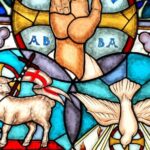
But focussing on preaching on the Trinity is a bad idea for several reasons. First, why depart from preaching on Scripture on this day of all days? Secondly, why choose to preach on the Christian doctrine which, although distinctive, has been the biggest and most challenging that theologians have wrestled with down the centuries? Thirdly, why preach on something that so many get so badly wrong, with illustrations of clover leaves or ice, water and steam that alternately lapse into tritheism and modalism or (even worse and more common) make the false analogy between the ‘persons’ of the Trinity and human persons in social Trinitarianism? These problems might be a good reason to do some teaching—but whether this can be done on one Sunday of the year, in a service of worship, is another matter.

When and from where is Jesus ‘coming on the clouds’?

The phrase ‘coming on the clouds’ is commonly misread as referring to Jesus’ return at the end of the age—when reading it in context and noticing its source in Daniel 7 paints a very different picture.

I have spent the week at Lee Abbey in Devon (if you have not been, you should go!), teaching on Hope and the End of the World.

In my teaching and reflection on issues around eschatology and the ‘second coming’ of Jesus, there is one phrase that keeps coming up, and to which people thinking about these things keep returning: the language of the Son of Man ‘coming with the clouds.’ When I have offered an alternative reading to the key passages in Matthew 24 and Mark 13, this is one of the main things that people get stuck on. I think the reason for this is that people assume that the key questions have obvious answers—so we don’t even need to ask them. But it is important to reflect on: in this phrase, where is Jesus coming from, and where is he coming to? When will this happen? And what is the origin of the phrase?

The spiritual gifts in 1 Corinthians 12

The lectionary New Testament readings for the Pentecost, this coming Sunday, are 1 Corinthians 12.3b-13, Acts 2.1-21, and John 20.19-23—but the first or second reading must be from Acts. So I suspect most churches will read Acts and 1 Corinthians 12. Written commentary on Acts 2 can be found here, and video discussion here.

Here I offer commentary on 1 Corinthians 12, with the link to the video discussion at the end.

What we call Paul’s first letter to the Corinthians is clearly part of an exchange with the faith community there, since Paul makes reference to the previous correspondence back and forth; we actually have Paul’s second and fourth letters (depending on how you reconstruct the exchange). This because significant at key points in this letter, as Paul makes it clear that he is responding to questions asked or issues raised by the Corinthians themselves—but of course we don’t know what they have said, and can only speculate. It is an important window into Paul’s exercise of authority; I wonder if today, in a Church of England church, we could imagine the congregation challenging and questioning their bishop in an exchange of correspondence!

Preaching on the Trinity and John 16

The Sunday gospel lectionary reading for Trinity Sunday in this Year C is John 16.12–15. It is another very short reading (four verses) from the ‘farewell discourse’ of Jesus, and I think is actually quite a difficult reading to preach from. Like much of this part of the Fourth Gospel, it is reflective, repeats things … Continue Reading
Peace, Hope, and Suffering in Romans 5 video discussion

The lectionary readings in this Year C for Trinity Sunday are John 16.12–15 and Romans 5.1–5, both quite short readings. Western eyes often read Romans 5 in individual terms, but the honour/shame/glory motif needs to be understood corporately. The surprising combination of hope and suffering shows that Paul’s eschatology stands behind this—the future has broken … Continue Reading
The Great Commission in Matt 28 and preaching on the Trinity video discussion

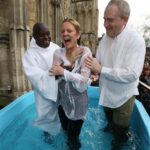
The Sunday gospel lectionary reading for Trinity Sunday in Year A is Matthew 28.16–20, the so-called Great Commission which concludes the gospel. It has been picked for this week because it contains the triadic/Trinitarian formula ‘baptising them in the name of the Father, the Son, and the Holy Spirit.’ Apart from the fascinating details of … Continue Reading