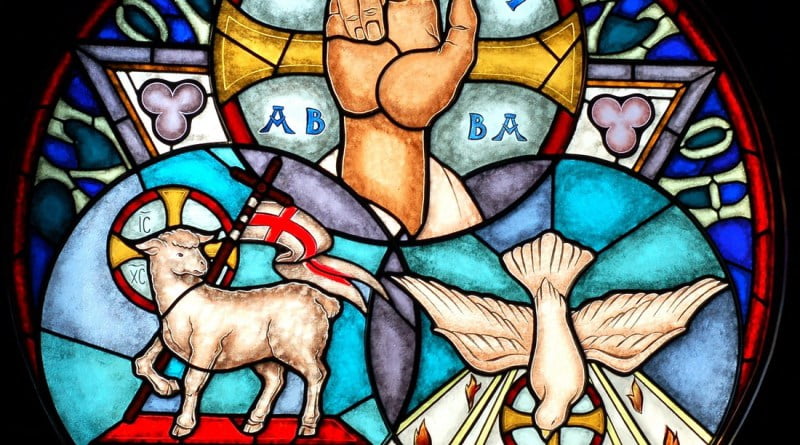
The Sunday gospel lectionary reading for Trinity Sunday in this Year C is John 16.12–15. It is another very short reading (four verses) from the ‘farewell discourse’ of Jesus, and I think is actually quite a difficult reading to preach from. Like much of this part of the Fourth Gospel, it is reflective, repeats things that have been explored before (in chapter 14), and when a few verses are removed from their context in the wider passage, this makes it even hard to preach about. The NT epistle is Romans 5.1–5. At the bottom of this article I have posted the video discussions for both John 16 and Romans 5.
But many will not preach on this anyway! For some reason, this is the one Sunday of the year when those preaching feel they should depart from the Scripture readings, and (sometimes for the only time in the year) try and preach on a theological idea. I can understand the temptation; Stephen Holmes, in his Quest for the Trinity notes the influence of Karl Barth, who commented:
The doctrine of the Trinity is what basically distinguishes the Christian doctrine of God as Christian…in contrast to all other possible doctrines of God (cited in Holmes p 4).
I think this is true, and you only realise how surprising this is if you ask someone who has not thought about it: what is the central distinguishing feature of Christian faith? I remember being asked this when I started ordination training, and still feel my sense of surprise, first, that I hadn’t ever really considered the question and, second, that this was the answer.
But focussing on preaching on the Trinity is a bad idea for several reasons. First, why depart from preaching on Scripture on this day of all days? Secondly, why choose to preach on the Christian doctrine which, although distinctive, has been the biggest and most challenging that theologians have wrestled with down the centuries? Thirdly, why preach on something that so many get so badly wrong, with illustrations of clover leaves or ice, water and steam that alternately lapse into tritheism and modalism or (even worse and more common) make the false analogy between the ‘persons’ of the Trinity and human persons in social Trinitarianism? These problems might be a good reason to do some teaching—but whether this can be done on one Sunday of the year, in a service of worship, is another matter.
Yet there is a bigger reason not to preach ‘on the Trinity’ on this one Sunday. If the Trinity is indeed not so much taught in Scripture (though Revelation gets pretty close to this) but the doctrine underlying all of Scripture, without which Scripture does not make sense, then if we have been preaching faithfully on Scripture all through the year, then we have in fact been preaching on the Trinity! What we might do is to make the Trinitarian assumptions of our text clear as we preach on them—but that is something we should be doing all the year.
I was encouraged to read this comment on social media in response to my previous post on Pentecost:
I REALLY appreciate this post and the emphasis on maintaining a trinitarian lens through which to understand and explain Pentecost and the role of the Spirit. Thanks.
Perhaps this Sunday is a moment to reflect on our preaching through the year, and ensure we have a Trinitarian orientation to it, just as we should have an anti-antiSemitic orientation to our preaching and reading of Scripture. as well.
So I offer here some briefs notes on the reading from John 16.12–15, followed by some important contributions on the subject of the Trinity from previous articles here which might help shape your preaching on this occasion.
In some ways, this is not the most obvious reading to have on Trinity Sunday; but in other ways, it emphasises the close interrelation between Father, Son and Spirit.
Jo-Ann Brant (Paideia commentary) notes that the material in this section appears to repeat much of what Jesus has said in John 14, so it is worth reading these two sections together—although in chapter 16 some ideas are further developed.
The context of this passage is the promise of Jesus to send the Paraclete (John 16.7), which has several important implications. It means that the Ascension is closely related to Pentecost, since it is the ascended Jesus, now enthroned, who sends the Spirit. There is something here akin to the normal human process of learning, growing up, and taking responsibility; the disciples’ dependance on Jesus changes register, and it is a dependance which leads to maturity. And it is striking that, at times, Jesus says that he is the one who sends the Spirit (as here), but at others he asks the Father who sends the Spirit (as in John 14.16, 26), and in John 15.26, Jesus sends the Spirit from the Father. The Spirit is sent by both Father and Son, so that in Rev 22.1 the river of the water of life, symbolising the life-giving Spirit, flows from the (single) throne of both God and the lamb.
The term ‘Paraclete’ is only used four times in the Fourth Gospel, in John 14.16, 26, 15.26 and 16.7. Its basic meaning (reflected in its etymology) is meaning ‘one who has been called alongside’ another. It has a passive sense, in that the one who comes alongside has been requested by another, and this is reflected in the ‘self-effacing’ description of the Spirit here. The Spirit does not do things of his own accord, but in response to the request and calling of Jesus and the Father. The Spirit does not point towards the Spirit’s own work, but points us what belongs to Jesus, which in turn is of the Father (John 16.15).
Some ETs translate the term as Helper (which sounds rather weak) or Advocate (which sounds rather forensic) though this does fit with the one mention of Jesus as our Paraclete in 1 John 2.1, where he pleads our cause with the Father. In fact, the Spirit is ‘another Paraclete’ (ἄλλος παράκλητος), that is, another of the same kind. The role of the Spirit here appears to be to make real for the disciples the presence, power and speech of the risen Jesus. Interestingly, some Rabbis taught that the Messiah would be called Menachem (the Hebrew for ‘comforter’) because the gematria value of Menachem is the same as the value of ‘branch’ nezer in Isaiah 11.1.
The cognate verb parakaleo is common in the NT (though absent from the Fourth Gospel), and is variously translated to urge, to encourage, to comfort, depending on the context—these things are all the work of the Spirit. And as we are comforted in all our sufferings, so we learn how to comfort others (2 Cor 1.4).
The opening sentence of our passage raises some important questions. If Jesus ‘still has many things to say’, does that mean that the gospel records are incomplete or inadequate? The writer of the gospel does not appear to think so; we have enough to know who Jesus is, understand his purposes, and so believe (John 20.31). David Ford, in his theological commentary on this gospel, notes that the term ‘to bear’ is very often associated with suffering—so Jesus ‘bears’ his cross (Luke 14.27), and we are to ‘bear with one another’ in the things that weigh us down (Gal 6.2).
This then means that when the Spirit speaks of ‘what is to come’ (John 16.13), this is not about the end of the world, but about the coming suffering and exaltation of Jesus. at the time, the disciples will not understand, but as they look back, with the understanding that the Spirit gives, then it will make sense. We have seen this theme from the very beginning of this gospel: ‘After he was raised from the dead, his disciples recalled what he had said’ (John 2.22; compare John 12.16).
The Spirit is the ‘Spirit of truth’; all through this gospel the question has been explored, who is the true witness to the things of God, as Jesus is put on trial by his accusers, culminating in the actual trial before Pilate. We have just learned that the Spirit is the one who tells us the truth about what is right, what is wrong, and how to tell the difference (verses 8–11), and we will hear Jesus’ prayer that all his followers will be ‘one’ when they are ‘sanctified in the truth; your word is truth’ (John 17.17).
It is not possible to suggest that Scripture says one thing, but the Spirit is now saying something different, because what the Father says, what Jesus teaches, and what the Spirit speaks to us are one and the same. The articulation of this here is a reiteration of what we heard in chapter 14: ‘But the Advocate, the Holy Spirit, whom the Father will send in my name, will teach you all things and will remind you of everything I have said to you’ (John 14.26). The idea that ‘he will speak whatever he hears’ is expressed rather well in the message to the seven assemblies in Revelation 2–3; the opening of each message proclaims that ‘these are the words of…’ the risen Jesus—yet at the conclusion of each we are urged to ‘hear what the Spirit is saying.’ The words of Jesus are what the Spirit is saying.
The mention of ‘glory’ is characteristic of this section of the gospel; the first half focussing on signs, whilst the second half has the prominent theme of glory. The Spirit is associated with Jesus being ‘glorified’ as early as John 7.39; the glory of Jesus is bound up with the glory of the Father (John 8.54). God’s glory is made manifest when we pray in Jesus’ name (John 14.13) and when we bear fruit by keeping his commandments and abiding in him (John 15.8). But Jesus’ glory is most notably associated with his death, as he remains obedient to the Father and offers himself up for us (John 12.23, 28, 13.31, 17.1, 4). And this carries over into the death of those who would be martyred for their faith (John 21.19).
If you are tempted to talk more about the Trinity than the passage, then here are some pointers from previous articles.
Mike Higton, Professor of Theology and Ministry at Durham, preached on Trinity Sunday a couple of years ago. To demonstrate that this was not complicated, he preached (almost) the whole sermon in words of one syllable. He concludes:
So there is God, the one to whom we pray, the one to whom we look, to whom we call out, the one who made the world and who loves all that has been made. And then there is God by our side, God once more the one with whom we pray; God in the life of this man who shares our life, this man who lives the life of God by our side, and who pours out his life in love for us. And then there is God in our hearts, God in our guts, God one more time, the stream in which we dip our toes, the stream in which we long to swim, the stream which filled the Son and can fill us too, and bear us in love back to our source.
The life of the one God meets us in all these three ways, and all that we meet in these three ways, has its roots deep, deep down in God’s life—all the way down in God’s life—in ways that our minds are not fit to grasp in ways that break our words to bits. One life, one love, one will, works through these three to meet us when we pray, to catch hold of us, to bear us up—and to take us home.
And that’s why our words for God need to stretch; one-bit words, it turns out, will not do on their own. We call the source, the one to whom we pray, God the Father. And we call the one by our side, the one with whom we pray, God once more, Jesus. And we call the one in our hearts, the one in whom we pray, God one more time, the Spirit. And that is why we call this God—the God we meet when we pray, the God we know when we pray—that is why we call this God ‘three in one’; that is why we call our God Trinity.
Turning to the text of the New Testament, I previously shared my theological comments on Revelation 4 and 5, which offer perhaps the clearest narrative articulation of the Trinity in the Bible:
The language of worship here does a remarkable thing in identifying the lamb as equal with the one on the throne in deserving of worship and adulation—in a text which implicitly refutes the claims of the human figures to be deserving of such obeisance. Because of this, it is reasonable to claim that it offers us the highest possible Christological understanding in the whole New Testament: what we can say of God in worship, we can say of Jesus. The two figures of the one seated on the throne and the lamb are thus characterised as God the creator and God the redeemer. These figures are never quite merged, and remain distinct within the narrative of Revelation and, unlike the association of the Word with the work of creation in John’s gospel, their roles also remain distinct. But in the final hymn of praise, the worship is given to the two as if they were one.
The placing of these scenes of heavenly worship following on from the royal proclamations to the assemblies in the seven cities has a powerful rhetorical impact. The followers of Jesus might be facing particular challenges and opportunities, located within their own cultural and physical contexts—yet the context for all their struggles is this cosmic vision of the praise of God and of the lamb. Where they might feel as though they are ‘swimming against the tide’ in terms of dissenting from the cultural norms of their society—in their participation in the trade guilds with their associated deities, in their moral stance, and in their reluctance to participate in the imperial cult—the juxtaposition of chapters 4 and 5 offers a startling reconfiguration of their world. All of creation is caught up, not in obeisance to the emperor, but in the worship of the God and Father of Jesus, and of the lamb, and any who are not taken up with this are, in fact, in the minority. It is an extraordinary cultural and spiritual counter-claim to the majority perception of reality. And in its emotive extravagance, this vision of worship is not offered as a rational fact, but as a compelling call for all readers to join in themselves.
And finally, Kevin Giles warns us away from any comparison between the ‘community’ of the Trinity and the community of human persons, the heresy that is ‘social Trinitarianism‘.
The way in which the three divine persons relate to one another in eternity is neither a model for nor prescriptive of human relationships in the temporal world. God’s life in heaven does not set a social agenda for human life on earth. Divine relations in eternity cannot be replicated on earth by created human beings, and fallen beings at that. What the Bible asks disciples of Christ to do, both men and women, is to exhibit the love of God to oth- ers and to give ourselves in self-denying sacrificial service and self-subordination, as the Lord of glory did in becoming one with us in our humanity and dying on the cross. In other words, the incarnate Christ provides the perfect example of Godly living, not the eternal life of God.
Specifically, appealing to the doctrine of the Trinity, a three-fold perfect divine communion, to support either the equality of men and women or their hierarchical ordering, is mistaken and to be opposed.
Happy Trinity Sunday!
Here is the video discussion between James and Ian about John 16:
And here is the video discussion about Romans 5:
 Buy me a Coffee










Is it really so bad to see in the story of Abraham, Isaac and the Chief Steward a reflection of the Trinity?
Hebrews 11:19 Abraham reasoned that God could even raise the dead, and so in a manner of speaking he did receive Isaac back from death.
After this they went and stayed in the Negev and sent the Chief steward out to get a wife for Isaac. Does this not speak, in human terms, of what God is like? The Chief steward took gifts and went in search of a wife, giving her gifts, giving her the pledge in the form of three rings? Took her back with him. Met Isaac coming towards them. etc.
This Genesis story seems full of Trinitarian content.
Thanks Steve.
It reminds me of the introduction to a small book, God and Us, by Keith Warrington, which was written in response to a question by his wife, why do we not hear sermons about God?
Yes, it’s a shame if the story is only a tale about how Abraham lived his life 4000 years ago, and to deviate is to fall into some sort of allegorical heresy.
And also, I believe, the first verses of Revelation start with an allusion to the story of Abraham setting the scene for the Revelation to be about the Wedding of the Lamb right from the first verse!
Or it is reduced to morals or character; be like Abraham; don’t be like Abraham; a sermon that would not be out of place in a synagogue. With the application being little more than, try harder. You’re not measuring up.
As Tim Keller has said preaching is not good information, not good advice, but godd news.
Here is a quotation from Spurgeon that may find a home in hermeneutics today:
https://www.thegospelcoalition.org/blogs/justin-taylor/spurgeon-on-preaching-christ/
Correction: may not find a home…
Indeed. I recall from somewhere a quotation from Spurgeon on how he prepared his sermons: ‘I take a text and make a bee-line for the Cross.’ This is what Tim Keller constantly sought to do. Sometimes the exegesis could seem a little forced, but he was determined to show thst all Scripture witnesses to Christ.
The doctrine is ‘the biggest and most challenging that theologians have wrestled with down the centuries’ because it is neither true nor rationally defensible. It may be a ‘distinguishing feature’ of modern Christianity but it is not ‘central’ and it does not accord with Scripture. Only last Sunday the reading at church was James 2, in the course of which the apostle says, “You believe that God is one [James is addressing Jews, so he is alluding to Deut 6:4]; you do well. Even the demons believe [this].” Why did he not write, “God is three persons in one” or “Moses said that God was one, but you should now revise the belief of your forefathers: God is also three”?
Neither Paul nor Jesus nor anyone else teaches that there are and always were three gods, albeit in perfect harmony. Given that this would have been a radical departure from the OT’s monotheism, the NT should have been absolutely explicit on the point. But what does it actually say? That Jesus is the son of the one God.
Scriptures listed on page 66 of When the Towers Fall: A Prophecy of What Must Happen Soon:
‘Jesus answered, “The most important is, ‘Hear, O Israel: The Lord our God, the Lord is one.” ’
‘For us there is one God, the Father, from whom are all things and for whom we exist, and one Lord, Jesus Christ, through whom are all things and through whom we exist.’
‘An intermediary implies more than one, but God is one.’
‘For there is one God, and there is one mediator between God and men, the man Christ Jesus.’
‘ … until the appearing of our Lord Jesus Christ, which he will display at the proper time—he who is the blessed and only Sovereign, the King of kings and Lord of lords, who alone has immortality, who dwells in unapproachable light, whom no one has ever seen or can see.’
‘Now to him who is able to keep you from stumbling and to present you blameless before the presence of his glory with great joy, to the only God, our Saviour, through Jesus Christ our Lord, be glory, majesty, dominion, and authority, before all time and now and forever.’
The repeated asseveration that God is one – not, therefore, three – makes Trinitarianism a heterodoxy, and, biblically viewed, a heresy.
Careful Spirit-enlightened readers of Scripture will have no trouble making sense of Scripture without this pagan doctrine, which does not underlie any part of Scripture, let alone all of it.
As for John 16.12–15, Jesus is speaking about a person distinct from himself, who nonetheless does not speak on his own authority but according to what he hears – hears, evidently, from the Father, who is evidently superior to him (cf. Matt 8:9). He is distinct inasmuch as he is given to the Church and dwells in the hearts of those who invite him in. That indwelling is what makes an individual born again. ‘The context of this passage is the promise of Jesus to send the Paraclete.’ Yes, and who is the Paraclete? ‘Jesus Christ the righteous’ (1 Jn 2:1) Just as there is only one God, there is only one Paraclete. When Jesus speaks of the Spirit of Truth being sent to enlighten and strengthen his brothers, he is speaking of himself dwelling in them (Jn 17:23, 26). “If anyone loves me, he will keep my word, and my Father will love him, and we will come to him and make our home with him.” (Jn 14:23) It is the Father and the Son who, through the Holy Spirit, dwell in the believer.
Steven,
Are you saying that Jesus was a created being?
It is of course another modern heresy that God did not create anything living, that everything evolved into being by itself. Thus for the great majority of Christians – yourself included? – your question would be meaningless. If you are asking whether I believe that Jesus is the Son of God, the answer is yes. There is good scriptural authority for the belief – and what Scripture says is crucial.
That is not the question l am asking Steven. I asked was Jesus a created being ? Or did he have an eternal pre -existence in some form co-existing with the Father? Was he God becoming flesh and walking among us?
Or did he have no existence before then?
Since Jesus was the son of God you should be able to work out the answer for yourself. Why are you intent on rephrasing Scripture, which very particularly sticks to the language of sonship? The thing to do, if you are genuinely puzzling things out, is interact with the substance of my comment, and that substance is in the many scriptures I cited.
More evasion Steven. Please can you answer my question.
Jesus has ALL authority. Only God has ALL authority. Conclusion?
God gave him all authority. One does not have to construct a chain of logic aside from Scripture to come to that conclusion. Scripture expressly says so.
So he is co-equal with God. OK.
May I suggest the re-reading of Rev chapter 4 & 5?
When John sees the scroll, he becomes overwhelmed with sadness and frustration. It seems that this scroll contains God’s plan for the world, but it’s completely sealed, and no one is able to open it or understand what it says. Just as all hope seems lost, a new figure appears: a lion who looks like a lamb.
Even though the lamb is never directly called “Jesus” in the book of Revelation, it’s clear from the symbolism and context that it represents Him. The lamb fulfills the hopes of Israel, especially the promise that a king from David’s line would come. He is strong like a lion, able to defeat enemies, but when John sees Him, He appears as a lamb that had been killed. This image ties into other parts of Scripture: the Passover lamb, the suffering servant who was “wounded for our sins,” and the sacrificial lamb offered for atonement.
This lamb, once slain, now stands alive and powerful. He shares God’s throne and sends the Holy Spirit to carry out God’s will on earth. This scene presents one of the most precise and most complex descriptions of the Trinity in the New Testament. John shows us deep truths by putting together powerful and opposite images—like the lion and the lamb, representing strength and weakness, victory and suffering. Understanding this contrast is key to understanding the whole message of Revelation.
The way worship is described here is essential, too. The lamb is worshiped in the same way as the one seated on the throne (God), which shows that He is equal with God. This stands in direct contrast to earthly rulers who falsely claim they deserve worship. Because of this, many scholars see this moment as one of the strongest declarations in the Bible about who Jesus is. He is not just God’s servant—He is God. In Revelation, God and the lamb are shown as two separate figures: God as Creator, and the lamb as Redeemer. Their roles remain distinct, but they are worshiped together as one.
Finally, the placement of this heavenly scene right after the messages to the seven churches is powerful. The early Christians faced all kinds of struggles and choices in their daily lives. But here, John reminds them—and us—that behind all of that is a much bigger picture: the eternal worship of God and the Lamb in heaven. This cosmic perspective gives meaning and hope to every challenge they face.
Or
The statement “In the beginning was the Word” encapsulates the eternality of the Word, the creating power of the Word, and the revelatory nature of the Word. As John later defines the Word as being Jesus (John 1:14–18), the purpose of the Gospel of John becomes clear—“that you may believe that Jesus is the Messiah, the Son of God, and that by believing you may have life in his name” (John 20:31). Jesus is the revelatory and actual eternal Creator—the object of the Christian’s faith. He is not simply a representation of God, but He is God, and He has always been so: “In the beginning was the Word.” The remaining chapters of the Gospel of John endeavor to show this statement to be true.
From ( https://www.gotquestions.org/the-Word-was-in-the-beginning.html ), just in case you need a reference.
Thanks. See also my article on the trinity in Rev 4 to 5.
Steven Robinson has just provided the reason to preach/teach the Trinity of the One Unique God of Christianity. It is foundational and irreducible: unique separating Christianity from all other religions.
Assumptions that it is preached by implication throughout scripture are a negation of the burden and joy, doxology to preach/teach.
It may be American, but the UK may only be slightly better…..
“Yet, a new research report from the Cultural Research Center at Arizona Christian University shows that only 11% of American adults, and only 16% of self-proclaimed Christians, believe in the trinity.”
It’s difficult to do, but surely worth restating a foundation of one’s faith? Compare. We should be preaching Easter every week, but we take time out to especially remember what happened.
The Trinity is tricky because, accurately understood it defies analogy. The point is rammed home in an amusing way (if you like that sort of thing) by the YouTube channel Lutheran Satire imagining St Patrick encountering a couple of exasperating but very well-informed Irish peasants:
https://www.youtube.com/watch?v=KQLfgaUoQCw
There is no good analogy for the Trinity, but there might be one for our understanding of it. We are of course talking about God, and perhaps it is a conceit of man that we instinctively believe we can grasp God, get our intellectual hands around him etc.. And when we can’t do that we get frustrated and jump to saying that the idea must be rubbish, rather than considering that it might be our inadequacies that hold us back. I sometimes wonder if the mystery of the Trinity, is like trying to look directly at the sun. We’re extremely aware of the sun, and fully appreciate it’s importance, but we can’t look directly at it and are reduced to trying to snatch a sideways glimpse or an artificial construction to aid our understanding. (This analogy falls down because you can really look directly at the sun, you just shouldn’t because it’s very damaging to your eyes…).
Yes analogies only work up to a point. But then that is not surprising. The Trinity cannot fully be understood by mankind, it is the very depth of God. And the reason why it couldn’t be made up by man. No man could make it up.
There are several examples of the term trinity which encompass a unity.
Man was created as a trinity because he is made in God’s image
Robert Green Ingersoll said
“Reason, observation, and experience; the holy trinity of science.”
Mark Hart wrote, “Instead of loving the Trinity of God (Father, Son, and Holy Spirit), we tend to love a different trinity: Me, myself, and I.
“The modern holy trinity is money, sex and celebrity.” Says P. D. James
“Salvation is accomplished by the almighty power of the Triune God. The Father chose a people, the Son died for them, the Holy Spirit makes Christ’s death effective by bringing the elect to faith and repentance, thereby causing them to willingly obey the gospel. The entire process (election, redemption, regeneration) is the work of God and is by grace alone. Thus God, not man, determines who will be the recipients of the gift of salvation.”
Loraine Boettner
As well as explaining the Holy Trinity it is well worth considering the trinity of the man as created by God, a trinity in unity.
A. W. Weckeman has a scholarly paper on “THE TRINITY OF GOD AND MAN
@ perfectingofthesaints.com/trinity-man-adam-spirit-soul-and-body/
Shalom.
The Holy Trinity:
In Scripture; In History; In Worship, by Robert Latham is well regarded.
Here is a brief review;
https://learn.ligonier.org/articles/book-review-the-holy-trinity-by-robert-letham
It is a good, edifying read.
You are telling us that ‘The Trinity’ is the central distinguishing feature of the Christian faith? The Trinity is, of course, true – and, properly understood, is unique to the Christian faith. But the concept is hard to understand and ‘big shot’ theologians disagree on it. I found the view of Anasthasius (explained in ‘The Trinitarian Faith’ by T.F. Torrance) most convincing (this was the view of T.F. Torrance and I found his arguments convincing). At the same time, this view was not universally accepted at the council of Nicaea (as explained by T.F. Torrance) – showing that serious Christians did have disagreements.
The distinguishing feature of the Christian faith is that: God rescued me and brought me into the number of the Saviour’s family, even when I was lost in my own sin and rebelling against Him. The Christian position is that, through my own sinfulness, I was *worthless* and Christ had to die on the cross because we were worth so little (in contrast to the false gospel which proclaims that Christ took the trouble of dying for us because we were of such great worth to Him). Anything I do is a *response* to God’s love for me; the ultimate question of Salvation has already been solved.
I am unaware of any other religion / faith which takes this view; in all other religions, the adherent, after having come to faith, is *required* to do something further (getting to heaven is contingent on obeying some set of rules) in order to maintain their position of one of the faithful who will get to heaven.
Of course, The Trinity is at the bottom of this – God the Father, His only begotten Son who has to be both fully human and fully divine, The Holy Spirit as a deposit guaranteeing what is to come, which transforms our hearts and minds so that not doing the will of God becomes a moral impossibility (although not a logical impossibility). The Trinity is behind it – but trying to say that it is the central distinguishing feature looks a bit too intellectual to me.
Hi Jock, I wonder if you can define *worthless* for me. I’ve just reread the parables of the lost coin and sheep, and the buried treasure and pearl of great price. In each one Jesus seems to declare that people are worth a lot so much so He is willing to pay a great price for them.
steve – OK – I’ll try. ‘Worthless’ is the way we are described in Romans 3:12 when Paul is quoting Isaiah. To give a very imperfect analogy: we drive a very old Skoda. We’ve been told that the gearbox won’t last much longer, so we decided to sell it and buy a new car instead. But when we asked the garage how much he would give us for the old Skoda, he said that he wouldn’t give us anything at all – the car is worthless.
Now, instead of scrapping the old Skoda, we *could* buy a new Skoda, have all the good parts taken out of the new one and inserted into the old one, restoring it to life – and send the new one to the scrap yard instead. At this point I don’t see how to continue the analogy, because it would mean that after the old one was restored, the new one would have to come to life again …..
But the whole point here is (following Romans 3:12) that in our sin and rebellion we really have become ‘worthless’ in the sense that the logical conclusion is that we should be consigned to the scrap yard and God should start his creation all over again. This indeed is the import of Ephesians 2:1-3, where Ephesians 2:4 goes completely against the logic of the first three verses, ‘but because of his great love for us, God who is rich in mercy ….’
and there is your answer! God loves us. The Holy Writ doesn’t give us any reason why God loves us – this is an inexplicable fact. Nowhere does it say that he loves us because of any worth or value in us – and Ephesians 2:1-3 would indicate precisely the opposite (as would Romans 3 and also the Isaiah passage that Paul is quoting). God loves us – and God is rich in mercy towards us (Ephesians 2:4) – despite everything about us and not because of any intrinsic worth or value in us.
For the one pearl of great price and the treasure: Jesus is the one pearl of great price, Jesus is the treasure. We are the ones who are willing to give everything for Jesus.
Jesus, of course, gave everything for us – because he loves us, because he is rich in grace and mercy towards us – this comes purely from within the Godhead; not from any intrinsic value or worth within us.
I think it is one thing to know “about” God
However, what is important is “How do we experience the Trinity”?
Hence, we may have a definitive knowledge of God [but Theologians cannot agree]
In appearing before God, it will not suffice to say “I know all about you”
He may reply “Depart from Me for I never knew you”.
As Ian asks “How do we preach the Trinity”?
Quoting theologians at length? Or preaching pastorally?
The former is academic the latter is transformative.
Time is short. This caravan is about to move on.
Tell me not how He exists but tell of the “wonderful works of God”.
Nail on the head, Alan.
The wonderful works of God are only in and through God in Triunity. There is no other way.
Tell me of the wonderful Person of God, who carries out wonderful works
Hello Jock,
It is unique and distinguishes Christianity from all other religions.
1. The Triunity is central to incarnation of Jesus, fully managed, fully God: full redemption, salvation, the cross, resurrection, Ascension, return, sanctification, union, relationship, resurrection. None would exist if the Trinity didn’t.
2. God existing in eternity, pre-creation, in an intra trinity of love, is the reason God s love. A uniperson God is not love. Allah has a number of names but Love isn’t one of them.
3. TF Torrance is critiqued by Robert Letham in his above mentioned book, which I don’t have to hand, as I’m not at home.
Geoff – I think that the key to TF Torrance is that he is very perceptive and useful when he is describing the theology of other people (hence his ‘The Trinitarian Faith’ is very useful); he is somewhat ‘off the wall’ when making up his own theology – and is disturbingly Barthian. I found his ‘The Trinitarian Faith’ very useful indeed.
He points out in that book (quite rightly) that the whole ‘filoque’ controversy would have been avoided if they had simply stuck to the very sensible view of The Trinity, propounded by Anasthasius.
Everything you say is (probably) right – but why therefore not ‘home in’ on God’s *love* as being the distinguishing feature of the Christian faith (something that anyone can grasp) rather than The Trinity (which seems to have caused a lot of bother to very brainy people some of whom were fine Christians in the past)?
Why Jock, not say God is Love and be done with it? Because that can be employed for all sorts of liberal and sometimes libertine, heterodoxy, embracing pluralism, and a free-for-all subjectivism, to the exclusion of God, as frequently displayed in the comments on this blog resulting in the inversion: love is god.
Geoff – well, that is a very good point – if we then expand on ‘God is love’ to exclude the nonsense that you rightly point to as nonsense, then we’ll end up with ‘The Trinity’ anyway ……
I wouldn’t pretend to know how the Trinity ‘works’ – just accept that God is moe complex than my brain can grasp.
But one key thing I can see – that in trinitarian theology, when God forgives us he very much does it at his own direct expense. In any non-trinitarian theology, the atonement appears instead as if God does it at the expense of an innocent third party – and I really can’t see how that is acceptable. Indeed if anything it portrays an unforgiving God who demands his pound of flesh but doesn’t care too much whose flesh it is…..
and that is why people like Steve Chalk are completely wrong in viewing some understandings of the atonement as ‘child abuse’. He really doesnt understand.
Thanks very much for these thoughts, Ian. I agree that taking ‘the Trinity’ head on this Sunday in a sermon (or any Sunday!) has some real pitfalls. Leaving aside the old question of ‘preaching vs teaching’ there are many times when approaching the truth head on isn’t effective. As Emily Dickinson said, ‘Tell all the truth but tell it slant… the Truth must dazzle gradually.’ Or as the hymn has it, ‘Tis only the splendour of light hideth thee.’
In general I think that congregations learn much (more?) of their theology in practice from the hymns/songs they sing and interiorise rather than from our carefully crafted and orthodox sermons. So the choice of good hymns is vital – ones with some serious content and a sense of the mystery, otherness of God as well as the closeness of God. Sadly at the moment a good many modern songs focus on me and my feelings not on God. For Trinity Sunday Timothy Dudley-Smith’s ‘Affirm anew the threefold name’ is a notable exception.
Who would Adam and Eve.
In a denomination that follows a liturgical year, on a day to celebrate the Trinity, it becomes a embarrassing unmentionable. Well it is the CoE after all so it is par for the course, it seems. Another Christian doctrine down the drain.
Did you read the article? The point is that ALL christian teaching must be at it’s core trinitarian – not an optional upgrade. So having a day for it is somewhat redundant. Ian’s not saying that it should be jettisoned as a teaching of the church, quite the opposite.
Hello Thomas,
Redundant?
Maybe that says a lot. Why have it.?
Surely it is at least a reminder of the reality of God. And not the least, the Holiness of God. Who he is.
We do need more sermons about God, as I expressed above.
Yes, I did read the article and this is a push-back. The point I made was an assumption that the gospel is preached, but comments on this blog that show there is a liberal cohort that can not articulate or do not accept, what it is and are not accepting of the Trinity of God. Indeed, the Gospel, in doctrine, in application, in experience, is only ever Trinitarian. See my earlier comments.
Geoff – I’d probably agree with Thomas Pelham here and go further. ‘The Trinity’ is actually a very difficult doctrine and incredibly brainy theologians who are also fine Christians disagree with each other on the finer points of it – so I’m not at all convinced of the value of talking explicitly on ‘The Trinity’. However, it *does* actually underpin just about everything of importance. Therefore, if a preacher does what he is supposed to be doing in a sermon – namely proclaiming the gospel in such a way that people fall under the conviction of sin and are brought to trust in Christ as a remedy for their sin, then The Trinity is necessarily there – and in a vital way.
If one has only 20 minutes to preach on the Trinity this Sunday
one would need to be quite succinct.
Perhaps a need to break free from the strictures of the Lectionary and saints days and do a good pastoral teaching series.
The knowledge of God is, I think, similar to the first use of knowledge in
The book of Genesis, Adam “knowing” Eve, it requires an intimate
Union. The whole fullness of God for the whole man.
As Jesus said “feed my lambs, feed my sheep”.
Praxis over theory every time. Scripture is founded on experience, which begets testimony, which leads into explanations which we call theology.
Walter Brueggemann calls the OT “Israel’s testimony concerning herself” (and her God). Revelation says we are saved by the Blood of the Lamb and by our testimony. No one ever got saved by sound theology. And no, you cannot testify to something that happened two thousand years ago, that is hearsay, which does not stand up in a court of law. Testimony is about what we ourselves have experienced.
That should set a few cats among the feral pigeons.
FHB,
Your understanding of hearsay would not stand up in a court of law!
A separation of Christian pastoral praxis from the reality of the transcendent and immanent God in personal relational experience, in union, is sub Christian.
Which God? Only the Triune God.
I said nothing about separation.
Exactly FHB. I suspect simply mentioning Walter Brueggemann (‘may he rest in peace and rise in glory’) would have been one ‘cat’ too many. 😉
It was inextricably implied.
BS,
Would include our host, who opposed his WB’s theological, scriptural arguments in support of ssm.
Thank you Geoff for actually confirming my suspicion 🙂 Do you not see the difference between Ian opposing *arguments* and commenters reacting to *names*? Names like Brueggemann, Wright, Bultmann etc.
BS
Please read carefully rather than with your confirmation bias. The opposition was to the theological, scriptural position, espoused by WB.
Unless you include Ian Paul in your confirmation bias, IP who has countered scripturally and theologically WB on this site.
Again and insubstantial, quarrelling comments from you, off topic.
Maybe your god isn’t the Holy Triune God of Christianity, as you have nothing to say about the article.
Off to worship our Triune God. On Father’s day!
I have never really understood why Tertullian’s idea of three legal “persona” operating through one individual in a courtroom setting is very different from Modalism. Am I just thick (probably) or would Tertullian have been branded a Modalist if he had not got there first?
For anyone keen on exploring “trinity” pastorally without reference to theological jargon;
I would recommend Pastor A .W. Weckeman @
.perfectingofthesaints.com/spirit-soul-and-body/
Some gems here that flame with fire.
Explore with profit any of his related articles.
How do we preach on Trinity Pastorally?
Bob Hiller at 1517, suggests:-
A sermon focused on just listing verses and reducing trinitarian theology to proof-texting will not do the work of preaching, namely, killing and making alive.
Instead, it will just bore people to death!
I propose, instead of working through each and every trinitarian passage,
you should preach the trinity as a narrative.
Or, better said, tell the story of what God, the Father, Son, and Holy Spirit, has done for us and for our salvation.
Here, I commend to you Martin Luther’s marvelous hymn,
*Dear Christians, One and All, Rejoice (Lutheran Service Book, #556).
Oswald Bayer has suggested this is the greatest work of trinitarian theology he knows. In this hymn, Luther shows us the hopelessness of our sinful condition but locates our hope in the heart of God in Heaven. The Father will not leave our hope in Heaven and sends the Son, who willingly comes to free us from Satan and forgive our sins through the shedding of His blood. Jesus returns to the Father, victorious for us, and sends the Holy Spirit to guide us into all truth.
In this hymn, Luther views the entire narrative of salvation through a trinitarian lens and helps us sing the trinitarian faith into our hearts as pure gospel.. This will help your congregation know the triune God as the One who gives Himself for us and for our salvation.
Preaching on a doctrine like the Trinity can prove challenging. Nevertheless, this Sunday offers preachers a wonderful opportunity, not to dissect the triune God and also not to ignore an inaccessible mystery, but we are set free to preach the Father’s love in the sending of His beloved Son in the power of the Holy Spirit for us and for our salvation! Preaching the Trinity as the God who gives of Himself for us will lead to a joyful confession of faith and true doxology.
The whole of the fulness of God for the whole of the body, soul and spirit of a man.
*Luther’s Hymn
1 Dear Christians, one and all, rejoice,
with exultation springing,
and with united heart and voice
and holy rapture singing,
proclaim the wonders God has done,
how his right arm the vict’ry won.
How dearly it has cost him!
2 Fast bound in Satan’s chains I lay;
death brooded darkly o’er me.
Sin was my torment night and day;
in sin my mother bore me.
Yet deep and deeper still I fell;
life had became a living hell,
so firmly sin possessed me.
3 My own good works availed me naught,
no merit they attaining;
my will against God’s judgment fought,
no hope for me remaining.
My fears increased till sheer despair
left only death to be my share
and hell to be my sentence.
4 But God beheld my wretched state
before the world’s foundation,
and, mindful of his mercies great,
he planned for my salvation.
A father’s heart he turned to me,
sought my redemption fervently;
he gave his dearest treasure.
5 He spoke to his belovèd Son:
“It’s time to have compassion.
Then go, bright jewel of my crown,
and bring to all salvation.
From sin and sorrow set them free;
slay bitter death for them that they
may live with you forever.”
6 The Son obeyed his Father’s will,
was born of virgin mother,
and, God’s good pleasure to fulfill,
he came to be my brother.
No garb of pomp or pow’r he wore;
a servant’s form like mine he bore
to lead the devil captive.
7 To me he spoke, “Hold fast to me,
I am your rock and castle.
Your ransom I myself will be;
for you I strive and wrestle.
For I am yours, your friend divine,
and evermore you shall be mine;
the foe shall not divide us.
8 “The foe will shed my precious blood,
me of my life bereaving;
all this I suffer for your good;
be steadfast and believing.
Life will from death the vict’ry win;
my innocence shall bear your sin,
and you are blest forever.
9 “Now to my Father I depart,
the Holy Spirit sending
and, heav’nly wisdom to impart,
my help to you extending.
He will a source of comfort be,
teach you to know and follow me,
and in all truth will guide you.
10 “What I on earth have lived and taught
be all your life and teaching;
so shall the kingdom’s work be wrought
and honored in your preaching.
Take care that no one’s man-made laws
should e’er destroy the gospel’s cause;
this final word I leave you.”
Avoid Theologians Ancient and Modern at all cost.
Great stuff. Thanks.
Including Luther? Darby?
And you Alan? What are you doing on this site if all are to be avoided?
We are all theologians! Even atheists!
Geoff, Completely off topic….I’ve looked at Happy Jack’s website, he’s not very well. We should remember him at this time.
Thanks Steve.
I was wondering about Jack as he hadn’t commented for a good while.
He’s missed on here.
Just talked to a clapper-board man, his name Peter in the street. He is 65, is sleeping in a tent. He mentioned two evangelists who I:f met, both from a criminal gangland past, but converted and transformed, both to my surprise, as they were younger and seemingly vigorous, now at home with our Lord.
Peter, was converted and transformed out of alcoholism.
The front read, God is merciful and on his back, Jesus came to save sinners.
Peter, a theologian. He said that there were a lot of street evangelists in the nearby city, where I rarely go, and where he was headed next.
What strikes me about all three, is that they find it difficult to be part of, settle into a local church.
Perhaps people feel uncomfortable in church because they expect it to be a picnic and find its more like a Japanese tea ceremony!
BTW Steve,
Which is HJ’s website? I’ve found one but don’t know if it is his.
The last entry was an article opposing chemical castratration.
There is nothing about his health, if it is the correct site.
Geoff, that’s the one. Somewhere on it he has posted a poem about feeding a blackbird. I could not find a way to contact him directly.
BTW Steve,
Which is HJ’s website? I’ve found one but don’t know if it is his.
The last entry was an article opposing chemical castratration.
There is nothing about his health, if it is the correct site.
I’ve had amother look . Mebbe a false alarm. I think I mistook a poem for something more serious.
No – no false alarm – and thanks for bringing it to attention. The key sentence is:
He has become part of my rhythm, part of the long hours of waiting and wondering that mark the months of illness, of relapse, and recovery. Living with cancer has meant living with uncertainty; with scans, with scars, and with doubt. And so I find myself, like him, watching the morning light with hope for peace, but with caution.
Thanks Jock and Steve, I saw the Blackbird entry but didn’t open it up. I will now.