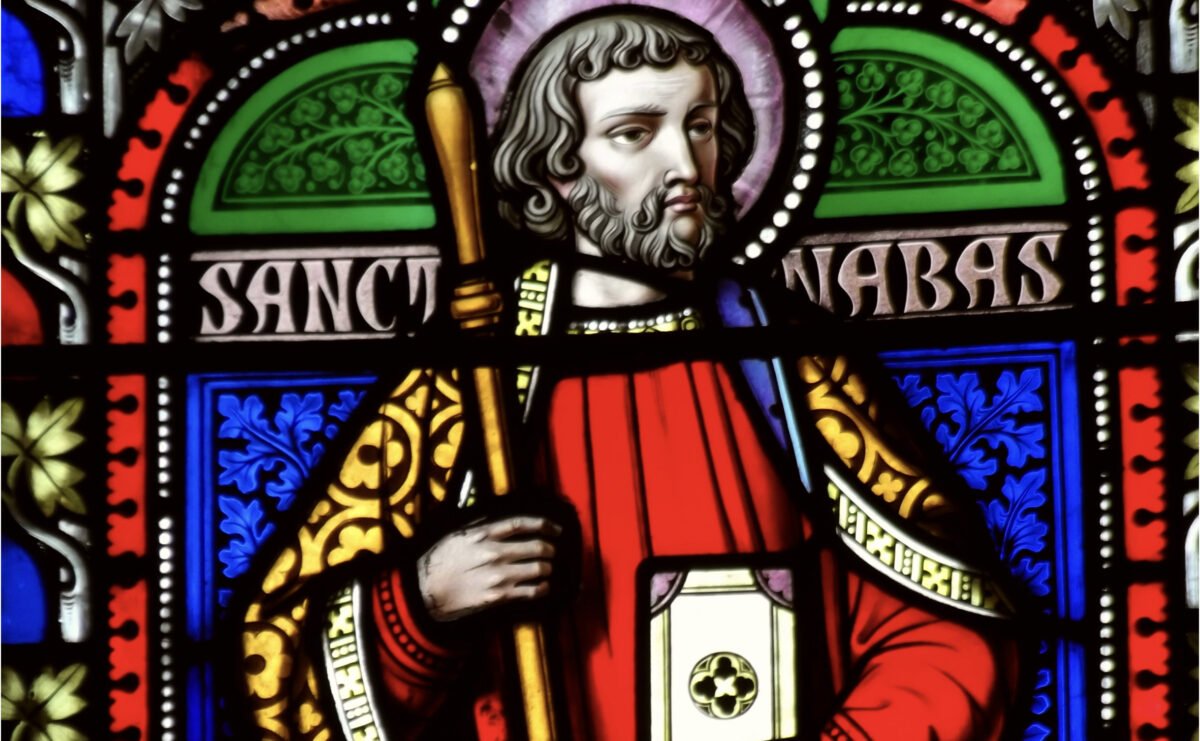
The first Sunday after Trinity (formerly known as Pentecost 2) is also often used to celebrate the feast of St Barnabas, who was responsible for receiving, encouraging, and working with the apostle Saul/Paul. In our lectionary reading, Acts 11.19–30, he performs a vital role in encouraging the believers in Antioch and advocating for them to the leadership of the church in Jerusalem. (Although this is not strictly the gospel reading for Sunday, since Acts is really ‘Luke Part II’ then we can think of it that way! And we have been dipping into Acts already this year).
Our chapter divisions once more do not quite reflect the natural breaks in Luke’s narrative. Many English translations start our reading in v 19 with the disjunctive preposition ‘Now…’, as they have done at the beginning of the chapter in Acts 11.1. But the break and change of focus here is much stronger; in verse 1 Luke uses de but in verse 19 the much stronger μὲν οὖν men oun which has the sense of ‘on the other hand…’
The reference back to the persecution ‘that arose over Stephen’ takes us all the way back to Acts 8.1, so these different aspects of the narrative are leap-frogging over one another. First we hear about Philip in Samaria, then the controversy between Peter and Simon Magus, then Philip and the Ethiopian eunuch/official, then the conversion and initial ministry of Saul, and the raising of Dorcas. We then have a chapter and a half of Peter and Cornelius; this is so significant that Luke includes two full accounts of the event, one as he narrates the events and the second one as Peter gives his own account.
The persecution has driven Jewish followers of Jesus up the coast to Phoenicia, and from there is was a natural boat trip to Cyprus, as stop on the way West towards Rome. Further north, in the ‘elbow’ of Syria and Turkey, was Antioch. Founded in the fourth century BC, it was on key trade routes including the Silk Road from the East and spice trades routes, and it was now the third largest city in the Empire after Rome and Alexandria. It was also a leading centre of Judaism in the Diaspora; Josephus (in The Jewish Wars) tells us that between 20,00 and 40,000 Jews were there.
Jesus has predicted that his disciples would ‘be my witnesses in Jerusalem, in Judea and Samaria, and to the ends of the earth.’ The irony of Luke’s account is that this has been achieved not by the intention of the disciples but by persecution, who have been driven to Judea and Samaria in Acts 8 and now move even further afield. When we are slow to follow God’s intention, he finds ways of making it happen!
The practice of sharing the gospel only with Jews follows Jesus’ ministry ‘only to the lost sheep of the House of Israel’ (Matt 10.5, 15.24). Yet even in this ministry, Jesus’ teaching and healing spills over to the Gentiles, and parts of his northern ministry were in non-Jewish territory across the Jordan. The term ‘Hellenists’ is translated by some ETs as ‘Greeks’, and we need to remember that the world was divided into two groups: ‘Jews’ and ‘Greeks’, meaning all non-Jews (who throughout the Roman Empire spoke Greek, even on the streets of Rome). In Acts 6.1, the term must mean Greek-speaking (that is, diaspora) Jews, but here in context it must surely refer to non-Jews.
What is striking is that those taking the good news to this new group are people who themselves straddle this divide—diaspora Jews who have one foot in a Jewish camp, so to speak, but culturally another foot in the Greek-speaking gentile world. It is people who stand on the boundaries, in the ‘liminal’ spaces, whom God uses to spread his boundary-crossing love.
There is a striking repetition of ‘the Lord’ in this section. Luke is the only gospel writer who refers to Jesus as ‘the Lord’ without qualification. The Jews from Cyprus and Cyrene preach ‘the Lord Jesus’; the ‘hand of the Lord’ was with them; many ‘turn to the Lord’; Barnabas encourages them to ‘remain faithful to the Lord’; many were ‘added to the Lord’.
This is a fascinating collection of sayings, not least because ‘the hand of the Lord’ is an OT phrase denoting the demonstrable presence of the power of Yahweh (see 1 Sam 5.3, 6, 9, 2 Sam 3.12). The power of God amongst his people is now the power of the Lord Jesus by the Spirit. Repenting and believing in God is now repenting and believing in Jesus; the phrase ‘they believed and turned’ in Acts 11.21 echoes Jesus’ proclamation of the kingdom and the right response to it (‘repent and believe’) in his own early preaching (see Mark 1.15). (Some translations suggest these are two distinct actions, but the grammar of the phrase suggests these belong together.)
Luke has previously talked about those who were ‘added to the number’ of the disciples (Acts 2.41), but here they are being ‘added to the Lord’, which suggests an understanding of believers as the ‘body of Christ’ which we find in Paul’s writings, ultimately arising from his encounter with Jesus on the Damascus Road, where Jesus accuses Paul not of persecuting his followers but of ‘persecuting me’ (Acts 9.4).
The report of what is going on quickly reaches the believers in Jerusalem—a reminder that, because of the construction of Roman roads, and the busyness of trade routes, there was excellent communication between the Jesus communities in different cities, contrary to the contrived view of earlier scholarship that there were isolated groups in rivalry to one another all believing different things. (The classic exploration of communication between Christian groups in the Empire is The Gospels for All Christians edited by Richard Bauckham.)
I cannot help thinking there is some implied humour in Luke’s arrangement of the events. The leaders in Jerusalem have just been listening at length to Peter’s account of his vision from God and meeting with Cornelius, and all that has happened. And the very next moment they receive a report from a completely different location telling them that just the same kind of thing is happening. ‘Do not believe the testimony of only one witness’ we are told in Deut 19.15, but only when two witnesses agree. Surely this new move of God now has two quite distinct witnesses who testify to it!
It was natural for the Jerusalem leaders to send Barnabas; not only had he been an early exemplar of the practical sharing of resources with others, following the pattern of the early faith community (Acts 2.45, 4.36–37) but he was both a Levite, as it were a most Jewish of Jews, but also from the diaspora community of Cyprus. He would therefore have much in common with both parts of the growing community of believers in Antioch, and credibility with both.
His given name is Joseph, a good Jewish name, but he has attracted the appellation Bar-nabus; it is not entirely clear what Hebrew or Aramaic phrase this derives from, but we are given its meaning as υἱὸς παρακλήσεως, ‘son of encouragement’. When he comes to Antioch, he naturally ‘encourages’ the believers, and Luke uses the cognate verb parakaleo that fits him so well. He has seen the ‘grace’ or ‘gift’ of God which is manifest in people turning from their sin and trusting him. The exhortation to ‘remain faithful’ to the Lord uses the verb prosmeno, a compound of the important Johannine term meno, to ‘abide’ in him.
The description here of Barnabas is striking. He is the only person in Acts described as ‘good’, and this is entirely in line with Luke’s interest in God’s blessing and use of those who are pious Jews. In Luke and Acts, Jesus and his people are indeed concerned with reaching sinners and those on the margins—but he and they are also interested in piety and holiness. The further description of being ‘full of the Holy Spirit and faith’ parallels the description of Stephen in Acts 6.5. His guidance by the Spirit and his confidence in God and his work make him someone especially suited to be at the frontiers of the new thing that God is doing.
Despite his competence, it is striking that Barnabas feels the need to recruit another. This follows the consistent pattern in the New Testament, that ministry and leadership are never a solo effort, but always plural, following Jesus’ example in Luke 9 and Luke 10 of sending people out in pairs. That questions the later development of monarchical episcopacy which we have inherited to this day, and it also undermines the model of single, celebrity leaders which continue to cause so many problems in the contemporary church. Always working with another both deflects the possibility of celebrity culture and builds in a sense of accountability to one another.
Barnabas was the one who first advocated for Paul to the Jerusalem leadership in Acts 9.27, so it seemed natural for him to seek out Paul, who lived not far from Antioch in Tarsus. Remaining in a place for an extended period of time like this marked Paul’s practice later in Acts; the ‘teaching’ that they offered need not be read as merely being directed to believers on the ‘inside’, but would also have included teaching outsiders (‘a great many’) about Jesus, thus drawing them in.
The introduction of the term ‘Christians’ here (repeated only in Acts 26.28 and 1 Peter 4.16) is fascinating in several respects. First, Luke is clear that this is a term given to them by outsiders, not one that they have chosen themselves; up until now, Luke has described them mostly as ‘followers of the way’, or disciples, holy ones (saints) or brothers (and sisters). It follows the usual way of designating people with reference to the person they are following, devoted to, or distinguished by their allegiance to—and it appears to have a slightly mocking tone to it.
But within Luke’s narrative, it identifies for the first time this group as distinct from the Jews in the city who do not respond to the good news and are not followers of Jesus. Does this mark the first sense of this new community beginning to pull away from its Jewish roots? If so, this is not something that Luke would support, given the shape of his gospel’s narrative which begins and ends with Jerusalem and is centred there.
Yet the narrative of Acts now moves away. This section, from Acts 11.19 to the end of chapter 15, is described by Ben Witherington as ‘The Antioch Chronicles’. Although accounts of Peter’s continued ministry are still woven in, this is the point from which the focus shifts decisively from Peter, and the Jewish church in Jerusalem, to the ministry of Paul, and the growth of the Jesus movement amongst a predominantly gentile context. And this is, of course, in fulfilment of Jesus’ words at the very beginning; the disciples will indeed be his witnesses ‘to the ends of the earth.’ This episode in Antioch is a literal turning point, as the movement of the gospel, having headed north, now turns West, as well as a figurative one.
And Barnabas, with his mixed heritage and bridge-building skills, his encouragement of both dynamic leaders like Paul and ordinary believers in Antioch, and his exemplary life of generosity and teaching, plays a key part at this crucial turning point.
Join James and Ian as they discuss the issues arising from this passage:
 Buy me a Coffee





















St. Barnabas, one could spend a month just on this amazing man so pivotal almost a fulcrum of church expansion [explosion] sent by God, sent by the “bishops “of the church to write a report on the reported, none overseen, none organised, even none funded ,grass root phenomena in Antioch.
Barnabas was over joyed and encouraged the disciples to continue Abiding in Christ;
no creed no ordinances just keep on keeping on depending on Christ.
Today we can read many reports both commissioned and none commissioned.
What joyless offerings that so many are, one might forgive a passer by for thinking No thanks – not for me – to much navel gazing- where is the Coke -the real thing?
The times are crying out for Barnabites, positive thinkers, encouragers, builders.
Mission enterprises and church planters are coming to realize the importance and centrality of the Barnabites in church expansion in unreached areas of the world.
For a in depth study of the Barnabas ministry and the pivotal effect on Church missions today I urgently recommend Mission Leader’s two-part initiatives by seasoned Church Planters.
1] https://missionsleaders.com/be-barnabas-intro-and-mints-story/
2] https://missionsleaders.com/why-be-barnabas/
For those unfamiliar with Barnabas see their “Who was Barnabas” post
AND “Be Barnabas – What is a NAV?”
We need the Barnabite people “Let God arise…thou and the ark of thy strength” Shalom++
Barnabas strikes me as a man prepared to take risks. In this passage, he takes a risk on Paul, not yet fully proven and accepted as a leader (Acts 9:26-30); more than that, Barnabas brings him to a church initially planted by those who reached Antioch in connection with the persecution arising from Stephen’s death – a persecution with which Paul (then Saul) was not unconnected! Could there have been some difficult conversations among the believers in Antioch arising from that?
Yes I think you are right. Although he is a ‘son of encouragement’, he is actually a risk taker.
But isn’t that what we have to do when we invest in the life and ministry of someone we see has promise…?