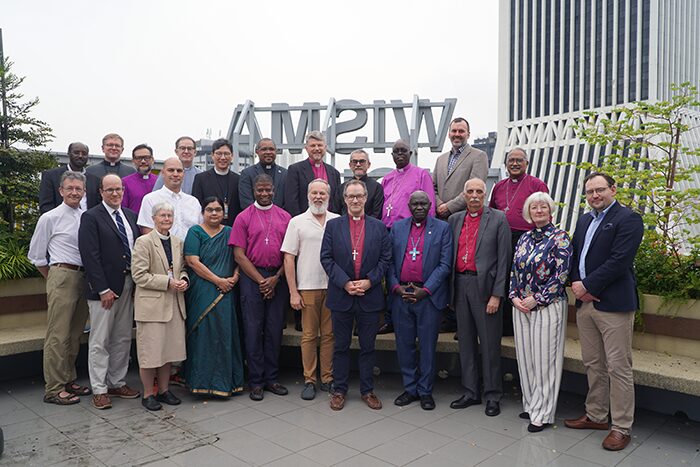
Andrew Goddard writes: There are multiple visions for the future of the Anglican Communion. One, being offered by Gafcon, is found in the Abuja Affirmation. Another is found in the Nairobi-Cairo Proposals (NCPs) developed by the Inter-Anglican Standing Commission on Unity, Faith, and Order (IASCUFO), which will be considered by the Anglican Consultative Council (ACC) in Belfast this summer.
Both of these visions are attempts at addressing our fractured common life and witness. The NCPs have recently been strongly rejected by Paul Avis, a Church of England scholar and ecumenist, in a Church Times essay. Avis sees the NCPs as “deeply troubling” and having “seismic consequences for the Anglican Communion,” indeed meaning “the Communion would not be a ‘communion’ at all, as ecclesial communion has been universally understood: namely, as a eucharistic communion with an interchangeable ordained ministry.” Given Avis’ standing and signs that others in the Church of England, including leading bishops, are also concerned about the NCPs, it is important to understand and evaluate his arguments.
He opens with an account of IASCUFO’s mandate and here he fails to acknowledge a key element of the mandate that sheds light on his fundamental disagreements. The ACC resolution which he quotes not only referred to the need to “address our differences in the Anglican Communion” (3(a)). It also affirmed “the importance of seeking to walk together to the highest degree possible, and learning from our ecumenical conversations how to accommodate differentiation patiently and respectfully.”
This recognition of the need to acknowledge degrees of communion among the churches of the Communion and to accept we now have to consider some form of “good differentiation” (the resolution’s title), learning from ecumenical conversations, is part of the mandate. It seems Avis is unwilling to countenance these steps as regrettable necessities even as he recognizes that the Communion is “currently fractured and dysfunctional.”
It could be argued that these steps have for some time been necessary, but they became even more pressing once a growing number of provinces in the Communion felt unable to continue in full communion with the see of Canterbury (a core feature of the historic 1930 description of the Communion) amid Prayers of Love and Faith as made clear in, for example, the 2023 Ash Wednesday Statement by Primates of the Global South Fellowship of Anglican Churches (GSFA).
Avis begins his substantive critique of the NCPs by stating that “the core proposal is to demote the see of Canterbury and to promote the Primates instead” and even claims (without evidence) that the NCPs “exhibit an animus against the Church of England and the Archbishop of Canterbury which is uncharitable” and that the report casts them “as the primary causes of disunity.”
In relation to Canterbury, Avis objects to deleting “in communion with the See of Canterbury” from the wording of the 1930 Communion description and replacing it with reference to churches having “a historic connection” with the see. He sees this proposal as arising because of a belief that “baptism, not holy communion, should be a sufficient future basis for the Communion” and rightly points out that we have a much thicker, richer and deeper understanding of ecclesial communion and that the Communion has claimed to embody this in its common life historically.
Avis claims the proposal is “that baptism should be sufficient for ‘communion.’” (italics mine). The difficulty here is that he appears to be reading the NCPs as taking as normative and satisfactory what they rather present as the significant minimal degree of ecclesial communion that they trust and hope all the churches of the Communion still recognize as existing between themselves, despite deep disagreements.
This then provides a theological basis for continued fellowship and, instead of “learning to walk apart” as we were warned may occur by The Windsor Report, “seeking to walk together to the highest degree possible.” It is similar to the point made by the Archbishop of York at the end of his speech in the first General Synod debate on Prayers of Love and Faith and then explored further in a New Directions article:
But our identity, surely, first of all is our baptismal identity. That is what unites us as the body of Christ. I want to say that water is thicker than blood, and because we belong to one another in Christ we have to have these conversations which can and will hold us together.
Many churches in the Communion thankfully have a much higher degree of communion with each other and in particular with Canterbury than baptismal communion. Furthermore, on the proposed new description of the Communion, all in the Communion are also committed to, among other disciplines,
- seeking to uphold and propagate shared Catholic and Apostolic faith and order
- recognizing they are bound together by “common counsel (of bishops and others” in conference” and
- seeking “interdependently to foster the highest degree of communion possible one with another.”
All this is much, much more than saying baptismal communion should be sufficient and nothing else really matters.
However, the reality Avis avoids addressing is that many churches within the Communion no longer have the degree of communion historically claimed and experienced with some other Communion churches. This includes for a growing and significant number of churches their degree of communion with the see of Canterbury. There is among the churches of the Communion tragically no longer what Avis seems to understand as necessary for the language of “communion” to be legitimately used at all: full eucharistic communion and episcopal collegiality
expressed by the mutual participation of Anglican bishops in episcopal ordinations, by the interchangeability of Holy Orders, and by the Lambeth Conference’s symbolically starting with a eucharist presided over by the Archbishop of Canterbury, with whom all bishops of the Communion are expected to be “in communion.”
In critiquing the new proposed wording of “historic connection” to Canterbury, Avis appeals to how he thinks this would have been applied around the time of the first Lambeth Conferences (1867 and 1878). This, however, fails to recognizes that the whole point of the NCPs is that they are a response to the Communion constantly changing (and sadly, often, in recent years for the worse), hence the inadequacy of the 1930 resolution’s description. As Rowan Williams said 20 years ago,
There is no way in which the Anglican Communion can remain unchanged by what is happening at the moment. Neither the liberal nor the conservative can simply appeal to a historic identity that doesn’t correspond with where we now are.
Avis’ argument here is even weaker when he claims that 150 years ago the Episcopal Church in the United States would have been excluded because it “derives its episcopate from the Scottish Episcopal Church” and so lacks such a historic connection to Canterbury. While it is true that the first American bishop was consecrated in Aberdeen, this was not what was sought (unsurprisingly, given the historic links to England of the colonial church). The next three American bishops were all consecrated by the Archbishop of Canterbury after the Episcopal Church “fulfilled its pledge to the English bishops to defer consecrating any bishops in the United States until it secured three in the English succession” (David L. Holmes, A Brief History of the Episcopal Church, p. 55).
Even though there were three bishops in the United States—two of the English succession (White and Provost) and one of the Scots Non-Juror succession (Seabury), they waited for Madison to be consecrated in England before gathering the four American bishops to consecrate Thomas Clagget. The American Church’s episcopate has three times the links to England as it does to Scotland.
The second element of Avis’ critique—that “The NCPs aim to increase the authority of the Primates Meeting”—is also problematic. There are suggestions here that his opposition to the NCPs is shaped more by the first published form of the NCPs or even the earliest forms of the proposal (that the Primates’ Meeting elect its Chair), which were never published as they were rejected by the Primates. These have, as he notes, now changed in the recent revised proposals in the Supplement.
However, it is seriously misleading to describe this current form of the NCPs (which nowhere refers to “primacy”) as proposing that “a Primates’ Council would embody the primacy” and that it would be this council and not the Archbishop of Canterbury “which exercises the functions of the primacy.” Nowhere does Avis consider the arguments for the actual, more limited proposal. His claims about primacy in Anglican understanding being of a form that “needs to be recognizable and ‘findable’” and is “located at Canterbury” need to be put alongside the earlier emphasis that “The Archbishop of Canterbury lacks any power to direct the Anglican Communion or its member Churches.”
The reality is that the NCPs here are again partly arising out of issues he largely downplays or ignores, namely the need to face the reality of impaired communion with Canterbury for many churches and to become more representative and postcolonial in public Communion leadership. They are also both more modest than he portrays them and their rationale has more precedent in earlier discussions of the Instruments and the meaning of primacy (see, e.g., references in note 72and note 83 of the original NCPs, the only places where “primacy” is referred to).
It is in the short section “Invalid argument” that what appears to be a key driver in Avis’ approach is articulated. He first criticizes the NCPs for how they handle Gafcon and GSFA, two bodies he lumps together despite their being distinct and often significantly different in theological and political approaches. That distinction becomes clear in their different positions regarding the Abuja Affirmation (see my discussions here and here). Avis argues that their statements and actions are taken “at face value” and “meekly accepted as the agenda.” He even concludes by claiming that IASCUFO “has moved the goalposts” to allow Gafcon churches “to score.” This is then followed by these astonishingly strong and undefended assertions:
But there is no biblical, theological, or historical justification for separation on the grounds that one disapproves of certain actions of a Church, even actions deemed to be scandalous. The appeal to the example of the Reformers is invalid.
Avis must know that all those claims are highly contentious but also that his language of “separation” again appears to suggest a binary “united vs. separated” or “in vs. out” in relation to communion. Once again there is no recognition of degrees of communion between distinct churches within the one church. There is no recognition either of the reality of differentiation or distancing as sometimes justifiable responses within the mixed body of the church as it constantly struggles to uphold unity in the truth amid what is seen by some (in this case the overwhelming majority of Anglicans) as the appearance of doctrinal error or moral scandal.
This leads to the final area where Avis and the NCPs are approaching matters quite differently, almost working in contrasting paradigms. Avis seems to have a very clear and stark dividing line between “Anglican relations with Churches with which Anglicans are not in ecclesial communion” and “Churches with which they are in ecclesial communion.” He speaks of these as being “different in kind” and differing “essentially.” The problem the NCPs seek to address, however, is that we can no longer look at the list of churches that are part of the Communion and say that they are all “in ecclesial communion” with one another or even with the see of Canterbury.
In line with the section of their ACC mandate (to which Avis did not refer), the NCPs try to chart a path that does not simply abandon the goal of “ecclesial communion” and replace it with “baptismal communion” (his unwarranted fear and accusation). Rather the NCPs seek to allow our structures to evolve to encourage and enable the highest degree of communion possible. This involves “learning from our ecumenical conversations how to accommodate differentiation patiently and respectfully” by bringing insights from them into the ordering of our global Anglican life, given that we are living in a time when we need to seek “the restoration of complete communion in faith and sacramental life” (to use the language of ARCIC that Avis quotes) withinthe Communion.
But what of the pragmatic question with which Avis ends, “Will it work?” Of course we cannot know, though Avis seems quite clear he does know that the NCPs won’t work. But his judgment is based on defining “work” as getting those provinces (basically Rwanda, Uganda, and Nigeria) that have ceased to participate in the Instruments to return. But that, though desirable, is not the litmus test to apply.
The NCPs will “work” if they can give time and space (see here Ephraim Radner’s helpful essay) to prevent other provinces from following their path. They will “work” if they can create a reformed Communion for continued (and where possible restored and deepening) communion and partnership with integrity. They will “work” if they can open time and ecclesial space for the necessary and hard conversations over the matters that divide us.
The GSFA provinces, representing a large proportion of Anglicans, have much to contribute in such a space. They are working, in their Cairo Covenant, to maintain the deeper ecclesial communion they feel they have been deprived of by recent developments within the existing Communion membership. They also appear (unlike the voices represented by the Abuja Affirmation from the currently dominant element within Gafcon) to be willing to work toward creating such a space with the wider historic Communion provinces and have much sympathy for the NCPs as a means of achieving it.
Avis, in his dismissal of the NCPs and his Canterbury-centric understanding of Anglicanism, fails to recognize this fact and its significance. Nor does he offer any alternative way of reforming the “structure and decision-making” of the Communion as requested by the ACC but instead dismisses “decision-making in the Communion” as “a pseudo-problem, a rhetorical fiction.”
Ultimately, Avis seems to be saying that the real problem lies with those Anglican churches that have not been able simply to accept what the Episcopal Church and other provinces, including now the Church of England, have done in recent years.
The NCPs have, in his view, made a mistake in seeking to respond to those who believe that those actions, in disregard of Communion consensus which was the fruit of the Communion’s episcopal collegiality, have impaired ecclesial communion. Rightly recalling the ideal of full ecclesial communion, he then misrepresents the NCPs as abandoning that gold standard (despite the Supplement once again strongly reaffirming it, e.g., in paragraph 7) and being satisfied with “a reductionist nature of ‘communion.’”
He describes the NCPs as “deeply troubling” without facing, let alone offering an alternative to, the truly “deeply troubling” reality: that the churches of the Communion no longer recognize in each other the degree of shared faith and order that they had in the past and which, as he knows from his years of ecumenical work, is an essential component if we are to embody that gold standard of full ecclesial communion in our common life.
To embrace Avis’ stance and dismiss the NCPs would be to ignore both the words of Archbishop Rowan Williams about not simply appealing “to a historic identity that doesn’t correspond with where we now are” and the warning words of the NCP Supplement as it draws to a close:
If we choose not to engage the need for change and try instead to maintain the status quo, we will in effect be refusing to engage honestly and constructively with our problems and increasing the likelihood of more acrimonious division. In view of this reality, we can take heart in recalling that the Church is ever reforming. Continual testing and exploring will be needed and must be anticipated, until our Lord returns. We must, therefore, hold our structures lightly, recognising their proper provisionality in service of the healing of the one Body (para 27).

Revd Dr Andrew Goddard is Assistant Minister, St James the Less, Pimlico, (where his wife Lis Goddard is vicar) Tutor in Christian Ethics, Westminster Theological Centre (WTC) and Tutor in Ethics at Ridley Hall, Cambridge. He is a member of the Church of England Evangelical Council (CEEC).
This article was originally published at Living Church and is reproduced here with permission.
You can read Andrew’s previous articles on the Communion here and here.
 Buy me a Coffee




















You can still have communion between the different provinces of the Anglican communion, not just the baptismal link. While also reflecting the fact it should no longer be top down from Canterbury, the Anglican Communion is not the Roman Catholic church where what the Pope and Vatican says goes globally. Instead the symbolic leadership of the Communion could be rotated amongst Anglican primates so the Archbishop of Canterbury just leads it when their turn arises, reflecting the post British Empire 21st century
Alternatively Sarah Mullally could just say that gay marriage is not recognised by God, that man has no authority to change the divine definition of right and wrong, that the Church of England will not be changing its doctrine of marriage, and that the last Archbishop of Canterbury was wrong.
Then all of these problems would simply go away.
She has already said all of that, same sex couples still cannot get married in Church of England churches. They can only get prayers within services, little different to the prayers the Pope now allows Roman Catholic priests to say for same sex couples.
Only the US and Scottish Anglican churches perform same sex marriages
She has said all of that? Do provide references for where she has actually said that gay marriage is not recognised by God, that man has no authority to change the divine definition of right and wrong, and that Welby was wrong.
She has made clear as has Synod Holy Matrimony and marriage is only between one man and one woman ideally for life, even Welby said that.
So she didn’t say what you said she said. Thank you.
You denied Mullally said the C of E would not be changing its doctrine of marriage but it remained between one man and one woman. You were wrong as I said
A couple of points:
Given the statement from Archbishop Mbanda that Gafcon are now the Global Anglican Communion, which he is now chairing, and participation in that means you cannot participate in any Canterbury instruments such as the Lambeth Conference or the ACC, aren’t the Gafcon Churches now finally and definitively gone? That is more than Nigeria, Rwanda, and Uganda. It would also include Kenya, Alexandria (Egypt), South Sudan, Myanmar, South America, Chile, and Congo (as well as breakaways like ACNA, AC Brazil, CCAANZ etc.). Where does that leave proposals from as IASCUFO that has a number of members who are presumably now gone? And proposals that are named after cities where the local Anglican Church has left the ACC? Or am I missing something obvious?
It is disappointing that the authors of Nairobi-Cairo Proposals have only wanted to look at one side of this – the worry about the views in provinces like CofE and ECUSA on human sexuality – but pays scant regard to the championing of the death penalty for homosexuality in provinces like Uganda. Is that not also a difficulty for the communion? Or is that, by definition, just not a big deal?
Finally, I don’t understand how scrubbing out “in communion with the see of Canterbury” from the Lambeth Conference’s definition of Anglican is supposed to help with anything, not to mention undermining the episcopal nature of the Church. I’m not sure it was a good proposal to begin with, and now it appears to be out of touch with the reality of events.
If they are gone it is because of there being a female Archbishop of Canterbury, though tough, 2/3 of the C of E Synod voted for female Archbishops over a decade ago. In any case 26 of the 42 global Anglican primates did attend Mullally’s enthronement and a further 6 sent representatives and indeed five African female Anglican bishops were there supporting our new Archbishop of Canterbury. If you are that anti female ordination as an Anglican you may as well become Roman Catholic anyway
Gafcon are divided over womens ordination though – Nigeria allows them to be deacons, Uganda allows bishops but hasn’t had one yet (only priests), and Kenya has women bishops.
As a point of fact (cf. Simon Baker on Sarah Mullally), the Church of Uganda does not support the death penalty for homosexuality, and homosexuality as such is not outlawed in the country, only ‘aggravated homosexuality’ (you can read the Act or summaries of it to find out what that means). The Church supports the legislation, but does not support the death penalty in such cases.
https://premierchristian.news/en/news/article/church-of-uganda-grateful-for-harsh-anti-gay-law
I am well aware of the what the Act says. The death penalty is for “aggravated homosexuality”, which includes being convicted of the offence of homosexuality for a second time. And the offence of homosexuality? That includes merely “hold[ing] out as a lesbian, gay, transgender, a queer, or any other sexual or gender identity that is contrary to the binary categories of male and female”. If you have children or care for a relative, those children and relatives will be removed. Your landlord is at risk of being imprisoned for 10 years for renting to you. If you oppose this, and that is interpreted as promoting homosexuality, that will land you with 20 years in prison. If your neighbours fail to report you they’re liable to 6 months in prison.
Yes, homosexuals who have consensual sex are still jailed in Nigeria, Kenya and Uganda, they are back in the 1950s on LGBT issues from a UK and western perspective
If individual criminal acts cause harm, how much more harm when they are embedded in a society.
So to confirm Christopher Shell you would support recriminalising homosexuality in the UK?
You are one of those sensationalist people who holds up conclusions without citing the evidence that comprises all the content of those conclusions.
Yes. But you need to understand why, without having a shock-horror attitude that anyone should fail to uphold the random norms of a random date and random location.
The reason is that structural wrongs do far more total damage than individual random wrongs. It is typical for socialists to see structures as being at the root of most things. On this, I agree with them.
Adam
Since you are ‘well aware’, that makes it all the more culpable that you should say the Church of Uganda champions the death penalty for homosexuality.
If I were a Ugandan, I would probably support the Church’s position. The promotion of homosexuality is not good for the health of any society. In the UK, it is not only individuals who zealously promote it but also public bodies – the Football Association, the police, supermarkets (e.g. Marks & Spencer), libraries, even schools – but the Church says nothing.
I assume you will also advocate opposition to the promotion of divorce by divorce lawyers and registry offices and hotels offering to remarry divorcees too then? Divorce is also contrary to biblical teaching, indeed with no exception even for sexual immorality if you believe Mark not Matthew
The promotion of d by d lawyers is far worse than most of the illegal things in this country. It produces far more devastation, and, quite separately, is morality and justice free, punishing the innocent without evidence being needed.
Why would this surprise you, or why would this not be the case?
You cannot possibly think that legality is liable to be a marker of morality??
Supporting a new law, but saying you don’t support the main provision of that new law is a nonsense position. I’m not surprised you support it, and wish to see gay men and women thrown into prison for life and subjected to ‘rehabilitation’ orders.
On that at least I agree with you Christopher, criminal law should just prevent harm being done to others without their consent. Morality is different and as Christians rooted in our faith
Morality is more important than legality. The moral matters I mentioned are cause of extreme harm, so how does the law prevent harm in this instance? That is laughable.
And should only Christians be moral? Moral means good. Why should other people not be good?
Where did prison for life and rehabilitation orders come from? One can support the principle but the details are country-by-country.
This discourse rather lamentably shows the reaction of the privileged to any claims to equity from the oppressed and marginalised. White cisheterosexual males are so used to the sacralisation of the patriarchy that any attempt to achieve recognition by those they choose to suppress appears as an attack on their privilege. Privilege of course carefully framed and curated as the norm. Any provision for the needs of minorities or for the vulnerable is rejected as though their own privileges and rights would be threatened by others having some of the rights that they take for granted. Hence the outrage when accommodation is provided for those not made in their image.
Rather sadly we aren’t even close to discussing a claim to equity, merely decriminalisation rather than life imprisonment, rehabilitation orders, and the death penalty. And of course all of this is greatly preferred to saying anything about the Nairobi-Cairo Proposals themselves.
What’s the phrase? Shocking but not surprising…
Topics that everyone knows were never mentioned nor relevant, but which are used as a ubiquitous default lens once we assumed and do not read-
Fathers (who quite obviously do not ‘rule’ the sort of society where by law a child supposedly does not need one of them at all);
Colour;
Privilege. Nature and statistics know no privilege. They are what they are, and the same natural way of functioning and flourishing is to mutual benefit.
The Bulverism fallacy is when A says ‘The statistical evidence shows the correlates of happiness, health and flourishing are X, Y, Z’ and B says ‘Oh, you only say that because you are (delete as appropriate) a man / a Romanian / lower middle class.’
Christopher, I was responding to Steven R saying he supported the Ugandan law (except for the death penalty part) just like the Church of Uganda.
Although as you support recriminalisation, perhaps you could enlighten as to what sort of offences and penalties you have in mind (assuming it differs from the Ugandan approach).
Criminalising ‘homosexuality’ is meaningless because the term is ambiguous.
There is no need to have structures that make it at all probable/feasible that people will cause themselves and others unnecessary trouble by sleeping together without being married.
Such structures are built on neglect, and no-one could think that the young are not valuable enough for neglect in their upbringing not to be an option.
[Community and] family can then deal with the serious matter internally, with the fewest possible people involved.
For something to be a felony or a wrong, it does not need to be seen in a 100% civil context. It is very odd to think that civil contexts are the only contexts. It is indeed a civil crime as well as a family crime, but would be best dealt with at family level, unless anyone thinks that non family members either know or care more than the actual family!
(I don’t see homosexual and extra/premarital as very different from one another.)
As I read the holy scriptures and the laws of God in the OT.
It seems to me that God’s commands where for the good order of the community and Nation. Laws that were impossible for anyone to uphold.
In the NT two people tried to lie and deceive the embryonic
Church, for the good order of the church, lying an deception was summarily dealt with by God.
Our God is a consuming {holy} fire and it is a terrible thing to fall into the hands of the living God, of which there are many examples.
One can only declare the mind of God in the hope that the individual will take heed. Jesus wept over Jerusalem, let this mind be in you. Shalom.
Odd that some here are calling for the recriminalisation of ‘homosexuality’. It simply describes a sexuality. I would have thought given ‘ Thou shalt not commit adultery ‘ is one of the key original laws, that should be first on the agenda. But of course it isn’t as it is committed by straight people who generally make the laws. New prisons would have to be built to contain so many offenders. They would be overflowing. Given the damage to society that adultery and the ensuing family breakdown causes, that’s only right and moral.
My position as stated above is that nonmarital sex is a single category; that ‘homosexuality’ is an ambiguous word; and that larger structures of acceptability are proportionally more harmful than individual transgressions. So we largely agree on these three things.
In the written laws of Moses, God prescribes different punishments for differing violations of his intention that sexual union take place only between man and woman within marriage.
Good point.
Peter
Concerning Adultery. If you are a Bible reader, consider
David’s adultery in 2 Samuel 11 & 12 and the judgement of God and the great grace of God
“12:10 Now therefore the sword shall never depart from thine house; because thou hast despised me, and hast taken the wife of Uriah the Hittite to be thy wife.
God has His methods of dealing with this sin.
Perhaps our own king is cursed with the same judgement “Now therefore the sword shall never depart from thine house; because thou hast despised me,…” it does seem to follow a patern.
Concerning the great grace of God to David see:-
See “The Ways of God “ by T. Austin-Sparks
Chapter 3 – The Way of Spiritual Strength”
Where the “uncircumcised in heart” are dealt with by
a gracious God as David foreshadows Christ which I think shows how His people became uncircumcised in heart and seems indicative of the low spiritual state of the modern church aligning with cultural mores.It is a very prophetic word for the “circumcised in heart”. Shalom.