
What would you identify as the climax and completion of Jesus’ life and ministry? Surprisingly, this is not a trivial question. One of the key differences between John and the synoptic gospels is that, where the synoptics portray the crucifixion as a necessary but incomplete act on the way to the resurrection, John portrays it as the climax and completion of Jesus’ ministry in itself. In place of Jesus’ cry of despair (Matthew 27.46, Mark 15.34), John records a cry of triumph ‘It is finished!’ (John 19.30). The promise of ‘living water’ springing from the belly or side of the one who believed (John 7.38), best understood in reference to the Temple prophecy in Ezekiel 47, is fulfilled in the blood and water from Jesus’ side at his death (John 19.34). No wonder the true testimony of this leads to faith (John 19.35).
But most of the NT would point to the resurrection as the completion. Paul’s theological linking of Jesus’ death and resurrection to our movement into and out of the water of baptism (Romans 6.3–4) suggests that crucifixion and resurrection belong together, and this is evident all through the proclamation of what God has done. This Jesus, whom you crucified, God raised from the dead, Peter tells the Pentecost crowd in Acts 2, and we are witnesses of this. Paul, in Luke’s parallel depiction of his ministry, also talks of ‘Jesus and the resurrection (anastasis)’ (Acts 17.18), so much so that his hearers think that Anastasis is the female consort goddess to the male god Jesus. Paul’s summary of the gospel for the Corinthians is that ‘Christ died for our sins…was buried…and was raised on the third day’ (1 Cor 15.3–4).
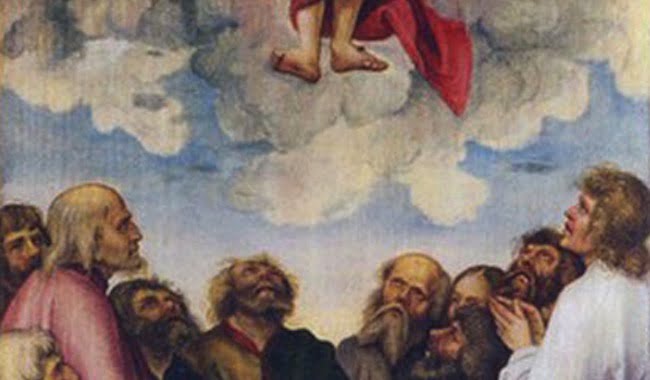 Yet most of the New Testament actually sees a third movement as an essential part and completion of Jesus’ work: the Ascension. We might miss this because of our theological tradition, but we often miss it because of our failure to read carefully. In Peter’s Pentecost speech, the climax of what God has done in Jesus is not the resurrection, but Jesus being ‘exalted to the right hand of God’ (Acts 2.33). In support of this, he cites Ps 110, the most cited psalm in the NT (just pause to take that in…), with its imagery of ‘the Lord’ (messiah) taking his seat at the right hand of ‘the Lord’ (Yahweh, the God of Israel).
We can see how important this is, even in Paul’s theology. In his great hymn in Philippians 2 (I am not convinced Paul is citing a pre-existing composition), he actually skips over the resurrection and moves straight from Jesus’ ‘death on the cross’ to his being ‘exalted to the highest place’ (Phil 2.8–9). It is as if the movement from death to life to glory, in resurrection and ascension, are one movement—incidentally, a move that is mirrored in the language of the male child ‘who is to rule the nations with a rod of iron’ being snatched up to God and his throne in Rev 12.5. In John, Jesus makes reference to this by the garden tomb, telling Mary not to hold on to him because he has not yet ascended, and, most intriguingly, the gospel message she is given for the disciples is ‘I am ascending to the Father’ (John 20.17). Luke divides his work into two not on the basis of the resurrection but at the point of the Ascension:
In my former book, Theophilus, I wrote about all that Jesus began to do and to teach until the day he was taken up to heaven… (Acts 1.1–2)
So why do we miss the importance of this? It largely comes down to misunderstanding Daniel 7 and its appropriation in the New Testament.
In my vision at night I looked, and there before me was one like a son of man coming with the clouds of heaven. He approached the Ancient of Days and was led into his presence. He was given authority, glory and sovereign power; all nations and peoples of every language worshiped him. His dominion is an everlasting dominion that will not pass away, and his kingdom is one that will never be destroyed. (Daniel 7.13–14).
Although Jesus appropriates the language of ‘one like a son of man’ to refer to himself, in Daniel this is a corporate figure; just as the four beasts earlier in the chapter have been personifications of the four great empires (Babylonian, Persian, Greek and Roman), this human figure is a personification of God’s own people, currently oppressed and persecuted by the powers that be, but trusting God who will rescue them, bring them into his presence, vindicate them and give them power and authority over those who currently have power over them. A parallel to the visions in the first part of Daniel (the four beasts correspond to the four parts of the statue in Daniel 2), it represents the inversion of power that Mary describes in the Magnificat—’you have scattered the proud in the imagination of their hearts’ (Luke 1.51).
In taking up the title ‘Son of Man’, Jesus is claiming to fulfil the destiny of Israel—to take on their oppression, but also to experience the vindication from God. This also involves a crucial re-interpretation as well: it is not the empires of this world that are the true oppressors of Israel, but the powers of darkness and their own sin and disobedience. Thus when John the Baptist ‘goes before the Lord to prepare his way’ it is through ‘the forgiveness of all their sins’ (Luke 1.77).
 But the key thing to notice in Daniel 7 is the phrase ‘coming with the clouds of heaven’. This is associated not with anyone’s coming from heaven to earth, but rather the opposite—the exultation of the Son of Man as he comes from the earth to the one seated on the heavenly throne. This is language both distinct from, and opposite to, Paul’s use of ‘coming on the clouds’ in 1 Thess 4.17. This would have been very obvious to Paul’s readers, since he uses quite different language for ‘coming’, the word parousia meaning ‘royal presence’.
Noticing this difference helps us unravel several key texts in the gospels. In Mark’s account of Jesus’ trial, Jesus says to the High Priest:
You will see the Son of Man sitting at the right hand of the Mighty One and coming on the clouds of heaven (Mark 14.62)
This cannot refer to Jesus’ return to earth (‘second coming’) unless Jesus was deluded about how soon that would happen. But more importantly, it cannot mean this because it is an almost exact quotation from Daniel 7, and refers to Jesus’ (the Son of Man’s) ascending to the throne of God and fulfilling the destiny of Israel. That is why the High Priest considered it blasphemy: in effect, Jesus was crucified because he anticipated his Ascension!
Similarly, Matt 24 makes no sense unless we read it in the light of Daniel 7. Jesus predicts that:
At that time the sign of the Son of Man will appear in the sky, and all the peoples of the earth will mourn. They will see the Son of Man coming on the clouds of heaven, with power and great glory… (Matt 24.30)
but then goes on to say, quite solemnly, ‘Truly I tell you, this generation will certainly not pass away until all these things have happened’ (Matt 24.34). Unless both Jesus and Matthew (and those collecting the canon) were mistaken, this must have already happened—and it did, in the Ascension. Jesus was caught up in the clouds of heaven to sit at the Father’s right hand in glory.
The lectionary reading for Ascension Day is Acts 1.1–11, the fullest account in the New Testament of the moment of Jesus’ ascension. There are a few important things to note about it.
We have already noticed that it is the Ascension which provides Luke with the point of division between ‘all that Jesus began to do and to teach’ and the continuing ministry of the apostles, through which Jesus continues to act and to teach by means of the Holy Spirit. What is striking in this account, though, is that Jesus’ teaching of the apostles ‘whom he had chosen’ can only happen ‘through the Holy Spirit’. Just as Jesus ministered by the Spirit (and after his testing in the desert ‘in the power of the Holy Spirit’, Luke 4.14), so after his resurrection he continues to do so, setting the pattern for the apostles themselves. They cannot continue his ministry until they, too, are ‘clothed with power from on high’ (Acts 1.8).
This is a time ‘after his suffering’ which appears already to be a semi-technical term for his being handed over, beaten, and crucified, his ‘passion’. You might think that his simply being alive was enough to answer any questions the disciples had—yet Luke agrees here with Matthew’s description that ‘some doubted’ (Matt 28.17) in that they need ‘many convincing proofs’.
The language of ‘forty days’ is significant throughout scripture. ‘Forty’ signifies an interim period of waiting, testing, and preparation, including the time the rain fell during the flood (Gen 7.4), the Exodus wanderings (Num 32.13), the periods of Moses’ life (according to Stephen in Acts 7, 23, 30, 36), Elijah at Mount Horeb (1 Kings 19.8), Jonah’s preaching to Nineveh (Jonah 3.4)—and so on. It is often the time period between major epochs in the biblical narrative of God’s acts of salvation.
Jesus continues to teach about the ‘kingdom of God’, which continues the central theme of his preaching in the gospels. This would make sense within a Jewish context, where God was thought of as ‘king’ and the eschatological hope was for the manifestation of his reign as king over Israel—and the whole world. But it is striking that as Acts unfolds, and within the writings of Paul that we have, the language of the kingdom takes second place to other language of resurrection and salvation.
The ‘gift which my Father promised’ echoes Johannine language from Jesus’ Farewell Discourse, which has been explored in recent lectionary readings. The contrast between the water baptism of John and the Spirit baptism of Jesus picks up the language of John himself from the beginning of Luke’s gospel (Luke 3.16), but this pairing also forms a theme in Acts, where those who believe are both baptised with water and with the Spirit.
The question in Acts 1.6 ‘Will you at this time restore the kingdom to Israel’ demonstrates the disciples’ continuing, nationalistic, misunderstanding of the meaning of the kingdom—so they really did need those 40 days of teaching! Rather than directly rebuke them, Jesus leads them in a different direction; the Spirit will equip them to be his witnesses ‘to the ends of the earth’. It transpires that this is the meaning of OT eschatological expectation that all nations will be drawn to Jerusalem, not in the physical sense of migration, but in the spiritual sense of being drawn to the Jewish messiah who was crucified and raise there. This becomes crucial at the Council in Acts 15 called to make sense of the ‘gentile mission’, and is reflected in Revelation’s vision of people drawn from every tribe, language, people and nation as the new multi-ethnic Israel of God in Rev 7.9.
Finally, the angel makes an explicit connection between the Ascension and the anticipation of Jesus’ return (never in the NT described as his ‘second coming’, paired with the incarnation, but as his ‘return’, pairing it with the Ascension). We might, on first reading, think that the correlation is being one of the means of travel, so to speak—he will ‘come back in the same way you have seen him go’. But the theological connection is much more significant. Jesus ascends to the throne of God, to sit ‘at his right hand’, exercising the power and authority of God by means of the Spirit. If Jesus is now Lord de jure then one day he must become Lord de facto. He final revelation as Lord of all is the inevitable consequence of his exaltation to the Father now.
 If the Ascension is so important in the NT, what does it mean?
- Authority. Jesus is enthroned with the Father. It is because of the Ascension that the lamb who was slain is seated with the one on the throne and shares his worship (Revelation 4). It is in the Ascension that ‘all authority has been given to me’ (Matt 28.18). And this authority means that Stephen is confident that he is held by a higher power, even to the point of death—his final vision is of Jesus ascended in Daniel 7 terms (Acts 7.55–56)
- Humanity. In the incarnation, God entered into human existence. In the Ascension, that humanity is taken up into the presence of God. We have a High Priest interceding for us who is not unable to sympathise with our challenges, dilemmas, suffering and weakness (Heb 4.15–16)
- Responsibility. The Ascension marked the end of Jesus’ earthly ministry; he has now given us responsibility to continue this work, empowered by the Holy Spirit. Jesus is not distant or indifferent, but he has delegated.
- Fidelity. Jesus ascending in the clouds to heaven promised that he will return ‘in the same way’ (Acts 1.11). His return is never called the ‘second coming’ in the NT, because it is not paired with his ‘first coming’ (the Incarnation) but with the Ascension. As God has put all things under his feet, one day his authority de jure will be an authority de facto.
(Published previously.)
 Buy me a Coffee










I would still answer “the resurrection” if asked what was the most important event in the New Testament (though with the caveat that none of the events can really be separated from each other).
It’s the resurrection that is new and truly unexpected, and therefore the point around which everything changes. But the ascension invests it with meaning. The resurrection of Jesus isn’t like Lazarus – he’s not restored to life to die again later, so he has to ascend. That’s not the only difference (Jesus’s resurrection has some strange things going on – the appearance in the locked room, not being recognised on the road to Emmaus, Thomas putting his hands in the wounds etc.) but it’s the vitally important one.
If we had Jesus death, and the ascension without resurrection, then what’s happened? A good man dies and is taken into heaven by God. The Gospel becomes: be nice, and do good things, and God will look after you when you die. If we had Jesus death, and resurrection but with no ascension, then what’s happened? Jesus has like Lazarus, come back to die again later, and his death becomes a neat trick at the expense of the Romans but nothing more. Or Jesus comes back, but ends up wandering off (into the wilderness again?), essentially abandoning us and becoming irrelevant.
The ascension is necessary to underscore what the consequences of the resurrection are for us: that life everlasting with God is open to us.
Agreed. It is silly to ask what is the most important event or moment. The ascension wouldnt have happened without the resurrection, which depended on his death, which depended on his life, which depended on his birth, which depended on his incarnation. It’s a package deal!
Ascension Day. Its importance, it’s scriptural and theological significance has been considered here, from Monday through today, from an unlikely source, in a series of short podcasts, with transcripts with a spread and depth that brings praise and glory to be enjoyed:
Monday: He ascended into Heaven
Tuesday: Dominion Regained
Wednesday: The Heavenly Ministry of Christ
Thursday: Interceding from Heaven
Starting with Monday-
https://learn.ligonier.org/podcasts/things-unseen-with-sinclair-ferguson/he-ascended-into-heaven
On a purely personal level the the most startling event of the Gospels;
Resurrection and Ascension – “He raised US up to be seated with Him
in the Heavenly places” Giving us Resurrection life right now! Awsome!
Shalom.
isnt the fact that God could die pretty startling?
How can God die, even if it is just for a couple of days, and still be considered “everlasting”?
The Resurrection and Ascension are a declaration of the Sovereignty of God.
The Sovereignty of the Holy Spirit and the Ultimate Sovereignty of Jesus Christ.
We are invited to sit with Him in recognition of the Sovereignty,
at rest with Him “waiting for His enemies to be made His footstool” to the Glory of God
Shalom.
Did God die on the cross of Christ? Only in the human nature of Jesus! Not in his divine nature.
https://www.gotquestions.org/did-God-die.html
Geoff, an interesting link again. But what makes you think that the “answer” is biblical?
Bruce what makes you think it isn’t Biblical. Yours question, by its very raising, implies it isn’t.
Ferguson’s sweep of scripture relating to the Ascension provides a Biblical overview, and background.
The dual nature of Jesus as God’s incarnate Son, fully God and fully man, is the key. Maybe you don’t believe the incarnation. Or that Jesus was mere man, or only God.
It is all to easy to slip into one or the other as a varying dominant belief.
Geoff, this is the part of your linked article that I was especially referencing:
‘The question for all people to ask is “what will happen to my soul/spirit when it leaves my physical body?” This is the most crucial question in life. As we saw with Jesus, our spirits will leave our bodies and travel on to somewhere else. We will either follow Him to heaven to spend eternity with Him, or we will go to hell to spend eternity in “outer darkness”’ (gotquestions.org/did-God-die.html, seen 16May2026)
Does this rely on Paul or “the Greeks”?
So I agree with Adam Bell below: ‘That is a terrible explanation of the cross.’ (May 15, 2026 at 11:53 am)
So God did not die for our sins, only a human being?
Is that the none existent God you don’t believe Gary, who couldn’t live let alone die? How could something that doesn’t exist, die?
I am challenging you to use critical thinking skills for your beliefs, Geoff. If you are not interested in doing that, ignore me.
You are not calling me, you are seeking to ridicule, from your stated position, which I am challenging in your fallacious comment.
That is a terrible explanation of the cross. It would seem to deny the Apostle’s Creed (“he descended to the dead”). It questions the hypostatic union. And, just to be on topic, appears to deny the ascension by suggesting Christ no longer has a body because your spirit just floats up to heaven when you die. From reading that, I’m not even sure they’re on board with the resurrection.
Why was the only documentation of the Ascension left to a non-eyewitness, the author of Luke/Acts? That always puzzled me.
Matthew was present at this event. Peter was present at this event. John was present at this event. Yet none of these three apostles included this climactic event in their written accounts of the Jesus Story (Peter, via John Mark). God himself slowly levitates into the clouds and disappears before your very eyes never to be seen again, yet you choose not to include this detail in your Gospel.
Odd.
Perhaps Peter didnt actually view the ascension as the important part, rather his death and resurrection. And Mark chose to end his Gospel as we have it with a slight air of mystery, despite Jesus saying a number of times in the same Gospel that he would die but rise again. I think Mark liked his rather abrupt beginnings (showing no interest in Jesus’ birth or early life) and endings. I can just imagine his readers having a knowing look in their eyes when they read the last chapter.
As for the others they had their own reasons for including or excluding different details. John may have been aware of Luke’s writing and chose not to include it in his own.
So you go with the “it wasn’t part of their theme” harmonization.
Imagine if another religion claims their prophet levitated into the clouds in front of at least twelve eyewitnesses but not one of those eyewitnesses wrote about this event, even though several of them later wrote entire books about this man. The only mention of this event is found in the writings of one non-eyewitness, who doesn’t tell us the name of his source for this information, and whose own identity is hotly disputed.
Why do several of the Gospel writers not mention the Ascension of Jesus?
Another argument from silence?.
Several months ago, I read an article [I think from the Guardian];
Which stated that young people are turning away from social media blogs [sic] towards AI for life questions, hence blogs becoming increasingly irrelevant.
One can us AI to pose this Question and have links to various papers on the subject.
Usually on purely Christian/Biblical/theological/philosophical questions which link with often quite detailed sources of discussion as appears in Geoff’s correspondences.
There seem to be very few if any, advocating a Liberal , Atheistic ,or Socratic points of view blogs.
At the moment this may be a platform but such is the nature of blogs messing with people’s minds detrimentally, they are beginning to have a very short shelf life .
Yet Christians will pose the same questions I am posing to members of other world religions regarding *their* supernatural claims. What evidence is there that Mohammad flew on a winged horse over Jerusalem? Any undisputed eyewitness accounts of this event? No.
The absence of evidence is not evidence of absence?
It is certainly possible, allowing for the supernatural, that a seventh century man flew on a winged horse over a large city but without any corroboration it is purely hearsay. Ditto for the Ascension Story.
The Bible record of the Ascension is clear, many of the witnesses did not believe. No change there then in todays culture, those who haven’t seen, and don’t believe, compared to those who haven’t seen, but who have believed.
The Bible always leaves open a path to doubt and unbelief.
Should the Bible be held to the same standard of evidence as the Koran, the Hindu Scriptures, and the Book of Mormon? I will bet that most educated, rational people today will say, yes. If an historical claim in an ancient Christian, Jewish, or Roman document is corroborated by other contemporary, independent sources, then its historicity should be strongly considered. If, however, the claim has no independent corroboration, the claim should be considered hearsay/rumor/fiction until proven otherwise.
There is no contemporary, independent corroboration of “Luke’s” Ascension Story. It is hearsay. It is entirely possible that the author of this story invented it for theological purposes.
There were plenty of witness at the time, some believed, some didn’t. That speaks of a true record, putting both sides who could be questioned.
Truth would be important to Dr Luke, the historian who could have questioned known witnesses.
You clearly have no idea of what hearsay is and isn’t, from our exchanges, even recently on this blog. And as said, the Gospels are akin to ‘documents of Public Record’ evidence. They are reliable. Particularly, they are not merely documents of human construct. God is the ultimate author.
God you don’t believe.
And you are revert as usual to your canard, straw man, flying horse fallacy.
You critical faculties have taken flight, in your atheist determination, zeal to convert with your diversionary interventions on a Christian blog site. Why does it matter to you?
Mind you Gary, from comments down the years you would find a place as practicing Anglican, who do not subscribe to doctrines of God, of scripture and of revelation. There have been known atheists among their hierarchy.
Let’s check your statement using good critical thinking skills, Geoff:
“There were plenty of witness[es] at the time, some believed, some didn’t.”
1. Please provide a list of names of the eyewitnesses to this alleged event (the Ascension of Jesus).
2. Please provide your source or sources for this list of eyewitnesses. If you only have one source, are you willing to admit that this claim has no corroboration in support of it?
3. If you do have multiple sources, can you verify that the multiple sources are independent of one another?
4. Provide the individual statements from each of these eyewitnesses regarding this alleged event.
5. Can you verify that these eyewitness statements are independent; that none of the witnesses had access to the testimonies of the other witnesses prior to giving their own?
6. If you can verify the independence of the multiple eyewitness statements, do these independent eyewitness testimonies corroborate the principal facts of this alleged event?
These are basic questions which any investigator would ask for any claim of fact, yet you can’t get past the first step on this claim, Geoff! Please explain why that is not a problem, using good critical thinking skills and without engaging in your favorite defensive tactic of attacking the character of the skeptic and avoiding addressing his criticisms.
The burden of proof is yours, Gary. Please engage your critical thinking, from the outset.
And to repeat, to claim hearsay, there is a need to know what it is and isn’t, and then prove it!
You are muddled. As is your understanding of recording of history.
All your points and far more are well covered in 1000 pages or so in, The New Evidence, that Demands A Verdict, by Josh McDowell, if you can take your thinking, beyond well worn furrows.
Praise and thanksgiving worship and glory, for the Ascension; Christs Dominion, the second man, last Adam, Prophet Priest and King.
He must reign.
https://learn.ligonier.org/podcasts/things-unseen-with-sinclair-ferguson/he-must-reign
“Blessed are those who have not seen and yet have believed” is a famous quote from Jesus to Thomas in John 20:29 of the Bible. It emphasizes a, profound faith that trusts without needing physical proof, rewarding those who believe in His resurrection and promises without having witnessed them firsthand.
In the Gospel of John 8:56 He says, “Your father Abraham rejoiced to see my day, and he saw it, and was glad (AI)
Christianity is not a science or even logical .
“Blessed are those who have not seen and yet have believed”
Since I believe Jesus was dead, I don’t think he ever said this. The fact is, the historical Jesus used “signs and wonders” to prove who he was. If faith without seeing is the purest form of faith, why didn’t Jesus just preach the Word? Isn’t the Word of God powerful enough to convict the hearts of sinners without needing parlor tricks?
I will bet my mortgage that the above quote from John was invented at the end of the first century for apologetic purposes.
Jesus was moved by compassion to feed, heal and preach. They were not parlour tricks to whip up a following. He distanced himself from the great throng who followed him for more fish and bread. He tried very hard to make it difficult to be understood sometimes! He told his brothers he wasn’t going up to the feast, then he went up secretly appearing in the temple incognito before whipping out the cattle and sheep. He then melted back into the crowd. Playing cat and mouse with the authorities ; it is surprising how far he got ! In the end he had to let himself be arrested.
You still need a lifejacket. If you don’t want it , can I keep it as a spare?
Yet the Jesus of John tells everyone he encounters that he is the Son of God, in long-winded sermons. His miracles are very public. There is no melting back into the crowd in this version of the Jesus Story.
If the Word of God is the most powerful method of convicting sinners there is no need for miracles, friends. So why did Jesus do them? The truth is, if he hadn’t, he wouldn’t have received even a footnote in our history books. The “miracles” gave him fame. The problem is, miracle workers came a dime a dozen in the ancient world. And they are still with us today! One only has to go to the local Pentecostal church and visit one of their services. The lame will walk and the blind will see! Nothing has changed.
Am I saying that Jesus was a con man? No. Not necessarily. Many Pentecostal “healers” sincerely believe they heal people. They believe they have been given a divine gift. I will bet that Jesus’ thinking was no different than that of a modern Pentecostal healer in regards to healings. He believed what he was doing, but maybe added a little flare to “the show” to win more souls. If a parlor trick wins even one soul, isn’t it worth it?
The heroes we respect usually say, “I didn’t think about the risk at the moment, I did what anybody would do, I’m no hero.”
I can’t see the Jesus of the Gospels being any different . He healed people because they were sick and because he could. He taught people because they “were like sheep without a shepherd”
His mission was to go to Jerusalem and be a sacrifice for sin; not to show off. He was tempted to float down from the highest point but didn’t. The disciples wanted him to be a political hero but he wouldn’t let them.
All those who were won over by ‘party tricks’ soon abandoned him when they realised the gravy train had stopped.
Wins one soul???
So faith in faith has some benefits
Yours critical thinking is muddled with uncorrobated assertions and fallacies along with mocking.
You are deconstructing your stated claims, the more you continue, with comments bringing ever more into the light, your true motives.
You may be able to redeem your mortgage, bu it is impossible for you to redeem your life- foreclosure is unavoidable, terminal.
Gary – but the ‘parlour tricks’ as you call them were seriously limited – and this is one of the messages of the temptations, right after his baptism. He declined the opportunity to turn stones into bread. He *could* have increased his popularity by doing lots of food miracles – but seems to have restricted the loaves and fishes to two occasions (and these were to make a pointed statement that he was the ‘bread of heaven’). Also, pointedly (John 6) the miracle of the loaves and fishes – if the aim was indeed to increase his following – was a total disaster. He caught their attention by performing the miracle, then gave a long speech telling them what it was all about – and as a result they left. The other temptations are along similar lines – Satan suggested a spectacular display where he throws himself down and is saved by the angels. That would also have been a good ‘parlour trick’ – and he declined to do it.
The crucifixion was also hidden in there – Satan was offering Jesus the power that Jesus was going to get anyway, but in a way that bypassed the need for the crucifixion.
He did sufficient miracles so that Scripture was fulfilled so that when (Matthew 11) John the Baptist begins to have doubts and sends his disciples to ascertain if Jesus really is the Messiah, Jesus replies by quoting Isaiah the prophet, ‘Go back and report to John what you hear and see: The blind receive sight, the lame walk, those who have leprosy
are cured, the deaf hear, the dead are raised, and the good news is preached to the poor.’
He was under absolutely no illusions about the efficacy of miracles – that miracles did not produce faith, but at best gave people of faith a reason for the hope that they had – which was that he was the fulfillment of Scriptures – the Messiah.
Of course, I’m well aware that you’re taken in by the speculative nonsense of incredibly brainy theologians from a certain school which started approximately 1760 – which was that the New Testament was basically written by the early church who were projecting the religion they wanted to promulgate onto the character of Jesus.
This has been well refuted, but you don’t seem interested in the refutation.
Dear Jock, right off the bat you ASSUME that the story of Jesus being tempted by the Devil and the story of Jesus turning a few loaves of bread and fish into enough food to feed thousands are historical. Why?? That is NOT using good critical thinking skills.
Whether we are reading an ancient Egyptian, Hittite, Sumerian, Roman, Jewish, or Christian document we need CORROBORATION from other contemporary, independent sources to determine if that story is historical. Otherwise, the story in question may be political, literary, or theological fiction.
Please provide ONE Jesus miracle story which is corroborated by at least one other undisputed, independent, contemporary source.
Gary – I can’t help you further – and I get the strong impression that your reasoning is circular. You’re not going to find these ‘independent’ sources, since those who saw – and came to believe – would then no longer be sufficiently ‘independent’ for you; they would be part of the Christian community.
If you really want to go down this line, you could also say that the entire history of Israel was invented by Ezekiel and Jeremiah (as Bertrand Russell suggests); there doesn’t seem to be any independent corroboration of the 40 years in the wilderness after Moses led Israel out of Egypt, nor of King David or King Solomon, etc ……
Similarly, with your quest for ‘non-evangelical’ scholars who don’t buy into the views of the 19th century theologians who took the view that the self-consciousness of Jesus as to who he was, understanding that he was the object of faith (rather than simply a first among equals), that he had a crucifixion to undergo, etc … was something imposed on him by the early church when they wrote the gospels to bring him into line with their theology.
As I indicated to you, there is much sound internal evidence within the gospels that they go back to source and that the authors present the real Jesus, in particular that he was conscious that he was the Messiah, that he would be crucified and that he would be raised from the dead on the third day, etc ….
In fact, it’s the opposite point of view seems weirder and more fantastical – that there existed literary geniuses who could invent the whole theology and impose it upon the character of Jesus at some later date, and yet they are completely anonymous and there are no other literary masterpieces by named authors that might gives us clues as to those who were responsible for such invention.
If the ‘evidence’ isn’t strong enough for you – then your loss.
Jock, I am asking you to apply the same standard of critical thinking for your religion’s claims that I ask of Mormons and Muslims. And what is that standard:
AI: “Most academic historians and academic bodies (such as those at the American Historical Association) do not treat historical facts as an all-or-nothing binary. Instead, they operate on a spectrum of probability, assessing the internal consistency of sources, plausibility, and the corroborating weight of physical evidence to determine the likelihood of an event’s occurrence. Requiring corroboration represents a foundational principle in historical epistemology. By limiting accepted “facts” to claims verified by multiple, independent sources, historians minimize bias, mythology, and fabrication in the historical record.”
Multiple, independent, corroborating sources do not exist for most stories about Jesus in the Gospels. These stories may be true but there is no way to be certain. Therefore, judgement as to their historicity should be exercised with great reservation.
Gary – one further comment – I’d say that if you are trying to convince people here (i.e. those who contribute to the comments section of Ian Paul’s blog) then you probably have no chance. You see – the position you take is rather ‘old hat’. James Denney when he refutes it (Death of Christ, Jesus and the Gospel) does point out that the school that you seem to subscribe to has been around for at least 150 years. His book ‘Jesus and the Gospel’ is from 1908 – so that would put your school at approximately 270 years old.
The people who comment here are actually well aware of the arguments that you propose. They have put in serious critical thinking and, after serious critical and logical thinking, have come down firmly against them. So I’d say you are wasting your time – you’re not proposing anything that people haven’t already heard and you have already drawn your own conclusions about the arguments for the ‘other side’.
Prove me wrong by answering this one question:
Please provide the undisputed testimony of ONE eyewitness, who explicitly identifies himself in his eyewitness statement, who claims to have seen/touched/and conversed with the resurrected BODY of Jesus.
I don’t think you can do it.
If Christians cannot provide this one very basic piece of evidence, their entire “case” is very, very weak.
Gary,
What if you found a treasure map with x marking the spot?
Would you go and find out, or would you show it to everyone to try and determine its veracity?
Steve – well, he found the treasure map – and then decided to use it as toilet paper.
As above, my comment @9 :48 am 16 May,Gary; the burden of proof is yours.
And in combination with the aforementioned, ‘New Evidence the Demands a Verdict’ by Josh McDowell, his freely downloadable book, ‘He Walked Among Us- Evidence for The Historical Jesus’ will more than answer your comments a questions, challenge and test your critiques and lay bare your, materalistic world view, pre-suppositions and set in stone atheism which drive your comments.
Yours in Christ Jesus, Geoff
It is doubtful that you will read this book:
https://s3.amazonaws.com/jmm.us/Books-Downloadable/He+Walked+Among+Us.pdf
(BTW. For anyone else who may read this comment, as a possible encouragement to delve into the book, it even has an opening quotation from RT France, who Ian Paul has favourably referenced in his articles on scripture.)
Exactly. You can’t provide it.
Your perception that Jesus lives inside your body is not good evidence. Neither are your perceived experiences of answered prayer. If you can’t provide even one undisputed eyewitness statement from anyone claiming to have seen and interacted with the resurrected BODY of Jesus, your “faith is in vain”. Just as Paul of Tarsus said.
Paul saw a bright light. That’s it.
Gary – you were kind enough to post a link to your blog on the other thread and I took a brief look at it. I’d say, based on this, that the picture you presented of your faith journey was inaccurate.
Firstly, you stated (on the previous thread) that your objection to ‘evangelical’ was that it was something got up in the 16th century and didn’t have a historical basis, while the summary on your blog implies that you had doubts as to whether your faith in Christ was sufficient, so you preferred Lutheranism where you instead had faith in your baptism. If this is correct, then of course it was an untenable position – and you eventually came to see this. But it doesn’t seem to me to have been driven by a sudden ‘discovery’ that there was insufficient evidence that Jesus had actually been raised from the dead.
The evidence is actually all in Scripture (e.g. Thomas) and the ‘neutrality’ that you are looking for simply won’t exist, because those who were convinced that Jesus had been raised from the dead (and were eye-witnesses to the evidence) were convinced and as a result committed themselves to the cause of Jesus – they were no longer neutral. Much work has been done by many people with sharp and critical minds, working pretty much on the principles that you outlined (which you got from AI) which led them to conclude that there was plenty of evidence (a) that the Jesus presented in the gospels was the Jesus that lived in Palestine (along with all his statements of who he claimed to be – particularly that he had a job to do that involved getting crucified and being raised from the dead) and that (b) he was indeed raised from the dead.
So it’s pretty clear that your objection is actually a moral objection and isn’t evidence based and it would be useful if you could honestly put this as your starting point. I don’t know what you were indoctrinated with as a child, since I know that the umbrella of ‘evangelical’ (or ‘Baptist’) can range from the sensible to the extremely weird and wacky. I do have concerns about what you say of yourself as a nine year old. I have a 10 year old son – and I haven’t introduced the Christian religion to him yet (at least not seriously), because I know that he isn’t ready for it – and I’m well aware that indoctrination at an early age can lead to bad results.
So I’m only guessing – but I do know for certain that your problem with Christianity isn’t a ‘no evidence’ problem.
A common tactic when one is backed into a corner in a debate is to attempt to change the subject by attacking the character and motives of the opponent.
Stop the prevarication, Jock. Admit you cannot provide even one undisputed eyewitness testimony of anyone claiming to have seen and touched Jesus’ resurrected body.
Gary – for the record, I’m not ‘backed into a corner’ and I don’t have to answer your questions (as far as I’m concerned I’ve given you perfectly good answers – and if you don’t appreciate this, then that’s your problem). I am, though, interested in why you are asking these questions and what is behind them.
Elihu promised to come in and give you an answer – we’re waiting for it.
Truth matters, Jock.
Christians and their supernatural belief system hold great sway in the world, culturally and politically. If the evidence indicates that their foundational beliefs are nothing more than ancient superstitions, is it wrong for skeptics to challenge them?
If a modern religious sect claims that their deceased leader has recently appeared to groups of them, returned from the dead; that he spoke to them and allowed them to touch his body, wouldn’t you want to see the eyewitness statements of this event before accepting it as fact?
I think the point about his authority is vital – we don’t readily think of Him as King, as generally we seem so weak in the world, and in the recent past did not need a heavenly Sovereign to be able to live our lives comfortably. But maybe He is calling us back now to that understanding. Likewise the near abandonment of lived preaching on judgement & atonement.
I think it’s also significant that this event happened physically – instead of just appearing/disappearing from their sight as happened earlier – Jesus bodily enters heaven. This seems to me to signal the importance of the physical world – that He created out of his mouth, and which He loves, as an expression of the Godhead, and which we also need to love – not in an ‘eco’ way but more profoundly and of course mankind, the pinnacle. So all politics, industry, agriculture, sport really matter to Him – not just the people that come through the church door or have leftist leanings.
For those wishing to pursue Jock’s earlier point on an
“old hat” position, Jonathan Birch has an interesting PhD thesis.
Birch, Jonathan C.P. (2012) Enlightenment Messiah, 1627-1778: Jesus in history, morality and political theology. PhD thesis @
https://theses.gla.ac.uk/4240/1/2012BirchPhD.pdf
If one does not have time to read the whole, or unfamiliar with such thesis see his Conclusion.
It is quite Enlightening. Shalom.
Alan – many thanks for the link – this *is* an interesting thesis – I’ll enjoy this one.
It is sad Gary that you ignorant comment, that evidences yet again that you have no intention to enter into critical thinking and adult discussion but resort to playground retorts and that you have no intention to read the book, and can’t get beyond your prejudices and pre-assupmtions.
And you ignore the fact that the burden of proof is yours. It is typical of your approach to none reasoning, using mere unsubstantiated assertion.
Why are you here? To reveal your own philosophical set in concrete beliefs? And how clever you are. But nothing you write has not been expressed in multiple ways over the years. Nothing new.
Get over it – you are on the wrong side of history, the time of the new atheist movement has passed-withered- away.
Bye.
Do enjoy the book, He Walked Among Us.
Looking in , the disciples saw Jesus flanked by Moses and Elijah. Now Jesus said “if you can accept it , John is Elijah.” So we now see Jesus flanked by Moses, the Alpha prophet and John the omega prophet. Jesus is probably not standing but sitting because He it is who sits on the mercy seat flanked by the cherubim. Is this therefore a view into the holy of holies? Jesus is the law, word of God ; He is the manna ; the staff / branch cut down yet budding again? The beginning and end. The cherubs are Moses and ‘Elijah’!
P.s. I should say , I’m talking about the transfiguration.
i think we got that Steve lol
We were wondering Steve, however, not everything in the Bible is symbolical I think.
Well, Alan, I’ve just made it so.
Thanks for not finding a reference to some theological tome to dispute my thesis!
..unless you have?
..or an original thought?
sadly original does not mean reflecting reality.
Though your theological base is not original, Steve, it is imaginatively iterative, kaleidoscopic, in finding it’s fulfillment in Jesus, which isn’t original at all, but is deeply satisfying and never ending in its Glorious teleological terminus.
Yet it is a product of a (transfigured) sanctified imagination, it seems to me.
Thank you Geoff.
I think [Peter] the author of Hebrews would also give me a grudging nod! 🙂
Steve “Well, Alan, I’ve just made it so.”
Well good luck with that.
I think St.Peter would disagree with you but I will refrain
from quoting him as he is not symbolical enough for you.Shalom.
I think Peter was flanked by James and John , reflecting the transfiguration.
So the Pope wrote Hebrews, Steve!? And he was there at the transfiguration! There, asking what happened to Eve/Mary.
Though Peter embraced, conflated the offices of prophet, priest and king in the person of Jesus, (as in Hebrews) and that being central to holiness, in Peter’s letters: central also to a believers position in Christ as prophets, as royal as in kingly, (and holy) priesthood, offering spiritual sacrifices.
Similarly in Revelation 1, we have prophet, priests and kings.
And while there is a theological confluence and corroboration, Peter did not write Revelation, though there are theological connections between Peter and Hebrews.
Scripture is interwoven and interconnected with Jesus, all about Him.
Just a thought…
James may have been the first written record and John’s the last. Peter is flanked by the first and the last.
Crazy , I know.
Flanking Peter, James the first writer, and John the last, make a fitting witness to the transfiguration.
I said this an hour ago but it went into moderation..then disappeared
Simple question: If there is ZERO first-hand eyewitness testimony of anyone claiming to have witnessed the alleged levitation (ascension) of Jesus in full view of the Twelve and possibly others from a mountain top into the clouds, why should any modern, rational person believe this fantastical event occurred?
Gary,
There is witness testimony, it is a statement, by historian, Dr Luke, a record of what was seen and witnessed.
It is akin to a s9 Criminal Justice Act Statement such as when the police take a statement from a witness and submit it as truth, evidence of fact it contains.
Read the book yet, Gary? It is is rational, in more than 300 pages.
Yours in Christ, Geoff
to Geoff:
Your statement includes many assumptions:
-You assume that Luke the physician obtained this information from an eyewitness/eyewitnesses to this alleged event.
-You assume that if Luke did not obtain this story from an eyewitness, that he obtained it from a close associate of an eyewitness who did not embellish/or misquote the eyewitness’ testimony.
-You assume that Luke the physician did not invent this story out of thin air for theological purposes. No other canonical author mentions it.
-You assume that Luke the physician did not invent this story for apologetic purposes.
-You assume that Luke the physician, a companion of Paul, wrote Luke/Acts. Most critical scholars doubt he did.
-You assume that first century Christians would not lie (invent non-historical stories about Jesus) when we know as a fact that many second century Christians did invent non-historical/fictional stories about Jesus (pseudepigrapha).
-You assume that IF the Evangelists invented fictional stories about Jesus that the Twelve or other eyewitnesses/the Church would have called them out for their “lies”. However, we have ample evidence that scribal additions were made to the original canonical Gospels very early on and no one seemed to have been bothered by these fictional additions to the Evangelists’ books, such as the longer addition to Mark, the Story of the Woman Caught in Adultery, the Story of the healing at the Pool of Bethesda, etc..
Your “case”, Geoff, is built upon one assumption after another!
Ian, I wish to return to our difference of opinion over where Jesus is coming to with great glory in Matthew 24:30. You say he is coming (back) to his father in heaven, mission accomplished, after his crucifixion and resurrection, and that this happened at the Ascension. I don’t believe this because
1. You say it happens when Jerusalem is destroyed as also mentioned in parts of Matthew 24. That event took place in AD70, which is some 37 years distant from the Ascension.
2. Matthew 24 says that the peoples of the earth, or in your preferred translation the tribes of the [holy] land, will see the son of man coming with great glory. To see that on the day of the Ascension or even the day Jerusalem was destroyed, they would have to be given a vision of the event from the heavenly point of view. What is the evdience for that?
3. You take the quote from the prophets, that the sun moon and stars will be darkened (24:29,), to be poetic. Would you not regard that as far-fetched in any other exegetical context?
Your starting point, up-on whic you build your exegesis of MNatthew 24, is verse 34 in which Jesus says that those things will happen before “this generation passes away”. And last time we discussed it, you said generation always referred to people and their human lifespan, and you disputed my view that it could have a wider meaning by saying it *always* meant that in scripture. It doesn’t. Please see Luke 16:8, “the sons of this age are more shrewd in dealing with their own kind [genea] than are the sons of light.”
This is not a knockdown of your entire exegesis, but your one-verse knockdown of the alternatives to it doesn’t work.
Gary,
It is a written record of what happened, and is unalterable.
The burden of proof is yours and. you are too late by a couple of thousand of years to cross examine anyone.
You don’t believe, and make suppositions as a result, without any evidence. With you bottom line pre-suppostion of a closed material world system, that miracles are impossible, and the Tiune God of Christianity doesn’t exist (and you hate him?: a fundamentalist new atheist movement position.)
It is clear you haven’t read the book, He Walked Among Us.
I’m drawing a line under this.
You can worship you own subjective secular, counterfeit-replacement, finite God’s.
Turn to Jesus, He is wonderful, counsellor, Prince of Peace, mighty God incarnate. Know him in Union with Him, in reality, eternal life starting now, communion with Father, Son and Holy Spirit, in Trinity.
Actually I think Gary has turned FROM Christ.
Anthony, Geoff, yes – this is completely clear. But I wonder if he has turned from the real Christ, or some sort of hypocritical imitation. I don’t want to disparage his background, but I have seen this. I’ve mentioned before here the fellowship that my father found extremely useful and enlightening. The parents of one of his school friends attended that fellowship – and his school friend went completely off the rails. And this is actually very understandable (from a human point of view) if one gets some idea of the sanctimony and hypocrisy that seemed to prevail in the household. One important thing: the fellowship was basically Brethern – and even though he got a lot out of it himself, my father made sure that we steered well clear of Brethern groups.
Both of you (Anthony and Geoff) have indicated in the past that you converted to Christianity as adults. I have tried to probe Gary about his background – but he has put up a wall demanding ‘proof’ (and rejecting what we would consider to be convincing proof – based on how the New Testament documents came about, the prophecies of the Old Testament, etc …. which has been outlined to him). I found his description of his experience as a 9 year old pretty weird, but he won’t discuss this further.
I’m simply pointing out that there may be issues here (that I have seen working themselves through in other contexts).
I’m sure there are!
Your comment about parents and children reminded me of what a friend told me some years ago. At his church he was one of the leaders of the youth group. Some young people had issues with their parents. For those who had parents who were not Christians/Church goers this could be understood. There was no expectation of godly behaviour or attitudes from their parents. Those who had church going parents had a harder time with parental conflict. They could see the difference in their parents’ behaviour between church and home.
David – there could very well be a lot of truth in that. But in the case I’m thinking of (my father’s school friend), the parents were extremely devout – and I wonder if they didn’t ‘over-egg’ this. I actually think their behaviour may have been entirely commensurate with belonging to a very austere fellowship; their behaviour at home may well have been in line with their behaviour at church. Both the children (my father’s school friend and his sister) turned out very badly. The sister became a chain smoking alcoholic and died at an early age. She was basically a nervous wreck. He was very promising in his youth (he knew everything about fine art, painted beautiful pictures, etc …), but ended up completely dissolute, got divorced, lost a lot of money through gambling, etc …. and, crucially, never darkened the doors of a church. I remember him referring to his mother as ‘the fatted calf’ and mocking the grace she said before meals ‘for every greedy mouthful we shove below our noses, may the good Lord make us truly thankful’, etc …..
I don’t really understand the mechanism of cause-to-effect here. What was going on at home? When I met his mother, she came across as a lovely woman – who was clearly deeply saddened by the way her family had turned out – so I confess I don’t understand it at all – but my father seems to have seen cause-to-effect about the sort of upbringing and the fellowship – and the way the family turned out.
Jock,
Yes indeed. As David Pawson put it (very well), we walk the tightrope between legalism and license. Conservative evangelicals tend to the former, and their children oven over-react when they grow up by tending toward licentiousness. I’d add to Pawson’s comment that the tightrope between legalism and licentiousness can only be negotiated by love.
Sad.
Imagine an ex-Muslim attempting to discuss the truth claims of Islam with his family and friends using critical thinking skills and all they can focus on is his motivation for leaving the religion.
Gary, your initial comment relates to the credibility of ‘Acts’. I would ask you what kind of evidence of events about 2000 years would you accept? Do you rule out ‘supernatural’ events a priori? If not, what kind of evidence is required for a claimed event which is by its nature basically unique? “This sort of thing doesn’t normally happen” is precisely the significance of the event.
Hi David,
Several crowds of people all claiming to have seen the same person whom they recognize at one time and place is not necessarily a supernatural claim. Could be, could not. So if such group sightings of Jesus occurred after his public death and burial, why are there no undisputed eyewitness statements of these alleged sightings? Even if these eyewitness statements are written off by skeptics as hysteria, shouldn’t we demand to see at least some undisputed eyewitness testimony for these events to believe they really occurred?
That is all I am asking for: one undisputed eyewitness statement of anyone claiming to have seen the body of Jesus after his public execution and death. Most skeptics accept Paul’s statement “have I not seen the Christ” as an undisputed eyewitness statement. The problem is, Paul never tells us what he saw. For all we know, all Paul saw was a bright light.
If it is true that more than 500 people saw the resurrected body of Jesus at one time and place, why are there no undisputed eyewitness statements to these events?
“For all we know, all Paul saw was a bright light”
Yes… these speaking bright lights are really common.
“For all we know…”…. that’s the point of St Paul’s testimony…
If someone today told you that he saw and heard a talking bright light “in a heavenly vision” on a desert highway last night would you believe him?
Depends what it said.
What makes you think it is fine to turn up here, set us a theological exam, and duck questions about your motivation for doing so?
The only good reason for us to answer theological trolls is to demonstrate to third parties that your questions do have good answers.
I will tell you my motivation but I can guarantee that you will not accept it, Anthony. Why? Because in your belief system, the only way someone leaves the faith is if that person has allowed the Devil to take control of his or her mind . But this is only true if your belief system is true. I am trying to help you see that the problem is the falsity of your belief system, not my motivations.
Here is my motivation: I love debating the topic of the Resurrection because I am involved in the greatest movement known to humanity: the debunking of fear-based superstitions.
Ultimately it’s about truth, not fear or joy. And you too have a faith system, meaning things you believe without being able to prove them from anything more primitive. Either you can state the axioms of your non-theistic faith system, in which case they are axioms that can be questioned, or you can’t state them, in which case your arguments are not worth very much.
Which is it? I’m willing to discuss Christianity further with you for the opportunity to discuss your faith syatem, which I shall not drop.
Gary – your last comment negates everything you asked for -‘That is all I am asking for: one undisputed eyewitness statement of anyone claiming to have seen the body of Jesus after his public execution and death.’
Going by your last comment youve just admitted that you wouldnt believe someone if they told you directly they witnessed a supernatural event.
So it is clear, despite all your protestations and demands for evidence, you dismiss supernatural or miraculous events regardless of eyewitness testimony. And that includes the resurrection of Jesus.
Ill end with that as there’s zero point in further discussion. You will have heard all the arguments before. It is between you and God now.
It doesn’t matter if I believe the undisputed eyewitness statement or not.
What matters is if Christians can provide such evidence. To this date, no Christian has been able to do so. This fact demonstrates the profound weakness of the evidence for Christianity’s central claim: the Resurrection.
Mormons can provide much better evidence for their supernatural appearance claims. At least they have signed eyewitness statements (affidavits). Christianity has nothing remotely close to that quality of evidence.
Mormons are yet to dig up those gold tablets.
Question for (Trinitarian) Christians:
If an ex-Mormon attempts to expose the false claims of Mormonism with friends and family, at what point would you recommend he stop? Or, do you believe he should never have tried to help them see the truth to begin with?
None of my business.
While the situation w.r.t. Gary now seems completely clear (a record stuck in the groove and well worth ignoring), a good question is raised about ‘Trinity’ and Christian belief. I recently finished reading James Denney’s book ‘Jesus and the Gospels’ (which does answer all the questions posed about the validity of the New Testament evidence that Jesus was raised from the dead). While he is undoubtedly a Trinitarian, he is quite clear that he would like to see what he describes as ‘a uniting confession’ (p. 398), based on the New Testament and suggests ‘I believe in God through Jesus Christ His only Son, our Lord and Saviour.’ He then goes on to suggest (p.400) that ‘such an expression as ‘I believe in the Holy Ghost’ is entirely foreign to the New Testament. What the apostles asked was not, `Do you believe in the Holy Spirit?’ but `Did you receive the Holy Spirit when you believed?’ believed, that is, in Jesus (Acts 19:2). It is better, in thinking of what is essential to a Christian confession, to keep to New Testament lines. The Spirit will have its proper place in the interpretation of Christian experience; but to introduce the bare term into the primary confession, and to present the Spirit as an object of faith co-ordinate with Christ, is both to desert the New Testament and to beguile ourselves with an illusion of knowledge about the divine nature which has no Christian value.’
“What the apostles asked was not, `Do you believe in the Holy Spirit?’ but `Did you receive the Holy Spirit when you believed?’ “
Brilliant Jock. Thanks .
Yes, I’m all in favour of updating the Creed. It was written to hammer Trinitarianism into a largely illiterate populace at a time when the view that Jesus Christ was a very high being, but not divine in the sense of the Creator, was the theological threat to Christianity. It still is useful where Islam is at work, but a different creed might be better in secular lands.
Anthony, we now at last, have irrefutable evidence of the self apocalypse of Gary, his mendacity in superior overblown motives and mission, and tragic Sysiphus- superstitious- scientism, philosophically- unprovable, enterprises.
Don’t surrender the high ground by insulting him. Just keep answering him forensically and let his answers show the blogosphere what he is made of.
“If Christ is not risen, your faith is in vain.” -Paul the Apostle
Paul was willing to suffer persecution and death for his belief in the Resurrection. But what was this sincere, intense belief based upon? Paul tells us in Acts 26: the resurrected Christ appeared to him as a talking bright light in a “vision” on a desert highway.
Visions are not reality. If someone today told you that Jesus appeared to him as a talking bright light in a vision while traveling on a road in the desert, you would immediately dismiss him as mentally unsound or hysterical.
Sincere belief is not evidence of the veracity of one’s belief.
I have asked all of you to provide *one* undisputed eyewitness testimony of anyone claiming to have seen a resurrected BODY. None of you have been able to do that. The Appearance Stories in the Gospels are unauthored and uncorroborated. Therefore, they may be nothing more than more visions, more hysteria, or fictional tales told for theological or apologetic purposes.
There is no solid evidence for your faith. I know that is devastating for you, but it is the truth. Superstitions are not healthy. Your superstitions about Jesus may be comforting for you but they are responsible for much pain and suffering throughout history. Come out of the darkness of your superstitions and into the light of reason and science. Do it for humanity.
Good bye.
Christians stamped out as abominations industrial-scale human sacrifice in Latin America by the Aztecs and Incas, cannibalism in Africa and the Pacific, widow-burning and the thuggee ambush-and-strangle cult in India. In the Roman empire in the fourth century, bloodsoaked gladiatorial games ended, private orgies became socially unacceptable, slaves were granted a weekly day off, and unwanted babies were no longer put outside to die. (Secular society considers itself better for deploying the technology to kill them before they are born.) You are surfing on this legacy without realising it.
None of this is relevant to whether Christianity is true, of course, but that subject has been played out here in various exchanges with you, which I leave readers to examine for themselves.
I will add, though, that you too have a faith system, meaning things you believe without being able to prove them from anything more primitive. Either you can state the axioms of your non-theistic faith system, in which case they are axioms that can be questioned, or you can’t state them, in which case your arguments are not worth very much. Which is it?
AI: Between 1450 and 1750 in Europe and the American colonies, an estimated 40,000 to 50,000 people were executed for witchcraft, with women making up roughly 75% to 80% of those victims.
Yes that’s a disgrace, but if you want to compare the track records of paganism and Christianity you are going to come off worse. As I said, there was massive -scale human sacrifice in Latin America by the Aztecs and Incas, cannibalism in Africa and the Pacific, widow-burning and the thuggee ambush-and-strangle cult in India. In the Roman empire in the fourth century, bloodsoaked gladiatorial games ended, private orgies became socially unacceptable, slaves were granted a weekly day off, and unwanted babies were no longer put outside to die.
And you have ducked my question more than once now: you too have a faith system, meaning things you believe without being able to prove them from anything more primitive. Either you can state the axioms of your non-theistic faith system, in which case they are axioms that can be questioned, or you can’t state them, in which case your arguments are not worth very much. Which is it?
And you have ducked my question more than once now: you too have a faith system, meaning things you believe without being able to prove them from anything more primitive.”
Really?
Let’s first define our terms. What is “faith” in your worldview, Anthony?
AI: Christian conquerors, including the Spanish, British, French, and subsequent U.S. governments, committed massacres, enforced brutal labor systems, and engaged in targeted extermination campaigns.In some localized regions, such as the Caribbean and California, colonial violence and forced servitude led to near-total eradication of specific populations.
To explore the historical records of this devastation, you can read more about the Genocide of Indigenous Peoples via the Holocaust Museum Houston or examine the U.S. context via the National Park Service.
AI: During the 30-year Saxon Wars (772–804 AD), Charlemagne forcibly Christianized the Saxons through executions, mass deportations, and strict laws. The exact death toll is unknown, but records detail 4,500 Saxon men beheaded in a single infamous event known as the Massacre of Verden.The total number of Saxons killed throughout the entire conflict is debated, as modern historians consider the documented figures from medieval monastic chroniclers to be approximations. The most notable recorded statistics from the Wikipedia Saxon Wars include:
Massacre of Verden (782 AD): 4,500 Saxon prisoners were executed at Verden upon the river Aller for revolting and rejecting Frankish/Christian rule.Battle of the Swarte (798 AD): Between 2,800 and 4,000 Saxons were killed in battle following another pagan uprising.
Christianity may have initially spread by the peaceful preaching of the Gospel, but after it became the state religion in the fourth and fifth centuries to the present day, it has murdered millions if not billions in the name of Jesus.
Mass Deportations: Thousands of Saxons were forcibly relocated from their homelands into the Frankish interior to break their tribal and religious allegiances. For example, in 804 AD alone, 10,000 Nordalbingian Saxons were deported.
Gary,
You understood the word ‘faith’ very well until I stumped you with a question about it. It suits me if you want to play rhetorical tricks that readers believing and nonbelieving will quickly see through.
Gary,
You write: “Christianity may have initially spread by the peaceful preaching of the Gospel, but after it became the state religion in the fourth and fifth centuries to the present day, it has murdered millions if not billions in the name of Jesus.”
You know what? I agree with you! (Although it is millions, not billions.) Look in the New Testament and you will find a religion that is about the individual believer being remade better upon believing in Jesus and being sorry for what he or she does wrong in God’s world. That is a personal process (to which I can testify) and it cannot be induced by political or social means. Furthermore the church – the collective of those who undergo this process – will be persecuted by ‘the world’, meaning the prevailing culture in each time and place. So there is no question of the (true) church having political power.
So what happened in mediaeval Europe when Christianity became the religion of state? The church filled with persons seeking social advancement who had little interest in the faith. That had good effects on the empire – the ending of gladiatorial games, the sabbath for slaves, the end of dinner party orgies, the end of the exposure of unwanted baby girls – but bad effects on the church, which led to the abuses you document.
But were those abuses actually perpetrated by the church of Jesus Christ? If you look closely at mediaeval European history, you can find small groups of believers in Jesus Christ who demonstrably lived purer lives and who were persecuted for meeting outside the institutional churches of state. THEY were the church and the institutional churches were ‘the world’. Someday the former will meet Jesus Christ for judgement and be in for a shock. Belief that the scriptures are true is not the same as loving Christ.
Before you say that this is excuse-making, kindly read the New Testament and check the criteria for church against those minority groups and against the institutional church for yourself. Two such troups were the Lollards in England and the Waldenses around the Alps, but there are plenty more documented in Leonard Verduin’s remarkable book “The Reformers and their Stepchildren.”
AI: Historians estimate that several thousand to tens of thousands of Muslims and Jews were killed during the capture of Jerusalem on July 15, 1099 by Christian crusaders. Exact figures remain a matter of debate. The wide range of casualties is due to the unreliability of medieval records:
Medieval Estimates: Christian and Muslim chroniclers from the era often provided inflated or allegorical numbers. Crusader accounts, such as Fulcher of Chartres, claimed 10,000 died on the Temple Mount alone, while Muslim historians like Ibn al-Athir placed the total death toll as high as 70,000.
Modern Scholarly Consensus: Because the city’s total population was likely between 20,000 and 30,000, modern historians suggest a more realistic death toll is in the range of 3,000 to 10,000.
Fate of the Jews: Jewish residents fought alongside Muslim soldiers to defend the city. When the Crusaders breached the walls, many Jews fled to their main synagogue. The Crusaders set the synagogue on fire, burning those inside to death.
Do you think that the Crusades were just a genocidal campaign against peoples who had long lived peacefully in the Holy Land?
That matches the fate of the Jews of Jerusalem and it should not have happened. Here is the background to the Crusades.
In 1071 the Byzantine Empire lost a battle to a Muslim people moving west from central Asia, the Turks. (They would later occupy modern Turkey and give it their name.) Byzantium called to Western Europe for help. The Pope turned the call into a war cry to take back from Islam the land that Christ had trod. So began the Crusades, a series of military campaigns. The gospels gave no license for holy war, for Jesus said his kingdom is not of this world and renounced arms on its behalf (John 18:36); but Christians are free to fight in good worldly causes (against Nazism, for example) and, militarily speaking, the Crusades were simply a response to protracted Islamic belligerence against Europe – Muslims took Spain from 711AD, were stopped in France in 732AD, raided Rome itself in 846AD, and by the end of the 10th century were threatening Byzantium again as in the early 8th century.
To repeat: militarily, the Crusades were not more than a matching response to centuries-long Islamic belligerence against both eastern and Western Europe (not to mention Byzantine North Africa). They were ineptly conducted, however.
Christians did not stop at killing “sinful/evil” Jews, Muslims, and pagans. No, they murdered each other too…by the millions! And over what? Answer: the proper interpretation of an ancient book of supernatural claims (superstitions).
Supernatural belief is deadly!
The Thirty Years’ War (1618–1648) was one of the most devastating conflicts in human history. It claimed an estimated 4.5 to 8 million people, primarily in the Holy Roman Empire. Roman Catholic Christians and Protestant Christians arguing and fighting over the meaning of a few words in an ancient book. Irrationality at its zenith.
Anthony – possibly with my apologies for bringing up Peter Oborne again. I found his book ‘The Fate of Abraham’ very interesting. I get the impression that at the time of the Crusades I may well have found myself on the side *against* the ‘Christians’ – and I may have found that I had more in common with the Muslims at that time. I have great difficulties in seeing anything at all in common between my own beliefs and what passed for Christianity at that time – which seemed to be absolutely full of superstitious nonsense.
Incidentally – where did Wagner get his plot for ‘Parsival’ from? That is *real* pagan nonsense dressed up as Christianity.
By the time Wagner wrote Parsifal he was taking himself far too seriously. In the music you can hear both that he has continued his superlative musical development, yet also sense the inflated sense of importance. As for the plot, I can only agree with you. Have you seen Hans-Jurgen Syberberg’s strange 4hr film of it? I remember watching in the Cinema in the 1980s, and it can be viewed free on YouTube.
Anthony – when that period of history (10th century) is under discussion, I thoroughly enjoyed the book by Frans G. Bengtsson ‘The Long Ships’. It is connected with the ‘Christianisation’ of Scandinavia. At some stage in the novel, Rode Orm is a galley slave to the Andalusian Muslims during which time they raid Santiago de Compostela. To cut a long story short, they get hold of the bell, which is apparently a holy relic, which gets taken back to Scandinavia – and because of its magical properties (as a relic), it gets used to cure the toothache of King Harald Bluetooth (so-called because of his bad teeth).
Of course, Frans G. Bengtsson had an agenda – but I don’t think his portrayal of mainstream Christianity at that time was completely wrong.
Gary,
Your knowledge of history is poor. The Thirty Years War of 1618-48 began when protestant Bohemia objected to an ardently Catholic new ruler, Ferdinand II, who had already stamped out protestantism in Styria (in Austria). The protestant regimes of Denmark and Sweden joined in on behalf of the protestant States, and against the Habsburg dynasty of Holy Roman Emperor Ferdinand – a dynasty which also ruled Spain. Spain was already battling to maintain its interests in the Low Countries, and it entered on behalf of the Catholic States and the Emperor. Then France, though Catholic-ruled, entered in 1635 against the Habsburgs who confronted it on two borders. The last 13 years were by far the bloodiest and were due to Catholic France fighting Catholic Spain and Austria.
Jock,
In Njal’s Saga, written in the 13th century about events 300 years earlier, blood feuds abound; then Catholicism arrives, and after a debate the chieftains agree that Iceland will become Catholic (AD1000); then the feuds resume with unabated vigour…
There we have it.
With an undefined but pejorative ‘superstition’ which by the same none definition could be attributed to an unevidenced belief that there is no God, which would require a superstitious omniscience.
Let’s press on and into the new humanity in Jesus.
Gary,
‘May the LORD bless you and keep you, the LORD make his face to shine upon you and be gracious to you; the LORD turn his face toward you and give you peace.’
May you come to know Him personally as Father, in Union with Jesus the incarnate Son through God the Holy Spirit, in Trinity.
Yours in Christ, Geoff
Ask yourself this question, Geoff: If one day onlookers in heaven see you lean over the rails of heaven to catch a glimpse of me down below, writhing in the flames of Hell for my refusal to believe in Jesus as Lord and Savior, what will they observe? A tear from your eye or a faint smile.
An honest answer will reveal to you the danger of your superstition.
What a strange, odd superstitious invented scenario, that bears no relation to scripture reality. Hell is real and that is the reason I have continued to press the Good News of Jesus to you. Turn to Jesus, I implore.
As for honesty, what is greivous to me, is what I see as your mendacity, on this site, a view that has come about from the cumulation of your continued embrace new atheism, from David Robertson’s blog, to this blog a few years ago along with a couple of others and now again here with a missionary zeal that is incomprehensible to me as a former lawyer atheist, who had generalised but unarticulated concern about the meaning of life, possibly humanist even in the face of contrary evidence, who had no interest in converting Christians to atheism, life being taken up with life and career. My faith in atheism was not as strong as your extreme faith.
And it was through family death that brought about investigations into philosophies, which I’d touched on in a law degree. It all came to a culmination of conversion on an Alpha course, led by a Church of England minister.
Christianity is intellectually satisfying as well as experiential in combination, It also satisfies my concern for evidence and truth, objective and subjective. It is interwoven with reason and rationality notwithstanding your steadfast repetitive banal block implying believers are ignorant, unthinking.
Turn to Jesus. He is alive, risen and ascended. Otherwise our faith is in vain and we are all dead in our trespasses and sin, all of your faith, which hits the buffers of death.
Eternal life starts now, in Union with Jesus, a mutual indwelling.
Why would you not want, the Gospel indicatives, reality set out in Ephesians chapters 1-3.
OK Gary – your question convinces me that I was right all along – your rejection of Christianity is entirely connected with the moral issue and has nothing to do with any ‘discovery’ that there is no real evidence that Jesus was raised from the dead. I still don’t know, though, whether you have rejected a false imitation of Christ or whether you have rejected the real thing. But you don’t seem prepared to engage in this.
Gary,
Thank you for making us raise our game and justify Christianity. I consider that we have justified it to the reasonable reader and that we shall never justify it in your eyes, so there’s not much else to say.
One. Undisputed. Eyewitness. Statement.
You don’t have it, my friends.
If you were thinking critically, you would recognize how serious a problem that is.
Gary – yes – I apply the same logic to the moon landings. The statement that Neil Armstrong walked on the moon is disputed. There are those who think that the whole thing was a fraud and was filmed somewhere in the Arizona desert. This is a very serious problem for those who believe that Neil Armstrong walked on the moon. Anyone thinking critically understands that the odds are against it.
Apples and oranges.
We have Neil Armstrong’s undisputed testimony.
The historicity of the moon landing is disputed (by a small fringe), but Neil Armstrong’s testimony is not.
Try again.
But Gary – why should I ‘try again’? It’s very clear from your comments that your rejection is based on the moral issue (c/f your earlier question to Geoff). It now seems clear to me that the rejection is actually a rejection of God Himself – and not a false representation of Him (for example – something that you were brought up with). He called you, you rejected Him and hardened your heart against Him – and in response He judicially hardened your heart so that you could not repent. Nothing for me to do – no point to ‘try again’.
I reject your god for the same reason you reject the gods Allah, Lord Krishna, Jupiter, and Zeus.
Gary,
Zeus and Jupiter are the same god, one is from the Greek name and the other from Latin.
Krishna and Zeus are not creator gods, Allah is. I believe in an omnipotent creator God, so that knocks out Krishna and Zeus. There can only be one omnipotent creator god, so do I believe the Islamic scriptures about him or the Judaeo-Christian ones? (There are clear incompatibilities between the Bible and the Quran, eg was Abraham willing to sacrifice his son Ishmael or his son Isaac?) The Islamic claim is that Muhammad corrected the Old Testament which Jews had distorted and corrected the New Testament which the early Christians had distorted. But Muslims have never been able to offer any who, when, where or why to the question of Christians supposedly changing the books that became the New Testament in the first 200 years after Christ, and after that there is no question of changes. So I’ll stick with the Bible, thank you.
Gary,
I don’t dispute Neil Armstrong’s testimony, but you are wrong to describe it as ‘undisputed’ because the cranks who disbelieve the Apollo moon landings do dispute it.
It now seems clear to me that your rejection of the teachings of the prophet Mohammad is actually a rejection of Allah Himself – and not a false representation of Him. He called you, you rejected Him and hardened your heart against Him – and in response He judicially hardened your heart so that you could not repent.
This is why you refuse to accept the truths of Islam. The Koran is readily available for you to read. Have you read it cover to cover? Have you humbled yourself to study the Koran in detail with your local imam? No. You raise your fist in defiance against Allah. It isn’t a matter of evidence, it is a matter of your sinful heart, Jock.
Gary – well, you do seem to be consistent, don’t you? You have just indicated that you are anti-Muslim.
For the record – I’m not the one here who condemns the Muslim faith. There is, indeed, a very worrying side to their religion (as indeed there are twisted people who would claim affiliation to the ‘Christian’ faith – most of those who go on shooting sprees in American high schools), but those Muslims whom I have encountered (and I haven’t personally encountered members of the headbanger faction) come across as good people and I’m certainly not the one to suggest that they all stand condemned.
I am not condemning Islam. I am using the same logic with you in regards to Islam that you are using with me in regards to Christianity: Why do you harden your heart against Allah and the teachings of his prophet, Mohammad?
Surah At-Tahrim 66:8: “O you who have believed, repent to Allah with sincere repentance. Perhaps your Lord will remove from you your misdeeds and admit you into gardens beneath which rivers flow…”
You must repent and believe FIRST, Jock. You cannot come to Allah as an equal. You must come to him in repentance, on your knees as a supplicant. Why haven’t you done that? Why have you hardened your heart against The Almighty, Allah, your Lord?
Gary – actually, you’re not using the same logic, because ‘Allah’ is the term used (in the Muslim religion) for God – and (unlike you) I *have* come to God in repentance – so I do actually fulfill the criteria which you quote.
Your question to Geoff earlier betrayed that your rejection is basically a moral rejection (not simply a rejection of ‘superstition’ which anybody could understand and sympathise with – and did not originate from the ‘no evidence’ card). Furthermore, that you do seem to understand full well what you have rejected (unlike the Apostle Paul, whose rejection before the Road to Damascus was based on ignorance). I hope I am mistaken about this – but from the information you have given, it appears unlikely.
From a Muslim perspective, you are an infidel. You worship the prophet Jesus, who was a man. You do not worship the Creator God, who is Allah.
Why do you rebel against Allah, Jock? Why is your proud heart hardened against Him?
Are there any critically thinking Christians on this blog who see the error in Jock’s thinking? Truth must be based on OBJECTIVE evidence, not subjective matters of the “heart”. My feelings regarding Yahweh/Jesus the allegedly resurrected Christ have nothing to do with whether or not these two entities exist or not.
Gary – you are the one who brought subjective feelings into it – I have consistently stated that Holy Scripture, critically examined (and exploring objectively questions of authorship, where it came from and its reliability) give me the *objective* evidence that Jesus was, in fact, raised from the dead and that he is the Christ.
And I see from what you have written that your rejection of it is a *moral* objection – it’s the moral content of Christianity (the need of a redeemer) that is your sticking point.
Gary,
Get your facts right. Christians re not infidels in Muslim eyes. We are ahl-al-kitab, people of the book. It is pagans who are infidels.
Islam.
Dr Andy Bannister who has a PhD in Islamic studies has here a series of 13 short talks on Islam:
https://www.solas-cpc.org/spotlight-on-islam-equipping-you-for-gospel-conversations-this-ramadan/#Same
You too, Geoff, insist that it is divine revelation, in your heart, that determines truth, no objective evidence. So why have you hardened your heart against Allah? He sent you his prophet, Mohammad. He sent you his Holy Word, the Koran. Why don’t you humble yourself, pray to Allah, repent, and allow Him to speak to you? If you do, Allah promises He will show you that his Holy Word, the Koran, is true.
For those who have been following the interminable discussion (and my apologies for over-posting here), I strongly recommend the book by Peter Oborne ‘The Fate of Abraham: Why the West is Wrong about Islam’.
I do not know if Gary’s rejection is a fundamental rejection of God, or if he is simply reacting against wicked things that he has seen and been subjected to within the ‘Christian’ community (and since he won’t interact with this, no way of probing deeper), but the discussion took a turn which show that he *assumes* an anti-Muslim bigotry from Christians – and he seems to make the assumption that all Christians share this.
There seems to be much truth in this – the whole reason necessitating a Zionist state in the Palestine was anti-Jewish bigotry *by Christians* – who (in the 19th century) saw the establishment of Israel as a way of killing two birds with one stone – (a) fulfilling the promises that God had made in Scripture and (b) creating an alternative to Jewish immigration into Britain. Similarly, anti-Muslim bigotry has added huge fuel to the fire ……
Jock n Gary, I’ve been following all of your conversation. Thank you both. A word of knowledge it probably what is needed now to break the speed of light barrier. I don’t have it so I’ve nothing more to say.
Well Steve,
I thought there was a proposal for the study of comparison of world religions
Jesus has ascended above it all to assume sovereignty.
Geoff – it was supposed to be a proposal to have a more humane perspective. I think we all (the Christians here) agree that Muslims would be immeasurably better off if they understood that Jesus was the Messiah and that salvation was through Him.
I do not, however, take the view that nobody got saved before Jesus came along. It’s pretty clear that Job was saved – the land of Uz suggests he was a descendant of Esau. He was aware of his need of a redeemer, but at that time Jesus had not come in the flesh, the New Testament had not been written, his precise knowledge of the divine transaction was therefore pretty sketchy. He was saved through Christ, but didn’t have a clear picture of his redeemer.
Your links giving guidelines on how to evangelise Muslims (and tell them about Jesus) are useful. At the same time, we have to accept the fact that so-called Christians have spent centuries beating Muslims to a pulp and generally engaged in behaviour towards them that wasn’t very nice – so it isn’t very surprising if one has difficulties getting them to listen to Christians. As I indicated earlier on the thread, I actually think that in important ways the Muslim religion, although far from my own, may well be closer to me than the pagan superstition that was being promulgated in the 7th, 8th, 9th, 10th centuries in the name of Christianity. Also, even today, when I see the Satanic ‘prosperity gospel’ that is being promulgated in (for example) Nigeria (discussed on a recent thread), I believe that if I had been brought up in that environment, I personally would have run a mile – and may well have found myself having more affinity with the Muslims (there are, of course, twisted extremist Muslims, but that is only one faction).
It appears to me that the Ethiopian eunuch of Acts 8 was saved even before Philip enlightened him and made it clear to him that the ‘man of sorrows’ of Isaiah 53 was, in fact, Jesus who had been crucified and raised from the dead.
So evangelism is very important – and thanks for the links – but ‘Christians’ of the past have given us a very steep hill to climb and made the task very difficult. Furthermore, I’m not prepared to write off the faith that many of them have (although – I strongly agree with you – they would be much better off knowing explicitly that Jesus of Nazareth is the Christ – and Lord and Saviour of all who are saved).
Jock,
The Bible reveals who is and isn’t saved, and why and how, and includes those in the Old Testament, from Genesis through Revelation, It includes God’s covenants culminating with the New covenant in God incarnate in Jesus the Jew who is not of the descent of Ishmael.
The Triune God of Christianity is not the uni-person God of Islam.
This blog of Ian’s does not consider the theology of Old Testament scriptures as distinct theme within the whole protestant canon of scripture.
The Old Testament believers were saved, retrospectively and retroactively, known in some Christian circles as Old Testament saints.
Or Christians are ingrafted.
Or the whole of the Old Testament scriptures were about Jesus and fulfilled by Him, pointed forward to Jesus. They looked forward to someone who would be the true prophet, true High Priest, true King, not the fallible ones of their times.
Just my poor penny’s worth on a vast but overlooked topic.
One short form, book based on work by Graeme Holdsworth, identifies one overview as God’s People, in God’s Place, under God’s Rule.
For what seems to me a quite definitive reflection of this latter comments
subject there is a paper that discusses this a t quite some length;
“Finding and Following Jesus: The Muslim Claim to the Messiah”
@ https://yaqeeninstitute.org/read/paper/finding-and-following-jesus-the-muslim-claim-to-the-messiah.
Warning it is a 2 hour read! Shalom.
One other thought.
Islam’s spread was in terms of conquest to establish an Islamic state where the conquered were compelled to observe Islamic Ideology
It is a religion of subjection as the Iranian people are experiencing currently.
It would love to dominate and destroy Israel.
However as is God’s Way is in warfare, He divides His enemies to fight among themselves.
Current conditions in the middle east do testify to the fragmented nature of Islamic cults.
This internecine struggle describes a conflict or struggle that occurs within a group, organization, or nation. It also refers to actions that are mutually destructive—meaning they cause heavy damage or losses to both sides involved or not involved as we see the case may be.
Jock,
One correction: it is Goldsworthy.
One other other whole Bible, arc. overview is this:
“we usually read the Bible as a series of disconnected stories, each with a ‘moral’ of how we should live our lives. It is not.
Rather, it comprises a single story, telling us how the human race got into its present condition, and how God through Jesus has come to put things right. In other word, the Bible doesn’t give us a God at the top of a moral ladder saying,’if you try hard to summon up your strength and live right, you can make it up’.
Instead, the Bible repeatedly shows us weak people who don’t deserve God’s grace, don’t seek it and don’t appreciate it, even after they’ve received it.
This is the great Biblical story arc into which every individual scriptural narrative fits. ”
T Keller’s book; Counterfeit God’s
Christianity: salvation, life, is all of God’s grace, all other belief systems, religion, are salvation by works, ( including Islam and atheism.)
Geoff – yes – I’d agree with all of that. I’d also say, though – I’ve seen this in Christian circles – you get people who *claim* to follow ‘salvation by works’, but actually they don’t – and you can hear this when they pray – they aren’t actually trusting in their own contribution in any way at all – whether they’re prepared to admit it or not, it’s God’s grace alone.
Geoff, I was reading what you are saying about the Bible just yesterday. In N.T. Wright’s _God’s Homecoming_. Interesting, eh!? (turn off tongue-in-cheek)
Thank you to everyone who has participated in this fascinating discussion. I think it has run its course. If anyone is interested in further discussion regarding this topic or regarding my non-supernaturalist worldview, I invite you to visit my blog for further respectful debate.
Peace and happiness to all!
Gary, author of Escaping Christian Fundamentalism blog
I’ve left a comment on your blog and it is awaiting moderation it will be interesting to see if you allow it. As you have quoted me verbatim and attributed it under the heading ‘ sophisticated Christian, : which brought.a response from Ark (Douglas) a fellowereof new atheism, who has posted comments on this site, a number of years ago, along with you.
Shabby.
We are done.
Nope. It has not been posted. So much for the quest for honesty and truth and your critically- thought-out, free-thinking, methods.
Untrue. It was posted yesterday at 12:30 PM. Here it is unedited:
https://lutherwasnotbornagaincom.wordpress.com/2026/05/19/sophisticated-christian-takes-me-down-a-peg/#comment-53658
All on-topic comments are welcome on my blog.
Very belated and your response is no response to my substantive points. It is interesting you mention supernatural entities without evidence. They are false equivalents.
You do not have my permission to take my comments on this blog, verbatim and set them out as a ficticious, ‘Sophisticated Christian’ and respond with comments you didn’t make on this blog.
It is elf-contradictory to say that book are not to be referenced on your blog as evidence of critical thinking from scholars that refute your contentions, when your whole blog is based on the books you recommend and reference as authority and on which you base your unoriginal comments.
My comments on evidence, witnesses, hearsay, documents of Public Records, s9 Criminal Evidence Act witeness statements of evidence have been based on legal training an practice, any may be critical, free thinking, from outside the Christian faith, and have not been responded to with any substance, but with a mere derisory rejoinder.
For someone who says he is on a quest for truth and honesty and for critical-free- thinking, the disparity between your comments here and the articles posted on your site are evidence of your circumscribed methodology that limits your free critical thinking, which is neither.
I have attempted to post a similar response on your blog, without success, but that may be due to unfamiliarity I making comments on Word Press.
I do not seek to block-up Ian’s blog comments but do seek some counter weight to your heavily redacted responses.
But that ought to be enough from us both here. Maybe, just maybe, we are agreed.
So, what’s the practical outworking of this revised eschatology?
Now but not yet.,, a silent acquiensce, with sophistry excluded, Steve!?
Hi Geoff,
I made the remark in the wrong place. But yes, sophistry excluded. You’re the least of the sophists!
Geoff,
No one would know those are your quotes if you hadn’t identified yourself as the author. I never identified you.
Disingenuous, misrepresentation that is twisting, pedling a travesty of honesty and truth and if you weren’t caught out, it wouldn’t have mattered! If that is something you can’t see in your self-serving way, it is an self indictment, per se.
You do not have my permission. Get it???
Geoff, your comments here breach my guidelines, so I will delete them.
Ian,
Your guidelines have not foreseen the type of actions of Gary in this matter. Not that, that is a criticism of you.
Sure, my response is not one you would make, but I am not you. Delete them if you will and they offend you, but I was angered at Gary’s behavior and have expressed that in a robust opinion, lawful way, against what could be argued is unlawful. And, at its lowest level it has been a misuse of your blog. It is behaviour that in any professional-work- context could bring disciplanary actions.
If that is going to be permitted, there is no reason for anyone to have confidence that their comments will not be misused elsewhere without their knowledge.
If you want to condone Gary’s actions, so be it. Or maybe, you think they are OK.
I apologize that this has spilled over to your blog. It is a result of Gary advertising, self promoting, his own blog in the comments above.
I might delete some of his too. I don’t want anger and antagonism in any of the comments thanks.
Ignore the anger That was only partial. The main complaint is the abuse, misuse of process. My comments stand alone as responses to Gary’s. . It is the process Ihat has been misused, abused. That something you and others have been keen to denounce in Synod’s process.
BTW, It is recalled that Bruce Simmons has asked permission to cite comments elsewhere.
Geoff, thank you for dragging me into your justification for your comments here. I’m intrigued though how you think these are similar. Are you saying I shouldn’t use (completely unattributed) examples of silly statements about language as evidence for silly statements about language?
It is not a justification. Nor is it dragging you into it, (My comments stand alone). Yours was an example, a precedent, of proper practice. Are you saying, now that it wasn’t? If recalled correctly, you asked permission of Christopher Shell and he gave it?
Thanks Geoff. Understood.