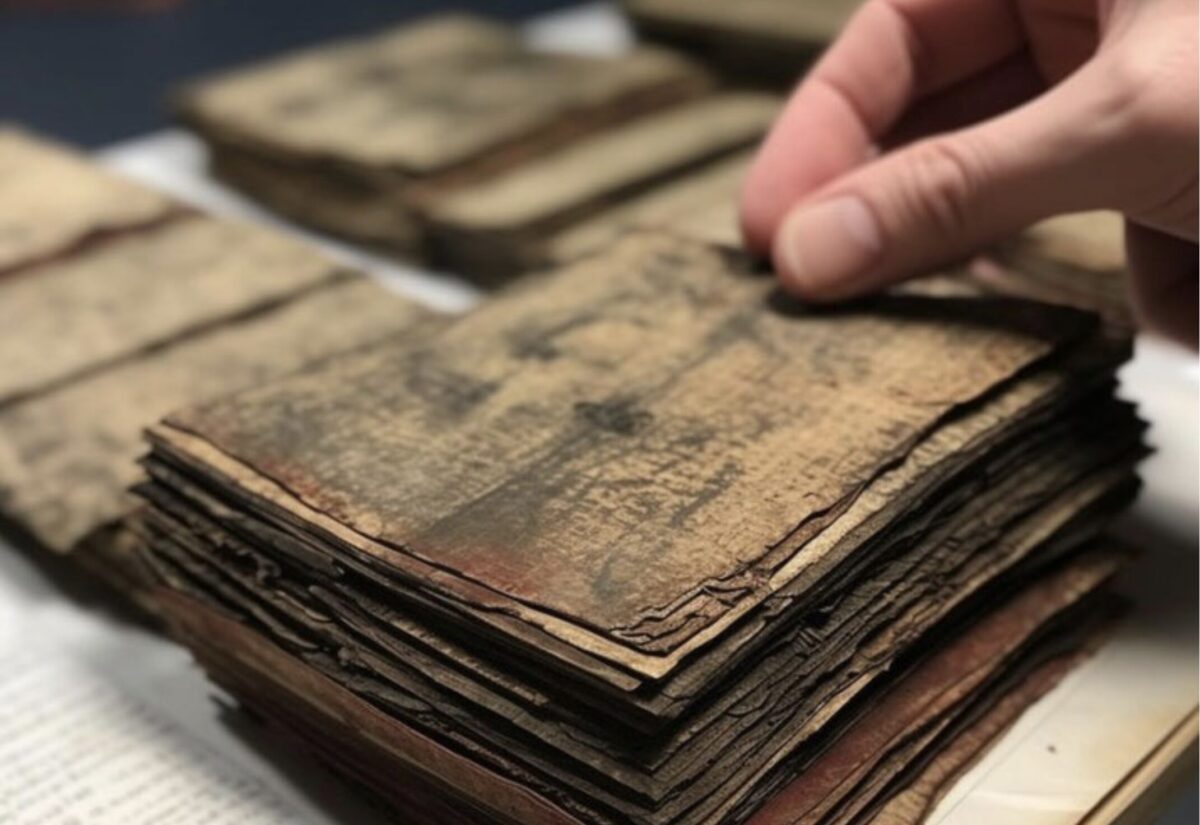
The discovery of the Vindolanda tablets in the 1970s, and since then the Uley tablets and the Bloomberg tablets, has transformed our understanding of ordinary, functional literacy in the Roman world. This has a major impact on how we understand the world of the New Testament and the way that the New Testament was written and read.
I first met Dr Richard Cleaves at the British New Testament Conference, where he was giving a paper about Roman writing tablets and our understanding of the world of the New Testament as background to reading it well. (You can find some discussion of the Vindolanda tablets here.)
Richard has a new book out on reading Luke-Acts in the light of his findings, and I had the chance to ask him about this fascinating and important subject.
IP: What made you start making connections between the world of the New Testament and the world of Roman Britain?
RC: I grew up in Leicester, walking along the Via Devana (for a short stretch still called Devana Road!) into the centre of Ratae Corieltavorum. I did Scripture exams in Sunday School, O Level and A Level Scripture, a Theology degree heavily weighted to Scripture, and have spent a life time preaching, teaching the New Testament to University level and telling Bible stories to children. And yet I did not make any connection between the world of the New Testament and the world of Roman Britain until I was in my 40s.
In 1997, Gloucester celebrated the 1900th anniversary of its being recognised as one of the highest ranking of Roman cities, a colonia. The layout of the streets had been preserved; the course of the walls was marked out in the pavement and a life size bronze statue of the Emperor Nerva on horseback appeared on South Gate. At the time I was preaching on Philippians in the context of Acts 16, and it dawned on me that Luke goes out of his way to identify Philippi as a colonia. The whole story of Acts 16 and Paul’s talk of followers of Jesus having their citizenship in heaven in Philippians 3 fits exactly with what can be seen in Gloucester. That was the start of my interest. From that point on I was on the look-out for connections between the world of the New Testament and Roman Britain. And I have made use of them in my preaching, my teaching and in telling Bible stories to children.
IP: Where in Roman Britain do particular New Testament texts come alive?
RC: In addition to Gloucester, two more locations come immediately to mind—Caerleon and Colchester.
The Feeding of the 5000 occurs in all four gospels. Matthew tells us there were 5000 men, besides women and children. Mark describes them sitting in groups of 50 and 100, and in the Latin translations, each group is a contubernium. John tells us ‘they were about to come and take him by force to make him king’. Go to Caerleon and you can explore the fortress of the Second Augustan Legion, a fighting force of approximately 5000; you can see the barracks where each century of 80 men lived in their mess rooms or contubernia, and where the centurions’ living quarters and offices were. And you can see the bread ovens where they baked their bread. John was right! Those 5000 men on the hills of Galilee, sitting in their groups of 50 and 100, were a fighting force wanting Jesus to take up arms against Rome. Jesus would have none of it, withdrawing by himself to the mountain, later to enter Jerusalem not on a war horse but on a lowly beast of burden. Visit Caerleon, read all four accounts, finishing with John 6:15 and maybe you’ll see what I mean!
Claudius arrived in Britain with four legions and another 20,000 auxiliary soldiers. They were quickly victorious over the south east of Britain and established their capital at modern Colchester, which as the name suggests, quickly became a colonia. Immediately after the death of Claudius they built a magnificent classical temple dedicated to the divine Claudius. It was still standing a thousand years later when the Normans invaded; they used its foundations to build a castle keep that is the largest in Europe. Standing to five stories it is now an imposing home to Britain’s finest collection of Roman artefacts. But the temple was even bigger as you will be told when you visit those foundations originally laid in the middle of the first century!
With a porticoed surround, and a monumental gateway linking it to the forum and basilica, possibly with an account of the Acts of Claudius, it echoes the temple dedicated to Augustus in Pisidian Antioch with its copy of the Acts of Augustus, regularly visited by Paul. You can even argue that it’s not unlike Herod’s rebuilt (Roman classical style) temple in Jerusalem with its royal basilica. Talk of temples and of Jesus as Son of God in the New Testament has to be set in the context of the cult of the emperor and has everything to do with who the followers of Jesus owe their allegiance to. Visit Colchester, take a look at that remarkable temple and then read what Acts has to say about temples in 7:48–50, 14:15, and 17:24–25 and what Paul has to say about the human lineage of Jesus and what makes him ‘Son of God’ in Romans 1:1–7, and maybe you’ll see what I mean!
IP: What about writings from Roman Britain? Are there any that connect with New Testament texts?
RC: It is very rare to discover documents contemporary with the events narrated in the New Testament. And yet that is exactly what happened in 2016 when wax writing tablets from mid first century London were published as The Bloomberg Tablets. They brought forward by thirty years the earliest writings to be discovered in Britain and joined the Vindolanda tablets in opening up windows on to the world of the Roman empire in the first century.
IP: What do they tell us about levels of literacy in the first century?
RC: They indicate that literacy reached deeper and further than had hitherto been supposed. Traders and merchants, together with many who lived in a military community, and those from the local population who dealt with them had a significant level of literacy. At the same time they pose interesting questions about literacy itself, and the even greater extent of what might be described as ‘functional literacy’.
IP: What are the Bloomberg tablets and are there particular ways that they relate to the New Testament?
RC: They are wax writing tablets that are a mix of financial, legal and personal documents. They show the extent to which the economy of the Roman empire was built on debt, mutual relations of trust, and the honour of those who traded with each other. They also give a glimpse of the way in which Roman law worked out in practice in the middle years of the first century. In the dealings of real people we encounter the world that Jesus was responding to in his teaching on finance, wealth, debt and poverty. We also encounter elements of the law which are apparent particularly in the later chapters of Acts.
IP: What about the Vindolanda tablets? Who were they written by and what sort of things do they discuss? How do they relate to the people of the New Testament?
RC: The Vindolanda tablets are the everyday working documents of an auxiliary fort on the northern frontier of the Roman empire at around the time Luke and Acts were arguably written and began to circulate (c. 85–120 CE). They show how extensive was the bureaucracy of the Roman army. More than that, they include personal letters that enable us to relate to the lives not only of the soldiers and their officers, but also the women and children who lived together as a community. In Luke-Acts we encounter a significant number of centurions, the commanding officers or tribunes, men of high standing, and leading women in different communities. These are precisely the kind of people we meet in Vindolanda.
It’s fascinating to see the way the Vindolanda tablets throw light on the letter-writing that is so important in the New Testament. In one letter (Tab. Vindol. II 291), Claudia Severa, the wife of the commander of a neighbouring fort, invites Sulpica Lepidina, the wife of the commander of the Vindolanda fort, to her birthday celebration. An amanuensis, no doubt a slave, writes the fulsome invitation at her dictation. But at the end Severa takes the pen into her own hand and lovingly implores her friend to come. In just the same way on four occasions, we see Paul taking pen in hand to add his own very personal greeting at the end of letters he has dictated to an amanuensis, who some suggest may well have been a slave.
IP: Are there any other writings from Roman Britain that relate to New Testament texts?
RC: Back in 2015 when I took a sabbatical, I intended to spend a month exploring Roman sites in Britain that relate to the New Testament, a month researching the literature in a library, and a month writing up an account of ‘The World of the New Testament on our Doorstep in Roman Britain’. When I shared my ideas with Professor Philip Esler at the University of Gloucestershire, he was excited as it tied in with work he was doing on the Babatha archive, reading Matthew by the Dead Sea. He suggested I focus closely on something very specific and pointed me in the direction of the so-called curse tablets of Bath and elsewhere.
I still enjoyed a month touring Roman sites with my wife but then homed in on the curse tablets. At the time, only a few had been published from the temple of Mercury on the Cotswold escarpment. Philip Esler invited me to read a paper to a conference of the Context Group meeting in Cheltenham at the end of July. That gave me something to aim for and I read a paper suggesting it was possible to explore the world of the New Testament in Roman Britain with a focus on the curse tablets in general, and one tablet from Bath in particular (Tab. Sulis 98). My paper was well received.
A year later, when the publication of the Bloomberg tablets was announced on the BBC News at Ten, Philip Esler rang me the next morning and invited me to contribute a chapter to the second edition of his The Early Christian World. I bought the book immediately and my church gave me a couple of days each week for a month to research my piece which I managed to complete by the (tight!) deadline. When the book came out in 2017, Philip Esler told me that in a good review in the Brynmawr Classical Review, my chapter, ‘Reading the New Testament in Roman Britain’, had been singled out as of particular interest. That was what prompted him to challenge me to ‘write the book’. With funding from the Kirby Laing Foundation, I embarked on a (second!) PhD following my retirement as a Minister and have since adapted it into a book.
By 2018, interest in curse tablets across the Roman empire was growing rapidly, with the publication of significant volumes, and catalogues of the tablets. Roger Tomlin, who had published the Bath tablets in 1988, the Bloomberg tablets in 2016, now gave his full attention to the Uley tablets. They came out in small numbers, enabling me to focus on a significant proportion of them in my dissertation. When they were published in full in 2024, I was able to incorporate them into what was then becoming my book.
IP: So what exactly are these curse tablets?
RC: That’s the really interesting thing! There are grounds for saying they are not so much curses, as prayers for justice. Someone has stolen what may have been a plough, four oxen and other belongings from Honoratus who is farming somewhere below the escarpment. What can he do? He cannot go to the authorities. So instead he goes up to the temple of Mercury where with the help of one of the priests he scratches out his ‘prayer’ on a piece of lead that’s about A6 size. He asks the most divine Mercury to get him his property back, and to do all manner of horrible things to whomsoever has stolen it, be they slave or free, boy or girl, unless they return it (Tab. Uley 72). He folds up the piece of lead and deposits it in a pit in front of the statue of Mercury in the sanctuary of the temple. When that building is subsequently re-built, demolished, replaced by a Christian church and then in the 8th century lost beneath the grass, the folded tablet, with many others, is lost having long since been scattered among the debris.
Then in 1976, when a water pipe was being laid across that field, the archaeologists were called in, discovering a sequence of shrines, and a great number of these folded lead tablets. They painstakingly unfolded them and lo and behold the writing scratched on the surface was just about visible when photographed from lots of different angles. In 1993 the first five were published by Roger Tomlin, and another eighty were listed. It is not until 2024 that they were published in full. I was excited to be able to turn to those writings as well. It means, since 2016, we now have access to three ‘archives’ of written material from Roman Britain that come from an urban, a military and a rural context. What riches to use as a window on to the world of the Roman empire!
IP: How might these insights affect the way we think about the gospels and the rest of the New Testament? How does it help us understand how its teaching would have had an impact on readers in the first century?
RC: Imagine in a thousand years’ time someone came across a sealed plastic bag containing perfectly preserved post-it notes from a 21st century church with prayers on. They would give that archaeologist a millennium hence a field day in deciphering them, analysing them, and discovering how 21st century followers of Jesus prayed out of concern for people facing difficult circumstances in ill health and bereavement, for the needs of the world, and for peace. Drawing on the insights of Ordinary Theology, of the Lived Ancient Religion approach to religious practice in the ancient world, using a tool developed by Tania ap Siôn to study such prayer requests, I have made a study of those prayers from long ago. They reveal how manipulative, transactional, and vindictive prayers of the Roman empire could be. Had such people become followers of Jesus all his teaching about forgiveness, not least in the context of prayer, would really hit home. Bear all that in mind and read Matthew 6:7–15 and you’ll see what I mean!
You can also look at what the New Testament has to say about cursing, and about temples with those Uley tablets in mind; and what the New Testament has to say about money, wealth and debt with the Bloomberg tablets in mind; and what the New Testament has to say about centurions, commanders and women of standing with the Vindolanda tablets in mind. At each stage texts from the New Testament come alive in fresh and exciting ways.
IP: This information seems rather important to me—but I am not sure that scholarship is yet taking these insights seriously. Why do you think that is?
RC: Two things come to my mind.
First, we have a tendency to compartmentalise things. Roman Britain is studied by historians, archaeologists and classicists, while the New Testament is studied by biblical studies scholars, theologians, ministers, pastors, and Christians generally. Children of about eight or nine ‘do’ the Romans. That’s the age of children we tell Bible stories to in primary school assemblies, in Messy Church, in Open the Book, and in all sorts of settings. Why don’t we bring those stories to life in the context of what the children are studying especially in Roman Britain. That’s exactly how I’ve taken to telling the Feeding of the 5000, and the children and the staff, are fascinated and can see how it relates to the real world long ago, and also to the real world today.
Second, it is only since 2016 that we have had access to an archive of writings from an urban setting in Roman Britain, and only since 2024 that we have had access to an archive of writings from a rural setting. First published in 1983, the Vindolanda tablets so far excavated were only published online in 2019, and that included tablets excavated only a couple of years before. So the other reason is that it is only now that these documents are available and this story has been told!
IP: If people want to find out more—and perhaps even read all these tablets for themselves—where should they go?
RC: There’s a great display of the Bloomberg tablets at the Bloomberg European Headquarters in the City of London, exactly where they were found. They are on the way into the London Mithraeum, which itself is well worth a visit. There will also be a major exhibition of the Bloomberg tablets and the other finds at those excavations at the Museum of London when it reopens at the end of November 2026.
There are excellent displays of the Vindolanda Tablets and the Uley Tablets in the Weston Gallery at the British Museum. Vindolanda can of course be visited, and the tablets and other artefacts are on display in the Vindolanda Trust Museum.
There is nothing to be seen at the site of the Temple of Mercury on the Cotswold escarpment but everything to experience, not least as the sun sets over the Welsh mountains: the nearby Iron Age Hill Fort (see also here) and neolithic burial chamber, Hetty Pegler’s Tump, can be visited – the temple site straddles the road in the field where Hetty Pegler’s tump can be found. There is also an informative display of artefacts found at the site, with large pictures of some of the tablets at the Museum in the Park, Stroud.
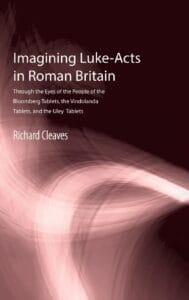 But in answer to your question in a different way, If you’ll excuse the plug (!!), I would start with my recently published book, Imagining Luke-Acts in Roman Britain Through the Eyes of the People of the Bloomberg Tablets, the Vindolanda Tablets and the Uley Tablets, and its accompanying website.
I introduce each of those sets of tablets in detail, and the people who wrote them. I then offer my own reading of texts from Luke and Acts. I do that in the hope that it will spark people either to agree with my reading or (better still) to come up with a better one. The book begins by exploring some explicit connections between the world of the eastern Mediterranean and the world of Roman Britain in the first century, and by offering a select gazetteer of places to visit (which, of course, are mainly the places my wife and I visited during that 2015 sabbatical!!). Once you’ve seen how to make the connection, you’ll quickly find all sorts of unexpected connections when reading the New Testament.
Another wonderful thing is that since 2019, the Vindolanda Tablets and the Bloomberg Tablets are all available on a comprehensive website, Roman Inscriptions of Britain. The Bath tablets are already there, and the Uley tablets will eventually follow them.
Through the book, and the website, I hope to inspire others to read the New Testament in the context of early Roman Britain.
IP: Richard, thank you for all that fascinating information—and especially these resources for further study. I hope that they will be explored and read widely.
Dr Richard Cleaves is a Minister of Congregational Federation churches latterly in Cheltenham, and taught New Testament in the Congregational Institute for Practical Theology. Since Gloucester’s 1997 celebration of its foundation as a colonia, he has researched the world of the New Testament in Roman Britain and caught the imagination of adults and children in his preaching and teaching.
 Buy me a Coffee













Great stuff.
I often wonder what Christians were doing in Roman Britain.
Just to let you know you mistyped your email address…
Ah, thank you Ian
Were the first Christians here ethnic Jewish traders who came with the Romans? Or legionnaires? (Do we know which legions were here when, and where most of their soldiers were recruited from?) Was it to do with the Cornish tin trade? How fascinating that we are uncertain.
St Alban was martyred in the third century, and three British bishops attended the Council of Arles in 314AD. The pagan Anglo-Saxon colonisers seem to have eradicated the church of the ancient Britons in the south of England, but it held fast in Wales and the north – as Augustine of Canterbury’s mission (landed AD597) eventually discovered. The grassroots celtic church and the hierarchical Roman church discussed their differences at the Synod of Whitby in 664AD and the former agreed to accept the authority of the latter. This decision – which I regret – hinged (absurdly!) on the date of Easter. Bede’s motivation in writing his Ecclesiastical History was largely to endorse the decision made at Whitby.
(Why isn’t called Devana Way???)
Brilliant! I’ll take a look at the Bloomberg tablets when next in London.
This is the kind of stuff that is hugely important in understanding the context of the NT writings and obtaining the correct interpretation of them.
Many thanks Richard.
Walking the hills four miles either side of Hadrian’s Wall I often come by stone from the Wall that was re-used in farm buildings and churches. A lot of these stones bear inscriptions. It has often struck me that, because they bothered to leave these inscriptions, basic literacy must have been widespread. Latin inscriptions were usually abbreviated according to a standard scheme, so a lot of people must have known those rules as well. Great article, thank you!
Did you know that this reuse of the stone probably only happened as a result of the Enclosures Acts from 1750.
It is likely that Hadrian’s Wall largely remained complete and intact prior to that.
Really! First time I’ve heard that, though it is easy to imagine as stone buildings were fewer and further between before then. An enormous amount of Roman stone went to build General Wade’s military road – the one between Newcastle and Carlisle (The A6318 now) post 1715.
Can the literacy of Roman army culture be extrapolated beyond that to the civilian commoners of occupied territories?
A fascinating piece – and one that would have interested the late Professor of Hebrew at Liverpool, Alan Millard, who retired to Cheltenham. I imagine Dr Cleaves knew him? Professor Millard wrote ‘Reading and Writing in the Time of Jesus’ and he laid great store by the ubiquity of pinakes, wooden tablets covered with wax, which were like notepads in the ancient world. Millard was making the case for actual contemporaneous notetaking of Jesus’s words and teaching. The claim that literacy was a bit more widespread than scholars of the past were prepared to admit is of course welcome to the readers of this blog.
It is excellent that first century evidence from Britain can be adduced for re-creating the thought world of pagans as a backdrop for understanding the New Testament. I hope this work will feed into preaching in England.
Here’s a fascinating statistic.
The average number of words on a Vindolanda-style table is between 100 and 250 words.
In the gospels, most of the pericopes are between 6 and 12 verses, or around 120 to 220 words in Greek…
I image a retired tax collector probably had a stash of them somewhere, when he was waxing eloquent.
I’ll keep taking the tablets ….
so the depiction of Matthew in The Chosen taking notes may in fact be accurate.
That certainly is fascinating.
The attacks and undermining of oral tradition and transmission of the New Testament protestant canon by Higher Criticism , ( Redaction Criticism, Form Criticism, Literary Criticism- source criticism, historical criticism, – and the Lower Criticisms of Textual criticism have been refuted by scholars.
The question of the historical reliability of scripture, depends primarily on the prior reliability of eyewitness and ear witness accounts before being recorded in writing in the Jewish cultural milieu of those times.
And it more than well argued by Christian scholars that Luke/Acts are the reliable products of an ‘historian.’
Well, I believe that as you do, but you still get attempts to date Acts to the late first century or even early second. An article in Tyndale Bulletin a couple of years ago makes the case for the early 60s, looking at the depiction of Jewish-Roman relations, which took a decidedly bad turn after the Jewish-Roman War (66-72).
This is just the difference between the same person finalising their history/memoirs in their early 30s or their late 60s. How is historical accuracy different either way?
1. If Luke-Acts was written c. 115, it would likely be fictitious, not eyewitness material.
2. If Luke-Acts appeared c. 80, it would likely reflect the collapse of Roman-Jewish relations in the 60s and 70s.
3. If If Luke-Acts was written after c. 63, it would reflect what happened to Paul after his first trial. The ending looks pretty contemporary.
This discussion happens interminably, but makes a lot of errors each time, and does not learn from the points already made against.
-The issue with accuracy is the author not the date.
-When there is any number of factors, the fewer factors cited the less adequate the position.
-When dating a given NT document, it is not a matter of (e.g.) Acts or Luke/Acts but of the NT documents as a whole, since their interrelationships are many – and moreover are the best clue to dating. Again, we prefer the accounts that proffer a network of dating and demote those that unrealistically isolate a single document as though it were not interrelated.
-Luke is not allowed to run out of papyrus even when his writing is the longest ever contained on a single papyrus, and moreover even when further closure is obviously needed.
All our assessments involve some degree of second guessing (including compositional theories). A datable MS gives us the terminus ad quem.
Exactly. But the ‘degrees’ involved not only differ, but differ vastly.
Moreover, discussion happens at the levels of hard evidence and analysis of factors. In other words, precision is at the top end and vagueness at the other.
Since I date Acts 98[+] (98 is about the earliest possible, but it is hard to date it much later either – this pincer movement of ante quem and post quem is common and to be expected), the first two of Seccombe’s main considerations do not apply…
…but the third looks bogus to me as I and most of us would likely have written of the shipwreck in Luke’s detail had we been personally involved in it…
…and reference to the forthcoming decade would have been irrelevant within the shipwreck account, all the more so if it was potentially the topic of his future writing.
…and 62-70 is less pressing and present in 98 than it would have been earlier.
Christopher, can you explain in a few words why you think 98 is the earliest possible date? You are something of an outlier compared with current scholarship.
When you reach one generation on from the events, you get to the time when
(a) the yarns are especially interesting,
(b) the author is less in active ministry and more able to write,
(c) the author is of the distinguished age-range of most of our NT authors,
(d) it becomes pressing to record the events before eyewitnesses all die,
(e) one has the perspective to see the significance of what has been experienced, and indeed the shape in it (the progress of the Word and Way of the Lord).
(f) Anyone who lived long and yet did not do vol.2 of the Acts (except in the shape of his involvement in the Pastoral Epistles) must likely have written vol.1 late on rather than early on.
After all, Ac 1.1 does not lead us to believe he waited long between volumes.
At the end of the day, these are all subjective arguments, which only invite subjective arguments in reply. I don’t see anything in Luke-Acts that reflects not only difficult Roman-Jewish relations in the aftermath of the Jewish War but also difficult Roman-Christian relations that pertained after the Neronian persecution (64) and, to some extent, Domitian’s actions reflected in Revelation.
I wasn’t listing my arguments; I was listing points that bore on the ruling out of the years up till 98. None of these points were of any importance in my dating presentation, which focused on intertextuality. The overall shape of the dual prefaces compared to In Apionem; Theudas; Paul’s Athens speech on the boundaries of nations and David as a man after God’s own heart, both compared to 1 Clement according to priority criteria.
Because the comparison of Luke-Clement textual links points to the priority of Luke (which should postdate Josephus Antiquities, while Clement is expertly dated from multiple angles at mid-90s) while the reverse is true of Acts, which should not far postdate Luke, then it looks like we can be fairly precise with the dating.
To give a fuller list for pondering – as I don’t want to keep harping on:
Luke cannot be much earlier than 95 because of its postdating Antiquities, on which see van Kooten, Reverberations among others. This alone makes Acts unlikely to predate c98, even given Luke’s predating of 1 Clement. But note that this point is independent of the 1 Clem – Acts links and their direction:
[Note – 1 Clement and Luke-Acts are both Rome documents.]
1. 1 Clem 18.1//Ac 13.22. The direct association is pretty much certain one way or the other (by which I mean that other possible explanations are far less likely because they are so improbably convoluted) because of *both* the insertion of ‘a man after my own heart’ *and* ‘the son of Jesse’ into the source. Which way round is the dependence?
-Luke has more that is unique to 1 Clem than he has that is unique to Ps 89 here;
-the 1 Clem parallel is more colourful than the Ps 89 parallel;
-the Ps 89 parallel with Luke is as short as a quotation can be (2 words) – one does not usually seek out a quotation only to cap it at two words – appended by a vague coda.
-both writings are characterised by a degree of OT saturation generally, but this intertextuality saturation is more comprehensive in 1 Clement.
-1 Clement shows overall that he knows Ps 89 first hand because of his continuation to ‘anointed with eternal mercy’. Does Luke necessarily? The only evidence for this is his putting ‘Heuron Dauid’ as a pair of words; but that could have been through rearranging Clement’s ‘I have found a man after my own heart, David’ clearer as ‘I have found David…a man after my own heart’.
-The inclusion of ‘a man after my own heart’ by Luke could have been a quotation in the form most familiar to him and a giveaway that his source was actually 1 Clement and not Psalms.
-There is nothing in Luke (aside from the tiny word order consideration which can be explained in another way and is insignificant anyway) to suggest that he knows any of the Ps 89 that is not already in the 1 Clement.
2. 1 Clem chs 3-6 with Acts 5.17, 13.45. The word zdelos as ‘jealousy’. This is a word that does not appear in Luke. In Acts, it appears of the attitude towards Peter and Paul (5.17, 13.45) but such an attitude to Peter and Paul is noted in 1 Clement as part of a larger treatment of jealousy/envy that lasts 4 chapters (3-6), meaning that of the two authors Clement has the greater endemic interest in the topic. Luke’s interest is (a) only in passing, (b) in a connection with Peter and Paul that is in 1 Clement. An author could more likely show traces of a theme that was thoroughly dealt with in another than make a big thing out of scattered inessential references in another.
3. 1 Clem chs 19-20 // Acts 17.25-6 The close connection of providence with national boundaries.
This is the more striking as the endemic connection of these two themes is not especially close.
Moreover, the theme is strikingly different from anything else found in Acts.
Like with point 2, we have an extended passage that shows Clement’s primary interest, while in Luke we have a scattered reference. See final sentence on point 2.
4. 1 Clem 2.1,13.1,46.7 with Acts 20.35. In the same way as points 2-3, the injunction to ‘remember[…] the words of the Lord Jesus’ is characteristic of Clement, but not of Acts (the closest I could find was Acts 11.16).
5. This raises the very interesting question of the agraphon Acts 20.35 ‘It is better to give than to receive’. Is Luke being less than 100% on the ball about his sources (cf. point 1, and also cf. possibly 1 Tim 5.18)? – 1 Clement 2.1 has ‘more glad to give than to receive’. The advantage of this would be that it explained why there should be an agraphon at all (something that was understood by the author to be already previously heard and known as a saying of Jesus, but possibly only because it was simultaneously deducible from such dominical teaching as is in Luke 6.37-8 and formulated in 1 Clem 2.1). If one ranked the gospel writers for precision, Luke is sometimes the least precise.
The two Josephus points I also mentioned above.
Chris, I am none the wiser at all.
Can you say in a sentence (or two, but no more) why Luke-Acts cannot have been written before 98?
(Sorry, I missed your earlier question ‘Why is 98 the earliest possible date?’
I am a mild outlier here, for what that is worth, but on a disputed issue.
The answer is:
(a) the specific nature of the individual 1 Clement links (given Lightfoot’s masterful dating),
(b) Luke 3.1 postdating Antiquities as analysed,
(c) overall commonalities with the twin In Apionem prefaces, and the fact that it would be precisely this author -and in a two-book work- whom he is *closest* to in this (it is not as though L Alexander does not give enough other candidates). Other considerations – Luke’s age, Pastorals, Ignatius, likely short timelag in production of Acts safter production of GLuke – make 98+ also an optimum date.
Use of Antiquities is not the only issue; the pincer movement of a network of other established dates, established by intertextuality of otherwise, is always key. In the mid-90s there are several.
The anti-Jewish point already aired works against e.g. Josephus’s use of the more marginalised Luke as opposed to vice-versa. But all such analysis is primarily intertextual not suppositional.)
Sorry, Chris, none of that adds up at all.
I think most people have in the past argued for Luke 3.1 being dependent on Josephus because they believe reference to ‘Lysanias the tetrarch’ is a garbled corruption of Josephus. The argument is undercut by independent epigraphic evidence. An inscription from Abila itself (near Damascus), commemorating a temple dedication, is dated by the reign of Tiberius and refers to “Lysanias the tetrarch” (a freedman of his makes the dedication) — CIG 4521, discussed at length by Emil Schürer and taken up by most subsequent commentators (Fitzmyer’s Luke commentary has a full discussion). A second inscription (IGRR III 1085) attests a Lysanias as tetrarch and high priest in the same general region and period, from the reign of Tiberius or shortly after. So Luke 3.1 is correct—and not related to Josephus.
The broader “Luke used Josephus” thesis (associated with scholars like Steve Mason, pressed further by others) tends to explain the Luke/Josephus parallels elsewhere in Luke-Acts (Judas the Galilean, Theudas, the census) by direct literary borrowing, when shared dependence on common Roman administrative records, oral tradition about the same well-known public events, or simply two authors independently drawing on the same stock of Jewish historical memory are equally or more economical explanations. Literary parallelism between two authors describing the same public figures and events is weak evidence of dependence unless the wording or the errors are shared — and in the Lysanias case, Luke and Josephus don’t even agree on the errors, since Josephus never actually calls anyone “tetrarch of Abilene” in Luke’s timeframe. Luke’s Lysanias is, if anything, independent of and better attested than the reading that generates the objection in the first place.
So I don’t really buy any of your arguments here.
To the contrary, I think GLuke *has* to have been written before 98, and cannot vary much from 95, because of the interrelations with Antiquities, In Apionem, 1 Clement.
As I gather, the idea that the second of the Lysanias inscriptions refers to first-century AD not BC is based on the following: The inscription has a tetrarch Lysanias who is father of Zenodorus – and this fits the BC Lysanias well. However, the idea is that this cannot be the 40-36BC tetrarch because Zenodorus is not himself called a tetrarch in the inscription, as he would naturally be in such an inscription – it must therefore be another tetrarch Lysanias, for which we have a ready candidate in the first inscription mentioned. The second inscription fragment is very small. This idea seems a good argument, based on knowledge of typical usage, rather than a conclusive one. If it is correct, it means that not only were there two Lysaniases but both had the same name for their son. Of course, this is not particularly unlikely in dynastic circles, though it gives pause. This is an inscription for which there is a good theory that it must be AD rather than an inscription which must be AD.
That Josephus happens not to mention any younger Lysanias, I would not think is conclusive. Many people he mentions only once or twice (or never).
There are no coins from Lysanias 1st-century tetrarch, but there are from his fellow tetrarchs Philip and Herod Antipas. 3.1 looks well set out and authoritative. In addition, Luke has form for the correct nomenclature and designation of officials.
I must bow to the superior wisdom of Schuerer and Savignac on the former inscription. (Schuerer apparently is persuaded by the arguments for the second inscription being first-century; fortunately I have a 4-vol Schuerer so can look at whether I find this persuasive or not, and at Fitzmyer.)
Typically, 90s dating of Luke or Luke-Acts is related to the Antiquities’ publication in 93.
That is quite far from my position. Anyway, (a) verbal parallels between Lk-Ac and Ant do not exceed random chance, and (b) it would be more surprising if historians of the same period never overlapped in what they covered.
If Luke was interested in In Apionem and its prefaces, he would (as an historian and secondly as a Rome resident) be even more interested in Antiquities. But we would naturally expect his interest in both, if they preceded him, whether or not we in fact had evidence for it.
My position, by contrast, assigns the following descending order of importance:
1 An overall network of dates (i.e. maximising the total amount of evidence) -this network being established by close criterion-based intertextual priority-analysis which ranks criteria by reversibility or otherwise;
2 1 Clement (where the evidence of dependence is clear, and where we have an instance where both are related to the same OT passage at the very point of dependence, and several themes where we can test which author shows the greater interest);
3 In Apionem prefaces;
4 Antiquities (esp the mention of Theudas before Judas), with the Josephus data only becoming interesting and relevant once it is seen to cohere chronologically with the preceding data.
Chris, I find a general claim of ‘this network being established by close criterion-based intertextual priority-analysis which ranks criteria by reversibility or otherwise’ unconvincing I am afraid. I think it is almost impossible methodologically to establish the direction of dependence of texts.
I cannot see any clear verbal dependence of Luke on 1 Clement. It looks rather than other way around. Why does Luke stop short of the end of Paul’s life?
The arguments for early Luke-Acts are much more compelling.
[Read: ‘There are no coins from Lysanias 1st-century AD tetrarch….’]
The excellent Schuerer I ’73ed. regards the Lukan-era Lysanias as a foregone conclusion and his connection with the second inscription as an intriguing possibility, not brought into his mainstream argument. Fitzmyer unduly multiplies possible Lysaniases beyond the two.
It’s like any form of study – the more precision, time, refinement and dedication the more headway, but no form of study is a nonstarter. Compare Markan priority, which is accepted by 90% on the basis of close textual analysis of the sort that can also be applied to other interrelated pairs of texts. So Markan priority is far from being a 50-50, and the same likewise applies to other pairings.
Relative dating (who used whom?)- Although the principle is sound that the more one has gone down this road, the more one can speak of it (hence I commend my tiny methodological pamphlet or, preferably, anyone else’s) a few examples of the way not everything is 50-50 or anywhere near (of course, 50-50 is a random ratio, and no other ratio would apply in all circumstances; probability ratios naturally vary).
Examples-
Scenario A. Luke’s Deuteronomy and Elijah snippets (perhaps 80 in number): Matthean posteriority requires that every single one of these was excised by Matthew without trace. The comparative likelihood of this compared with the alternative of Luke’s tweaking of his source (Matthew or other) has odds of thousands or millions to one.
Scenario B. Two sources both make the same OT reference, but also change it in the same way (just as Mark and Matthew do with ‘Behold, I send’, changing ‘Me’ to ‘you’). Simplest is that the OT was mediated to one by the other. A source theory that said that they both made precisely the same single change (in circumstances where one *already* had reason to suspect dependence) does not at all have the same value as one that denies it.
Similarly, in the case of Luke 13//1Clem 18, we have no knowledge that Luke independently knows Ps 89, since all the Ps 89 elements he contains are also in 1 Clement. He also has, in the parallel, more that is in 1 Clement than he has that is in Psalm 89. Luke contains two units of 1 Clem material that are extra to Ps 89, while 1 Clem (an inveterate alluder and producer of catenae) shows he knows this Psalm verse first hand by quoting more of it. So the odds are far from even.
Scenario C. Source C equals source A plus source B, where A and B lack overlap with one another. This means C comes third. Otherwise either A would have had to unpick all the B from C or B would have had to unpick all the A from C. The options are not of anything like equal probability.
I am always glad to debate textual specifics, and in the case of 1 Clement and Acts (I was very excited, for precision’s sake, when the ‘results’ showed Luke preceding Clement and Acts postdating it) I would begin with the Ps 89 passage showing textual dependence of some sort, followed by the reasoning above as to which way this went. I would then follow by listing how special interests of 1 Clem (providence and natural boundaries; ‘remember the words of the Lord Jesus’ and similar; jealousy/envy) were outlier scattered references in Luke that are not special interests of his. And by mentioning that knowledge of 1 Clem makes more economical the existence of Acts’s one agraphon, especially given both authors’ related interest in reciprocity sayings. And by making the point that the traffic is all one way. The points are of vastly different weight, and the lighter have relevance only once the heavier be admitted.
DATING LUKE-ACTS
FURTHER ARGUMENTS FOR AN EARLY DATE
David Seccombe
Tyndale Bulletin 71.2 (2020) 207-227
available free online
https://www.tyndalebulletin.org/article/27747-dating-luke-acts-further-arguments-for-an-early-date
‘The case for dating Acts in the early 60s has been argued by others. This
paper offers two additions to the case for a date in the early 60s and a
restatement of a third. First, the manner in which Luke has portrayed
salvation in terms of Israel’s national hope would have been dangerous
for the author and recipients of the book any time after the outbreak of
hostilities with Rome, and well into the second century. Second, the
viewpoint of Acts presupposes a church whose Jewishness is taken for
granted, with justification needed for Gentiles to be admitted. This was
the situation before AD 70, not afterwards. Third, the prominence given
to the voyage to Rome and the vividness of detail in the account indicate
an author at work prior to the extraordinary disruptions of the following
decade.’
This is rather compelling…
On the first point, Luke is writing in Rome. Emperor Nerva 96-98 (and the early years of Trajan) was more friendly to the Jews and eased up on the Jewish tax. This tiny historical pocket of the Nerva years, ff. (we saw his forum last week) coheres well with the dates already established by the intertextual pincer movement I referred to. Of course Luke can only ‘floruit’ for so long, and any other explanation for the ‘we’ passages is batty.
On the pincer, we also look at the evidence from the letters of Ignatius (cf. Epistle of Polycarp 4.1) who echoes different aspects of 1 Timothy 1.3-5 three times (to Polycarp 3.1 heterodidaskalein, Magn 8.1, Eph 14.1 – all of this is in the core authentic Ignatius stratum).
Acts is known to the Pastorals and the Pastorals to Ignatius (and, a bit later, Polycarp).
On the second point, the viewpoint of Acts does presuppose such a church, since that is the church of the years it is writing about.
On the third point, who would not write in detail about a shipwreck like that one? The question mark should, rather, be over someone who failed to do so.
Chris
a. How do you know Luke is writing in Rome?
b. Your argument about ‘more friendly to Jews’ fits better with a pre-70 date. Why are you ruling that out?
c. ‘Who would not write about the shipwreck?’ Someone with limited space wanting to say something theological, which this section hardly does.
Ok-
a. He was last seen in Rome (Col and Phm – another site, the house-arrest, that we saw last week – and 2 Tim 4). Also Mason’s logic for Acts’s use of Antiquities post-93, which is the relevant period, is quite tight, and how many copies of that tome can there have been at the relevant date, and where? (If one wants to research, and one’s main or normal domicile has been the best place for research, then best not to move.)
b. The ‘more friendly to Jews’ periods encompass both the early 60s and the late 90s alike. (Who knows whether 1 Clem init bespeaks a period when he can finally speak out after a very extended period, and hark back still to Peter and Paul as though nothing much had publicly happened since? The envoys seem much the same personnel as a generation earlier. A long undercover period 70-95 could be indicated.)
c. He doesn’t have limited space, nor does any historian, as there is no imposition on how many volumes one is allowed to write. On the present papyrus he certainly does have limited space. Matt, Luke and Acts are notorious for their space-cramming.
Thanks. But *all* this hinges on the argument that Luke uses Antiquities, so must have post-93 access to it.
If two texts have similarities, how do we know which direction the influence was in, or whether they both draw on the same source? This is methodologically where all such arguments struggle.
Yes, it historically has been, which is why I sent my ‘who used whom?’ ‘calculus’ (Tyn 2019) when the question was previously raised. It is a highly important question that has not received nearly the analysis it deserves; on the other hand, the more one chips away at it, light emerges. I nearly always find (Rev – Jas; 1Ptr – Jas; 1Clem – Ac etc) that the traffic is almost all in one direction, and the odds against even a 3-0 situation (say) obtaining when the reality was the other way round are remarkably high. Often it is more like 6-0, 10-1, that sort of thing.
Chris, can you explain in one sentence why you are convinced that Acts is dependent on Ant, rather than either the other way around or both drawing on the same source?
‘Although the Antiquities question is but one among many interrelated questions – dates of Matt, Luke, Antiquities, In Apionem, 1 Clem, Pastorals, Ignatius; identity of Josephus’s Epaphroditus and should never not be viewed as such – if we limit ourselves to Antiquities we think a second similar Theudas is unlikely whereas the likelihood of a single Theudas has always raised the hypothesis of Luke’s eye jumping on the Josephus text which would then make likelier that it did so with Lysanias as well; but although this could, since anything is *possible*, be accounted for by other source family trees (and writing down what these would mean in practice has only emphasised how remarkably unlikely these are) we return to the fact that Antiquities is only one element in an interrelated and unitary web, of which 1 Clement is the most telling element.’
Chris – using your likelihood argument re Theudas, historians in the future, if they had the same paucity of material we have regarding 2000 years ago, would conclude it is highly unlikely there was ever 2 Presidents of the United States with the same name, and within a few years of each other. But those of us who lived at the time know better.
That’s right. But from your presentation of the issue, one would never guess that different names have different rarities. But as we both know, they do, in spades.
‘Before these days’ (Gamaliel) is not a context full of precision.
Referring to a precedent that is unknown would be an own goal.
And if the earlier Theudas did what is said, he ought to have left a trace elsewhere. I say that, though we often rely solely on Josephus.
Chris – are you arguing Theudas was a very uncommon name in the area at the time? If so, evidence please?
‘Referring to a precedent that is unknown would be an own goal.
And if the earlier Theudas did what is said, he ought to have left a trace elsewhere. I say that, though we often rely solely on Josephus.’
– how do you know it was unknown? Again the paucity of written records. Hardly a reasonable conclusion to draw.
– as for Josephus we know he did make mistakes, indeed contradictions within his own writings, including dates. Why you would compare Luke with Josephus and conclude the latter is right I do not know.
– if Luke really did use Josephus’ work, he made quite a mess of it.
Overall, I find the argument very weak.
What is your own estimate of the prevalence of the name Theudas? Was it popular or unpopular as a name?
The name Theudas is not strictly a name but a contraction (of Theodorus, Theodotus…). But we can look at how many people are known to have gone by this contraction.
We know of three, as far as I know:
-The popular leader c44, regarding whom is the Ac 5 controversy;
-The proto Valentinian Gnostic who according to the First Apocalypse of James mediated (in time and ideas) between Paul and Valentinus
-The Jewish teacher under the Hadrianic Persecution (second Jewish revolt).
Popular leaders, if anyone, were dynastic in their naming practices, normally defaulting to the names of the heroic Maccabees (this was the case with the family of Judas the Galilean). If an earlier Theudas had been a rebel hero, future generations – not just of his own family – would copy this. Though insurgency requires a motive (for Judas the Galilean it was the census, for later figures it was Roman domination), and hence insurgents cluster around certain dates.
Josephus makes plenty of
-mistakes
-overestimates of numbers
-‘gnosticism’ (so to speak) where agnosticism would be more appropriate.
So we look to the method of first having some reason to think that two passages in two writers are dependent in some way (here, it is the naming of Theudas and Judas in close succession in that order even though those known to us were far apart in time – unless it was the rhyming that naturally brought them together in people’s minds) and then see which author is better for first hand information and (even more importantly) whether both authors have first hand information at all.
Here, Luke’s only first hand information is the number 400. Here he
-is more specific than Josephus;
-is more realistic than Josephus.
Usually Josephus will be the fuller and seemingly in more first-hand touch with public affairs.
‘Why you would compare Luke with Josephus and conclude the latter is right I do not know’:
-But there are different details and different authors can be right at different times
-Why should one be right and the other wrong? Both being right and both being wrong are equally possibilities.
‘If Luke really did use Josephus’ work…’
-If he did, his verbal echoes are very indirect, and thematic note-taking looks likelier, if anything at all.
-Luke’s Josephus, Ant. links are very unexciting. It is essential to explore the question – re Lysanias, Herod Agrippa’s death, the census, Theudas etc etc. But only one likely link is all we need to make his access to the whole of Ant likely. Someone of Mason’s expertise is almost guaranteed to find this one (or more) link whether or not it is actually there.
We can always reconstruct Luke’s actions if we assume he has used a source. The question is whether he actually did use this one. For that, the Theudas parallel is our best evidence, but is a complex issue in itself.
Luke can be hasty when using his other sources (Goodacre etc; Goodacre put it down to the immensity of his task) so hastiness could be characteristic.
Our thinking on this gets better when it is more evidence led and (as a distinct point) less binary.
Hi Geoff – have you ever looked at the YT videos on the ‘Testify’ channel? Some nice nuggets, particularly on Acts.
Thanks Peter. I’ll look it up.
Have you seen the many Roman Chi-Rho artefacts in the Roman Britain gallery at the British Museum? See also https://www.dayone.co.uk/products/early-christianity-in-britain?_pos=1&_sid=f0230f9c0&_ss=r
Thank you for sharing! This is so fascinating. It’s a little bit like “Time Team meets Tom Wright”! 🙂 “Roman Britain” by Guy de la Bédoyère brought this era alive for me and I love the idea that that world was also enlightened by little wax tablets or parchment scrolls communicating the words of the Gospels and / or Epistles!
Well, our church is mile or so from a small, almost unknown, Roman Temple on the edge of the empire? What does the temple tell us about Christianity and preaching the gospel?
Interesting, of course Christianity came to Britain via the Romano British and Emperor Theodosius I and the Edict of Thessalonica in 380 CE. Before that Britain was majority pagan. So finding out about Roman life in Britain via the Vindolanda tablets also leads onto discovering more about early Christianity here
There were Christian churches in Britain long, long before AD 380.
(However, they weren’t established, so the ordinary Romano-British didn’t have the right to get married there or have a service of blessing for his relationship with his favourite slave.)
This only become possible after the meeting of the General Synod at Whitby.
Source: ‘The True History of the Church of England’ by Professor Jason R. Day
Ex-professor, mercifully. The BBC wrote:
Arday… has admitted errors in his work, but said he had faced “an unrelenting level of public scrutiny and personal attack” and was not a “liar”.
Having never admitted to plagiarism, he says he never lied. Does that include the mandatory declaration at the start of his published thesis that it was all original work except where others were referred to? As for suffering public scrutiny, perhaps he should meditate on the etymology of the word ‘publish’.
In a sense this doesn’t matter, because it is an affair in the intellectual slums, i.e. sociology. But the Critical Race Theory of which he is an exponent is now working its way into science and mathematics, where Native American, Maori, Aboriginal ‘ways of knowing’ are presented as valid alternatives and the curruiculum is being ‘decolonised’. This is code for throwing out work done in Western civilisation. It is insidious, for there is only right mathematics and wrong mathematics, and all races and cultures are welcome to join in right mathematics, which should be seen as a gift from the West to the world. (Do decolonisers wish to deny electricity, modern medicine, powered transport and other Western inventions to Indians, Africans and Aborigines?) When the Jesuit missionary Matteo Ricci gained access to the Chinese imperial court in 1601, he showed its mathematicians that you could prove a theorem step by step starting from axioms. Euclid had been first to do that, in the ancient Greek world. Euclid’s textbook Stoicheia (‘Elements’) deeply impressed Chinese scholars, as centuries earlier it had impressed scholars in the Islamic world. Postmodernists who deny the universality of mathematics are following Nazis who spoke not only about Jewish scientists and Aryan scientists, but Jewish science and Aryan science.
When this nonsense starts to affect funding for science and mathematics there is going to be a huge row. The sooner the better, in my view.
“This is code for throwing out work done in Western civilisation. It is insidious, for there is only right mathematics and wrong mathematics, and all races and cultures are welcome to join in right mathematics, which should be seen as a gift from the West to the world.”
Right mathematics is also the gift of numerous non-western civilisations to the west: the Babylonians who pioneered geometry and gave us the sexagesimal system; the Islamic world (Persian and Arabic) who developed algebra; and above all, the south Indian world who gave us zero, the first draft of our numerals and much else besides – negative numbers too, I think. The genius of the west has been to accept good rational ideas of any provenance.
CRT is a complete dead end intellectually, because the drive for it is not based on reason but sentiment (and ressentiment). A little battle is going on in New Zealand, where advocates have tried to insinuate ‘matauranga Maori’ or traditional Maori animistic cultural beliefs of ‘life forces’ in rivers, plants etc into science education. These ideas belong in an anthropology class, not a laboratory, but they were encouraged into school and university curricula by the previous Labour government of Jacinda Ardern. Academics at Auckland University condemned this 3 or so years ago in an infamous letter to ‘The New Zealand Listener’ and there was a proper public spat and the usual accusations.
As you say, sociology is only marginally an academic discipline (and ‘sociology’ of education even more marginal) and much more subjective political ruminations, but the rot has spread. This desperate oikophobia has corrupted the humanities beyond redemption in many places. so I hope the sciences will not lose courage.
Cambridge University should hang its head in shame.
The Greeks also did a fair amount of algebra as well as geometry: look at their ingenious proof that the square root of 2 cannot be written as the ratio of two whole numbers. (Denote the square of a number n by n^2, and assume provisionally that the square root of 2 *can* be written as √2=m/n with all common factors of 2 cancelled, so that 2n^2=m^2, so m^2 is even, so m is even. So let us write m as 2q, so that 2n^2=4q^2, so n^2=2q^2 is even, so n is even – a contradiction. So the assumption is wrong. ) Or their proof – also by contradiction, and in Euclid – that there is an infinite number of prime numbers. (Assume that the number of primes is finite, multiply them all together and add One. The resulting number – which is odd since 2 is prime – must be either prime or not prime. If it is prime, we have an immediate contradiction. If it is not prime then it must be divisible by some prime from the list of primes; but it isn’t, because whichever prime we try there is a remainder of One – another contradiction.) Or their proof that if (2^n – 1) is prime (which is true for n=3, false for n=4) then
(2^n – 1) * 2^(n-1)
is a perfect number, one that equals the sum of all its divisors eg 28=1+2+4+7+14. Such reasoning is far beyond the achievements of the Babylonians or the Indians, or the Muslims (who preserved but barely added to Euclid). Only in the European Renaissance was mathematics taken significantly further in a tradition that runs to this day.
Neither the Greeks nor anybody else has ever found an odd perfect number, and whether any exist is still an open question 23 centuries after Euclid. Answer that and put Andrew Wiles’ proof of Fermat’s last ‘theorem’ (i.e. conjecture) in the shade!
The trouble is that Arden is the authentic face of Critical Race Theory, the basis of which is that it is not about scholarship but power. Nobody who believes that should be given any university position, let alone a chair. Shame on my Alma Mater, as you say.
Arday not Arden!
Considering how long it took Wiles to confirm Fermat’s last “theorem” and (IIRC) he depended upon the highly geometric work of Japanese mathematicians in the 1930s or was it the 50s, I doubt that Fermat did prove it and that the proof is hidden away in some library in France.
There is no denying the mathematical achievements of the ancient Greeks, Archimedes especially. Perhaps if that idiot Roman soldier hadn’t killed him, he might have gone on to discover calculus.
I would love to see Goldbach’s conjecture proved. Now that would be worth the Fields Medal.
Yes, given the effort put into Fermat’s last ‘theorem’ by 300 years of mathematicians having the benefit of greater knowledge, it is clear that Fermat’s claim to have proved it by 17th century means was mistaken. (We never saw his working.)
I prefer the odd perfect number conjecture for its venerability, but Goldbach’s conjecture takes the award for something explainable in a pub in less than a minute but still not proven after 284 years: that every even number can be written as the sum of two primes. Obviously nobody has found a counterexample.
The Fields Medal (the Nobel of mathematics) is given only to mathematicians below the age of 40 at the time of winning. Wiles never got one because of that.
The outstanding history of mathematics is John Stillwell’s ‘Mathematics and its history’. It doesn’t treat it as a march through time, moving from culture to culture; instead, each chapter is devoted to the history of a different part of mathematics. The result is far superior to the better known histories by Boyer or Kline.
I have the book. It’s a challenge to a non-mathematician like me but I will persevere. I did maths till my last year at school, then pretty much forgot it all until a few years ago I rekindled a love for it, partly through its theological significance. Gary Ortlund has a wonderful video on youtube on this, which chimes in with Eugene Wigner’s famous essay on the “unreasonable relevance” of maths to science. Believers in the Logos find this perfectly logikos.
GH Hardy called mathematics the science of patterns, and it isn’t surprising that the patterns found in ‘nature’, i.e. the Creation, are richer than those dreamed up by human intelligence – hence the unreasonable effectiveness of mathematics in physics, at least. (I’m not so sure about biology.)
The half-hour tutorial on Veritasium’s YouTube channel about perfect numbers, ‘The Oldest Unsolved Problem in Math’, is excellent:
https://www.youtube.com/watch?v=Zrv1EDIqHkY
Among other things it explains, at intelligent lay level, the next result in perfect numbers, found by Euler, that the Greeks didn’t reach: that EVERY even perfect number is of the form
(2^n – 1) * 2^(n-1)
where (2^n – 1) is prime.
The beauty in mathematics is as objective as the beauty in the sky at night, or in a certain woman, or in a Mozart composition compared to a Stockhausen. This beauty reflects the aesthetic sense of the Creator.
Theology is also only marginally an academic discipline.
I don’t think speculative theology is an academic discipline at all. History of theology, biblical/textual studies, philosophy of religion etc are 100% academic disciplines.
Tertullian (circa AD 200) lists Britannia as being one of the places Christianity had reached.
Alban was martyred in AD 304.
There were three Romano-British bishops at the Council of Arles in AD 314.
The invasion in small boats of the Angles, Saxons and Jutes did not ethnically cleanse the Britons, but even as a minority their culture and language took over. However, when Augustine arrived in 597, he did meet with British bishops, but did not win them over. His foothold in the South East faltered. It was the Christians from Iona who really re-established Christianity in the emerging ‘Angleland’ starting in the North East.
More interestingly, when the Norse invaders – in small boats again – started to settle, they converted to Christianity.
Rome invaded Britain in 43 AD, it was Roman merchants who then first began to share stories of Jesus
How do you know it was merchants rather than legionnaires? Does any ancient source say so, or are you just making what is (I agree) the best guess?
It was Romans in Britain either way
You made an unequivocal assertion based on guesswork rather than sources, and now you are backpedalling without acknowledging it.
We’re not even sure of that, by the way: the Cornish tin trade was older.
No I didn’t, it was most likely Roman merchants but almost certainly those from the Roman Empire who first brought Christianity to the British Isles. Even Augustine of Canterbury prior of the Benedictine Abbey of St Andrew in Rome when Pope Gregory sent him to Kent in 595 AD. St Patrick came from a Romano British family before he went to Ireland as a missionary in the Roman Empire. Jesus himself lived and died in the Roman Empire
Re, Ian Paul’s comment above @ 11:27 am, 5 August.
It is indeed fascinating, which to me brings more weight to the oral tradition and transmission of the gospels with the Jewish cultural religious mileu’s emphasis on memorisation.
It brings to mind a retired Senior police officer who had memorized the whole gospel of Mark and was invited to recite it verbatim at a Sunday morning service.
The heading of a book chapter is ‘The Gospel before the Gospel. Sub headings are : Trapped in a Literary Culture; The Formation Period; How was the Information Preserved; Evidence; Conclusion
Some snippets:
1. It was taboo to change a story orally for example your family history.
2. Though the culture into which Jesus was born did use literary documents it was primarily an oral-tradition based culture.
3 Daniel- Rops is cited to emphasize and support the point;
1 “we must rid ourselves for the moment of ( modern people of a paper civilisation. For us reading and writing are two such automatic operations we can scarcely imagine how some societies have almost managed to do without them.
2″ Our memories, in consequence, have almost become anaemic and stiff…
3 ” It was no so at the time of Christ…
4 ” To learn by heart and recite were the two normal operations for the transmission of a text
——–
“Gerhardsson cites a number of rabbinic quotations to demonstrate how important it was in Jewish culture to receive and transmit its oral tradition accurately….
“In several places the rabbis give their students mnemonic devices to help them memorize certain passages….
” Strong admonitions against forgetting include this one from R.Meir, ‘Every man who forgets a single word of his Mishnah (ie what he has learned) Scripture accounts it to him as if he had forfeited his soul’
…..
There is more from the book, He Walked Among us, by Josh McDowell and Bill Wilson (freely downloadable) but I’ll close with a nod back to Ian Paul’s comment with this from the book:
“It is clear from the gospels that Jesus phrased his teaching in easy to remember segments…
(and Gerhardson concludes ‘All historical probability is in favour of Jesus’ disciples and the whole of early Christianity, having accorded the sayings of the one whom they believed to be the Messiah at least the same degree of respect as the pupils of a rabbi accorded the words of their master.”
And in a different chapter Donald Guthrie is quoted: Prior to this time, (the deaths of the apostles elevating the importance of their writings) in accordance with Jewish practice ‘Oral teaching was regarded more highly than written testimony.’