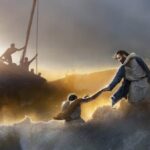
The gospel for Trinity 10 in Year A is Matthew 14.22–33, Jesus walking on the sea to the terrified disciples. The episode has parallels in Mark and John, but only Matthew includes the further account of Peter stepping out of the boat to meet Jesus—and this raises import issues of interpretation.
Should we focus on Peter, and whether he is a good or bad example, why he left the boat, and what his response tells us? Or does his role in the narrative ironically challenge our reading—so that what really matters is what we learn about Jesus, and in our interpretation we should keep our eyes fixed firmly on him?
We mentioned the change in culture and rule from the west of the Jordan river to the east, on the north side of Galilee. Until AD 39, the north west side was ruled by Herod Antipas (who also ruled Perea, where he imprisoned John the Baptist). The north east side was ruled by his half brother Philip, both sons of Herod the Great. The west side was mostly Jewish (despite the title ‘Galilee of the gentiles’) but the eastern side was much more Greek, and Jews were a minority here and in the adjacent territory of the Decapolis (the ‘ten cities’).
The quotation ‘Love God and do as you will’ is indeed from Augustine, Homily 7 of his Tractates on the First Epistle of John (In Epistolam Joannis ad Parthos), specifically in his commentary on 1 John 4:4–12: ‘Dilige, et quod vis fac.’
The Grove booklet we highlighted is Whole Church Curriculum by Karen Saunders and can be found here. The print copy is delivered post-free in the UK, or you can buy it as an ebook.
Written commentary on this passage can be found here.
 Buy me a Coffee




















Thanks, Ian and James. Just a thought about the distance question in John versus Matthew. Perhaps when John says “When they had rowed about three or four miles” he’s not talking so much about the distance that they rowed as he is about the difficulty they had in rowing against the wind (e.g., they rowed forward but were blown backwards time and time again; they were making an arc rather than a straight line). We’ve all had that experience in some way or another when we felt like a short trip turned into an epic journey because of the weather. Just a thought!
How interesting! I just wonder how you might measure that…?
I’m not sure! Perhaps John is saying something more experiential/hyperbolic than factual–“We rowed for MILES (or so it seemed)”. Or he just gets the distance wrong…:)
The question arises – WHY did Jesus walk on the sea?
He had for the night “returned to His Rest” the “still dews of quietness” refreshed Him, enjoyed the “Beauty of His Peace”
God in ancient times walked on the sea “ Thy way is in the sea,
and thy path in the great waters, and thy footsteps are not known
Psalm 77 v 19
We hear Moses saying to us, as he did to the Israelites, when seemingly reduced to the last extremity, Fear ye not, stand still, and see the salvation of Jehovah.” — Horne.
(p) When he delivered Israel from Pharaoh, Ex 14:22.
(q) When the Israelites passed through Jordan, Josh 3:17.
The disciples where the academics of the Sea but they were not Masters of it.
Jesus saw His small ecclesia overwhelmed, Restless on a boiling sea.
Job was cast upon a sea of trouble, even his “friends” would sink him.
But Job believed in resurrection life and power !
Previously he had heard about God, he now saw and understood
the Sovereignty of God.
The Psalmist similarly was overwhelmed
Ps 69:2 I sink in deep mire, where there is no standing: I am come into deep waters, where the floods overflow me.
Ps 69:14 Deliver me out of the mire, and let me not sink: let me be delivered from them that hate me, and out of the deep waters.
Because “… the wicked are like the troubled sea, when it cannot rest, whose waters cast up mire and dirt.
What is our “desired haven”? Rest and Peace?
Alas, so many churches are not places of rest and peace, but
boiling restless seas with little concept of the Sovereignty of God
and His resurrection power.
The Queen of Sheba when she heard of Solomon and his temple and visited it she found a place of great harmony and happy servants said as Job “I Have heard and now I see”
This wonderful account brings the universal to the corporate and individual saints and this is that which Overcomes the world even our faith, God keeps watch on His own that they may enjoy His Rest. Shalom
PS. I do love the comments of Benson on Psalm 107 : 23
“They that go down to the sea in ships, that do business in great waters;
“We cannot help reflecting, that there is a ship in which we are all embarked; there is a troubled sea on which we all sail; there are storms by which we are all frequently overtaken; and there is a haven which we all desire to behold and to enter. For the church is a ship; the world is a sea; temptations, persecutions, and afflictions are the waves of it; the prince of the power of the air is the stormy wind which raises them; and heaven is the only port of rest and security. Often during the voyage, for our punishment or our trial, God permits us to be thus assaulted. The succession and the violence of our troubles, the elevations and depressions of our minds, the uncertainty of our counsels, and our utter inability to help ourselves, are finely represented by the multitude and impetuosity of the waves, the tossings and agitations of the vessel, the confusion, terror, and distress among the sailors. In both cases prayer is the proper effect, and the only remedy left. We should cry unto the Lord Jesus in our trouble; we should, as it were, awake him, like the disciples, with the repetitions of, Lord, save us, we perish! Then will he arise and rebuke the authors of our tribulation, saying unto them, Peace, be still, and they shall hear and obey his voice. He will make the storm a calm, so that the waves thereof shall be still; and, at length, he will bring us in peace, joy, and gladness, to our desired haven, there to exalt him in the congregation of his chosen, and praise him in the great assembly of saints and angels.”
Maybe they just want to make apes of themselves.
Urrgh. Posted in the wrong thread! Ian, can you put it in the evolution one please?