I have posted a version of this every Advent since 2013. There are signs the message is getting through, but the stable will still be preached from pulpits up and down the land, so here it is again. This year I have rewritten my previous pieces, drawing the different elements together. The argument now integrates Stephen Carlson’s important work on Luke’s vocabulary (which was previously an appendix), engages directly with the case for a cave, and answers the best objections raised in the comments over the years.
The scene we all know
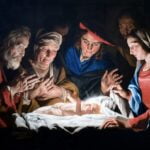
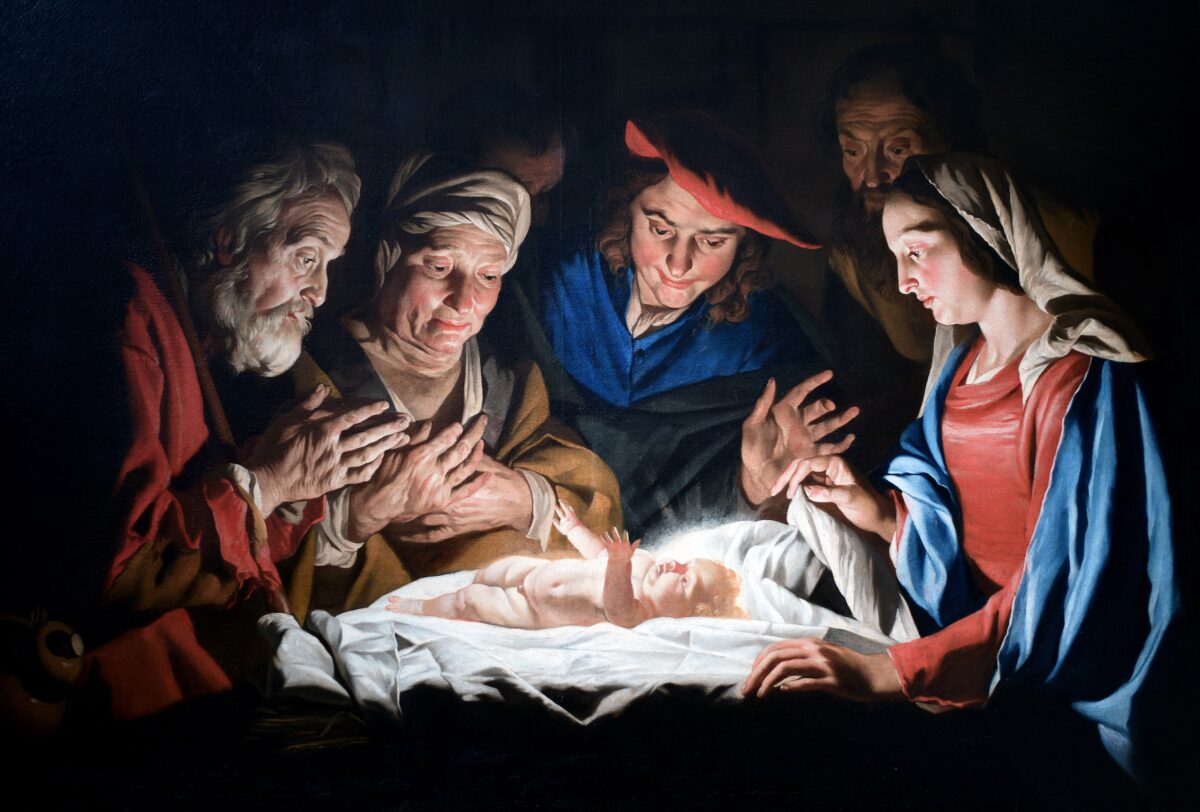
Picture the nativity. Bethlehem sleeps beneath the moonlight, unaware that the Son of God has been born in one of its outbuildings. Down an anonymous backstreet stands a draughty stable, warm with the breath of animals. A donkey, a cow and an ox lie serenely to one side. The baby stirs in a straw-filled manger while Mary, Joseph and a small lamb kneel in silent adoration. All is calm; all is not quite right.
I am sorry to spoil the scene, but Jesus was not born in a stable, and the New Testament hardly hints that he was. More importantly, he was not born alone, ostracised and outcast. That matters, because the stable tradition loses sight of something Luke is keen to show: that Jesus’ birth bursts into the middle of ordinary life, among ordinary people, and offers the possibility of its transformation.
What follows is in three parts. First, I explore what Luke actually says (which, remarkably, many people ignore). Secondly, I look at what we can reconstruct—and I think it is worth distinguishing between what we can say with certainly, and what is reasonable speculation. Thirdly, I address the question of why the stable has proved so durable—and why it is really worth letting it go!
What Luke actually says
Read Luke 2.1–20 slowly, dear reader, and notice what is missing.
Done that?
There is no innkeeper, no stable, no ox or donkey, and no knocking on doors. Joseph goes up to Bethlehem with Mary to be registered. ‘While they were there’ (2.6) the time comes for her to give birth. There is no last-minute dash into town on the night itself. (That scene in The Chosen is lifted from the second century, unhistorical, Protoevangelium of James.)
What Luke does give us is two details. Mary lays the baby in a phatnē, a manger or feeding trough. And she does so ‘because there was no topos for them in the kataluma‘ (2.7). Almost everything hinges on what those two words mean.
The manger is clearly important to Luke; he mentions it three times in ten verses. (Why we still call it a ‘manger’ is an example of the power of tradition; no-one uses that word today for a feeding trough.) It describes where the baby is laid (v 7); it is the sign by which the shepherds will recognise him (v 12); and it confirms that they have found the right child (v 16). Any reading has to account for that emphasis. But nothing in the text locates the manger in a separate building, and nothing suggests the family were alone.
The words: kataluma and topos ‘no place’
Kataluma is not an inn. The older translation ‘inn’ (AV) could be argued to have some etymological justification; the word comes from kataluō, to unloose, as in unsaddling your animals at the end of a journey. But Luke’s own usage points clearly away from this. When Jesus sends the disciples to prepare the Passover, he asks the householder, ‘Where is my kataluma?’ (Luke 22.11; Mark 14.14). That is the upper room—a reception room in a private home. And when Luke does want to talk about an inn, in the parable of the Good Samaritan, he uses a different word, pandocheion (10.34, still used in modern Greek though now for an inn or public house), a place that receives all (pan-) comers, and he has a word for its keeper, pandocheus (10.35). If Luke had meant an inn with an innkeeper in chapter 2, he had the vocabulary to say so.
The difference is made clear in this pair of definitions:
Kataluma (Gr.) – “the spare or upper room in a private house or in a village […] where travelers received hospitality and where no payment was expected” (ISBE 2004). A private lodging which is distinct from that in a public inn, i.e. caravanserai, or khan.
Pandocheion, pandokeion, pandokian (Gr.) – (i) In 5th C. BC Greece an inn used for the shelter of strangers (pandokian=’all receiving’). The pandokeion had a common refectory and dormitory, with no separate rooms allotted to individual travelers (Firebaugh 1928).
Kataluma in other contexts. Stephen Carlson’s 2010 article in New Testament Studies (available on his own website here) surveys the word across Greek literature and the Septuagint. There kataluma translates a wide range of Hebrew terms for places to stay: a lodging place on a journey (Ex 4.24); a dining hall (1 Sam 9.22); and others. His conclusion is that it is a general term for whatever accommodation one is using—it refers to the lodging itself, not to a commercial establishment.
‘No place for them’. Carlson goes on to explore the ambiguous language about the topos ‘place’. The phrase ouk ēn autois topos is usually rendered ‘there was no room for them’, implying they were turned away—and thus leading to 1,001 school nativity plays! Carlson notes that the grammatical construction actually means ‘they had no space’. In other words, they were staying in the kataluma, but it was not a suitable space in which to give birth and lay a newborn. So the birth happened in the main living space of the house.
When we put these two pieces of information together, we get a very different picture from the traditional scene. Luke is not describing rejection at an inn, for none is mentioned. Instead, he is describing a crowded domestic setting in which a baby ends up in a feeding trough. Notice though that the whole account is quite brief and sparse. To make sense of it, we need to understand the social context which Luke appears to assume that his readers are familiar with.
Houses, mangers and caves
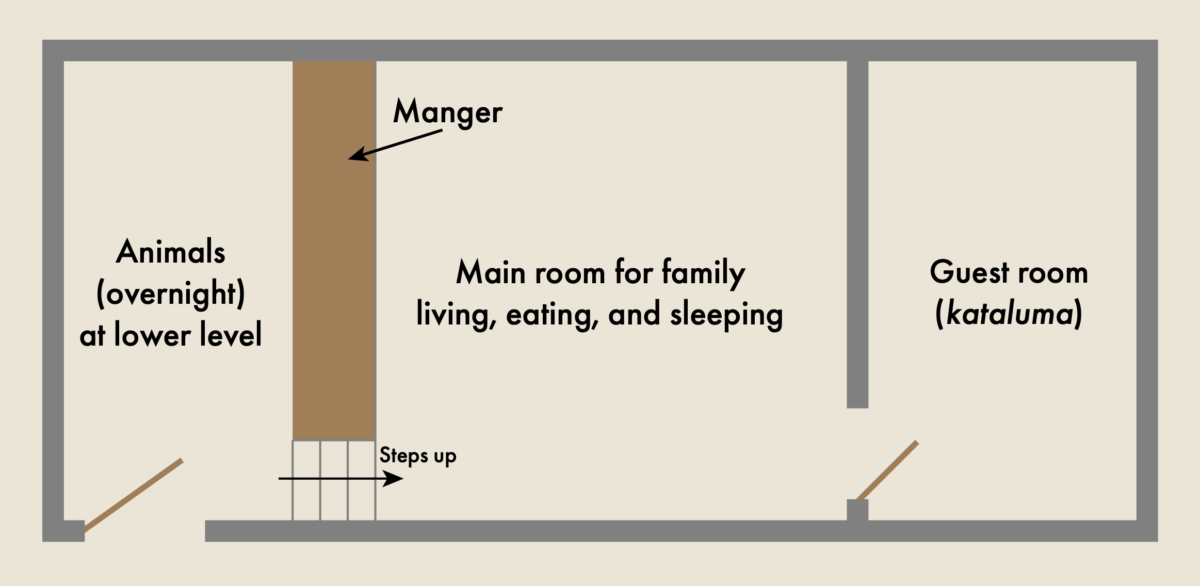
Animals lived in the house. Kenneth Bailey, in his collection of studies Jesus Through Middle Eastern Eyes drawing on decades living and studying in the Middle East, describes the typical village home. It was essentially one room. The family lived on a raised level, and the animals were brought into a lower area at night. Feeding troughs were set in the floor, or cut into the edge of the raised platform, so that the animals could eat from them. Many homes also had a guest room, either at the back or on the roof.
The gospels clearly assume this arrangement, and so do as a passing assumption. A lamp on its stand ‘gives light to everyone in the house’ (Matt 5.15), which only makes sense if everyone lives in one room. And when Jesus asks his critics whether they do not untie their ox or donkey ‘from the manger’ on the sabbath and lead it out (that is, out from the house) to water (Luke 13.15), no one objects that they keep their animals elsewhere.
(Note: A ninth-century Arabic version of the New Testament, probably made in Palestine, translates Luke 13.15 as untying the animal from the manger ‘in the house’. No Greek manuscript has those words, but the translator understood his world. (Bailey, Jesus Through Middle Eastern Eyes, p 31; Vatican Arabic MS 95.)
 The Culture. We need to locate the whole story within the historical and social context of first century Judean customs. In that context (as in many similar cultures today, especially in that region), it would be unthinkable that Joseph, returning to his place of ancestral origins, would not have been received by family members, even if they were not close relatives. Kenneth Bailey comments:
Even if he has never been there before he can appear suddenly at the home of a distant cousin, recite his genealogy, and he is among friends. Joseph had only to say, “I am Joseph, son of Jacob, son of Matthan, son of Eleazar, the son of Eliud,” and the immediate response must have been, “You are welcome. What can we do for you?” If Joseph did have some member of the extended family resident in the village, he was honor-bound to seek them out. Furthermore, if he did not have family or friends in the village, as a member of the famous house of David, for the “sake of David,” he would still be welcomed into almost any village home.
The archaeology. Bailey’s evidence is largely ethnographic; it comes from villages observed in the nineteenth and twentieth centuries. This raises the question of how much continuity there was with the first century—and that has been a common objection to Bailey’s argument. But excavations have answered that question.
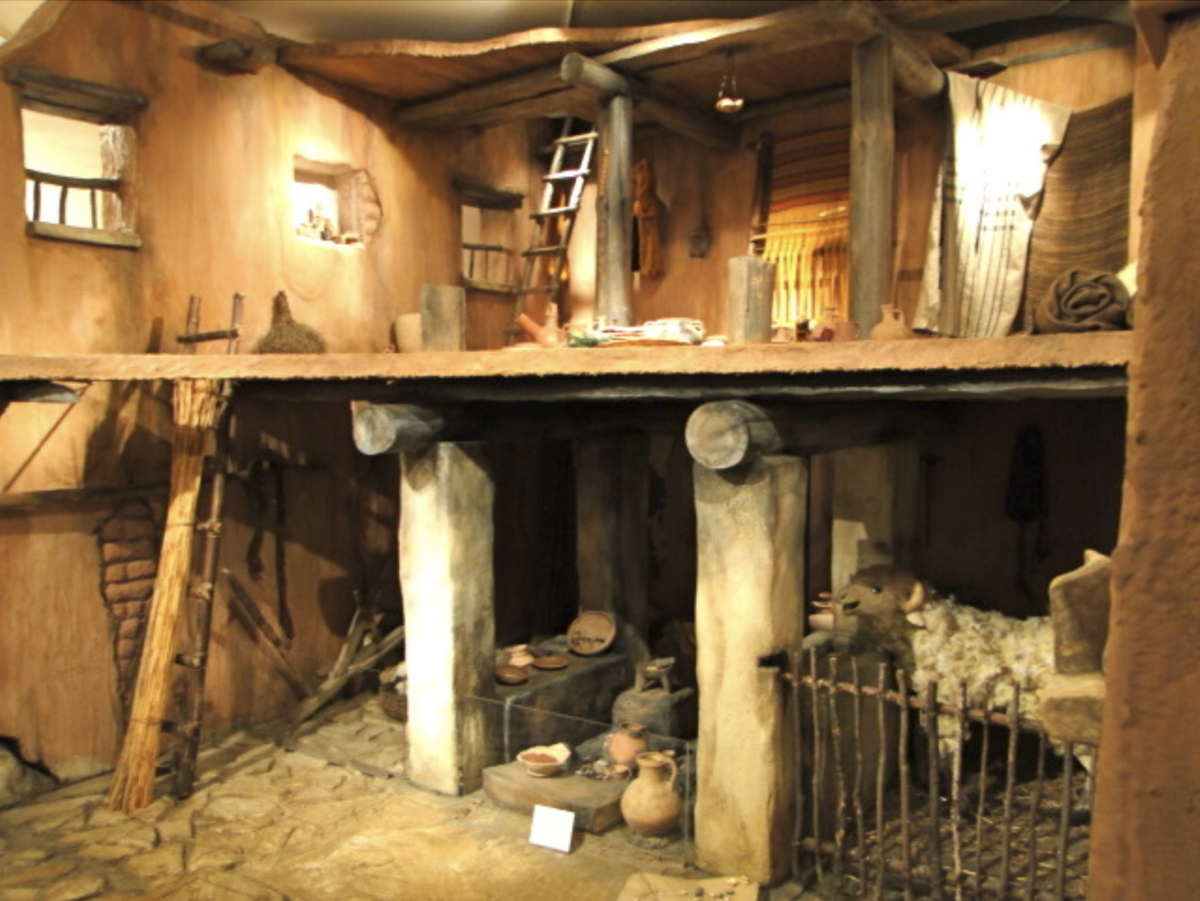
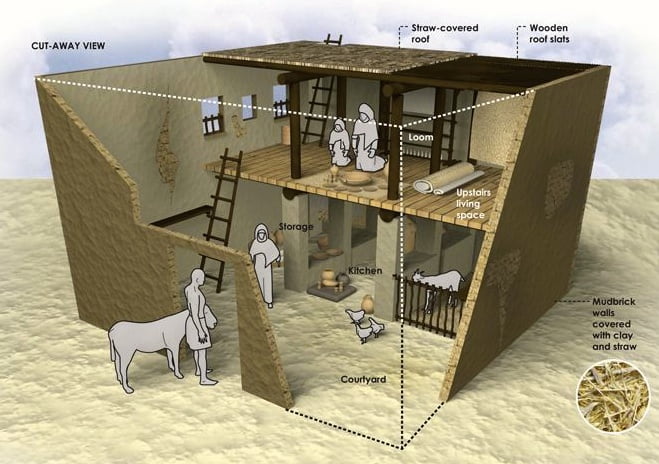
The archaeology of domestic buildings in Roman-period Palestine, gathered by Yizhar Hirschfeld among others, shows the same basic pattern—a courtyard and single-room houses with space for animals inside the household compound. Even in other agrarian cultures, we find something similar in old Swiss farmhouses, with the space for cattle underneath the family’s rooms, and in Welsh ‘long houses’—this is a natural way to live for poorer, agrarian, rural communities.
We saw something similar in a reconstructed cave house in Matera in Italy; the home was a single space, but with different sections for a kitchen, for eating, for sleeping—and for keeping the animals. Building walls in your house is an expensive luxury for most of humanity!
What about the cave? One question I always get asked is about the idea that Jesus was born in a cave. This tradition is early; Justin Martyr says so around AD 150 (Dialogue with Trypho 78). So does the Protoevangelium of James (ch 18). Origen, a century later, reports that the cave was still shown to visitors in Bethlehem (Against Celsus 1.51). The Church of the Nativity stands over just such a grotto, and Joan Taylor’s careful study takes the site’s antiquity seriously.
But there are two issues with this idea. First, the tradition is not wholly independent of Scripture. Justin connects the cave with the Greek version of Isaiah 33.16, which speaks of dwelling in a high cave of strong rock. Theological interest may therefore have shaped the memory—and this is a similar theological move to the one that puts oxen and donkeys in the (non-existent) stable in the first place, derived from Isaiah 1.3.
Second, and more importantly, a cave is not a rival to the house. In the Bethlehem hills, houses were commonly built against or over natural caves, and the cave at the back was exactly where the animals were kept. (We have just visited Cappadocia, where you find exactly the same phenomenon.) A birth ‘in a cave’ and a birth ‘in the lower part of a family home’ may well describe the same place. What the cave tradition does not support is the isolated stable down a back street.
Three reconstructions, one conclusion
Bailey, Carlson, and the cave tradition offer us three variations on interpreting what Luke actually says. They differ in the details, but they agree on the point that matters.
| Bailey | Carlson | Cave-house | |
| Whose home? | Relatives of Joseph’s in his ancestral town | Joseph’s own family home | A Bethlehem home built against a cave |
| What was the kataluma? | The family guest room | The couple’s own lodging, perhaps a room on the roof | The living quarters |
| Why ‘no place’? | Guest room already full of other relatives | The room too small for a birth | Living space unsuitable for a birth |
| Where was Jesus laid? | Manger in the main family room | Manger in the main family room | Manger in the animals’ cave at the back |
| Main support | Ethnography; hospitality customs | Philology of kataluma and topos | Early tradition (Justin, Origen); local building patterns |
Carlson’s view of Bethlehem also deals neatly with questions raised about the census. There is no clear evidence of a Roman census requiring people to return to ancestral towns. But a prefect’s edict from Egypt (AD 104) does require those living away to return to their own homes for registration. If Bethlehem was Joseph’s home, and Nazareth Mary’s, then Luke 2.39 describes the couple settling near her family after the birth, following the registration at his home.
So here is what I think we can say, with differing degrees of confidence. It is certain that kataluma does not mean a commercial inn, and Luke mentions no innkeeper. It is highly likely that the manger was inside a domestic setting, where animals were kept at night, not in a separate outbuilding. This was widespread practice, and both culture and archaeology support this. This implies that Mary gave birth surrounded by family, not alone. We cannot be absolutely sure whether the guest room was full or too small, whether Bethlehem was Joseph’s home or his ancestral town, or whether the animal space was a lower floor or a cave. But none of these options brings back the stable!
Objections answered
‘The manger is a sign, so it must be unusual.’ This is an important objection, and so it worth responding to. A sign in Luke 2.12 is a means of identification. The shepherds need to find one newborn among the households of Bethlehem, and a baby lying in a feeding trough is distinctive enough to pick out. It is a little unusual, then, but it is not shameful. And there is irony in it: the angels announce a Saviour, Messiah and Lord, and the sign is that he is lying where any village family’s animals eat. The surprise lies in the ordinariness, not in exclusion.
‘Perhaps no room means they were shunned because of the pregnancy.’ This is a real possibility in an honour culture, and the Nazareth villagers’ later reference to Jesus as ‘Mary’s son’ (Mark 6.3) might hint at gossip. But Luke simply gives not the slightest indication of such rejection. The kataluma lacks space—and is certainly part of the home; no one refuses anything. Nazareth is several days’ walk from Bethlehem, and the couple travel as a betrothed pair (2.5), which was a normal stage of marriage. If Carlson is right, they stayed in the kataluma, so they were not turned away at all.
‘Luke’s theme is lowliness.’ Yes, it is—think of the Magnificat. But the lowliness Luke emphasises is the lowliness of becoming human in an ordinary family under an imperial decree, set against Caesar Augustus at the start of the chapter. Fifty years ago in Britain, a newborn might sleep in a drawer pulled out of a chest of drawers. That would not have been seen as especially poor, just normal. The manger is like that. It is the same humility Paul describes, when Christ, though rich, became poor (2 Cor 8.9). It is the poverty of sharing our humanity, not (in and of itself) the poverty of an outcast.
‘The earliest tradition says a cave.’ See above. It does, and the cave-house fits well with everything argued here. The tradition supports a domestic birth among animals; it offers no support for a lonely stable.
‘The shepherds point to the Lamb of God.’ Some find sacrificial symbolism here, linking the shepherds with flocks reared near Bethlehem for the Temple (Micah 4.8 speaks of the ‘tower of the flock’). That may be part of Luke’s surplus of meaning. But mangers belong to oxen and donkeys, not sheep (Isa 1.3; Luke 13.15). So the symbolism, if it is there, does not depend on the setting. And, again, Luke does not offer us the slightest hint in what he writes that this is of any significance to him.
‘It is still a stable, even if within the house.’ Some friends have said to me that it is perfectly acceptable to talk about the ‘stable’, since that is where the animals are kept, even if it is part of the main house. But that is simply not what the word means—and not what our hearers imagine! We do not keep animals in our houses (with the exception of pets) and so ‘stable’ immediately means to us a separate building away from the domestic dwelling and separate from it. And that means the mistaken trope of ‘no room at the inn’ and ‘Jesus the poor outsider’ cannot be resisted.
Why the stable persists
None of this is new. In 1857 William Thomson, a Presbyterian missionary in Lebanon and Palestine, suggested that the birth took place in an ordinary peasant house, with the baby laid in one of its mangers. Alfred Plummer’s ICC commentary agreed. So why has the stable lasted so long? I think four things have combined.
- Iconography. Reading Isaiah 1.3 (‘the ox knows its owner, and the donkey its master’s manger’) as a prophecy of the nativity brought the ox and ass into Christian art. And if there are animals, surely there must be a stable.
- Translation. The Vulgate, Jerome’s Latin Bible which became universally read in the West, rendered kataluma in Luke 2.7 as diversorium, (“non erat eis locus in diversorio”) a word that could mean a lodging or an inn. Once ‘inn’ entered English versions, an innkeeper and a stable followed naturally as a narrative back formation.
- Our own assumptions. In the modern West, especially in cities, animals live away from people. So we read that assumption back into the text, even though rural households across Europe kept animals under the same roof well into living memory.
- Hymnody and habit. Once ‘a lowly cattle shed’ is sung every year, the image becomes part of how we read Luke, not just a decoration added to it. Traditions of this kind are remarkably resistant to change.
Dick France describes what happened when he first advocated Bailey’s reading. A Sunday newspaper picked it up, and radio programmes treated it as theological vandalism.
[T]o advocate this understanding is to pull the rug from under not only many familiar carols (‘a lowly cattle shed’; ‘a draughty stable with an open door’) but also a favourite theme of Christmas preachers: the ostracism of the Son of God from human society, Jesus the refugee. This is subversive stuff. When I first started advocating Bailey’s interpretation, it was picked up by a Sunday newspaper and then reported in various radio programmes as a typical example of theological wrecking, on a par with that then notorious debunking of the actuality of the resurrection by the Bishop of Durham!
That reaction tells us how much the stable is carrying for us.
Why it matters for preaching
France’s point is that the stable distances Jesus from the rest of us. It puts even his birth in a setting as remote from ordinary life as if he had been born in a palace.
The problem with the stable is that it distances Jesus from the rest of us. It puts even his birth in a unique setting, in some ways as remote from life as if he had been born in Caesar’s Palace. But the message of the incarnation is that Jesus is one of us. He came to be what we are, and it fits well with that theology that his birth in fact took place in a normal, crowded, warm, welcoming Palestinian home, just like many another Jewish boy of his time.
The incarnation means Jesus is one of us, born into a crowded, noisy, ordinary home like countless other Jewish boys of his day.
That changes the shape of a Christmas sermon. In the stable version, Jesus is sad and lonely, some distance away, and he needs our sympathy. In Luke’s version, he is in the thick of family life, and he demands our attention. God does not wait at the edge of the scene. He arrives in the middle of it.
This also needs some pastoral care. Many preachers use the stable to say that God stands with the excluded: the homeless, the refugee, the family no one wants to know. For some congregations, that has real force, and the gospel does say it. But Luke makes that point elsewhere, through the shepherds, the flight to Egypt in Matthew, and the whole shape of Jesus’ ministry. We do not need to invent a rejection at Bethlehem to make it. And the stable can quietly turn the incarnation into a story about someone else’s misfortune, rather than God sharing our ordinary life.
If you want an example of telling the Christmas story for all ages without the stable, see Stephen Kuhrt’s retelling. You can also read my carol service sermon on this theme.
Further reading
- Kenneth E. Bailey, Jesus Through Middle Eastern Eyes (IVP, 2008), ch 1.
- Stephen C. Carlson, ‘The Accommodations of Joseph and Mary in Bethlehem: Κατάλυμα in Luke 2.7’, New Testament Studies 56 (2010). Free version on Carlson’s blog here.
- R. T. France, chapter on preaching the infancy narratives, in We Proclaim the Word of Life.
- Yizhar Hirschfeld, The Palestinian Dwelling in the Roman-Byzantine Period (1995).
- Joan E. Taylor, Christians and the Holy Places (OUP, 1993).
- William M. Thomson, The Land and the Book (1859), for his 1857 observations.