What is the issue?
If you read through Romans in one sitting, you will find something strange happens. After complex theological arguments about sin, justification, faith, human nature, the Spirit, the status of Israel, you read uplifting exhortations and practical instructions—and then hit chapter 16, which feels more like a complex holiday postcard to Paul’s friends! What on earth is it doing there?
There is a serious rhetorical answer, in that Paul is confirming his strong personal contacts with key figures in Rome, a Jesus community he has never visited. And it demonstrates the remarkable social, cultural, and ethnic diversity of the Christian communities. But it indicates something else beyond that. Paul has never been to Rome, and yet he sends greetings to around 26 people by name. Some of them he describes in terms that only make sense if he has worked alongside them, or shared a prison cell, or been mothered by them (Rom 16.3–4, Rom 16.7, Rom 16.13). They must have met somewhere else, and then moved. And Romans is not unusual. Paul’s letters and Acts are full of people who turn up in one city having come from another, carrying letters, money, news, and greetings.
This matters for more than mere curiosity. For most of the twentieth century, critical study of the gospels has been predicated on the assumption that each gospel was written for, and shaped by, a particular community. So we have the Matthean community, the Markan community, the Johannine community, each with its own concerns, crises and opponents, and each gospel can be mirror-read as a kind of allegory of that community’s life. The assumption is so familiar that it is often not noticed as an assumption at all.
 In 1998 Richard Bauckham and his colleagues challenged it head on in The Gospels for All Christians. They argued that the Gospels were written to circulate widely, and that the early churches were not isolated enclaves but a network in constant communication. If that is right, then a gospel writer would expect his work to travel, and the idea of a gospel addressed to one local group looks much less likely.
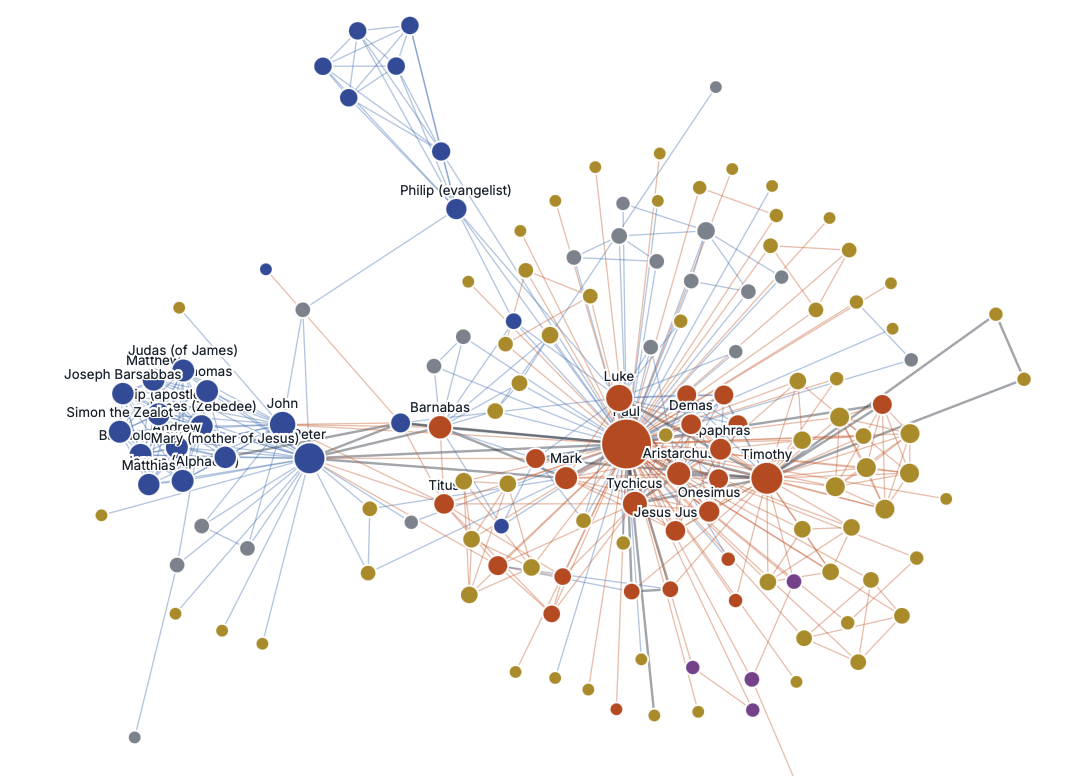
The question I want to explore here is a simple one. If we list everyone named in Acts and Paul’s letters, and note who knew whom and who was where, what does the network actually look like? Does it support Bauckham’s picture of a well-connected movement? Or does it show something more complex?
Who has looked at this before
None of this is entirely new, and there are three strands of earlier work worth knowing about.
The first is old-fashioned prosopography, the careful study of named individuals. E Earle Ellis’s article ‘Paul and his Co-Workers’ (NTS 17, 1971) and Wolf-Henning Ollrog’s Paulus und seine Mitarbeiter (1979) set out who worked with Paul and in what roles. Wayne Meeks’s The First Urban Christians (1983) included a prosopography of the Pauline churches, and Peter Lampe’s work on the Roman Christians made a great deal of Romans 16. Earlier this year, Trevor Burke’s Paul and His Colleagues (LNTS) looked at how Paul’s language itself constructs his network of relationships.
The second strand is computational. Chris Harrison built a biblical social network by linking any two names that occur in the same verse of the King James Bible, and the ESV team published a similar map of the whole New Testament in 2011. Viz.Bible’s Theographic database offers a knowledge graph of biblical people and places. These are striking to look at, but co-occurrence in a verse is a crude measure of acquaintance, and including the Gospels makes Peter, rather than Paul, look like the centre of everything.
The third strand is formal social network analysis. Jens Dörpinghaus’s UNISA thesis (2020, supervised by Christoph Stenschke) reconstructed the network of Acts 1–12, and his later Pretoria work extended this to Luke–Acts as a whole. John Kloppenborg, in NTS 66 (2020), used network theory to argue that the Christ movement spread as a ‘complex contagion’, needing persuasion through close ties rather than simple contact.
The chapter that bears most directly on the Gospels question is my good friend Michael Thompson’s ‘The Holy Internet’ in The Gospels for All Christians. Thompson gathered the evidence for travel and communication between churches in the first generation, and it is his case that the work below tests. The main replies to Bauckham are David Sim’s response in JSNT (2001), Margaret Mitchell’s argument from patristic evidence in NTS (2005), and the essays collected by Edward Klink in The Audience of the Gospels (2010). Sim’s point is the one that matters most here. Being connected to other churches does not mean a writer had no particular audience in mind.
As far as I can find, no one has built a network across Acts and all the letters in which each link is tagged by its source, and then tested which links survive when Paul is taken out.
What I have done
I have built two things, working with Claude, and both can be explored below. (I can take credit for asking the question, but I cannot take much credit for the graphics. Claude simply generated these out of my questions ‘How could we map the networks of relationships?’ and ‘How could we show the geographical significance of this network?’)
The first is a network of acquaintance. It includes 149 named people in Acts and the letters and 454 links between them. A link means that the text shows or plainly implies that two people met, worked together, travelled together, were family, or were in the same small company at the same moment. Each link carries its references, and each is coloured by where the evidence comes from. Of the 454 links, 227 rest on Acts alone, 194 on the letters alone, and only 33 on both.
Although the graphic is embedded here, it is much easier to view if you open it in its own window as per the link below. And other than clicking on individuals and seeing their relationships, you can also drag each person around and the network reorganises around that. I am not sure it tells you anything, but it is fun!
View the network diagram full screen
The result is, unsurprisingly, dominated by Paul. He sits on about four in five of the shortest paths between any two people. Take him out and 55 people fall away, either into small islands (Stephanas, Fortunatus and Achaicus; Euodia, Syntyche and Clement; the Caesarea officials) or standing alone. What holds the rest together is Timothy, Peter, Luke, Mark and Barnabas.
At first sight, this looks like it could be bad news for the claim of complete intercommunication as put forward by Bauckham et al. Sim could reasonably say that this is not a network of churches at all, but one apostle’s address book, and that local groups were linked only through a few hubs. But acquaintance is not quite the right measure. Thompson’s case is about movement, so the second thing I built measures that.
For each named believer I listed every place where the text puts them, 260 entries for 126 people. Each entry is graded by the strength of the evidence; A where the text narrates the person being there; B where a letter places them there; C for a stated origin or home (‘a native of Pontus’); D for an inference (such as ‘Babylon’ in 1 Pet 5.13 meaning Rome). Each entry is also marked if the person was there only because of Paul, travelling with him, sent by him, or coming to him. The places are grouped into 16 regions, from Judea and Syria to Achaia, Asia and Italy. Anyone attested in two regions joins them.
View the mobility map full screen
Then I ran the same count with different evidence removed.
| Test | People joining regions | Regions | All joined? |
| Everything | 38 | 16 | Yes |
| Without Paul himself | 37 | 15 | Yes |
| Without Paul or anyone moving because of him | 20 | 15 | 13 joined; Malta and Dalmatia apart |
| The same, grades A and B only | 11 | 12 | 9 joined |
| The same, Acts only | 19 | 13 | 12 joined; Malta apart |
| The same, letters only | 4 | 9 | 4 joined |
| The same, Acts and the undisputed letters only | 20 | 13 | 12 joined; Malta apart |
The full table, with every reference and grading, is in the spreadsheet. Some of the codings are judgments that others might make differently, so feel free to challenge any of those in the comments.
What this might mean
The first and most important result is that, from the evidence of both Acts and Paul’s letters, Mike Thompson is not only right but his claim is meaningful for the NT documents. Not only was communication easy and accessible between the different centres of Christian community, but individuals clearly made use of these routes to actually connect the communities themselves.
Remove Paul, and remove every journey that Paul occasioned, and named believers still join 13 regions. No single person holds that network together. So David Sim’s ‘address book’ objection does not hold, because a great deal of the movement has nothing to do with Paul.
The Aegean in particular is criss-crossed by people travelling on their own account. Prisca and Aquila move from Pontus to Rome to Corinth before they ever meet Paul (Acts 18.2), having left Rome under Claudius’ expulsion of the Jews, which Suetonius also mentions (Claudius 25.4). Apollos goes from Alexandria to Ephesus and on to Corinth with a letter of commendation from the Ephesian believers (Acts 18.24–28). Lydia has moved from Thyatira to Philippi (Acts 16.14). Epaenetus, ‘the first convert in Asia’, is now in Rome (Rom 16.5). And the people Paul greets in Rome, whom he clearly knows already, imply a whole pattern of movement that we cannot trace in detail.
The second result is perhaps less comfortable, and more interesting. The link between the churches of the eastern Mediterranean (Judea, Samaria, Syria, Cyprus) and those of the Aegean and Italy is thin. If we use only Acts and the undisputed letters, that link rests on two people. One is Peter, whose presence in Corinth we infer from the Cephas party (1 Cor 1.12; 1 Cor 9.5). The other is Silas, who stays on in Beroea after Paul leaves (Acts 17.14), though he got there with Paul in the first place. Take out those two and the map splits in half. Add 1 Peter, with Mark and Silvanus alongside Peter in ‘Babylon’ (1 Pet 5.12–13), and the link holds, but on evidence that is itself disputed.
Yet this is exactly the link that matters for the Gospels. Material from Jerusalem and Antioch had to reach Rome, Corinth and Ephesus somehow. The people who could have carried it between the two halves are the very people whom tradition connects with the Gospels. Papias says that Mark wrote down what Peter taught (Eusebius, Ecclesiastical History 3.39.15), and Clement of Alexandria places that in Rome (Eusebius, Ecclesiastical History 6.14.6). The network does not prove the tradition. But it shows that if the tradition is right, Peter and Mark were in just the right place in the network to carry the story from east to west.
(Given the later split of the church into the east and the west, is there also a lesson here? Christian unity needs proactive attention to building relationships across cultural, geographical, and linguistic divides.)
I am conscious that the case depends heavily on Acts. Using the letters alone, and leaving Paul out, only four regions join up. If we dismiss Acts as a source, then the network looks sparser. But the problem with this criticism is that the information that Acts contains about movements and connections is completely ‘undesigned’. There is no sense in which Luke wrote Acts in order to convince readers 20 centuries later that these communities were connected. He records such names and movements as incidental to his narrative, and they fit with the same kind of undesigned mention of people and places that we find in Paul’s letters.
All this data, both from the material culture of the first century, and the undesigned and incidental evidence of the texts, supports the idea that the early Jesus communities were interconnected, communicated frequently with one another, and experienced interchange of its leadership. For anyone who wants to claim that there were distinct communities, that they were rivals to one another, and that there were large gaps in space and time between the documents that found their way into our New Testament—the burden of proof lies with them to demonstrate this. All the arguments I know are inferences from differences that they find in these texts. These are inferences which I think are unwarranted—and appear to have no historical or material cultural support.
 In particular, this provides a convincing reconstruction of a social and communicative environment where fresh ideas, like Michael Gorman’s observations about the relationship between Paul’s letters and John’s gospel (Paul and John in Harmony, on which see later on this blog) are entirely plausible.
Questions for further work
There are potential further developments of this kind of analysis, and, in principle at least, the use of AI in analysing texts, in collaboration with reasonable scholarly assumptions, makes further analysis much easier.
- What happens in the next generation? The same exercise could be done for 1 Clement, Ignatius, Polycarp and the Didache. 1 Clement names the three men who carried it from Rome to Corinth (1 Clem 65.1), Ignatius names the messengers who travel with him (Philadelphians 11), and the Didache has to regulate travelling apostles and prophets (Didache 11–12). Do the same routes persist, and does the east–west link grow stronger?
- Can we add time? The map compresses 30 years into one picture. A version sliced by period (before the council, the Aegean mission, the 60s) would show whether connections were growing or whether the network fragmented after 64, which on the conventional dating is when most of the Gospels were written. (On an earlier dating, of the kind John Robinson argued for, and others are now retrieving, the network of the 50s is the one that matters, and that is the network we can see.)
- What kind of travel is it? Mission, delegation, letter-carrying, exile, trade and hospitality are different things. Classifying each move would show how much of the network was deliberate church communication and how much was the ordinary mobility of the Roman world.
- Is this unusual? How does Christian mobility compare with what we know of Jewish diaspora communities, or of voluntary associations and trade guilds from inscriptions? Kloppenborg’s work is important here.
- Where are the Johannine Christians? The Elder of 2 and 3 John and his circle form an island that connects to no one else in the network, even though 3 John 5–8 is precisely about receiving travelling believers. Revelation 2–3 adds named communities but almost no named people (the ones that are named are likely narrative constructs).
- What about the women? Prisca, Phoebe, Lydia and Junia are among the most mobile people in the whole network. Given the significance of women in Paul’s list in Romans 16, this would be another interesting piece of analysis.
- How much do the judgment calls matter? Several identifications are uncertain (Sopater and Sosipater; the three Erastuses; the various Gaiuses), and so is where Paul wrote Philippians, Colossians and Philemon from. A further set of connections might be established if Richard Fellows’ proposition about Paul renaming his companions is true. Testing the results against each alternative would show which conclusions are robust and which hang on a single decision.
The spreadsheet is open to anyone who wants to check the codings; please make any observations in the comments.





I’m interested in how the gifts of the Spirit reflect social position. A preacher for instance could be a slave without mobility. An elder could be a preacher too but with the ability to travel, and an evangelist would definitely have to be a free man, able to move about with ease. Does this have any bearing on this?
I am not sure that being an evangelist requires mobility. Being an apostle might.
I think to answer those questions you would need to go back to my analysis of social diversity in the linked article.