Every year, in the northern hemisphere, and especially in Northern Europe, we are apparently caught by surprise as the evenings draw in, and the morning light comes later. It always seems surprising, even though it is the same every year.
And every year, I brace myself for the repetition of the ill-founded claim that Jesus was born in a stable, alone and isolated, with his family ostracised by the community—despite the complete lack of evidence for this reconstruction. It will be repeated in pulpits, real and virtual, up and down the land, so I do not apologise for reposting once more this annual feature.
There have been signs that the message is getting through, after my posting on this since 2013, and people are reframing these tired tropes to focus on what the New Testament actually says; if you have any evidence one way or another, then let me know in the comments. I think it is still worth repeating—and it makes a difference. If you want an example of how to preach about Christmas without mentioning the stable, have a look here.
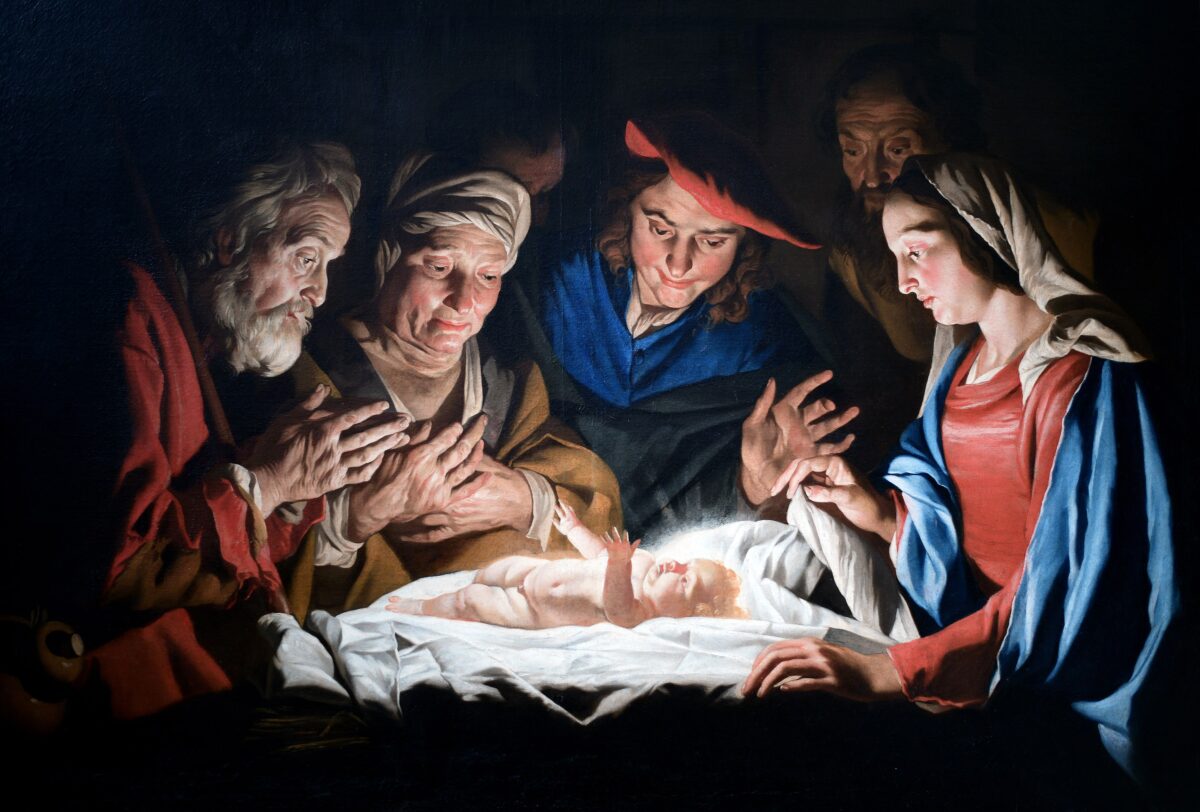
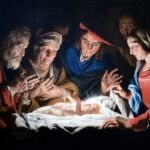
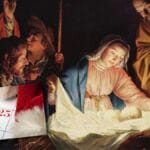
Picture Jesus’ nativity. Bethlehem town sits still beneath the moonlight, totally unaware that the son of God has been born in one of its poor and lowly outbuildings. In an anonymous backstreet, tucked away out of sight, we find a draughty stable. Inside, warm with the heat of the animals, a family sits quietly. Lit by a warm glow, a donkey, cow and an ox lie serene at the side of the scene. The cow breathes out a gentle moo and the baby in the straw filled manger stirs. Kneeling close by Mary, Joseph and a small lamb sit in silent adoration of the child. All is calm, all is not quite right.
I am sorry to spoil the scene, but Jesus wasn’t born in a stable, and, curiously, the New Testament hardly even hints that this might have been the case. This might shatter the Christmas card scenes and cut out a few characters from the children’s nativity line-up, but it’s worth paying attention to.
This long-held idea demonstrates just how much we read Scripture through the lens of our own assumptions, culture, and traditions, and how hard it can be to read well-known texts carefully, attending to what they actually say. It also highlights the power of traditions, and how resistant they are to change. And, specifically, the belief that Jesus was lonely and dejected, cast out amongst the animals and side-lined at his birth, loses sight of the way in which Jesus and his birth are a powerfully disruptive force, bursting in on the middle of ordinary life and offering the possibility of its transformation.
So where has the idea come from? I would track the source to three things: traditional elaboration; issues of grammar and meaning;and unfamiliarity with first-century Palestinian culture.
The traditional elaboration has come about from reading the story through a ‘messianic’ understanding of Is 1.3:
The ox knows its master, the donkey its owner’s manger, but Israel does not know, my people do not understand.
The mention of a ‘manger’ in Luke’s nativity story, suggesting animals, led mediaeval illustrators to depict the ox and the ass recognising the baby Jesus, so the natural setting was a stable—after all, isn’t that where animals are kept? (Answer: not necessarily!)
The issue of grammar and meaning, and perhaps the heart of the matter, is the translation of the Greek word kataluma in Luke 2.7. Older versions translate this as ‘inn’:
And she brought forth her firstborn son, and wrapped him in swaddling clothes, and laid him in a manger; because there was no room for them in the inn. (AV).
There is some reason for doing this; the word is used in the Greek Old Testament (the Septuagint, LXX) to translate a term for a public place of hospitality (eg in Ex 4.24 and 1 Samuel 9.22). And the etymology of the word is quite general. It comes from kataluo meaning to unloose or untie, that is, to unsaddle one’s horses and untie one’s pack. But some fairly decisive evidence in the opposite direction comes from its use elsewhere. It is the term for the private ‘upper’ room where Jesus and the disciples eat the ‘last supper’ (Mark 14.14 and Luke 22.11; Matthew does not mention the room). This is clearly a reception room in a private home. And when Luke does mention an ‘inn’, in the parable of the man who fell among thieves (Luke 10.34), he uses the more general term pandocheion, meaning a place in which all (travellers) are received, a caravanserai.
The difference is made clear in this pair of definitions:
Kataluma (Gr.) – “the spare or upper room in a private house or in a village […] where travelers received hospitality and where no payment was expected” (ISBE 2004). A private lodging which is distinct from that in a public inn, i.e. caravanserai, or khan.
Pandocheion, pandokeion, pandokian (Gr.) – (i) In 5th C. BC Greece an inn used for the shelter of strangers (pandokian=’all receiving’). The pandokeion had a common refectory and dormitory, with no separate rooms allotted to individual travelers (Firebaugh 1928).
 The third issue relates to our understanding, or rather ignorance, of (you guessed it) the historical and social context of the story. In the first place, it would be unthinkable that Joseph, returning to his place of ancestral origins, would not have been received by family members, even if they were not close relatives. Kenneth Bailey, who is renowned for his studies of first-century Palestinian culture, comments:
Even if he has never been there before he can appear suddenly at the home of a distant cousin, recite his genealogy, and he is among friends. Joseph had only to say, “I am Joseph, son of Jacob, son of Matthan, son of Eleazar, the son of Eliud,” and the immediate response must have been, “You are welcome. What can we do for you?” If Joseph did have some member of the extended family resident in the village, he was honor-bound to seek them out. Furthermore, if he did not have family or friends in the village, as a member of the famous house of David, for the “sake of David,” he would still be welcomed into almost any village home.
 Moreover, the actual design of Palestinian homes (even to the present day) makes sense of the whole story. As Bailey explores in his Jesus Through Middle-Eastern Eyes, most families would live in a single-room house, with a lower compartment for animals to be brought in at night, and either a room at the back for visitors, or space on the roof. The family living area would usually have hollows in the ground, filled with hay, in the living area, where the animals would feed.
This kind of one-room living with animals in the house at night is evident in a couple of places in the gospels. In Matt 5.15, Jesus comments:
Neither do people light a lamp and put it under a bowl. Instead they put it on its stand, and it gives light to everyone in the house.
This makes no sense unless everyone lives in the one room! And in Luke’s account of Jesus healing a woman on the sabbath (Luke 13.10–17), Jesus comments:
Doesn’t each of you on the Sabbath untie your ox or donkey from the manger [same word as Luke 2.7] and lead it out to give it water?
Interestingly, none of Jesus’ critics respond, ‘No I don’t touch animals on the Sabbath’ because they all would have had to lead their animals from the house. In fact, one late manuscript variant reads ‘lead it out from the house and give it water.’
Additional note: in response to questions from Andrew Grundy and John Grayston, I tracked down which this ‘late manuscript’ is, from Bailey, Jesus through Middle Eastern Eyes p 31:
One of the earliest and most carefully translated Arabic versions of the New Testament was made, probably in Palestine, in the ninth century. Only eight copies have survived. This great version translated from the Greek) records this verse as: “does not every one of you untie is ox or his donkey from the manger in the house and take it outside and water it?’ No Greek manuscript has the words “in the house” in this text. But this ninth-century Arabic-speaking Christian translator understood the text correctly. Doesn’t everybody have a manger in the house? In his world, simple Middle Eastern villagers always did!
The manuscript is Vatican Arabic MSS 95 Folio 71. Most of the Vatican manuscripts have been digitised; the Arabic ones are here, but for some reason this one is missing!
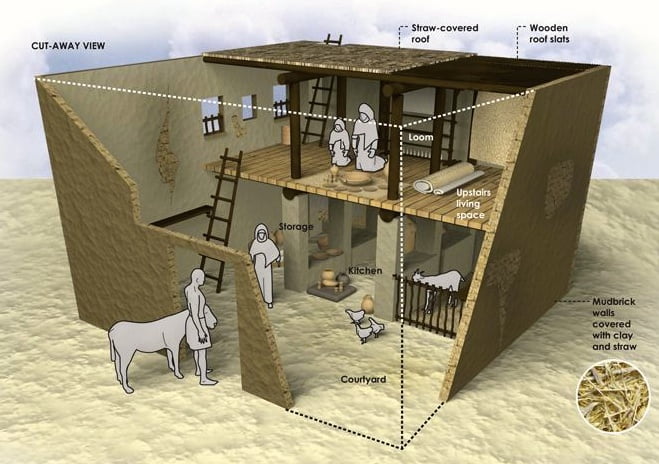 What, then, does it mean for the kataluma to have ‘no space’? It means that many, like Joseph and Mary, have travelled to Bethlehem, and the family guest room is already full, probably with other relatives who arrived earlier. So Joseph and Mary must stay with the family itself, in the main room of the house, and there Mary gives birth. The most natural place to lay the baby is in the hay-filled depressions at the lower end of the house where the animals are fed. The idea that they were in a stable, away from others, alone and outcast, is grammatically and culturally implausible. In fact, it is hard to be alone at all in such contexts. Bailey amusingly cites an early researcher:
Anyone who has lodged with Palestinian peasants knows that notwithstanding their hospitality the lack of privacy is unspeakably painful. One cannot have a room to oneself, and one is never alone by day or by night. I myself often fled into the open country simply in order to be able to think.
In the Christmas story, Jesus is not sad and lonely, some distance away in the stable, needing our sympathy.
Rather, he is in the midst of the family, and all the visiting relations, right in the thick of it and demanding our attention.
This should fundamentally change our approach to enacting and preaching on the nativity.
But one last question remains. This, informed and persuasive, understanding of the story has been around, even in Western scholarship, for a long, long time. Bailey cites William Thomson, a Presbyterian missionary to Lebanon, Syria and Palestine, who wrote in 1857:
It is my impression that the birth actually took place in an ordinary house of some common peasant, and that the baby was laid in one of the mangers, such as are still found in the dwellings of farmers in this region.
And Bailey notes that Alfred Plummer, in his influential ICC commentary, originally published in the late nineteenth century, agreed with this. So why has the wrong, traditional interpretation persisted for so long?
 I think there are two main causes. In the first place, we find it very difficult to read the story in its own cultural terms, and constantly impose our own assumptions about life. Where do you keep animals? Well, if you live in the West, especially in an urban context, away from the family of course! So that is where Jesus must have been—despite the experience of many who live in rural settings. I remembering noticing the place for cattle underneath the family home in houses in Switzerland.
Secondly, it is easy to underestimate how powerful a hold tradition has on our reading of Scripture. Dick France explores this issue alongside other aspects of preaching on the infancy narratives in in his excellent chapter in We Proclaim the Word of Life. He relates his own experience of the effect of this:
[T]o advocate this understanding is to pull the rug from under not only many familiar carols (‘a lowly cattle shed’; ‘a draughty stable with an open door’) but also a favourite theme of Christmas preachers: the ostracism of the Son of God from human society, Jesus the refugee. This is subversive stuff. When I first started advocating Bailey’s interpretation, it was picked up by a Sunday newspaper and then reported in various radio programmes as a typical example of theological wrecking, on a par with that then notorious debunking of the actuality of the resurrection by the Bishop of Durham!
So is it worth challenging people’s assumptions? Yes, it is, if you think that what people need to hear is the actual story of Scripture, rather than the tradition of a children’s play. France continues:
The problem with the stable is that it distances Jesus from the rest of us. It puts even his birth in a unique setting, in some ways as remote from life as if he had been born in Caesar’s Palace. But the message of the incarnation is that Jesus is one of us. He came to be what we are, and it fits well with that theology that his birth in fact took place in a normal, crowded, warm, welcoming Palestinian home, just like many another Jewish boy of his time.
And who knows? People might even start asking questions about how we read the Bible and understand it for ourselves!
If you would like to see how it might be possible to re-write the Christmas story for all ages in a way which is faithful to this, see this excellent example from Stephen Kuhrt.
I preached on this theme at a Carol Service, and you can read my sermon here.
Additional note
I am grateful to Mark Goodacre for drawing my attention to an excellent paper on this by Stephen Carlson, then one of his colleagues at Duke. The paper was published in NTS in 2010, but is available on Carlson’s blog for free. Carlson presses the argument even further by arguing three points:
1. He looks widely at the use of kataluma and in particular notes that in the Septuagint (LXX, the Greek translation of the OT from Hebrew in the second century BC) it translates a wide variety of Hebrew terms for ‘places to stay.’ He thus goes further than Bailey, agreeing that it does not mean inn, but instead that it refers to any place that was used as lodgings.
2. He looks in detail at the phrase often translated ‘there was no room for them in the kataluma‘ and argues that the Greek phrase ouch en autois topos does not mean ‘there was no room for them’ but ‘they had no room.’ In other words, he thinks that they did stay in the kataluma, but that it was not big enough for Mary to give birth to Jesus in, so she moved to the main room for the birth, assisted by relatives.
3. He believes that Bethlehem was not Joseph’s ancestral home, but his actual family home, for two reasons. Firstly, we have no record of any Roman census requiring people return to their ancestral home. Secondly, he argues that the phrase in Luke 2.39 ‘to a town of their own, Nazareth’ doesn’t imply that they were returning to their home town, but that they then made this their home. We already know this is Mary’s home town, and it would be usual for the woman to travel to the man’s home town (Joseph’s Bethlehem) to complete the betrothal ceremonies. After Jesus is born, they then return together to set up home near Mary’s family.
The kataluma was therefore in all likelihood the extra accommodation, possibly just a single room, perhaps built on the roof of Joseph’s family’s home for the new couple. Having read this, I realised that I had stayed in just such a roof-room, jerry-built on the roof of the Jaffa Gate Hostel (you can stay there still today) in the Old City of Jerusalem, in the lee of the Jaffa Gate, in 1981. It was small, and there was certainly no room to give birth in it!
 Buy me a Coffee







Forget advent calendars. This article always marks the start of Christmas for me!
I love this article – quote it often and do a quiet eye roll whenever I hear the traditional take on events.
Excellent essay. Then there is the question of the time of year…
Stephen Carlson’s translation about ‘no room’ meaning ‘not enough space’ is an intriguing one, and makes the idea of being surrounded by people more plausible. Because in a hospitality culture, there’s just no way that you don’t make a woman in labour the priority, no matter who had reserved the guest room first.
But what I get frustrated with in your ‘this is the only right answer and everyone else is stupid’ tone is that there is one exception to first century Mediterranean hospitality: dishonour.
What would be known only to Joseph’s family and the people of Nazareth is that he didn’t get Mary pregnant. Pregnancy out of wedlock was potentially a stone-able offence, and dishonour to one person would have ripple effects throughout the whole family.
So that does make it possible, even plausible, that the ‘no room’ is a shunning, a shocking rejection, despite the value of hospitality.
And wouldn’t Mary have been in a room full of women when she was giving birth, not men? So if there’s no room for the birth, where are all the men at this point? In the tiny guest room?
Other, early traditions, have Mary giving birth in a cave. Is this not also a possibility?
And as for the point that it’s essential theologically that Christ is born among people, not ‘distant’ from us, I think that is a weak theological justification, when Luke’s main concern is about Jesus’ poverty and humility.
Luke isn’t presenting this story as a reasonable one ‘oh, and Jesus gave birth in the family house, as normal, and it was completely normal to put a baby in an animal’s feeding trough’. He’s mentioning it because there was something unusual about it. The special sign to the shepherds was that they would find a baby in a manger. This signals that this is not normal. It is not normal that there is no room in the guest room in a hospitality culture. We are not supposed to bill and coo over the pastoral stable seen, as you point out, but we are supposed to be shocked in some way. So we must ask ourselves what was abnormal about the situation, and what we have to work on is only ‘laid in a manager’ and ‘no room’.
I’m not saying Kenneth Bailey’s suggestion is wrong, but it would be nice to see an acknowledgment of more than one claim to truth here.
*pastoral stable scene*
Excellent comments Tanya, I would support your objections.
Ian’s view is certainly the current fashion, and as a reaction against the trad Victorian stable scene is moving in the right direction, but you have expressed my own misgivings very well.
I will comment further later.
If Joseph or Mary tried to explain the true circumstances of Jesus Christ’s conception to the people of Nazareth, they weren’t believed. That is more likely to be why the people there call him Mary’s son than Joseph’s (in Mark 6:1-3), than that the couple were believed. Even his own kin did not believe in him (John 7:5), and this cannot mean spiritual kin (the Catholic view, to preserve Mary’s alleged perpetual virginity), or else they would have believed.
You are striving for accuracy yet mention Palestine. Jesus was born in Israel. ☺️
Yes, except the region has also been known as Syria Palestina for some time. Until very recently this was a term for the region. It has no political or ethnic sense.
Not me, Natalie! I’d have called it Israel. Although the name Palestine was in common use long before the Romans trashed the Holy Land in AD132-5; Josephus uses it, for instance. It ultimately derives from ‘Philistine’, fairly obviously, although the meaning broadened long before Jesus’ time.
After years of acrimonious debate and votes in General Synod and a churchwide consultation that cost millions, the Bishops have commended PLF (‘Plays of Liturgical Folklore’) to parishes, stating that, with the agreement of the PCC, traditional nativity plays with innkeeper, donkey, sheep, talking stars, three wise persons etc may be performed as part of usual services but standalone nativity plays may not. The Bishops were very clear the PLF did not represent ANY change in the Church’s doctrine of the Incarnation, which is in any case not defined and it is very unclear what the texts mean. This was warmly welcomed by theologian Canon A. Godsall who pointed out modern science has hugely advanced our understanding of conception and that first century people didn’t know that virgins don’t have babies.
PLF was also warmly welcomed by Mr S. Baker of ‘Save The Established Church!’ who explained that millions of English folk who never otherwise come to church have a right to see children dressing up in teatowels once a year and mangle ‘Away with the manger’ in THEIR parish church. ‘It’s why we have an Established Church under the King’, said Mr Baker. ‘ Nobody is forced to have a nativity play. If anyone wants to know what really happened, they should leave and join the Pentecostals or Baptists.”
The Bishops have refused to publish their legal advice on PLF.
Beautifully conceived and written (for the neutral).
I suspect you may receive two less-favourable replies.
Be careful what you wish for ….
Some of today’s players in today’s costumes, James. ‘Away with the manger’, along with the pews, is progressiveness too far.
But, plays on words are found at many stages in a diversity of places with a plurality of messages and personal take aways.
I am new to this site in 2025 (I liked Ian’s commentaries in BRF’s excellent Guidelines and googled this site), so I am unfamiliar with the traditional annual rant.
I loved the teaching in the article, and in Tanya Marlow’s thought-provoking comment above. I am one of those people who embraces a new slant on established views and will certainly apply my Ignatian spirituality to living through that wondrous event with new eyes.
Thanks to you both – and to all those whose comments enliven this site on every topic. I even welcome the light generated by the friction between those who disagree vehemently with each other, even if the tone can be distressing at times.
Truly, the Primus inter pares among Christmas traditions.
When you are preaching to a congregation from a sink estate being rejected and on the outside separated from decent folk being in a stable and visited by smelly shepherd’s IS being like us. No one want to know you or give you a job if you live in……..
Still being born in a family home makes more sense.
A fascinating annual piece of reading! The real sign that Christmas is coming, rather than Sainsbury’s TV advert!
However you look at Jesus’ birth it is his incarnation as God being born amongst his people that remains core. Wherever and however it occurred in the detail.
Interestingly, the 2010 TV film “The Nativity” shows Joseph and Mary being turned away from his relative’s house, Joseph being welcome but not Mary. I always thought this quite insightful.
Even in Ian’s “clarification” I still find laying a new-born child in a depression in the floor near where the animals were kept somewhat demeaning. It certainly qualifies for being “lowly”, whether in a home, a back room of a hostel or in a cave.
Merry Christmas, everyone!
Slow down, man, it’s not even Advent!
Advent is too late to plan Christmas!
The journey from Nazareth to Bethlehem takes four or five days they are 65 miles apart.
I doubt very much that gossip had travelled ahead of them that far for them to be rejected.
Indeed they weren’t. They were betrothed and it wasn’t up to anyone to comment.
They were in a relatives house, crowded as it was, because everyone else had to return from wherever they had been living as well.
Jews couldn’t just stay at gentile lodgings; because of strict food laws, remember.
Did people move away much from their birthplace in that area at that time?
Maybe not. Probably not. Maybe for work.
Maybe Joseph only did because of God’s plans for him.
I’ve always thought of Jesus’ birth being lovely- warm and cozy and with the animals. But I obviously didn’t move past my childhood wonder at it all.
Giving birth in a cramped and crowded building? Not fun for poor Mary.
Born in a manger. Of course he would, as Lamb of God.
Was Jesus an ‘insider’ or ‘outsider’.
Either/or, or both/and ?
Mangers are not associated with sheep or lambs. They are associated with oxen and donkeys which are the animals used for ploughing and carrying. Luke 13:15 is a good illustration of the special treatment of these animals.
David, that is a very interesting observation. Do you have supporting evidence for that outside the NT?
See my comment of today’s date. The supporting evidence appears to be the Septuagint.
Laid in a manger, not born in a manger. People use this phrase, but Mary would not have stood in a feeding trough/dip in the floor to give birth.
This annual offering reminds me of the TVs Christmas
Films, 1950’s repeats. Nothing new to watch /see here.
Just have to eat a bit more turkey and pull a few crackers.
To be fair, Ian is a serious Anglican.
Ding Dong [merrily on high]
Oh great, great, Tanya and James have arrived
Life and soul of the party! Things are looking up.
We can park Unkle Ian by the fire with a drop of Christmas spirit.
Roll on Christmas.
However you’r enjoying Christmas remember “it’s all about Jesus”
GLORY TO GOD IN THE HIGHEST.
“Why was there no room in the inn, child?”
“Because it was Christmas, Sir!”
So the stable is part of the household? We sanitise the events?
Of course we do – who wants the real smells of first century Palestine.
But Jesus was still born in lowly surroundings and animals were almost certainly part of the scenery and the shepherds and wise men (however many of them there were) did visit……..
What is important to me is that visitors to church at Christmas understand that God sent his son to be born among us and that he welcomes everyone to follow him. That might start with a tea towel but if it ends with knowing God’s love that is far more important to me than insisting on (possibly accurate) historical reconstructions.
Well, it is not the case of ‘the stable’ being part of the household; it is that there was no stable. Jesus was not ‘over there’ in some other building; he was at the heart of the home.
It is true he was not born in a palace; but this was not an especially ‘lowly’ setting, except in being human. It was normal, typical, mundane.
Ian
He may have been physically in the same building, but he was still in the animals’ bit. An integral garage is still a garage.
As Tanya suggested earlier, one is still left with the impression that you have not really worked out exactly what it is that Luke was trying to tell us was significant about these arrangements.
Being in the ‘heart of the home’ doesn’t quite cut it, somehow. Some of us sense there’s a bit more to it than that.
H V Morton in his 1934 travel book (In the Steps of the Master) has some interesting observations (pages 118-126). His views pre-date Kenneth Bailey and Dick France, being based in early 20C 1934 Palestine when, (in his view), some things may not have changed much over the centuries.
He discusses historical reasons why Early Church traditions that the birth took place in a cave should be carefully respected, then outlines his own current observations of Arab houses being built over such caves. The lower story (cave) houses the animals, the upper story (house) the family. Morton also discusses the meaning of “katalyma”, and agrees loosely with Bailey’s views; so while some of the Bailey dynamics are in place, the original cave tradition is in place also.
Some brief quotes: “There are a number of old houses in Bethlehem built over caves … one of the houses I visited might have remained unchanged since the time of Christ … two donkeys and a foal were tied up to a rock in the cave, in the room above a woman was [cooking] … she talked to her husband as he [attended the animals below]”. He mentions mangers being chiselled into the rock face. (p125-6)
Morton was not a scholar but a travel writer, but I have always valued his insights.
Luke (2:7) wrote that there was no place for Joseph and Mary at Bethlehem in the kataluma, most likely the guest quarters in Joseph’s relatives’ home. The Last Supper was held in the kataluma of a private home (Luke 22:11), and for a wayside inn Luke (10:34) uses the word ‘pandocheion’ in the parable of the Good Samaritan. Why was the kataluma full? Two reasons make sense.
One reason is relatives arriving for the census, for which people had to register in their home town (Luke 2:1-3). This requirement is also in a papyrus edict of the Roman governor of Egypt Gaius Vibius Maximus in AD104. Roman officials would obviously not have been present on the same day in every place as small as Bethlehem; presumably they moved around according to an advertised timetable, and people registered when the officials passed through their home town. In that case the kataluma was already full of other relatives registering.
Alternatively the kataluma was full because Jesus was born at one of the three annual pilgrimage festivals: Passover, Weeks, Tabernacles (which Joseph would have been required to attend). These festivals filled Jerusalem, and Bethlehem is a mere five miles away. Luke is not clear about the interval between Joseph and Mary’s journey to Bethlehem and Jesus’ birth, but does state (Luke 2:5) that they travelled together while betrothed, not married. That was acceptable only as the ritual journey from the bride’s house to the groom’s family that immediately preceded the marriage, so perhaps some relatives of Mary accompanied them on this journey. So they married immediately upon arrival in Bethlehem. The couple would then have stayed in the kataluma but sought privacy when Mary went into labour. It would then be quite in order that the private place which the couple sought for Mary’s labour was a nearby cave.
HV Morton revised and abridged his Footsteps of the Master and combined it in a single volume with abridgements of his travels throughout the Near and Middle East. This single volume was prepared for British troops sent there during World War 2. I have this book, in which Morton writes:
The church [of the Nativity] is built above a cave which was recognised as the birthplace of Jesus Christ two centuries before Rome became a Christian state. The grotto must have been sacred to Christians in the time of Hadrian. In order to defame it, as he tried to defame Golgotha, he built over it a temple to Adonis. Constantine pulled down that temple and built this present church in its place.
The idea of a cave seems to originate from Justin Martyr, writing in the 1st half of the 2nd century. He seemed to think some verses in the Septuagint version of Isaiah 33 were messianic. However the Hebrew text, at least the Masoretic, does not use the word ‘cave’.
So we have 3 problems with such a view – it seems to have originated quite late, decades after Luke wrote his account; it arose because of a particular church father’s view that certain verses in Isaiah 33 were prophetic concerning the Messiah, debateable, and he chose to apply them to the birth; and the Greek appears to be an incorrect translation of the Hebrew text, though I accept the Septuagint was probably more widely used then than the Hebrew.
I also think it is unlikely the couple would go looking for somewhere else to give birth, Mary would likely have wanted some women to be there with her (not sure what the custom was re husbands) – presumably it was relatively common then for babies and for that matter the mother to die in childbirth, so she would have wanted others to be near. I doubt they disappeared off to a cave from the home. So I wouldnt bet on that notion being correct.
I’m not saying that my scenario is the only one consistent with Luke; I think it’s the best (or else I’d change my mind!) but I accept that others are possible. For the cave, please see the short clip on YouTube by Joel Kramer to which I link below.
So what is the true story?
What Luke actually tells us…
And then there is the polar opposite of Ian’s study which takes the stable metaphor to an embellished extreme – that Jesus was born to a “homeless” family in a stable. I heard it explained this way in a voice of forced wonder by a Methodist bishop. Although I am not a biblical scholar I was pretty sure I was hearing the Gospel being distorted to preach secular politics from the pulpit.
What about the journey?
This is more about raising queries than offering answers, just thinking aloud.
Trad Christmas cards show a very pregnant Mary bouncing along rough Judean hill tracks at the dead of night, hoping she can get there before she pops. Nothing in the narrative requires this, as far as I can see. Here is a rough working alternative, for others more skilled than myself to improve on.
After meeting the angel, Mary scoots off to see Elizabeth (how does she travel? how far? who goes with her, she could not possibly go alone?). Presumably she wants time alone to think, pray, and talk it over with the one person who could possibly empathise, her also miraculously pregnant elderly relative. Elizabeth’s condition is a convenient excuse for getting out of Nazareth.
After 3 months John is born and time is running out for Mary’s bump to be hidden, so return to Galilee (how? with whom?). What can she and Joseph do before their plight is discovered?
However a little while ago Augustus Caesar issued a another tiresome tax call round the Empire; and now the local Judean governor decides to enact his bit. Joseph seizes his opportunity, they will simply have to bring the wedding in Galilee forward, so they can hive off to Judea as required by the wretched Romans. By now Mary is perhaps 4 months pregnant as they travel. Hopefully, no-one in Nazareth has yet sussed?
(Incidentally do we have any time frame for Roman registrations? Unlikely to be 24 hours? Maybe even a month or so?)
Anyway the family in Bethlehem welcome the newly weds, then sooner than might be expected a birth takes place. Before anyone has time to do too much arithmetic Herod obligingly gets involved, causing the family to flee again, before the Bethlehem lot can ask too many questions about time frames and conception.
A bit inconvenient, but when was the Christian life meant to be easy. Mary’s honour just about survives intact, there was more than one reason to hide out in Alexandria for a while.
Paul might even say “all things work together for good”; (except for the nasty business of all those other poor babies, of course).
Just some speculative thoughts about time frames, questions about unwarranted assumptions that are not in the text. Please, someone do a better job than I have.
Frank,
I’ve proposed a scenario in a comment above (November 12, 2025 at 2:54 pm) that is consistent with Luke’s gospel account, consistent with the strong cave tradition of Christ’s birth, and consistent with the obviously correct meanings of kataluma and topos given in the main essay above.
Nobody travelled in the winter, when the roads were essentially mud. But Luke does not specify the interval between the couple’s journey to Bethlehem and the birth of Jesus, so we are not much further forward about learning the time of year. Our choice of midwinter is based, in summary (I can say plenty more but prefer not to), on either the pagan solstice celebration of sol invictus, or on a highly speculative theological extrapolation based on Deuteronomy 31 & 32. For 300 years after Christ the church held no festival of his birth, which is why it forgot the time of year, which is why there was speculation about it two centuries later by Clement of Alexandria (Stromata, I). I have recently moved my best guess from Tabernacles to (ironically!) Hanukkah, the ‘extra’ Festival of Midwinter Light in the Old Testament.
As the Holy Spirit did not specify the time of year in the New Testament, it matters little to God whether the church knows it, or therefore whether it celebrates it. Following Christmas in 1565 the rector of St Stephen’s Cornhill, John Gough, attacked the festival because Christmas had metaphorically become more “a feast of Bacchus than a true serving of the memory of Jesus Christ” at which people “do… what we lust, because it is Christmas”. And the Festival of Nine Lessons and Carols was invented in 1880 by a Bishop of Truro to attract people away from pubs on Christmas Eve. Plus ca change…
Thank you Anthony.
I like your treatment. Apologies that I was too busy writing & posting to notice your contribution. I take your point about betrothal in Luke 2:5. Still I think our shared general point about re-visiting time frames remains.
I too have the same passage from H V Morton that you have noted.
A great many people of course favour Tabernacles as the time of birth, for a variety of reasons we need not rehearse again here.
As a keen armchair Lukan Scholar I have often been irritated with the popular Christmas story, where I find no evidence for. I came across your article and found it refreshing to know that there was someone out there putting across a true and very exciting story of how events really happened.
What about the Magi?
Another hoary Christmas tradition to dust off and reposition is of three “Kings” of dubious origin and unknown ideology turning up to conveniently representing the Gentile recognition of a “cosmic” Christ. No need for a theological identity or ongoing commitment, just say Hi once a year, bow gratefully in the vague direction of Everyman spirituality, and we are all OK. A Christmas Service once a year should just about do it, if you really want to get religious.
Last year I published a short paper suggesting that the Magi were Jewish. Which gives a coherent theological content to the narrative; among other things it supports the perception of Matthew’s Gospel being aimed at a Jewish readership, including his mission fields among the Jewish diaspora in Parthia for a start.
For anyone interested my paper is Olive Press Research Paper No 57 (Dec 2024) available from CMJ UK. It has been well received, but I have since discovered there is even stronger evidence than I was aware of at the time, which provides links between Jewish Magi from the Persian (Parthian) court to the Temple during Herod’s regime. So the evidence really is quite strong. Presumably Matthew’s missionary activities among the Parthian diaspora would have afforded him the necessary reliable witnesses.
Anyway, another favourite Christmas tradition to re-evaluate.
Yes, three gifts but an unknown number of Magi (not kings).
If the Magi were Jews then they weren’t very good Jews, because the written laws of Moses makes clear that all able-bodied males were to gather in Jerusalem several times each year. That precludes living outside the Holy Land; the Roman period was not a time of exile.
Anthony
I don’t understand why you think there were no Jews in exile at this time. On the contrary, they were very widely dispersed.
Consider the various languages represented at Pentecost (Acts 2) when devout Jews throughout the Diaspora heard the Spirit speaking in their own tongues. Acts 2 calls them “devout Jews from every nation under heaven”, so they were scattered far and wide, as Josephus and other Jewish sources affirm. Philo estimated a million Jews in Alexandria, or two fifths of the City, a figure which is usually considered excessive, but there were obviously a lot.
Not all the exiles returned from Babylon, a substantial diaspora still remained in Parthia during the Second Temple period, but were able to travel to the feasts. F F Bruce estimates the Jewish diaspora at this time in Parthia and Mesopotamia amounted to hundreds of thousands. There is well recorded correspondence between Pharisees in Parthia and Jerusalem, including a letter from Paul’s mentor Gamaliel. Communication and travel was frequent.
In addition, the previous dispersion of the ten northern tribes under Assyria remained either beyond the Euphrates, or scattered in various places throughout Asia and Europe. Richard Bauckham has carried out a fascinating and very informative investigation of the Diaspora throughout Media up to this period in his book “Gospel Women”. Bauckham cites Josephus who reckoned that caravans of pilgrims travelling up to Jerusalem for the feasts from Media and Northern Persia could be numbered as “tens of thousands”.
It would not be unusual for Jewish Magi to be among them.
Hang on Frank! I *do* think there was a Jewish diaspora at the time. That is not in question between us. I just think they weren’t Jews who were faithful to God – or they would be back in the land and able to present sacrifice regularly at Jerusalem, as commanded.
That’s a bit harsh. the majority of Jews were not back in the Land, and many of them made great efforts to attend at least some of the feasts.
Anthony – apologies if you think I over-reacted – but you did say “the Roman period was not a time of exile”, so I thought I would fill in the blanks; and hopefully the info might have been of interest to others.
Frank: By “a time of exile” I mean a time like the Babylonian exile when God himself said “out you go for a time as my punishment on you”. A diaspora, in contrast, comprises people who *haven’t* gone back, not people who *can’t* go back. I accept that upping sticks from a place like Babylon post-Cyrus is an upheaval if you have made your life there, but it is nevertheless what God required of Jews, who were commanded to live by the Pentateuch, which revolves around the Temple.
Here is a note on the Magi as “king makers” which might interest some:
The Magi were in effect the ruling civil service (in Persia, later Parthia). There were known to be Jews among the Magi from Daniel’s time onwards. The Magi were known as “king makers”; kings came and went, the Magi instituted and anointed, then supported them.
Parthia briefly took over Judea in 40 BC, and installed a pro-Jewish ruler – Antigonus. (variouly known as Antigonus II Mattathius or Antigonus the Hasmonean). To gain Jewish support they involved Jewish Magi in his institution. When the Romans regained the territory in 37 BC, they ousted Antigonus and installed Herod (who became Herod the Great). Since Herod was not Jewish but an Idumean, the Romans again retained the services of the Jewish Magi at his institution, to help legitimise him in the sight of the Jewish people
Subsequently Jewish Magi continued to be influential during Herod’s time, being involved both at the temple and as advisers to Herod. Visiting Jewish Magi from Parthia would have had immediate rapport with their colleagues in Jerusalem.
Jewish Magi in Parthia who learned (by whatever means) of a Messianic King would understand their “king maker” function required them to play a part in endorsing his kingship. Their first port of call on coming to Jerusalem would have been to enquire among their colleagues at the temple authorities, as recorded by Matthew.
Frank, I have a curious idea about the star of Bethlehem.
When the Glory left Solomon’s Temple it went due east. When Ezekiel saw the Glory it was coming from the north. Due east of Jerusalem is the Chebar canal. Ezekiel was on the Canal. When the magi saw the star I think they were witnessing the Glory rise up from its place and travel west. Perhaps the magi were the inheritors of Ezekiel’s prophecies and built a synagogue to look after his legacy and writings. Due east would take them to Bethlehem but they made a diversion to Jerusalem before being corrected . They should have known the chariot of the Lord only travels like a Rook in chess, up and down, left and right.
So, the Glory of the Lord is the Star of Bethlehem returning, not to Herod’s Temple but to the true Temple, Jesus.
To find the exact site of the nativity therefore, one has to find the site of Ezekiels vision and trace a parallel back to Bethlehem.
The east and the north have much the same meanings in ancient Israel, becaue to get to the east you had to start by going north along the fertile crescent, to avoid the desert.
Anthony, the Temple very much had a noth and an east.
Travelling very much depended 9n knowing the difference.
Following the Star/Glory must have necessitated a trip across the desert or working out mathematically where it was headed to plota course.
Anyway, on a more relevant subject, is Santa’s outfit red or green?
I am intrigued with all the travelling that took place. Nazareth to Elizabeth’s home 75 miles (and back 3 months later) – Nazareth to Bethlehem 90 miles. Even for the young, fit and hardy never mind one who was pregnant (at least 4 months then?) no easy hike. Would I be right in assuming that over night stops enjoying Middle Eastern hospitality in villages along the way (Bethshean, Shechem, Shiloh, Jerusalem, Bethel perhaps?) would be more likely than wild camping?
I think you are commenting from a modern, comfortable, non-walking culture.
Just go back a generation or two and people walked like this here.
I once did a fifty mile charity walk – took me over 18 hours!
I reckon there would have been at least a few over night stops for eating and sleeping etc.
The options are hospitality or bedding down around a camp fire Cowboy style – which?
I note in Luke the trip to Jerusalem for Passover was an annual event but even so with children and expectant mothers in the party they would not be doing it marathon style!
The Temple in Jerusalem was essentially a planned like bigger version of a standard home and living arrangement. The ‘kitchen stove’ or altar was in the yard. The cistern or water trough was to one side of it. Lean-tos were all around the courtyard. I expect God planned the Temple that way so it was understandable as a dwelling. The house in which Jesus was born was probably just like the Temple but smaller. I imagine the birth took place, not in the holy of holies (the inner room) but in the courtyard, near the stove/altar, near the cistern/bronze sea, fenced off from animals each side, under a lean-to, against the north wall. Probably only a curtain between separating them from other guests sleeping against the walls.
Just think of a very small version of Solomon’s Temple and there you have it! Pick your way over all the sleeping bodies, a sheep or two, give way to exiting shepherds, and there they are!
It’s this article that gets me branded as a “pedant ” every Christmas….
Great though…. keep writing Ian!
Here is the excellent evangelical archaeologist Joel Kramer on the relation between the house, the kataluma and the cave in Bethlehem:
https://www.youtube.com/watch?v=LTRFJBvB_sw
As soon as one realises that a ‘kataluma’ is not an inn but a guest-chamber, it becomes totally logical to interpret Luke 2; 3 straightforwardly as “Everyone (including Joseph) went to his own town to register’.
Arguably Jesus was in fact ‘born in a stable’ – but it was not a stable of the kind found in an inn, but the kind of animal accomodation found in a private/family residence, the house of Joseph’s family. Joseph as a ‘tektoon/builder’ rather than a carpenter worked near Nazareth probably in the ‘new town’ of Sepphoris, and went home to Bethlehem with Mary at an appropriate time.
I like to translate TEKTON in context as ‘joiner’. Jesus was a physically strong man.
Given what he went through later, I agree he was likely physically fit.
Let’s revisit the original “cave” tradition, just to see what if anything it might have to offer us. Since Ian recently wrote a piece on symbolism in Luke, let’s keep an eye open for any of that.
Briefly there was “no room” – meaning no suitable privacy for a birth – in whatever accommodation J & M were staying in, so the family midwives decamped them to the lambing caves nearby. Query – usual or unusual? Possibly not a one-off, been done before? First symbolism, the Lamb of God born in a lambing cave.
When the shepherds were told he would be wrapped in cloths and lying in a manger, they knew just where to look. No need to go racing round the village, just try the lambing caves of course. Contra Bailey, recent archaeology suggests “Bailey-type” buildings, incorporating caves and/or animal living space, were not built until at least the end of the 1st century AD. So, lambing caves it is.
Further down the valley were burial caves. It was customary for the burial party to stop off at the lambing caves, get hold of some of the birthing sheets, to use as burial sheets. So Luke’s “swaddling bands” were lambing birthing materials, but with the added symbolism of burial. The sacrificial Lamb, born to be slain.
Matthew’s mention of a house is irrelevant. Within a few hours or so, once the birth had safely taken place, then yes, they would all be back in the house again.
I’m not suggesting this is the “right” solution. It is open to the accusation of being led by retro-active symbolism. But the Gospel writers were very theologically aware, it was Ian who a few days ago was urging us to look for symbolism in Luke, and Luke is including all the various details to try to tell us something. Oh, and the tradition is very strong.
And why were the cloths and the manger a “sign” to the shepherds, if this was normal behaviour in a normal house? The word “sign” (unusual in Luke?) would point to either an abnormal location, or some other unusual significance. What is unusual about an ordinary home?
The Joel Kramer video link given above might help…
the cave tradition only seems to have started, at least in writing, around AD 155 when Justin Martyr wrote his ‘Dialogue with Trypho’. That’s at least 155 years after the event. So how ‘strong’ really was this tradition? See my other comment above.
On the need for written evidence:
Do we think believers in Jerusalem and Bethlehem throughout First century AD would need written evidence to know where the caves were (if there were such) ?
By reference I can describe the street I grew up in 1950. I clearly recall the horse drawn refuse carts, horse drawn rag&bone men, horse drawn pig swill carts. I can describe the council stables for the horses for their collections in both Plymouth and Gloucester. That was 75 years ago.
Jesus’ first cousin Simeon was Bishop of Jerusalem until AD 107. He would have known where the caves (if any) were, even if they had been built over by his death. He would have been well aware of all the family stories of his cousin’s birth, having had them all first hand from his Aunt Mary. That takes you up to AD 107.
But there doesn’t seem to be any evidence that the cave idea was what was believed in the early church before AD155. Justin Martyr appears to have concluded that from a particular understanding of Isaiah 33, not from an existing oral understanding. It’s pure conjecture to argue otherwise.
The accommodation used in Transhumance farming in Scandinavia, may give some idea of the accommodation where the birth took place, shared with animals. pre barn conversion days. Open plan living before open plan living.
(1) On ‘Tradition’.
Traditions are notorious for being invented long after the events in order to fill gaps; e.g. see accounts of how St Helena found the holy sites in Jerusalem and identified the ‘true Cross’.
How anyone knows that a bit of paving 2 metres below the present ground level is actually part of the Via Dolorosa rather than a cul-de-sac (which is not a current French word) is seriously open to doubt.
(2) Ancient travel.
That previous generations travelled long distances on foot, or, if on a horse, at the speed of their servant(s) who was(were) on foot, is clear, (e.g. Luther’s informative trip to Rome).
That these trips were not quick is also clear. Ezra (ch. 7) “began his journey in Babylon on the 1st day of the 1st month, and arrived in Jerusalem on the 1st day of the 5th month” (Ezr. 7.9).
If any government officials had really gone to Jerusalem once a year from Babylon (never mind from Suza) they would soon have lost their jobs, if not their heads, for being awol for 2/3 of the year. Galilee to Jerusalem once p.a. yes; “Parthians & Medes”, 1st on Luke’s list at Pentecost, perhaps once a lifetime (compare pilgrimages to Mecca today)?
That long trips were expensive, and hence beyond the means of most folk, is also clear. You don’t earn much while you are walking, even if, like Joseph, you have a trade that is in demand anywhere. [N.B. Joseph was indeed a builder/wood worker/…, but if he were a foreman-tektos, he would of course have been an architektos, and we still know what that word means!]
(3) Housing
I have stayed in (half of) the oldest house in Bönigen (Switzerland). There are now no animals on the ground floor, but the spaces for them are still there, and the accommodation is still all upstairs. That hasn’t changed in hundreds of years, even if recent habits have.
As I understand it the point would be that as a ‘tektos’ Joseph would be a ‘jobbing builder’ of the ‘have Transit – will travel’ kind – though the ‘Transit’ would have four legs and long ears rather than wheels. He is not a stonemason, but nor is he an ‘archi’ or chief builder. He could probably have built the kind of house he lived in, but in the works of Herod’s cronies at Sepphoris he would in effect start when the masons had finished. He could have been a low-level foreman or supervisor. He would be enough above a ‘village carpenter’ for it to be worth his while and his clients’ for him to travel to work in places like Sepphoris.
The key thing here is that for purposes of the census, a Bethlehemite would be seen by Galilean officials almost as foreign as a migrant Polish worker in the UK – and he would be required to register ‘at home’ in his primary residence rather than in the place he seasonally worked at the other end of Palestine. Even in the 1st century CE (or circa 753 from the founding of Rome) bureaucrats were not so stupid/weird as to send a guy to register in an ancestral home town where he had no current connection and would have to stay in an inn. So the place of Jesus’ birth was not the stable of a public inn.
It has been speculated that the ‘inn’ confusion arose from early translation into Latin where a word may have been chosen that could also mean an inn. One account I came across some years ago suggested the word might have been ‘mansio/a-staying-place’ which apparently was used of the way stations of a formal ‘pony express’ service which partly paid for themselves by also serving as inns.
According to Josephus, Jewish pilgrims from Parthia travelled by camel caravan, so it seems unlikely that longer distance journeys were solely (ouch!) on foot. I had always assumed that the escape to Egypt was by camel caravan, and that was why Joseph’s bag of gold came in useful. I agree that Galilee to Jerusalem would be a different matter.
The holy sites in Jerusalem were never forgotten. Hadrian plonked pagan temples on them with great accuracy as part of an anti-Christian drive, and did so at a time when people could say “My father told me that this is the site”. Under Helena and Constantine the pagan temples were destroyed and churches erected in their place. No archaeological detective work was necessary. See Joel Kramer again:
https://www.youtube.com/watch?v=w9qL8iuFFzo
I second the comment that ‘it would be nice to see an acknowledgment of more than one claim to truth here’. The question has been raised in comments before, perfunctorily, but this is the first time (at least since 2020) that it has been discussed in depth. Reading through the discussion as a bystander, I would say that the case for a cave being the birthplace – specifically the cave under the Church of the Nativity – is actually the stronger one (given that the ‘born in a stable/no room in the inn’ story can be dismissed). If the article berates a certain hidebound refusal to entertain anything but the modern-traditional story, ostensibly it is open to much the same charge.
Joel Kramer, as usual, makes a strong case, and Anthony is right to draw attention to his videos, both on the birthplace and the deathplace. Christians living in Jerusalem from AD 130 onward bore testimony that the buildings which preceded the present Church of the Holy Sepulchre stood at the site where Jesus was buried. Justin Martyr circa AD 150 stated, consistent with Bethlehem’s Church of the Nativity, that Jesus was born in ‘a certain cave’. Dr Joan Taylor, who published a book entitled Christians and the Holy Places on the basis of her doctorate, supports the statement. So does Dr Shimon Gibson (a non-Messianic Jew), who has excavated under the church.
How interesting that ancient tradition held that Jesus was both born and entombed in a cave – in the womb of the earth, as it were. Eph 4:9f comes to mind. That the ‘swaddling cloths’ might have been for birthing lambs also strikes a chord. And of course we are familiar with the idea, supported by Micah 4:8, that the sheep tended by the shepherds were being reared for sacrifice.
In textual criticism the principle of lectio difficilior argues that, where manuscripts differ, the less obvious reading is the more likely to be correct, all other things being equal. The same surely applies here. Who would have supposed, or believed, that Jesus was born in a cave, unless he had been?
Ian, I suggest a rethink might be in order.
I don’t like the cave idea. Starting life in a cave “the earth womb” ties Jesus as being of this earth. But, coming to his own, to the house of David , seems to speak of openness, transparency. Caves are where prophets hide, fugitives flee, robbers have their dens, the dead lie.
we’re talking about the Lord of life ! Not the angel of the abyss!
Actually all I care about here is the historical truth. G. K. Chesterton writes a wonderful meditation on “God the caveman” in “Orthodoxy” which no doubt reflects the way people were thinking about Neolithics in the 1920s but it doesn’t really come from the Gospels.
There are a lot of biblical references to caves (David and Saul; Obadiah etc) which are meaningful in their own way. They can be places of salvation or judgment. But there is no biblical evidence they feature in the birth of the Messiah.
It’s the metaphorical references to caves in the Bible that I think about to review the idea of Jesus’s birth. None seem to point to 5he possibility of being signs of the incarnation. The nearest is the parable of the wheat- sown in the ground. But that points more to His death and resurrection.
There is a lambing barn not far from my front gate. In the lambing season it has feeding troughs for the sheep … mangers ?
Frank, feeding troughs can be used for any animal I ‘spose. If it has to be commandeered for a baby it’s multipurpose in nature. Probably the ox and ass had finished using it? 😉
Anyway, what I’m driving on about is how we use scripture. Extrapolate a meaning from ‘cave’ and it leads to a blank in my imagination.
Extrapolate from ‘house’ ‘temple’ ‘his own’ and one imagines just that.
Well, there is no biblical evidence one way or the other: that’s what’s driving the debate. But as has been pointed out, the baby’s lying in a manger is mentioned by the angels as something unusual and as the clue to finding him.
David Wilson points out that mangers are not associated with sheep or lambs – the generalisation being based, I believe, on Job 39:9, Proverbs 14:4, Isaiah 1:3 and Habakkuk 3:17 (as well as Luke 13:15). So I withdraw my support for an association with sheep and lambs. The manger, pars pro toto, requires a place where oxen and donkeys were kept, whether singular or plural. It is unlikely to have been visible from the outside, and perhaps its being singled out for mention suggests a distinct place, as if the place to look for the child was not a house – but of course one cannot push such tenuous hints very far. One is clutching at straws, as they say. It was night, the shepherds felt a sense of urgency, and perhaps it was easier to listen out for oxen or donkeys than to ask around for where a (betrothed but not yet married?) woman might have given birth to a child. There were other caves in the vicinity.
The place to have mentioned a house would have been Luke 2:16.
So I go back to the testimony of Christian tradition: Justin Martyr, Origen and the siting of the Church of the Nativity over a cave, 12 m long and 3 m wide. Gibson showed that the site (s.l.) was occupied in the 1st century AD. Some domestic structures were built against a cave, so the distinction between house and cave is potentially minor. In those cases, the cave would have been the natural place to house domestic animals.
I see in Ezekiel’s Temple a prophetic plan of Jesus. The sea no longer exists because it has been replaced by a river out of His side. It’s a prophetic depiction of Jesus in glory.
Solomon’s Temple is a plan for a dwelling. I think it may have been intended to be a template for the sort of house a descendant of David might build.
In the same way the way people buried their dead must have been instituted by God to facilitate Jesus resurrection.
These are strong indicators of god foreordaining everything for the way in which Jesus was to enter the world. It was flexible enough that, if the owner of the house ‘understood the times’ he could have cleared out his own inner chamber, his holy of holies for Mary. He didn’t. Jesus came within ten feet of home comforts and was forced to be born outside in the yard.
For ‘1st century AD’ in my last comment read ‘the time of Jesus’, including the last years of the previous century.
…and a cave is where Saul went in order ‘to cover his feet’ (1 Sam 24:3).
And in the Living Bible was ” translated ” as bathroom!
The key question is whether we think “sacrificial lamb” is the intended symbolism or not.
Context is all important:
Luke’s nativity narrative is not a nice historical biopic, but an assertive theological apologetic about a crucified Jewish Messiah. We easily slide over the uphill task the Gospel writers faced, proclaiming a message which was “a stumbling-block to Jews and foolishness to Gentiles”. They all in their different ways start on the front foot.
In Luke we could suggest a kind of “inclusio”, if we regard 1:5 to 2:52 as being in some sense within a Temple framework. (I have my views on why Luke chose that approach which are not pertinent here.)
If we think that is a valid approach, then the symbolism of the Lamb of God, born where the Temple lambs were being reared for sacrifice, becomes relevant, and the symbolism gives poignant meaning to the text. It becomes the symbolic point of including the shepherd story in the first place. If that is so, then the birth location needs to fit that context.
In much the same way Matthew introduces myrrh as a harbinger of Messiah’s future death. Early symbolic pointers to the Gospel content, insisting on proclaiming a crucified Messiah from the outset. Not by historical misfortune, but Divine intention.
What did Ian say recently about not overlooking symbolism in Luke …
To quote some of Ian’s remarks in his previous essay
“we can see that Luke tells key parts of his narrative in such a way as to offer a ‘surplus of meaning’, so that, historiographical elements notwithstanding, they offer a symbolic significance … Luke highlights such significance by means of placing such actions in a particular narrative framework and context … The symbolic significance of the text only comes to the fore as a result of this task of literary excavation, of exploring beneath the surface. ”
I rest my case, Me Lud.
My farmer friend brings the pregnant sheep into the barn near the house at lambing time, usually February. If the cave is next to , or under the house then Ok a cave could be the place for The Lamb. Otherwise, the courtyard within the enclosure of the house is a better place.
The lambing barn near me is nowhere near the farmer’s house. It just depends on local practice. My farmer now lambs from late December to mid-January. Used to be later, but he seems to have brought it forward.
Did Justin Martyr ever visit Bethlehem? Since he came from Syria, seemingly came to faith in Samaria and travelled widely, it would seem strange if sometime, possibly between 120-130AD, he did not visit both Jerusalem and Bethlehem, before he went west to Ephesus and Rome.
How much weight can we put on the testimony of the residents of Bethlehem in say AD 120, bearing in mind many of Joseph’s wider family, sons. nephews, grandsons (& female equivalents) would still be in the area?
Let’s make it personal. I can take you straight to the house in which my mother was born. I have been there many times. We can go straight there. I was born there too. Now, my mother was born in 1907. That’s a sniff off 120 years. So the same as from Jesus’ birth to c120 AD.
There is no earthly reason to suppose the same did not hold true in Bethlehem. If I can take you to my mother’s birthplace 120 years ago, then in 120 AD folk closely related to Jesus could take Justin to exactly whichever house, cave or whatever else Jesus was born in. Of course they could.
There is absolutely no reason to disrespect his testimony, even though the written evidence we have comes from a few years later in his life.
Sorry, but after ad70 who or what was left in and around Jerusalem?
Jesus’ cousin Simeon (cousin on Joseph’s side) was leader (bishop) of the Jerusalem church until AD 107. He had first hand testimony from Mary and Jesus’ family, testimony which was therefore extant in the Jerusalem church until his death. The Jerusalem church was forced to decamp beyond the Jordan in the disruption of the 60’s, but returned sometime later with Simeon as leader. The Temple was destroyed in AD 70, but the city itself was not completely razed until c AD 130.
After AD 130 (ish) I grant you, things were very different. Whether Bethlehem was completely evacuated at the AD 130 ‘cleansing’ of Judea I don’t know. Provided Justin visited before AD 130 (when as I understand it he would have been 30-40 yrs old) before he migrated west to Ephesus, then we should assume there would be relatives and other believers to talk to.
Thank you Frank. That’s interesting. I don’t know anything about early church history. I avoid it as untrustworthy blathering by the over pious. I know there must be truth in it but to find it I’d have to read far too much for little reward. I.e. I’m not up to it!
What you say sounds plausible . I’m happy to accept it.
In any event. if many of the believers in Bethlehem & Jerusalem were forced to migrate to Ephesus and Rome because of the troubles, then their testimony goes with them. If Joseph’s relatives (grandsons etc) are amongst them, then Justin has family testimony where he is.
And again, if I can testify to my mother’s birth place 120 years ago, then …
Here is a model of the nativity I made last year based on
Kenneth Bailey’s diagram.:
https://www.dropbox.com/scl/fi/r1534eg9d1ult8tucxrwe/Nativity2024.jpg?rlkey=bguxsyq5crpb3fs0nnvgagybs&dl=0
The cooking is performed outside. This year, after reading this blog, I’ve decided it should be in a courtyard setting.
I can’t bring myself to place Jesus in a cave!
a lot of people had a problem with a messiah on a cross …
“Secondly, it is easy to underestimate how powerful a hold tradition has on our reading of Scripture. ”
The ‘cultural inertia’ of tradition is enormously strong in all areas, not just the understanding of Scripture. Most people really, really do not like having to unlearn something that they have believed or done for years, possibly since childhood, and adopt something entirely new instead. Paradigm shifts (the concept introduced by Thomas Kuhn in the natural sciences, but of wider application) are sometimes only completed when the people who hold determinedly to the old understanding die out.
Dear Ian, A little late catching up with this. I know you feel very strongly about the stable! I did write two or three years ago, quoting from James Neil’s ‘Everyday life in the Holy Land’. He explains very helpfully, how the caravansarai being full, an ordinary home in Bethlehem offered to Mary and Joseph the lower part of their home, the stabling where donkey and ox were kept. James Neil has a helpful illustration for this. I am not sure what you make of Luke 2 verse 7, phatne, the manger? I will keep preaching about the stable, and the extraordinary condescension of the Word made flesh, coming from the heights of heaven, to the lowest depths.
Thanks…but I am puzzled! Why mention the caravanserai at all when it simply does not feature in Luke’s account?
The humility of the manger is simply the humility of Jesus becoming human. In the UK 50 years ago, it would not be uncommon for babies to be placed in a drawer from a chest of drawers.
That would not be seen then as *especially* poor, but as normal. That, surely, is Luke’s observation, and it is in line with Paul, where the poverty that Jesus takes on is *not* the distinct poverty of an economically poor person, but the poverty of our shared humanity.
Thank you, Ian. I greatly appreciate your faithful writing, and hesitate to introduce a questioning note.
katalumati, – no room at the inn. As James Neil explains so helpfully, ‘ the inn of the East, the modern khan or caravanseray, has a large open courtyard with empty rooms around it on two or three sides, where for a small sum paid to the khangee, or khan keeper, the traveller is allowed to lodge’, plus the animals in the caravan of the traveller. He adds: ‘If all the rooms were full of travellers, this stable part would be crowded with strange animals. As there are no geldings in the East, many of these horses, mules, asses and camels would be stallions, and the fights, stampedes, and confusion that would be constantly going on under these circumstances would render it an impossible place for Mary, or for the birth or cradling of her child.’ ‘Unable to find accommodation in any part of the inn, and with all the Bethlehem houses thronged, they were thankful to find such poor shelter as the stable part of one of them could afford.’ As mentioned there is a painted picture of this by James Clark.
Thanks. But I don’t understand this comment. Kataluma is *not* the word for caravanserai, which is pandocheion.
So why this discussion at all?
At last, someone else who is brave enough to stick their bead above the parapet and ‘scotch’ the image of the stable – someone just sent me this article
https://divinerevalations.com/2025/12/09/thelonely-stable-wasnt-there-/
PS near the top you say ‘If you want an example of how to preach about Christmas without mentioning the manger, have a look here’ – I presume that’s a ‘Freudian’ slip for “…preach about Christmas without mentioning the **stable**…” – the *manger* is very much part of the Biblical tradition (I always comment that Luke mentions it 3 times in 10 verses in ch.2 (vv.7,12,16) – first to describe the unlikely location of the baby, second to give the shepherds a way of identifying which one of all the newborn babies in Bethlehem he is and third to reassure them that they’ve definitely found him (i.e. they knew what the angel said was true).
Happy Christmas!
Ooh yes, thanks for the correction!