One of the problems about the development of traditions around Christmas is that people writing hymns or plays set Jesus’ birth in their own world rather than in what we know of the first century. In particular, many assume that Jesus was born in winter, since Christmas is celebrated in winter in the northern hemisphere. (It would be interesting to see some genuinely antipodeal hymns: ‘In the deep midwinter’ would become ‘In the height of summer’…Do post them in the comments if you know some!)
It is fairly widely recognised that the celebration of Christmas was not determined by the historical date of Jesus’ birth. But there are two issues to disentangle here: first, was the birth of Jesus an historical event—that is, did Jesus exist? And secondly, the question of whether the date of Christmas was chosen to displace pagan festivals, so that ‘Christmas is really pagan’.
On the first, I have previous noted the historical evidence for the existence of Jesus outside the New Testament here. But I also recently found the excellent website History for Atheists, written by atheist Tim O’Neill, who is frustrated by the anti-theist myths peddled by ‘New Atheists’ which make poor and unsubstantiated claims. He has a whole section of his website on ‘Jesus mythicism‘, including an overview of the issues, in which he notes:
The consensus of scholars, including non-Christian scholars, is that a historical Jesus most likely existed and the later stories about “Jesus Christ” were told about him. The idea that there was no such historical person at all and that “Jesus Christ” was a purely mythical figure has been posited in one form or another since the eighteenth century, but is not taken seriously by anyone but a tiny handful of fringe scholars and amateurs.
O’Neill’s most recent post (at the time of my writing) is an interview with critical scholar Bart Ehrman, who has published a book on Jesus mythicism.
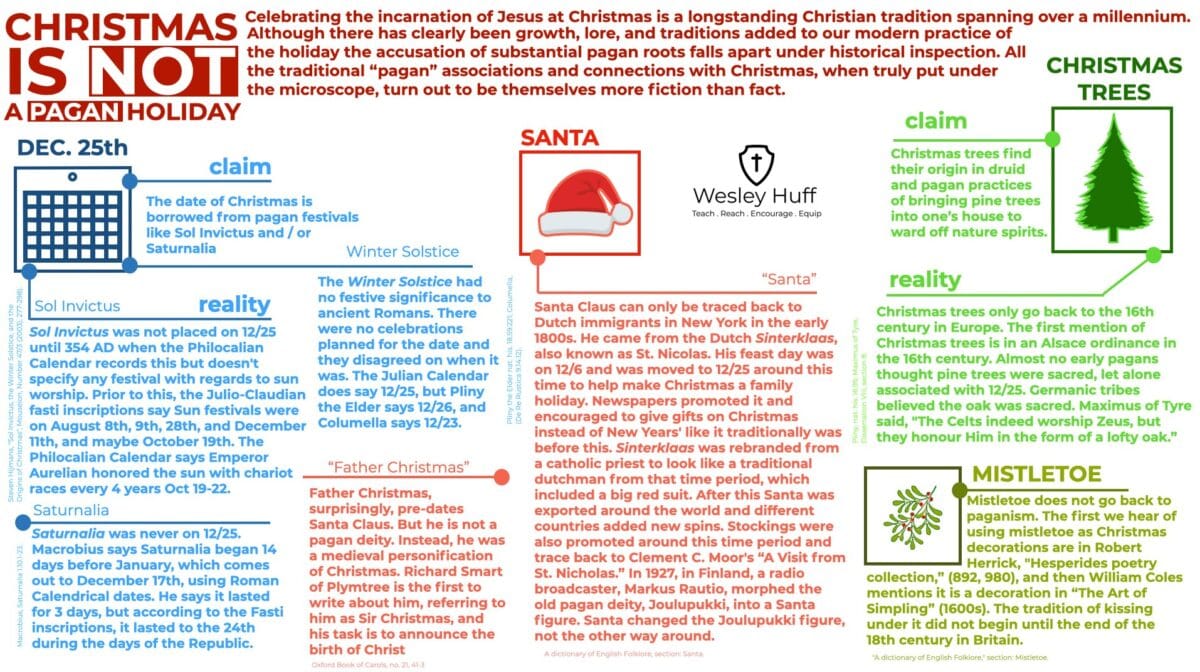 Turning to the second question, the (mostly anti-Christian) myth that the date of 25th December was chosen to displace the pagan festival of Sol Invictus, I have previously noted that Andrew McGowan of Yale University has demonstrated that this was 12th-century anti-Christmas propaganda. Canadian apologist Wes Huff has also engaged with this question, and circulated these helpful infographics (on the right; you can see them full size by clicking on them).
In relation to Sol Invictus, Huff notes:
Sol Invictus was not placed on 12/25 until 354 AD when the Philocalian Calendar records this but doesn’t specify any festival with regards to sun worship. Prior to this, the Julio-Claudian fasti inscriptions say Sun festivals were on August 8th, 9th, 28th, and December 11th. The Philocalian calendar says emperor Aurelian honoured the sun with chariot races every 4 years Oct 19-22.
He offers rebuttals based on historical evidence to the other claims pagan origins, from both the Winter Solstice (which of course does not occur on 25th December) and the feast of Saturnalia, which was never on 25th December either.
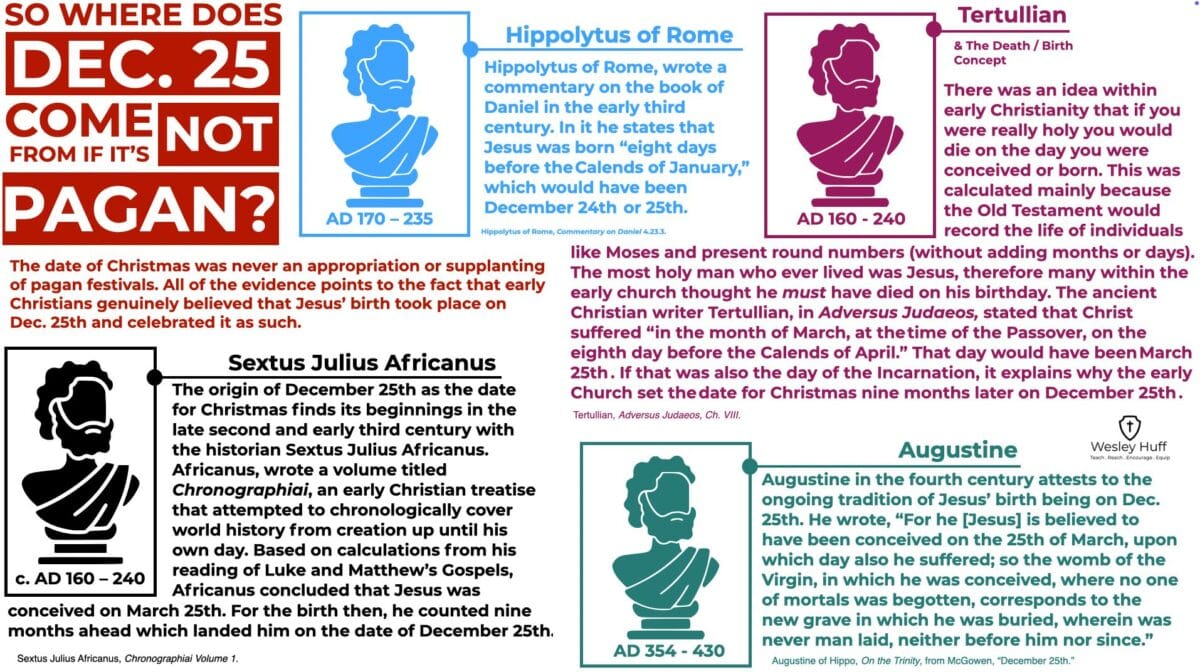 From the earliest times there appear to have been two contesting dates, December 25th in the West, and January 6th in the East of the empire. The December date comes from counting nine months on from the believed date of Jesus’ conception, March 25th, which was also (for theological reasons) believed to have been the same date that Jesus died on. Huff’s infographic helpfully provides sources for this, noting the comments of Sextus Julius Africanus, Hippolytus, Tertullian, and Augustine.
There was an idea within early Christianity that if you were really holy you would die on the day you were conceived or born…The ancient Christian writer Tertullian, in Adversus Judaeos, stated that Christ suffered “in the month of March, at the time of the Passover, on the eighth day before the Calends of April.” That day would have been March 25th. If that was also the day of the Incarnation, it explains why the early Church set the date for Christmas nine months later on December 25th.
So the date was set for theological rather than chronological reason. In which case, we might ask, can we know from chronological evidence when in the year Jesus was born? I think perhaps we can.
The first clue comes in noting the relation between the birth of Jesus and John the Baptist.
In the sixth month of Elizabeth’s pregnancy, God sent the angel Gabriel to Nazareth, a town in Galilee, to a virgin pledged to be married to a man named Joseph, a descendant of David. The virgin’s name was Mary. (Luke 1.26–27)
If Mary conceived soon after this, and assuming that Mary and Elizabeth both went to term, then Jesus was born five to six months after John. (Notice that the visit of Gabriel was in the sixth month of Elizabeth’s pregnancy.)
The second clue comes in noting when John’s father, Zechariah, was serving his term as priest in the temple. Zechariah belonged to the priestly division of Abijah (Luke 1.5) and we know when this division served from 1 Chronicles 24.7–19:
The first lot fell to Jehoiarib, the second to Jedaiah,
the third to Harim, the fourth to Seorim,
the fifth to Malkijah, the sixth to Mijamin,
the seventh to Hakkoz, the eighth to Abijah,
the ninth to Jeshua, the tenth to Shecaniah…
 Each of the 24 divisions served for a week, but all divisions served together at major festivals. We need to remember that the ecclesiastical calendar began in the month of Nisan, around the end of March, whereas the domestic calendar began at Rosh HaShannah (‘the head of the year’) at the end of September. (We also need to remember that the Jewish calendar uses lunar months of 29 or 30 days, and has to add an extra month in six years out of every 19 to align with the solar year. So correspondences with months in the Gregorian calendar vary from one year to another.) This pattern of service was interrupted during the exile when Solomon’s temple was destroyed, but it was restored (presumably from this text) on the return from exile and the rebuilding of the temple.
Assuming Zechariah was on his first duty of the year, the timing would look like this:
| Event | Priestly division on duty | Month | Week |
| 1. Jehoiarib | 1 Nissan | 1 | |
| 2. Jedaiah | 2 | ||
| Passover Festival | All 24 | 3 | |
| 3. Harim | 4 | ||
| 4. Seorim | 2 Iyar | 5 | |
| 5. Malkijah | 6 | ||
| 6. Mijamin | 7 | ||
| 7. Hakkoz | 8 | ||
| 8. Abijah | 3 Sivan | 9 | |
| Schavuot (Weeks or Pentecost) | All 24 | 10 | |
| Zechariah returns home: John conceived | 9. Jeshua | 11 | |
| 10. Shecaniah | 12 |
So John was likely conceived in the second half of Sivan, which is around the beginning of June. Adding the six months between John and Jesus, and the nine months of Mary’s gestation, brings us to around the middle of September the following year.
So Jesus would have been born in September.
Some interesting points arise from this calculation:
1. This would mean that the shepherds in their fields were outdoors in September (Luke 2.8). Given the mild weather at this time of year, this is highly plausible. The hill country around Jerusalem and Bethlehem is cold in the winter, often with snow, so this would be less likely in December.
2. There is a tradition that Jesus was conceived on or around 25th December (rather than born then), and this would fit with Elizabeth’s visit to her in her sixth month.
3. There is also a tradition that ‘Elijah’ who comes to prepare the way for the Messiah would be born at Passover, which is John’s date of birth by this calculation.
4. If Jesus was born in September, that would be close to one of the three major pilgrim feasts, that of Succoth, also called Tabernacles or ‘Booths’. This feast commemorates the period of time that Israel lived in tents in the wilderness. ‘Tents’ is succoth in Hebrew, tabernacula in Latin and skenai in Greek; we get our word ‘scene’ from this, since tent material would have been hung at the back of the stage in a Greek theatre. This connects with John 1.14:
The Word became flesh and made his dwelling [Gk: skenoo] among us.
which some have translated ‘tabernacled among us’ to bring out this connection. So it might be that John’s theological reflection on Jesus was prompted by knowing the date of his birth.
It is worth pointing out that it is rather unusual that we can be relatively confident of historical events at this kind of level of detail. The root source of this is the Jewish interest in schedules and calendars, in this case, the rota of priestly duties. Such precision and organisation is relatively rare in the ancient world, and it offers a historical framework for the material of the New Testament that is unrivalled.
A further theological point of interest is that Jesus’ life, death and ministry are then connected with all three of the pilgrim feasts. He was born at Succoth, crucified and risen at Passover (Pesach) and the Spirit was poured out at Pentecost (Shavuot). [Many years ago I read David Pawson arguing that Jesus’ return would happen at Pentecost, to complete the three, but I think he missed the significance of the outpouring of the Spirit at this festival.]
Of course, Gabriel’s appearance to Zechariah could have taken place during his second duty as priest, which would have been around six months later, putting the Annunciation in June and Jesus’ birth in March. I have found no arguments either for or against this in the literature—and there are no early traditions in support of this date.
Does this all mean we are wasting our time celebrating Christmas in December? Not at all. The main point of Christmas is not chronology but theology. As I have commented elsewhere:
As the nights close in, and the days shorten, we long to see light. As the winter gets colder, we long for warmth. As nature around us seems strangled by death, we need signs of hope and life. And as the inconvenience of going out gets greater, and we are more isolated from friends and neighbours, we long for company…Who can bring us light but the light of the world (John 8.12)? Who can bring us warmth but the one who has poured God’s love into our hearts (Rom 5.5)? Who gives us hope beyond death, but the one who not only tasted death for us but swallowed it up in victory (1 Cor 15.54)? And who else can bring us into friendship with God (2 Cor 5.18–19)?
 Buy me a Coffee





Quite good.
Is it not possible to get an estimate of the time of Jesus’ birth by examining the planetary conjunctions? I am inclined to the view that Star of Bethehem was a phenomenon of this kind.
Nope. The star was the chariot of the Lord returning from Babylonia. The magi couldn’t follow it across the desert so went via Damascus thus taking a lot longer to get back on course, on the same parallel.
Eh?
ask AI this question:
is the star of Bethlehem the glory returning to the temple?
and you’ll see the Star is the Glory returning from exile to the new temple…Jesus.
it left the holy of holies, hovered over the threshold. moved east to the mount of olives and was last seen by Ezekiel by the Chebar canal. exactly due east of Jerusalem. Therefore the star is the glory riding on the Cherubim.
A lot more interesting with theological meaning than a lump of sublimating ice fizzing through space!
That’s a new one on me Steve!
Whyu in that case did the glory not return with the exiles after they had finished building a working second temple, 500 years before Jesus?
The dedication of Solomon’s temple coincided with the Feast of Tabernacles (Sukkot) when the glory appeared.
So, if the star was the returning Glory it probably arrived at the same time of year!
That’s my logic
Anthony, why indeed.
That’s the key. God said build a tabernacle. God’s Glory came.
God said build a temple. Gods Glory came.
The Israelites went into exile. The glory went too.
They started building a temple on their return but it wasn’t at all like Solomon’s. Perhaps it wasn’t according to Ezekiel’s plan that the Glory didn’t show up (BTW ‘show’ is a derived from shoa). Perhaps prophecy should have had them looking for the returning Glory. Perhaps when the Cherubim carrying the throne of Good hovered over Bethlehem nobody noticed, except a few shepherds and a few magi from the school of prophecy, founded by Ezekiel on the banks of the Chebar! 😉
No clear answer to my question then?
Zerubbabel’s Temple lacked the fire and the ark, its successor, Herod’s temple, lacked the seal of approval, the glory, too. both were never given the seal of the living God because of sin and idolatry.
Jesus as the true temple was sealed with the Glory…the Star!
When Herod’s temple was destroyed there was no departure of the glory recorded in history. He wasn’t there, He had ascended.
Ezekiel’s temple plan was a prophetic plan for Jesus time on earth. Look at the plan with east at the top. The north/south gates correspond to His hands. His head is where the east gate is, where the dove rested and remained- like the prince of Ezekiel’s temple. Ezekiel’s temple didn’t have the ‘sea’ The wound in Jesus’ side corresponds to the river of life which sprang from the position where the sea should have been.
Elsewhere the river flows to the Dead Sea. This means that his sacrifice was effectual for bringing life to all in the past, in the east. The half running to the west is for all subsequent healing in the future. Note where the Feet/footstall is , where the western wall is. He stands on the Mediterranean which represents the nations under his feet.
Temple with east at the top
https://www.dropbox.com/scl/fi/r11kqgtjaiw666l5korzv/Temple-Throne.jpg?rlkey=utwfl4v4qh2i9iwg5vj1pi0v3&dl=0
I must say I’ve wondered why God did not let the Ark be found after the exile to Babylon and put into the Second Temple, but the building of this Temple during Ezra and Nehemiah is described in the Old Testament in unequivocally positive terms, with no prophetic warning that it was unauthorised.
You say the glory came from Babylon to Christ. Where was it in Babylon during the exile (and why was it invisible); where was it after the exile; and why was it invisible after it landed at Bethlehem?
Anthony, great questions,
Let me make something up…
Ezekiel saw the Cherubim coming from the north . So , because the cherubim only travel like a rook in chess he must have been south of the parallel that Jerusalem is on but not too far so that by travelling due west it would arrive over Bethlehem. Therefore the chariot of the Lord must have been exactly on the same parallel as the east temple gate. Over the river as that is where he Voice came from that spoke to Zechariah. ..if memory serves me well. Therefore a longitudinal line from there to the bank of the Chebar parallel to Bethlehem will be the spot where Ezekiel saw the vision and where the house in Bethlehem stood. Someone should go and dig!
Dig it?
As for God, his throne above the Cherubim is invisible most of the time!
Where did it go? Back up into heaven to await the ascension of The Lamb . Revelation 4 describes the throne above and or between the Cherubim.
The comet theory hit the headlines again the other day, with the ‘discovery’ in Chinese records of a comet at the correct time. But this isn’t news: Colin Humphreys argued from Matthew’s description of the aster (‘star’) of Bethlehem, and by comparing it against ancient descriptions of comets, that it was a comet, specifically one recorded by Chinese astronomers and visible in the spring of 5BC (‘The Star of Bethlehem’, Tyndale Bulletin vol. 43.1, p.31-56; 1992).
Yes indeed. The problem is that what is described in Matt 2 just doesn’t fit this.
Have you read Humphreys, Ian? He makes a good case and doesn’t ignore “stopping over Bethlehem”. I don’t regard his argument as conclusive but it is well reasoned given how cometary orbits appear from the earth and how they were described in the ancient world.
I think the key to all this is understanding how the Magi viewed it.
How so? The Romans described Halley’s in a similar way. Rather a coincidence – similar ancient language about another comet.
Indeed, The Sky at Night did an episode on it a few years ago. The presenter seemed genuinely surprised when he realised the ‘star’ may have been real. Perhaps it made him think…
Ian,
I’m intrigued by the Jewish calendar. Does Revelation map onto it? I.e. Revelation 4 , with its reference to the elders =month 1 etc. just a thought…
If not, then it’s still great to see Jesus fulfilled the calendar as well.
We do not know the year of Jesus’ birth, for Herod sought to kill the baby Jesus yet impossibly our calendar has Herod die in 4 ‘BC’ (Before Christ). Even the time of year was eventually forgotten, hence speculation about it two centuries later by Clement of Alexandria (Stromata, I) and later Christian writers. The earliest mention of a Christmas celebration – on December 25th, in fact – is in the Depositio Martirum of the ‘Chronograph of 354[AD]’, often taken to imply a celebration in 336AD because the chronograph records nothing later. In that era Pope Julius I favoured December 25th, after Christianity had become favoured under Emperor Constantine. This is the day of the year that Emperor Aurelian, in AD274, associated with sol invictus, the sun god, and Constantine was tolerant of that cult. Under the Julian calendar used in that era, this date was very close to the winter solstice. (The Julian calendar has since drifted; the Russian Orthodox church still uses it and nowadays celebrates Christmas in January as a result.) The solstice is also close to pagan midwinter celebrations such as Rome’s Saturnalia.
John Chrysostom’s sermon from around 386AD known in Latin as In Diem Natalem (not his only Christmas sermon), and also in De Solstitiis et Aequinoctiis commonly attributed to him, argued for a midwinter nativity, claiming that Zechariah was High Priest and his duty was on Yom Kippur, because he burnt incense with the worshippers remaining outside (Luke 1:10); this view dates back to the 2nd century Protevangelium of James. But Zechariah was chosen by lot (Luke 1:9), whereas Herod nominated High Priests in Zechariah’s time.
Thomas Lewin (Fasti Sacri, 1865, paragraph 836) was first to use Luke’s specification of Zechariah’s priestly subtribe (Abijah), and the fact that 1 Chronicles 24 sets out the 24 subtribes, presumably in order of service. Duty lasted one week (1 Chronicles 9:25). Josephus confirmed these details several decades after Jesus (Antiquities of the Jews vol. 7, ch. 14, paragraph 7). Probably the rota was run through twice a year, plus the festivals; Zechariah’s service took place during his subtribe’s tour of duty (Luke 1:8). Lewin’s argument implies two windows for Christ’s nativity in the year, not one.
But there is a greater source of uncertainty in supposing the rota was run through exactly twice a year, so that the first subtribe was always on duty at the start of the year. As well, slippage occurs because of the discrepancy between the lengths of the lunar and solar year; to keep the former tuned to the latter (unlike Islam’s calendar), the Jews added an extra month every few years. (This month was known as a further Adar, after the month it was placed next to.) Even if some tours of duty of some subtribes were made longer in order to ensure that the first subtribe always opened the year, we do not know whether Jesus’ miraculous conception or birth took place in a year with an extra Adar added. Josephus sheds no light on the extra Adar in his era, and the year of the Nativity is uncertain.
Early in the 3rd century Hippolytus of Rome wrote (in his Commentary on Daniel, 4:23) that Jesus was born on December 25th, based likely on the view that he was conceived at Passover because he died on it, or that the world was created at that season. Augustine of Hippo said as much 200 years later (De Trinitate IV.5), and Hippolytus’ contemporary Julius Africanus made an equivalent speculation in his Chronographiai (written around 220AD and lost, but mentioned in sufficient detail in Eusebius’ Chronicle). But this is very speculative reasoning indeed.
For some years I believed that Jesus was born in the autumn, at Tabernacles, and there is no doubt that his Second Coming will be then. But increasingly I have come to believe the best guess is at the Jews’ winter festival of light, Hanukkah, begun in order to celebrate the relighting of the oil lamps in the Temple in 165BC after victory in the Maccabean wars over a Hellenising invader. Hanukkah is in December or late November, and is mentioned in the gospel of John (10:22-39). The theme of Jesus as the light of the world at the start of this gospel (where one might expect a nativity) could be a hint that Jesus was born at Hanukkah, in which case God had a deeper reason for letting the Jews add Hanukkah to their religious calendar. Neither of Mary’s two trips to Judea would then be in the muddiest part of winter, and the lambing season was just starting during the later trip when Jesus – the lamb of God – was born. Crowding for Hanukkah might also explain the fullness of the kataluma; this festival would have been popular under the Roman occupation.
But, as the Holy Spirit did not specify the time of year in the New Testament, it matters little to God whether the church knows it, or therefore whether it celebrates it. For 300 years after Christ the church held no festival of his birth, which is why it forgot the time of year.
There is no ban on a Christian calendar in the New Testament, and we are free to keep one (Romans 14:5-6). But Paul is explicit that this is a matter of private conscience (Colossians 2:16). This is not part of corporate faith, and any church that says we ‘should’ keep Christmas is going against Paul.
Following Christmas in 1565 the rector of St Stephen’s church in Cornhill in London, John Gough, attacked the festival because Christmas had metaphorically become more “a feast of Bacchus than a true serving of the memory of Jesus Christ” at which people “do… what we lust, because it is Christmas”. Oliver Cromwell outlawed Christmas celebrations in the 1650s, which were associated with the Catholic calendar and its large number of saints’ days, and with extensive drunkenness. With rising secularism this celebration has become a materialist orgy of over-spending, over-eating and excessive drinking (exactly what concerned Cromwell), all overseen by the dubious figure of Father Christmas. The Anglican Festival of Nine Lessons and Carols was invented in 1880 by a Bishop of Truro to attract people away from pubs on Christmas Eve. At least vicars get an audience of nominal believers to preach to at Christmastide.
It is unfortunate that persecuted brethren are not free to celebrate Christmas publicly, but the early church did not count this among its trials. So let us be glad that our culture gives us freedom, but also keep it in perspective and prefer phrases about the season that are non-committal, such as “At this time when we celebrate his birth”. Above all, hold Christ at the centre of what you do.
“For some years I believed that Jesus was born in the autumn, at Tabernacles, and there is no doubt that his Second Coming will be then”. No doubt? Fascinating. Why? Particularly in light of Matthew 24:36. However, I have only a lay understanding, and could be missing something.
There were three principal annual festivals specified in the Pentateuch for which all able-bodied adult male Israelites were to make pilgrimage to Jerusalem: Passover, Firstfruits and Tabernacles. Passover received fulfilment in Christ’s crucifixion with Christ as Passover lamb; at that same year’s Firstfruits festival, Pentecost occurred – the first fruits of the Holy Spirit. Tabernacles has yet to have a fulfilment in Jesus Christ. Christ is yet to come again, but we know that he will come as lion not lamb, to judge the world. Tabernacles is the harvest festival; it is the festival of rejoicing for believers; it is preceded by the Festival of Trumpets (a clear hint); it is the only festival to which Israelites welcome gentiles; and it is the festival at which Jews expect their messiah (Zechariah 14:16) which is why Jesus’ Jesus’ sceptical relatives taunted him to show himself at Tabernacles (John 7). That is a pretty strong cumulative case.
”Oliver Cromwell outlawed Christmas celebrations in the 1650s, which were associated with the Catholic calendar…”. But Christmas is a major celebration in the Book of Common Prayer calendar. Sorry – forgot – the Book of Common Prayer was also illegal during the reign of Cromwell. Wasn’t it the puritan Richard Baxter who said that when Cromwell died he was the most hated man in England?
It is ‘major’ in the BCP…?
There was still plenty of Catholic sympathy in Cromwell’s time.
For a non-winter Christmas carol, see “Carol our Christmas” by Shirley Erena Murray (1931-2020), sometimes set to the tune REVERSI by Colin Gibson (1933-2022). The lyricist and composer were both Kiwis. The first verse begins:
“Carol our Christmas, an upside down Christmas;
Snow is not falling and trees are not bare …”
The text was written in 1986 in reaction to northern-hemisphere Christmas carols and imagery. The full text and tune can be seen at https://www.hopepublishing.com/Images/HymnodyPDF/HM1051.02.pdf.
In the 1980s at least, Australian Christmas cards included snow even though it is midsummer in Australia and snow never blankets Bethlehem! I believe some Down Under call theirs a Pool Yule.
May I make a comment on ‘tabernacles’?
The LXX confuses us because it translates three different Hebrew words into the Greek skēnē: o.hel – a tent in which a nomadic person would live, suk.kah – a temporary dwelling, also a thicket, and mish.kan – a dwelling place or habitation. This last one is, I think, confined to Exodus and the ‘tabernacle’. This confusion is perhaps excusable as the Greeks would not have a developed vocabulary for movable and temporary dwellings.
Then the Vulgate retains the confusion, translating these as tabernaculum. Wycliffe transfers this into his English, and Tyndale/Coverdale retain this.
The feast of ‘Tabernacles’ is properly the feast of Booths. It is a requirement for the Jews that a sukkah which they build should allow in the rain, and you should be able to see the stars through its roof.
So, I do not find it appropriate to associate the feast of tabernacles/booths with John 1:12. It would imply that the “becoming flesh” was merely temporary. I would think that the link is much likely to be with skēnē/ mish.kan. God came to dwell amid his people in a ‘dwelling of the tent of meeting’ (mish.kan o.hel mo.ed) but behind a curtain. In Jesus God comes to dwell among his people in such a way that John can say “we looked upon and have touched with our hands.”
As the “dwelling tent” was to be erected on the first day of the first month (Exodus 40:2) (and in Exodus the first month is the month of Passover) does this give a date in the year for Jesus’ conception or birth? For the latter, the timing would fit with Zecariah’s duty in the second half of the year.
In response to your request. Glen Scrivener compares the celebration of Christmas in Australia with UK:-
It used to be summer when Christmas came round,
Neath tall southern skies, over sun-scorched ground,
With the backyard cricket, the barbies, the beach, And munching on mangoes to watch the Queen’s Speech.
The slatherings of sunscreen, the glorious glare
And toasting the glow in the warm evening air.
It used to be summer… when I was young.
A golden age in a land far flung. But there came a point, I crossed a divide,
Went up in the world and summer had died.
December is dark now, the nights close in, So we huddle together as kith and as kin.
It’s winter now when Christmas rolls round, We celebrate still though with different surrounds. We mull the wine and strike the matches, Light the fires, batten the hatches,
Gather around the warming beam Of family love or a TV screen.
So safe inside, no place to go, We toast marshmallows and let it snow.
Does Lu 1.24 ‘Meta de tautas tas hemeras’ mean immediately after those days, or could it mean at some indeterminate point thereafter? Wouldn’t the latter make any identification of John’s, or Jesus’ birthdays questionable?
Hi Ian – thanks for this. Just to be pedantic, In diem natalem is the only authentic Christmas homily of Chrysostom’s. Many others were attributed to him (as is typical).
Thanks–that’s useful to know.
Given that the King has two birthdays – his actual birthday and his Official Birthday – we can hardly begrudge something similar for the King of Kings…
It’s interesting to observe when you look at the major Christian festivals they’re nearly all timed in relation to Easter:
Lent is 40 days in the run-up to Easter
Palm Sunday is the Sunday before Easter
Good Friday is the Friday before Easter
Ascension Day is 40 days after Easter
Pentecost is 50 days after Easter
Trinity Sunday is the first Sunday after 50 days after Easter (i.e. Pentecost)
Corpus Christi is the Thursday after Trinity Sunday
All Saints Day, Candlemas, and the Assumption of Mary (if you observe that) have no Easter connection.
If you take Christmas as being dated deliberately to being 9 months after Easter, then that puts all the Christmas festivals – Advent, Christmas, Epiphany – similarly locked on the centrality of Easter to the Christian faith. And I can’t see that as a bad thing.
Of course it was December 25!
Holy day or pagan?
Worship Him.
https://learn.ligonier.org/articles/should-we-celebrate-christmas
Rename as Incarnation Day.
More than a new ID!
Good to see the historicity of the incarnation under such detailed discussion on your blog. Thank you, Ian. As a long term member of Christians in Science (CiS) I think there may be more to be said, sourced from outside of the strictly theological arena.
I have in mind the CiS site: https://www.cis.org.uk/serve.php?filename=scb-5-2-humphreys.pdf Also the American Scientific Affiliation , Faraday Institute and other and others.
The premise of Sir Colin Humprhreys* is that the star of Bethlehem was a tailed comet, recorded in Chinese archives of the time as visible from China and the Middle East for 70 days from March/April 5BC.The birth of Jesus is thus placed between March 9th. and 4th.. May 5BC on the Julian calendar, a time of year when shepherds are most like to have been in the fields by night. The analysis is backed by quite technical astronomical modelling and calendrical studies in conjunction with world-wide specialists, and peer reviewed as you would expect of a leading Cambridge scientist.
• Colin Humphreys, now retired, was formerly Professor of Materials Science at the University of Cambridge and Professor of Experimental Physics at the Royal Institution in London.
Ian Bensted
Late to the party, but more on antipodean carols: “The north wind is tossing the leaves, the red dust is over the town, the sparrows are under the eaves and the grass in the paddock is brown, as we lift up our voices and sing to the Christ Child, the heavenly king”. James and Wheeler produced a set of fifteen Australian carols, which are all quite charming and some remain well-known. An English perspective on them is at https://www.abcalumni.au/the_abc_of_australian_christmas_carols, including a link to a sound recording (which sounds very un-Australian these days). BTW thanks to those who have been praying in the last week following the Bondi Beach tragedy.
Fabulous, thanks for sharing.
And continuing to pray…