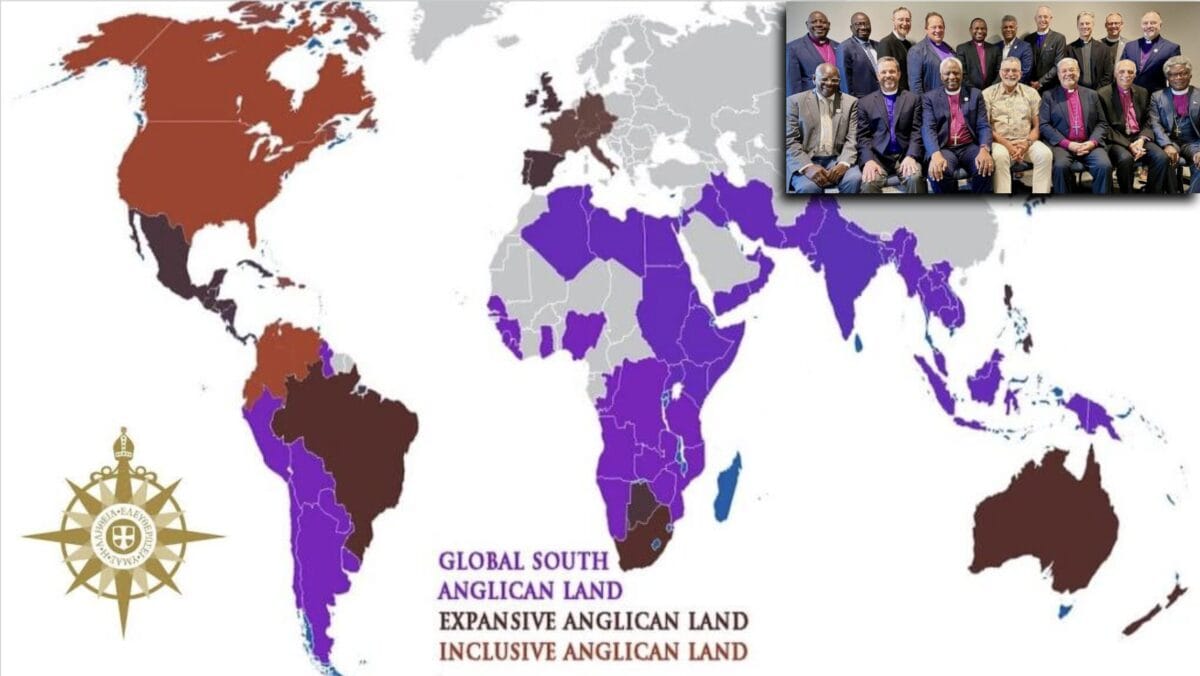
Summary: This article analyses the significant developments emerging from the March 2026 GAFCON gathering in Nigeria arguing that a key feature of its Abuja Affirmation is not what it includes, but what it omits: any reference to the Global South Fellowship of Anglican Churches (GSFA). This “is…a significant missing piece of the complex Anglican Communion jigsaw” because GSFA and GAFCON have shared overlapping leadership and previously articulated “complementary roles” in resetting the Communion.
Drawing on GAFCON’s own Kigali 2023 commitments—which heralded renewed partnership, with GAFCON as a mission movement and GSFA as the ecclesial body tasked with “establishing doctrinally based structures within the Communion”—the article highlights how Abuja marks a departure from that shared vision. It traces the path to Abuja, showing how a subset of GAFCON leaders, largely from provinces long disengaged from the Instruments of Communion, drove the shift.
It then explores two major developments in The Abuja Affirmation relating to GAFCON’s leadership: the dissolution of the Primates Council in favour of a new Global Anglican Council, and a new requirement that GAFCON leaders must practise “principled disengagement” from all Canterbury-led Instruments.
The article shows that GAFCON has redefined its identity and leadership boundaries, placing pressure on GAFCON provinces that continue to engage with Communion structures. This may result either in a depleted Canterbury-aligned Communion or a reduced GAFCON leadership, while GSFA will likely continue developing its own distinct ecclesial vision within a reconfiguring global Anglican landscape.
A second article will explore the alternative visions for the Communion, arising from the Nairobi-Cairo Proposals of the Communion itself, and the alternative vision of the GSFA.
Andrew Goddard writes: The recent gathering of GAFCON in Nigeria has already received a fair amount of attention, including even from the BBC News. Some of it has been supportive (for example pieces by Martin Davie and Anglican Futures), others much more critical (as with Tim Wyatt and Gavin Drake and Gerry Lynch). Attention has, unsurprisingly, focussed on two areas. Firstly, the surprise announcement during the gathering that they had revised their original plan to recognise one of the GAFCON Primates as primus inter pares (widely seen as an alternative leader to the Archbishop of Canterbury for Global Anglicanism) and instead created “A Council to Lead the Communion”. Secondly, the confirmation in the final Abuja Affirmation communique that, this time in line with their October 2025 Martyrs’ Day Statement (MDS), they were now presenting themselves as the Global Anglican Communion (GAC).
These actions, particularly the latter, were often contrasted with the Anglican Communion’s own proposed reforms to its structures, the Nairobi-Cairo Proposals (NCP) a supplement to which—following the annual meeting of IASCUFO (the Inter-Anglican Standing Commission on Unity, Faith and Order)—was published shortly before GAFCON met. Indeed, both Anglican Futures and, in much more detail, Martin Davie have described the situation now as one of being offered two alternative visions of the Anglican Communion.
What such analyses have not recognised is the significance of what is missing from the Abuja Affirmation: any reference whatsoever to the Global South Fellowship of Anglican Churches (GSFA). GSFA’s leaders last met and issued a communique back in January (which similarly did not reference GAFCON, its recent MDS, or the imminent meeting in Nigeria). This “dog that did not bark” in Nigeria is, however, a significant missing piece of the complex Anglican Communion jigsaw on at least two counts:
- the recent history and respective roles of GSFA and GAFCON with their overlapping membership and leadership, and
- GSFA offer a third vision of the future for global Anglicanism, distinct from both the NCP developed within the Instruments, and GAFCON’s new GAC.
This understanding of Anglican life in communion is already embodied in the GSFA’s Cairo Covenant produced back in 2019 and formally inaugurated in June 2024.
I plan to explore those three contrasting theological visions in the second article, here the focus is on GAFCON and GSFA and what has happened in Nigeria and its implications for GAFCON and global Anglicanism.
GAFCON and GSFA: The longer story
Before setting out the recent situation I should probably sketch the longer history and, for the sake of transparency, note my own changing relationship to it. I was initially cautious and concerned about the launch of GAFCON which was announced at the end of 2007, sharing many of the questions and concerns raised by some in the wider Global South. I therefore regretted its meeting in Jerusalem in June 2008 shortly before the Lambeth Conference and the decision of many there (notably Uganda, Nigeria and Rwanda, all of whom had independently intervened in North American Anglicanism in previous years) not to attend that gathering. This first meeting (GAFCON I) produced the historic Jerusalem Declaration and Jerusalem Statement which has continued to be the core of GAFCON’s theological position. Since then, various developments have led me to form a still cautious but more positive view of GAFCON’s role within global Anglicanism. I attended, with a strange combination of both delight and at times discomfort, the two most recent major GAFCON gatherings prior to this one in Nigeria, those in Jerusalem (GAFCON III, June 2018) and Kigali (GAFCON IV, April 2023). These were much larger gatherings than Nigeria 2026 with respectively 1,950 representatives and 1,302 delegates attending, compared to the 347 bishops and 121 lay and clerical leaders who participated in Abuja.
GAFCON and GSFA: Clarifying closer partnership
One of the most distinctive and encouraging features of GAFCON in Kigali, just under three years ago (17-21 April 2023), was the strong and widespread desire for, and then welcome of, closer working relationships between GAFCON and GSFA whose respective primatial leaderships already had a significant overlap. That partnership was reported in the Kigali Commitment communique under the heading “Resetting the Communion”. This embraced language which appeared in the communique from the GSFA Primates Steering Committee who, in contrast to many within GAFCON, attended but did not participate fully in the 2022 Lambeth Conference. That document committed GSFA to resetting the Communion (5.9, 5.11, 6.1, 6.7(k), 7.1). GSFA then reaffirmed this, a few months before GAFCON’s meeting in Rwanda, in its significant Ash Wednesday Statement of February 2023 responding to the Archbishop of Canterbury’s support for Prayers of Love and Faith. It stated,
With the Church of England and the Archbishop of Canterbury forfeiting their leadership role of the global Communion, GSFA Primates will expeditiously meet, consult and work with other orthodox Primates in the Anglican Church across the nations to reset the Communion on its biblical foundation. We look forward to collaborating with Primates and bishops in the GAFCON movement and other orthodox Anglican groupings to work out the shape and nature of our common life together and how we are to keep the priority of proclaiming and witnessing to the gospel of Jesus Christ in the world foremost in our life as God’s people. Together with other orthodox Primates, we will seek to address the leadership crisis that has arisen because for us, and perhaps by his own reported self-exclusion, the present Archbishop of Canterbury is no longer the ‘leader’ of the Communion and no longer the Chair of the Primates’ Meeting by virtue of his position.
This then led to what was reported in the GAFCON Kigali communique:
We were delighted to be joined in Kigali by leaders of the Global South Fellowship of Anglican Churches (GSFA) and to host a combined Gafcon-GSFA Primates meeting. Together, these Primates represent the overwhelming majority (estimated at 85%) of Anglicans worldwide.
Even more significantly, the section continued to confirm in writing the clarification which had been articulated during the Conference as to the distinctive callings of the two bodies:
The leadership of both groups affirmed and celebrated their complementary roles in the Anglican Communion. Gafcon is a movement focused on evangelism and mission, church planting and providing support and a home for faithful Anglicans who are pressured by or alienated from revisionist dioceses and provinces. GSFA, on the other hand, is focused on establishing doctrinally based structures within the Communion.
This distinction had been described in terms of GSFA being an ecclesial body (reflected in the long history of the Global South as a recognised grouping within the Communion) and GAFCON being a mission movement. After setting out the shared common ground and “united commitment of both groups”, this section of the GAFCON statement concluded:
We welcome the GSFA’s Ash Wednesday Statement of 20 February 2023, calling for a resetting and reordering of the Communion. We applaud the invitation of the GSFA Primates to collaborate with Gafcon and other orthodox Anglican groupings to work out the shape and nature of our common life together and how we are to maintain the priority of proclaiming the gospel and making disciples of all nations.
Resetting the Communion is an urgent matter. It needs an adequate and robust foundation that addresses the legal and constitutional complexities in various Provinces. The goal is that orthodox Anglicans worldwide will have a clear identity, a global ‘spiritual home’ of which they can be proud, and a strong leadership structure that gives them stability and direction as Global Anglicans. We therefore commit to pray that God will guide this process of resetting, and that Gafcon and GSFA will keep in step with the Spirit.
In the light of this Kigali statement the recent Abuja Affirmation is significant not only in its failure to even mention GSFA but its clear determination to implement what in 2023 GAFCON recognised as the role of the GSFA—“establishing doctrinally based structures within the Communion”. This outcome, and how it was reached, raise a number of serious questions about what has happened.
GAFCON: The Road to Abjua
The gathering in Abjua was announced “on behalf of our Primates Council” by the Chair of the GAFCON Primates Council, Archbishop Laurent Mbanda of Rwanda, on 10th July 2025. It was described then as a “Mini-Conference” for “all global orthodox bishops and their wives” and the plan was that “Gafcon primates and senior leaders will assemble before the conference for preliminary meetings, plus we will invite some senior bishops to a special, one-day, pre-event”. A “Solemn Summons” was then issued by the Archbishop on 13th September 2025 which stated “the next six months are crucial for our global Church” and claimed that the gathering “may be the most important assembly of authentic Anglicans since Gafcon reset the Communion at Jerusalem in 2008”. This was reaffimed in his 3rd October statement on the appointment of the new Archbishop of Canterbury.
Rejecting the new Archbishop, this surprisingly first claimed that “the majority of the Anglican Communion still believes that the Bible requires a male-only episcopacy” before alleging that “Bishop Mullally has repeatedly promoted unbiblical and revisionist teachings regarding marriage and sexual morality”. With hindsight, one can see here the first explicit sign that the Kigali agreement was being abandoned and GSFA sidelined when it was claimed “The reset of our beloved Communion is now uniquely in the hands of Gafcon, and we are ready to take the lead” (italics added).
Then, two weeks later, in another statement (what has become known as the Martyrs Day Statement or MDS) from Archbishop Mbanda, it was announced “Our Gafcon Primates gathered” and “resolved to reorder the Anglican Communion”. The soundbite heading given to this was that “The Future Has Arrived”. This rather grandiose, and theologically questionable, claim apparently arose from picking up the “F” for Future in the acronym GAFCON with reference to the future of “GA” ie Global Anglicans.
It soon became clear from
- the The Living Church’s podcast and various reports, particularly this by Mark Michael and John Sandeman,
- the interview with Archbishop Mbanda on The Pastor’s Heart and
- Stand Firm’s interview with GAFCON General Secretary Bishop Paul Donison),
that the gathering which produced this major initiative was not in fact a full formal meeting of the GAFCON Primates Council which Archbishop Mbanda chaired. The October gathering from which the MDS appeared had been called two months previously by Archbishop Mbanda. It involved only some of the Council (predominantly or solely those new provinces never in the Communion or provinces which have stayed away from Communion gatherings to which they were invited since 2008) and various other selected guests including long-retired former GAFCON leaders such as Peter Akinola from Nigeria and Peter Jensen from Sydney. The statement this group produced was then put to a hastily convened short online meeting of the Primates’ Council. This met less than an hour before the public release of the MDS which was signed off by those invited and able to attend.
GAFCON: Abuja
The Abuja gathering which reaffirmed the majority of the MDS appears to have been predominantly a similar subset of the whole GAFCON leadership and wider movement.
The GAFCON website lists its 12-member Primates Council. These are in two broad categories: Primates whose provinces are members of the official Anglican Communion structures and Primates who lead new Anglican provinces. There are
- 9 GAFCON Communion provinces (Rwanda, Congo, South Sudan, Uganda, Nigeria, Myanmar, Kenya, Alexandria, Chile) and 6 of these (Congo, South Sudan, Uganda, Myanmar, Alexandria and Chile) lead provinces which are also among the 13 covenanted members of GSFA. The other 3 (Rwanda, Kenya and Nigeria) are listed as “provinces part of the Global South” (as is another key GAFCON player, the Diocese of Sydney)
- Of the remaining 3 GAFCON Primates who lead new Anglican provinces (Brazil, REACH-SA, ACNA), 2 of these non-Communion GAFCON provinces (ACNA and Brazil) are also covenanted GSFA members. This significant overlap between the GAFCON and GSFA leadership further highlights the strangeness of the lack of reference to GSFA.
I understand that although other provinces in that first “Communion Primates” group of GAFCON leaders had bishops present in Abjua, the only Primates from the first group present at Abuja were Rwanda, Nigeria and Uganda of which only the last is a covenanted member of GSFA. These are the three GAFCON provinces which have consistently refused invitations to attend meetings gathered by the formal Instruments of Communion for the last two decades. The provinces of the 347 bishops present is unknown but it is clear that there was, unsurprisingly, a very large contingent from the host province of Nigeria which reportedly has 148 dioceses (although Wikipedia reports higher numbers).
This question of who was represented at Abuja (and earlier in Sydney for the MDS) is important not because of what it reveals about the current relationship between GAFCON and GSFA but because of the two significant developments in relation to GAFCON’s own future governance that were announced in the Abuja Affirmation.
Restructuring and Redefining GAFCON: A new conciliar structure
Firstly, the MDS had stated as its eighth and final commitment that
We shall form a Council of Primates of all member provinces to elect a Chairman, as primus inter pares (‘first amongst equals’), to preside over the Council as it continues “to contend for the faith that was once for all delivered to the saints” (Jude 3).
As noted, above, to the surprise of many and speaking of a late night “movement of the Holy Spirit”, a statement was issued on 5th March which stated that the GAFCON Primates had “dissolved the Primates Council” and created instead not a “Council of Primates” but rather a new Global Anglican Council. This would include not just Primates but bishops, clergy and lay leaders and was described as a more “conciliar” structure. It was also announced that the Chair and Vice-Chair of the previous Primates Council now held those roles in the new Council supported by the same General Secretary
A number of elements of this restructuring remain unclear. In particular, given that it appears barely half the previous Council were present, how the previous Council formally dissolved itself and constituted the new body. The wider membership of the new Council and how they were chosen has also not been clearly explained (the GAFCON website continues, over two weeks later, to display the old Council of Primates structure and membership. The exact rationale for this shift in governance is also unclear. It did, however, mean that it could be stated that “True conciliar bodies don’t really function with a ‘first among equals’ in the same way” as a rationale for abandoning that plan. Other possible reasons for not following that path might have included the fact so many GAFCON Primates were absent, ACNA’s current problems in relation to its senior leadership, and the difficulty of choosing in Nigeria to give one Primate such a novel and significant status at this time.
Restructuring and Redefining GAFCON: An obligatory break with the Instruments
Secondly, and even more significantly, the MCD had stated (point 5)
Provinces of the Global Anglican Communion shall not participate in meetings called by the Archbishop of Canterbury, including the ACC, and shall not make any monetary contribution to the ACC, nor receive any monetary contribution from the ACC or its networks.
This reappears in the Abuja Affirmation under the heading of “Principled Disengagement” with one important change: a new distinction between the terms of GAFCON membership and GAFCON leadership. It is stated
While our fellowship in the Global Anglican Communion is based on assent to the Jerusalem Declaration, leadership in the Global Anglican Communion requires a principled disengagement from the Canterbury Instruments. Leaders who hold office in the Global Anglican Communion must not attend future Primates’ Meetings called by the Archbishop of Canterbury, nor attend the Lambeth Conference, nor attend ACC meetings or participate in Commissions of the ACC, nor personally approve financial contributions to the ACC. It is also expected that they will not receive financial assistance from compromised sources….A full and public disengagement from these structures is necessary…Office holders in the Global Anglican Communion who continue to participate in any Canterbury Instruments will not be able to continue in this role (italics added).
This distinction and in particular the new conditions for “office holders” and those in “leadership” represents a major new development. Once again questions arise as to how and by whom this decision was made. This is not only because it is a new requirement much more relating to the ecclesial task of “establishing doctrinally based structures within the Communion” which GAFCON in Kigali acknowledged was not its primary role but rather that of the GSFA.
More particularly, there are questions given it seems all those Primates (and most of the bishops) present were those who either are not invited to such meetings or have in conscience previously refused such invitations. In particular, the gathering did not include precisely any of those GAFCON Primates who have attended such meetings in the recent past nor, for example, most of the bishops from GAFCON Provinces who decided they could in conscience attend Lambeth 2022.
There has always been a strong “disengagement” constituency within GAFCON and its voice has been heard at times in its various communiques. Many, but certainly not all, of those bishops and Primates in Jerusalem at the original 2008 GAFCON did not attend the Lambeth Conference a few weeks later. Ten years on and back in Jerusalem, the 2018 gathering urged the Archbishop of Canterbury to follow certain principles in issuing invitations for the next Lambeth Conference and stated,
In the event that this does not occur, we urge Gafcon members to decline the invitation to attend Lambeth 2020 [the expected date pre-Covid] and all other meetings of the Instruments of Communion.
This was, note, only an exhortation and, once again, the GAFCON bishops were not of one mind with many (along with most from the wider non-GAFCON Global South) continuing to be engaged, albeit in a differentiated manner, in the 2022 Conference and other Instruments. The 2023 Kigali Statement, while emphasising the failures of the Instruments, rejecting the proposal of learning to walk together in ‘good disagreement’, and insisting on the need to “reset” the Communion, drew back from even urging, let alone requiring, non-attendance.
In practice, once again, at the Primates Meeting in Rome in May 2024, some GAFCON Primates attended and others in principle did not. One GAFCON Primate (Kenya) has continued to serve as the Primate from Africa on the Primates’ Standing Committee and wider Standing Committee of the Communion, another GAFCON (and GSFA) Primate (Alexandria) has continued serving on IASCUFO as it has worked on the NCP.
The longstanding position of GAFCON has therefore been that what unites it at every level, including its leadership, is simply assent to the Jerusalem Declaration. This is part of being, in the words of the Kigali Commitment, “a movement focused on evangelism and mission, church planting and providing support and a home for faithful Anglicans who are pressured by or alienated from revisionist dioceses and provinces”. Other matters, including how one should relate to the historic Communion Instruments, have been effectively treated as adiaphora. Decisions about attendance were, in other words, to be left to the consciences of individuals and/or the collective decision-making processes of each province.
Initially the small gathering that produced the MDS, and now the larger but still far from fully representative gathering in Nigeria that produced the Abuja Affirmation (which appeared, unlike previous statements from GAFCON gatherings, as if signed off by the Council’s Chair), have unprecedentedly redefined this. They have announced significant new requirements that will now be held to be necessary for GAFCON leadership. In effect, the meeting in Nigeria took the first part of its biblical text, Joshua 24:15 (“Choose this day whom you will serve…”), and said to many who have long served in GAFCON leadership, including members of its now-disbanded Primates Council, “you now have to choose between continuing to lead us and continuing to meet with them”.
Paradoxically, however, it appears that the theological rationale given for this “principled disengagement” stance is not being applied in relation to the much closer, legally structured, forms of communion found within rather than between Anglican provinces. Here the Abuja Affirmation reiterates what has been GAFCON’s historic position in relation to the Instruments by stating, “Gafcon has always acknowledged that it is a matter of conscience, when rejecting the authority of revisionist leaders, as to whether one remains or not in a compromised ecclesial structure”.
Conclusion
In summary, much remains unclear for anyone seeking to understand and evaluate recent developments within GAFCON and their implications for GAFCON itself, the GSFA, and the wider Anglican Communion.
It would appear, however, that, led by the Archbishop of Rwanda, those provinces within GAFCON that have never been part of the Communion or have been almost wholly absent from its Instruments for almost two decades have, supported by some of GAFCON’s initial founders, sidelined or bypassed GAFCON’s established structures. They have then replaced these with new leadership structures with new and narrower terms of membership. They have done so by reneging on the terms of closer partnership agreed with GSFA and strongly welcomed just three years ago by the GAFCON gathering in Kigali.
The aim of all these changes seems to be to put the squeeze on those within GAFCON (and perhaps the wider GSFA) who—as part of their way of seeking to “reset” the Communion—have continued to engage with the Instruments and IASCUFO’s NCP as a contribution to the “reset”. Those Anglicans, despite sharing GAFCON’s stance on sexuality and the failings of the Instruments, and being committed to the Jerusalem Declaration, have effectively been told they need
- either to cease and desist from such engagement and decisively walk apart from the “Canterbury Instruments” into the new Global Anglican Communion that GAFCON has unilaterally declared
- or they will be removed from leadership in GAFCON.
Unless something shifts, it would appear that these high stakes mean we will over coming years, or perhaps even months, see one of two broad outcomes taking shape.
On the one hand there could be a much-depleted Canterbury Communion if all of the GAFCON leadership (and perhaps others) align with the newly-declared Global Anglican Communion on the terms of the Abjua Affirmation ie separation from involvement in the traditional Instruments.
On the other hand, there could be a significantly smaller and narrower GAFCON, certainly in terms of its leadership and perhaps its wider membership, if some GAFCON Primates and provinces are unwilling to accept these new terms.
Either of these outcomes, particularly the latter, could be combined with the continuing development of the GSFA taking up its aim, as a primarily ecclesial body, of “establishing doctrinally based structures within the Communion”. These would be structures that deepen the GSFA’s own covenantal common life while remaining engaged, at a lower and differentiated degree of communion, with the wider historic Communion as it too reconfigures itself in response to a new Archbishop of Canterbury and to whatever decisions its forthcoming Belfast Anglican Consultative Council (June 27 to July 5) makes in relation to the NCP’s proposed reforms.

Revd Dr Andrew Goddard is Assistant Minister, St James the Less, Pimlico, (where his wife Lis Goddard is vicar) Tutor in Christian Ethics, Westminster Theological Centre (WTC) and Tutor in Ethics at Ridley Hall, Cambridge. He is a member of the Church of England Evangelical Council (CEEC).
 Buy me a Coffee









So “A Council to Lead the Communion – why? We’ve had the four instruments of Anglican unity for over 100 years – The “crack” in the Common Union that GAFCON has created seems now to be cracking again – while the rest of the Communion get on with the job of being church in the thousands of local communities – Deaconing, ordaining Priests and consecration Bishops (male and female) and continuing the amazing work on the local levels of good pastoral care – for everyone / including the unmarried, the widows, widowers, the divorced, the LBGTI communities – God bless us all we seek Gods guidance and help in this ministry of love.
Can we really say that ‘the rest of the Communion is getting on with the job’?
In the Western churches, the Communion has drunk deeply of Western post-Christendom culture, abandoned its historic beliefs, and is rapidly declining.
What do you mean by ‘Communion’ here?
Do you mean the Episcopacy? or the Laity? Or both? The ‘communion’ can drink of what it likes, perhaps, in any age but the professing core is untainted.
I sometimes think that Reformed, Biblical Anglicans seem to take a very ‘High’ view of the ecclesial structure of the Anglican church , in spite of themselves.
Anglicanism professes a conciliar, not a hierarchical episcopacy. Canterbury is not ‘head of state’ she is not even ‘head teacher’. The Archbishop’s role is that of, effectively, chief convener.
Despite what many in GAFCON seem to assert, The Archibishop of Canterbury is not the ‘head’ of the Anglican Communion – not even informally. She is not even ‘head’ the Church of England, Christ is the head of the church and HM the King is it’s Supreme Governor.
That this upsets Anglo-Catholics, the loudest among so-called ‘traditionalists’, is, I think, why it is so poorly understood by the public.
The Anglican confession of faith is the 39 Articles as conformable to the Historic Creeds and, ultimately, Holy Scripture.
Whatever pundits and opinionated clerics may think and assert the foundation of Anglicanism remains the same as it was in 1662.
Nomative Anglicanism is the Scriptures read daily and the Daily Office prayed through yearly interpreted under the direction of the 39 Articles.
Anglicanism’s ecclesial claims are quite strictly limited. Wonderfully so.
It does not claim to be the ‘One True Church’ outside of which is no salvation. It does not claim that it’s Primates are ‘infallible’, that its councils are ‘inerrant.’ or that its clergy is ‘holy’. It never has.
At root it’s claim is one of extreme liberating parsimony –
“Holy Scripture containeth all things necessary to salvation: so that whatsoever is not read therein, nor may be proved thereby, is not to be required of any man, that it should be believed as an article of the Faith, or be thought requisite or necessary to salvation”
Whoever sits at Canterbury, whichever tendency or ‘offence’ rules the day in synod (‘for it must needs be that offences come’), the normative unchanging core of Anglicanism remains the Scriptures, the Articles, The Prayer Book and the Ordinal – lived out as a ‘Pattern of Godly Living’.
Praise be to God.
David Shepherd says:
“…the absence of GSFA says less about GAFCON’s procedural legitimacy and more about the emerging divergence of two orthodox approaches, one doctrinal‑confessional (GAFCON) and one covenantal‑ecclesial (GSFA). Abuja may simply have formalised a separation already underway.”
This is a good summary. Many Gafcon leaders have good personal relationships with those who identify more with GSFA, but in terms of resetting the Communion and ensuring a home for orthodox Anglicans, as an organisation what has GSFA actually done? Similarly within the Church of England – patiently, politely and moderately over many years re-stating the case for orthodoxy from within the established structures while distancing from those conservatives perceived as lacking in winsomeness: what has it achieved?
It has achieved:
a. the end of the LLF process.
b. the reaffirmation of the doctrine of marriage, and a high bar for that changing
c. evangelicals now much more aware of the importance of engaging in the structures
d. Some important evangelical episcopal appointments.
e. freedom for orthodox churches in most dioceses to flourish and grow.
Thank you, Mike and of course a crack is appearing in GAFCON just as it has appeared in a large way in the ACNA. It is because the whole premise of the formation of those bodies is to do with hatred and fear. The primary reason GAFCON and ACNA exist is because they want the gays and lesbians out of the Church. They fear – and that’s the only appropriate word – that any leniency towards such people threatens the purity of God’s Church here on Earth. So let’s create our own world without them, and let’s denounce anybody else who dares to be welcoming and accepting of those whose love is ‘different’. It’s the only reason GAFCON exists, and of course GAFCON will ultimately fail because the foundation for their existence is fear and hatred. It will be dressed up, of course, as being more loving because it’s addressing sin, and so ultimately saving people from hell. It will be dressed up as the church wanting to withstand the ravages of the modern world. It will be dressed up as orthodoxy. It will be dressed up as being more authentic to the pure teaching of Jesus. But the only real reason GAFCON exists is because it doesn’t want queer people spoiling the game.
Andrew
Do you really think it will be better if the liberal wing ‘wins’ and produces a church giving out the completely irrational message that they know better than God; an evangelistic message to “Join us – we don’t really trust God ourselves”!!!
More fear of the Lord would be a good thing among the liberals.
Oh ” liberals” fear the Lord. They just think they will be judged on what they have done to counter systemic sin rather than whether they lived in a faithful same-sex relationship.
So those are the only two perspectives?
And each of them is limited to one type of issue?
Where is their evidence?
And why cannot it be a both-and? You didn’t explain that.
It could be both/and. But since the vast majority of conservatives think that focusing on systemic sin is ‘woke’, they very rarely do.
Everything is accusation. You know the right way, both/and. Walk in it.
With selectivity one can prove literally anything.
No Christopher. I could not walk in a way which treated queer people unfairly or deny faithful, holy same-sex partnerships their legitimacy. That would be truly sinful.
But you could walk in a way which:
-enforced that people accept these same minority categories
-minority categories, moreover, which virtually deny everyone an existence before the age of 13…
-and then make post-13 *more* essential to them than the person they were born as
-was compliant and captive to the very distinct worldview, with or without self-contradictions that you by chance were surrounded with at your random period and location in history.
“Holy same-sex partnerships”, not to put too fine a point on it, is not a phrase from scripture. It’s a modern pretension that would never have seen the light of day prior to the last few years, and in the two millennia before that would have been considered a risible absurdity had anyone actually uttered it. This will not matter to a person who knows everything.
But the concept of sinfulness you are adopting comes straight from the very same text which ranges itself miles away from any idea or acceptance of foreign bodies like (the rather under-defined) ‘faithful same-sex partnerships’.
All very modern and sophisticated and (as Molesworth would have it) ‘advanced, forthright and significant’.
Holy matrimony, not to put too fine a point on it, doesn’t appear in scripture.
The concept of sinfulness comes straight from scripture and tradition. That it doesn’t include fidelity in sexual relationships is consonant with that.
Christopher
You are absurd. Does other sex marriages deny the reality of those under 13?
And why 13? Do you consider that a marriageable age?
‘Holy matrimony’ is just an English phrase, so could not possibly appear in the Bible. It overlaps very strongly in its essentials in a Venn diagram with the NT concept of marriage, gamos, since NT marriage is understood to be holy.
As the Brabourne/Ustinov Poirot might have said, many things a person says may be absurd, but how can the person themselves be absurd? Which of their thousands of aspects (aspects, moreover, of a person you have never met) are you referring to?
Sinfulness doesn’t include fidelity in sexual relations? Right. It includes infidelity in sexual relations, though.
13 is relevant because it (or some similar age) is when people first claim homosexual impulses. They then claim that they, as a person, have homosexual impulses. From this it follows that they [think that they] did not, unlike the rest of us, exist when aged 0-12 (the most formative, fundamental and essential ages of all).
Christopher
My response about the phrase was to John. I think he may have understood that we were speaking about English translations. The NT is rather ambivalent about marriage, so I can’t agree with your view.
Most people begin to have sexual feelings at puberty (if not before). This is not exclusive to gay people.
The first miracle of Jesus was at a wedding, if I am not mistaken. That would be a celebration of what we would call holy matrimony. It was between a man and a woman. Nowhere does scripture envision “same sex” marriage: indeed, everywhere homosexuality is explicitly mentioned, it is with opprobrium. But I confess that unlike some, I do not know everything. So I could be in error. What I could not be is any more baffled at some of the things I am reading in this string.
Not my point. My point is that everyone who claims that their post-13 identity is all there is is obviously not telling the truth, and their points are therefore to be disregarded. To say nothing of the fact that all the worst, unwisest and most harmful behaviours set in around that age if they set in at all.
If someone is either ill developed or estranged from their biology by the age of 13, they have certainly had all the time in the world to become that way. We then ignore that when we define their identity?
Christopher
I have never met nor heard of a queer person who claims that being queer is the ‘whole’ of their identity. Minorities tend to be more vocal about their minority identities, because they are often marked as aberrant. Thus able, white, straight, neurotypical people tend to be quieter about their identities because these are regarded as ‘normal’, are unchallenged, and are not discriminated against.
How odd Penny. I have met lots of ‘Queer’ people who claim that being ‘Queer’ is the defining element of who they are, and the lens through which they view everything.
I am ‘quieter’ about ‘my identity’ because I do not claim that it has this ontological or epistemological status as the thing through which I view the world.
John
Good point (though it’s only the 1st miracle in John). Dors the text warrant this description as Holy Matrimony though? It’s a wedding – that is all we are told.
Ian
How odd that you know queer folk whose whole identity is their queerness.
And I’m afraid that you are quiet about your identity not because you question its ontological or epistemological significance but because, as a white, Western, straight, cis male, you inhabit a world where your identity is unmarked. As in my response to Christopher, you have a, largely unacknowledged, privilege which those on the margins do not. You do not need to make your identity about your colour, sexuality, able-bodiedness, or neurotypicality.
Penny, who are ‘on the margins’? The group currently most suffering failure of our systems in education and work are white working class boys.
PCD, you use this word ‘queer’, as though it were agreed territory, in conversation with people who you must be aware regard it as no such thing.
This is one of the tactics I have witnessed time and again elsewhere – preempting discussion by imposed vocabulary – though whether it is tactical in your case I do not know.
Ian
You keep saying this. It doesn’t mean that other groups are not marginalised. Those marginalised by the CoE include disabled people, neurodivergent people, black people, queer people, and working class people.
Penny, you appear to be living with a victim obsession. Half the cathedral deans are gay; there are a higher proportion of black bishops in the C of E than black people in the country.
How does this represent ‘marginalisation’?
Ian
And you keep proving that you inhabit a place of unacknowledged privilege.
How representative of the UK population (or even of the CoE ‘population’) are Cathedral Deans?
Ian
“To be rehabilitated as one of the good queers, the good disabled, the good blacks, is not to achieve social and material equality, but rather to fortify the system that marked one as bad in the first place”.
Karen Bray
Ascribing opposing views to “fear and hatred” is a surefire way to make it impossible to understand those views.
It is also a two-edged sword. I’ll give an easy example. It can be said that “the sanctification of homosexuality through the distortion of marriage is borne by fear of what Scripture teaches, and hatred of those who refuse to go along with ignoring it.”
What if there is fear and hatred? Should we just not name it?
Last month an article considered ACNA position as a House Divided.
It considers the Articles, Homilies, and BCP .
It also asks for people, to commit honestly about their convictions and goals (their underlying belief structures) while identifying one set, with a generalized conclusion.
Though Andrew Godsall’s self -righteous, extreme, fallacious rant is somewhat corroborative of that generalised conclusion.
Apologies. Here is the article;
https://adfontesjournal.com/steven-wedgeworth/neither-dissembling-nor-cloaking-in-the-womens-ordination-debate/
From one of the hymns at Sarah’s installation today.
But we make His love too narrow
By false limits of our own;
And we magnify His strictness
With a zeal He will not own.
Maybe someone can let GAFCON know about that verse eh Geoff!
From the infallible Fr Faber. By some mechanism, far less in need of interpretation than scripture itself. When the text shows a broad understanding of God’s lenience, suddenly it is treated as a pellucid text.
One thing about this text is that it is telling God what He will and will not own.
Although Fr Fabre had his own psychological context for penning those words, there is much to affirm and only two things to take exception to. First, the whole idea that one can proprietorially and patronisingly tell God his own business and views on a matter (at least, on a contested matter). Second, the way the words appear to distance God from zeal (s ‘mild God’ take) – what could be less true? In fact the words distance God from a zeal to be strict.
Two more problems lie not in the hymn but in its reception. First, its being treated as holy writ – normally by those who question actual holy writ. This could be because it was written in that venerable and authoritative period, ‘the past’. Second, its use as a rallying cry or manifesto among political clerics. Although the only context I can recall is Dean Beeson’s funeral, I have read of another example or two recently, which I cannot at present place.
Faber
Except that verse does not match the teaching of Jesus.
It matches it exactly. It doesn’t match the exclusive interpretation by which no one will be in heaven at all.
The thief on the cross is the crucial part here. Today you will be with me in paradise.
As the two brigands had different destinies, as can easily be seen from Luke’s use of baker/cupbearer here, then that aligns with our own view that destinies are bifurcated.
Whereas you refer to ‘the exclusive interpretation by which no one will be in heaven at all’ – an interpretation that nobody ever held in the first place.
Any more than the all-inclusive one makes sense.
Andrew, it matches one half only of the teaching of Jesus, as I set out here: https://www.psephizo.com/biblical-studies/the-trouble-with-the-inclusive-jesus/
Ian I really respect that is your sincerely held belief. And indeed the belief of the Gafconites. But the idea that just a few elect are going to be ‘saved’ is a severe distortion of the love of God made freely available through Jesus Christ. In the two thieves at the cross it is clear. Paradise is open to all who willingly accept the grace of God is Jesus Christ at the very end. You can’t earn it. Some will not wish to accept it. And that has to be a free choice. No one can be forced to accept. But the grace of God is not just for the chosen few.
Andrew ‘Ian I really respect that is your sincerely held belief.’ From what you often say in these comments, I don’t think you evidence that.
‘And indeed the belief of the Gafconites.’ Again, a ludicrous lumping together of all those you think in error.
‘But the idea that just a few elect are going to be ‘saved’ is a severe distortion of the love of God made freely available through Jesus Christ.’
Then you need to take that up with Jesus. “Enter through the narrow gate. For wide is the gate and broad is the road that leads to destruction, and many enter through it. But small is the gate and narrow the road that leads to life, and only a few find it.” Matt 7.13–14
Perhaps you think you know better than him…?
But the number of deathbed conversions/pleas is only a small percentage of those who die. So ‘the chosen few’ (or ‘many’; nobody mentioned ‘few’ or ‘many’) will not be significantly increased by adding in deathbed conversions.
Nor is the matter best studied by fastening onto a total of one scripture, a scripture which would already be factored in by those who, much more properly, focused on a panoply of different scriptures rather than one.
Least of all when the guiding factor is that that scripture happens to be the most *congenial*, which is not a relevant way of judging things. I pointed out above that it is in fact not: we just have here a bifurcation of two different brigands and destinies, which is exactly what everyone had always said in the first place.
Who mentioned death bed conversions? Once again Christopher you are seemingly not able to follow the discussion.
‘all who willingly accept the grace of God at the very end’ – ‘the very end’ is death.
Presumably then Ian you will not want to be part of a Church that includes people like me. And there are plenty of us. Bishops included. GAFCON offers you a purer option.
Andrew, you presume too much. What I would love is for the bishops of the C of E to believe the doctrine of the church and to drive away error—as they publicly promised they would do.
It is a basic point of integrity.
Well I think you do, at some level, have to recognise that people have different priorities and emphasises, and being part of the CofE involves that breadth. Also important to recognise that God has a part in the appointment and calling of bishops, priests and deacons. It sounds like you don’t think that can possibly be the case.
Andrew, I do find it bizarre that you continue to project on my your own prejudices. Of course God has a part–I just wish it was more.
It is quite hard to imagine God wanting people who will make a public vow they believe something to be people who don’t believe what they say.
Ian. So you are saying God has a hand in the appointment of clergy you approve of but no hand in the appointments of those you don’t? That is truly bizarre! Either God is involved or God isn’t.
And your legalism and literalism is truly odd as well. The 39 Articles were a political statement for their time. No one is required to subscribe to the individual Articles and I have pointed this out many times with reference to the appropriate documents.
And people are quite free to dispute some of the small print – the Canons. Evangelicals do it all the time in respect of liturgy and canonical dress for example.
There is a breadth to the CofE which you simply don’t recognise. The narrowness that you require will create a tiny sect like The Free Church of England. We don’t need another of those.
No, Andrew, I am saying that, contrary to what you appear to be claiming, the CNC is not infallible. So God wants to be involved, but unless you have a Catholic theology of the infallibility of the Church, God’s will is not always done.
In particular, I find it hard to believe that God wants people to lead his Church who don’t believe its doctrine, given that teaching that doctrine is one of the things they promise to do. God does not bless dishonesty and hypocrisy.
You are simply in error in saying that ‘The 39 Articles were a political statement for their time.’ They are theological, and in law they determine the doctrine of the C of E. They were actively present in all the debates about liturgical revision, and they continue to be the touchstone in the debate about sexuality. Hence the HoB statement in October.
Your language of ‘narrowness’ is a rhetorical power play. I don’t deny there is a breadth in the C of E; the question is how much of that breadth is a good thing, and how much is a bad thing. You don’t appear to want to recognise that that is a legitimate question.
Believing the doctrine of the Church, and using only forms of worship allowed by canon, still allows breadth.
But ‘breadth’ which is about denying the doctrine of the C of E and defying discipline is not a healthy kind of breadth.
So in other words GAFCON has divorced itself even from the GFSA let alone the wider Anglican communion and has just become a small group of anti female ordination, anti LGBT Anglicans mainly focused on a handful of African provinces ie Nigeria, Uganda and Rwanda. Plus one uber conservative Australian diocese, the diocese of Sydney. Meanwhile the vast majority of Anglican provinces welcome Sarah Mullally’s enthronement as Archbishop of Canterbury today and have sent representatives to the service
Maybe you could set out the whole hymn Andrew.
I read on the Christian Today site, she chose Tell Out My Soul and Praise My Soul the King of Heaven, both theocentric, not human centric. Maybe you could let the revisionists know that.
Cruciform salvific faith in Christ is exclusive, with a new life, birth, in Him.
No need Andrew, I have looked it up. Little wonder you did not quote it in full, but only a sliver to push your narrowness.
It is significant that the hymn seems to be based on part of the indicatives, facts, of what God has done, in Ephesians chapters 1-3, that is, on Ephesians 2:4-5 and Psalm 106:1 ( Covenant making/keeping LORD.)
Sell out my soul?
I consider myself reasonably well informed on this stuff, after nearly 50 years of ordained ministry in the CofE. But I have to say the alphabet spaghetti of the fracturing communion, alongside the frequently sharp and uncharitable nature of the comments sections on these blogs, bear little relation to what I have lived and seen in that near half century of ministry. Sad really – as informed and charitable comment might still have a part to play within the kingdom.
Thanks Pete.
On the comments here, I share your concern. I keep asking people to abide by my comments policy, to no avail. The only option would be to close all comments, which I am reluctant to do.
(Note that the vast majority of the comments are by a very small number of regulars.)
On the Communion, I think there is a real dissonance between the political manoeuvring at the higher level, and actually personal relationships on the ground.
It’s quite easy with the comments – either have a moderation policy or disable comments. Other blog sites do this and it isn’t obvious why you don’t.
Because:
a. I actually trust people to follow the guidelines which I set out clearly. It is a shame when my trust in that is not honoured.
b. I have other things to do with my time than police people who cannot exercise self-control in this regard.
Do you think perhaps your habit of policing those you disagree with, whilst giving free rein to those you agree with, has anything to do with it?
I want to commend Andrew Goddard on this impressively detailed survey of the Abuja Affirmation and the earlier history that led up to it. He is correct to note the instability that has resulted from these developments.
Nevertheless, I would contend that his analysis overstates GAFCON’s inconsistency and understates the degree to which GSFA, GAFCON, and Canterbury now represent three genuinely different strands of Anglicanism that do not have to be coterminous to be legitimate.
That’s why I’m not convinced the analysis fully captures what is actually happening within global Anglicanism.
Firstly, the analysis leans heavily on procedural and institutional expectations, e.g., who was present, who wasn’t, what wasn’t referenced, and whether Abuja followed the “proper” lines of representation. However, this assumes a relational‑institutional Anglican framework that GAFCON has never worked within. GAFCON has always operated from a doctrinal first principle (as I explained in this article: https://www.e-n.org.uk/comment/abuja-has-gafcon-divorced-the-cofe/), rather than a conciliar or procedural one.
According to that principle, the question isn’t “Did every primate have a hand in drafting Abuja?” but “Is the Archbishop of Canterbury still capable of exercising spiritual authority over a Communion whose doctrinal boundaries she does not defend?” With the answer to the latter question as their premise, the Abuja Affirmation, however untidy procedurally, becomes a perfectly rational extension of GAFCON’s own theological commitments.
Secondly, the article treats the omission of GSFA almost as a failure of essential ecclesial diplomacy. But it never seriously entertains the most obvious explanation: GSFA and GAFCON are not drifting apart accidentally but because GSFA is intentionally developing a different ecclesial strategy, which remains engaged (even if critically) with the Instruments, and which therefore cannot be folded into the uncompromising “principled disengagement” now required by the Abuja Affirmation.
In that sense, the absence of GSFA says less about GAFCON’s procedural legitimacy and more about the emerging divergence of two orthodox approaches, one doctrinal‑confessional (GAFCON) and one covenantal‑ecclesial (GSFA). Abuja may simply have formalised a separation already underway.
At the same time, Andrew Goddard’s analysis is spot-on is in noticing the narrowing of GAFCON’s leadership and the tension now created for provinces that still have relational commitments to the wider Communion.
Nevertheless, the deeper issue is not procedural irregularity, but rather the clash of first principles. GAFCON believes doctrinal consensus was broken years ago by TEC and, more recently, by the Church of England. From that perspective, Abuja is not the rupture, but instead a late correction to already impaired communion.
As i wrote in my recent Evangelicals Now article: “In the West, Anglican identity has long been shaped by the idea that the communion is held together not by administrative authority, but by “bonds of affection”. The Western view is that communion across the Anglican world is maintained through patient consensus-building, shared provisional discernment, participation in the Instruments of Communion, and a willingness to “walk together”, despite profound disagreement.
This model assumes that autonomy is constrained primarily by relationship. Provinces remain recognisably Anglican by staying in the room, continuing the conversation, and deferring, at least symbolically, to the Archbishop of Canterbury’s traditional role as “focus of unity.”
From this perspective, Gafcon’s withdrawal from Canterbury-led structures looks like a repudiation of Anglican identity. If communion is relational, then stepping back from the Instruments appears to be stepping out of the Communion.
This is why some Western Anglicans read Abuja as schismatic or usurping Canterbury. If the Instruments form the golden thread of Anglican Communion, then refusal to participate feels like tearing its fabric.
By contrast, the Global South [apart from GSFA] operates with a different ecclesial mindset, whereby the Anglican Communion is held together not by process but by a baseline of confessional unity, encapsulated in the Scriptures, the creeds, the Thirty Nine Articles, and the 1662 Book of Common Prayer.
The Abuja Affirmation reflects this mindset: “True communion is confessional, rather than defined by a shared history or institutional structures.”
Thanks David—very interesting indeed. I wonder what Andrew makes of your perspective?
Many thanks, David for your solid sanity and assesment. The conclusion on communion seem to be what AMIE is based on.
Thank you for this clear and concise summary of the issue at question.
Speaking as a ‘Prayer Book Evangelical’ in Britain, the position in the pews seems even further removed from the controversy as described in the news.
From where I kneel every Sunday I am assured that the Scriptures, the creeds, the Thirty Nine Articles, and the 1662 Book of Common Prayer are still established, by law, as the normative standard of the Anglican Church.
‘Article XXVI: Of the Unworthiness of the Ministers’ appears to indemnify the layman from the errors and offences of wayward clerics – provided doctrine remains legally unaltered.
Article XXI – “Of the Authority of General Councils” indemnifies the layman against anything agreed by synods “unless it may be declared that they be taken out of holy Scripture.”
It strikes me that “The humble soul compos’d of love and fear” who merely wishes to follow Christ, “meekly kneeling upon our knees” is still better insulated, both in law and spirit, against error and enthusiasm in the Anglican system than in any other.
We seem to be seeing a repeat of the Reformation. A hierarchy that has ungodly and unscriptural doctrines and behaviours – in 1517 Rome, today liberal Canterbury – has provoked a godly reaction, which then splinters in schism to the cheer of its opponents while continuing to agree over the precipitating issue. To me this shows the problematic nature of church hierarchy nd the overturning of the scriptural system of many episkopoi (overseers) per congregation, as recorded in Acts and the letters, in favour of one episkopos over many congregations.
A reaction for sure, but was it particularly godly? The get rich quick schemes, witch hunts, tortures and executions, and atrocities don’t make large parts of the reformation look much more godly than say the counter-reformation.
I do not support disengagement from Canterbury but it is good that the godly do not take money from the official Anglican Communion because it can then be used as a weapon by liberals to advance their ungodly agenda.
Which only goes to show that liberals are (as is often observable) aligned more with political types who unscrupulously treat the ‘third world’ thus, and are also low on conscience, insofar as they do such things.
Whatever the rights and wrongs of all this, I don’t observe any great interest in the Anglican Communion amongst those attending worship in the C of E. I suspect that only a very few pay any attention to the assorted political manoeuvrings of the ever-growing alphabet soup of different factions.
Among ‘normal’ churchgoers I don’t discern much interest in the neighbouring parish, let alone the Anglican Communion.
Nor in revisionism of the liberal kind. Creatures of church going social habit.
If salvation matters it will be universal, or by works on balance and sin is not recognized as being in opposition to God.
Mostly unthinking deists.
Whose main concern is not decline as long as theirs is last building standing.
You are absolutely right Penny. I find it far more interesting and hopeful that ++Sarah has had such a good exchange of letters with the Pope. All the GAFCON Primates can do is spout threats and unpleasantness. The Pope commands a great deal more respect.
The Anglican Communion is of course merely symbolic now, the King is not Supreme Governor of any Anglican church now outside England and Mullally is only leader of the Church of England. She is only a symbolic first amongst equals in the rest of the Anglican Communion.
Of course the Church of England existed for about 300 years from the Reformation until the Anglican Communion was even formed in 1867 as the British Empire expanded from the Anglosphere and into Africa
23 months ago she appointed as suffragan bishop of Edmonton (in London) a man who encouraged Africans to rediscover their ‘traditional religions’ i.e. paganism – involving slavery to what Paul called the elemental spirits (Galatians 4:3). According to the March 13th essay on this blog she appointed him against the advice of her consultation group. What is your opinion of that action?
I can see no reference to that ‘https://portal.lancaster.ac.uk/portal/news/article/lancaster-lecturer-will-be-new-bishop-for-north-london-and-for-racial-justice’. As someone from an untouchable Indian caste and a Dalit Christian he is a great example for social mobility within the church
I don’t understand your comment. You are surprised that every article about a person does not mention everything about them??
Not the sort of thing an official article would mention anyway.
It’s a bit like saying, ‘I’ve never heard that before, therefore it cannot be true’. Honestly! You’re well aware that you knew only 1 percent of what there was to know about this or any bishop in the first place.
I am sure you are right!