
I would like to start a campaign, and it begins today: we should prohibit all use of the word ‘church’. I suppose I should qualify that a little: we should prohibit the use of the word “church” in the context of discussing the New Testament. Anyone who was my student from my nearly ten years teaching in a theological college will already be familiar with this mild obsession of mine. When students reported from their placements, they would usually start by showing a picture of the building that they were attached to, and saying ‘This is the church at which I am on placement’, to which I would respond ‘No it isn’t; that is the building. Do you have a picture of the church?’
The problems start when we look at the etymology of the word.
Old English cir(i)ce, cyr(i)ce, related to Dutch kerk and German Kirche, based on medieval Greek kurikon, from Greek kuriakon (dōma) ‘Lord’s (house)’, from kurios ‘master or lord’. Compare with kirk.
As you might know, in most current English translations, ‘church’ is used to translate the Greek ἐκκλησία, ekklesia (from which we get all those ‘ecclesiastical’ type words). So there is a kind of cross over: we use an English word derived from one Greek term to translate an entirely different Greek term. (The term It is bound to lead to trouble, as it has done when we use the word ‘priest’, derived from the Greek πρεσβύτερος, presbyteros, meaning ‘elder’, to translate a completely different term ἱερεύς.)
(Note that the Greek term kuriakos, ‘of the Lord’, does occur in the NT, at 1 Cor 11.20, ‘the Lord’s supper’, and in Rev 1.10, ‘on the Lord’s day’, an early reference to the switch of worship from Saturday to Sunday amongst the followers of The Way.)
We can begin to understand the problems when we compare the semantic range (the range of meanings) of the respective English and Greek terms.
church /tʃəːtʃ/ nounnoun: church; plural noun: churchesa building used for public Christian worship. “the church was largely rebuilt at the end of the 15th century”Similar: house of God, the Lord’s house, house of prayer, kirk
- a particular Christian organization with its own clergy, buildings, and distinctive doctrines. noun: Church “the Church of England”
- Similar: denomination, sect, creed, faith
- the hierarchy of clergy within a particular Christian Church. noun: the Church “Isobel would enter the Church as a deacon”
- institutionalized religion as a political or social force.
“the separation of church and state”
This Oxford online definition does indeed reflect normal English usage. But all its primary meanings—building, denomination, hierarchy, institution—bear little or no relation to the way the Greek term that it translates is used in the New Testament. The entry in BDAG is too long to quote here (which implies the importance of the term), but the headlines are:
1. a regularly summoned legislative body, assembly, as gener. understood in the Gr-Rom. world
2. a casual gathering of people, an assemblage, gathering
3. people with shared belief, community, congregation
a. of OT Israelites assembly, congregation…
b. of Christians in a specific place or area…
α. of a specific Christian group assembly
β. congregation or church as the totality of Christians living and meeting in a particular locality
c. the global community of Christians, (universal) church
The primary difference here is that the English usage focusses on things (buildings, institutions, hierarchies, doctrines, and so on) whereas the Greek usage focusses on people—people gathering to make decisions, people meeting for a purpose, people sharing a commitment and common belief. (We can, at this point, put to bed that hackneyed sermon illustration that the ekklesia comprises people who are ‘called out’, because the word derives from ek-kaleo. It might be true of the ekklesia of Christ, but it is not part of the meaning of the term, since words do not gain their meaning from their derivation, but from their use.)
As it happens, I am not the first person who wanted to ban the use of the term ‘church’ in translating the New Testament; that honour belongs to William Tyndale (1494–October 1536). In both his 1526 and 1534 editions of the NT, he consistently translated ekklesia with ‘congregation’. Notice the impact it has on reading some key verses:
And I saye also vnto the yt thou arte Peter: and apon this rocke I wyll bylde my congregacion. And the gates of hell shall not prevayle ageynst it. (Matt 16.18)
And great feare came on all the congregacion and on as many as hearde it. (Acts 5.11)
Saul had pleasure in his deeth. And at yt tyme there was a great persecucion agaynst the congregacion which was at Ierusalem and they were all scattered abroade thorowout the regions of Iury and Samaria except the Apostles. (Acts 8.1)
I commede vnto you Phebe oure sister (which is a minister of the congregacion of Chenchrea) (Rom 16.1)
Vnto the congregacion of God which is at Corinthum. To them that are sanctified in Christ Iesu sainctes by callynge with all that call on the name of oure lorde Iesus Christ in every place both of theirs and of oures… (1 Cor 1.2)
and hath put all thynges vnder his fete and hath made him aboue all thynges ye heed of ye congregacion… (Eph 1.22)
Husbandes love youre wyves even as Christ loved the congregacion and gave him silfe for it (Eph 5.25)
but and yf I tarie longe yt then thou mayst yet have knowledge how thou oughtest to behave thy silfe in the housse of God which is the congregacion of the livinge God the pillar and grounde of trueth (1 Tim 3.15)
Yf eny be defeated amonge you let him call for the elders of the congregacion and let the praye over him and anoynte him with oyle in the name of the lorde (James 5.14)
I am Alpha and Omega the fyrst and the laste. That thou seist write in a boke and sende it vnto the congregacions which are in Asia vnto Ephesus and vnto Smyrna and vnto Pargamos and vnto Thiatira and vnto Sardis and vnto Philadelphia and vnto Laodicia. (Revelation 1.11)
There is no doubt that Tyndale was in part motivated politically; he wanted the text of the New Testament in the vernacular to be de-institutionalised. But his underlying motivation was that he wanted his English translation to reflect more accurately the meaning and context of the Greek text. (For similar reasons, he used ‘overseer’ and not bishop, ‘elder’ and not priest, ‘love’ instead of ‘charity’, and ‘acknowledge’ instead of ‘confess’.)
And for such reasons, there are some contemporary translations which follow Tyndale’s precedent, including Young’s Literal, the Lexham English Bible, and the public domain World English Bible (WEB).
The Greek lexicon I mentioned earlier, BDAG, includes this important comment:
(the term ἐ. apparently became popular among Christians in Greek-speaking areas for chiefly two reasons: to affirm continuity with Israel through use of a term found in Gk. translations of the Hebrew Scriptures, and to allay any suspicion, esp. in political circles, that Christians were a disorderly group).
Let’s take those two points in turn.
First, in the LXX (Septuagint, Greek translation of the OT from Hebrew and Aramaic), the term ekklesia occurs frequently in the Deuteronomistic history, that is, in Deuteronomy, Joshua, Judges, Samuel and Kings. It begins as a reference to the specific ‘assembly’ of the people before God at Horeb (Sinai) from Deut 4.10. But the term then acquires a more technical sense of the people of God, the ἐκκλησία κυρίου, the ‘assembly of the Lord’. This then becomes ‘the assembly of Israel’ in Deut 31.30, and even the ‘assembly of the sons of Israel’ in Josh 8.35 (εἰς τὰ ὦτα πάσης ἐκκλησίας υἱῶν Ισραηλ, though the words ‘sons of’ is usually omitted in English translations).
The phrase ekklesia of Israel continues to be used through Judges, when the tribes gather together for decision, and in 1 Kings especially in relation to the dedication of the temple by Solomon in 1 Kings 8.14 (and elsewhere) and repeatedly in 1 and 2 Chronicles. The Hebrew term here is קָהָל qahal, and we find the related term Qoheleth at the start of Ecclesiastes, referring to Solomon (the ‘son of David’) as the one who speaks to the Qahal, and so in English is often call the Teacher or the Preacher, but in the LXX is the Ekklesiastes, the one who addresses the ekklesia, hence the name of the book in English.
On the other hand, the ekklesia in the first century was the public gathering of the citizens of the Greek city, to make decisions, and to elect by the drawing of lots the Boule, the city council, who met regularly in the bouleterion, a building that can be found in most ancient archaeological remains. In Athens, the ekklesia met on the Pynx, a flattened rocky plateau you can see from the Parthenon and the Areopagus—the key thing was that the ekklesia met in public view, and anyone could listen to their discussion and decisions. (Although styled a ‘democracy’, in this context ‘citizens’ originally meant free men over the age of 30, and often only those who had done military service.)
In the light of these two uses of the term, it is impossible to read the term ekklesia in the New Testament without hearing echoes of both of these. The frequent occurrence of the term, especially all the way through Acts, and in Paul’s writers, would be heard as connecting with both of these senses.
This fits with two features of Paul’s theology of the people of God.
On the one hand, Paul appears to be making the startling assumption that the (mostly gentile) believers he is writing to in Corinth would see the Jewish scriptures as written for them, indeed, telling them what now becomes their story as part of the people of God. He draws on the Shema of Deut 6.4, reframing it in the light of Jesus, in 1 Cor 8.4, without any explanation. And he appears to refer to those who followed Moses as ‘our Fathers’ (1 Cor 10.1); it is possible that Paul is using ‘our’ as a reference to ‘us, the Jews’, as he does elsewhere, but that idea is completely absent here, and he is clear that these things were written ‘as examples for us’, meaning the whole believing community. The actions of God, and the failure of all God’s people to respond faithfully, model exactly the dangers and challenges that the (mostly gentile) Corinthians face. Paul assumes that the Jewish scriptures are now the scriptures of the mixed Jewish-gentile people of God in Jesus, and that whatever happened there was a lesson for contemporary readings.
On the other hand, Paul consistently redefines who the people of God are ethnically. This is most clear in Romans 2 and Romans 9. In Romans 1, he has deployed classic Jewish criticisms of pagan immortality, especially the most offensive practice of same-sex sex, to demonstrate that the gentiles have sinned and fallen short of the glory of God. But in chapters 2 and 3, he draws on the logic and text of the OT to show that Jews also have sinned and fallen short of the glory of God, and draws these two arguments together in Romans 3.23: all have sinned, both Jews and gentile, and so both groups are equally in need of the atoning sacrifice of Jesus to be right with God.
Within this, he makes some startling claims: gentiles who do not have the Law, have the Law in their consciences when they do the right thing (Rom 2.14); the circumcised who sin become uncircumcised (Rom 2.25); the uncircumcised who do what is right are really circumcised (Rom 2.26); true circumcision is of the heart, and done by God, and not by human hands, and so a true Jew is one who is a Jew inwardly (by trusting God) and not one outwardly (by being an ethnic Jew) (Rom 2.29). His argument is not that salvation is now by faith, where previous it was by obedience to the law, but that it has always been by faith. So salvation in Jesus, though in one sense radically new, is the same radically new thing God has been doing since the time of Abraham.
That is why, in the section reflecting on the future of ethnic Israel, Paul is able to say that ‘not all Israel is Israel’ (Rom 9.6); English translations mostly add explanatory phrases, but these are Paul’s words: οὐ γὰρ πάντες οἱ ἐξ Ἰσραὴλ οὗτοι Ἰσραήλ. Not all [ethnic, circumcised] Israel are [true, believing] Israel, which makes it clear he is using the term ‘Israel’ in these two senses, both as reference to the historic, ethnic, people, and as reference to the true people of God who trust in him. That is why he can greet all the people of God, Jew and gentile together, as the ‘Israel of God’ in Gal 6.16.
This also fits with his argument in Ephesians 2: those who were near (Jews) and those who were far off (gentiles) have now been made one, and gathered into one people, the ekklesia or Israel of God. And of course this is exactly what we find in Revelation 7: the Israel of God, counted out as 144,000 from all the tribes of Israel (though renewed, restored, and defined in relation to the Messiah) are actually from every nation, tribe, people, and language (Rev 7.9).
For all these reasons, as we read the New Testament, we cannot talk about ‘the church’ as though this was some new entity created by God as a result of the life, death, and resurrection of Jesus. Yes, the people of God look rather different now than they looked in the Old Testament. But they also look remarkably similar!
And it makes no sense whatsoever to talk about the contrast between ‘the church’ and ‘Israel’, since the scriptures use the same terminology for both.
So what language should we use? There are two questions being asked here, one in relation to the NT, and the other in relation to contemporary practice.
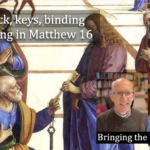
In relation to the NT, I adopted using the word ‘assembly’ to translate ekklesia in Revelation 7, following the example of Craig Koester in his Anchor Bible commentary. Using the word ‘church’ leads to the problems we can see in the picture at the top of this article, drawn from the Anjou Apocalypse tapestries. Elsewhere in the NT, where the reference is to a local gathering, or the Christians all in one place, I think congregation would do. Where it refers to the whole people of God, as in Ephesians, there is more of a challenge; I don’t think we normally consider the whole people of God in every place together as a ‘congregation’—but perhaps we should! I don’t think ‘church’ is any better.
In relation to contemporary life, it is impossible to avoid the term, and perhaps we should continue to use it for the ‘Church of England’. But we need to be clear that we should not use the same term for buildings and for people; so I would normally try and make that explicit. If you are going to use the word church for local things, use it to refer to the people, and describe the building in other terms.
 Buy me a Coffee












How about we call any small gathering of Christian’s, sheaves. Big churches, stooks and mega churches bales. Of course Anglicans could use Greek translations.
Oh, and an arch bishop could be a giant haystack
Back in the day, Giant Haystack was a wrestler.
Sounds about right for the role, then. Wrestling the wheat from the grip of the tares
In a previous “church” for similar reasons the Vicar called all “services” “gatherings.” That, he thought, was nearer the biblical picture and helped to avoid confusion.
Yes, that is a good idea.
If I were ever called to plant a new church, I think I would call it ‘The Gathering’, as it is such a theologically rich idea…
What about ‘assembly’ ?
Gathered and scattered.
Visible and invisible.
Something I found when looking at this is that qahal (the noun) is translated in the LXX not just as ekklesia but also sunagōgē. The latter seems to be used throughout Genesis to Numbers, and also Deut 5:22. However, after this in Deuteronomy it switches to ekklesia. This then seems to be found in most other books, except Jeremiah and Ezekiel (where the Hebrew noun is translated in various ways).
Did the early, Jewish Christians use ekklesia to distinguish their assemblies from the Jewish <sunagōgē.
(Hat tip to stepbible.org which makes this kind of thing fairly easy).
Thanks. That is a great observation. And Step Bible is great for that. Abbott-Smith manual Greek lexicon did this in a previous technology, giving the Hebrew terms that LXX translated by each Greek term.
I am sure you are right about that choice. But I have been surprised how rarely this issue is commented on…?
Can I ask for the source of the rather intriguing illustration at the top of your (also intriguing) post, Ian?
I reference it in the expanded final comment: the Anjou apocalypse tapestries. It has been colour enhanced (not by me). Link included above.
Thank you.
Perhaps as part of your campaign we should refer to buildings as “Steeple houses” like the early quackers did! Human nature seems to love labels and soon as a group gels it creates a name for itself which soon becomes misused. I was brought up in the “brethren” some 70 years ago (a title which nowadays would be considered inappropriate) where your sort of radical thinking was embraced heartily – we’ll have you converted one of these days!
Great term!
Not only is this a good article, but is is a remarkably useful one practically.
Thank you. I so appreciate this article – It makes sense to one who has pondered long about our identity and how best to describe who we are. I have often used the word congregation rather than Church. We are still left with the difference between buildings and the institution. For the latter I tend to think simply in terms of the People of God or sometimes “the Body of Christ.” Then one can run away on a tear of metaphorical delight! There again our English can be confusing as we will use one word for different things – for instance “bow.” Ambiguity is built into our language. Thank you, and every blessing.
thanks! Glad you found it both interesting and useful…
Most excellent, Ian!
I’ve said for some time now that ‘church’ is an identity to hold, not a place to go. Here’s my further explication:
“What is the Church?” For many (most?) the term church is just an aggregate of bodies, bucks, and buildings; an institutionalized organization with paid professionals and a tax-exempt status. However, church is not simply some place we go or some thing we do on a specified day of the week. In fact, the New Testament shows that the term “church” refers to “the people of God,” whether locally or globally expressed. Metaphors referring to church include “body” (Col 1:18), “temple” (Eph 2:20-21), “virgin” (2 Cor 11:2), “bride” (Rev 21:9), “people” (Tit 2:14), “flock” (1 Pt 5:2-4), “household” (Eph 2:19), “new humanity” (Eph 2:15), “chosen people, holy nation, royal priesthood” (1 Pt 2:9), and even “Israel of God” (Gal 6:16). Given this usage, I doubt anyone in the first century would care to ask “Where do you go to church?” Because the term “church” was and is an identity to hold, not a place to go. It’s not an event to attend, but a family to embrace. When we come to Christ in faith, we are grafted into the Body of Christ composed of “saints from every tribe and language and people and nation; [who are] a kingdom [of] priests [and who will one day] reign on earth.” (Rev 5)!
Significantly, no image for the church occurs more often in the New Testament than the metaphor of family. In fact, “the early church viewed family as their dominant relational identifier, and family is how Jesus refers to his disciples—not just the twelve, but all of them (and us) (Matt 23:8). The New Testament writers pick up on this metaphor and adopt it in their own teachings … Family is primary, but in that family, we are all equal brothers and sisters” (see Matt McKirland’s post at https://mattmckirland.substack.com/p/we-need-better-questions-for-the). This is why marriage is used so often to portray Christ (who is Bridegroom) and the Church (who is bride).
Incidentally, a good example of how certain words should simply be avoided because they produce nothing but confusion and are built on false premises. (I list some in What Are They Teaching…?) E.g., ‘reactionary’.
This is nothing to do with censorship (it is not as though anyone is suggesting penalties for using such words), it’s just challenging people to say any good that comes from using the word when the unclarity that comes from using it is clear.
This seems to me like another Anglican dilemma.
Those who have seceded from the C of E
have adopted Brethren and Brethren Hall
Congregational congregations.
Quakers Meeting house.
Salvation Army Citisales
Charismatic Temples etc. Etcetera.
Perhaps CofE might be called C in E, it seems to be heading that way by all accounts. What may be the moniker of a seceding
party next time I wonder. Remember it must describe the People
frequenting their establishments
The Roman Catholic church certainly won’t be stopping calling their church buildings churches and nor should the C of E
The Salvation Army never seceded from the CoE, except insofar as we originated as an off-shoot of the Methodist New Connection, itself an offshoot of the Methodist Church. One wonders why the reference to the CoE, which could equally be described as having seceded from the (Roman) Catholic Church….?
First, a small correction: the reworked Shema is in 1 Corinthians 8.6, not 8.4.
I’m doing some work on ecclesiology at the moment, so this is a very helpful summary of some of the lexical issues. I think it has profound implications (positive and negative) for the life and mission of the contemporary church, for example contemporary church planting. As evangelical Protestants I find our ecclesiology is often very weak, so I hope this stimulates some reflection.
Ending the use of the word church would be incredibly confusing for most ordinary people, most of whom would see it as the building and maybe with the congregation added on. As established church the Church of England in particular needs to ensure it does not confuse its parishioners.
Now you can widen the definition to include not just the congregation as well as the church building but all those who have committed to Christ as Christians if you want. However the term should remain, having a new term for church buildings would not entail huge costs in terms of changes to letterheads, signs outside etc but would also take a long time to come into common usage
However the term should remain, having a new term for church buildings would entail huge costs in terms of changes to letterheads, signs outside etc but would also take a long time to come into common usage
Ian
I am a bit bowled over by the depth of your erudition, much of which is new to me. However I would respectfully disagree with your offer of ‘congregation’ or even ‘assembly’ as alternative terminology. For one thing they have both been tried before, we had the Congregationalists as a denomination at one stage, and the Brethren always met in what they designated Assemblies, neither of which have ‘caught on’. However more importantly both terms miss out on the salient reason why (in my opinion) Paul and the other NT writers chose ekklesia as their designated terminology.
You have touched on the significance without I think recognising its importance, which in my view is because both the Qahal of Israel, and the ekklesia as assemblies in Roman society, carry an implication of “exercising authority”.
The Qahal has been described by FF Bruce as ‘Israel in theocratic assembly’, involving an implication of spiritual authority. In Roman usage an ekklesia was (to quote your article) ‘the public gathering of citizens to make decisions’.
I have published elsewhere on this point, (Olive Press Research Paper No 28; 2016), where I suggest that the common link between Kingdom, ekklesia and euangelion is a shared emphasis on designated authority. All imply coming under the authority of God in order that his authority might be exercised through us. Briefly euangelion is not simply ‘Good News’ as so often (and wrongly in my opinion) supposed, but carries powerful implications of a proclamation of a New Authority.
I have no useful suggestion to make for an alternative designation for ‘church’, but I do firmly believe the original NT usage was because ekklesia carried an extremely strong connotation of devolved authority. The church does not just ‘congregate’ (how nice!), it meets to do spiritual business. How one describes that is another question.
This quotation from Michael Frost and Alan Hirsch may further help to explain why I find ‘congregation’ or ‘assembly’ as inadequate at getting to the heart of what Paul & the NT community understood by ekklesia. They write “In its original usage an ekklesia was not just an assembly or a gathering as many suppose. If that’s all Paul wanted to convey he could have used agora and panegris, as well as heorte, koison, thiasos, and synago, all of which refer to an assembly. … In Paul’s time an ekklesia was a gathering of the council of elders of a community.”
The point Frost and Hirsch are making is that whatever it was Paul had in mind, it was something a bit more heavyweight than a mere assembly or congregation.
[ Michael Frost & Alan Hirsch “ReJesus: A Wild Messiah for a Missional Church”; Hendrickson/Baker Academic 2009; p31]
Ah, you’ve hit the spot. Paul wanted to help Christians know that they were God’s executives on earth. A supreme senate.
Thanks. But I am not sure that is true. They appear to be confusing it with the boule which was the council. The ekklesia was the gathering of all citizens, properly defined.
The brethren never did and never do meet in assemblies. The ‘congregation’ is the assembly not the building.
One of my earliest memories of being an Anglican after my confirmation as a teenager was my realising that one of the outcomes of Vatican II was that we Anglicans were recognised as an “ecclesial community”, so that the Holy See could reserve for itself the title of the (true, one and only) “Church.”
Half a century or more later I think Tyndale had the right idea – congregation does the job while side-stepping all the problems created by the diversity of meanings of the over-used term church.
Many thanks for starting the discussion, Ian.
Then that would effectively mean handing back the title of English church to the Vatican and Roman Catholicism
“Sometimes an expression has to be withdrawn from language and sent for cleaning—then it can be put back into circulation.” (Wittgenstein)
Love that comment!
One respondent on Reddit recently wrote
“I like Chapel or Parish best, specifically because in my world the church is kind of a moral grey, where many Perish.
Perhaps we should also stop using guitars in ch… er, congregation.
Aren’t they stringed instruments, mentioned the psalms for praise and lifting Holy hands?
OK but they are for plucking, not strumming.
That’s merely a style preference. It can be well/badly plucked/strummed.
Violins are sometimes plucked. Is that “wrong “? Pianos can be played classically or chordally…
What matters is whether the instrument “works” in supporting singing in its actual setting. I’ve heard classical plucking kill songs and well handled strumming aid “voices to heaven”.
Lucky you. In my experience those who can, pluck. Those who can’t, strum.
There is also a correlation with the type of music.
“Sometimes an expression has to be withdrawn from language and sent for cleaning—then it can be put back into circulation.” (Wittgenstein)
Perhaps we should withdraw the term church until it has been cleaned up morally and spiritually?
Indeed, what would Jesus say of our church as in Revelation?
[the good the bad and the ugly] He appears to say that His Church are those individuals in the midst of such places who are Overcomers.
Laodicea.
“Sometimes an expression has to be withdrawn from language and sent for cleaning—then it can be put back into circulation.” (Wittgenstein)
Perhaps we should withdraw the term church until it has been cleaned up morally and spiritually
Indeed, what would Jesus say of our church as in Revelation?
[the good the bad and the ugly] He appears to say that His Church
are those individuals in the midst of such places who are Overcomers
Who are the overcomers? GOT QUESTIONS suggests
“Overcomers are followers of Christ who successfully resist the power and temptation of the world’s system. An overcomer is not sinless, but holds fast to faith in Christ until the end. He does not turn away when times get difficult or become an apostate. Overcoming requires complete dependence upon God for direction, purpose, fulfillment, and strength to follow His plan for our lives (Proverbs 3:5–6; 2 Corinthians 12:9).
The Greek word most often translated “overcomer” stems from the word Nike which, according to Strong’s Concordance, means “to carry off the victory. The verb implies a battle.” The Bible teaches Christians to recognize that the world is a battleground, not a playground. God does not leave us defenseless. Ephesians 6:11–17 describes the armor of the Lord available to all believers. Scattered throughout this narrative is the admonition to “stand firm.” Sometimes all it takes to overcome temptation is to stand firm and refuse be dragged into it. James 4:7 says, “Resist the devil and he will flee from you.” An overcomer is one who resists sin no matter what lures Satan uses.
The Christian Fellowship Church, Bangalore has
To the Angel of the church in Laodicea write: He who overcomes, I will grant to him to sit down with Me on my throne as I also overcame and sat down with my Father on His throne. The Lord specifies that we can overcome EVEN AS HE ALSO OVERCAME in the days when He was on earth. Jesus was the first Overcomer. He is our Forerunner, Who has already overcome the world and the Devil. Thus He was exalted to sit down with the Father on His throne. Now we can overcome all of these just as He did. If we do, we too can sit with Him on His throne one day, as His Bride.
We must not forget, either, that Acts 7.38 refers to ‘the ekklesia in the wilderness’, pointing a to a continuity of faithful believers across the ages and Testaments.
Some of the more radically minded Anglican parishes in Sydney do refer to their ‘services’ as ‘meetings’. Some even hold that the church only exists in a gathered sense and when the congregation disperses the church has ceased to be until it gathers again. Quite a radical ecclesiology.
Anyway, I don’t think we hear of joining the ordained ministry being described ‘entering the Church’ any more, although equation of the priesthood with ‘the Church’ is still common enough.
While I am in agreement with Ian’s central point, I am not really a fan of ‘church’ being used as a vocative form of address as is found in some ‘renewed’ circles, where it is the fashion to say things like ‘Good morning, church’ and ‘Think of this, church’ etc. Maybe it’s just the unfamiliarity of this expression that bridles a little with me.
Doesn’t gathering sound a little like new age.
And steeple, maybe a little to geographically tethered to Steeple Bumpstead.
I don’t think it matters much and is rather late in the day to change.
I would certainly like to be more consistent. 😉
I often refer to the gathered congregation on any given Sunday as the ‘community’, the ‘gathered community’, or even ‘the fellowship’, as deliberately distinct from ‘the church’ which I tend to use exclusively of the physical building. I think our Baptist heritage helps us a little here, as the distinction between the people (the church) and the building (the chapel) has long been a feature of our union, admittedly less so over time, and so it’s not quite so jarring.
I am not saying that ‘fellowship’ or ‘community’ are baggage-free terms, but it’s certainly less clunky than ‘covenanted members’, or something a little more trad from our confessions. I was reading your article while sat outside our building earlier today, helpfully signed [PlaceName Baptist Church], and realised that if you’re right, our sign lies, as there was no human in it at the time.
We can recognise the weakness of the language we’ve inherited, but I am not so sure that I feel strongly enough about the word ‘church’ that I would invest the time into fighting against it. Of the other words you list, I think Overseer and Elder as replacements of Bishop and Priest are much more worthy of this energy, even if they’re much more intractable. Haha.
Thanks for the article.
Mat
Churches of apostolic succession like Roman Catholics, Orthodox, Lutherans and Anglicans must have Bishops
T1/Simon
All churches/congregations should have presbyteroi/elders. Biblically ‘episkopos/bishop’ is a synonym for elder and a very different concept to the kind of bishop you want, who are essentially unbiblical and therefore actually undesirable……
That is a low church Baptist view, you cannot be Roman Catholic, Orthodox, Anglican or Lutheran without having bishops
We do have ‘episcope’ in Baptist churches, it’s just that the person exercising that ‘oversight’ authority is simply one among a plurality of elders within the local church rather than a unique office elevated above it. I don’t think episcopos and presbyter are quite synonyms, but plainly they are not distinctions of form, but of function.
So the the point is not that ‘high’ churches recognise the ministry of ‘bishop’ and ‘low’ churches like the Baptists, Congregationalists etc don’t, but that we disagree about the manner in which it is expressed.
“That is a low church Baptist view, you cannot be Roman Catholic, Orthodox, Anglican or Lutheran without having bishops”
So you are quite happy for the Roman Catholic, Orthodox, Anglican or Lutheran churches to have a humanly invented unbiblical office rather than what is clearly meant by the word ‘bishop’ in the NT?
Given St Peter was first Pope as commanded by Jesus to be the rock on which to build his church and apostolic succession began with St Peter of course it is biblical
Simon, why? What is the rational for apostolic succession, and how is it continued?
The rational is that Christ anointed St Peter as first Pope and head of the apostles and the ministry of the Christian Church has continued via continuous succession to the line of succession of Bishops since then, derived from the original apostles. Continuing to the Orthodox, Lutheran and Anglican churches which replaced the Roman Catholic church in their nations as the national church and remaining in the global Roman Catholic church to this day too
No, that is not the rationale. The rationale was to ensure that the apostolic message is passed on from one generation to another by reliable teachers, who have been taught in person by the previous generation.
Your approach sounds more like magic.
Yebbut – what actual use is the ‘apostolic succession’ when it does not seem to secure consistent doctrine including adherence to the indisputably apostolic teaching found in the NT.
You might take note that I Peter is a favourite text of Anabaptists precisely because Peter’s teaching differs from post-Constantine Roman Catholicism. Following Peter’s teaching directly surely counts for something, following supposed successors who disagree with Peter seems rather pointless….
Churches of apostolic succession literally pass it on via laying on of hands from one Bishop to another
I don’t see anything in 1 Peter contrary to Roman Catholicism
Jesus literally asked Peter to be the rock on which his church would be built as first Pope, with apostolic succession continuing via laying on of hands from 1 bishop to another since.
There is nothing in 1 Peter that contradicts that
Jesus did not ask Peter to be first Pope!
Matthew 16 18-19
“18 And I tell you that you are Peter,[a] and on this rock I will build my church, and the gates of Hades[b] will not overcome it. 19 I will give you the keys of the kingdom of heaven; whatever you bind on earth will be[c] bound in heaven, and whatever you loose on earth will be[d] loosed in heaven.”
Thanks for quoting the text. I had not read it before! That always answers the question. (Sarcasm alert)
(Can you point me to the word ‘Pope’ in this text? I couldn’t see it.)
Simon
1) “Churches of apostolic succession literally pass it on via laying on of hands from one Bishop to another”
But what is ‘it’ that they pass on, given that consistency of doctrine does not seem to be part of ‘it’?
2) “I don’t see anything in 1 Peter contrary to Roman Catholicism”
I see Peter stating a very different form of church/state/world relationship to that found in post-Constantine Roman Catholicism, Orthodoxy, Anglicanism, and all the other various established or otherwise state-entangled churches; and unlike what has come from those churches, those following Peter’s actual teaching would not be involved in situations like ‘holy wars/crusades’ or persecutions like the Catholic Inquisition(s) or, say, Anglican persecutions of fellow-Christians like John Bunyan.
I’d see that as
a) Peter’s teaching seriously contradicting Romsn Catholicism, and
b) seriously questioning the value of an apostolic succession that led to Crusades/Inquisitions/etc.
As for Matt 16, Augustine interpreted that diifferently, that it was not Peter personally on whom the Church was to be built, but Peter’s recognition of Jesus as Messiah. Given the above-mentioned contradiction between Peter and the post-Constantinian Popes, I think Augustine is likely to have been right…..
Simon, could you please post your actual name, rather than the code T1 from now on? It helps the conversation. Thanks.
Why? I don’t see why anyone else needs to know my name given you already have it
Or at most I would use first name only
Because I don’t allow anonymous posting, and for most people your posts are anonymous. Please change your practice if you wish to continue commenting.
thanks
Plenty on here post using first name only, as I now will.
However you don’t have my permission to add my surname, that could be a potential data breach as you cannot give my full name on the public site without my consent so please remove it
I will remove all your posts unless you conform to my policy. I will start enforcing this strictly in future.
You allow people to comment by first name only but have now insisted on leaving my posts on here with my surname. Something I never approved and which is a breach of my personal data without my consent, please remove my surname
What Mat? Community this, community that, everything is community these days?
I don’t object to ‘community’, as while it does seem to be a modern fashion, and one enjoyed by the secular world as well, I think it captures something of the idea of a shared set of values/culture/beliefs that identify a given group of people. ‘Community’ makes the distinction about the things that unite the group, rather than a comment on their structure/organisation or polity.
Perhaps I should specify ‘Christian’ community in future? 😉
As I already said, I am not sure there is a perfect term.
In 2019 I bought from the St Andrews Bookshop in Missenden, a Liddell-Scott-Jones Greek-English Lexicon, from the library of a deceased vicar. It was in almost pristine condition (not bad for £4.50), and close examination showed it had been cracked open to one page only — that bearing the entry for ekklesia, which had some underlinings in blue biro. I suppose, having solved all the problems of ecclesiology by studying this entry, the previous owner wrote his sermon and put the lexicon back on his shelf, never to be disturbed again.
How amazing!
The second and third uses in Graeco-Roman society are especially interesting for the light they bear on the widespread argument that ‘ekklesia’ is the ‘called people’ – a view I had always been somewhat suspicious of.
As an officer of The Salvation Army, I find this blog interesting because TSA has historically been wary of the term ‘church’. We have, until very recently, preferred to describe ourselves as ‘a permanent mission’ and there are still many who insist we are a ‘movement’.
In the discussion, it seems to be somewhat overlooked that your proposal is to avoid the word ‘church’ in relation to the NT. In modern society, precisely because meanings are determined by usage, I think there is very little point in introducing alternative terms, though we need to be clear in our public discourse (and constantly remind ourselves!) that the ‘church’ is not the building, but the people of God.
One last thing on a harvesting theme. Grains are supposed on stalks. Stalks are held together in sheaves by a band of twisted stalks. Sheaves form stooks by leaning against each other for support.
Eventually all the grains enter the Barn. All the stalks end up in a haystack and the stubble is burnt.
Betel, International Harvest, Tabernacle, have all been taken up.
“Sinners” would have them coming in in droves. They may even get a Helter Skelter, a dance and Ozzy at some Establishments in England.
ok, harvest is taken; perhaps we should ‘go to the ant’ for inspiration, or termite? btw, I was within 5 miles of Steeple Bumpstead yesterday. We had just been to see Thaxsted’s nice steeple.
Who would have Adam and Eve’d it Steve?
Through Faith Missions had a dramatic sketch for children based on a water pump at Steeple Bumpstead.
I can recall it being played, involving the children volunteers, unrehearsed, at a school assembly in Tunbridge Wells.
Those were the days, my friend.
Well, what have I got from this discussion? How do we replace the static word ‘church’ with something more dynamic to reflect the way, the truth and the life within the body of Christ. Battlecruiser? something that implies it is coming to you/for you , not waiting for you to join it. not like a field station for dressing wounds— but an army with banners.
My wife was in the Faith Mission, a long time ago, complete with bonnet.
Don’t think that ever counted as a church, which raises the question, what are para-church ministries, missions, and so on? Are they not part of the ekklesia in the broadest, global sense? But we don’t call them churches.
Truly Truly An exercise in futility.
I think that in interpreting the Bible it is very important that we get right the concept of CONTINUITY between the OT and NT people of God; and right now this is very important to our understanding of the situation in the Middle East.
So far in this blog, little or no attention has been given to an important issue which emerged recently in the topic :” Does the state of Israel have a divine right to the land?” [ 30/7/25]. I made several contributions to that post and several of the issues I raised then have been raised again in this post:
First, in the paragraph in Ian’s essay beginning “That is why —-“Ian refers to Romans(9:6) that Paul is using the term “Israel” in two senses: ‘ethnic,circumcised’ Israel and ‘ true believing’ Israel —-” makes it clear it which he is using the term ‘Israel’ in these two senses. That is why he can greet all the people of God as the ‘Israel of God’ in[Galatians 6:16].
First : If he (Paul – not Ian) is using the term ‘Israel’ ‘in these *two* senses, then the next sentence does not follow logically since whatevever the interpretation is placed on Galatians 6:16, it is abundantly clear that it cannot apply to the *first* of the two senses. ‘Israel here can only refer to *believing Israel’!
Secondly, while I am in full agreement with Ian in the distinction he suggests concerning both Romans 2 and 9s I have also made the observation that Romans 9:1-5 refers to ethnic Israel ;thereby serving as an introduction to the section ending in chapter 11 . Romans 9: 1 – 5 is clearly stating that ‘theirs’ (ethnic Israel) [NIV] (ESV – “They are Israelites and to them *belong the adoption, the glory, the covenants). (Compare this with Ephesians 2: 12: “remember that you were at one time separated from Christ, *alienated from the commwealth of Israel and strangers to the covenants of promise —–) , the giving of the law —“. As CEB Cranfield makes the point : ‘it is often forgotten by Christians that unbelieving Israel is within the elect community , not outside it.’ For his ‘forgotten’, I would say ‘denied’.
I shall draw this to a close, at this point, by referring to comments made by the late Leon Morris in his commentary on Revelation (IVP). In his introduction to chapter7, he mentions the ‘meta’ [translated as ‘after’] as an interlude between the sixth seal and the emergence of the 144,000. However while acknowledging amnother ‘meta’ between their appearance and that of the great multitude, the meta is virtually ignored. Why? Perhaps it is because he wants to make the following declarations : “The Christian is the true Jew” [ Romans 2:29 – see above – totally false interpretation] and Morris continues “and the church is ‘the Israel of God’ [Galatians 6:16] . [ P 114]
This is why,beyond any other reason , would wish that ‘church’is extinguished!
Thanks. But on what basis does Cranfield claim that ‘unbelieving Israel is within the covenant community’. Isn’t Paul arguing exactly against that in Romans 2 and Romans 9.6?
Ian
Jennifer Eyl seems to be thinking on a similar wavelength when she says “contrary to almost all interpretations of Paul, the apostle is not converting but incorporating”, and voices various similar sentiments; such as “Paul is not making Christians of his pagan followers, but quasi-Judeans of his gentile followers”; “Paul’s use of ekklesia is instrumental in his effort toward the in-grafting of these gentiles … Paul’s ekklesia is an assembling of the people of the deity of Israel”.
I am not making any particular case here, simply recording her views.
[ Jennifer Eyl “Semantic Voids, New Testament Translation and Anachronism: Paul’s Use of ekklesia” in Method and Theory in the Study of Religion No 26 (2014) p321-322 ]
No-one seems to have made the obvious comment that there is a difference between the term
“congregation” and “church”. In an assembly or gathering, it is appropriate to describe those attending as a “congregation”. This includes those who are attending because it is their habit or tradition, because they have been taken there, perhaps unwillingly, by parents or guardians, because they are interested in understanding what the church is (seekers) or because they find what goes on in church encouraging or interesting philosophically in an Iris Murdoch-style way. Most assemblies will include people who belong to the one church of born-again believers. Those who manage such assemblies appear to like the ambiguity of “congregation” and “church” and it is difficult to imagine a healthy assembly without containing those currently unbelievers.
This is always a fascinating issue, as many comments show. I am in agreement with the principle Ian is espousing here, and I also teach this concept on the terminology to my seminary/graduate students. Generally, they readily agree and adjust their use of the term fairly easily, especially when using “community” (although I do not require them to do so).
I do think some of the disagreements over different terminology are telling. Whether or not one wishes to use different terms rather than “church,” it is fair to say that the term and its loss of meaning in the current time for something about the people of God rather than merely an institution creates problems. An argument can be made that it diminishes the Scriptural focus on what God’s people are and are meant to become. That alone is problematic and worth changing.
Yes it is!
You might like OpenEnglishTranslation.Bible where we’re trying to make a number of helpful improvements? e.g., https://Freely-Given.org/OBD/OET/bySec/ACT_S39.htm#V1
To add to the discussion, we can see a parallel development in the way synagogue (Greek synagoge) used frequently in the LXX for the ‘assembly’ of Israel and used 56 times in the New Testament, through usage came to refer to the building in which the Jews gathered. The Hebrew for synagoge is ‘Keneset’ – now used for the Legislature (Knesset) in Israel.
Thanks. But part of the reason for that is that, after the destruction of the temple, the place of meeting became a mini-temple to replace it (we can see that in the evaluation of synagogue design in the following centuries). For us, it is Jesus, not the building, which replaces the temple.
Unfortunately I think we won’t be able to find a good substitute for ‘Church’; but I do think that in preaching and discussion in churches we should point out the proper meaning of ekklesia and its connection via the LXX Greek with the ‘congregation’ of Israel. As I said above that is not only important about Churches but also at present in understanding the Middle East.
Perhaps I might suggest ‘salt cellar’ as a gathered name, as it underlines that the gathering is a short term learning and strengthening, and keeps the emphasis on the scattering after the gathering. We are not always very proficient at being scattered thinly, and some these days are very much more willing to have hours, days an weeks long worship and teaching sessions than to encounter the tougher harder but more biblical and more growth spurring matter of being salt and light in society.
Yes that is true. And fits with ‘the meeting place is the training place for the marketplace.’
I don’t think that week-long annual meetings are against that though—they are an occasional more intensive form.
Please note my policy of needing to give names when commenting.
Thanks Ian. Love the article. It’s a topic I’ve been arguing for years. When Jesus said “on this rock I will build my xxxxx” there’s no hint of a question from the disciples. They heard what he said and we presume knew exactly what he meant, whether from a Greco-Roman political application or their own traditions is unclear. However, I find it hard to believe that Jesus would make such a pivotal statement without a radical understanding of the word, one which “gathering” or “congregation” fails to convey. I would argue that ekklesia is designed to render a picture of the Kingdom as distinct from earthly kingdoms structured around their own ekklesia. We are the Kingdom citizens, the demos, called out to rule, wage war (spiritually), and expand the Kingdom, as was the original Athenian view under Cleisthenes. Any thoughts?
You’ll find an extended version of this on my blog (not so academic as yours I’m afraid), plus an argument against insipid understandings of the title “Christian” where I write “Why I don’t want to be a Christian any more”!
Thanks, how interesting. What is your blog address?
We find ourselves with quite a dilemma with Bible translation and man’s collection of traditions that have become sacred to the masses. There seems to be no room for scrutiny of our translated terms or their current uses. No passage or verse of Scripture teaches us to attend church for worship services. Church, purposely mistranslated from ekklesia has given folks an idea never seen in the first century or the “New Testament.” If indeed congregation or assembly is translated ekklesia in the Septugiant, it then stands to reason it should in the New Testament.
I agree about the power of tradition in translation.
But not sure about your other point? ‘No passage or verse of Scripture teaches us to attend church for worship services’.
What about the example of the apostles, breaking bread and meeting in each others’ homes, and worshipping at the temple? What about the model of the synagogue for weekly meeting? What about ‘Do not give up the habit of meeting together’ (Her 10.25)? What about ‘Do not neglect the public reading of Scripture’ (1 Tim 4.13)
We should regularly meet together. The what for is the question. I find no references calling us to come together for the expressed purpose of worshiping GOD. Worship is altogether something other than our meeting together. The main terms used in Hebrew and Greek mean prostrations before God (literally falling on our face) resembling nothing we do in our “churches” today. Jesus declaration to the woman at the well that it will no longer be at places but in Spirit and Truth in John 4. Romans 12:1-2 describes worship. When we gather together, for fellowship and maybe a meal and prayers and singing and teaching altogether for the expressed purpose of building up of one another. 1 Corinthians 14: 26. I cannot find any Scripture requiring us to attend weekly “worship services” with “order of service” all sitting in rows in front a “worship leader” and passively listening to a elevated minister on an elevated platform. Building up “one another” by encouragement and exhortation along with praying and teaching/discussing so that all are prepared for ministry. We have to learn from each other. Ephesians 4. That said, I completely agree with your response. I hope this helps you understanding my comment.