The Sunday lectionary gospel for Trinity 8 in Year C is from Luke 12.32–40, and offers a slightly odd selection of verses, in that it includes the end of one section of Jesus’ teaching—on trusting God for provision, and so being generous with our possessions—and the beginning of another, on readiness for the return of our Lord. See here and below for the video discussion of this passage.
But this selection actually raises an important question: why has Luke collected these different teachings of Jesus together, and what connects them? The opening verse ‘Fear not…’ doesn’t have any exact parallels elsewhere in the gospels, though the next few verses are close to Jesus’ teaching in Matthew 6.19–21. But the following pericope, ‘Keep ready for action with your lamps burning’, or more literally ‘Let your loins be girded about…’, is unique to Luke. Then from verse 39, ‘But know this…’, we run parallel to Matt 24.43–44. The fact that, within a few verses, we find parallels from near the beginning and near the end of Matthew’s gospel shows us either how diverse this material is—or perhaps how the questions of lifestyle and eschatological expectation are more closely related than we are accustomed to thinking.
The language of ‘fear’ (Luke 12.32) has a range of connotations, as we see elsewhere when the fear of others is contrasted with the fear of God (for example, in the contrast between fear of those who might execute Jesus’ followers and the fear of God in Matt 10.28). Here, though, the contrast is between fear as anxiety about physical and practical needs, and trust in God who has already provided all that we need in the gift to us of the kingdom of God.
It is striking that Jesus characterises his followers as a ‘little flock’, so that God is the Father-shepherd of his people. Thus, in his teaching in John 10, Jesus is not only a shepherd in contrast to the failed shepherd-leaders of Israel, but also a shepherd caring as his Heavenly Father does for the flock. And where we might expect Jesus to appeal to a source of authority, perhaps by quoting the Scriptures, in fact he appeals only to his certain knowledge of the will and intention of his Father. It is Jesus himself who reveals to us the Father’s compassion and provision.
The language claiming that God ‘has been pleased to give you the kingdom’ might suggest that this event has already passed, and that the kingdom is now fully present—particularly in the ministry and teaching of Jesus (compare Luke 11.20). In fact the grammar highlights not the act of giving but the act of decision; it is God’s settled will to have already decided to give the kingdom to those who would receive it, an idea we find even more explicitly in Matthew’s eschatological parables, ‘the kingdom prepared for you from the foundation of the world’ (Matt 25.34).
The command to ‘sell your possessions’ sounds radical, demanding and unavoidable. Yet it isn’t quite as absolute as it first appears, since (in contrast to Jesus’ instruction to the rich young man in Luke 18.18–30) he is not here telling us to sell everything but to be radically generous. In fact, for some this will mean leaving everything, as Simon Peter did after the miraculous catch of fish—and it is difficult to avoid seeing the connection between this command and the actual practice of the community of Jesus’ followers in Acts 2.45 as well as of individuals like Barnabas in Acts 4.36–37.
It is very easy for us to miss the radical reinterpretation of gift-giving and generosity that these verses imply for Luke’s first readers. In Roman culture, to give a gift meant to put someone in your debt—as it still does in some cultures today. The gift-giver would then be owed loyalty, allegiance, political support, or perhaps a reciprocal gift. The striking thing in Jesus’ teaching is that the debt that is owed has already been paid by God; the obligation has been fulfilled by his generosity in giving us the kingdom. If we owe a debt of obligation to God because of his gift-giving, then we pay it forward rather than paying it back, by giving to others without demanding anything in return.
In verse 33, we see that the kingdom we have been given is a treasure, a precious and costly gift from God, which we eventually learn is paid for with the price of Jesus’ own life. This idea of kingdom as treasure is made explicit in Matt 13.44 where a man finds a trove of treasure buried in a field—but it is a vital key to interpreting other parables of the kingdom, such as the parable of the ‘talents’. The ‘talents’ here are not our abilities to play guitar, bake cakes, do strategic planning or other trivial skills (our word ‘talent’ meaning ‘ability’ has been coined by a strange kind of back formation from this parable), but, being actually half a kilo of silver, represent this costly treasure of the kingdom.
Summarising his teaching in this pithy aphorism, ‘Where your treasure is, there will your heart be also’, is not telling us what ought to happen, but what is the case in real life. Whatever we see as really valuable, that is where we will put all our energies and interests. So if we want to see what it is we really value, then we just need to do an inventory of what attracts our attention and to what we give our time and money.
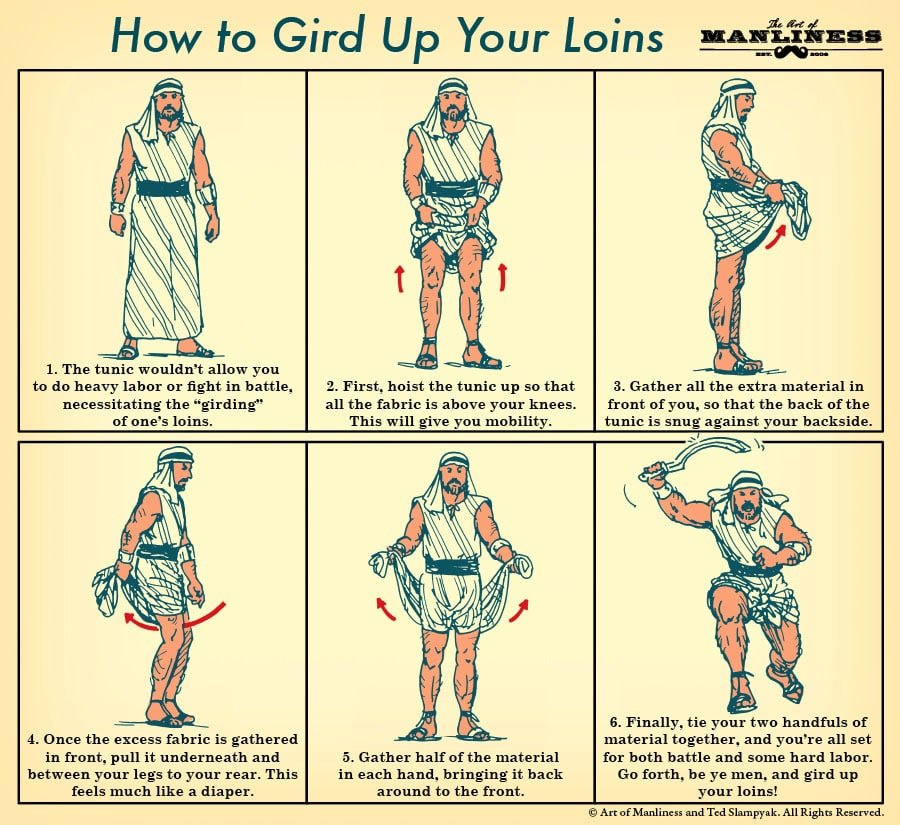
There appears to be a break and a change of orientation and subject matter from Luke 12.35. The rather weak equivalent ‘Be dressed and ready for service’ (NIV) is much less dramatic than ‘gird up your loins!’, translating the literal phrase ‘remain with your loins clothed around’. The act of hoisting up long robes that went nearly to the feet, as helpfully illustrated above, and tying them up around the loins or waist, was an essential preparation for any practical task, including both fishing and warfare, and it is mentioned frequently as a literal action throughout the OT. But there is a particular allusion here to Exodus 12.11, where the people are to be in a state of readiness to flee Egypt once the angel of death has passed over them. This connects with other Exodus motifs in Luke, including in the Transfiguration where Moses and Elijah talking with Jesus about his coming ‘Exodus’ which will be achieved in Jerusalem. It is also one of the many links between Luke and the Book of Revelation, which is replete with Exodus imagery. It means that we are to live ‘on-the-brink-of-deliverance’ lives, as we see the beginnings of the realisation of our complete deliverance from sin and death and pain, both in the present foretaste of the gift of the Spirit and as we anticipate its completion on the return of Jesus.
The connection with the Spirit is hinted at in the parallel command to ‘keep our lamps burning.’ John the Baptist promised that Jesus would baptise us with the ‘Holy Spirit and fire’; the Spirit in Acts 2 comes as tongues of fire; in the parable of the virgins in Matt 25, the oil for the lamps appears to signify the poured-out Spirit; and Revelation takes up imagery from Zechariah to describe the Spirit as burning lamps before the throne of God and the lamb.
There follow three images of waiting and expectation, of which the first two are in our set reading. None of them quite fits with the others, but all emphasise the two needs of readiness and patience; the one coming will certainly come, but there might well be some delay before that happens.
In the first, the image of wedding banquet is rather reversed; the Lord in this story is returning from a wedding banquet, rather than going to one. Nevertheless, when the Lord does return, it appears that he brings some element of feasting and celebrating with him, since he undertakes a radical role reversal, and himself waits on the servants (or slaves) whom we might expect to be waiting on him—that would certainly be their expectation! The image of the Lord knocking on the door and the servants inside quickly opening it to him connects with the image of Jesus at the door in Rev 3.20, and is a reminder that there, and elsewhere, the language of ‘coming’ is not exclusively reserved for Jesus’ final return, but also includes the idea of God coming in both blessing and judgement within history, in anticipation (and as a foretaste) of that final and complete blessing and judgement at The End.
In Jesus’ original context, the language of ‘slaves’ would not necessarily conjure up the full social implications of Roman slavery, since Jews were generally less accepting of the practice; it is notable that in Luke 15.17 the father has misthoi, paid workers, and not douloi, slaves. But for Luke’s readers, the idea of a slave-Lord stooping down to serve his slaves would offer a radical overturning of everything that they knew about slavery. At the Last Supper, Jesus ‘comes among you as one who serves’ (Luke 22.27), service that involved the actual duties of a slave in John 13 as an image of his giving up his life for both them and us.
The observation that the Lord might come soon or after some delay, even at the last possible moment, ‘toward daybreak’, is one of many indicators that the early Jesus movement wasn’t simply in the grip of imminent expectation, whose failure to happen provoked a major theological crisis. All these texts of expectation carry with them an equal and complementary focus on the need to be patient, and persist in a state of readiness as an orientation towards life as a whole. We never know when we might see God break in and act dramatically in our own lives and the lives of those around us—or when we might meet him in death.
The shift to the quite different image of the thief breaking in at night offers a verbal connection with the mention of a thief earlier in Luke 12.33, but the sense and meaning of the illustration is quite different. There is no need to think that the analogy means that Jesus is himself like a thief; analogies and metaphors offer us a partial and not a total predication or identification. The point here is that, when you are not prepared, then you are taken off your guard by the unexpectedness of what is going to happen. The same point is made by Jesus in Matt 24.38 drawing on the story of Noah and the ark; when Jesus comes, many will be preoccupied with the routines of life, and will not see him coming.
The analogy of Jesus’ return being ‘like a thief in the night’ occurs here, in the parallel in Matt 24.43, in 1 Thess 5.2, in 2 Peter 3.10, and in Rev 3.3 and 16.15. It would be hard to find another such precise idea in such a diverse range of NT texts—by any sceptical measure, this phrase is at the bedrock of historical certainty as a faithful record of Jesus’ teaching. This is all the more striking in view of the other basic paradox: this thief in the night is actually the day of the Lord, when all things that are hidden will be revealed and brought to light. This paradox was rather neatly summed up by my hero the late David Watson, when he said boldly: ‘For those who are ready, he will not come as a thief in the night but as a friend in the day’.
There are, in fact, verbal connections all the way through this different sections, parables, and aphorisms. The treasure of the kingdom is contrasted with the wealth of the rich fool, and the readiness of Jesus’ followers contrasts with the fool’s lack of readiness to meet his maker. But perhaps the strongest connect of all is the relentless theocentrism of these sayings—the challenge to focus on God rather than on our own concerns and needs. When we focus on God first, then he and his kingdom become our treasure, and this frees us from anxiety into a life of generosity and grace. And when we focus on the coming of the kingdom in the return of Jesus, then our anxieties about what is happening in the world around us find a new perspective.
(The illustration at the top of this article is from the site The Art of Manliness; you can find other helpful images like this in the book The Illustrated Art of Manliness.)
Come and join James and Ian as they discuss all these things, and what they mean for our reading of and preaching on this passage.
 Buy me a Coffee















It never ceases to amaze me as to how, what is described a bible study on a particular passage, is almost immediaely reorientated in a different direction.You rightly point out Ian that as a lectionary reading it comprises a ” slightly odd selection of verses”; a selection that I have to deal with shortly for this coming Sunday. I look forward to perusing your comments above!
Yes “Gird up your loins is the way to go”for those that know that
The kingdom of God
Trawling through various commentators I came across the following {references at end of piece.}
The Hebrew word chagar -girding your loins
chagar: to gird, gird on, gird oneself.
Part of Speech: Verb of Action that became a Hebrew idiom.
It is a major theme of the Bible. From proverbs 31, to battle cries, to gentle words of Jesus, and finally eschatological promises; these words have great significance to those in covenant. Today much of the meaning has been lost in translation.
The term is first mentioned in Exodus 12 when the instructions were given for the Passover and preparation for the Exodus.
It became an action verb like none other for Israel. It was a Hebrew idiom that bore great significance to Israel that they should be ready at any moment to follow the Lord with all they were. Like many Hebrew idioms the chant “chagar” literally become a one word sermon on being ready.
Throughout Israel’s history this would become a household family and military chant or reminder that would lead them to battle and most great things that was rooted in the idea of simply doing what was asked in the waiting before the Lord,
, and giving them to Yahweh in sacred devotion that He might not only go before you, but that he might completely bring you victory. That complete victories were only of God (or later Jesus) and not at all through you yourself. That in emptying yourself in complete humility Jesus meets your humble sacrifice and does immeasurably more than you ever prayed or imagined.
One commentator says “This is the 44. That you bring a complete (22) offering of all you have to offer and God doubles the portion. Takes the number of completeness 22 and doubles it to 44 which is actually the sign of innumerable strength… thus the 144,000 it later represents as the faithful remnant that knows no boundary.
(NOTE: Some people are aware of the theological notion that God intended to literally fight every battle for Israel just like he defeated the Egyptian army in the closing of the Red Sea. That Israel wasn’t ever supposed to actually fight. In this way, when the Israelites did physically fight it was actually a sign of not totally trusting God.)
In war time as the Israelite soldiers rallied for battle and chanted KHAW-GAR as they pounded their spears to the ground, their hope and prayer would be that God would completely fight the battle. That should be the way that we also gird up. That is why Paul makes the connection to rather gird up your mind for prayer rather than the physical. If you can mentally and spiritually give something to God, the end result is that your faithfulness results in little to nothing of yourself and all of what Jesus does. Similar to an ancient Israelite battle you might only be intended to be the cleanup crew that through God enabled or brought healing!
It is likely the same word that Jesus declared (in Hebrew) over his disciples in Luke 12 ““Be dressed ready for service and keep your lamps burning, 36 like servants waiting for their master to return from a wedding banquet”
In Hebraic culture preparation for weddings and wars meant you were ready to give of your life, the ultimate sacrifice and act of humility for another. This is the Exodus motif connected throughout all of scripture.
The NRSV translates Job 38:3a as Yahweh saying to Job [from a whirlwind], “Gird up your loins like a man
The Hebrew written is this: “’ĕ·zār-nā ḵə·ḡe·ḇer ḥă·lā·ṣe·ḵā,” which is rooted in “azar,” “geber,” and “chalats” or “gird now like a man loins.” Because Yahweh was not talking to the physical “man” that was Job, there should be nothing physical being the advice here. The soul of Job is masculine essence, simply because we know Job was an “upright” man. That says he was masculine in essence, not in physicality. Therefore, Job was not a physical “man,” his soul had no “loins,” thereby his soul could not wear clothing of any nature, This reality means one needs to see the spirituality that comes from those word in Hebrew.
The flexibility of Hebrew says many words cannot only translate to one English word. In the case of “azar,” it has the flexibility to translate as: “encompass, equip” (Strong’s), with the figurative possibility meaning, “girded with might.” (Brown-Driver-Briggs) The BibleHub Interlinear shows the usage to be “prepare,” which gives the impression to protect.
The Hebrew word “geber” has the flexibility to mean: “every one, man, mighty.” (Strong’s Exhaustive Concordance) That source says the word comes from “gabar,” which means “a valiant man or warrior,” with “warrior” being one translation found elsewhere in Scripture.
The Hebrew word “chalats” has the flexibility to mean, “the loins (as the seat of vigor). (Brown-Driver-Briggs). Still, it reflects “strength,” as a “seat of virility” in men and a “seat of pain” in women experiencing labor pains in childbirth. BibleHub Interlinear translates this word as “yourself,” presumably because a “self” is a “soul” and a “soul” is the “seat” or “loins” of a human body of flesh.
This flexibility means the same words that have been translated as “gird up your loins like a man,” equally says, “protect your soul like a warrior.” This means the Holy Spirit of God is the “warrior supporter,” when the “warrior” is an Apostle or Saint.
The reading from Job is an optional reading on the fourth Sunday after Pentecost, where the two other Old Testament readings are of David facing Goliath and David eluding the spear of Saul, after he became possessed by an evil spirit. The soul of David was protected like a warrior of Yahweh;
In the “ideal” woman depiction in Proverbs 31, we read, “She girds her loins.” If you are reading the ESV, it is translated as “she dresses herself with strength,”
the overall meaning of the word “chayil,” the Hebrew word translated as “virtuous” in Proverbs 31:10.
Cf. See also Jesus saying “virtue has gone out of me “when the sick woman touched the hem of his clothes.
. It is also used as a symbol of humility form in the father in greeting His lost son in the prodigal son parable. An esteemed elderly man would not typically run or show his legs, this was what young men did. It is a picture of Christ taking a role of ultimate humility to save us from the kazazzah or the “pot breaking ceremony”, we should have rightly received after the son disavowed his inheritance and left.
The idiom or chagar chant should bring you to freedom in Christ. To accept being recreated (kainos) as a royal priesthood that lives in freedom and is ready to bring others to this freedom in Christ as those that live in ancient intimate covenant to pledge an allegiance to the kingdom and represent the king that goes before them.
To live humbly as temples of the Holy spirit in devout consecration to your mission. That you and your family might be living sacrifices that are enumerable in your vocation to represent the king of kings as His ambassador to dark and hurting world. To function as agents that bring order to chaos and healing to brokenness.
Yet, as we wait for Christ to consummate all things, we find that our situation is not entirely different from that of the old covenant saints. We too have a race to run with endurance. We too have to gird uup our loins and cast aside sins that hinder us so that we will cross the finish line (v. 1).
We will only be able to do this if we look to Jesus who is the “founder and perfecter of our faith” (v. 2). We must keep the eyes of faith upon our Lord and look to nothing else or we will not endure.
we demonstrate that Jesus has given us faith and that He perfects it only as we exercise this faith in the midst of adversity. Jesus is our example of what it means to persevere, for He, looking to the joy that would come, endured the suffering of the cross and is therefore now seated at the right hand of God (v. 2). He was obedient to God in the midst of the worst suffering imaginable. Therefore we too must be obedient if we call Him Lord.
The glorious Gospel of the sons of God will be found that through
consecration we find that it is mainly Christ who serves us far more than our serving Him loading us with his riches of Mercy,
Grace and Glory!
expedition44.com
chagar // girding your loins
katrinapearls.com
Gird your loins like a man
https://www.fruitfullyliving.com/gird-up-your-loins/
Alan, are you really recommending katrinapearls.com? Why?
Apologies folks for repeat! I did not realize that Ian had begun a new comments thread.
George Herbert?
Yes, he said it all in 3 short verses with the poet’s gift of brevity and theological insight. Simone Weil said it was the greatest religious poem ever written.
The theme of this passage seems to be
Readiness and Watchfulness whilst Waiting.
It is interesting to note that, in the words of Jesus
in the Gospels, His return is sudden, un-signaled and uncertain as to time.
According to the Bible, specifically Matthew 24:36, Jesus stated that no one, including himself, knows the exact day or hour of his return, only the Father knows.
The Bible emphasizes that the timing of Jesus’s return is not meant for humans to know.
The Bible emphasizes that God the Father is the only one who knows the timing of the Second Coming.
The lack of specific knowledge about the timing is meant to encourage believers to live in constant readiness and watchfulness, rather than trying to calculate the time or date.
All of which leaves me to wonder if this might be a caution to those who have the end time events game plan already sorted.
Hi Bruce
I am not recommending anyone. I did point out that I did a trawl through commentators on the subject of “Gird up your loins”
What is your problem with that?
Shalom.