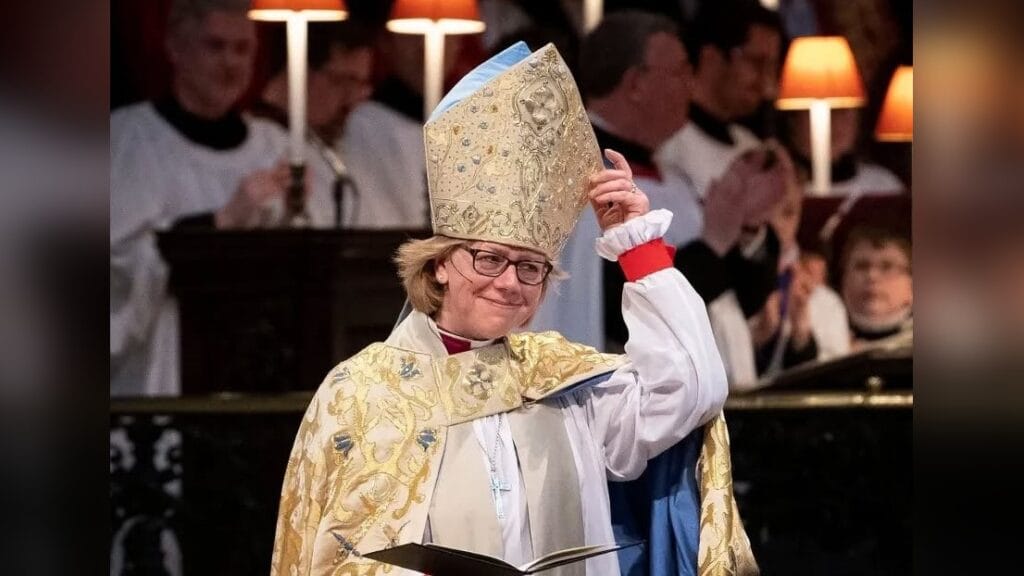
Martin Davie writes: The announcement of the choice of the Bishop of London, Dame Sarah Mullally, to be the next Archbishop of Canterbury has been accompanied by frequent references to the Archbishop of Canterbury as the ‘head of the Church of England’ or the ‘head of the Anglican Communion.’ In this post I shall explain why both of these statements are misleading, what roles the Archbishop of Canterbury actually has in the Church of England and the wider Anglican Communion, and the implications of the fact that these roles are very limited.
What do we mean by ‘head?’
When thinking about these topics, the first thing we need to be clear about is what we mean when we say that someone is the ‘head’ of something. When we use the word head in this connection we are using analogical language. An analogy is being drawn between the role of the head (and more specifically what is inside the head, the brain) in the human body and the role of an individual in a particular organisation.
The analogy is between the role of the brain in determining how a human body shall act and the role of an individual in determining what happens in an organisation. Calling some the head in this way (as in the terms ‘head of state,’ ‘head teacher’ and ‘head of the armed forces’ ) means that they are the person who has the authority and ability to govern the life of the state, the school, or the armed forces. They have the right to say what will happen.
By extension, when it is said that the Archbishop of Canterbury is head of the Church of England or the Anglican Communion, what is being claimed is that the Archbishop of Canterbury has a similar governing authority over these bodies. The problem with this claim is that it is untrue for three reasons.
Reason 1 This is not a claim that is officially made by either the Church of England or the Anglican Communion.
A study of the official documents of the Church of England and the Anglican Communion shows that neither body describes the Archbishop of Canterbury as their head.
Thus, the ‘Governance’ page of the Church of England’s website describes the Archbishop of Canterbury as ‘the most senior bishop of the Church.’ It does not say that the archbishop is head of the Church of England. In similar fashion, the Anglican Communion website states that the Archbishop of Canterbury is ‘is a focus of unity and has pastoral responsibilities in the Anglican Communion.’ It does not say that the archbishop is head of the Anglican Communion.
If we ask why neither the Church of England nor the Anglican Communion describes the Archbishop of Canterbury as their head, the answer is that there are two further reasons for not doing so.
Reason 2 The Archbishop of Canterbury is not Jesus Christ.
The Church of England and the Anglican Communion are both parts of the one, holy, catholic and apostolic Church to which all Christians belong. Thus, Canon A1 of the Canons of the Church of England declares that:
The Church of England, established according to the laws of this realm under the King’s Majesty, belongs to the true and apostolic Church of Christ.
and Principle 10:1 of The Principles of Canon Law Common to the Church of the Anglican Communion likewise declares:
The Anglican Communion is a fellowship of Churches within the One, Holy Catholic and Apostolic Church.
This is relevant to the issue of the role of the Archbishop of Canterbury because the New Testament is clear that the Church that is one, holy, catholic and apostolic is the body of Christ of which he alone is the head.
[God] has put all things under his feet and has made him the head over all things for the church, which is his body, the fulness of him who fills all in all. (Ephesians 1:22-23]
Rather, speaking the truth in love, we are to grow up in every way into him who is the head, into Christ, from whom the whole body, joined and knit together by every joint with which it is supplied, when each part is working properly, makes bodily growth and upbuilds itself in love. (Ephesians 4:15-16)
For the husband is the head of the wife as Christ is the head of the church, his body, and is himself its Saviour. (Ephesians 5:23)
He is the head of the body, the church; he is the beginning, the first-born from the dead, that in everything he might be pre-eminent. (Colossians 1:18)
What these verses tells us is that Jesus Christ alone is the head of the Church as the one who rules over the Church, cares for it, and enables it to reach that state of spiritual maturity which God wills for it. [See the end of this article for an important note on the meaning of ‘head’ in the New Testament and today.]
In the words of Bishop John Jewel in his Apology for the Church of England, what these verses tell us is that the Church:
…is the kingdom, the body and the spouse of Christ; that Christ alone is the prince of this kingdom; that Christ alone is the head of this body; and that Christ alone is the bridegroom of this spouse (John Jewel, An Apology for the Church of England, in Works, Vol III (Cambridge: CUP, 1848), p 59).
In consequence we have to say that neither the Archbishop of Canterbury, nor anyone else, can rightly be described as ‘head’ of the Church of England or the Anglican Communion. That post is already occupied by someone else.
Reason 3 the roles performed by the Archbishop of Canterbury in both the Church of England the Anglican Communion are strictly limited.
If we look at the relevant documents, what we find that the jurisdiction of the Archbishop of Canterbury, that is the authority they have to act as a bishop, is limited both geographically and in terms of the roles allotted to them.
The Church of England
In terms of the Church of England, the Canon which governs the ministry of the Archbishop Canterbury, and also that of the Archbishop of York, is Canon C17 which runs as follows:
1. By virtue of their respective offices, the Archbishop of Canterbury is styled Primate of All England and Metropolitan, and the Archbishop of York Primate of England and Metropolitan.
2. The archbishop has throughout his province at all times metropolitical jurisdiction, as superintendent of all ecclesiastical matters therein, to correct and supply the defects of other bishops, and, during the time of his metropolitical visitation, jurisdiction as Ordinary, except in places and over persons exempt by law or custom.
3. Such jurisdiction is exercised by the archbishop himself, or by a Vicar-General, official, or other commissary to whom authority in that behalf shall have been formally committed by the archbishop concerned.
4. The archbishop is, within his province, the principal minister, and to him belongs the right of confirming the election of every person to a bishopric, of being the chief consecrator at the consecration of every bishop, of receiving such appeals in his provincial court as may be provided by law, of holding metropolitical visitations at times or places limited by law or custom, and of presiding in the Convocation of the province either in person or by such deputy as he may lawfully appoint. In the province of Canterbury, the Bishop of London or, in his absence, the Bishop of Winchester, has the right to be so appointed; and in their absence the archbishop shall appoint some other diocesan bishop of the province. The two archbishops are joint presidents of the General Synod.
5. By ancient custom, no Act is held to be an Act of the Convocation of the province unless it shall have received the assent of the archbishop
6. By statute law it belongs to the archbishop to give permission to officiate within his province to any minister who has been ordained priest or deacon by an overseas bishop within the meaning of the Overseas and Other Clergy (Ministry and Ordination) Measure 1967, or a bishop in a Church not in communion with the Church of England whose orders are recognized or accepted by the Church of England, and thereupon such minister shall possess all such rights and advantages and be subject to all such duties and liabilities as he would have possessed and been subject to if he had been ordained by the bishop of a diocese in the province of Canterbury or York.
7. By the laws of this realm the Archbishop of Canterbury is empowered to grant such licences or dispensations as are therein set forth and provided, and such licences or dispensations, being confirmed by the authority of the King’s Majesty, have force and authority not only within the province of Canterbury but throughout all England.
What this Canon tells us is that as well as having the normal responsibilities of a diocesan bishop (what is known as ‘ordinary jurisdiction’) within their own dioceses of Canterbury and York, the two archbishops have a number of additional responsibilities.
First, to exercise general oversight over the dioceses and bishops in their province and to exercise jurisdiction in a diocese when they undertake a visitation within it (paragraphs 2-3). This is known as ‘metropolitical’ jurisdiction because it is jurisdiction which belongs to the diocesan bishop of the chief city (or ‘metropolis’) of a province of the Church, in this case Canterbury or York.
Secondly, to confirm the election of bishops, act as the chief consecrator of other bishops, and receive such legal appeals as are specified by law (paragraph 4). The point of the reference to the election of bishops is that when a new diocesan bishop has been chosen by the monarch the person concerned is then formally elected to the post by the Dean and Chapter of the diocesan cathedral. The responsibility of the archbishop is to confirm that this election has taken place.
Thirdly, to act as the presidents of the General Synod and to give or refuse assent to Acts of the Convocations of the Provinces of Canterbury and York (paragraphs 4 and 5). The Convocations are the ancient provincial synods of the provinces of Canterbury and York. They consist of two Houses, the Upper House consisting of the diocesan bishops of the province plus ex officio (in the case of Canterbury) and elected suffragan bishops and the Lower House consisting of the elected representatives of the other clergy. The Convocations have the right to pass Acts of Convocation which have moral but not legal force and these Acts only have validity if the archbishop of the province gives assent to them. Since 1970 the two Convocations, plus the Houses of Laity of the two provinces. have met together as the Church of England’s General Synod and just as the archbishops have traditionally presided over the meetings of their Convocations, so also they act as the presidents of the joint General Synod.
Because they are the presidents of the General Synod the archbishops are also the joint presidents of the Archbishops’ Council, the national body which was established in 1999 to ‘co-ordinate, promote, aid and further the work and mission of the Church of England’ and which is also Central Board of Finance for the Church of England.
Fourthly, to give permission to clergy ordained by bishops outside the Church of England to serve as clergy in their province (paragraph 6).
Fifthly, to grant certain licenses and dispensations (such as an archbishop’s licence allowing a couple to marry in church) (paragraph 7).
What all this means is that while the Archbishops of Canterbury have important responsibilities both within their provinces and nationally this does not mean that they have governmental authority over the Church of England as a whole. They cannot tell The Archbishop of York what to do, they cannot tell their fellow bishops, except in the case of the suffragan bishops of the Diocese of Canterbury, what they should do, and they cannot tell the Church of England nationally what it should do.
The Anglican Communion
If we turn to the Anglican Communion, we find that the Archbishop of Canterbury has jurisdiction as archbishop in five overseas Anglican churches:
- The Anglican Church of Bermuda, led by the Bishop of Bermuda
- The Church of Ceylon, Sri Lanka, led by the Bishop of Colombo
- The Parish of the Falkland Islands, led by the Bishop of the Falkland Islands (a post currently held by the Archbishop of Canterbury)
- The Lusitanian Catholic Apostolic Evangelical Church (Igreja Lusitana Católica Apostólica Evangélica) in Portugal, led by the Bishop of the Lusitanian Church
- The Spanish Reformed Episcopal Church (Iglesia Española Reformada Episcopal) in Spain, led by the Bishop of the Spanish Reformed Church
Except in the case of the Falkland Islands, the archbishop does not have ordinary jurisdiction in any of these churches but has the same sort of limited metropolitical jurisdiction as they have over the dioceses in the Province of Canterbury.
In addition to having jurisdiction over these five churches, the Archbishop of Canterbury has traditionally also acted as a personal ‘focus of unity’ for the Communion with all the churches of the Communion being in communion with the archbishop. The archbishop also convenes and chairs the Lambeth Conference and the meetings of the Anglican Primates and is the president of the Anglican Communion Council. However, the Archbishop of Canterbury does not have the power to determine the teaching or practice of the Anglican Communion as a whole. These are determined on a collegial and communal basis by the Lambeth Conferences, the Primates’ meetings and the meetings of the Anglican Consultative Council.
What this means is that just as the Archbishop of Canterbury does not have governmental authority over the Church of England as a whole, so also the Archbishop of Canterbury does not have governmental authority over the Anglican Communion as a whole. The archbishop cannot tell the Communion what to do.
The implications of the limited role of the Archbishop of Canterbury
The fact that for the reasons set out above the Archbishop of Canterbury cannot rightly be described as the ‘head’ of either the Church of England or the Anglican Communion mean that we should not think that the future well-being of either the Church of England or the Communion depend on how the new archbishop exercises her archepiscopal ministry.
First, as we have seen, she will not have the legal power to determine what happens in either the Church of England or the Anglican Communion. To reiterate, she will not be able to tell the Church of England or the wider Communion what they must do. That will not be in her power.
Secondly, even if she did have the legal power to tell the Church of England and the Anglican Communion what to do, her actions would not be able to determine the future of either body. That prerogative, the prerogative of building the Church belongs exclusively to the one who is the head of the Church, namely Jesus Christ.
In the words of the great German Lutheran Theologian, Dietrich Bonhoeffer in a sermon on Matthew 16:13-18:
… it is not we who build. He [Christ] builds the church. No human being builds the church but Christ alone. Whoever intends to build the church is surely well on the way to destroying it; for he will build a temple to idols without wishing or knowing it. We must confess-he builds. We must proclaim—he builds. We must pray to him—he builds. We do not know his plan. We cannot see whether he is building or pulling down. It may be that the times which by human standards are times of collapse are for him the great times of construction. It may be that from a human point of view great times for the church are actually times of demolition. It is a great comfort which Christ gives to his church: you confess, preach, bear witness to me, and I alone will build where it pleases me. Do not meddle in what is my province. Do what is given to you to do well and you have done enough (Dietrich Bonhoeffer, No Rusty Swords (Glasgow: Fontana, 1977), p 212).
However, as Bonhoeffer declares, both the new archbishop and every other member of the Church of England and the Anglican Communion do need to do well the tasks that God has given each of us to do.
In the case of the new archbishop, this means that she will need to seek to do as well as she can the specific tasks she has to perform as Archbishop of Canterbury in fulfilment of the promises she made when she first became a bishop and will make again when she becomes an archbishop.
In the case of the rest of us, we need to pray for her that God will enable her to do this, obey her if she asks us to do things which she has the proper authority to ask us to do (Hebrews 13:17), and get on with performing as well as possible the specific roles that God has asked each of us to perform within the body of Christ (1 Corinthians 12:12-26).
In summary, we must neither overestimate nor underestimate the importance of the new role which Dame Sarah Mallaly has been selected to perform. We must pray for her that she will perform this role well and for ourselves that we will do well that tasks that God has asked us to do which are, in the economy of God, equally important for the well being of the Church.
 Dr Martin Davie is a lay theologian who is a fellow of the Latimer Trust and theological consultant to the Church of England Evangelical Council. The main body of this article was previously published on Martin’s website here.
Additional note: Ian Paul writes: Martin Davie is quite right to note the metaphorical way we use the term head in our cultural context:
When we use the word head in this connection we are using analogical language. An analogy is being drawn between the role of the head (and more specifically what is inside the head, the brain) in the human body and the role of an individual in a particular organisation.
The analogy is between the role of the brain in determining how a human body shall act and the role of an individual in determining what happens in an organisation. Calling some the head in this way (as in the terms ‘head of state,’ ‘head teacher’ and ‘head of the armed forces’ ) means that they are the person who has the authority and ability to govern the life of the state, the school, or the armed forces. They have the right to say what will happen.
The analogy (or metaphorical use of the term) draws on contemporary understandings of physiology: our head contains our brain which controls what the body does. Hence we naturally think of ‘head [teacher]’ as the one ‘in control’ or ‘exercising authority over’.
In the ancient world, however, understanding of physiology was quite different. The brain was at times understood to have the function of cooling the blood (hence your face goes red when you are hot), and of being the place where semen went for fertilisation (and hair draws the semen, hence women have long hair on their head, and hairless bodies, whilst men have short hair on their head, and hairy bodies).
The head itself was the source of life, not the centre of control; when you chop someone’s head off, they don’t go out of control, they drop down dead. And it signified social prominence; we still say ‘we look up to’ someone we respect. Control belonging in the heart, which was believed to be the centre of decision-making—not the centre of emotions (as we tend to use it metaphorically) which belonged in the guts or bowels.
So we need to read the NT language of ‘head’ as metaphor in this very different cultural context. It is worth noting that Aristotle does not ever refer to men as ‘head’ of the household but as its ruler (and believes it is in their nature to rule over women and children, as it is in the nature of a king to rule over his subjects). The NT writers appear to clearly reject this understanding; their ‘head’ language does not reflect this view.
And it is striking that the Hebrew OT *does* use ‘head’ (Hebrew rosh, רֹאשׁ ) metaphorically for ‘leader’, but the Greek OT, LXX, almost without exception translates this with archon, ruler, since the metaphor of ‘head = authority’ does not work in 2C BC Greek.
(For more detail on the mean of ‘head’ as a metaphor, see this study.)
None of this affects what Martin here says about the role of the archbishop. When we talk about someone being ‘head’ of an organisation, we do use the modern metaphorical sense of being in control of or having authority over. But we cannot read that back in the New Testament, either when it talks about Jesus as ‘head’ (he is Lord of his church, which is language of authority) or when it talks of husband as ‘head’ of the wife. (In 1 Cor 11.2, the idea that God has ‘authority’ as head over Christ is an ancient heresy believing there is hierarchy in the Trinity, and is contradicted and corrected by the language of the Nicene Creed.)
 Buy me a Coffee





If the ABC can’t actually do much to change things then why have one?
Well, as I noted before, no-one appears to have missed not having one.
Of course the other point to make is that if the Archbishop doesn’t make any difference in the Anglican Communion, why would the Global South provinces not want to be in communion with Canterbury?
You’re asking the wrong question. Why would they *want to?, is the actual question. It made sense in the old days of patronage and Empire, when England trained the clerics and sent out missionaries, and world Anglicanism really was a communion, with the same doctrine and interchangeable ministry.
When the Anglican churches of the old white former colonies like America, Canada and New Zealand decided unilaterally to change their sexual ethics and ministry, they made it clear that nationalism and provincial autonomy were their guiding principles, not a transnational commitment to act together. That’s what it means to be a Communion, and is the reason why the Roman and eighteen or so Eastern Rite Catholic churches are a Communion, and the Orthodox Churches are a Communion, but Anglicanism no longer is.
The best you can hope for now, Andrew, is a liberal federation of the Anglican churches of the old white former colonies, along with England, Scotland and Wales. Not a Communion, more of a club.
But the Americans will not be told what to do or believe, least of all by the English.
The position is currently that they are part of the Anglican Communion. If they don’t wish to be Anglicans, they don’t have to be.
It is bishops and archbishops in England who wish to outrank Jesus Christ by redefining sin who are not proper Anglicans.
Andrew errs again, this time by trying to claim ownership over the word ‘Anglican’. Anglicanism is not defined by recognising the Archbishop of Canterbury as some kind of ‘head’. Andrew surely knows that the Scottish Episcopal Church never recognised the Archbishop of Canterbury as its head or primate, and when the Archbishop of Canterbury refused to consecrate a bishop for the Church of England in America, the Scottish bishops went ahead and did this.
Nobody denied then that the Scots and the Americans had the same faith as the English Church.
Today there is a growing number of churches in England that are Anglican in their orders and statements of faith but not under the jurisdiction of the Church of England.
It is called the Anglican Mission in England.
There is also the Anglican Church in North America, and the Confessing Anglicans in New Zealand. They all have Anglican orders, conferred by the Anglican Churches of Africa.
Andrew’s ecclesiology is pretty wobbly.
All you need to do is look at the Anglican communion website to see what defines being Anglican. Sin has nothing to do with it. It’s to do with the four instruments of Communion. You can’t go on about how important the Canons and Articles are and then ignore the Instruments.
The ACNA and the AMiE are not Anglicans.
Andrew, repeating an error does not make it correct.
You make this imperious claim:
“The ACNA and the AMiE are not Anglicans.”
But the obvious point you keep missing – or rather, you keep ignoring – is that the orders of these ministers were conveyed by Anglican bishops and such ministers may serve in Church of England parishes without being re-ordained. The Church of England recognises them as validly ordained within the Anglican tradition – something that won’t happen to Baptist or Pentecostal ministers.
So they are Anglicans, just not part of the Church of England.
Andrew doesn’t get to define who is in an Anglican. Neither does a website.
Of course the Clergy are validly ordained. That isn’t at all in dispute. It’s simply that neither the ACNA or the AMiE are part of the Anglican Communion.
And of course neither I nor a website gets to define who is or who isn’t Anglican. It’s the Instruments of the Anglican Communion that does that. The Anglican Communion website is simply the source for that information.
The ACNA and the AMiE will not be present or invited to ACC19 next year, and it is that gathering that will be discussing Nairobi Cairo proposals concerning the future arrangements of the Anglican Communion. You can see those proposals here
https://www.anglicancommunion.org/ecumenism/iascufo/the-nairobi-cairo-proposals.aspx
No amount of commenting here or anywhere else changes these basic facts.
What on earth does Jesus care whether someone is ‘Anglican’, ‘more Anglican’, or less Anglican’?
That wouldn’t be even in the top 100 priorities, and even then would be a matter of indifference.
Andrew now grants my point: that ACNA, AMiE, CAANZ, REACH etc have valid Anglican orders. So they are Anglicans. Andrew doesn’t like this, but it’s a fact.
The Scottish Episcopal Church had Anglican orders long before any of these ‘instruments of unity’ were dreamed up (in the 1990s, I think).
Same with the Protestant Episcopal Church of the USA, which predated this by centuries.
The fact that ACNA, AMiE etc are not subject to the Archbishop of Canterbury is neither here not there. ‘Anglican’ has a broader and much older meaning than Andrew claims.
The old white former colonies will gather around Canterbury, the majority black and Asian Anglicans will reconstitute without colonialism.
“What on earth does Jesus care whether someone is ‘Anglican’, ‘more Anglican’, or less Anglican’?”
I really doubt that our Lord cares, but Andrew does, because he thinks he can disqualify them from being respectable Christians unless they have Lambeth’s approval.
“Andrew now grants my point: that ACNA, AMiE, CAANZ, REACH etc have valid Anglican orders. So they are Anglicans. Andrew doesn’t like this, but it’s a fact.”
Andrew has never disputed the fact that the clergy in those ecclesial communities are validly ordained. However, that doesn’t make those ecclesial communities members of the Anglican Communion. They aren’t. That’s why they weren’t invited to the Lambeth Conference and why they won’t be at ACC19.
And there are of course many more important things in the world than that. Not least the Fennel and lemon risotto I am cooking for dinner tonight
Why would western Anglican churches, almost all in nations with same sex marriage and where women are not treated equally to men, need to follow what works for most African nations, in many of which same sex relationships are illegal and a much more traditional approach taken to gender roles? The Anglican Communion has only ever been a very loose relationship of churches of BCP heritage anyway, not a top down denomination like the Roman Catholic church where what the Pope and Vatican and Holy See says goes for management and doctrine for Roman Catholics globally
Why would western Anglican churches, almost all in nations with same sex marriage and where women are now treated equally to men, need to follow what works for most African nations, in many of which same sex relationships are illegal and a much more traditional approach taken to gender roles? The Anglican Communion has only ever been a very loose relationship of churches of BCP heritage anyway, not a top down denomination like the Roman Catholic church where what the Pope and Vatican and Holy See says goes for management and doctrine for Roman Catholics globally
Either sin matters or it does not. If it does not, why have Jesus and why have Christianity. And how do you explain to your children that it doesn’t matter whether they do right or wrong?
Please quote me the Bible passage where Jesus said those in same sex relationships should be arrested and thrown in jail? Thanks
Simon,
It’s in the chapter after the one that says, ‘I will build my church, which will be established under the king of Britannia and will perform baptisms, weddings and inhumations for all who wear the correct woad.”
I tried to post a laughing emoji but it didn’t land and you don’t seem to be able to edit or delete posts here.
A thorough analysis on the actual and authentic power and responsibilities of an Archbishop. Sadly, the reality is that, whilst limited in power, archbishops have in recent years been accorded far too great an influence, which often equates to power. This is seen in the recent tradition of “lanyard” appointments to the episcopacy and the push towards achieving personal legacies, such as same-sex marriage, to name but a few. I would like to hear Dr Davie’s thoughts – and yours, Paul – on how influence rather than power works out in both archbishopric roles.
Dame Sarah may be a good administrator but the Church of England has suffered from too many managerial episcopal appointments recently. We need shepherds who care for, build up and enable both ministers and congregations. By doing so they may at last come to fulfill their true roles under the Canons.
Bishops exercise power by powerfully expressing opinions in context where others exercise serious deference towards them, and do not know the actual extent of their formal powers.
If their powers of the Episcopate are strictly circumscribed, the same cannot be said of our duty of deference as laymen.
In the Catechism of the Prayer Book, candidates for confirmation must promise to “submit myself to all my governors, teachers, spiritual pastors and masters”.
Unfashionable as it may be to say in this age which makes a civic obligation of factiousness and rebellion, deference and submission to legitimate authority and reverence for our ‘betters’ is in fact strictly enjoined on all Anglicans preparing for Confirmation.
Confirmation itself, full participation in theAnglican communion, is contingent upon an ability and willingness to ‘say the Creed, the Lord’s Prayer, and the Ten Commandments and… also answer to such other Questions, as in the short Catechism are contained”
Deference to our spiritual pastors and masters is a non-negotiable component of our participation in a Episcopal church, surely?
Thanks. But it seems to me that these two things belong together—don’t they?
I vowed to obey my bishop ‘in all things legal and honest’. But for any clergy, if their bishop over-reaches their authority and tries to demand things (like ‘You cannot pray in your church building’) then they cannot expect such deference.
My observation is that undue deference is a cancer in the C of E. It hands power to bishops over issues that they should not have control of.
Of course I agree, if we are arguing from first principles or in an abstract or worldly sense. The ideas of submission, subordination and deference are deeply suspect in our culture today. And that is probably, just about, a healthy thing.
However, I cannot see a justification for any such contractual understanding of the duy of deference within the oaths and affirmations of the communion service for a layman as they stand in the Prayer Book, at least.
It may be a different question for those with authority in the church, but for us-in-the-pews, it strikes me, the obligation to deference is almost absolute.
Our communion is not, after all, a presbyterian or congregationalist one.
Forgive me, that should of course have read ‘Confirmation’ service, not Communion service.
If Martin Luther had taken that line in 1517 then the Church of England wouldn’t even exist.
I think it would be fair to say that the leader’s of the Peasant’s Revolt in Germany were quite surprised to learn the extent to which Luther disapproved of spontaneous and individual acts of personal disobedience towards properly constituted authority.
But more to the point, it was Dr Paul’s scepticism about the proper limits of deference expected of laymen within the Anglican Church with which I was engaging, not freedom of religious practice in general -which was the great point which Luther was making, as I understand it.
Indeed, David.
Am I right in thinking that Cantuar has de facto power in the appointment of diocesan bishops? (In the Province of Canterbury at least?)
You are wrong in that. The Archbishop of Canterbury will sit on the CNC for each diocesan appointment in their Province but doesn’t have that power.
In my absolute ignorance on this matter I’ve always seen the primary purpose of an archbishop simplistically- to be the head teacher and priest over the chief teachers and priests (bishops) and under them the priests. Encouraging, exhorting, leading and guiding them to be better priests and bishops for the flock. Standing up for Sound Doctrine and brutally exposing and fearlessly ejecting heresy and rooting out apostacy from within the Church. I don’t much care about anything else. Do that, Sarah, starting with your own sinful views, and things will go well with you, and the C of E.
The formularies of the C of E agree with you on the second part of your comment, but not on the first. Bishops are not ‘heads’.
I am not an Anglican but read this article with much interest – I note the Canon C17 as quoted uses ‘male’ descriptions (himself – him – his – he). In the light of the latest ABC appointee will this need to be amended (himself / herself etc) or has that already been done, given the other female bishops appointments, with a general caveat?
Rest assured your free church brothers and sisters in Christ have been praying for you and will continue to do so.
Thank you. A note to the canons has made it clear that, on the ordination of women, male pronouns in the canons in relation to ministry should be understood as equally applying to women without having to rewrite every single one.
Hi David [Shipley]
“Influence” has been a recent theme on here
in the recent past, aka who are your influencers
and how do we influence others in a godly way ?
As someone remarked “we are under the influence[s]
of someone all of the time”
Some influencers enjoy controversy and contentious diversions
Recent posts here have been on Paul’s letters to Timothy
and are a good study on the topic of Influence and influencers
if indeed one does value Paul’s who embraced Christ’s
and The Holy Spirit’s influences.
Whatever influences the AB of C remains to be seen
In Paul’s example a Church hating Zealot by the mercy and grace of Christ became a church planter and builder
of full Gospel Churches and through his doctrine[s]
his influence has been a worldwide one for centuries.
May God in His Mercy and Grace raise up such a one to the leadership of our Church[s] along with the men in grey suits
and empowered pew dwellers. Such is our persevering prayer.
Shalom.
Peter Carroll, an Anglican bishop in New Zealand, expresses a different view in his blog ‘Anglican Down Under’, stating that he considers Sarah Mullally as “our Archbishop” and he expresses pride in the role that a New Zealand cleric played “as a Communion representative” in the selection of Mrs Mullally.
So at least in New Zealand – and perhaps in Wales, which provided the other “Communion selector” – there is still a belief in “the Anglican Communion headed by the Archbishop of Canterbury”. That New Zealand and Wales – two of the most liberal as well as fastest failing provinces – provided selectors shows you that this was a done deal, making a liberal choice inescapable.
Because Gafcon and the GSFA have rejected Mrs Mullally as having any leadership over them, it looks as if the old white former colonies of Britain are closing ranks together, while the black and Asian former colonies – about 70% of world Anglicans – are charting a different course.
Recent (western) Anglican ecclesiology claimed there were four “instruments of unity” in the Anglican Communion:
1. The Archbishop of Canterbury; 2. The Anglican Consultative Council; 3. The Primates’ Meeting; 4. The Lambeth Conference.
All of these seem to have fallen apart but Bishop Carroll and the New Zealand Church seem to want to keep the old white Communion going, and they manage this with American money.
‘and they may manage this’
Perhaps the Anglican Church of Canada will back this as well (although, like the Welsh and Scottish Anglican churches, it is close to extinction).
Just as the British Empire turned into the Commonwealth, which is now dying and looking to non-British leadership, so with its church, a generation behind the times as usual!
The Commonwealth still has uses in terms of preserving cultural links and exchange and sporting contests amongst democratic, largely English speaking nations and to reduce the influence of China over them. The Anglican Communion also has use to link churches which use services still based on the BCP
As I have commented up the page, ACC19 next year is the gathering that will be discussing the Nairobi Cairo proposals concerning the future arrangements of the Anglican Communion. You can see those proposals here
https://www.anglicancommunion.org/ecumenism/iascufo/the-nairobi-cairo-proposals.aspx
No amount of commenting here or anywhere else changes the instruments of the Communion. If some Provinces wish to stay away from ACC19 that is their choice. But clearly they won’t get a say in discussion of the proposals if they refuse to participate.
James, by ‘the New Zealand Church’ do you mean ‘The Anglican Church in Aotearoa, New Zealand and Polynesia’? Or, what?
James said: ‘Peter Carroll, an Anglican bishop in New Zealand, expresses a different view in his blog ‘Anglican Down Under’, stating that he considers Sarah Mullally as “our Archbishop”’
But, James, that isn’t exactly what Peter Carrell said, is it? You have missed the qualification +Peter added and so you seem to be misrepresenting his thoughts. As I keep harping on about, communication is more than what we read in an utterance, let alone one that we misrepresent.
That’s what he wrote. If you have secret access to his mind through an esoteric mind reading machine, then please tell us what your machine says. I don’t have one of those machines or any mystic powers, I can only go by a person’s words and the rules of grammar.
Then in this case you are not going ‘by a person’s words and the rules of grammar’ , James. In +Peter’s blog of October 6 2025 (‘Archbishop-designate Sarah: let’s pray for her!’) nowhere does he ‘state’ (your word) that +Susan is ‘our archbishop’. So, no, ‘That’s [*not*] what he wrote’.
So, James, no ‘mystical powers’, just reading the actual utterance and doing what we humans always do with an utterance — interpret it using the signals the writer provides plus context.
We must be reading different blogs:
What Bishop Carroll wrote:
“This role is important in the C of E itself and [in my view, argued elsewhere on this blog] for the Anglican Communion also. At this time, Bishop Sarah is well-positioned to be the (dare I say, “our”?) new archiepiscopal leader: a leader in the secular world, former Chief Nurse of the UK, prior to ordination, then Bishop of London, these past seven years – a complex and challenging role in a major world city.”
Be daring!
We may well have been reading ‘different blogs’, James, since I have never heard of a ‘Bishop Carroll’.
The quotation you gave us from Anglican Down Under actually does not say ‘our Archbishop’. Why did +Peter add ‘dare I say’ and who was he referencing by ‘our’? You do really have to work out those things, James, — even to the point of mind-reading because THAT is how we humans communicate using language. Or as Andrew guesses below ‘you read what you want to read’.
Bruce, it’s obvious to me that Bishop CarrEll, writing as a NZ Anglican bishop, means at least the NZ Anglican Church when he says “our” – expressing the desire to see Mullally as their archiepiscopal leader. But you really ought to ask him yourself. Send him an email and ask him to explain. That is how we humans communicate using language (and keyboards).
Head or Instrument?
Cord or chord?
But for a deep look at Communion…the centrality of Communion with God, here is a talk by Anglican JI Packer.
It could be described in short, as Communion with the ‘instruments’ of the ‘Godhead’.
https://www.mljtrust.org/sermons/newly-found-sermons/the-puritan-idea-of-communion-with-god/
Just to note that the first Bishop of the American Episcopal Church (Samuel Seabury) was consecrated in Scotland, not because of the personal stubbornness of +Cantuar but because it was not possible for a bishop to be consecrated in the Church of England without declaring allegiance to the Sovereign, which Seabury as an American was obviously unable to do. The law of the C of E was later changed, but I think it took an act of Parliament to do it.
Which shows that being an Anglican in the 18th and 19th century didn’t depend on the permission or good will of the Archbishop of Canterbury – a point that Andrew Godsall was confused on because he thought that the Archbishop got to say if someone was Anglican or not.
Oh well of course we all agree that things were different 200 years ago. And Anglican ecclesiology has always evolved and continues to do so. Nobody denies that. And its evolution is the subject of ACC19 next year. Not sure why you think any of that is in dispute James?
The arrangements for about the last 150 years have given a convening role to the Archbishop of Canterbury and they are currently one of the four instruments of Communion. The Nairobi Cairo proposals may change things next year. Worth reading.
“Not sure why you think any of that is in dispute James?”
I’m not disputing any of that – I’m the one who brought this historical matter up. I was responding to your claim above that Anglicans who didn’t recognise the Archbishop of Canterbury (as what, I am not sure) were not Anglicans. This is quite false: those who have Anglican orders and who hold to the doctrine of the BCP – like AMiE and ACNA – are definitely Anglicans.
Whether the Anglican world majority that is found in the churches of Nigeria, Uganda, Rwanda, SE Asia and South America see much value in ACC and its attempts to paper over the cracks remains to be seen. My own impression is that Gafcon and GSFA are done with that.
That would seem to be a new definition of the Anglican Communion invented by you.
Adam
You are mistaken. I don’t have any definition of ‘the Anglican Communion’. I have all along been referring to the definition of ‘Anglican’ and Andrew’s claim made above that those Anglican churches who didn’t recognise the Archbishop of Canterbury have ceased to be Anglican.
Andrew has now agreed that this is not correct.
As to what will become of the Anglican Communion, I really don’t know, but I suspect the old white former colonies will close ranks with Canterbury, while the Global South will reconfigure.
This has happened in other Protestant bodies as well, like the American Methodists in relation to world Methodism.
It’s also an idiosyncratic definition of “Anglican” though, isn’t it? Not least when what exactly is the doctrine of the BCP is a surprisingly somewhat vague thing (hard to see women’s ordination in the BCP for example). And whatever happened to the Chicago-Lambeth Quadrilateral as a basis for shared Anglican identity?
You don’t seem to be able to follow what I have said at all James, but I guess you read what you want to read.
Andrew: I have read pretty accurately everything you wrote. You explicitly stated above (October 15 at 2.51 pm) that those who didn’t give some kind of primacy to the Archbishop of Canterbury , specifically ACNA and AMiE “are not Anglicans”. This is silly – they are obviously not Presbyterians or Methodists or Baptists. You have now agreed that they do have Anglican orders which thry have not renounced, so it makes no sense for you to claim they are “not Anglicans”. The majority of the world’s Anglicans do not acknowledge any obedience to the Archbishop of Canterbury, or even a symbolic headship in that office, and the Church of England does not have a patent on the word ‘Anglican’. The term is entirely different from, say, “Roman Catholic”, where submission to the Pope is baked into the meaning.
Your other comments are on ACC19, on which I have no opinion. What ACC19 may or may not achieve is entirely another question.
Adam:
It is not ‘idiosyncratic’ because from very early on the Scottish Episcopal Church and the American Episcopal Church did not swear loyalty to the King of England and did not depend on Canterbury for their bishops but acted independently.
The new Anglican bodies like ACNA, AMiE, CAANZ etc do follow the Chicago-Lambeth Quadrilateral (Scriptures, Creeds, two sacraments, historic episcopate). The doctrine of the BCP is not vague. I agree that it is hard to read women’s ordination into the BCP, which is why I remain agnostic about it. The BCP’s standard is that the Church can only teach and ordain what is taught in Scripture, so the issue turns on whether WO is allowed by Scripture. Many evangelicals do see this in the example of Priscilla and Aquila and others in Scripture , others dispute this understanding. It is not an article of faith for me, as it would be for a Roman Catholic. That is why I have no problem with “lay communion”, so-called.
James you really have to read everything and in context. I made it clear – twice – that of course the Clergy are validly ordained. That isn’t at all in dispute. It’s simply that neither the ACNA or the AMiE are part of the Anglican Communion. They aren’t.
Individual members of those ecclesial communities are not might still consider themselves Anglicans. That doesn’t mean those particular churches are members of the Anglican communion. That are not. For reasons I have stated more than once.
You’re all over the place now James.
Your definition of Anglican isn’t idiosyncratic because the American Episcopal Church didn’t swear loyalty to the King and didn’t depend on Canterbury? How does any of that mean having Anglican orders and holding to BCP doctrine is the definition of Anglican? There’s not even an attempt at a logical argument there.
And now it turns out that the BCP is a just a bait and switch anyway, because what really matters is a personal interpretation of Scripture. You can’t read women’s ordination, or lay presidency, into the BCP but because you’re ok with some people drawing on Scripture to argue those positions are correct you’re ambivalent about them.
“James you really have to read everything and in context. I made it clear – twice – that of course the Clergy are validly ordained. That isn’t at all in dispute. It’s simply that neither the ACNA or the AMiE are part of the Anglican Communion. They aren’t”
Andrew now tries to change the game. On October 15 at 2.51 pm above Andrew stated that ‘ACNA and AMiE are not Anglicans’.
Now he changes his words and says ‘they are not part of the Anglican Communion’.
Big Difference. People have been Anglicans long before an ‘Anglican Communion’ existed. I have never disputed his second point.
Andrew also grants that ACNA and AMiE are ‘validly ordained’. But as what? As holding *Anglican* orders, not Presbyterian, Baptist etc.
Andrew, you need to retract your claim of October 25 at 2.51 pm that ‘ACNA and AMiE are not Anglican’. It’s just wrong.
It is correct. Individual members of those ecclesial communities might consider themselves Anglican. ACNA and AMiE are not currently Anglican, I.e. part of that body of Churches affiliated to the Anglican Communion.
I will leave the bald men to fight over the comb.
Gafcon plans to brand itself as ‘the Global Anglican Communion’ from March 2026.
https://gafcon.org/communique-updates/the-future-has-arrived/
Those who wish to take out a copyright on the word ‘Anglican’ should hurry up and register their claim.
I will leave the bald men to fight over the comb.
Gafcon plans to bill itself as ‘the Global Anglican Communion’ from March 2026.
https:// gafcon.org / communique-updates / the-future-has-arrived/
Those who wish to take out a copyright on the word ‘Anglican’ should hurry up and register their claim.
The head of the Church of England is of course King Charles III on earth as its Supreme Governor, Jesus Christ in the eternal. Though only in symbolic fashion, the actual role of managing it is down to the Archbishop of Canterbury and diocesan bishops and the Synod and Archbishops Council just as the King is only symbolic head of state of the UK, the PM is head of government and with his Cabinet and Parliament makes the laws and sets the taxes and spending for the nation. Anglican bishops should also of course wear mitres to reflect their authority as leaders and bishops of apostolic succession within it, even if they cannot rule alone without the rest of Synod.
In terms of the Anglican Communion the Archbishop of Canterbury is only a symbolic leader, a primus inter pares. The Archbishop can preside over meetings of the Lambeth Conference but has no actual power over the Anglican Communion and may not even head it going forward. Instead the role of head of the Anglican Communion is likely to rotate amongst its Archbishops just as Prince William has said when he becomes King of the UK and remaining Commonwealth realms he will rotate the role of head of the Commonwealth amongst Commonwealth heads of state rather than him always doing it
If one instrument/ pillar of Communion, has fallen/failed, has been shown to have not been fit for its set purpose, has not the whole Communion failed and come to an end, voided? So which instrument has failed: ABoC and Lambeth, jointly and severally?
The King of England has no role in the Anglican communion, instruments.
An apology is made with contract law. Generally, contract can not be subsequently amended: it may be ended and a new one started, but the original terms and conditions can not be ‘unilatterally’ varied subsequently. All original parties are needed to agree not merely selected or representatives from a number of parties.
Correction…An analogy…
Today:-16/1/2025
The Global Anglican Communion – Gafcon plants a flag on the shore
“Today, Gafcon is leading the Global Anglican Communion.”
The Most Revd Dr Laurent Mbanda
Chairman, Gafcon Primates’ Council
.anglicanfutures.org/post/the-global-anglican-communion-gafcon-plants-a-flag-on-the-shore
The GAFCON Primates make assent to the Jerusalem Declaration as the condition for membership of the Global Anglican Communion. Have they turned themselves into a confessing church?
I wonder where that leaves GSFA.
Gah! Typo – confessional church, not confessing.
It will be interesting to see how the GSFA plays this. GAFCON have also created a significant problem for conservatives in the CofE and other Provinces that are not part of GAFCON. Which Anglican Communion will those conservatives want to belong to, and how will that belonging then be expressed if they choose not to stick with the Anglican Communion as currently constituted?
Correction, today GAFCON has laid claim to leading the Global African Anglican and socially conservative anti female ordination and anti recognition of same sex couples Anglican Communion. It certainly can’t claim leadership of the largely liberal to moderate western Anglican Communion or even the more moderate South African Anglican Church of the late Desmond Tutu
You are correct: Gafcon is not OWCAC, the Old White Colonial Anglican Communion.
It’s not old, white, nor part of the Anglican Communion. Still scarred by colonialism though.
Colonialism is like everything in life: a mixture of good and bad. Some of the scars are the result of culpable injury, some from necessary surgery. Abolishing suttee in India, cannibalism and slavery in the Pacific, internecine tribal warfare in New Zealand, and the Arab slave trade in central Africa no doubt caused some scars to some people.
Correction should read 16/10/2025
‘the Archbishop of Canterbury ‘is a focus of unity and has pastoral responsibilities in the Anglican Communion.’
We blew that sky-high when we chose a woman to lead us. It’s now not possible to be a ‘focus of unity’.
Please note that I am not personally objecting to women bishops. But I am concerned at how this appointment, which seems to have only borne in mind our own needs, has effectively erased any chance of being a focus of unity. The vast majority of the Communion are elsewhere in the world, and most are not in favour of female leadership. More than this however, is the huge damage it is doing to fragile ecumenical relationships with churches like the Orthodox, thus ripping up decades of careful and prayerful work.
I don’t have any answers, only questions, and concerns about the wider picture.
“More than this however, is the huge damage it is doing to fragile ecumenical relationships with churches like the Orthodox, thus ripping up decades of careful and prayerful work.”
Do you have any evidence for that claim Gill?