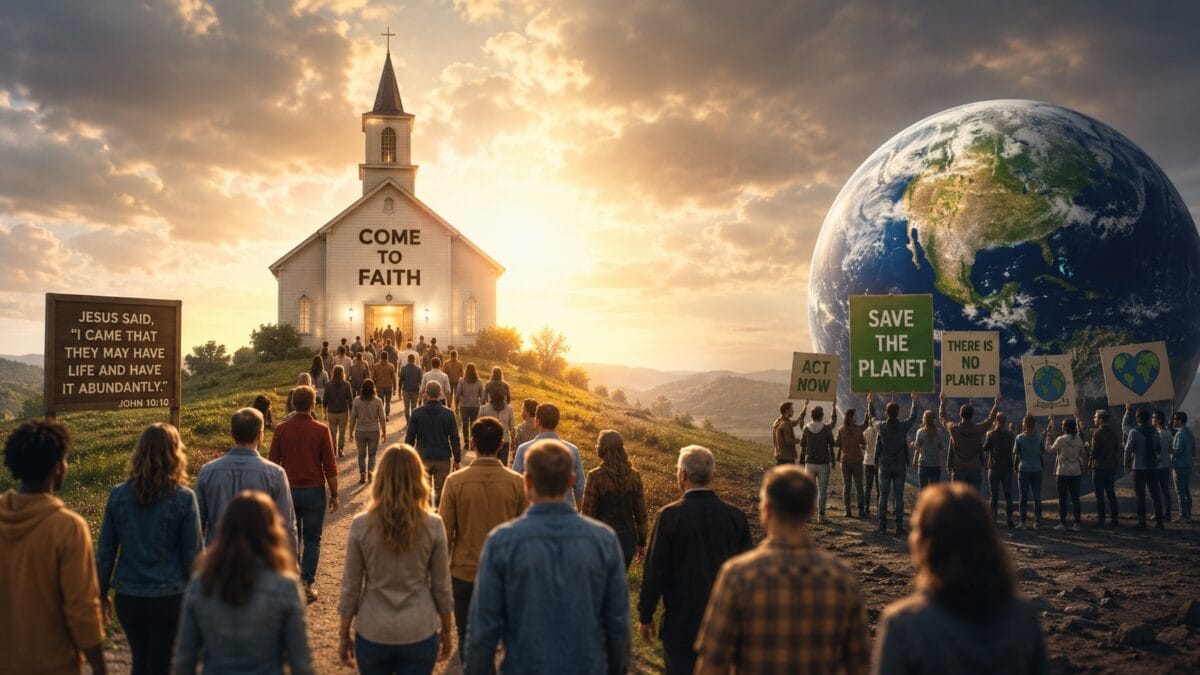
Sir Paul Marshall, the owner of GB News, has apparently committed the unforgivable sin. Instead of seeking to save the planet from global warming, he has contributed money to the seemingly lesser cause of actually seeing people saved by coming to faith in Jesus.
The co-owner of GB News, a British TV channel accused of broadcasting climate change denial, has donated £28m to influential Church of England institutions that support climate action.
This raises “serious questions”, say Christian leaders, given that Sir Paul Marshall’s views on the climate crisis and those frequently broadcast on the TV channel are “in direct opposition” to the Church of England, which believes that “responding to the climate crisis is an essential part of our responsibility to safeguard God’s creation and achieve a just world”.
Rev Dr Darrell Hannah (whom I happen to know from NT academics) is chair of Operation Noah, a ‘leading UK Christian climate charity.’ He commented:
Marshall’s views are in direct opposition to those of the Church of England. Given his outsized influence on our country – and in light of his problematic views on the most significant moral and practical challenge of our time – serious questions need to be asked about Sir Paul Marshall’s donations to faith groups, and specifically to the Church of England. This cannot go unchallenged.
There is quite a lot here which ‘cannot go unchallenged’—not least the projection of what Sir Paul actually believes. The same Guardian article actually cites his position.
Sir Paul generally agrees with Christian and Anglican teaching on the environment and climate change. Like many people, including many Christians, he just doesn’t subscribe to net zero by 2050 due to the serious negative impact on poor people, their communities and the economy. Instead, he prefers to allow human innovation to adapt to and to limit climate change. This is a perfectly reasonable position held by millions of people, including many Christians.
GB News (the other villain of the piece here) might well have challenged some of the dogmatic approaches to climate change; presenters have accepted that the climate is changing, but they have challenged claims about the rate of change and the costs of ‘net zero’—as have many others.
(I do love the naming of a climate charity ‘Operation Noah’, when the story of Noah in Genesis 8 to 10 was largely about God’s judgement on the evil of humanity, and his saving of the faithful remnant of Noah’s family…)
And it is not true to claim that Paul Marshall has donated ‘to the Church of England.’ He has contributed to one particular congregation, and one charity, but all congregations are separate legal entities from the central Church. For those making sweeping ideological comments, it is just too easy to lump everyone together and call them ‘the Church of England’ rather than take time to understand what is actually going on here.
The Church of England is indeed a ‘broad church’, not in the virtuous sense of tolerating a wide range of views, but in the sometimes problematic sense of being a collection of different entities who often don’t agree with one another.
And this reality means that Marshall’s views are not ‘in opposition to the Church of England.’ General Synod did indeed pass a rushed motion on net zero in 2020—but many are now challenging this, as Synod did not think through the costs and implications for local churches, particular those with historic buildings. Many now consider that the hasty measures are damaging to local ministry.
An analysis undertaken in 2022 of a series of church court rulings, and comments made by ecclesiastical judges, has shown that green heating systems, such as electric boilers or heat pumps, are either too expensive for parish churches which are buckling under financial pressure, or that they cannot be fitted in historic buildings. Of course, Synod did not allow such realities to dent their climate change virtue.
The Daily Telegraph reported last year:
Net zero targets are killing off the Church of England, clergy and wardens have warned. Access to new oil or gas boilers has been restricted under a Church of England commitment to reach net zero carbon emissions by 2030.
A Telegraph investigation can reveal that the policy has left dozens of churches in the cold for months on end, with rural churches bearing the brunt of the policy. Priests and wardens have warned that the green energy drive is putting parishioners’ health at risk, driving down church attendance and causing damp to rot historic buildings.
The inimitable Marcus Walker, the rector of St Bartholomew the Great Church in central London, led opposition to the net zero policy in Synod. His church lost heating in the winter of 2022.
“It’s ridiculous,” he said. “Some people would rather our churches were empty so long as they were more green.
“They make it so difficult to put in a boiler they hope you’ll just give up. But while they force you through this process, your church is cold and people will freeze, fall sick, and go elsewhere. It’s hard to believe their priority is people coming to God and worshipping him.”
It is worth revisiting the 2020 Synod motion and its introduction. The motion originated as an Oxford Diocesan motion, and so was introduced by one of the suffragan bishops from that diocese, Olivia Graham.
We have the rest of this decade to take decisive action. The motion challenges us in all areas of life, from finances to buildings and political advocacy. We must not kick this can down the road for future generations to deal with. There is no greater issue facing society today than runaway climate change. Our Church, with the level of resources, reach and influence we have must be on the frontline of the battle to save God’s creation.
I think that claiming society faces ‘no greater issue’ might be true from a secular humanist point of view. But is that our theological position—seriously? In a context where we have seen a radical deChristianising of our culture, and unprecedented and apparently terminal decline in church attendance—at least in the C of E? Might not ‘people coming to know Jesus’ be the most important issue facing society?
On the question of ‘the position of the Church of England’ we should note that every element of the motion is supplicatory: ‘commend… urge… urge… commit… call upon’. The reason for this is that, in such motion, the General Synod has no actual authority to command dioceses (who are legally independent) to do anything. So in fact all the zeal in dioceses to implement such things, regardless of the damage they are doing on the ground, is entirely voluntary.
We still should note the remarkable language here, and its extraordinary hubris. Olivia Graham says that we must be ‘on the frontline of the battle to save God’s creation’. Save God’s creation?
On current estimates, the United Kingdom produces about 0.7–0.8% of the world’s annual greenhouse gas emissions (or roughly the same for CO₂ alone). In 2024 that was about 387 million tonnes CO₂e.
The Church of England has about 16,000 parish churches, and most of these are low-occupancy, intermittently heated buildings. Even if the average parish emitted (say) 10 to 20 tonnes of CO₂ per year (a plausible ballpark based on church energy audits), that would give roughly 160,000–320,000 tonnes CO₂/year.
That would mean that we contribute about 0.04–0.08% of UK emissions, which is about 0.0003–0.0008% of global emissions. So in global terms, local Church of England churches are effectively a rounding error.
As for ‘our level of resources, reach, and influence’ I cannot help thinking that Olivia Graham is over-estimating how much attention people are paying to us. And if they do, what they might see is an organisation that is crippling itself in relation to its main goal in order to make a practically insignificant contribution whose major goal is signalling virtue.
It might be claimed that this is not, actually, a zero-sum game—that we can be concerned about mission and evangelism, and about ‘saving the planet.’ But the reality is, for many local churches, it really is. They have finite resources, both in terms of finance and energy, and it is very hard to give the same energy to both. Some argue that we need to look credible on this issue to outsiders—but I am yet to hear of anyone saying ‘Gosh, I ought to think about the claims of Jesus on my life; after all, look at my local church’s new heat pump.’
And what is fascinating is to note the zeal of the Net Zero motion.
That this Synod, affirming the fifth mark of mission, concerned by the scientific evidence that climate change is proceeding at a rapid rate and by the impact of climate events, and seeking to build on the decisions taken…
I wonder what response we would get to a motion that began:
That this Synod, affirming the first mark of mission, concerned by the evidence that few people hear and respond to the good news of repentance and faith in Jesus, and seeking to…
And it is also worth reflecting on Dr Hannah’s own situation, and how these matters affect his congregation in Ascot Heath. As it turns out, his parish is part of one of the most expensive towns in England. The top five wealthiest streets in Berkshire are all in Ascot. At the pinnacle is Titlarks Hill — known locally as “Millionaires’ Row” — which sits next to Sunningdale Golf Course and has an average property value of around £9 million. His congregation is drawn from one of the wealthiest postcodes in England. So perhaps questions of affordability are not something they need to worry about.
But they might worry about the other kind of salvation. His diocese, Oxford, has seen church attendance drop by 30% in the last 15 years—and his own congregation has fallen by 10% in the last two years. On the church’s website, I could not find a single mention of mission, how to learn more about the Christian faith, or anything like an Alpha course for outsiders.
You might say I am being unkind to pick on Darrell’s own parish—but if someone is going to criticise someone else in the national media, it seems fair to me to ask what the impact is in their own back yard.
There is a kind of inverted ideological idiocy that would rather see money invested in a heat pump for a medieval building as it empties of people, than actually see people coming to faith and filling it with the warm of lives made new in Jesus.
I think it is wonderful that someone Like Sir Paul Marshall is putting money into serious efforts to see more people come to know the good news of Jesus for themselves. In the light of continued decline in Church of England attendance, I think we would be wise to welcome this rather than criticise it.
(A much shorter version of this piece was published at Premier Christianity.)
 Buy me a Coffee

















I am always confused by the ”climate crisis” and its (often odd) adherents. It often strikes me as a form of collective group think. There are plenty of acredited scientists who question the narrative (USA based Will Happer being but one).
I remember David Bellamy the scientist and tv broadcaster who was cancelled and sent to Coventry by the BBC because he questioned ”climate change” as it was then known. What a tragic end to a super career.
The C of E is a broad church and I do feel the far end committed ”environmentalists” are from the planet Wacky. But a broadcaster and tv channel owner whose has made money in the city, should be able to distribute his money wherever he likes. I especially like where he has distributed it and applaud him heartily.
The trouble is that it is well known that indwelling an environment organically will have better effects than ‘acting like you own the place’ (in the immature sense of this phrase). Everyone agrees with that.
Everyone also agrees that it neglect leads to major longterm problems.
And everyone also agrees that selfishness, greed and thoughtlessness are antithetic to Christianity and to proper human development and formation.
So we are left with a set of propositions that everyone agrees on anyway, and which would encourage responsible and mature behaviour within (not towards nature) even before we start calculating the climate statistics.
Also, give the climate statisticians a break. Their topic is impossibly large, and is full of variables and unknowables. It is enough that they indicate trends, and indicate where those trends are potentially dangerous.
Even if (which is unlikely) they are not actually dangerous – I can’t believe I am saying this, because it is like playing Russian roulette, as well as being uncaring and philistine – we would still be better to be safe than sorry, so to err on the side of caution.
The cavalier treatment of nature, which has seen biodiversity halve in our own gardens in our own brief lifetimes, is akin to (but even worse than) things like litter dropping. Human selfishness displayed in lack of awareness of the wider repercussions of individual actions.
You may be right, you may be wrong. But the question should form no part of the common life of a Christian church.
For my part, I pray to be relieved of the resentment I instinctively feel against anyone who tries to launder or inveigle a private worldly commitment into the common life of our shared communion. There are many such ‘hobby horses’ in every age and tendency no doubt. But it is endlesly tiresome to be told such-and-such forms a part of one’s ‘essential duty’.
The Lords Burden is light. Climate Action forms no ‘essential’ part of it. To insinuate otherwise, to well meaning Christians in a mixed communion is to “bind heavy burdens and grievous to be borne, and lay them on men’s shoulders”.
Thankfully we have the eternal freshness of our Articles to clear the air and set the conscience free.
VI. Of the Sufficiency of the holy Scriptures for salvation
Holy Scripture containeth all things necessary to salvation: so that whatsoever is not read therein, nor may be proved thereby, is not to be required of any man, that it should be believed as an article of the Faith, or be thought requisite or necessary to salvation….
XIV — OF WORKS OF SUPEREROGATION
Voluntary Works besides, over, and above, God’s Commandments, which they call Works of Supererogation, cannot be taught without arrogancy and impiety….
I would return to the freshness of patristic theology: humankind has a priestly role between God and creation, receiving the blessings of creation and offering Thanksgiving and blessings back to God. Reform theology and Enlightenment philosophy eschewed the original meaning of symbolism and introduced a binary between the sacred and the material which was novel. Concern for creation is not a secular concern; it is profoundly sacred.
But is it ‘essential’ to salivation, sister, in the full and solemn sense of the word?
Salvation, even!
The idea of the creation being a side issue is a non starter. The creation is everything. By definition.
Christopher: the *new creation is everything. 2 Corinthians 5.17
The creation is everything, i.e. it is that which exists, the sum of all things.
We should all be concerned about nature and the environment. I cannot be the only person hugely concerned about the lack of flying insects, flies, bees, wasps, butterflies etc. How many insects have you counted squashed on your car windscreen after a journey? The first explanation is ‘change in farming practices,’ never the prolific spread of windfarms and solar panels. God will decide on our climate, not man
God has delegated responsibility to us.
I wrote the government about insects, and we do have a national policy…!
I have always assumed that the reduction in insects was due to agricultural chemicals, but this Summer may have changed my mind … Maybe it also had something to do with the damp cool Augusts we’ve had a lot of in recent years, because this year ….. far more bugs. I have just seen this: https://www.telegraph.co.uk/gift/fdd93ac1127543a3
excellent! ‘Marshall’s views are in direct opposition to those of the Church of England’ – he must be on the right track then – if current pronouncements rather than founding principles are considered.
BTW the IPCC has now given up on its original predictions, more political than scientific, and a good number of ‘scientists’ have given up on it too – now their jobs don’t depend on believing the dogma. In fact the computing energy demands of AI have now made the World Economic Forum give up on it too.
It’s good to take the natural world seriously and mankind has been tasked with that from day1 but you cant help thinking that the Creator is rarely purposefully asked.
Yes, the IPCC has now given up on RCP8.5, the most alarmist of its scenarios, and admitted it has no basis in science. It was – of course – the one that it featured most prominently in its press handouts, which the alarmist media obediently trumpeted.
Anybody who wants the truth should sign up for a free weekly round-up of climate change news from this sceptical site, which mingles technical analysis and lucid non-technical explanations:
http://www.sepp.org/the-week-that-was.cfm
The reason the IPCC has given up on RCP 8.5 is that it was their worst-case scenario, which assumed continued heavy use of coal worldwide. Coal use peaked in 2013. As well as this China has shifted massively to renewables far faster than was predicted, and this trend is spreading out into Southeast Asia and also Africa. Thus RCP 8.5 is no longer plausible. This of course does not mean that climate change is no longer a threat. Very far from it.
But this is what you highlight: one new Chinese solar farm will do more than *all* the parishes in the C of E could possibly contribute.
So how should that affect our approach to these issues?
Ian Paul: I’m not entirely sure what point you’re making. Just because China is doing better than us doesn’t mean that we shouldn’t be doing our best to move into the future. Maybe the Church of England will need to revise its targets, but it’s the direction of travel that matters.
China is actually not doing ‘better than us’ except at cooking the carbon books:
https://joannenova.com.au/2026/06/china-cooks-the-carbon-accounting-books/
So do you think that we should just absolve ourselves of all responsibility, just because someone else is better/worse than us?
Climate change is occurring because billions of individuals are making daily decisions that result in far higher carbon emissions than necessary. THAT is why everybody counts. That is why we need to lead the way as far as we can to change attitudes and actions.
Whatever the deniers say on this post, the facts are very clear:
It is happening
It is caused by humans
It is very bad
We can do something about it
If you decide not to, then you are personally part of the problem not part of the solution.
And when God asks you if you cared for their world and the people in it .. what will you answer be?
Actually RCP8.5 was never plausible, and I am willing (and able) to discuss why with you to whatever scientific level you wish. But the IPCC pushed it onto the alarmist press because they believe the means justifies the ends, even though they know that the alarmist press will give teenagers sleepless nights by telling them they have no future since the world will supposedly be on fire by 2050.
I don’t think it’s any longer necessary to debate about the reality and risks of man-made climate change. This debate was had all through the 90’s and the succeeding decade. The matter is settled. It’s only a question now of whether we will address it with the necessary urgency.
They revised their predictions based on current conditions and data. I call that good science.
John Duncan: Saying the matter is settled is empty polemic. Would you like me to explain to you why it isn’t?
John Duncan: If the atmosphere were dry (and motionless) then it would be an easy matter to calculate the warming due to a given atmospheric concentration of CO2. But the gas in the atmosphere that does by far the most absorption of infrared radiation is water vapour. And water vapour may (or may not) condense into cloud, which has different absorption/reflection characteristics (as is obvious when a cloud passes in front of the sun).
The IPCC argues that CO2-induced warming causes evaporation of more seawater into the atmosphere, and since water vapour is itself a greenhouse gas then this magnifies the effect. Nobel physics prizewinner John Clauser argues conversely that more water in the atmosphere causes more condensation into cloud, the topside of which reflects more sunlight back out into space, and that the CO2 consequently makes no difference. IPCC scientists and Clauser have severely criticised each other’s reasoning, and I actually agree with both criticisms. We simply don’t know – it’s too complex. The best satellite obervations – by the Huntsville group – suggest that Clauser is nearer the truth.
Because fossil fuels are finite, largely beneath hostile regimes, and lead to COI2 levels that might ultimately make us drowsy, we should indeed rethink our energy – but NOT because of global warming, and not at all with the urgency with which the UN speaks. The UN wants to get the right to tax the world using climate as the excuse. This is more political than you might guess. And the victims are teenagers who are heartlessly being given depression over it because they are told they have no future.
The Church of England’s commitment (Synod resolution of 2022) to Net Zero by 2030 is absurdly hubristic and frankly quite embarassing.
The Lead Bishop for the Environment is the Bishop of Norwich – but there is no prospect whatsoever that more than a fraction of the vicarages of the Diocese of Norwich converting to green energy by 2030. I know – I live in one. And I’m told that the diocesan budget won’t allow for the conversion to green energy of more than two vicarages per year…
Golly. Worth asking a question in General Synod (or the diocese) about that?
I agree that practical decisions, (such as around creation care in relation to church heat pump installation!), need to made in a nuanced way, specific to situations as choices are often limited by resources. I agree that Christians need to approach this issue differently from humanists, we should bring more hope and of course hold the gospel central – creation care is an outworking from that, just as other issue of justice and holiness are.
But I’m not sure about your overall emphasis/tone here? This is really not an issue Christians should be putting to one side. God’s creation (God’s! Not ours) is being destroyed as a direct consequence of a society-wide greed and idolatry. The enormous cost is not only being paid by the rest of creation, but also by those desperate souls who happen to be living in other parts of the world now becoming uninhabitable, if they aren’t already, due to floods, famines, droughts, and wars driven by the wish for more oil.
All christians should be challenging this system & it’s consequences in whatever ways we can. This way of living, it’s assumptions and structures, doesn’t glorify God or help people know Jesus, it does the contrary. So to suggest it’s ever a choice between evangelism and creation care (as your article seems to do) is not helpful.
This is like saying, in Wilberforce’s day, that it’s a choice between owning slaves or sharing the gospel because owning slaves frees up time for pastors to prep their sermons. The real point is that owning slaves would CONTRADICT the very gospel being shared.
And so it is today – Christians watching God’s creation being destroyed and not caring deeply about that and doing what they can, is a contradiction of the idea that we love God (whose world it is), or our neighbours who (albeit in other parts of the world) are suffering hugely or dying as a result of it. And this sort of attitude undermines all the evangelism in the world. We really need to care about these issues, they are an outflowing of us living in a way that honours God.
Think of James 2:14-17. Or Jesus’ words to the Pharisees (Matt 23:23) that despite all their evangelism (!), and all their zealous rule keeping, they had neglected “the weightier matters” of the law: “justice, mercy and faithfulness”.
Consider it possible that God put the oil there for our use? Industrialised society, based on cheap energy and human ingenuity, has granted people freedom from toiling in the fields, mass literacy, and a far more equitable ratio of wealth of the masses to the aristocracy then in pre-industrial societies. Would you rather have power cuts, being cold in winter, and famine?
However, God also created a physical world where carbon dioxide absorbs infra red radiation, of the wavelength range which the planet radiates. Therefore, this physics has the effect that increasing the carbon dioxide in the atmosphere results in the surface of the planet at a given temperature losing less energy to space. The energy it receives from the sun is not decreased by the CO2, so that increase inevitably leads to an increase in the average temperature of the surface. That has been known qualitatively for over a hundred years.
It is obvious that burning coal or oil which has been underground for a long time will lead to such an increase in CO2. We know how much. The level is now 50% higher than it was 200 years ago. That is a significant increase.
With this level of CO2 we now have a measured (by satellite) imbalance in the gain/loss of about 0.1%. That is causing heating. The imbalance would be removed by an increase in temperature, so more is lost to space, or by reducing the CO2 in the atmosphere. This imbalance takes time to take effect, just as turning up the gas on a gently simmering pot will not make it boil immediately. Probably the main thing which has to be heated up is the water in the oceans.
Increasing further the CO2 makes things even worse. So, Net Zero is a mitigation, not a cure.
Modelling the climate is not easy. However, the climate models made 20 years ago or so have proved to match pretty well what has happened over that time.
I would add that climate change is disproportionally affecting poor people round the world at the moment. Consider how rising sea levels affects much of Bangladesh, or how changes to rainfall is affecting agriculture in sub-Saharan Africa, and how the latter is then making old antagonisms worse.
There is use and abuse of the world God has given us. It seems clear that our love of fossil fuels is abuse – among the many other abuses which we perpetrate.
‘Net zero’ reminds me somewhat of the difference between ‘deficit’ and ‘debt’. It is as though any improvement is not even considered; the goal in mind is for things to fail to get any worse (from an already bad starting point).
David Wilson: If the atmosphere were dry (and motionless) then it would be an easy matter to calculate the warming due to a given atmospheric concentration of CO2. *That* is what has been known since we learnt about the absorption characteristics of the CO2 molecule. But the gas in the atmosphere that does by far the most absorption of infrared radiation is water vapour. And water vapour may (or may not) condense into cloud, which has different absorption characteristics (as is obvious when a cloud passes in front of the sun). That makes the calculation of the effect of incremental CO2 so much more complicated as to be worth little. One school of thought – that warming is larger and is dangerous – has grabbed most of the academic jobs, grants and journal editorships. That doesn’t mean it is correct. I believe it is incorrect, in fact. Feel free to ask me a specific question.
Satellites measure the huge amount of upgoing and downcoming radiation at the top of the atmosphere and then calculate the (tiny) difference. That procedure is asking for inaccuracy.
It is the case that the Muslim Arabs regard oil as God’s gift to them. How much of the Islamist violence around the world is funded by the oil revenue which they receive?
It seems clear to me that one significant cause for the chaos we have in the Middle East is Western action and policies over the last 100 years or so. That was also motivated by the need thirst for oil, and so the desire to control that.
It’s obviously a false dichotomy – but not for budgeters.
Often in life, the choice is between short term and long term.
This choice, however, is between two critical long terms.
The answer is to do both but to increase the budget by being a lifegiving effective community.
The reality and risks of man-made climate change have been well known since at least the 1980s. It is now well documented that fossil fuel interests, fearing for the future of their livelihood, made it their business to cast doubt on the science of climate change from that time onwards. Nowadays the reality and the risks of climate change are so well known that the narrative has changed from denial of the reality of climate change to “Yes, there is climate change but it’s not as bad as they say, we do need to do something about it but there’s quite a lot of time and we don’t need to listen to the doomsayers.” Unfortunately that’s the tone I pick up from this article and it’s just as dangerous as outright climate denial.
Therefore, I applaud the Church of England for taking this matter extremely seriously. How this works out at Parish level and the internal politics of it all is obviously a somewhat different matter, and the logistics of each parish have to be treated sensitively and on an individual basis But the general direction has to be to move towards renewable options as soon as is reasonably possible.
Forget renewables. The alternatives for the UK are fossil fuels, nuclear or lights-out. As stated by the late Prof Sir David Mackay FRS, Chief Scientific Adviser 2009-14 to (what was then) the Department of Energy and Climate Change, in his detailed book for the intelligent layman “Sustainable energy without the hot air”, available free online. David was as green as they come – vegetarian, cycled everywhere and bought a small car only in the last months of his life when couldn’t ride – and in his last interview before his sad death of cancer in 2016 he described powering the UK largely by renewables as an “appalling delusion”:
https://www.theguardian.com/environment/2016/may/03/idea-of-renewables-powering-uk-is-an-appalling-delusion-david-mackay
I can’t help thinking back to forty odd years ago in the days of Scargill v. Thatcher, when it was a badge of honour for the political Left to aim for “nuclear free” – the idea, of course, being that the country must be in hock to coal and therefore, inevitably, to the NUM. (The most absurd manifestation of this that I encountered was a sign saying “Welcome to Nuclear Free Watford”. Come on, I thought to myself, if British Rail – as it then was – want to run a train of nuclear waste through Watford on the West Coast main line, they ain’t going to ask your permission!)
I think that Watford is made of atoms, which are 99.95% nuclear by mass…
I remember when NMR (nuclear magnetic resonance) was renamed MRI (magnetic resonance imaging) in hospitals because the word ‘nuclear’ frightened a minority of patients. I was able to calm one person I knew who was scheduled a scan by saying that I’d do it voluntarily for the interest!
Anthony Williamson: to say “forget renewables” is anachronistic. Renewable technology has moved forward with staggering speed in the last 10 years or so. Things that seemed impossible in 2014 or 2016 are now starting to look feasible. The problem with renewables, of course, has always been that sun and wind are both intermittent, but battery technology is also moving forward in leaps and bounds, and who knows what may be possible in 5 to 10 years?
In the US theyve developed solar panels that can produce hydrogen which is then used in hydrogen-fuelled vehicles.
That is the sort of technology governments should be investing in.
John Duncan: Please specify the improvements in battery technology that would be capable of storing safely and at reasonable cost enough energy to power a major industrialised country through a week of cold still air in winter.
At some point discussions like this have to go quantitative – that was David Mackay’s point.
One tiny point: I personally have grown to expect my church to be warm enough so that I can take off my coat in the depths of winter. Maybe this is an unreasonable expectation? I sometimes think it is. But then I’m not 80 years old, and I don’t have to work in the building.
St Paul wasn’t wrong when he said that the Gospel was veiled to those who are perishing!
Many are cold, but few are frozen.
Revelation 3.16 – the most terrifying verse in the Bibele for Climate Denialists, as well as fur (!) Coat wearers.
Perhaps the CxE could supply puffer jackets to every parishioner.
As long as they don’t contain forever chemicals.
O k
Wooly jumpers slathered in lanolin
Now that would be a thing Steve- a church full of sheep.
“Tell me what the world is saying today, and I’ll tell you what the church will be saying in seven years.” – Francis Schaeffer
Ouch!
Oh for heaven’s sake, when even the IPCC (which gets everything last) has to back off the Doomsday Cult you’d think people would stop hyperventilating. We have intractable wars in Ukraine and Iran, simmering violent conflicts in various parts of Africa, relentless Christian genocide in western Africa, a mountain of crushing global debt to leave to our posterity to sort out, below-replacement fertility in the entire developed world, and creeping impoverishment of the middle- and lower-class in western Europe due to harebrained alarmist programs like NetZero. Not for nothing has concern about global warming/cooling/change/[your preferred label here] sunk in the public consciousness. We simply can no longer afford the luxury of indulging in a fashionable neurosis about a gradual temperature rise during an interglacial warming period such as the Holocene we thankfully have been in for thousands of years. I do not “deny” (an odious term) that the climate is changing, I simply do not take panic-stoking seriously, particularly when the demanded remedy to alleviate the panic always seems to involve transferring money and power to those doing the stoking.
Quite
Given the tiny amount of possibly anthropogenic warming gases emitted by the UK, and the massive amounts by PR China (which is allowed to because, for reason inexplicable, it is still treated as a “developing nation”); surely any serious action should be aimed, not at driving congregations into frigidity or penury, but campaigning against the enormous amount of tawdry tat and plastic rubbish people buy from PR China. Not only is Chinese industry still largely driven by coal-fired power stations, but it is the largest plastic polluter, and is known to employ slave labour: all reasons for the Church to campaign on this front.
Not only that but buying from Temu and other outlets is known – or at least strongly suspected – to provide useful intelligence to the PRC Ministry of State Security and to fund intelligence and military organisations.
Let’s combat the real problems not focus on green-washing and making ourselves feel good by actions that make little difference.
China to be fair to it is the world’s leading producer of renewable energy but it also doesn’t let net zero targets cripple its industry
God is Sovereign!? Yes? No?Maybe?
yes but we also have free will as to how we chose to live on planet Earth. It’s not just about ‘saving the planet’ but trying to prevent the suffering of human beings, just as human development of medical science has helped to prevent or alleviate such suffering. Surely that is a good thing.
One of the six churches in this parish is effectively shut: why? Because its gas-fired blower heaters have been condemned, and the diocese has said that they may not be replaced (if the PCC could afford it) by similar which is the only feasible alternative. As a result the building, the organ, and its contents are being damaged by cold and damp. More importantly, the village and its satellite settlement, built for coal miners from the now closed pit, and now a deprived area, is deprived of a centre of worship and evangelism because the Rector had decided that it was too cold and damp for anyone to use. This has resulted in the congregation (small but very faithful) being dispersed amid great resentment. How does this further the Great Commission? What does an effectively closed church building say to those outside? How does it proclaim the Good News?
(I am grateful that I have been allowed to celebrate its Patronal Festival in that church at the end of the month, and my 40th Anniversary of priesthood.)
[So, Dr Darrell Hannah (sorry, I keep thinking of a mermaid) is chairman of Operation Noah, from the well-heeled environs of Ascot. I took the funeral of two of his parishioners, my cousin and his wife. No-one had visited despite requests; perhaps he was distracted.]
If you just replaced it and then told the diocese, what would actually happen?
Nothing if you didn’t tell the diocese in the first place?
That is what they should do. We faced similar idiocy in our parish.
Life is a vast series of trade offs. That simple fact constantly escapes the bureaucratic small minds who congregate in diocesan circles. Anglicans constantly let the tail wag the dog.
Does the diocese check the books of its parishes annually, and if so then what would happen when it found its demands ignored?
do you need 6 churches in a single parish?
That should be up to the parish to decide, rather than having churches eliminated as a practical matter by impoverishing climate policies, don’t you think?
It’s also about how and where to spend limited funds. Regardless of climate issues, should a building be kept open for the sake of say a handful of attendees? Practical matters are important.
Yes, especially if it is the only church in the village or area, that is what Church Commissioner funds should be directed to Parish Ministry not stuff which is for national governments to deal with like climate change
The thing is “do we save the planet For our children or
do we save our children From the demise of the planet?
From the idea that all of man’s woes are self- inflicted,
Or do we teach them the fear of the Lord?
Recall the fall of Jericho; Listen to Rahab! What did she say to the spies?
Israel has not arrived yet, but she says, ‘We know all about you.
We know what you signify. We have heard all about it.’
Already the fear of this people is ahead of them.
There is something of spiritual power there which does not have to be
preached in words or doctrines or rituals.
The people are there, with God in their midst – because God has
His heavenly thoughts and principles as the very constitution of their life,
He is there; the rest follows. Is God in our midst, do we believe what He says?
Do we need to explain that God judges the Nations as the prophets foretold?
As John said from Patmos- It is God who pours out the Vials of Judgements Upon the Earth Pestilence, famine etc.
These judgements are detailed primarily in Revelation 16
and signify several specific theological realities:
“The Climax of Divine Justice: Unlike earlier, partial judgements
(such as the trumpet plagues which affected only a third of the earth),
the bowl judgements are total and universal. They signify that the period of grace has ended and the time for ultimate
accountability has arrived
.Recompense and Vindication: The plagues—including the sea and rivers turning to blood, scorching heat, and utter darkness—specifically target those who accepted
the “mark of the beast” and persecuted believers.
They signify God repaying the wicked for their violence against His saints.
Echoes of the Egyptian Plagues: The bowls closely mirror the plagues God brought upon Egypt (e.g., Exodus 7:14-25).
This signifies a final, ultimate deliverance for God’s people,
mirroring the rescue of the Israelites from bondage.
The Sovereign Rule of God: The word “vial” translates the Greek word phialē, which means a wide, shallow bowl used for pouring offerings. This signifies that God is in complete, deliberate control of this catastrophic period;
His wrath is poured out precisely and completely. [AI]
Do we believe in Emmanuel, is it characteristic of us, is it most obvious in us?
For a detailed look at all the evidence, read The Climate Book.
For huge buildings with maybe only a dozen folk, why not close them and meet in homes?
For any buildings, go for the ‘low hanging fruit’ first, such as energy efficient lighting.
There might be other solutions that avoid Heat Pumps or other systems that heat massive volumes of air. Black heat radiant for example.
Sadly, it’s not only the climate that is changing rapidly. There’s biodiversity loss, gross pollution increases too. Let alone absurd economic inequalities.
Life this side of the grave is important, kingdom coming now …people living out lives of love, with God and each other, the planet.
The Climate Book? Edited by Greta Thunberg, a near-perfect example of my comment on this thread that “the IPCC… believe the means justifies the ends, even though they know that the alarmist press will give teenagers sleepless nights by telling them they have no future since the world will supposedly be on fire by 2050.” She is a victim of cruel and manipulative forces, but she knows no atmospheric science and we don’t have to take her views seriously. I might add that by sheer force of will she wrecked her mother’s career as an opera singer by demanding she cease flying between the opera houses of Europe because of the carbon footprint.
When you’ve finished reading that book, watch the documentary “Climate: The Movie – The Cold Truth”, at
https://www.youtube.com/watch?v=zmfRG8-RHEI
Try also the book of collected expert essays “Canary in a Climate World”, published last month.
Here we have it.
Matthew 28: 16-20
Perhaps this can be raised at Synod. Use of heat pumps should be recommended but voluntary and if some churches would prefer to have a new oil or gas boiler as it would be better at keeping their parishioners warmer that should be their choice. The C of E can also remain committed to tackling climate change without being impractical and no need not to welcome the extra funds Sir Paul Marshall has invested in the likes of HTB
Our village church has had no heating for four years and its largely elderly congregation rarely achieves double figures – and this only in the summer. And yet the talk is all about being “green” – with sadly little mention of the Gospel. Given the miniscule contribution that certainly rural churches make to the climate crisis, I wonder whether the probable closure of such churches as ours is another factor in the minds of the C of E hierarchy, thus solving a financial concern rather than a climate problem?
We are called to be “stewards” of God’s creation – which surely should focus on the highest pinnacle of that creation – humankind – whilst still being concerned for all life. Sharing the Gospel is what we are called to do. What is the point of prioritising a “safe” planet when the salvation of its inhabitants is at stake?
We should leave terminology like “saving the planet” in the capable hands of God, whose unique and ultimate purpose is to make all things new in His new heaven and new earth.
Exactly the reason why this should be raised at Synod and small village and rural churches certainly allowed to keep oil and gas boilers. Church Commissioners should also be pressed to spend more on parish ministry and less on climate change initiatives which are a government not a church issue
Sharing the Gospel doesn’t seem to be working for that church which begs the question.
It is for those who attend it in what will be only a small rural community, they are the churches the C of E should be funding and supporting most as often the C of E church will be the only one there. There are plenty of churches of all denominations in towns and cities
My understanding is that in John 3:16, the word for “world” used in the passage is “cosmos”. That means the whole physical creation and crfeated order. I believe that Jesus came to save us from our wrondoing and being made right with God. But I ALSO believe that God has a purpose for the whole planet. And, frankly, as humans we are messing it up, living well beyond planetary boundaries. So it seems to me that ALL the marks of mission have relevance. It’s not either/or.
On the broader issue of creation care rather than the narrower one of Net Zero, I can point to many excellent examples of Eco Churches that are managing to INTEGRATE creation care with other marks of mission very successfully. Maybe, we should be celebrating that rather than throwing brickbats at each other.
The current political discourse in our country is not helping us find solutions to complex problems. I hope our church discourse will not folow suit.
My understanding is that in John 3:16, the word for “world” used in the passage is “cosmos”. That means the whole physical creation and crfeated order. I believe that Jesus came to save us from our wrondoing and being made right with God. But I ALSO believe that God has a purpose for the whole planet. And, frankly, as humans we are messing it up, living well beyond planetary boundaries. So it seems to me that ALL the marks of mission have relevance. It’s not either/or.
On the broader issue of creation care rather than the narrower one of Net Zero, I can point to many excellent examples of Eco Churches that are managing to INTEGRATE creation care with other marks of mission very successfully. Maybe, we should be celebrating that rather than throwing brickbats at each other.
There are good points in the comments about the implementation of Net Zero. Again, my understanding was that the focus would always be on the bigger, heavily used, churches that were the highest carbon emitters, rather than small, rural, churches. It seems like we need a bit more flexibility here. (By the way, I have also seen examples of small churches shifting to electric heating at the end of a gas or oil boiler’s life and implementing a renewable tariff).
If rural churches can shift to heat pumps at the end of a gas or oil boiler’s life that is up to them but they should not be forced to. The focus as you say should be on bigger urban churches to make that change if they can
Dioceses should not be interfering with parish churches and how they decide to heat themselves any more than parishes should be telling parishioners how to heat their own homes.
Gas and oil fired heaters are not sinful or immoral. Unfortunately a lot of old churches are cold places: they predate a proper understanding of insulation br centuries.
The net zero craze is gradually being revealed as another hyperzealous crusade (a bit like the covid hysteria that closed schools) where a few grains of truth are admixed with a handful or two of uncertainty and imprecision. The problem is that about helf of diocesan structures don’t do much that is actually useful to the coalface work of the churches, and if half of diocesan “ministries” disappeared tomorrow, they wouldn’t be missed and money would br saved. But that’s not how the Church of England does things.
Couldn’t the same logic be applied to church buildings like the one above which has at most just 9 people attending typically?
The consensus appears to be saving the planet
and not saving the planet.
Little mention of saving souls or the activities of God in judgements ?
No warnings to flee the wrath to come?
What am I missing? – The first two paragraphs of this piece tell opposite stories. Para 1 says that Sir Paul is supporting spiritual salvation, para 2 says that he is supporting work to mitigate global warming.