
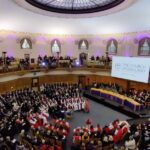
Yesterday in Synod, we spent five hours (yes, five!) on what is likely to be the final debate on the Living in Love and Faith process (LLF), the Church of England’s damaging and divisive debate on sexuality launched by Justin Welby in 2017. Following what was widely seen as a volte face by the House of Bishops in October—both in terms of what they said and their belated commitment to transparency—they offered this motion as ‘settlement’ for the process:
The Archbishop of York to move:
That this Synod:
a) recognise and lament the distress and pain many have suffered during the LLF process, especially LGBTQI+ people;
b) affirm that the LLF Programme and all work initiated by the February 2023 LLF Motion and subsequent LLF Motions will conclude by July 2026;
c) thank the LLF Working Groups for their committed and costly work, which will now draw to a close with the conclusion of this synodical process;
d) commend the House of Bishops in establishing the Relationships, Sexuality and Gender Working Group and Relationships, Sexuality and Gender Pastoral Consultative Group for continuing work.’
As is customary for this debate, both ‘sides’ (excuse the shorthand) viewed it with deep suspicion—revisionists because it understated their pain, and showed no real signs of sorrow, and the ‘orthodox’ because clause (d) seemed like a hostage to fortune, leaving the door ajar for future possible change and further damaging debate. Indeed, Steven Croft, bishop of Oxford, had said as much in the Tuesday afternoon Questions session, talking about ‘affirming’ bishops (as if those believing the teaching of Jesus and the doctrine of the Church were somehow ‘denying’) and an ongoing process.
There were eight amendments tabled, ensuring that the debate would last the whole five hours. Many of them were predictable—from revisionists wanting to amplify the apology, and delete the idea that LLF is over, and some from orthodox wanting to amend or delete the possibility of continuing discussion.
There were two exceptions to that, though, the first from Christopher Landau simply recognising that the ‘LGBTQI+ people’ were actually a diverse lot with different views. This is, of course, anathema to revisionists, who repeatedly talked as though all such people were a monolith who agreed with them—despite the number of gay women and men in the chamber who were orthodox and gave very clear speeches to that effect (I include several below).
The other was a cross-party proposal from Lis Goddard, agreed with Helen King, aiming to bring the fruitful learning of the ‘Leicester’ discussion groups into the proposed working groups. No sooner had Lis proposed this, than Helen King misused a point of order to deny her support for it! It was a clear sign that even the minimum of collaboration is not politically expedient for revisionists.
But we had been told ahead of time that that House of Bishops, having painfully thrashed this motion out as the only way forward for them, would resist every amendment—and the procedure of calling for a ‘vote by Houses’ meant that they effectively had a veto, and used it fairly consistently. I did wonder whether some of the revisionist bishops would break ranks, and perhaps vote for one of the revisionist amendments, but a maximum of six out of the 38 or so present did so.
It was clear that the revisionists really did not want to vote for the unamended motion, because it said clearly that LLF had ended. But if they voted it down, they would also be voted down clause (d) offering a chink of light of continued discussion, so they held their noses and voted ‘for’. Orthodox felt similarly ambivalent for the opposite reasons, and in the end some voted for (drawing a line under LLF) and others voted against (because we don’t want further damaging discussion).
I doubt many on the outside will now sit and watch five hours of discussion. But for me there were two clear features of the debate. The first was that evangelicals and other orthodox have clearly matured and grown in the way they conduct themselves and engage in this contentious discussion over the years since 2023, 2017, and long before, and that is a good sign. I think, almost without fail, the speeches were clear, were full of pastoral wisdom and good theology, and were expressed in a sensitive and winsome tone.
By contrast, many of the revisionist speeches were full of emotion and anger—understandable—but also full of unchanging generalisations and stereotypes. Jesus was ‘inclusive’, and they are ‘inclusive’, so they are being like Jesus, which means that those denying same-sex marriage are…? It is all about love, and love means love, and love means giving people what they want. For me, the theological low point was one women saying that, when her two lesbian friends entered a same-sex marriage, this was equivalent to Simeon and Anna meeting the baby Jesus in the temple in Luke 2: ‘My eyes have seen the salvation of the Lord’.
I am sure that those I disagree with will claim that I am biased—but my strong sense is that, whilst the orthodox have travelling a long way in terms of care of language, level of engagement, and tone, revisionists have not moved one inch. I noted, in my speech at the start of the debate opposing Charlie Bacyk Bell’s amendment, that the whole LLF process, after all this time, has not even delivered the basics of common understanding of the terms of the debate.
Brothers and sisters, we need to face some sobering realities.
After all this time, we have not even agreed on the basic terms. The Jesus of the gospels is fully inclusive (how could we be more inclusive than him?) and yet teaches clearly that marriage and sexual intimacy between one man and one woman, as a reflection of his creation of humanity male and female.
After all this time, we have not recognised the shape of the discussion—not between two different views, as if we were standing nowhere, but between those who uphold the doctrine of the Church—and of the church catholic through all ages—‘according to the teaching of our Lord’, and those who want to see it changed.
After all this time, there is so little recognition that gay people in this chamber do not agree, and are on both—on every—side of this debate.
After all this time, there is so little good will across the debate. I was part of the RMC discussion last week, and I found Chantel Noppan’s expression of anger and disappointment deeply moving. But I honestly doubt that any here wanting change will believe me for a second. What a tragedy that is.
After all this time, we still have not had the openness from the House of Bishops that we have all been asking four. There are four papers we were told of in February 2024 which have still not been published.
This amendment will cement this failure and do nothing to take us forward.
So where do we go now? Interestingly, both the Guardian (‘issue is put in deep freeze’) and the BBC (‘abandons proposals for same-sex blessing ceremonies’) were very clear: the Church of England has put a stop to this debate, and abandoned the possibility of blessing same-sex relationships. By contrast, ‘Together’ (the revisionist group) has declared that it is full steam ahead, and though progress has been slow, change will certainly come.
This complete contrast between what most people see as reality, and the revisionist spin, was evident this morning when I was invited on the Radio 4’s Today programme (at 7.32 am) to debate with Charlie Bączyk-Bell, a vocal campaigner on this issue who went to the US last year to marry his same-sex partner. Here is the transcript:
Justin Webb: The Bishop of Canterbury, Sarah Mullally, said the discussions had left us wounded as individuals and as a church. But she said the bishops’ proposals were a sensible way forward that will take us on to the next steps.
Let us talk to the Revd Dr Ian Paul, author and theologian and a member of the General Synod, and to the Revd Dr Charlie Bączyk Bell, who is a priest in the Diocese of Southwark and a Fellow of Girton College at the University of Cambridge. Good morning to you both.
Dr Paul, first of all — do you think they’ve done the right thing?
Revd Dr Ian Paul: Yes, I think they have. This is the teaching of Jesus, this is the doctrine of the Church, this is what is said very clearly in canon law and in our teaching. And this is what all of us — Charlie, myself, and all the bishops — make a public vow to uphold.
At ordination we are asked: “Do you believe the doctrine of the Church?” and we say yes. Then we are asked, “Will you uphold and teach it?” and we say yes. So in fact all that has happened in Synod is that we have confirmed that we will do what we all promised to do.
I think Sarah Mullally is exactly right — this debate has been damaging. It has hurt people on both sides. And I realise that for people like Charlie, who want to see change, it has been deeply painful. I really hope we can now put this aside, focus on other things, and stop having these bitter debates.
Justin Webb: Dr Bell?
Revd Dr Charlie Bączyk Bell: I don’t know which General Synod Dr Paul was in, because that’s not what happened yesterday. It was really clear what occurred. It’s frustrating that after ten years we’ve not got where we need to be.
But what Synod had the option to decide between yesterday was: do we continue or do we stop? And with almost a two-thirds majority, Synod said, “No — we want to continue.”
It’s not just people like me who are hurt — LGBT people are hurt, and that wasn’t heard enough in the chamber. But actually I think we have a real possibility now to move forwards because it’s clear the bishops themselves want to move forwards. This is not going anywhere.
Justin Webb: What do you think the next step is? What should happen now — and what will happen now?
Revd Dr Charlie Bączyk Bell: I think the bishops need to decide how they are going to deliver change. One of the big problems over the last couple of years is that the bishops have hesitated about structural changes in the Church of England. They’ve now said clearly they’re not going to pursue those.
So the question now is how they move forward — and I think that is what the new working group will address.
Justin Webb: Ian Paul — is that acceptable to you?
Revd Dr Ian Paul: Well, it’s strange — and I think you can see the damage this debate has done. If you read the motion, clause (b) says the Living in Love and Faith process has come to an end. Yesterday Charlie himself spoke in tears and said gay people felt utterly betrayed by this. So it’s strange to hear something different this morning.
And Charlie doesn’t speak for all gay people. One of the striking things in the debate was hearing from gay men and women who accept the teaching of Jesus and the Church’s doctrine of marriage and see it as life-giving. So even among gay people in the Church there is a wide diversity of views.
Justin Webb: For those outside the Church watching this debate — they might say churches change their teaching over time. Why couldn’t this be another example of that?
Revd Dr Ian Paul: I understand why people think that. But the Church of England is actually very conservative institutionally because it is established by law — its doctrine is part of the law of the land. Canon law roots doctrine in the teaching of Jesus in Scripture and in the Book of Common Prayer.
The Church has changed its administration over time, but not its doctrine on major issues. And because we are a Reformation church, our test always goes back to Scripture and to the teaching of Jesus.
Even liberal scholars agree that the consistent teaching of Jesus, as a first-century Jew, is that marriage is between one man and one woman. That leaves very little room for manoeuvre.
Justin Webb: Blessing prayers for same-sex couples within regular services have been approved — it’s only standalone services that haven’t. So why not take that as a win?
Revd Dr Charlie Bączyk Bell: I think we are taking that as a win. But there’s also a fourth clause in the motion — to set up a working group to progress the work. Yes, we have these prayers, but the broader question remains unresolved.
Justin Webb: But isn’t setting up a working group often just a way of kicking something into the long grass?
Revd Dr Charlie Bączyk Bell: That’s one way of looking at it. Another is that there’s a clear determination among bishops to get this done. I think it’s a question of when, not whether.
And from a practical perspective, it makes little sense to allow prayers on a Sunday morning but not in a Saturday afternoon service. I suspect many clergy will simply go ahead and do them.
Justin Webb: Dr Paul — what happens if that happens?
Revd Dr Ian Paul: Then the bishops need to decide whether they will hold clergy accountable to the doctrine of the Church and the teaching of Jesus — which is what we all promised at ordination. The bishops themselves vowed to uphold doctrine and drive away error. The question is whether they will do that.
Justin Webb: Revd Dr Ian Paul and the Revd Dr Charlie Bell — thank you both very much.
So it is clear that revisionists are not going to take this lying down, and will continue to campaign. Sadly, this means that the next Synod elections in the summer will be largely based on this, and it means that orthodox Anglicans need to step up their involvement, again, in Synodical structures.
But the doctrine of marriage remains unchanged, and the main part of this damaging, divisive, and demoralisation debate has been drawn to a close. It is not the end, and there is disagreement about whether it is the beginning of the end or the end of the beginning. I hope and pray that it is the former, not the latter.
Here are a small selection of other excellent speeches that won’t be reported in the media:
Laura Oliver, Blackburn, 256
When I first stood for election to General Synod five years ago, I did so with a particular conviction. As someone who is LGBTQI+ and who holds a theological position that shapes the way I live my life as single and celibate, I was acutely aware that the voice of those like me was not often heard in the debates around sexuality that the church had been having. I stood, therefore, to try and be that voice.
In God’s grace, I have been able to speak into several of the debates we have had on LLF and PLF in the last five years, and whenever I have had the opportunity to speak, I always do so with those many other faithful Christians I know, who are navigating the same combination of sexuality and theological conviction that I do, in mind.
I am very grateful that there is acknowledgement in GS 2426 of our existence and I thank the Bishops for including those comments.
However, my lived experience is that this apparent acceptance of the diversity of LGBTQI+ people does not always translate to the words said in this chamber.
There was a lot of mention on Tuesday about the ‘radical new Christian inclusion’ that (and I quote) ‘we all long for and has not been delivered’. This inclusion seems to assume that all LGBTQI+ members long for the Prayers of Love and Faith and other change to be welcomed within their local churches.
But this is not the case for me.
And this is why I welcome this amendment with enormous thanks to Christopher Landau for moving it.
The LLF process has been extraordinarily painful. My efforts to live a life shaped by my identity as a treasured child of God, accepting (and rejoicing!) in a life of singleness and celibacy as modelled by Jesus himself, have been undermined and diminished by statements made in this chamber. At times, my existence as an LGBTQI+ person who holds a different theological conviction to other LGBTQI+ members of this synod, appears to be conveniently forgotten.
I welcome the acknowledgement from the Bishops of the hurt and distress caused to LGBTQI+ people in this motion, but I would urge you all to accept this amendment that clearly spells out the existence of the diversity of theological convictions amongst LGBTQI+ Christians and the need to be sensitive to this fact.
By doing so, you will be putting positive words into positive actions and will result in me, and many others like me, feel seen and included, which I know must be the goal of the radical inclusion we are corporately striving towards.
Good afternoon. Mike Smith, Chester 87. Thank you chair, for calling me. This is my debut speech.
I’ve always been fascinated by buttons. As a small boy, to my mother’s horror, I pressed the “stop” button on the escalator in Grace Brothers Department Store – yes, it was a real place in 1970s Sydney.
Friends, we need to press the stop button on LLF – before it is reborn under a new acronym, and continues to deepen our divisions.
I became a Christian 37 years ago from an atheist home. When I wandered into church looking lost, Hitesh, the young curate, took me under his wing. He made me incredible curries, and he taught me about the Church of England. In those early months, he took me to a discussion meeting, which I now know was part of the process that led to Issues in Human Sexuality in 1991. The meeting was divisive and unpleasant.
For nearly 4 decades – and many of you for longer still – we have been on an interminable escalator. But it never arrives. We’re not really sure where it is going. But some of us want it to go faster; others are trying to reverse it. The longer it continues, the harder it is even to be civil to those who travel with us. The only thing that is new are the acronyms. It’s time to press the “stop” button, embrace the startle and try something different.
Our Lord Jesus came from the Father, full of grace and truth. For too long, it feels as though grace and truth have been set against one another in this endless debate.
Slightly over half of you suspect conservatives like me have hard hearts and don’t really believe in grace. Slightly less than half of us wonder whether the rest of you are reading the same Bible as we are when it comes to knowing the truth of our Creator’s mind on matters of sex and sexuality.
But friends, we are called to speak the truth in love. Just as the Lord is indivisibly both, so only that will unite us in our faith and mission.
After all the years of hurt, anger and discord, it’s time to shift our focus.
Here’s one suggestion. One of the few things that this Synod has agreed is that we are not going to change the doctrine of marriage. But we aren’t celebrating that doctrine either, or making the case for it in the public square.
We just want to put the fees up for the few who still come. Meanwhile, our culture is rejecting marriage in general and marriage in church in particular in greater numbers than ever recorded in English history.
So if we are agreed on the doctrine of marriage, then before the divisions are irreparable, let’s reunite around promoting that “gift of God in creation and … means of his grace” that is the union of one man and one woman that centres us again on our faithful Lord and his beloved bride. In our culture, that would be radical, missional good news.
Paul Chamberlain: Yesterday we had a really good debate, Article 7 business about the Festival of God the Creator and the commendation of the Martyrs of Libya. In that debate the Archbishop of York said: “our predecessors 25 years ago spent an awful lot of time on liturgical business. I’m not sure we do enough. As Anglicans, it is our liturgy which gives expression to our faith. Liturgical prayer unites us, expands our hearts and forms our minds. Liturgical prayer is not our is “our prayer”, not “my prayer”.”
I was really fascinated to hear that, because I wanted to ask the question: so why did we not do that for the Prayers of Love and Faith? Why did we not spend the nuanced time, as we did yesterday, looking at the liturgy that we may introduce there, on the Prayers of Love and Faith?
Instead the House of Bishops commended probably the most controversial liturgical changes in many years, but without the full proper synodical process. Do we really believe that the Prayers of Love and Faith, as they are even used in already existing services, unite us? Are they “our prayers”? No, they are the prayers of some.
So whatever we do going forwards, we need full proper process and that includes the proper synodical assessment of newly introduced liturgy. So this amendment seems to me to try to fast forward that, or to get round that. And so I encourage you to resist the amendment.
Whatever happens going forwards, and I hope we find a way forwards, we will need the full proper process, including the full Article 7 process for liturgy. Please resist this amendment.
 Buy me a Coffee










Of course, those were indeed the ordination vows.
But it’s not just a matter of rule-keeping and/or obedience. If the laws (or Jesus) say this, they don’t say it randomly but for a reason, in fact several reasons.
So I find the obedience-to-vows point to be subsidiary to several greater points:
-The way that humans (and animals and plants) are made: according to a particular pattern…
-…and also fearfully and wonderfully
-What statistically produces human flourishing
-Nature of 2nd temple Judaism, nature of law of Moses, and so on
-Coherence with other doctrines. Like: image of God, fruitfulness, reverence and fleeing idols, marital doctrine of one flesh (most idols are deifying some good natural or material thing like food or sex)
[Again, the point with doctrines is not primarily that they are rules or laws but rather that they were made such because of a prior matter: namely, their importance as true realities.]
-Biology being obviously prior to psychology because more objective and less subject to circumstance
-Fluctuation of rates of claims to be homosexual depending on the sort of society one is in (and the sort of family, sort of upbringing, sort of experiences…).
If I were in the chamber, I would definitely not be in either party, but rather in some third party which could not make head or tail out of the mantra ‘LGBTQIA+’, but certainly strongly opposed its mouthing on all sides as though it were some kind of datum (the lack of independent thought here, and the degree of lemming-like or sheep-like-ness is worrying, and inadmissible in an executive body). I believe Sam Margrave would be on my side in this. None of the initials refers to a settled state, but rather to a state, sometimes settled sometimes less so, that belongs to the period of sexual maturity only. ‘T’ is ambiguous between surgically altered and self-claim, which are vastly different matters. ‘+’ could mean anything, yet people flag it through. ‘A’ and ‘B’ are, one imagines, often not people whom one should feel sorry for nor who suffer greatly. (In general, a lot of the talk of great suffering should be put in perspective against the backdrop of those who suffered in wars, etc..) ‘Q’ is far from being a lucid term, and it is also not clear how it is separate from those that have gone before, apart from maybe its political edge. If it is ambiguous with the word ‘questioning’ (another group who are in many cases not suffering greatly) then it is a bit dilettante, and just locks in the odd minority (and probably selfindulgent, rich-culture) idea that the *main* way of people being classified is according to sexual preference.
So we are clearly dealing with people so denuded of family contact and association with children and relatives that they think one’s life begins at 13. In which case they are also greatly impoverished, and also dishonest.
“What statistically produces human flourishing”
And interesting, no one making any kind of “fruits of the Spirit” case for homosexuality ever want to go into those statistics, because they show that there is a wholly different spirit at work there.
Dan
Actually I have heard people using statistics on suicide rates declining, divorce rates declining, and great parenting scores used to defend gay equality.
It’s a huge challenge to come up with any statistics on gay people because they often use MSM as a proxy for gay (which then ignores celibate gay people and women) and often are people who have been selected by association with promiscuity at a club or through a sex-focused magazine or through people who have disclosed to their GP that they are gay (which is usually because they have an issue related to their sex life). If you took a survey of Loaded readers then it wouldn’t be representative of straight Christians. If you looked at statistics from women who had requested the pill then it wouldnt be representative of straight Christians
I think we all live in bubbles and thats why you’ve only ever heard the case against.
In the world ye shall have tribulation: but be of good cheer; I have overcome the world.
— John 16:33
‘The Church has changed its administration over time, but not its doctrine on major issues.’ Somewhat strange Ian. What was Synod’s vote for women priests in the 1990s and women bishops in 2013 if not a major change in doctrine on a major issue which led to many traditional conservative Anglo Catholics crossing the Tiber to the Roman Catholic church for instance? Synod also voted to allow remarriage of divorcees in its churches early this century too.
You are right though that while LLF has ended for now same sex relationships recognition or not will be the key issue in this year’s Synod elections. Liberal Catholics and open evangelicals are already campaigning for candidates who would vote for bespoke stand alone services for same sex couples or even same sex marriage in C of E churches. At the moment though they lack the 2/3 majority for that and conservative evangelicals like you will no doubt stand and be campaigning for candidates who think even the prayers within services go too far and will fiercely resist any further moves to bespoke services or same sex marriages for same sex couples in C of E services
It will be the key issue for worldly and political types. There could be little more important than saving the parish, and I am glad the ABC seems to agree. And little more important than catching the wave of interest in full blooded Christianity, which will not persist indefinitely.
At least all wings of the church are now largely agreed on investing more in Parishes, whatever the divides on same sex relationships
There will always be divides where people are (as is usually the case) affected by their surrounding culture and intolerant of the degree of cultural deviance (only a low level) needed to be objective and intellectually-critical about it, rather than simply swallowing whole its concepts and presuppositions, which have sometimes been cynically prepared and broadcast by others with the purpose of their being imbibed.
E Noelle-Neumann, The Spiral of Silence.
Simon, can you point me to the canons or liturgy which expressly said ‘Women cannot be ordained’ which had to be revoked to allow this to happen?
Bespoke services cannot happen without a change of doctrine, and the bishops have said that there are no plans for that to happen.
1 Timothy makes absolutely clear women cannot teach or have authority over men. Yet Synod voted by 2/3 majority to ignore that part of scripture anyway. If Synod elections this year produce a 2/3 majority for bespoke same sex couples services they will happen too in the C of E regardless of what some parts of scripture say
Simon, as I have pointed out repeatedly, 1 Timothy proves no such thing.
And it is revealing that you cannot answer my simple question:
‘Simon, can you point me to the canons or liturgy which expressly said ‘Women cannot be ordained’ which had to be revoked to allow this to happen?’
Simon
I think more pertinently to this issue there has been a very clear softening on the issue of divorce and remarriage.
Princess Margaret was not allowed to remarry after her divorce
Princess Anne was allowed to remarry, but not in the CofE
Charles was allowed a blessing in the CofE, but had to have a civil ceremony
Harry and Meghan were allowed to marry in the CofE with no difference than a first marriage
That seems quite a rapid evolution and we are now at a time where remarried couples are widely accepted in pretty well every part of the CofE
I don’t commend the bishops for anything when they are letting themselves be used by Satan.
This is patently no more than a ceasefire and it will not end until those who navigate by scripture unite to expel those who wish to deviate from it.
Synod is divided about 50% liberal Catholic and open evangelical and about 50% conservative evangelical with the few remaining conservative Anglo Catholics. Neither is big enough to expel the other or decisively win the argument and I doubt this year’s Synod elections will change that. As established church anyway the C of E is supposed to represent all wings of Christianity
Why on earth should there be wings?
As there is a liberal block and a conservative block of Synod which crosses the Catholic and evangelical divide and disagrees with the other
Is no-one allowed to be an indeopendent thinker?
All the best thinkers are independent. Either (a) Synod has not got very many clever people in it, in which case it would be silly to listen to what it votes for, or (b) it has nuanced thinkers and they do not fall into facile box-categories. Which is it?
Is no-one allowed to be an independent thinker?
All the best thinkers are independent. Either (a) Synod has not got very many clever people in it, in which case it would be silly to listen to what it votes for, or (b) it has nuanced thinkers and they do not fall into facile box-categories. Which is it?
You are either for same sex relationship recognition in church or against, there is very little independent thinking beyond that except for PLF by the Bishops which both sides disliked. Hence the 2 blocks
If there is very little independent thinking, then you should not go near it. It is shameful for an executive body to have very little independent thinking. But actually I see quite a lot of it in some of the speeches.
Normal distribution does not peak at both poles with a flat middle. There is something suspicious about that. However, if the exercise is an incommensurable circle-squaring exercise, this odd shape of distribution is at once solved. Therefore it is an incommensurable circle-squaring exercise. The two poles are not part of the same enterprise, so why are they (or why is either of them) trying to be?
For the sake of the angels.
helpful also to have an unambiguous input to the Today programme. Thank you Ian
Ian’s contributions are always a model, and pack in a lot of strong points. Evidence of good preparation.
No progress will ever be made while ‘LGBT’ and variants are used. For such acronyms name an ideology – and alien belief systems can have no place among us because church has its own belief system variously known as the gospel, the Kingdom of God, or simply Jesus.
Bishops get very worked up when ‘the far right’ adopt the national flag and use the language of Christian nationalism, but they have little compunction in importing left wing ideology right into the heart of the church. They treat the church as a vehicle for the advancement of their political preferences.
The damage done is incalculable – as is the damage to the prestige of the bishops. They have lost the trust of the church. Synod no longer trusts them on safeguarding, on clergy discipline, on sexual ethics, on doctrine, or on due process. Thne new Archbishop has her work cut out.
Synod did vote for LLF though and the prayers within services
What is the significance of that? People vote for all kinds of things, usually the sorts of things that are temporarily acceptable or fashionable in their own transient cultures.
…only as long as they were not indicative of a change of the doctrine of marriage.
I do not describe myself as an Anglican – I simply worship at an Anglican church that is nearby and well led – and I repudiate the bishops as largely a group of invertebrate hypocrites. Thankfully nobody requires me to pledge loyalty to any bishop.
Evangelicals should remember that their side alone has the Holy Spirit on their side, and should read holy scripture to see how sharp His words can be.
Unfortunately, you assume that queer people are ideologues and that you are being objective, or at least neutral. Your ideology may be more hidden but it is that of a male living in the post-industrial, late capitalist Global North. Your culture and relative privilege informs your views and your prior rhetorical commitments. You read scripture through these hermeneutical lenses
Absolutely all the social pressures of post industrial liberal society are against the traditional readings of scripture as opposed to the progressive readings, which didn’t exist prior to these conditions interestingly enough. It’s the progressive readings which are clearly privileged by society
I think you might be rather surprised by some of the ‘traditional’ readings of scripture. They were far more nuanced and imaginative than modern Protestant readings.
Maybe. I’ve never encountered a traditional reading that says same sex marriage is a thing though
Dan
It would be anachronistic if there were. There was very little acceptance of even the existence of gay people in western culture until the late 20th century. Even now many religious people deny gay people are anything other than deluded/mentally ill/demon possessed straight people.
And of course in antiquity marriage was very different. It often, especially among elites, was more of a political/commercial match than anything to do with love.
Slightly edited from a post on another thread here …
First, the around 50% of Synod who are supporting ‘SSM’ are not evil but are acting in good faith – but unfortunately are also mistaken. They have accepted the idea that people ‘are’ gay/homosexual/etc in the same kind of way that people ‘are’ for example ethnically black/white/brown/yellow etc. Being black is obviously unchosen and if that comparison stands, then objecting to people being LGB+ (exclude ‘T’ and ‘I’ which are a different kind of issue requiring separate treatment) would be immoral like racism, and good Christians rightly would not want to be guilty of such a sin. But if that comparison does not stand it may be a different matter….
As I understand it, the Christian position is basically that people are meant to love people, including men loving men and women loving women. But it is also clear that biblically God has designed sex as a thing for men to do with women (and indeed ideally between married couples), and acts of sex between same-sex couples are in various ways inappropriate or worse. And that is a key difference between this and things like ethnicity that people ‘just are’. ‘Gay sex’ is not something people just are, it is something you DO, and ipso facto you CHOOSE. That makes it a whole different moral category, and to have sensible moral/rights-and-wrongs discussions you need to understand that.
And yes, in relation to the things people do – in many areas of moral conduct, not just sexuality – there are also things people ‘are’; but they are not quite the same kind of things as ethnicity, morally neutral external appearances like skin colour. Instead they are questions of urges and desires, some of which might reasonably be regarded as temptations; and it should not take a genius to realise that urges and desires are not automatically OK to act on just because people have/are those urges and desires. If God has said gay sex is wrong, then the urges and desires to do it are very much temptations to be resisted.
And Anglicans need to be getting this across to the ‘liberal’ Synod members, especially the bishops – that the ‘gay is like ethnicity’ comparison is invalid, that gay sex is very much a choice, and that urges and desires to do sexual acts (of any kind) are a different moral category to things like skin and hair colour.
I don’t agree. That has been perfectly obvious for decades and more, and is obvious to anyone upon a moment’s reflection. If people don’t know it by now, and have spend £1.6m while still pretending it is not true, then they are obviously dishonest and will not be helped by people speaking truth to them until they vow to become newly honest.
Christopher
It ought to be obvious – but clearly it hasn’t been made obvious enough; it is an idea that has rarely even been mentioned in Synod debates, and has been drowned out in wider society by the pro-gay propaganda. And I’m not sure that ‘dishonesty’ is what’s going on – very lazy thinking, agreed, but I think rather than downright accusation of dishonesty try a really concerted attemt to challenge the secular thinking and, well, get the bishops and gay professing Christians to really think through the implications. I think a “We see your good intentions but…. ” approach may have better chance of success than other current approaches, and also it’s something we can say not just in the church environment but also to explain ourselves better to the secular world.
It IS dishonesty. I understand that they could be duped, even so greatly duped, at the start. But however many times the obvious truth is pointed out to them, when they next discuss it, that is ignored once again. This would often be dishonesty if it happened once. If it happens so many times then it must be dishonesty.
If a process has taken upwards of a decade (as it has…), and ‘very lazy thinking’ is still not merely endemic but also at exactly the same stage that it was at the start (as it is), then….
It is all a matter of a Big Gay society, as things have been portrayed, where certain things are socially unsayable in the presence of BG.
Gosh, I do get tired of this. Men and women have sex in many of the ways in which gay couples – both men and women – have sex. Indeed, some mixed sex couples can’t have PIV sex as ‘God designed’. If God did ‘design’ PIV sex, reproduction is one of its intended consequences. All other expressions of sexual intimacy deepen intimacy and are fun. There is really no such thing as ‘gay sex’.
Gosh, I do get tired of this. Men and women have sex in many of the ways in which gay couples – both men and women – have sex.
‘Gosh, I do get tired of this. Unmarried people have sex in many of the ways that married people have sex. Indeed, some married couples can’t have sex as “God designed”. Therefore there is no difference between a sex act involving two people who are married to each other, or two people who are unmarried, or even two people who are married to different people entirely! It’s the same physical act, and that’s all that matters! Absolutely nothing else about the situation or context (as long as it’s consensual) has any bearing whatsoever on the moral nature of the activity!’
I mean… that’s a logical position. It’s certainly the the world’s position. But what it isn’t is a Christian position.
But what else would you expect from someone who thinks one-night stands can be moral?
“Elinor agreed to it all, for she did not think he deserved the compliment of rational opposition.”
Oh, and given all the discussion passim about ‘queer theology’, readers may be interested in a first-hand account of the sorts of things that go on in ‘queer spaces’: https://benappel.substack.com/p/the-cult-of-queer-niceness
Hi Penelope
It always surprises and disappoints me that the obviously emotionally intelligent people who comment on this blog – such as yourself – are the people with whom I have a deep theological disagreement.
The people who share my position and who comment on this site are all too often clearly in the grip of a personality disorder !
I admire your forebearance with them
Hi Peter
Thank you, that’s very kind. I’m afraid I do occasionally indulge in sarcasm when my patience is really tried.
This is an startlingly dishonest take.
Here the press release from the Church of England makes clear that I was quite right, this morning.
https://www.churchofengland.org/media/news-and-press-releases/synod-approves-motion-confirming-llf-programme-conclude-and-new-working-group-be-established
Thanks for commenting. You might find it startling, but how is it dishonest?
The motion did state the LLF has ended. And the House of Bishops confirmed—yet again—that there are no plans to change the doctrine of marriage. Those are the two things I noted.
And you are welcome to comment here. And I have publicly expressed my understanding of your disappointment.
But is it conduct becoming of a minister to call me a ‘liar’ on your Facebook page, and encourage others to make abusive comments?
Ian
You claim above that the Church has abandoned the possibility of blessing same-sex relationships. This is simply untrue.
The PLF were proposed on the basis that they did not ‘bless the same-sex relationship’ because that would be indicative of a departure from the doctrine of marriage. Both synod and the HoB had said that there are no plans to change the doctrine of marriage. So I have said nothing untrue.
I didn’t mention the PLF. You said that the Church had abandoned the idea of blessing same-sex relationships. It has not. Hence part (d) of the Motion which was passed in all three Houses.
Well, you didn’t tell the truth on the radio this morning, Ian – and you are clearly misrepresenting what you said, which is noted in black and white above, here again. That doesn’t seem a good thing for a minister of the Gospel to do. I see your attempts here to threaten me with CDM (‘conduct becoming’), which is beneath you. It’s a nasty way to engage and it’s not how I have or would treat you. You’re a fellow Christian minister. I couldn’t care less about your ‘understanding of’ my ‘disappointment’. What is clear is that you have no willingness to empathise with it or seek to engage with it beyond the shallows.
In what way have I encouraged others to make abusive comments? I would either evidence or withdraw that.
You did not tell the truth on national radio today, intentionally seeking to mislead the public in relation to the outcome of yesterday’s Synod, and you should apologise and make a correction. As you well know, LLF as a methodology – a process, if you will – is finished, but the press release clearly states:
‘Synod last night approved proposals from the Bishops to set up a Relationships, Sexuality and Gender Working Group which will, among other things, explore the approval process for bespoke services under canon law. The Working group will also explore what legislation would be needed to licence or ordain same-sex married clergy.
The group will have a remit to resource the House of Bishops on wider issues around Relationships, Sexuality and Gender, recognising the Church’s ongoing call to share a Christian worldview of what it means to be human.’
Charlie, calling me a ‘liar’, and claiming I have threatened you with a CDM, which I haven’t, is odd.
I said in my speech that I doubted any on the ‘other side’ would accept any expression of sympathy, and you have rather proved my point.
I said on Radio 4 that the bishops have stated there is no intention to change the doctrine of marriage. That is manifestly true.
I also said that all clergy, in their vows, swore to believe, uphold, and teach the doctrine of the C of E, including (but clearly not limited to) the teaching of Jesus that marriage is between one man and one woman.
That is what we have both committed to, and that is the framework for any future work of the Working Group.
Is not the problem (and the reason why both sides can accuse each other of lying) that the statement, as passed by Synod, contradicts itself? That is, the statement both rules out the possibility of blessing same-sex relationships, and also says that a working group will be established to explore the possibility of blessing same-sex relationships?
It seems to me that the whole goal of Rev Welby’s process was to find a Kissinger-esque ‘constructive ambiguity’ — that is, a form of words that both sides could sign up to, while meaning completely different things by it.
The fabled ‘circle with spikey bits’, in other words.
That would allow the illusion of unity to be maintained, which was the highest priority.
That having comprehensively failed, what has been produced could be called destructive ambiguity: a statement which explicitly commits the Church of England to believing two incompatible things, first that same-sex blessings are completely ruled out, and second that there might be a way to have same-sex blessings that can be found with ‘further work’.
Somebody once said something about houses divided against themselves…
It’s unclear, even, who can be said to have ‘won’. The point of a constructive ambiguity, as practised by Kissinger and Welby, is to settle the conflict de jure with a lie in order to enable ‘facts on the ground’ to develop which, it is hoped, will render the issues of the conflict irrelevant.
(Whether this ever actually works is open to question: the conflicts where it’s been tried, like in Israel, Northern Ireland, have generally kept bubbling along, albeit at a lower level, and generally burst back into being later. But that’s beside the point.)
So what are the facts on the ground? Well, clearly you’ve got revisionist clergy who are going to push the current allowances to their limit and beyond and dare their bishops to take action against them. And you’ve got bishops who range from openly sympathetic to ‘anything-for-a-quiet-life’. So de facto same-sex blessings are going to happen, even though the ambiguity failed and they are de jure not allowed.
Nothing about this seems sustainable!
And you have also said, in this blog, that the Church has abandoned the possibility of blessing same-sex relationships, which is manifestly untrue. So, unless it was a mistake on your part (which you have not corrected), it is a lie.
Thank you so much Charlie for speaking truth to the soft power of the Conservative evangelical bubble. Its arrogance is frightening.
Yes the forces of evil will keep pushing until they get their answer, and then suddenly, the debate will be finished. Imagine that.
Justin Welby was the author of LLF and it was always his project.
I was surprised at the absence of any recognition of this reality in the debate.
The cost and damage has been enormous and Welby will surely be remembered as the worst archbishop in the last four hundred years.
The people who selected him should hang their heads in shame
People have quoted his ‘radical inclusion’ pledge as though it were holy writ. A bit like journalists who angle away for a quote from a luminary and finally get one that they can run with, provided that it is viewed from a certain angle. We know their game. But.
(1) it was made off-the-cuff at a moment when he was wrongfooted;
(2) the pledge did not differ from others that had been made;
(3) it is unclear, since it does not differentiate between inclusion of people and inclusion of sin;
(4) it is endemically unclear, since ‘inclusion’ is one of the instances of a concept being made objectless and intransitive, because of the furore that would result if the object were actually mentioned. Like ‘affirming’, and all the others. The pattern does not escape us, even though the purpose may have been that it should. WATTTC ch10. Dishonest.
(5) It is spoken in the context of the cliches of the time, and therefore may not have been thought through.
These people know very well that something uttered off the cuff is way down the list in terms of how much authority it possesses – even if it had ever had clarity of thought, which it did not.
Go back a few years, and it was R Williams’s ‘The Body’s Grace’ that was being treated like holy writ.
Perhaps because it was an excellent piece of theology. Welby is no theologian but his radical Christian inclusion was a good, if flawed, piece of rhetoric. Flawed of course because it assumes that we – the heterosexuals, the normals, the respectable – are doing the including. We don’t have that right and, indeed, the queer and the marginalised are already here – in the Church – and often leading and serving. We do need to treat them as equals in the Body of Christ, but we have no authority to invite or welcome them.
‘ Welby is no theologian but his radical Christian inclusion was a good, if flawed, piece of rhetoric. ‘
I don’t know anyone in Synod who agrees with you here.
Really? Really?
To be fair to Welby he did get a majority of Synod to vote for LLF and prayers for same sex couples but only within services. Liberal Catholics and open evangelicals failed to get the required 2/3 majority for same sex bespoke stand alone services for same sex couples and indeed got fewer votes for that than LLF got. Conservative evangelicals also failed to defeat LLF in the Synod votes on it
In fairmess to Justin Welby, he is probably only the worst Archbishop of Canterbury in the last 300 years. In the 17th century, Archbishop William Laud had entirely peaceable Puritans persecuted – including having ears chopped off – merely for wanting to worship in low-church ways outside the Established church which under him (and Charles I) was high church.
Well at least Laud didn’t ban use of the BCP and scrap Bishops and the House of Lords and execute the King like Oliver Cromwell
Cromwell allowed freedom of protestant religion. You could have bishops if you wanted. But not in the Established church. Then bishops could no longer live opulently off rents paid by the poor to whom they presumed to dictate religion.
Charles I was in flagrant violation of his Coronation Oath, which made him accountable to the people as well as God; yet he had declared war on his own people to uphold his unaccountability. After he had lost the first phase of the English civil war Cromwell was more than willing to treat with him, but Charles repeatedly obfuscated and eventually called down an invasion of his other people, the Scots, thereby showing that his word was worthless. Even then he was permitted to treat with Parliament, but after weeks of constitutional haggling the Army began to lose patience, and its leaders set out their own proposals (the ‘Army’s Remonstrance’). Lifetimes later, these would be viewed as routine privileges of the English: freedom of protestant religion, regular elections, Parliament above king. After yet more delay the Army purged Parliament of MPs who favoured agreement with Charles and put the king on trial for treason.
I am fond of drinking a toast to Cromwell in the bar of Raffles’ Old War Office hotel on Whitehall, from which the balcony upon which Charles was executed is visible.
Cromwell not only banned bishops but the Mass, hence Roman Catholics could still not practise their faith. As you allude too Oliver Cromwell effectively made himself dictator by the latter half of his Protectorate.
The Protectorate of Oliver Cromwell was a miserable time where dancing, theatre, even Christmas were banned. There was much rejoicing when Charles’ son Charles II was restored to the throne, removed the bans on the above and restored the bishops, Lords and Book of Common Prayer revised in 1662.
Indeed for many high church Anglicans there are still King Charles the Martyr churches where they remember King Charles I and his horrific execution by Oliver Cromwell and the Puritans
https://en.wikipedia.org/wiki/Church_of_King_Charles_the_Martyr,_Royal_Tunbridge_Wells
Catholicism was an intrinsically political form of Christianity which is largely why Cromwell banned it.
Cromwell did not ‘make himself dictator’. He actually tried to give up power twice but Parliament by itself proved incapable of running the country. He also refused the crown. So your implication that he was power-hungry is the reverse of the truth.
Christmas was banned briefly in the 1650s because it was viewed as a Catholic feast and an occasion for widespread drunkenness. There are many more petty laws today than in Puritan England, when licensing hours were unknown, for instance.
Notice that Charles II of the many mistresses was invited back by Parliament’s movers and shakers; he did not conquer his way back. And he was only invited back after accepting various conditions in the ‘Declaration of Breda’. He knew very well that the balance of power had shifted. Unfortunately it had also shifted within Parliament, and the obnoxious Clarendon Code was enacted which persecuted the most serious Christians in the land. But after his openly Catholic brother James II died in 1688 Parliament invited James’ daughter and her husband William of Orange to be joint monarchs provided that they accepted the Bill of (Parliament’s) Rights. This was very similar to what Cromwell and the Puritans had fought for a generation earlier. The English enjoyed the freedoms they have done ever since because of the Parliamentary victory in the civil war.
What had actually happened in 1649? Before the Civil War the Puritans had never contemplated running England, but on holding to their demands for freedom of protestant worship and consultation of Parliament over taxation they discovered that Charles was equally committed to absolute monarchy. That meant either war, or continental-style absolutism and, in the absence of religious tolerance, a continuing exodus of Puritans – the citizens of England most committed to diligence, family life and honest dealing. The patience and constitutional proposals of the Army’s leaders in the two and a half years between Charles’ surrender at Newark and Pride’s Purge, and the self-discipline of the Army’s religious independents in not becoming a rabble, show good faith. Charles, in contrast, had considered himself not only unaccountable to anybody in England despite Magna Carta, but not bound by his own word. He could not be trusted not to seek military allies outside England who might reimpose his absolutist rule upon it. Who then but England’s Parliament might prevent him? And how other than by executing him? Charles was not a great man, but his tragedy was a great tragedy because he held a great position.
The distinguished historian John Roberts (who was secular) wrote this:
The inheritance of debt did not help the first king of the Scottish house of Stuart, who succeeded [Elizabeth I], James I. The shortcomings of the males of that dynasty are still difficult to write about with moderation; the Stuarts gave England four bad kings in a row. Still, James was neither as foolish as his son nor as unprincipled as his grandsons…
But after his openly Catholic brother James II died in 1688
James II did not die in 1688. He abandoned the throne in 1688. He lived until 1701, after his attempt to steal the throne back had been, thankfully, thwarted at Aughrim in 1691.
Honestly, what has the world come to if they aren’t teaching about the Glorious Revolution in schools?
Catholicism was the ancient faith of this nation for centuries before the Reformation. Cromwell removed half of Parliament and effectively ruled with the army by the time he died.
Cromwell banned merrymaking and most activities of joy, including Christmas. Charles II was far more relaxed. Dissenters had only themselves to blame for the restrictions on nonconformist Puritans in the Clarendon Codes after the appalling restrictions on high church Anglicans under Cromwell. After the civil war a settlement could have been reached with Charles I for a more constitutional monarchy but the Puritans around Cromwell and Cromwell himself refused as they were determined for a republic.
Oops Yes, S, James II was indeed deposed and lived longer. It was a late night!
Simon, I’ve already disposed of some of the inaccuracies in your post, but you give further ones in these words:
Dissenters had only themselves to blame for the restrictions on nonconformist Puritans in the Clarendon Codes after the appalling restrictions on high church Anglicans under Cromwell. After the civil war a settlement could have been reached with Charles I for a more constitutional monarchy but the Puritans around Cromwell and Cromwell himself refused as they were determined for a republic.
1. Provided they did not set up a political movement or press for Catholicism, high-church folk were free to dress up and conduct liturgy as musical concerts or drama during Cromwell’s rule. They simply couldn’t do it using the assets of the Church of England. In contrast, the Clarendon code put John Bunyan in prison for unlicensed preaching, where to our great benefit he wrote Pilgrim’s Progress.
2. It is Charles I who stalled the negotiations with Cromwell and the Puritans. All that the latter wanted was Parliament not to be treated with contempt. Charles in contrast wanted his absolute rule restored and was willing to break his word to achieve that – for which he paid the appropriate price.
You put me in mind of Mr Dick in David Copperfield.
No, high church Anglicans were denied use of the BCP in services, saw their beautiful stained glass windows and high altars smashed by roundheads.
Parliament refused to disband the New Model Army even as Charles was negotiating with them.
No, you *were* free to have a denomination with bishops and BCP, just not in the Church of England’s buildings, and not pay the bishops from the CoE’s assets.
It was the New Model Army that refused to disband until Parliament had given it the back pay that was due and granted it indemnity for killing Englishmen on English soil. Do check your history!
No, bishops were banned and high Anglicans arrested for having services using the BCP, they had to hold them in secret like the Elizabethan priest holes.
For claiming to be the Church of England, not a free episcopal denomination? Evidence?
The main point on which I differ from your analysis, is on whether this is a question of doctrine. I find nothing on this subject in the catholic creeds and I incline to view that it is, therefore, a matter of exegesis.
You argue that the Bible clearly teaches your theological position on this issue. But I find that Biblical interpretation is rarely that simple. Tom Wright (hardly a liberal figure) observes that the idea of homosexual orientation is less than 150 years old. He then arrives at different conclusions from me. But I don’t see how, given this observation, we can reasonably argue that the relevant Biblical passages refer directly and literally to long-term committed same sex relationships.
If it is matter of exegesis, and if different conclusions are possible, then I cannot accept that this is a first order issue theologically. And, if it is not a first order issue, then it is surely one on which faithful Christian people can reasonably differ.
To me, this points towards a type of potential solution. Might something work along the lines of the current settlement on the remarriage of divorced persons?
How can it not be a matter of doctrine? It is a key part of biblical anthropology, tied to the nature of humanity as created bodily in two sexes.
It is significant in the teaching of Jesus, and is stated in the doctrine of the C of E.
It has always been connected with the believe in God as creator, and Jesus as Lord.
And it has been believed always, by everyone, and everywhere across the church catholic.
Ian
We’re in danger of a semantic dead-end here. My fault, as I wasn’t precise about my terms. I wanted to draw a distinction between fundamental doctrine (eg. the Trinity and the death and resurrection of Christ) and other areas where differences of understanding are permissible.
I don’t disagree that theological anthropology is important. And my knowledge of it is limited. But what study I have put into this area leads me to think that it unwise to too doctrinaire about our conclusions. The first two chapters of the Bible provide two distinct narratives of human origin – and that is just the starting point.
I am not sure about your assertion that what you believe to be the right conclusion has been church teaching everywhere through all time. I tend to agree with Mark Vasey Saunders on this point. I won’t elaborate further here as I’m sure that you’re aware of his work on this matter.
If you are right, then I am a dreadful heretic and should probably be drummed out of the church. But if there is space for genuine disagreement on this matter, then I am concerned for the church if only one view is permitted. The tragedy of the Reformation is that our ability to read and interpret the scriptures has led to thousands of different protestant denominations, splitting from each other over disagreements that simply baffle the world that we are sent to serve. I hope that the CofE doesn’t add one more
Thank you Andy. What a wonderful and helpful contribution to this debate. You state exactly what I understand is the truth of this matter in every respect. And I can only hope that what you have so clearly stated comes to prevail much more widely. The narrow view of the conservative evangelicals is a complete denial of the good news of Jesus Christ.
simply baffle the world that we are sent to serve
But we’re not sent to serve the world, are we? We’re sent to save people from eternal damnation by pointing them to Jesus. And if we get these things wrong, then people won’t be saved — that’s why being a teacher is such a heavy responsibility.
So if you say ‘ah, these things don’t matter’, and as a result people who could have been saved are instead damned to eternal death — how could you have that on your conscience?
I don’t think that I said that this issue doesn’t matter. I certainly hope that I didn’t. That is not my view
What I hope that I did say is that there is more than one view on this subject and that I believe that it is an issue on which it is possible for faithful Christians to differ. I suspect that you take a different view.
As to my conscience about potentially misleading people, the best that I can do is to say what I genuinely believe. I could be wrong, I am only human after all. But I no not believe that it would be better if I told people things that I do not believe to be true.
Hi Andy M. ‘There is more than one view on the matter’. But there is more than one view on whether the earth is round or flat. What does that prove? The question is whether the alternative views have merit. Given that just about every liberal, critical, biblical scholar says the teaching of the Bible is clear and consistent, I am not sure there is more than one *credible* view on that question.
‘I believe that it is an issue on which it is possible for faithful Christians to differ.’ This has been *the* question for the last 20 or 30 years. We know there are different views; the question is whether or not this can be considered ‘a thing indifferent’, someone on which we can agree to disagree. There are three key things to note here:
a. it is not logically possible. The church cannot believe that a relationship is both holy and blessed by God, and sinful and to be met with a call to repentance at the same time.
b. There is not the slightest hint in Scripture that this could be considered ‘adiaphora’, a thing indifferent. Rejecting of same-sex sex was one of four ethical/practical distinctives of Jews in the ancient world, and (unlike the other issues of circumcision, food laws, and strict Sabbath observance) the followers of Jesus followed suit.
c. This has never been a thing indifferent in the history of the Church until about five minutes ago.
So if you think that there is scope for a credible alternative, and that we can agree to disagree, you are going to have to make your case!
What I hope that I did say is that there is more than one view on this subject and that I believe that it is an issue on which it is possible for faithful Christians to differ. I suspect that you take a different view.
Do you agree with the quotation in https://www.psephizo.com/life-ministry/the-discussion-at-the-end-of-the-llf-process/#comment-508451 that what we are really seeing is a struggle between two incompatible visions of what is good for human beings?
How can it be possible for faithful Christians to differ on something so fundamental to the faith as what is good for human beings?
Regarding the ‘thousands’ of protestant denominations, the basis of this wildly incorrect claim is presumably the World Christian Encyclopedia compiled by David Barrett in 1982, stating that there are 25,000 protestant denominations. Its second edition (Oxford Univ Press, 2001) refers to 33000+ total Christian denominations, but it defines the word ‘denomination’ as an organised Christian group within a specific country. That is an eccentric use of the word, for denominations run across national borders. As there are several hundred countries (and as smaller denominations are not represented in all of them) we should divide the figure of 25,000 by about 100. This gives a few hundred genuine denominations, consistent with the list recorded in Wikipedia:
http://en.wikipedia.org/wiki/List_of_Christian_denominations_by_number_of_members
Nevertheless, from the viewpoint that the church should be one worldwide hierarchy, this is still deplorable. But who said that? (Catholics ought to be reminded of the earlier split with the Eastern Orthodox in 1054.) The New Testament reveals s network structure of congregations, not a hierarchy.
Look at the end of Suetonius, Vitellius, for example.
I wonder whether that is precisely what Tom Wright said. Was he talking about the word ‘homosexual’? He has often observed Plato, Symposium’s presentation of dyed in the wool homosexuals.
That’s rather a misunderstanding of Plato. And a reach to assume that the writers of the NT had read Plato. Has Wright read Chaucer? Does he take his narratives as a model for life in the 21stC?
Anyone as educated and also as cosmopolitan as Paul would not have read no Greek greats, but if he read any then Plato would be high on the list. However, ‘the writers of the NT’ are not a homogeneous blob anyway. Few could think John and Hebrews emanate from writers unfamiliar with Plato. Van Kooten has dealt with this background Platonism not only in several parts of his recent book but in his other writings e.g. on John 13.23, 14.18.
The point was not the Symposium etc etc but the society it reflects and which the Mediterranean inhabitants inhabited.
In what way is it a misreading?
The writer of John was aware of elements of Platonism; there is no evidence that Paul was.
Read, as I have often suggested, Helen King’s article on Pausanias and Agathon.
Helen King poses a binary – 4th century BC and 21st century AD perspectives can or cannot be mapped onto each other. This denies what is obviously true: that the extent to which they can be is a sliding scale.
She explains why Plato cannot be mapped onto 1stC Judaism nor onto 21stC culture. Many ‘conservatives’ write as though cultural and scientific understandings were immutable, that 4thC Greece maps onto the 1stC G/R empire, that everyone was familiar with Plato, and that, even if they were, they would assume it was relevant to their context.
I’m assuming you did read her piece?
Like I said, a binary as opposed to a sliding scale. So the argument fails at the first hurdle.
‘Plato’ is not equivalent to ‘one random thing observed by Plato’.
Oh, I thought it was you who advanced that simplistic understanding.
Regarding my first para or my second?
Why the obsession about ‘especially LGBTQI+ people’ and their sexual urges? What about single people – especially those who have longed to marry but, for whatever reason, have never found the right person? Do their struggles with their ‘sexuality’ not count, because they don’t draw attention to them and don’t express their ‘hurt’ when, as often, they do not feel treated as socially equal with happily married people, but rather as eunuchs? We honour Christians of homosexual disposition who, in obedience to Christ, have remained chaste and celibate, but about the many more who are of heterosexual disposition who have remained chaste and celibate? In my view, this lack of balance is the saddest and most disgraceful aspect of the whole LLF debate.
Well we don’t stop heterosexuals getting married just because some heterosexuals never find the right partner and remain single do we?
Good point Simon. Which is often ignored by gay people who choose to be celibate. Why their choice is invalidated by gay people who choose not to be celibate is a mystery. Almost as if they don’t have the courage of their convictions.
Indeed, if they want to be single and lifelong celibates fine but it doesn’t mean others who find a partner they want to be with should be prevented from doing so
that’s not the argument, is it?
In other words, you are saying that the Christian life is about getting what you ‘want’.
Obviously that is the very last thing it is about.
Selfishness.
No wonder you are coming up with all these secularist positions if THAT is your starting point.
you are saying that the Christian life is about getting what you ‘want’.
Have you not got it through your head yet that Simon Baker is not a Christian, and has no interest in being a Christian?
Simon Baker likes the aesthetics of the Church of England. Old buildings, the Book of Common Prayer, hymns, Christmas carols, royalty, hatches, matches, dispatches and men playing dress-up. That’s all.
Some people seem to think that Simon Baker is ideologically committed to the Church of England accepting same-sex relationships, like Andrew Godsall or Penelope Cowell Doe. But nothing could be farther from the truth! Simon Baker is committed to the continuation of the Church of England as an aesthetic institution. That requires it to not drift too far from the mores of the society which hosts it, lest that society turn on and destroy it. So in a society which is accepting of same-sex relationships, Simon Baker wants the Church of England to make gestures in that direction.
This is why Simon Baker is that rare thing: someone who is actually happy with the current state of affairs! Those who want the Church of England to accept same-sex relationships are unhappy because the seemingly-inexorable march towards that has at least been paused, if not stopped; traditionalists are unhappy because Pandora’s box has been opened and the threat of renewed efforts for change is ever-present.
But Simon Baker is happy, because a compromise position has been reached that may allow the Church of England to be perceived by the wider society as having shifted enough that it isn’t so out-of-touch that it must be dismantled, while not having shifted so much that the whole thing falls apart.
Of course, if (when?) society shifts back the other way and same-sex relationships are frowned upon again (it could happen — the Victorians were much more sexually conservative than the Georgians), and Synod votes to rescind the ‘Prayers of Love and Faith’, Simon Baker will be just as vociferous in saying that that is now the decision of Synod and must be abided by. Because in that case, strongly rejecting same-sex relationships will be the stance to take to fit in with the wider society and so ensure the continuing existence of the Church of England doing its aesthetic thing in its pretty old buildings, which is all that matters to Simon Baker.
So please stop trying to engage with Simon Baker on the level of truth, or doctrine, or Christianity! Those are simply not things Simon Baker cares about at all!
People can still do the aesthetic charade and ritual, but they would not have a world to do that in, thus it could not be done, and nothing else could be done either, without the Creator whose perspective you demote in favour of something called ‘Synod’, which fell from the sky infallible when the universe began in the year 1970.
You make a good point. Is not part of the challenge for church communities is that they truly become communities, as families where there is real depth of relationship enabling those who are single & celibate and either heterosexual or homosexual or other can build meaningful relationships that enable them to live fulfilling life.
Yes all must be valued
But very few could be viewed as ‘family’ thats the problem.
‘Either heterosexual or homosexual’? You have been duped. The former word was coined so as to pretend that these are two egalitarian alternatives, much of a muchness with each other, without ever mentioning the main point that one is the entire basis of life and the other by nature can be the basis of absolutely none.
Everyone knows that is not equality, in fact it is difficult to see anything that could be less equal. But adolescent people think only of sexual pleasure, not of children and families (i.e. they are still more selfcentred on average, less mature, altruistic and familyminded on average).
There are LGBT couples now with families and children
If you think that gay couples only get together for the sake of sexual pleasure, you are even more jejune than I thought.
On that I agree. But I think Chris views gay people as adolescent in their developmental stage.
Christopher is stuck in an adolescent attitude towards sex in particular.
That is an irrelevant reply and just insulting. Adolescents of course are at a peak of desire, which is no bad thing.
Another vast generalisation Christopher.
Not ‘all’ adolescents are at the peak of desire. Far from it. That might be why you commend underage love and early marriage, but such is not a recipe for health and happiness.
But, both the Guardian and the BBC were wrong to claim that, weren’t they Ian? The CoE hasn’t abandoned same-sex blessings. Synod has commended them and they will continue within services.
The BBC report did at least mention that once you read the article rather than just the headline. Prayers for same sex couples within C of E church services will continue yes
…only if they continue not to be indicative of a change of the doctrine of marriage.
Indeed. My apologies. Synod voted for them. The Bishops commended them. They are being used and will continue to be used. There is a rather mendacious spin being put on the Synod debate and on the Motion.
Moreover, legal guidance is just that. It is not binding.
so the CoE has only something valid to say on the question of marriage, and what it is, but not other sexual relationships?
other sexual relationships
Any sexual relationship other than within marriage is wrong; what more needs be said?
Adam and Eve
They will say we did this
To ourselves, love.
Let them, Let them say it.
Let them say we failed
Our little test.
Now I taste your body
in the darkness
If this is the fall, let us be the fall.
If it costs us
Eternity
To earn this,
Hold to me
The beautiful fruit of our ruin
And again I’ll tell you
Yes, yes,
Yesyesyes.
Joseph Fasano
A poem about how you’d rather be eternally damned than forego enjoying a moment’s fleeting, tawdry pleasure. Yep, that about sums this whole sorry debate up. You’ve got it exactly right there, I have to hand it to you. Enjoy your self-willed damnation.
Adam and Eve would have just as much bodily union whether they fell or not, the only difference being that they would enjoy it more if they had not.
This is therefore a sexual-revolution poem with the oddly untrue message that there are two options; those are God and sex; and sex is the better of the two.
Christopher
The difference is that Eve is queer before the Fall. Only after that does she become heterosexual Gen. 3.16.
It’s so obvious once you see it.
Such an odd interpretation of the poem Christopher. You ignore the word ‘if’ completely. To equate sexual love with the fall is an indication of an entirely adolescent attitude. Sexual love in the poem is beautiful. Things that are beautiful can not be things that are apart from God. Beauty is truth. And truth is beauty. And truth is an attribute of God.
Nope, Penny. Synod cannot ‘commend’ anything. The House commended them, and then have a vote, and only half reaffirmed this commendation.
And when all the legal documents are published, we might well find that even this cannot stand.
Of course it will stand, otherwise there would be effective civil war in Synod and it is only prayers within services. PLF was the compromise remember, if conservative evangelicals try and overturn even that, then liberal Catholics and open evangelicals will go all out to get the 2/3 majority they need from elected Synod candidates this year for bespoke stand alone or even full same sex marriage services in C of E services
A compromise only means middle ground between two positions. Those two positions could include one that was very extreme, in which case the middle ground would also be extreme. What is so strange about that? It happens all the time and is a common tactic. You bid for something outrageously extreme, meaning that when the time comes to compromise, you still obtain something extreme.
Conservative evangelicals failed to defeat PLF when it was voted on, liberal Catholics and open evangelicals did not have the 2/3 majority for bespoke stand alone services for same sex couples. So PLF was the default position of Synod anyway
Correction above.
Thank you for your clear summary Ian and your “holding the line” on Today this morning. However, with regard to your final point, I’m not sure that many bishops are going to ask too many questions of clergy who offer a mid week service with PLF for a particular couple. Charlie’s B-B’s point about the difference between Sunday morning and Saturday afternoon services is a fair one. Consider the scenario:
A vicar with the PCC’s blessing is persuaded by a small group to begin a mid-week communion service on the first Friday afternoon of each month. After a couple of such services it is clear that the congregation consists mainly of one SS couple and their friends. A few months down the line the lay person leading ‘spontaneous’ intercessions includes one of the PLF prayers, adapted/disguised in such a way that none really notices. The couple then approach the vicar and ask if the next of these services could include ‘that lovely PLF prayer’ and a few others as it’ll be the first anniversary of their civil wedding. The vicar agrees and then a few days before the next service she discovers that couple have invited all their friends to ‘our blessing service’. They turn up in matching suits & corsages, photographer, etc. with the rest of the congregation dressed as for a wedding, the service ends with a public kiss and confetti and it’s splattered all over social media as ‘our wedding blessing’.
When the bishop is informed, the vicar can quite justifiably claim that this was ‘a regularly-scheduled service’ and nothing was said at it that was substantially different from previous occasions.
She is somewhat surprised though that the following month the congregation is significantly smaller; within 3 months it has dwindled to nothing and less than a year after it starting up the service is wound up.
All this even though vicar hadn’t planned the service as a stalking-horse for a bespoke SSM blessing service.
How much easier would it be to do the same with that specific goal in mind?
We need structural provision.
Spot on.
And there are fairies living at the bottom of the garden as well Francis. Your scenario sounds like one of the spoof pastoral letter exercises we used to set for candidates going to a BAP. Such as ‘write a letter to a young long term unemployed Jewish man who has just been offered a job in a sausage stuffing factory’.
When will you conservatives find something other to obsess about.
‘Spoof pastoral letters’, is a summary of the depths to which the CoE has fallen, in its intellectual Helgian dialectic leaps of superiority away from well settled Christian protestant doctrine of
1.God
2. Revelation
3 Scripture
4 humanity
And progressively creating God in our own image.
And at the very outset of CoE ordination making public vows, misrepresentions, in declarations of fidelity to doctrine while holding and prosecuting contrary doctrines overtly and covertly espousing doctrinal infidelity.
It is highly commendable that Ian Paul clearly articulates the key points, as in the radio 4 interview such as vows. It is highly pertinent that that point was ignored by his respondent. It invariably is in this whole matter.
It would be revealing if some research were to be carried out to find out how much of settled CoE doctrine the revisionists genuinely subscribe to.
I knew I spotted them…
When you liberals give up your obsession with ‘gaying’ Christianity.
Which will be c. 2035 when most of your churches will have closed for lack of attendance.
Andrew,
Francis and his fever dream are obviously an embarrassment.
Ignoring that, sure the time has come for a settlement.
Peter
Yes, the time is right Peter. I think the CofE is actually over now. It likes to think it is at the centre of society with a church in every parish etc etc. The reality is that it’s at the very edge of everything and a complete irrelevance. No one really cares any more.
It is clear that the broad church it once was has now vanished. A clear settlement is needed. Dioceses are now only surviving because they are being bailed out financially. Unless action is taken now to put a good settlement in place then in ten years the whole thing will be gone for good. And quite frankly I no longer care. God is much bigger than the small minded fevered dream we witness above.
Utter rubbish, our rural C of E churches are still used for weddings, funerals and baptisms regularly by local people. Indeed they are the only churches of any denomination in any of the villages and hamlets they serve. They also hold concerts and events and support foodbanks etc as well as the church services they hold.
The C of E is also one of the wealthiest landowners in the UK with £8 billion in assets and investments. It just needs to ensure more of that income goes to Parishes
Andrew,
In what form would you envisage the settlement to take and what would its practical manifestation look like do you think?
Andrew, throughout its history, the C of E has often not been a ‘broad church’. Ask the expelled Puritans. Ask the non-jurors. Ask non-conformists prohibited from the professions.
Why should we make a ‘settlement’ between those who do believe the doctrine of the Church and the ‘teaching of Jesus’, and those who do not?
I can see that you no longer care. So can you leave the debate and action to those of us who still do?
Changing the doctrine of marriage will make us more marginal, not less. It has done that to every denomination which has gone down this path.
our rural C of E churches are still used for weddings, funerals and baptisms […] They also hold concerts and events and support foodbanks etc
That is not a church. That is a community centre.
Ian I’m sorry to say it but I don’t actually think you believe the teaching of Jesus. I understand you think that you do, and I have suggested before the ways in which you don’t, and won’t be doing so again as you are not open to listening. I don’t begin to recognise the kind of church you prefer as even being vaguely Christian. I’d be much happier in a RC church or Orthodox. At least they aren’t obsessed with sexuality and recognise the variety of human love and experience.
If we must be in the same church – and this is a response to Chris Bishop as well – then I think a separation along the lines that Paul Chamberlain suggested on these pages is the way forward.
It is a church, we also have services every Sunday in one of the 4 villages churches, three communion and one lay led and a communion service on a Wednesday too. However in rural areas churches are also a big community centre too, in 2 of the small villages there is no longer a pub or post office or school or hall but there is still a church. One of the others has a hall but no pub and only the biggest village still has a pub, a primary school and hall
Since the 19th century the Church of England has been the only church in England incorporating a Catholic and evangelical wing, liberals and conservatives. If having full same sex marriage in your church is the be all and end all for you go off an be a Methodist or Quaker. If rejecting any recognition of same sex relationships is your be all and end all go off and be a Baptist or Pentecostal or Orthodox. If rejecting female priests and bishops is key for you go off and be Roman Catholic or Orthodox. The C of E however is and must remain a broad church and that involves compromise through Synod
Andrew,
I am mystified by Ian’s response. I admire his fearlessness at Synod and share his fundamental theological convictions – just as I disagree with you on SSM
Having said all that, a desire for a settlement is without any doubt the general position of those who hold to my and Ian’s position.
I do not understand his rejection of a settlement.
I wish you well and hope we speak again
Peter
‘his fearlessness at Synod’
-what is there that ought to make one afraid?
Is the implication that not conforming is terrifying to some people? Is it actually?
Not conforming to what?
You care enough to write extensively here, Andrew.
There is no question of a ‘settlement’.
First, that implies that both sides have a case. But one side is just following cultural fashion and moreover does not show that it has the intelligence to think outside that easiest box.
Second, that consigns one side uncaringly to the wrong position and trajectory.
Third, are people really proposing a settlement rather than enlightening the people on that side?
Fourth, it is well known that the people on that side are far less versed in the Bible.
Fifth, it is well known that the people on that side are the ones less inclined or apt to debate.
Sixth, it is well known that that side is the one that contains the entitled people who think that doctrine (and thought?) can be bypassed, and that their preferred conclusion is inevitable sooner or later.
Seventh, the kind of sociological data in Gagnon or WATTTC or Whiteheads or Satinover or ML Brown or Schmidt is a foreign body to them.
Eighth, it is not that they are still thinking illogically that sexual orientation is in the category of race or colour. It is that they are claiming that (a) without having produced arguments in favour of such a position and (b) having been assured for over a decade that it is nothing of the sort.
Perhaps we do. But no clergy are free to do something which is indicative of a change of the doctrine of marriage.
If the bishops choose not to exercise discipline, they are forfeiting their authority and breaking their own vows.
Yes, indeed. Though most of the Bishops have already forfeited their moral and spiritual authority and broken their vows by advocating what is forbidden and trashing the due process of decision-making. They do not seem to care. They have reduced solemn vows to mere calculation – they thought they could bully the church into submission and there is no sign that they are repentant. If they had any respect for the doctrine of marriage none of this would ever have happened.
They are bishops of the established church of a nation where same sex marriage is legal. At least half of Synod want to go even further than PLF to bespoke services for same sex couples
All sorts of things are legal – that does not make them compatible with the kingdom of God.
And Synod might want all sorts of things – but Synod is posited on the leadership of the Bishops. The Bishops have failed catastrophically in their sacred duty of faithful leadership. The House of Bishops is unfit for purpose.
Well female ordination is not compatible with the Kingdom of God if you believe 1 Timothy but Synod endorsed that long ago and now has a female Archbishop. Remarriage of divorcees in church is not compatible with the Kingdom of God either if you believe the gospel according to Mark but Synod approved that too decades ago and the C of E was even founded to enable a King to divorce his wife and remarry.
The House of Laity and the House of Clergy both voted by majority for PLF, it was not just the House of Bishops
Er – yes. People conform to the fashions of their transient age. Who knew? And if anyone wants to do anything other than curse and anathematise ‘divorce’, where are they coming from?
Francis
You have allowed your imagination to run away with you
Why? Both twosomes and many vicars are determined to make a very big thing of these events, such as they are, as are friends, and the (perceived or real) long wait before final actualisation just adds to that.
I doubt that congregations would be happy with these done in their building in their absence – would seem sneaky – but in their presence, that will mean immediate tensions and repercussions, which is always what happens when people begin by not taking God & sin seriously.
The CoE is marrying the spirit of the Age, by divorcing its true Groom.
And will be a widow in the next progressive age to come.
Except that isn’t really true is it, otherwise the C of E Synod would already have voted to have same sex marriages in its churches by the required 2/3 majority
Simon B
The CoE is colluding with and condoning sin: that which can not be blessed.
It is Spiritual adultery, in full view, with the spirit of the age. Denial merely corroborates shamelessness .
The Highest Good; secular derivatives; hollowed out Christianity.
Here is a highly pertinent essay, ‘Modernity’s Hollowed- Out search for the Good Life” based on ” Sources of the Self: the Making of the Modern Identity” by Charles Taylor.
A cluster of values in the Western World form determinants of what is good, and the basis of our identity.
Identity remains the underlying and foundational topic of this whole farago. Who am I? On what is that based?
Perhaps this is the new starting point for any future developments. It certainly is an opportunity for the promulgation of the Gospel, reiteration in depth.
Is that not the beginning and end point?
https://www.thegospelcoalition.org/article/modernitys-hollowed-search-good-life/
https://www.thegospelcoalition.org/article/modernitys-hollowed-search-good-life/ an interesting paper.
The search for Sanctification/authenticity.
In Christianity when did you last hear a sermon on Sanctification?
I would probably say “Er never”; Because of the great neglect of teaching on this fundamental doctrine of the Kingdom there is so much ignorance of the Gospel thus “half-baked”
“Ephraim is a cake not turned” (Hosea 7:8) is
a biblical metaphor for a person or nation that is spiritually imbalanced, inconsistent, and compromised. It describes a “half-baked” state—burnt on one side (over-worldly) and raw on the other (undevoted to God)—making them useless and unappetizing to God
. “TheGospel Mystery of Sanctification” by Walter Marshal which has been praised as perhaps the single greatest work on sanctification ever composed, by a renound Puritan of the 17th Century, is still the go to
writer on this subject. Google the title and see several comments / apraisals on this great work.
It is far deeper study of the authentic Christian life that has equilibrium, not Imbalance and Instability . Shalom.
s,
Your tirade against Simon Baker in the early hours of today is quite extraordinary.
You need to ask Ian Paul to delete it.
Well I can take it but yes it wasn’t really called for
Your tirade against Simon Baker
It’s not ‘against’. It’s simply a description of Simon Baker’s position — a position which, though I don’t hold it myself, is far more logically coherent than the positions of some others who write on this page. It’s not a Christian position, but Simon Baker has always been quite open about being ‘Church of England’ rather than ‘Christian’ and indeed often tells people that if they want to follow the Bible (ie, be ‘Christians’) they should leave the Church of England and join other denominations instead.
The ‘Church of England as English State Shinto’ view is a coherent view with a long history and lots of eminent proponents and merely pointing out that it is the view to which Simon Baker ascribes, when Simon Baker is open about that, can hardly be said to be ‘against’.
What is frustrating is when someone of the ‘Church of England as confessional Christian Church’ view and someone of the ‘Church of England as English State Shinto’ view start having a discussion and talking past each other because they don’t, apparently, realise that they are talking about completely different things, in completely different ways.
We haven’t quite got to that state though have we S. If the Church of England Synod approved same sex marriages to be performed in its churches, then with the C of E already having female priests, bishops and now even a female Archbishop and with divorcees easily able to remarry in most C of E churches with few questions asked now you could argue it was then a State Shinto church. We are not there yet, you might though say the US Episcopal church, which does now perform same sex marriages in its churches, is basically the US Shinto church. Even if the US has no established denomination most state events in DC and presidential funerals etc occur at the Episcopal Washington National Cathedral still and the Episcopal Trinity church Manhattan is the church of choice for the Wall Street wealthy lawyers, bankers and corporate elite with the church managing $6 billion of properties and assets. A plurality of Americans though are Roman Catholic (even if the number members of all Protestant denominations combined are more than the number Roman Catholic) and the largest Protestant denomination in the US terms of numbers is the evangelical Baptist church
It’s not about any particular doctrine; it’s about what you think the purpose of the church of England is. Does it exist to save people’s souls from eternal damnation by telling them about Jesus, or does it exist to provide weddings, Christenings, funerals, national rituals and the aesthetic experience of services in old buildings?
The ‘English state Shinto’ description was, I believe coined by Davis Starkey in interviews such as this one:
The relevant paragraph: https://www.theguardian.com/culture/2012/apr/22/david-starkey-interview-a-bit-harsh
As for the Church of England, of which the sovereign remains Supreme Governor, it’s a hopeless mess. “The church made a lethal mistake when Michael Ramsey was appointed archbishop by Harold Macmillan. It rediscovered Christianity, and that was fatal. Until that point, the archbishops had been the high priests of English Shinto: in other words, the church’s job was really just to [enable us to] worship the monarchy and, by extension, ourselves. That was sensible. But then it gets cluttered up with all this nonsense about Christianity. The absolute disaster will be if someone like John Sentamu [the doctrinally conservative archbishop of York] is appointed. Catastrophe! The church has got to choose between being a national church or an international communion. It can’t be both.”
Simon Baker, is there anything in that paragraph with which you would disagree?
So you think David Starkey is a leading intellectual commentator on the Church of England ?
I sense you do not know much about him. He has, to put it mildly, a mixed reputation as a public intellectual.
You need to try harder and do your research more thoroughly. The ability to type a word into google does not make a person an expert.
So you think David Starkey is a leading intellectual commentator on the Church of England
No. I think he has a view; I think Simon Baker shares that view.
Whether that view is correct or not (It’s certainly not my view, quite the opposite) is beside the point.
There were certainly no same sex prayers in C of E churches before Ramsey in the C of E, nor even women priests let alone bishops or Archbishops. The C of E has actually moved in a more liberal direction since then, contrary to what Starkey says
And the fact that this coincided with the advent of the sexual revolution is a fluke?
S
Your analysis is shallow and facile.
How how is it shallow?
Simon B, has always avoided, or has been unable to give any explanation of the Good News, the Gospel of Jesus Christ, and if he is anyway a measure of the CoE it is so very far from Christ of Christianity, a national Great Pretender built on ordination pretend and false vows.
The C of E was founded by a King who wanted to divorce his wife. It has always seemed somewhat ludicrous to me that those who expect biblical purity on anything were ever in it in the first place. Though there is far more to the Gospel of Christ and the NT than hating those who are LGBT, rejecting divorcees and believing in male only headship and clergy.
For starters Jesus’ main message was to love one’s neighbour and care for others, not to hate one’s neighbour!!
Geoff,
You evidently know nothing at all about Shinto. I suggest you do some reading and you will then be in a position to answer your own question
For starters Jesus’ main message was to love one’s neighbour and care for others
No, it wasn’t. Jesus’ main message was, ‘Repent, for the Kingdom of God is near.’
I suggest you do some reading
‘I suggest you do some reading’ is what people who cannot back up their unfounded assertions say, in the hope that no one will actually be bothered to do any reading.
Anyone who actually has a good reason for making the points they are making would be able to provide logical arguments for them themselves.
Anyone who tells you to ‘do some reading’ you can safely assume has no actual arguments and so can be ignored.
Jesus was certainly the first person who thought of the idea of caring for others, hence his uniqueness. And it now becomes unsurprising that he was crucified. The idea of caring for others is terroristic and incendiary.
Peter,
As you can read, my comment was not about Shinto, and is a comment about Simon B and his beliefs, about the Gospel of Jesus the Christ that that still stands unaddressed.
Geoff – you asked me a question. How is it shallow ? I have answered your question by pointing out the absence of any grasp Shinto in the statement to which I was referring.
In regard to Simon, it is for him to explain his own views. It not for S to tell us all how we should understand what Simon is saying. If you want to ask him a question – then ask him, not me.
Nobody has asked S to make sure we all understand what is being said. He has no business claiming such a role for himself
S,
No argument is needed. Shinto is not the same as the Church of England.
It really, really is not the same or in any way comparable at all.
The invocation of Shinto is intellectually risible
Shinto is not the same as the Church of England
And I never said it was. The ‘Church of England as state Shinto’ view is that the Church of England’s purpose is to play a uniting rôle in the national culture by providing life-event ceremonies, an aesthetic and ritual presence at national events such as coronations and remembrances, and local presences in communities, in much the same way as state Shinto did in Imperial Japan.
The point is not that the content of those ceremonies is in any way similar; indeed, quite the reverse. The point is that the content is irrelevant, and what matters is the sense of national unity.
S,
You are engaging in wikipedia history. You are plucking shiny bits of information you have found and pasting them together to tell a made up story.
Your description of the role of Shinto in Imperial Japan is simply absurd.
Whatever. I have explained; I cannot make you understand.
Which is of course wrong, otherwise the C of E would already be performing same sex marriages in its churches as 56% of UK voters and most voters of all parties except Reform want it too
https://yougov.co.uk/topics/politics/survey-results/daily/2023/01/19/24c7d/1
https://ygo-assets-websites-editorial-emea.yougov.net/documents/Internal_ChurchofEngland_241107_publish.pdf
Which is of course wrong, otherwise the C of E would already be performing same sex marriages in its churches as 56% of UK voters and most voters of all parties except Reform want it too
Not everyone in the Church of England is of that view, indeed, but some are.
Charlie,
I do not agree with your position on SSM, but it would be helpful to understand the point you are making about the LLF process, which is not being particularly helped by Ian’s focus on his own rebuttals.
Are you happy and able to say where you think the GS decisions last week leave us – in your own words ?
Peter
Peter, just in case Charlie does not see this comment and question from you, you might like to look at this excellent article from GS member Nic Tall.
https://viamedia.news/2026/02/13/leaving-in-love-and-faith/
Hi Andrew,
Thanks – yes, I agree Nic is a thoughtful and important commentator.
His article is useful
Peter
Peter, the reason he rejects it he already said. There is not the slightest equivalence between followers of Jesus’s teaching and rejecters of it. Yet you are treating these two as equally honourable positions, which rules out your stance from the start.
Secondly, you are confusing the mere fact that two stated positions exist with their both having comparable status. Any position could exist and could have a name. That does not mean that there is anything in its favour. That is the nominalism fallacy.
Christopher,
What are you talking about ?
Your comment is incoherent
The degree of substance in your answer matches the level of your engagement and ability to comprehend.
Christopher,
What are you talking about.
I can hardly respond if I have no idea what you are talking about
My 5.18 comment is not hard to understand if read carefully. If it is not understood, that is the result of intellectual level. Given your intellectual level, it would be surprising if you did not understand it.
What is difficulty about understanding that adherence to the teaching of Jesus and disobedience to it are very far from being equally good (much of a muchness) options- Ian’s original point? That is actually an easy point to understand.
For an excellent and very helpful theological analysis of why LLF has failed I commend this piece by Dr David Nixon. Quite superb
https://viamedia.news/2026/02/14/the-failure-of-llf-a-glimpse-of-the-blindingly-obvious/
this piece by Dr David Nixon
He seems to want the Church of England to renounce the idea that salvation is found only in Jesus Christ, and all other roads lead to destruction.
Except it hasn’t failed has it. LLF got a majority in all 3 houses of synod, conservative evangelicals failed to defeat it. LLF also got a bigger majority of Synod for it than the proposal for experimental bespoke stand alone services for same sex couples got
Simon – not sure that is something for the CofE to boast about…..
I must have missed this. I look forward to reading it. David is such a wise priest and a grounded theologian. It is a pity that the Church hasn’t got more parish priests like David.
Andrew
I have now read both. Nic on strategy is clear and accurate and David’s theology is, as ever, superb (and echoes my thoughts but more eloquently). It is good to see some really good commentary on this debate an vote.
Ignore S.
I do not agree with a far bit of what Dr Nixon says but it is meticulous and carefully argued.
If you are serious minded – not always the most obvious feature of people who comment on this site from an orthodox perspective – then you need to read the pieces by David Nixon and also Nic Tall
I do not agree with a far bit of what Dr Nixon says but it is meticulous and carefully argued.
It is meticulous and carefully argued, yes, but it rests on false premises.
Do you think it is possible to reconcile the idea of the Church as ‘an institution engaged with a pluralist, secular state aiming for the common good underlying universal human principles’ with the fact that salvation is only possible through Jesus?
I can’t see how those can be reconciled at all; am I missing something? Because if they can’t, then no matter how meticulous the argument is, its conclusions must ultimately be false, mustn’t they?
I think what we have here is a lot of clergy basically losing their minds because they cannot cope with the scandal of particularity.
One of the more dismal features of contemporary life is the notion – stimulated by blogs such as this – is the conceit of reductionism.
You have not understood and summarised Nixon’s article. You have done a finger painting of what you want it to mean.
Go back and read it properly. Then get somebody who is more knowledgeable than you to explain it to you. You might then start to make progress
You have not understood and summarised Nixon’s article
I have understood it. I have not summarised it; I have pointed out that it is incompatible with a key point of Christianty.
Then get somebody who is more knowledgeable than you to explain it to you.
You clearly think you are much more knowledgeable than me, so why don’t you explain how the two ideas I pointed out as being mutually incompatible can in fact be reconciled?
If you can’t explain that then we will all have to conclude that in fact I am right.
(Also I think a lot of them have gone the Don Cupitt route and become atheists, assuming they ever weren’t atheists to start with.)
S
You have not understood the article and no, I do not have to provide you with a justification for that statement.
no, I do not have to provide you with a justification for that statement.
‘That which is asserted without evidence can be dismissed without evidence.’
You are dismissed.
And by the same argument, what is to be done about those ordination vows, that were never meant before, during, or after.
Andrew Godsall (if I understand his present thinking) now seems to support a formal schism in the Church of England between orthodox evangelicals and liberals.
Something of this was proposed in the National Province movement, which was roundly rejected as unthinkable by the hierarchy of the Church of England.
If this is Andrew’s view, then we have a rare moment of agreement. I have good idea of which parts of the C of E are dying off and which parts are living and growing.
If I have misunderstood Andrew’s point of view, he can correct me.
It’s rather more nuanced than that James. I don’t know what it would look like and I don’t think the kind of split you describe neatly fits two categories.
What I do know – for certain – is that the vast majority of people for whom the Church of England is their church in some way or another, will welcome same sex marriages and will wish to have full equality. What that then means for the much smaller number of sectarian church members I am not sure. And as I say, I don’t think it all divides neatly to those who are for and those who are against. But I do think we need to make some decision about things now. The Church of England is dying. And the continual discussion is getting us nowhere. General Synod have just voted for years more of it. I don’t think GS are representing what the majority want. As I have made clear earlier, I think the conservative evangelical ‘party’ is sub Christian but I respect their place in a broad church and that needs provision.
Unless you attend a C of E church regularly ie habitually over a 6 month period or are a baptised resident of a Parish and apply to join the electoral roll you aren’t going to have an input into electing the deanery synod members who elect the diocesan synod members who in turn elect General Synod members. Like it or not it is also true that the C of E churches with the biggest congregations tend to be conservative evangelical who do not want full same sex marriages in their churches. LLF is a fair compromise, liberals are years, maybe even decades from the 2/3 of elected General Synod members they need for even bespoke stand alone services let alone full same sex marriages in C of E churches
Simon,
A good analysis, with one error of detail. The electorate for General Synod Elections are the Deanery Synod members – not the Diocesan Synod members
Peter
Fair enough, though you still need to be on the Parish electoral roll to vote for the Deanery Synod members who can then vote for General Synod members
Andrew: I agree with you that the Church of England is dying (as is every one of us), but not that those who never attend (the great majority of the English population) are ‘members’ in any meaningful sense.
As one of those you consider to be ‘sub-Christian’ (but identical in faith, if not in faithfulness and fruitfulness, with such ‘sub-Christian’ people as John Stott and David Watson) I recognise your candour and see why the Church of England cannot continue limping like the Israelites on Mount Carmel.
It does sound strange to my ears that those who actually and unreservedly believe the doctrine of the Church of England as taught in the BCP and the Thirty-Nine Articles should be tolerated like passengers in steerage but we are used to ‘de haut en bas’ talk.
The wider reason the Church of England is dying is because English culture itself is dying, caused by a massive collapse in the birth rate and a loss of confidence – something happening across most of Europe (probably not Poland) – while the Islamic population continues to grow in numbers and assertiveness (as the ‘Gaza MPs’ showed us in 2024). The weak and fading C of E in its liberal corporate image is not equal to the task but we sans culottes are still having children and those who keep the faith will win the day.
Technically as established church any resident of a C of E Parish is a member of it and entitled to be married or buried or baptised in its churches. Birthrates have declined globally except parts of Africa and the Middle East as more go to university, more women want careers too and more are secular.
Despite the rants of Tommy Robinson and the rise of Reform and the populist anti immigration right in Europe most of the western world though only a small minority in Europe are Muslim, 6% in the UK
Simon Baker: the Pew Research Center estimates that by 2050 Muslims will be 17% of the population, with similar percentages in Germany and France. On present levels of decline the Church of England will be half thd size it is now, perhaps less. The result will be a balkanised Britain (as it already is in some places), like Bosnia.
You can’t really argue with demographics.
On present levels of decline the Church of England will be half thd size it is now, perhaps less
Simon Baker will no doubt claim that as the Muslims are resident in England, and therefore would be entitled to be wed in the Church of England if they wanted (which they don’t), that they should be counted as members of the Church of England. So far from being half the size it is now, in actual fact the Church of England will have grown massively (thanks to all those Muslims).
Technically membership of the Church of England requires enrolment on the electoral roll of a particular church. That requires both that the applicant is baptised and also that he or she is either resident in the parish or has attended public worship in that church for 6 months or would have done so but for a reason to be specified. There is also ecumenical provision. But it is certainly not the case that everyone is a member of the parish church simply by being resident in its parish. Your argument proceeds from false assumption.
No every resident of a Church of England Parish is a member of it and entitled to a wedding or funeral or baptism for their child in their local Parish church. Though you cannot vote for deanery synod without being on the electoral roll
Even 17% of the population is less than a quarter
No every resident of a Church of England Parish is a member of it
Including all the Muslims, then?
Called it.
17% so less than a quarter then
The trouble is, Andrew, we ‘conservatives’ have no confidence in any settlement that remains subject to ‘liberal’ influence via the Church of England’s hierarchy and constitution. We believe that you would attempt to throttle us. And you probably believe we would attempt the same.
It is worth saying that the leading voices amongst conservatives – such as CEEC – could not have made their position clearer.
They agree with Andrew Godsall that an organised settlement is needed
Peter and Andrew
“If we think that conflicts within the church over gender and sexuality can be solved by listening exercises, reports or other forms of information gathering, we’ll never be able to face up to the fact that what’s really going on is a struggle between incompatible visions of what is good for human beings.”
Marika Rose, ‘Theology For The End Of The World’.
Penelope
Marika Rose is clearly right.
Peter
Peter,
I think Penelope’s quotation from Marika Rose is dead on the mark although I think that this was known by many of us right from the beginning, that it would all end in tears. It has been instructive for Baptists like me to watch.
We are in a somewhat different situation as we are not episcopally governed and Baptist churches have a very high level of self-autonomy. It was only when it came to issues of national accreditation did it nearly cause a split.
On the issue of a ‘settlement’ and its form that Andrew wonders about, then some kind of greater level of self-autonomy and governance would be required for each parish and even each church within the parish, but this would mean significant changes in the power of Bishops and fundamental changes to the whole parish system so I think it unlikely to happen.
I do not share Andrews’s belief that the Cof E is dying, but I think pressures of various kinds will cause undergo some form of deep structural change in the next few decades and it will continue to remain.
( Just so you know, unlike Christopher ‘Whippersnapper’ Shell – I reach 70 this year so it will probably happen after I’m long gone! )
I don’t see the point of PCD’s quotation. Agreed, it was blindingly obvious from the start that they were incompatible, but that does not state the root. What *made* them incompatible was that one comported with the evidence of longterm flourishing and the other with selfish instinct. There could not be less equivalence.
That is a fabulous and helpful quote Penny, thank you very much. How right that is.
Christopher
Once again, you have missed the point. Marika’s argument was against incompatible visions, but that reports, conversations, data gathering are red herrings or dead ends. I think she’s right that these things never reach a consensus nor a compromise. But then, I don’t believe in consensus.
Sorry ‘not against’.
What was my point?
a struggle between incompatible visions of what is good for human beings
This is what I have been saying for years: it is crazy to imagine that such totally incompatible world-views can co-exist for any substantial length of time in the same denomination, and frankly incomprehensible why they would want to, given each pretty much considers the other to be evil.
S, you might have been saying all kinds of things, but by the looks of your comments you don’t have any qualifications for saying anything beyond being an anonymous troll. So of course no one in their right mind will actually take any notice of what you say.
you don’t have any qualifications
Credentialism is a disease. The only qualification that matters is being right.
I fully agree with this quotation, which suns up what St Augustine says in ‘The City of God’.
But Christians also believe in the possibility of repentance: recognising the errors in one’s belief and embracing the truth.
And Christians also believe in praying for one’s enemies. This is the mark of the true Christian on the rough and narrow road that leads to life. All true Christians are pilgrims.
Penelope
OK – but within the Church the vision is supposed to be what the Bible says. People who don’t agree with the Bible should as a matter of honesty take themselves and their incompatible vision out of the Church, admitting that as far as they are concerned Christianity isn’t true. Wanting all the benefits of Church membership while undermining the church’s belief is dishonest.
Either be willing to put forward the Church’s biblical vision, or honestly struggle against that vision from outside.
Firstly, I quoted a work on Theology. It was meant as a conversation point. I did not say I agree with it. Though I do. Which leads me to my second point: I don’t disagree with what the Bible ‘says’.
Penelope
I think it fair comment that from things you’ve said in the past it is not exactly a surprise that you do agree with what you posted. Your advocacy of ‘queer theology’ is a big clue.
I have tried quite hard to come up with an interpretation that makes ‘gay sex’ OK – and I’ve concluded that such an interpretation really does not exist. The attempts at such an interpretation are horrendously stretched and strained.
Stephen
Your comment makes no sense because, as I keep reminding folks, there’s no such thing as ‘gay sex’.
Your comment makes no sense because, as I keep reminding folks, there’s no such thing as ‘gay sex’.
Of course there is. A sex act performed between two persons of the same sex is ‘gay sex’.
Just as a kiss between two persons of the same sex is a ‘gay kiss’.
Or are you going to claim there’s no thing as a ‘gay kiss’ now?
In which case you’ll have to explain how people somehow understand what an article means when it refers to ‘the first gay kiss on television’, kf there’s no such thing.
Penelope
“Your comment makes no sense because, as I keep reminding folks, there’s no such thing as ‘gay sex’.”
Male humans do sexual activity together as best they can given that neither of the couple have vaginas. As substitute for the vagina these couples use inter alia one male’s anus, throat, or doing it intercrural/between-the-thighs. It is common usage in the English language to describe this as ‘gay sex’, and the gay people I know do so describe it. So clearly it does in fact ‘make sense’. It will help meaningful discussion if you would accept normal usage.
It is true, which I understand to be part of your point, that some of these practices can also be used heterosexually. There can be a further question whether that is legitimate use of sexuality.
Leviticus forbids ‘lying with a man as with a woman’. Now clearly by ‘dumb wooden literal’ interpretation that is impossible precisely because men don’t have vaginas. But by the more commonsense understanding of ‘literal’ actually used by medieval and Reformation scholars, which could roughly be expressed as “Read the Bible as you do other books, and by everyday use of language including literary devices like figures of speech”, Leviticus clearly refers to the attempt to use a man ‘as if’ he were a woman, necessarily using other anatomical parts as substitutes for the vagina. Again perfect sense unless someone is being deliberately (and unscholarly) obtuse. And by normal standards of interpretation the Bible therefore forbids as inappropriate such male attempts to imitate heterosexual sex. Anyone disagreeing with the Bible belongs in some religion other than Christianity. Simples!!!!!
Penelope
“So female humans having ‘gay sex’ is fine?”
I’d have thought even you would be up to realising the obvious that females can only do penetrative sex together by rather bizarre artificial means which look even less appropriate use of sexuality than the bizarre things men do ….
Stephen
So, by your logic: only penetrative sex outside marriage is immoral. Lesbians, then, could have their relationships blessed in church and Bill Clinton really did not have sex with ‘that woman’.
From The Koran, Surah Al-A’raf (7:80-81): “And [We sent] Lot, when he said to his people, ‘Do you commit such immorality as no one has preceded you with from among the worlds? Indeed, you approach men with desire instead of women. Rather, you are a transgressing people.'”
So the Muslim holy text condemns same sex acts as much as the Old Testament does and of course Leviticus is part of the Torah so Orthodox Jews condemn same sex acts too. There is nothing specifically Christian about condemning same sex relationships, indeed Jesus himself never mentioned it!
Simon: No, and neither did Jesus mention polyamory or consensual adult incest. So does that mean he approves? If not, how do you know?
Neither are legal in UK law so not relevant to the established English church anyway.
Stephen
So female humans having ‘gay sex’ is fine?
Out of all the people whose Advocate one could (consistently) be determined to be, at all costs, the Devil is the worst possible.
What does the Bible ‘say’ about Christian same-sex marriage in the 21stC?
What does it say about providence, or fearing God, or idolatry, or the fruit of the Spirit, or the Ten Commandments, in the C21st? Or the C18th? Or the C9th? Or the C33rd?
Yes, you are quite right Christopher. The bible always addresses what was happening at the actual time. The crucial question is always ‘what did they believe then that made them express themselves in the way they did?’ We believe different things at different times, and there is always a provisionality. Or as Paul wrote, we see through a glass, darkly.
Yes. So lying was bad then but not so bad now. Judas has been misunderstood. Providence was a thing then, but not now. Idolatry could actually be fine sometimes, but it depends which year is on the calendar. Some of the fruit of the Spirit is out of date. Love and patience, for example.
I keep thinking you will actually to follow a basic argument Christopher, but clearly you find anything beyond binary black and white impossible.
How dreadful of me. Explain.
Penny, spot on. One vision is the teaching of Jesus, the doctrine of the C of E, and the consensus view of the church catholic.
The other is none of these.
Well said S.
Not sure why anyone would give any credence to anyone who makes ordination vows in the CoE.
Why would they be believed?
Any ostensible authority is forefeited, ab initio.
Geoff
That is a ridiculous comment.
People who take ordination vows take them incredibly seriously. That is true of people who hold all views on SSM.
Being a clergyperson is a costly and sacrificial life choice. I grieve over the doctrinal views of some clergy but to disparage them in general terms in unacceptable
Christopher.
My sense is that you are an elderly man. Grace and kindness towards you seems right.
I wish you every blessing, Christopher
Hang on a minute. That is no way to address a gentleman in his fifties.
Christopher.
I apologise. The mistake is mine
Seemed to be losing my marbles, eh? I assure you I am in my mental prime. Younggg whippersnapper.
I dream of the days past when I was in my fifties – the vigour of youth and all that
Trying to write in these text boxes make us all look as though we losing our marbles !
Don’t agree, Peter.
Unless I personal know that my ministers adhere to their vows in their preaching and teaching and lives there is no reason to trust them, to come under their spiritual authority. Truth is necessary in public proclamation of vows.
I had in the past in comments on Ian’s blog likened it to perjury and it’s weighty seriousness and importance.
Our host has stated his position on ordination vows which is a key point that is made in the radio 4 interview and which is deliberately unanswered, and remains unanswered by revisionist contributors in the comments.
So, you’re a Donatist.
Merely, a former lawyer who knows about the necessity of truth of vows of witness testimony in Court.
Truth of vows is unimportant to you, is it PCD?
Do you want to be misled, lied to.
It has nothing to do with faultlessness, just as faultlessness. The Gospel of Jesus is not one of faultless human good works. And that is not the point I am making.
Is the CoE as it now is, founded on lies and deception,, not honesty and truth.
But the question of vows remains extant, as pointed out by Ian with the attendant authority.
BTW, A solicitor of the Supreme Court has two principal duties,
1 to act in the best interest of the client
2 not to mislead the Court
The second is the higher duty and where the duty to the client would result in misleading the court, the solicitor is required to withdraw from acting.
In the CoE where does that higher duty reside, to whom is it owed?
I prefer not to be lied to. Which is why I have questioned Ian on the untruth he posted on his blog. He has not responded to me.
Penelope
The Donatist controversy was a mess – it was also a mess that should not have happened because Church and State/surrounding-world should not have become entangled as they were because of, in effect, Constantine’s wish to exploit the Church which also led to distortion of important aspects of the faith. The CofE represents an offshoot manifestation of that entanglement with the state, and would be a lot better off if it disentangled itself.
I think the Donatist Controversy was over those clergy who, under the Diocletianic persecutions handed over their copies of the Scriptures as a token repudiation of their faith. Those who did not do so, and so experienced the persecution, then denied that the offices of the ‘traditores’ were valid.
Are you saying that the clergy who support, for instance, SSM, are doing so because of the threat of perscution from the surrounding culture?
I am a donatist.
Well, at least you admit you’re a heretic. The accusation usually comes from others 🙂
Something doesn’t become heresy just because a particular church system says it is.
Penny: if every donatist is a “heretic”, then everyone who has left the One Holy Catholic Church is a ‘heretic’.
St John Newman discovered this from Cardinal Manning.
Turn or burn!
(The Donatists were right. Just as some people, like Canon David Tudor, have been banned from ministry for life for their betrayal of their ordination oaths, betraying the faith can indeed permanently disqualify from ministering. I suspect Penny is a secret Donatist as well, but don’t worry I will never say so in a public forum. )
Anthony
Given that the Donatist controversy was quite long-winded, I assume you mean you adopt the Donatist end-position of rejecting state/church entanglement….
The issue with the Donatists was that they held that a minister who had handed over the books could not validly continue in ministry even if they had repented.
It’s not Donatism to think that ministers who are living in unrepentant sin cannot validly minister. That’s not Donatism, or heretical; that’s perfectly orthodox.
So once those who have broken their ordination oaths, or who never intended to keep them, have sincerely apologised and repented, then we can talk about Donatism.
But while they are flouting their oaths unrepentantly, then no Donatism is involved in rightly calling their ministry invalid.
Here is what happened. Persecution came to the church in North Africa. Some church leaders gave in and even denounced their flocks by name to the authorities. After the persecution ceased these men claimed they had repented and said they wanted their positions back.
Now, what would you have done if you had been a member of such a congregation? I know what my attitude would be: respond that real repentance would be indicated by someone asking to be re-admitted penitently to congregation but recognising that they should no longer lead the brothers and sisters of people whom they had betrayed.
If such a man were parachuted back into leadership then I’d quit that congregation. And if I get persecuted by the worldly authorities for playing a part in starting another congregation which did not have tainted leadership then I’ll accept the persecution and leave the persecutors to argue it out with Jesus Christ on the Day of Judgement. I hope I’d have the grace to pray for them.
Too much of the Donatist issue is taken up with whether the sacraments are valid (whatever that means) if administered by someone who hasn’t genuinely repented. As far as I’m concerned the debate ends long before that issue need be considered. Of course I don’t condone Donatist riots in the streets against the return of an unsuitable shepherd; just quit quietly, start your own convgregation, and don’t worry about the apostolic succession being used as a weapon of blackmail (“you’d better stay with us or else you are not in the true church of Christ”), which is all it is. Certainly it is not provable from scripture. And I couldn’t care less what highly politicised Councils of the post-Constantinian church say.
Now, what would you have done if you had been a member of such a congregation?
Obviously that would depend entirely on whether I thought the repentance genuine.
real repentance would be indicated by someone asking to be re-admitted penitently to congregation but recognising that they should no longer lead the brothers and sisters of people whom they had betrayed.
Obviously there are some roles, and some sins, where the truly repentant sinner shouldn’t be restored to their position: you wouldn’t put someone convicted of fraud back into their role as church treasurer. But not because they theologically shouldn’t be: just because it would be wrong to expose them to the temptation. ‘Lead us not into temptation,’ we ask God, so similarly we should not lead our brothers and sisters into temptations to which they had succumbed in the past.
But the specifics of Donatism do not seem to me of this type. If someone breaches their ordination vow by preaching heresy, then confesses their error, apologises, publicly repents, and humbly and penitentially seeks forgiveness from those they have misled, while making amends, and avoiding doctrinal error, I don’t see why they couldn’t, in time, if they have the skills to offer, be put into a preaching role again.
But this is all moot until the oath-breakers admit their sins, apologise, and publicly repent (for their sins were against the public, so the repentance should be public too). Until then, and while they persist in unrepentant sin and even refuse to recognise that they are sinning, it is no Donatism to point out that their ministry is invalid.
Let’s be more cautious in our desire for greater rigour by our bishops regarding ordination vows. Rigour has to be applied equally and across the board to all vows, not just to those we consider concern the most important areas. It’s a question of personal integrity and trustworthiness in public ministry as well as one of correct doctrine. It involves church and personal discipline in a much wider range of areas than doctrine. Some of the ‘orthodox’ might find themselves excluded if we were to become truly and equally rigorous. The drive to greater rigour is a two-edged sword – be careful what you wish for.
In what areas might the anti-LLF camp regret rigour?
Tim Evans,
Haven’t you complained before that many evangelicals have broken their vow of obedience to their bishops by not having CW or BCP services? – notwithstanding the clear provision in Canon B5 for orthodox but non-liturgical services. And you have equated this with clergy breaking the promise not to have sex with their civil partners? Gnats and camels, maybe?
‘S’, as I state clearly, I am not permitting of anonymous posting. If you need to be pseudonymous, please email me.
Penny you’re a Donatist. You abandoned the Catholic Church for a heretical sect, didn’t you? Don’t worry, I won’t tell anyone.
Thanks Penelope, PCD.
The points put and questions I asked of you are deemed to be conceeded by being unsanswered, and adverse conclusion can be drawn from your silence on these matters. You have revealed and conceeded, more than intended by your failed attempt at a fallacious diversion.
This is to bring some legal principles, to matters of discourse, debate and advocacy.
Thank you.
A decade or more of bickering and insults
and more yet still to come.
What or where are the solutions? {James 4 v1 – 3?}
Each week we declare “Thine is the Power and the Glory”
For many this is probably only a ritual statement,
Not appreciating that power and glory which are, a, if not the,
key to the whole of Scripture.
What is the Power or Glory?
The fact is that that One on the Throne, whose
‘eyes are as a flame of fire’ (Rev. 1:14),
sees right through, knows all the hidden motives, and acts accordingly. It is not what we see, and not what we are willing to see, but what He sees. The eyes of His glory look us right through; they know all our self-deceptions; and all our deceivings of one another. They know us perfectly, and the Lord is acting with us according to that knowledge, and we are not going to get away with it. If the Lord takes in hand to deal with us in a form of judgment; if He really does take action in regard to us, it is because He has seen or is seeing something; something that is injurious to us; something that is limiting or hindering the glory in us, personally or individually, or in our companies. He has seen something that is against the glory, and so with energy He takes in hand, and He will judge it. He will go to great lengths in order to get that eliminated and put right, in order that the glory may come in, and make way for new life, and that we may go on anew in a fresh phase in His purpose.
We see, then, that there is an energy of God, of the Throne, toward glory, and to glory through holiness.
For those who do see the power and the glory the effect
Prostrates them as on dead.
The end of the Bible sees a City which is absolutely transparent: God is really seeking transparency in His people – no duplicity, no deception, no questionableness. How we need to judge our motives! How we need to keep in the presence of the Everlasting Burning (Isaiah 33:14b)!
The sinners in Zion are afraid; fearfulness hath surprised the hypocrites. Who among us shall dwell with the devouring fire? who among us shall dwell with everlasting burnings?
Nahum 1:6
Who can stand before his indignation? and who can abide in the fierceness of his anger? his fury is poured out like fire, and the rocks are thrown down by him.
. The Throne is fully cognizant of everything; it is not blind; it is never deceived by anything at all. The Throne is active and its activity may be found in many, if not all, of the experiences into which we come. The Throne is determined to have one end, everywhere, in all things, and that is GLORY.
In considering the death of Lazerus
there was a hopless situation, then an impossible situation
Urgency, Calling for the Lord but no answer, no solution.
Why? He fortold them that if they believed they would see the
The Glory of God, He delayed that they might see
The power and the glory of God!
Go deeper @austin-sparks.net/english/books/006512.html
Chapter 7 – The Throne – The Living Ones and the Wheels
{From Ezekiel Ch. 1 to Revelation}
Shalom.
Where do you stand, Alan, on ordination vows? And their truth or otherwise?
One of the significant points in this whole LLF and prayers, is seen, it is suggested, in the comments on this blog, down the years is that scriptural warnings on false teaching are brushed aside as being of no consequence by some revisionists, universalists.
There have even been comments that in the Garden, the serpent the devil, the adversary, spoke the truth, not God!
A) the serpent in the Garden is nowhere identified with the Devil in the whole of scripture.
B) the serpent did tell the truth. God didn’t. Exegetically simple. Hermeneutically complex.
Penny, I take it back. You’re not a Donatist. You’re a donut-ist.
Perhaps you could usefully devote your time to some exegesis of the HB, and leave puns to someone with more verbal dexterity.
Oh, Penny- you’re such a “Do not-ist”!
And now you say I should be pun-i-shed behind a puny shed for every pun I shed from my punnish head.
I believe that’s an Upanishad.
Revelation 12.9 ‘the ancient serpent, who is called the devil and Satan…’
Yep. Not that serpent. The twisting serpent; Leviathan and Rahab. ‘Later’ agonistic origin texts.
The serpent in Genesis 2 is just a snake.
A serpent IS a snake. Leviathan/Rahab/Yam is characterised scripturally mainly by being beheading-fodder, also by rebellion; but not by deception.
Whereas, to repeat, we have already a deceiving-serpent in the text, and your proposal is that the one we have be ignored while the one that is not deceiving be made into a deceiver. There is a simpler solution.
To add to that, Gen origin story is prominent in Rev, whereas the Rev references to monsters can be exhaustively accounted for by scriptures that exclude the combat myth.
Not that John did not know the combat myth. He often syncretises different scriptures together.
Thr other stories are origin myths.
Genesis is not the only origin myth on the Bible.
That does not address my point[s].
No. Satan is identified with the serpent-deceiver in Rev 12.9 and also in 20.2 (his deceit is highlighted both times), within a work by a scripture-saturated author. You are saying that a scripture-saturated author imported some other serpent deceiver while simultaneously all the time he had one in his source and never mentioned that one.
Nope. He isn’t. That’s the serpent of ‘later’ texts. The Leviathan and Rahab.
The serpent of Genesis 2 is just a snake.
Penelope
” the serpent did tell the truth. God didn’t.”
The serpent told a partial and distorted truth which had the effect of lie. God gave a true warning but in love rescued Adam and Eve from the mess they got themselves into.
If you believe God is a liar you are not a Christian; please stop pretending otherwise …..
I can’t believe I’m having to explain this!
The writer(s) of Genesis 2 portray God as lying to Adam and Eve. I don’t know why the narrative takes that particular shape, but this is the ‘plain meaning’ of the text.
I don’t believe God is a liar but the writer(s) clearly does – at least on this occasion. I don’t believe in a literal Adam and Eve either, so the narrative is functioning on some other mythical level.
Penelope, you wrote that “the serpent did tell the truth. God didn’t. Exegetically simple.” I think I know the answer to the following qestion, but I’d like it in your own words so as not to put words in your mouth: What *exactly* do you believe the serpent told the truth about but God didn’t, please?
Penelope’s claim is a common one among liberals. Not long ago, David Runcorn was making the same claim in ‘Thinking Anglicans’.
He got the same pushback as here (more, in fact) but as is his wont, David completely ignored what was said in rebuttal of his claim.
Genesis 2.17. God said: in that day you will die. The serpent said to Eve: no you won’t. And the serpent was right. They did not die in that day.
Now some commentators argue that the writer(s) of Gen. 2 meant ‘spiritually dead’ or not immortal. But neither of these is attested in the text. They are apologetics, not exegesis. Numerous HB scholars take this view; it’s hardly uncommon or innovative.
I see you consider apologetics to mean an apology for a view of scripture, Penelope.
“In-the-YOM you shall eat of it you shall surely die”. As many exegetes have pointed out, YOM has a double meaning of ‘era’ as well as ’24 hours’. In Job 15:23 & 18:20 it can only mean ‘era’, for instance. So it is wholly ambiguous what the writer means, an mbiguity resolved by the fact that they didn’t die on the same 24-hour period that they ate the fruit. So here YOM means ‘era’ and a decent translation is “In the time you shall eat of it you shall surely die”.
https://ibb.co/nMPQzsp
Hers is not the only article on this.
Dan McClellan has a video on his YouTube channel.
Having eaten from the tree of knowledge they now “know good and evil” (3:22). [God is] none too keen on them being able to discern what’s good and what’s evil.
Do you not grasp that eating the fruit of the tree of knowledge of good and evil means tasting – experiencing – good and evil for oneself? And that experiencing evil changes you so that you are not as you were before; from being unsullied, you gain an appetite for it? God’s prohibition was for their protection, not to prevent them from discerning and avoiding evil. Whoever wrote this passage undersands nothing about the Fall.
Anthony gives a good summary here, readers should read it slowly.
Anthony, I’m not really thinking of the ‘anti-LLF camp’ as a single entity because it’s a very diverse group with different views. As Ian said above, not all SSA/gay people take the same view and neither do all those who cannot support LLF. But anyway here are some examples: the ordination vows are very wide ranging e.g. in the areas of liturgical discipline where there is only quite limited discretion allowed to clergy; they also have to offer baptism to all in the parish irrespective of the parent(s) current marital status or lack of it and also to those in same sex relationships; in accepting the settled doctrine of the C of E that only priests can preside at Holy Communion and not questioning that in public; accepting the Royal Supremacy; in using the lectionary Bible readings according to the Christian year as prescribed in Common Worship, except for those times when variations are allowed. Again, there are arguments about these things but as public ministers of the Church of England priests promise to uphold the teaching and practice of the church. And the conduct of worship, the reading of Scripture and the sacraments are about as fundamental to the life of the Church as we can get. They are not peripheral areas to be regarded as optional at the discretion of the priest. So if we want bishops to exercise greater rigour with the clergy then it will have to include these areas, too. It does look rather as though rigour is being demanded in one area but opposed in others where people don’t want to be told what to do, even though they’ve publicly promised to do obey the Church’s approach. It’s a matter of personal integrity and trustworthiness whichever aspect is under discussion.
Tim, I would agree with you in principle; this is where we ought to start from.
But there are some big questions to explore here, in no particular order.
1. In relation to liturgy, the authorisation of A Service of the Word means that most services even in the most relaxed charismatic service are very close to conforming. They need to include some authorised form of confession, creed, and readings—but that is common in any case.
What this does *not* allow is the use of liturgy from the Roman Missal.
2. Baptism cannot be refused—but it can be deferred for pastoral reasons, including catechesis on the doctrine of the C of E. There is no limit to how long that delay would be.
3. Given that the doctrine of the c of E is that only the ordained can either preach or preside—and note the BCP does not prioritise one over the other—then there is a serious question as to why we have allowed lay preaching but not lay presidency. See Andrew Atherstone’s Grove booklet on this.
4. Overall, though, the point of these regulations is *not* that liturgy is an end in itself, but that liturgy is a bearer of our doctrine, corporately expressed. So the questions we have to face are precisely the ones Jesus tackled in relation to the law, in the gospels, and especially in Matt 5 to 7: what is of most importance, outward observance in the absence of heart belief, or heart belief in the absence of consistent outward observance?
I would ideally like to be in a church of both outward observance and inward belief. But if I had to choose, like Jesus and Paul, I would take inward belief any day.
The real issue is that we are ordaining people who simply neither understand nor belief the doctrine of their own church, and you cannot continue doing that without creating serious problems.
And our ordination training is not up to scratch in delivering or assessing this.
Ian
That is a fair response to Tim Evans. I have been in (and led) very many services in the Church of England which have not been formally liturgical but have met all the requirements above, as is provided for by Canon B5. Tim seems to have no knowledge of how this canon works.
You are also correct in noting that baptism ought to be preceded by appropriate instruction because the Church of England does not have a policy of indiscriminate and uninstructed baptism – and neither did the ancient church, whose baptismal discipline would put us all to shame.
And I don’t know where Tim gets the idea that you can’t question in public the discipline that only priests can preside at communion. That is nonsense. This is a discipline, not a doctrine. Tim is confused about Anglican theology and thinks we are Roman Catholics with a sacrificing priesthood. A very basic error here.
As for following the official lectionary, where on earth does Tim get the idea that this is a law the breach of which should make you liable to a CDM? I have been in services in All Souls and somewhere with every Archbishop of Canterbury since Robert Runcie and the official lectionary was never used.
When was thd last time Tim led a Service of Commination?
Interestingly Sydney Cathedral is doing such a service this Ash Wednesday…
Once again, Tim falls into the error of equating an informal approach with clergy in civil partnerships lying to their bishops about their sex lives. Tim makes sn absurd comparison, straining at gnats and swallowing rainbow camels.
I would have thought though denying the King is head of your church, refusing to do any BCP services and refusing to baptise infants say would be clear grounds for discipline for any C of E clergy doing that as those principles are fundamental to the C of E. A priest having a bit of a romantic evening with a lifelong same sex partner is not something which is such a problem to core C of E principles
Simon Baker is mistaken again.
1. The King is not the head of the Church of England he is the Supreme Governor. Christ is the Head. Scripture is clear about this.
2. BCP services are not obligatory anywhere in the C of E.
3. Anglicans will certainly baptise the children of believers after appropriate instruction.
4. Sex outside of marriage is obviously against the doctrine of the Church of England. Sexually arousing someone you are not married to is clearly wrong and unbecoming of a Christian leader.
These are pretty basic points which should not be controversial.
Allowing clergy to enter civil partnerships was a catastrophic mistake not guided by Christian widom. It needs to be rescinded.
1. Christ may be Messiah but the King is head of the C of E on earth.
2. BCP services are the backbone and foundation of C of E liturgy, even more than Common Worship.
3. Anglicans believe in infant baptism as Article 27 of the 39 Articles affirm.
4. Sex outside of marriage is something probably most Anglicans have done at some point, at least before marriage. Only once in marriage does sex outside it become more serious.
Allowing clergy to enter civil partnerships was entirely in keeping with a church which is established church of a nation where same sex marriage is now legal
I have always said that blinkered moderns start their history in 1963, and with vague undocumented and unevidenced assertions. They give the impression of thinking they are so clever for knowing no precise history and informing others that things have never been much different from the one and only society that they themselves have inhabited. Simon Baker exemplifies that here.
Utter rubbish, the BCP and King as head of the C of E dates back to Tudor times, they are the foundation stones of the C of E
If tradition is all to you, what on earth are you doing going anywhere near same-sex ‘sexual’ congress, which is not even in tradition apart from being rebuked in tradition?
Simon Baker evidently does not know that the 1558 Act of Uniformity explicitly states that the monarch is NOT the Head of the Church of England. Until Simon actually reads the Act, there is no point interacting with him.
The Act of Uniformity of course made the use of the BCP mandatory in C of E services. The Act of Supremacy affirmed the English monarch as Supreme Governor of the C of E and therefore its head on earth
Tell that to Philip and the Ethiopian eunuch.
The concepts preside and communion are in tension with each other, and how can anyone but Jesus preside?
Christopher, the term we ought to use is “administer” but in England that word has been adopted to mean “give out the bread and wine”. I think the word “preside” is from Ignatius or one of the Church Fathers.
Simon Baker continues his errors. The 1558 Act of Supremacy states that Christ is the Head, the Monarch of England is the Supreme Governor. This is not a matter of doctrine but local politics. Most Anglicans iin the world do not have this strange political rule.
Nobody has denied baptism for the children of believers. The issue has always been adequate preparation.
Sex outside of marriage remains sinful. People like The Reverend Richard Coles (as the BBC pompously styled him) lied to their bishop – and laughed about it. This is hypocrisy and dishonesty.
Simon Baker thinks lying and hypocrisy are fine for clergy if they’re gay.
James,
I actually agree with Gavin Ashenden, since he swam the Tiber to Rome that the Church of England is ‘schizophrenic’, about what goes on in Communion. Surely you either believe in transubstantiation, in which case you need to know which humans God causes it to happen upon demand from, or you don’t, in which case any believer ought to be able to lead it, in homegroup or anywhere else.
As I don’t believe in transubstantiation, I take the view that the requirement for an ordained person to lead Communion in the Church of England is simply part of the system of social control that Canterbury inherited from Rome.
Anthony:
I don’t believe in transubstantiation either.
The rule that only presbyters in the Church of England may lead the communion prayers is only that: a rule, a discipline. There may be good practical reasons for it (chiefly, not upsetting the the Anglo-Catholics, if they still exist), but since trusted and educated ‘lay’ persons may preach the Word of God in the C of E, there is no good *theological reason why trusted and educated ‘lay’ persons may not also lead the communion prayers either.
As Ian points out above, the argument is perfectly parallel.
In the other Protestant churches, ‘lay’ communion is perfectly OK.
The Archdiocese of Sydney only held back from it as a political move against SSBs in the Australian Anglican Church.
James,
One of our communion services sounds very much like transubstantiation, yet I have been assured by the Minister that it is only symbolic, yet further understand that someone else in a lay leadership role, said it was so that Anglo -catholics would not be upset. (Didn’t know there were any- certainly not in the ministers, though they may be aware of some.)
It is either one or the other, surely, and not to make it clear is to mislead through not teaching. Unless there is some hybrid form of Communion?)
There is also an often unasked question of who may partake?
Geoff,
Transubstantiation is ruled out as Anglican doctrine. The 39 Articles support receptionism: the body and blood ‘are received after an heavenly manner.’
Other Anglicans – perhaps most – have a ‘Zwinglian’ (symbolic understanding) of the eucharist. That doesn’t mean the symbols may be treated without the highest respect (just as a soldier would honour the physical flag of his country).
If Tim Evans really believes it is a breach of vows to question publicly whether ‘lay’ people may lead communion prayers – and extraordinary claim I have never heard in my life – I would be grateful to hear his reasons for this. I must have been missing something.
I strongly suspect Tim is making this up.
Thanks Ian, I’ve been a bit busy today so haven’t responded before now. If you agree with me in principle then you agree that our ordination vows require us to fulfil them in ministry and that bishops can require that of us as one of the things ‘lawful and honest’. That, I take it, is part of the reason why on this site some very tough and at times blunt things have been said about our bishops demanding that they keep their ordination vows; a similar standard has to be applied to us all but not just in the area that is under discussion. My point is that it seems that on one important issue strict discipline must be rigorously enforced to the point of demanding a quasi- separate church, but on a range of others open discussion or actual disobedience is allowed without question. Public worship is absolutely at the heart of the Church (and expresses doctrine) and the role of a priest so it cannot be less significant than the issue of sexuality. I don’t think inward belief vs outward observance is the point here. It is about integrity, consistency and honesty. So, the point remains that great rigour is being asked in one area but that requires equal rigour in other areas; if we wish our bishops to maintain the order of the church (which I do and I know you do) in one area then we cannot object or complain when they do so in others.
Why not? The body of Christ is corporate, and differnt members of it might feel strongly about different abrogations of doctrine.
Tim
You keep missing the point. Canon B5 permits the variations that you criticise. I don’t know any Anglican church that doesn’t follow CW dommunion prayers. When did you last do a service of Commination?
You clearly don’t understand Canon B5 or the Service of the Word which allows great flexibility within orthodox faith.
And what do you make of liberal clergy who are liturgical fundamentalists – and then in the pulpit deny the Scriptures?
You have it completely backwards: you strain at a gnat and swallow camels.
And your claim that clergy are not allowed to question communion practice is completely wrong.
Thanks Tim. But I don’t think you *can* separate outward observance from intention, if you have a concern for integrity.
Otherwise you are left in the crazy position of thinking that using an unauthorised form of the creed is equivalent to having sex with my same-sex partner.
Of course it isn’t. Using an unauthorised Creed is wrong.
Ian,
Have you relaxed the requirement for posting non- anonymously?
I have noticed that more seem to be appearing.
No, but some people are defiant.
Ian
I had not realised that is the policy and may have inadvertently clogged up the site with generally pointless exchanges with S.
I will desist.
Geoff @ February 16, 2026 at 3:17 pm
Quick, short answer.
God takes himself seriously when He makes a vow /promise.
There are many scriptures concerning Vows, their making and keeping
Eccl 6:5 It is better not to vow than to make a vow and not fulfill it.
6Do not let your mouth cause your flesh to sin,
and do not tell the messenger of the temple that your vow was a mistake.
Why should God be angry with your words and destroy the work of your hands?
7For as many dreams bring futility, so do many words. Therefore, fear God.…
Berean Standard Bible
Matthew 12:36-37
[Jesus] But I tell you that men will give an account on the day of judgment
for every careless word they have spoken.
/ For by your words you will be acquitted, and by your words
you will be condemned.”
But the things that come out of the mouth come from the heart,
and these things defile a man. /
For out of the heart come evil thoughts, murder, adultery, sexual immorality,
theft, false testimony, and slander.
“their judgement is already written” in the Bible, particularly in
Psalm 149:9 (“to execute on them the judgment written”)
, generally refers to the predetermined, divine decree of God’s
justice against the enemies of His people.
It signifies that the condemnation of evil is not an arbitrary or last-minute decision, but an established, certain, and prophetic decree
already documented in Scripture
“It is Written” (Jude 1:4): In the New Testament,
Jude 1:4 refers to those who were “long ago designated” or “pre-written” for condemnation, suggesting that the fate of those who oppose God has long been foreseen and established.
In summary, it means that God’s judgment is secure, authoritative,
and documented, fulfilling His justice according to His predetermined plan
Indeed. Thanks Alan.
The scriptural consideration of vows, is what has been missing in the whole question of vows.
There is always a higher, ‘ vertical’ duty/entailment to God, to vows, that is dismissed or ignored in the whole question of ordination vows, it seems. The vow ultimately is to God, but that will be of little weight, or little matter, to those who don’t believe.
BTW, for anyone else who may read this, in view of Chris Bishop’s comment, I have made comments down the years, with my shortened first name.
Our host, Ian Paul, has my full name and the reasons for not giving it.
Having trawled through all these comments and observations I am left with one conclusion – that most of them can only be described as “spitting into the wind” and by that I mean the common idiom in English used to describe an action that is futile or pointless. Vaughan Roberts summed the General Synod debate on LLF up well for me: that there is no middle ground on this issue where we can come to an agreement so any further attempts to persuade those of different thinking would appear to be futile. So let’s not try.
Wherever you stand on this issue, it seems apparent to me that the only way forward is for a settlement that recognises differentiation, which would enable a re-focussing on the essential element of the Church’s role – to share the Gospel of Jesus.
I agree absolutely.
The complication will be finding a settlement that can be agreed upon. The comments here do not suggest that will be at all straightforward or likely to come quickly. And it does not sound as if the bishops are even at the beginning of being able to consider that.
Sadly, that’s true. But is their unwillingness to consider differentiation more about self preservation than the good of the Church? In Newcastle there appear to be few who disagree with the Bishop in her urging of the House of Bishops to further doctrinal revision. However, with many of her parishes, certainly in the rural areas of Northumberland, struggling to make double figures in congregation size, it may be that she will be presiding over an ever-decreasing flock. Is that sort of power worth preserving?
David there appears to be little correlation between the stance of a bishop and the numerical growth or decline of a diocese. Southwell and Nottingham diocese has seen considerable decline in numbers despite having had a succession of conservative evangelical bishops. Guildford has had a conservative bishop yet continues in decline. Whereas London has had a succession of bishops who were entirely liberal on matters of sexuality yet has grown considerably.
Any settlement has to be gracious and generous, with an openess to reversal as people change their minds – which they do.
Andrew: you forgot to mention:
Manchester 2019 18.4k 2022 14.0 k (since 1990, – 60%)
Southwark 2019 31.6k 2022 25.2 k
Manchester and Southwark are two notably liberal-led dioceses. Southwark figures will be even lower now because several hundred members of the Co-Mission churches have left the diocese now.
Many African churches have started in Southwark but they don’t seem to be part of the Church of England.
It’s also fair to point out that primary schools have been closing in inner London because families just can’t afford to live there now. The British – or at least the indigenous British – seem to be giving up on having children. Last year there were under 600k births but 300k abortions.
In 2019 the Diocese of Canterbury had 1600 children in church. In 2022 this was 1000 (-40%). Many churches there have no children at all.
These figures are from Dr David Goodhew. The post-covid recovery has not restored anywhere to 2019 figures.
There is one exception to this: Southwell and Nottingham child attendance is now above the trend line from 2019.
Canterbury, ‘led’ by Rose Hudson-Wilkin, is at 50% of what it was.
The growth of a decline of a diocese is also related to its demographics, whether it is urban or rural, and whether it is host to migrants.
It is a bit bizarre to call Sarah Mullally and Richard Chartres ‘entirely liberal on matters of sexuality’; as LLF lead, Sarah repeatedly reaffirmed that marriage is between one man and one woman, *and* that this is the only appropriate place for sexual intimacy. Hardly ‘liberal’!
It’s a bit bizarre to suggest Sarah is not personally supportive of same sex relationships Ian. It’s well known that she has quite openly recognised that such relationships are going to include sexual intimacy. And in 2023 Sarah voted to allow clergy to offer prayers of blessing for same-sex couples.
And Sarah clearly made appointments whilst in London of people entirely supportive of same sex marriage and in same sex relationships.
These are all reasons why GAFCON were not pleased at her appointment.
Sarah is a person of real integrity with emotional intelligence. We are very fortunate to have her as Archbishop.
‘in 2023 Sarah voted to allow clergy to offer prayers of blessing for same-sex couples’…which, if used in a context where it is not made clear that this is not a sexual relationship, would be hard to claim this is not indicative of a change of doctrine, (according to the legal advice) which she and the other bishops have rejected.
And as I said, she reaffirmed the doctrine of the Church in Synod, in public, on several occasions.
Are you now claiming that she believes in private something that she has clearly denied in public…?
Ian it is quite clear that Sarah has a more liberal approach to same sexual relationships. We know that she is entirely supportive of those in faithful, stable same sex relationships and that she recognises, quite publicly, that they will be sexually intimate. This is just one reason why GAFCON have said they can not accept her. And it is also the reason why some of your evangelical colleagues have rejected her.
But if you are quite content with her more liberal approach, then that is excellent and shows some movement is possible.
Why are AG and PCD so often knowingly mischievously summarising what others say in an inaccurate ‘liberalising’ direction? First it puts them willingly among the ranks of the dishonest; second it is an open display of devil’s advocacy. And of all the people to be advocate of, then….
Christopher. It is simply relating the truth. You seem to think, on another thread, that truth can be good or bad. Truth is simply neutral. All the things I am saying here are completely in the public domain, and known to be true. I realise that you don’t like the facts. But I can’t change them to suit you.
Andrew, you didn’t understand my point. My point was the pattern of behaviour wherein you and PCD like to attempt to back people into a corner falsely inferring they support some hedonistic position that they quite obviously oppose, simply because they have not focused yet on that angle. It is a pattern of desperately attempting to drag the maximum number of people into sexual-revolution territory. Devil’s advocacy, but on this occasion a committed variety of it, not a playful variety.
The latest example of it in your case, as I highlighted , was your recently saying to Ian ‘if you are quite content with her more liberal approach, that is excellent and shows some movement is possible’. This is part and parcel of your angle that true reality is inevitably of a drab and debauched nature and we are fooling ourselves if we think there is anything better anywhere in the universe.
Penny’s most recent of many instances was where she tried, in hope, to demonstrate that Stephen was opposed only to extramarital penetrative intercourse and thought anything else to be fine and moral. Whereas his point had clearly been on the impossibility of lesbian consummation, an entirely different point. It is a desperate attempt to frame and to drag down, as though that of all things were one’s aim and focus in life.
Actually you didn’t highlight anything. As so often, you made a very general point, and didn’t make it at all clearly. These two things are characteristic of your writing.
It does happen to be true that Ian seems content with the choice of Sarah as Archbishop. But I am also very content to use rhetoric in my posts. It’s an effective thing in debate.
It is very simple, and this conversation illustrates it.
1. The prayers were ‘authorised’ by no-one. They were commended, just, by a split House of Bishops, who made that claim that they were doing nothing more than formalising what was already allowed. That is unconvincing.
2. The legal advice specifically warned against commending such prayers *without* specific teaching about the doctrine of marriage. But the bishops hid most of the advice they were given until last October.
3. As a result, the prayers *have* been used in ways which do look indicative of a change of doctrine. The language of Sarah quoted, and the acclamation of revisionists, shows this.
The fact that you are failing to note these things in your comments, and claiming that these prayers were authorised and do affirm patterns of relationship contrary to the doctrine of the Church and the teaching of Jesus just makes the point.
For the second time, you did not get the central point about the seeming attempt to drag everyone down to the lowest common moral denominator.
I am sure rhetoric is effective in debate, for the easily swayed and in the armoury of demagogues.
Christopher be assured that I got your point. It’s wrong and just isn’t worth engaging with.
Which is a convenient Molesworthian way of failing to demonstrate that it actually is wrong.
Christopher
Penny didn’t try to demonstrate any such thing. I’m sure that Stephen is against ‘gay sex’ (even between women) for reasons. But because he didn’t specify sexual acts between women and focused only on penetrative sex between men (which, as we already know, straight couples enjoy), he failed to provide a cogent or logical reason why ‘gay sex’ is wrong.
I have far more respect for those like Ian who oppose same-sex relationships because they believe that God designed marriage for a male/female relationship and that scripture attests this. I don’t agree, but it’s a respectable reading of scripture and tradition. I have little for those who instead peddle pseudo science and social science and whose belief in a male/female dyad is simply that men can insert tab A in female hole B. That’s a reductive and, actually, rather grubby argument.
Christopher
And why does it matter if lesbians can’t consummate their relationship? Who cares? Some straight married people can’t or don’t consummate their relationship and their marriage is still perfectly valid. Consummation, like virginity, is a social construct and they are both unnecessarily prurient and reductive. If couples want to divorce, there are many other routes, so couples don’t need to jump through hoops to prove their ‘intactness’. I often think that conservatives have a much more instrumental and much tackier view of sex than so-called liberals.
(No-one was supposed to care, because the issue in that particular discussion never was whether anyone cared, but just an issue of fact which then got factored in in the cause of accuracy and of obtaining a correct perspective.)
If there are few people in the first place, it follows that there will be few who formally disagree (or who are not elderly enough to find it a trial to go through the disagreement process).
The settlement is PLF/LLF. A majority of Synod voted for it and by more than the number who voted for experimental stand alone services for same sex couples liberal Catholics and open evangelicals pushed for and conservative evangelicals failed to defeat it
Simon, nope; the settlement is there is no change to the doctrine of marriage, and PLF can only be used in a context in a manner which offers no indication or suggestion that this doctrine has changed.
Neither of those things are the kind of settlement which David Shipley is suggesting and which you say you absolutely agree with Ian.
The settlement voted for by majority of Synod in all 3 houses was for prayers for same sex couples within C of E church services. Just because that does not change the doctrine of marriage PLF was the settlement
like?
Tim Evans has 2 or 3 times in this thread claimed that certain clergy are committing a very serious breach of their vow to their bishop to lead services according to CW or the BCP or under Canon B5 of the Church of England.
In Tim’s view this is a grave sin, at least as bad as having sex outside of marriage.
There is a very simple remedy for the problem Tim claims to exist. He simply has to make a complaint to the bishop under the CDM stating where and when this violation occurred.
Because this is public worship and not private behaviour in a bedroom, the charge, if true, should be easy to determine.
Has Tim ever complained to a bishop about this? If not, why not?
A stand-alone same sex blessing service was held in our diocese back in 2024 about which I complained to the two archdeacons. A reprimand was issued to the offending vicar and a reminder sent to all Area Deans to pass on the instruction that such services were NOT permitted. The vicar, reportedly, expressed her regret at breaking the rules. Though formally a correct response, I suspect that it was more about “dressing the window” than addressing any failing. This suspicion was reinforced when the Bishop recently inducted to a northern parish a new vicar who was in a same sex civil partnership, his same-sex relationship being lauded and celebrated.
I believe that many Bishops will pay similar lip service to such reported breaches whilst quietly turning a blind eye – even an encouraging eye! – to other incidents. This would reflect a deviousness and a level of deceit that is unworthy of their position.
In which case, you and others need to continue to protest and this grievous failure of oversight by the bishops. (Which diocese are you?)
Newcastle – and where we hear about it we will call it out!
If she regretted breaking them, why did she break them?
Most people are not sorry for what they have done – only that they have been found out!
Vicars are allowed to be in same sex civil partnerships in the Church of England, so there was no breach at all there
The breach was the open celebration, lauding and blessing of their same sex relationship in what was not a normal service.
How is that Bishop to be made accountable. What is the process and what are the remedies?
Is it the same Bishop who was jointly appointed with the Bishop o Leicester in to see through the LLF revisions, but withdrew?
Sarah Mullaly: “In our letter, because we write a letter to the church, we express our joyful affirmation and celebration of LGBTQI people in our church communities, and we have begun to produce a suite of prayers. These prayers are known as Prayers of Love and Faith. They mean that same-sex couples, who are faithful and seek a lifelong relationship, will be able to come into churches in the Church of England for prayers of dedication, thanksgiving, and of God’s blessing after, for example, coming to a significant point of their relationship, or entering a civil partnership, or marriage. For the first time, churches within the Church of England will be able to do this, this is a real first.
Up until now, same-sex couples have had no way of publicly expressing their desire to put God at the centre of their relationship and commitment to one another in a Church of England church. ”
It is very clear she advocates for same sex sexual relationships as Andrew Godsall has said. To suggest otherwise is delusional.
Thank you, Peter. Exactly.
Thanks, Peter, I agree that is very helpful. But we need to note two things:
a. What she says here contradicts what was agreed in Synod. It echoes precisely what Stephen Cottrell said on Radio 4 in February 2023, over which I have challenged him. What she says here is *not* the basis for the PLF.
b. As a result, it contradicts what she said in Synod as LLF lead in answer to questions.
So we have an archbishop who has said opposite things at different times on the issue.
Ian are you really saying you didn’t know any of this before? Seriously?
Are you really saying that you didn’t know she has said the opposite *in Synod*? Seriously?
I’m really saying what I’ve said all along, and you denied was the case. Sarah’s approach to this is generous and liberal. It isn’t either/or. It’s both/and. Or, as Sarah said in the same speech quoted by Peter just above :
“Along with this, we live in a society in which we often are pressured towards adversarial behaviour. As God’s church, we are called to a different way. By being honest about our own disagreements and through gracious interpretation of doctrine, we will honour the reality of our differences within the Church of England and across the Anglican Communion and among our ecumenical partners. We hope to model this by providing prayers that bear a nuance of variety and of understanding.
This is not about enforcing unity, but it is about pursuing it by the grace of God. What we must do is create a gracious space for the Holy Spirit to fill as we stay faithful to Jesus Christ, rooted and grounded in the love of God.”
It’s really clear. Doctrine has to be interpreted graciously. I’ve said the same here and elsewhere.
Sarah is a person of integrity and emotional intelligence. And I’m delighted that you find her an acceptable Archbishop- we are fortunate to have her.
Andrew, Sarah’s approach to this appears to be different in different contexts.
But I am glad that the ABC is not our Pope. What matters isn’t the individual views of whoever happens to be ABC at the moment.
What matters is the doctrine of the Church and the teaching of Jesus, because that is our authority.
Besides, you say above that you have given up on the C of E and you hope it dies. So why do you care who the ABC is or what she believes?
Ian did you actually not read the quotation from Sarah that I posted above? Sarah is being entirely consistent. Let me quote the key part again
“By being honest about our own disagreements and through gracious interpretation of doctrine, we will honour the reality of our differences within the Church of England and across the Anglican Communion and among our ecumenical partners. We hope to model this by providing prayers that bear a nuance of variety and of understanding.”
Doctrine is not some wooden literal thing. Nuance and gracious interpretation are needed. I hope this helps.
Andrew, did you actually read what she stated in Synod? The one thing she is not being is ‘consistent’.
But, again—why are you interested at all? You say you have given up on the C of E…
Ian…
we live in a society in which we often are pressured towards adversarial behaviour. As God’s church, we are called to a different way. By being honest about our own disagreements and through gracious interpretation of doctrine, we will honour the reality of our differences within the Church of England and across the Anglican Communion and among our ecumenical partners.
It’s great advice. Let’s aim to follow it.
I wholeheartedly agree.
Let’s be honest: I and many others believe the doctrine of the Church ‘according to the teaching of Jesus’ on marriage, and as part of the one holy catholic and apostolic church who also believes this, do not think it should change.
I understand that your honest position is that you do not. Is that correct?
Ian I respect your position. Thank you, of course, for your honesty.
Mine is not quite a denial of that position.
Firstly marriage in the bible is not at all like we understand it now, so it’s really difficult to superimpose our own pre conceptions on to what Jesus thought about marriage.
Secondly, Jesus seems to have a low regard for marriage at various points. Suggesting that disciples need to disregard family in favour of discipleship. But I think we might agree on the reasons for that.
Thirdly, the whole thrust of the gospel message is about love and, in some ways, intimate friendship. So I am of the view that close relationships between the same sex would not be condemned by Jesus. And that development of relationships is something that Christians can take different views about quite legitimately without need for disrespect on either side. I think that’s what Sarah describes as gracious interpretation of doctrine, and nuance, and variety of understanding. And that’s a helpful way to view it.
Of course that’s necessarily brief. But that’s my own understanding.
Thank you. That is a helpful summary.
I would simply note:
a. your position does indeed contradict the doctrine of the C of E, which claims to be the teaching of Jesus, and is something which all clergy vow to uphold and teach as part of their ordination vows.
b. I don’t know of a single reputable NT scholar on any side of the debate who would support your claim that sexual relationships ‘between the same sex would not be condemned by Jesus’. Can you point me to any?
Ian I am not a NT scholar and don’t claim to be at all. So I don’t know the whole field by any means .
Richard Hays, of course, is one who changed his mind.
James Brownson, in Bible, gender, sexuality.
Brandon Robertson.
Off the top of my head.
Indeed. And Hays failed his own tests for a coherent reading of scripture, and admits as much in his book: https://www.psephizo.com/sexuality-2/does-gods-widening-mercy-contradict-biblical-sexual-ethics/
For a list of scholars who are quite clear on what the teaching of Jesus is, see here: https://www.psephizo.com/sexuality-2/is-the-bible-contradictory-on-sexuality/
Typical is the liberal Luke Timothy Johnson: The task demands intellectual honesty. I have little patience with efforts to make Scripture say something other than what it says, through appeals to linguistic or cultural subtleties. The exegetical situation is straightforward: we know what the text says. But what are we to do with what the text says? I think it important to state clearly that we do, in fact, reject the straightforward commands of Scripture, and appeal instead to another authority when we declare that same-sex unions can be holy and good (Luke Timothy Johnson).
But both of the first two named had sons who led them that way, the former a son who was steeped in that culture at a time when his father had been ill and suffered mental decline, and indeed co-wrote the book; and the latter a son who ‘came out as gay’, according to the very specific norms of the age (not of other ages).
Neither went that way before the son, or the son’s personal history, took the initiative.
The third has no standing nor pretensions as a NT scholar at all.
This in a world where both SNTS and BNTS have hundreds of members.
Thus it is NT scholars who need to speak on this topic of what NT scholars think, as you are avowedly vague and nonspecialist on it.
Anyway, why would it matter what nudges ++Sarah gives on this? You know very well that there are many hundreds of better qualified in this area. (The wretched Southwark ordination course (and its offshoots) is coming home to roost.)
Ian, just to be clear that actually thinking something doesn’t contravene any doctrine at all or break any vows, so such language is not helpful
Nope, ‘These prayers are known as Prayers of Love and Faith. They mean that same-sex couples, who are faithful and seek a lifelong relationship, will be able to come into churches in the Church of England for prayers of dedication, thanksgiving, and of God’s blessing after, for example, coming to a significant point of their relationship, or entering a civil partnership, or marriage.’ Nothing in that at all contradicts what Synod voted for ie prayers for same sex couples within services. If you continue to believe that the only option for the Church of England is nothing but condemnation of same sex couples questions must start to be asked whether you really belong in the established church of a nation where same sex marriage is legal? PLF is not changing the definition of marriage, it is not even a bespoke service for same sex couples (both concessions to you and other conservative evangelicals) but to suggest it offers no recognition of same sex couples at all is unacceptable. It was passed by a majority of Synod to allow prayers for same sex couples within services
Simon, it is not a question of ‘What I believe’ but what Synod has voted for—which you deem of ultimate importance.
The Prayers were commended *on the basis* that they were not indicative of a change in the teaching on marriage.
So it was Synod who agreed that these prayers cannot affirm what contradicts current doctrine. That is why just about half the bishops are not confident that commendation actually stands.
It is a question of ‘what you believe’ when you clearly are determined to spin the Prayers of Love and Faith as offering no recognition of same sex couples at all. That is not what Synod voted for, hence you voted against Prayers of Love and Faith on the Synod vote. The house of Bishops also voted for the prayers by clear majority. You lost, just accept that but yes also be thankful Synod still voted to reserve holy matrimony for one man and one woman for life
No spin: I am pointing out what Synod passed, and what the legal advice said.
At all stages the commitment was ‘no indication of change to the doctrine of marriage’.
It is odd when you suddenly change your mind on whether Synod is authoritative…!
Synod passed prayers for same sex couples within C of E services and was authoritative on that.
If you really thought the prayers offered no recognition for same sex couples at all, surely you would not have tried to defeat PLF and not voted against it? There is as I said no change to the doctrine of marriage in PLF anyway, so you still had that concession
It’s a very good question Ian. Why did you oppose PLF if you are content with what is offered in them?
Exactly Andrew
Equivocation became quite an art in the time of the early Jesuits.
And indeed could be said to be a feature of the original Anglican compromises.
PLF tries to be as right-on as possible while still being orthodox. This involves highly subtle wording. One can easily point at the fact they are orthodox while also doubting the spirit behind them and the intentional ambiguity, which never bodes well.
Ian, if the new Archbishop is saying one thing in one place and a completely different thing in another, does that not show a lack of integrity? Should clergy not already be challenging her on that? She doesn’t sound much different from the previous one, and yet was apparently the best of the bunch.
I suspect Paul wouldn’t have chosen her even as an elder in a local church.
I think a very key thing is this:
When she spoke to the media on national TV, she was the individual who assured them ‘Some [of the couples’ friendships that will be blessed] will be sexual.’.
Why? Because, according to stereotype, that is exactly the message that they, the media, really want to hear.
How do we know that? Because in a peak woke year, 2017, the gotcha question du jour was ‘Is gay sex a sin?’. (It is certainly a pandemic causer/chief-accelerator, together with being a misuse of design, as though all that were not enough.)
So then we have the then Bishop giving the media precisely, by coincidence, the answer that they might be expected to want.
The encounter between Abp Welby and Peter Tatchell outside Lambeth Palace was of the same nature. Please, Peter, I’ve done all I can (in effect). Some suggest that Abp Welby has given different slants to different audiences, and that indeed several public figures do just that – but that is not something I have made a study of. It is natural that if one is, at least in part, in thrall to people-pleasing (something that can be detected by one’s positions following transitory fashion to an extent that cannot be coincidental) then this is the sort of thing that one would expect to see.
Whereas Christians would be expected to get a check in their spirit for involvement in the promotion of ‘sexual’ activity of that nature, particularly if one is in a position of influence and authority, and indeed a nurse who should be wanting people’s health, and a mother. But that is the contemporary NHS for you. If nurses and doctors are not particularly interested in life itself as opposed to death, they will be perceived (often unjustly, but reasonably) as not even interested in health. They certainly do not seem interested in doing ‘no’ harm. That is bad in anyone, but in a nurse or a doctor, who has the privilege of bringing new birth etc, it is quite chilling.
It’s not just about what the media want to hear, but whether or not the CoE Bishop and now Arch-Bishop advocates for gay sexual relationships. According to Ian she has said different things, but per above it is clear the new ABC believes God approves of such sexual relationships (and probably advocates gay ‘marriage’). Just like the previous office holder. As such, I dont understand why it seems so many clergy on the ‘conservative’ side appear to have welcomed her appointment or at least not said much about it. Odd.
What is quite chilling is your repeating the lie you told on a previous thread that ‘gay sex’ caused a pandemic. Really your relationship to accuracy is extremely loose for someone who professes to be a ‘truth seeker’. And you trot out the same tired old tropes about ‘homosexuality’ being a misuse of design. Did you really study for a doctorate to come up with this natural law argument which a raw undergraduate could challenge with ease.
Sarah said that some of the couples relationships will be sexual because she’s a realist. She also, like many Christians, has come to the conclusion, after study, reflection, and prayer, that same-sex relationships can be fruitful and holy.
I would have more respect for you if you argued (as others do) that scripture proscribes same-sex relationships. But your ‘arguments’ appear to be based on natural law, your own ideological interpretation of science and a crass and, frankly, insulting inability to believe that those who disagree with you aren’t captive to the spirit of the age, but steeped in scripture, theology, study, and prayer.
What an erroneous summation of Ian Paul’s position.
Yes their is a Natural law argument, but it does not stand alone as Ian Paul has more than ably demonstrated, repeatedly so, down the years: it is, based on scripture, teleological, canonically, biblical, not the spirit of the progressive age which engages, employs, postmodernism, chronological snobbery, Marcusian, Frankfurt and Foucault philosophies, let alone Western sexual revolution and permissiveness of mid to late 20 Century.
But we’ve been here many times before.
The circle can not be squared as the previous ABC sought to do. Disambiguation prevents that succeeding .
(I am not sure she is addressing me here…?)
She’s addressing me. Quite right that I (not just I, obviously) prioritise natural law, science, evidence etc – what else? For whatever is true in the Scriptures, as in any writings, both was true before they were written, and it is obviously the case that their being written does not affect its truth either way.
Great to see the appointment of Rick Simpson to Durham, a good and intelligent man. Makes me forget I’m already older than Lightfoot was when he died.
Correction, nearly as old as.
It’s quite clear this was a response to Christopher.
Anyway, I don’t know what the ward ‘relationships’ means when it is unmodified (it’s vagueness seems deliberate whereas scholars deliberately avoid and minimize vagueness), but ‘that Scripture proscribes same sex (sexual) relationships’ is precisely what I have always maintained. I have never thought to ‘argue’ this, as you put it, since things that are obvious do not need to be argued.
Are you now saying I do NOT maintain this?
Passing strange.
As for ‘homosexuality’, which you put in quote marks, so far as I know I never mentioned it. This word too runs the risk of failing the vagueness test.
‘Word’ not ‘ward’, ‘it’s’ not ‘it’s’
Autocorrect twice rejects ‘its’.
Odd that you claim not to understand terms that are commonly used in cultuyal discourse. Anyway, the word relationship was not unmodified in my comment. And ‘gay sex’ which you claim causes pandemics is practised by folk who are sometimes called ‘homosexuals’. As you well know.
This unseemly nitpicking is your way of avoiding the substantive issue which is that your arguments are reductive, unpleasant, and credulous.
I make thousands of arguments. Are they all to be classified as one amorphous mass? Or does that imprecision level reside in the reader not the writer?
When speaking of human relationships, simply specify if you mean sexual or non sexual. This is the biggest difference possible yet you are categorising these two opposites together.
This fruitless one-to-one exchange ought to be conducted by email please. It is just clogging up the comments here and getting us nowhere.