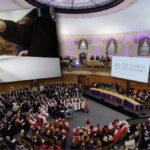
Last Sunday, I was invited to preach at Oriel College, Oxford, by the Chaplain, Dr Robert Wainwright. All services in the chapel follow the Book of Common Prayer. This year is the 700th year of the foundation of the college, which was originally called House of the Blessed Mary at Oxford, and so the sermon series this term focuses on the person of Mary, the mother of Jesus. Rob asked me to preach on Revelation 12, in light of my research, and this was an interesting challenge, since Rev 12 is not about Mary!
I offer here my text, along with a recording of the sermon, followed by some reflections of the challenges and opportunities of preaching.
Thank you for your kind invitation to contribute to this celebration of Mary, in your 700th year. I am particularly delighted to preach on Revelation—the most important text in the New Testament, as I am sure you are aware, and the single most influential text on Western Culture. The last time I was in a college chapel, I was preaching on the number of the beast, 666, but it was over at the Other Place, so felt fitting.
And of course, contrary to a Catholic tradition of exegesis, this passage is, in fact, not about Mary, so my sermon is brief. In the name of the Father…
Just one moment, Dr Paul, I hear you cry. How can you be so sure? Well, because John is drawing for us what we would call a political cartoon, which is why the narrative is so strange. (Someone said about the Troubles in Northern Ireland: ‘If you are not confused, you don’t know what is going on’. And the same is true of Revelation.)
Like all the best political cartoons, John is blending characters from one context with a narrative from another. The narrative is the Python-Leto myth, where bad boy Zeus has sex with Leto (whilst married to Hera), Leto is pursued by dragon Python, the chaos monster, but is carried to safety by the eagle-wind, and gives birth on Delos, next to Patmos. Her twins are Artemis (of Ephesus) and Apollo, who at four days old, pursues Python and slays him.
This story was widely circulated from the second century BC to the third AD across this region—and is well known today. You can read it online in Hyginus’ collection, Fabulae no 140. Last year, in a teaching session in Derby, one of the audience leapt up and recited it for us! She was a Greek Cypriot, and she was raised with this story, just as we are with Jack and the Beanstalk, or Robin Hood.
Why are these myths to powerful? Because they tell us about the real world as it is. Emperor Domitian was fond of retelling this—adding himself in the story. The chaos monster is the Parthians, or the Germans, or the Scots—whichever unwashed barbarians they are currently locked in combat with—and he, of course, is the Apollo figure, bringing Pax Romana to the chaos of the wider world.
But John turns the tables. The characters he inserts are from the biblical narrative. Python, we are told in verse 9, is ‘that ancient serpent, who is called the devil and Satan, the deceiver of the whole world’. The ‘male son’ ruling with an iron rod, Psalm 2 verse 4 tells us that this is the longed-for Davidic messiah—yes, as the little boy said in Sunday School, ‘the answer is always Jesus’.
So who is this woman, ‘clothed with the sun, with the moon under her feet and a crown of twelve stars on her head’? The dream of Joseph tells us clearly: this is the people of God, both formed and glorified by God despite emerging from the most dysfunctional family, the 12 sons of Jacob, that you could imagine.
And Isaiah 66, and Micah 4 and 6 tell us that she is in labour pains—in the agony of exile, waiting to be ‘delivered’ by God. Do you get the pun? A woman delivered, the people delivered? This is the agony we read of in the Benedictus, where Zechariah longs that they will be ‘delivered from the hand of our enemies.’ (Perhaps there is a connection with Mary after all…)
And deliverance comes, of and through this male son, who, though snatched away from God, has won the victory by his blood on the cross, and who is now the lamb, slain, standing, on the throne of thrones.
So what does this Mary-like figure tell us about who we are, and the world we are in?
First, she is a picture of glory and agony.
The sun, the moon, the stars—this is royal, radiant, cosmic imagery. This is the people of God—wrapped in divine promise and honour—given as gifts, not earned as rewards.
But then the agony—bloody pain and trial in bringing new life to birth. And there, in two verses, is one of the great truths of the Christian life. The people of God are both glorious and groaning. We are crowned—and we are crying out. We are chosen—and we are stretched. And Mary’s story reflects this too—Mary, full of grace, by the gift of God—but also the one whose soul will be pierced with a sword.
Secondly, God’s People Are Defined by Longing, Not Control
The woman here is not organising. She is not strategising. She is not managing the situation. She is is waiting, trusting, and enduring.
This is deeply unfashionable spirituality. We like control. We like plans. We like outcomes we can measure by Tuesday. But the people of God are shaped not by efficiency, but by expectancy. Salvation does not arrive because God’s people are clever enough. It arrives because they are faithful enough to wait.
Now, plans are not without their use. When my wife was giving birth to each of our three children, I was grateful that the midwife was skilled and trained, and had contingency plans in place should anything go wrong. But notice that it is not the plans that deliver the child—it is the mother.
And we need to ensure that our plans serve this longing for the coming kingdom of God, rather than controlling it. But the longing, the desire, needs to be there. As Paul says in Gal 4.19 ‘I am in the agonies of childbirth until Christ is born in you’. Does that agony mark our desire for our fellow students, our friends, our family?
Thirdly, we are caught in real spiritual conflict.
In our narrative, the dragon appears before the child is born. This is a hard but necessary truth: faithfulness attracts opposition. If you imagine that living a quiet Christian life will keep you out of trouble, Revelation 12 gently shakes its head. The dragon is not interested in noisy rebellion; it is threatened by faithful obedience.
Mary learns this immediately. The annunciation is followed not by applause, but by danger. Her pregnancy triggers Herod’s paranoia. Faithfulness puts her family on the road as refugees.
And notice how this is summarised in verse 11: ‘they have conquered him by the blood of the Lamb and by the word of their testimony.’ When we are faithful witnesses, we will be caught up in the same conflict as this woman, and as Mary was.
Fourthly, We know God’s Protection in the midst of tribulation.
John introduces himself to his readers in this way (Rev 1.9): ‘I, John, your brother and partner in the tribulation and the kingdom and the patient endurance that are in Jesus.’ That perfectly describes this woman—and of course Mary.
The child is born—and immediately “snatched up to God and to his throne.” The woman is carried away, pursued by the Dragon—who also attacks the rest of her offspring, which is you and me. This is the greatest paradox of the Book of Revelation. In chapter 7, those dressed in white have come through the great tribulation, not passed around it.
Revelation 12 does not invite us to admire the woman from a distance. It invites us to be the woman. To live with dignity and pain held together. To long deeply without grasping control. To expect opposition without losing hope. To trust that God’s purposes will outlast the dragon.
Mary shows us what that looks like in one human life.
And the Church is called to show it again—patiently, faithfully, and courageously—until Christ is fully born in the world. Which, admittedly, is not easy. But then again, no one ever said giving birth was going to be easy.
Here is the recording, as an audio on YouTube, and below it I offer some reflections on preaching in this context, and preaching generally.
It is always worth reflecting on your preaching; when you preach in the same place, week in, week out, then this needs to happen more periodically. But preaching in a quite different context provides fresh opportunities for reflection.
Rob had asked me to preach for no more than 12 minutes—because the service is followed by formal dinner. In light of this need to be precise, and the relatively short time I had, I knew I had to write a script. Preachers can usually expect to speak at 100 words a minutes, so I had a space of 1,200 words. (In fact, I got through my text slightly faster, so ad libbed a little in the second half—and ended up one minute over).
The space of the chapel was quite formal, and I was preaching from my stall, not from a central lectern—and there was no amplification system. So I knew I had to be very clear in my delivery.
This raises interesting questions about the role of the script. I usually preach from notes, sometimes quite short notes, and often improvise. But when I taught preaching (for nearly ten years), I urged students to go to both extremes—find contexts where you have to stick to a script on the one hand, and other contexts where you have to speak without any notes. The reason for this is that the two extremes teach you different things, and both are necessary for preaching. Having a script teaches you to hone your words with precision, whilst speaking without notes teaches you to engage with your audience. The combination allows you to be both precise and engaging.
According to Aristotle’s writings on rhetoric, good speaking always includes the three elements of logos (explanation and argument), ethos, (the speaker’s credibility and connection) and pathos (emotional appeal). My quips at the beginning were designed to be part of connecting with the audience (ethos), indicating that I, too, was an Oxford man (!). Personal references and experience also have that function.
I had a fascinating conversation after dinner with a visiting fellow, a Hindu woman who lectures in English literature, and who was raised in south India and attended an Anglican school. We talked about the interrelation between trust and suspicion, and the role of criticism. I have found the work of Paul Ricoeur most helpful in thinking about how critical thinking relates to trust, both in the context of interactions with people and our handling of texts (since texts are, in fact, acts of interpersonal communication).
Ricoeur calls trust without critical thinking the ‘first naiveté’, and although that has an appeal, it leads to the dangers of deception and manipulation by the other. We therefore have always to go on a journey of critical reflection (‘What did that person mean by saying X…?’ ‘Does this biblical text really mean what I thought it did when I first read it…?’)—but we cannot stay there. The danger here is that criticism on its own creates a desert of suspicion, and (says Ricoeur) ‘Beyond the desert of criticism we wish to be called again’. In the light of critical reflection, we need to make a wager of faith, and commit ourselves to trust in the meaning of the person or the text, having gone through the process of reflection—which Ricoeur calls the ‘second naiveté’.
In this text, the critical question to ask is: is this text really about Mary? The critical answer is clearly no: the features of the characters, including the woman, when read in canonical and cultural context, point to her being a metaphor for the people of God, in the pains of longing to be delivered by God from evil and oppression, and longing for the coming of the promised messiah. So the first half of my sermon involved going on that critical detour, and the second half expressed the ‘second naiveté’ of engaging once more with the text in the light of the critical work.
Was I happy with the final result? Yes and no. I think the congregation found it engaging, and some great conversations followed. I actually wrote the sermon in two stages (as I had been at General Synod the previous week) and in two different ways.
On reflection, I would thin the second half in terms of content—three points rather than four—and ensure it was more lyrical and engaging. And I thought my final sentence was not as punchy as I would have liked. And overall I was not sure I was clear enough on the call to personal trust in Jesus that I would have wanted to include.
But Ricoeur reminds us of something else in relation to language and preaching: the idea of ‘distanciation’. Once we write or speak something, a distance arises between the speaker and the spoken. On the one hand, this is what gives rise to the need for interpretation. On the other, it does mean that our words, written or spoken, then have a life of their own. We cannot control them, and so we need to pray and trust that God will use them in the lives of our hearers as he wills.
That is why preaching always makes us feel vulnerable—a little bit like a woman in the pains of childbirth.
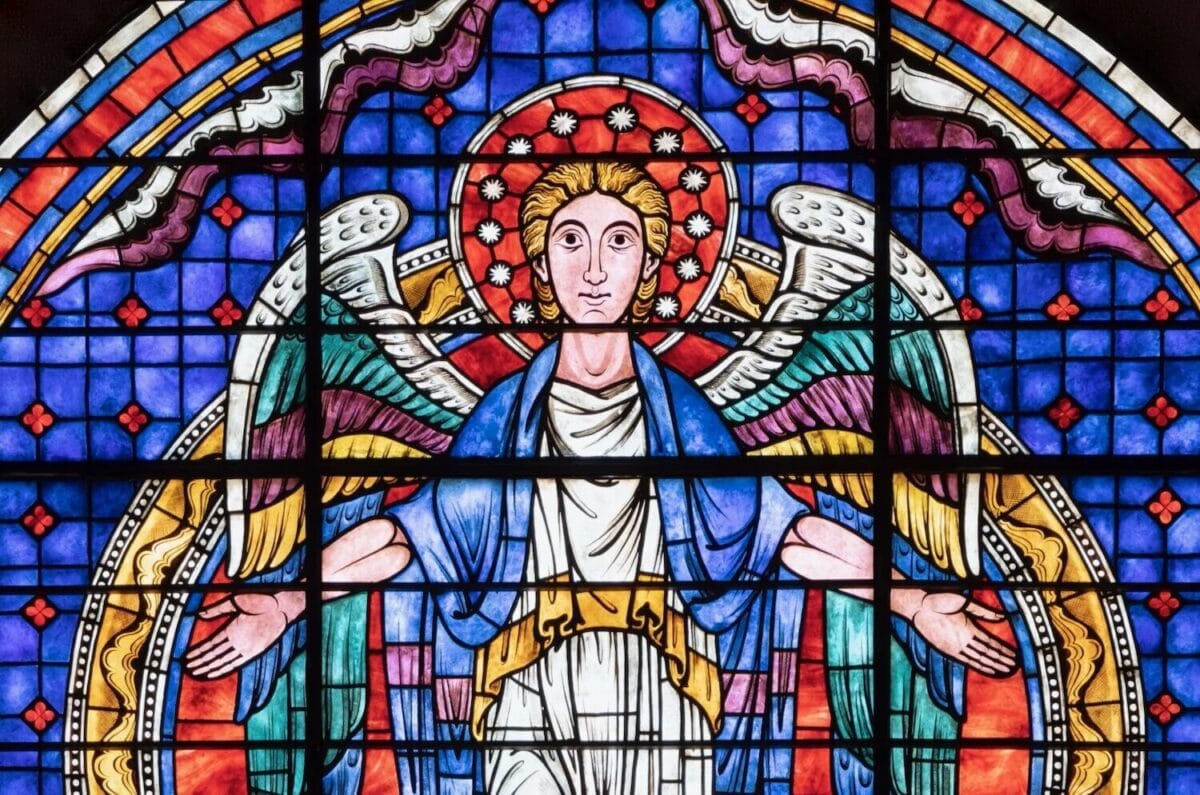
The stained glass at the top is from Glencairn Museum, in Bryn Athyn, just north of Philadelphia.
 Buy me a Coffee








What a brilliant piece! Thanks Ian
Thank you. What did you enjoy—the sermon or the commentary on it?
I found the commentary particularly helpful – lots of meaty content and practical tips; and great reflective style. I probably haven’t got time, but Ricoeur sounds interesting…
Thanks. He is, but he is a difficult read.
Dan Stiver’s volume is good, though not sure how much he talks about preaching. Theology After Ricoeur. https://amzn.eu/d/08pFm6hg
Great, many thanks for this
Why Oh Why? On Ash Wednesday, we read Matthew ch 6 v16. Where he tells us; to not be like the Heathen, who when they are Fasting. They disfigure their face? (Ash on the forehead?)
To show to everyone, that they are Fasting!! But, Wash your face and apply oil…..
Matthew 6 is about *performative* piety, and not just in regards to fasting, but in charity/giving and prayer too.
Ash on the forehead is a sign of repentance and humility, mean to remind us of our mortality (ashes to ashes, dust to dust). It happens right at the start, before the effects of any sustained fasting would be felt, and is temporary. It is meant to evoke the prophetic witness of the people, turning back to God.
While ‘ashing’ is certainly man-made tradition, it is valuable as sign so long as it points to the right thing.
I do love Oriel’s chapel. Oxford has many strange and wonderful ones, from the riot of gilt, colour and image in Worcester, to the magnificence and grandeur of Merton. I always liked Oriel’s and St John’s for that matter; both are grand, while still being slightly understated.
Lincoln college probably has my favourite though. Sorry. 🙂
This is an excellent homily on such a dense and complicated passage. I think you’re probably right that 3 points is better, in terms of rhetoric within the time limit, than 4, but I didn’t think it ended poorly.
Did you know that Merton was planned to be the cathedral? Hence the transept and the whopping tower.
They sold the land and built Corpus Christi, so the plans were scuppered…
I did.
You can tell, but on the off chance you are a visitor and don’t, there are always Merton undergraduates around to rub it in your face. 🙂
In the hoped-for glory, or the failure to realise it?
Hello, thanks so much for your lovely sermon and commentary. I just don’t understand why you consider Revelation to be the most important text in the New Testament. I think you could make a very strong argument that the Gospels should claim this title. I am very interested in hearing your reasoning.
Thanks Erin!
it was a slightly tongue in cheek comment. But how do you know the word Alleluiah? Because it is in the Book of Revelation. Why do we call Jesus the Lion of Judah? Why do we talk of the Lamb on the Throne? The Alpha and the Omega? The river of life? The New Jerusalem? All these things come from the Book of Revelation.
If you go into any church building with stained glass, I bet you will find at least one image from the Book of Revelation.
It is massively influential on Christian art and praise, actually moreso than any one of the gospels…!
Thank you for your response. Revelation does summarise the whole story of the Bible and it does testify to the deity of Jesus. However the Gospels are the eye witness testimony of people who were with Jesus its based on their testimony that we base our faith in Christ. We could still be practising Christians with the gospels, without Revelation we could not be. The same cannot be said of the reverse. However I understand that your statement is tongue and cheek and I look forward to reading many more of your excellent sermons.
Well, of course you are right!
But the theology of who Jesus is is very often implicit in the gospels (the Fourth Gospel being something of an exception).
In Revelation, we find the most explicitly worked out Trinitarian theology: https://www.psephizo.com/biblical-studies/where-is-the-trinity-in-the-book-of-revelation/
which is probably why the like of James Tabor have tried to argue Revelation was originally a purely Jewish text. He has actually rewritten it to remove Jesus’ name. You can see where his bias lies.
What a bizarre way to treat a text. This idea was put forward by Josephine Massyngberde Ford in the previous Anchor Bible, which rendered the commentary almost completely useless.
Did anyone get upset with you for insisting that Revelation 12 isn’t about Mary? (I wouldn’t have done, by the way, in case you were wondering!)
Thank you. I enjoyed this piece – the more so as I tend to avoid preaching on Revelation (!). Having just completed a BMJ module on presentations – nd reflected on how much it sounded (and read) like a module of preaching skills, I now reflect on how much your comments sound like a training on presentation skills – and yes, I am familiar with Paul Ricoeur. I do still enjoy theology and scripture so much even after preaching for nearly thirty years (and I was relatively elderly when I started!). In fact, I only began preaching at all as a result of a dare – and then really fell in love with scripture (long story).
Thanks. What is BMJ—British Medical…?
An interesting and understandably time limited lecture.
Revelation Ch 12. Is a great comfort to saints, the battle belongs to God amongst the principalities and powers.
As Jesus said “ John 16:33 These things I have spoken unto you, that in me ye might have peace. In the world ye shall have tribulation: but be of good cheer; I have overcome the world
1 John 4:4
Ye are of God, little children, and have overcome them: because greater is he that is in you, than he that is in the world.
1 John 5:4
For whatsoever is born of God overcometh the world: and this is the victory that overcometh the world, even our faith.
For a more nuanced appreciation of Ch.12
See Biblehub commentaries by Benson [a particular
favourite of mine] Darby and Clarke in particular.
This is a timely word for the internecine contenders
of the “Anglican “Issues”.
The best advice of the prophets was to “Stand still and see the Salvation of the Lord”
2 Chr 20:17 Ye shall not need to fight in this battle: set yourselves, stand ye still, and see the salvation of the LORD with you, O Judah and Jerusalem: fear not, nor be dismayed; to morrow go out against them: for the LORD will be with you.
And the Apostle “Stand in the evil day”
1 Chr 21:16 And David lifted up his eyes, and saw the angel of the LORD stand between the earth and the heaven, having a drawn sword in his hand stretched out over Jerusalem. Then David and the elders of Israel, who were clothed in sackcloth, fell upon their faces.
“The battle belongs to the Lord” for His is the “Power and the Glory”. Shalom.
This is a great sermon. 12 minutes listening, or 12 minutes reading, is quite long enough if you want to hold my attention. And long enough to get under the skin of this reader at least, with the reminder that – as individuals – we are not supposed to be in control.
But the woman in the parable is a church, not an individual. Will the churches – as churches – believe they are not in control? There is huge pressure on churches – especially conservative ones – to project themselves as “sound” or “successful.” Who would want to join a struggling organisation?
Thanks.
I think anyone with any experience in ministry knows that they are not in control. We sow and we water…but any growth that comes is from God.
However, there are views on whether sowing and watering is what we should be doing…!