
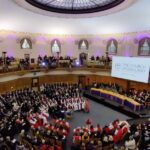
Last summer, with a little help, I reimagined how Synod would look to Anthony Trollope and Raymond Chandler, whom I had been reading at the time. Now that the dust has settled from Synod in London last week, it is worth reflecting with some humour on the proceedings.
One of the debates on Thursday was about the use of Oasis (the green foam) in flower arranging in churches. This was a vital discussion, since everyone knows that people in the local church are incapable of making responsible decisions themselves, and so it is incumbent on members of General Synod to do their thinking for them, and issue decrees from on high, without any need to consider unintended consequences.
The summary below was circulated on a clergy discussion group; if you are the author, or know the source, please tell me in the comments.
The Archbishop of Canterbury promised ‘radical new arrangements’ for church flowers. Nobody knows what this means, but everyone is already upset or excited by it, or possibly both.
The Church will begin a 10 year process of reflection, called ‘Learning about Leaves and Flowers’ (LLF for short). This will include a 500-page book and a labyrinthine website with videos about different arrangements. The resource will be imposed on the church at an inconvenient time, and is intended to divert as much time and energy away from prayer and mission as possible.
The resulting Prayers for Leaves and Flowers will be produced by the bishops. Hopes for arrangements for standalone flowers in services are expected to be met with a compromise, that flowers may be blessed but only when contained within something else.
Some clergy have made their own arrangements and are seeking to have them recognised.
Traditionalists who can’t accept the new arrangements are campaigning for Alternative Horticultural Oversight, and have set up The Carnation Fund, so that parishes can be sure their contributions aren’t being spent on the wrong sort of foliage.
Last week, there was also a two-and-a-half hour debates about fees, and net result was (more or less) not to change them—after the discussion of something like 48 amendments! I have been reading Dickens’ Little Dorrit, in which he describes the workings of the government department he calls the Circumlocution Office. It seemed a fitting match. Here is Dickens’ own account of that Synod debate. Any resemblance to any persons living is purely coincidental:
It was a truth universally acknowledged—at least within the oak-panelled, time-curdled precincts of the Synodical Chamber—that nothing of any importance could be accomplished without first proving, beyond reasonable doubt, that it ought not to be done at all. This proof, once established, must then be debated at length, subdivided, amended, re-amended, point-ordered, metaphorised, and finally returned—unchanged—to the drawer from which it had never really emerged.
Thus we enter the modern Circumlocution Office of the Church of England, where the business of fees had been conveyed, like a modest parcel misaddressed, from Common Sense to Committee, from Committee to Sub-Committee, and thence to the floor of General Synod, where it sat trembling under the weight of forty-eight amendments and two and a half hours of sanctified attention.
At the centre of this gentle storm stood Cool Hooves, Director of Finance, a gentleman of such firm hoof and flinty gaze that one suspected he had once balanced a spreadsheet by candlelight during the Flood. He rose with papers in hand, arranged as if by long habit into impeccable columns.
“My friends,” said Mr Hooves, with the air of one proposing not an increase but a law of nature, “the adjustment before us is modest, proportionate, and necessary. It reflects inflation, sustainability, and—”
At this point he was interrupted by the soft but unmistakable sound of an amendment being sharpened.
Jonathan Racy, vicar of a parish so poor it could not afford pessimism, was already on his feet. He spoke briskly, as one who had spent a lifetime making five loaves explain themselves to seven thousand mouths.
“Director,” he said pleasantly, “I beg to move Amendment One, which replaces the word increase with the phrase financial optimism to be borne elsewhere.”
Murmurs of approval fluttered across the chamber like hymnbooks dropped from a height.
Before Mr Hooves could reply, Clive Scowler leapt up, clutching the standing orders as a drowning man clutches driftwood.
“Point of order, Chair! One cannot replace a noun with a phrase of that length without due notice, sub-paragraph reference, or a theological rationale.”
The Chair nodded gravely, as Chairs do, and the amendment was discussed for twelve minutes before being declared admissible, during which time Mr Racy produced three further amendments, each slimmer, sharper, and more lethal than the last.
Then rose William Pouncer-Flee, who never spoke without first boarding an imaginary train.
“Chair,” he began, “we must consider whether this motion is on the right track. I fear we are being shunted into a siding of unintended consequences, with parish priests left standing on the platform while the express to Diocesan Solvency whistles past.”
This metaphor was carefully uncoupled, inspected, and reattached by Synod, at which point John Doughnut stood up, rubbing his hands as though warming them over a metaphorical engine block.
“Friends,” he said, “we’re revving the engine but going nowhere. We need to keep our eyes on the road and bring this in to land. If we keep fiddling with the dashboard while the car’s in neutral, we’ll never reach the destination.”
It was widely agreed that the train had now crashed into the car, but this did not prevent further discussion.
Amendment followed amendment, each proposed by Mr Racy with the calm persistence of a man removing bricks from a wall one at a time while explaining politely why the wall had never been load-bearing in the first place. Each time Mr Hooves rose to restore fiscal gravity, Mr Scowler rose to query procedure, footnotes, or whether gravity itself had been properly authorised by Synod.
After two hours, forty-eight amendments, and one theological digression involving medieval toll bridges, the motion lay on the floor exactly as it had arrived: unchanged, unimproved, and visibly exhausted.
At this moment, when the chamber teetered between fatigue and farce, Helen Sheep rose. She had spoken little, listened much, and carried the quiet authority of someone who knew precisely where all the bodies were buried—and under which statute.
“Chair,” she said gently, “it seems to me that we have achieved a rare and elegant clarity. We all agree that fees matter, that parishes differ, and that fairness must be real as well as theoretical. We have also demonstrated, conclusively, that this particular proposal cannot command the confidence of those who must live with its consequences. The most lawful, prudent, and—if I may say—Christian course is therefore to proceed exactly as we are.”
There was a pause. Then nods. Then relief.
The motion was put. The motion fell. Nothing changed.
Mr Hooves gathered his papers with stoic dignity. Mr Racy smiled faintly and sat down. Mr Scowler made a note to check whether sitting down had been correctly timed. Mr Pouncer-Flee disembarked. Mr Doughnut turned off the engine.
And the Circumlocution Office, having once again demonstrated its unrivalled expertise in the noble art of getting nothing done, adjourned for tea.
Finally, Apple TV have a series about a post-apocalyptic world, where people live in hidden underground silos, and have to take on trust that there is nothing actually happening in the world above, outside their silo. I thought it sounded familiar, and came across this write-up for a new series soon to be broadcast:
Deep beneath the streets of London, in a labyrinthine structure known only as Church House, thousands of devoted clerics, laity, and occasional baffled civil servants live their lives in ritualized routine. In this silo-like chamber, known as the General Synod, members faithfully debate motions, pass resolutions, and endlessly amend amendments—all while denying the very existence of anything outside the silo.
Overseeing this subterranean world are the enigmatic Bi-Shops, mysterious figures whose every pronouncement is treated as gospel and whose true motivations are as murky as the basement archives. The Synodarians cling to the sacred creed: “All that matters exists within Church House. Anything outside is a heresy of imagination.”
But when the courageous and slightly rebellious cleric Reverend Peregrine Ponder starts asking forbidden questions about life beyond the silo—wondering if there’s a world where congregations actually attend, where fees are simpler, and where decisions are swift—the foundations of Church House tremble. As debates drag on for hours, motions are endlessly amended, and agendas mysteriously vanish into the depths, Ponder risks censure, bafflement, and endless footnotes to uncover truths that could shatter the Synod forever.
Sinod is a tense, satirical journey into bureaucracy, belief, and the uncharted wilderness beyond the notice papers—a world where faith is literal, procedures are lethal, and one brave clergyman dares to peek out of the hatch. Tune in for the next episode in July.
I hope these reflections might help members of Synod—and the wider church—not take themselves too seriously…
 Buy me a Coffee









It’s good to have a smile on my face after a week of General Synod!
In the same vein, just as the Bishop in “The Warden” comments about Septimus Harding, I am reassured to see that some at least in Synod still have “persistent bouts of Christianity.” Unlike those who ask, along with Archdeacon Grantley, “what’s Christianity got to do with the Church?” – although the latter may be a mis-quotation from the BBC drama series.
But I would give the last word to Mr Bennett in “Pride and Prejudice” – “For what do we live, but to make sport for our neighbours, and laugh at them in our turn?”
The joy of the Lord is our strength – along with a good laugh in His Name!
There’s also the episode of Yes Prime Minister about the appointing of a new bishop.
https://www.youtube.com/watch?v=m2dNCw0hPLs
What is mildly alarming here is how much still seems to be relevant. Have we not moved on at all…?
so poor it could not afford pessimism, laft outloud.
Yes, that was brilliant! I also liked the fact that even Charles Dickens quotes Jane Austen’s opening (“truth universally acknowledged”.)
What about those Flowers that identify as cacti? Aren’t they included too?
Or should they have a separate pot?
I’ve never been to Synod, and this doesn’t stir that ambition within me … I am, though, reminded of one of my favourite observations: A committee is the one place on earth where fog generates heat.
. . . and the ideal committee has three members with two having given their apologies!
Or, a committee is a body that meets for hours to produce a result called minutes.
Didn’t Anthony Buckeridge’s Jennings books speak about making a right bish-up of something?
Bench, bevy, psalter, sea, absolution, consistory…
…are all collective nouns for bishops. (We were charged in 1978, in Lambeth Conference processional context, with suggesting one such, and ‘bish-up’ was what came to my mind. Jennings is like William – a good example of creating very funny humour by setting unfettered spirited originality against the backdrop of conventionality and predictability.)
How about a superfluity of bishops?
A genderfluity of canons?
Brilliant, both.
Thank you Christopher. I suspect autocorrect would have changed it to superfluidity!
Some of Mrs Proudie’s columns at the late Archbishop Cranmer blog might still be readable on the Wayback Machine.
A genderfluity of canons?
Certainly not a broadside.
An arsenal of canons, perhaps? Some are big shots, with the occasional small bore.
Oh, honestly, do put a sandbag in it.
(In best Lady Bracknell voice): ‘A sandbag???’
Which takes us back 2 years earlier, to the 1976 Abbey funerals/memorials of Dames Edith Evans and Sybil Thorndike. (To continue the prima donna theme from where we began.)
The best advice that I received when I was a curate, and one I have taken to heart ever since was this:
‘Never argue with organists or flower arrangers; you will NEVER win’.
I have found this to be wise advice indeed. I have seen the consequences of those who dared to do this.
I would add a further caveat: ‘For if you do, you will not only upset the organists or flower arrangers, you will almost certainly lose the congregation as well’.
You go there at your peril!
What is the difference between a terrorist and a liturgist?
You can negotiate with a terrorist…
I thought it was an organist…
What’s the difference between a terrorist and a Vicar?
….
The terrorist knows what they arevdoing!
Definition of synod:
A group of Anglicans waiting to go home.
Oh very good!
I thought the implicit definition was: a camel is a horse designed by a committee!
No, a committee would never come up with something as useful as a camel. A rocking horse, perhaps.
This puts me in mind of Proverbs Ch’s 14 &24
[Cf. Proverbs 14:1 and Proverbs 24:3-4]
Trigger warning:- Disturbing.
Speaking as an old salt, I rather fear that these reports from the General Synod must have exceeded the daily recommended dose of sodium chloride by a dangerous margin. Have any deaths been reported since?
The See will give up its dead….
Which diocese is the Dead See?
A pinch of salt?
Salt was a sacrificial requirement: The Mosaic Law required all offerings to be seasoned with salt, emphasizing that sacrifices were intended to be pure and in accordance with the covenant (Leviticus 2:13)
It symbolizes preservation and purification because salt was essential for preserving food, it symbolizes the preservation of holiness, purity, and the prevention of moral corruption.
Jesus instructs believers to “have salt among yourselves and be at peace with one another,” implying the preservation of good relationships and seasoned, wise speech. Cf. Colossians 4:6
A pinch of salt and a ton of humour will not resolve this
“issue” I fear.
For more salt perhaps start at a Jewish understanding “The Jewelled Symbolism of Salt in Scripture” @https://faithgateway.com/blogs/christian-books/taste-and-see-the-jeweled-symbolism-of-salt-in-scripture#:~:text=The%20two%20parties%20of%20the%20covenant%2C%20God,not%20forgotten%20their%20salt%20covenants%20with%20GodIt is quite informative. Shalom.
It must be remembered that it took tons of salt
to purge the land that God had gifted to Abraham.
Learning about Leaves and Flowers is my work, I’m afraid. https://davidkeen.blogspot.com/2026/02/new-cofe-flower-arrangements.html
Aha! I should have guessed!
We need your wit and wisdom on Synod!
I think ‘will to live’ is the thing beginning with w that I’m most concerned about!
We love the Carnation Fund…since wearing a single carnation was once seen as an indication of which side you liked to make arrangements…