There has been a record-breaking rise in antisemitic incidents in the UK since the attack by Hamas on October 7th 2023.
Antisemitic incidents reached the highest level recorded, the monitoring and community safety organisation the Community Security Trust (CST) said. In the 12 months after the 7 October attacks there were 5,583 incidents in the UK – including abusive behaviour, threats, assaults, damage and desecration – a 204% year-on-year increase.
Jews in Britain are now more actively considering whether they are safe here, and whether they should move to Israel themselves, the one country in the world where—ironically—they might feel safe. This follows a pattern since the establishing of the State of Israel in 1948, particularly in Muslim Arab nations. In that time, 900,000 Jews have left or been driven from their homes, so that ancient, historic communities have simply disappeared.
Earlier this year I visited Morocco on holiday, and in every city we visited we came across ‘The Jewish Quarter’, ‘The Synagogue’, and ‘The Jewish Cemetery’—but no Jews. The famous Blue City, Chefchaouen, is blue because houses in the Jewish quarter were painted blue to set this area apart from the rest of the city. When tourists came to visit, they realised in the 1990s that more tourists might come if more houses were painted blue—but of course by then there were no longer any Jews. It is rather ironic that people come to see something which is a sign of a community that no longer exists.
This therefore is a good time to repost this article, first written three years ago. I should note at the outset that some claim ‘antisemitic’ should apply to hatred of both Jews and Arabs, since they are both semitic peoples. But that is to commit the genetic fallacy: words do not mean what their etymology says (a ‘lady’ is not someone who kneads bread, despite that being the origin of the term). Antisemitism, in any decent dictionary, is ‘hostility to, prejudice against, and hatred of Jews; discrimination against Jews as a religious, ethnic, or racial group.’ It is all too prevalent in the UK and Western culture—and I hear no protests about it.
A service was held on Sunday 8th May 2022 to mark the 800th anniversary (one day early) of the Synod of Oxford of 9th May 1222 which introduced the first measures against Jews in England, and led to more harsh measures and the eventual expulsion of Jews from England in 1290. This appeared to have encouraged anti-Semitic measures across Europe. It is sobering to note that the Synod was convened by Stephen Langton, former professor of theology in Paris and then Archbishop of Canterbury, who not only likely wrote the Magna Carta, but also added the chapter divisions into the Bible which we use today. Details of the service, together with links to the sermon, and a historical account of the Synod of Oxford, can be found on the diocesan website here.
The Times reported the service with this introduction:
English Christians must repent for their “painful and shameful” history of persecuting Jews, a bishop said at a service of “penitence” at a Church of England cathedral today.
Many of the “lethal” antisemitic myths and stereotypes used over centuries to justify the abuse, oppression, expulsion and murder of Jewish people across Europe can be traced back to Christian teaching, and specifically to anti-Jewish laws enacted at the Synod of Oxford in 1222, church leaders said.
This offers something vital and positive—a rejection of antisemitic ideas and language—but also includes much nonsense. The idea that I, or anyone else, can ‘repent’ for something historic that we did not do—indeed, as the Guardian writer notes, something that happened before the Church of England even came into being—is nonsense. Those who need to repent (change) are long dead, and I do not own their views so cannot repent of them. The event was clearly of significance for the Jewish community, but it would have been no less so if the language of ‘reject’ and ‘renounce’ was used instead.
But this raises the question: what views should we reject which might contribute to an antisemitic outlook? I would suggest these 12 views, which might not all look discriminatory at first, but sow the seeds of an anti-Jewish outlook amongst Christians—and are very common indeed.
1. Jesus rejected the law
It is quite common to hear people comment that Jesus rejected the law and its legalism, and modelled a kind of free-wheeling gospel of grace where the law does not matter; it has even been promoted by some Anglican bishops. I think this originates from a simplistic reading of the ‘you have heard it said, but I say to you…’ language in the Sermon on the Mount in Matt 5–7, from seeing the criticisms by the Pharisees of Jesus’ apparent lax approach to practices they insisted on (such as Sabbath observance and ritual washing), and from Jesus’ association with ‘sinners’.
But, as Andy Angel has pointed out, all the evidence is that Jesus was a Torah-observant Jew, who called his followers to a stricter, not more lax, observance of the law, in demanding that outward observance on its own was not enough. Jesus rejected particular interpretations of the law, rather than the law itself. And he was concerned with purity, but it was a purity he offered people rather than demanded of them. In Matthew’s gospel particularly, Jesus encourages his hearers to treasure the law alongside the good news of the kingdom (Matt 13.52). And his repeated refrain is that he did not come to ‘do away’ with the law, but to ‘fulfil it’.
2. Jesus saves us from ‘religion’
Jesus was not ‘religious’, but hung around with ‘non-religious’ people on the margins—and his main criticisms were reserved for the religious. Or so we are told. If this is so, it is quite hard not to read this as seriously antisemitic, since the only religious people around in the gospels were Jews! But this claim includes at least three mistaken assumptions.
First, the world of the first century was a religious world quite distinct from our contemporary Western culture where we have compartmentalised ‘religion’ into a neat, distinct, category. Essentially, in the ancient world everyone was religious, even those ‘on the margins’! Secondly, the good news is directed towards and appeals to both the observant and the lax, the pious and the marginal. Luke’s gospel, which we are reading in this Lectionary Year C, is particularly explicit here: almost all of the main players in the narrative are pious, observant, devout Jews, and it is to these whom God reveals himself first.
Thirdly, Jesus ‘hung around with the outcasts’ in order to call them to pious holiness, not to leave them as they were. ‘I have not come to call the righteous [since they are well, and do not need my medicine], but sinners to repentance‘ (Luke 5.32).
3. The Pharisees were all bad
The sharpest conflicts in the gospels often appear to be between Jesus and the Pharisees, who were a primarily lay-led purity movement, and who were ambivalent about the power plays of those who were associated with the temple. They are often depicted as amongst those challenging and questioning Jesus, and join in the conspiracy to do away with him, and Jesus appears to reserve his harshest words for them.
Yet Pharisees were also drawn to the ministry of John the Baptist to be baptised (Matt 3.7); many of them come and attend to Jesus’ teaching and want to defend him (Luke 7.36, 13.31). In fact Jesus makes this remarkable comment to his disciples to urge them to attend to the teaching of the Pharisees:
The teachers of the law and the Pharisees sit in Moses’ seat. So you must be careful to do everything they tell you. But do not do what they do, for they do not practice what they preach (Matt 23.2–3)
4. The love of God is unconditional and works don’t count
I read online yesterday an animated argument for an ‘inclusive’ church, which was accompanied by a picture of a placard in multicolour: ‘God accepts you as you are’. It is very hard indeed to reconcile that with anything to be found in the New Testament! The message we find there is much more like ‘God loves you and therefore calls you to change; at great cost he deals with your sin, what is wrong in the world, in order that you might live a changed life’.
John Barclay has demonstrated convincingly that in the writings of Paul, God’s grace is unconditioned, in that the gift of new life in Christ does not have any pre-conditions to it, but it is not unconditional, in that it does make demands. If that were not the case, how could Paul (following the example of Jesus) so often warn of the consequences of not living out the obligations of faith? Paul is very clear that we have been saved by grace through faith—in order to live a life of good works (Eph 2.8–10). The apparent contrast between the language of faith and works in James 2.18–24 and Romans 3–4 is just that: apparent. The debate here is precisely around the grounds on which we are saved (grace) and what we are saved for (good works), so that saving faith makes itself seen in a changed life. This is vital to avoid the caricature of ‘works-based Judaism’ contrasted with ‘grace-filled Christianity.’
5. Grace has replaced law
One of the most striking and repeated refrains in the Old Testament is ‘The Lord is gracious and compassionate, slow to anger and rich in love’ (Ex 34.6, Num 14.18, Ps 86.15, Ps 103.8, Ps 145.8 and so on). So how is it that many people come to read the OT as being about a demanding, law-giving (Jewish) God who is constantly angry, and a loving, meek (Christian) Jesus who loves us and accepts us just as we are? There is no doubt that Jesus came close to those who were far away, and touched them with the healing compassion of God—just as there is no doubt that Jesus talked more about the need for radical change and the danger of eternal destruction than anyone else in the NT.
One source of this mistake is a misreading of John 1.16–17, where the AV implies a contrast between the law given through Moses, and the grace we have received in Jesus: ‘For the law was given by Moses, but grace and truth came by Jesus Christ.’ However, the word ‘but’ is not there, and the preceding phrase ‘grace upon grace’ or ‘grace received in place of grace already given’ (TNIV) is a pointer to Ex 33.13 ‘if I have found grace…’ The grace of God in Jesus is an even greater outpouring of the grace God and already bestowed on his people Israel, not a contrast to it. God rescued his people first, and only then gave them the Commandments to shape their new life together in response to his saving acts.
6. ‘The Jews’ were opposed to Jesus
In the Fourth Gospel, there are moments where it appears that ‘the Jews’ are the ones who oppose Jesus, and taken out of context (as this language has often, tragically, been) it could be read as contrasting Jewish opponents of Jesus with his ‘Christian’ followers. This is, of course, both historical and narrative nonsense. All the characters in the Fourth Gospel are Jews, including Jesus and his followers, so we need to read this language more carefully. Even a cursory reading of this gospel shows that the term Iudaioi is used in at least three different ways: to refer to Jewish practice and belief (John 2.6); to refer to southern Judeans in contrast with northern Galileans; and to refer to the Jewish leaders in Jerusalem who opposed Jesus. Mark Stibbe also proposes that the term specifically refers to Jews who had believed in Jesus and had then turned against him in John 8.31.
But the Fourth Gospel is very clear: salvation is from the Jews (John 4.22) and those who are outside Jewish belief need to come to the Jewish messiah to receive God’s gift. The whole gospel is structured around the Jewish festivals, and it is only in understanding these that we can know who Jesus is. German critical scholarship of the nineteenth and twentieth century, which put this gospel as a late, Hellenised document from the second century, was profoundly anti-Jewish as well as being unhistorical.
7. Paul thought the law was bad
Protestant reading of Paul has been deeply shaped by the Reformation, and a general outlook of the contrast in Paul between ‘works righteousness’ versus ‘salvation by grace’. This is why it is important to consider the (now not very new) ‘new perspective on Paul‘ which offers a more historically rooted reading of Paul and of first-century Judaism(s), and takes seriously the positive as well as negative things Paul says about the law.
For Paul, the law is good (Rom 7.12, 1 Tim 1.8) in that it tells us the truth about God’s call on our lives, but it cannot deliver that without the defeat of sin through the cross and resurrection of Jesus, and the gift of the Spirit to empower us to live the life of obedience to God. And we fulfil the law by the power of the Spirit so that we live the kind of changed lives that he outlines in his repeated ethical injunctions.
8. The Church is contrasted with Israel
There is a good case for never using the word ‘church’ in English translations, for two reasons. First, we cannot read that word without including with it associations of either institutions (‘the Church of England’) or buildings (‘St Botolph’s Church’) neither of which belong in the New Testament. But, second, we miss a vital point of continuity: the word ekklesia was used of the gathering of citizens (that is, free men over the age of 30) for decision-making within the Greek polis, but it was also the word used in the Greek OT for the ‘congregation of the sons of Israel’, that is, the people of God.
We should therefore read the word ‘church’ as having continuity with, not differentiation from, Israel. Paul is very clear that gentile believers are grafted into the Israel of God, neither replacing it as ‘the Church’ nor being absorbed into it by becoming Jews. And John is clear, in Revelation 7, that the ordered, holy Israel of God (the ‘144,000’ that he hears counted out) is now drawn from every tribe, language, people and nation. The Israel of God is still Israel, but it now includes both ethnic Jews and gentiles from every ethnicity, nation, culture, and language. In this sense, I am an ‘honorary Jew’, a ‘Jew inwardly’ (Rom 2.29), graciously incorporated into the Israel of God.
9. Jesus is not the Jewish Messiah
Evangelism amongst Jewish people is a uniquely sensitive issue, in part because of the history of forced conversion and abuse visited upon Jews in European Christendom. But there is a strange paradox in the idea that a movement, which was entirely a Jewish renewal movement in its earliest days, following a Jewish messiah, and made up entirely of Jewish followers, should not now ever include Jews amongst its numbers.
And the idea that Jews cannot be followers of Jesus is a slap in the face to Jews who already say that they are—who are in danger of being a marginalised group within a marginalised group. We should honour and recognise those ‘messianic’ Jews who remain Jewish followers of Jesus by allowing them to share their faith.
10. Modern Israel is a uniquely evil oppressor
There are many who believe that the existence of the modern state of Israel is a sign of God’s faithfulness and, in particular, fulfilment of his ‘end times’ plan—but I believe they are quite mistaken. One of the many problems with this view is that modern Israel is treated with ethical exceptionalism, and that to question anything that happens there is to challenge God’s plans. On the other hand, many others think that Israel is an almost unique oppressor of Palestinian Arabs, claiming that Israel is an apartheid state.
Even if modern Israel had a unique place in God’s purposes, it is hard to justify ethical exceptionalism—after all, in the OT Israel is to be a light to the nations, and is called to a higher ethical standard, not to be excepted from ethical accountability. And a deeply awkward aspect of the narrative of exile is precisely that Israel was judged by God for not pursuing justice and righteousness. But modern Israel is the only functioning democracy in the region, and stands out in comparison with neighbouring Arab states on its human rights record—and in fact on just about any other ethical measure. So if we are going to criticise modern Israel, then we need to do so in proportion, and aim our censure even more at other countries in the region.
This is especially pertinent in the current tragedy unfolding in Gaza. By any measure, Israel’s response appears disproportionate, and it is highly divisive within Israel itself. We should both lament and protest. But why does this tragedy dominate social media, when there are greater tragedies we might protest about? Why do we not lament and protest about other crises, such as that in Sudan?
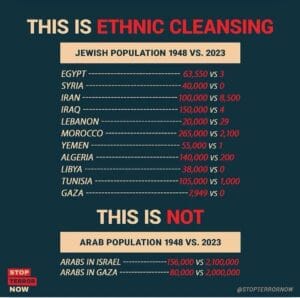 The most offensive response to this tragedy is the claim that Israel is committing ‘genocide’ against Palestinians. 50,000 casualties out of a population of 2 million in Gaza is appalling (assuming that the figures from Hamas are correct) but that is not the ‘the destruction of a nation or of an ethnic group’. And it is bizarre to suggest that this is the aim of the Israeli government: there are 2 million Palestinian Muslim Arabs living as citizens with full democratic rights within the State of Israel. What is deeply offensive is that this term was coined to describe the antisemitism of the Nazis and their ‘final solution’ to the ‘Jewish problem’. As a result of this, the global population of Jews has still not returned to the level it was in 1935—in a time when the world population itself has exploded. And the destruction of the Jews remains the aim of Hamas—’from the river to the sea’.
So, let’s protest about Gaza. Let’s avoid using disproportionate and offensive language. And let’s protest in proportion to our protest at other crises in the world today.
11. The suffering of the Jews is mere history
On one of my trips to Israel, I was in a group which had the chance to meet political and religious leaders from all sides of the current political dispute. That included meeting with members of the PLO’s negotiating team who had been working with Israeli leaders in the conversations about future peace. I asked one of them: ‘How important do you think the Holocaust is for those you have been negotiating with?’ His reply was shocking: ‘Well, it was unfortunate’. He appeared to have no understanding of how central the Holocaust is in the thinking of those with whom he was negotiating.
We need to understand how important the painful history of antisemitism is for Jewish people, and confront its reality. I have found both my visits to the Yad Vashem Holocaust memorial and museum deeply troubling, and we should all be troubled by this history—not least at a time when antisemitism appears to be on the rise again in the present moment, including in Putin’s Russia, and across the Arab world.
12. Jesus is a non-Jewish everyman.
Jesus relates to all people everywhere, and so has universal significance. But he does so from the particularity of the incarnation, as a first-century Jewish man. All attempts to erase this identity include within them the seeds of anti-Jewish thinking, whether that is making Jesus a white European, making him an ‘inclusive’ hero who affirms all sexualities (something that is historically implausible for Jesus as a first-century Jew), or making him the archetypal black man who suffered involuntary oppression against the ‘Whiteness’ of Roman imperialism.
The best antidote to all this approaches is taking seriously what the gospel say about Jesus the Jewish messiah, whose grace has flowed from this place into all the world. Salvation is of the Jews.
In my own journey of discipleship and scholarship, I have been immensely helped by engaging with Jewish scholars and thinkers, reading Jewish commentaries on the Old Testament, and listening to orthodox Jewish critiques of contemporary culture. These are things every Christian leader—every Christian—ought to be engaged with.
 Buy me a Coffee



















We could mention the Kairos declaration – which calls for ‘a system of economic sanctions and boycott to be applied against Israel‘ Support for this was debated in Chichester Diocesan Synod recently and was defeated – but not by a large margin. The speakers against the declaration tended to have actual experience of the situation in Palestine and that to Christians, Islam was the greater danger. It’s interesting to consider the spirit behind both the attacks on Jews and the delusion of our minds.
Golly. So where is the parallel debate about boycotting Saudi Arabia for its human rights violations?
I would support a boycott of Saudi Arabia but of course, unlike Iran, they are our ‘partners in the war on terror’ and can be relied upon to support American and Israeli interests.
The Saudi Royal Family, albeit very Muslim, are strongly against revolutionary movements that wish to set up an ‘Islamic republic’, for obvious reasons. Also there is the petrodollar deal by which the Saudis require to be paid for much of their oil in US dollars (meaning Washington can pay simply by printing money, unlike everybody else) and bank it in the USA, while the US guarantees Saudi Arabia’s borders from invasion.
What this deal doesn’t stop is Saudi subsidy of mosque-building across the West.
“So where is the parallel debate about boycotting Saudi Arabia for its human rights violations?”
As far as I know, many hundreds of children and babies are not at risk from starvation or death in Saudi Arabia because Aid agencies have been blocked by the country’s politicians from being allowed to send in aid – food and medical supplies.
So where is the parallel?
…aid agencies that were effectively being run by Hamas.
For 18 months we have been repeatedly told that Gaza is three days from mass starvation, yet nobody seems to have actually starved. Why is that? First, because most people in the West are only a few days from starvation if food ceases to reach the supermarkets, and until a few weeks ago food was indeed getting into Gaza. It was propaganda. As for the blockade in recent weeks, Hamas is being forced by it to disgorge to Gazans the enormous stockpile of food which it had taken and hidden for itself. Hamas knows that if it stops feeding the people of Gaza from its stockpile then the people, with their lives at stake, will turn mortally against Hamas – and the Israelis understand this too. The question is how much of that stockpile remains. But if Hamas wants the blockade lifted, it has only to return the remaining hostages. Why do you think it doesn’t do this instantly?
This! Thank you, Anton!
(This post above was not from James. But I don’t disagree with the comment or Anton’s.)
“We need to understand how important the painful history of antisemitism is for Jewish people, and confront its reality.”
I do and therefore I am mindful to not be too critical of my Jewish friends when they blame Hamas for everything that has happened in Gaza, and the media being biased for showing children starving and babies dying. I notice they don’t cry bias when the pictures are from Yemen.
BTW on legacy, I think Matthew 27:25 has a lot to answer for. There is a lot of “interpretation” against a reading that it the Jewish people present call down their culpability, which sounds very like special pleasing, but the fact is that the average person in the pew (the church equivalent of the Clapham omnibus), will take it in the worst way, even if they reject its message as being anti-Semitic, and those who are anti-Semitic have plenty of justification to be found there (as the German Church did).
There is no anti-Israel bias in reporting from Yemen because you cannot blame Israel.
I’ll be back later with a wider reply, but first
“…. I should note at the outset that some claim ‘antisemitic’ should apply to hatred of both Jews and Arabs, since they are both semitic peoples. But that is to commit the genetic fallacy: words do not mean what their etymology says (a ‘lady’ is not someone who kneads bread, despite that being the origin of the term). Antisemitism, in any decent dictionary, is ‘hostility to, prejudice against, and hatred of Jews; discrimination against Jews as a religious, ethnic, or racial group.’ It is all too prevalent in the UK and Western culture—and I hear no protests about it”.
I’m well aware of the fallacy whereby words don’t necessarily mean what their etymology says; but that happens precisely because of usage, and I detect here that the usage may be changing in a way that will make it unhelpful to continue using the word ‘anti-semitic’ only about Jews. Already I’ve seen Gazans protesting about the usage precisely because they are also by that classification ‘semitic’, ie in the much wider group of the descendents of Noah’s son Shem. Whatever the case in the past, I think it will be helpful for the future to change the usage and use instead a term like ‘anti-Jewish racism’. The change will allow for greater precision in the ongoing discussions.
Ultimately the appropriate Christian attitude to Jews must be Paul’s, when he said that if it were permissible he would be prepared to trade his own salvation for that of his fellow Jews. We too must love/care for the Jews similarly. But note that in the nature of the case, if we assert that Jesus is the Jewish Messiah, there will have to be, to use as neutral a term as I can thnk of, a ‘questioning’ of the validity ofa Jewish religion which rejects Jesus’ Messiahship.
I wouldn’t trade my salvation for anybody’s, given the descriptions of the lake of fire in the New Testament. And I agree that rabbinic Judaism with its active rejection of Jesus (I shudder at what Talmud says about Him) as Messiah is not a legitimate religion in God’s eyes. But we are to encourage the Jews toward their Messiah not so much by scriptural argument as by making them envious of the love among Christians and the love we show toward them (Romans 11). Institutional churches should be utterly ashamed of their history.
Anton
Not really arguing with you. But also not arguing with the basic point made by Paul that we must love the Jewish people.
Note that a major part of the bad response by institutional churches has been the post-Constantine entanglement with the state, which tends to a dynamic of persecuting dissenters including of course Jews.
The scriptural argument needs first to take place among Christians both to get a better understanding of the NT position and also to correct some recent attitudes and approaches to Israel derived from 19thC ‘dispensationalism’.
‘Antisemitism’ is an expression coined in the 19th century as a euphemism for ‘hatred of Jews’ (Judenhass). In the 19th century, Europeans and Americans often wanted to avoid referring to ‘Jews’, so they substituted ‘Israelite’ or ‘Hebrew’ for ‘Jew’. This is in the same vein. ‘Antisemitism’ is a strange word for several reasons.
First there is no such thing as ‘semitism’, so how can there be ‘antisemitism’?
There is such a thing as ‘Semiticism’: it means a linguistic feature of the so-called Semitic languages (Akkadian, Amharic, Arabic, Aramaic, Ge’ez, Hebrew, Maltese, Syriac, Tigrinya etc).
Second, there is no such thing as ‘a Semitic people’, as if Arabs and Jews were the same people with slightly different dialects (like Serbs and Croats).
Indeed. But it is usage that determines meaning, not etymology.
Ian
” … it is usage that determines meaning, not etymology”.
Yebbut – usage can be changed and sometimes should be, as I referenced about the word ‘black;’ in my youth …..
And my point is that ‘antisemitism’ actually means ‘hatred of Jews’, not ‘hatred of Jews and Arabs’. Arabs are not ‘Semites’, neither are Jews. People are not defined by their language. It is time to stop using this confused, unscientific term:
https://en.wikipedia.org/wiki/Semitic_people
What single word would you suggest in its place?
What single word? I prefer ‘Judenhass’ but that won’t catch on. Judeophobia? ‘Anti-Jewishness’ sounds a bit clumsy but that is what is meant.
James
I think if anything you confirm my point about the inappropriateness of the ‘anti-semitism’ usage.
Originally ‘Semite’ meant the wide people group considered descended from Noah’s son Shem; and as Noah is part of Islamic belief, Arabs and others over a wide area are also nominally ‘Semitic’. It is now the 21st century, not the 19th, and the continued narrow use of ‘anti-semitism’ has potential to be confusing in the present situation. Do we really have to cling to it?
I note that back in my youth, about the time I started at Uni, politically liberal people like my family went to a lot of trouble to NOT call black people black; by the time I finished at Uni the blacks had decided they were proud to be black and rather wrong-footed people who had been trying to support them!!
A change of terminology to “anti-Jewish racism” could come about just as quickly as the usage of ‘black’ back then, and could be genuinely useful in avoiding confusion in future.
Section 10 is the only part of this excellent document that I would question. The conflation of antizionism and antisemitism fails to do justice either to those secular and ultra observant Jews who oppose Zionism or to those Christians and other men and women of good will who speak up for Palestinian rights. Sadly, Israel’s genocidal behaviour does indeed feed antisemitism among ignorant people who are apparency unaware that not all Jews are Zionists and that most Zionists are not Jews. Zionism and antisemitism are both racist ideologies that have a a symbiotic relationship–the one feeding upon the other.
This not just one among of many places of bloodshed and war given undue focus by covert antisemites. Britain was largely responsible for the conflict and the Bible has been weaponised to a unique degree to justify the injustices visited upon the indigenous population of the land where Christ once walked. Without detriment to speaking out about the Sudan, the Ukraine or other terrible situations of mayhem and war, it is quite natural that the Israeli-Palestinian conflict should be central to our concerns.
Christians should support an unconditional end to violence and work towards a just solution that provides peace and security for Christians, Jews and Muslims, for Jews and Palestinians.
Israel is not engaged in genocide. To use that language is to succumb to Hamas propaganda—an organisation that is, as it happens, committed to genocide.
Israel is certainly engaged in ethnic cleansing, and has been ever since 1948 when it set about clearing large areas of the Palestinian Arab population. The same concern for human rights that compels us to stand up to antisemitism should also compel us to defend the rights of the Palestinian people. That balance will require us to be willing to to challenge the conduct of the modern state of Israel, which has often been found by the United Nations to be in breach of international law.
If Israel engaged in ethnic cleansing, how come there are two million Arab ‘Palestinians’ living with full rights as citizens, in the State of Israel today? They have rights and a standard of living which no-one has under Fatah or Hamas, nor in any of the neighbouring Arab countries.
If this is ethnic cleansing, they have not done a very good job of it.
On the other hand, the Arab neighbours have completely cleansed their countries of all their ancient Jewish communities.
The Arab Israeli citizens of Israel are only one part of the Arab population that lived in the land prior to 1948. The rest were not granted citizenship, but were displaced from their land and homes. Over two million of them are now in Jordan, others are in other Arab nations. Many settled in either the West Bank or Gaza, from where they are now being displaced again. The existence of the Israeli Arab community rather obscures the fact of the wider programme of seeking to remove Palentinians from the land. That denial of the human rights of the Palestinian people has been repeatedly identified by the United Nations, but the world looks the other way.
Thank you, Ian. It’s so refreshing to read this.
Fr Dexter, the ‘rest’ as you put it were not displaced, they fled what they knew would become a war zone, in the hope that the Arab armies would massacre the Jews. The massacre failed spectacularly and that is what they call the Nakba: the failure to eliminate Israel. They’ve been crying about it ever since and Christians should not rewrite history and call their failure a catastrophe. How many unilateral wars will the Jewish people have to survive?
As second class citizens of Israel they do enjoy rights that Palestinians in the West Bank and Gaza might envy. These do not include the right to freely visit or entertain family members living in the West Bank or Gaza. Their municipalities are underfunded. They experience racist discrimination in employment and are not eligible for social housing unless they have served in the IVF which, understandably, few of them are prepared to do.
‘they do enjoy rights that Palestinians in the West Bank and Gaza might envy’. And in neighbouring Arab countries. Why might that be? And what does it tell us about what a Palestinian state would look like?
I don’t doubt that there are issues of racism—as many feel there are in the UK today.
They are not conscripted, and so avoid a major service required by the State.
Except for the citizens of East Jerusalem, for example. Who have no passports or identity of voting rights beyond JLM. I find that it’s much more helpful to understand that democracy in Israel is not functioning, and never really has. There are not equal rights for everyone there. There are better conditions than in the Arab nations. But is that “what aboutism” really helpful in understanding why it was ever okay to give an inhabited, settled land to form a state, by primarily immigration and continued expulsion, to a non-native people? In 1948, the historic expulsion of the Jews from neighboring Arab countries was a horrific a reality. Why is it any less of a crime than the historic expulsion of 750,000 Palestinians? We could go on….
The citizens of East Jerusalem come under the Palestinian Authority, do they not? If so, they are not citizens of Israel.
The difference is that, in Arab countries, Jews were subject to pogroms and persecutions.
In 1948, the new State of Israel declared that all would be welcome—but the Arab nations started a war. In that war, there were expulsions on both sides—on the Arab side at least in part because Arab leaders told people to flee, and that they could return in a few weeks when all the Jews had been killed.
At least 150,000 Arabs remained in Israel, and have now grown to 2.1 million. How many Jews were left in Arab areas, do you know?
People use the phrase ‘international law’ thoughtlessly, but any state – including Israel – can only be held only to its signature on international agreements. The UN is a democracy of dictatorships and a contemptible organisation comprising a democracy of dictatorships. Look at the regimes that have headed its human rights branch over the years. Also, the United Nations Human Rights Council was set up in 2006, and from then to 2013 a total of 45 of the 98 country-specific condemnations it has issued were against Israel, while in 2013 the UN General Assembly passed three times as many resolutions critical of Israel as about Syria, Iran and North Korea combined. Where ywoujld you prefer to live? Israel is held to higher standards simply because there is one Jewish State but many Islamic ones.
But about the UN… in response to the British intent to withdraw from Mandatory Palestine it passed a motion at the end of November 1947 in favour of a two-state solution. The Jews of Mandatory Palestine voted for it, the Arabs against. Civil war then broke out between them, which the Jews won. Who started it? Jamal Husseini, the Palestinian Arab leader, told the UN Security Council on April 16th 1948 during the fighting: “The representative of the Jewish Agency told us yesterday that they were not the attackers, that the Arabs had begun the fighting. We did not deny this. We told the whole world that we were going to fight.”
When the British departed on May 14th 1948, the Jews declared the State of Israel, and its Arab neighbours invaded it next day – but they too lost. Was there ethnic cleansing of Arabs? Jewish policy was that if Arab civilians refrained from fighting then they could stay. There was clearly some ethnic cleansing by individual Jewish commanders, but most Arabs who left did so ahead of the front line reaching them, because they expected to be treated as they would have treated the Jews, and because they were actually told to depart by Arab commanders in expectation that they could return after an Arab victory. According to General John Glubb ‘Pasha’, the Arabist commander of the Arab Legion (i.e. the Jordanian army), “Arab civilians panicked and fled ignominiously. Villages were frequently abandoned before they were threatened by the progress of war” (Daily Mail, London, August 12th 1948). The Arab Higher Committee in Palestine had issued instructions on 8th March 1948 as a result of which the Arab National Committee in Jerusalem ordered women, children and the elderly in parts of the city to leave their homes, stating that “Any opposition to this order is an obstacle to the holy war and will hamper the operations of the fighters”. The Arab Higher Committee also ordered the evacuation of “several dozen villages, as well as the removal of dependents from dozens more” in April-July 1948, while “the invading Arab armies also occasionally ordered whole villages to depart, so as not to be in their way”. Musa Alami, a prominent Palestinian Arab leader, a year later wrote of evacuation rather than expulsion: “…in the first phase, between November 1947 and the middle of May 1948, which ended with the evacuation and the incredible collapse… If ultimately the Palestinians evacuated their country, it was… because they had lost all confidence in the existing system of defence… they were told that the Arab armies would be coming… and they placed their confidence and hopes in that” (The lesson of Palestine, Middle East Journal vol. 3, p. 381; 1949). Time magazine (May 3rd 1948) wrote that Arab leaders had ordered Arabs to leave Haifa in hope of paralysing the town; a large proportion of the Arab population had left well before battle took place. The then Prime Minister of Syria later stated: “Since 1948 we have been demanding the return of the refugees to their homes. But we ourselves are the ones who encouraged them to leave” (Mudhakkarat [Memoirs of] Khalid Al-Azm (Al-Dar al-Muttahida lil-Nashr publishing, Beirut, 1973), vol. 1, pp. 386-7). Mahmoud Abbas himself wrote that “The Arab armies entered Palestine to protect the Palestinians from the Zionist tyranny but, instead, they abandoned them, forced them to emigrate and leave their homeland, and threw them into prisons similar to the ghettos in which the Jews used to live” (Falastin a-Thaura, March 1976).
By the end of hostilities in March 1949 the Jews saw no reason to re-admit across Israel’s borders hundreds of thousands of people who had recently been firing guns at them. (Would you?) Here’s a question: If you start a war but then lose it, what are the just consequences?
More recently Mosab Hassan Yousef, son of a Hamas leader, rejects the notion of a Palestinian people because he sees it as a victim narrative. He insists that they are Arabs – simple as that. See his speech at the Oxford Union last November on YouTube. Arabs in the Israeli-run parts of the former Mandatory Palestine have better civil rights than elsewhere in that plot or in Israel’s neighbours.
Gaza was not taken over by the Jewish authorities in 1948/9 and it was run by a Palestinian Arab administration from 1948 to 1959, with several months’ interruption during the 1956 Suez crisis. After that, Gaza was run by Egypt from 1959 to 1967. Israel took it over after the 6-day war, constructed modern infrastructure in there (and in the West Bank), and letting Arabs living there cross the green line and work in Jewish-controlled areas. As a result the economy of the West Bank and Gaza grew rapidly between 1968 and 1980, by an annual average of 7% or 9% in real per capita GDP and GNP respectively. Life expectancy increased and infant mortality fell. These trends were only briefly interrupted by the Yom Kippur war in 1973. In the six years from 1980/81, growth continued more slowly; real GNP per capita rose by a total of 12% and real GDP per capita by 5% (World Bank figures). But, from the outbreak of the first intifada (Arab uprising) in 1987, strikes and periodic border closures which Israel enacted for security reasons disrupted economic relations. The sporadic violence of the first intifada lasted six years, during which the Jewish authorities fenced off the Gaza strip for security. In 1993-5, as part of the Oslo accords, Yasser Arafat committed his organisation, as the Palestinian Authority (PA), to Israel’s right to exist. In return, Israel handed the daily running of the main Arab population centres in Gaza and the West Bank to the PA. But in 2000, after Bill Clinton’s Camp David summit failed to reach a final peace agreement, a second intifada began. It ended in 2005 after more than 100 suicide bombings, when Israel constructed barriers between Arab-run and Jewish-run areas. In that year Israel handed administration of the Gaza strip to its Arabs, forcibly evacuating nearly 10,000 Jews from settler villages there.
What thanks did Israel have for building first world infrastructure in Gaza and letting its Arabs cross the Green Line for work? Two intifadas, and since then repeated rocket fire into Israel and the atrocities of October 7th 2023.
I referred to ‘genocidal behaviour’, an accusation echoed by a number of Israelis, including Israel Zionist army offices and politicians who are appalled by the indiscriminate carnage and the policy of population transfer.
I suppose nobody should call a spade a spade in case Hamas calls it one too.
Hamas is a symptom and not the cause of the tragic impasse in the Holy Land.
The one thing that the IDF action is not in Gaza is ‘indiscriminate’. It is targeted precisely at Hamas weapons and command centres—which Hamas deliberately place in hospitals and food stores.
‘Hamas is a symptom not a cause’. Hardly! This is been the resolution of Arabs since well before the State of Israel. Look up the violence of 1929 across the terrority, when (for example) the ancient Jewish community in Gaza was driven out by violence. The irony!
Do you not know that Ireland, wishing to call Israel’s actions in Gaza genocidal, recently requested that the International Court of Justice change its definition of genocide precisely because what Israel is doing in Gaza does not fit the definition?
No, I did not know that
I was aiming that question at Duncan Macpherson, but it’s a revealing fact for all of us!
Christians of course are generally more free in Israel than most of the Muslim majority Middle East. Though we must also of course stand up for West Bank and Gazan Palestinian Christians, especially the latter hit by Israeli bombing.
As for Jesus, he was of course born a Jew but his message was one of salvation and forgiveness of sins for those who turned to him rather than just the condemnation message for those who breached the 10 commandments and the other laws of the Old Testament
We need to be cautious about making claims for Christian freedom in Israel. Attacks on churches in Israel have been increasing recently, with some of the more extreme parts of the settler movement believed to be responsible. The Armenian community is embroiled in a legal battle with the Jerusalem authorities who are trying to confiscate church property, and the Israeli government has increasingly restricted the movement of Christians wanting to travel to Jerusalem for celebrations such as Easter. Our brother and sister Christians are suffering in the land of Our Lord’s birth.
Noted, still more free than most of the Middle East but not the current Israeli government is not overly Christian friendly
I regret all of those things. But the human suffering is negligible compared to what Christians face in Israel’s neighbours.
There is a superb comment by a Jew, about his people, reported in this fine document setting out a Christian view of Israel:
https://www.maranathacommunity.org.uk/wp-content/uploads/2018/04/The-State-of-Israel-An-Appraisal.pdf
The comment is: “We are human, only more so.”
Thanks for this excellent piece. It is stunning to me to look at the historic and consistent oppression of the Jewish people in so many very different cultures. It actually amazes me that the anti-Jewish/anti-Semitic (thanks for the fine definitions in the article) actions and attitudes today so easily operate in what are supposed to be “pluralistic” societies. Yes, this situation in Gaza is horrendous and we can hope and pray for a better situation there. But however one feels about that, the appalling anti-Semitic hate and rhetoric is all too common and leads to such things as the assassination of Jewish people on the streets of Washington, DC.
There is a fine book called “The Israel Test” by George Gilder, written 16 years ago and updated twice since. His thesis is that antisemitism occurs always because Jews are more successful than other peoples – in host countries, and now in the State of Israel amongst Arab nations – and this success provokes envy. Historically, this envy was exacerbated by the fact that Christianity and Islam regard themselves as superior, not inferior, to Judaism, so the success of the Jews was an intolerable if implicit reproach to their deepest beliefs. In modern times the envy is because leftist antisemites take a (incorrect) Marxist zero-sum view of economics, instead of the (correct) view that the talent and good fortune of some is a source of wealth and opportunity for all.
This of course raises the question of why Jews are more successful. I suggest that the answer is their study of the written laws of Moses. The Jews always had a high literacy rate, and the study and discussion of Mosaic Law were staples of their conversation. This provided the equivalent of a university education, for Europe’s first university, at Bologna, was founded specifically to extract the wisdom from a code of law, namely Emperor Justinian’s 6th century Digest of Roman Law following the discovery of a copy after the ‘Dark Ages’. The Jews got a better education because they studied a better legal code – underlain uniquely by divine wisdom – and the laws of Moses cover every part of life. Interestingly, the current generation of Western Jews, brought up mostly in secular Jewish households which do not study Mosaic Law systematically, do not perform so well, as measured by admissions to elite universities. (See the section named The Strange Collapse of Jewish Academic Achievement in Ron Unz’s 2012 essay The Myth of American Meritocracy, available online.)
On Jews today: the old joke went: ‘What do you call a Jewish dropout? One who didn’t get his PhD.’ I think it’s an in-joke on TV’s ‘Big Bang Theory’ that the only physicist without a doctorate is the Jew. But he is completely harassed by his mother.
I hadn’t made that connection. How funny! PS the first three series were excellent. It went downhill after that…
Agreed. It fell into a boring rut, recycling and reshuffling its basic idea about very clever men who are sexually frustrated and refuse to grow up, marry and form families.
He’s also ‘only’ an engineer.
They could also be a smarter gene pool, and I think it’s true that early stimulation of infants’ mental capacities through a strong emphasis on literacy, music and mathematics is going to add a few points to their IQ. I think children who are under-stimulated intellectually in their earliest years are not going to develop as well and may slip a few points in their IQ.
IQ tests routinely show Ashkenazi Jews and east Asians having an average IQ of about 110, compared to c. 95 for most white Europeans and Americans.
The main early stimulation is via speech. An amazing amount of the brain is given over to it.
Just to say that the James at 3.33 pm above isn’t me (James the Lesser). As I have used my name here for a long time, may I ask James II to add a distinguishing word to his moniker. I wouldn’t want him to be scolded by Penny in my place.
We have a James, James, Robinson , Jeremy…we now need another Robinson a George and a du Pre … A A Milne.
What good is this current bombing of men, women and children doing? None.
What good does allowing illegal settlements, forcing out people who have lived and worked there for a long time, do? None.
Does having such an insular mind-set do any good? No.
This seems more like ‘an eye for an eye’ or in this case, 50 eyes and counting for an eye.
Perhaps the Lord will step in, as He did with NI.
It is odd that there is no agreement over what or who, anti applies to.
Study, value of study based originally on Torah study is foundational to a nearby Jewish community, perhaps once considered to be the equivalent to a European Harvard.
The community is very insular.
What is beyond reality is repeated goal of Israel to irradicate Hamas. While the organisation may be disbanded, it’s underlying religious tenets will morph and spring up elsewhere.
The Israeli government knows it cant get rid of Hamas or its supports, but continues to bomb civilians. As you say even if they did another similar group would arise. And you can guarantee their action will just produce even more supporters of such groups, especially among the young who have lost so many family members.
The evidence is that Israel targets Hamas weapons and command centres. When Hamas station these in hospitals, what is Israel to do?
Not blow up hospitals.
Whilst the Israeli government may be primarily targeting Hamas, though others might disagree, they certainly dont seem concerned at all with ordinary civilians being massacred in the process. Or starving them. Theyve only relented on the latter because of Trump.
If Israel declares that it won’t touch hospital sites, where do you think Hamas is going to base itself? And what does it say about Hamas that it is willing to put its sick at risk? The Nazis didn’t behave like that.
Palestinian civilians can seek a future outside of the culture they were born into (Hamas control and propaganda). That’s the beauty of the Trump solution – let them go somewhere else even though Arab countries and otherwise pro-immigration Western liberals scream “Hell no!” for this particular group of refugees.
Palestinians are a victim fetish for the Muslim world and Western liberals. Pakistan has forcibly removed 80,000 Afghan refugees since the beginning of April and nobody gives a fxxx about them. There are no stories about their plight (unless they somehow manage to get to Calais and can afford to pay people smugglers to ferry them across the English Channel).
Israel would have been more than happy if the Palestinians had built a functioning society after they handed them full control of Gaza (and continued to supply essential utilities such as electricity and water). The Palestinians could have built a second Tel Aviv but they chose to hate Jews more than they loved their own people.
That is because Islam is not compatible with democracy. Islam is essentially a tribalistic political ideology based on blood links and patronage. All of this is undergirded by Islamic law. Islamic societies are by nature authoritarian and depend on strong police forces and punitive legal codes. They also depend on oppressing and subjugating religious minorities and seek to outlaw conversion from Islam.
Hamas understands this and has promoted Islamic fundamentalism in Gaza. This always leads to mystical extremism and violence.
I disagree. There are plenty of Muslim states that get along fine with modernity (not necessarily fully democratic). The Palestinians are an ideological cause. Only bad actors keep supplying them with weapons.
Joe S just agreed with my point that Islam is not compatible with democracy. Democracy is not the foundation of human but the capstone. But try leaving Islam in Malaysia and you will find yourself in all kinds of legal difficulties and discrimination. Try converting to Christianity in Turkey and see how difficult your life will become.
Islam is the enemy of democracy.
Ian – an excellent presentation, many interesting and valid discussion points ! However I do have one point of dissension. (Unless I have misunderstood you of course)
Effectively you say Proposition A must be wrong because it leads many people on to Proposition B, which none of us like very much. That is like saying the whole of sub-atomic physics must be wrong because we don’t like atom bombs.
Proposition A is that God is bringing his beloved people home in accordance with the scriptures; Proposition B (which we are all agreeing we don’t like) is that therefore everything Israel does is right. I submit that because B is faulty does not automatically deny A.
The same kind of logic says that Jesus cannot be the Messiah because he did not dispense righteousness, truth and justice the way everyone thought he should (including John the Baptist), by kicking out the Romans and sorting out Herod – much the same argument really.
The evidence for A is in fact massive, there are many angles to choose from …
Shalom
I should explain my point about John the Baptist a bit better – nasty political activity on the surface with tragic human collateral, should not blind us to God’s subversive spiritual activity behind the scenes.
Thanks Frank. I am not sure how, but you appear to have misunderstood me on both propositions.
I do think Proposition B is wrong, but that is not my reason for rejecting Proposition A. I think the scriptures do that, and I set that all out here: https://www.psephizo.com/biblical-studies/does-israel-have-a-divine-right-to-the-land/
Ian
Many thanks for taking the trouble to reply. Had a quick scan of your article, as I might expect, fully agree with bits, half agree with some, picky about others; but whole-heartedly (and as nicely as possible I hope) reject the conclusion. Nothing there I have not heard before, eg Tom Wright etc. Of course the NT does not mention the Land, why should it. They were still there(ish), albeit not in a very satisfactory way, but as you correctly point out that is not what the new Kingdom theology was about. I fully agree it is not a topic the NT is interested in.
But spiritualising the promises (which Paul says are irrevocable) does not cancel their original temporal promise. Feeding pastors their “corn” does not mean we suddenly start treating oxen badly.
Nor can we say the OT scriptures relating to the return from Exile had been fulfilled by NT times (as you suggest). That just does not wash if you look at them even half closely.
It takes some explaining when the second biggest tranche of prophecy in scripture is being fulfilled in our lifetime, and somehow it’s all an accidental coincidence and the Sovereign God of History (who by the way set out his intentions a couple of thousand years ago) turns out to have nothing to do with it. “Not me guv, sheer accident, blame someone else!” Sorry Ian, can’t swallow that.
Then there is testimony, my own and others. I’ve set out before in your blog just one experience how God personally dealt with me on the subject.
Others who travelled the Soviet Union at God’s specific instruction urging the Jewish people to come home, followed by the KGB, but guarded by angels (they could see) – folk I have met and talked with. Wonderful stories too long to detail here. This does not stack up with a God who is no longer interested in Israel.
The Acts of the Apostles is about testimony changing theology. I would (lovingly) urge you to think carefully before you neglect (to investigate) what God is doing today.
Put it another way, if Israel really is on God’s heart, and the church and clergy are in denial, where does that go?
So much in your blog on antisemitism is absolutely great, spot on. I cannot quite understand how you obviously have a loving, God-given heart to protect God’s people, but a blind spot on his heart for Israel today.
Given that the people of God live all over the world, why does land matter?
Because God says it does, and has staked his reputation on it.
Frank Booth
1) Yes the land matters – but
2) the entitlement to the land depended on obedience to God and essentially Jews who reject Jesus as Messiah/King are disobedient, in breach of covenant, and not entitled to the benefits of the covenant, including the land.
3) As is pointed out in the epistle to the Hebrews, the land is not the ultimate blessing but the ‘earnest’ of a greater and wider eternal blessing brought by the promised ‘new covenant’.
4) And therefore the modern Israelis are not entitled to Christian support in their claim on ‘the land’.
Stephren
No, the Abrahamic covenant – which is the relevant one here, not the Mosaic – is conditional only on circumcision. Nothing about obedience. It is important to understand that Israel occupying Canaan is the norm and exile for disobedience the exception to it – for 70 years to Babylon for idolatry and for 1800 years to all parts of the world for rejection of Jesus Christ. But Ezekiel is clear that they will return and be given a new heart, not the reverse order. As has been happening, slowly but surely, since 1948.
Please look at Isaiah 11:11-12 about a second return , this time from all parts of the world. To interpret this spiritually is to render it effectively meaningless.
Anton
In some ways I agree with you; I see the current return of Israel to the land as permitted precisely so that they hopefully learn that they need the new covenant and the Messiah Jesus to avoid deep problems including a decidedly nasty pro-Jewish racism. They could be helped in that learning by various Christians themselves better understanding the implications of that new covenant for Christian/Jewish relations ….
I’m not sure we’re really getting it yet. In 2023 the rise in anti-semitism in this country got so bad that Britain’s Jewish population felt it needed to march on the streets of London in protest (March Against Anti-Semitism, 26 November 2023). I was on that march and a few things really struck me:
1) There was a palpable sense that people could not understand the utter indifference to what had happened on October 7th, or the ongoing plight of the hostages.
2) The family I happened to be standing near and then walking with were shocked that any non-Jewish person would turn up to the march (although thrilled that I and others did). Their assumption is that they are on their own when it comes to standing against anti-semitism.
3) A good number of Jewish people simply don’t believe they’ll ever be free of anti-semitism, and that includes the threat of another Holocaust. October 7th removed all doubt that another Holocaust could take place, or that there were people who wanted one and were prepared to try and bring it about.
The explanation is not too difficult to find. Immigration and high birth rates mean that the Muslim population of Britain has grown enormously in the past 30 years. This population is overwhelmingly concentrated in London and a few other cities and it has great influence over the Labour Party there.
Second, the vast influx of foreign students has brought a great number of activist Muslims from Pakistan and the Middle East to British universities, as it has to the United States. “Free Palestine” is the new religion of the left.
The Judenhass problem is largely self-inflicted. Trump understands this.
AJ – thank you for this contribution, which is helpful. It puts me in mind of a conversation I had with a rabbi in Jerusalem some years ago. I challenged her on her unwillingness to trust any Palestinian, and she responded by admitting that “we are a paranoid people”, and then added “but we’re paranoid for a reason”.
The combination of that paranoia and the abiding sense of injustice felt by the Palestinians is what makes the situation in Israel/Palestine intractable. During my time in the Holy Land I was aware of how hard it was to have a coherent conversation with anyone about it, and it became clear to me that both Jews and Palestinians are deeply traumatised peoples, whose fear and anger are not well understood by the world.
Dexter: the thought that someone might randomly stab you in the street because you are wearing a yarmulke does tend to put people on edge.
You know also that Hamas has been playing a zero-sum game. It wants the destruction of Israel and has followed this fanatical religious goal for years.
Those on the West Bank are not so crazy.
Gaza was a happier place before the Iranian-sponsored poison on Hamas appeared – certainly not perfect but a lot more peaceful, with many Gazans working in Israel.
The United Nations has helped to create this mess as well.
Only excising Hamas will solve the problem.
James, I agree with all but your last sentence. The root of the problem is religious and will not therefore vanish with Hamas.
Anton – agree. Antisemitism has many faces, but is basically spiritual.
Anton, I agree that hatred of the Jews will continue until the Second Coming.
But just as we had to destroy Nazism in Germany in 1945, we have to destroy Hamas. Nazism comes back, currently in a Muslim form, just like Japanese knotweed. But we don’t give up.
I wasn’t saying don’t destroy Hamas. I was suggesting that doing so won’t solve the problem of Jew-hatred among the people of Gaza.
Thanks for this comment: it captures something of the complexity, trauma and agony of the situation. Intractable is a good word for it and apparently strong, clear solutions such as, destroying Hamas or the state of Israel offer no way forward at all.
As you know, Tim, the Allies in 1945 understood they had to destroy the Nazi Party, and destroying Hamas and its evil dictatorship is essential to regaining the kind of peace that existed c. 2005, before the Hamas coup and their campaign of terror. I hope you don’t want to see Hamas continue in power. They are murderous criminals.
James – you are defeated by your own argument. The Nazis were destroyed but satan raised up other agents to continue his warfare against God’s people.
FHB – no, not defeated at all. The defeat of Nazism was essential for the peace of the world. Nobody ever believed that meant the coming of the Kingdom of God.
Well, a discussion about anti-semitism has turned pretty much exclusively to the question of the State of Israel.
I find Daniel Barenboim’s perspective very interesting and useful.
https://danielbarenboim.com/60-years-daniel-barenboim-on-israel/
Thanks for posting the link to this article – it’s very moving and insightful, and also tragic.
The 1967 war, the growing and changing involvement of the US and the growing ultra-orthodox movement have much to answer for.
Thank you Jock for this link. Insightful stuff to chew over.
Thoughtful piece by Jonathan Freedland in today’s Guardian at: https://www.theguardian.com/commentisfree/2025/may/23/gaza-conflict-israel-palestinians-jewish-museum
His Jewish credentials are unquestionable ( allowing for the fact that there is a plethora of sometimes mutually contradictory understandings of what Jewish means today.) What is helpful is that he holds together condemnation of the horrors of the Hamas attack in October 2023, the horrors of the state of Israel’s current programme of violence in Gaza and the recent murder of two Jews in Washington DC. (He doesn’t include Israel’s acceptance of settler violence which is also horrific. ) He avoids the terrible binary approach that so much of the discussion quickly falls into.
In light of these appalling realities arguments about the divine gift of the land to Israel, what that might have meant then, who Israel was/is and whether such biblical promises still apply, and whether they are being realised in our own day look secondary – what Jews, Muslims and Christians should be united in is condemning the continuing slaughter. Nothing can justify the violence that is deepening the cycle of mutual hostility and feeding future generations with the poison of hatred. Freedland also makes the key point that to criticise the state of Israel (which some ultra orthodox Jews don’t recognise anyway) isn’t necessarily to be anti-Semitic, though Netanyahu would try to portray it in that way. What a desperate tragedy in which deep understanding, restraint, compassion and wisdom seems to be in short supply.
Tim: you know that only wiping out Hamas will stop the violence. Hamas is a cancer that kills everything it infects.
You understand this point.
James, please don’t pretend to know my mind or tell me what I think; it comes across as patronising, though I assume that isn’t what you intend. I was primarily pointing to Jonathan Freedland’s article which I find helpful because he avoids a binary approach, but you don’t refer to it at all. Do you think he’s making some worthwhile observations? I didn’t mention Hamas except to call their attack a ‘horror’ but ‘wiping out Hamas’ won’t solve anything and the collateral damage among the people of Gaza is going to create an even deeper hatred and resentment among Palestinians and may unjustifiably fuel anger against innocent Jews in other parts of the world. How will hearts be changed? Not by more violence, either physical or rhetorical, but by putting aside the siren calls to violence and engaging instead in the long, slow, sometimes tedious work of listening, building trust and confronting prejudices, injustices and tragic histories on every side. The Daniel Barenboim article Jock posted a link to is very moving: https://danielbarenboim.com/60-years-daniel-barenboim-on-israel/
Tim, I thought you understood that Hamas is committed to the destruction of Israel and this writtrn into their Constitution. I am surprised that you didn’t know this, which is why Hamas is proscribed as a terrorist organisation by the UK Government. If you know about the history of the Second World War (many people today don’t), you will know that the Allies decided not to seek a peace treaty with Nazi Germany but to destroy the Nazi Party, even though this led to civiliandesths in Germany. I hope you would not have supported a peace treaty with the Nazis, and I hope you do not advocate a peace treaty with Hamas. They have to be deposed and destroyed, even though thry have many supporters in the world just as the Nazis did. I think you understand this.
Barenboim on Barenboim is riveting. Barenboim on the piano is magnificent. But Barenboim on the conflict is shallow.
After 1967 Israel turned very much toward the United States—not necessarily to its own advantage. The traditionalists said, “we will not give up the newly occupied territories.” The religious Jews said, “these are not occupied but liberated, biblical territories.” And with that the end of Socialism in Israel was sealed.
The idea that Socialism is a bottom line is absurd. I am not attacking it here (note well), just saying that it is merely one of several alternative outgrowths of Western industrialisation. I suspect Barenboim is of the view, tenable in 1990 after the Berlin Wall fell by idealists having little knowledge of history, that the whole world would evolve toward liberal democracy and we should all live happily ever after. This view was promoted by Francis Fukuyama in his book The End Of History. To those of us who understand the darkness in the human heart, or even a little of its outworking in human history, this was patently nosense; and so it has proved in the subsequent 35 years. (Not that this prevents Fukuyama being feted as a great thinker; truly Thomas Sowell is correct that intellectuals talk so much nonense because it is free of consequences. Engineers who design bridges that badly get sued when they collapse.)
What gives me hope? Music-making. Because, before a Beethoven symphony, Mozart’s Don Giovanni or Wagner’s Tristan and Isolde, all human beings are equal.
All are among the finest human achievements in what I regard as the greatest art form. But as a statement of spirituality, I am afraid this is nonsense. It is before God that all men are equal.
Tim writes to praise Barenboim’s words.
Barenboim writes: “What gives me hope? Music-making. Because, before a Beethoven symphony, Mozart’s Don Giovanni or Wagner’s Tristan and Isolde, all human beings are equal.”
This makes no sense to me. As a non-musician, I am a nobody before Beethoven, Mozart and Wagner.
But musical genius doesn’t confer moral greatness on a person. The revelation that Barenboim was in an affair with another woman and fathered a child while his wife Jacqueline du Pre was dying casts doubt on his capacity to be a moral spokesman. Does Barenboim actually believe in Judaism?
James – then you’re perfect! You wrote ‘I am a nobody ….’
The argument:
Nobody’s perfect
I am a nobody
therefore I am perfect!
This reminds me of the book of Job [T he Gospel to the Theologians}
A bunch of theologians meet up to discuss the problem of evil, each had their own take, then God shows up! He doesn’t explain their problem but simply declares His Sovereignty.
“Job consists of a series of enduring dialogues that address theological questions that forever elude simple answers. Although the questions have profound pastoral implications, the book is not primarily about immediate pastoral care. It is a long and complicated book that wrestles with serious theological issues.”[
To Jeremiah God reiterate and says “This is what the LORD says: “Don’t let the wise boast in their wisdom, or the powerful boast in their power, or the rich boast in their riches. but let the one who boasts boast about this: that they have the understanding to know me, that I am the LORD, [Sovereign]
On our present discussion Jeremiah goes on to say
“Jer 13:11
For as the girdle cleaves to the loins of a man, so have I caused to cleave unto me the whole house of Israel and the whole house of Judah, saith the LORD; that they might be unto me for a people, and for a name, and for a praise, and for a Glory: but they would not hear.
The very fact that God is a Covenant keeping God is a great reassurance for Christians , if He isn’t, Christianity is pointless.
On the question of war we do need to understand
The Bible describes God as “a man of war” [ Exodus 15:3]. says the Scriptures. Throughout the mature Old Testament narrative, God is constantly invoked as a God of War, from Eden to Revelation. In the NT the Christian is encouraged
God of the O.T. is not a vindictive God, Peace can only be accomplished through the warfare of the crucifixion, which overcomes evil.
We may try to judge Israel and the Jews, but only God knows His covenant with them and how He will Judge them or favour them
As Jesus says “John24:36 But of that day and hour knoweth no man, no, not the angels of heaven, but my Father only.
We may have our theories but more important to know and understand that God is Sovereign.
Correction to my last post, after ” In the NT the Christian is encouraged” I meant to add ,”to put on the whole armour of God”
why?and to do what ?
I fear that we have for some time now been conditioned by the BBC to ask questions of our own choosing’s rather the questions that should be asked by the “talking heads”; It is the questions that are not being asked that are the crux of the matter and the frustrations of those who shout at their TV’s
It’s not that the Beeb doesn’t report facts, it’s the fact that they often ignore which has been the perennial complaint of the BBC biased reporting on many issues.
Verifying “facts” may be all well and good but it is the choice of which facts and which emotions one chooses to verify.
As Jesus stated “there will be wars and rumours of war” but these are only birthpangs….Something is about to be born, be ready.
didnt those words of Jesus apply to the time leading up to the destruction of the Temple? The end of that old covenant age was coming to an end, when the Temple was irrelevant and left desolate by God. That was the Son of Man’s judgement on that generation who had executed Him, and signalled the end of that covenant.
Jesus’ return will have no signs leading up to it.
I’m preaching on the first half of Gen 15 shortly…
Tips for not rushing in like a fool but treading angelically?
Ian – I don’t see how Genesis 15 is really connected with the topic of this thread, but here are some notes on Genesis 15:1-6 (courtesy James Philip) which you may find useful. I don’t think there is anything controversial here.
Times of spiritual reaction often follow great exploits for God, and it would seem
that Abraham, after his victory over the kings, passed through such an experience. (We
may recall a similar happening in the case of Elijah, after his notable victory over the
prophets of Baal on Mount Carmel, 1 Kings 18, 19). This would explain the words
spoken by God, ‘Fear not’. There is almost a plaintive note in Abraham’s rejoinder in
2, ‘What wilt Thou give me?’ And we may gather something of the strain that is upon
him, and the sense of loneliness and discouragement that going forth has cost him. It
was to such a troubled and tried heart that God spoke this wonderful promise and
assurance. ‘Unto the upright there ariseth light in the darkness’ (Psalm 112:4), says
David, and this is surely what happened to Abraham. That day God not only renewed
His promise to him, but amplified it (4), and made the starry heavens a sacrament of
remembrance for him (5) as to the truth of the promise, and Abraham believed God
(6). In the midst of the despondency, when his mind and heart were dark and his
spirits discouraged he believed the bare word of a promising God. What a lesson there
is here for us in our times of spiritual darkness – this is the way out, to cast ourselves
upon His faithful, unchanging Word, against all the evidence of our senses and
feelings and indeed, in face of all the pressures of Satan, and believe what He says to
us. This is both shield and exceeding great reward to us and all our fears are set at rest.
Thanks Jock…
I think the link in people’s minds will be “the land”. Most congregations will have the events of today’s Israel in their minds with the evil violence on all sides. They may struggle with seeing beyond this.
Abraham in Hebrews is surely helpful…
Ian – yes – Abraham in Hebrews – I agree completely with this ….. Sounds like the makings of an excellent sermon – a flawed character who was driven by faith ….
Ian – and from the same collection of notes for Genesis 15:7-21 (hoping it may be of some use to you)
15:7-21
There is an air of mystery about these verses. The dividing of the animals was a
usual form of making a contract or covenant (cf Jeremiah 34:18), the walking in
procession along the pathway between the pieces of the sacrifice, thereby signifying
their agreement and instituting the covenant. Here, God alone (17) passed between the
pieces, showing that this covenant was all of God and all of grace.
The ‘horror of great darkness’ (12) must have deep symbolical significance, and
perhaps the following verses serve to explain it as being a foretaste, so to speak, an
emblem of what his seed was to pass through ere the promise of the covenant was
fulfilled to them; a kind of prophetic preview of His dealings with them. As to Israel,
his natural seed, it signified the bondage in Egypt (13) before they reached the
promised land. As to Christ, the promised Seed, it surely signified the Cross that was to
be endured for the joy that was set before Him as to believers. As Abraham’s spiritual
seed, it signifies that we must through much tribulation enter into the kingdom of God.
Notice particularly that this darkness came after the revelation of God and after
Abraham’s response of faith to it. It is impressive to trace a similar pattern in the
experience of others in Scripture, and it should encourage us in our own times of
darkness to realise that they may be very closely related to future blessing in our lives.
It was when our Lord had received His anointing at Jordan that He was driven
straightway into the wilderness to be tempted of the devil. It was on the borders of the
Promised Land, on his return from Laban’s household, that Jacob wrestled with the
angel. It was on the threshold of his life’s work that Moses had that strange and terrible
encounter with God (Exodus 4:24). These things are written for our learning and
encouragement. God does not always let the sun shine on us, for we must learn to
walk by faith, in the darkness. Remember Exodus 20:21, ‘Moses drew near unto the
thick darkness where God was.’
Indeed Jock, a comprehensive summary of the text
I can only add Darby’s and Clark’s comments on this passage
available on Biblehub.com /commentaries/darby/genesis/15.htm
and https://biblehub.com/commentaries/clarke/genesis/15.htm
May God bless your ministry and people. Shalom.
I fear the answer here is that neither Hamas nor Israel are right, both are wrong in different ways and the Christian position should be ” A plague on BOTH your houses!” With added plagues to be called down on ‘Christian Zionists’, dispensationalists and all Christians who since Constantine have been doing the ‘Christian state’ thing in defiance of the teaching of the NT. All ignore or disregard key teachings of the New Covenant ….
A key issue here is “How many peoples does God have?” And I would say one people only, who are supposed to operate in the world in the New Testament way. English translations tend to obscure that Jesus’ people are described not by a new term as ‘the Church’ but by the same term used in the Greek OT to translate the ‘congregation’ of Israel. The ‘Church’ is in continuity with the OT people of God, but ‘transposed’ into new covenant terms with Gentiles adopted in and as Paul reminds us, even in the OT not all ethnic Jews were truly Israel. (Hebrews also has interesting things to say on this) There are not two separate and distinct peoples of God operating in very different ways, one supranational and pacifist and the other nationalist to the point of racism and warlike. Jews who follow Jesus will also be realising a wider promise, and will not need the narrow promise of the land.
How do you understand ‘all Israel will be saved’? Paul is clearly referring to Jews. Do you think there will, at some point in the future, be a mass Jewish conversion to understanding Jesus is the Messiah?
PC1
Broadly I think such a mass conversion possible; and indeed it might arise precisely from a realisation of the problems of running a somewhat (!) racist ‘Jewish state’ in Israel. In the meantime I see a tension – Hebrews, addressed to Jews, has that thing about “How shall we escape if we neglect so great a salvation? (Hebrews 2:3), rather clearly implying that merely to be an ethnic Jew is not enough; while Paul in Romans seems to suggest that although it will no longer be a matter of ‘covenant right’, some may be saved despite rejecting Jesus.
As Christians we don’t perhaps pay enough attention to (a) the implications of Romans about the position of Jews, and (b) the implications of Hebrews which after all is addressed primarily to ethnically Jewish people perhaps having second thoughts about following Jesus. We have also paid no proper attention to the fact that one of the MANY bad consequences of trying to have (unbiblical) Christian states has been persecution of Jews as dissenters rather than loving them as Paul clearly says we should.
Joe S stated above that “there are plenty of Muslim states (not necessarily democratic) that get along with denocracy’.
Joe has not looked below the surface. In Malaysia there are very many people, not all of Chinese or Indian race, who want to leave Islam, which is their stated religion on their identity cards becuase they were ‘born into Islam’. They don’t believe or practise Islam but the sharia courts don’t permit them to renounce Islam – but make it very easy to “convert” to Islam for marriage or jobs etc.
Apostasy carries the death penalty in Islam. The only way to leave Islam in Malaysia is to emigrate, This is what everyone told a Chinese Malaysian officially registered as “Muslim” who wanted to marry a Buddhist man.
In 1992, one year sfter the Gulf War, I was with a large group of clergy from Bristol diocese in Jerusalem. An American born rabbi spoke to us about the Israrli state and in a Q and A opined that a Muslim Palestinian state would quickly become fundamentalist. We were shocked by this claim but years later I think he was correct.
PC1, You are quite right – unbelievers will not see or
be aware of any signs concerning the return of Christ.
However the holy scriptures are full of God
giving prophetic signs to believers to be ready.
The times will be so catastrophic that those
who do look for, long for and love His appearing
might be encouraged to hope and standfast.
For the signs for believers; it is a great study to consider
God’s uses signs and prophetic revelations to believers
throughout the Scriptures.
Of course, there will be false signs and wonders
which will amaze unbelievers, perhaps even the elect.
Some will ask for a sign and not be given even one
As Paul said “the Jews [still]seek a sign”
Forthose interested to dive deeper I might recommend
for a springboard: –
https://lifehopeandtruth.com/prophecy/end-times/signs-of-the-times/
As it was in the time of Sodom…, people struggled to find the door { even if there was an Exit sign above it.}
That link misunderstands reality.
As Ian has pointed out in previous posts, most of Matthew 24 is about the time leading up to the destruction of the Temple in AD70, for which Jesus gave specific signs to his followers to look out for. If they paid heed to him, they would indeed escape Jerusalem and the coming massacre (tribulation). It was all going to happen within that generation, not some future generation. It was the ending of that age, of the Temple and sacrifice which were no longer relevant, not his return. It was the Son of Man’s judgement on that ‘wicked generation’ that had condemned their own Messiah.
So the times will not be ‘catastrophic’, as Jesus himself made it clear that life would be carrying on as normal before his return. But his return would be like a thief in the night, unexpected, precisely because life was going on as normal.
For more info on the Church of God, linked above by Alan K:
https://www.gotquestions.org/Church-of-God.html
Hi Geoff, not sure why you referenced the link to the church of God[?] on this thread.
I do not endorse any denomination: show me one that is without sin, only t hen can one cast stones.
I work on the principles of “1 Thessalonians 5:21
Prove all things; hold fast that which is good.
Ephesians 5:10
Proving what is acceptable unto the Lord.
1 John 4:1
Beloved, believe not every spirit, but try the spirits whether they are of God: because many false prophets are gone out into the world.
Philippians 1:10
That ye may approve things that are excellent; that ye may be sincere and without offence till the of the day of Christ; Shalom.
Till we ALL come to the measure of the stature of the fullness of Christ.
Hello Alan,
Your link was to a Church of God article. Opening up information is not casting stones.
But the point is, not the source, denomination, but is it a deeper dive, is it reliable, on the point?
As far as Sodom is concerned, the key is whether God was believed, not where the exit was. God told Lot to leave and God was believed and Lot did so, those who didn’t believe, stayed to their destruction. More could be said, but what this has to do with anti Semitism is somewhat beyond me (which is easily done).
Thanks Geoff, your intentions are clear.
Perhaps a reading of the Judgement of Sodom will show that before
it’s destruction some of it’s people were struck with blindness,
they could not find the door.
Could have ramifications for our present day?
Alan,
You seem to have taken umbridge and this personally, been defensive, turning it ad hominem, even as you declaim at the same time that denominations are not for you.
Please be explicit. What do you say my intention was?
Your judgment of my intentions is wrong, even as it is wrapped up in your citation of scriptures.
Struck by blindness? Where in scripture context of Lot and Sodom, does it say that? I stand to be corrected.
The question of blindness as unbelief can be supported by scripture, but not from this text, it is submitted. (It is beyond a stretch to say that Jesus had this text in mind when he referred to blind guides).
The text revolves around believing God, or not, it is again submitted. And again where does this fit with the topic of the article?
Genesis 19: two angels/men were welcomed received by Lot brought into his home and bakef bread without yeast.
The house was surrounded. Then Lot went outside to speak to them and threatened Lot and tried to break the door down.
Verse 10 “The men inside reached out and pulled Lot back into the house and shitbtje door. v11 Then they struck the the men who were at the door of the house, young and old, with blindness so that they could not find the door.’ NIV
It wasn’t a question they couldn’t find the exit! It was the opposite.
Then, the two men told Lot and anyone else belonging to him to get out as they were going to destroy, the place, sent by God.
Lot believed God, but son in law thought he was joking.
So just following the text, without regard to any commentaries, the idea that the exit could not be found, due to bring struck by blindness, is erroneous.
Correction: to read, ‘and shut the door.’
Geoff, I stand corrected ,thankyou.
I will be more diligent in future. consider me chastened.
Geoff Sorry I missd your previous post to your last post.
Be assured I did not take any umbrage at all,
You explained your thinking in quoting the church link and I
responded that your response was clear to me.
I did not judge your responses as egregious. Shalom