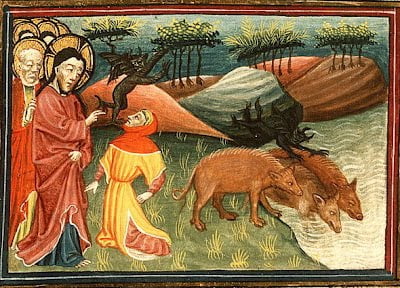
The lectionary reading for Trinity 1, Year C, is Luke’s version of Jesus meeting and healing the demon-possessed man in the ‘region of the Gerasenes’ (Luke 8.26–39). See below for commentary on this passage.
The epistle for this week is Galatians 3.23-29, and you can watch the video discussion of that passage here, and the video of Luke 8 here. (These are also linked below.)
The account occurs in all three Synoptic gospels; in Mark (the shortest gospel) the story is in the longest and most detailed version; Matthew 8.28–34 is the shortest, and just includes the main points in summary; here in Luke, the story is only a little bit shorter than in Mark, and Luke includes much of the detail.
Luke’s description of the location in verse 26 is less precise than Mark’s; he suggests that ‘the region of the Gerasenes’ is opposite Galilee, when it is most likely on the north east shore of the lake rather than the north west. (Mark uses a quite different phrase for ‘sailed across‘ in Mark 5.1, and this fits with the frequent crossings of the lake, and prominent mention of boats, which supports the idea of the influence of Peter on Mark’s narrative.) There is uncertainty about the exact location, as the name is not otherwise known, and Matthew includes other variants of the name; the most likely place is Khursi on the north-east shore, which has the ruins of an ancient church building.
Although ‘they’ sailed across (that is, Jesus and the disciples), it is striking that Jesus alone is mentioned alighting from the boat on the shore. The disciples have already been seriously shaken by the storm that overtook them as they sailed (the immediately preceding story in all three gospel accounts) and Mark 4.41 tells us that they were ‘terrified’. So the lack of mention strongly suggest that, coming to a strange land, and seeing such a strange man approaching the boat from the tombs, the disciples thought it best to stay in the boat! In fact, Jesus is the only person who features in the dialogue with the man until the locals are mentioned after the drama has all died down in Luke 8.34.
Luke follows Mark in recounting what happened out of order, as if the chaos in the man’s life is reflected in the chaos of the events as narrative unfolds. First, he mentions that the man comes to meet Jesus; then he includes a (shorter than Mark’s) explanation of who the man is; then he mentions the man’s cry to Jesus; then he explains that Jesus has already been commanding the spirit to come out of the man; and finally Luke completes the explanation of who the man is, which Mark has included earlier.
In doing this, Luke includes two elements which connect with other parts of his narrative. First, Luke notes that the ‘unclean spirit’ had driven the man into ‘solitary places’ (NIV), translating the word eremos that elsewhere refers to the desert (from it we get our word ‘eremitic’ and then ‘hermit‘ for someone who pursues a solitary life). Thus Luke connects this spiritual battle with the battle Jesus has already won in facing temptation in the desert in Luke 4.1–13. The question of power is not far from the surface there, with Jesus returning from the desert ‘full of the power of the Holy Spirit’ (Luke 4.14) and the power dynamics are quite explicit here.
The second element of significance is the phrase the man (or demon) uses in addressing Jesus: ‘Son of the Most High God!’ (Luke 8.28). This matches exactly the wording in Mark 5.7, but it has added significance for Luke. For one thing, his readers who have come from a pagan, polytheistic background will recognise the claim being made, that Jesus is not exercising the power of one god amongst many but has a distinctive status in relation to the one God who is over all. But as a result, we find this phrase is of particular importance in Luke’s wider narrative. It is repeated twice by Gabriel in announcing to Mary that she will bear this extraordinary child (Luke 1.32, 35), and it is a phrase used by the spirit-possessed girl in Acts 16.17. So this episode offers evidence of the fulfilment of Gabriel’s words to Mary—but also describes a ministry of Jesus that is continued by the apostles in Luke’s second volume.
Jesus’ asking of the demon’s name accords with ancient belief that to know someone’s name, their true identity, was to have power over them. The exchange fits with the earlier addressing of Jesus by the demon, revealing his true identity, and forming part of this ‘power contest’ between the two. The use of the name ‘legion’, evoking the Roman soldiers who occupy the land of Israel, would have been particularly relevant to Luke’s pagan readers. Some modern interpreters read the exchange back into the political situation, seeing this as a metaphorical exploration of the political dynamic—but that is surely to read the metaphor in the wrong direction. For Jesus and the man, the ‘unclean spirit(s)’ or ‘demon(s)’ are an occupying force who have no rightful place in the man’s life, and Jesus’ deliverance of him forms part of ‘setting [him] free to worship without fear’ (Luke 1.74).
Here, as earlier (Luke 8.29), Luke has smoothed out the narrative by explaining what the demons (earlier, Jesus) say, rather than simply quoting them as in the Marcan account. But in Mark, they ask not to be sent out of the area; here, Luke sharpens the request, so they ask not to be sent ‘to the Abyss’, the chaotic ‘deep’ (Heb tehom) of the Old Testament and in pagan thought the realm of the dead which we also find mentioned in the Book of Revelation (Rev 9.1, 11.7, 20.1 and elsewhere).
The sending of the demons/unclean spirits into the (unclean) pigs offers us a wonderful irony, and one that will have worked for those who know something about Jewish food laws as well as for Jewish readers themselves. That the pigs hurl themselves over the cliff makes clear the destructive power of the demons, destructive power that has already been evident in the life of the man up until now. It is not surprising that this story is paired with the episode that immediately precedes it in all three gospels; together they underscore the power of Jesus to bring peace to a chaotic world, in fulfilment of Ps 65.7: ‘You calm the seas and their raging waves, and the tumult of the nations.’
Jesus has ultimate authority over evil, whether that evil is manifested in nature or in the life of an individual. By the end of these stories, the audience is hopefully much better prepared to answer the pressing question, ‘Who can this man be?’ (Luke 8.25) (Mikeal Parsons, Paideia Commentary on Luke, p 140).
The narrative offers us potent material for reflection on the ministry of Jesus.
First, there is the significant presence of dissociation. The man has become cut off from his community—and it is striking that the end of this episode is focused emphatically and rather surprisingly on Jesus restoring him to the place he has come from, sending him home in every sense of the word. There is dissociation of the man from his body, as he cuts and harms himself, and dissociation from the forces at work in him, as the voice of the unclean spirit(s) speak to Jesus. These dynamics of dissociation are very evident in our world, with fractured communities and broken relationship, the apparent rise of mental health issue, individualism, and the defining of the self detached from bodily identity at the heart of the debates about sexuality and transgender ideology. There is no sense in which I am suggesting that any of these things are the result of ‘demon possession’ but Luke, like Mark, is telling us the impact of Jesus’ ministry on this complex range of issues.
Secondly, contrary to what has been suggested in relation to disability and Jesus’ healing ministry, there is little sense here that Jesus uses the disabled as a ‘prop’ to demonstrate his power, with the individuals concerned ‘marginalised in the narrative’. Jesus uses his power not as a demonstration, but for restoration—restoring the man to dignity (‘clothed’, Luke 8.35), sanity (‘in his right mind’) and community (‘to your own people’ Luke 8.39). Yet the response is fear; the people are not prepared to accept Jesus’ reordering of their world.
This leads the third observation: just as the disciples had been terrified by both the storm and Jesus’ calming of it on the way over to the Gerasenes, the local people here respond with fear. When they ask Jesus to leave, he does so without any objection; Jesus’ ministry will not be imposed on those unwilling to receive it. Yet he leaves the man, not only restored but with a purpose and a mission, to tell of what God (in Jesus) has done for him. He has (in Tom Wright’s words) become the first apostle to the Gentiles, anticipating what will unfold in the larger narrative of Luke-Acts.
Come and join Ian and James as they discussion this passage here:
and Paul on faith and law in Galatians 3 here:
 Buy me a Coffee














Do you believe demons can and do afflict believers? Are generational curses real?
Two different questions.
1. Without question demons can cause temptation to be put in the way of believers. The question that seems to divide even the subsecctor of the church that is willing to accept the reality of demons is whether a believer can harbour a demon. Some people say “No – the believer is a new creation”. This argument seems to me to ignore the fact that we continue to carry our old flesh until bodily death, and perhaps a demon can lodge in that? What I have seen suggests that it can, but there might be some other exp;lanation; I don’t know.
2. Of course generational curses are real. The question is whether they are broken in the case of believers, presumably at believers’ baptism by full immersion in the name of Jesus Christ. Again, though, can a curse apply to one’s flesh?
Yes I asked those questions as I think too many times the reality of the demonic encounter described in such passages is viewed as either it only happened in Jesus’ day, or it was just a way of what we would now recognise as a mental health issue, as there can be similarities.
Im not convinced of so-called generational curses. I know some who think due to the sins or behaviour of ancestors, demonic affliction can be passed on down the line, with negative effects on individuals. Unfortunately I dont really see anything in the NT to support such a view, and those who believe in such curses tend to go by their experience alone. You would think being born again/from above would have implications for such things?
I agree with your theology – the trouble is that I have seen fairly strong practical evidence to the contrary. If I am asked to pray (I do NOT have a plaque outside my door saying Deliverance Done Here) then I pray about what I see.
I’ve been involved Deliverance Ministry for several years, and I have come to the view that a Christian cannot be possessed demonically, but—and this can be a significant qualification—can be subject to demonic influence or oppression as an external factor.
The aspect of generational issues is a really tough area for ministry, and yes, examining a family tree’s history could disclose matters that call for deep healing prayer. I am told that the writings of the late Dr Kenneth McAll are good on this subject but I don’t have any of his work in my library so I cannot comment.
For those of us who minister in the CofE, there are clear guidelines as to the authorisation and practice of DM.
‘Possessed’ is not a concept found in scripture; without agreeing or disagreeing, what do you mean by it, please?
The man in Luke 8 is described as “demon-possessed”. Are you arguing that’s a mistranslation or we’re misunderstanding it?
AJ Bell – yes, I was wondering about that too. It is very clear that there is something called ‘demon-possession’; it is used to describe the man of Luke 8. It is also used in other contexts where the demon does not express itself in terms of psychological ailments, but in terms of physical ailments. Also, the examples are such that it simply will not do to ‘explain it away’ by finding parallels between ‘demon-possession’ in the New Testament and conditions described by modern psychiatry and modern medical science.
One thing I would point out: in the NT, if the problem was caused by a demon, they all *knew* that this was the case – and they weren’t saying to themselves ‘hmmmm …. is this a demon, or is there a natural explanation?’
The Greek of Luke 8:27 says simply that the man “has demons”, so ‘demon-possessed’ is a translation that outruns the Greek. The Greek of 8:36 is ‘daimonistheis’, and I am not Classicist enough to know what ‘istheis’ means as an add-on; but in view of the eisegesis in the translation of 8:27 I would not be confident that it means ‘possessed’. Any Greek scholars out there?
Check the Greek option for these verses at biblehub dot com
I understand that ‘possession’ or ‘possessed’ is a mistranslation and should not be used. Nevertheless, in describing the working of demons, the NT does describe them as ‘leaving’ or the command ‘come out’ is used which implies they were ‘in’ the person in some sense.
From speaking to some others well experienced in such ministry, it seems that often the person does feel something has come out of, or left, them when dealt with. And Im talking about Christians.
This account proves that the demonic is not simply the view back then of what is called human psychology today. No amount of human psychology will expain the change in behaviour of the pigs.
Many Western Christians today (liberal and some conservative evangelicals) dismiss the demonic; conversely, ultra-charismatics seek to explain nearly all human behaviour by it. Both parties would learn if they visited their brethren in other cultures.
Attributing ideas of an identity or self
which is unrelated to the body may not be possession as in this story’s context, but I have no doubt there is demonic connection in the sense that James teaches:
‘Such ‘wisdom’ does not come down from heaven but is earthly, unspiritual, demonic.’ (James 3:15)
First up: absolutely correct to point out that “there is little sense here that Jesus uses the disabled as a ‘prop’ to demonstrate his power, with the individuals concerned ‘marginalised in the narrative’. “, but the pattern does follow very closely what we see in Acts, where the Holy Spirit comes on some people with power and manifests itself in visible ways – when these people are called to be witnesses and the Holy Spirit steels them up so that they proclaim the gospel in the teeth of hostility.
The same is happening here. Jesus sends him back ‘to his own community’ (in the words of Ian Paul) – when that community has shown real hostility towards Jesus. They know exactly who He is – and, fully aware of who He is, told him to leave. Scripture tells us that this person really did witness – and we are left wondering how the ‘community’ who had instructed Jesus to leave reacted to this.
In fact, the ‘community’ he returned to was no longer his community; through belief (and therefore having the Holy Spirit within him as a deposit guaranteeing what is to come) he was now (Hebrews 11:13) ‘alien and temporary resident’. Although still part of his own ‘community’, he had been transported out of it through belief and was now a member of the community of forgiven sinners (i.e. the Saviour’s Family).
A good example might be the Prophet Daniel, who was not only part of the Babylonian community, but very much part of the Babylonian establishment (third highest ruler in the land), yet considered himself as ‘alien and temporary resident’ in that community.
The newish guidelines from CofE HQ for ‘Ministerial Education: Deliverance Ministry’ set Luke 8.26-39 for the theological overview and to lead into the delivery of aspects of the session.
I’ll be delivering this IME2 unit to our curates-in-training in a few weeks. We’ll just have to wait and see whether any of the more perceptive curates ask the question about the benefits of deliverance ministry exercised for one of the Gerasene community number against the possible wrecking of the local Gerasene economy in the loss of 2000 pigs! Jock’s comment at 8.57 is really helpful because it opens out a much broader discussion about the consequences of true discipleship.
Of necessity, Deliverance Ministry (DM) is specialist, a bit niche and comes with the requirement in the CofE for specific insurance. But it should never be seen as other than within the broader ministries of healing and wholeness; therefore, DM can never be separated from being missional. There is a range of views on DM and its practice, but its purpose is always to point to Jesus and only him.
Any Spirit-filled Christian of strong faith can do it. It often fails for two reasons: (1) the person ministering hasn’t strong faith or is kidding himself that he is Spirit-filled; (2) the person ministered to actually likes what the demon gives him/her but does not realise the connection – in which case back it comes with seven more (Matthew 12). Expertise in deliverance ministry is in teasing out the relation between the person and the evil spirit. This requires wisdom, sensitivity and prayer (not shouting louder). It is seldom like the demoniac in Luke 8.
Anton – have you ever done this? Or spoken to people who have?
Both. You?
No – I’ve neither tried it nor spoken to someone who has. On ‘deliverance ministry’ I confess ignorance.
does ‘missional’ not imply it is really only for non-believers when there does seem to be a reality of demonic affliction against believers? In other words if you only view it in that way, are you not neglecting the demonic affecting church members too?
PC1 – I tried replying to you earlier in the day – but it seemed to get lost in ‘cyberspace’. I get the impression, from the way you are asking this (approximately the same question in different ways) that either you, or someone you know in the fellowship you attend, has a problem that may be explained by demon possession.
I’d say that the remedy is the same irrespective of whether nor not there are demonic forces behind it – and I take 2 Corinthians 12 (Paul and the thorn in the flesh) as the example. You pray. You ask God for deliverance – and then you accept His answer ‘my grace is sufficient for you’ whether he removes the thorn in the flesh or not.
Hi Jock
Im not sure Paul’s thorn in the flesh is relevant. Paul came to understand the reasoning behind it : ‘to keep me from becoming conceited because of these surpassingly great revelations’. Paul was in a rather unique situation, given his own experience of God. In other words, although it was unwanted, God was using it, whatever ‘it’ was, for a specific purpose (I tend to think ‘it’ was a person who often gave him grief, perhaps through direct persecution). I dont think that is the case in the sort of demonic afflictions Im referring to, where it appears to start following sin, or trauma etc.
But I appreciate your thoughts, and I may very well be wrong!
Peter – Following the opening of Job, it’s clear that ultimately everything is from God. If an affliction is somehow caused by the laws of nature (e.g. an illness), then ultimately God created the laws of nature and God can intervene. If an affliction is caused by demonic forces – well, we see from the conversation and interaction between God and Satan that Satan is actually constrained by God.
In all cases, the remedy (for us) is the same – which is prayer. Pray to God that he removes the affliction. We have to bear in mind (c/f Paul in 2 Corinthians 12) that sometimes it is God’s will that we continue to bear the affliction. We also have to bear in mind that God’s time scale is often very different from our own (c/f book of Exodus, Israelites crying out for deliverance, a baby was born – and it took a further 80 years until Moses took them out of Egypt).
Perhaps Peter Davies could come back and gives us some insight into the Deliverance Ministry, what falls within its framework and anything that they do over and above the usual Christian prayers.
PC1 – I wouldn’t say that ‘missional’ means only for non-believers – not based on Luke 8:29-36 – where it is ‘missional’ in the sense that the person went and proclaimed everything that Jesus had done for him. You see other examples in the New Testament where the demon-affliction manifests itself as a physical ailment, the person first believes that Jesus can cast out the demon – and then goes proclaiming the good news after Jesus has performed the miracle. In this sense it is ‘missional’; those who have been cured (whether the problem was caused by a demon or not, whether they were believers or not before Jesus performed the miracle) then go out and proclaim the good news – often at great expense to themselves (c/f John 9, the man born blind – and all the trouble the pharisees gave him).
So Peter Davies is right here, but I would like him to come back and give us some idea of what people in the Deliverance Ministry do – over and above the usual prayer which is the duty of all Christians.
The demonic is capable of many kinds of manifestations
Here was a man with an unclean spirit;
that they perished in unclean animals seems ironic.
Demons manifest the characteristics of their father [as Jesus says
“You are of your father the Devil”]
hence some manifest a lying, deceiving, unclean, self-destructing, manipulative/ controlling, rebellious, mocking or a murderous spirit.
Any of which may be influencing or controlling.
Modern day medics may define any of these as complex mental syndromes;
Perhaps influenced by cultural detrimental circumstances beloved of some liberal social scientists or defense lawyers as mitigations of wickedness.
False teachers, prophets and priests can hold “doctrines of demons” either influenced or controlled by them.
not helped by lack of teaching,preaching,warning on the SIN or Judgement word
An excellent paper on this topic can be found ©Westminster Seminary California
.wscal.edu/a-pastors-reflections-demon-possession-and-mental-illness/
Responding to Peter Davies’ comment on the writings of Dr. Kenneth McAll, there is a book, I believe originally printed in the 80’s, called “The Healing of the Family Tree.” I checked on line back in the Spring of this year and I believe that it is in its 2nd print and is available on line.
I did have this book in my possession for some time. An excellent overview of possession vs.
oppression. An excellent dealing of the subject matter providing examples within his actual ministry, a ministry of love and God’s powerful healing. Of import was Dr. McAll’s work with a local minister who was often called in to have a Eucharist, for the person in question, with Dr. McAll being present. This Eucharist was paramount, in certain cases, and paved the way for complete healing.
Severing a connection with inherited issues are also key. I am involved with the Laying on of Hands and as well being a Prayer Leader and I often include within my prayers healing for those inherited issues and as well a severing from the effects of past experiences. I also believe that our internal dialogue, and belief system, can greatly affect those areas where oppression is an issue. Healing, and the love and compassion, of those involved in being a channel for God’s healing go a long way.
Karen in Montreal (Licensed Lay Reader)
So, precisely what is a ‘demon’?
In other words, is it a fallen angel (whose existence evangelicals should not dispute) or something lesser? A very good question.
Any connection between the demonic and the occult?
What are their roots? Is there any commonality?
There seems to be two equal but opposite errors.
1. The demonic doesn’t exist.
2 The demonic is everywhere.
And what are we to make of ‘spiritual warfare’, and the need to put on the armour of God, if it is not real?
Although not everyone accepts Genesis 6 as the origin story of demons, I find it quite convincing. Michael Heiser has some well researched book on this topic (or the “Unseen Realm”) in general.
https://www.logos.com/grow/bsm-are-demons-fallen-angels-and-2-other-misconceptions/
Thankyou Karen
The battle is a battle for the mind and all manner of things can affect it.
Some years ago I attended a church where there was a major emphasis on “Healing of the memories” to good effect.
Praise God “the weapons of our warfare are not carnal but mighty
through God to the pulling down of strongholds”
Jesus recognized that people were bearing heavy yokes
as perhaps in ISA. 10:27 And it shall come to pass in that day,
that his burden shall be taken away from off thy shoulder,
and his yoke from off thy neck,
and the yoke shall be destroyed because of the anointing.
Jesus offers an easy yoke that will bring only rest and peace.
Of yokes ai says
“The Bible speaks of breaking yokes in both a literal and figurative sense. Literally, yokes are used to restrain animals and carry burdens, and the Bible describes God breaking yokes of slavery and oppression. Figuratively, yokes represent burdens, bondage, and anything that hinders freedom and spiritual growth. God’s anointing and the truth of his word are presented as the means to break these yokes.
Literal Yokes:
Oppression and Slavery:
The Bible uses the image of a yoke to represent the burden of slavery and oppression experienced by the Israelites under various rulers.
God’s Intervention:
Isaiah 10:27 speaks of God destroying the yoke upon his people, signifying the end of their captivity and suffering. Isaiah 9:4-7 also promises the breaking of yokes and the removal of burdens.
Figurative Yokes:
Spiritual Bondage:
Yokes can represent spiritual bondage, such as addiction, fear, or negative thought patterns.
False Teaching:
Yokes can also refer to the burden of false teachings and legalism that can hinder a relationship with God.
Jesus’ Yoke:
In Matthew 11:29-30, Jesus invites people to take his yoke upon them, which is described as easy and light, contrasting with the heavy yokes of the law and religious traditions.
Breaking the Yoke:
God’s Anointing:
Isaiah 10:27 states that the yoke will be destroyed “because of the anointing”. This anointing can be understood as God’s power and presence working in a person’s life.
The Truth of God’s Word:
Jesus states that knowing the truth will set people free. Therefore, studying the Bible and understanding God’s will can help break free from spiritual bondage.
Faith and Obedience:
Faith in God and obedience to his word are crucial for experiencing freedom from yokes.
In summary, the Bible uses the imagery of breaking yokes to describe God’s liberation from physical and spiritual bondage, highlighting the power of his anointing and the truth of his word in bringing freedom.
Isaiah 9:4-7 –
9:4 For thou hast broken the yoke of his burden, and the staff of his shoulder, the rod of his oppressor, as in the day of Midian.
9:5 For every battle of the warrior is with confused noise, and garments rolled in blood; but this shall be with burning and fuel of fire.
9:6 For unto us a child is born, unto us a son is given: and the government shall be upon his shoulder: and his name shall be called Wonderful, Counsellor, The mighty God, The everlasting Father, The Prince of Peace.
9:7 Of the increase of his government and peace there shall be no end, upon the throne of David, and upon his kingdom, to order it, and to establish it with judgment and with justice from henceforth even for ever. The zeal of the LORD of hosts will perform this.
Fight the good fight of Faith. Shalom.