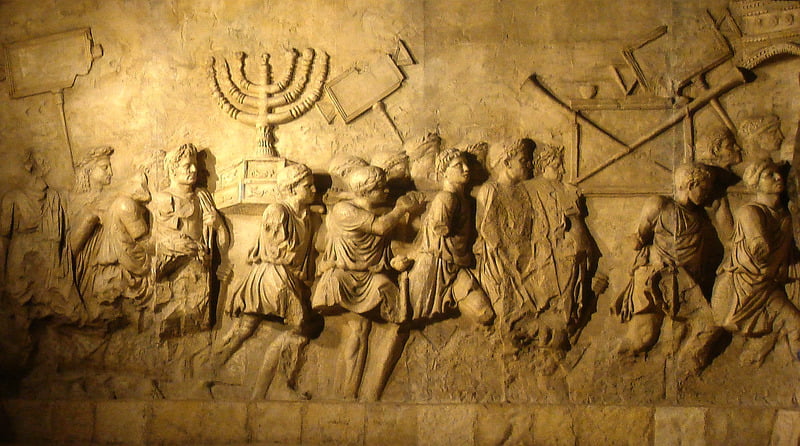
The Sunday lectionary reading for the Second Sunday before Advent in Year B is Mark 13.1–8. This feels a little odd, in that we last visited Mark 13 all the way back last Advent, when this lectionary year was just beginning, and the reading is quite truncated and only really makes sense when the chapter is read as a whole.
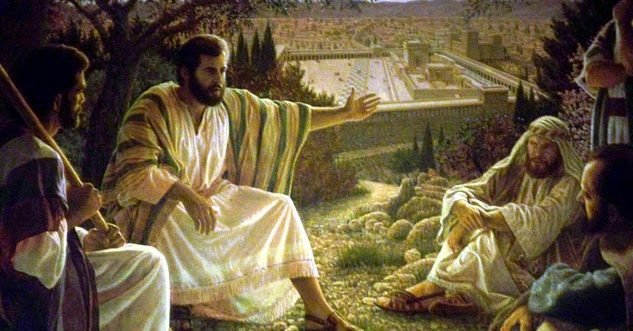
This chapter, and its parallel in Matt 24.1–42, and often known as the ‘Olivet Discourse’, being given as Jesus sat (in the teaching position) on the Mount of Olives, or the ‘Little Apocalypse’, because of the similarities of language with the Book of Revelation, in particular the mention of ‘tribulation’ or suffering (thlipsis) and the parallels with, for example, the four horsemen of Rev 6.
The big question concerning this section is whether it is about the fall of the temple, and the suffering and disruption associated with it—bringing the Jewish world to an end and ushering in a new era—or whether it is about The End of the World, and the return of Jesus. There is a strong interpretive tradition that it is the latter; this is communicated by the headings in many English translations, which often liberally scatter the term ‘parousia’ around or refer to ‘Jesus’ return’, guiding the reader into this interpretive approach. And there are good reasons for this.
Firstly, there is a close association between the events in the first section and language of ‘the end.’ Mark 13.7 mentions that ‘the end is yet to come’ and Mark 13.13 talks of standing firm ‘to the end.’ Secondly, in Mark 13.10 Jesus talks of the gospel being preached ‘to all nations’ before the end comes. Thirdly, Mark 13.19 talks of great distress ‘that will never be equalled.’ Then in Mark 13.24–25, we are told of cosmic signs of the end of the age, after which in Mark 13.26 we read of the ‘coming of the Son of Man’. Finally, in Mark 13.27, there is a trumpet call, and the angels gather the elect from the ends of the earth. (One issue that is raised here is whether Jesus can be speaking hyperbolically, for example in talking of distress ‘unequalled since the beginning’; some talk about the need to read this ‘literally’ because Jesus speaks the truth, as if the truth can never be poetic, metaphorical or hyperbolic.)
But this approach founders on the emphatic saying of Jesus at the end of this section:
Amen I say to you, this generation will certainly not pass away until all these things have happened. (Mark 13.30)
Jesus’ saying here is quite emphatic in form, including the emphatic form of the negative, mentioning ‘all’ these things clearly, and opening with the ‘Amen’ formula; this is characteristic of Matthew’s record of Jesus’ teaching, occurring 32 times and suggesting recollection of Jesus’ actual words in Aramaic, but it is much less common in Mark, coming only 14 times.
This is very difficult to evade. Some people suggest that the word ‘generation’ genea could be translated as ‘nation’ or ‘race’ rather than ‘generation’. But there is only one other occurrence in the gospels where this could be the reading—in Luke 16.8. Even here, the contrast is between people of this age and those ‘of the light’, so there is a temporal sense here. But in all other cases, the word clearly has the sense of ‘the people alive at this time.’ The clearest examples are in the genealogy in Matt 1.17 ‘fourteen generations’, and in the Magnificat in Luke 1.48 and Luke 1.50 ‘his mercy extends to those who fear him, from one generation to another.’ Along with this, the verse itself has a clear temporal sense in talking of it ‘not passing away.’
(A minority reading argues that ‘this generation’ refers not to the generation Jesus is addressing, but the ‘end times’ generation of some time in the future to whom all these things will happen. Apart from making this saying completely tautologous, such a reading has the minor disadvantage of making the term mean whatever the reader wants it to mean, rather than what Jesus actually said. If he is looking around at his disciples and uses the word ‘this’, then he is referring to them!)
This all makes the first approach problematic, and led C S Lewis to comment:
It is certainly the most embarrassing verse in the Bible. (in “The World’s Last Night” (1960), The Essential C.S. Lewis, p. 385)
Such a view also proposes that, in these verses, we have a confused mixture of predictions about the near and the distant future, which suggests Jesus didn’t really know what he was talking about, or the disciples didn’t, or the gospel writers didn’t—or all three. More seriously, it has made not a few scholars conclude that Jesus thought his return would be within a generation, and that he was clearly wrong—he was a failed apocalyptic prophet, and the writers of the NT tried (unsuccessfully) to cover up the fact.
The difficulty with this last conclusion is that Matthew, Mark and Luke all record Jesus saying this. Unless you think that all three gospels were written before the destruction of the temple in 70 AD, then you have to conclude that they also believed Jesus expected his return within the generation and that subsequent generations of copyists believed this, but somehow ignored it. This seems altogether implausible. All the evidence points to the gospel writers taking Jesus seriously, and thinking that their contemporaries needed to know what Jesus said.
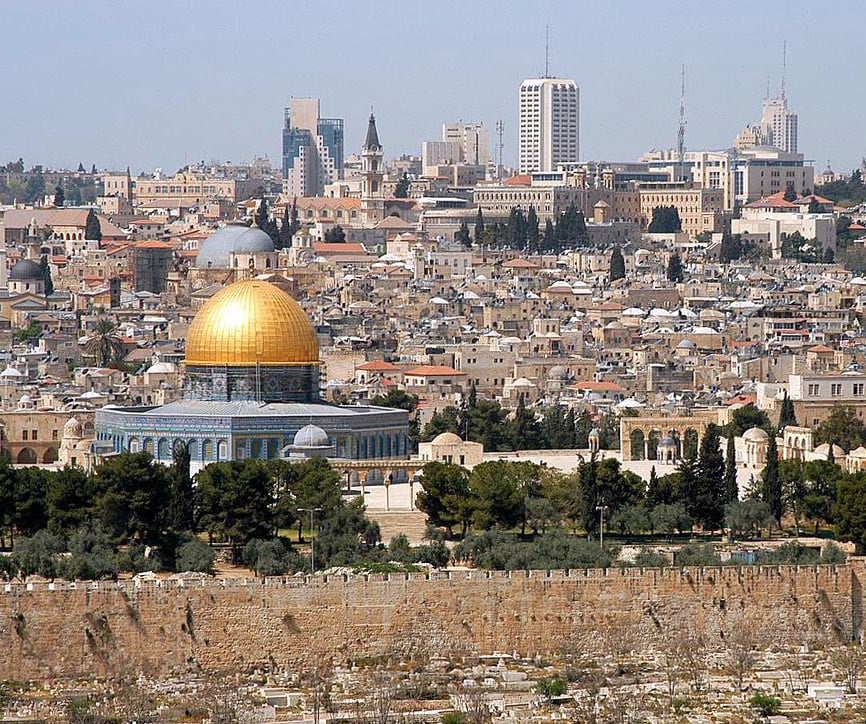 How can we make sense of this? A first massive clue comes in comparing the parallel passage in Mark 13 with Matthew. The first section of Matt 24 equates to Mark 13.1–31; if you look in a Synopsis (which puts the passages from the different gospels in parallel with one another) you can see that Matthew and Mark are almost identical (with the exception of Matt 24.10–12). But in the second section, Mark has just 6 verses, whereas Matthew continues with 16 more, and then in chapter 25 records a series of Jesus’ eschatological parables about final judgement (the bridesmaids, the parable of the ‘talents’, and the sheep and the goats).
A second massive clue comes in noticing Matthew’s distinction between ‘this’ and ‘that’. In Mark 13.4 the disciples ask Jesus a single, compound question about the temple, prompted by his comment that ‘not a single stone will be left on another’:
“Tell us, when will these things happen? And what will be the sign that they are all about to be fulfilled?”
But in Matthew, the compound question has become two questions:
“Tell us,” they said, “when will this happen, and what will be the sign of your coming and of the end of the age?”
For some reason, Matthew appears to want to distinguish more clearly between the question of the destruction of the temple, and the question about Jesus’ coming and the end of the age. Matthew continues the distinction, by being clear that in the first section, Jesus is talking about ‘this’, but at Matt 24.36 he introduces a marked change of focus: ‘But about that day or hour, no-one knows…’ The most obvious explanation of this is that Matthew is writing after the temple’s destruction in 70AD, but Mark was writing before it. So for Mark, the impending fate of the temple looms large; for Matthew, this has now passed, and the question of Jesus’ coming deserves more attention.
What, then, do we make of all the material in the first section which looks as though it is referring to ‘the end’? It doesn’t need to be read in this way at all.
Note first that emphasis of Mark 13.7 is not to associate these events with ‘the end’, but to distinguish them. ‘The end is not yet.’ And in Mark 13.7 and 13, the word ‘end’ is not the (semi-technical) term eschatos (as in ‘the last days’) but the more general term telos. Secondly, the reference to ‘preaching to all nations’ functions not to refer to the coming of the ‘end’, but to encourage the disciples to persist in their task, despite serious opposition. Thirdly, the distress of the siege of Jerusalem was indeed terrible; Josephus recounts a story of a woman killing her baby and eating half of it, offering the other half to rebel fighters (Jewish War chapter 6), and more Jews were killed by other Jews than by the Romans.
But a key observation is to note the language of the ‘coming of the Son of Man.’ The word for Jesus’ second coming to earth, parousia, meaning ‘royal presence’, does not occur in Mark 13.26—in fact, it occurs nowhere in Mark’s gospel! It is used in the slightly expanded account in Matthew, at Matt 24.3 (where it forms the second of the disciples’ questions), in Matt 24.27 (where Jesus says that all the rumours having nothing to do with his parousia), and then in the parallel with the days of Noah in Matt 24.37 and 39, signalling the change of focus to answer the disciples’ second question.
The phrase in Mark 13.26 is instead the ‘erchomenos of the Son of Man’, not a noun but a present participle. This is an almost direct quotation of the Greek of Dan 7.13:
“In my vision at night I looked, and there before me was one like a son of man, coming with the clouds of heaven. He approached the Ancient of Days and was led into his presence. He was given authority, glory and sovereign power; all nations and peoples of every language worshiped him. His dominion is an everlasting dominion that will not pass away, and his kingdom is one that will never be destroyed.”
In other words, this is not about the ‘Son of Man’ coming to earth, but his coming before God, receiving authority and being vindicated. Note that he exercises authority over ‘all nations and peoples’. Jesus also quotes this—in exactly the same words—to the High Priest in Mark 14.62. Here Jesus cannot be talking about his return—he refers to himself sitting at the right hand of God and exercising the power of the kingdom, which the priest believes to be blasphemy. And he says that the High Priest will witness Jesus’ vindication and authority; he will see Jesus raised from the dead and the Spirit coming to equip the disciples as witnesses not just to Israel but to all nations. (He does not see it literally with his own eyes, since the resurrection and ascension were witnessed only by a small group. But he would hear the testimony, and see for himself the evidence in the transformed band of disciples filled with the Holy Spirit proclaiming the resurrection and Lordship of Jesus with all boldness.)
 This also makes sense of the final parts of our puzzle. The ‘trumpet’ is not the ‘last trump’ of 1 Cor 15.52 and 1 Thess 4.16, but a metaphor for the proclamation of the gospel which we read about in Acts, and the ‘gathering of the elect’ is the entry into God’s people of the Gentile believers. But what of the cosmic language: ‘the sun will be darkened, and the moon will not give its light; the stars will fall from the sky, and the heavenly bodies will be shaken.’? Note that this is to happen ‘immediately’ after the distress of those days. Well, these words from Isaiah 13.10, Isaiah 34.4 and Joel 2.31 are also quoted soon after—by Peter at Pentecost:
In the last days, God says, I will pour out my Spirit on all people…The sun will be turned to darkness and the moon to blood…And everyone who calls on the name of the Lord will be saved. (Acts 2.17–21)
Peter appears to understand what is going on in front of him in exactly the same words that Jesus uses in Mark 13.24 and following—all happening within the life of that generation.
What, then, of our passage that we have set in the lectionary? What can we say about it?
At one level, we need to recognise that this is Jesus’ words to the disciples in the particular situation they will find themselves. Jesus will have gone to the Father; they are now entrusted with the task of preaching the message. As we learnt in chapter 6 and the execution of John the Baptist, those proclaiming the kingdom will face serious opposition; the fate of John will soon be the fate of Jesus, and the disciples will likewise need to ‘take up their cross’ and follow Jesus along the same path. Trouble and opposition has been a theme of this gospel from the beginning—but this means it is time to find courage, speak up, and stand firm.
Yet, though the situation they faced, with the destruction of the temple, the scattering by persecution, and the great upheavals of the Year of Three Emperors in 69, was unique, it was not untypical. As long as ‘the end is not yet’, we live in a world where, in every age, we hear of ‘wars and rumours of wars’. And Jesus’ message to them is the same as his message to us: ‘do not be afraid’. Many English translations lose the force of Mark 13.7, δεῖ γενέσθαι—not so much a general ‘these things will happen’, but a divine imperative, ‘this must take place.’ God has not deserted his world, despite all its tribulations, but he is working his purposes out, and we can trust him.
Thus it is that we live in the ‘overlap of the ages’. In one sense, the ‘end times’ have already come, marked by the longed-for resurrection of the dead (not all the dead, but the forerunner Jesus) so that when we turn to him we shared in the ‘new creation’ (2 Cor 5.17) which all the world will one day see (Rom 8.19). So Paul can confidently state to the Christians in Corinth that they are the ones ‘on whom the end of ages has come’ (1 Cor 10.11). And yet, this old age of sin, violence and injustice has not yet passed away; we still look for the full revelation of the kingdom of God of which we have had a foretaste—indeed, ‘your name be hallowed, your kingdom come, your will be done’ is our daily prayer.
 Jesus’ charge to us is to live out the peace of the kingdom in a world of war; to live out the hope of the kingdom in a world of false hopes; and to live out the confidence of the kingdom in a world that is being shaken—until he comes again.
Information about the planned study trip to Turkey and Greece in June 2025 is here (mentioned in the video discussion).
You can buy Ian’s Grove booklet on the end of the world language here.
Come and join Ian and James as they discuss all these issues:
 Buy me a Coffee












Ah, a preachers ‘gift!
Last week we had the small beginnings with burnt, blackened detritus.
This week we have the big bang endings.
Holywood only mimics the bible end times.
“These stones” many larger than the stones of Stonehenge, would be scattered,
Every Temple built by the Jewish people was utterly destroyed to the end that now a Muslim Mosque stands atop the resting place of God.
In Heaven there will not be a Temple or Cathedral all these things are and will be swept away, there will be no history in heaven.
1 COR.10:6 Now these things were our examples, to the intent we should not lust after evil things, as they also lusted.
(1 Corinthians 10 v 4 – 10)
1 COR.10:11 Now all these things happened unto them for ensamples: and they are written for our admonition, upon whom the ends of the world are come.
10:12 Wherefore let him that thinketh he standeth take heed lest he fall.
May our repentance be in good repair for whenever and however the Lord Jesus returns;The fact is, it will be sudden and devastating. Watch,Persevere!
Our calling is to warn men to “flee from the wrath to come.” History is our warning.
The temple that is Jesus was ‘destroyed’ on the cross and the daytime darkness of judgment.
Mark 15
The Eclipse of The Son
Daniel 6:17 A stone was brought and placed over the mouth of the den, and the king sealed it with his own signet ring and with the rings of his nobles, so that Daniel’s situation might not be changed.
Matthew 27:65-66 “Take a guard,” Pilate answered. “Go, make the tomb as secure as you know how.” So they went and made the tomb secure by putting a seal on the stone and posting the guard.
Genesis 1:14-19 And God said, “Let there be lights in the vault of the sky to separate the day from the night, and let them serve as signs to mark sacred times
What greater sign could the Sun and Moon make than prophesy to the evening of the old day and the morning of the new?
Not only that Steve, there is the resurrection of the dead, the first-fruits of the Resurrection, a realised and prophesised
foretaste of the inception inauguration of New Age to come was brought into space, time and history on earth, moving into Jerusalem, or as it wer the, a New Jerusalem ‘the Holy City’, on earth, as in heaven, with newly raised from the dead, holy, inhabitants, as it were.
Matthew 28:51-54
Mat 28:51 not in my Bible!
Anyway…I was going to add, because the great lights have served their purpose they wont be needed in the NJ. And therefore we dont need to be fazed by supposed prophesies of blood moons or solar events.
Not in mine, either.
Try Matthew 27: 51-54
Thank you Geoff.
“Christ loved the Church”
Michael Lawrence @ crossways asks “Why Study the Book of Ezekiel?”
Ezekiel is shown that God has abandoned the temple in Jerusalem, driven away by the sins of Israel (chs. 8–10). The exile cannot be avoided; God’s judgment cannot be averted (ch. 12). The question haunts the first half of the book, and the answer seems self-evident: “The Lord has forsaken the land, and the Lord does not see” (9:9).
It’s easy to lose perspective in the midst of life’s challenges and trials. It’s easy to become consumed, and distracted by disputes over the details and timing of the last days. Ezekiel lifts our eyes and refocuses our vision on the centrality and certainty of God’s gratuitous, saving work in the gospel. Despite what we see in the world around us, or in our own lives, God’s plan was accomplished at the cross of Jesus Christ, is displayed now in the life of the church, and will be consummated in a New Jerusalem, in which there will be no temple “for its temple is the Lord God the Almighty and the Lamb” (Rev. 21:22).
Where is God when your world falls apart, when God’s promises seem impossibly far off, when the enemy seems to have the upper hand, and it feels as if God does not see and does not care? Ezekiel knew from bitter experience the reality and pain of those questions. But we study him not because he could give voice to our questions. We study him because he gave voice to God’s answer. Hope is found not in our circumstances, our feelings, or our efforts, but in the confidence that God is with his people, for what Ezekiel prophesied, Jesus Christ fulfilled—“And behold, I am with you always, to the end of the age” (Matt. 28:20).
I read somewhere Herod’s temple was the only one where the Glory of the Lord did not appear, except, perhaps when Jesus Himself entered the precincts. All the others : Abraham’s tents, Moses’ Tabernacle, Solomon’s Temple, Ezekiel’s Temple were all indwelt. Herod’s Temple was just a theatrical backdrop.
Except it was centre for the sacrificial system including entering into the Holy of Holies.
Jesus as an observant Jew would likely have neen in attendance at the OT required festivals.
But isn’t it significant that Herod’s temple was the 9nly one where the cloud never appeared?
Is the Greek word for ‘generation’ that used to translate the Hebrew ‘toledot’ in Genesis in the Septuagint? If so then it might be stretched to mean ‘era’. Then it makes better sense.
Bertrand Russell used Mark 13:30 in his essay “Why I am not a Christian”.
I suspect it had more to do with his inability (or unwillingness) to abide by other parts of Scripture.
I agree. I have an analysis of that essay, but here is not the place.
I think Genesis makes clear how the word generation should be understood. There are two generations, one good, one bad. Jesus is pulling the story of the generations to a close. The sifting has begun. His followers identify themselves as in need of rescue from ‘this wicked generation.’
Only those without conviction of sin fail to take His words to heart. To them the word generation is about somebody else, somewhere else, in the future, in the past.
The word toledot seems to be translated differently by the LXX:
genesis 24 times
sungeneia 14 times
genea 1 time
In every case apart from Gen 2:4 the word is associated with the origin of people.
Gen 6:9 has genea, but translating here dor. toledot is also in the verse, translated by genesis.
genea is a common word in the LXX – 180 uses. It seems to be the translation of dor in most. I have not looked to check if it translates any other words other than dor and the single instance of toledot (in Gen 25:13).
This latter word, ‘generation’, is used as a means of expressing time. dor v.dor (geneas geneōn in LXX), literally “generation and generation” means “for many generations of people”, i.e. a long time.
This seems to bring us back to “this generation will not pass away before…” to mean clearly a limited time-frame, in contrast to a long time-frame.
I see no indication of the words being translated ‘generation’ being used to indicate just two generations.
That doesnt make sense to me. It makes more sense if Jesus is simply saying the things he has described will happen while some of those currently alive will still be alive. In other words it’s not centuries away, but decades or earlier. Given his whole emphasis has been on the time leading up to and including the destruction of the Temple, which started the whole conversation in the first place, those are the things he is referring to. Lo and behold, the destruction of Jerusalem and the Temple occurred around 40 years later, within the lifetime of some living in AD 30-33.
The disciples seemed to conflate that destruction with Jesus’ coming. I know so-called full preterists argue he did ‘return’ in AD70, but I dont think that’s right. Though you could argue he did if you understand ‘coming’ as in coming in judgment. But I think that’s stretching it.
What was the purpose of the Temple -God, his presence, permanently dwelling in the midst, at the heart of his people.
The Temple’s function, purpose, was effectively ‘destroyed’ when the curtain into his presence, in the Holy of Holies was torn from top to bottom, at the crucifixion of Jesus.
The physical destruction would be within a generation.
“The physical destruction” came about after threescore years +ten. The lifetime of man. Perhaps Herod’s temple was symbolic of man’s life without the Shekhinah. A Tower of Babel. Jesus only visited it, to see what was going on, as it were. He never dwelt there.
Yes. Jesus is the Shekhinah, I Am glory.
I do like these thoughts of Dean Stanley, they seem so apposite now.
Mark 13:1-2
And as he went out of the temple, one of his disciples said to him, Master, see what manner of stones and what buildings are here! …
What is the true religious aspect of archaeology? We must all profit by that warning voice which did for a moment check the enthusiasm of the disciple.
The admiration for stones and buildings, however innocent and useful, is yet not religion.
The regard for antiquity and the love of the past, if pushed to excess, have often been the ruin of religion. Christianity is not antiquarianism, and antiquarianism is not Christianity.
There must be times and places when antiquity must give way to truth, and the beauty of form to the beauty of holiness, and the charm of poetic and historic recollections to the stern necessities of fact and duty.
It is well to remember that there is something more enduring than the stones of the temple. If archaeology is not everything, it is at least something.
I. It awakens that love of the past which is so necessary a counterpoise to the excitement of the present and the future.
“I have considered,” says the Psalmist, “the days of old, the years of the ancient time.” They were to him as a cool shade, a calm haven. The study of them carries us back from the days of the man to the days of the child; it opens to us a fresh world; it makes us feel that we do not stand alone in our generation on the earth, but that under God, we are what we are because of the deeds and thoughts of those who have lived before us, and to whom we thus owe a debt which we have constantly to repay to our posterity. How this insight into the past has been increased in our own age
Ii. The importance of these studies in developing those rarest of god’s gifts to man, a love of truth, and a love of justice — the will and the power to see things as they really are, and in their just proportions to one another.
II. The more thoroughly we can understand these ancient forms, the more eagerly we can restore and beautify ancient buildings, so much the better is the framework prepared for the reception of new thoughts and new ideas.
It has been sometimes said that the great periods of building and of admiration for the past have been the precursors of the fall of the religion of the nations which they represented.
It has been said, for example, that the burst of splendid architecture under the Herods, immediately preceded the fall of Judaism; that the like display under the Antonii preceded the fall of Paganism; that the like display at the beginning of the sixteenth century preceded the fall of the Church of the middle ages. There is no doubt a truth in this.
There is a tendency in an expiring system to develop itself in outward form, when its inward spirit has died away. But this is not at all the whole truth, and the higher truth is something quite different, namely, that these magnificent displays of art, these profound investigations into the past, in those eras of which I have spoken, were part of the same throes, of the same mind and spirit, which accompanied the birth of the new and higher religion, which in each case succeeded. Those Augustan buildings suggested to the apostles’ hearts the imagery by which they expressed the most sublime of spiritual truths. “The chief cornerstone;” the stones joined and compacted together; the pillars which were never to be moved; the whole idea of what the apostles called “edification,” — that most expressive word when we understand it rightly — the architecture, so to speak, of the Christian soul — all these images were drawn from the superb edifices which everywhere rose before the apostles’ eyes. And so in the last great efflorescence of mediaeval architecture, religion, instead of dying out with that effort, took a third start throughout Europe. Oh! may God grant that the glory of the third temple, the glory of the living temple, may as much exceed the glory of the second, as the glory of the second exceeded the glory of the first! Cast not away the old, but see what it means, see what it embraces, see what it indicates, “See what manner of stones and what buildings are here,” and then, as in the case of sacred and of ancient words, so also in the case of sacred and ancient edifices, they will become as Luther said of words, not dead stones but living creatures with hands and feet; living stones which will cry out with a thousand voices; stones which will be full of “sermons;” dry bones which when we prophesy over them, will stand on their feet an exceeding great army; ancient, everlasting gates, which shall turn upon their rusty hinges and lift up their hoary doors that the Lord of Hosts may come in; a heavenly city within the earthly city, a city which hath foundations deeper than any earthly foundations, a city whose builder and maker is God!
Thanks for this, Ian.
One small point that is easily overlooked in verses1 and 2 is the way that after a disciple tells Jesus to look at the Temple, he then asks an apparently otiose question: ‘Do you see these great buildings?’ It’s as if the disciple doesn’t really see their significance at a deep level – what they represent in terms of Herod’s ambition, hubris, labour, pride, arrogance and the false sense of security they engendered. Another example in Mark of the disciples not really getting the point but staying with superficial impressions. Something similar is going on I think in Luke 7 in Simon the pharisees house when Jesus asks: ‘Do you see this woman?’
yes indeed. Nice spot.
Wasn’t the Temple, then widely known for its magnificence, as the eighth wonder of the world?
That would point to the scandalous nature of Jesus’s self-identification as the ultimate temple and the prophesy of the temple’s physical destruction.
That disciples didn’t fully understand was nothing new, only revealed in hindsight after his crucifixion, resurrection, post resurrection appearances, encounters and ascension and Pentecost in combination.
Would you or I have been any different?
Even while we now have that revealed truth.
Buildings, eh? Yes, it will be nice when Notre-Dame is restored again.
It would be infinitely better if France returned to God.
And England etc.
Is there a post/place where you deal with Matthew 16:18 (& parallels) – “Truly I tell you, some who are standing here will not taste death before they see the Son of Man coming in his kingdom.”
Followed as it is by the Transfiguration, we might say, “That’s what Jesus was talking about!”
Or we might think of that link with Daniel 7 and say, “That’s what Jesus was talking about!”
Or we might thing of Pentecost and say, “That’s what Jesus was talking about!”
But that verse in Matthew is preceded by “For the Son of Man is going to come in his Father’s glory with his angels, and then he will reward each person according to what they have done.” Given Matthew’s ordering of these verses, it seems natural to connect “the Son of Man is going to come in his Father’s glory” and “the Son of Man coming in his kingdom.” The associated qualities, however, the “rewarding” and the “some standing here not tasting death,” IF the latter is answered by the Transfiguration, Ascension, or Pentecost, don’t seem to coordinate.
Yes, here: https://www.psephizo.com/biblical-studies/the-turning-point-of-the-gospel-in-matthew-16/
Thanks! But I made a mistake in my question. I was looking at 16:28, not 18. (I evidently need to work on my typing skills.)
Do I touch on it here? https://www.psephizo.com/biblical-studies/taking-up-our-cross-in-matthew-16/