The Sunday gospel lectionary reading for the Second Sunday before Advent in Year C) is Luke 21.5–19, this gospel’s version of what is often called the ‘Little Apocalypse’. As usual, we need to read on to put this text in its context to understand both the text itself and how it compares with its parallels in Mark and Matthew.
(Note that there is no video discussion this week of the epistle; normal service will be resumed very soon. At the end of this article is a link to the video discussion of Luke 21.)
(And note that the next part of this passage, Luke 21.25–36, is where we began this liturgical year. You can read the discussion of that passage, which goes with this one, in the commentary here.)
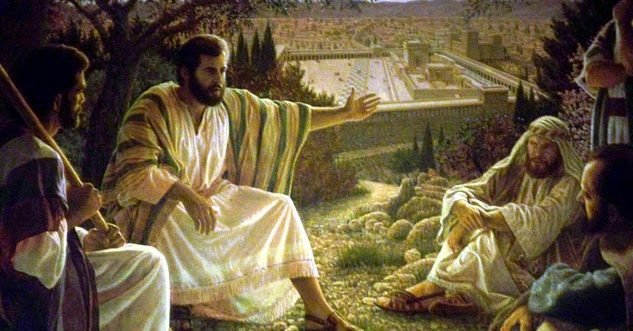
The opening of the discourse, which stimulates the whole narrative, is the observation of the wonders of the temple, and Jesus’ response that ‘every stone will be thrown down’. In Mark and Matthew, the question comes from the disciples, and the following discourse takes place between Jesus and the disciples on the Mount of Olives (so that this passage is often called the ‘Olivet Discourse’). But, as we have seen happen in Jesus’ travelling ‘on the road’ from Luke 9.51, Luke does not identify precisely Jesus’ audience, and does not distinguish between the crowds and the disciples. So it is ‘some’ who speak of the temple (verse 5), and the follow-up question is address to Jesus as ‘Teacher’ (verse 7), the characteristic form of address by those who are not disciples (the disciples call him ‘Lord’). Luke omits any reference to Jesus and the disciples sitting on the Mount of Olives, and the comment in Mark 13.3 and Matthew 24.3 that they discuss this ‘privately’.
Luke has relocated Jesus’ lament over Jerusalem, which Matthews includes immediately before this episode, to an earlier point, Luke 13.34–35. The language of Jerusalem being ‘forsaken’ and ‘desolate’ (Matt 23.38) naturally links it with the mention here of the city’s ‘desolation’ (Luke 21.20), but its location earlier in Luke suggests (in line with John) that Jesus visited Jerusalem more than once. Luke also relocates the warning about premature claims that Jesus has returned to Luke 17.23–24; in its position in Matt 24.26–28 it runs the risk of confusing the reader, with its mention of the parousia of the Son of Man, when in the rest of this section it is not the parousia which is in view.
But, just as in Mark and Matthew, Luke includes at the end of this teaching Jesus’ stern words ‘Amen, I tell you, this generation will not pass away until all has taken place’ (Luke 21.32). It is striking that Luke includes Jesus ipsissimum verbum in the ‘Amen’, just as Mark and Matthew do, despite writing primarily for a non-Jewish audience, indicating how important this point is. At other places he seems to omit references and comments that Jewish readers, or those familiar with the Old Testament, would appreciate.
- Luke omits the Jewish eschatological language of the ‘birth pangs’ of the new age, the kingdom of God, breaking into this age (Matt 24.8, Mark 13.8).
- There is no mention of testifying ‘to the Gentiles’ (Matt 24.24, also mentioned in the parallel in Matt 10.18) or being hated ‘by all Gentiles’ (Matt 24.9).
- There is no mention of ‘false prophets’ (Matt 24.11), a concern echoing the history of Israel.
- Where Matthew and Mark allude to the ‘abomination that brings desolation’ of Daniel 9.27, 11.31 and 12.11, Luke 21.20 makes a more prosaic allusion to the Roman armies besieged then destroying Jerusalem, something Jesus has already alluded to in Luke 19.43–44.
- He omits the allusion to Zech 12 in Matt 24.30 that ‘all the tribes of the earth will mourn’.
All this confirms that the content of our reading is not about ‘distant end times’ but was going to be immediately relevant to Jesus’ audience in the period up to the fall of Jerusalem. If it has relevance to us, then it needs to be interpreted from this starting point.
If the order of events in Jesus’ teaching is slightly unclear in Mark and Matthew, Luke is careful to make the chronology clear. He alone describes the opposition and trouble that his followers will face as coming ‘before all this’, that is, before the fall of Jerusalem. In fact, Jesus’ teaching here offers a summary of what will happen as described by Luke in his second volume:

(from Mikeal Parsons, Paideia Commentary, p 301).
This connection makes clear its relevance to us: although we are living in a different chronological time, after the fall of Jerusalem rather than before, we are living in the same theological time, in the ‘end times’ prophesied by Joel (Acts 2.17f) in which the Spirit is poured out, but before ‘the end’ when Jesus returns and the kingdom of God is fully revealed. So if these things happen to and amongst Jesus followers in Acts, they will happen to us too.
So, what might we learn from these comments?
First, that we should not be unduly perturbed by what seems to us to be catastrophic political upheavals. The Jewish War and the destruction of the temple were absolutely catastrophic for the Jewish nation, and Jewish followers of Jesus most likely would have felt no less distressed about it. And yet Jesus is quite explicit: even such a catastrophic event does not shake or undermine the purposes of God.
Secondly, in uncertain times Jesus’ followers are bound to face opposition. When things are being shaken, people feel insecure, and they are quick to find scapegoats and make minority groups objects of vilification. We should not be surprised.
Thirdly, this is a time for testimony. It is a time to be rooted with confidence in the good news of Jesus, and to trust the Spirit of God that he will guide and direct us in speech and action.
Fourthly, this is a time to be rooted in the teaching of Jesus, and not to be blown off course by various teachings claiming to be from him, but in fact misleading us away from the gospel.
Fifthly, this will be a time of division, even division within households. After all, Jesus was clear that, in an important sense, he came to ‘bring division and a sword’.
Sixthly, the primary quality for Jesus’ followers is ‘endurance to the end.’ This is a consistent emphasis of both Luke’s gospel and the Book of Revelation. In the parable of the sower, Luke alone qualifies the nature of the fruitful soil as those who endure:
But the seed on good soil stands for those with a noble and good heart, who hear the word, retain it, and produce a crop in patience endurance (Gk hupomone) (Luke 8.15).
This quality of ‘patient endurance’ is the one that frames John’s testimony to his visionary experience in Rev 1.9:
I, John, your brother and companion in the suffering and kingdom and patient endurance (Gk hupomone) that are ours in Jesus…
We might be living in a different moment from those Jesus was speaking to in Jerusalem, but many of the lessons are ones we need to hold on to.
Watch James and Ian discuss the passage and its application here:
 Buy me a Coffee








An excellent paper on this passage, I heartily recommend
that folks read Ian’s other paper, highlighted in blue in the text,
he came to ‘bring division and a sword’.
One thought on who was Jesus addressing?
the Disciples or a crowd?
The times for the coming tribulations which came upon
Jerusalem presumably in AD 70
I figure that most of the disciples were dead by then and not even in Jerusalem.
We tend to focus on the AD70 travails but the more devastating
destruction came at the time when The Emperor Hadrian
after crushing the Bar Kokhba [messiah] revolt (132-135 CE)
destroyed Jewish cities, forbade Jewish practices,
and built a new pagan city, Aelia Capitolina, and sacrificed pigs there.
Hence the whole economy of the Jewish religious traditions was
Obliterated.
Truly it is an awfully devastating thing to fall into the hands of a consuming fire.
On the “man of lawlessness” Some might be forgiven for thinking
“it ain’t over until the fat lady sings”, but what is this “revealing”?
Who will it be revealed too? Obviously not to mankind in general.
How long after the revealing before his demise?
As Daniel records “these things are sealed until the time of the end”
It seems to me that he will be liberal [having no boundaries or subject to rules]
At present that seems to be “the way of all flesh” within Church and State
The disciples endured their personal tribulations for the sake of the Gospel but taken before the specific demise of Jerusalem.
The saints need to be watchful, praying and being ready
for that sudden day of the Lord. Shalom.
Dan 12:4: “But you, Daniel, shut up the words and seal the book, until the time of the end. Many shall run to and fro, and knowledge shall increase.” (ESV)
The obvious interpretation of this is that Daniel writes down what he has received and seals up the words in a scroll so that they cannot be read. If the “time of the end” has not been reached, then the words remain sealed up. So, how come we know what they are?
A strong candidate for an answer is that the “end’ being referred to has already passed. Many associate the events with the Antiochene crisis, and there are many points of correspondence in the words with that time.
Most of Luke 21’s changes (mostly additions) to Mark-Matt seem to be Joseph the patriarch – and mostly Genesis 41. Initially seeming to be complicated and falling over itself, his wording has this unitary explanation.
21.11 widespread famine (Gen 41.54-7 thrice)
21.11 terrors and great signs from heaven (Gen 41.8,25)
21.15 I will give you a mouth and wisdom (Gen 41.8,39)
21.18 Not a hair of your heads will perish (Gen 42.38 directly connects greying/whitening hair & perishing)
21.19 Endurance is the key (Joseph novella passim)
21.22 Days of vengeance (Joseph story is one of getting his own back, most particularly Gen 41)
21.24 Falling by mouth (stoma) of sword (Gen 34.26LXX)
21.26 Fainting with fear (Gen 41.8)
21.28 Lift up your heads because of coming redemption (Gen 41 has its pun on the different ways cupbearer’s and baker’s heads are lifted up; cupbearer and Joseph see redemption)
21.34’s new material recalls the Luke 12 ‘faithful and wise servant’ parable (also previously in Matt) which is Joseph to a T
21.34 also has the theme of not being caught unawares. Although this is also in Mark-Matt apocalypse, note Gen 41.34-6
21.34 the day is a snare (pagis), which is also the word for a noose (the baker of Gen 40-1 was hanged: Gen 40.22)
21.34 all who live on the face of the earth – the phrase is in both passages (Gen 41.56)
21.36 escape and stand before the Son of Man – the brothers escaped the famine and stood before Joseph (as judge) who was both their father’s Son and referred to by them as ‘the Man’ (chs 42-3).
Work has been done on the Joseph-Luke links by myself, Tobias Siegenthaler, Nicholas Lunn, Elizabeth Clayton.
Daniel ‘went his way with the prophecy sealed.
In Revelation The Lamb opens the seals.
They must be the same .
Jesus death , resurrection and ascension is the wonder revealed.
Yes Steve. He is the only one with the authority. What is the purpose of a seal? Signed, sealed and delivered.
“seal does not mean hide forever, but to secure intact until the proper recipient and season”.
There is more here concerning seals:
https://biblehub.com/q/Why_seal_Daniel_s_words_until_the_end.htm
Thanks Geoff,
A good read.
Ah, The widow with a noble and good heart.
God loves to honour them and point to them as examples for us to imitate.
I had my own incident with one thirty-five years ago.
God had clearly given me a specific directive to address homelessness in my town.
I announced this mission in the Harvest service (my favourite festival btw) in Church on that Sunday evening.
Straight afterwards an elderly parishioner approached clutching a small purse from which she pulled a £5 paper note, which she handed to me.
“God told me to bring this with me tonight, but I didn’t know why, until now”
Hers was the First Response of many – ‘First Response’ became the registered Charity’s name.
God wanted her faith and obedience honoured.
Two thousand years after the incident with the Widow’s Mite and he is still, over and over, honouring the faith and relationship with him and obedience of his ‘little people’ and painting these living pictures before principalities and powers, of his magnificence.
Thank you Jeannie.
Nothing like personal testimony for putting theology in context.
… which of course is Ian’s third learning point inn his article …
Thanks for the link Geoff, a great resourse, there are unknown things that we know about.