The term ‘love’ is clearly important in the New Testament in a range of contexts. But modern use of ‘love’ shifts its meaning into all sorts of different areas. One solution to this has been to distinguish the different Greek terms for ‘love’ in Scripture.
But this approach does not stand scrutiny, so cannot solve the problem. But there is another, better, solution which can help.
The problem
I was rather struck by one part of the discussion last week about the contribution of the late Richard Hays to New Testament ethics, and his decision not to use ‘love’ as a category, because it very quickly becomes a wax nose—it can be pushed into whatever shape the commentator wishes. So what is the problem with the term ‘love’?
On the one hand, it is one of the most familiar words in the Christian vocabulary. God is love. Love your neighbour. Love one another as I have loved you. The greatest of these is love. For some reason, the term ‘love’ has emerged as the controlling term shaping what the Bible means, and what determines Christian action. A typical example is the cartoon from ‘The Naked Pastor’ where he contrasts ‘loving’ (ie liberal) Jesus with nasty narrow fundamentalists:
The difference between us is that you use Scripture to tell you what love means and I use love to determine what Scripture means.
And yet I am increasingly convinced that when most English speakers hear the word ‘love’ today, what they understand has surprisingly little overlap with what the New Testament writers meant when they reached for agapē and its cognate verb agapaō. This is just one of the many problems with the Naked Pastor’s comment. (I don’t think he realises that he is setting his own modern worldview as the authority over Scripture.)
This is not a merely academic concern. If ‘love’ in contemporary English means something different from ‘love’ in the Bible, then every time we read, preach or debate on the basis of ‘love’, we risk importing a meaning the text never carried. That matters for discipleship, for pastoral practice, and for the arguments the Church of England is currently having about what it means to be a ‘loving’ church.
But the problem is easy to state badly. It is a staple of popular preaching that Greek had ‘four words for love’ and that agapē was the special, selfless, divine one. That claim does not survive close attention to how the words were actually used.
So the question needs a little more care and exploration. Where do English ‘love’ and Greek agapē genuinely overlap? Where do they part company? And what would it take to recover the biblical sense in a language whose default meaning has drifted elsewhere?
Two semantic ranges
Now, dear reader, you might think that, to make my case, I will immediately reach for the ‘semantic range’ of the two words (their ranges of meaning), in English and Greek, and show how different they are. This expectation was set up nearly 100 years ago by Anders Nygren’s influential Agape and Eros.
Nygren was part of the so-called Lundensian School of Theology, which included Ragnar Bring and Gustaf Aulén—the author of the hugely important Christus Victor, which explored the true nature of New Testament ideas of atonement. Nygren’s study (first published in the 1930s) set up agapē as a distinctively Christian, self-giving love, contrasted with acquisitive erōs. (More people will be familiar with C S Lewis’ The Four Loves, though Lewis argues on different grounds, and does not appear to draw on Nygren.)
James Barr (of The Semantics of Biblical Language fame) offered a specific critique of the ‘word-concept fallacy’ which challenged this. (In Semantics, Barr appeared to be bringing critical thinking to bear against naive, usually evangelical, pious readings of Scripture—but the reality is that all evangelicals, including me, now make use of his approach.) A single word does not carry a theology on its own back, and the NT usage does not support Nygren’s lexical claims. It is in fact rather surprising just how ordinary agapaō is.
Consider some examples. Demas deserts Paul because he ‘loved this present age’ (agapaō 2 Tim 4:10). The Pharisees ‘love’ the best seats in the synagogue (agapaō Luke 11:43). People ‘loved the darkness rather than the light’ (agapaō John 3:19). None of these is selfless or divine. In the Septuagint, the Greek translation of the OT, the verb is used for romantic and even sexual attachment. Isaac loves Rebekah (Heb ’ahav Gr agapaō Gen 24:67), Jacob loves Rachel (Gen 29:18, 30), and Amnon ‘loves’ Tamar before he rapes her (Heb ’ahav Gr agapaō 2 Sam 13:1, 15). And in John’s Gospel agapaō and phileō appear to alternate with little difference of meaning: the Father ‘loves’ the Son with agapaō in John 3:35 and with phileō in 5:20.
So the Greek verb could cover preference, attachment, desire and enjoyment, just as English ‘love’ does. English speakers love their dogs, love chocolate and love watching television. Greek speakers likewise ‘loved’ (philousin) to pray on street corners (Matt 6:5). At the level of raw dictionary range, the two words, in English and Greek, look surprisingly similar.
What they share at the core is real. Both denote a positive orientation of one person toward another person or thing, one that values it and seeks it. Both can describe an inner disposition and the actions that flow from it. Both apply to divine and human relationships, to family, friends and community.
If the dictionary entries are so similar, why does the gap feel so wide? Because meaning is not just a list of possible senses. Every word has a centre of gravity, a prototypical sense that comes to mind first when the word is used without qualification. The decisive differences lie there, and in the theological frame the biblical writers placed around the word.
Where they part company
The centre of gravity. In everyday English, the lighter senses of ‘love’ are so frequent that they shape contemporary default readings. When we hear ‘love’ in a theological sentence, the most familiar meaning arrives first, and it is a pleasant feeling of attachment. Between adults, unqualified ‘love’ leans toward the romantic, and the expression ‘make love’ gives it an explicitly sexual dimension (much more so than in the past, when it had a sense of ‘courting’).
Classical Greek kept erōs for that, and the NT avoids the word group altogether. So when we read ‘love one another’, we hear something warmer and softer, and more private and more sexual, than a first-century reader would have heard.
Feeling or allegiance. Modern ‘love’ is first of all an emotion, and largely an involuntary one. We ‘fall’ into it; it can fade; it is authenticated by how it feels. Biblical love, shaped by Hebrew ʾahăbâ, is weighted toward loyalty and commitment. William Moran showed long ago that ‘love’ in Deuteronomy belongs with the language of ancient Near Eastern treaties. ‘Love the LORD your God’ (Deut 6:5) sits alongside fearing him, serving him and keeping his commandments.
That is why love can be commanded at all, including love of enemies. No one can command a feeling, but you can command allegiance and conduct.
Love as choice. ‘I have loved Jacob, but Esau I have hated’ (Mal 1:2–3; Rom 9:13) sounds harsh to modern ears. But in Deuteronomy 7:7–8, love is the explanation for God’s choosing of Israel.
It was not because you were more in number than any other people that the LORD set his love on you and chose you, for you were the fewest of all peoples, but it is because the LORD loves you and is keeping the oath that he swore to your fathers, that the LORD has brought you out with a mighty hand and redeemed you from the house of slavery, from the hand of Pharaoh king of Egypt.
To love is to elect. Luke 14:26’s demand to ‘hate’ father and mother is matched in Matt 10:37 by loving them ‘more’ than Jesus, which shows the same comparative idiom. English has almost entirely lost this sense of love as preferential choice, and it goes along with our cultural incomprehension of arranged marriage.
Love and obedience. ‘If you love me, you will keep my commandments’ (John 14:15; see also 1 John 5:3). If love is fundamentally a feeling, this is a non sequitur. If love is loyalty, it is self-evident. Yet in contemporary culture love is often set against rules and obligation, as if commands were the enemy of love rather than its expression.
Love and indulgence. This is the sharpest divergence of all. Modern English ‘love’ increasingly means giving the other what they want: affirming their choices, removing friction, making no demands. Think of the doting, over-indulgent parent, or the plea ‘if you really loved me, you’d let me…’ This is why, in all sorts of areas of morality and ethics, to place limits on actions or claims to identity is perceived as being ‘unloving’.
Biblical love seeks the other’s good, which may run directly against what they want. It was Thomas Aquinas who said that love is velle bonum alicui—to will or desire the good of another person (Summa Theologiae, Prima Secundae, Question 26, Article 4, drawing on Aristotle).
So ‘the Lord disciplines the one he loves’ (Heb 12:6), and the risen Jesus says ‘those whom I love I reprove and discipline’ (Rev 3:19). Love ‘does not rejoice at wrongdoing, but rejoices with the truth’ (1 Cor 13:6). In current English, love and judgement are treated as opposites—‘how unloving to be judgemental!’ In the biblical frame, love is what makes judgement necessary—hence John 3.16 (‘God so loved…’) is quickly followed by John 3:19 (‘people loved darkness instead of light…’) both using the verb agapaō!
Private or communal. Finally, in English ‘love’ is largely interior and individual, and often oriented towards the lover’s own fulfilment. In Paul, love is the practice that builds the community (1 Cor 8:1). Its description in 1 Cor 13 consists almost entirely of verbs—it is patient, kind, does not insist on its own way, bears all things. In Jude 12 agapē even names the shared meal of the church.
For all these reasons, the phrase ‘Love is love’ becomes not merely a meaningless tautology (in which case it would be useless but harmless), but a seriously misleading claim about both clarity of the word’s meaning and its transfer from one culture and context to another.
Love defined by a basin and a towel
If the lexicon alone cannot give us the meaning of biblical love, where does it come from? The New Testament’s answer is clear: from what Jesus did.
In this is love, not that we have loved God but that he loved us and sent his Son (1 John 4:10).
By this we know love, that he laid down his life for us; and we ought to lay down our lives for the brothers (1 John 3:16).
The content of the word is supplied not by a dictionary but by a narrative.
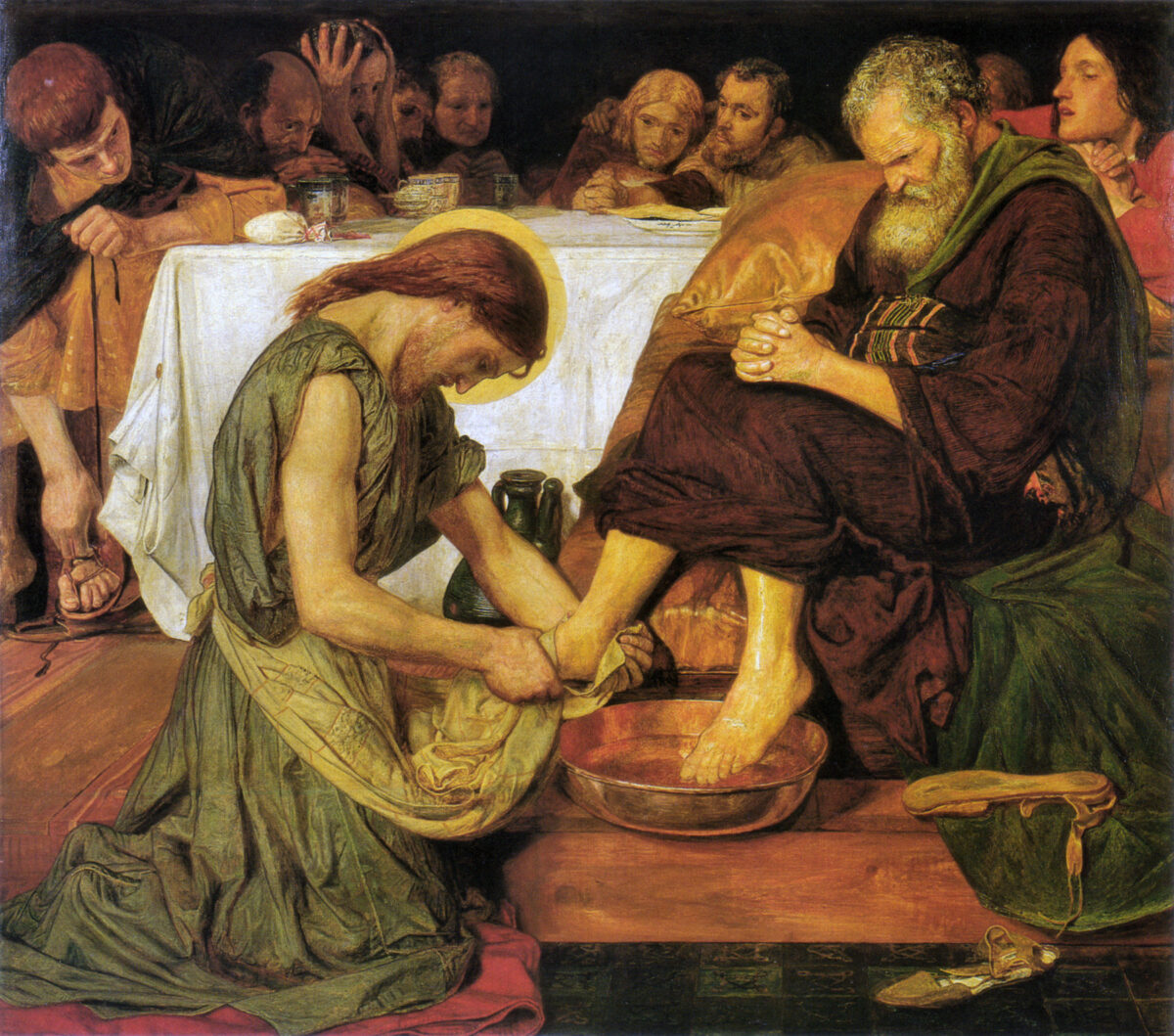
Nowhere is this clearer than in John 13. The footwashing is not an illustration added to a pre-existing concept of love. It is the definition. The scene opens with ‘having loved his own who were in the world, he loved them eis telos‘ (13:1). That means both ‘to the uttermost’ and ‘to the end’, and it points forward to the cross. Jesus then takes the slave’s place, kneels, and washes his disciples’ feet. Shortly afterwards comes the new commandment: ‘Just as I have loved you, you also are to love one another’ (John 13:34). The standard is not a feeling to be matched but an action to be copied.
Three things follow. First, this love involves status reversal. Footwashing was a menial task, which is precisely why Peter objects. Love takes the lowest place for the other’s benefit: ‘the Son of Man came not to be served but to serve’ (Mark 10:45; compare Phil 2:5–8).
Secondly, this love is not indulgence. Jesus overrides Peter’s protest: ‘If I do not wash you, you have no share with me’ (13:8). Serving love does not simply give people what they ask for.
Third, love takes the form of service. Paul makes the connection explicit: ‘through love serve one another’ (Gal 5:13), where the verb douleuete means to act as a slave. Christian freedom is not abolished but redirected, into enslavement to the neighbour’s good.
Is there a better English word? Each candidate recovers one dimension and loses another. ‘Charity’, the KJV’s choice in 1 Cor 13 (via the Vulgate’s caritas), has shrunk to almsgiving and condescension. ‘Loyalty’ or ‘faithfulness’ captures the covenantal sense but sounds cool and contractual. ‘Devotion’ holds commitment and warmth together but faces inward or upward. ‘Goodwill’ and ‘benevolence’ seek the other’s good but can cost nothing. ‘Care’ is perhaps closest in everyday speech, but has been professionalised. Coverdale’s coinage ‘loving-kindness’ for Hebrew ḥesed is a reminder that translators have sometimes needed to invent words because none existed.
Perhaps the best solution is not to abolish the word ‘love’ (which was my first instinct, as with the word ‘church’ which we should never use in the New Testament!), but to qualify it (‘self-giving love’, ‘costly love’) and to define it by example, as John does. (There is a parallel here with calling God ‘a good father’ to prevent misunderstanding by those whose experience of fatherhood has been negative).
And if we need a partner word to keep ‘love’ from drifting back into sentiment, the best candidate is ‘service’. I therefore nowadays find myself asking not ‘How can I love this person, these people?’ which immediately sounds sentimental, but ‘How can I serve them?’
Conclusion
The gap between English ‘love’ and biblical agapē is not mainly a matter of dictionary range. On paper, the two words cover much the same ground. The difference lies in where each word’s centre of gravity sits. Contemporary English has drifted toward feeling, pleasure, romance and indulgence, and has almost entirely lost love as covenant loyalty, as choice, and as obedience to teaching. The New Testament anchors love in the action of Christ—a love that commits, chooses, corrects, and kneels to serve.
That has consequences. When the Church appeals to ‘love’ as the decisive argument, it is worth asking which love is meant. Is it the love that affirms whatever the other desires? Or is it the love that takes up a towel, washes feet, and will not let the beloved go without being made clean? Only the second is the love Jesus commands us to imitate. Recovering it will mean doing what John does: not defining love in the abstract, but pointing to the one who ‘loved his own to the end’.
PS If you want to know about the 1,000-year history of the term ‘wax nose’ there is a great account here. If, on the other hand, you do an internet search for ‘wax nose’ you will find something else altogether!
 Buy me a Coffee

























This is a much needed, but neglected topic or doctrine and it takes me back to D. A. Carson’s small book, ‘The Difficult Doctrine of the Love of God’ which is based on a series of lectures he gave. I have the book but not to hand to check that this is the first, ‘On Distorting the Love of God’:
https://www.thegospelcoalition.org/sermon/distorting-the-love-of-god/
Ah, Geoff – I was about to reference that little book in my own comment just posted – I have only just seen your comment. The book is just under 90 pages of text and is very accessible. You are right that that is the first chapter.
Indeed! So very important to keep all this in mind and to introduce others to it. I recall, too, Carson’s Exegetical Fallacies and, more importantly, Moisés Silva’s Biblical Words and Their Meaning: An Introduction to Lexical Semantics.
A good and helpful discussion that reminds me of what Bishop Robert Barron regularly says in his youtube prorammes: referencing Thomas Aquinas (as you have done in the original Latin above): ‘to love means to will the good of the other.’ I was once puzzled by my Catholic teacher’s insistence that you could (indeed, had to) love someone you didn’t like, but it became clearer to me now how this is the central axiom of Christian living. I have often wished that Protestants had the kind of conceptual and linguistic clarity that Catholics have by using Thomas as their touchstone and guide.
Naturally this raises the question: what is the good of the other? Medieval Christian writers often thought long on the question, how eros could be purified of self and become ‘caritas’.
It is notable that the Vulgate uses ‘diligere’ (to choose out; hence to prize, love, esteem wisely) to translate agapao in John 3.16; and historically the favoured English translation for ‘agape’ has been ‘charity’. Certainly among the classical Latin poets (Catullus, Horace, Ovid), ‘amor’ often denoted a passionate longing or desire, and Amor personified frequently denotes Cupid or Eros, and perhaps that is why Jerome avoided the word.
Looks like I am a good Thomist then.
The good of the other cannot be understood outside of eschatology.
PS if you put a double return to create a line space between paras, your comments are much easier to read.
“Give us a child until he is seven and we will have him for life.”
But that was the Jesuits, not the Dominicans, so you may be safe.
I will try to remember the double return move.
It was Jean Brodie too. Or so she thought.
James, your comment elicits two distinct thoughts in me, as follows.
First, about love meaning to will the good of the other: I have reservations about the will being involved in any part of love. Genuine love (including self-sacrificial) flows spontaneously without any grinding-out. I think that the human will – even when it is used in order to do good – sprang into being at the Fall. Nietzsche said that will and power were what was left when God was discarded; evil men such as Hitler and Aleister Crowley were obsessed with the will. In Crowley’s Thelema movement he placed love under will, not above it. One man I knew put it well by saying that God is I AM, Satan is I WILL.
Second, about “the kind of conceptual and linguistic clarity that Catholics have by using Thomas as their touchstone” – Yes and No! He is a realist in the Aristotelian tradition, and I believe his power comes from being a member of that basically correct school. But when he goes on and on about something being a necessary rather than a contingent truth, and then arguing why (and then building upon it), I smell bullshit. The line between necessary and contingent truths is more arguable than philosophers concede.
The Bible has a lot to say about the redeemed human will, especially Philippians 2.13. God is the source of the good will, and the essence of Christian obedience is allowing God to transform us in our attitudes and desires. “God is working in you, giving you the desire and the power to do what pleases him.” (NLT) It begins with God and the goal is to glorify him.
Contingent truths, I submit, belong to our human existence and the reality of the choices we make. None of us *had to exist, and if freedom of the will is a fact and not an illusion, then we all confess that in at least *some of the actions we have taken, we could have chosen otherwise. The notion of moral responsibility is based on this claim, in the face of the assertion that a law of causality rules everything.
…the redeemed human will…
Yes, we have wills since the Fall, but I question whether we had them in that brief interval between our being made in the image of God and unfallen, and the Fall. WE have no human writings from that time. The will is not to be redeemed, it is to be put to death and replaced by God’s life and holiness.
“And if we need a partner word to keep ‘love’ from drifting back into sentiment, the best candidate is ‘service’”
With this bold out-stepping in mind, how ought we to understand 1 Corinthians 13:3 without getting ourselves caught in a loop?
‘Love’ there seems to be held out by the Apostle as a thing which precedes and envelops Christian Service. A thing without which any service on its own is essentially worthless. Are we not in danger of going round in circles here?
1 Corinthians 13:3 seems to imply (to me) that a certain quality of heart above and beyond the work itself – if not a ‘feeling’ then at least a spiritual disposition – is needful and essential before any act of ‘service’ can begin to answer to God’s purposes for us.
That ‘quality’ is defined explicitly as ‘Love’ and we are therefore back where we started!
1 Corinthians 13:3. Motives or reasons could be self serving.
In 1 Cor 13.3, Paul is talking about actions which can become self-serving, rather than actions that are manifestations of a desire to serve.
There have been many who have lived in poverty, but some might do so out of a desire for merit.
This is very good Ian, -thank you
Thanks Chris!
This is an excellent word/idiom study.
Reminds me of Oswald Chambers definition of Love as –“My sovereign preference of/ for another”
For me love has two sovereign elements which define it, total Submission and Abandonment. not Feelings {as Chambers enlarges on.}
This is well documented in the 144000 in Rev. Ch 7. and 14.
Submission and Abandonment are the motif of love throughout Scripture, they are its touchstones.
As we know Submission and Abandonment are the two most difficult thing for a nation or an individual to contemplate doing whether secular or religious.
We prefer easier concepts and definitions of what love is and we
go off at a tangent, love for peace or the poor or justice for the marginalised and oppressed etc.
This cohort demands all everywhere to adopt this Interpretation or your moral compass is out of whack !.
God and Christ are not just of the highest moral standard they are the exemplification of Submission and Abandonment, for Him and for us.
It is an individual choice, a Sovereign costly Choice.
Perhaps Google “the motif of Submission” in scripture
OR The motif of ” abandonment to God” in the Bible
Shalom.
“A single word does not carry a theology on its own back.”
I like that comment.
No, a single word doesn’t, but Jesus does.
To understand the nature of holy Love – holy Compassionate Love – we need to look to Jesus: to His revelation of the nature of God in His life and his giving of Himself on the Cross, to the point of no turning back.
We need to open ourselves to the Cross and the sacrificial devotion of our Lord Jesus Christ. And then we are called to follow that example in our lives, to devote ourselves, and to share in fellowship with the compassion and sacrifice of Christ.
The nature of Holy Love, as revealed and demonstrated by Jesus, does not bypass the Cross and the offering of self in compassion to others.
A motif in the Bible is the idea of dying to self, and coming truly alive in God… truly alive in the Way of Compassion and Devotion that Jesus longs to draw us into. And in doing so, as we should grow lesser, He should grow more.
I sincerely believe that we are called to open our hearts and lives each day to the flow of God’s Love toward others. In the Old Testament a ‘devotion’ was an offering to God of a sacrifice. In the New Testament, the ‘devotion’ becomes Christ. And in our small ways, day by day, we are being called to be ‘devotions’ as well… to be drawn into the Love of God… through opening our hearts to God’s own sacrifice first of all.
I like the way in the article that you go through the various way that words occur, but home in on Jesus Himself, and what He reveals of Holy Love, the compassion that flows like a stream from God – through our fallible lives – to others. The Love of God is eternal and ever in flow. To seek understanding we need, more and more, to understand the ‘Devotion’ of Christ on the Cross.
Not just to understand it, but to receive it – through the Holy Spirit – in our hearts, and to give ourselves. I asked someone a few days ago what ‘the Fellowship of the Holy Spirit’ meant and I have been reflecting on that. I think, if we ‘devote’ ourselves to Christ and follow the Way of the Cross, perhaps we are drawn into a Fellowship of Compassion, and drawn into living (in Christ) as the children of God.
I am sure there is more than what I have tried to voice here. We need grace to love God more from day to day. It’s not just about compassion for other people, but a giving kind of ‘devotion’ because of who God is and how wonderful God is. We need grace that that may grow, so that we share in devotion to God and in covenant love – the covenant Jesus established in His own self-giving, His faithfulness, His Body, His Blood.
Come let us worship. Let us open to God’s compassion, and Holy Love. And its flow, and its cost, as we follow the Way of the Cross, day by day.
Thanks for that lovely reflection.
It is about all that—but in the NT that cannot be separated from obedience to the teaching of Jesus.
And I do have an article in preparation on the ‘fellowship of the Spirit’!
Thank you. I am very keen to understand better what the ‘fellowship of the Holy Spirit’ means, so I really look forward to that.
I accept that obedience is important. I have found that at certain times in my life, in exploring vocation, when I thought to go in one direction and God said ‘No’, and yet through obedience other ways opened up, that I could never have anticipated. Obedience can really hurt at the time, but in a way is an expression of love and an acceptance of mercy.
And we have the example of our Lord who was obedient unto death on a cross.
For fellowship or communion with Holy Spirit see the book “Communion with God”, by John Owen, where fellowship/communion with the Father and with Jesus the Son are also opened up.
I have only the version abridged by Anglican R. J. K Law, published by Banner of Truth.
Reviews look really good. I’ve ordered it. Thanks for the heads up.
I think that is very well put and something that is important to bear in mind.
And not only as far as ‘love’ is concerned but in all the aspects of godly living.
We learn what the words mean by observing their several natures as it is embodied in the life of Christ gifted through the workings of the Holy Spirit and recorded and represented in Holy Writ.
I have observed this well-meant confusion about at my children’s school where the fruit of the spirit is taught as a sort of code-of-conduct or behavioural model. This not only potentially sets the children up for failure, with the ‘spirit’ in question being erroneously confused with the ‘spirit’ of the child, but it also flattens, distorts and trivialises the very nature of the spiritual qualities in question.
The question, for the Christian truly, is not what is the meaning of the words ‘love, joy, peace, patience, kindness, goodness, faithfulness, gentleness, self-control‘ in an abstract sense, but in what way does Christ embody and perform those gifts in his being as recorded in the scriptures.
That is our best starting point if we want to better understand what the essential spiritual quality of these various gifts might be.
They are such lovely qualities, but as you say, so often we need to look first to Christ. And when it comes to compassionate love, we may look above all at Christ’s supreme oblation on the Cross. I haven’t thought to take the list of the fruit of the Spirit, and go search for the ways we see them in the life of Jesus. At least, not methodically, looking for each fruit one by one. It’s a lovely and very helpful idea.
Thanks, this is a helpful and necessary corrective to some of our loose thinking.
Just wondering, though: is there not still an affective dimension of Christ-like love that needs due emphasis? Or were the mourners wrong to observe Jesus’ deep distress and see this as an indication of his love for his beloved friend Lazarus? (Jn 11:36)?
Thanks. I don’t want to deny the affective. And that is where we do see overlap between two. I don’t think it is either/or.
However, I also note that, very often, when Jesus is moved, the gospel writers use other language for this, largely the ‘spleen’ terminology!
In NT theological physiology, we are moved with our guts (‘the bowels of Christ’ Phil 1.8 AV), but we love with our hearts, which is the seat not of the emotions but of the will.
Yes, and with your caveats and clarifications it is easier to comprehend that the loving Jesus could also be the angry/indignant Jesus (Mk 1:40f [?]; Mk 3:5; Mk 10:14).
…which even copyists clearly struggled with!
Randomly reminded of the TV show Jeeves and Wooster, of how Jeeves doesn’t always do what Bertie asks and often does things he doesn’t ask for, but what he does as servant is always for Bertie’s ultimate good. But it’s clear in Jeeves and Wooster that Jeeves knows what is good for Wooster more than Wooster knows himself, which, to come back to reality, highlights that the real disagreement may be about what is actually for the good of the person. Liberals think you have to accept what the person says is their good, whereas others think God’s Word overrides personal and cultural tensions.
An unusual illustration!
Liberals can be inclined to be just adolescents or ADHD toddlers. When they speak of their good or their best interests, they mean their short term individual satisfaction with no thought of ramifications. In fact, best interests can be calculated retrospectively by seeing what may be expected on past experience to increase happiness, health, virtue, character formation, success, and the *common* good.
Really helpful. Thanks for the article, Ian.
Reminded of the phrase “tough love” that doesn’t seem to be fashionable these days.
Tricky things, words…
Thanks. The difficulty with the phrase ‘tough love’ is that the ‘tough’ applies to those loving; without it the recipients are not actually being loved…
Looking for meaning among the waving water weeds of words … funny that words don’t just change meaning but they also lose definition and precision. Like “nice”
and “meat” and “deer”
Good article – and important. I suspect Greek can only take us so far – because all the writers of the New Testament were Hebrew – and the thought is Hebrew. So the Hebrew scriptures provide the most obvious frame of reference – and in particular the word ‘hesed’ which variously gets translated love, mercy, loving-kindness, grace, faithfulness. The central idea is loyalty to the covenant – whatever that means in its context.
I suggest covenant and faithfulness to the covenant are ideas as central to the New Testament as they are to the Old – which is why modern Western ideas of ‘love’ cannot simply be read into the scriptures, especially where ‘love’ is taken to mean something quite contrary to the express meaning of the covenant.
‘because all the writers of the New Testament were Hebrew – and the thought is Hebrew.’
Actually, I don’t think I agree with that. Paul shows extended familiarity with Greek and Roman methods of rhetoric, and Luke matches Greaco Roman patterns of historiography.
And I think Jesus taught in Greek! https://www.psephizo.com/biblical-studies/did-jesus-teach-in-greek/
Ian,
I am a bit surprised by this comment (unless I have misunderstood it) — you can be thoroughly Hebraic in your worldview but express that worldview in the language/idioms of the culture you are addressing?
This has been a problem in the theological academy in the past where it was thought Greek idioms used by Paul meant he was expressing a Greek worldview.
I lived in France for 20 years and good friend there, born in the UK, had lived there 40 years, fluent in French, taught in a French university, married a Frenchman, her children were born in France — and she still spoke about the French as ‘they’.
Colin, I am not sure I understand your question…?
Ian,
Paul Burr had said, ‘because all the writers of the New Testament were Hebrew – and the thought is Hebrew’ — and you replied, ‘Actually, I don’t think I agree with that. Paul shows extended familiarity with Greek and Roman methods of rhetoric, and Luke matches Greaco Roman patterns of historiography.’
So, mine was a rhetorical question — to which I expected the answer yes — Paul could indeed be a Hebrew of the Hebrews and be expressing a Hebraic worldview even while writing in Greek (and I would argue the same for Jesus).
To deny such has meant Greek concepts have been imported into the NT? But I think I am correct in saying there has been a move against it in the academy (I am not talking about the faith-based seminaries).
Ian,
Here is a specific example —where concepts are read into Paul’s Hebraic mind based on the understanding of the Greek word used for ‘flesh’ in the LXX and NT — it allows Loader to argue that sex itself creates a new ontological reality — a concept foreign to the Hebrew Bible, but now widespread in Western Christianity:
“The Hebrew word, בשר(“flesh”) in the expression “become one flesh” has its primary focus on creation of kin, whereas the word used in the LXX, σάρξ (“flesh”), puts the emphasis more on sexual union. Whereas בשר can be used metaphorically in the Hebrew for one’s own kin or family, σάρξ (“flesh”) is rarely used this way in the LXX. In the Hebrew the sexual is more likely to be located in the word דׇבַק (“join to/stick to”), whereas in the LXX both προσкολλάω (“join to”) and σάρξ (“flesh”) are capable of including sexual connotations . . . It allows Paul . . . to apply Gen 2:24 to sexual intercourse with a prostitute (1 Cor 6:16).”
William R. G. Loader, The New Testament on Sexuality (Grand Rapids, Mich.: Eerdmans, 2012), 278
In the “offering of ourselves as a living sacrifice
to God
Rom 12:1
I beseech you therefore, brethren, by the mercies of God, that ye present your bodies a living sacrifice, holy, acceptable unto God, which is your reasonable service.
In presenting our bodies as a living sacrifice holy and acceptable is a chosen, willed action on our part, a submission to the Cross.
The nature of a sacrifice is that the sacrifice is
wholly consumed, no flesh remaining.
“the flesh profits nothing” has no benefits remaining, nothing that it can contribute to our fellowship with God, “That no flesh might glory or boast,
We cannot mimic or imitate such a sacrifice as
the way of the cross.
The language of the NT is that Grace has already provided all that pertains to Godliness
Believers not only receive the Spirit but enter into a union with God’s very life. This union reflects 2 Peter 1:4, which speaks of believers becoming “partakers of the divine nature.” The Holy Spirit’s indwelling power enables this divine fellowship.
Pet 1:3 According as his divine power hath given unto us all things that pertain unto life and godliness, through the knowledge of him that hath called us to glory and virtue:
Eph 1:19 And what is the exceeding greatness of his power to us-ward who believe, according to the working of his mighty power,
The “evidences” of love are detailed in 1COR 13
And in the fruit of the Spirit, they are the evidences of the presence of Eternal life, not aspirations. Shalom,
Another book worth consideration is ‘Religious Affections’ by Johnathan Edwards.
If I’m not mistaken, he posits affections not as simply emotions, but as the seat or centre of all our desires, drivers.
And that is the scriptural meaning of ‘heart’.
But, as often happens, we seem to be moving away from the Person of God, to focus on us, humanity.
‘God is Love’, starts, does it not, with the intra-Trinitarian love, Father, Son, Spirit.
How, when, where, why is is that manifested, and spread out?
This requires the revelation of the whole Bible, the whole Counsel of God .
Indeed Geoff,
The phrase “love is of God” (or “love comes from God”) is written by the Apostle John in the New Testament,
1 John 4:7: “Beloved, let us love one another, for love is of God, and everyone who loves is born of God and knows God.”
1 John 4:8: “Whoever does not love does not know God,
Very helpful, Ian, and thank you.
I read the Naked Pastor’s cartoon differently.
I understood it as a commentary on those who claim to be speaking from a standpoint of love, but who, in fact, are arrogating it to press home their particular and uncritically held stance.
I suspect that I’m not the only person who has heard those famous words, ‘Listen, I am telling you this in love …’ Whereas they are using it to put the boot in fair and square.
Sure, but that is a different criticism which needs a different expression.
I take the Naked Pastor at his word, as others have done: the source of our authority for what we judge to be loving is not in fact the Jesus of the New Testament but the Jesus I find reimagined in my own image, expressing love as I would do so.
Recently reading ‘Salvation by Allegiance’ Matthew Bates. Interesting Allegiance,the inacting of following Jesus, rather than only mental acquisence resounds with love as an act of service to the other. Its not necessary to agree witg his entire thesis and there have been many critical comments (inclyding who/what saves) but my take away links love and alliagiance.
When we are brought by the Spirit to that crisis moment
Where we come to Romans 12:1 and take up the Cross
And the sacrifice is complete and accepted we are consumed.
An awesome thing happens God takes all responsibility for us
The life we now live is by faith in Him, it is no longer the I who lives but Christ who lives in me. It is entering into the “Rest” of God.
Madam Guyon says about abandonment to God, “What is abandonment?
It is forgetting your past; it is leaving the future in His hands; it is devoting the present fully and completely to your Lord.
Abandonment is being satisfied with the present moment, no matter what that moment contains. You are satisfied because you know that whatever that moment has, it contains—in that instant—God’s eternal plan for you.”
Which is much what Peter says
Humble yourselves, therefore, under God’s mighty hand, that he may lift you up in due time. Cast all your anxiety on him because he cares for you.” -1st Peter 5:5b-7
As Jeanne Guyon said, “Be careful; do not listen to the voice of your natural reasoning. You can expect just such reasoning to well up within you.
Nonetheless, you must believe that you can abandon yourself utterly to the Lord for all your lifetime and that He will give you the grace to remain there! You must trust in God, “hoping against hope? (Romans 4:18)”
Like Abraham even when all seems humanly impossible.
“What a joy divine, what a peace sublime, leaning on the Everlasting arms …..” Sol 8:5a
As Jesus says “these [ lilies ] neither toil or spin yet your Heavenly Father cares for them and even Solomon in all his glory cannot be compared to them. Shalom.
And something greater than Solomon is here.
I share your observations Ian regarding Richard Hays’ rejection of the term “love”. Alongside several other key NT terms, it no longer necessarily can pass as a genuine desire to explore Christian ethics, but as a need to fit a preconceived understanding of what the essence of the Gospel really is.
When you highlight “love as choice”however, we are reminded of the wouderful passage in Ephesians chapter1 ; declaring that “in love he (the Father) predestined us to be adopted us as his sons through Jesus Christ” – “through His blood” we begin to see and experience the overpowering nature of that love.
It reminds us of what Paul Burr has said about love as covenantal. It reminds us also of the superb summary of Susannah: -“devotion to God and in covenant love – the covenant love Jesus established in His own self giving, His faithfulness, His body and His blood”.
And what supremely defines that love? I would humbly suggest that what was possibly to be the first public recognition of the nature of that love did not emanate from the lips of a ‘born again, four-square disciple, but from the mouthings of a raving lunatic :”What do you want with us Jesus of Nazareth. Have you come to destroy us? I know who you are – *the Holy One of God*[Mark 1:24].”
That passage in Ephesians (and notably 1:7) is almost overwhelming in its power and truth.
The outpouring of the Blood of Christ is a determined (I choose that word carefully) act of love and compassion. A signal demonstration of God’s amazing desire that we should be redeemed and forgiven for our sins which are many.
It is through the Blood of our Lord – and the covenant with us to the point of no turning back – that we find redemption, and receive grace. And in the encounter with the mercy of God, and God’s great self-giving, our hard hearts may be broken, and we may be drawn into the outpoured love and grace, the compassion and mercy that God has for others.
It is little wonder that demons draw away and quake, in the face of such love, which is light shining into the dark. And tyrants too. They fear the determined compassion of God, and its truth, because the power of love – in the determined act of God – goes all the way and does not turn back. It is selfless love, and shames the forces of evil. It shows them up.
We are invited to follow the Way of the Cross ourselves, to offer ourselves as ‘devotions’ in turn. And to open to the great Love of God that flows from God’s eternal reality. To open to love for others, but also to Love God with all our strength (and mind),.. which in turn takes determination, and is impossible without prayer.
[You or Ian could advise me whether strength or mind is the closer translation in the Great Commandment, but I guess both combine in the sense of determination…]
We are drawn into a covenant, involving shared devotion (in the sense of sacrifice), but the devotion of God is the foundation of it all… to the outpouring of life blood and the giving involved.
And so, yes, “we have redemption through His blood”. That was love as choice. The love God first had for us, the determined love, the determination to save. It is an amazing grace that God chooses to be offered in sacrifice and total outpouring, and seeks a covenant people and a household. We learn about what love means and what love costs when we look to the life and death of Jesus Christ.
Love is not sweet feeling, though we may express tenderness and kindness, to help and comfort other people. Love is choice. Choice and determination. We are shown that when we look at Christ. It is also cost, and the Way of the Cross. But it is also life, and resurrection, and a call to grow and open to the whole of who we are in Christ, in Christ’s love, and giving, and mercy for others. “I have come that you may have life…”
Of course, these are only my thoughts and reflections, and it’s time I stopped. Thanks for the Ephesians 1:7 reference.
Dear Susannah,
This response to your question is probably ill -thought out .But here goes! I have been someone who struggles between mind and imagination and still, late in life, I struggle between accepting God’s love while struggling periodically over past failures. No doubt there will be those involved in this topic who believe (or think ?) they have resolved such issus. Nevertheless, while the Great Commandment embraces the whole of life, there is something about issues of the mind which many Christians today are wrestling with against a background of what has been called in certain quarters cognitive dissonance. And one of the key concerns here are questions of spiritual authority. By way of example,even when we are bombarded with the slogan (cliche?) ‘its all about Jesus’, I ask myself -“where is God the Father?” So may I try to answer your question (perhaps illogically) by making some negative observations?
In Genesis 3, the woman is tempted first of all by the serpent’s question: “Did God ‘really’ say “you must not eat from ‘any’ tree in the garden?” The outcome? *The fall of man(generic).” But this is the forerunner of the greatest temptation of all: the testing of Jesus in the wilderness ! Satan, confronting a physically and probably psychologically weakened Jesus poses him (Jesus) twice with a question: *if* you are the Son of God” ——–. I am aware of two possible meanings of ‘if’ in this context – either ‘suppose’ or, as I believe, the serpent is deliberately attempting to cast doubt in Jesus’ mind? – the big *if*.
The weapon Jesus employs here is The Word of God. No wonder the Apostle Paul says:” Do not be conformed by this world but be transformed by the renewal of your mind — and elsewhere : ” set your mind on things on things that are above—– for you have died and your life is hidden with Christ in God.” Therefore I would answer your question re strength and mind by saying that where there exists a mind, heart and soul rooted in Jesus Christ, such a person will find all the strength needed in him-her. .He calls us to submit to his *loving* will and purpose. And He ,of course, as the living Word of God, reveals to us the glories of the *written* word. And as you yourself have indicated word and prayer are the conduits to the Lord and King.
Every blessing to you
I am grateful for your blessing, Colin.
I believe we all carry the weight of past failures, even after we confront them and believe that God forgives us. I have certainly needed God’s forgiveness and mercy, and still feel the weight of sins where I cannot undo the harm that I’ve done. Yet I know that God wants us to receive that forgiveness and seek God’s grace and love in the life we are given from day to day. And speaking for myself, I continue to pray for forgiveness for the many times I continue to be selfish, as well as prayer for others who are weighed down by sins. I pray for us all, that in God’s mercy we might receive healing, and open to God’s Spirit to renew and restore our hearts and minds. I believe God SO wants to do that.
In our Lord’s prayer, we are exhorted not only to pray for our own forgiveness, but to pray for so many people who also sin and get diminished by that, praying for mercy and healing for others.
I guess many of us experience times of cognitive dissonance – for myself, though I am daily reminded of God’s compassion in so many places in our world, as a retired nurse there is sometimes dissonance in the pitiful suffering and poverty and needs of so many people, and it can make me indignant.
One of the things that has been growing in my mind is – not to block out the pitiful suffering, but to look to God’s own compassion and seek grace to be drawn into it. And to try to trust God, and find rest in God. I believe God longs to hold and enfold us, and wants us to come and shelter in God’s tender love. Then what can we do, but try the next day to be part of the compassion in whatever practical needs pass our way. But I must say that I find the enigma of suffering and pain a challenge – through sickness, or poverty and deprivation, or as the consequence of sin.
The words you quoted – “you have died and your life is hidden with Christ in God” – are very resonant to me. Too often I assert myself… probably even by being on this page… when I should be seeking to hide myself in the selfless compassion of Christ.
And yes, as you say, we find our strength of purpose and compassion when we turn to Christ and let God draw us into that sacrifice, that daily offering of ourselves, supported by prayer and scripture.
Some days prayer comes readily. Other days less so. But that life of prayer is a conduit, through which our hearts may be touched and slowly changed. Thank you this conversation. I will leave it there.
May the Grace of God be with you. May God hold you in the hiding place. Hold you in tender love and care.
Susannah
Self-sacrifical love is the hallmark of a Christin, no matter what Greek word appears in the NT.
Do you sometimes wonder, as I do, in this context whether the kind of love you are describing is too easily weaponised by “speaking the truth in love”? It always seems such a fine line between speaking the truth in love and speaking an opinion in spite.
Yes, I entirely agree with you. But isn’t the answer to check whether what we say or do is actually part of willing the best for the other…?
How, Ian? The phrase is meant to prepare the listener for words that he or she will find difficult, just like “This is for your own good”. But it is a manipulative phrase, because it implicitly plays the God card by pretending to certainty what the truth is. More honest is “There’s something I want to say to you that you won’t find easy, but I believe it is true.”
That is a perfect introduction.
It all stems from repentance, conviction of sin. The repentant heart and mind, one that accepts his need of a redeemer and knows (i.e. has faith) that he has been redeemed through Christ’s work on the Cross at Calvary (the ultimate act of love), intuitively knows what Christian love is (although he won’t necessarily have done the intellectual task of going through all the uses of words that mean ‘love’ in Scripture and figuring out what they mean in each case).
C.S. Lewis (the four loves) probably drew heavily on George Macdonald. I would recommend Macdonald’s novels ‘Malcolm’ and ‘Sir Gibbie’ which illustrate Macdonald’s ideal of how Christian love should work out, except that he writes in dialect which is probably off-putting for those who don’t come from the Doric-speaking North East of Scotland (I do – so I don’t need the translation). There is a Scots-English edition, translation into English by David Jack, which is very good. I have come to see that these two novels in particular are probably essential reading for anyone who wants to understand the background to C.S. Lewis.
The “love is love” claim I see as trying to justify any form of sex as long as there is mutual consent and a claim of love existing between the participants. I reject such a claim based on 1 Cor 5 where Paul disfellowships someone involved sexually with another. I think all the disfellowshipping examples in the NT are instructive for us, but I also think we need to be consistent and not simply dismiss some of them. I think each of these were examples of loving someone in a way that would hopefully result in their repentence. Thus, love is not anything goes.
‘Love is love’ is not only facile and analysis-free, but also disingenuous. To think that its proponents consider themselves clever enough to be part of a debate.
Donald,
I agree. Don’t we all have tendency to think “your will be done” was addressed to us by Jesus, rather than to God the father?
Anyone has any idea of how to respond to our bishops’ diocesan letters (Oxford!!) appealing to love in our response to the immigrant crisis arriving on boats. This in their dismissive attitude to responses from the white working class – actually anyone who has an acquaintance say with tension in Bradford.
‘How is it loving to admit a group that might well include those who want to cause harm?’
There is a pastoral and evangelistic reason why this discussion is so important. If the church is going to connect with those it seeks to serve, it will come into contact with many who have been abused or harmed by those who claimed to love them. In such situations, naively talking about God’s love runs into the problem highlighted here, that what we mean by the English word and what others hear are two different things altogether. I still remember one young woman who asked, “How can I call God Father when that term for me is a swear word?” More generally, I find the response to the second greatest commandment is so often, “How can I love my neighbour when I struggle to love myself?” It’s difficult to find other words that adequately convey all that is entailed by the love of God but in my experience the themes of God’s care, compassion and constancy often carry greater resonance
Both Jesus and St Paul gave their own explanations for what love meant given we are told to love our neighbour.
Jesus, in Luke 10, tells the parable of the good Samaritan. That was to illustrate who was a neighbour, but also tell us about love: the Samaritan bandages the beaten man’s wounds, puts him on his own donkey (meaning the Samaritan is now walking) and pays for his stay at the inn. He doesn’t give him just enough to get by, he doesn’t take the opportunity to lecture him on safe travel protocols, and he doesn’t seek to be recompensed. He sacrifices to restore a man he sees in pain.
St Paul in Romans 13 argues that love does no harm to a neighbour and this is why love is the fulfilment of the law. In doing this St Paul does not just tell us what is loving, he also tells us what is not loving. It is not loving to do harm, which is why according to St Paul we are told to love our neighbours as ourselves.
From this I would argue we need to be very careful with the seductive argument that as long as I’m doing something that I tell myself is for your own good, I can be confident that I’m being loving. That is a neat way to supercharge all our prejudices, and wash away the profound challenge of loving our neighbour: I don’t have to worry about being challenged, because I can just say it’s for your own good and therefore loving. St Paul’s argument about love doing no harm undermines that simplistic, seductive and self-righteous line of thinking. Nor does the “it’s for your own good” argument get much support in the parable of the good Samaritan told by Jesus.
I think what you are illustrating is why we have the whole Bible. We don’t know what it is to love; we need the teaching of scripture to show us.
Incidentally, this rules out the situational ethical approach to ‘love’ which is often beloved by liberals…
Does it rule it out? Jesus sounds a bit situational in Luke 14 don’t you think? : “Which of you, having a son or an ox that has fallen into a well on a Sabbath day, will not immediately pull him out?”
Thanks, Ian, for such a master-class in both content and communication. So my contribution is only given against this standard.
I may or may not be addressing the elephant in the room here, (and I am sure this has been addressed elsewhere, so I comment in ignorance and apologise in advance) but here goes!
Increasingly, I am struck by the possible vacuum in which much of our (very much-appreciated) discussions take place, and one which also may explain why we end up back where we started re what we mean by love in this discussion.
Were we to locate the meaning of love more explicitly within its OT covenant context, which our Lord and his teaching fulfill, not only would immediate Enlightenment and post-Enlightenment interpretations of love be immediately excised from the term, whether Romantic or Rational, but the meaning might be better accessed. An additional elephant – namely, the need for some form of intentional discipleship into Christian faith – would then need to be addressed since love’s meaning is understood neither by church-attendance/osmosis or nationalism, but rather is modelled – cultically (OT) or ecclesial (NT). As has already been said, this is supremely to be understood via a Christological lens, since it is Christ who models love supremely, yet even this can be made into anyone’s image – a wax nose example(!) – unless this lens itself is understood both as within and fulfilling God’s covenant with Abraham/Israel, which includes Gentile inclusion, but not replacing.
I’m aware I’m opening a can of (non-inter disciplinary) worms here, but ho hum!
Graham, thanks for this helpful reflection.
Have I understood you aright: are you highlighting the fact that we cannot simply operate from principles expressed as ideas, even ‘love’, if they are detached from the specific revelation of God to Israel and especially in the person of Jesus?
I think I have written about that before, but cannot locate it just now (perhaps under writing about the greatest commandments). The summary of the law, for Jesus, does not do away with the law, but offers us a key hermeneutical lens through which we read it.