
A lengthy new report argues that the primary reason for decline in the Church of England is the wrong allocation of money and resources. It proposes that decisions about ministry should be delegated to deaneries, and that this will resolve many of its problems. But do its claims stand up to scrutiny—even on the report’s own terms?
A new report from Robin Gill and John Craven, Wasted Money in a Diminishing Church, has been doing the rounds, and it has touched a raw nerve. (It was extensively reported in last week’s Church Times though I found it very odd that the report itself was not published online. You can read it here. [1 MB PDF])
The authors are no lightweights—one a former Professor of Applied Theology and adviser to three Archbishops of Canterbury, the other a former Professor of Economics, Vice-Chancellor and member of the Archbishops’ Council (though he finished in 2013, two years before I joined). They have pulled together a great deal of history and data, and their diagnosis is stark. Dioceses have nearly doubled their administrative staff in 25 years, while parish clergy have fallen by a third and attendance by more than 40%. The Church, they say, is caught in a cycle of decline, and the cure is to shift money and decisions away from dioceses and bishops and into the deaneries.
There is much here I want to agree with, and I will come back to that. Many parish clergy will read it and nod vigorously, particularly those supporting the Save the Parish agenda. But when you look closely at the argument—and in particular when you test it against the authors’ own numbers—it begins to come apart. And the remedy it proposes would, I think, make things worse rather than better.
Does the report’s own data support its case?
The whole argument rests on a causal claim. Diocesan administration has grown, parishes have been starved of resources, and decline has followed. If that is true, then the dioceses that grew their central staff the most ought to have seen the steepest falls in attendance. Helpfully, the appendix to the report gives us figures for all 40 dioceses from 2000 to 2025, so we can actually test this.
When I ran the numbers, the correlation between growth in diocesan staff and change in average weekly attendance came out at effectively zero (r = 0.01). Against change in parish share received, it is a weak 0.19. In other words, how much a diocese expanded its central staff tells you nothing at all about how its congregations fared.
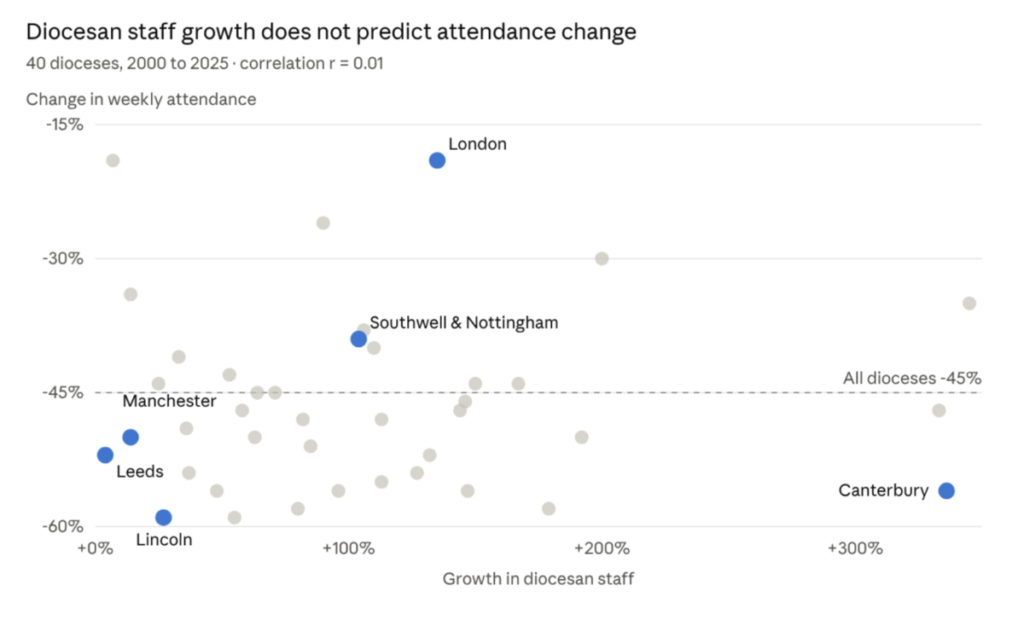
The individual cases highlighted make the point vividly.
- Leeds grew its staff by only 4%, which the report itself notes with approval. Its attendance still fell by 52%.
- Manchester grew its staff by 14% and fell by 50%; Lincoln grew by 27% and fell by 59%.
- London grew its staff by 135%—and had the smallest fall in the country, 19%, with parish share actually rising by 10% in real terms.
- Southwell and Nottingham, where I minister, roughly doubled its central staff (up 104%), yet its weekly attendance fell by 39%, noticeably better than the national figure of 45%. More than that, in the last year our adult weekly attendance grew by 8% and our child attendance grew by 11% in just one year.
It is worth pausing on that. The authors have given us the data to test their thesis, and the data does not support it. Whatever is driving growth and decline in the Church of England, it is not the size of the diocesan office.
It matters what central posts are for
The reason the report’s thesis fails is that it counts heads without asking what those heads are doing. Every diocesan post is treated as overhead, whether it is a compliance officer or a youth evangelist.
Take Southwell and Nottingham again. When the 2024 attendance figures came out, I noted that the number of children attending in this diocese had returned to their 2019, pre-Covid, levels, and grew 11% last year. In Canterbury, the figure was half what it had been. Canterbury happens to show the largest growth in central staff in the whole table (up 336%). So it is not the number of people employed centrally that makes the difference. It is what the diocese is trying to do, and whether its central posts serve that aim.
Work with children and young people, support for church planting and grafting, curacy training, vocations work—all of this shows up in Gill and Craven’s figures as diocesan bloat. Yet it is exactly where much of the growth we have seen has come from.
That does not mean every central post is justified, and here I find myself in agreement with much of what the report says. I have noted before that between 1959 and 2020 the number of parochial clergy fell by around 45%, while the number of archdeacons and bishops actually rose from 219 to 235. I have recounted the conversation with a friend whose bishop turned the diocese round ‘by not cutting clergy posts, and not appointing an archdeacon’. I have questioned the appointment of racial justice officers in dioceses where there was no evidence of a problem. And I agree entirely that the £100m set aside for Project Spire is money that cannot be spent on parishes, whatever has been claimed to the contrary.
So the dividing line is not between ‘central’ and ‘local’. It is between posts that equip parishes for mission and those that serve institutional agendas. The report has no means of distinguishing the two, and so its diagnosis misses the point.
And the recruitment process for such diocesan posts raises the question rather starkly. As Adrian Hilton notes, a recent advert from Oxford highlighted that half the diocesan staff were not even practising Christians—apparently in the name of ‘inclusion’!
The questions the report doesn’t ask
At root, Gill and Craven treat decline as a problem of allocation. Move the money from the diocese to the parish, and things will improve. But they never ask the more uncomfortable question of why the money isn’t there in the first place.
Giving. The Church of England set a target in 1978 of members giving 5% of their income to and through the church. Nearly fifty years on, we have never come close; when I last looked at the national figures in detail, average giving stood at just 3.3% of income. The Church’s own national giving survey found that a third of regular Anglicans give nothing to their church at all. The report simply takes this as a given and asks how to divide a shrinking cake. Yet notice that, in real terms, parish share has fallen by 20% while attendance has fallen by 45%. Those who remain have, on average, been giving more. Our financial problem is not mainly that dioceses spend too much; it is that we have lost givers. And that is a discipleship problem, not a structural one.
Faith. The report quotes David Voas and Laura Watt’s finding that decline is driven by the failure to pass on faith from one generation to the next. But having quoted it, the authors do nothing with it. Their chapter on mission draws instead on Hartmut Rosa’s sociology of ‘resonance’, in which religion is one possible sphere of meaning alongside music, art and the natural world. There is nothing here about the gospel, about conversion, about evangelism, or about making disciples.
This matters, because we actually know quite a lot about what makes churches grow. The Church’s own research has shown that the single biggest factor is having stipendiary ministers who are competent and intentional about growth. And the churches that are growing now—in what some have called the ‘quiet revival‘—are those which offer a real sense of encounter with God, and what David Goodhew calls ‘full fat faith’, which is distinctive and counter-cultural rather than an echo of political positions people can find elsewhere.
The report is right to call for more parish clergy. But it treats this as a matter of pay, security and freedom from micro-management. It never asks what those clergy are for, or why so many in our churches show so little interest in sharing their faith.
Deaneries are not the answer
The central proposal of the report is that deaneries should become the principal budget-holders. They would receive historic funds weighted by deprivation, deploy as many clergy as they can afford, own and maintain the parsonages, manage lay staff, and pay into an insurance scheme to cover clergy redundancy. This is where the report is weakest.
It contradicts its own principle. The complaint throughout is that functions are needlessly duplicated forty times across the dioceses. The remedy is to hand budgets, deployment, housing and HR to around 600 deaneries. Each would need a treasurer, an administrator, someone to manage property, and a mechanism for paying insurance premiums. The duplication would be multiplied fifteen-fold. The report even concedes that deaneries would probably want to collaborate in engaging agents to manage their housing—which is, in effect, to reinvent the diocese.
Deaneries have no capacity. Area deans are unpaid (for this role), and usually already run a full benefice. Deanery synods are widely regarded as the least effective layer in the Church’s whole structure (if you are not convinced of this, I suggest you visit one). The report does not say who would actually do all this work.
We have seen this before. When I wrote about Leicester’s move to ‘minster communities’, Tiffer Robinson recalled that Sheffield diocese had paid for administrators at deanery level to free clergy up for mission and ministry. The result was that the clergy were all much happier—but did not do much more mission and ministry. Leicester’s scheme is itself a version of the deanery idea, and it has hardly been greeted as a liberation of the parish.
It would freeze mission across boundaries. Church planting, resource churches and grafting all depend on moving people and money across local lines. A deanery funding only those clergy its own parishes will pay for has every incentive to protect existing congregations against a new plant next door. That would entrench decline in places with no vision for growth, rather than reversing it. More fundamentally, the whole question of vocation, training, and deployment needs to be national, not local. There has always been a serious imbalance between dioceses that generate vocations and are ‘net exporters’ and those which import. Demarcating by deanery will just make this worse.
It is not even new. In Southwell and Nottingham, the diocesan synod already sets the common fund ‘to be raised from the deaneries’, and many other dioceses work in a similar way. The report presents as radical something that much of the Church already does—albeit in a limited way.
Some further problems
There are several other weaknesses worth noting briefly.
- There is no theology of oversight. Bishops appear only as a cost to be cut, never as guardians of doctrine or leaders in mission. That is odd, since the issues the report itself highlights, such as LLF and Project Spire, are failures of episcopal leadership, not consequences of the size of diocesan offices. As I have said before, I think we have too many bishops—but I also think we are asking them to do the wrongs things in a way which is simply unachievable.
- The localism is selective. The authors want safeguarding, payroll and clergy training run nationally, but deployment run locally. That may be a sensible judgement about scale, but it shows that ‘localism’ is not really a principle for them.
- Investment in mission is waved away. The Strategic Mission and Ministry funding certainly needs proper, independent evaluation. But the report never acknowledges that much of the growth we have seen has come from just these kinds of initiatives.
- The authors admit the limits of their own plan. They concede that their reforms are unlikely to reverse two centuries of decline. Read alongside their own data, the honest conclusion is that structures are not the main lever at all.
A better way forward
Gill and Craven are right that something has gone badly wrong, and right that parishes and parish clergy are bearing the cost. But the remedy is not to rearrange the structures yet again. If we want to see the Church of England renewed, I think we need to do five things.
- Protect and increase parish clergy who are intentional about growth. The evidence is clear that this is the single biggest factor in whether churches grow. To plan for fewer stipendiary leaders is to plan for decline.
- Test every central post by whether it equips parishes for mission. Some diocesan roles do exactly that, and the dioceses that are doing better show it. Others serve institutional agendas, and those should go.
- Teach generous giving as part of discipleship, not as a levy. Paul’s approach to the Corinthians (2 Cor 8–9) is not to demand a quota but to point to the grace of Jesus, who ‘though he was rich, yet for your sake became poor’ (2 Cor 8.9). Giving flows from that, or not at all.
- Stop spending money and attention on divisive agendas. The headlines generated by LLF, Project Spire, and ‘racial justice’, even ‘net zero,’ put people off, and the money they consume is money not spent on mission.
- Make the passing on of faith the measure of success. Jesus’ commission was to ‘go and make disciples’ (Matt 28.19). Whether we are doing that, in families, in churches and in our communities, is what actually determines the future.
God is at work in our country; people, and especially young people, are asking questions about faith in a way we have not seen for a generation. The question is whether the Church of England will be ready to meet them.
That will not depend on whether budgets sit with dioceses or deaneries. It will depend on whether we have leaders and congregations who believe the gospel, live it, and are eager to share it.



If we want to see the Church of England renewed, I think we need to do five things.
I’d be happy with two: To introduce mutual episcopal accountability and to sack every liberal bishop.
Not happening given half of Synod are liberal Catholics and the Archbishop of Canterbury leans that way
It is the nominative fallacy to think that by giving a classification name to something you somehow justify that thing.
As a research student I was tempted to think that photocopying something was equivalent to reading it.
Seriously? Money mismanagement is why Christianity is declining?
I do believe that the mismanagement and misdirection of money, energy, time and people in the C of E is contributing to our distraction and discontent, and thus hobbling the church’s mission.
But it is one factor among several. In my opinion significant but not prime.
I think attention to Ian’s 5-fold agenda at every level of the C of E would help re-focus in a better direction.
It is all about leadership. It is leadership that controls the money, of course.
I am not sure the claim is that ‘Christianity’ is in decline—because it isn’t!
In raw numbers it is declining in Europe, the Middle East and Americas and Oceania. Though Christianity is growing still in Africa and the Far East and South Asia. Pentecostalism is the only denomination clearly growing in every continent
It’s not a denomination. It’s a tendency.
It doesn’t matter, for growth purposes, how many groups are growing. Even if only one group is growing there could still be growth overall. Wanting lots of groups to be growing presupposes wanting lots of groups to exist, which we don’t necessarily.
Great article, as ever.
We know how to achieve numerical growth; the problem is that much of the leadership finds the theology of most of those growing to be challenging.
‘Then he told this parable: “A man had a fig tree growing in his vineyard, and he went to look for fruit on it but did not find any. So he said to the man who took care of the vineyard, ‘For three years now I’ve been coming to look for fruit on this fig tree and haven’t found any. Cut it down! Why should it use up the soil?’
“‘Sir,’ the man replied, ‘leave it alone for one more year, and I’ll dig around it and fertilize it. If it bears fruit next year, fine! If not, then cut it down.’”
Luke 13
Not upsetting people seems to be a major aim of the CofE, with the result that parishes persist until it’s too late. Sadly the report doesn’t give us the number of church building in use; I suspect many in urban and suburban areas need to be released to other purposes, such as hosting non-CofE churches.
As I’ve said before, parish quotas should be expressed as a request from the parish for a subsidy if they don’t pay the FULL cost of their incumbent. The PCC should be required to vote on the statement: ‘We believe that other parishes should subsidise us by n thousand pounds, and we will, with God’s help, seek to pay the difference’; the n thousand figure being the difference between the cost of their incumbent – at least £60k a year and probably more – and what the quota is set at for the parish. Perhaps it will make some realise that it’s time to close.
Or better the church commissioners realise they need to direct more funds to poorer and lower income Parishes
‘they need to direct more funds to poorer and lower income Parishes’
they already do. It is called Lower Income Community Funding.
And should be increased
Not without a serious discussion about why the money that’s been given to these poorer areas has achieved little or nothing except burnout and depressed clergy.
I remember one such church on a sump estate doing a review of where their members lived. It showed that NONE of them lived on the estate. NONE.
We need to ask those hard questions, rather than carrying on pumping in money.
“4. Stop spending money and attention on divisive agendas. The headlines generated by LLF, Project Spire, and ‘racial justice’, even ‘net zero,’ put people off, and the money they consume is money not spent on mission.”
The Gospel is divisive. Mission is, sometimes, scandalous.
I know exactly what you mean, I’m just being a pedant. I just want to make the point that there is often a real value in making the right people uncomfortable, and ‘rightly dividing’ (2 Timothy 2:15) is part of our Christian duty.
Excellent analysis.
Mat
Hi Ian – thanks for that analysis. As a centrally-funded post holder 🙂 I agree wholeheartedly that the focus on my/our work should be supporting and enabling parishes. I am pleased to report that the colleagues around me in our diocese are 100% focused on just that. It’s a daily discussion in our teams and we pray regularly that any support we might offer will strengthen parish leaders and facilitate the mission of reaching more people in more places than before. Blessings.
Thanks David—and nice to meet you at the diocesan conference! Hope you noted the mention of our diocese…
With respect to decline: Don Carson has made the point that when he came to a congn he changed the emphasis from reaching children to mission to men in particular. Within two years there were more men and the families followed. Fits in with your recent, admirable blog on manning up.
Indeed… in the 1970s it was suggested that reaching out, primarily or solely , to children had been a strategic failure…. evidenced by numbers. (I’m not sure it was thought out strategy. ) “Reaching the Families” by Michael Botting?
The evidence was that reaching the man was more likely to reach the woman and the children. … who stayed in greater numbers.
I remember many children’s mission events which packed church halls but left almost nothing behind. Congregations loved them but that wasn’t a guide to “success” historically.
I come at this issue as a (retired) accountant, a Lay Reader and a church treasurer.
A characteristic of every civilisation is that the top people have the wherewithal to leave a permanent memorial to themselves. Building a new forum in a Roman city gave far more kudos than spending the same amount of money on food for the poor. During my civil engineering years, I noticed — especially in the public sector, where tenure of high office is usually far shorter than in the private sector — a great desire by top people to erect new buildings, even if it meant skimping on the maintenance of existing ones. Thus, a new school would be built, but the window frames would never get painted or the grass kept away from the damp course, and before too long an expensive, and well-publicised, refurbishment would take place.
Project Spire and parochial clergy numbers need to be understood in this cultural context. Project Spire (if it somehow survives the legal challenges) will put the current Archbishop of Canterbury in the ecclesiastical history books; spending that £100m on the fabric of a thousand church buildings won’t.
Similarly bureaucratic spending. Safeguarding disasters and not being seen by the right people to be doing enough to counter racism or promote net zero means the church’s top people feel impelled to commit scarce resources to dealing with these issues (or at least being seen to be trying, which seems to count just as much with our national elite and media).
Christianity supplanted Judaism because God’s people became obsessed with religion and got out of touch with their faith, to the extent that most of them were blind to the Messiah when he arrived. If the Church of England persists with cultural religion and elitist projects at the expense of promoting faith, it too will be supplanted.
I minister in a team of four churches, where our congregations are ageing and shrinking. On my way to one of them, I pass the Baptist Church, where the car park has a large number of teens and twenties milling around. Praise God that young people have a spiritual home in our town but it hurts that it is not in the CofE, where our clergy seem to use all their energy visiting the housebound elderly, battling on-message archdeacons and endlessly working with people like me to keep buildings fit for purpose.
My diocese (Liverpool) is on financial life support from the national church and yet the diocesan bulletins seem to have the same three headline messages every month: “Bishop urges everyone to be nice to each other”; “Churches making great strides to achieve net zero by 2030”; “Series of lectures on black oppression in the cathedral”. There may be gospel stuff in the small print, but I never read that far.
I see the future clearly, and it isn’t CofE shaped.
I am not sure how long Liverpool Diocese actually has…
What would bishop Ryle say?
‘where our clergy seem to use all their energy visiting the housebound elderly.. and endlessly working with people like me to keep buildings fit for purpose.’ All important work. The C of E also is the only denomination with a presence in most hamlets and villages and towns and cities in England, so remains the main vehicle for national Christianity.
You make some good points about public sector leaders needing to be focused on mission more than just memorials to themselves. Though the average FTSE 100 CEO is in post 6 years so also doesn’t have that long to make their mark, so in the private and public sectors leaders need to look long term
‘The C of E also is the only denomination with a presence in most hamlets and villages’
Only if by ‘presence’ you mean a building—which is not presence at all!
Of course it is, it is where not only services but villagers weddings, baptisms and funerals and concerts and carol services and flower shows and church fetes are held
‘Not presence at all.’ Mm, I wonder if that’s the case. Buildings can and do speak of God’s presence (even Philip Larkin recognised that) and church building needn’t have a regular worshipping congregation to do that. God’s presence is not only revealed through other people but also through the physical stuff of creation including e.g. books,pictures, landscapes and buildings. The visitor books of many rural church building I have known bear testimony to that. We don’t always need words spoken by people to do that.
I don’t deny that some buildings can communicate. But Scripture is very sceptical about that; it consistently tells us that it is in the people of God that God is present; and the buildings themselves were *all* first built to house the people of God, not point to God as empty buildings.
Exactly so. Part of the role of the Church of England is to preserve grade listed cathedrals and churches. Many of which draw in visitors to a Christian place of worship due to their heritage, stained glass and paintings etc who would not otherwise go
Thanks, Ian. I agree that God’s presence is primarily communicated through people in a community, but that doesn’t exclude other ways in his presence is made real to us including through buildings. As long as we keep the priorities right. The replacement of the Temple by Christ is the key but I don’t think that he’s only truly encountered through other people.
“A characteristic of every civilisation is that the top people have the wherewithal to leave a permanent memorial to themselves… I noticed — especially in the public sector, where tenure of high office is usually far shorter than in the private sector — a great desire by top people to erect new buildings”
Your observations call to mind the dizzyingly profound vignette about the ‘Pillar of Absalom’ (2 Samuel 18:18).
“Now Absalom in his lifetime had taken and reared up for himself a pillar, which is in the king’s dale: for he said, I have no son to keep my name in remembrance: and he called the pillar after his own name: and it is called unto this day, Absalom’s place.”
Robin Gill’s schtick for year was: ‘We’re not really declining; the Victorians built too many churches, and now we’re stuck with closing them in the cities which the churchgoers have left for the suburbs.’ Now he is agreeing that the Church of England has declined – seriously – while non-parochial posts have burgeoned. He doesn’t seem to have any ideas on how you win a non-believing nation to Christ. Perhaps he’s a universalist, I don’t know.
The Report does have a point about political programmes coming to dominate the time and sap the energy of the national church, and a bigger point (I don’t think it’s addressed above) about the unstoppable growth of the Safeguarding Empire. About 220 such posts now exist nationally.
I have never really known why the Church of England has so many suffragan bishops, unless these are essentially placemen and -women to provide the likely next cohort of diocesan bishops; in which case this is trying to game the system. I guess they also become acting bishops in an interregnum, or in the increasing cases where bishops are suspended. Since confirmation has largely died off in the C of E, there isn’t much liturgical need for them, or for most archdeacons either. Why aren’t these posts combined with an incumbency, as they were in the past?
I agree with Ian that the Report’s suggestion of making deaneries the holders of the purse strings is a non-starter.
Liverpool (a very poor diocese) had two archdeacons under David Sheppard, both serving in parishes. A recent (not much-missed) bishop ignored the finances and increased it to four non-parochial archdeacons. The result was not growth but parish clergy irate at having to deal with people trying to justify their position.
Re deanery purse strings: we are a modest team of churches recently shoved into the wealthiest deanery in the diocese. The deanery allocates its (massive) Parish Share on clergy headcount, not on ability to pay. Our forty pensioners are invoiced over £70,000 a year but anything over £30,000 will bankrupt us (having paid Parish Share out of reserves for decades), so that’s all they get. Please don’t give them absolute power over finance!
Crazy!
On the first point, here is the supreme irony: the growth of population overall and urban populations mean that the Victorians didn’t build enough for our cities!
To take one example, my former parish in Poole. When St Mary’s Longfleet was first built, it seated 650, and only 500 lived in the parish. It is now part of a town of 120,000.
The place where there are too many buildings is the countryside, a legacy of a more evenly distributed population.
The Victorian Church was a madhouse. My home town saw some hefty church building in the 19th century, but didn’t alter the parish – so you had a Rector who had 4/5 churches under his watch, and recruited a team 7+ curates. To this day the old medieval church in the town is referred to as the parish church.
Good point
Not really, large towns and cities have churches of every denomination to choose from and there are several large towns now which have several C of E churches now too because of the ones the Victorians added to those built in medieval times. In rural areas though most villages and hamlets still have only 1 church, still the medieval C of E one
Don’t worry – the Labour Government is trying to fix that by disproportionately dumping new housing estates on rural areas.
That only changes things if those new rural housing estates come with new churches. Even then, while obviously offering more choice in rural areas they still wouldn’t be grade listed buildings in need of preservation like the ancient C of E rural churches
Suffragen bishop numbers could be halved as could archdeacons. We still have confirmations though Suffragen bishops perform, you can’t have communion without confirmation
The C of E has actually agreed that baptism is full sacramental initiation.
In practice though baptised 5 year olds do not have communion, in most cases it still comes after confirmation
May I respectfully ask how this was done, as it appears to constitute a material departure from the doctrine of the Church of England as contained and expressed in the Book of Common Prayer?
Was it done properly and if so, how?
Yes, the details are set out here: https://www.churchofengland.org/prayer-and-worship/worship-texts-and-resources/common-worship/christian-initiation/commentary
The key landmarks in the discussion were:
– 1971 – Ely Commission report. Christian Initiation: Birth and Growth in the Christian Society argued that baptism itself constitutes complete sacramental initiation and that baptised people should be admitted to Holy Communion on that basis.
– 1976 – General Synod. Synod decided not to proceed with a change to the rules on admitting children to Communion before confirmation. The theological argument had therefore not immediately changed the Church’s discipline.
– 1983–85 – Further consideration. A subsequent report again recommended admitting baptised people to Communion before confirmation, but Synod did not endorse the recommendation in 1983.
– 1996–97 – A practical change. General Synod approved guidelines allowing dioceses and parishes, with the necessary episcopal agreement, to admit baptised children to Communion before confirmation.
– 1995 onwards – Integrated initiation theology. The Church’s liturgical work increasingly emphasised baptism as a sacrament of initiation in its own right, while retaining confirmation as an episcopal rite with a continuing role.
This has been quite a big thing in liturgical discussion over that time.
There is a good exposition of it by Colin Buchanan (who was involved in all these discussions) here: https://grovebooks.co.uk/product/w-219-baptism-as-complete-sacramental-initiation-2014/
Safeguarding has indeed become something of an “empire” and often a reason why retired clergy are not taking up PTO and why in esp rural areas it is difficult to get Churchwardens. But given the past and present anxieties it difficult to see any likely pruning, more likely given the way of things it will grow.
All this makes for tragic reading, the quoted stats exceedingly stark.
Coupled with the local news yesterday that our Nottingham
Cathedral, – Southwell Minster, may have to close next year
“due to the desperately urgent need of twenty million pounds for structural repairs on uninhabitable areas of the Minster and surrounding houses and buildings”. This from the Dean.
Along with the economic strictures of Nation, business, and households, there is no spare money to be had.
No doubt there will be many who will have opinions on
how best to re-arrange the furniture with new business models.
What stands out for me is that there seems so very little love for our National Church; so little of the Christ spirit which
Loved the Church [Ecclesia] and [sacrificially] gave Himself up
for it, offering up strong crying [s] for it”
Psalm 107 came to mind to direct and lift my spirit,
Desperate minds – Mighty God, it seems a superb Business
Model to adopt, though it might seem a bit too fanciful for many.
In answer to the set question ““Is wasted money the problem with the Church of England?” I would think not.
Shalom.
Just a fifth of Project Spire funds would provide the £20 million Southwell Minster needs
That is a great calculation!
Indeed and I hope you raise it at the next Synod
The C of E is one of the biggest landlords in England, has millions in dividend income and should spend it on Parishes. The issue is less whether dioceses or deaneries are the budget holders but ensuring that church commissioners direct their hundreds of millions in annual income to ensure that dioceses or deaneries direct funds to each C of E Parish in England ensuring that each Parish, whether in a city, town or village has at least one paid stipendiary priest. Schemes like Project Spire and net zero should be less of a priority for central funds.
Increasing congregation size and getting those new Church attendees would also help. However we must remember the C of E is not a purely evangelical church which can only survive with the donations of its congregation. It is the established church which over centuries has built up £11 billion of assets, it could keep most of its churches going from rental and dividend income alone if it manages those funds wisely and should direct them to its parishes. Having visible priests will then also help congregations grow
So souls are a secondary concern.
Souls for the C of E are the parishioners of every Parish in England
Every person is a soul, but why do you think that it is only the closed world of the C of E that thinks that?
Secondly, it is no good souls existing if they are not saved. So my reference was obviously not just to ‘souls’ but to ‘the salvation of souls’.
Ian, in your article why did you feel the need to put racial justice in quotation marks? That bothers me and may bother others. I’m sure you are not a racist and that youbelieve in racial justice as part of the gospel message. So, some clarification would be helpful.
Hi James. I have posted a lot on the blog about this issue in the C of E.
No, I don’t believe that ‘racial justice is part of the gospel message’. The gospel is that, though created by God, we have turned from him, and he gracious invites us to repent, believe, and enter the kingdom by being born again of water and the Spirit.
If we have harboured discriminatory thoughts against anyone, then we turn from those as part of our repentance.
I believe strongly that the C of E ‘racial justice’ programme is based on racist ‘anti-racism’ and identity politics. It refuses to define the problem, and throws useless money at projects that have been shown to be ineffective—incidentally in breach of charity law.
Does that explain my inverted commas?
The fact that you put ‘being racist’ as the counterpoint to ‘believing racial justice is part of the gospel’ I think illustrates the problem rather nicely!
Thank you for he reply. I am new to your blog and part of another Province, so I have not always followed C of E debates closely hitherto. A further response to your answer. I understand now your use of inverted commas. But surely sin is structural as well as individual? People trying to do the right thing can still “miss the mark” when caught up in sinful structures (like a Church in the past that accepted slavery or the Blood Libel), or in today’s society by not being able to negotiate their way through fake news. We can repent sincerely as individuals but not always be able to spot the wrongness of something we are told is right but then see subsequently as wrong.
On a personal level, my own, minor involvement some years ago in Church-based racial justice work gave me a huge appreciation of the spirituality and witness of Black Majority churches in the UK. And the story behind why that term came into being at all speaks of a need to overcome sin by transforming distorted structures as well as calling individuals to repentance.
Brother, you obviously mean very well but you dangerously overburden yourself.
The Bible teaches us that we cannot, do not, and are not expected to ‘do the right thing’ in the way you conceive of it.
Our sins are personal and individual. And are enough and more than enough in and of themselves for a lifetime.
That voice – whether it be external or ‘internal – which tells you that you are to vicariously atone for the ‘sins of the whole world’ in that way is ‘a liar and a murderer’. It is the old ‘Accuser’ himself.
But through Grace and Faith we are reconciled to a loving Father
“For it is by grace you have been saved, through faith—and this is not from yourselves, it is the gift of God…”
God bless you friend, you will be in my prayers.
Thanks James. I don’t want to be as negative as William. Just to say:
1. Yes, I think it is possible to think of sin as structural as well as personal. But this is complex and needs to be handled with care. Walter Wink wrote about this in I think the 1980s—but then his theology went off beam.
In particular, the Marxist reading of this in Black Theology has gone seriously wrong. Do you know my article about this? https://www.psephizo.com/life-ministry/was-jesus-black/
2. You don’t need to swallow racist anti-racism in order to appreciate the Black-led churches. Just read Rev 7.9! The church where I am associate minister is a multi-ethnic, multi-cultural, multi-lingual church.
3. We got into trouble on all this when Justin Welby decided unilaterally to describe the C of E as institutionally racist. It was on the basis of no evidence, and has caused great harm and division.
Welby? Listen to this interview with Nissar Hussain, convert in Bradford from Islam to Christ, who very nearly paid with his life. He was an inconvenience to Welby’s program of interfaith dialogue and got treated with open contempt by him:
https://www.youtube.com/watch?v=v4HYQzYkovY
One of the two men is a traitor to Christ.
A student friend, (early ’70’s) who with three others of us shared a house, was a former choir boy at Southwell Minister. We were all atheist, although I’m unsure of his beliefs as he never expressed them.
What part did he and others of that choir cohort play in the present situation at the Minster, which was highlighted by the present Dean (a fundraiser appointment it seems) on a programme, today, on Premier Radio.
Perhaps the post of ‘fundraiser’ spells out the present spiritual and cultural temperature of the place and it’s environs..
A good report might well expose important concerns and even offer some reasonable recommendations. But the CofE is not wired up to react to, much less implement, report style pronouncements and strategy. For every reasoned statement that might apply to a diocese, deanery, benefice or parish there are a many more situations where that statement cannot or does not apply. Solutions offered at a national, regional or even diocesan level usually fail to capture the nuanced reality at parish level. If a bishop/archdeacon/advisor is not willing to come to every PCC meeting in person to explain the implications of a new diocesan strategy they are not sufficiently invested in the project nor sufficiently interested in its outworking.
I’ve only skimmed the report. I’ll try and read it more properly over the weekend. But the impression I got was that the push for organising around the deanery is the logical answer if you want to decentralise away from the diocese, but recognise you can’t throw everything onto the parish (some will cope, and plenty won’t). The long history of deaneries as part of the institutional architecture makes it feel safe.
Like you Ian I’m not sure. As I’ve laid out several times, I think there’s a strong case to consolidate and rationalise the dioceses. Gill and Craven suggest we aim for about 30. I suggest we go explicitly for 26 (or more accurately 23 dioceses as we’d recognise them and 3 archbishops to preside and run the national elements) which matches up with the 26 seats in the House of Lords whilst we retain them, and allows you to have sensible looking dioceses of roughly similar sizes and doesn’t create any giants bigger than the likes of Chelmsford and London today.
I think you make a really important point that the size of diocese admin is less of an issue that what you’re getting them to do. Mission and witness lives and dies on the ground in the parish. Is part of our problem that we are loading onto parish clergy, PCCs and congregations, more and more work and burdens that overwhelm them and eat up their time and resources. Could the dioceses do more to assist with the practicalities of accounts, building maintenance, safeguarding etc.? Would that mean that those things could be done better and the parishes freed to get on with worship, witness and mission (with support from the diocesan clergy)? Or am I being a naive fantasist?
PS: The diocesan structure I’d have:
3 Archbishops with miniature, nominal dioceses, whose primary purpose is to run the national institutions of the Church, be the national leaders etc. – Canterbury, York, and a new one at Winchester.
Dioceses remaining as they are: London, Chelmsford, Liverpool, St Albans, Southwark, Oxford, Leeds, Lichfield, Chester
Dioceses merging: Exeter (with Truro), Bristol (with Bath & Wells), Salisbury (with Portsmouth and Winchester), Chichester (with Guildford), Rochester (with Canterbury), Norwich (with Ipswich & St Edmundsbury), Ely (with Peterborough), Lincoln (with Southwell & Nottingham), Durham (with Newcastle and Carlisle), Manchester (with Blackburn), Sheffield (with York), Derby (with Leicester), Coventry (with Birmingham), and finally Hereford (with Worcester and Gloucester).
Some interesting thoughts, though why Liverpool doesn’t join Manchester and Blackburn to be the diocese of Lancashire isn’t obvious.
Three archbishops probably doesn’t make sense. Make Canterbury head of the Anglican communion – and have them appointed by a representative body. Make York the Primate of England in fact, as, of course he is named to be…
That would create a diocese serving 5.2 million people – 1 million more than London, and would make it by far the largest diocese in the country. You could merge Liverpool with Blackburn and leave Manchester alone as an alternative.
Good answer; thank you
“Could the dioceses do more to assist with the practicalities of accounts, building maintenance, safeguarding etc.? ”
This is where the Deanery comes in, in my opinion, holding an adminstrive role where churches are failing to fill roles. Area Dean’s could also be recently retired clerics with PTO on a fixed term of say 3-5 years, releasing stipendard clergy from having to be the Doocesan Postie.
I think I would disagree with every one of the five points you make at the end because the ecclesiology is just wrong. Once again, Rowan Williams offers an important corrective.
“it is about getting away from a view of the Church that is very seductive and very damaging – and very popular. This is the view that the Church is essentially a lot of people who have something in common called Christian faith and get together to share it with each other and communicate it to other people “outside”. It looks a harmless enough view at first, but it is a good way from what the New Testament encourages us to think about the Church – which is that the Church is first of all a kind of space cleared by God through Jesus in which people may become what God made them to be (God’s sons and daughters), and that what we have to do about the Church is not first to organise it as a society but to inhabit it as a climate or a landscape. It is a place where we can see properly – God, God’s creation, ourselves. It is a place or dimension in the universe that is in some way growing towards being the universe itself in restored relation to God. It is a place we are invited to enter, the place occupied by Christ, who is himself the climate and atmosphere of a renewed universe.”
The reason the CofE is getting emptier and emptier is because it is obsessed with a weird view of ‘mission’ and has lost any interest in public theology and the importance of place. It has become a club and ignored what Rowan points to in his piece here.
I think the current C of E is closer to that quotation than to my five points.
And guess what is happening? Is it growing or declining…?
The more I read that quotation, the more incoherent it becomes.
‘a place we are invited to enter’ but apparently we are not to ‘communicate with those “outside”.’
So how will they ever know they are invited…??
This seems a very strange ecclesiology, a word I have chosen deliberately. Jesus is building his ekklēsia, a word which connects to the gathered people of God in the OT – the assembly. Jesus said that his brothers and sisters are those who do the will of his Father – a family. We are linked together in his body. It is about people, relationship and gathering together, and given the task of making disciples, going to all nations. Since (as we must quote Revelation) it comprises those drawn from every nation and people and language and tribe.
I fear Ian that you are doing two things. One is missing the point of what Rowan says, and therefore being seduced by a notion of the Church which is obsessed by growth in numbers in the CofE as the primary goal – which is exactly what he warns about. If the Church is the place where people can come in to the right relationship with God and with each other, then it will grow. The CofE institutionally seems to be so obsessed with its own survival above all else that it misses its prime purpose. Ever since it set out on the Decade of Evangelism it has started to shrink and become small minded. It has got mission and evangelism totally wrong.
The second thing that you – and not just you but many in the church are doing – is trying to Make the CofE Great Again. We can see exactly how that kind of agenda goes by looking across the pond. We end up with division, rule by social media, lack of any depth whatsoever, populist but flawed leadership, weakest go to the wall policies, exclusion of those who are different, ‘othering’, and sound bite culture, amongst many other things.
Andrew, thanks for the really daft projection!
What is the prime purpose of the Church of England? Here’s three proposals:
Which of these do you disagree with?
I don’t disagree with any of them but none of them has anything *primarily* to do with an emphasis on money or numbers, or Making the CofE Great Again.
Get the emphasis correct and numbers and money will follow. The emphasis at present is entirely on a very narrow and exclusive idea of mission and evangelism that has been a recipe for decline over the last 40 years.
Can I answer? They’re correct as far as they go, but they all miss the point, which is a call to repentance (this important word is missing and its absence sticks out like a sore thumb). For the first statement, the call to repentance is the call ‘from darkness into marvellous light’. Those who have not repented and do not have the penitential heart and mind are not in the light. For the second – well, if ‘gospel’ were described as ‘gospel of repentance unto remission of sins’ it might be OK, but you know as well as I do that there is an appealing fake gospel around, whereby ‘proclaim the gospel in word and deed’ doesn’t mean a call to repentance. For the third, the word ‘repentance’ is absent – and so is any mention of Calvary – so the question is: what are they praising God for? (Clue: our praise and thanksgiving is precisely because our sins (each individually) was nailed to the Cross and we bear them no more – and this is why our souls praise the Lord).
Andrew, my five points relate precisely to these things, and the Williams quote seems to speak against them.
You appear to be tackling a straw man of your own creation.
Let’s make the CoE holy again.
‘Ever since it set out on the Decade of Evangelism it has started to shrink….’
Growth in the 1920s saw a 1930s peak followed by somewhat of a decline. There was another growth period in the 1950s.
Around 1960s a very sharp decline both in attendance and vocations first set in, encouraged by the double Ratner of Lady Chatterley trial and Honest to God. The church voices seemed to be on the side of secularisation and the sexual revolution – even actively producing them – not against them. (That is why the cast of Hair were invited to perform at St Paul’s and at St Thomas New York while simultaneously no official support beyond a prayer was given to the Festival of Light. In other words, there was an explicit siding with the powers of darkness against those of light. And of course, everywhere in nature darkness kills while light brings life. It follows as night follows day.)
Interesting history, thank you.
You keep using an email address with the word ‘spam’ in it, so it always needs to be approved manually.
The historian and journalist George Owers recently made an interesting remark to this effect which I thought was very incisive. It applies equally to ‘Jock’s’ important point about an emphasis on repentance-
“It seems to me that every great movement of spiritual revival in the Church of England – the Caroline Divines, Methodism, the Evangelical movement, the Tractarians – has had a major emphasis on the consciousness of individual sin & the urgency of personal repentance & holiness. They often had other emphases too, & how they conceived repentance & the growth of personal holiness varied. But that urgency was present with all & I think it’s key to any Christian revival. If we cannot, by God’s grace, reform ourselves, how can we reform anything bigger?”
https://x.com/CapelLofft/status/2115373164741931296
It was St John the Divine Cathedral New York, not St Thomas. 1971. They sang musical excerpts from the Hair musical interspersed with the choir singing Mass excerpts. Bernstein’s ‘mass’ (interesting wording) was another production of the time.
Somewhat of a dedication ceremony for the denomination.
If Lady Chatterley can destroy the CoE, it really doesn’t deserve to continue!
It isn’t even a good novel.
I read it at sixteen in the library of my convent school. So far as I know, the Catholic church has survived.
Your standard and predictable stock response shows you do not understand the specific issues.
JAT Robinson in the Chatterley trial said that the *adultery* portrayed in the novel was ‘in a real sense [oh, in a real sense, eh?] an act of holy communion’.
The absurd phrase ‘in a real sense’, which in the Bishop of Durham era was so beloved of satirists as a quintessential example of the bankruptcy and dishonesty of C of E ‘thought’. received its popularisation here.
The phrase ‘holy communion’ was, of all the choices that could have been made for a phrase, the most provocative, perhaps compulsively provocative. Not by coincidence. But this was in a context of what sometimes seemed compulsive provocativeness on topics like adultery, age of consent, homosexual practice, other religions from this generation of Cambridge clerics, e.g. HA Williams (Objections to Christian Belief; Soundings).
So if you ask the public which witness and which ‘argument’ they remember from the trial, they will of course remember the headline-catching one and forget all others.
Ever keen to highlight clever-clever minor dimensions and ignore the big picture, the same tone deafness was evident in the runaway bestseller of two and a half years later. The (highly dishonest yet apparently inevitable) way the public thinks is ‘X bishop is such and such; therefore they’re all the same as each other.’. Just as Cathy Newman saw the whole episcopal bench as an undifferentiated amorphous mass – and target.
Lady Chatterley (only one of several interrelated elements) can scarcely harm the C of E given that it has no connection with the C of E, now can it?
But that was your misunderstanding.
It was not the novel but the cleric’s public assessment of its message that was harmful to ill-informed public perception of Christian leadership and therefore of the robustness of Christian belief.
Thank you Christopher. I didn’t know that Robinson had made such a silly statement. I suppose contemporary observers we’re keen to oppose censorship. (A little like The Well of Loneliness; Virginia Woolf thought it an execrable novel, but on court supported its publication.) Anyway Robinson and Williams were both wise, so can be forgiven the odd solecism. I’m always rather suspicious of the disturbing the innocent faith of the flock trope. If people’s faith can be shattered by a bishop commending Lady C, their faith isn’t really very robust in the first place is it? Certainly my reading of the novel at 16 didn’t persuade me that adultery was a Good Thing. If anything, the sex on the book is somewhat risible (if I remember correctly; I haven’t re read it since my twenties).
Disturbing the innocent faith of the flock? That is the stereotype, but that was not what this was about. This was about a skewed overall picture being given by an immature determination to shock. Not wise at all. But rather, as you say, the ‘silly’ ass tendency. Adrian Hastings’s history notes this latter trope. My mother in C of E admin said she saw it everywhere among the clergy.
Yes David you are right. Andrew’s quotation from Rowan is very strange indeed—neither Biblical nor Anglican.
How did that go?
The culture of fundraising?
The causation of absorption of culture and place of unbelief; of pluralism; of syncretism; of universalism; of incipid declension?
Maybe DDO’s carry some responsibility for the present decline.
Can’t see that the Elizabeth Pathway will bring about a reversal.
I hadn’t heard of the Elizabeth Pathway. Having looked it up, I can’t see how it is any different from the various OLM schemes that were briefly fashionable 20 years ago.
I am not sure it is! Does it specify ‘ordained to one diocese only’? that was the marker of OLM.
I see nothing here about the gospel of repentance unto remission of sins. The aim of a church service is that the gospel of repentance unto remission of sins should be proclaimed – and in every aspect of the church service; hymns, spiritual songs, prayer, bible reading sermon. The aim is that through God’s word, those who are not ‘in Him’ are convicted of their sins and brought to the stage where they ask, seek, knock. Exactly the same message should give comfort to a person who is already repentant and has come to Him, that his sin, not in part, but the whole, was nailed to the Cross.
I note with very great interest that Rowan Williams did not mention repentance at all, even though repentance and believing in Him is an if-and-only-if condition, exactly what is needed so that people become what God intended them to be.
But I don’t see that Ian Paul’s article addresses the problem in a better way. The root problem is that the message of repentance to remission of sins is not being proclaimed and I simply don’t see how the five point plan for a way forward addresses this.
Growth isn’t the main objective here. In fact, Jesus refused the rich young man of Mark 10:17-22. There will be periods when people respond to the call to repentance; there will be periods then people mock the call to repentance, so church growth isn’t a good measure of success.
Ah ha – my daily bible reading (from James Philip) just came in. Today it’s on Luke 14:34-35 about salt of the earth and has something very relevant for the discussion about the role of the church.
The world through sin has ‘gone bad’, and there is, therefore, no depth morally or spiritually, to which it might not sink. To prevent this, to stay this process, Christ has left His Church in the world, to act as a moral disinfectant. This both defines and indicates the limitations of the Church’s work in the world. For salt will not indefinitely prevent decay, and not even the presence of the Church in society will ultimately prevent the final moral disintegration of the world. This should give the lie very decisively to the idea that the Church’s task is to win the world for Christ, to Christianise society. This world is death-doomed; it refuses to bow the knee to Christ. The presence of the Church is meant to be a stay against the over-quick corruption of the world, so that Christ, through His Church, might call out a people for His Name. This ‘negative’ influence is therefore seen to be a very important and integral part of Christian testimony. And where the distinctive qualities of discipleship are lacking, that testimony is not borne.
Well said sir.
For the faithful and the hopeful there is unspeakable consolation in what you describe.
I met a wonderful Christian recently, a father of one of young my sons friends. We talked about the church, his and ours, and he gave me to understand that for him and his congregation The Great Commission was if not the entirety then the ultimate vocation of the Gospel.
Evangelism and bringing people to Christ he called the ‘everything’.
He was a good and a decent man but what he said has given me much pause for thought since then because his vision of the Church and of Christian life appeared to leave little room for what I have always felt Walking with the Lord to mean.
I don’t know if you feel that Evangelism can, eventually, be given disproportionate prominence in life of a Christian and in the church?
I still have James Philip’s paperback commentary on Romans. I paid 60p for it! And it’s still worth its weight in gold.
Andrew Godsall nails it.
Self absorbed: Make the Church of England Great again: get the emphasis right and the rest will follow. Andrew Godsall nails it.
But he completely offers nothing to reverse the decline as former DDO (I think) of the Liberal Wing, a wing that recruits people in its image, who know little or nothing of the evangel and have nothing, no Jesus to offer.
It can hardly be said that evangelism has failed, when it has been philosophically, theologically and spiritually expunged.
‘The church exists for the benefit of its none members’.
This is something which seems to be far from reality as it is built in its own liberal self preserving image, left to itself to manage, (yet at the same time reproduce and accelerate) decline.
Whose church is it? Called by whom for and to what and how?
Geoff: your personal comments from someone who can’t even have the honesty to use their full name are intensely hypocritical and unpleasant. Nothing short of trolling.
You have broken your vow not to respond to me.
It is not trolling to expand. answer, counter your points to which you do not respond.
Neither is it hypoctrical nor dishonest to use part of my name. Ian Paul has my full name. I have not held an office in the church
Mere assertion does not make it so.
It is not the discovery of a better Business Model but
a re-discovery of the fact that the Church is the trustee
of the glorious Gospel of God
1 TIM.1:11 According to the glorious gospel of the blessed God, which was committed to my trust. 1 TIM.1:11
The Gospel is the power of God Romans 1:16
It is not just pie in the sky etc. it is a daily lived reality of
“ Power that works in us mightily”.
I am convinced that this is a time for weeping [and sackcloth if you will] for deliverance from all that plagues us.
Both Corporately –
. In 2 Chronicles 20:9 , King Jehoshaphat, facing a formidable enemy, declared, “If disaster comes upon us—whether sword or judgment, plague or famine—we will stand before this temple and before You (for Your name is in this temple). We will cry out to You in our distress, and You will hear us and deliver us.”
This demonstrates the communal aspect of crying out, where leaders guide their people in seeking divine intervention.
Or individually –
Psalm 18:6 states, “In my distress I called upon the LORD; I cried to my God for help. From His temple He heard my voice, and my cry for His help reached His ears.”
Or if only she priests-
Jeremiah’s form of prayer was no different. A man who was mocked , abused and laughed at by the people he loved and served couldn’t help but pray with a deep heartfelt passion for his nation. “Oh, that my head were a spring of water and my eyes a fountain of tears!” he said. “I would weep day and night for the slain of my people,” (Jeremiah 9:1).
As best as I can understand it, tears are a sign that God is touching our centre.
If we believe that we are the Israel of God where is the spirit that obtained that New Name that is written on the overcomers the
Prevailers with God who do not have a spirit of fear or slavery
But rejoice in “crying Abba Father”Do consider Googling the Motif of weeping in the scriptures
As best as I can understand it, tears are a sign that God is touching our centre.
Joel says that before God’s sons and daughters prophesy in the streets, God’s ministers are to weep between porch and altar. Joel. 2 v 17.
17 Between the vestibule and the altar
let the priests, the ministers of the Lord, weep
and say, “Spare your people, O Lord,
and make not your heritage a reproach,
a byword among the nations.[a]
Why should they say among the peoples,
‘Where is their God?’ see more at
https://biblehub.com/q/Priests_weeping_in_Joel_2_17_today.htm
Shalom.
Rather than theorising, Is this a time for Blowing the Trumpet?
JOEL CH.2
2:15 Blow the trumpet in Zion, sanctify a fast, call a solemn assembly:
2:16 Gather the people, sanctify the congregation, assemble the elders, gather the children, and those that suck the breasts: let the bridegroom go forth of his chamber, and the bride out of her closet.
2:17 Let the priests, the ministers of the LORD, weep between the porch and the altar, and let them say, Spare thy people, O LORD, and give not thine heritage to reproach, that the heathen should rule over them: wherefore should they say among the people, Where is their God?
2:18 Then will the LORD be jealous for his land, and pity his people.
2:19 Yea, the LORD will answer and say unto his people, Behold, I will send you corn, and wine, and oil, and ye shall be satisfied therewith: and I will no more make you a reproach among the heathen:
Shalom.
What is blowing a trumpet? How do you blow your own trumpet?
Hello Steve,
Have you ever heard the shofar blown? It is stunning, affecting, spine tingling. Not that I’ve heard it in the CoE.
No Geoff, only on Ben Hur!
Your memory is far better than mine. Steve.
Well, er, actually, probably.
Today Anglican Future published
. “What is likely to be the first real test of the General Synod when it meets in a few weeks, in November?”
That was the just one of the direct questions from Revd Dominic Steele, the host of the podcast, put to two of the Directors of the orthodox grouping, The Alliance, when they appeared on an Australian podcast, ‘The Pastor’s Heart’, earlier this week.
The title of the podcast was – “Will God save the Church of England?”
In conclusion the article states
“ So, in answer to Dominic Steele’s question: the first real test, and probably most important test, for the orthodox members of General Synod will take] place [ at the Eucharist] in Westminster Abbey at approximately 11.30am on the 17th November 2026.
Set an alarm now to pray for them then.
Set an alarm on the 17th! No, sound the trumpet now. Wake up the sleepers.
Two politicians talking up their faction and salivating at the prospect of a schism they spent the last Synod denying they wanted.
But if someone is not prepared to share the Eucharist I am compelled to ask what they’re doing standing for Synod in the first place…
Is it that you think there are no limits? If you think that there are limits, then what are they?
The limits in the case that Adam refers to are absolutely clear. If you are not prepared to be in communion with the leadership of the church you belong to – in this case the Church of England – then you should withdraw until you are able to be in communion. That is so straightforward and ought not to be in contention.
So as between Jesus Christ and an Archbishop-
which is the leader?
which is the more important leader?
I don’t think Jesus Christ ‘leads’ the CofE in the sense we are referring to here Christopher.
And I do think that if people wish to have communion with Jesus then the actual minister is irrelevant.
But we are called into communion with Jesus AND the Archbishops/bishops/other members of Synod. If people do not want that, then, as I say, they should not be members of the CofE until they are ready for that kind of communion.
No, the Archbishops should resign.
So, the Archbishops are the real thing, and Jesus is an optional extra. Very Yes, Minister.
If He doesn’t lead the church in that way, in what way *does* He lead the church?
Christopher if you think Jesus ‘leads’ the CofE in the same way an Archbishop or bishop does then you really aren’t following the argument.
I refer you to my previous answer which you haven’t addressed.
You think I am treating the two leaderships as equivalent?
Another misunderstanding. When do we see anything else?
Jesus’s leadership is insignificant enough not to be worth comment. As in Yes, Minister.
You are not addressing the point I made. No matter. I didn’t think you were able to.
I was, either way, drawing attention to the way I could believe you would write on the topic of the Archbishops’ leadership, whereas I could not believe you would mention Jesus’s leadership – i.e. cart before horse.
Christopher this is really easy. Jesus Christ is THE head of the Church. No one else. If people don’t the think the CofE is part of the Church then they should have absolutely nothing to do with it. Let alone take communion with others in it.
If they DO think Jesus is Head of the CofE, then the limits are exactly as I lay out above. There aren’t half measures.
If you are not prepared to be in communion with the leadership of the church you belong to – in this case the Church of England – then you should withdraw until you are able to be in communion.
Isn’t this basically making out that the Archbishop of Canterbury is an Anglican Pope: what he or she thinks defines the doctrine, and if you disagree with the leadership you must leave the Church?
I get that that is how the Roman denomination works: what the Pope says is doctrine, is doctrine, and if you disagree, you leave.
I thought the Church of England was different, in that it admitted the possibility that if a member disagrees with the leadership, then it might be the leadership who is wrong, not the member. And why should a member leave if they are in the right?
Is this not the case? Is the Archbishop the Anglican Pope after all?
Dear Andrew,
I am currently in a Church of England congregation on the basis that (somewhat to my surprise) it is the best congregation reasonably near me, but I consider my diocesan bishop to be a heretic. Nobody has required me to pledge allegiance to him, just as you seem to consider that allegiance to the 39 Articles is optional.
Goodness people have weird ideas about the way the Church works.
I wouldn’t suggest you ‘pledge allegiance’ to any bishop or church leader. That’s an entirely different matter. Being in communion has nothing to do with pledging allegiance or agreeing with. The head of the Church, as I say above, is Jesus Christ. Holy Communion is sharing in the body and blood of Jesus Christ. If you, or anyone, believes that they know better than any other person about that holiest of mysteries that means you can’t accept that holy gift from the hands of a fellow sinner then, as I say, it crosses a line and it’s time to move on. People who won’t share communion should have the courage of their convictions rather than playing offensive games.
I’m not playing games. The bishop is playing games with God. If he were taking a Communion service then I’d not go forward. Quite probably my vicar wouldn’t either. Why should I take your admonitions seriously given your attitude to the XXXIX Articles is equally loose?
My approach to the 39 Articles is exactly in line with the teaching of the CofE for decades. Read To Proclaim Afresh from the Faith and Order Commission. It’s been discussed here many times before.
And you don’t seem to be abiding by Article 26 if you refuse the sacrament in the way you suggest you would do.
Ian and others have thrown your first paragraph into serious doubt on this very thread.
Are you saying I am not free to decide privately when I may and may not take Communion?
Unfortunately for Ian and others the text and history of the last few decades are on my side in the matter of the 39 articles. It’s quite clear.
You can decide whatever you want. Christopher asked what the lines were. I replied that if you want to take part in the governance of the CofE by being on General Synod then taking communion with others on that body, even if you disagree with them, is a line. And I have explained clearly why that is.
Whever mentioned that I wanted to be on General Synod? You ducked my question, and in any case I am not interested in your admonitions given your own errant opinions made clear here.
I can’t see any questions I haven’t answered. Feel free to repeat in case I missed one.
You have serious disagreements with others on here, not least the host, about the ordination of women. So I am well aware that you are likely to disagree with the vast majority of people in the CofE.
Changing the subject again?
Am I or am I not free to decide whether to take Communion if offered it in the CoE, without giving any explanation? That is a matter of private conscience for a wide variety of reasons, and the person presiding does not presume to have a ‘window on men’s souls’.
Also, I seem to recall you quit the CoE, perhas because it stuck (just) to the biblical line over what sexual relations are acceptable. How quick you are to offer what you phrase as binding advice to those who remain in it!
I replied very directly to your question. It’s right there …
“You can decide whatever you want.”
I also made the point that, given the reasons you have indicated for not sharing communion with your bishop, you are goo going directly against Article 26. And you seemed very keen on following the Articles.
Yes, so many things are a matter of private conscience and should remain that way.
I am not going against Article 26 at all, because I am not denying the validity of Communion as administered by a heretical bishop. I simply do not wish to take part.
Well if you think they are an heretical bishop and you don’t want to take part, then why go along in the first place? Just stay away….
This sequence of comments was about the introductory service for GS at Westminster Abbey. If you are not involved in that then why comment. I was elected to GS for two terms, and that’s why I had an interest.
I don’t need your permission to widen the subject to Communion in the CoE generally. And I trust my vicar, just not the bishop above him. Nor does he, in fact.
Well in that case just don’t go to services presided over by that bishop. A far easier solution
Why should I absent myself if the bishop turns up to lead a confirmation in the congregation I am part of? He is the heretic, not me.
Anthony – a very bold move on your part. Aren’t you a bit worried that you might be in the wrong place if a latter day Jehu rolls up to deal with the situation? In fact, I heard that somebody by the name of Fred Jehu, who can trace his ancestry way back to the kings of ancient Israel had moved into a nice semi-detached house in the suburbs of Exeter …..
Makes you weep doesn’t it ?
A further comment on the Rowan Williams quotation above, which seems to have occasioned controversy. As well as being a very able and extraordinarily well read theologian Williams is a also a gifted poet and commentator on art. I think the quotation is more in the nature of a poetic image than a propositional statement of the doctrine of the church. Like a lot of poetry it mustn’t be either read as straightforwardly factual or internally logically consistent. Nor do we always need to use biblical language or the language of Church documents. It can perfectly well sit alongside other more directly propositional statements. I find it helpful pastorally and in terms of working with a congregation but I can see that someone else might not do, (and that’s fine); but that’s no reason for rejecting it and setting up statements of ‘fact’ in opposition to it. Let’s be gracious in our reading of those we may not agree with or even understand rather than quick to tell them they’re wrong.
Tim Evans – as I pointed out earlier, I’d agree with Rowan Williams characterisation of the church as a place ‘…in which people may become what God made them to be’. The trouble is that I don’t see anything at all in what Andrew Godsall quoted to indicate that Rowan Williams understood either why we are not what God wanted us to be in the first place (sin) or how we may become what God intended us to be (through repentance, accepting our need for Calvary and understanding that ‘our sin, not in part but the whole, was nailed to the Cross and I bear it no more).
If you can find another quote by Rowan Williams, poetical or otherwise, that indicates that he understood the problem of why we are separated from God in the first place, what Christ did at Calvary to reconcile us to God, and the role of the church in communicating this, then I would be all ears. Based on the quote from A.G., the ledger is not in his favour.
As I also indicated, I don’t see much about the imperative of proclaiming the gospel of repentance unto remission of sins in the original piece by Ian Paul, so he is no better than Rowan Williams in this regard.
Thanks for your response, Jock. I think my first thought is that it’s a short quote, so I wouldn’t expect him to cover all the areas you mention. It’s not comprehensive but rather just offers a single image, maybe a bit like a psalm that expresses one aspect of ancient Israel’s faith and isn’t comprehensive. And secondly, if it’s not a helpful quote for you that’s fine, we all find different things useful.
Pure relativism, in other words. Everything is potentially as true and as helpful as everything else.
Christopher, if you wish to take others’ comments in a poor spirit and misread what I have written you’re entitled to your opinions, but I suggest that you express them in other places not in a public forum. A degree of courtesy is required of us all.
That’s a tissue of unexamined cliches, surely.
-‘You’re entitled to your opinions’ is something that no-one ever doubted, making it suspicious that you should be saying it at all.
-Secondly, it is not to any one person that we all look to bestow such entitlement to us, because we had it already.
-Third, if all opinions are entitled to be held, then you are incorrect in saying that is not relativism – it is relativism. But in reality, the value of opinions is on a scale depending on how much evidence there is in their favour.
-Fourth, people are not likely to classify things that interfere with their lifestyle as ‘helpful’ – but this ‘unhelpfulness’ does not make them a whit less true (which leads to the question of how much people care, or don’t care, about truth). Not all ‘helpful’ things are evidenced, and vice-versa.
I do that analysis just to show that positions that refuse to debate, or divert from debate, are built on shaky positions, on cliches that do not add up. Debate (or rather debate’s preliminaries) consists in clearing the ground to remove such incoherences.
Tim – you certainly would expect him to show explicitly that he understood the issues; sin, conviction of sin, repentance unto remission of sins, each and every one of us *needs* a redeemer, what Christ did for us on the cross at Calvary.
If he is serious, then he is very clear and very explicit in his statements, because if he is serious then he knows *full well* that there is a synthetic gospel out there, which uses all the magic words which he used, and quite deliberately does not mention what the blood of Christ was actually shed for – and if he is serious, then he is bending over backwards to make sure that he isn’t one of those to invite people to ‘sink in on divine ground’ and feel the Holy Spirit doing something nice within them, in a way that achieves a false communion with God. It is false if it bypasses the need of a redeemer, bypasses the need for repentance – in short, bypasses the role of Christ as Mediator between man and God.
We may all find different things useful in having this message communicated to us and we may find different things useful in communicating this message to others – but if this basic message is missing, then it is not of God (and if it is not of God, then …..)
Jock, you are correct and Tim has seriously missed the point. If repentance from sin isn’t central to the identity of the Church and the mission of Jesus is not seen fundamentally as taking away sin and enabling the new life of the Spirit, then there is no point to the Church.
Unfortunately Rowan Williams made a habit of speaking obscurely and tangentially about the Christian faith, and setting up false oppositions.
Yes Jock, I agree with your analysis of Rowan Williams. Sadly he exemplified the difference between knoweldge and wisdom.
Who else remembers the 2004 on-stage dialogue between Rowan Williams and Philip Pullman in which Pullman blasted Christianity, and Williams, instead of advocating for the faith which paid him and explaining the defects of secularism and New Age beliefs, tried to position himself as honest broker?
Why is it that many pew-sitters could do a better job than Williams of debating Pullman, better than Welby at understanding what is and is not sinful, and better than Mullally in not handing out awards to terrorist sympathisers who espouse a faith that denies Christ’s divinity and atoning death? And, before that, better than Carey in heeding warnings about a sexually abusive bishop, better than Runcie at not appointing apostates like David Jenkins to the episcopacy (whose outspoken views Runcie never criticised)?
Can anybody look at that track record and seriously deny that Satan, rather than Jesus Christ, has taken charge of the most senior appointments in the Church of England?
There is something invisible that brainwashes people to hold back from appointing the clearest and most powerful and most frontline voices and ministries, even often the most educated.
Dear Jock, please look at what I wrote – this was a single brief quotation and so it only makes a singe point, and in a poetic register not a propositional one. So to make such criticisms isn’t appropriate. Just because he doesn’t say all the things you would like him to doesn’t mean he’s not saying anything worth hearing, or at least, that some will find it worth hearing.We don’t all have to find everything helpful and I’m not worried if we don’t. That’s not relativism.
Any change in doctrine in the Church of England has to be approved by Synod. As leader of the established church in England the Archbishop of Canterbury has to be able to work effectively with the government of the day and those of all faiths and none
All faiths and none? You seem to think that people can attain a worldview at the start of their lives! A worldview (as opposed to a psychological attachment) is a big thing. Therefore its attaining is far more suitable to the end of one’s life.
Tim Evans – I did read carefully what you wrote – and I responded to it; I don’t believe that, even in a short quote, there would be such room for ambiguity or misunderstanding. Furthermore, Andrew Godsall provided us with another quote, where Rowan Williams did indicate that something I would consider essential to the Christian faith only seems to be accommodated as a ‘strand’.
I’d almost say that ‘Blessed Assurance’ (what R.W. considers to be characteristic of ‘a strand’ – albeit a ‘strand’ for which he claims to have a lot of sympathy) is the essence of faith (faith is ‘being certain’ – Hebrews 11 – and certain of the important thing – i.e. my salvation – not simply that there is a lovely heavenly kingdom, where Christ is King – that I might not actually get into). At the same time, the ‘Blessed Assurance’ has to have the right basis (i.e. – that it is all of Him; the wages of my own personal sin is death – and that he took the wages due to me personally on the Cross at Calvary).
I’d advise you to wake up and smell the coffee – your own personal salvation is at stake here.
Christians are nothing if they’re not disruptors. Jesus was a disruptor from the age of 12 until that cry at the moment of his death on the cross of shame: “It is finished!” Soon after that fearful day his disciples were filled with the Holy Spirit and took on the disruptor’s mantle for themselves, obeying the great commission and turning the world upside down. How did they start? Peter got up and preached. And what happened? The people were cut to the heart. They asked: “brothers, what shall we do?” And Peter told them…
And that’s it. Preaching! The number one disruptive activity on the planet; the challenger; the eye-opener; the conscience-pricker; the life changer; the joy bringer; the remedy for a broken society and dead communities everywhere. No gimmicks, no apologies, no political statements or ingratiating themselves with the powers that be. Just preaching – and much prayer of course. OK, when Peter stood up lots (years) of preparatory stuff had come before; and plenty of things would need sorting out on a practical and faith basis in the future. But the start and finish of the new church’s enterprise was, is, and always will be preaching.
I wonder how many clergy in today’s Church of England are anointed or even genuinely enthused with the gift of preaching. If it’s not their way-out-in-front greatest priority, they urgently need help to make it so – hopefully from bishops who are themselves fired up to get the message across. And if the bishops themselves don’t get it…? I honestly think nothing else we do in the atrophied Church of England will make a ha’porth of difference unless we face up to and resolve this issue.
Some preachers are like deckchair stewards on the titanic; suggesting we would be more comfortable if we turn our chairs slightly toward the direction of the list. you come along and say the ship has a hole in it.
James, I think that if, for some reason, you want to make unpleasant and frankly patronising comments it’s best if you do so in private not on a public forum. I didn’t seriously misunderstand anything as I wouldn’t expect a single comment in a poetic style to include all the points you or Jock made. As has happened before because of the tone of your comments I now think it’s best to conclude this exchange.
Tim, my sole comment about your comment was ‘Tim has seriously missed the point.’ If you think that is ‘unpleasant and frankly patronising’, you really need to buy a jar of Victorian smelling salts and avoid any challenging site that might trigger you. And since I hadn’t even addressed you, this wasn’t even an “exchange” until you addressed me and announced you would not address me. Farewell, and be careful, it’s slightly robust out there.
Rowan Williams is renowned for making sweeping comments. He once described evangelical and reformed theology as “singing Blessed Assurance and hitting a tanbourine”. He wasn’t being “poetic” here, he was free associating in his accustomed discursive manner. It is perfectly in order to call him up on this.
Perhaps the full quote and context puts your sweeping comment to bed James.
Rowan was being interviewed by an Anglican news service in 2002. One question went like this:
Q: How do you see yourself in relation to the reformed and evangelical side of our tradition?
A: It is something that I think became very important to me at one or two points when I needed it as a kind of corrective to what can be a slightly precious and elitist anglo-catholocism. Sometimes you just need to sing Blessed Assurance and hit a tambourine. You just need to know that there is something profoundly simple about what an evangelical would rightly call a personal relationship with Jesus Christ, and that nothing substitutes for that.
So I have never been inclined to look down on that kind of piety – I think it is an absolutely essential strand, and for those of us who are inclined to be over subtle or over complex about things it is a necessary bit of medicine. It is also a joy and liberation.
Particularly in the last ten years, having more and more contact with charismatic renewal in Wales, I find it’s a liberation. I’ve got some questions of course, some reservations, but again it is a real freeing of the Spirit.
Andrew, that quotation *looks* generous, but I can assure you it is deeply patronising and shows an extraordinary failure to understand either evangelicalism or the Church of England.
Being evangelical isn’t about ‘singing Blessed Assurance and hitting a tambourine.’ It is about the central role Scripture has in God’s revelation of himself in the person of Jesus to his people and the world. It is *the* source of authority for the Church of England, according to its own doctrine.
And the C of E doesn’t have a ‘strand’ of this. As the ABC said to the King at his coronation: the C of E IS a Reformed and Protestant church.
Anyone who doesn’t know that doesn’t know history.
Indeed, evangelicalism is about the supremacy and sufficiency of Scripture in expounding the nature and the shape of the Christian faith, through the five ‘solas’of the Reformation. Evangelicalism isn’t Blessed Assurance on a tambourine, it’s the St Matthew Passion with orchestra and full choir con ripieno.
It absolutely is a strand. Anybody who doesn’t know that doesn’t understand the history of the Church of England and the Anglican Communion of which it is part. The 39 Articles were written for their time of deep political and religious turmoil. To express a fundamentalist approach to them is to forget the way that they were forged and the many shifts in politics and religion of the last 400 years.
Andrew, Canon Law states that the doctrine of the C of E is found in the Formularies, to wit, the Articles and the BCP.
The Anglican Communion does not have a shared doctrine, so that is a distraction.
Andrew,
It isn’t just the 39 Articles – notwithstanding your atempt to nullify them by a fallacious historical argument.The Articles have been part of Anglican worship since 1553. Would you reject the Niceno-Constantinopolitan Creed because it came out of “a time of deep political and religious turmoil”? No, don’t answer that. The service of Holy Communion in the BCP is the clearest liturgical expression there is of Reformed theology. Matins and Evensong are what you get when Sarum meets the Reformation. And so on it goes.
You can’t read Catholicism into the Articles or the Prayer Book. Newman tried this, then realised this was unsustainable.
Evangelicalism is defined by the central role of Scripture? Now that’s patronising, as well as being self-serving, self-righteous claptrap. Evangelicals accept that Luther et al were able to edit the Scriptures to knock out a number of books. And the evangelical doctrine of sola fide is a direct denial of Scripture (James 2). So quite plainly evanglicalism does not have a more central role for Scripture than other wings of the Church.
Whilst being rooted in scripture is absolutely important to evangelicals, it is not straightforward nor unique. What I think does set them apart is attaching a particular emphasis to the importance of the conversion experience, as an emotional and personal encounter with God, and salvation therefore that is expressed in the past tense (“I have been saved”). This contrasts with the historic Protestants who would put more emphasis on adopting a correct theology and prayer, Catholics who place an emphasis on encounter with God in the sacrament, and Orthodox who view salvation as an ongoing and future life with. Hence, within Anglicanism the evangelical tradition is associated with a stripped back approach to worship, less ceremonial, and inward reverence of the spirit rather than outward actions.
Adam, I mostly enjoy your contributions to discussion here, and you are always welcome.
But this: ‘So quite plainly evangelicalism does not have a more central role for Scripture than other wings of the Church’ is something of a parody!
I wonder what world you are living in…?
Evangelicals accept that Luther et al were able to edit the Scriptures to knock out a number of books.
No, you cannot edit scripture. The task is to identify it correctly and then live by it. The Reformers were correct to exclude Sirach (for instance), with its statement about bringing up children, “He who loves his son will whip him often… If you play with your child, he will grieve you; do not laugh with him, or you will have sorrow with him… give him no freedom in his youth… make his yoke heavy” (ch. 30). And “a man’s wickedness is better than a woman’s goodness” (Sirach 42:14). On the other hand Luther’s wish to exclude James and Revelation rightly was not accepted.
James. Almost zero evangelicals use the BCP or have any knowledge of the Articles from one week to the next.
Ian your fundamentalism about the Articles et al is increasingly legalistic. And your denial of the significance of the Anglican Communion is curious given the arguments of the last 40 years about how upset some parts of the Anglican Communion have allegedly become about the CofE.
Andrew ‘Almost zero evangelicals use the BCP or have any knowledge of the Articles from one week to the next.’ I wonder who knows the evangelical constituency better—you or me?
I am not ‘fundamentalist’ about the articles. I am just citing Canon law, by which you are I are bound as part of having a licence or PTO.
I am not ‘denying the significance’ of the Communion. I am pointing out that some provinces have changed their doctrine without consulting others. That is the cause of division.
Adam repeats his regular error of partially quoting and misrepresenting what another has said. I stated evangelicalism was marked by ‘supremacy and sufficiency of Scripture’, noy by its ‘centrality’, although Scripture is certainly also central. That means a prohibition to adding beliefs and practices not sanctioned by Scripture.
His claim that evangelicalism is set apart by the importance of a ‘conversion experience’ is not sustained. I know many evangelicals who have no real personal experience of conversion other than growing up as Christians and deciding at 6 or 7 that they believed it; while I know of numrrous Catholics with strong conversion experiences in their lives. Adam confuses theology with psychology. And his grasp of justification by faith is very shaky.
Looking back over this complex thread, I see Adam may have been responding in the first instance to Ian rather than to me. Nevertheless the point still stands. And I am puzzled by this: if Adam thinks you are justified by your works as well as your faith and what Protestants call the Apocrypha is part of Holy Scripture, why isn’t he a member of the Orthodox or RC Churches?
James, I was responding to Ian. If you read you’ll see he said “Being evangelical… is about the central role Scripture has”. The world doesn’t revolve around you.
Adam, if you read my post which precedes yours, you will see that I recognised that you were responding to Ian. The world doesn’t revolve around me but some of us are further ahead in this revolving world, and can even avoid snark. The validity of my points remain. You reject the Anglican canon of Scripture and the doctrine of justification by faith alone. Why haven’t you joined the Catholic or Orthodox Church?
“I wonder who knows the evangelical constituency better—you or me?”
What are you after, a competition? 🙂
After quite a few years involved in clergy vocations and training I was astonished how little knowledge of the CofE evangelicals had. Some had never heard of the BCP. Most had no knowledge of the liturgical year and seasons. I don’t think any had heard of historic formularies, or Canons. Those who had considered them very unimportant.
I expect their vision was broader – just as there are many parts of Church History, all fascinating, but unable all to be grasped by one individual, and all of the nature of carts rather than horses.
More disturbing than lack of knowledge of one random denomination is lack of knowledge of foundations/roots. Which of course are 1st century and earlier.
Ian, I live in and observe the real world. The unique reverence for Scripture is a story evangelicals like to tell about themselves, but in my experience doesn’t bear much scrutiny.
Adam: Scripture is our only source for the Virgin Birth, Crucifixion and Resurrection of Jesus Christ. If you take it upon yourself to decide which parts of it to believe, you will need to give and justify a criterion. Can you?
Adam,
What you call “unique reverence” is actually the *supremacy and *sufficiency of Scripture. This means that a doctrine that can’t be evidently derived from Scripture cannot be required of a believer. This pits evangelicalism against both Roman Catholicism which affirms tradition and the pronouncements of the Papacy alongside Scripture, and Orthodoxy, which affirms Sacred Tradition. Tradition is the main reason for affirming Marian dogmas, invocation of the saints, purgatory, and icons. The Reformers insisted that the Scripture Principle was the position of the early patristic church, which is why it generally affirms teachers like the Cappadocian Fathers. Do you agree with the Catholic “extras”?
Anthony and James, could you please explain why Arius was wrong?
Christian philosophers used human reason to study how Jesus was both God and man. That is futile, because we need first to know what unfallen man and what God are like, and the clearest view of those things comes from Christ himself. So any attempt to disentangle them within him uses circular logic. Jesus Christ’s followers understood that he and the Creator had identical personalities and power in which their divinity consisted; this is all that is necessary to grasp.
Arius also wrote of the second person of the Trinity that “there was a time when he was not”, presumed to be before the creation of the universe. But time as we understand it is part of the created universe, so Arius is not so much wrong as incoherent.
I sail with Athanasius but I prefer my own arguments, as stated above.
This thread was not discussing Christology; why did you ask, please?
Anthony, didn’t both Athanasius and the followers of Arius both ‘use’ scripture? Maybe the followers of Arius even more so? And so the crucial point for Athanasius concerned the ‘rule of faith’ — *how* to read scripture and not simply quoting texts.
It is true, Bruce, that the meaning of words used in scripture comes from their application outside scripture; and that you have to work out what the scripture authors were intending to convey. Most of the time this is obvious.
Jesus didn’t say “I am God incarnate” because he wanted people to work it out for themselves – all in a monotheistic Jewish context. Would you care to comment on my preceding post before we continue?
Curiouser and curiouser. Are you lads trying to argue that all Anglicans are in fact evangelicals, whether we realise it or not?
Intelligent people do not choose between pre existing options in the first place, since the list of pre existing options could be random, incomplete, or both.
They think about things, and classify themselves accordingly. It is therefore often possible that they will come up with a new or eclectic classification.
As to the Anglican/evangelical overlap, both words (though they both have an irreducible core) have had different connotations at different times. One is a denominational name and the other is an adjective for one aspect of what it is to be a Christian. Self-conscious navel gazing is incurvatus in se. By the time people have decided what tribe they belong to (when the question was always what they would do once they were in the tribe – or, more importantly, in the army) they are half way to their grave.
I am a Churchwarden and Treasurer in Bristol diocese, and found this interesting, given that I have just emailed our PCC some information for setting a budget for 2027.
excellent!
Thanking Andrew Godsall for the further quote from Rowan Williams. I feel somewhat sorry for Rowan Williams, because it appears that he is well aware that something is going on – in some sense he finds it attractive – but he doesn’t know what it is – does he? ‘Blessed Assurance’ is the heart of the gospel message – whether you sing it or not – but when we understand what is behind it (i.e. I am a sinner; Christ had to die on the cross for my sins) – then I’m not sure that we’re so inclined to bang on tambourines about it (certainly not my experience anyway) – although I do like the hymn ‘Blessed assurance, Jesus is mine; Oh what a foretaste of glory divine’ – so we do sing about it. And (of course), as Ian Paul points out, ‘Blessed Assurance’ isn’t simply a strand; it is the very definition of faith (knowing for certain that my sin, not in part but the whole, was nailed to the cross and I bear it no more – assurance that I am destined for heaven when I pass from this life to the next). If he asks, seeks and knocks, then the door will be opened to him. At the time of the quote, though, it looks as if he is quite content to regard ‘blessed assurance’ as one strand (among many). So it’s not clear to me that he ever will figure out what is going on.
Here we are again, it all seems a bit Irish to me –
Looking back, fighting centuries old battles that are never
to be resolved.
We are seeing the celebration of All Saints Day, now known as
as Halloween to the population.
A.N.Wilson gives us an alternative list of stats in a recent article
And quoting “ The New Dark Ages,” the writer James Marriott.
“…..The hashtag WitchesOfInstagram has more than ten million hits. ‘WitchTok’ on TikTok has at least nine million.
On the online marketplace Etsy, there are 36,000 sellers offering the clobber needed for karmic rituals, digital divinations and voodoo dolls.
Gen Z girls buy ‘spells’ for £30 a time or more on the platform, casting ‘hexes’ on their enemies, love-rivals and hated colleagues.
The census in 2011 asked everyone how they identified in the religious sphere – and found that about 70,000 people in Britain then regarded themselves as Wiccan (witches). By the 2021 census this had leapt to 89,000 – almost a 30 per cent increase”. Etc,
https://www.dailymail.com/debate/article-16253727/Antichrist-Witchcraft-occult-fashionable-godless-era-dark-age.html
A YouGov poll conducted this summer found that fully one in five people believe that witches possess magical powers.
Wake up Church, smell the coffee aroma of the present times
Sound the trumpet. Shalom.
Alan, some of us are “more than a bit Irish” . And some of us who have an intimate knowledge of the internal workings on the C of E are somewhat bemused by the banalities of some of those purporting of late on this blogsite to be cognisant of Anglican theology and practice.
By the way, what is the nationality of those you cite in your latest diatribe?
Colin – I’m reminded of the time that Richard Ingrams (Private Eye) described Spike Milligan as a ‘dirty Irish pouve’ – and Spike Milligan sued Private Eye on the grounds that he wasn’t Irish.
Bandying words about pejoratively.
Legalism ; what is it? Ask Andrew.
For the avoidance of doubt.
Legalism and legalistic. Neither of them are complex terms.
Core Meanings & Contexts
• Strict Adherence to Rules: Following rules rigidly or literally, ignoring common sense, context, or flexibility. For example, a legalistic interpretation of a contract or policy enforces every minor clause strictly, even if it creates an unfair or absurd result.
• Over-reliance on Technicalities: Arguing or making decisions based on technical loopholes or fine print rather than the intent of the agreement or law.
• In Theology and Religion: In a religious context (particularly Christianity), legalism refers to the belief that strict obedience to a set of human created or ritual rules—rather than grace or faith—is the path to righteousness, salvation, or moral superiority
It was misapplied to Ian Paul.
Can it be correctly applied to Liberals?
Both antinomianism and nomism/legalism have the same root belief.
For the avoidance of doubt. Integrity: keeping the vows that you made in public and renew every year in public.
All provisional.
And has been made clear many times before, clergy make assent in general terms to the 39 articles as historic formularies. They are, without doubt that. Clergy are not bound by everyone of the articles individually and that has been made clear since the introduction to the declarations, vows, whatever you may wish to call them, was changed back in the 1960s.
Any other approach to the historic formularies, articles, canons, prayers books etc etc is legalistic.
Oaths are public declarations, vows, assents.
Nothing to do with legalism but more akin to perjury if they are deliberate, knowing misreprentations, that render them to be unreliable and to mislead for self serving purposes.
It goes to the integrity of truth telling. And trust, trustworthyness .
So very far from legalism.
I respect and admire your perseverance, patience, assurance and fluency in his debate, – and I am now persuaded you are correct in what you say in procedural terms – but this remark here seems, to this poor sinner at least, to fall far short of the Christian standard in oaths and assents described at Matthew 5:37.
If I could not in conscience subscribe to an article I would not dare in conscience to assent to it.
By no means.
Where are the people with the sensitivities of the heart and soul
of a Jeremiah the “weeping prophet” ? And I might add – to whom
Jesus was compared or imagined to be.The mind and the spirit of Christ.
We might suggest that Jeremiah was the father of the Holy
Remnant, inspiring [Through God] a determined few to rebuild the House that was desolate. Daniel Nehemiah, Ezra , Haggai, Zechariah and Malachi: It only takes a few [as God always operates] Over-comers to bring in the glory of God. A Resurrection People . Shalom.
Q. Colin,”By the way, what is the nationality of those you cite in your latest diatribe?
A. Read Wilson’s article, Shalom.
Which Wilson? Harold?
And what nationality!? Oh I believe they are citizens of Ingellund!
By the way, one of the most fascinating of Irish Bishops in the 19th century ended up as Archbishop of York. His name? William Connor Magee.
He did not have much time for William Ewart Gladstone.
On one occasion, Gladstone asked Willie how he felt that he, as Prime Minister, was dealing with the Irish question. “PM, it’s not your dealing that bothers me; its the way you shulffle the cards!”
Christ is the Resurrection Life, God is a God of Resurrection:-
Ps 44:26 ARISE for our help, and redeem us for thy mercies’ sake.
Ps 68:1 LET GOD ARISE, let his enemies be scattered: let them also that hate him flee before him.
Ps 74:22 ARISE, O GOD, plead thine own cause: remember how the foolish man reproacheth thee daily.
Ps 12:5 For the oppression of the poor, for the sighing of the needy, now will I ARISE, saith the LORD; I will set him in safety from him that puffeth at him.
Psalms 146:7-8
Which executeth judgment for the oppressed: which giveth food to the hungry. The LORD looses the prisoners: The LORD opens the eyes of the blind: THE LORD RAISETH THEM that are bowed down: the LORD loveth the righteous: Shalom
What is the opposite to Blessed Assurance?
Cursed Confusion?
Addled Ambiguation?
Infertile Intellectualism?
Fabulous Fallacies?
Mendacious Materialism?
Mammon Magnified?
Ubiquitious Unbelief?
Postmodern Presumptiveness?
Liberal Licence?
Solidified Syncretism?
Perfumed Pluralism?
Rebellious Rancor?
Revelation Reviled?
Sin’s Sovereignty?
Humanity’s Hubris?
Pride’s Impregnability?
Evil Exploited?
Tiny Trinity?
Come. Let us worship!
SYNOD BEWARE.
The Government’s Draft Conversion Practices Bill puts Synod and its members at severe risk of Criminal Proceedings as it is drafted, (let alone all clergy, teachers, parents and more).
The Committee reviewing the draft Bill has set a deadline of of 5pm on Monday 16 November for public submissions.
‘The law is an ass’ is conditioned on the legislature.
And while I’ve only briefly skimmed the draft Bill’s outline, it is so poorly drafted that it appears to reverse the key principles of criminal law: burden of proof and standard of proof.
And it would be in breach of public policy, to avoid multiplicity of actions/cases.
More broadly, it would bring discussions and contentions into the criminal class of ‘acts against the state. ‘
The Christian Institute has posted,
1. The draft Bill
2. The reviewing Joint Committee’s Call for Evidence
3. CI’ s briefing and general outline of the Bill’s proposals.
Who knew money as a topic could engender such a lively and highly personalized discussion of all manner of things? In the Navy we were advised to avoid discussing politics, sex, and religion in the wardroom. Which were virtually all we talked about of course, but that’s beside my point, which is that maybe money should be added to the no-go list. Not here of course! Just the Navy.
…. but the discussion became ‘lively and interesting’ precisely when it was taken off the subject of money and onto the subject of what the C. of E. should be doing.
One further note on the second quote of Rowan Williams (which Andrew Godsall presented): on reflection, this is the work of a shrewd politician. It is, on the one hand, a total misrepresentation of ‘blessed assurance’, because there isn’t the slightest hint in it of what underpins the ‘blessed assurance’ (namely, a contrite and humble heart, a person that understands his sinnerhood – and, from this basis, has come to believe that Christ took the wages for his sin on the cross at Calvary).
A naive person might think that this is somehow understood and doesn’t have to be said. I have seen with my own eyes (over a 10 week period) a ‘Charismatic Anglican’ church where, over the 10 week period, repentance never got a mention – so that any ‘blessed assurance’ was a false assurance. This is certainly a ‘strand’ within the C. of E. – and it looks to me as if this was the ‘strand’ that Rowan Williams was being nice about.
Jock, here is what Ian said in the prior discussion:
‘James Barr (of The Semantics of Biblical Language fame) offered a specific critique of the ‘word-concept fallacy’ which challenged this. (In Semantics, Barr appeared to be bringing critical thinking to bear against naive, usually evangelical, pious readings of Scripture—but the reality is that all evangelicals, including me, now make use of his approach.)’
I wonder if you are illustrating here that maybe we haven’t learned anything from James Barr about how language works?
Bruce – not at all – it is a moral issue and not a language issue. I think you place far too much emphasis on language. The moral issue is very simply stated – but people reject it – and make fancy and clever use of language to fool themselves into a false sense of security.
And, as a Christian, one learns to understand that *an awful lot* is communicated *by omission*. So that if sin, repentance *doesn’t get a mention*, then you know why.
There are an awful lot of people – and there have been since the beginning of time who would like to ‘feel Holy’, feel the workings of the Spirit – and want to do this *without repentance*. This is what Emil Brunner was getting at in his ‘The Mediator’ written in 1927 when he wrote of mystical approaches, ‘sinking in on divine ground’ as he put it, which achieved communion with God without the need of the Mediator (Jesus Christ). By this he meant bypassing the necessity of the crucifixion and resurrection, in which Christ received the wages for my sin.
In the second quote from Rowan Williams, that Andrew Godsall gave us, I see a clear and clever use of language, accommodating the ‘strand’ which feels the ‘blessed assurance’ without the repentance.
The language issues here really are very simple if one has first grasped the moral issues.
Communion with God without the (divine) mediator Jesus Christ to cover your sins would be terrible, not beautiful.
What, so God’s ancient people the Jews are all terrible?
Andrew,
Do you not believe that the pre-incarnate Christ was the mediator between God’s ancient people and God? What do you think 1 Corinthians 10.4 is indicating?
I would appreciate an answer from Anthony to my very clear question. Shifting the goal posts never helps.
I didn’t shift the goal, I answered your question. You decided to play another game. The pre-incarnate Christ was active in the life of Israel as mediator. This has been the teaching of the Church since the New Testament. If you choose another religion, that’s your choice, Andrew.
You beat me to it in your reply to Andrew, James!
Andrew knows all about shifting the goalposts.
Andrew,
Consider also the Church Fathers, including Justin Martyr and Theodoret, who asserted that at least some of the many OT references to ‘the Angel of the LORD’ were to a pre-incarnate Christophany. 1 Corinthians 10.9 and Jude 5 in some textual traditions (supported e.g. in Fee’s commentary) support a reference to ‘Christ’ or ‘Jesus’ communicating with the Israelites. In support of that reading in 1 Corinthians 10.9 is the clear earlier reference to Christ the Rock in verse 4. We should not be surprised by this, since Paul (and the primitive church whose hymn he quotes in Philippians 2.6-11) clearly believed in the pre-existence of Christ.
You are both shifting goal posts and avoiding answering a direct question. You are using Christian sources. That’s fine – but avoids the question by sidestepping it. Let me put it once again and see if either of you will answer it.
Anthony said:
Communion with God without the (divine) mediator Jesus Christ to cover your sins would be terrible, not beautiful.
So my question is:
What, so God’s ancient people the Jews are all terrible?
Your reasoning is both an ad hominem fallacy and a non sequitur.
He spoke of a terrible state, and you transposed that into the idea of a terrible people.
Christopher, as so often is the case, you seem unable to follow an argument.
Andrew, if you don’t believe that the Israelites in the wilderness were not drinking from the Rock that is Christ, that’s your choice. If you don’t believe that the pre-existent Son appeared as the Angel of the Lord, that’s your choice as well. But this is a discussion about Christian theology, not liberal Judaism (or whatever game you have decided to play).
Again James we see you can’t answer a direct question. No matter.
Anderw, given that you so often misunderstand what I say (more than 50% of the time), how can you possibly tell whether I have understood or misunderstood?
Either way, why did you not respond to my 2 points?
Andrew,
I have already told you several times that at NO time were God’s ancient people without the divine (pre-incarnate) Mediator; but you choose to reject this claim. Were *some of them ‘terrible’? Of course they were – so are *some Christians. So your question was mistaken in the first place. Logic 101. If you think my argument is wrong, it is up to you to show thew error of my ways.
I’m not asking WERE they terrible. Of course some people have been terrible, Christians, Jews, Muslims, Hindus, Buddhists..whatever religion you like to name.
I asked ARE they terrible.
It was Anthony’s statement. If he wants to defend it, then let him do so.
Andrew,
I cannot see anywhere that Anthony has said that ‘all of God’s ancient people the Jews are terrible’. What he wrote was ‘communion with God without a mediator is terrible’, which is something entirely different. If you wish to believe that ‘all the Jews are terrible’, sadly you are at liberty so to do. That has become a very popular viewpoint today, but one I condemn.
I most certainly do not believe that. Which is exactly why I was asking for clarification.
Maybe Anthony will reply without your feeling the need to be his spokesperson
Andrew,
You are the one who asked if Anthony thought all Jews are terrible, when he has never said any such thing to my knowledge. Can you reference Anthony making any such remarks? If not, why would you raise such a question? Antisemitism is creeping back into the Church of England, and Anglican clergy should take a clear stand against it.
Evening All! I’m just back from a day trip and my reply to Andrew would be identical in content to what James has already replied. God is Trinity and the Trinity is God.
And they looked to prophets, priests and kings as communicators of God, of all the gracious covenants, pointing forward to Jesus as forerunners.
Agreed, these offices were all proleptic signs of the Mediator. But liberalism is rather indebted to Deism and unitarianism via Kant and the scepticism of the 18th and 19th centuries which discounted miracles and sought to understand Jesus in naturalistic and moralistic terms. Kant’s ‘Religion Within the Limits of Reason Alone’ is the model of religious liberalism. which is essentially reductionist.
So it rejected the Trinity, the Incarnation, divine messianism, and predictive prophecy in Scripture as either later speculations or false notions about God (Kant denied that God communicated with humans). At the same time, a kind of liberal Reform Judaism developed which effectively shelved messianic expectation and re-visioned Judaism into moralistic law-keeping. I think this was the origin of the ‘Two Covenants’ thinking that prevails in circles like the Council of Christians and Jews: the claim that there is no need for Jews to convert to Christianity because they already have a sufficient covenant with God. Perhaps this is where Andrew is coming from with his questions. Islam now has to added to the mix today (as the theologically illiterate King would happily agree).
JA Robinson has had a formative theological influence on some commentators here.
And along comes NT Wright to ground Robinson’s theology in post enlightenment philosophy and deism.
https://ntwrightpage.com/2016/04/05/doubts-about-doubt-honest-to-god-forty-years-on/
And for one Anglican Old Testament scholar Alec Motyer, the Angel of the LORD is a Christophany, an appearance of Jesus in the Old Testament.