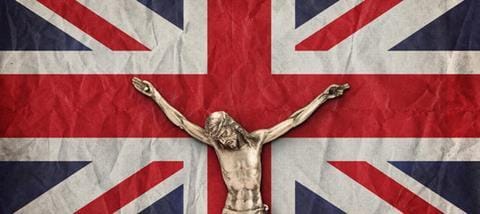
Martyn Whittock writes: Where should we stand on the subject of ‘Christian nationalism’? As a Christian historian (with a very eclectic set of interests, and having written about early-medieval national origins, attempts at theocracy in the 17th century, and modern European dictatorships) I am very conflicted about the combination of faith and nation.
And I urge others to be equally conflicted because history teaches us that simplicity (even certainty) in this area ends in tears. That is why I find descriptions of a country being (or was or should be) a ‘Christian nation’ highly problematic. And I suggest that we all should have concerns about this terminology and political ideology.
No New Testament model for ‘politically dominant Christianity’
As a Christian, I would like everyone in the country to willingly choose to be so too and that culture and nation are in line with Christian faith. But whatever would that look like?! There is absolutely no warrant or blueprint in the New Testament for doing it. The whole New Testament model is geared to being a powerless minority, in a multi-cultural society with a very ‘mixed economy’ when it comes to faith.
The New Testament model also assumes a transnational and transethnic identity to the Christian faith-community (the ecclesia of Christ). Common faith in Christ is the sole defining feature (not gender, citizenship, tribe, class, social status):
There is no longer Greek and Jew, circumcised and uncircumcised, barbarian, Scythian, slave and free; but Christ is all and in all! (Colossians 3:11, NRSVA)
There is no longer Jew or Greek, there is no longer slave or free, there is no longer male and female; for all of you are one in Christ Jesus. (Galatians 3:28)
Given the profound contemporary (1st-century) differences between imperial citizens and ‘barbarians,’ between free and slaves, and between male and female, these statements are revolutionary. The New Testament asserts that the Christian’s fundamental identity is defined by membership of the community (ecclesia) of Christ. Now, that did not negate the experience of being within an ethnic group, or of recognising virtues of that group, but it made it clear that something greater and more fundamental existed and was the defining characteristic for a Christian, that replaced ethnicity, gender or social status as a signifier.
Augustine of Hippo, in the early 5th century, wrestled with the same conundrum that the Christian’s city (Latin civitas/Greek polis) is the ‘City of God’ (the heavenly Jerusalem, that is foreshadowed by the international community of Christians on Earth), not the imperial city (Rome) or the ‘City of the World.’ This supercharged an existing political definition which assumed that a city is properly understood as a body of citizens with defining civil character, responsibilities, and duties. While the Latin word civitas (city) is formed from the word for citizen, in Greek the connection is reversed with polites (citizen) being formed from the Greek word polis (city). Either way, what constitutes and defines a political/civic body of people is their relationship to each other within a uniting principle of confederation. For Christians the relationship is sharing common belief, the uniting principle is faith in Christ. No other – earthly – characteristic legitimately defines, or acts as a boundary of, this community. That is radical and counter-cultural in any period of history.
Consequently, while Christians should be engaged in working for the good of their earthly communities, and celebrating what is best about them, their identity and allegiance is not rooted there. This is derived from Jesus’ own verdict on earthly authority:
Jesus answered, ‘My kingdom is not from this world. If my kingdom were from this world, my followers would be fighting to keep me from being handed over to the Jews. But as it is, my kingdom is not from here.’ (John 18:36)
This is often misquoted as “my kingdom is not OF this world,” which gives it an otherworldly and disinterested character. However, the actual wording assumes that Christ’s kingdom has engagement with the issues of this age but: (a) does not derive its authority from worldly structures and ideologies, (b) does not exhibit the characteristics of worldly structures, ideologies and strategies.
This is not surprising, given the nature of the early Jesus-movement, which had no political power, and had no agenda to impose itself through political power and coercion.
The evidence from the letters underscores the desire to live under stable government and to pray for its proper functioning:
Let every person be subject to the governing authorities; for there is no authority except from God, and those authorities that exist have been instituted by God. Therefore whoever resists authority resists what God has appointed, and those who resist will incur judgement. For rulers are not a terror to good conduct, but to bad…Pay to all what is due to them—taxes to whom taxes are due, revenue to whom revenue is due, respect to whom respect is due, honour to whom honour is due. (Romans 13:1–3 & 7)
For the Lord’s sake accept the authority of every human institution, whether of the emperor as supreme, or of governors, as sent by him to punish those who do wrong and to praise those who do right. (1 Peter 2:13–14)
First of all, then, I urge that supplications, prayers, intercessions, and thanksgivings should be made for everyone, for kings and all who are in high positions, so that we may lead a quiet and peaceable life in all godliness and dignity. (1 Timothy 2:1–2)
However, there is not the slightest hint of having the ability to impose Christian faith and practice through such institutions. Clearly, that would have been unthinkable to a small 1st-century group within the massive Roman Empire, but the complete absence of any blueprint for power should cause those today, who claim to base everything on scripture, while also confidently asserting their God-given authority to impose on society, a reason to hesitate!
In time, all too many rulers would show that one could demonstrate “good conduct”, “do right” and live a “peaceable life in all godliness and dignity” – yet still incur the wrath of rulers. At that point a debate might begin over what circumstances justified action against rulers. But that is another matter entirely. When it comes to imposing Christian political muscle, the New Testament is silent. Revelation counsels standing firm and looking to God to ultimately overcome the world order. But there is no manifesto there (or anywhere in the New Testament) for theocracy in this age.
The Christian community was (and is) a serving and witnessing community, not a politically imposing or coercing community. The challenge came when Christians found themselves in power. What to do then? There was no blueprint for establishing a ‘Christian state,’ or a ‘Christian government.’
The problem posed by the exercise of Christian political power
Every Christian state, since the 4th century conversion of the Roman Empire, that sought to define itself officially as such, soon hit the dilemma over coercion rather than persuasion when it comes to implementing holiness as a society. The same occurred within the successor states in the West (which arose out of the wreckage of the Western Empire) when they converted to Christianity.
As a result, there is frequently more of an Old Testament model of theocracy being imposed in such cases (again and again), rather than a New Testament model of witness and service within a wider community where people could choose their own religious path. The latter option, regarding plurality of faith within a society, would have been unthinkable in these ‘Christian states.’ It would have been in line with New Testament principles and experience but unthinkable nevertheless!
This had immense consequences. The institutional Church often assumed the mantle of power as imperial governmental power collapsed (in Gaul/Francia, Spain and Italy); became closely allied with secular power in the Christianised successor states in emerging England and in the British kingdoms (and elsewhere); fused with imperial power, to create a sacred emperor in the Eastern (Byzantine) Roman Empire until 1453. The early emergence of the latter became a model for later sacred kingship (and then a reinvented imperial concept under Charlemagne, from 800) in the West.
With this came landed wealth designed to underpin Church power. This embedded institutional Christianity within institutional secular power systems of law codes and economic relationships. As a result, Church estates were some of the last across Western Europe to emancipate slaves, from the 11th century, and then to abandon serfdom (villeinage), from the 14th century, as these constraining social arrangements were useful supports of Church economic power. This is why rebels (who were semi-free Christian villeins) targeted Church estates and records in the 1381 Peasants’ Revolt in England, why lower-class Anabaptists targeted Church power structures in the 16th-century German Peasants’ War and other uprisings, and why anticlericalism was so prominent in the French Revolution after 1789. The Church was a grasping landlord that was in bed with secular power. But this went far beyond economic power. Ideological conformity was also imposed. And this had started in the 4th century, as imperial authorities became increasingly involved in Church doctrinal matters and creedal formulations – and their enforcement.
Soon those who didn’t conform become ‘othered’ as heretics, or the wrong sort of Christian, or aliens. And this was imposed using state power. Such societies expelled Jews and Muslims (eg Spain after 1492); imposed conversion by force (many examples of this but Germanic military action in late-medieval Prussia and the eastern Baltic stands out); persecuted ‘heretics’ (however defined) in the post-Reformation Wars of Religion of the 16th and 17th centuries; drove forward the Great Witch Hunt 1450-1750; and (vividly revealed in the North American Bible Commonwealths of the 17th century) in America defined themselves as conquerors of ‘An American Canaan,’ classed indigenous people as ‘Canaanites’ and, consequently, were happier ‘smiting Amalekites’ than implementing the principles of the Sermon on the Mount.
Just look at how Puritan militia commanders justified the mass killings of women and children during the Pequot War (1636–37) and King Philip’s War (1675–78) in New England. Relating the destruction of a Pequot settlement on the Mystic River, in 1637, Captain John Underhill wrote, in 1638, in Newes From America:
Many were burnt in the Fort, both men, women, and children, others forced out, and came in troopes to the Indians, twentie, and thirtie at a time, which our souldiers received and entertained with the point of the sword; downe fell men, women, and children, those that scaped us, fell into the hands of the Indians, that were in the reere of us; it is reported by themselves, that there were about foure hundred soules in this Fort, and not above five of them escaped out of our hands.
Underhill, added:
Sometimes the Scripture declareth women and children must perish with their parents… We had sufficient light from the word of God for our proceedings.
One assumes that he was not thinking of anything to be found in the Sermon on the Mount, or anywhere else in the New Testament for that matter. Estimates of the dead at the Mystic River atrocity range between 400 and 700 men, women and children. It set the pattern for other ethnic cleansings (often in the name of Christian civilisation) that defined European relationships with Native Americans.
One could also quote ‘godly’ atrocities against Catholic Irish civilians, in the 1650s. All these Puritan semi-theocrats, in these circumstances, acted a form of Christianity as if the New Testament had never been written! All their justifications were from the Old Testament conquest of Canaan. And they used the instruments of secular power to impose their (sectarian) ideological conformity on others.
Secular society (associated with the 18th-century Enlightenment) often has a bad name among some modern Christians, but it arose out of a reaction against the atrocities perpetrated by the proponents of imposing faith and ‘godliness’ through secular power.
Nationalism and Christian politics:there’s a reason why critics keep referring to the 1930s and 1940s
This brings us to the role of nationalism within this Christian political mix. Nationalism assumes an ethnic identifier as a distinctive feature (often connected to language) and became increasingly prevalent during the 19th century, as European ‘national’ groups sought to break free from multi-national empires (most notably those of Austria-Hungary and Russia); or assert a distinctive political ‘national’ identity in the cases of Prussian-led Germany by 1871, and Italy during its ‘Risorgimento,’ headed by the Piedmontese monarchy, 1859–70. These identities often included a religious character as part of the ‘nation-building glue’ and often also included the identification of ‘alien others’ who were not part of the new ‘national community.’ The Italian model was rather more complex, as it involved a massive falling out with the papacy which lasted until the 1920s. In Prussia, though, a loyal Lutheran church underpinned imperial power.
The 19th century was complex, as many of the early European movements (such as those involved in the 1848 revolutions across the continent) were ‘liberal nationalists,’ wanting constitutional rights and safeguards for their nation. However, they soon became embroiled in fights with other national groups and, by the end of the 19th century, it was conservative nationalism that was in the ascendance. Different forms of the European nationalist model influenced some expressions of anti-colonial identities in European empires. In South America nationalist resistance to colonial power had roots that stretched into the early 19th century.
In Europe, antisemitism was often a common feature of ‘othering’ (as it had been from the 12th century onwards across Europe); or identifying the ‘wrong kind of Christian’ (especially if they could be accused of extra-national loyalties as in Bismark’s ‘Kulturkampf’ against Catholicism). In both these examples, accusations of transnationalism were used to differentiate the ‘other’ from the emerging national community.
It should be noted that English nationalism is more complex still, as England has been identifiable as a distinct nation since the 950s and the roots of English national identity are much older than the emergence of 19th-century nationalism. But it also involved ‘othering’ and domination of neighbours, alongside the (positive) celebration of a distinctive national language, culture, and literature.
As European empires collapsed after 1918, the formation of new national ethnic identities accelerated and was frequently accompanied by a defining religious character. The assertion of resistance to atheistic Bolshevism (communism) boosted the allegedly Christian character of these inter-war nationalist movements and was usually accompanied by antisemitism. Nazi Germany was not alone in this, as the same characteristics could be identified in many far-right parties, in the 1930s, from Poland to France.
Japanese imperial nationalism—though not exhibiting the Christian motifs—shared many characteristics with the European authoritarians in terms of territorial expansion, ethnic chauvinism, contempt for human rights, and extreme expressions of national identity.
During WWII, the activities of nationalists massively accelerated in Europe, after early German victories. Murderous pogroms (presented as Christian religious expressions, as well as ethnic actions) characterised events in the Baltic States, Croatia and Ukraine from 1941, and had earlier characterised collaborationist regimes in Western Europe from 1940. In Poland – itself subject to murderous German ethnic chauvinism against Poles from 1939 – Polish Jews found they could suffer ad hoc slaughter at the hands of nationalist Catholic Poles fighting the Germans, as well as industrial-scale slaughter under German occupation.
Every European persecuting nationalist regime and ideology of the 1930s and 1940s (west of the USSR) clothed itself in Christian terms and images. In Germany, Spain, Poland, Hungary, Romania, Italy, and elsewhere, authoritarian regimes stressed national (ethnic, linguistic, cultural) identify; religious character (ambiguously in Germany which appealed to a pagan-Christian cocktail); frequently the ‘othering’ of minorities; opposition to Bolshevism; powerful leaders; end of political rights and democratic norms. The latter was proclaimed as necessary to meet contemporary crises. In Italy, an original falling out with the papacy was initially resolved by the 1929 Lateran Pacts. The papacy attempted a similar reconciliation with Nazism in Germany, only to be disillusioned by the outcome of Nazi policies on Church youth groups in the emerging Nazi state. In both cases the assumption that a reconciliation might work to the Church’s advantage was based on a common opposition to Bolshevism and liberalism. Nationalism was perceived as wholly compatible with Christian faith. It was a Faustian Pact.
While this ‘Christian character’ was often cynically manipulated by powerful forces in these nationalist regimes (Nazism, for example, was mostly neo-pagan, with a Lutheran veneer), others were genuine in their certainty about it, and there was mass appeal in such Christian nationalism in turbulent times. The results ranged from very bad to utterly horrific across Europe.
Same old, same old?
As Christians feel they are a minority in 21st-century societies and that their nation lacks the (apparent) cultural cohesion (and claimed ‘Christian character’) that they associate with the past (real or imaginary), there is a growing tendency to want to assert and impose ‘Christian values & symbols’ on a recalcitrant society. This is Christian nationalism today. As in the past, it involves people stressing their ethnic identity and asserting that there is something particularly Christian about it. It can often involve assertions of superiority over—or antagonism towards—other ethnic groups or others identified as ‘not belonging.’ Race is often in the mix but not in every case. It is complex. It is increasing as a phenomenon.
In this process, Christian nationalists join a growing coalition that is far from homogenous. Within it can be found: far-right racists; antisemites; those opposed to any Muslim presence in the UK; those anxious at radical Islamism; disillusioned members of post-industrial urban working class communities; members of rural communities that feel cut-off; members of the white working class; those feeling uncertain and adrift in a multi-cultural society; those alarmed at unsustainable levels of inward migration in a turbulent world; climate-change deniers; conspiracy-theory believers; those anxious about trans ideologies; opponents of gender equality; those wanting a return to old certainties. And there are many who just want to assert patriotism and pride in national achievements – without repeated reminders of shameful historic national behaviour raining on the parade. It is not possible to place one label on this mix, except for one that reads: ‘Dangerously volatile and open to manipulation!’
Which brings us back to a desire to assert and impose ‘Christian values & symbols’ on a recalcitrant society. Because it is done for God, it is assumed that this must be justified. Every would-be theocrat and ‘Dominionist’ feels that God’s (claimed) approval justifies the imposition of ‘Christian values’ on society, even if it means the dismantling of liberal democratic norms. ‘Godly ends’ justify ‘messy means.’ That is why some Christians in the UK and USA today are heartened by the crosses and Christian slogans apparent at far-right nationalist rallies. Some have even likened it to ‘revival.’ They feel an affinity with this strident Christian nationalism. They need to read their history.
The way forward?
None of the above indicates what I think is the easy way forward, except for this set of questions that I pose to modern Christians: Are you acting like a New Testament serving-minority preaching grace, or an Old Testament theocrat imposing law? Is your position based on imposition or persuasion? Is this an act of witness or coercion? Does your agenda for social transformation require secular power or God’s grace? Are you willing to fail in your aim for society, rather than trying to impose it?
I think that the debate needs to start with these question, doubts and uncertainties. As a historian, I am all too aware of what confident believers have done to others in the past (and to gospel values). I would rather that Christians lived as a powerless minority in a complex multi-cultural society and served others and witnessed humbly, than attempted to use political power to impose Christian culture and ideology on others. I am concerned when a wish to present our nation in competition with other nations is presented as a Christian stance.
And pursuing national interests at the expense of other nations is unacceptable. For Christians, it should never be ‘America First,’ ‘UK First,’ (or whatever). Rather, it should be ‘Christ’s International Kingdom of Humble Loving Service First.’ I love my country but Christ and gospel principles come first. I believe that ‘Christian nationalism’ is a contradiction in terms.
 Martyn Whittock is a Licensed Lay Minister in the Church of England. As an historian and author, or co-author, of fifty-four books, his work covers a wide range of historical and theological themes, and he regularly appears in the media.
His books include exploration of end-times beliefs in action, are: When God Was King: Rebels and Radicals of the Civil War and Mayflower Generation (Oxford: Lion Hudson, 2018); Mayflower Lives: Pilgrims in a New World and the Early American Experience (New York: Pegasus Books, 2019); and Trump and the Puritans: How the Evangelical Religious Right Put Donald Trump in the White House (London: Biteback, 2020).
 Buy me a Coffee















If Christianity is not to be the worldview and polity, then a better one is required. Not only is there not a better one; but those who putatively think it is the best often say that something else should be adopted; and they often do so in terms of cliches (‘we don’t want a theocracy’), which are a giveaway for lack of independent thought.
The King’s Army, who recently took ground in making sure a longstanding stronghold was shut down on Old Compton Street (and are associates of, or in tune with, Charlie Kirk’s Turning Point), seem orthodox Christian in all things. But those who oppose them are not orthodox Christian because they deny the actual (as opposed to theoretical) spiritual battle. They also make the main point that they wear black. They wear a uniform, as have other Christian ‘armies’. One could wish it were not black because of the inevitable associations which those whose conversations involve only a recurring handful of cliched concepts (Nazism, DEI…) will inevitably unthinkingly make. But it is not as though we should do colour discrimination. Black is the most self-effacing colour; the easiest for everyone to purchase; possibly the most standard in our culture.
It is extremely unchristian / extremely uncaring to do nothing when all children are put within one button of pornography, or when their high streets are allowed to normalise things that will harm many of them over time. But that is mostly what has collectively been done recently by Christians. So thank God for the return of orthodoxy.
We have to pause while the awful thought that Christians might actually be achieving something sinks in among those who dedicate their lives to a supreme way and worldview that, nevertheless, is not expected actually to achieve anything.
Meanwhile the Church of England issues a ‘euh! the horrid thing! take it away!’ statement at the spectacle of Christians who actually battle the powers and achieve things.
Black is entirely appropriate for these contemporary blackshirts. They are racist, far-right thugs. Wolves in sheeps clothing.
Penny, I am really not interested in these kinds of silly insults. If you cannot offer a considered reflection, please post elsewhere.
Would-be ‘soldiers’ marching through the street to scream at people and intimidate? The modern face of evangelism or far-right wolves in sheep’s clothing? Penny is not throwing out a silly insult.
I totally agree with Adam here. Penny is making a sadly desperately true point. No insults. Just pointing out what is going on.
The screaming and intimidation are invented out of the blue according to stereotype, right? But are stereotypes often accurate?
The most superficial/predictable/unthinking analysis is to focus on the colour black (which most of us are probably wearing today on some part of our body). The more superficial/predictable/unthinking, the less valid.
Institutions promulgate lax norms and lifestyles that end up harming our young and not so young. In proportion as people care about those who could be harmed, they act. The idea of Christians acting is Wilberforce and Booth, i.e. the best Christians not the worst. It may be distasteful to the bourgeoisie, but what on earth has that to do with the NT? The early Christians were all about going into the centre of the town and causing a bit of havoc (not that they intended havoc as such, but they knew it was inevitable when darkness encounters light).
…and you’re not exactly going to leave the darkness to be dark when you have light to share, are you?
Penny, Adam, Andrew: I (for one) agree with your comments. Ian, I think you may have ‘jumped the gun’ on what Penny said. And I also do not envy you your task of running a blog without the time to moderate all comments.
Christopher, I will try again — with your using words like ‘stereotype’, ‘cliche’, ‘unthinking’ etc you are showing (yet again) very little understanding of how communication seems to work. Your comment ‘…the colour black (which most of us are probably wearing today on some part of our body)’ is completely misleading. Yes? Context ignored again.
Apologies, I may have ‘jumped the gun’ a bit before looking up ‘Kings Army’. My comment about communication still stands. Now I would add (again thinking about ‘communication’) that ‘the uniform’, ‘army’, ‘marching’ is provocative, but unhelpful. Martyn’s article itself cautions us here.
The correspondent to the Church Times 3.10.25 felt they had to be anonymous when speaking about their son’s positive experience of encountering the King’s Army. Better to have a world where they don’t feel that, and where people reliant on first impressions, second hand impressions or mere (and predictable) stereotypes are not so dishonest as to think they can lord it over people who know something first hand.
The K’s A were criticised for confronting an issue that had not been there for 20 years (the sex industry). That is good, as before marriage I was once invited to a tract launch and went on to join the trumpet-led Booth-style march (the trumpeter later played at our wedding) which involved. among other things – as it had in more than one Amsterdam mission – student age females giving flowers and love to the employees. There were doubtless several good ministries going on in that strategically planted central-London cesspit. So if it did indeed close down 20 years ago, it is heartening that that was shortly after our own church’s ministry there. My wife (this was before I met her) hated being there every Saturday night as the local satellite pastor’s chief assistant, but knew it was a great thing to be doing, and was protected by the armour of God. Her precious Sundays were half wiped out and she had to study as well.
In 1987 there was an Ichthus march through the area which I just missed awareness of by a week or two, and they had an office/church there, whose personnel overlapped with what was later our own church’s. This was the precursor to larger scale marches for Jesus, which became a massive and global thing and began a couple of months later.
So now that that industry has closed down, the area is problem free? To some extent the residents ensure that. However, Old Compton Street is full of people who believe in the sexual revolution lifestyle, don’t mind it spreading to the young, don’t apologise for setting promiscuous trends, don’t apologise for the pandemic whose main accelerating cause their lifestyle was, and don’t say thank you for their self indulgence being baled out by medical research and pills. They believe that something which in many instances is the result of imbalanced parenting and/or molestation at a formative age should be perpetuated, as opposed to minimising said imbalanced parenting (which their support for the sexual revolution actually causes, large scale) and molestation.
Actually ‘a couple of months earlier’ – first March for Jesus May 1987, Piccadilly march summer holidays 1987.
When I use the term, from scripture, of wolves in sheeps clothing I am told to take my arguments elsewhere.
When Jeannie, on a previous thread, describes +Sarah as a witch and a wolf you make no comment.
I do wonder why.
Ian
Id be careful about supporting pseudo criminal militia who claim to have something to do with Christianity
Based on your comment (and Andrew Godsall’s) I’m pretty much in complete disagreement with your politics. But I would never dare to claim that Jesus Christ would vote for the same party as me and the opposite party from you. I would regard saying that as blasphemy.
David (Lord) Alton has a fine book showing how in the 19th century our modern political parties came about by emphasising different aspects of the gospel. It is a great shame that both the Left and the Right have gone secular, and both can look ugly as a result.
I wholeheartedly agree with this. I was recently reminded myself that at one time there was still fear and reverence if God in both parties and we could still trust that character and integrity were part of serving our country. Not so much anymore is it?
thanks for commenting. In line with my request, please use both your names. Thanks.
I hadn’t heard of them so watched a video online where standing in the front row is Andrew Williams from Christian Concern (very hot on suing people who lie and falsely accuse). I’ve no idea why you’d call them those things. They seem rather splendid. Are the black skinned people seen in amongst and leading them, racist too? They aren’t sheep- they are Sheep Dogs. Ready to challenge and expose and chase off the wolves. ‘Far-right’ nowadays included anyone right of Marx. What specifically do you reject about them? That they hold to sound doctrine? It is important, I think, not to mischaracterize people, but to deal in specifics.
‘King’s Army is not a political organization but an evangelistic one. Our primary focus is gospel sharing, soul winning, disciple making, and soldier raising.
We believe we are in a war, but our fight is not against man. It is a spiritual battle for the souls of mankind, against the forces of evil in the heavenly realms (Eph. 6:12). We don’t hate anyone, regardless of the way they choose to live or the choices they make. We believe every human being has been formed and fashioned by the hand of a loving Father in heaven, and the Cross of Christ remains the monument of His everlasting love for humanity.’ https://www.facebook.com/JesusAtTheDoor/
‘Ok this is getting a little ridiculous…
Daily, media publications are pontificating about our hate toward the gay community!
Despite numerous attempts to clarify that we DID NOT go to Soho in London to target the ️ community! We went there to share the gospel! People dont seem to want to listen to the truth!
We’ve been to many places around LDN to share the gospel & this happened to be one of them! Why? Because that’s what we do we go to places to minister to people who don’t know Jesus! Now pls give it a rest…..’
‘Anti gay? homophobic intimidators? fascist’s in black tracksuits? Lunatics?! Just some of the poetic, creative verbiage that’s been thrown at us by altruistic journalists in the past few days. None of this is true! Kings Army are an evangelistic movement whose sole focus is sharing the gospel, making disciples, & raising up soldiers of Christ! We’re not a political organisation we’re an evangelistic one! Despite claims of people being afraid of our presence in Soho.’
Retractions and apologies in your own time, several of you, perhaps…3..2…1..
*Andrea Williams, Christian Concern (not Andrew!!)-typo, sorry
I would love to know more about the King’s Army. Their website offers very limited information. If they are like the Salvation Army used to be, then I’m all for them. If they have a different spirit, I’d be wary.
They are nothing like the Salvation Army used to be.
Used to be when? The Salvation Army were more radical when they first began. And more effective, therefore.
wrt the “awful thought that Christians might actually be achieving something” – consider the reminder that “apart from me you can achieve nothing” (John 15:5.) So let’s achieve stuff – but our methods have to be Christlike as well as our objectives. I am not sure the King’s Army qualify on this point.
Provide the evidence that they really are ‘battling the powers’.
Of course they are. Firstly they hate them because of the lives they spoil, and because they unlike others care about those lives and act preparedly rather than picking up the pieces too late. Secondly, they strongly confront them. Third (as often happens when darkness encounters light) they see them flee, as the deep rooted G A Y club just did. Spiritual encounters and battles in town centres were obviously what the apostles’ work in Acts was all about . Copy them, or copy a church that follows a spoiled society like a lapdog?
Christopher
I forget that bit in scripture where Jesus tells his followers to dress in uniform and attempt to intimidate minorities into fleeing the country
Or where he tells them to dress In Anglocatholic robes or never go near the marketplace or have rainbow altar drapes.
Christopher who isnt going near the marketplace?!
There is no such thing as Christian nationalism because Christianity is about being changed for the better by CHrist in a way you cannot do for yourself, when you commit to Him and repent of your sins. That is a personal process and it cannot be induced by political means.
Furthermore the NT warns that genuine Christians will always be a minority. That was as true in mediaeval Catholic Europe as in China today, for example.
BUT there is a further question: in places where Christians may partake in the body politic (such as democracies), what laws should they argue and vote for? Here the Old Testament becomes relevant. Mosaic Law is not to be imposed in whole on nonbelievers (and the sacrificial system is obsolete even for believers, thanks be to Jesus Christ), but the parts of Mosaic Law governing interpersonal relations – so-called moral law – remains a good guide, becaue human beings haven’t changed.
Seeing international gatherings with everyone in national costume is an edifying and beautiful sight.
Just like on the high street each business tries to be its best, likewise with nations. They can spur one another on.
Sports events prove how positive is team identity. It is, in jest, a competition thing, but at the end of the day it is about raising the overall standard.
George Otis, Transformations videos show how Christianity changes cultures.
We should never keep the best hidden from those (everyone) who can benefit from it.
It is not the single nation in costume with its flag: it is the gathering of plural nations with all their costumes and all their flags. They are individually wonderful but the collective is even more the point.
I have reservations abot the Transformations video, Christopher. It is based on C. Peter Wagner’s crank theological idea that to evangelise a place you must first go round it praying against the dark spiritual principality that dominates it, whether Islam or witchcraft or secularism or whatever. St Paul, the greatest evangelist for Christ of all time, never recommends anything of the sort. We make progress against those dark spiritual forces by pulling human beings out of such belief systems into the light of faith in Jesus Christ. Part of doing that is praying FOR the PEOPLE there. But when Wagner (etc) says “Lord, I pray against the principality of witchcraft [or whatever] over this place”, what does he think is actually happening in the heavenly places, i.e. the spiritual realms, as a result of his prayer? I’ve never got a coherent reply from anybody who advocates this.
I’d add that the ‘Prince of Persia’ episode in the Book of Daniel shows that such territorial spirits really do exist – but also shows also that they are for angels loyal to God to do battle against, in that case the archangel Michael. We are human beings, and we make progress by dealing with human beings.
I was increasingly suspicious of the claims in that video, and I at last met a pastor from Cali in Colombia, one of the places it covers. I asked him if the place was transformed into the virtual heaven-on-earth that the video describes as a result of the different Christian denominations there burying the hatchet and praying and working together for their community. He said no, not at all, Christian unity is a good thing but there was still plenty of violence and cruelty and corruption. I would have loved to have been wrong – but I wasn’t.
Many charismatics who have some sense reject Wagner’s views.
Wagner’s views are not all the same as each other and cannot be generalised about. It amounts to the fact that the more we see things through heaven’s eyes (Jethro’s song in Pixar) the better we will understand things. This involves seeing things on a larger scale and seeing structures and seeing repeated patterns and analysing in terms of principalities. The emphasis is indeed on the rescue and indeed on preventing the enemy occupation in the first place. But when everyone is working towards those good ends, someone who understands larger structures of how things work spiritually will be the person best placed.
Evidently Wagner doesn’t understand the larger spiritual structure of things if he calls for Christians to pray against the principality over an area as a precursor to evangelism. Or are you saying that the apostle Paul’s evangelistic strategy was lacking a vital ingredient?
For the larger spiritual structure of things, I prefer Michael Heiser.
The key to your answer is the word ‘precursor’. I may well agree with you there. My perspective is contained in my previous comment.
Christopher: If you believe that Christians *should* pray against the principality of witchcraft [or whatever] over a place not necessarily before, but during an evangelism drive, what words would you advocate praying and what do you think those words actuate in the spiritual realms?
We should pray for people, certainly, and in some circumstances we should evict demons from people, but a principality is not an individual demon in somebody.
I don’t even think people should remotely assume they are infallible in what they detect or discern. But an individual person will know if their powers of discernment or analysis have gone up or down over time.
We should pray about everything, not just that; and we should seek to discern more rather than less; but as I said earlier, identifying the principalities as a preliminary to doing any prayer or ministry at all is not going to be a good idea much of the time. It means too much waiting around and that is uncompassionate for people who need help now. Nor is it in line with Acts.
Both in counselling and in heart to hearts and in exorcism the **naming** of the root issue is absolutely key.
Christopher, I think you are not engaging with my very specific questions. I affirm that we should pray for persons, individually and collectively. I affirm that on (fairly rare) occasions we should evict evil spirits from individuals. But I do not believe we are called to pray “against the spirit of witchcraft [etc]” in a geographical area. Do you? Please cinclude a Yes or No in any answer.
I don’t think we are called to; I think it is a natural thing to do; it will be done specifically by those who see not only the issue but its seriousness and salience; praying for things is clearly more important than praying against things; and there is no reason why confronting powers – which surely is a central part of spiritual warfare- should be seen in a Wagner framework.
For yes/no answers to be possible (as one was this time), one has to accept the premises, the framework, and even then include relevant context. It’s not always so simple.
For those who believe they are called to it, what do they think actually happens spiritually when they say “Lord, in your name I come against the principality of witchcraft over this town”?
I call that a declaration that doesn’t actually achieve anything.
But they are on the side of the angels, a strange thing to complain about. Witches do their own kind of quasi praying, and had a particular quasi prayer drive associated with what became the context of Charlie Kiel’s shooting. Our complaints should be reserved for that sort of thing.
Kirk’s
But if you won’t answer my question about what is actually going on in the spiritual realms when someone prays “I come against/pray against [in thename of Jesus Christ] the principality of witchcraft/secularism/Islam over this town” then you/they quite literally don’t know what you are doing. That isn’t a good basis for prayer, is it? It might be dangerous, in fact. In contrast, if I pray FOR a human being, or if (on very rare occasions) I – by Jesus’ power – expel an evil spirit from someone, then (1) I know and understand what I am doing, and (2) I have biblical sanction and precedent.
Not only have I already said we should basically be praying for things rather than against things, but secondly I have already said that praying against bad things is good.
Thirdly, the point about not knowing what is going on in the spiritual realm (always supposing it does not interlock with our own realm…) is not relevant here, for the reason that exactly the same applies to *all* the prayers any of us ever prays. But we can make a good guess.
Chrsitopher,
You default to making general points when I am making a very specific point which does not quite fit into your general categories.
As I (too) said before, “I come against the principality of witchcraft over this town” is a *declaration*. I deny that it actually does anything. It is like a declaration of war but without firing any weapons. You actually make progress against that principality when you pray FOR people immersed in the occult, when you preach the gospel to them, when (on rare occasions) you expel an evil spirit from one of them, when the love you show them makes them want what they can see you have got, etc.
Upon reflection, you can ask God to send a loyal angel to do battle against that principality in the spiritual realms. But you are not thereby battling it yourself.
I don’t understand why you are repeating the same positive-not-negative perspective that I share. I made 3 points last time, and there is no way that they do not cover all that you need to know (or all that exists) about my stance.
That’s an excellent wide-ranging article, but for me it approaches the problem from the wrong side. We are not Christians in the 1st Century Roman Empire with no political influence and barely much chance of survival, we live at a time in history when the degree to which Christian values within the governing principles of England, then Great Britain, then the British Empire, and finally in the legacy of this in many nations across the globe today, can be assessed. The roots of England go back to 950 or earlier and there seems to be an interesting confluence between the Anglo-Saxon ideas of liberty (and rejection of tyranny), and the Christian idea of being equal before God. Please forgive the lack of detail in this, but the spirit of the Reformation both amplified and cemented this in rejecting a kind of tyranny of which the RC church tended to be guilty, at that time. In England this reinforced ideas of personal liberty in a Christian National context, giving the foundation for the Bill of Rights of 1689. For all the rights and wrongs of the ensuing centuries, this Anglo-Saxon-Christian-Protestant way proved to be the least bad way of running the world. The modern legacy of this is the proven relative prosperity of nations which are governed with at least an eye to these old principles.
When people hoist the flag of St. George, at least some of them are asserting that our nation should take just a little bit of pride in what was achieved, and remember that what England stands for is the least bad way of governing, with Christianity being absolutely fundamental to how that way of governing was formulated. I would say they are not seeking to impose Christianity, just to remind people that it is actually the best.
Need to re-read, but a first blush thought or two.
1 A central point, made more than once, seems to be the adoption of Christian symbols in furtherance of a pre-determined national identity. There is not and never can be Christian ‘ nationalism’ nor in any way a theocracy.
The fact is that English law has roots in Roman law and Christianity.
2. It is here where the present conflict arises. The present UK wa largely formed by a Christian disaporra.
Today, there is a influx of Islamic Diaspora, and Islam is rooted in a Theocracy. Former Archbishop, R Williams, was in serious error to support, Sharia law in the UK, and was properly rebuffed, by the then Bishop of Rochester, whose name I don’t recollect, but
who subsequently swam the Tiber.
Today, is there not a collective subconscious rooted in living memory of the world wars and the main purposes for which they were fought. The present day influx bring not harmony, but import their own national/ religious identities and divisions, played out in the UK, using and misusing UK laws with their rooted mess.
I believe his name was Bishop Michael Nazir -Ali Geoff.
Still is. He was the other one of the two names being touted in 2002, and would have been a good appointment, very good actually, though he had strong competition (which is not always the case).
Yes, Chris. Thanks.
Last word is ‘rootedness’. The mess is now! The Gospel is the moderator, though if a local CoE, national church is anything to go by, hosting an event ‘Divinely Aligned’ under the auspices of Gaia, a sacred site, the CoE is not a national guardian of the Christian faith. Hardly a theocracy.
I often think that a desire for some type of ‘Christian nationalism’ stems from the very different desire to avoid the scriptural language of being sojourners, or travellers through foreign lands. We do indeed have a nation, rather a Kingdom, but it is not of this world.
The church is it’s embassy.
But what polity is best for a nation?
I think you couldn’t be more wrong Mat. It’s very hard to see Christian Nationalists as people poring over their Bibles and being troubled by the description of Christ’s Church. Rather it’s people upset with the country they’re in, nostalgic for a past that didn’t really exist, and willing to adopt extreme and simplistic ideas because they think they’ll only hurt other people and not themselves. So you see some American Catholics who embrace this stuff pining for the dictatorship of Franco because they have a misguided idea that he was a good Catholic, building a happy Catholic Spain.
It is totally irrelevant whether something previously existed or not, because if it did it will not help us now, and if it did not then it still can if we work for it to happen.
Anyway, it is a total cliche and a completely unproveable one to say you know exactly what did not and did happen in the entirety of the past. The past is colossal and multi location. You don’t know any such thing.
As this is rather my ‘specialist subject’ I’ll probably be saying a lot on this. For now I have literally just been watching the following on Youtube, which seems very relevant….
https://www.youtube.com/watch?v=lBArC8RLMEY
I do not think that this issue is a binary choice
In deed there is a furious existential philosophical debate current as to what Britishness or Nationalism means.
On the global scene the war between Palestine and Israel is polarizing
many Nations and individuals regarding Nationalism.
As Christians we are advised that in these last days there will be
“wars” and rumours of war …see that you be not troubled”;
Why? because God will gather the Nations together when He will
Judge the Nations.
To pick a side for or against is for me a denial that Power belongs to God; Paul reminds us to pray for all kings [leaders] that we might live Quiet and peaceable lives recognizing that “The kings heart is in the hands of the Lord, like the rivers of water He turns them whichever way He will”.
Let us all pray for each despot and dictator, each protagonist influencer by name and continually .
Christians are not only often victims but have a mighty power working in them; one cannot forget the “cloud of witnesses” who “ confessed that they were strangers and pilgrims on the earth…..
But now they desire a better country, that is, an heavenly: wherefore God is not ashamed to be called their God: for he hath prepared for them a city.
1:32 And what shall I more say? for the time would fail me to tell of Gedeon, and of Barak, and of Samson, and of Jephthae; of David also, and Samuel, and of the prophets:
11:33 Who through faith subdued kingdoms, wrought righteousness, obtained promises, stopped the mouths of lions,
11:34 Quenched the violence of fire, escaped the edge of the sword, out of weakness were made strong, waxed valiant in fight, turned to flight the armies of the aliens…..
I remember people like Rees Howells and his constant persistent
Intercessions before and during the last great war that reads like Hebrews 11. See last paragraphs of
https://ukwells.org/revivalists/rees-howells
I am equal parts amused and baffled at this rush to condemn “Christian nationalism” for two reasons. Maybe the black-shirted group in England wants to “assert and impose ‘Christian values & symbols’ on a recalcitrant society”, but in my part of the world I see not one jot of evidence of anyone trying to do this. As far as I can determine, “Christian nationalism” is not a contemporary thing in any significant sense at all, except as a manufactured idea from which to moralize against other Christians whose worst transgression appears to be holding up a cross at a peaceful rally.
Secondly, there is indeed a strong, coordinated, and worldwide effort to impose religious values and symbols on a recalcitrant society, but it is not Christian. It has been going on since around the seventh century and if anything it is gaining steam. But the Supreme Governor of the C of E and his clerical counterpart, as well as the entirety of religious and political leadership in what used to be called “Christendom” are in vigorous accommodation of it, in between bouts of inveighing against “Christian nationalism”.
Absolutely spot on!
I think you have to be careful about assuming a movement has a particular all-encompassing coherence just because of a name given to it. Christian Nationalism is not about attempting to build a Christian nation. In the US it looks very much like an ultra-nationalist political outlook coupled with a take on social / culture war issues where invoking a sort of Christian theological argument is enough to be the argument on its own – but that makes them focus on abortion, gay rights, 10 commandments being displayed in school etc., rather than say trying to work out what a Christian tax or healthcare or education policy would be. In the UK, as Matthew observes, it’s not really the same. Proclaiming that the UK is a “Christian country” looks to be as much about an anti-Muslim stance as anything else (when Tommy Robinson was leading the EDL one of their criticisms of Islam was that it wasn’t keen on gay rights).
All this is in stark contrast to, say, Christian Democracy which grew out of the old Catholic Centre parties in countries like Germany and the Netherlands are were highly informed by Catholic Social Teaching from Pope Leo XIII down. The Christian aspect there was trying to take Christian theology and apply to a full political manifesto, but which was a full political argument that people outside Catholicism (or indeed were not themselves Christian) could engage with and adopt.
Maybe the idea of theopolis can be seen in the life and work of Abraham Kyper is a better lens to view this topic, than is the singular monocle of homosexuality, today.
Here is a link to an article on the same topic, Christian Nationalism, on the Theopolis website on the other side of the Pond.
https://theopolisinstitute.com/notes-on-christian-nationalism-origins-and-fault-lines/
An article on this topic really needs to look at Act 17:24-27: “The God who made the world and everything in it is the Lord of heaven and earth and does not live in temples built by human hands. And he is not served by human hands, as if he needed anything. Rather, he himself gives everyone life and breath and everything else. From one man he made all the nations, that they should inhabit the whole earth; and he marked out their appointed times in history and the boundaries of their lands. God did this so that they would seek him and perhaps reach out for him and find him, though he is not far from any one of us.”
This clearly portrays the ‘nations’ (Greek: ethnos – also race or tribe) as part of God’s intended order for humanity. This theme was taken up by William Temple in his famous book Christianity and Social Order, which was distributed to British troops in WWII as part of an effort to give soldiers a theological vision of the society they were fighting for. The book presents family-like nations as the antidote to the fascism and imperialistic regimes Britain was fighting against. I suggest the author reads this book and gives further thought to whether the context for Christians in the 21st century – where Christians in power must consider how to govern in line with God’s will – might not be substantially different to that in the first century. A consideration of the role of natural law (ie the law ‘written on the heart’, as per St Paul, or the ‘moral law’, as per the 39 Articles Art. VII), would also be very welcome to trouble the crude law/grace distinction being made at one point.
Rather in the manner of constantly fearing ‘reds under the bed’ at every turn, the author of this piece seems to presume ‘Christian nationalism’ in everything he looks at, save perhaps today’s global fascism which he doesn’t mention but which is the real and present danger of our times. There’s not a whisker of any kind of ‘nationalism’ in that movement but its threat to the lives of ordinary people around the globe more than rivals any nationalist movement in its brutal indifference to human life. It is of course pure atheism in action. Such terms as ‘left’ or ‘far right’ are no longer accurate or adequate: this is pure satanic evil, totalitarian control through truly frightening digital technology, marketed as ‘convenience, efficiency, safety, sustainability’, and any other nice sounding adjective to win round the gullible.
As a small point, ‘America First’ is not about ‘pursuing national interests at the expense of other nations’. In fact it’s a reaction against the USA’s history, especially since World War 2, of constantly using military and economic power around the world under the justification of being ‘the world’s policeman’. The cost in lives and treasure to America (as well as the nations involved) has been vast. ‘America First’ is simply about attending to what is happening within its own borders first and foremost, ie minding its own business. It could be considered as simple realism in a changing, multi-polarity world. The only problem involves learning how to turn that aspiration into reality. So far it’s proving an easier slogan to promote than a reality to enact! As here in the UK, USA politics and politicians are subject to unseen powers and financial interests which far outweigh the democratic process.
Thanks, Geoff, for the Theopolis Link
It is a timely rebuke to we armchair warriors who all to often jump onto passing hobby-horses without studious examination,
all to often common pew dwellers can often see that their teachers have no identifying clothing.
The church was given one simple task to engage in “to preach the Gospel and baptize
believers and make disciples” teaching them to observe Christ’s teaching”
When priests who did preach the Gospel, to amazing effect, that Gospel circled the earth, for an example think Luther, Wesley and Darby etc. they were set for the defense of the Gospel.
Alas over the past few decades the Gospel has been largely abandoned.
It is doubtful to me that few in recent time have ever indeed heard the Gospel, The Gospel of the Glory of Christ.
There are many obvious reasons why this is the case.
In my own lifetime I have witnessed some advocating the Holiness of God is central to the preaching of the Gospel, others wishing to be “more inclusive” advocated that the Love of God is most central, hence we now have advocates that Love is God.
As often happened in church history it was lazy indolent priests who deviated from the Gospel choosing rather to indulge in political expediency and cultural morals and mores.
All too often I have witnessed church leaders completely abandoning the faithful without even a nod to the Gospel and Christ crucified.
We do need a new reformation where Christ and His Gospel of the kingdom are rediscovered and proclaimed just because it is the Power of God.
We must demand more of our leaders and influencers.
I didn’t see anything about he abolishment of slavery. There has never been as large and clear imposition of Christianity upon the world as that.
Most people believe the Bible nowhere condemns slavery and they would be right. In fact in the OT they are told how to do it.
They would be wrong. Revelation 18 condemns trafficking’the bodies and souls of men’. It is the climactic final cargo of the evil city.
Have you read the OT? God’s people can pass down their slaves to their kids, just as they do any other property.
As for Rev 18, there is nothing in the text that condemns slavery, it simply states it as a fact. Unless you think selling wine and olive oil is evil?
In that eventuality, the text would say ‘of slaves’ (doulon with long ‘o’).
The fact that the text adds ‘souls’ to ‘bodies’ says it all.
How would you account for: (a) the use of ‘bodies and souls’ instead,
(b) the positioning,
(c) the fact that any dispassionate view of slave trafficking would go against the equality of slaves with non slaves in the early church – Philemon et passim?
Peter,
In the Old Testament, God stipulated that if ancient Israel defeated the army of an opposing nation, i.e. killed the menfolk, then the women and children could be taken as slaves. But if the women were to be taken for sex then marriage had to take place, slaves had to be given the Sabbath day off, and above all they were treated as equally in the image of God just like Israelites, e.g. if you killed your slave then you would face a murder charge for which the penalty was death. All of that was in total contrast to the treatment of slaves in pagan nations. And consider also the likely fate of those defenceless women and children if Israelites did not take them captive.
In the New Testament, is not Jesus’ statement “do unto others as you would have them do unto you” definitive against slavery?
On slavery in general people might consider how it looks in what is known as ‘redemptive arc hermeneutics’ – a somewhat technical phrase of big words but a quite simple idea, that a generous God is willing to start with people ‘where they are’ and lead them to a better place in the end.
In the case of slavery God actually puts down a big marker against slavery in Exodus when he leads Israel out of slavery in Egypt. At the same time in the world as it then was, among other things there was not the ‘infrastructure’ such as modern banking systems to easily abandon slavery – so initially God allows it but makes it clear to Israel that they must remember their own slavery and treat slaves humanely, for example by slaves sharing in the sabbath rest.
By the time of the NT that infrastructure issue had improved, and the early Christian movement is seen acting against slavery, a gradual transition. Unfortunately this particular movement temporarily stalled with the imperial takeover of thelatre 300s, to be eventually reasserted by Wilberforce and others.
It is probably because ‘most people’ do not know the Bible especially well that they think that.
It is hard to argue that doing nothing at all about the normalising evils of Soho is actually better than fighting (spiritually) relentlessly till one of them flees that has been there an appreciable time. Which attitude of these two would the good parent have, for example?
I think intimidating groups like the so called King’s Army will just alienate people even more. What exactly does repeatedly shouting Jesus saves actually accomplish? I could imagine many thinking well he should go to a bank.
I think most people will not see love there but only hatred and judgement.
No thanks.
Whom do you listen to? People who go by first impressions or those who think and analyse?
You seem to be saying that we should listen first to people who have had a hazy first impression. If so, that is where your stance falls down.
The mission statement explicitly says – the same perspective as most Christian organisations – that their struggle is not against flesh and blood etc..
As for ‘hate’, don’t you realise that the recent surge in ‘hate’ accusations and ‘crimes’ has been because people know they would lost in actual debate, so they have to focus on secondaries like (1) tone. And even then it is not tone, but (2) tone subjectively experienced, and (3)experienced from the not unbiased perspective of those who are challenged or exposed by the arguments being put forward – who are also (4) not incapable of being economical with the truth.
Neither Jesus nor Paul saw any justification in forming any sort of ‘army’ to defeat demonic powers, nor to wear a uniform that would make them stand out in the crowds. Funnily enough their power came from God, not by chanting slogans. And they certainly didnt intimidate people as they went around preaching the Gospel.
And yet again we have such an ‘army’ concentrating on homosexual promiscuity as if that is central. They seem to be ignoring the rampant heterosexual sexual promiscuity, you that which it seems a significant number of church leaders are indulging in. Wonder why.
Because the former is at a much higher level (see stats in What Are They Teaching The Children ch11), and secondly because it is compounded by going against nature. Thirdly, because of the correlation with STIs/STDs where the chances of MSM catching/transmitting them is quite massively higher. Where did you get your information?
Christopher
I do not believe that you genuinely believe the Kings Army went to Soho to protect gay men from catching STIs.
They very clearly went to intimidate minorities they dont like to make themselves feel powerful using religion as a legal shield from prosecution
Indeed, if their main motivation was encouraging gay men not to engage in promiscuity they would support LLF or same sex marriage
Evidence is good, assertions without evidence are bad and dishonest.
Simon thinks that there are only two possibilities- promiscuity or completely rewriting what a family and family tree is, by ignoring biology!! A binary thinker.
when you say at a much higher level, do you mean more instances? I doubt that is true given so many straight people have multiple partners before getting married, if they ever do. And then so many of those marriages now end, often due to adultery. Number of sins wise Id suggest the heterosexual ‘community’ are out in front by a mile. Yet groups like these, and you apparently, always focus on gay sexual sin (you know I dont deny it is sin). Look at yourselves for a change!
Re STIs, I suspect a significant number of gay men dont indulge in anal, yet it seems more and more straight men are, and more straight women are saying yes to it. One once popular US pastor said it was fine inside marriage! Again, look at your own behaviour.
You cannot classify individuals by reference to one random (and almost universal) characteristic among their thousands of characteristics. That is what ‘LGBT***’ does, and you are falling into the same trap.
Don’t speak theoretically (let alone vaguely) about real statistics, just access the real statistics. Although What Are They Teaching The Children? ch11 is now 9 years old, the Centers for Disease Control will keep you up to date.
Homosexual men are a cohort that is much less than average tied to marital monogamy. Even when ‘marriage’ (as opposed to necessarily monogamy) was offered to them, very few took it up.
The [evolving] statistics have been out there for decades. There is no excuse for speculation. Speculation is about things we do not already know.
Of course I don’t mean more instances. I mean more per capita instances, a higher rate, a higher average.
Interesting. Is that what you see, Peter? Is that what Jesus does? How, why, and and from what and for whom.
Yes, it may be a slogan, but it needs to be unpacked, rather than debunked and seen as hatred, judgement.
Your response reminded me of a similar one years ago, when a banner bearing the same words was displayed at a soccer match and the Leeds United supporters responded, Gary Sprake saves. Is that the level of response?
It is hardly a slogan at the level of Allah Ackbah. Or death to Israelites.
Or maybe there should be saving the world through dog collars in Extinction Rebellion. Neither of which contain the seed bed of Salvation only in Jesus name.
It is a a solgan that would bring swift judgement; imprisonment, torture, death in other countries of the world.
Wearing a black uniform, marching and shouting is intimidating. Jesus had no need for such nonsense, and neither did Paul or any other apostle.
As for others countries, they wouldnt dare do the same there out of fear. Nothing to do with fighting against ‘powers’.
Why is it generally regarded as benign when worn by Salvation Army or Church Army then?
What is the difference between ‘intimidating’ and ‘confronting’? We have established that, as is obvious, principalities not people are being confronted. Evil principalities deserve to be confronted and in no uncertain terms. Do we hate the way they destroy precious lives, or are we merely mildly diverted by it?
The Salvation Army aren’t seen as benign by everyone, but they arent going around trying to intimidate communities
You weren’t listening. ‘Principalities’ not ‘communities’.
Christopher
Are the Kings Army opposing gay people or invading Wales?!
Jesus was wanted dead, he more than riled the Governors, leaders, of the nation. His disciples didn’t want Jesus to go the Jerusalem in fear that he’d be killed. His very life merited Herod’s death warrant.
Cleansing the temple was what? Calling some of his opponents as having the devil as there father was what?
Not sure which Jesus you are talking about. He was in respectable.
Maybe you don’t see the reality of the spiritual battle, in the principalities, powers in the heavenly realms.
Ephesians 6:12, 2:2, 3:10
Colossians 1:16, 2:15
Just the name of Jesus, offends, is derided as foolishness, stimulates hatred, hostility and judgement.
Thanks, Peter, for trying to point out that we Christians (especially evangelical Christians?) are so often muddled in what we do. We wonder why we are misunderstood when we completely ignore how we humans actually communicate with each other.
Actually I was taught by a bunch of men who wore black uniforms and did a bit of marching and shouting.
They were called ‘the Christian Brothers’. 🙂
James,
Ratzinger may not have been raised by the Christian Brothers, but it was notable to me at the time that he spoke more of Jesus, than any of the CoE leaders did. The late Queen in her national address did as well.
Geoff, I have given up expecting any C of E bidhop to speak publicly of Jesus and what it means to acknowledge him as Lord and Saviour. All they trade in are the bromides of the left, such as the comments by the Bishop of Manchester on the synagogue terrorism attack: “There is no place for that here, this is not who we are” and suchlike remarks. To which the obvious response is: ‘Who cares who you are?’ Welby, despite his HTB background was just the same: whatever the issue, his response was typically religion-free and reaching for some leftist humanist cliché. It won’t get any better with Mullally: she is from the same cookie cutter.
James, in fairness to the bishops, is it possible that they do preach the gosepl from time to time but it doesn’t get reported by the secular media?
Anthony,
I hope they are preaching the gospel in their Sunday services. But the public pronouncements of most Anglican bishops are usually generic leftist and non-Christian moral appeals – usually about welfare benefits or climate change or asylum seekers, never about sexual morality or abortion – that any Guardian op-ed writer could pen. Not that this is exclusively an Anglican episcopal failure to proclaim the lordship of Christ and the glory of the gospel, Catholic bishops are just as pusillanimous. I understand that clerics don’t want to talk about sexual morals because the media would be on them like a ton of bricks.
Thank you to Martyn for his work on this and to Ian for publishing it.
I have been very impressed with Jim Wallis’ book ‘ The false white Gospel’. Whilst that addresses the situation in America concerning Christian Nationalism, the issues are the same, as Martyn’s piece makes clear.
JIm Wallis looks at a variety of biblical texts in exploring the theme, not least the Good Samaritan parable at some length, Galatians 3 28 and Matthew 25
Matthew 25 is not just about individual actions but also about the collective responsibility of nations to care for the marginalised and vulnerable. It is a judgment on how societies treat the “least of these,” reflecting their true values and priorities.
The text calls for more than just charitable acts but also for systemic changes that address the root causes of poverty and injustice. It challenges us to confront the structures that create and perpetuate inequality.
Matthew 25 is a call to discipleship, urging us to actively engage with the needs of the poor, the hungry, the stranger, the naked, the sick, and the imprisoned. It is a reminder that our relationship with Jesus is directly tied to our treatment of those on the margins of society.
I commend the book to readers here.
The text calls… for systemic changes that address the root causes of poverty and injustice.
But does it identify what those are? Does it include fatherlessness and look at the stats for it across different income brackets and across different ethnicities?
Not many years ago a black female politician pointed out that when families with fathers were looked at, many of the other differences – often held to be due to to systemic racism – actually vanished.
The “root causes of poverty” that Andrew Godsall refers to but doesn’t identify are fairly well known and have been for a long time.
They are fatherlessness, single parenthood, school failure, youth crime, drug use, and the failure to enter the workforce and progress within it.
In other words, they are developmental failures among young people, especially young males who take longer than young females to mature and who suffer particularly from the absence of good father figures to help them enter mature adulthood.
When 70% of black children in the United States are being born to single mothers (the figure was 25% in 1964), and 50% of the violent crine is being committed by 6% of the demographic (black males 15-30), is it any wonder they are doing so poorly? If anyone wonders why Indians are easily the wealthiest demographic in the United States, followed by East Asians, it is very easy to identify the reasons. Culture is upstream of economics.
Exactly, it is so obvious. All the people who are closing their common sense and going ‘lalala’ are complicit as part of the cause, and the bad effects on the young are part caused by them.
It’s all the stranger when you consider there have been more than 60 years of affirmative action aka positive discrimination, laws forbidding racial discrimination and an enormous cultural and educational programme to change the way people speak and think. Why were the outcomes not what the secular cultural elites expected? Because they were looking through the wrong lens and ignoring the uncongenial facts of how people actually develop.
If you compare American blacks between 1865 and 1965, the differences are enormous. They were still notably behind American whites in wealth and achievements, but the gap had been narrowing throuout the twentieth century, and this despite Jim Crow laws and other forms of unequal treatment and discrimination. Educational standards were improving and the black family was generally stable and secure – better in fact thsn comparably poor whites, according to Thomas Sowell. Perhaps the black church had more sway in those days: it was certainly central to the life of very many black Americsns.
And then, as Daniel Moynihan foretold, things started going downhill in the 1960s as illegitimacy rates soared, religion declined, schools deteriorated and a guns and drugs culture became increasingly prevalent among young black males. The state became the default parent – or rather funder – of most black children and a growing number of poor white children, as young men were no longer required to be responsible for the children they had begotten. As one who grew up in poverty because our earthly father abandoned us, this is a world I implicitly understand. Why is abortion duch a hot buton issue in American politics? Because half of all black babies are aborted.
Do we not see similar patterns of behaviour in Britain today?
This is why I no longer pay much attention to Jim Wallis. When I was at theological college, he was lionised by some lecturers, but his progressive abandonment of biblical sexual ethics and his embrace of abortion and an ever larger state have made him indistinguishable from secular socialists. And his “exegesis” of Matthew 25 is seriously wrong, as Ian himself has shown here on more than one occasion.
I do wonder then, James, whether there is any poverty in India or East Asia. Do you know?
You can Google just as well as I can, Bruce. Do your own homework.
None of your comments alter the fact that, as Jim Wallis’ book makes clear, from scripture, that our relationship with Jesus is directly tied to our treatment of those on the margins of society.
I knew that decades before I had ever heard of Jim Wallis – or met his future wife. I also worked out a better exegesis of Matt 25, and independently Ian has discussed a similar understanding here.
You love your neighbours by helping them to become self-sufficient and contributing members of society who establish stable, sober and thrifty families focused on education, home ownership and positive involvement in their communities.
I doubt one is helping ‘those on the margins of society’ by festooning a cathedral with stick-on graffiti. That looks more like virtue-signalling performance ‘art’. But I suppose that’s of a piece with helter skelters, crazy golf and silent discos.
How appropriate on her 100th birthday, the Thatcherite gospel.
On this, she was absolutely right. Only slaveholders and aristocrats want a society ruled by wealthy lords and ladies (including those who wear red rosettes) ruling over a mass of dependents who are not free to make the most basic of economic decisions.
When ordinary people find it beyond their means to own a home and are discouraged from starting a family, then a nation is in a bad place.
James
You must know this is nonsense. In large swathes of the world, including countries in the Global North, people do not own their own homes and there is little correlation between home ownership and procreation.
Houses today cost about 8.1 times the average annual income compared to 4.1 times in the 1970s. Millions are also saddled with student debt. That’s a major reason why there’s so much unhappiness in the Global North. When two incomes are needed to buy a house, people delay starting a family – or don’t have one at all (as China is now discovering). A woman’s fertility also declines significantly after 35.
The birth rate in Europe is now 1.38. The demographic collapse in Europe is really the most significant political fact of our times. More people die in Europe each year than are born, and the deficit is made up by immigration. The population overall is ageing and the health and welfare costs are no longer supportable. This is the political reality that explains most European politics today.
James
That’s a different problem. And one that is linked to late stage capitalism in the Global North. I agree that house prices and student debt are very problematic.in the UK. I don’t agree that there are too few white babies.
Too few white babies for what? There are certainly too few white babies to maintain the current ethnic mix of our country; it is suddenly changed from about 5% non-white to 18% non-white in a very few years, and that means that many of our cities are, in areas, nearly 100% non-white.
Lower birthrate amongst White western citizens means that in a generation we will be 40% non-white.
Different people will see the significance of this in different ways. But given that migrants come from very different *cultures*, this is certain to change the shape and culture of Britain as a whole. The one thing is cannot do is make no difference.
After the murder of Charlie Kirk, his widow very publicly forgave his killer because of her Christian faith.
Kerry Lake (politician, Christian) then went on TV claiming that Erica Kirk didn’t mean that she didn’t want the killer to be executed and that what she meant by forgiveness was helping her own mental health.
I dont know if Lake is right or not, but Lake herself is a Christian and this is obviously her understanding of Christian forgiveness- you dont necessarily really mean it.
Another thing thats struck me – Speaker Mike Johnson is very publicly a Christian, yet hes been very obviously lying in media interviews
Theres a very nasty almost anti Christian version of Christianity being adopted by politicians and media where morality just doesn’t matter. Jesus didn’t really mean what he taught. Its mainly about cultural dominance.
Theres certainly a rise in people in that world adopting Christianity as a way to justify their extreme political views.
I think its impossible to be a genuine Christian and a nationalist (in the sense that you think your nationality makes you better than everyone else), but clearly this movement exists and is currently a major component in the US government
Oh right, and do you think that forgiving burglars for stealing your property means you shouldn’t ask for it back?
Anthony
I think Id want my property back. I wouldn’t want the thief to be executed. If I wanted to follow Christ on this I might forgive abundantly and let the thief keep what he stole.
I think forgiveness has to be more than some wellness culture feel good moment. Did Christ die in our place or did He not?
Execution was never a Mosaic punishment for theft.
Yes, Peter Jermey’s comment is silly distraction and shows his lack of biblical knowledge. Execution for theft is part of the law of Communist China and North Korea, not the Mosaic law.
Biblical law treats murder as a most grievous sin because each human being is a divine image bearer. The principle is established in Genesis 9 and is consistent through the Bible and church history.
James, it might be worth thinking about who is doing the ‘distracting’ here. It may not be Peter (Jermey)!
‘Christian nationalism’, ‘current US politics’, ‘Charlie Kirk’s widow’s very public forgiveness’, ‘what Jesus said’, ‘the death penalty’ all seem very accessible (that is, related) concepts in this discussion. ‘Biblical knowledge’, not so much.
The death penalty for premeditated murder has been the default position throughout most of Christian history. Jesus and Paul affitmed the right of authority to wield the sword of punishment. What’s your problem with it – or with them?
Christians have always believed the condemned should have a chance to get right with God before dying. Edward King, the Anglo-Catholic bishop of Lincoln, used to visit the condemned in their cells to pray with them just before they were hanged. Was he wrong to do this?
You accuse Mike Johnson of lying repeatedly in public. Which lies are these?
Did you condemn Georgis DA Fanni Willis for her ‘church speech’ when she had been having an affair with her employee Nicholas Wade, whom she paid great amounts of public money? Democrat politicians, especially black politicians are always ramping up religious rhetoric in black churches, when they are obviously not living godfearing lives. Do you condemn their use of churches for political purposes? If not, why not?
‘Publicly a Christian’, particularly in the US, seems to mean very little these days. Many so-called evangelicals backed Trump despite everything he is accused of doing, including inciting an insurrection.
And Trump showed his true colours when he publicly completely ignored Jesus’ teaching on forgiveness.
It also means very little in the Church of England episcopacy!
Politics is all about “accusations”. Trump was indicted repeatedly by his opponents. It was all very transparent politicking. What are the lies you accuse Mike Johnson of? Put up or withdraw as Christian should.
Peter, you don’t need to ‘put up’ or ‘withdraw’ anything. When some of the regular commenters on Ian’s blog ‘get on a roll’ they seem to ignore what is being said or even check who is saying it.
Now, Bruce, if only you understood how people communicate.
I take it you are referring to Peter Jermey, not me.
What counts as extreme? If the media spread a certain normality, soon everything else gets classified as suddenly being extreme. What the media mean is that it is inconvenient for their own self imposed Overton Window. Every new idea, and every new great idea, is very extreme indeed, because at first only one person holds it. All we should care about is whether something is in accord with the evidence. Truth or accuracy does not, obviously , always lie in moderation, still less in narrow sheeplike social conformity.
Put it simply – an ‘established church’ is a “Christian nationalism”; and over centuries in various often contradictory ways the CofE has demonstrated the wrongness of Christian nationalism, from early days of lethal persecution and warmaking rather than peacemaking, through to now when to please and woo the world any biblical doctrine it seems can be abandoned or fudged. But we must hang on to the ‘precious’ establishment – readers of Tolkien will know how that ends….
And yet establishment is not a biblical doctrine …..
A stimulating essay. I share the writer’s concern about the dangers of ideological nationalism cloaked in Christian language, but his analysis risks flattening important historical and theological distinctions, especially regarding the Church’s relationship to political authority.
The Catholic “two swords” tradition, from Gelasius I through Aquinas and the medieval synthesis, never envisioned a theocracy or a coercive “Christian state,” but a rightly ordered cooperation between spiritual and temporal powers oriented to the bonum commune. The medieval monarchy, at its best, understood its authority as derivative and limited, accountable to divine and natural law. This was not domination by the Church, but a theological understanding of politics as ministerial: the crown serves the good, and the Church illumines what the good is.
To read this simply as a prelude to persecution or clerical tyranny is to project modern liberal assumptions backwards onto Christendom. Certainly, coercion and corruption occurred, but these represent the failure of the Christian political vision, not its essence.
Moreover, as Chesterton reminded us, patriotism and nationalism are not the same. The former is a virtue of gratitude, the latter a vice of exclusion. The Church has always affirmed the virtue while condemning the vice.
The deeper issue, then, is not “Christian nationalism” but how faith should inform public life without being instrumentalised by it. The Catholic answer has never been withdrawal into privatised religion, but the sanctification of culture and polity through truth, charity, and the grace of Christ – the true alternative to both secularism and chauvinism.
Whittock’s critique operates entirely within the assumptions of liberal democratic modernity, which treats political legitimacy as procedural rather than teleological. In this framework, authority arises not from participation in divine order but from the consent of the governed — the ballot box as the final arbiter of truth. The result is that religion is tolerated only as a private sentiment, safely quarantined from the public sphere. The Christian vision of politics, however, is not about imposing faith, but about ordering freedom toward the good. Once the political order severs itself from transcendence, it ceases to serve persons in their full moral and spiritual dignity and becomes a mechanism for managing competing desires. This is why the modern state, even when formally democratic, so easily degenerates into technocracy or soft despotism – because it has displaced God with process.
By interpreting every union of Church and polity as a prelude to persecution, Whittock unconsciously suggests the liberal myth of emancipation: that freedom begins only when the sacred is expelled from public life. Yet history shows that when transcendence is banished, politics itself becomes absolute – the state, the nation, or the individual becomes god. The Catholic tradition offers a different horizon altogether: a sacramental politics, where temporal authority serves the common good under divine law. The alternative to “Christian nationalism” is not liberal secularism, but a renewed understanding that politics, too, must be under judgment, not by the ballot box alone, but by the eternal measure of truth and justice that flow from God.
And, no, I’m not a Catholic Integrationalist. That ship has sailed – for now.
I think this is all good comment, Jack. Even if we had a perfect democracy, that would not per se prevent it from becoming a despotism, democratically deciding to oppress particular persons or groups. And although the United States is sometimes thought of as the embodiment of the democratic principle with its endless elections and invoking of “we the people”, in fact it was established first as a republic, not a democracy, and wiser heads knew its survival depended on being a *virtuous republic. Plato, of course, was no fan of democracy: he saw what Athenian democracy did to Socrates.
This debate continues to reverberate in American political circles: do laws come from nature and nature’s God or are they the product of the assertive human will? The latter, of course, is little other than moral nihilism.
I think Aquinas’s Trestise on law is a good place for orientating our thinking about the right scope of the state and whence law arises. The politicalscientist J. Budzsizweski has written a major study of Aquinas on law.
And this plugs into another of Nigel Biggar’s books, What’s Wrong With Rights?, evincing scepticism of the notion of human rights. Certainly the Mosaic code is not written in such terms.
Another good book which exposes the flimsy foundations of secular liberalism.
Essentially there are problems if either the state imposes Christianity or Christians use the worldly power of the state to impose their faith and practices; with the biggest problem in some ways being the blurring of the lines between Church and World, between the ‘born again’ and those who wrongly think they’re Christian just by being born in a so-called ‘Christian’ country and those whose profession of faith may be consciously false, a conformity out of fear or for worldly advantage. It is better that the division of Church and World remains clear. Especially as a ‘mongrel’ Christian state is likely to end up doing bad things in the name of Jesus and bringing the faith into disrepute.
Except the Church of England is clear it is welcome to Christians of all ethnic backgrounds and willing to engage with other faiths as established church. Unlike Christian Nationalism
How can a church “engage with other faiths” when, apart from Judaism, we believe they are worshipping idols and false gods?
The God of Abraham is also the same God as Jews and Christians worship. Although neither believe Christ is God and in the Trinity unlike Christians
The God of Abraham is also the same God as Jews and Islams worship. Although neither believe Christ is God and in the Trinity unlike Christians
Sorry, the same God as Jews and Muslims worship
You have changed the subject and avoided my point, but I’ll follow you there… the question “Do Jews and Muslims worship the same god?” isn’t capable of a Yes/No answer. The character and actions of the Creator are different in the Old Testament and the Quran. It is a matter of faith which book has them correct.
If John Smith aged 47 lives at 23 Acacia Drive and I ask if there is a John Smith aged 48 resident at 23 Acacia Drive, the formal answer is No, but the helpful answer is “Yes but you have his age wrong”.
Your example of John Smith is a bit too simplistic.
There is indeed a John Smith who lives at Acacia Drive. He runs a business there designing and manufacturing kitchens, and many people know about that business. However what many don’t understand is that his business has in the past also designed and manufactured timber frame houses. Same John Smith.
The problem with any religious nationalism is that it creates God in its own image and inevitably makes God far too small. As does any writing about God.
If we are going by God as deduced (as opposed to God as revealed), then there will be an overlap in what is deduced.
Going by God as revealed seems to make God contingent, whereas God by definition is necessary rather than contingent. However, any revelation that takes place will show God as particular, having attributes etc that could theoretically have been otherwise but were not.
Because revelation can both be misinterpreted and be misidentified as being revelation, we are again thrown back on deduction: our more secure findings will be those that are deduced.
The talk so far suggests the options available to us in discovering what God is like are all prearranged and complete package deals (which just so happen to coincide with local traditions that already exist). That is certainly not true, and philosophy of religion would make short work of it. It wrongly privileges culture and tradition (which are smaller scale) above cosmic and large-scale logical considerations.
Andrew,
Your analogy is indeed better than mine. One question is: Did the Creator cut a covenant, after Abraham, with Isaac (as the OT says) or Ishmael (as the Quran says)?
I share your distaste for Christian nationalism. Nevertheless a discussion can be had about what laws Christians should support and lobby for in lands in which they are permitted input to the body politic.
Thanks Anthony. And yes, of course that is one question. And as Christians we will follow the OT. But we will also add that ‘in Christ’ we have a new Covenant.
So it is still the same John Smith, even if there is a difference of opinion on his age.
Muslims also believe Jesus is the Messiah, which Jews don’t, even if like Jews but not Christians they don’t believe in the Trinity. So on that perspective Islam is closer to Christianity than any other faith, albeit Jews and Christians share the Old Testament which has some differences in the Quran. Christians, Jews and Muslims are certainly closer to each other than Hinduism or Sikhism or Buddhism for example
“Except the Church of England is clear it is welcome to Christians of all ethnic backgrounds and willing to engage with other faiths as established church. Unlike Christian Nationalism”.
That is true of the current CofE – bit less so in the past and black migrants within my lifeime sadly often foundthemselves unwelcome among English Anglicans despite being Anglican ‘back home’ in the Caribbean or Africa.
A book that I’ve been minded to buy for years but didn’t is, The Intolerance of Tolerance, by DA Carson.
It seems to have a contribution to make to this topic as it relates to Christianity and democracy a search will bring up Carson’s lecture, but here is a review:
https://www.shelfreflection.com/blog/theintoleranceoftolerance
A comment I often find myself making aboout this is that ‘tolerance’ is not ‘indifference’ – it is about having a clear and strongly held position but tolerating those who differ from us.
Carson, sets out the difference, (as seen in the linked review) explaining the change in meaning, between tolerance as it used to be known, and how it now is defined, influenced by postmodernism: every subjective view has equal validity, merit, weight and that as as a result a claim to objectivity can not be tolerated. Christians are to press against that secular and political approach, with Biblical ethics and morality, as an objective position.
This book post dates , Carson’s book The Gagging of God, which I have.
Not arguing with you Geoff, just restating the older view….
Two often overlooked texts here are
1) Jesus telling the disciples not to ‘lord it over’ each other, let alone over outsiders, and
2) Peter telling his readers not to be “allotriepiskopoi – overseers of other people’s affairs”
I don’t hink I’ve yet seen any ‘Christian nationalists’ who could claim to be observing those rules (and that includes the CofE for most of its history….)
not to mention Paul’s apparent instruction that believers had no business judging non-believers.