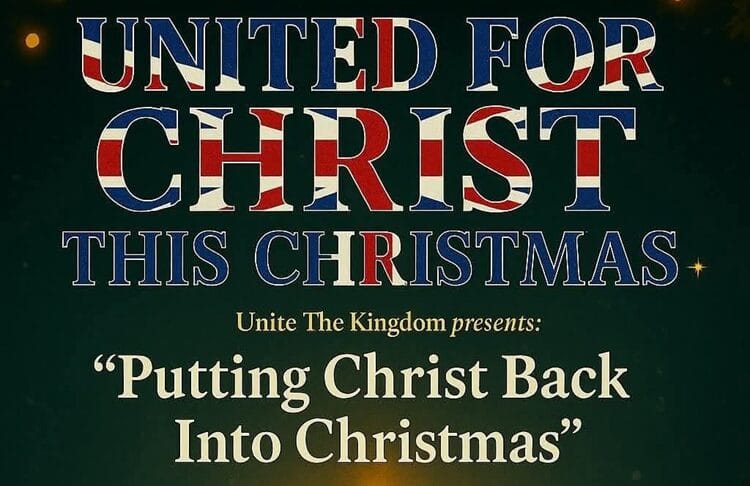
The fury over a Christmas carol event exposes the ideological gatekeeping hollowing out British Christianity.
Jason Clark writes: Over the last few days, my social media feeds—shaped by the strange, selective algorithms we all live under—have been replete with progressive and left-leaning Christians condemning the upcoming “Christ in Christmas” event in London linked to Tommy Robinson. Anecdotally, those are the voices I see most loudly. And beyond my feeds, the national news and radio have been wheeling out predominantly Anglican clergy (as they always do) to denounce the gathering in firm, moral tones, with warnings of the ‘Far Right’ and ‘Christian Nationalism’.
I understand why people feel uneasy. I am no Tommy Robinson supporter. But I also sense that something deeper is happening here—something revealing, something uncomfortable, and something worth paying attention to. Because if we only focus on the personalities involved, we risk missing what this moment is saying about the soul of the UK, and perhaps the state of Christianity itself.
We seem to have had Christian groups who have spent months entirely at ease under pro-Palestine banners, Islamic slogans, rainbow flags, LGBTQ+ causes, BLM symbolism, climate change flags, and anti-colonial rhetoric, who are suddenly and seemingly scandalised by a carol event—and not primarily because of the carols. That contrast alone should make us pause.
Anglican and other priests have been arrested for supporting a proscribed extremist organisation—Palestine Action—whose activists violently assaulted a police officer with a sledgehammer. Yet many of the same voices express horror at a proposed carol service, immediately castigating it as ‘far right Christian nationalism’. It is a revealing moment in our public discourse: outrage is not always proportionate to actual harm, and moral energy is, I suggest, often spent denouncing the wrong thing.
Policing Faith
For years now, huge numbers of ordinary Brits have felt ridiculed, unheard, and publicly shamed simply for being British. And the moment some of them reach for Christian symbols, language, and tradition—the very things Christianity once assumed belonged to all—those who preach tolerance respond with moral panic and purity tests. The contradiction is hard to ignore.
Beneath that reaction lies something more uncomfortable: the instinct to decide who is “allowed” to reach for Christ, who may “recover” Him, who counts as worthy of invoking His name. As though Christ belonged to some ideological tribe or moral elite. As though we could curate where Christ is permitted to appear.
But here is the truth few want to say aloud:
The most unsettling element of this carol event will not be Robinson. It will be the crosses, the icons, the voices publicly shouting, “Jesus is King.”
That will disturb many who have been perfectly comfortable with other ideological symbols dominating public space all year. The offence is not nationalism; the offence is Christ showing up in a place we did not approve.
And if anyone imagines the attendees will be the fever-dream caricature of the “far right,” it is worth remembering how elastic that label has become—a catch-all category deployed for almost anyone who disagrees with a dominant progressive moral imagination. It functions like a modern heresy charge, shutting down conversation rather than opening it.
This caricature stands in stark contrast to Trevor Phillips’ firsthand account after attending the Unite the Kingdom march with 150,000 taking part in London this year. Many of whom might well be at this Christmas Carol Event:
The vast majority seemed normal, not like the stereotype of some far-right extremists.
Exactly. The people attending will mostly be ordinary folk—neighbours, parents, tradespeople—people reaching for meaning, identity, and yes, perhaps even faith.
And that prompts a difficult question: If we casually call this gathering “far right,” are we prepared to label everyone condemning it “far left”? Of course not—and that’s precisely the point. These labels are flattening our moral vision and impoverishing public discourse. They tell us more about our cultural anxieties than about the people themselves.
Here is another irony: Some of the voices denouncing this event come not from worshipping communities or from people living a discipleship-shaped Christian life, but from cultural and professional Christians—those whose functional faith has migrated into ideological symbols, activist liturgies, and moral slogans. Their causes have become their creed, baptised with Christian symbols and terminology.
Yet they insist that those gathering in London have “no right” to use Christian imagery. Misappropriation is a serious charge — but it is being levelled by many who have done the same thing with their ideological beliefs. And they can appear as cultural middle-class Christianities, offended by their sensibilities, unable and unwilling to have empathy for those in their sights.
And yet, to be fair and truthful, not everyone raising concerns fits that description.There are many thoughtful Christians genuinely troubled about co-option, distortion, or Christian symbols becoming vehicles for grievance or identity conflict. Those concerns matter as much to me as they do to you.
But even here, a question lingers: Why is it so easy to publicly denounce this event, yet so hard to critique the ideological culture of the progressive left and their ideological capture in public?
Their symbols, chants, and moral framework have dominated public space for months with scarcely a murmur from the same people now speaking so forcefully. That asymmetry reveals something about the state of Christianity in Britain—people often more willing to critique unfashionable expressions of faith than fashionable forms of ideology.
The danger of co-option is very real. Christian symbols can be bent into political tools and have already been used by the progressives and left this year. But it is hard to name that danger without first acknowledging how we ourselves—left and right—are discipled by cultural ideologies that function like anti-Christian liturgies.
Tommy Robinson now speaks openly about having found faith and believes a kind of revival is stirring outside the established church—among people who, like him, feel they would never be welcomed by its leaders. Whatever we make of his claims, the dynamic he is describing is not unfamiliar. Time and again in Christian history, those on the edges of church respectability have insisted they are encountering God, while the institution has responded with suspicion, distance, or outright rejection. Often, the church has been uneasy not only with the individuals involved but with what their presence might say about its own life and witness.
Throughout the centuries, many of the Church’s most significant renewal movements began precisely in these marginal spaces. In nearly every instance, the resistance was shaped as much by cultural anxiety and political concern as by theology: fears of instability, the loss of control, and the unsettling presence of people who did not fit the accepted norms. Yet history shows how often these same movements became agents of renewal, mission, and reform that reshaped the Christian landscape, no matter how much people condemned them at the time.
There is a pattern to such moments in history:
- God meets people in unexpected places — often outside established structures.
- Authorities denounce these encounters as spiritually suspect, socially disruptive, or politically dangerous.
- The “outsiders” form new communities around their lived experience of God.
- Some of those communities become significant renewal movements in theology, mission, and prayer.
- Within a generation, the church often adopts what it once opposed.
What begins as illegitimate spirituality at the margins often becomes the birthplace of renewal for the whole Church.
This is the cautionary note for our current moment. The increasingly alarmist efforts to proscribe the carol event associated with Tommy Robinson may end up driving more people toward it, not away. When leaders resort to sweeping denunciations, collapse every distinction into the language of extremism, or speak as though attendance is itself morally suspect, they unintentionally reinforce the narrative that the church and the cultural establishment neither listen nor welcome. People already wary of institutions often interpret such reactions as proof that something genuine must be happening beyond official boundaries. Ironically, history teaches us that attempts to shut down fringe religious gatherings rarely diminish them; more often, they consolidate them.
If we are wise, we will pay attention not only to the very real risks but to the deeper questions being revealed — questions about belonging, credibility, and the gap many now feel between the church and the people it is called to reach.
This moment, if we are willing to receive it, is a mirror.
It reveals the ideological purity cults we build, the idols we defend, the boundaries we draw to gatekeep Christ, and the strange comfort we find in labelling others rather than examining ourselves.
But perhaps the greatest tragedy is pastoral.
Instead of denouncing and deepening polarisation, this could be a moment to reach out —
…to listen,
…to understand the woundedness beneath the rhetoric,
…to invite people into a relationship with Christ and into communities that actually form disciples of the risen Lord.
For many who participate in the carol service, there is pain there. There is longing. And beneath the surface noise, there may be genuine hunger for God. Christ often appears where respectable religion least expects Him. As mentioned above, we only have to take a cursory glance at church history to see this. What if this part of a ‘dirty/messy revival’ as messy as other moments in history, to lean into instead of condemn?
Grace always begins when we stop gatekeeping Christ, lay down our ideological idols, and open our eyes to the people right in front of us.
Summary
Given the minefield I have stepped into on this topic, let me summarise what I have attempted to express:
Post-Church Condemnation: Those outside the church in post-church life who have made cultural ideologies their mission are as guilty as those charged with Christian nationalism.
Genuine Concern and Suggestion: Christians who sincerely want to follow Jesus, in whatever form that takes and with Christ at the centre of their lives, are right to feel uneasy. But before reaching for the reflex of condemnation, I am suggesting it is worth asking whether something deeper may be happening — something that might actually be an opportunity to help people find faith in Christ.
Opportunity: What if there are hundreds of thousands of ordinary people who, amid the political and cultural turbulence of our age, are instinctively reaching for Christianity as a stabilising identity and source of hope? And what if, instead of being dismissed or denounced, they were listened to, welcomed, and gently guided toward a relationship with Jesus by those who have one — one not captured by nationalism or by progressive ideology, but shaped by the gospel itself?
And for absolute clarity: If anyone reads this as support for the event or for Tommy Robinson, they have not read what I have written.
Jason Clark is  a professor of leadership, having designed and continue to lead the Doctor of Leadership for Portland Seminary. He spent his twenties in finance in London, then twenty-five years as a church planter and pastor—his post PhD research centres on Christian identity formation and leadership.He is an Ignatian spiritual director, and the director of the London Centre for Spiritual Direction.
This article was originally posted on his substack here.
 Buy me a Coffee








https://www.youtube.com/watch?v=WwmgQbDpj2U
(5 mins)
Tommy Robinson speaking for himself rather than others speaking about him (often without knowledge).
One of the major influences on his opening himself up to the gospel was a pastor who visited him in prison. Also a manly Christian called Bob.
He who is not against us is for us.
Bob of Speakers’ Corner does a superb job in bringing manly Christianity, and proper discussion and debate, into the public space. He gives people one to one attention, has an incisive independent mind, does not believe in crying out half-heard on street corners (which leaves too much to chance), and is an autodidact like Charlie Kirk whose discussion-booth approach is similar.
Any Christianity that leaves out the manly leaves out the core agreed fact that there is a spiritual battle to join. As Catholics, Puritans, Pentecostals, 1980s renewalists, Inklings have always agreed. The culture is feminised at present, when it ought to be tapping the very best of both feminine and masculine.
Young Bob, 17, who spoke at the Carol Service is trying to continue Charlie Kirk’s legacy. He sets up discussion booths. Again, a very good mind for his age or for any age.
Younger speakers such as was seen at the end have also preached in Speaker’s Corner of late. Natural flourishing and natural pace of development should not be quenched. There is an accelerated period of development between around 8 and 14.
Bob is 17 years old is he, Christopher?
Is it the same Bob, who seems to have written the article linked by Steve, above, and relinked now. If it is, it is remarkable.
https://www.soldierofchrist.online/2025/09/23/a-response-to-the-open-letter-given-by-mentioned-church-leaders-upon-the-occasion-of-the-united-the-kingdom-march/
The second of the two Bobs I mentioned (Young Bob) is 17.
The first of the two Bobs I mentioned (Bob of Speakers’ Corner) wrote the article. Yes, it is a good one. He is not called Old Bob, as he is not old, just older than the other.
Neither of them is actually called Bob. Even the ‘surname’ SOCO is actually ‘Soldier Of Christ Online’.
I am with Ian in wanting people to use their actual names.
However, sometimes in life there are quite pressing security reasons for withholding them.
Thanks Christopher.
Why do all these Tommy Robinson figures use pseudonyms – presumably the police know their real names?
Yes, the police do. Meanwhile, typing in a name will bring up address details whether people operate in dangerous contexts or not.
What is the reason for your saying that these two Speakers’ Corner debaters (take on all comers) are even remotely Tommy Robinson figures? I am sure the said TR would be modest about his debate abilities, though actually it is very clear that he has a good mind.
The article is good in that it treats the issues with the required level of seriousness. Most do not even begin to do that.
It is easier however for a freelancer who does not have congregations (or at least physical organisations) to keep ‘on the road’ to be dismissive and condemnatory. Dismissiveness and condemnation are biblical, and are biblical for a reason. But they could be leavened with awareness of one’s own shortcomings and a more pleading tone instead, to go with the proper urgency that is already present.
Strength to his arm – you see how he is breaking through where so many are not.
Peter
We know Tommy Ten Names’ real name.
What young Bob’s real name is I have no idea. He’s trying to bring the Charlie Kirk grift to the UK. Our soil isn’t, at present, hospitable to this kind of Christian Nationalism and, in the longer term, I think ‘Robinson’ and his acolytes will tire of cosplaying Christian virtue. Especially if it doesn’t garner them the support they need here. And because it’s kind of difficult for criminals and thigs to keep up the pretence. I understand people were leaving the protest early because they were already bored.
I don’t know what protest they were leaving early.
First of all, whatever you understand, it is impossible to generalise about a crowd of 1000.
Second, your understanding will by definition be deficient compared to that of someone (like me) who was present and did not see early leavings.
Third, there was not anyone there who understood it to be a protest.
However, the Met Police shorthand was that it was one, because they were lumping it in the same category the anti-ID protest nearby.
The programme began at 3 not at 2 as advertised, and a counterprotest was scheduled to happen at 1 outside 10 Downing Street, i.e. very nearby. However, as I arrived at 2.40, I cannot say what happened before that. Nothing that hit the news. I imagine the counterprotest was unappealing to join, since who would protest a carol service. Thus I did not see any counterprotest present there. Two people were arrested, not that I saw that happening – it may have been before I came. One of these was, quite rightly, not for what the person did on the day but for what they had done in the summer protest. Tons of misdeployed police, though – just as there are tons of warnings when the polite and gentlemanly Christian Concern descend on Oxbridge Colleges.
The organisers described it as a protest.
rather arrogant of him to say ‘we, the Church’ as if they truly represent the millions of Christians in this country or elsewhere. They dont.
Just a note – Charlie Kirk was campaigning for young adults to vote for Trump, not surrender their lives to Christ.
That is highly inaccurate. He did very many debates, even during a single day. And he spoke on many topics. Why would he need to debate so often, or to take on ANY question thrown at him, if he had only one topic?!
Kirk wanted public executions, witnessed by children. He didn’t have many topics. He had one agenda. And it wasn’t Christlike.
The only way to see how many topics he had would be to watch his entire output. There are two issues with that:
(1) He often did several question sessions a day. That amounts to a lot of topics.
(2) It is nonsense to say someone has few topics when they are spending their life putting themselves in the firing line for *any* question at all that may come up. It is the questioners setting the agenda, not the answerer. Hence, it clearly follows that there is no limit to the nature or number of the topics, and that CK agreed to that. So I don’t understand your point, which is clearly wrong.
Christopher
To clarify, his paid employment at TPUSA was to get young adults to vote for Trump.
Im only aware of his partisan political debates. Im sure that he went to church and spent time with his family outside of his job.
What?
For a comment below in the thread:
“He had one agenda. And it wasn’t Christlike.”
Would someone reading here respond exactly as you have, to your own comments? Are your strong opinions and indeed insults ‘Christlike’?
Would you judge them such?
I don’t call for public executions and the overturning of the Civil Rights Act. I don’t question the qualifications of black pilots. I don’t vote for paedophiles.
I don’t call for public executions
What exaclty is wrong with calling for public executions? You keep bringing this up as if it’s something that would put someone totally beyond the pale of civilisation; but while you personally might be against capital punishment, not everyone is (in Britain support for reintroducing capital punishemnt hovers around the 50% mark, sometimes a little less, sometimes a little more), and if we were to have capital punishment then it would seem reasonable, for reasons of transparency of justice, for executions to be public.
In other words, support for public executions isn’t an extreme or fringe opinion (nothing that has support of 50% of the population could really be described thus).
So why keep including it in a list which is clearly intended to make out that the late Mr Kirk was well outside the bounds of civilised opinion?
Thank you, Steven.
If Tommy Robinson’s conversion is sincere then he will grow in Christ. I trust the Holy Spirit somewhat more than I do the Bishop of Manchester.
The Jesus who turned Matthew the tax-collector and Simon the Zealot into brothers will have no trouble in accommodating TR.
As for TR’s history, which some quail about above, I think Saul of Tarsus was far worse and therefore much less acceptable in the faith than Robinson.
All in all, I loved the article and also the link that “Steve” gave to the SOC response to the letter written by those who have failed miserably as our leaders.
And Steven Robinson’s link above. Thanks guys.
The Gospel of Jesus Christ on display. We are all of us being brought along by the work of the Holy Spirit.
Thank you for the link.
The far right attenpt to exploit our faith depends on the idea – which one can agree is plausible – that God ‘must want’ states that as states follow Him and impose His ways. And this feeds the human desire to ‘lord it over’ others and to be ‘allotriepiskopoi/bossy-boots in other people’s business’. Being able to claim “God is on our side” is a powerful drug, as the well-known Dylan song shows, and as demonstrated by centuries of ‘holy war’ in Jesus’ name and persecution of dissent also in His name.
And the big problem is that according to the NT God has in fact chosen a different way of going about it – an above all VOLUNTARY faith based on spiritual rebirth by which one joins the ONLY “Christian nation” the NT recognises, the inter/supra-national CHURCH itself. Instead of superficially ‘Christianising’ the World’s nations we are to call people OUT OF the world and into the Church.
And the big problem of the far right for Anglicanism is that founded as an established church for the benefit originally of a despotic ruler, Anglicanism is in effect committed to the same (unbiblical) principle as the far right’s ideas for the faith, even in a period when its former totalitarian dominance has been rightly reduced. The CofE can’t coherently oppose the far right because it is doing the same thing….
And the irony – of course both Anglicans and the far right see that when this is done in the name of other religions it is deeply wrong…..
So yet again you make clear you are anti Anglican, hence as a Baptist you correctly have no place in the Church of England. You are also completely wrong, Tommy Robinson and his supporters want a war against Islam in England, the Church of England as established church engages in inter-faith dialogue with Muslims
If the CoE supports sharia law, as did a former Archbishop, then it is effectively placing itself outside of the rule of law the English legal, justice system and the constitution. It is effectively disestablishing itself at that point. Even more so as it embraces and propounds by promotion and neglect, omission, religious and secular syncreticism, fusion. At heart is unbelief in the unique Gospel of Jesus, Emmanuel which is so offensive, so divisive, foolish.
The festival of Hannuka would not draw out hatred and murderous evil, but it would point to Jesus as the Light of the World.
“If the CoE supports sharia law,”
It doesn’t. Next please
Just on a point of information, the former Archbishop of Canterbury had a rather more nuanced position re the law than the bald statement you make, as was made clear at the time by Lord Lamont in a letter to the Times in which he protested at its biased an d ill-informed criticisms of Rowan Williams. He was not proposing that anyone or any institution or faith community was outside English law, though that was the spin put on it be the Daily Mail, Daily Telegraph and The Times.
Tim,
His position was robustly opposed by the then Bishop of Rochester, Nazir-Ali.
A B Rowan Williams, to me as a trained lawyer, showed little understanding of the English legal/ judicial system and Constitutional law, nor Islam and sharia law, according to BP Nazir-Ali with his rooted knowledge of Islam.
If AB Williams was nuanced, which wasn’t from what I read, and lived out shari reality was far from nuanced, it, as nuance, was conflated in practice. Ivory tower thinking that bore no relation to reality.
Would AB Williams welcome Sharia Court’s over LGT matters?
Would the CoE in any inter-faith dialogue?
AB Williams did indeed have a more nuanced position. He is an academic, and academics cannot think themselves back into duncehood. It was second nature to him to review and understand different angles, as all academics have to do.
The Church of England does not support sharia law, it supports the law of the UK as laid out by statute of parliament and common law passed by the judiciary. Jews believe in the Old Testament, they don’t believe Jesus was Messiah, which Muslims do even if Muslims don’t believe in the Trinity
Geoff, I remember reading the Archbishop’s lecture and then reading the outraged attacks by the media and figures such as Michael Nazir Ali, and wondering which lecture they had been listening to. And I also read that Rowan Williams had been angry that his lecture had been so deliberately misrepresented for cheap headlines. Was it perfect? No. And no doubt now he would give a different lecture, but it wasn’t a call for the introduction of sharia law in England and in any case what’s sometimes referred to as sharia law isn’t a single and unified code but a wide and varied set of traditions and debates.
‘The Church of England as established church engages in inter-faith dialogue with Muslims.’
??
Two numbers would be relevant to research.
First, the number of years the C of E has been established church.
Second, the number of years it has indulged in inter-faith dialogue.
You seemed to write as though indulging in inter-faith dialogue were a feature of the established church!
It has been that since, for example, the Beatles went East.
Simon
Islam is an established religion in any state it can get control of.
The CofE is an established religion with different beliefs to Islam.
The ‘far right’ wants an established version of Christianity.
The CofE was founded to be a totalitarian religion like Islam. It only isn’t that kind of warring and persecuting religion nowadays because of the efforts of better and more biblical Christians like the Baptists you clearly despise. But it still hangs on like grim death to the decidedly unbiblical practice of establishment …..
Technically Islam is not established nation in all nations where it is the majority, Turkey for example. The far right doesn’t want an established Christianity especially, it just wants no Islam. It only uses Christianity as a tool against Islam.
The C of E emerged at a time of global wars between Protestantism and Catholicism, the end of those has far more to do with its more moderate form now than what some Baptists said. Its established status however remains very valuable in offering weddings and funerals and baptisms as of right for parishioners for starters
Simon
Id say in both the US and the UK, the right already mostly see Christianity as both established and the only acceptable religion. Theres certainly a significant opposition to Islam here in the US, Muslim citizens are not considered real Americans by the ruling party. And Im certain Reform UK are the same
Yes but the fact is in the UK only the Church of England is an established Christian denomination and in the USA there is no established Christian denomination at all. In both the US and UK Muslims have freedom of worship, indeed the ReformUK Head of Policy is a Muslim
It seems pretty clear to me that for at least the last decade there’s been an exploitation by people in politics and the media for various purposes and the lack of the resistance from legitimate Christian leaders has legitimized their claims and emboldened abuse of religion. It’s clear that none of these people have genuine faith. They are just using Christianity to feel good about political views that hurt people.
Examples that spring to mind
Russell Brand – who it seems to me conveniently suddenly decided to be a Christian when he started having legal trouble over his treatment of women
Jordan Peterson – who uses Christianity as a kind of life vest when someone calls out holes in his wild claims, despite failing to actually be a Christian himself.
JD Vance – who, like Peterson, has used Roman Catholicism to justify political positions that he has no better argument for. I find it wild that hes been a catholic only for about 5 years and in that time has had the arrogance to argue with two different popes about theology! Depending on the day, if we are to believe him, hes either frustrated with his wife for refusing to convert or such a full supporter of religious freedom that it doesn’t bother him that he’s more catholic than the pope and yet hes married to a Hindu.
Kemi Badenoch – again, not a Christian, but uses Christianity to justify political positions.
Even as you make judgements to I unable to subscribe, not having the inside personal knowledge which you seems to have, your point, also pertains within the progressive clamour in the Church, serving a purpose of their own and misappropriate a name, an identity in Christ as Lord and King over their lives. In that particular cohort I must have missed any testimony of conversion to Jesus, the Jesus not of our own making, but as revealed by the ‘ mouth of God’ in the whole canon of scripture.
Worship Him,
Geoff
I tried telling you a while ago about my personal faith journey and you were only interested in insulting me.
Im happy to have a discussion about personal matters, as long as it is in good faith, but I was posting about the above article.
“Lord, I thank you that I am not like these people” – Luke 18:11.
Peter
An interesting list. But you have omitted:
a. the net zero lobby
b. BLM
c. LGBTQI+ campaigners.
They are by *far* the bigger ideological distorters of the Christian faith who have had an impact on the C of E.
could you clarify how the net zero lobby has distorted the Christian faith?
Speaking only for this “Ian”….
Locally to me the net zero/ eco agenda seems to be the no 1 priority for *some* church members … above the need for a Saviour. And dioceses can prioritise spending it over providing a few more “vicars “
But that’s different isn’t it? That’s a bad internal Church discussion. It’s not a public political figure trying to cloak themselves in, and abuse, the faith.
I suppose it depends whether those ‘few more vicars’ are really needed as to one’s view of priority.
Indeed Ian.
That is the nub of it. Some in the lobby see themselves as saviors of the world, rather good stewards.
A religion in itself that supplants the true Saviout in their affections and commitments. Or in the theology of Tim Keller, becomes a ‘counterfeit god’.
Indeed. Or Black Lives Matter. Or queer people.
All in breach of the first commandment, all counterfeit gods, idols.
Anything but Jesus; affections, desires and commitments which have expulsive power over our First Love of God incarnate, Jesus God the Son in union with God the Father and the Holy Spirit.
Worship Him at such a time, a Christian season, as this.
There is nothing else to Bragg about.
But nationalism for some reason isn’t a counterfeit god or idol in your book?
Adam, where do you get that idea from? Yes, nationalism can be a counterfeit God, an idol.
But nationalism is not what the article is about.
It includes conversion to Jesus, Jesus as King.
Aren’t you flipping everything around there?
Peter was talking about people abusing the faith – using Christianity to feel good about their political views in the public sphere. You, I think, are talking about the groups you don’t like in internal Church debates. That is to say, net zero lobby, BLM, and LGBTQI+ campaigners don’t have a history of wrapping themselves with the cross (so to speak), but there are groups within the Church who argue and campaign on similar issues (e.g. wanting us to do more on combatting climate change, reparations for slavery, same-sex marriage etc.) and who as internal Church groups having internal Church debates ground their arguments in their faith. I don’t see how that’s remotely the same thing, or have I misunderstood your point?
Net-zero might not wrap them in the cross, but they certainly get their photos wrapped up in the dog collar.
On BLM, two Bishops literally did a photoshoot of themselves ‘taking the knee’ in front of a large cross: https://coventry.anglican.org/bishops-take-the-knee.php
Ok two bishops did a thing. People can disagree with that or agree with it. Those are internal Church figures. That is not the same as political figures exploiting the faith to give themselves cover.
Bishops sit in our legislature and choose to make political pronouncements. The bishops choose to make themselves political figures.
I would rather have politicians look to Christ for answers than bishops looking to politics.
But in that case – Streeting was staff in Stonewall and has publicly spoken of his faith informing his politics. Fallon has spoken of his religion and supports net-zero. Black Lives Matter mixes politicians with the reverend Al Sharpton.
But, of course your allies ‘[doing] a thing’ won’t be the same as your enemies ‘exploiting the faith’. That is entirely down to using unequal weights and measures.
Adam writes ‘People can disagree with that or agree with it.’.
”Same difference”, right?
Unbelievable.
The entire point is the arguments in favour of or against their actions, which you are dismissing as a matter of indifference, as though it can be taken for granted that said arguments are well balanced.
So arguments are *always* well balanced? Never skewed in any one direction?
Ian
I dont recall leading climate scientists blaming Jesus for their views on climate change?
What exactly is ‘manly’ Christianity, as opposed to Christianity?
It’s toxic masculinity pretending it’s God’s will for ‘mankind’.
Penny, I wonder what you would admit deserves to be labelled “toxic femininity”. Theoretically, claiming all sorts of exemptions/privileges, or else rights without balancing commensurate duties/responsibilities, at the very least constitute societal burdens borne by men to the same extent.
Men are expected to pay for and look after children not their own (including ones whom they’re deceived into believing are their own – a very widespread phenomenon), on pain of being slandered as deadbeat dads or worse, while women are allowed to actually kill even their own children before birth? Wow.
PCD you never fail to be conformist, repeating the fashionable phrases of each year just precisely when they are in fashion. The Zeitgeist is an unforgiving as well as unattractive spouse. Dan’s analysis is apposite.
Peter, it may have been referred to as robust or muscular Christianity previously, or even Mere Christianity as opposed to what has been known as the feminisation of the church.
that’s what I thought, nonsense.
Thanks Geoff.
and sometimes dangerous nonsense – see John Smyth
Quite. I didn’t think I could be more shocked and distressed. But the Channel 4 documentary was utterly harrowing.
Not exactly Jimmy Edwards, was it? I actually think the awful Smyth saga is more about the English public school system than the church. Bash Nash’s camps to make better Christians of the men likely to lead the country were a fine idea, although I disagree that such men are as suited to leadership in the church as in the world. As well as being holy and having powers of leadership, church leadership should be men who better reflect the social demographic of their congregations.
It is hard to blame Welby for doing not much in 2013, long after the bird had flown, but it was right that he resign, because he was refusing the standard that he was holding his own clergy to. Given the division he sowed in the Church of England by trying to move it away from the biblical view of righteousness, few evangelicals will weep. Perhaps also Welby knew more about Smyth in 1980 than he said:
https://anglican.ink/2025/01/01/what-welby-knew-and-when-he-knew-it-a-personal-observation-on-john-smyth-and-justin-welby/
Clearly the most culpable persons, though, are those who told Smyth to discreetly leave the country more than 40 years ago in order to keep it dark, and they are now all dead. As is Simon Doggart, the talented batsman whom Smyth beat and then co-opted to do the worst beatings. Incredibly he went on to become a prep school headmaster, and died of cancer in his 50s just as the story was breaking. He would have been pilloried.
It is said that Smyth died while an extradition request to South Africa was being prepared. In view of the ages of the men beaten and the consent given, does anybody know what laws from the 1970s and early 1980s Smyth could have been convicted under?
Nabbing John Smyth on street in 2017 was Cathy Newman’s finest hour. The next year she got run rings round by Jordan Peterson.
GBH or ABH cannot be consented to
It can easily be consented to, but it cannot be consented to in law, because law has its own separate definitions of common words. Law forces one to live in a binary universe of reality on the one hand and legal fiction on the other.
Anthony, ‘knowing about Smyth’ could mean a lot of things. There are 1000s of facts to know about any one individual, not necessarily the ones you have in mind. Even re the ones you have in mind, there are different quantities and combinations. Most of which postdated the Hudghton reminiscence to which you link.
JS was a problematic and self-willed individual. Hence there would be problems with him needing discussion even outside the parameters of what Makin etc discuss. His 1977-82 behaviour did not come out of the blue.
I find the Hudghton report to ring true in many ways. But what is my gut feeling compared to that of the victims who largely dismiss it, even when it would be in their interests to do otherwise?
Bleeding For Jesus 2nd ed p231 JW writes: ‘The tricky question would be about the 2013-17 gap. Any ideas for an answer welcome.’. That means that he agreed that in this particular period he and his underlings should have done more, and indeed that was why he resigned.
However, 90%+ of commenters do not have a grip on the very complex facts. What JW had been informed of in 2013 was that one complainant *Graham (who had had two beatings – at the preliminary stage therefore for quantity if not for acuteness – which he had not previously considered blaming for his lifelong mental troubles; and who was vague about who else or how many others had or had not been beaten, or how badly) wanted the counselling that MR had offered 30 years ago, and had said as much to another victim, who had had one – again preliminary-level – beating.
JW therefore knew nothing (till, much later, he was apprised of the Ruston Report contents) of the full scale. One of these 2 victims had contributed to the Coltart Report, which I imagine may have been in the public domain though hard for Brits to track down, and it is possible that he had also read that Report and seen the contents of the Ruston Report summarised in it.
In fact, it is only Spitting Image journalism, and the pursuit of headlines, that puts a random camper like JW at the centre of the picture at all. The UK reality (men not boys [min 17 or maybe 16 but almost all more], consenting not coerced, off camp not on camp, sharply at variance with policy not in accord with it, panevangelical not merely anglican, only one third of the participants having been involved for any real length of time; public domain not private – see Olonga, Thorn, Coltart; never-broken deliberate 30-year silence among victims and families; former eccentricity of viewing old news as topical) has never been loved by the sensation-seeking journalists.
Andrew Brown’s analyses cut through some of the lazy stereotypes.
Christopher, the question is: Did Justin Welby know that John Smyth was grooming young men at Iwerne camps to be beaten at his home? Hudghton asserts that Ruston and Welby knew there was something about Smyth that should be kept dark from another ordinand. We now know that there was indeed something embarrassing (and worse) about Smyth, so how likely is it that the Ruston-Welby conversation from which Hudghton was excluded was about Smyth’s beatings?
You say that Smyth’s victims ‘largely dismiss’ Hudghton’s recollections. They have no more knowledge of conversations between Ruston, Welby and Hudghton in Ruston’s house in Cambridge than anybody else. So what do you mean by ‘dismiss’? Do you mean ‘deny’ and if so then on what grounds do they deny it? Or do you mean they are saying ‘whether Welby knew or not would have made any difference to what happened to us’ (which is probably true)? What is your reference for what the victims said about Hudghton?
Winchester headmaster John Thorn did not mention Smyth by name in his memoirs, and Henry Olonga wrote about events in Zimbabwe and knew nothing of Smyth’s former activities in England. So they put nothing into the public domain about what Smyth had done here.
It appears to be necessary that I repeat what I wrote above: It is hard to blame Welby for doing not much in 2013, long after the bird had flown, but it was right that he resign, because he was refusing the standard that he was holding his own clergy to.
Honour to Smyth’s son PJ, who was also beaten, who has kept his faith in Jesus Christ, and who confronted his father in 2017.
In response:
‘the question is’
There is not a single question, but many.
‘did JW know that JS was grooming men to be beaten [in the future]’
No – and no by definition. You can know at second hand what a person is doing now. But you cannot know what they are planning to do in the future as a result of that.
Moreover, what we call grooming (softening up) is scarcely quantifiable, is nebulous, until one has *later* seen where it was all leading.
‘there was something about Smyth that should be kept dark’
I have already answered this one above. Why should it, by pure coincidence, be the same one thing that you personally know about? Thousands of things happened in JS’s life. And many of those thousands will have exhibited the same intransigence, arrogance and selfwill. He was perpetually producing problems. Not always of different sorts.
‘Smyth’s victims ”largely dismiss” JH’s recollections’
To repeat: This would be an own goal on their part unless they had very good reason to do so.
Moreover, an own goal scored by those who have no track record of minimising evidence or minimising a case against JW – quite the reverse.
Makin’s own downplaying of this evidence is entirely based on the victims’ downplaying. it has therefore no independent value. Least of all as Makin was in thrall to the victims to come to the conclusions they wanted, being indebted to them because of the timelag in finalising what was actually a very complex large report which was given too small a time frame in the first place.
I repeat that much rings true to me from JH’s report, in terms of circumstantial detail. But there is no way that your or my reaction is not subordinate to the reactions of those who were thereabouts at the time.
By ”dismiss” do I mean ”deny”?
Definitely not. People who were not present are of course not in a position to deny anything. They have to rely on their contextual knowledge.
Thorn put nothing in the public domain?
Who read Thorn? Prominent among his readers will have been: the Wykehamists of his period in charge; and evangelicals who were alerted to it (as indeed they were: as we read in Graystone etc). So a high proportion of the readers will have known exactly who was being referred to.
I can’t remember the reference, though the main point is not in dispute. Maybe *Graham on twitter, reacting to its initial publication 1.1.25; maybe also Makin. I have seen at least 2 things but cannot remember where. Probably there.
‘It is hard to blame JW for not doing much in 2013.’
Yes. So long as you take on board my point that the 2013 information was regarding one person beaten twice (and unaware of the extent of beatings in general) who had spoken to another person beaten once (who quite possibly may have been more aware of the extent, but may not have shared this, and very likely did not with JW, who did not at this stage know anything like the extent from any other source either). Even then, JW was worried in retrospect that the inaction 2013-17 was the main case against him and his team.
I see that Christopher persists in acting as an apologist for Iwerne, for Smyth, and for the men who swept his abuse under the carpet and waved him off to Africa.
The other more serious issue is Christopher’s assertion that the young men weren’t coerced. For someone who often mentions grooming in connection with abuse, this is somewhat surprising. Grooming, coercive control and gaslighting are all now recognised behaviours and one can be a criminal act. I hope sincerely that Christopher has no safeguarding role within his Church.
As to ‘grooming young men at Iwerne camps’:
That is not inaccurate at all. But the majority of his victims were Wykehamists, so an appreciable amount of his getting to know them, and often the foundational stage of that, was in Winchester and environs.
Most of those who were not Wykehamists were Cambridge students, and as such were often beaten more by SD than by him.
This does not leave many individuals to fit into this approved category of ‘grooming on IC’, at least not solely without qualification, though I fully appreciate that there was plenty of freer time there and more time spent together, and that he sought that the Wykehamists and his own acolytes in general be under his supervision there.
The main problem is that the media try to shoehorn IC into everything.
Yes indeed the line between consent and coercion is a fine line, and there is a sliding scale involved.
But PCD is wrong for four separate reasons. (Apart from the usual predictable jump to maximum accusation.)
First, because the young men went freely into the experiences, which is the dictionary definition of consent.
Second, because they were enthusiastic about the spiritual benefit (not in all cases, as time went on), and went on defending JS/SD motives even when the beatings ceased. Their understanding was spiritual improvement.
Third, because only those who chose participated, meaning that there were those who opted out, of whom at least two are detailed in the literature. Pp 73, 172. In the face of that, how PCD can maintain her position is unclear.
Fourth, JS 73 says explicitly ‘It doesn’t work for everyone.’. He was not a truthful man; but there is no way this is a lie, since he bases it on the facts.
The broader pattern is that PCD without knowledge of specifics tries to debate knowledge of specifics. It is foreordained which comes off better and worse.
Alright Christopher, *my* question is: Did Justin Welby know during his time with Iwerne that John Smyth was acting as a predator at Iwerne camps and beating at his home the young men he preyed on? You apparently want to remind us that other questions are yet to be answered. But this is the question of greatest general interest.
You add ‘in the future’ to my words and then complain about that. But it would have been possible for someone whom Smyth groomed at Iwerne and then beat in his shed to have told people in positions of responsibility at Iwerne what had happened.
Channel 4 focused on the victims who suffered most and were prepared to speak out. But we know nothing of how many young men were lured to Smyth’s property and declined to be beaten, or how many were beaten once, and then never came back. Somebody able to snub Smyth like that would also have had what it took to tell Iwerne.
You play a straight bat to my question about what Ruston and Welby might alternatively have been discussing about Smyth that they wished to keep Hudghton away from. There are indeed plenty of unanswered questions, but nothing else has emerged about Smyth (a man now intensively scrutinised) that would be embarrassing enough not to discuss at table, has it?
You fail to explain why Smyth’s victim’s ‘dismissal’ of Hudghton’s report is of any greater value than the views of anybody else who had not been present in Ruston’s house.
I regret your muddying the water about the meaning of ‘public domain’ (Wykehamists are not the general public). I stand by my comment.
To take your points seriatim:
Q. Did JW know during his Iwerne period that JS was acting as predator during camps and later beating those he had preyed upon?
A. We agree that the combination of both former and latter is crucial. Had he not known the context of the latter, what was it that he was supposed to notice in respect of the former? However scary the word ‘predator’ is, what of substance would have appeared on video?
The Hudgton/Ruston conversation is the only evidence of this. That we have analysed. I see much in it that is suggestive. The year 1978 was a year of sea change – the beginning of an organised programme – so if there were to be ‘talk’, that year would be a prime candidate.
One remarkable thing is that no-one imagines that people forget conversations. Quite the contrary. People probably forget most conversations that they have.
We have said before that the content of the secret 1978 talk is under no obligation whatever to be in line with the interests of people who live in 2025.
And then we have to ascribe weight to *Graham’s minimisation of the event, and that of fellow victims. Who knows? Maybe they are following *Graham’s lead here. It is improbable that there is no reason for the minimisation.
And the point about own goal I have now made 3 times, but you have not factored it in.
As for 1978 knowledge, no-one else aside from participants seems to have had that.
Ruston is said by the 12.2.82 whistleblower to have been taken aback by the 12.2.82 revelation as though he had heard no such thing before.
His report sees the matter as extremely serious. Meaning he could have had little inkling if any of it before.
However, Graystone says (227) the other whistleblower blew his whistle one week earlier. Memories vary. And in addition the precisely contemporary cry-for-help was known about within the circles. So how uninformed was MR on 12.2?
Q. You say: You apparently want to remind us that other questions are yet to be answered.
A. Nothing apparent about it. But that was not the point of my remark. The point was to say that very often people say ‘the question is’ on occasions where they can see only one question and should therefore defer to those who can see more. All they mean is that that is the question that interests them most; it would be wrong to say that no others exist, for plenty do.
Q. You say ‘You add ”in the future” to my words.’.
A. This was the way I understood your words. You referred to whether grooming was known about, but grooming is only grooming at all if it is followed by something in its future, and it is in the nature of the case that it cannot be known at the time whether or not it will be so followed.
Q. ‘It would have been possible for someone whom Smyth groomed at Iwerne and then beat in his shed to have told people in positions of responsibility at Iwerne what had happened.’
A. Yes.
‘Groomed at Iwerne’ is using a sledgehammer to crack a nut. Since the only victims in 1978 were 3-4 Wykehamists and Smyth lived on the outskirts of Winchester, why bring Dorset into it (with the provisoes noted above)?
Also it ignores what I said above about most victims having been befriended, for years prior, at Winchester near his home, and most of the rest (largely 1981) being the Cambridge circle.
I can think of only one possible person in that case, and even then, hypothetically, I doubt he would have taken the roundabout route via Cambridge to spill beans. Cambridge was inhabited by the relevant circle only from the *following* academic year onwards. MR was leader to the Cambridge circle – but to others?
Q. You say: ‘Channel 4 focused on the victims who suffered most and were prepared to speak out.’
A. The emphasis should not be on the latest Channel 4 documentaries. The same interviewees, broadly, have been in view throughout the 9 years.
Do they equate to those who suffered most physically? With one exception, no. Generally they exemplify those who suffered a very great deal, and had/have done throughout their lives, as is the way with early trauma: they deserve our utter sympathy. Note that 50% of the Smyth victims, never mentioned in the press, are opposed to the angle taken by the vocal ones (as Feb’s Synod made clear); but more than 99% of the publicity has given the latter narrative. Also the number of individuals standing behind the latter narrative is not clarified (which can sometimes be a strategy to make the numbers seem larger than they are; but in this case letter-signatories show that the numbers are not especially small, however small they be in terms of gatherings and activism). The two narratives are not opposed to each other, since broadly speaking there are those who suffered more and less, and the different responses from the two groups are entirely understandable.
Q. You say: ‘We know nothing of how many young men were lured to Smyth’s property and declined to be beaten, or how many were beaten once, and then never came back.’
A. But this is the same topic I raised already: pp 73, 172 cover both broad categories. In general, those beaten once (i.e., any number of occasions including just one) were counted in the roll of victims.
If you mean that there may have been an unknown victim/whistleblower at the said date, you are correct. But it surprises me slightly if with the amount of forensic research into the case their role and identity remains entirely hidden. Far more likely, it is indeed true that MR was not lying when he claimed to have known nothing in early 1982 and reacted with horror. Your theory has him know something horrible on two occasions, yet reacting not at all significantly on the first and greatly on the second.
Q. You say: ‘You play a straight bat.’.
A. No, I don’t. That is to be tactical. I am never tactical, only straight.
Q. You say: ‘Nothing else has emerged about Smyth…that would be embarrassing enough not to discuss at table.’
A. A whole wealth of embarrassing material has emerged; he was overbearing and egotistical in all situations. See for example p57, but there are countless examples.
Q. Why is *Graham’s dismissal of Hudghton worth any more than anyone else’s view?
A. He has contextual knowledge. We don’t know details. But the fact that all other victims seem to back him up on this amounts to a wealth of independent testimony. There is also the fact that *Graham could have been the most scary to Makin (the one who pulled out of the process altogether through exasperation), and Makin could have felt that none of the victims were to be contradicted but quintessentially *Graham above all.
Q. ‘Public domain’
A. You can’t exclude any group e.g. Wykehamists from the public domain. All have equal presence there. And a public domain of any book is in practice limited to those who read it. I.e. those groups listed, in particular.
Even those who were neither Wykehamists nor evangelicals and read the book still have substantial actual information there about (the person who turned out to be) JS.
Christopher is doubling down in his contention that Smyth’s (young adult) victims chose their abuse. As I pointed out coercive control manipulates ‘willing’ victims. They aren’t being physically forced to submit. But they are being mentally coerced into accepting their own abuse, often believing that they deserve it.
Christopher needs to learn more about this, to find out about trauma informed pastoral care, and, as I observed before, to be kept away from any safeguarding roles.
If I may say so, Christopher, it seems to me that you are doing your best to misunderstand me wherever there is even a minor possibility of it. An interested and sympathetic reader would do his best to *understand* me.
I am not excluding Wykehamists from the public domain, of course. Its definition is that a member of the public can make sense of goings-on without extra knowledge or without recourse to work of detective effort in putting clues together. Thorn’s published memoirs (not the etymology of ‘published’) do not mention Smythe by name and no memver of the general public reading them would know where else to look to identify the beater.
I have already suggested that the victims were uninterested in Hudghton’s comment bec ause they thought it wouldn’t have made any difference to what happened to them even if Welby had known at the time. Welby was a junior leader in Iwerne but didn’t remotely have the clout to force Smyth to keep his distance. Ruston’s horror in 1982 might well be horror at realising that it wasn’t just one incident of which he and elby had hears but didn’t want to discuss in front of Hudghton. We simply don’t know.
You speak of “another victim, who had had one – again preliminary-level – beating.” So unless I am misunderstanding you there were indeed men who refused further contact with Smyth after one beating.
First, I was taking ‘public domain’ to be presence in a published writing, in which case the events were public to all and the identity of the perpetrator was now made public to some.
Second, in 1978 there were more Wykehamist victims than I said. Of these the well known group in Kingsgate House, b1961, persisted in the practice while some others seem to have fizzled out. Some candidates for spilling the beans, then.
Third, neither Welby nor Hudghton was an ordinand. At the time. They were part of the Round Church crowd, with Welby then decamping to St Matthew’s and its charismatic renewal – an interesting story in itself.
Fourth, every beaten man was at one point the recipient of just one beating. The fact that we happen to be talking of someone who never received a second through circumstance is neither here nor there. In his own very individual case he did indeed pull out of the programme and thus make himself a third example of turning the programme down, but his case was different because it equated to curtains for the whole project.
You equated ‘had had one beating’ with ‘didn’t intend to have a second’, but the two are not equivalents.
Fifth, it is rarely possible to use the cliche ‘we simply do not know.’. It requires an awful lot of research before one can say that confidently.
Sixth, you suggest that the victims may have been uninterested in Hudghton’s account because it/ Welby would not have been capable of altering subsequent history. This is certainly wrong. First, what *Graham expressed was scepticism not lack of interest. Second, the scepticism as I remember hinged around the ear lines of the date, among other things. You and I would agree that 1978 is not in fact too early for relevant evidence. And would also agree that the victims understand the milieu better than we do. The main point is that this would have been gold evidence for Makin whose remit was to find out who of the Anglican leaders knew what when. So whether or not Welby could have changed the future, the event at breakfast would still be just as crucial to the study. But Makin did not treat it as such. I have never understood why he did not give it more prominence. The insistence of the victims was key here. The victims seem to be scoring an own goal, so must be very sure of their ground. Either they are following very vocal victim(s) en masse without independence, or they, as is of course likely, know things we don’t. There could be more here than meets the eye.
Re PCD’s latest comment, cleansing and soldiery seem often to have been uppermost in their mind rather than punishment, which is by contrast negative and dead-end.
I was taking ‘public domain’ to be presence in a published writing, in which case the events were public to all and the identity of the perpetrator was now made public to some.
But I was talking about the identity of the perpetrator being in the public domain, as was obvious to anybody who wanted to try to understand me.
I was only a few hundred yards from Ruston’s house in 1978. I knew Wykehamists at my college, but mercifully they had no interest in religion (nor had I at the time) and they had not heard of Smyth until the story broke. (You may infer that I am still in contact with some.) I knew Doggart by sight at Fenners. I am happy to be corrected that Welby was not an ordinand at the time.
You have been pretty free in taking the position that “we cannot know” regarding what Ruston spoke privately to Welby about.
Suppose Road to Winchester had never included the relevant passage. Then a great deal would have been removed from the public domain.
Clearly at this moment it is uncontroversially true that we cannot know the nature of that conversation. It is equally in controversial that that situation may potentially change.
Christopher
Ah well, bleeding copiously after beatings is clearly OK if it’s about soldiery.
Though, also, it clearly wasn’t because Smyth described these beatings as punishment for certain offences.
Purification and punishment are and/or were 2 sides of the same coin. My only question is which of the 2 was the participants’ purpose in participating.
SELF-flagellation was fashionable in the Catholic High Middle Ages, and persists among Opus Dei members to this day.
Anthony
The CofE leadership seems to be full of people who dont meet moral standards expected in secular organizations.
Its staggering to me that the bishops want to make moral judgements on gay people marrying, having sex and started families when they dont seem to even understand that child abuse is wrong, young adult abuse is wrong, lying to try to cover it up is wrong.
The CofE should not have any bishops who lie or who have been caught lying. There should never have been a cat and mouse game between the press and what-Welby-knew-when. He should have been open and honest from the start and advocated for justice from the start. Nobody forced him into the priesthood. He chose to do it. It should come with more moral responsibility than a local postmaster (who would have been fired if he had behaved as the Archbishop of Canterbury did).
And now we have more moral judgment problems with the new ABC. Its pathetic and horrible. Why cant the CofE promote good Christians who actually care about morality?
London diocese is as huge as London.
People could always come up with something within the whole of London if they were minded to do so.
Cathy Newman and Channel 4 News are very minded to do so, as they wish to bring down the C of E and see everything through that lens.
Mostly you will notice that the things people come up with are things that are at one remove from the person themselves (but have a sexual element to grab headlines), who can nonetheless be named in the headline.
That means that there is nothing at fewer than one remove that they can pin on them.
Also they leave out of consideration that if these high officials dealt directly with everything they would need a 40 hour day.
Also the accusations are made often by people with a far smaller workload of their own.
Peter,
Of the three houses that comprise General Synod, it was the House of Bishops that was far the most strongly in favour of conducting same-sex wedding services. I share your opinion of Church of England bishops.
Christopher
It doesn’t matter if it was punishment or purification. Not one jot. You completely miss the point as usual. Young men (and, later, boys) were being groomed and coerced into being beaten until their bottoms bled and they had to wear adult nappies. (As an aside, who purchased those?)
It doesn’t matter if the offences were real or imaginary nor if the victims ‘consented’. They were being physically, spiritually, mentally (and sexually) abused. They are deeply traumatised to this day. One attempted to commit suicide. They were not willing. They were tortured by an evil man and by a corrupt institution and its enablers.
PCD’s comment is a list of things that she knows are not disputed by anyone, and that she also knows are very old news. Consequently, she also knew that her comment was irrelevant even before she wrote it.
If punishment and purification are two sides of the same coin, or were perceived to be, it cannot then be framed as an either/or.
Christopher
You have been disputing them for days (or, rather, years). Your insistence that the victims consented, for example. And that punishment was being meted out. You have your very own narrative which seeks to ameliorate Smyth’s abuse and others’ complicity.
Whatever ‘narrative’, it is not one that you can dispute.
You cannot dispute that consent in words and deeds is not necessarily the same as consent in law.
You cannot dispute that the ‘discipled’ split into those who did and did not agree to be beaten (Graystone 2nd ed, pp 73, 172 etc). Consent is the way that the one group is distinguished from the other. Nor that JS said ‘It doesn’t work for everyone.’.
By leaving out these and other pieces of data, you can come to any ‘conclusion’ at all. That is always what happens when inconvenient data is left out.
Probably a conformist, 2nd-hand and cliched conclusion.
That’s been complained about for 2000 years!
The Channel 4 documentary makes the point that the reaction against the so-called ‘feminisation of the church’ was strong from the 1970s onwards in those Iwerne circles. https://www.channel4.com/programmes/see-no-evil/on-demand/77710-001
It’s a vague catch all negative term (rather like woke, liberal, ConEvo, sexual revolution, toxic masculinity) that doesn’t help us understand much but gives us the sense that there’s something bad happening and that we’re right to oppose it.
Muscular, manly Christianity is far from toxic.
It is seen in the disciples, the apostles, in Acts, in all of the writers of the New Testament.
And supremely in thev life and death of Jesus.
Yes, we are confronted by Jesus.
Jesus is the peerless exemplar.
It’s the phrase ‘toxic masculinity ‘ that I think is unhelpful here. But it’s equally unclear what muscular or manly Christianity is and why we need to use those words. But the C4 documentary suggests that since Smyth’s time some have reacted against the perceived feminisation of the church.
Feminisation of the church bears no relation to
Smyth. It is to be found in the USA.
I have a book at home which presents it as a reason men are leaving the church.
I remember reading a comment in some history book that a missionary in India was not prepared to baptise a male adult convert until he had gone a round of boxing with him. I hope that this merely comprised sparring and sparing, but it is a prime example of ‘muscular Christianity’ and – to put it lightly – it isn’t in the New Testament. Muscular Christianity is specifically an English public school phenomenon. Toxic masculinity is the manifestation of human fallenness in relation to activities confined to the male and, because of Genesis 3 it is, sadly, ubiquitous (as is toxic femininity).
For feminisation of the church try the books “Why men hate going to church” by David Murrow and “Losing the good portion” by Leon Podles. I learnt of the latter on this blog and it is a deep work.
Anthony,
I think the book you mention by Murrow is the book I have at home.
It’s not vague at all. Ask any critic and they will quantify it with examples.
Tim Evans,
there is nothing vague about the expression ‘Feminisation of the Church”.
It means valorising and celebrating in church life and in theology those outlooks, images, responses and behaviours which are traditionally seen as feminine and deprecating and deploring those which are traditionally seen as masculine.
According to Leo Podles, this approach has been going on in the western church since the 13th century (incidentally, the high water mark of Marianism in the west).
Using these traditional psychological types, it means that Christians should be:
– maternal rather than paternal
– accepting and embracing rather than criticising and rejecting
– submissive and patient rather than active and aggressive
– quietist rather than activist
– nurturing rather than combative.
Naturally many women will dislike this divisive way of categorising things but this is largely how the cookie crumbles.
There have to be some good reasons why most churchgoers are female, and it’s long been recognised that most church activities don’t appeal much to men. Mother’s Day celebrates womanhood, Father’s Day (if observed) criticises men’s failures.
How often does one hear – at least in the old line churches – of the Christian life being described according to those two robust NT metaphors, as warfare or a gruelling athletics contest?
Even modern C of E baptism services contain the strange injunction to the newly baptised: ‘Fight bravely as a *disciple of Christ against sin, the world and the devil.’ As a onttime teacher, the last thing I wanted to see students doing was fighting! Of course, the BCP kept the biblical metaphot, ‘soldier of Christ’.
After Ball, Smyth, Tudor and Pilavachi a bit of feminisation of the Church of England is no bad thing given the recent male sex and abuse scandals it has had.
If you want to be uber macho there are plenty of Orthodox church or conservative evangelical churches you can go to still
Simon, Bishop Peter Ball was a predatory homosexual. He was the very symbol of the feminised prelate.
Homosexuality in the clergy is all part aand parcel of the feminisation of the Church.
Real men have wives and protect children as real fathers do.
Nobody with vhildren wants an open homosexual to be their pastor or their children’s pastor or teacher.
Most vlergy also know thst colleges like St Dtephen”s House were well known for having a homosexual sub-culture which prevailed particularly among the ordinands.
Yes. I encountered some of them at a university party, and the host apologised afterwards, twice using the word ‘blasphemous’. Ironic that they were ordinands of all things.
Even Bishop Ball was a male not a woman. There have been barely any cases of sexual abuse from female clergy and bishops. Smyth of course was the epitome of the uber macho male conservative evangelical. He also had a wife and children, one of whom also said he brutally beat him.
Most parents today are not homophobic either and are happy with out LGBT pastors or teachers.
The Church was criticised for being feminised long before the high Marianism of the Middle Ages.
And there’s no church festival known as Mothers’ Day.
TERF’s down history, TERF’s in the present; Mother’s day entry into the Church.
Who knew?
How abhorrently terfified -feminised.
And there isn’t one called Father’s Day either. But there you are. You haven’t kept up.
There is one called Mothering Sunday (Refreshment Sunday) but nothing corresponding for fathers: an imbalance.
However, in practice churches do celebrate Fathers’ Day. When they do so, they normally preface their celebration with ‘Now – we know many of you will have ambivalent feelings about your fathers.’.
A comparable preface is absent on Mothering Sunday.
And there have been some book publications recently to the effect ‘It’s not your fault – it’s your mother’s. She was a narcissist [etc].’.
Not sure how they know.
“The Church was criticised for being feminised long before the high Marianism of the Middle Ages.”
Interesting if true! May I have a reference please?
Evidence of modern feminisation is everywhere
David Maywald – The Relentless War on Masculinity. Again and again, not only are the sexes portrayed as being at war (!), but also things are said about men visavis women which would be regarded as utterly scandalous if said about women visavis men. E.g., my appetite for toyboys, toxic masculinity, mansplaining, pale-male-stale, gammon, and so on. I.e. sexism. This is not surprising in a society which increased in the woke years in its racism and ageism too.
In the church, the divine characteristics shoved to the fore are suddenly hospitality, generosity.
Messiness (things not being cut and dried) becomes an emphasis. Winning debates is not what debates are for.
It does not matter what one thinks about doctrine – all views are acceptable, nor indeed would one be schooled in it in the first place in order to be in a position to have a view worth the name.
Services have less preaching; when they have it, it is less connected to the text; sometimes they have none, just more worship.
Fathers’ Day is prefaced with an apology; Mothering Sunday is not.
Sex-based quotas are required for bishops. People are allowed to say that the next archbishop should be of a certain sex whoever the best candidate is – provided that sex is female. And so on.
Christopher: that’s a good summary of how the feminisation of the church proceeds. I have seen all of these trends – and unconsciously imbibed a few of them as well in my theological training.
And one of the strongest proponents of this cultural shift was George Carey, who was succeeded at Trinity College Bristol by David Gillett. As the ordained ministry of the Church of England has rapidly approached becoming majority female (at least as far as ordinands are concerned) this has inevitably entrenched a feminised view of the world, with many former female teachers and nurses getting ordained and very few significant preachers and Bible teachers appearing among the new cohorts of clergy. Into this gap a focus on ‘community’ or ‘celebration’ has arisen and so church has become therapy rather than combat training, and theology has been dismissed in place of psychology.
What the Church of England desperately needed was churches that would help Christian men to become Christian husbands and fathers but the feminised church which Carey and Gillett helped to reinforce in their strident advocacy of female ordination did nothing to help this essential goal.
Traditionally minded men were disparaged – although such men were really what most congregations wanted.
Good points.
Anthony
Origen “Contra Celsus”.
Thank you. As you are evidently familiar with it, please tell me wher ein its 8 books I can find the offending passages online. Here is Boook I in English translation:
https://www.newadvent.org/fathers/04161.htm
Anthony,
Leon Podles’ book on the feminisation of the western church is available on line, you can download it ffeely from his website. I have been reading through it and have reached his discussion of the High Middle Ages and the influence of Bernard of Clairvaux, who wrote many sermons on the Song of Songs with its allegorical interpretation as a picture of the Bride of Christ.
Celsus was of course a very early pagan critic of Christianity.
Look at recent Synods. An appreciable percentage of people talk about nothing else than two topics, neither of which is prominent in church affairs in 2000 years:
-‘inclusion’
-‘safeguarding’.
I use inverted commas because the first term needs a lot of unpacking (some use terms as essential descriptions of people when they are not) and because if the main thing about an organisation is that it is implied not to be safe, it is obvious that most people would not join it, which is probably the idea or agenda – however, it is not the case that that is the main thing about the organisation in question – not only IS it largely safe but it is particularly safe; and for people to find contrary instances even within a huge organisation they generally have to go back decades; while now the structures are such that it could easily not be other than safe. For most, it would not have crossed their mind that it was not anyway. So the term has the power of suggestion, which creates unnecessary unease.
Both are feminine in the sense that the first is anti-competition and reassuring, affirming (CS Lewis Mere C writes how a mother would be less able to be objective about when her child had actually been naughty than a father would be) – even to the extent of ‘there, there, if you want to commit those sins then don’t listen to the people who tell you not to’. The second is protective of the young to the extent of foregoing adventure.
The question needs to be asked – given that one is safe and included, what does one actually then DO? This is the main point but is treated as a sideline.
The third feature in all this is gossip. The two topics in question provide endless amounts of it, unlike most items on a synod agenda. Is that why they get the lion’s share?
Gossip is only anecdotally a more feminine thing than masculine. But it may (or may not) also be so in reality, never mind the anecdotes. There are endless gossip rags in a newsagent. They are so very mass market that they can be extremely cheap. Their covers are covered with feminine topics. If anyone has seen one man among their (clearly) 1000s of buyers, let me know.
These are some of the ways the national church has changed not for the better, precisely since 1992-3. There are also ways it has changed for the better. It would be hard to deny the common thread of feminine leadership and feminised society.
If you really think parents want a church which doesn’t bother with safeguarding to protect their children when they attend church then you are deluded. You can be inclusive of everyone regardless of background as Jesus did while still preaching a Christian message too
Your binary either/or type of analysis means you come up with ideas about what people said that are not even close to what they said; and, moreover, are not anything that any sensible person would say, as you must know.
Simon,
If you were a parent, you would understand the point I am making. I do not know of any Christian parent who would want their child to be taught or pastored by an openly homosexual man or woman who talked about their romantic affections and relationships. Do you?
I know an independent private school (nominally a church school, in reality very secular) where an openly homosexual teacher was on the staff – with his partner – and his campaigning was everywhere in the school. I think the school was happy when they left.
I watched on youtube the openly gay Dean of St Edmundsbury denouncing the C of E’s partial climbdown over PLF. What was notable was that the congregation numbered about 80, including the choir, and there were few people under 60 there.
You may want a gay pastor but parents don’t. Can you think why?
James, yes I do. Indeed I even know some openly homosexual parents. In Scotland for example 56% in 2010 though gays and lesbians could be suitable primary school teachers.
https://www.tes.com/magazine/archive/public-more-accepting-gay-primary-teachers
Most British people as a whole also accept openly LGBT people.
https://www.globalcitizen.org/en/content/lgbt-education-britain-schools-uk-poll/
If campaigning is just acceptance of LGBT people that is fine too.
As for gay pastors, 48% of self declared Anglicans in the UK even back same sex marriages in church, as now takes place in the SEC for example in Scotland and may be approved in Wales next year. Only 36% opposed
https://yougov.co.uk/society/articles/45199-anglicans-more-likely-not-back-church-england-cond
‘Self declared’ means they don’t attend.
James
Sadly, we do have an idea why you don’t want children taught by a gay man. It looks like you hold the bigoted and ignorant view that gay men are both predatory and paedophilic. This is a gross distortion. Of course, some teachers are predatory, some groom their charges, but they are mostly straight. Ask Monsieur Macron.
Quite. There are no church festivals called Mothers’ Day or Fathers’ Day. Nor should there be IMHO.
Indeed, there are plenty of gay men who make excellent teachers, provided they have passed a DBS check why wouldn’t parents want them teaching their children?
Same sex marriage has strong support in UK polls, so why wouldn’t the people of England want gay men or lesbian women in stable relationships being pastors in their established church?
Simon, perhaps because they actually believe the teaching of Jesus and all of scripture that marriage is between one man and one woman?
Conservative evangelicals may believe that, as might some conservative Anglo Catholics. However as established church the Church of England belongs to every resident of its parishes, not just those who regularly attend its churches. The Church of England has also been willing to ignore what parts of scripture say against women priests and bishops or against remarriage of divorcees in church when it suits. The Church of England has never been a church of biblical and scriptural purity on everything, it has always been a church that somewhat reflects English culture. After all it was founded by a King who wanted to divorce his wife when his wife had committed no adultery and remained alive
So why, Simon, do you prefer a church that ignores key parts of scripture?
Simon isn’t a parent and strongly desires to have a homosexual pastor. He can easily find such a church or religious fellowship where he will feel at home. Penelope isn’t a parent either and she thinks parents like me who wouldn’t want their children to be taught by an openly homosexual man who talked about his romantic feelings to children are “sad and ignorant “. This is a cross we will have to bear. Christian parents don’t want their children to be used in progressive atheist social experiments.
As I don’t feel I need to be in a church which follows every passage of the bible exactly, I eat shellfish too for starters which is prohibited in part of the Old Testament. Indeed Jesus emphasised inner purity over the dietary restrictions in the Old Testament but Jews still don’t eat shellfish.
Jesus also never mentioned opposing female ordination and used Mary Magdalene to spread his word unlike Paul who forbade female priests. Jesus also allowed remarriage of divorcees in the case of spousal adultery. Jesus also never forbade same sex couples in loving unions even if Leviticus did and Paul did and of course LLF still reserves marriage to heterosexual couples anyway.
I don’t strongly desire to have a homosexual pastor but unlike you I am not homophobic and don’t believe clergy in same sex partnerships should be removed from the Church of England. Indeed, nor do most of the C of E congregation, many of whom are parents and not homophobic and nor do the C of E leadership. If you want a denomination where homosexual clergy are rejected there are plenty of Baptist, Orthodox or some Pentecostal churches you can join.
Hi Simon
Can you say what is the relevance of shellfish?
1. The New Testament (Mark 7, Acts 10-11) ‘declares all foods clean’, thus overriding the Old in that respect.
2. Whereas not only does the New fail to differ from the Old on homosexual sexual practice, but it has explicit New Testament passages on that. You won’t find those on shellfish.
I think the reason you are mentioning *shellfish* specifically, rather than anything else, is that you are just repeating for the nth time the point first made by Dr Laura Schlessinger, rather than thinking originally.
I’m not afraid of homosexuals, Simon, but we do very much understand your strong and persistent desire to see homosexual pastors in the Church of England, and homosexual couples being valorised in the C of E. This is the goal that the homosexual movement has been aiming at for about fifty years now, and it looked like your movement was going to prevail – until the Bishops were forced to be honest about the legal advice they received but tried to conceal. The only problem with your movement is that it’s entirely against the will of Christ and the clear teaching of the New Testament of what pastors should be like, according to the Pastoral Epistles.
I understand that you’re not a biblical scholar but I take it you are aware that Jesus said not a word against slavery – which was everywhere in his day. Is this why you support slavery today?
Christopher
1 So apparently the New Testament now overrides the Old then, interesting, so now you are willing to ignore key parts of scripture if just in the Old Testament because you, I assume, see the Old Testament as principally the Jewish Bible.
2. There is not a passage in the New Testament where Jesus says a word against faithful same sex couples. At the end of the day we are Christians, so the word of Christ is most important in our readings of the Bible.
James
There already are homosexual pastors in the Church of England, indeed many with partners living with them, even if they are not allowed to be married to them yet. Homosexual couples are also now able to have prayers for them in a service their local C of E church via PLF now that it LLF and PLF have been approved by a majority of Synod, even if not a full marriage service.
Given the C of E is established church of a nation where same sex marriage is legal, legally married couples had to have some recognition of their relationship in C of E churches and the government also expected that. Hence LLF has been approved. Even if 2/3 majority is still required for bespoke or same sex marriage services in church rather than prayers for same sex couples within services. Jesus of course never said a word against faithful same sex couples, despite your determination to say that he did. If you wanted to take every word of the Bible literally you would also not oppose slavery provided the master treated his slaves well with respect and care. Again the C of E takes a reasoned approach to scripture rather than literally following everything it says from Genesis to Revelation.
Simon,
Your advocacy of slavery on the grounds that Jesus never said a word against it and it was very common in his time is very striking.
You are correct that we have NO RECORD of Jesus condemning slavery. And you are correct that slavery was common in Jesus’ day, including in Israel.
Do you think you will be successful in your campaign to reinstate slavery? You make a very interesting argument from silence.
But tell me, why do you think bringing back slavery will be a good thing?
Simon Baker writes that I am saying the NT ‘now’ supplants the OT, as though this were a new idea or originated with me!
Of course there is only ever a new covenant if it replaces the old one as the new state of play, however much they overlap. The same goes for an old and a New Testament/will.
It is not the collection of writings that is abrogated and replaced but the regime.
Thus Hebrews 8.13- ‘By calling this covenant new, he has made the first one obsolete, and what is obsolete and aging will soon disappear.’. It is an Old Testament writing, Jeremiah, that says this is so.
If anyone thinks otherwise, they think Jesus’s incarnation and atonement etc made no difference. But every Christian agrees fundamentally that they did make not only a difference but a large and crucial one. Have I misunderstood your position?
‘Many with partners already living with them.’ This is said as though it were somehow an achievement. Anyone can do all kinds of behaviour, and it is impossible to do none. You are saying it is significant that people do one kind of behaviour rather than another? What is the force of your point? If people do moral or wholesome things that can be seen as significant, but how is it significant that people do some random thing regardless of whether that be moral or wholesome?
Your argument seems to be that anything that happens is good and right. Everyone has known for years how inaccurate that is.What could be more obvious than its inaccuracy? One needs only to pick up a newspaper.
It is not me advocating reinstating slavery, I have already said I don’t follow all of scripture. It is you indirectly backing slavery by saying you follow every word of scripture, given both the Old Testament and St Paul allow slavery as long as the Master treats his slaves fairly and with respect
Christopher So you are confirming that as a Christian the New Testament supercedes the Old Testament, distinguishing you from Jews for whom only the Old Testament is supreme. Whatever you think is moral or wholesome or not the fact remains the C of E allows clergy with same sex partners, provided officially anyway they are celibate though nobody checks
So Simon Baker has confirmed that he supports slavery on the grounds that we have no record of Jesus condemning slavery, which existed in his day.
Simon’s argument is that because Jesus did not condemn slavery, he must be presumed to have approved of slavery.
Opposed to Simon’s defence of slavery is the fact that the Apostle Paul clearly taught that slavery was not a good state of life for a Christian and if a Christian slave could obtain his freedom, he should.
But because Simon ignores what St Paul says, we are back with the fact that Jesus didn’t speak against it, therefore Simon supports it.
Nope, James Thomson has confirmed he backs slavery as it is endorsed by scripture provided the Master treats his slave reasonably in both the Old Testament and by Paul. Jesus never mentioned slavery but the OT and Paul backed allowing slavery as long as the Master treated his slave in a fair way. ‘5 Slaves, obey your earthly masters with respect and fear, and with sincerity of heart, just as you would obey Christ.’
https://www.biblegateway.com/passage/?search=Ephesians%206%3A5&version=NIV
Simon,
Now you are contradicting yourself!
First you say that Jesus never said anything about slavery, so you support slavery.
Then you claim that St Paul supported slavery, so you’re against it!
Please make up your mind: do you or do you not agree with Jesus on slavery?
James
I wouldn’t be keen on a teacher discussing their romantic relationships in any great detail. But it’s irrelevant whether they were gay or straight, or bi or asexual (though, if they were the last they probably wouldn’t have romantic relationships). Sadly, a lot of people are only too happy to see children being groomed into heterosexuality from a very young age.
Jesus never said a word for or against slavery, Paul backed regulated slavery
Simon,
Paul did not ‘back’ any form of slavery. He simply told slaves who were Christian how to behave. Had he told them to start an uprising then the church would have lasted about as long as Spartacus’ revolt did.
“a lot of people are only too happy to see children being groomed into heterosexuality”
Glorious satire, thank you!
Simon writes ‘the fact remains that the C of E allows clergy with same-sex partners’. This comment plumbs the intellectual depths.
1. First, does he seriously think anyone does not know that? He thinks he is introducing a new, revelatory and significant point? But what is the force or significance of the point? He seems to think it is a telling point. It is, obviously, not. It is just saying that one organisation is in a particular state at present. All organisations are in some state or other, and the fact that they are in that state does not make the state a good (or bad) state.
2. He has been challenged before on his tendency to say ‘this is the way things are at this random moment in time’, even though he already knows that some things are bound to be worse than they could be, and in need of improvement. His response is just to repeat the same point!
3. The C of E is a much-criticised organisation, not always without reason.
4. He is – as others have pointed out – essentially operating as one who believes in the infallibility of the C of E: a C of E fundamentalist.
5. He thereby puts the C of E (only as it is in 2025, not any other date) above all other authorities. Reason and analysis. Jesus. You name it. All pale into insignificance.
6. He does not define ‘partner’. It is not only a term that is (often quite deliberately) vague, much like ‘relationship’, so that less-moral people can take advantage of the fuzzy edges. It is also a secularist term. So he actually privileges secularist terms over Christian ones. Which could be indicative of where he stands.
Clergy in the C of E are allowed same sex partners living with them now provided they remain celibate. That will not change, all the bishops have said is that Synod could by majority vote approve C of E clergy having a same sex partner they are married to or in a civil partnership with in UK law living with them without being required to be celibate
Who knew?
But are you not capable of explaining how that fact makes the thing right as opposed to wrong? It seems that you are not, because you have been asked three times. Prove me wrong?
PCD says ‘of course some teachers groom children but they are mostly straight’.
Since the chances of self-identifying as ‘gay’ are only 1 in 25 in the first place, it stands to reason that not only is that the case, but that this proportion is the reason for its being the case.
This is the same trap that people fall into every time. When it is pointed out to them, what is the result? The result is that they continue to fall into it.
PCD should have realised that the relevant question was whether the gay proportion was (as all studies indicate) definitely disproportionately large.
Of course, some try to get round this by saying that p….a as an orientation is quite separate from both ‘straight’ and ‘gay’. PCD phrases things in terms that deny that latter position.
Anthony
So, you have never seen ‘sexy’ clothes for pre teen children, or infants asked who their boyfriend or girlfriend is? Children are regularly subjected to grooming but it’s become so normalised that you don’t see it.
Christopher
No. It’s not disproportionately large. You would like it to be, because that would fit your ideology. But it’s not.
Yes actually Penelope, there is plenty of heterosexual grooming going on in school lessons – sex education lessons that involve putting a condom on a banana, for example. I am glad to hear that you disapprove of such things as much as I do.
PCD writes
‘No, it’s not disproportionately large. You would like it to be, because that fits your ideology. But it’s not.’
It follows that PCD knows the actual proportions.
It follows that PCD is withholding the main point, since the actual proportions are the main point.
So, don’t be so shy. You know the actual proportions, and can say them. Watch this space.
WATTTC 309:
[We begin with the datum that only 1 in 25 call themselves homosexual in the first place, so that our expected percentage is 4%, and 24% for example would be a 500% rise on that expected percentage, but an even more notable differential because the het percentage would then be falling correspondingly.]
I cite in general Julia Gasper at academia.edu/17168650/H***********y_and_P*********a_A_Reference_Guide – this interacts with a wide bibliography.
EO Laumann et al. found a disproportionately high 21% of all adult-preteen sexual bonding to be same-sex.
JMW Bradford et al (Psychiatric Journal of the University of Ottawa 13.4 [1988]) gives a higher figure of 33%, with an additional 10% mixed: findings which were subsequently cited favourably by a Home Office document (D Grubin, Police Research Series, paper 99. Home Office, 1998: p14, para 2).
K Freund et al (Journal of Sex and Marital Therapy 10.3 [1984]) gave a similar figure of 35%.
WD Erickson et al (Archives of Sexual Behavior 17.1 [1988]) reported an 86% finding, though this included bisexuals.
Proportions of homosexual child-abuse *offences* seem much higher than ps of h c a *offenders*. Freund above found h offences to be 80% of the total, and his later paper with RJ Watson (Journal of Sex and Marital Therapy 18.1 [1992]) found that on average h ps m***st 7-8x as many victims as het ps.
The meta-analysis of JR Hughes (Clinical Pediatrics 46.8 [2007]) which reviewed 554 papers concluded that it is impossible to view h.y and p.a as completely unrelated.
I was using understatement when I said things were disproportionate.
Christopher
It strikes me, not for the first time, that your citations are very out of date.
PCD for the second time cites no proportions whatever.
Which makes it very likely that she was not telling the truth when she said to me that there was no disproportionality. The truth is: she had no idea.
For the second time, the floor is clear for you to cite. I hope I will not have to say this a third time.
Mine was published in 2016, and the time period since 2007 (the final citation I gave) has been one where people have been terrified to publish on the topic and have been in more danger of being censored. Nevertheless, it makes no difference, because you can cite anything you like. What makes you think that the percentage swing can be as totally colossal as that, or even that it will go in the direction you wish?
Christopher
It doesn’t matter when your book was published. You’re citing studies from 40 years ago.
Christopher
https://lgbpsychology.org/html/facts_molestation.html#:~:text=In%20summary%2C%20each%20of%20these,against%20confusing%20homosexuality%20with%20pedophilia.
You have now cited *one* paper (which is generally the one people cite in this context) with a brief survey of other papers which date from exactly the same period that I cited papers from, which was the heyday of research into this topic. Far fewer papers than I cited and far fewer than are found in Hughes’s metaanalysis.
(Also the fact that your cited paper focuses on this one question suggests that that is the issue that outrages it, without this sub-issue being seen in the broader context provided by large national studies like Laumann.)
But what is the reason for you thinking that one study (which claims no more than parity – and when in life is there ever actual parity?) outweighs several? Several obviously outweigh one.
Let alone when (like you) the study does not cite any actual proportion. Why should it be shy in doing so?
And as though that were not enough,
1. some online source called ‘lgbpsychology’ does not sound unbiased;
2. is not at journal-level.
Does that mean that nothing at all to support your huge and remarkable hoped-for percentage swing can be found at a journal level?
A simplistic straw man fallacy does not dignify a doctorate; rather the opposite bringing it into disrepute.
Even the herrings are red… In the face .
TERF’s rule. Yet not in the heterodox hegemony in the secularly breached church.
When St Paul said “you still need milk…by now you should be teaching others” he was addressing a stunted church culture that had similarities to the normal domestic life they all knew.
The church he wrote to had stayed in with mother. What a ghastly sight.
Isn’t the church today similar in some ways to preschool?
You can download Leon Podles’ ‘The Church Impotent: The Feminization of Christianity’ here. The chapter on American Protestantism (with commentary on English Anglo-Catholicism) is very interesting.
https://www.podles.org/church-impotent.htm
The church isn’t feminised. it is simply retarded , stunted, like an 13 year old held back in primary school. to use the word ‘feminised’ is to denigrate the feminine. I’m surprise PCD isn’t yelling at you!
And Steve,
To denigrate some women as TERFs is what…? And men as toxic in their masculinity is what?
It is so very far, on both counts, from the Person of Jesus.
Does Mary the mother of Jesus fit into that, today’s, social construct category? Does Jesus, the author and finisher of our faith, not only but more than our supreme, sublime, exemplar?
And Steve, what does Christian maturity look like: chewing strong meat? Weened from mother’s milk. Fruit of the Spirit, that Jesus, exemplified?
Have a glorious, Incarnation Day.
Yours in Christ,
Geoff
Geoff,
Incarnation Day! Great. I’m going to use that from now on.
And a very blessed ID to you and yours!
Steve
Interesting reference above to C S Lewis and gender. Whilst Lewis is undoubtedly a C20 theological great his views on gender/marriage have not stood the test of time well. They were largely the product of his class, education and age and would have been very common at that time. (That is something we are all prone to and we all find it difficult to identify blind spots in part because our views seem so obvious and so natural – the way things are and should be for all, and we tend to join groups that agree with us so we must be right.) Something similar can be said of Bonhoeffer, another hugely important figure but who had exceedingly traditional views on men and women’s roles. But, of course, disagreeing with someone’s views on one topic doesn’t mean that they must be rubbished and have nothing good to say on others: I don’t agree with either Lewis on Bonhoeffer about gender but still read them for their other insights.
‘Stood the test of time’ is a phrase that assumes that we in our age know better.
Obviously, logically, there is no greater chance that we know better than that we know worse.
All you mean is that what he says is less fashionable. Since fashion is neutral as a criterion, then whether it is less fashionable is neither here nor there.
Lewis, like Chesterton, often pointed out how regularly people make this precise mistake. The mistake, a philosophical fallacy, is called ‘chronological snobbery’.
And your views Tim, are largely a product of what? And decisively on what are your conclusions, judgements based. or weighted? Or are you unaware of the on the social construct influences and their intensification over a period of living memory, C20, C21?
Tim,
What exactly did C.S. Lewis teach about marriage that ‘hasn’t stood the test of time’? Where has he been proved wrong?
Although you want same sex ‘marriage’ and have said so in ‘Thinking Anglicans’, you can advance no arguments from the Bible for this.
So, again, where has Lewis’s teaching on marriage been proved wrong?
You should explain from his writings.
I’ m not sure that Tim has expressed, with any degree of clarity his judgement, decision, in support, in favour of SSM, though I stand to be corrected. Have you Tim?
The bishop of Oxford in an essay a couple of years ago now, admitted that present day culture had brought him to support ssm, not scripture.
Cultural amnesia on which that decision is based is considered in the book, ‘The Rise and Triumph of the Modern Self -Cultural Amnesia, Expressive Individualism and the Road to Sexual Revolution’ by Carl R. Truman.
James & Geoff, why should Tim have to explain his views on ssm when he is talking about gender roles?
Tim purports to be undecided, sitting on the fence as if all opinion carries the same weight, without explaining on what his are based.
At least Bishop Croft explained at length what his decision was based on.
Tim has regularly said that scripture was based on interpretation, but has n’t supplied support for his. And if it is based on culture hasn’t set out his interpretation of current western culture and it’s last 100 years or so sexual and gender permissive revolution. There is no acknowledgment at all, which undermines the progressive ground on which he seeks to stand. Sitting on the fence is something he has not chosen to do.
Or in the manner of Chesterton, before fences are taken down, there needs to be shown that the reason they were erected is no longer valid, necessary. No doubt the quotation can be readily found online.
Bruce
Tim is an adult. He can fight his own battles.
And James, do you think that the Apostle Paul might have been responsible for (what you seem to be saying about the ‘feminisation’ of the church) when he wrote Colossians 3:12-15?
Geoff, I don’t think you have read carefully what I have written. I don’t think I have said scripture is based on interpretation only that there is no interpretation-free reading of scripture, just as there is no translation which is not simultaneously an interpretation. I’m not standing on progressive ground, whatever that might be, and I don’t find the phrase the ‘last 100 years or so sexual and gender permissive revolution’ helpful. There have been multiple changes in different western societies in sexual and gender relations, ongoing change in fact for 200 years or more – we’ve just celebrated the genius of Jane Austen and reading her novels is a wonderful way to get an insight into how our own society has changed so much since then. I think Chesterton’s Fence is a brilliant lesson for us all but he didn’t use it to reject all change but to emphasise the importance of watching, waiting, being curious and reflecting before we change something.
Bruce:
Only if I imagined that kindness, humility, patience and forgiveness were “feminine” virtues and not some of the very virtues constantly manifested in the life of God’s Son, our Lord Jesus Christ – as they obviously were; besides being the character of Yahweh extolled in the Psalms, and the essential conditions for any human society existing and not falling apart. Do you think a platoon of male soldiers or a team of male rugby players could exist for twenty minutes without these personal qualities? I don’t.
What you think I “seem to be saying about the ‘feminisation’of the church” is very wide of the mark and is not what I am saying at all. What I have been asserting is that men are not women and fathers are not mothers, and a Church thst disparages the masculine is doomed to failure.
Do you think that the Apostle Paul might have been responsible for male violence when he told Christians to “put on the whole armour of God” and fight against sin? I hope not. We should strive to make ourselves clear. But we cannot be responsible for those who wilfully misunderstand us.
Tim, I can’t understand four things:
1. Why you think you need to *tell* people that society has changed, and changes many times. After all, you already knew for sure that they were well aware of this.
2. How it is possible for society *not* to change? Change is constant.
3. Why change is significant per se. Why you are not distinguishing between change on the one hand, and change for the better on the other.
4. Why you think change is a brute fact that we have to cope with (on the one hand) rather than, as is often the case in the real world, something which we ourselves are, and continue to be, instrumental in causing (on the other).
I didn’t mention SSM at all or support it. Where do you get that from? It’s simply a point of view that as cultures and societies changes views among Christians change because we’re not isolated from culture, in this case about gender roles and marriage, and some older views seem to age less well than others and we wouldn’t want to return to how things were years ago e.g. in equal employment legislation. And it may be that cultural change helps to shape our views in a positive way unless we assume that cultural change is always negative. For example my view is that in the areas of gender and environmental concerns some changes in wider society over the past 50 years have had some very positive effects on how Christians understand these issues. You may not agree, and I’m not trying to change your mind. But please don’t try to make me say things I’m not saying.
Tim,
James mentioned that you supported SSM, from what you have written on Thinking Anglicans.
What ever your reason, and you still haven’t stated it, unless you are implying that it is a good moral change in culture, 1 do you support ssm?
2 are you therefore now abandoning that it is a question of interpreting sceipture through today’s cultural lens.
3 are you with bishop Croft? At least he has been open and clear?
Yes or no will do.
Tim
From your comments in Thinking Anglicans, where you side with the liberal views there – they are quite clear and not veiled in the ambiguity you use here.
What did CS Lewis teach about marriage which had been falsified by the passage of time? You asserted this but have so far refused to explain what you mean. Are you just expressing disdain without content?
I find it fascinating and significant that my mildly expressed comment above about two theological giants whom I make it clear I respect deeply has led to such antagonistic ripostes, some of which simply misrepresent what I wrote. From where does the need come from to express disagreement in such unpleasant and combative terms?
Tim,
An appeal to emotion, an emotional fallacy is no answer to questions of substance, especially as you seem to be someone of influence in the CoE, but again I’d be pleased to stand to be corrected on that point.
Tim,
You clesrly stated above that C. S. Lewis’s teaching on marriage is wrong and “hasn’t ztood the test of time” – but NOWHERE have you ststec what was false about his teaching (citing anything in his writings) and NOWHERE have you stated how the passage of time has falsified these teschings.
You have been asked several times to explain what you meant but you haven’t done so. What exactly are thd errors in Lewis’s teaching on marriage thdt you are faulting?
Hi Tim, I would be interested to know what Lewis said, either in his books or speeches, about marriage and gender that would be considered old fashioned now.
I wouldnt really be surprised if that is the case. Just a few decades ago a relative refused to repeat the words to ‘obey’ her husband as written in the vows. She did not think that was appropriate, especially as he wasnt required to obey her! If that is the sort of thing you are thinking of then youre probably right.
Though Lewis did marry a divorcee, whilst her ex-husband was still alive, so perhaps he went against what was expected in his own time?
Peter
Take a look at his essay on Priestesses in the Church as an example. Though it does depend on taking the more catholic view of priesthood that Lewis espoused (no pun intended) but which I suspect few contributors o this blog would agree with.
What Tim Evans said on Dec 19: “Whilst Lewis is undoubtedly a C20 theological great his views on gender/marriage have not stood the test of time well. ”
More than two days later, despite many requests to explain, Tim has declined to answer.
We have to conclude he has withdrawn this statement and cannot explain what ‘the test of time’ has disproved about Lewis’s views on ‘gender’ (as word Lewis wouldn’t have recognised outside of grammar) and marriage.
What Tim Evans said on Dec 19: “Whilst Lewis is undoubtedly a C20 theological great his views on gender/marriage have not stood the test of time well. ”
More than two days later, despite many requests to explain, Tim has declined to answer.
We have to conclude he has withdrawn this statement and cannot explain what ‘the test of time’ has disproved about Lewis’s views on ‘gender’ (as word Lewis wouldn’t have recognised outside of grammar) and marriage.
Similarly, above James.
Tim expressed favour in regard to Chesterton’s ‘taking fences down’ to them immediately marshalled it in support of change (including dismissing the permissive society and cultural amnesia as ‘unhelpful’) without doing what Chesterton was driving at:
1, setting out fully the reasons the fence ( or boundary in today parlance) of m+f marriage and m+f differences were put in place
2 setting out fully the reasons they no longer apply.
Instead, Tim has moved to demolished the fence ( boundaries) without doing either, making Chesterton say something he didn’t: in fact the opposite, to suit Tim’s purposes for change, without a substantive case being made out against and for.
In legal terms, the burden of proof is Tim’s, and he falls at the first fence.
Geoff, in my comments I haven’t mentioned ssm, or any view on male and female differences, and certainly not related either to Chesterton’s Fence. Where are you getting this from? I haven’t disagreed with Chesterton or moved to demolished any fences, I haven’t dismissed the ‘permissive society’ or mentioned it. As I asked before, why the extreme reactions to a fairly bland post? Where is all this anger coming from? I would appreciate it if responses could be courteous and respectful.
BTW I have been rather busy with parish ministry over the past few days – I don’t have much time for contributing to blogs.
Tim,
I don’t think you have been misrepresented in my summation of your comments above nor the questions of substance asked of you. You could easily and clearly reply to the questions asked of you, but you steadfastly chose not to do so. I’ll leave it there in this comments section, thanks.
James, I have decided that engaging in this discussion is a pointless experience as I don’t appreciate personal insults or trolling. Please don’t put further unpleasant and insulting comments about me here. Thanks.
Tim, I accept your withdrawal of your remarks about ‘gender’. Nobody has made any personal insults about you, but you have consistently failed to explain a claim you made.
I do note that you don’t engage with others when your claims are challenged, and most of your complaints are about ‘tone’ rather than content.
The future of the church is at stake here, so you will have to do better than that if you want to persuade evangelicals to be liberals, which is how you come across.
Come into the debate only if you have substantive arguments that you are prepared to defend.
Your withdrawal is accepted.
Well…interesting. But, James, you have not engaged with the content of Tim’s original comment nor with his 22 December 12.29pm one. Lewis’ ‘Priestesses in the Church’ is a fairly obvious example of what Tim was actually talking about. Your apology to Tim is accepted.
Obvious nonsense Bruce, about what Tim did and didn’t say and continues to refuse to say.
Putting words into his mouth is something he has opposed!
Happy Incarnation Day.
Bruce, you and I know that what Tim said about ‘priestesses’ is rubbish because Anglicans don’t have ‘priests’ (sacrificing ministers) but presbuteroi or elders (the same as episkopoi, as Lightfoot showed in his commentary on Philippians.
What is surprising – to you as to me – is that Tim doesn’t seem to know this rather basic point about Anglican theology, but just wraps up all opinions, right and wrong ones, as ‘different theological perspectives’.
Tim’s inability to distinguish false teachings from correct ones is the source of his practical religious Hegelianism, which sees Christianity as a constant flux of thesis and antithesis, with older teachings being rejected for no other reason than that they are no longer popular with secular society.
In this respect, Tim parallels Simon Baker who takes Jesus’s silence on slavery and the fact that the Roman empire approved of slavery as grounds for supporting slavery as a Christian.
It is the height of wrongheadedness to think that by virtue of being ‘different’, a so-called ‘theological perspective’ has the right to be considered on a level with all others.
It is also ‘different’ to think the moon is made of green cheese. Evidence, who cares for it?
Bruce,
For clarification, I have just seen Tim’s comment on 22nd.
It is a divergence, no response to question raised in response to his comment on 19 Dec where referring to CS Lewis and his
Tim’s
view that Lewis’s views ‘on gender and marriage have not stood the test of time well…’
Tim’s comment is a diversion and a nonsense as it relates to marriage, ( which presumably is between m+f bearing in mind his writing in Mere Christianity in opposition to homosexuality as unnatural desire and Lewis’s view that it is not for the state to define marital rules.)
And still Tim doesn’t admit that his own views are a product of his own cultural influencer(s), or his cultural amnesia as per Carl Truemans book length analysis.
Geoff, you may not be aware of this, but C.S. Lewis wrote more than _Mere Christianity_. In particular, he (that is C.S. Lewis) wrote an essay called ‘Priestesses in the Church?_ You can find it in the collection _God in the Dock_. After you have read that, you *might* be in a position to comment on Tim’s two posts that we? are talking about here.
James, I wonder if you are in the same situation as Geoff?
Incarnation Day, blessings Bruce. May you know the Prince of Peace.
Thank you Geoff. And to you as well.
Simon Baker has also stated above that there is no record of Jesus ever expressing a view on slavery and certainly not against it. This was in a world where slavery was exceptionally common (and even led to a war in Italy under Spartacus). The New Testament seems to bear out way Simon reads the Gospels.
This leads Simon to the conclusion that Jesus accepted slavery and therefore so should we.
Simon’s reasoning seems consistent to me, within the terms of evidence he is prepared to accept.
No it doesn’t, Jesus did not say a word in favour of slavery. Unlike St Paul in Ephesians and in Exodus (which allows slavery for at least six years and then release without payment and permanent slavery for foreign slaves)
As Simon has repeatedly said, Jesus is not reported as saying a single word against the very common practice of slavery, so he must be presumed to support it. If he was against it, he certainly would have said so.
In fact, Simon’s case for slavery is even stronger. In Luke 17:10 Jesus says, “Whrn you have done everything you were commanded, you should say, ‘We are unworthy slaves, we have only done our duty.” Here are clear words affirming slavery – even stronger than Simon’s argumentum ex silentio.
Simon has correctly observed that St Paul deplored slavery and stated in 1 Corinthians 7:21 “if you can gain your freedom, do so” and that he instructed Philemon to receive back Onesimus “no longer as a slave but as a brother”. These commands show that St Paul believed that slavery was not a right state of existence and should be done away with if possible.
Howver, as Simon shows, Jesus overrules St Paul by his silence in condemning slavery (unlike St Paul) and even by commending it in Luke 17:10 . Simon further notes that although St Paul says in 1 Corinthians 14 “we have the mind of Christ” (using ‘we’ for himself), the Apostle is clearly in conflict with Jesus on slavery.
You follow the word of Jesus, where Jesus does not mention an issue you can make your own interpretation of it in line with the law of the land you live in.
Jesus says you should do in work as you are commanded but not be slaves beyond that.
St Paul of course did not outright oppose slavery, even if he offered some conditions for slaves freedom in Ephesians he made clear that slavery was allowed as long as the Master treated his slaves fairly. See 5 Ephesians where Paul clearly said ‘Slaves, obey your earthly Masters with respect and fear.’
How do you know what Jesus mentioned or did not mention in his life?
Second, why would anyone listen to someone who takes no time to analyse but just says ‘Jesus didn’t mention it’ when they can listen to someone instead who does analyse how that topic fits into Jesus’s known teaching. It is obvious which of the two anyone would prefer to listen to.
Relevant to slavery is the idea of ‘redemptive arc hermeneutics’ – big words meaning the simple idea that in dealing with the somewhat ‘herding cats’ situarion of sorting out human sinfulness God has worked gradually through scripture starting with where people were and leading them to ultimately a better place. He understands for example that it’s not very practical to tell people to ‘turn the other cheek’ till they have seen the example of Jesus doing so in his death and the resurrection that led to.
In the case of slavery God put down a very significant marker against slavery by rescuing the Israelites from Egypt. Yet back then and for centuries afterwards there simply wasn’t the social and financial infrastructure for even God’s people to universally do modern waged employment. So God moves by stages initially giving Israel laws allowing slavery but at the same time insisting slaves must be treated decently, precisely because his people should remember their slavery in Egypt.
Jesus’ teaching to do unto others as you would have them do to you may not explicitly mention slavery but logically precludes it. By this time things had changed enough that Jesus’ people at least could work against slavery – but bearing in mind that they had to do so in a still slave-owning society. In the NT and the early church we see a gradual change with Christians freeing their own slaves and also buying others to free. The story of Philemon and Onesimus says quite a bit, and the equality of Christians meant that for example it would be odd for a fellow Christian to be a slave whle also in the church perhaps an elder with spiritual authority over his master
Unfortunately the process then started took a knock back with the Empire adopting Christianity but not banning slavery. Things went differently in different countries – in the UK for instance the Black Death meant that workers had more economic power to lay down conditions. Yet even in the UK it took further centuries before the abolition movement …..
As what Jesus mentioned as recorded in the Gospels is what Christians follow. If you are analysing what you think Jesus said rather than what he actually said then that is just your subjective biased opinion of what he should have said rather than what the objective record of what he actually said in the Gospels
Nonsense. Any scholar will tell you that there are informed deductions to be made from Jesus’s words, and also uninformed deductions. You are saying that the informed and the uninformed are the same thing! In other words, no-one ever needs to study: close all universities. They can just jump to conclusions instead.
Simon
“Jesus’ teaching to do unto others as you would have them do to you may not explicitly mention slavery but logically precludes it”.
Are you suggesting that slavery is something it would be all right for people to do to you?
That teaching is something Jesus definitely did say. And it has the effect of pushing further the ‘redemptive arc’ that started when God freed Israel from Egypt.
‘Informed deductions’ being those made by conservative evangelical theologians I presume?
Stephen I don’t dispute Jesus esssentially opposed slavery. The Old Testament didn’t though, nor arguably did Paul, as long as the Master was fair. So if you prioritise all of scripture not just the Gospels of Jesus logically you have to accept slavery is allowed with fair Masters to their slaves
Simon, you seem to have missed the point!
How can you have any grounds whatever for your supposition that ‘Jesus essentially opposed slavery’, when your claim about sexuality is that, because Jesus didn’t explicitly oppose SSS, we cannot either. Jesus says nothing against slavery either, so on what grounds would we?
Informed deductions are those for which a reasoned argument, where the points follow from one another, can be made. That is basic to scholarly discourse. If you are saying that any one deduction is as good as any other, that removes you from the scholarly debate.
As for ‘evangelical theologians’, why would I stand up for any ideology? Ideology is what I spend my time opposing. Together with which, theology is not a science. Theologians (qua theologians) would not be able to tell you tuppence about what happened in Jesus’s life. Only [some] New Testament scholars, as opposed to theologians, have studied that.
As I am a Christian who focuses on the words of Jesus. Where not forbidden by Jesus it is an allowed act provided it also accords with the laws of the land you love in.
If you fully adhere to Old Testament scripture and St Paul too though yes you have to oppose same sex relationships but you also have to oppose female ordination, not eat shellfish and even not oppose slavery provides the Master treats their slaves with respect
Simon, you always seem to assume that ‘adhering to the Bible’ means reading it with a wooden literalism, and taking each verse in isolation from every other.
It is an odd way to read. I have not met anyone who does it.
Reasoned arguments have to be based on what Jesus said, not what he didn’t
Sorry, accords with the laws of the land you live in
Simon, why is the teaching of Jesus subordinate to the law of the land?
Simon
I in practice affirm the whole Bible. But I mecessarily note that things do change with the progress of God’s plan through history. As quite a big example is the simple fact that Jesus so comprehensively fulfilled the various purposes of OT sacrifice that we no longer need to have a Temple and sacrifice animals, and though the Catholic/Orthodox/Roman-Imperial church distorted the point, our major ritual is not a sacrifice but a memorial of sacrifice. We also no longer need the ritual of circumcision and its nearest equivalent is baptism – not please note of ‘once-born’ infants but of the ‘born-again’ who show personal conscious faith. And again, while it pays to take note of some aspects of diet etc which are matters of health, we are no longer required to observe the ‘kosher’ food laws.
I outlined above how the slavery ‘arc’ works through the biblical history and even continued influence beyond the completion of the canon as the early church worked things out under the new covenant.
One note on slavery – the command to Christian slaves to serve even unjust masters is not about ultimate approval of slavery but about Christianity being voluntary and so for a time there was a ‘mixed economy’ in which non-Christian slave owners continued.
Stephen You oppose circumcision and don’t eat Kosher, unlike Jews for whom the Old Testament laws remain in force. You also oppose infant baptism as you a Baptist not Roman Catholic, Orthodox or Anglican, again no surprise
Simon
You wrote “Stephen You oppose circumcision and don’t eat Kosher, unlike Jews for whom the Old Testament laws remain in force. You also oppose infant baptism as you a Baptist not Roman Catholic, Orthodox or Anglican, again no surprise”.
Obviously much of the OT remains generally in force as basic human morality. The parts no longer in force are the dietary and ceremonial laws which served a temporary purpose until Jesus came – some making a ‘dividing wall’ between Jew and Gentile which Paul points out Jesus did away with; others being specifically a preparation for Jesus, if you like ‘visual aids’ to understanding whay Jesus did. Those rules no longer apply to anybody and are only still applied by Jews who have ‘missed the point’ and not realised the promised ‘new covenant’ has come.
It’s not that I oppose infant baptism “as (I) a Baptist”; Baptists are Baptists because infant baptism is unbiblical. Baptism is a sacrament of the New Covenant and applies to the ‘born again’ internationally people old enough to personally have faith, not to the ‘once born’ of Israel in the OT.
Jews still practice all the laws amd customs of the Old Testament, as a non Jew you don’t.
Infant baptism is a core part of Anglicanism welcoming the infant into the Christian faith. Your rejection of it is another reason you can never be an Anglican in the Church of England but must stay in your Baptist church.
S
Eating pork and shellfish is forbidden in the Bible in Leviticus. So choosing to pick bits of the New Testament that in your view allow them to be eaten is also picking and choosing which bits of the Bible to follow
Either you follow all of Scripture if you are a biblical literalist or you don’t. If Jesus doesn’t mention an action being prohibited but the law of the land does you can still follow the law and not contradict Jesus, especially important for established churches like the Church of England
So you are a biblical literalist for the recorded words of Jesus?
Simon
But what do you mean by literalism?
I mean the classic Reformation approach which I discussed in this blog post where I quote the famous translator Tyndale; and it is clear that this position
a) does not involve a rather mindless ‘dumb wooden literalism’ and
b) does not involve a ‘flat’ interpretation but a reading of the whole in proper context – and thus for example seeing how ideas develop throughout scripture, with the early texts being rather like school to be ‘grown out of’ but with proper understanding.
https://stevesfreechurchblog.wordpress.com/2013/01/31/a-brief-word-on-biblical-interpretation/
BY clearly accepting biblical authority himself, Jesus implicitly teaches many things which he is not recorded as having explicitly said. At the same time he often challenges us – for example in his comments on the sabbath – to not just dumbly follow the OT teaching but to think hard about its meaning and purpose. And the fact of Jesus forces a different use of many texts – for example on the one hand we no longer sacrifice animals because Jesus has ‘fulfilled’ the purpose of the sacrifices; but we can still fruitfully use the OT texts to give us a richer understanding of what Jesus accomplished.
‘Establishment’ does contradict Jesus (and the Apostles) and therefore is a part of English law that Christians should not obey. The CofE needs to be disestablished….
This ‘literal vs metaphorical’ is the sort of meaningless thing that people say when they are trying to be clever. What they call ‘literal’ is just the default meaning, the natural meaning that anyone would assume unless there were reason not to, and without which any communication is impossible.
Nor is the alternative often ‘metaphorical’, though it can be. There are as many problems with this dichotomy as we have fingers and toes, and I have listed several of them in WATTTC?
Christopher
Tyndale’s position is not a simplistic ‘dichotomy’ of literal v metaphorical so much as a recognition that human language use is rich and we don’t do justice to an author unless we use our brains to appreciate the richness. Understanding that is not ‘trying to be clever’ – failing to understand it can be pretty stupid…..
I agree totally (obviously). But what you say has nothing to do with my point, which is fivefold:
1. Saying ‘I don’t take all the Bible literally, as some of it is metaphorical’ is a cliche, and as a cliche it is uttered by people who know nothing of the topic but want to sound sophisticated.
2. Literal is not one among many, but is the default.
3. Literal/metaphorical is a false dichotomy, as there are plenty of other options.
4. ‘Metaphorical’ as a concept is highly complex, and the word is often misused.
5. All this applies no more or less to any other writing. So I have no idea why they are speaking of ‘the Bible’ in particular. Probably because that is the one that they want to find some way to disobey.
It was more Simon that I was responding to.
Your rejection of the established church, the core principle of the Church of England being since its foundation to be the established church of England headed by the monarch and tracing descent from St Peter who created the first church in Rome, is another reason you must stay in your Baptist church and can never be part of the Church of England
Christopher
A forum like this does unfortunately tend to detach responses from what they were responding to! As here I tend to clarify by naming the person I’m responding to and often pecifically quoting from their post. I suspected we were not too far apart….
Simon
I don’t think there is any doubt that ‘establishment’ has been a core principle of the CofE from Henry VIII’s foundation of it. The issue is whether such establihment is truly a biblical principle which we can show goes back to Jesus, or whether it is a merely human idea derived from the very ‘this world’ concerns of the human founder Henry. And I see no biblical evidence for it being Jesus’ prrinciple, and much both from Jesus and the Apostles to suggest that the Church was set up on a very different principle, to be indeed in spiritual continuity with faithful Israel but to be independent of earhly states. This is BTW particularly clear in the description of the Church and its relationship to the world in Peter’s first epistle.
I am further puzzled by your constant reference to Peter – surely the CofE’s rejection of the Pope also rejects the kind of special authority the Popes claimed to derive from Peter. I am more than happy to accept the authority of Peter as an apostle – but the supposed derivation of papal authority from succession to Peter seems much less well-founded! Anabaptists often find themselves in a position of rejecting papal ideas precisely because we are following Peter’s teaching!!
Simon
Incidentally Peter did not personally “create the first church in Rome” – unless you mean that that church was founded by Romans who heard him on the day of Pentecost. There will have been ‘Bishops of Rome’ before Peter, especially as in those days ‘bishop=elder’. Paul’s letter to the Roman church implies writing to a church which, because of its secular prominence, needed teaching of apostolic authority but had not yet been visited by an apostle. Peter was indeed in Rome for a time but as latecomer to a church almost certainly founded just a few years after the resurrection. A likely early bishop/elder was Linus, mentioned in 2 Tim 4;21 and later the leader of the Roman church after the martyrdoms of Peter and Paul.
The Church of England is a Catholic but Reformed church. So clearly it will see descent from the Catholic church founded by St Peter. The fact you as a Baptist reject the Catholic element of the Church of England as well as its established status is why you cannot be an Anglican
Simon
Let me try and untangle this….
The primary part of Roman Catholicism (and Eastern Orthodoxy) that I reject is the entanglement with the state (initially the Roman Empire) which is not the teaching of Jesus or the apostles – and specifically NOT Peter, whose first epistle teaches an entirely different way for state and Church to be related. Thus ironically on the one hand the RC church is out of line with its supposed ‘first Pope’; while on the other hand most of the faults Protestants see in Catholicism result from the inevitable worldliness of a state church.
What we might think of as the mainstream Reformation was’magisterial’ – carried out by ‘magistrates’, a concept which then wasn’t just minor judges but included all rulers up to kings. These rulers saw the Reform as away to free themselves from the secular demands of the papacy, especially Rome’s financial demands – but of course would want a state church so their rule could continue to claim divine authority. Henry VIII is an interesting example in that he initially wanted a Pope-free Catholic church rather than Protestantism, though his successors Edward and Elizabeth went fully Protestant.
The turmoil of the Reformation and the way it made the Bible available to all ‘made space’ for many initially separate groups including those we now call the ‘Anabaptists’ to work out/realise that to be truly biblical there also needed to be Reform of Church/State relations and a restoration of “believer’s baptism” as part of that separation. Crucially a realisation that Christianity is intended to be voluntary rather than imposed by rulers.
We wish that those who claim to be ‘Catholic’ would pay more attention to the actual teaching of Peter (and of course the ORIGINAL teaching of Jesus and the Apostles recorded in the Bible….
First the church of Elizabeth I was as much Catholic as Reformed. Second we know you want to turn the Church of England into your Baptist church in all but name. However being the established state church and with at least part Catholic heritage is the whole point of the Church of England so you must be never be allowed to succeed
Simon
1) Elizabeth’s CofE was a bit of a compromise; though by the teachings of the BCP and Articles clearly more Protestant than Catholic, and rejecting important RC ideas. Much of the modern ‘Catholicism’ of the CofE seems in reality only to go back to the Tractarian movement including Newman who in the end realised he was on a loser and went full RC. The problem with the Elizabethan church is precisely that it was formed to suit the monarch rather than fully conformed to the Word as a Protestant church should have been – whence Puritan objections. But the Church should be self-governing under God, not subject to the compromises wished by and for the benefit of human earthly rulers.
And we come back again to the question you don’t seem to have an answer for.
It is true that “…being the established state church and with at least part Catholic heritage is the whole point of the Church of England….”
But is that demonstrably the will of God, provable by the scriptures as Article VI requires? Or does it represent the worldly will of English monarchs defying many other texts which teach a different way to do State and Church? A different way much of which interestingly is found in I Peter – teaching which the post-Constantine RC church rejects, thus defying the very person on whom their authority is supposedly founded.
Elizabeth I was certainly a Protestant unlike her late sister who tried to restore England to the full Catholic faith with her husband Philip of Spain. However even Elizabeth I kept her own rosary beads. The Stuarts were certainly more in the Catholic Anglican tradition and Charles I and Charles II were certainly not keen on nonconfomist dissenters like you.
As a Baptist of course you will never agree with established churches, hence you can never be in the Church of England
Simon
I’m not Ian Paisley and don’t automatically reject Catholic ideas. Thus for instance I would go along with CS Lewis’ idea that there is a ‘purgatory’ not in the sense of a punishment of sins but more a case of “Perhaps I need a vigorous bath to deal with the ‘dust’ of my life journey before going into the heavenly banquet….” But purgatory as it had developed by the time of Luther had pretty much become a scam and Luther was right to reject it. Ironically he initially thought he was defending Catholic doctrine against an indulgence seller, Tetzel, who was getting it wrong to make money; it was apparently a bit of a shock when the Pope turned out to support Tetzel….
But the way purgatory had become a scam is a pretty good demonstration of how the alleged ‘succession’ from Peter was not in the end legitimate authority. As I’ve said, we Anabaptists follow Peter’s actual teaching on Church and state while both Orthodox and Catholic taught otherwise after the entanglement of Church and Empire in the 300sCE.
But yes I suspect an anti-papal attitude did occasionally result in “throwing out a baby with the (by the 1400s rather dirty) bath-water” of Rome.
After Jesus the concept of “God’s people” is ‘transposed’ from an earthly nation (Israel) to an ‘ekklesia’ of those who have faith in Jesus, with the Gentiles being ‘adopted into’ the family of Abraham while Jews who do not believe exclude themselves from the covenant. This works because Jesus as Messiah/anointed-king is now running a ‘kingdom not of this world’ which does not need an earthly nation. Again as Peter says God’s holy nation in this age is the Church, who have a kind of dual citizenship whereby even in their native land they are “citizens of heaven living abroad” like the Jewish ‘Diaspora’. A nationally established church is simply an inappropriate way to do that and confuses Church and World in an unhelpful way. Kings and rulers may want to claim their land as ‘Christian’; but that idea is not in the NT for any of them – any of themincluding the monarchs of England….
As I said you reject the fact that St Peter was chosen by Christ to start his church. You also reject churches of apostolic succession. Hence you can never be a part of our established Church of England
Hence you can never be a part of our established Church of England
Do you think that being part of your established Church of England will get you into Heaven when you die?
Simon
1) I don’t want to be part of the established Church, so you don’t need to keep telling me I can’t be….!
2) I tend to Augustine’s interpretation of the relevant text about Peter, which sees the ‘rock’ not as Peter personally but rather his confession of Jesus’ Messiahship as the foundation of the Church. And as I’ve pointed out a few times, we Anabaptists actually follow Peter’s teachings on the Church in his first epistle as the Roman church has not since the 4th Century Imperial takeover.. We wish the Popes would follow him more closely….
3) The fact thatthe CofE rejects papal authority would seem to mean that they at least heavily qualify the idea of ‘apostolic succession’. A quick Google produced this
“The Anglican 39 Articles don’t explicitly detail “Apostolic Succession” as a doctrine in the Roman Catholic sense (unbroken physical lineage), but strongly affirm Apostolicity through continuity of faith, teaching, and ministry (bishops, priests, deacons), as seen in Article XIX (‘Of the Church’) and the retention of episcopal orders, establishing a link to the Apostles through inheritance of doctrine and governance rather than just tactile succession, aiming for reform within Catholic tradition. While some Anglo-Catholics emphasize the sacramental succession, the Articles support a broader, scriptural ‘succession of teaching’ and apostolic function”.
The idea of that I find broadly acceptable but would point out that the threefold order of ministry with bishops as a kind of ‘regional CEO’ is unbiblical, as in NT times ‘episkopos’ and ‘presbyter’ were different titles for the same office, and it does seem that in NT times a local church would have a plural eldership rather than a single leader. One of a few areas in which the CofE was not fully biblically reformed as Article 6 implies it should be.
4) Going back to an earlier response, it is not so much “As a Baptist” that I “will never agree with established churches”, more that as a bible-believer I reject both ‘establishment’ and infant baptism in order to follow the Bible in those areas. As of course the CofE also should, to follow Article 6.
The only type of heaven I would wish to be in
Well of course you spin that Jesus never told Peter to be the rock on which his church was to be built as you reject infant baptism. Just as you also spin that there were never any bishops but only elders as the only church you could ever be in is a low church Baptist not an Anglican one
Simon
I try quite hard not to do ‘spin’, but serious interpretation. For example about elders/bishops interestingly the two are never mentioned in the NT as separate offices. In the one passage where both titles occur together, Acts 20, Paul meets the elders of Ephesus at Miletus and then he tells them in v28 to watch over ‘the flock of which the Holy Spirit has made you EPISKOPOI/bishops’, clearly identifying the roles. This would be an inappropriate way of putting it if bishops were a separate rank. Obviously I would want to be in a church which is run on biblical principles rather than one that is unbiblical. ‘Low’ and ‘High’ don’t come into it – just faithfulness to the Word.
On Peter Jesus says ” … You are Peter and on this rock I will build my church….” He does NOT say “upon YOU I will build my church” but uses phrasing which distinguishes Peter from ‘the rock’ on which the church is to be built. Augustine’s suggestion that the rock is Peter’s confession “You (Jesus) are the Anointed one” is quite reasonable. And if that is the correct interpretation Note also that the saying about binding and loosing is repeated in Matt 18 in a passage basically applying to all the church.
Proving a specific succession from Peter to the bishops of Rome is trickier. But it seems to have other problems too – As I’ve said, the Anglican rejection of papal authority puts significant question on what succession from Peter means. And as I’ve also said, Anglicanism currently presents a spectacle of divided bishops on the issues of sexuality though all are effectively equally in apostolic succession. For me, one resolves that conflict by going back to the indisputable apostolic teaching of the NT; in effect if apostolic succession were meaningful the bishops of now would not be in conflict with the bishops then…..
Episkipoi is Bishop in Greek. Jesus also told Peter to build his church on that rock. As a low church non conformist you are entitled to your view, you are no longer fined for not attending a C of E church or even jailed for your nonconformity as you might have been in the late seventeenth century. However we high church Anglicans have our own interpretations.
Synod of course decides C of E doctrine now, which gives the clergy and laity equal weight to the bishops. That is a difference to the Roman Catholic church where what the Pope and Cardinals and Bishops say decides doctrine for the Roman Catholic church globally
Simon
“Episkipoi is Bishop in Greek”. Well, ‘bishops’ plural actually. And that’s the point. The people Paul describes as ‘bishops’ were the ‘elders/presbuteroi’ of Ephesus – ‘bishop’ is not a separate rank or office but another word for ‘elder’. Bishops in the modern ‘regional CEO’ sense do not exist in the NT.
Actually if we’re being really fussy, at that time the word was not exclusively ecclesiastical, it was a secular word meaning an ‘overseer/manager’ – in effect it describes the job an elder does rather than the maturity which qualifies him for the job.
Yes in the past I could have been criminalised and punished by secular law for dissenting from the CofE – How do you fail to understand that this means the CofE was unbiblical, disobeying God? Christianity is about voluntary faith and spiritual rebirth that secular rulers cannot enforce and should not try to.
Synod’s decisions should be limited by conformity to scripture as Article 6 says; decisions against scripture are invalid and apostasy.
Of course bishops were in the New Testament, St Peter was first bishop of Rome. You just interpret the New Testament to suit your low church Puritan views and beliefs only elders should hold authority in the church not bishops.
Roman Catholics were banned from worshiping and holding public office in England and the UK for longer than low church Protestant Puritan nonconformists like you. You still reject the authority of English Roman Catholic bishops.
In the Church of England doctrine is decided by Synod, not pure scripture on e everything. Otherwise Synod would never have voted for remarriage of divorcees in church, ordination of women, women bishops never mind PLF and would have told its members not to eat shellfish too
Simon
1) The word ‘episkopos’ is in the NT – but at a point where it had not yet acquired its exclusively ecclesiastical meaning, but still carried its secular meaning of ‘overseer’ (epi = over, skopos = vision [cf ‘telescope’ meaning a ‘farseer’]). The NT usage shows that at that time it was simply another word for a ‘presbyteros/elder’ and did not yet mean a ‘regional CEO’ in the church. So ‘bishops’ as you understand it are not in the NT. Peter would in addition to his apostolic authority have been an elder/bishop in the Roman church, but not ‘THE bishop’. (He seems actually to have humbly referred to himself as an ‘elder’). I have no problem with Peter’s apostolic authority; as I’ve pointed out his first epistle shows him very much ‘on the same wavelength’ as us Anabaptists – whereas his post 4thC ‘successors’ don’t seem to be on Peter’s own wavelength….
Yes Catholics were discriminated against for centuries by the CofE. All three groups involved, Anglicans, Puritans and RCs held in slightly different forms the unbiblical idea of a state church and discrimination/persecution is part of that package – whereas Anabaptists separate from the state do not do such discrimination/persecution.
Synod cannot have authority to contradict the Bible. The examples you quote would need detailed examination; but on the current issue of sexuality there really isn’t a possibility of making gay sex and therefore same-sex marriage acceptable.
The shellfish law is to do with the changes of/for the new covenant – the Bible itself shows and explains the change of that rule.
Simon thinks he can pick and choose what heaven is like. That must mean that he is in charge of the cosmos.
He thinks that the interpretation of texts is in the hands of organisations with their own ideologies, rather than being in the hands of specialists.
He has shown himself unable to digest the difference between old and new covenants, even at the second time of asking.
And he assumes NT references to episkopoi must refer to something approximating to the bishops with whom he is familiar.
Christopher chooses to eat shellfish as he likes them. Scripture is clear it is forbidden and if you ignore parts of the Old Testament as you say the New Testament overrides it then already you are picking and choosing which bits of the Bible to follow.
Leviticus 11:9-12: “These you may eat of all that are in the water: anything with fins and scales… But anything in the seas or rivers that does not have fins and scales… you are to regard as unclean”.
Simon
1) As I said you are an ideological low church Protestant who is anti bishop and rejects even the fact St Peter founded the Catholic church.
Baptists like you are quite happy to reject the rights of LGBT people to have a relationship and discriminate against them so are hardly fully innocent and tolerant yourselves.
You believe the Synod must never contradict the bible, then shellfish eating must be banned women priests must be banned, remarriage of divorcees must be banned, not just same sex relationships as there are passages in the Bible forbidding all of that, certainly once you get beyond what Jesus said. Though even Jesus forbade remarriage of divorcees, certainly unless spousal adultery. PLF is of course prayers for same sex couples, not same sex marriage in church anyway. Little different to the non liturgical prayers for same sex couples the Pope now offers.
Shellfish is forbidden to be eaten in Leviticus, if you choose to ignore that you are deliberately ignoring a key passage of the Bible. Jews would certainly never eat shellfish if orthodox as they follow all of the Old Testament as you clearly do not
Simon
At least two places deal with the ‘kosher food’ issue, and Paul refers to it in several places as well.
Mark ch 7 refers to the idea that what goes into a man does not make him unclean, and there is a comment that in saying that Jesus declared all foods clean. That comment is not found in all texts so some uncertainty there.
Acts 10 relates Peter’s vision of assorted unclean foods God tells him to ‘kill and eat’, and Peter’s protests are met by the words that what God has declared clean Peter must not declare unclean. Of course the main thrust of the passage is for Peter to see the Gentile Cornelius as ‘clean’; but the logic of the situation really requires that like the Gentiles the food has now been declared clean, part of a breaking down of the wall of separation between Jew and Gentile necessary until the new covenant was established.
It’s not totally that simple – in that part of the world the unclean foods might also be comparatively unhealthy – now ritually clean but sometimes unwise; but the main idea still stands. The symbolic Jew/Gentile celebration is now unnecessary, so likewise the symbolic uncleanness.
So you prioritise Mark and Acts over Leviticus. In other words you prioritise some of scripture over other parts, you don’t prioritise all of it.
Simon
1) I am not ‘anti-bishop’ – much more positively I am pro-scripture and am pro-bishops AS THE NT DESCRIBES THEM.
2) Peter founded the church – under Jesus. He did not found the modern RC church which as it is now arose centuries after Peter as a body unbiblically (including ‘un-Peter-ly’ to coin a phrase) entangled with the state, claiming descent from Peter while in important areas contradicting him (and Paul and John and Jesus). Anabaptists following Peter’s teaching – well you could say he founded us more than he founded the later Roman heresy. And I note that as an Anglican you either don’t accept the RC version of Peter or you are very inconsistent in how you follow Peter….
3) Inasmuch as Baptists regard Christian faith as voluntary and accept the right of other citizens to disagree with us we do accept the rights of gay people to follow their beliefs. Within the Church it’s a case of “If you join a football team you’ll be expected to play by the rules” and the Church’s rules are that same-sex sex (and so marriage) are inappropriate. Since joining the Church is voluntary like the football team this is a much less vicious discrimination than both CofE and RC practised for centuries. In the Baptist circles I ‘run in’ we believe strongly in loving same-sex relationships, potentially as David said ‘greater than the love of women’, just not based on sex which men are not anatomically designed by God to do together. In a complex modern society there is something to be said for same-sex (but non-sexual) civil partnerships.
4) It is not ‘contradicting the Bible’ to believe for instance that we do not need to sacrifice animals any more because Jesus has fulfilled the purpose which the sacrifices taught. Though the OT teaching on sacrifice can be truly useful in understanding Jesus’ sacrifice. In the same way it is perfectly proper to understand that in the shift from a separated Israel to Jesus’ ‘ekklesia’ that includes adopted Gentiles, circumcision and other things needed to separate Jews and Gentiles are also no longer necesssary to do but helpful to understand how we got where we are under the new covenant. Eating shellfish (or bacon) appears to be among those things.
5) I might agree with you on some of the things that still ought to be banned. I would point out that the CofE is vulnerable to accepting things the world wants but God may not want precisely because of the establishment, which as I’ve now more than a few times pointed out puts the CofE in a position of trying to ‘serve two masters’ (God and England) in a way Jesus told us won’t work because of the conflicts of interest it creates. A church separate from the state as it should be is much freer to make godly choices….
1) Your are a Baptist, Baptists don’t have bishops, so of course you are anti bishop and only believe in ministers and elders and interpret the NT accordingly.
2) Peter founded the Roman Catholic church on the rock Jesus instructed him too as first Pope. As a Baptist you are of course neither Roman Catholic nor even in a church of apostolic succession like the C of E.
3) If it is a case of “If you join a football team you’ll be expected to play by the rules” then you have to oppose women priests, remarriage of divorcees, eating shellfish etc, all of which banned in parts of the Bible, not just same sex marriage. PLF is only prayers for same sex marriage in church anyway, not same sex marriage in church.
4) You believe Jesus overrules in his new covenant the prohibition on eating shellfish (and indeed eating pork in Leviticus). So unlike orthodox Jews you ignore passages in the Old Testament of scripture you think are no longer relevant.
5) You are wrong here too. Non established Methodist and URC churches, the Quakers, the Church of Scotland, the non established Scottish Episcopal Church and the non established US Episcopal church now offer same sex marriage in their churches, the C of E still does not. Only the Lutheran Church of Denmark of established churches offers same sex marriage now.
Indeed the non liturgical prayers for same sex couples Synod approved is little different to what the Pope now enabled priests to perform for same sex couple Catholics
Simon
1) Oh but Baptists (and Anabaptists) do have bishops; but we have them according to the New Testament description whereby they are the same thing as ‘presbuteroi/elders’ – and they don’t feel the need to wear exotic robes and purple shirts to make a display of their authority. Obviously we won’t have bishops of an unbiblical kind made up later….
And contrary to your implication we don’t “only believe in ministers and elders and interpret the NT accordingly”. We interpret the Bible first and have found that it teaches the pattern of eldership we therefore follow. We don’t twist the Bible to what we want, we do what it naturally means….
2) I’ll come back to Peter on a future occasion and for now get a few easier things out of the way
3) As I said, the sexuality thing is a case of “If you join a football team you’ll be expected to play by the rules” and the Christian rule is clearly that gay sex is forbidden though same sex love and affection are not. The other things you mention
a) “Women priests” – the first thing that needs deciding there is what you mean by ‘priest’. As I’ve said, in the NT that actually means ‘presbuteroi/elders’ with ‘presbuteros’ actually being the derivation of ‘priest’; and confusingly it does not mean ‘priest’ of the OT or pagan kind which would be ‘hieros’ in Greek. RC/Orthodox practice has muddled the two kinds of priest and Anglicans have not adequately reformed that muddle. I can see that it would be improper for women to be priests in the ‘hieros’ sense as in RC and Orthodox practice – I’m less sure it is wrong for women to be ‘elders’. Again, perhaps have that discussion in full another day….
b) “remarriage of divorcees” – I probably agree with you on that one; but also feel that the church must accept people as they are when converted including if they are already remarried after a divorce.
c) “eating shellfish” – separate section for this answer, see (4) below.
d) “PLF is only prayers for same sex marriage in church anyway, not same sex marriage in church”. On the ethics surely if same-sex marriage is wrong, then prayers in church which imply approval will be just as wrong as performing the actual marriage…? Trying to make out the prayers are OK when the thing you’re praying about isn’t sounds to me like playing questionable word games….
4) Shellfish etc You write that I “ignore passages in the Old Testament of scripture (I) think are no longer relevant”.
Er … NO. It’s not about what “I think”, the issue is that the new covenant changes things and we follow those changes as Jesus and the apostles teach. Because Jesus fulfils the things which the OT sacrifices symbolised, we no longer need to carry out those sacrifices; and indeed the Jerusalem Temple has been destroyed to drive that point home – even if the Temple were to be restored as Israeli Jews I believe intend, the sacrifices would still be redundant for followers of Jesus. And with Jesus breaking down the wall of separation between Jew and Gentile as the Father adopts Gentiles into the congregation/ekklesia of His people, many other OT requirements also become redundant – among others, circumcision and Kosher diet requirements. Basic moral rules about things like murder and theft remain valid, of course. And in some cases where there might have been doubt the NT reaffirms the OT rules – among other cases, Paul makes clear that gay sex remains wrong, that is a ‘creation ordinance’ based on God having created humanity male and female as Jesus affirms in Mark 10 and its Matthaean parallel.
5) The “non-established” denominations you mention are not so different from the CofE.
Well, apart from the Quakers who are no longer a Bible-believing movement anyway. I think I’m right in saying that in the mid-Victorian era Quakers split with the Bible-believers largely going over to the Brethren (whose worship practices were similar), while the followers of an ‘inner light’ idea became increasingly unbiblical including in the end accepting homosexuality.
The others though, not ‘established’ as such, actually tend towards ‘Christian country’ ideas and as they have become increasingly theologically liberal they have also felt pressure to conformity to the world about gay sex.
I must update myself on the current Catholic position but my impression has been that Francis was not really approving of gay sex but was shifting the position of his church in relation to modern states.
1)Exactly, so you don’t have bishops, you have elders and ministers who don’t have mitres, don’t have crooks and don’t claim apostolic succession.
3)
a) St Paul clearly forbids women to teach and have authority over a man, whether as elders of bishops. So if you want to follow all of scripture, that is out.
b) Acceptance maybe, still scripture forbids remarriage of divorcees in church though.
d) Well if you are a scriptural fundamentalist, which the C of E has never been, then yes PLF would also be out.
4) You interpret Jesus fulfils the things which the OT sacrifices symbolised and we no longer need to carry out those sacrifices. However scripture is still clear in the Old Testament eating pork and shellfish is forbidding, so you are still deciding to ignore passages of biblical scripture.
5) The “non-established” denominations thoroughly disprove the idea that disestablishment means no same sex marriage in churches, in fact it often shows the opposite. From the Quakers to the Methodists.
Pope’s Francis and Leo have both made clear they back non liturgical prayers for same sex couples
Simon
1) “Exactly” we don’t have bishops of the RC/Orthodox/CofE style because that is not the kind of bishop the NT teaches. I don’t think we’d necessarily object to elders having ‘crooks’ with their shepherding symbolism. And following the actual teaching of the Apostles as found in the NT seems to us more important than claiming a succession but all too often going against NT teaching as currently the bishops who favour SSM. A ‘succession’ not producing consistency of doctrine with the original Apostles doesn’t seem very meaningful ….
4) The OT does clearly forbid eating pork and shellfish and quite a range of other things like mixed fibres in clothing. The issue is whether these are absolute moral rules for all time or whether like the sacrifices they were intended to be temporary for the OT period. It seems to have been the general opinion of all churches that such items were part of the ‘dividing wall’ between Jew and Gentile which is removed as unnecessary under the New Covenant, and so those provisions are, like the sacrifices, redundant for the Church. We therefore don’t just ‘ignore’ those passages, but register that scripture itself shows reason for their redundancy.
In recent years attention has been drawn to these items by LGB advocates who try to suggest that the prohibition of gay sex is on the same level; but Paul’s clear forbidding of gay sex rather precludes that interpretation….
5) Missing the point – apart from the Quakers the denominations you cite have, though not established, nevertheless had a broadly ‘Christian state’ theology which puts them under similar pressures to the established church. One should also note that they all appear to be denominations in decline, raising a reasonable doubt whether God supports the course they now follow of increasingly ‘liberal’ theology including SSM.
Simon – I note this
” Well if you are a scriptural fundamentalist, which the C of E has never been, then yes PLF would also be out.”
The CofE does have Article 6 in its 39 Articles of belief – and that is more than enough for PLF to be “out”.
Historically that Article is pretty much the same as the scholarly bible-believing position stated in the original “Fundamentals”; and not the inappropriately ‘dumb wooden’ literalistic position taken by later fundmentalists as in the infamous Scopes trial of the 1920s.
So effectively you admit that PLF should be ‘out’ according to the CofE’s historic standards…..
1) You don’t have bishops full stop as you are a low church denomination. PLF as the bishops proposed is also not full same sex marriage, hence the likes of Jayne Ozanne have gone to the Methodists which now do offer full same sex marriage.
4) You interpret the OT prohibitions as only temporary but in doing so you therefore ignore scriptural passages in the OT. Leviticus remains part of the Bible, Jews still respect it by not eating shellfish or pork. You don’t as you interpret scripture your own way and decide the New Covenant makes these provisions redundant.
Paul also clearly forbids women priests and bishops but Synod approved those by 2/3 majority years ago
5) No they don’t, they are non established and even if they were under any legacy ‘state pressures’ so would the C of E even if it was no longer established church. The Methodists have never been an established church same as the Quakers too. In Denmark 70% of Danes are voluntary members of the Lutheran church which now performs same sex marriages in church
https://en.wikipedia.org/wiki/Church_of_Denmark
The C of E is governed by Synod and Synod alone, Article 6 was created decades after the C of E was founded by Henry VIII, the C of E existed for years without it. In any case how scripture is interpreted is determined by Synod as laid down by Parliament, Synod also does not take a ‘dumb literalist’ in your words approach to scripture either
Simon –
Who has bishops? As I’ve pointed out the NT evidence by ordinary use of language indicates that the ‘episkopos/bishop’ is not a separate rank or office but an alternative title for the one office of ‘presbyter/elder’. Baptists and other bible-believing denominations of Christian have such officers fulfilling the role ascribed to the ‘episkopoi/bishops’ in the NT, even if we/they don’t often use the actual title ‘bishop’ of those officers. One reason we rarely use that title is to avoid confusion with Anglican/RC/Orthodox use where there are officers given the title of ‘episkopos/bishop’ but doing a different job which doesn’t actually seem to be mentioned in scripture. So who really has real biblical bishops??
It is not I or fellow Baptists and indeed Christians of most denominations who “interpret (certain) OT prohibitions as only temporary”, nor do we do that ‘in our own way’. It is the Bible itself that does so as it reveals the progress of God’s plan over the centuries of biblical history. I don’t see how even you can sensibly dispute the proposition that Jesus’ sacrifice makes redundant the OT sacrifices which in effect prepared the way for Jesus’ own sacrifice. We do not need to sacrifice animals in our churches or have a special temple to perform such sacrifices – Jesus has fulfilled what that was about. Though knowledge of the OT rituals is helpful in explaining/illustrating/understanding what Jesus achieved. Good OT commentaries will give the necessary information ….
Again various passages of the New Testament imply that other OT observances should be treated similarly and we coherently follow those biblical guidelines.
In Denmark 70% of Danes may be nominal members of the national church – but reality there as here in England is that barely 2% are regular attenders. Without regular attendance how real is that 70%?
“The C of E is governed by Synod and Synod alone, Article 6 was created decades after the C of E was founded by Henry VIII, the C of E existed for years without it”. Reality is that early CofE history was quite mixed and erratic. Henry originally intended essentially a Catholic church without papal authority. Edward VI and the leaders of his church made it more consistently Protestant, Mary briefly put the whole thing into reverse by restoring Roman Catholicism, and Elizabeth went Protestant again. What the CofE clearly ends up with is the Bible as authority; and there’s the interesting phrase “… nor may be proved thereby …” which essentially means you’ve got to be able to show the interpretation valid – you don’t just get to make an unchallengeable pronouncement about it like a Pope….
As far as I know there was and is no other serious source of authority on offer except the Bible as stated in Article 6. It’s hardly clear what was the doctrinal authority under Henry with the Papacy excluded. Without that the CofE would just be making up the doctrines it wanted. There are occasions when in the turmoil of the Reformation and the political interference by the monarchy the church didn’t fully attain a biblical positio; the necessary implication of Article 6 is that in such cases they should further reform according to the Bible.
And note BTW that not to take a ‘dumb literalist’ approach does not mean doing any interpretation you feel like; it is about ‘reading like an ordinary book with ordinary use of language’ including issues of figures of speech and genre etc. Synod is meant to apply that kind of interpretation and if they don’t they will be acting in bad faith and their decisions can and should be rejected.
Incidentally governed by “Synod as laid down by Parliament” How does – or can – a secular Parliament claim such authority over God’s Church????????? And come to think of it, where would Henry get authority to found the CofE????
“PLF as the bishops proposed is also not full same sex marriage”. No but it does appear to accept sexual conduct emphatically rejected in the Bible – and that surely ought to be a big ‘NO-NO’!!
Yes I know you ideologically interpret the Bible as being anti bishop as you are a low church Baptist in a denomination which has no bishops only elders and ministers. As you say you can never be Anglican as you reject the Catholic bit of it as you reject the other churches with bishops of apostolic succession like the RCs and Orthodox.
You decide that passages of the NT overrule passages in Leviticus on the Old Testament. Your choice but still you ignore parts of scripture and Leviticus, unlike say Orthodox Jews who do follow all of the Old Testament and eat kosher.
Established churches represent the whole nation, if you want a purist church which follows literal scripture on essentially everything you and expect weekly church attendance you would never be in an established church. Even if you only go to church at Christmas or Easter or for weddings and funerals and baptisms though you are still considered a full member of an established church.
As you say, Henry VIII founded the C of E to be a church with the King as its head, it did not end up with even the Bible as authority for decades after it was founded. Now of course Synod decides for the C of E how it interprets the Bible. The Church of England Assembly (Powers) Act 1919 passed by Parliament gave the National Church Assembly, now the Synod, control over C of E doctrine and affairs. So how scripture is interpreted is entirely down to Synod, Article 6 has no more than symbolic importance in terms of the C of E following scripture as how scripture is interpreted is entirely down to what most of Synod decide it should be interpreted. Essentially how Synod interprets scripture is automatically correct for the C of E. As affirmed by Act of Parliament, Synod’s power over the C of E can never be challenged and can never be rejected. As established church of course Parliament has authority over the C of E, indeed until 1919 C of E doctrine and governance was directly decided by Act of Parliament.
Even the Pope now offers prayers for same sex couples so of course the C of E will and Synod has voted by majority for PLF, correctly. Anyone who rejects the will of Synod should not be in the C of E
‘Yes I know you ideologically interpret the Bible as being anti bishop as you are a low church Baptist in a denomination which has no bishops only elders and ministers.’
No, Simon: Stephen is noting what the New Testament actually says. The terms episkopos and presbyteros are overlapping and interchangeable. There is no hierarchy or monarchy in the NT communities. Leadership is clearly collegial and plural; Paul does not even address ‘leaders’ in the churches (even though they clearly existed) in writing his letters, with the one exception of Philippians.
Even in 1 Clement, writing from Rome to Corinth, Clement appears to assume a plurality of leadership, and the same appears true in the Didache—both late first century.
And when monarchical episcopacy does emerge, in Ignatius and Irenaeus, the concerns in both are about teaching sound doctrine and rejecting heresy.
As an Anglican, you are committed to Article VI ‘Of the sufficiency of the Holy Scriptures for Salvation’:
The idea that this has ‘no more than symbolic importance’ contradicts canon law, which says in Canon A5 that this is where we find the doctrine of the C of E.
Ironically, in your claim that ‘Synod interprets scripture is automatically correct for the C of E’ you are contradicting your own view of the importance of bishop—as well as the Article, which state clearly that ‘Councils [including Synods] do err’ (Article XXI).
you ignore parts of scripture and Leviticus, unlike say Orthodox Jews who do follow all of the Old Testament and eat kosher.
Do you think ‘Orthodox Jews who do follow all of the Old Testament and eat kosher’ will get to Heaven when they die?
Come to that, do you think that Baptists will get to Heaven when they die? Or do you think that only members of an established church can get into Heaven?
Simon
No, I don’t ‘ideologically interpret’, that would mean putting my ideas ahead of God’s – I just read the Bible and interpret in normal human language ways. IF the biblical teaching actually taught ‘bishops’ in the RC/CofE/Orthodox style I would want to follow the Bible. The trouble is the Bible doesn’t teach that kind of bishop, so I believe in the kind of bishops and other church offices that the Bible does teach. Simples!!!
And again, I do NOT “… decide that passages of the NT overrule passages in Leviticus on the Old Testament …” It is the Bible itself that decides that. The New Covenant promised in the Old Testament and proclaimed by Jesus tells us that certain aspects of the Old Covenant – with the Temple sacrifices as a major example – are no longer required because their purposes have been fulfilled in Jesus. Continuing to insist on them would be rather like demanding that adults must continue wearing their school ties for the rest of their life….
Nor do I just ‘ignore’ those passages; I proclaim them as part of the history of God’s work, and I use them to help understand that work better.
Your statements about the establishment etc are an incoherence of circular arguments and statements with no apparent divine authority, from which one might end up concluding that English monarchs, our parliament, and Synod are more important than God. Publish that widely enough along with your repeated saying that anyone disagreeing should get out of the CofE, and I think the CofE would massively lose most of the attenders it still has….
Well you are also low church Ian with little interest in the Catholic side of the Catholic but Reformed Church of England. So of course you will interpret episkopos as meaning elder not bishop.
Those on the Catholic wing however believe that St Peter was created first bishop of Rome by Jesus when he asked him to found his church on a rock. The bishops of the C of E descend via apostolic succession from St Peter.
The Articles as I said were not completed until 1571, a full nearly 40 years after Henry VIII created the C of E in 1533. Now of course they are largely symbolic anyway, it is Synod and Synod alone which determines how scripture is interpreted by the C of E. Whatever Synod decides by majority vote IS the doctrine of the C of E, even if in some cases that doctrine requires 2/3 majority vote to change it is still Synod that decides that. No article can now ever overrule the will of Synod, as the 1919 Act of Parliament affirmed Synod alone is now supreme power in the C of E
‘Well you are also low church Ian with little interest in the Catholic side of the Catholic but Reformed Church of England. So of course you will interpret episkopos as meaning elder not bishop’
Sorry, that is nonsense. I am a biblical scholar reading what the NT actually says. Episkopos is used interchangeably with presbyteros; a short survey of their use will show that clearly.
Canon Law says that the doctrine of the C of E is determined by the Articles and other formularies—and, as you know, since the C of E is established by law, this is the law of the land.
Simon, could you point me to the place in Canon Law where is says that doctrine is decided by Synod?
And if Synod is hte ‘supreme power’ in the C of E, what do you think bishops are for?
All think they will but Orthodox Jews are at least not hypocrites and when they say they follow all of scripture, they literally do follow all Old Testament scripture
All think they will
But what do you think? Do you think that being an Orthodox Jew will get you to Heaven? Do you think that being a Baptist will get you to Heaven? Or do you think that only members of an established church, like you, can get to Heaven when you die?
Stephen
You interpret the bible to ignore key passages of Leviticus. You decide that they are parts of the Old Covenant no longer required by the New Covenant, Orthodox Jews would disagree. You also ignore Christ’s instruction to Peter to found his church on a rock.
In terms of the Church of England, true English Anglicans believe the English monarch is literally anointed by God at their coronation and that his parliament and the Synod it has approved to govern the C of E then implement God’s will. Most active members of the C of E would agree with that, otherwise English Christians would be low church evangelical Baptists like you or maybe Pentecostals or Methodists or they would be Roman Catholic if they still believed in Papal and Vatican authority over the church rather than that of the English King, Parliament and Synod
Simon
Simple question with on the face of it a “Yes or No” answer. Do you believe that Christians are obliged to perform the animal sacrifices required in Leviticus? It is pretty universal Christian theology that we are not so obliged, and the Bible itself explains why – because the purpose of the sacrifices was to prepare for and instruct people about the greater sacrifice of Jesus. To follow that Bible teaching is not to “ignore key passages of Leviticus” but on the contrary to seriously believe the Bible as a whole. Of course Orthodox Jews would disagree because they don’t accept Jesus as Messiah and bringer of the new covenant. And by that refusal they are left up a theological dead end and by continuing the sacrifices they are not in fact obeying God as they think, but missing the point….
Not just the sacrifices but other revelations in the OT undergo that transposition of meaning; it is generally agreed that the dietary restrictions are ‘abrogated’. They are not ultimate eternal moral rules but part of the provisions which symbolically divided Jew and Gentile; As Paul tells us in the new covenant that ‘dividing wall’ is broken down as Gentiles are adopted into the people of God. According to Paul circumcision is another provision which is changed – it is no longer required for Gentiles to unite with the people of God. At the same time the knowledge of these things helps us to understand Jesus’ sacrifice and the changes of the new covenant – not ignoring the OT but making a new and exciting use of it.
You have made a bit of a challenge for yourself here because as I understand it you want to ignore the passages in Leviticus which say “No Gay Sex”. In the context of the Bible as a whole, those are not temporary texts of limited purpose; they connect back to the creation narrative where God creates humans ‘male and female’ to ‘become one flesh’ by the union of their compatible anatomies and also ‘one flesh’ in their children. That point is restated by Jesus in Mark 10 and its Matthaean parallel; speaking in a Jewish environment Jesus did not need to say explicitly that this precluded gay sex – his hearers would be aware of that not least from the Levitical prohibition. Paul speaking in a Gentile context needed to positively affirm the gay sex prohibition and very clearly does; and Paul remember was an apostle rather specially commissioned by Jesus to speak in His name.
So you on that topic are not meaningfully ‘interpreting’ the Bible – you are just ‘ignoring’ it to believe what you want.
I also note that while you keep referring to the prohibition of ‘women priests’ you actually believe in and support that concept. It is not at all clear on what authority you are doing that ….
You write that I “…also ignore Christ’s instruction to Peter to found his church on a rock”. Far from it – but I do not find in scripture anything to back up the RC claim that this somehow later created a special authority for the Bishops of Rome. And judging by your later comment about the CofE not accepting “Papal and Vatican authority over the church” you also reject that, though what you do believe about that does seem a bit of a muddle….
Yes like many monarchs after Charlemagne, Henry had himself anointed and claimed it as an anointing by God as a kind of new David. But where is the evidence for that being valid? The people of God worldwide have one eternal anointed King, Jesus. There is NO evidence that any other merely earthly king can claim such status; and the general NT teaching on Church and state relations is very much against such nationalistic ideas.
No but then I don’t claim the Church must literally follow all of scripture from Genesis to Revelation as you do.
I don’t follow all of Leviticus but then neither do you, as you ignore its prohibitions on not eating shellfish and pork. So you also ignore bits of the Bible in the Old Testament to interpret them as no longer relevant as you say the New Testament new covenant supercedes them. As even you affirm Jesus never said a word against faithful same sex couples, at most he just reserved holy matrimony to one man and one woman ideally for life.
Jesus also never said a word against women priests and used Mary Magdalene to spread his word.
The Church of England is Catholic but Reformed church, the only church in England therefore which has a Catholic element and a Protestant evangelical element rather than being solely one or the other. So it doesn’t accept Papal authority over the church but still believes in bishops of apostolic succession. The one uniting factor that has always been core to the C of E since it was created by Henry VIII is the King is its head not the Pope. That is pivotal to the C of E and if you don’t believe in that then like you you wouldn’t be in the C of E anyway!
‘ I don’t claim the Church must literally follow all of scripture from Genesis to Revelation as you do’
Where does anyone say that? You keep criticising a straw man of your own creation. It is odd.
Simon
You have strange ideas of how evangelicals go about interpreting the Bible. There have I suppose always been people who do ‘dumb wooden’ literalism, and a lot of very vocal Americans went that route in the 1920s in a so-called ‘fundamentalism’ which had misunderstood the pre-WWI writers of the original ‘Fundamentals’. But the Reformation tradition always followed the idea of ‘literal’ from the medieval church scholarship in which ‘literal’ was one of the ‘senses’ in the ‘four-fold-sense’ system of interpretation, and in that context it didn’t mean ‘dumb wooden’ literalism but a reading ‘like ordinary books’ as opposed to the other three more exotic ‘senses’ such as the ‘allegorical’. The Reformers essentially gave priority to the ‘literal’ because the other senses were potentially too subjective. I’ve seen examples of the allegorical by my namesake the Archbishop which are questionable interpretations ….
I’ll again link to my blog piece on this focussing on the principles expounded by the translator Tyndale
https://stevesfreechurchblog.wordpress.com/2013/01/31/a-brief-word-on-biblical-interpretation/
By that principle “I follow all of scripture from Genesis to Revelation” – it is all the Word of God to be taken seriously. But it is also a revelation built up over thousands of years, and over those years God gradually teaches his people, laying foundations in one era which lead to an expanded (not contradictory) revelation at a later stage. Thus for example the fact that Christians no longer need to perform animal sacrifices because Jesus’ sacrifice fulfils them and after the first Good Friday they are redundant though the scriptural in formation about them remains useful to understand what Jesus did. That I don’t do animal sacrifices is not ‘my’ decision – it is following the scripture.
You “don’t follow all of Leviticus …” but it’s not clear on what principle you don’t. I don’t follow all of Leviticus because the Bible itself tells me those bits have served their purpose. Not “I say the New Testament/new covenant supersedes them” – the New Covenant itself, promised in the OT and proclaimed by Jesus to have come in and with Him, says that. If I followed those sections of the OT and disregarded the NT changes, I would be missing the point and failing to follow the scripture as a whole….
Jesus doesn’t specifically say a word against faithful same-sex couples; but he clearly teaches obeying the Word, he affirms the heterosexuality of sexuality in terms which effectively preclude gay sex, and as I pointed out, in a Jewish environment he did not need to tell them gay sex was forbidden – when Paul takes the gospel among pagans not aware of the OT teaching, he, an apostle commissioned to speak in Jesus’ name, does make clear the prohibition. Bear in mind that same-sex love is not forbidden – it is simply that sex is inappropriate because God has not designed same-sex couples for that.
“Jesus also never said a word against women priests and used Mary Magdalene to spread his word….” If that is kind of intending to set Jesus against Paul that in itself would be bad interpretation.
For your last paragraph we are back to “By what authority…?” and in terms of the title of this thread you appear to end up saying that Henry VIII ‘owns’ the church even more than God himself.
So again you decide that New Testament scripture overrides Old Testament scripture, so much of Leviticus can be ignored on that basis as in your own words a new covenant came with the New Testament.
If you prioritise Paul then that means you have to oppose the decision of the C of E to ordain women priests and bishops, not just oppose PLF.
Having the King as its head is of course what makes the C of E unique relative to other churches and denominations
You keep criticising a straw man of your own creation. It is odd.
It is not odd at all if you make the slightest effort to understand where Simon Baker is coming from.
It is clear that Simon Baker does not think that religion is about having a true view of the world. Simon Baker thinks that religion is a matter of identity. Simon Baker sees the process as: first you decide what group you want to belong to (eg, are you an Anglican? A Roman Catholic? A Jew? A Muslim? A Buddhist? Something else?). For example, Simon Baker thinks that if you want to be an Englishman, who is committed to the King and the newly-formulated ‘British values’, then you are an Anglican. If you want to be against abortion, you become a Roman Catholic. And so on. Then you adopt that group’s views.
This is the reverse, obviously, of someone who thinks that religion is about having a true view of the world: then you would first work out what you think is true. So engaging with Simon Baker on that basis, as some here keep doing, is useless.
So because Simon Baker thinks that ‘truth’ is irrelevant to religion — what matters is identity — the ‘straw man’ is not odd at all. Because to Simon Baker, there are only two options: either you follow every single bit of the Bible, or you don’t. And if the second, then Simon Baker thinks you can just decide which bits to follow and which not to.
To Simon Baker, the idea of having to have a logically consistent view of the Bible doesn’t make sense. As far as Simon Baker is concerned, you can’t be saying that you think a particular part of the Bible is true because you are concerned with creating a logically coherent world-view. Because Simon Baker thinks that ‘truth’ is irrelevant to religion, Simon Baker cannot conceive of not being able to just decide to ignore bits of the Bible that you don’t like.
To Simon Baker, the Bible is just a load of myths and stories that you can pick whichever bits out of that you and your group prefer.
And honestly it’s exhausting watching people try to engage with Simon Baker on the basis of truth, because you are so obviously talking past each other.
Simon
NO NO NO NO!!!!!
I don’t decide that “New Testament scripture overrides Old Testament scripture”. Scripture itself makes that decision, with the new covenant promised in the Old Testament – primarily in Jeremiah 31. Jesus makes that decision by proclaiming the New Covenant for example during the Last Supper. The Apostles make that decision by preaching the New Covenant and the changes it necessarily brings.
Nor is the OT ‘ignored’ – much of it is obviously still valid, both many of the rules and also the ‘story’ which explains how Christianity came about. The parts we no longer need to actually do still help us understand the gospel; some are like scaffolding – needed while the whole structure was being built, but getting in the way if you leave them in place when that structure is finished, while others are ‘visual aids’ to the meaning of Jesus’ saving work. The whole Bible including the NT is an incredibly flexible tool created by an amazing God and talented literary artists he inspired.
I also don’t ‘prioritise’ Paul; but for example I can hardly ignore that a man directly commissioned by Jesus as an extra apostle very clearly teaches that gay sex is wrong and is still wrong in the new covenant. The way Paul deals with gay sex in Romans 1 really makes it impossible ever to consider it right.
I’ll come back another time on women in ministry – but I do think it’s important to understand that Paul is talking about the ministry of ‘elders/overseers’ of the NT and not what the Catholic priesthood later developed into; it is wrong for men also to be involved in that kind of ministry.
“Having the King as its head is of course what makes the C of E unique relative to other churches and denominations”. Yes we know – but how do we know that this is what God wants and not just self-aggrandisement by Henry and his successors on the throne? Where is the actual evidence? Especially when the NT rather solidly indicates a different approach to the issues of Church and state, and how Christians are actually supposed to relate to the surrounding world….
So you decided that the New Testament covenant overrides parts of scripture in the Old Testament. You therefore choose to ignore parts of OT scripture, Orthodox Jews don’t. If the Bible is flexible on your definition you can’t follow all of scripture either. You also interpret what St Paul said to conform with your own view of the priesthood and what women priests can do.
You are a Baptist who is ideologically opposed to having the King as head of state. I am a firm member of the C of E and of course will always and ever believe the monarch is anointed by God to head the C of E
So you decided that
Right, see? It simply does not compute for Simon Baker that there could be any way to approach the Bible other than to have already decided what you want to think, and then to pick bits from / interpret the Bible in order to get that result. That is what Simon Baker does and Simon Baker cannot and will not understand that there is any other way to approach the Bible (or religion generally) so it is useless to engage.
Simon
No, *I* did not decide “that the New Testament covenant overrides parts of scripture in the Old Testament”.
The Old Testament itself decides that when God through the prophet Jeremiah promises a new covenant in terms that are clearly meant to result in a change of status of the OT revelation.
Jesus decides it in many places including at the Last Supper when he refers to his blood of the covenant, which at the very least ‘overrides’ the OT sacrificial system by fulfilling it.
Paul in many places explains how the new covenant changes things related to the old covenant. It is likely that Jesus on the road to Damascus called Paul into the apostleship precisely so that his scholarly knowledge and former devotion to the OT scriptures would make him the ideal person to work this out for the infant church. Paul doesn’t ‘decide’ this – he follows the OT and Jesus to work it out.
Neither I. Paul, nor generations of Christians have simply ‘ignored’ the OT; on the contrary we pay it great attention. But we also understand, to use one of Paul’s images, that the OT was a ‘pedagogue’ – a guardian of the early years of God’s people laying the groundwork for the eventual amazing grace of the gospel.
I don’t “… interpret what St Paul said to conform with my own view of the priesthood ….” More a case of I read what Paul says about ‘presbyters’ (the word from which the title ‘priest’ is derived) and I follow by very ordinary interpretation what he says, rather than later inventions which resulted in the rather different ‘priesthood’ of the RC and Orthodox churches. For now to keep this discussion simple I’m leaving ‘women elders’ out of it especially given the added complication that you appear to believe in ‘women priests’ yourself.
“You are a Baptist who is ideologically opposed to having the King as head of state. I am a firm member of the C of E and of course will always and ever believe the monarch is anointed by God to head the C of E”.
No, I am a Bible-believing Christian who theologically has found that the Bible teaches a very different form of State/Church relationship, and I follow the Bible. I am a former Anglican who changed to Anabaptist/Mennonite beliefs precisely because I realised the Anglican church disagreed with the Bible in this area, imposing its own ideology upon or rather against the Biblical teaching. My loyalty is not to any denomination but to the Bible and what it says when read in a very ordinary way. There is NO Biblical evidence for the position you give to the English monarch and so by the principle stated in Article 6 that belief cannot be required of any Christian.
S
Eating pork and shellfish is forbidden in the Bible in Leviticus. So choosing to pick bits of the New Testament that in your view allow them to be eaten is also picking and choosing which bits of the Bible to follow
Jews don’t believe there has been a new covenant yet, they stick to all of the Old Testament. You believe as a Christian there has been but that leads you to in turn ignore passages of scripture in Leviticus and the Old Testament.
You as a low church baptist spin St Paul’s statement on presbyters to allow only elders not bishops. Paul however forbade women to teach or have authority over a man which forbids female elders as much as female priests and bishops therefore if you strictly follow Paul.
If you say you are ‘a Bible-believing Christian who theologically has found that the Bible teaches a very different form of State/Church relationship, and I follow the Bible’, then fine. Stick to your Baptist church where you can be in a church that follows all of that. You can never ever be in the Church of England though and you should never have been allowed in it in the first place as it was founded as a church to have the King as its head and you rightly left it. Even Article 6 was not present when the C of E was founded, it came in a few years later, whereas the King being its head was in place when the C of E was founded. That is the core feature of the C of E more than anything else relative to other denominations
Simon, you don’t appear to be capable of listening to what others say, and so you constantly misrepresent them.
This is not the kind of engagement which I am looking for on this blog.
Simon
What you say is incoherent, because there are parts of the NT that explicitly abrogate parts of the OT.
What you do not mention is that in such cases (e.g., all foods clean) ‘following the Bible’ is not an option, because ‘the Bible’ has two stages and says two contrary things in the two stages. ‘Following the Bible’, in such instances, is actually impossible.
However, because both testaments agree that the new covenant supersedes the old, the issue is whether we are following the new.
Which is what being a Christian is. Being in the new covenant as opposed to the old. It is not possible, as you know, to be in both – so what is your point?
Simon
You write “Jews don’t believe there has been a new covenant yet, they stick to all of the Old Testament. You believe as a Christian there has been but that leads you to in turn ignore passages of scripture in Leviticus and the Old Testament”.
Exactly – “Jews don’t believe there has been a new covenant YET …” But if they “…stick to all of the Old Testament…” they believe that one day that prophecy WILL be fulfilled and that it will necessarily change things. As I understand it they expect the new covenant when the Messiah arrives – which they don’t believe has happened YET because they have rejected Jesus as Messiah. Christians, both ethnic Jews and Gentiles like you and I adopted into the people of God, do believe in the new covenant just as they believe Jesus is the Messiah, THE ultimate ‘anointed King’ – if you profess to be a Christian you too should believe in the new covenant, and therefore you should accept the changes that makes in the situation. The ‘epistle to the Hebrews’ is precisely about that issue and warns Jewish people that if they reject the new covenant they are at risk of missing out on God’s great salvation ….
And as I have clearly said, not me ‘spinning things’ but just Christians generally following the whole Bible through the whole history of our faith, Christians following the new covenant are not “ignor(ing) passages of scripture in Leviticus and the Old Testament”. We place great value on the OT and we use it to help us understand the even greater revelation that it led to and prepared for – while also understanding that among other things continuing to perform sacrifices of animals is no longer needed because Jesus’ sacrifice makes that redundant, not because we decide that but because the scriptures teach it.
You suggest that “(I) as a low church baptist spin St Paul’s statement on presbyters to allow only elders not bishops”. Again, I am not ‘spinning’ anything; I look at Paul’s references to presbyters, and his references to ‘episkopoi’ and I accept what those references logically imply – that ‘presbuteroi’ and ‘episkopoi’ are different words for the SAME office and that local churches are normally run by a team of these ‘elders/overseers’. The concept that episkopoi are a higher rank and a kind of ‘regional CEO’ in the Church is a later and ipso facto questionable idea.
As I said earlier, I’m deliberately trying for the moment to avoid discussing ‘women priests’ not least because there is the complication that you clearly believe in such ministry while also believing that Paul rejects it. I want to get some more basic issues sorted out before delving further into that one.
I didn’t actually get much choice about initially belonging to the CofE; I was baptised as a baby and confirmed at age 11 when basically I hadn’t learned enough to know better. As I grew older and studied the Bible more I found increasing gaps between the Anglican position and the clear teaching of scripture and in my teens started attending a local ‘Brethren’ church (NOT the so called ‘Exclusive Brethren’), simply because it was convenient and other local teens also went. A major change came during my early years at University when the Northern Ireland ‘Troubles’ kicked off and revealed problems not just with Anglicanism but with the concept of ‘Christian countries’ in general.
The Northern Ireland conflict is quite complex and ultimately is about Anglo-Norman colonialism in Ireland rather than the religious conflict it was often presented as in the media. My analysis was interestingly that the religious part of the conflict was not about the religious disagreements but actually about a belief that both sides held. Thing is, seriously, one can have a ding-dong argument about things like Mass v Communion, or whether or not to pray to saints, but these aren’t really things to bring out guns and bombs for in the modern world. However, with both sides believing in the idea of a ‘Christian country’, and this resulting in serious practical discrimination against Catholics in Ulster while Ulster’s Protestants feared similar discrimination if there were to be a United Ireland, that put a festering sore in the society which all too easily turned violent.
I explored the biblical teaching and was actually a bit shocked to find that the Christian country idea which most people rather took for granted had virtually zero support in the NT and a great deal saying otherwise. I’m afraid that essentially the argument for Christian states boils down to people saying “Surely God must want….” but ignoring what according to the Bible God has said he actually wants.
So from that standpoint Anglican claims come out as somehow insisting that a national church founded by the despotic and brutal Henry VIII with all kinds of selfish reasons for it is somehow an exception to a broad NT teaching which doesn’t teach any kind of Christian state. Really???????
Well even if you say parts of the NT explicitly abrogate parts of the OT, you are still therefore saying you ignore parts of the OT. Jews as I said do not believe a new covenant has happened yet to supersede the old. Jews also share the Bible with Christians, they just only look at the OT not the NT
Yes as a Christian I believe the new covenant has happened but then I also don’t expect to literally follow every page of biblical scripture from Genesis on. If you believe the arrival of Jesus changed things in terms of foodstuffs and sacrifice etc then maybe it also changed things in other areas too.
Even if you think local churches can biblically only be run by elders, Paul is clear women cannot be teachers or have authority over men even as elders. So I accept women clergy and bishops and elders as I follow the teachings of Jesus above all, if you follow the teachings of Paul equally to Jesus though then logically you have to reject women even as elders in the church and reject female ordination.
In Northern Ireland the division is mainly between Ulster Protestant Presbyterian Unionists and Roman Catholic Irish Nationalists. Irish Anglicans in recent times are largely relatively moderate Unionists, UUP or Alliance voters. It is the Presbyterian evangelicals who are harder line DUP or TUV voters. In Ireland of course the Anglican church was disestablished as far back as 1871 but the Church of England remains national church as it has been since its foundation in England
If you believe the arrival of Jesus changed things in terms of foodstuffs and sacrifice etc then maybe it also changed things in other areas too.
Do you believe it changed the definition of sin?
Translation and use of word slave and servant in scripture.
A lecture by Peter J Williams. (A similar talk was given at the Keswick Convention a few years ago).
https://www.bethinking.org/bible/does-the-bible-support-slavery
BTW, what does out host Ian Paul mean when he describes himself as a slave of Christ?
Simon Baker on December 22 at 11.21pm makes the following significant comment:
“If Jesus doesn’t mention an action being prohibited but the law of the land does you can still follow the law and not contradict Jesus’.
As Simon has repeatedly said, Jesus didn’t make any comment on slavery (but see Luke 17:10 ‘we are unworthy slaves, we have only done our duty’), but since the law of the Roman Empire actively encouraged slavery, and since Jesus said ‘Render unto Caesar the things which are Caesar’s’, Simon has made a very strong case for the argument that Jesus supported slavery and the law of the land, and so should his followers.
The biblical teaching is not to obey the law of the land, but a delicate balance in which we are commanded on the one hand to “be subject to” worldly authority but on the other hand to “Obey God rather than man”. The apparent conflict is resolved by understanding that when we cannot obey the human authorities we do not rebel but peaceably submit to the punishment the authorities may sentence us to.
Slavery is an interesting case; to universally adopt other free forms of employment needs societal infrastructure not readily available in early centuries. As I pointed out earlier, God therefore allowed slavery in Israel but with laws requiring decent treatment of slaves. By NT times it was possible for Christians to work against slavery; but as we are not supposed to rule states wide abolition of slavery remained difficult.
Your website refused to take my comment Stephen.
So, Happy New year.
Steve Feist
I don’t publish every comment I receive, but I generally leave them ‘on file’ – I can’t see a recent comment from you on file and I haven’t trashed/deleted any for some time, and don’t remember one with your name on it. Which comment when??
Stephen, I’ll try again. It refused to send so you won’t have received a message. Thanks
Incarnation Day blessings.
Why Incarnation?
Geoff, Just been looking up etymology for skin, tent, robe , to see any supporting ideas for incarnation. Stretched out skin made into tents. Robe is high status clothing.
Makes me think of Jeremiah – “you have a cloak, you be our leader”.
God has, as it were, “skin in the game”.
He’s our God, enrobed, dwelling with us, encamped, stretched out for us to shelter under.
This has all been rather revealing.
In what way?