
John Nelson combines teaching in a secondary school with serious academic research on the New Testament. At the British New Testament Conference earlier this month, he gave a fascinating paper about his research on why the gospels don’t describe the appearance of Jesus, and I asked him about it.
IP: Most people—both Christians and interested outsiders—appear to be fascinated by the question of what Jesus actually looked like. How has this interest been explored in recent literature? Where do you think this interest comes from?
JN: It is one of those topics which reveals a gulf between popular and scholarly interest in Jesus. Bracketing the pseudo-intellectual discussion of Jesus’ appearance in 1930s Germany, in which racist scholars took to reconstruct a ‘Nordic’ Christ, scholars have largely overlooked the question of his appearance. Yet on social media, various shorts and videos have gone viral which claim to expose what Jesus really looked like.
I think this feeds off the fact that all of us have an idea of Jesus’ appearance—typically one informed by classical art and Christian iconography—and yet we are also aware that Jesus of Nazareth was not the Caucasian man of European imagination. So, the prospect that we might uncover the real appearance of Jesus is an enticing one. One could compare it to the way that the ‘missing years’ or ‘lost Gospels’ have gripped Western imagination. Many people desire a historical truth peeled back from the institutions which have ‘covered it up’.
Thankfully, scholars have begun to take another look at Jesus’ appearance, with a critical eye towards the many modern myths which surround it. Two publications spring to mind: Joan Taylor’s marvellous book, What did Jesus Look Like? (2018) is a treasure-trove of information, which trails through different images of Jesus throughout history and arrives at a more realistic Palestinian Jewish portrait; and Isaac Soon’s JBL article, ‘The Little Messiah’ (2023), which suggests that Luke 19:3—the famous Sunday-school story of a short Zacchaeus climbing the Sycamore tree—might be better read as a description of a short Jesus. For Soon, this enhances Luke’s characterisation of Jesus a philosopher, since Socrates and Aesop were also remembered as short. While I don’t agree with either of these contributions in every respect, I think they push the conversation forward in important ways.
IP: It is widely recognised that, rather than being completely ‘sui generis’, literature of a unique kind, the gospels are closely related to bioi, ‘lives’ that we find in the ancient world. How did writers of such works address the question of the appearance of the subjects of their works? Why was this thought important?
JN: My own interest in Jesus’ appearance was in fact sparked by such ancient biography. It is now very popular to see the gospels as a form of ancient life-writing. While I broadly accept that the gospels are narratives of an individual, the designation of bíoi has sat uncomfortably with me for a long time. When I read the biographies Tacitus, Suetonius or Plutarch, the gospels seem to depart from the conventions of their near-contemporary lives in some significant ways. One of those ways is their silence on Jesus’ appearance, which led me to ask how we might best account for it.
Physical descriptions mattered deeply for ancient biographers. From the origins of the Greek genre in the fourth century BC all the way through to the beginning of Christian life-writing in the fourth century AD, I found that every biographer aside from the evangelists include physical descriptions in some of their lives. (This took me rather by surprise, as the topos has not been given much treatment by NT scholars!)
Sometimes this is just a passing reference to one of their physical traits or a generalised description (so and so was exceedingly handsome). But in other works, like the fictional Life of Aesop or Suetonius’ Lives of the Caesars, we find much more detailed descriptions, which allow us to form a vivid portrait of a person’s whole form. This was known as an eikonismos—a full bodied ‘image’ or eikon.
To understand why physical appearance mattered so much in antiquity, we have to tune into the mindset of what classicist Elizabeth Evans calls their “physiognomic consciousness.” This is the very widespread sense in the Graeco-Roman world that a person’s nature can be read from their appearance. The roots of this idea are found in Aristotle’s theory of the soul as manifest in the body, so not everyone was on board with it.
Yet at a popular level, associations between appearance and a person’s nature were very widespread. They pop up all over the place and served a range of social functions: everything from forming a witty put down and ostracising heretics to anticipating the anti-Christ and eyeing up a potential candidate for ordination – hopefully not a criterion in the Church of England today!
Interestingly, even some biographers who might have disagreed with a technical physiognomy as spelled out in various ‘physiognomic handbooks’, nevertheless employ physical description as a literary topos. I think this attests to how deeply embedded physical descriptions were for ancient biography. The reason for this close association is that biographers were concerned to expose the character (or éthos) of their subjects. Descriptions could be seen as snapshot of character.
IP: Why is it surprising that the gospels don’t include descriptions of Jesus’ physical appearance? Is this primarily about our expectations from other ‘lives’, or is there a theological issue about Jesus as fully human in the incarnation?
JN: I’m not sure it’s a theological issue so much as a literary one. It’s partly surprising because of the prevalence of descriptions in biography. But this becomes much more surprising when we consider the way Jesus is characterised in the Gospels. He is not only a royal figure—the Davidic messiah—he is also a divine man. To be a divine man, especially a king, in classical antiquity just was to be beautiful. The body revealed that a child was destined to rule. We might think of figures like Suetonius’ Augustus, Philo’s Moses or the Life of Apollonius of Tyana. In fact, kings and divine men are more routinely described than any other figures in ancient biographies.
Even if Jesus was not especially handsome, it would have been easy enough for the Gospels to describe him as such. Beauty was often in the eye of the biographer, which we can see from the highly idealised descriptions we find in ancient lives. This ‘fictionalising’ tendency of biography only makes the Gospels’ silence on Jesus’ appearance more curious.
So, what is going on here? Is there something else about his characterisation which contributes to this omission? Could it be to do with the evangelists’ adaption of biography, or their treatment of appearance more widely? Without spoiling my answers, these are some of the avenues I explore in my thesis.
IP: In his commentary on Luke, Mikeal Parsons suggests that Luke’s descriptions of other characters in the gospels has physiognomic importance for Luke’s readers (and Parsons has done significant work on this). For example, the healing of the man with dropsy in Luke 14, who would have experienced intense thirst, leads into Jesus’ teaching about people’s thirst for respect and influence. Does this dynamic help us to understand why Jesus’ own appearance is not described?
JN: Mikeal Parsons has done some really great work on this subject. In his book, Body and Character in Luke-Acts, he argues that Luke ends up subverting the common physiognomic expectations of his readers. Figures whose bodies may have been perceived as physiognomically deficient—short-statured Zacchaeus, the ‘woman with a flow of blood’ and the Ethiopian Eunuch—are embraced into God’s kingdom. As Jesus’ parable of the Great Banquet in Luke 14 displays, God’s kingdom is one into which all are invited, regardless of their disability or non-disability.
For Parsons, this is the reason why Jesus’ physicality is not described. If Luke was bent on breaking the link between character and appearance, it would be somewhat counter-productive to describe his subject in glowing terms. But I am hesitant about this explanation for several reasons. One is that Luke could have described Jesus in less than conventional terms. This would arguably have been the best way to ‘break the connection’ between character and appearance, and there are many models which may have suited his purpose, including the suffering servant.
Another reason is that Luke’s message is that even those who are small, foreign or disabled can follow Jesus. His point about the inclusive nature of the kingdom therefore depends to an extent on reinforcing the sense that certain physical traits are marginal. Luke’s treatment of physiognomy is complex, and he does not do away with it altogether.
IP: In the centuries after the gospels and the growth of the Christian community, we see the proliferation of depictions of Jesus. What were these based on? Do they provide us with good examples—or do they function as a warning for how we should or should not picture Jesus?
JN: Intriguingly, our earliest surviving depictions of Jesus, around the turn of the third century CE, were probably not Christian at all. In the famous Alexamenos Graffito, we find a stick-figure servant saluting a crucified man with a donkey’s head. The Greek below can be translated: ‘Alexamenos (says), worship God.’ This image attests to the subversive notion that the divine Christ should be crucified, and it borrows a common anti-Jewish slur—that Jews worshipped a donkey—to do so.
In a magical gemstone of the same period, we find the crucified Jesus enmeshed between a series of names (Emmanuel, Lamb of God) and non-sense syllables which suggest a magical incantation. So, this could have been a Christian, or perhaps a pagan, who is invoking the power of the cross for magical purposes.
It would take Christians themselves a little longer to picture Jesus on a cross. Some of our earliest depictions show Jesus as the Good Shepherd, and as a beautiful young god, like Apollo or Orpheus or Hermes in funerary art. I can imagine a Christian asking a pagan craftsman to depict Jesus, and him replying: ‘I am not sure about Jesus, but I can do a Hermes’ and this being quite good enough. Much of the same symbolism—for example, Hermes leading souls into the underworld—would have been quite transferable to a Christian theology.
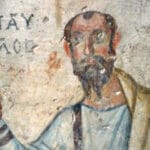
Yet we do also find some more ‘realistic’ depictions of Jesus, such as those found in the frescoes of the Dura-Europos synagogue in the third century. Here we have Jesus looking pretty much what we would expect a Palestinian Jewish man to look like.
The real “big bang” of Christian art occurs after Constantine. Here we get the Jesus who is more familiar to us today, with long hair, a big beard, and flowing robes. A Christian Rome began drawing on the iconographic palette of older deities, like Zeus and Ascelpius, to form an image of Jesus which embodied the power of Rome. Of course, this image is a far cry from Jesus of Nazareth. There is a certain irony that this Jewish teacher who criticised luxurious clothing and long flowing robes ends up being depicted in the very terms which he critiqued. This should serve as a cautionary tale: whose interests and images do our own depictions today reflect?
IP: We remain in the position of not knowing from the gospels what Jesus looks like—but still having a restless curiosity about him! How should we deal with these two realities?
JN: I think we have to take the Gospels’ silence both seriously and lightly. We have to take it seriously, because we are all doing something with it, and what we do with it is not always helpful. The global image of Jesus which became normative via Western colonialism—Jesus the European, with long flowing hair parted in the middle, strikingly handsome and, of course, non–disabled—has the potential to create a normative picture of ‘divinity’. In her essay, ‘God is not a white man,’ Chine McDonald has written well of the ‘divinisation of whiteness’ to which this image contributes, and we might speak of the divinisation of certain types of bodies as well.
We have to take it lightly, in the sense that our ideas or images of Jesus are not Jesus himself. My favourite poem of C.S. Lewis shares this sentiment:
Thoughts are but coins
Let me not trust, instead of
Thee, their thin worn image of thy head.
In Shusako Endō’s novel, Silence, a Jesuit priest is invited to step on an image of Christ—the image which he has held dear through all his missionary pursuits. It is only by stepping on the image that he can save the lives of the Japanese converts. I wonder if a similar thing has to happen today. We have to let go of some of our familiar images, so that we can allow more compelling ones to take their place.
IP: Thank you for that reminder and encouragement!

Dr John Nelson teaches Theology & Philosophy at Haberdashers’ Boys’ School, writes Behind the Gospels and is Producer & Researcher of the history podcast, Biblical Time Machine. His revised PhD thesis at the University of Edinburgh is forthcoming as Jesus’ Physical Appearance: Biography, Christology and Philosophy (2025).
 Buy me a Coffee

























This is fascinating reading thanks. I am certain that there is a connection with the apparent perception of someone’s visage and their internal spiritual state. One is probably familiar with the appearance of someone harbouring long term resentment and bitterness as opposed to one experiencing long term joy and happiness. So if Jesus who was constantly in deep communion with his Father one wonders how this would show on his appearance?
I think the question is: is our inference of people’s true state from their appearance an exercise of discernment or the result of prejudice? ‘Man looks on the outside…’!
We need to turn to Isaiah, who says (in 53:2) that he “had no beauty or majesty to attract us to him; nothing in his appearance that we should desire him” – in other words, he was a normal-looking man. Except that he had no sin in his face. It is not hard to tell rogues by their faces, and Jesus was the opposite, although I doubt that even the most saintly and talented Renaissance artist could catch this (except via a symbolic halo!)
Isaiah (50:6) also makes clear he had a beard, as this was pulled out during his last tortures.
I recall that horrible recent ‘scholarly’ reconstruction at top, doubtless representative of the genetic traits of persons of the day and place but definitely looking ‘a bit simple’. I suggest it was put out with a plausibly deniable secular agenda.
At a meeting with producers of the “Jesus” film, I asked the question whether it was providence or accidence thar Jesus didn’t live in the age of film/television! They didn’t seem to get the point, but I do think it makes a difference that we only have written Gospel accounts not visual records of the life of Jesus (as is the case for many pre-literate language groups today).
Ah, but what if one of the audiocassette recordings of the Sermon on the Mount turns up in a cave? (We’re not even sure what langauge He taught in!)
Can I give a nod to David Shillingford Paynter RA OBE (1900 – 1973) who was the son of Arthur Paynter (English missionary) and Anagi Weerasooriya (from Ceylon). He was a celebrated artist and probably one the first to depict biblical scenes in paintings and murals using indigenous Sri Lankans as his models against the customs of that time. Much of his work survives to this day.
So, maybe I was misinformed but I understood the lack of knowledge about the likeness of Jesus was informed by the Jewish commandment against any graven image. As those disciples who encountered Jesus were primarily of Jewish origin there would have been from the beginning a reluctance to depict Jesus? Then of course once there were Gentile followers of the Way it was too late to capture the likeness of the living Jesus.
More than one image has been generated based on the Shroud of Turin that supposedly accurate capture the face of Jesus. Easy to find on the Internet, and the image is remarkably similar to the classical ones we have which are disparaged by Chine McDonald. So it depends on what you think of the authenticity of the Shroud.
Isaiah prophesied details of a ‘suffering servant’, whom Christians take to be Jesus. As well as being flogged, this man would have his beard pulled out (Isaiah 50:6). The figure on the Shroud has a beard – with forks, which would be the obvious thing to tug. The gospel of John (19:1-20:7) indicates that Jesus was stripped naked and crucified after being flogged. Pieces of cloth (the Greek is plural) were then used to wrap his body, together with spices to inhibit decay, and a separate cloth was placed over his head. John’s account is hard to reconcile with the claim that the Shroud was placed over Jesus’ entire body and head, from which it gained an imprint. A first century tomb in Jerusalem with surviving burial cloths was found in 2009; the body had been tightly wound with the material (which survived because it was later covered in plaster), and there was a separate facecloth, just as John describes. The large amount of crushed spices stated by John would separate the body from the cloth and grossly distort any image. Believers in the Shroud’s authenticity suggest that the image was formed by radiation from Christ’s body at his resurrection, but this is speculation, and is not consistent with distortion due to the spices. And if Jesus’ face was seen on the burial cloth, why does John not mention it?
Those are merely the biblical arguments. There are more concerning the history of the Turin Shroud.
I can only think of the apostle John who described Jesus as
full of grace [beauty] and truth.
Similarly his description of the Glorified human Jesus.
I am not aware of any artist who has depicted this Jesus.
I struggle to think why a physical understanding of how Jesus
might have looked – to what possible purpose other than to suggest that artistic interpretations of the human Christ are perhaps very wideof the mark,
Paul remarked
2 Cor 5:16 Wherefore henceforth know we no man after the flesh: yea, though we have known Christ after the flesh, yet now henceforth know we him no more.
However we do have a clearer description of the glorified Jesus
for the focus of our prostration,awe and worship.
Shalom.
Note the obligatory pop at ‘the white man’ – by a Nigerian who chooses to live and work in England. How do Africans picture Jesus? How do Indians or Chinese?
Did first century Jews look any different from anyone else in the eastern Mediterranean?
What I mean is, Chine McDonald’s comment is silly if predictable. The great majority of Christians in the early centuries were southern Europeans, and artists were going to draw on models they knew, especially of philosophers as the nearest equivalent they knew to Jesus. But if you look at early Coptic art you will find Jesus depicted as an Egyptian and in Ethiopian art as an Ethiopian.
In other word, it seems that each culture see Jesus as the optimal projection of itself, and art was not about realism but the representation of religious values. If Christianity had spread first in Nubia or in Persia and India, a different tradition would probably have arisen.
“The Image of Christ ” The catalogue of the exhibition SEEING SALVATION, is worth a look. Jesus depiticed in different cultures and times.
I’m glad to hear he may have been short. It’s often been an insult without physical foundation (Little Napoleon). At 5ft 5in and a bit (!) I know that perfection cones early to some of us.
Thanks for the article as a 6’6 African American, 71 years old minister of the gospel of Jesus Christ. I have been recently reading several articles and observing “you tube” discovering that there was a slave bible which left me saddened by colonialism’s efforts to distract us from many truths. The Ethiopian Eunuch received Christ before Paul’s conversion in Acts 8…Also, Joseph escaped to Egypt with Mary and Baby Jesus. A European family couldn’t blend with the community there…Zacheus had to climb a tree to see him we have to climb too . Africa is the cradle of civilization… I have been empowered by the gospel of Jesus. The Love, faithfulness and power of the Holy Spirit. In my conclusion I believe Jesus tapped his foot when he heard a well known poet James Brown’s anthem “Say it Loud Im Black and I’m Proud”…. Peace and Blessings
Don’t believe the lies that are repeated about the so-called Slave Bible. It was not a Bible, but a collection of passages, and it was the idea of a notable abolitionist, Beilby Porteus
Some thoughts:
Is there a key difference between the Gospels and the other ancient biographies. The others are being written by people firmly educated within the conventions of upper class Greco-Roman life (eg Suetonius). The Gospels start off as the accounts of the apostles, specifically Peter and John, two fishermen from Galilee. They might follow the same conventions as Suetonius, but is it totally surprising if they don’t?
If the ancient approach is to use physical descriptions to inform us about character, then that makes the physical descriptions a bit fictional. How many people at the time knew that? If the readers all know that saying Augustus was exceedingly handsome is really just a way of saying he would make a good Emperor, then don’t they all know that it doesn’t mean he really was as handsome as that. So if you start introducing physical descriptions like that into the Gospels, you’re introducing fiction that the reader at the time will know is a bit fictional.
So it maybe didn’t matter to the likes of Peter and John to give a physical description, and by the time the Gospels are being compiled and written properly no one is interested in adding new material (especially if it will be obvious what you’re doing).
Finally, the debate over our depictions is interesting, but there’s a trap in looking back to previous depictions and failing to see it with our ancestors eyes. John Everard Millais’s painting ‘Christ in the House of His Parents’ to our eyes is a classic depiction of Jesus as thoroughly white and north European (a pale red-haired boy). But in the 1850s when it was painted it was controversial because it was seen as depicted Jesus as thoroughly Jewish – pale skin and reddish hair being the Victorian stereotype for Jewish people.
The really big difference is that at least three of the gospels, and all of the letters, were written by Jews, and Judaism had a tradition of fidelity of accuracy in describing the deeds of a rabbi; not to mention fear of inaccuracy in transmitting the divine word. In contrast the Graceco-Roman world freely put words into the mouths of people according to what the author believed they *would* have said.
I suppose Jesus is the ultimate Everyman; the sinless exemplar for all nations. But very Jewish, from Israel and regular looking. Not the tough guy and not the Mr Darcy. Nothing special physically and nothing to distract us from what is important about him.