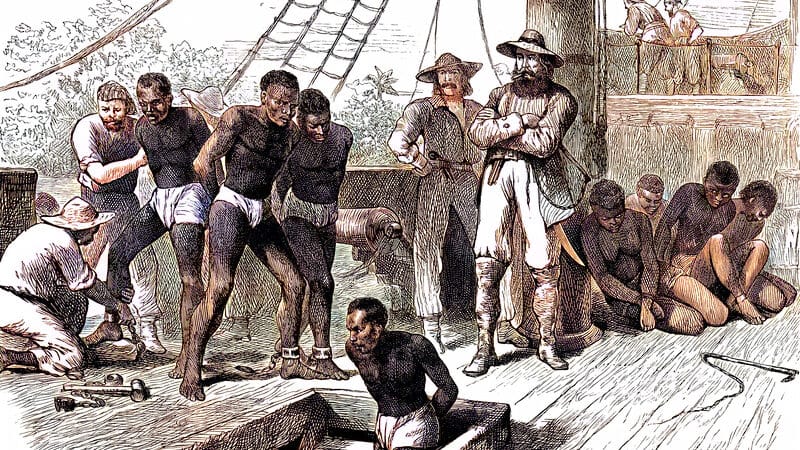
Lord Nigel Biggar is Regius Professor Emeritus of Moral Theology at the University of Oxford, and a well-known author on moral and ethical issues. He has just published Reparations: Slavery and the Tyranny of Imaginary Guilt (Swift, 2025), challenging the current narrative within and beyond the Church of England about the need for reparations for slavery. I had the chance to ask him about it.
IP: Why do you think the issues of reparations has become so important in recent years? What has sparked your interest in this issue?
NB: The topic of reparations for slavery is a distillation of the larger topic of ‘colonialism’. I first became interested in that issue during the 2014 referendum on Scottish independence. As an Anglo-Scot, I had a unionist dog in the fight and was viscerally opposed to the disintegration of the United Kingdom, which, according to the then British ambassador to the UN “would have had a devastating impact on the UK’s standing in the world, much greater than withdrawal from the EU ever would”.
Nevertheless, as a Christian, I could not regard the UK as divine. Nations and states come and ago. Before 1800 the United Kingdom did not exist. In the 1860s the United States almost ceased to exist. In 1993 Czechoslovakia did cease to exist. It was possible, therefore, that the Scottish nationalists were right and that the UK had come to the end of its justifiable shelf-life. So I felt morally obliged to consider nationalist arguments. And one I came across amounted to this equation: Britain equals Empire equals Evil. Therefore, Scotland needs to repudiate Britain’s bloodstained imperial past and sail off into a bright, new, shiny, sin-free future.
Yet, having read about the history of the British Empire for more than two decades, I knew that the simple equation, Empire equals Evil, is not historically tenable. But that was when I realised that colonial history was being used—and abused—for political purposes that I regarded as destructive. And I thought that someone needed to correct the distorted record—which I have sought to do in my 2023 book, Colonialism: A Moral Reckoning. I did actually broach the issue of British reparations for slavery there, but my latest book, Reparations: Slavery and the Tyranny of Imaginary Guilt is a much fuller treatment of the issue.
Why has the issue of reparations for slavery two centuries ago risen up the political agenda in recent years? The reasons are several. The immediate cause was the killing of the African American, George Floyd, by a policeman in Minneapolis in May 2020. This fueled a major upsurge in the US of the Black Lives Matter movement (BLM), which had emerged in 2014 as an informal alliance of people concerned to combat anti-racism in general, and specifically police violence toward black people in particular.
The BLM cause quickly crossed the Atlantic, where it was eagerly taken up by anti-racist groups who used it to promote the narrative that the UK, like the US, is systemically racist and that this systemic racism is rooted in historic British slave-trading and slavery. The causal connection between the 18th century and the present is ‘colonialism’, which the British—allegedly—continue to venerate. Therefore, in order to exorcise themselves of racism, the argument goes, the British must repudiate their colonial past, which can be summed up in one word: slavery.
The second cause of the present topicality of British slavery is exploiting the first but is somewhat older. In 2013 CARICOM—the Caribbean Community of fifteen member states and five associates—established a Reparations Commission to press the case for reparatory justice against former European colonial rulers such as Britain for “native genocide and slavery”. The case for reparations acquired a measure of apparent financial precision with the publication of the ‘Brattle’ report in June 2023, which calculated Britain’s debt as £18 trillion.
The Caribbean campaign for reparations is one expression of the third, more general cause, namely, a growing, worldwide assertiveness on the part of formerly colonised indigenous peoples. While this can be traced back to the League of Nations in the 1920s, it began to gather steam through the United Nations in the post-1945 period, finding focus in the 2007 UN Declaration on the Rights of Indigenous Peoples.
IP: I am sure everyone would agree that slavery is an appalling evil. How widespread has it been historically, and how significant was the Atlantic slave trade in that?
NB: One of the several contexts of the British enslavement of Africans between, roughly, 1650 and the early 1800s, that reparations-advocates invariably obscure is slavery’s historical universality. Across the globe societies employed slave labour in agriculture, mining, public works and even as troops. All the ancient Mesopotamian civilisations practised slavery in one form or another, starting with Egypt in the third millennium bc. To the west, around the shores of the Mediterranean Sea, the ancient Greeks, Carthaginians and Romans followed. To the east, slavery could be found among the Chinese from at least the seventh century AD, and subsequently among the Japanese and Koreans. In the Americas, the peoples of the Pacific North-West practised it from before the sixth century AD, the Incas and the Aztecs extracted forced labour from subject peoples from the fifteenth century, and the Comanches “built the largest slave economy” in what is now the south-west of the US from the eighteenth century.
From the time of Muhammad in the 600s onward, slavery was practised throughout the Islamic world. In the eighth and ninth centuries the Vikings supplied slave markets in Arab Spain and Egypt with slaves—again, white slaves—from eastern Europe and the British Isles. In the 1600s corsairs or pirates from the Barbary Coast of North Africa raided English merchant ships, and even villages in Cornwall and west Cork, for slaves. One estimate has it that raiders from Tunis, Algiers and Tripoli alone enslaved between 1 million and 1.25 million Europeans from the beginning of the sixteenth century to the middle of the eighteenth century. Another estimate reckons that the Muslim slave trade as a whole, which lasted until 1920, transported about 17 million slaves, mostly African, exceeding by a considerable margin the approximately 11 million shipped by Europeans across the Atlantic.
IP: Part of the challenge with reading the history of the Atlantic slave trade is locating in its historical context, particularly in the context of the conditions of ordinary men and women of the time. What difference does that make to the argument?
NB: There is no doubt that European enslavement of Africans in the sugar plantations of the West Indies was typically very brutal indeed, and it horrifies us. It is also true that other forms of slavery—such as domestic slavery in the Muslim world—was often less brutal.
That said, we need to put the horrors of British slavery in context. Enslaved African boys were often brought to the Arab world to serve as eunuchs. To that end, they had their genitals forcibly removed with a razor and the resultant wound cauterized by boiling oil. Nine out of ten of them died in the process.
And while urban workers in early industrial England were not slaves, because they had legal rights, their conditions of work and living were often quite appalling. They died young and in droves.
What difference does this make to the argument? It reminds us that life in the past—even in the quite recent past—was often ‘nasty, short, and brutish’. It reminds us that inhumane treatment was widespread and not at all confined to Europe or to formal slaves. And it reminds us that history contains an ocean of injustice, which is beyond human rectification. We are not gods; we cannot raise the murdered dead. Our instinctive desire for justice is one of the main fuels for belief in a God who can.
IP: It has been claimed that the slave trade was of great economic significance to the growth and economic development of the West, and therefore is of unique historic importance. Is that a fair claim, and has that been contested?
NB: A 2023 document sanctioned by the Church Commissioners for England, the body responsible for managing the Church of England’s assets, claims that profits from slave-trading and slavery were “central” to Britain’s industrial prosperity. This takes its cue from Capitalism and Slavery, the 1940 work by the Marxist historian, Eric Williams.
However, what the Commissioners present as uncontested fact is a highly controversial issue. Most historians reckon slavery’s contribution to Britain’s prosperity somewhere between small and modest. And Professor David Eltis—who, according to the African American historian, Henry Louis Gates of Harvard University, is “the world’s leading scholar of the slave trade”—goes so far as to describe the contribution of slave-trading to the wider economy of Liverpool, Britain’s main slave-trading port in the mid-1770s, as “trivial”.
Those who present the ‘centrality’ of slavery to industrial growth as a simple fact are either ignorant or disingenuous.
IP: It is not always recognised that Britain and its Empire played a unique role in the ending of the Atlantic slave trade—and the elimination of other forms of slavery around the Empire. What is the evidence for this, and how does it affect the debate on reparations?
NB: Yet another context that reparations-advocates completely ignore is that the British were among the first peoples in the history of the world to abolish slave-trading and slavery in all their territories, in the early 1800s. They then used their global dominance, following the Battle of Waterloo in 1815, to suppress both the trade and the institution from the Pacific North-West, across Africa and India, to New Zealand. In mid-century, the Royal Navy devoted over 13 per cent of its total manpower to stopping slave-traffic between West Africa and Brazil.
At the same time, Sir Thomas Fowell Buxton’s idea that the key to ending the slave trade and slavery in Africa was to promote alternative, ‘legitimate’ commerce, was gaining traction. This led to the setting up of trading posts in West Africa, and then, when the merchants complained of the lack of security, a more assertive colonial presence on land. In 1851, having tried in vain to persuade its ruler to terminate the commerce in slaves, the British attacked Lagos and destroyed its slaving facilities. Ten years later, when an attempt was made to revive the trade in 1861, they annexed Lagos as a colony. Observe the developmental logic of ‘colonialism’ here: first, the humanitarian intent; then the promotion of commerce; and finally, the imposition of colonial rule.
Unlike the cheap contemporary performance of ‘decolonising’ virtue, the sustained British campaign against slavery was expensive in both lives and money. David Eltis reckons that nineteenth-century expenditure on slavery-suppression outstripped the eighteenth-century benefits. And the political scientists, Chaim Kaufmann and Robert Pape concluded that Britain’s effort to suppress the Atlantic slave trade alone in 1807–67 was “the most expensive example [of costly international moral action] recorded in modern history”.
IP: I am of Irish heritage, and so one obvious question for me is: if there should be reparations for slavery, then why should there not also be reparations for the harm done to my ancestors? Is that a reasonable question to ask, and how do those arguing for reparations respond to such challenges?
NB: The answer to this question exposes the racist bias of the case for reparations: only black victims matter. My ancestors were Scottish, not Irish. But they, too, suffered in the 1600s. They were Presbyterian Covenanters, who refused to have bishops and the Anglican Book of Common Prayer imposed on them. As a consequence, they had to worship in secret, because their meetings were banned. They fought battles that they lost. And they were hunted by government troops in the hills of Galloway. Do I feel their pain? Do I suffer ‘intergenerational trauma’? Not obviously. An awful lot has happened to change the fate of their descendants. Other causes have intervened. My condition is not at all theirs. Thank God in heaven!
And yes, of course, all manner of people suffered grievously in the past: medieval serfs and early industrial workers and white slaves. So why privilege enslaved Africans and point the finger only and unfairly at their white enslavers? The obvious answer is that such a distorted focus best serves the exploitation of white elites, who, knowing no history and terrified of being labelled racist, indulge in ‘imaginary guilt’.
IP: Is there evidence of slavery having left a permanent and current negative impact on certain nations?
NB: Common sense tells us that historic slavery is bound to have left its mark on the descendants of enslaved people. But that mark needn’t always be negative: some say that one of the legacies of enslavement is resilience.
The claim made by reparations-advocates, however, is that the contemporary descendants of slaves continue to suffer the effects of historic slavery—they suffer ‘intergenerational trauma’. But this is invariably asserted, not substantiated.
What’s more, if early 19th century slavery is responsible for the present plight of Caribbean people, how come that plight varies so much? There are considerable differences between Jamaica, with a GDP per capita in 2019 of $5,500, and Barbados, with a GDP per capita of $18,000 (which is an average for the world). Indeed, not only has Barbados achieved the world average in GDP per capita, but in 2019 life expectancy at birth in post-slavery Barbados was 14 years higher than in post-slave-trading Nigeria, literacy (in Barbados in 2014) was over 60 per cent higher (than in Nigeria in 2018), and Gross National Income per capita in $US in 2023 twelve times higher.
In fact, according to Tirthankar Roy, the West Bengali-born Professor of Economic History at the London School of Economics and author of The Economic History of Colonialism, upon gaining independence in the 1960s:
Jamaica, Trinidad and Tobago, and Barbados had the highest average income and literacy rates in the region, incomes per head were three to four times that in the long-independent Dominican Republic and Haiti, literacy rates were around 15 [per cent] in Haiti and 75-80 [per cent] in Jamaica. Almost certainly, public health was also similarly advanced.
As for the emergence of subsequent disparities between Barbados and Jamaica, Roy has this to say:
Jamaica after independence was particularly badly governed and saw a deep stagnation during 1972 and 1984, when standards of living actually fell. There are few countries in the world not engaged in civil war that had as bad a growth record as did post-independence Jamaica. Average income recovered only so much that its real average income is now what it had been around 1975. Overall, the West Indies region saw rather little economic growth in the 1970s, 1980s, 1990s, when many Asian countries (colonial or not) forged ahead. The reason was bad and corrupt government, not the burden of colonialism.
…nor the effects of historic slavery.
IP: The Church of England has been caught up in these arguments, because of the proposed Project Spire launched by the Church Commissioners. How do you think we should respond to the proposals that have been made?
NB: My view is that Project Spire is well intentioned. Those behind it believe that, in publicly repenting of the Church of England’s involvement in slave-trading—by devoting an initial £100m of the church’s assets to supporting black-led enterprises—they will make it more attractive to the descendants of enslaved Africans. The problem, however, is that the project is premised on ‘imaginary guilt’.
Guilt, like pain, can be good. When we put our hand next to a flame, it burns and, if our body is functioning well, it hurts. The pain we feel warns us of the physical damage being done and prompts us to pull our hand back. Similarly, the feeling of guilt pains us, alerting us to our having wronged someone and urging us to put things right again by apologising and repairing whatever damage we’ve done. The apology is itself an act of reparation, in that, by communicating to the injured party that we know we’ve done wrong, we signal that we share their moral view and thereby we begin to restore trust. However, if the wrong we’ve done is more serious than, say, an unkind word, we need to do more than merely apologise; we need to go further and restore what’s been lost or destroyed, or, if that’s not possible, offer some equivalent compensation. Guilt as a response to personal wrongdoing is healthy.
But false, imaginary guilt is not.
 As I have reported in my book, several eminent historians have shown that the Church did not profit from slave-trading. Moreover, Project Spire is based on the cartoonishly racist—and racially divisive—narrative of white oppressors exploiting black victims. Since February 2024 I and others have been arguing in public that the project is historically groundless, ethically unjustified, procedurally reckless, and should be stopped. ‘We’ include a former incumbent of the Anglican Church’s premier professorial chair of moral theology, a professor of history at Cambridge, a professor of history at Oxford, a professor of international banking and author of a book on the South Sea Company, a KC and former Old Bailey judge, the Anglo-Indian director of an anti-racist body, and an eminent descendant of African slaves brought to Jamaica.
How has the Church—in the form of the Church Commissioners for England—responded to us? With defamation, evasiveness, silence, and intimidation. This is not behaviour befitting any organisation, especially not a Christian one, and most especially not the body responsible for managing the Church of England’s assets. Nor is it the response of a body confident of its own position.
This issue is not going to go away. Questions are now being asked in Parliament. If the Church Commissioners keep on digging, they risk embroiling themselves and the Church in a major national scandal, which reputations may not survive. That would be tragic. We beg them to stop, to listen, and, if they cannot answer, to turn around. Now, with the appointment of a new Archbishop of Canterbury, is the opportunity to turn over a new leaf.
IP: Thank you for your fascinating answers and observations. I am sure that you are right, and that this whole project needs a serious rethink.
 Nigel Biggar is Lord Biggar of Castle Douglas, Regius Professor Emeritus of Moral Theology at the University of Oxford, and Distinguished Scholar-in-Residence at Pusey House, Oxford, and a priest in the Church of England.
Described as “one of the leading living Western ethicists” (by John Gray, formerly Professor of European Thought at the London School of Economics, New Statesman, 25 November 2020), Professor Biggar was appointed Commander of the British Empire “for services to higher education” in the 2021 Queen’s Birthday Honours list and named one of Prospect magazine’s Top Thinkers of 2024. In January 2025 he entered the House of Lords as a Conservative peer.
Among his most recent books are Reparations: Slavery and the Tyranny of Imaginary Guilt (Swift, 2025); Colonialism: A Moral Reckoning (William Collins, 2023, 2024), What’s Wrong with Rights? (Oxford, 2020), Between Kin and Cosmopolis: An Ethic of the Nation (2014), and In Defence of War (Oxford, 2013).
His hobbies include walking over battlefields. In 1973 he drove a Morris Traveller from Scotland to Afghanistan; and in 2015 and 2017 he trekked across the mountains of central Crete in the footsteps of Patrick Leigh-Fermor and his comrades, when they abducted General Kreipe in April-May 1944. He enjoys playing an anarchical card-game.
 Buy me a Coffee


























I’d say there are several things not mentioned here (perhaps they are in the book) that make the issue slightly more complex.
1) I suspect the assessment ‘slave-trading to the wider economy of Liverpool, Britain’s main slave-trading port in the mid-1770s, [was] “trivial”’ only factors in the direct contribution of slave-trading itself (i.e. the value of trading slaves) without taking into account the cheaper goods produced by those slaves. The vast majority of cotton imports in the 19th Century stemmed from American cotton plantations. I doubt very much that Britain’s corner of the cotton manufacturing industry contributed only a trivial amount to Britain’s economy.
2) During the time where slave-trading was legal in the empire, only a very small proportion of the population had any voting rights whatsoever. The same rich magnates trading in slaves/owning plantations/owning factories with terrible working conditions were the very same ones holding the reins of power, oppressing at home and abroad. To seek reparations from Britain today (presumably at the taxpayer’s expense) would be to extract money from the ancestors of people who had zero voting rights whatsoever because of the actions of the people who denied them their voting rights.
3) I see little in any of the discussions around reparations about seeking reparations from West African countries. The truth of the matter is Africans were also directly involved in the slave trade, kidnapping and selling those of other ethnic groups/tribes in exchange for goods/money. If there is a legitimate moral case in favour of reparations, then reparations of the ancestors of these enslavers should also be sought.
4) I think one of the issues with pressing too hard on the ‘well nobody alive was involved in the slave trade so it’s not fair for us to pay reparations’ line means the wealth generated from the slave trade (and the cheap goods it produced) also isn’t ‘ours’. And if the ill-gotten wealth isn’t ours, in what sense can we complain if it is then given away?
Re your point (1), I think that the cost of raw cotton has always been small compared to the cost of turning it into clothes. That is true even today when cotton is not picked by slaves and weaving is fully mechanised.
I’d add a point about payment: from whom to whom? Why should the British children of a West Indian father and English mother (for example) pay anything; and why should any payment be given to corrupt Third World politicians rather than their peoples?
Your point (4) raises a fascinating issue about the passage of time. Everybody (including me) thinks it is right to return Old Masters looted by the Nazis to the families of Jews dispossessed of them. (Is it crucial that specific families can be identified – and also specific goods, whereas money is fungible?) In contrast, nobody thinks that British people having French surnames running provably further back than the Huguenots (i.e. running back to the Norman Conquest) should pay reparations to the rest of us, even though they are still wealthier on average nearly a thousand years later. (“A study of family surnames between 1861 and 2011 showed that bearers of Norman surnames were, on average, slightly more than 10 percent wealthier than the mean” – Daniel Hannan, How we invented freedom and why it matters.)
Your 2nd paragraph feeds into my 2nd point as well. Given there is a significant number of descendants of slaves who are British citizens, why should they have to pay for the damage done by the British Empire to their own ancestors?
The passage of time and the force of ethical issues crops up in so many places. It seems somewhat strange to me for people to hold the view that Jewish people have right to reside in the holy land that supercedes the Palestinians who’d been living their for over a millennia (given how long it had been since the land of Israel was a Jewish state pre-1948) but also claiming that the appalling horrors of slavery are too far in the past to impose any obligations on reparations for us today.
That’s different; I take the Abrahamic covenant as implying the Jews have the right to hegemony in that plot of land whenever God is not exiling them for disobedience – to Baylon for 70 years for idolatry, and worldwide for 1800 years worldwide for rejecting His Son. But we should see occupation as the rule and of the Covenant, and exile the exception – regardless of timescales.
i was in Ghana in the summer, visited St George’s Castle, with the soberingly named “door of no return” which says it all really, and had the privilege to meet with local Christian leaders, including the director of the museum at the castle. We discussed these issues, listened to what they had to say, listened to young people there, including those who are mixed race, because they are the heirs of children fathered by white soldiers. It was humbling, thought provoking, listening to these educated and articulate Ghanaians.
Admittedly a small sample of people, yet not one of them was in favour of reparation. There was the obvious questions from them of who, how and why, withthe fear that reparation money would be wasted anyway. One comment was, isn’t this just so you can feel less bad about whjst you’ve done? i think this is a bit harsh, as restorative justice is so important, and we discussed that, but it is still a valid question. Another comment that stayed with me was “isn’t this just another example of colonialism, you deciding what you need to do to put things right, rather than asking us?” Sadly, i didn’t know enough about the process to know how valid a critique that is, but again an interesting comment.
Interestingly their concerns were more about the injustices of the present than reparation for the past. An oft quoted example was that although Ghana exports $1bn worth of cocoa beans it exports only $34m worth of chocolate (which has a much higher worth), because historically the means of producing chocolate have been denied them. What i heard amongst the young people was not pain from the past but a real desire for them to be enabled to build their own future, and the frustrations of being up against a powerful western ecomomy (which pays our pension fund) resisting their efforts.
Wow, what a challenging and helpful comment. Thanks so much.
Ah, mention chocolate and Ian is all ears! 🙂
Ah, mention chocolate and Ian is all ears! 🙂
You can say that again!
Aside: the chocolate example is misleading. Food commodities are always traded much more than consumer foodstuffs. The reason is that shipping consumer-grade food is expensive: you have to comply with the food standards, inspection regimes, and labelling requirements of the destination market, pack it all safely and securely, and oftentimes refrigerate it for the journey. Shipping a commodity that will be processed extensively before it goes near a consumer is much simpler and cheaper. Companies like Nestle, Kelloggs, Coca Cola etc. don’t ship their products around the world, they make in the market they sell in. Even something as simple as sugar is shipped in a rough form (where it often has be drilled out of the hull of the ship) to be refined to be bought by consumers in the UK.
While it is true that “food commodities are always traded much more than consumer foodstuffs”, the factors that you mention (processing/storage/cold chain distribution) are constraints, but not insurmountable barriers.
Instead tariff escalation is the primary structural reason that Ghana doesn’t export chocolate to developed countries.
Thereby, raw food imports (e.g. cocoa beans) are treated more favourably than the most basic of processed agricultural products (e.g. cocoa powder and chocolate crumb containing cocoa butter) by imposing ad valorem taxes on the latter.
For instance, for cocoa, the comparative prices were:
Bean price: GBP 5,210 – 6,190/tonne (0% tariff)
Butter price: : GBP ~8,300/tonne (~7% tariff)
Powder price: GBP ~6,000 – £7,000/tonne (~8% tariff)
Chocolate attracts an 8 – 12% tariff.
The UK food industry lobbies government vigorously to maintain and even increase these differential rates of protection between stages of production.
In fact the UK has a Trade Partnership Agreement with Ghana meaning that Ghanaian products actually attract 0% tariffs. The EU’s Economic Partnership Agreement with Ghana is similar. If the UK food industry has been furiously lobbying to keep out Ghanaian chocolate bars with tariffs, it’s been in vain.
A bigger issue is the refusal of Western institutions to invest or partner in the fossil fuel industry in Africa (e.g. World Bank in 2010, UK government 2021), thereby driving African nations to align with Russia and China. Not very long ago Ghana had one of the fastest-growing economies in the world, but has reverted to blackouts. Many Africans still cook indoors using smoky biofuels that cause poor respiratory health. All this is due to another example of virtue-seeking, regarding climate change.
But I would add that, even if investment, is available, it is very hard indeed to start and run a successful business in a place where corruption is endemic.
I don’t find the argument for reparations for slavery convincing, for many of the arguments given. However, looking at Adam’s and Dominic’s comments – the argument that the world economy is currently skewed in favour of former colonialist powers and their companies eg Coca Cola perhaps) suggests to me that any reparations (or readjusting of the financial rules) should rather be on the basis of colonialism and historic European/American economic dominance.
There is much important information and analysis in this interview, but there are two important elements missing:
1. As Orlando Patterson, the Jamaican-born professor of sociology at Harvard wrote in ‘The Sociology of Slavery’, the islands of the Caribbean are unique in world history as slave societies that were artificially created solely for the production of agricultural goods, mostly sugar. The impact of that distortion has not completely disappeared.
2. It was slavery in the most extreme racialised form – powerful white masters convinced of their superiority over powerless and brutalised black slaves whose cultures, languages and religions were seen as worthless and suppressed. And with lasting effect on subsequent white perceptions.
For these reasons the legacy of slavery in the Caribbean is of a different order to other forms of enslavement and injustice.
Whilst the concept of intergenerational trauma is slippery, I believe it has force – evidenced in the broadly different senses of bearing and self-assurance between Caribbean and West African descended people on Tottenham High Road today.
It is arguable that the payment of reparations (by Franz Fanon for example) consolidates rather than assuages that sense of psychic injury, but the question of whether or how the legacy of that damage should be addressed needs serious thought and response, not least by the Church of England as the bearer of our nation’s moral and spiritual identity during the centuries of our enslaving; and whether or not money should be part of that recognition and apology.
Personally I think that some sort of permanent public expression of repentance and sorrow – for example a statue in Westminster Abbey, if not the fourth plinth in Trafalgar Square – is at least appropriate.
Not to mention the removal of statues, or sending them for a swim in Bristol docks…
Sensible points from Lord Biggar. As he mentions the UK did a lot to abolish slavery so should not be required to pay reparations.
There may arguably be a case for reparations from old aristocrat families, companies and institutions like the Royal family and Church of England where it is proved they benefited financially from owning slaves pre 1800 and investing in slave trading companies. Yet even that is arguable for the Church of England at least as the article makes clear and anyway should be voluntary
while urban workers in early industrial England were not slaves, because they had legal rights, their conditions of work and living were often quite appalling.
But were they worse than in working the land, which they had quit? Arguably they traded job security for a *higher* standard of living. The point is that the Industrial Revolution made an alternative possible to a hierarchical farming-based society for the first time in human history. (Actually the second time, because no landed aristocracy was mandated – in fact it was actively prevented by Jubilee regulations – in ancient Israel’s written Laws of Moses.) Also, the cities *concentrated* the poor, enabling them to organise – for revolution in Russia and for Trade Unions in Britain.
PS Factory conditions in the early Industrial Revolution might not have been so bad had the country not been so strapped for cash as a result of the Napoleonic Wars. EP Thompson, in his famous/notorious book The making of the English working class, is ambivalent (inconsistent?) about this effect and about Napoleon.
I’d be cautious about imagining that people were simply quitting farming of their own volition in search of a better living in the cities. England went through about 200 years of enclosures where farmland was reorganised and people thrown off it.
As an American (and a historian), I can’t quite get my head around the emotional need some older Brits have to continue to believe the 19th-century propaganda about the character and purpose of the British Empire. Christians especially have no business attempting to justify empire (which is definitionally a quest for power and wealth), and certainly can’t claim any degree of moral rigor when they engage in the kind of “whataboutism” that Lord Biggar seems to like so much. What about Muslim slavery? What about Ireland? What about the workers? What about West African slave traders? What about any and every excuse not to look squarely at the central role played by British merchants in the Transatlantic slave trade and at the unique brutality of that system, which flourished under British rule in the New World.
Look, you don’t have to like the idea of reparations. You’re well within your rights to say, “Well, everyone involved has been dead for 200 years, and it’s too difficult to actually asign blame.” You’re also within your rights to demand that the nations of West Africa, who eagerly sold millions of fellow beings into bondage, pay up as well (and incidentally, African-Americans know full well the role played by those nations, and resent them for it). You can even argue about the degree to which the C of E was actually involved in slavery. But what’s not going to work is waving away the problem of British complicity in the slave trade, or the damage it caused. GDP and literacy are not measures of suffering or oppression, except within the logic of justifying empire (“we made you rich and taught you to read, so stop complaining”). As another commenter pointed out, an economy built on processing slave cotton can’t very well claim that slavery was “trivial” to its growth.
Beneath all this rhetoric is the old British outrage at the ungrateful subaltern who refuses to recognize that he’s being lifted out of barbarism into civilization. What the defenders of empire have failed to remember is that someone who solves a problem they helped create (and profited from) does not receive any gratitude for doing the right thing, and that the police department that enriches itself by enforcing the law is considered corrupt and evil. Lord Biggar openly admits that destroying the slave trade was part of the process of colonization and economic exploitation, so (to paraphrase a certain 1st-century Jewish rabble-rouser) the British empire “has had its reward” and deserves no moral credit. Nor does the campaign against slavery cancel out manmade famines in India, or the plantation system in the British West Indies, or the numerous and brutal colonial wars that had nothing to do with slavery, like the Opium Wars or the Anglo-Zulu War or the Indian Mutiny of 1857 (not to mention the wars where slavery was merely a pretense to cover political aims, like the Boer War). Again, speaking as an American who’s trained in history, the tendency of British people to look to cranks like Lord Biggar to ease their consciences about the British Empire suggests that the British have not yet begun to truly understand their own imperial history. It’s an attempt to reconcile God and Mammon driven by emotion rather than history. The Church has nothing to gain by it.
I’m of Anglo-Saxon heritage (blond hair and blue eyes). I want reparations from France for one their dukes coming over here and subduing (enslaving?) my nation, introducing new taxes (and the French language) and replacing my ancestors with French aristocrats. While you be my advocate, please?
Can’t you edit here?
Read historian Alan Lester’s review of Biggar’s work (written in the peer-reviewed The Journal of Imperial and Commonwealth History) if you doubt my assertion that he’s a crank. If anything, it’s probably too mild a description:
https://www.tandfonline.com/doi/full/10.1080/03086534.2023.2209947
(Also, that an Anglican priest should devote years of his life to serving as an apologist for a dead empire and even claim to offer a “Christian ethics of empire” is shameless and disgusting. To quote a certain well-known Anglican author, “Better be without sense, than misapply it as you do.”)
Play the ball, not the man
Sorry for assuming this was a Christian setting rather than one more bastion of partisan moral relativism. Also, good job ignoring the link that was a review of Biggar’s crummy scholarship rather than his moral character, although I don’t see how the two can actually be separated given that Biggar explicitely positions his work as a moral (rather than merely historical) project.
Nothing like a good row between historians!
See Biggar’s reply to Lester, also in The Journal of Imperial and Commonwealth History, exposing Lester’s mistakes and bias.
Thank you for that link, and I am glad that someone else has posted a link below to Biggar’s response. Alan Lester is of a younger generation than Biggar, I think, and his assumption that Biggar is motivated by the politics of the Right since the time of the Brexit vote is shallow. In broadbrush terms, pre-war British historians had nothing bad to say about the British Empire, and postwar historians nothing good. Obviously both are simplistic, and I expect Biggar is writing to try to present a more balanced view between the two – a view which representatives of the postwar view are still around to dispute, hence the controversy. It has little or nothing to do with Brexit right-wingery.
Empires are founded by intrepid but selfish adventurers out to make a name and a fortune, and the British empire is no exception. The question is whether it nevertheless did a certain amount of good. I’ll not attempt to answer the question, but I will point out that the Celts of Europe no doubt chafed under the Romans, but the Romans brought towns with running water, paved roads, valuable goods not produced locally, literacy, a procedural legal system, and peace (pax Romana) in place of tribal feuding. After Rome had conquered Gaul there were theatres, public baths, country villas and estates. On the other hand many Gauls died fighting the Romans, and more were enslaved. Conquered peoples had to pay taxes to Rome, and obey it.
This is the colonialism debate in microcosm. I’d like to consider an updated version of the Monty Python scene, and put a question rhetorically into the mouths of some former subjects of the British Empire: What have the British ever done for us?
Lawrence James closes his history of the British empire with a quote from Nelson Mandela lauding the British Empire for its exports. Who will call Mandela an Uncle Tom?
How odd that the crank’s own rebuttal of Alan Lester should survive peer-review to appear in the every same journal. How odd that Tim James failed to mention that.
Great points, beautifully put.
If “destroying the slave trade was part of the process of colonization and economic exploitation” and is part of empire then I don’t think that you can simultaneously complain about empire and complain about us not stopping the slave trade sooner.
There are three possibilities for a scientifically advanced and industrially advanced country like imperial Britain:
1. Stop the foreign countries from doing what he hate.
2. Allow the foreign countries to continue doing what we hate but boycott them.
3. Trade and partner with the foreign countries who do what we hate
All have strengths. And all have weaknesses. And it seems to me that the polemicist with a chip on his shoulder can complain about any of them.
Slavery apart from the European white-on-black variety is ignored for the simple reason that other slave-owning cultures have been failures compared to Europe and in particular to the British Empire, whose language and mores still span the globe. Owing to their failure, these other cultures acquire the status of victims, and hence are beyond criticism. The most slave-tainted culture, that of Islam, also happens to respond to criticism somewhat differently than does the West and in a manner that I will simply observe makes it far safer and thus more advisable to play out one’s imaginary guilt against the British Empire.
It would be quite interesting for someone in Africa to call for reparations from Islam—or even justice for the Arab conquest of North Africa…?
Asking that question to an African would be similar to a person passing a shop that’s been looted and decides to loot also simply because someone else is doing it knowing well that it’s wrong.
I am sorry but it’s not the same.
I don’t understand your parallel. Britain had to fight against Arabs to prevent them enslaving Africans.
They still do it. Did you know that the common Arab term for black people means ‘slave’?
David Shepherd,
Thank you for your cut and paste from Wikipedia on the topic of agriculture.
If I might bring you back to the actual topic of the thread.
Biggar calls out the tyranny of imaginary guilt.
I trust that you are happy to join with him in repudiating critical race theorists and their attempt to foster an entirely false and pernicious narrative of victimhood and oppression in the context of the United Kingdom.
“A 2023 document sanctioned by the Church Commissioners for England, the body responsible for managing the Church of England’s assets, claims that profits from slave-trading and slavery were “central” to Britain’s industrial prosperity. This takes its cue from Capitalism and Slavery, the 1940 work by the Marxist historian, Eric Williams.”
A couple of clarifications:
1. The 2023 document does not assert that “profits from slave-trading and slavery were “central” to Britain’s industrial prosperity”. Instead, it states that: “African chattel enslavement was central to the growth of the British economy of the 18th and 19th centuries and the nation’s wealth thereafter. Industries that benefited included iron and steel, shipbuilding, weapons, coal mines, woollen and cotton manufacture, farming, fishing, merchant banking and insurance.”
The latter statement validly considers enslavement as a system—not just narrowly focusing on the profits from slave-trading (as Lord Biggar does), but the entire economic architecture built around slavery, including:
• Plantation output: Sugar, cotton, tobacco—raw materials that fuelled British industry.
• Colonial logistics: Shipping, insurance, and banking services tied to slave-based commerce.
• Industrial linkages: Textile mills processing slave-grown cotton; ironworks producing shackles and ship fittings.
• Long-term wealth effects: Capital accumulation from slavery reinvested into infrastructure, finance, and manufacturing
Of course, in terms of profits from slavery, there’s evidence of wealthy slave-owners and investors in the slave trade, who founded banks* that financed the Industrial Revolution. However, any assertion of those banks being central to Britain’s industrial prosperity is harder to prove.
2. Concerning Lord Biggar’s suggestion that the above assertion derived from Eric Williams’ Capitalism and Slavery, it’s worth reading the following assessment of Williams’ work by Elijah Kellett https://academia.edu/resource/work/11186378
He highlights more than one component to Williams’ thesis. The last component was that Williams said that “[due to] the rise in industrialism, the need for importation of slaves declined. Through syllogism., Williams shows that the slave trade was larger in magnitude in the years when labor was a hand-to-hand process and required a constant stream of new workers due to these back-breaking conditions. Williams states that following the rapid industrialisation of the plantation system, and the invention of things like the cotton gin, made it “less practical to be brute-forcing new workers, when the old sources [then] lasted longer”.
Notably, none of the components of Williams’ thesis suggests that “profits from slave-trading and slavery were “central” to Britain’s industrial prosperity”.
*
i. William Deacon bank (founded 1778, under its former name of Lowe, Vere, Williams and Jennings) invested in both slavery and industrial machinery (e.g. James Watt’s workshop, equipment and other expenses used to develop the steam engine).
ii. Industrialist Anthony Bacon (1716 – 1786), who held government contracts for the supply of slaves, in 1765, set up Merthyr Tydfill, which became a centre for iron smelting in Britain. His business partner Gilbert Francklyn was a West Indian plantation owner.
iii. John Moss was a slave owner, who founded Moss, Dales and Rogers bank at 4 Exchange Buildings. He owned and traded slaves on Crooked Island in the Bahamas. His recorded investment in railways across Britain was £222,470 (at least £200m in today’s money) was key to the success of the Stephenson’s invention: https://www.londonreconnections.com/2020/slavery-and-the-railways-part-1-acknowledging-the-past/
iv. Bristol Bank (a,k,a, The New Bank) was formed 1786 as Ames, Cave, Harford, Daubeny & Bright. Levi Ames, John Cave, Joseph Harford, George Daubeny and Richard Bright, were all involved in and profited from the slave-trade, either personally or through family links. That bank re-invested its founders’ wealth from the slave trade into industrial growth in Bristol.
Lester attacks Biggar – Biggar responds, in the same journal.
https://www.tandfonline.com/doi/full/10.1080/03086534.2023.2209948 src=recsys#d1e186
I don’t have the historiographical skill, or knowledge of the sources to evaluate either piece adequately.
This is a very helpful thread of comments that indicates the complexity of this topic, the need for subtlety in the use of language and the importance of careful historical analysis which includes the voices of those in other parts of the world. This is a lively debate here in Lancaster (the fourth most important slave-trading port in England) where the churchyard graves of those who invested in slave trading ships have recently been daubed with red St George’s crosses. It’s so important to be able to stick with the complexity of it all and not rush to simple binaries and to hear different voices responding with courtesy not vilification or insult. It’s one of the most challenging and thought-provoking discussions here I’ve read & I’ve been challenged to think about it all more deeply – thanks everyone.
The descendants of Britain’s slaves are generally poor compared to UK citizens. This is surely relevant to the reparations debate, but it has been overlooked here by both Nigel and Ian. The British ended slavery, but they never gave their former slaves the right to send representatives to Westminster. Caribbean nations should be given the option of joining the UK’s democracy. This would result in a transfer of wealth to the descendants of slaves through the tax-benefit system. You could call this “reparations”, if you want, or you could just call it democracy or Christianity.
Look, we didn’t even give the American colonists the right to send representatives to Westminster, and look how that worked out!
This makes no sense. The Caribbean islands became colonies, then independent states. Some have left the Commonwealth, no doubt hoping Uncle Sam will bail them out.
Not sure any of them have left the Commonwealth (though stand to be corrected), but rather are planning on moving to being republics with their own President rather than the King as Head of State. They’d still stay in the Commonwealth – India for example did this in 1950.
Today’s Daily Sceptic
https://dailysceptic.org/2025/10/08/sir-lenny-henry-wants-18-trillion-of-slavery-reparations/
reports on an article in the Telegraph highlighting Sir Lenny Henry’s demand for £18 trillion of reparations and adding a number of further interesting remarks germane to this discussion.
so bankrupt a country that has given him a high standard of living, not to mention a knighthood? ok then.
He must be joking.
No, I’ve seen Lenny Henry. He has never been funny.
Everyone would agree slavery is appalling. I’m submitting a question I would like answered. If one was raised as a Christian how could anyone at any time in history not be appalled by it and why did the Church not condemn it and rise up against it immediately when it began.?
I think three reasons:
1. Life for those in manual labour was already hard, so the inhumanity did not stand out.
2. Many simply will not have known.
3. Then as now, the Church failed because it accommodated itself to the norms of its culture. The arguments for same-sex marriage run strangely parallel to the arguments *for* slavery at the time.
The OT sets out apparently God given rules for slavery. Surely that is a big part of why it continued if it was not condemned in the Scriptures of the 1st century.
Thank you for your reply. If the arguments for same sex marriage run parallel to the slavery ones then that means the C of E is self serving and is ignoring scripture to suit the prevailing culture so that it can survive. Survival at all costs is not Christian ethic is it? Do you think we have become more compassionate as a species throughout history compared to the times when inhumanity did not stand out? It seems that it has taken a long time for humans to adapt to Christianity . Of course life is much better for all of us with it than without it but it seems to be a continuing uphill battle to preserve and maintain it in its true essence. Thank you again.
I would also suggest that Paul’s brief letter to Philemon is a time-bomb that was simply waiting to explode when the time was right.
The arguments run parallel? Are you sure about that?
In the US debates over slavery it’s the pro-slavery argument that asserts the view of Scripture is simple and straightforward: Leviticus 25 endorses enslaving people and trading them as slaves, in Genesis 9 the children of Ham are cursed to be slaves, Genesis 17 endorses slave trading, Deuteronomy 20 again endorses enslaving people, in 1 Corinthians 7 slaves are told not to agitate for freedom, Ephesians 6 taught slaves to be obedient, in Colossians 3 the master-slave relationship is regulated rather then overturned or disputed, 1 Timothy 6 teaches about the conversion of slaves but is clear Christian masters are not expected to free their slaves (even other Christians), and in Philemon St Paul tells an escaped slave to return to his master. And of course there’s the argument that Jesus never says a word against slavery despite living in a world saturated in it (sound familiar?). Moses Stuart, arguably the most respected Biblical scholar in the US in the 1840s/1850s argued that you couldn’t say slavery was evil in itself if neither Jesus nor the apostles ever condemned it. In his view abolitionists “must give up the New Testament authority, or abandon the fiery course which they are pursuing.”
By contrast the abolitionist had a distinctly liberal flavour: that there is a broad principle in the Bible of common equity and common sense, and the principles of justice and righteousness.
Cressida,
St Paul chose not to tell Christian slaves to rise up against their masters, becase if he had done so then the ruling Romans – who wre into slavery – would have annihilated the early church exactly as they did Spartacus’ slave revolt. The church would have lasted about as long as a congregation would in North Korea today if it advertised its meeting times and places online.
Then, a few centuries later, the church was instutionalised, and compromised with the world. There was a slave market in Bristol long after the Anglo-Saxons considred themselves Christian. It sold largely the Welsh and persons who had fallen into debt. It was abolished in the decades after the Norman Conquest, when outright slavery was softened into the feudal system.
In the C18 the great evangelical George Whitefield, a far more effective preacher many would say than Wesley, was one of those who successfully campaigned for the introduction of slavery into the formerly slave free British colony of Georgia. He used biblical arguments to support his case. He did it in the hope that it would boost the local economy and so help him to raise funds for his orphanage. He owned slaves himself, though he did argue against the ill treatment of slaves. It’s another example of how some readers of the Bible can come to conclusions others might abhor and later find utterly unconvincing.
Yes, I learnt from Nick Needham’s fine multivolume church history that Whit(e)field had owned and traded slaves to subsidise his preaching ministry. Too bad he never heeded Christ’s “Do unto others as you would have them do unto you”.
It doesn’t exactly help that God it seems never discouraged his own people from owning slaves and passing them onto their kids just like any other property.
Peter,
God made clear in the written laws of Moses that if ancient Israel defeated the army of an opposing nation, i.e. killed the menfolk, then the women and children could be taken as slaves. But if the women were to be taken for sex then marriage had to take place, slaves had to be given the Sabbath day off, and above all they were treated as equally in the image of God just like Israelites, e.g. if you killed your slave then you would face a murder charge for which the penalty was death. All of that was in total contrast to the treatment of slaves in pagan nations. And consider also the likely fate of those defenceless women and children if Israelites did not take them captive. The Ancient Near East was a brutal place.
Eight US Presidents owned slaves while in office, most notably George Washington and Thomas Jefferson, the biggest slaveholder with over 600. Please join my campaign to have Washington and Jefferson removed from Mount Rushmore and all the places named after them removed.
It’s the least we could do by way of reparation. After all, the Colston Hall has been renamed in Bristol.
‘renamed’, not ‘removed’. Zeal can go too far.
James,
The difficult question is what you would do if you were a committed English Christian and you inherited from your father a slave estate in the West Indies. Sell it and use the money to promote abolitionism would be my answer. If you simply tell the slaves they are free to go then they have nowhere to go and the other slaveowners on the island would instantly take advantage of them and/or see them as a threat. Perhaps you should give them some salary and education. Also, if the property was not yours outright but was in mortgage, you are not as free to act as you might think. Winding down an iniquitous economic system without bloodshed is not easy.
The Boulting Brothers’ satirical film Heavens Above (1963), with Peter Sellers as an idealistic vicar who causes chaos with his well-meaning schemes, is a parallel example.
Anthony,
That’s exactly what I meant about undoing the wrong. It is very easy to see what is wrong with the world, infinitely more difficult to work our way to a just world. This is what those who have no knowledge of government do not understand. One thing is generally clear: violent revolutions create all kinds of wrong in their wake. The English at least understood this in 1660. And if the British Government had had sense in the 1770s, as Edmund Burke realised, the American Revolution might not have happened, and Lord Washington and Viscount Jefferson might have brought in abolition. And there would have been no civil war. Counterfactual history is such fun!
I go with Barabara Tuchman on the American Revolution, in a major chapter of her book of case studies of political decisions that were obviously wrong in real time. The book is called The March of Folly and excoriates London. (Other chapters are about the Renaissance Papacy and Washington in Vietnam.)
Cressida: slavery in the ancient world was a very broad concept and reality. One could be utterly degraded (male and female sex slaves; mine workers and galley slaves who would not live long in that hellish existence); or one could be wealthy as a slave and obtain one’s freedom (think of Trimalchio in ‘Satyricon’). Some salves were highly educated and served as physicians in imperial courts. Sometimes old slaves would fear being manumitted because it would mean destitution.
The Spartacist revolt in the 70s BC showed how horrible the institution could be – and also how challenging it could lead to huge warfare. So you could not undo slavery without first rebuilding society on more just principles. because all economic, social and political arrangements presupposed the existence of slavery.
Not that all Romans supported slavery. The great Stoic writer Seneca in his ‘Letters to Lucilius’ condemns brutality toward slaves and urges slave owners to see the humanity of their slaves and treat them well. There is quite an overlap between what Seneca says and St Paul says about master-slave relationships, and it is no surprise that many medieval writers believed that Seneca and St Paul (who were contemporaries) corresponded with each other.
Beware of your census form. If there is a voluntary question asking whether you see yourself as “traditional English” or other then you will be taxed by the likes of Starmer if you tick the former box.
Anthony: the point you made about Spartacus is perfectly correct. Few people today have much knowledge at all about the ancient world and the context in which the New Testament Church arose. As a sometime teacher of Classics and ancient history I often had to explain the very different socio-economic and political world of the ancient Mediterranean, as well as the varied nature of slavery, from relative comfort without freedom to abject misery and degradation. To be clear, nobody in the NT has a good word for slavery and St Paul encourage his readers to obtain their freedom if they could. But he wasn’t a 19th century romantic, nor was all slavery like American or Brazilian plantations.
Speaking of Brazil – where slavery continued until the 1880s and was often very brutal – I wonder if they have the same reparations debate there.
To our American readers: it would have been so much better if you had followed the wisdom of Newton, Wilberforce et al instead of destroying your country in the bloodiest war in its history.
Interesting about Brazil – thank you.
Perhaps you might have directed your last sentence exclusively to the southern states of the USA?
I’m not familiar with the fine details of American history, but I know the abolitionist cause in the North had a lot of religious support. John Brown, who led the attack on Harpers Ferry in 1859, an event sometimes described as ‘the dress rehearsal for the Civil War’, was a fervent evangelical who saw himself as a new Moses called to lead the slaves to freedom. While Southerners supported slavery from the Bible, many Northern evangelicals zealously took the opposite view, and support for the war was often founded on a sense of religious duty (as in ‘The Battle Hymn of the American Republic’). The war was also preceded by violent conflict between pro- and anti-slavers in ‘Bleeding Kansas’, in which John Brown was active.
The American Civil War (1861-65) was fought over whether the USA would divide into two countries, one allowing slavery and one not. It was the first war to be extensively photographed, and the first in which machine guns were used. About as many combatants died as in all of the USA’s other wars combined, to date – including two world wars and Vietnam, all fought when the population was much larger. A lifetime before the Civil War, Eli Whitney’s invention of his cotton ‘gin’ (engine), capable of separating cotton fibres from their seeds, had triggered a great expansion of the cotton industry in the southern States. The cotton bolls were picked by slaves imported from Africa or, after Congress prohibited importation of slaves in 1808, their enslaved descendants. Meanwhile the northern states, in which the cotton plant did not flourish, began to develop a more diverse industrialised economy. Cotton nevertheless dominated the USA’s exports, which were sent largely to Europe. During the first half of the 19th century, the North used its slender majority in Congress to impose tariffs on imported goods. These tariffs hit the South harder, since it preferred to import European factory-made goods which at that time were cheaper and better-made than northern products. Slavery was widely condemned in the northern states. The other epic of the United States was meanwhile taking place, the great expansion westward, and pioneer territories were applying to join the nation from which settlers had recently trekked. Abolitionists wished to allow these territories to join the union only if they refused to allow slavery within themselves. That would reduce the influence of the pro-slavery party in Washington, and Southern politicians fought the issue keenly. In 1854 the Republican Party was founded to oppose a compromise that favoured slavery, and in 1860 its candidate Abraham Lincoln won an election and became the first Republican president. A number of southern States promptly seceded from the Union and formed the ‘Confederacy’, although anti-slavery had not been a major plank of Lincoln’s campaigning. So indifferent were the seceding States to the evil under their feet that they openly stated their motive to continue owning slaves.
They also asserted that, under the Constitution, slavery was a matter for individual States, not Washington. The South was not willing to let judges and politicians decide a question which had become existential for it and which could not be avoided any longer. Washington in its turn was not willing to allow secession, bringing reductions in the land and population it was governing and taxing, and the creation of a potentially hostile neighbour from its own territories. (Fort Sumter, where hostilities began, was a tax collection point at the entrance to a southern port, manned by soldiers loyal to the union.) For soldiers recruited by the North, preservation of the Union was sufficient motivation. Lincoln was explicit in August 1862, 16 months after hostilities had begun, that his constitutional “object in this struggle is to save the Union, and is not either to save or to destroy slavery. If I could save the Union without freeing any slave, I would do it…”. He wrote these words in a public letter to the New York Tribune in which he also made clear his personal opposition to slavery. One month later Lincoln went further and declared that slavery would be abolished throughout the United States if the North won. This emancipation proclamation headed off any possible military support for the South from its transatlantic trading partners, Britain and France, who would not support any pro-slavery party in a war of abolition; the Lancastrian cotton industry accepted financial devastation during this war, and Britain prevented its shipyards from fulfilling orders from the South for warships (although some had slipped through early on, such as the Alabama). Without external intervention, victory by the North was inevitable because of its industrial strength. The war lasted as long as four years only because the North was slow to find its best military commanders. The reckoning for the south came five months before the end, with the Union General Sherman’s ‘march to the sea’ from a torched Atlanta to Savannah in Georgia. During this march Sherman’s army lived off the land, deliberately leaving destruction in their wake. Lincoln did not see the fruits of victory, however, for he was assassinated by a vengeful southerner a few days after the South had surrendered.
The cotton industry carried on with paid labour that was free in law to come and go but, after northern troops were removed from the south a decade later, State laws were enacted there that distinguished black from white. The Supreme Court ruled in 1896 that such State-level laws were constitutional provided that equal resources were allocated to blacks and whites, but black communities in the south invariably received less. As for the right to vote, this was extended to blacks in an 1870 amendment to the Constitution, but was subjected to State taxes which deterred the poor from registering – in the south, disproportionately blacks. The result of discrimination was that six million blacks moved out of the southern states between 1910 and 1970, the ‘Great Migration’. The Supreme Court overturned its 1896 segregation ruling over schooling in 1954, and over everything else in the 1960s; interracial marriage had, shockingly, been prohibited in 16 states of the USA prior to 1967.
Some years back, Peter J Williams presented to the Keswick Convention a word trace on slave/servant and the historical time line for the change of use from servant to slave.
As part of my law degree, in the law of Torts, Employment law was known as Master and Servant.
What does it mean to be a slave of Christ?
The only form of slavery that brings freedom. From sin and its sting.
John MacArthur has written about the Greek word “Doulos.”
Referring to Kittle, the set of Greek language reference books that are widely considered “the last word, the consummate word, more than you ever need to know or care to know, about every Greek word,” he explains the meaning of doulos:
“There is no need to trace the history of this word; there is no need to discuss the meaning of this word; it has never meant anything in any usage but slave.” That is just very rare in that kind of vast lexicography [such as Kittle] because they will give you every possible nuance, every possible translation, in classical Greek, or in Koine Greek, or in any other usage, biblical, non-biblical.
“[Slave] is the universal meaning of the word doulos, and it is the word which most uniquely describes the believer’s relationship to Christ. In fact, to press the issue a little further, it has a companion word – a necessary companion word, without which doulos doesn’t make sense – and the companion word is kurios. Kurios means lord. There’s no such thing as a lord or master without a doulos, so this is the dominant paradigm in which we are to understand our relationship to Jesus Christ: He is Lord, and we are His slaves.”
We were slaves (doulos) to sin and controlled to varying degrees by Satan (see John 8:34,
The saint[s] is a purchased possession Ps 74:2 Acts 20:28
You are bought with a price” (1 Cor. 6:20) and “You are not your own” (1 Cor. 6:19).
In terms of human slavery, we know that slaves are chosen, purchased, owned, subject to their master’s will, totally dependent on their masters for sustenance, accountable, evaluated, and rewarded or punished by their masters.
“The fundamental aspects of slavery are the very features of our redemption that Scripture puts the most stress on. We are chosen (Eph. 1:4 – 5; 1 Peter 1:1; 2:9); bought (1 Cor. 6:20; 7:23); owned by our Master (Rom. 14:7 – 9; 1 Cor. 6:19; Titus 2:14); subject to the Master’s will and control over us (Acts 5:29; Rom. 6:16 – 19; Phil. 2:5 – 8); and totally dependent on the Master for everything in our lives (2 Cor. 9:8 – 11; Phil. 4:19). We will ultimately be called to account (Rom. 14:12); evaluated (2 Cor. 5:10); and either chastened or rewarded by Him (Heb. 12:5 – 11; 1 Cor. 3:14). Those are all essential components of slavery.”.(MacArthur, John F., The Gospel According to Jesus (pp. 35-36). Zondervan. Kindle Edition.)
Being owned, cared for, commanded, and nurtured by Christ is a totally different concept.
By God’s laws of justice, we receive our wages from the master we obey. (See Romans 6:16)
Dive Deeper
See Christian Bohlen’s “A Surprisingly Liberating Truth: Servant vs. Slave of Christ”
@rchristianbohlen.com An excellent paper on the soul of the Gospel
Nigel Biggar pops up again with a letter to The Times about an amendment to the Crime and Policing Bill that would decriminalise DIY abortion up to term.
https://x.com/Adrian_Hilton/status/1978808503427834086
Far be it from me to complain if women wish to put to death their viable, healthy, 9-month-gestated children moments before they are born. Their consciences will sound louder and more ceaselessly than external critics ever could.