Marginally later than in some previous years, the full details of the annual returns on attendance for the Church of England has been published (‘Statistics for Mission’). This is in two parts, both linked here: a report, giving the main statistics and trends, helpfully illustrated with graphs; and the detailed breakdown by diocese in a series (not ‘serious’!) of spreadsheets. Both are worth looking at. Thanks as ever to Ken Eames in Church House for their production.
Preliminary figures were released in June, and I commented on them then. As Ken had predicted, the overall picture has not shifted; the early data is a reliable indicator of the full picture, but this report comes with more detailed analysis and reflection.
So, what is the headline? According to the press release on the Church of England website, it is:
Attendance at Church of England churches rises for the fourth year in a row
The overall number of regular worshippers across the Church of England’s congregations rose to 1.009 million in 2024, a rise of 0.6 per cent, according to the annual Statistics for Mission findings.
It was the second year in a row in which the Church of England’s “worshipping community” – the combined number of regular members of local congregations – has stood above a million since the Covid-19 pandemic.
All age average attendance on a Sunday also rose 1.5 per cent to 581,000 in 2024, extending rises over recent years.
And overall attendance across the week edged upwards by 1.6 cent in a year, and stood at just over 702,000 last year, according to the figures.
The increase was driven by a recovery in attendance by adults (over 16), among whom average Sunday attendance was up by 1.8 per cent and weekly attendance rose by 1.8 per cent.
I understand that one of the roles of Comms is to take the most positive angle on any story—but, as with the press release last year, the headline is deeply misleading. I sincerely hope we don’t have the same ecstatic claims from church leaders about ‘growing for the first time in 100 years’ or some such. That is all misleading—and is suggests that church leaders are in denial of reality. Unless you admit the problem, you cannot solve it.
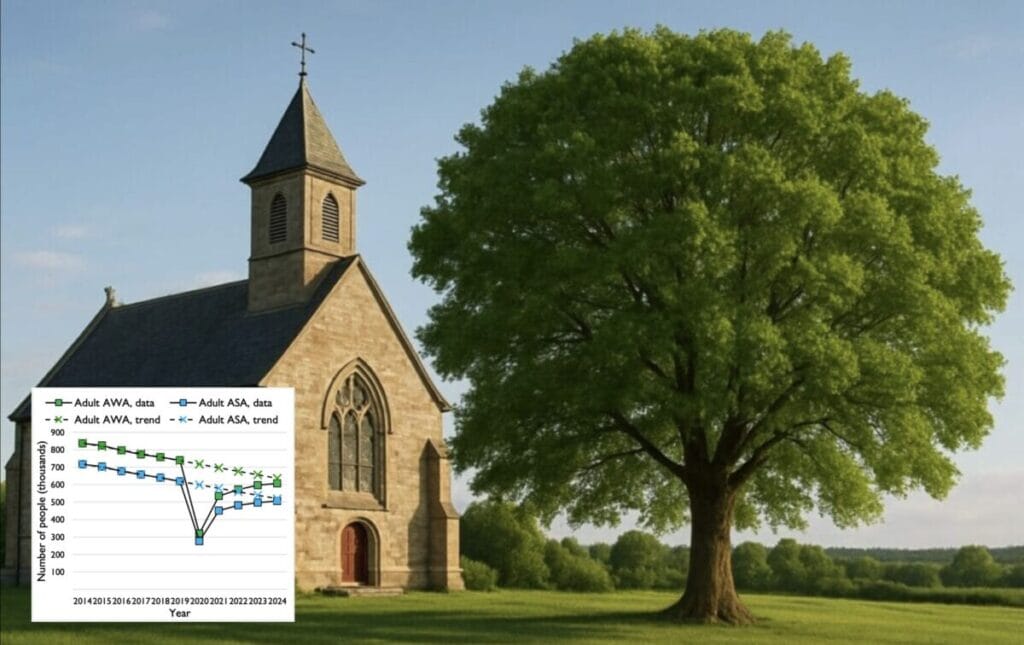
This is the real headline: on nearly every measure, the figures are now back in line with the long term trend of general decline and ageing established before the COVID pandemic. You can see this from the details, but the most striking is the graph from p 14:

Ken has added in a straight-line projection, since a straight line fits the pre-COVID rate of decline statistically (and there are good reasons why this should be the case).
There are two things to notice here. First, and most obviously, the recent growth in numbers has not yet take us back to the anticipated decline over the intervening five years. Just pause to take that in: we are still not yet back to the level of decline that we were experiencing before COVID. Despite everything, we have not reversed the trend of decline overall as a national church.
Secondly, the shape of the curve is telling. If the increase in numbers over the last four years indicated a change in trend, then we would see the line straightening up, preparing to cross the trend line. As it is, the curve is convex; the recovery from the COVID drop is a recovery to decline, not a recovery to growth. This needs to temper our public communication, and it needs to be given due attention in the places that matter. I have asked that we spend time on this at our next meeting of Archbishops’ Council (and my last) in December. Now that they will not be giving six hours or more to discussing LLF in their meetings, I hope the House of Bishops will spend time reflecting on this.
I should at this point address the common objection to focussing on numbers. Number are people, and if there are lower numbers attending our churches, then the obvious inference is that fewer people are hearing about and responding to the good news of Jesus. I think that matters.
But numbers have institutional implications too. With fewer people attending, finances will be under pressure, and structures will need to change. I am not clear that the Church as a whole has even begun facing up to that.
There are other issues in the details of the report which are worth highlighting. For me, three things stand out: differential growth; age and demographics; and children.
Because the headline figures are aggregated, it takes some work to understand what is happening on the ground. And there are huge disparities between churches, between areas, and between churches. This applies both to the net changes from 2019 to 2024, but also year on year from 2023 to 2024.
At a diocesan level, recovery varies hugely. I took the diocesan details on Average Sunday Attendance (one of the most robust figures), and looked at percentage changes from 2019 to 2024. Here are the top and bottom eight of that table, arranged by percentage decline:
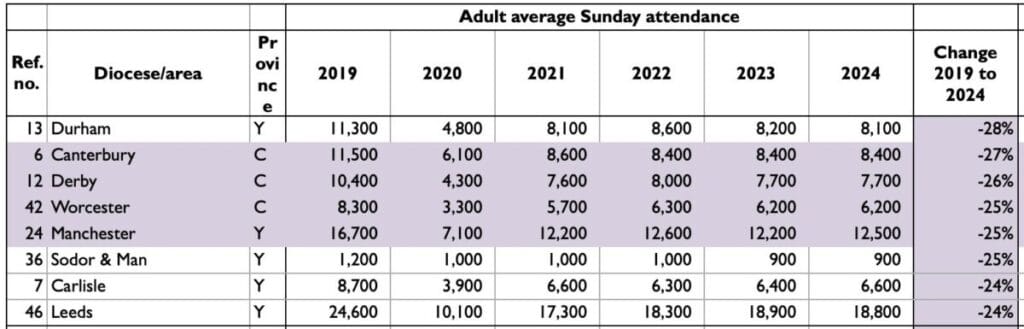
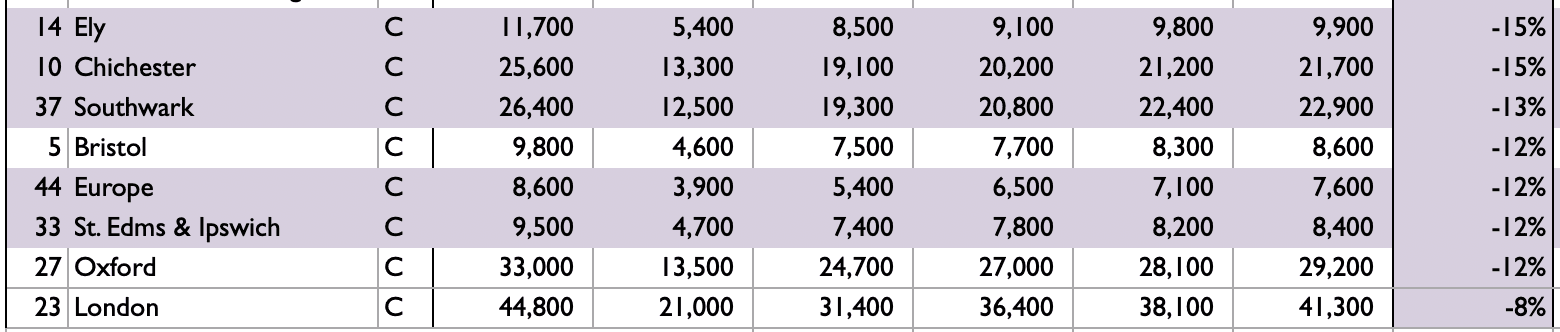
The average figure for the whole C of E over that time is -18%; the trend is 3% decline per annum. All the bottom eight would have broken above the decline trend line.
It is hard to see what has made the difference between the top and the bottom; it is certain to be a combination of leadership, strategic, demographics, and context, particularly rural versus urban. More of the most declining diocese are rural, and more of the least declining have major urban centres. London is clearly something of an outlier. David Keen, who has often commented astutely on the statistics, notes:
Interesting to see that 40% of the growth in adult attendance comes from London Diocese alone. Otherwise the growth is quite well spread across the country, with only 10 Dioceses showing a decline (with clusters in the SW and NW).
The strongest post-covid growth (2021-24) has been in big cities—London, Birmingham, Coventry, Southwark, Sheffield and Bristol are 6 of the 7 dioceses with a 20%+growth in adult attendance (St Eds and Ipswich is the other). Most of those with a lower recovery are rural, though Manchester and Derby have the 2 smallest growth figures.
Mads Davies, very quick off the mark in the Church Times, notes from the report:
A breakdown of the data by diocese indicates a high level of variation. On average, the worshipping community fell by nine per cent. But, while Canterbury and Derby reported a decline of 19 per cent and Salisbury a decline of 22 per cent between 2019 and 2024, Bristol recorded a fall of just 0.5 per cent, and London and Worcester both reported slightly higher numbers than before.
London’s AWA fell by 17 per cent in that period, and Worcester’s by 40 per cent. Liverpool reported that its worshipping community had exceeded 2019 figures in 2023, followed by a slight dip in 2024, but its AWA has fallen by 21 per cent since 2019.
And on individual churches:
For one in ten churches (12 per cent), the usual Sunday attendance, average Sunday attendance, and AWA were all higher in 2024 than in 2019. But in almost half (48 per cent), the numbers were lower across all measures.
This continues the trend that I have noted before—that middle size churches are generally disappearing, and that the C of E is turning into a combination of a few larger churches, and a large number of very much smaller churches. (An indicator of that is the growing different in the tables between the median and the mean.) The obvious question here is to ask: what are the 12 per cent doing right that the 48 per cent can learn from?
I would also want to slightly challenge Ken’s comments (from p 19) on the Quiet Revival. He notes that there are few signs of that happening in the C of E, and that leads him to be sceptical about its findings.
My observation would be: I think the 12 per cent are seeing signs of this. There are certainly signs of young people, especially young men, with no church background coming to explore faith. I see this in my own church and others that I have visited. But this is, in the main, bypassing many Church of England churches, as these numbers show, and we need to ask why that is.
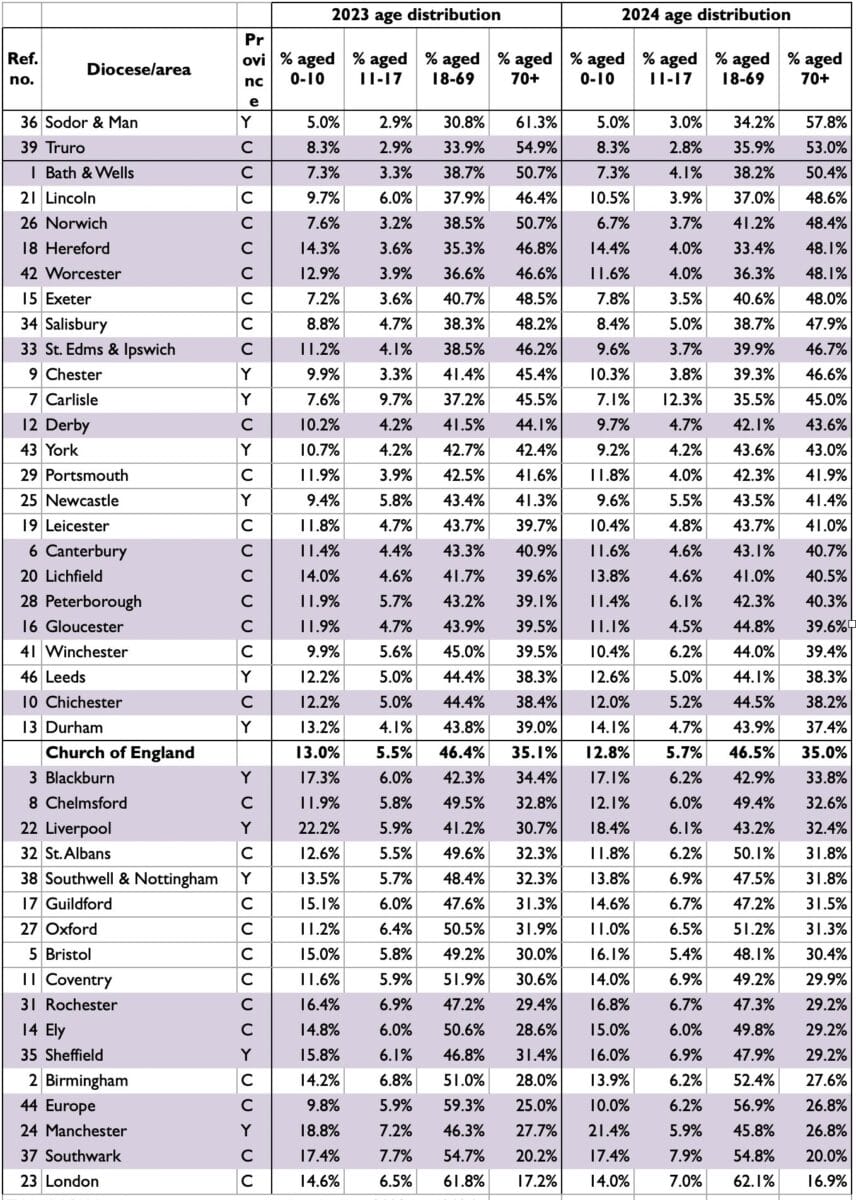
This all relates to the second issue, that of demographics and age profile. One of the tables in the diocesan data gives a split between children, young people, adults, and those over 70. (Would it help to have a more detailed breakdown? The different in life stage and experience between young adults, likely raising families, and older adults pre-retirement, is significant.)
I include here the age profile table, which I have sorted in order of largest number of over-70s to lowest. (If you click on it, you can see it in more detail.) Again, there is a huge disparity; again, there is quite a strong correlation with rural versus urban, with rural dioceses mostly having a much older age profile; and again, London is an outlier, with less than 17% over 70 compare with 53% in Truro.
For those dioceses at the top of this table, just project forward 15 years and think what will have happened. (It is not the case that no-one comes to faith later in life, and so might join a C of E church, but it is largely the case that people come to faith earlier in life.) What we are seeing here is the long-term impact of the demographic shape of the Church population, reflecting our failure to pass faith on to the next generation over the last 30, 40 or 50 years. That will not change overnight, and we will continue to see the impact of this over the next decades.
Mads Davies summarises:
The data also suggest wide variations in age profile, partly reflecting broader geographical demographics. In both Bath & Wells and Truro, more than half the worshipping community are over-70s; in Hereford, the figure is 48 per cent. Much higher proportions of under-18s are reported in urban areas, including Southwark and Manchester (both more than one quarter).
One small sign of hope is that the proportion of over 70s does not appear to have changed from last year, for the first time. The demographic crisis is here, and will have an impact, but for once, it is not deepening.
The third key issue is children and young people in C of E congregations. As I have noted previously, there has also been massive disparity between dioceses; some have recovered to their pre-COVID numbers, whilst other dioceses have seen their numbers halve. Diocesan strategy must be a key player here.
Overall, the numbers are stark: on average, we have as many children as we have churches, so, in theory, the average number of children per congregation is one. But of course that is not the reality; a small number of larger churches account for most of the child attendance, and vast numbers of congregations have no children at all.
Mads Davies again:
While child attendance in 2024 was close to or above the projected pre-pandemic trend, this reflects the previous steep decline in this measure. One third of churches had an AWA of no under-16s in 2024, compared with one quarter of churches in 2019. In 2024, 32 per cent of churches had no children in their worshipping community, compared with 26 per cent of churches in 2019. Churches’ ministry teams were also less likely to have led acts of worship in schools in 2024 than in 2019…
The data suggest that children’s attendance now tends to be concentrated in the largest churches. In 2024, the ten per cent of churches with the largest child AWA contributed 59 per cent of all child AWA, compared with 53 per cent in 2019. In this period, the number of churches with an AWA of 25 or more under-16s fell from 1270 to 850.
(I have just realised that this analysis was included by Ken as a result of a conversation I had with him a few weeks ago.)
This is a serious challenge to the C of E as a whole. It is the fruit of failing to pass on faith over the last generation or two, and it cannot easily be fixed. In those dioceses and churches with a high age profile, you cannot simply add children in; work with children cannot be detached from engagement with their parents, which is why it would be useful to have a more detailed breakdown of the adult age profile.
Finally, we need to stand back and look at how all this works out across the Church as a whole. This table, on average attendance, is startling:
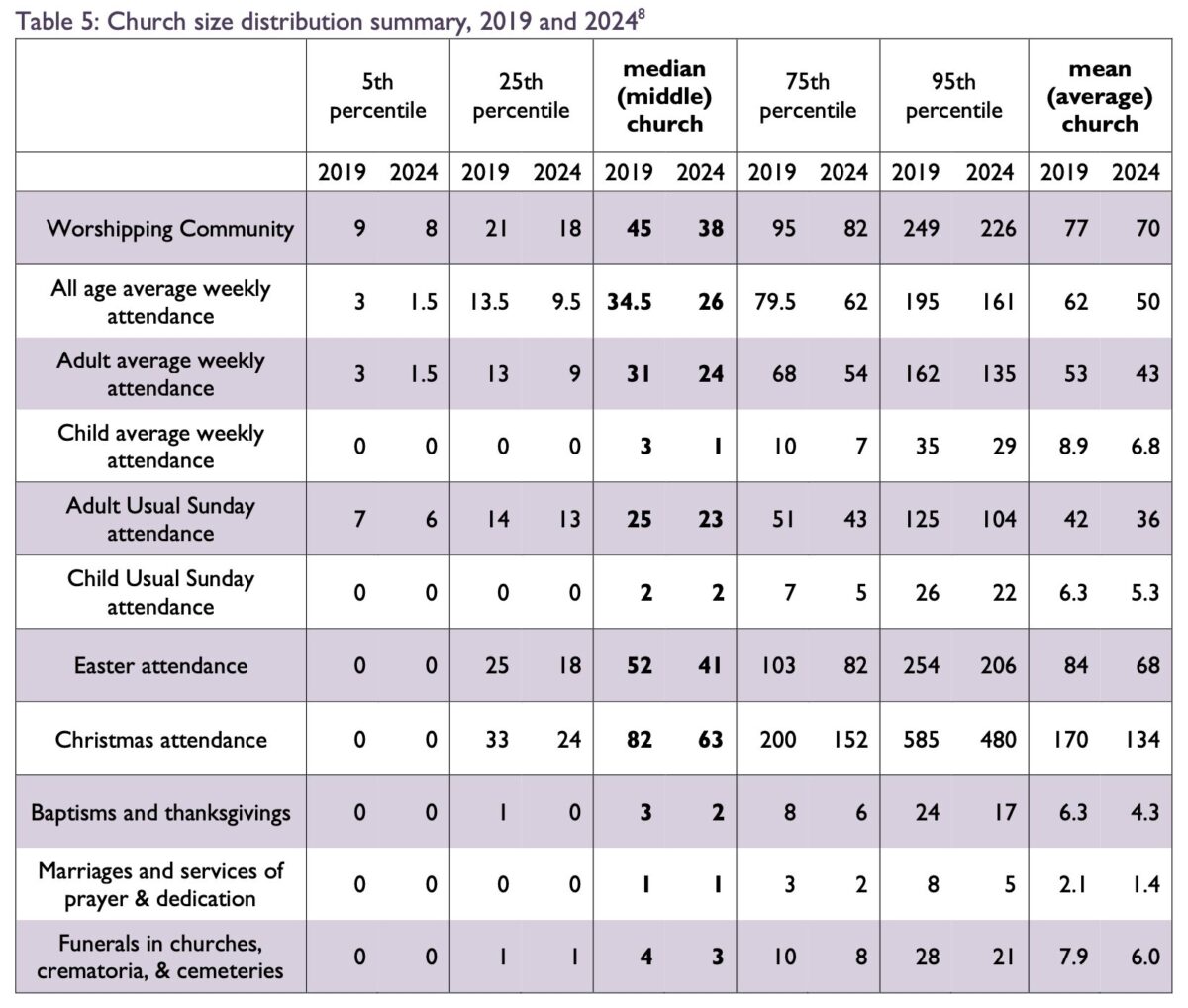
The middle column tells you that this is not a sustainable pattern for a national church. You cannot realistically maintain an expensive ancient building for a congregation of 23. It is more than ironic that, last week, Stephen Cottrell was speaking at a conference committed to preserving Church of England buildings. I could not spot any connection made there with this reality.
David Keen has commented to me about what this means:
I’m tempted to map that in some kind of organisational chart, e.g
5th percentile – usa 6 – house group
25th percentile – usa 13 – 2 house groups, maybe use community premises to gather.
median – usa 23 – hire community premises, or if largest in a group have a church building and be the ‘minster church’ for your benefice
75th percentile – usa 43 – can probably sustain a church building, but needs at least 1 other church the same size to sustain a full time leader.
95th percentile – usa 104 – the only level at which it would make financial and organisational sense to have your own building and a full time dedicated vicar.
Only the top 25% of churches have anything like a viable number of children, though I imagine most of the paid youth and childrens workers are in the top 5%, discipling the existing children, rather than in the other 95%, reaching young people with the gospel who aren’t part of the church.
The reduction in occasional offices per church means both a reduction in the fringe, and also in clergy workload—losing 2 funerals, 1 wedding and 2 baptisms a year for me would be the equivalent of 35 hours. However as clergy numbers are also declining, and compliance requirements are rising, it may not actually free up clergy time.
Someone somewhere needs to do the maths on what size congregation makes for a viable church, especially with all the roles required by charity law, by the increasing compliance and reporting burden from the CofE, the time/energy/money required to maintain a church building and pay for your share of a vicar. The growth last year was pretty low, I wouldn’t be surprised if its fizzling out in many places because we have such a hefty system to maintain and all our energy goes into that.
As I have mentioned before, these figures overall are a stark challenge to our messaging, and what we spend our time and energy engaged in. The LLF process has been a divisive disaster, and in some cases has contributed directly to our continued decline. It must stop.
And our overall messaging still needs to change. Daniel French puts it starkly:
log jam (new believers not choosing @churchofengland ) can be fixed sooner if a fraction 1% of hierarchy spoke more in the vibe of @jordanbpeterson than @owenjonesjourno .
Don’t be supernaturally shy also.
Stop sneering at Right-coded seekers!
They hear you loud n clear https://t.co/3twlV08jrm— Rev Daniel French (@holydisrupter) October 28, 2025
So, there are many challenges in these statistics, and these are my first reflections on the details. Do please make your own observations, and I might come back and add some of them in to the body of the article.
 Buy me a Coffee




















The sad detail is that you are approaching your last Archbishops’ Council. Your incisiveness is sorely needed. Every good wish.
Thank you.
Good piece Ian, as ever. Should the second ‘might’ in the paragraph beginning ‘For those dioceses at the top of this table…’ be ‘while’?
Probably!
Actually it was a mistyped ‘but’ which got autocorrected…
Are there any figures, a demographic breakdown on regular financial giving.
Is that not an important measure in spiritual health and maturity, growth?
That is a good question. There must be somewhere.
Yes – there is -the Huff post did a survey on this in 3 Oct 2013. The conclusions were as follows.
British Muslims give more to charity than any other religious group. They give on average £371 per year versus Jews £270 and Christians £178. Atheists give £116 to charity per year.
A sizable proportion of Christians give absolutely nothing and most of the rest give only very small sums of money.
In our own Methodist circuit the treasurer found that in order to keep the books balanced each congregant needs to give £10 per week: the actual level of giving is considerably less than this.
Tithing has been on a steady decline for decades reaching the lowest level in the United States in 2016.
Only 15% of tithing is spent on matters outside of the church.
The same study found that churches are spending more on themselves to make congregations more comfortable. Churches in the US spend $35 billion a year on themselves meanwhile 2.5 billion people in the world live on less than $2 a day and you have sufficient food water medical care or shelter.
An informative and instructive answer to a pertinent question. Matt 6:21.
The Anglican church I used to go to before it was led by a lesbian couple was located in one of the most affluent parts of Berkshire. Its level of giving per head was far below the diocesan average and every year it struggled to balance the books. To keep afloat, it relied on bequests and the occasional fund-raising event directed at villagers.
I kept stats until 2019. In the period 2014-2019 national Sunday attendance fell by 16%, our church’s by 22%.
For me the most disappointing statistic is the decline of children in the top 95% of churches – which looks like it is in-line with all the other declines. I have a bunch of optimistic takes “We shouldn’t be mourning that there was a revival in the fifties and those saints are going to glory”, “most children are in churches where there are plenty of children and peers”*, “look – we are growing younger!” that are all dashed to pieces by the reality of that decline.
(*At the risk of being a non-Anglican supporter of the gathered church, I would much rather one church with thirty children than fifteen with two.)
And surely the answer to our ancient and historic heritage has to be: The worshipping congregation can’t be the ones who fund it.
In France of course the state helps fund Roman Catholic churches built pre 20th century. Although it does limit what building works and changes to structure of the churches can be made to ensure their preservation as national historic monuments
Lioke this?
https://www.youtube.com/watch?v=13iVonww93g
To do with Vatican restrictions on the Latin Mass, nothing to do with the French state. Pope Benedict was a bit more willing to allow more Catholic churches to say Latin Masses if they wished
What stands out for me is that we have three groups of churches: 12% growing, 48% declining, and 40% remaining stable. Because the differences between these groups are so marked, the overall averages tell us little of strategic value. What we really need is to see the data broken down by these groups; that would help us understand how to foster renewal from within and identify our key opportunities and greatest challenges.
Yes, I would agree with you there. Ken Eames has the raw data. I think the key questions about each of these groups are:
a. what size are they
b. what is their vision
c. are they urban or rural?
You might have others.
Thanks Ian, very interesting – in our free church we tend towards growth over a period of years until we have too many for our accommodation and then we do a church plant allowing us to start growing again.
Is there anything like this in the CofE?
Yes, it is a very big thing amongst some churches!
Yes but you are a free church, the C of E already has ancient churches and cathedrals in cities, towns and villages already there. You need growing congregations to fund you and expand and create new churches. The C of E already has billions in assets and investments to fund itself
Simon ‘You need growing congregations to fund you.’ What a bizarre idea! Ray wants congregations to grow because he wants more people to know about Jesus and follow him.
You don’t appear to be at all interested in that. It is most strange.
I don’t say I am not interested in that but for the C of E it is a bonus, for the C of E it already has existing churches and cathedrals up and down the land to maintain
If you think that is a ‘bonus’, then you appear to have missed the whole point of the Christian faith.
Do you consider yourself a Christian? As Paul makes clear in 1 Cor 12 and Romans 8, this is about knowing Christ is Lord in your life, receiving the gift of the Holy Spirit who fills our hearts with the love of God, and so crying out in love ‘Abba, Father’ to God in deep personal relationship.
Is this something you have experienced for yourself?
In my existing Parish church, yes
Paul does not link this experience with any particular building. It is about life.
It is sobering reading indeed. I am struggling to see your proposed link between LLF and decline? The narrative proposed is the decline from 2014-2024 is continuing. Surely we could just also suggest that continued ‘strategies proposed by some Diocese’ are just as culpable to decline as LLF?
Tim, yes, there are multiple factors. But see the anecdotal evidence here: https://www.psephizo.com/sexuality-2/the-idiocy-of-the-llf-process/
And there is survey evidence of the serious impact on vocations. LLF is repeatedly mentioned near the top of the list of concerns.
PS please use both your names when commenting, as per the guidelines.
Apologies will readjust practice.
Ive read the article and it still remains anecdotal, so not convinced yet.
I hear and have read the evidence on vocations. At the same time other contributing factors also loom large in the evidence.
Anecdotally; I have heard more frustration with leadership at large and our continued culture of not dealing with disagreement well (which seems to be also a societal problem) than i have of the singular issue of LLF, anecdotally!
Sure. It is both/and. I am not sure anyone has claimed LLF is the *sole* issue. But it has been a major contributing factor.
Daniel French’s observation is the most prescient! (see https://x.com/holydisrupter/status/1983224765973156015). Why on earth did anyone think that worshipping a people-diminishing synthetic-virtue idol was ever going to work. Surely the Lord is more a left-right collision! or a million times the best of both! But it’s so encouraging that the Lord is waking people up to this more widely even if most of the leadership are still heading the other way. Love God, so get married, have babies, work hard, serve your community…
Firstly, the good news, encouraging to see that C of E church attendance is recovering, at least from its below Covid levels.
Second, the bad news. Usual biased anti rural ministry agenda from some evangelicals, Derby, Manchester and Leeds in the top 8 dioceses in most decline. Since when were those big city areas mainly rural? Ely, Chichester and Oxford dioceses and Suffolk showing most life and in the dioceses with least decline and all with large rural areas and plenty of village churches.
David Keen’s comments in particular are outrageous. It is perfectly viable to have churches with congregations of 23 or even just 6, especially in a village or hamlet with say an overall population of just a few hundred anyway. Suggesting that such congregations should be turned into house groups or community premises are completely unacceptable and would be vehemently opposed by Save the Parish for starters and its members like me. Not least as those churches also still offer weddings, funerals and baptisms for village residents.
The Church of England has £8 billion in assets, is one of the biggest landlords in the nation with a large rental income and large shareholder too. Church commissioners should be using that income to invest in C of E Parish churches, especially smaller and medium sized ones, not church plants. All should have their own Vicar, even the smallest rural churches can share a Vicar. Church planting is for Pentecostal and independent evangelical churches to do largely who do not have existing Parish churches across the country already like the C of E or Roman Catholic church does. If the likes of HTB want to privately fund church plants that is up to them.
Finally, on LLF how is a hardline anti LGBT agenda going to attract young people to the C of E in a nation where same sex marriage is legal, polls show the vast majority of English people back recognition of same sex relationships and polls show of self declared Anglicans it is the youngest Anglicans who are most supportive of recognition of same sex relationships in C of E churches?
I wasn’t suggesting that churches of 6 should automatically be turned into housegroups, I was mapping what might be a sensible way to form Christian community against the numbers of people involved. We could let everything be predetermined by the presence of a church building, and there may be places where that’s appropriate, but I’d be astounded if it was the best approach in every parish.
We are currently trying to plant a church on a new housing estate – sorry if you find this offensively unAnglican, but we’re sufficiently committed to the parish system that we think it shouldn’t be denied to people whose homes were built since 1980. At present, 1 year in, there are 6 Christians meeting in a home (plus a youth group of 50, toddler group, coffee morning, and after school club, all meeting in the local community centre). A great way to kill the church plant stone dead would be to saddle them with a church building which costs £10k a year to heat, light, insure and maintain. A village church 1/2m up the road, which has been faithfully serving its community of a few dozen, has also benefited from the new housing, and I’m delighted to say that their BCP evensong is growing, with 4 people from the estate due to be confirmed at the weekend. With a seating capacity of 40 and no running water, it’s limited in the mission it can offer to the 5000 residents. The solution in our context is both/and, not either/or. The important thing is not to save the parish, but to save the people, and to find a contextual form of mission and church presence tailored towards that.
On the rural point, a number of rural churches near me are joining forces: one group of 5 meets in rotation at each others churches throughout the month. Another is focusing on one or two parish churches within a large rural group and turning the rest into festival churches. Many (aged) church members are exhausted and discouraged from years/decades of keeping the show on the road with diminishing resources. If you think they are duty bound to carry on until the last keyholder goes to glory, then I’m sure they’d be overjoyed to hear it.
It is the best approach, the C of E is a Parish based church which is Catholic but Reformed with churches in nearly every village, town and city in the land to maintain. It is not a purely evangelical church which can meet anywhere, it should meet in the church buildings it already has.
If you want to fund a new church on a housing estate, fine but lead and fund it yourself as you already appear to have had some success in doing. If that then has some knock on benefits to the local Parish church, as also appears to have occurred here in terms of attendance at evensong, all to the good but it is the Parish church which should be the prime beneficiary of diocesan and church commissioner funds.
On your final paragraph, I largely agree you may be surprised to here. Our rural congregation also meets on rotation once a month at each of the 4 churches in our benefice very successfully. I would prefer to still use even festival churches for some worship though, even if only at Easter and Christmas and maybe have the odd wedding there as well. More resources for rural churches will also keep a great joy to the wonderful and often ageing wardens who as you say do such much to keep them going
So we should meet in buildings built 500 years ago, even if the population there has disappeared, and not build new places to meet in places where the population has grown?
Why?
Yes we should meet in buildings built 500 years ago, or even built in the Middle Ages, our Parish church was built in the 12th century. No the population has not disappeared, we may have had our church for centuries before the industrial revolution and move to the cities and big towns but we still have a population of farmers and retired here and a few families a reasonably high percentage of which come to our rural churches still
Why? What happened magically in the Middle Ages?
Some of the greatest buildings in the land were built and for Christian worship
I can’t work out whether Simon B is an architectural fundamentalist, or a historical fundamentalist. Either way, this seems to me a form of idolatry, and an impediment to the mission of the church: preserve historic church buildings and their congregations at all costs, and treat an ossified parish system as the be all and end all, regardless of the consequences for mission and church life.
The Church of England is a denomination based on a Parish system and which already has cathedrals, often ancient, in our cities and historic churches in nearly every city, town and village in the nation to maintain and still use for worship. If you aren’t interested in that David there are plenty of evangelical Baptist, Pentecostal or independent churches you can join whose main mission includes church planting and are happy to meet in the back of a restaurant or cafe or a theatre or cinema or town hall for worship
Hello David
Ian quotes you talking about growth being in 6 urban dioceses + St Eds and Ips.
Where can I find your analysis? I have been part of Growing Go in the Countryside here at St Eds and Ips and so I am very interested.
Thanks
Re your last point.
I suspect that the most fruitful line for LGBT-sceptics to take with young people, will be to challenge contemporary ideas on Identity. ‘Who you are is primarily a question of your living relationship with God, not your sexuality, gender, class, ethnicity, age, academic ability or anything else that allegedly ‘defines’ you. We’re all challenged by that question. All else follows from it.’
You may disagree, of course!
Simon, a couple of errors in your comments.
First, Derby diocese is largely rural.
Secondly, ‘how is a hardline anti LGBT agenda going to attract young people to the C of E in a nation where same sex marriage is legal’? That is precisely what is attracting young people. All the evidence is that they are drawn most to churches which reject our contemporary sexual ethic, which they find damaging and unhelpful.
You don’t need to conform to the mores of culture to draw people—quite the opposite. Just as St Paul says in Romans 12: ‘do not be conformed…but transformed’. I am not sure whether you have read that or taken it to heart? What do you think it means?
Derby has a population of nearly 300,000, it is a big city. Derby diocese also includes Chesterfield, a big town with a population of over 100,000 and the large town of Bolsover with 83,773 people.
Young people are certainly NOT going to C of E churches as it does not recognise LGBT relationships, otherwise they would have been flooding them before LLF was even proposed. Indeed if you are young person who is firmly anti LGBT relationships you would almost certainly be a Pentecostal, Baptist or Orthodox you wouldn’t be Anglican. Indeed even the RC church now has Papal approval for priests to provide non liturgical prayers for same sex couples. Given not only same sex unions but same sex marriages are legal in most western nations the median young person will certainly not oppose LGBT relationships and neither do young Anglicans. Indeed 56% of self declared Anglicans under 30 now back same sex marriages in C of E churches Yougov found, compared to just 34% of Anglicans over 70 backing same sex marriages in churches
https://yougov.co.uk/society/articles/45199-anglicans-more-likely-not-back-church-england-cond
Of course as established church the C of E will always have to conform to English culture to some degree in a way that Baptists or Pentecostals for instance won’t
‘Self-declared’ means they don’t go to church. That survey has no credibility as an indicator of what practising Anglicans believe. Indeed, it was designed to avoid that, because it wanted a certain result.
You appear to be ignorant of the research evidence about which churches young people are going to.
Despite Derby itself, the whole diocese has a population of over 1m. So the majority are not in cities. This is very different from someone like London, or Bristol, or Birmingham.
No some will some won’t as regularly except for weddings, funerals, baptisms and Christmas and Easter. However all self declared Anglicans still consider themselves as such and remain full members of our established English church.
As established church membership of the Church of England of course still includes every resident of its Parishes, so indeed goes even beyond self declared Anglicans let alone those who worship in its churches each week.
Birmingham is not in the top dioceses in least decline, so is not doing that well either. The division on the chart between C of E dioceses in most or least decline is more based on class than urban or rural demographic, posh dioceses like London, Oxford, Chichester, Ely and Bristol which are wealthier and have higher income congregations doing a bit better. Poorer dioceses like Manchester, Derby, Leeds, East Kent and Durham and Carlisle seeing most decline. Hence the need for more central church commissioners funds to support our poorer dioceses, as Save the Parish has proposed at Synod
If you don’t attend, you are not a full member. See the electoral role form.
There is significant redistribution of wealth through the LInC funding.
What you are mostly highlighting in that list is a north/south divide.
Not a full member no as in not on the electoral roll but still a member of the established church just by virtue of being a resident of one of its Parishes in England even if you hardly ever attend its church. Some redistribution has taken place, more targeted could take place. Yes it is partly a north south divide though not entirely, much of Cheshire or North Yorkshire or indeed York itself is richer than East Kent or parts of coastal Essex or Cornwall or Luton and Slough for instance
This is a time for REJOICING
“For everything there is a season”
The singers in holy array must lead the army [church] into the warfare.
See wisdomonline.org
The Danger of Decadence and the Call to Rejoice in the Lord
We rejoice in the Lord despite our circumstances because rejoicing in God means that we take delight in him and not our circumstances. It means we are comforted by his name and his presence. It means that despite what I am going through, I know that I am loved, cared for, and watched over. AI
Philippians 4:4-7 Amplified Bible (AMP)
Rejoice in the Lord always [delight, take pleasure in Him]; again I will say, rejoice! [Ps 37:4] Let your gentle spirit [your graciousness, unselfishness, mercy, tolerance, and patience] be known to all people. The Lord is near. Do not be anxious or worried about anything, but in everything [every circumstance and situation] by prayer and petition with thanksgiving, continue to make your [specific] requests known to God. And the peace of God [that peace which reassures the heart, that peace] which transcends all understanding, [that peace which] stands guard over your hearts and your minds in Christ Jesus [is yours]. [John 14:27]
Rejoice in the Lord always. I will say it again: Rejoice! (Philippians 4:4). This joy is not dependent on external circumstances but is rooted in our relationship with Christ.
SHALOM
Have you mapped against ethnicity. As a leader of an intercultural London church, my theory would be that London fares slightly better only because it is a reflexion of its diversity. Maybe one for John Root to take up!
Thanks Chris. That has been done elsewhere, and I think David Goodhew has commented on that in the past, possibly here. Yes, many eg African Christians coming to London has boosted church going…those often in non-C of E churches.
“I planted, Apollos watered, but God gave the increase.”
The Firestarters network, a group based out of St Hild’s college (near Huddersfield) published two books in the last couple of years. They’re both small, simple and to the point, and they are focused on church growth. They ask, what are the habits that the fasting-growing churches in the UK demonstrate, and what is it about them that make them effective.
There are seven they highlight, but the first two are:
-An intensity of prayer and fasting
-The Gospel simply told
Obviously, a comment here is not a book review, but the reason I put that verse from Corinthians at the start is to illustrate what has been observed by the Firestarters Network; namely that growth starts with prayer, personal and corporate, and growth is initiated and sustained by God when it comes at the hand of sharing the Gospel with people. This will, of course, not be a surprising thing to you.
But it does bear repeating!
I agree with the analysis in the article, and I think you are right to say the messaging needs to change, and that the CofE needs a rapid dose of realism. I also recognise the need to reform structures and adapt to the changing face of the nation (fyi, this is point 5 of the 7, I think) but equally I do worry that you seem to be putting far too much trust and emphasis on the human institution, and the workers within it, to provide the growth you so desperately need and desire.
Maybe, start in a different place: get on your knees, and commit to prayer first of all. Trust in God to restore and reverse the decline, and not to man. I am sad that this was not mentioned in the article, though I know you and the other commentators certainly believe it. The “Thy Kingdom come” prayer imitative was an excellent step in that direction; do more of that please.
Sorry, I’ll get off my soapbox now.
Mat
Well, yes indeed. God gives the growth. The problem I think I am seeking to highlight is that many churches in the Church of England are not that interested ‘sowing and watering’.
Besides this, we do have organisational and demographic issues to contend with. At the level of the local church, things can change quite quickly when we pray and see God at work. At the national level, unless individual congregations see renewal, it is not so straightforward!
It’s good to know there is one statistically literate person on the Archbishop’s Council. Unfortunately the comms department have produced a press release which is breathtakingly at variance with the report itself. This is nothing new.
I had a dispiriting experience in Bev Botting’s day. Bev asked me to write a preface to the stats report. I did so on the condition that I wasn’t shown the figures before writing it. It was a neutral piece intended to inspire people to make their statistical returns and for the importance of using factual evidence when appropriate.
Then William Nye came in. (I had interacted with him a bit in his pre church life). He didn’t like my preface and instead commissioned a spin-filled piece of the sort we are now sadly used to. The worst part of it was that he didn’t have the spine to tell me himself but gave Bev the job of telling me my piece wasn’t wanted after all.
I have no doubt Ian that you will use your last meeting to impress on the powers that be the need to be more honest about all this. Florence Nightingale didn’t improve public health by simply ignoring or denying the statistics
Now some thoughts about London. Another factor is this. There are many young people who come to London for their career and are a bit lonely. Going to a church is a natural way to meet people in a non work context.
Maybe. As a Londoner I’m a bit dubious about that. What I would say, is that London is a place where the students are probably more likely to stay after graduation (i.e. you go to University in London, and then stay in London for your career) – certainly way, way more than places like Durham which was my experience. So for London a strong student ministry feeds the churches beyond that student’s time in university (if that makes sense).
But probably more important is that being so thoroughly urban and with excellent transport London has avoided splitting its clergy across benefices. We historically have been able to simply merge parishes and close churches (my own is in the middle of the city, there are 4 other churches in spitting distance – literally a 5 min walk – and my church is the ‘heir’ of what were 3 parishes 100 years ago). It also means London parishioners get to ‘sort’: whether you prefer a BCP service, conservative evangelical, full-on anglo-catholic, open evangelical, liberal catholic, unabashed liberal etc., finding a church that suits is pretty easy and can make you pretty loyal.
Indeed, whereas we have one village church and the next nearest church is 40 minutes walk from that (though also in our benefice) and we have evangelicals and even some Roman Catholics all in the one rural church
Yes, I intend to. I have asked that it is on the agenda.
To kick start our rejoicing see Maclaren or J. N. Darby
on PHILIPPIANS Ch.4 @biblehub, they can inspire your delight.
On the other hand perhaps and just maybe ?
God is pruning his army/church to a holy remnant of faithful
Overcomers as in the time of Gideon {the tree hundred bought
into THE Lord’s Plan}
That when the Clay Vessel* is broken or smashed the
Glorious Light, of the Glory of God Shines forth the enemies will destroy themselves and be Scattered. [Without a shot being fired in anger. Selah]
*We have this treasure in earthen vessels – that the excellency of the power may be of God, and not of us. 2 Cor 4:7. Shalom
Gosh, Christians do choose some odd bedfellows (gurus, even). Jordan Peterson, indeed!
If you think that, you need to get more and listen to people you disagree with…
If I didn’t listen to people I disagree with, I wouldn’t be here! What depresses me is not the idea of a right wing guru, but the choice of someone who is so intellectually third rate. (I don’t care for Owen Jones either.)
Penny—It was a merism.
I missed that 🙂
So Charlie Kirk was assassinated and you only had wicked false accusations to write about him. I haven’t met him but so great a man was he that I grieved him for weeks. Jordan has been fighting for his life all summer and is extremely poorly and here you are again trying to make yourself appear superior to him now. Jordan is another great man who is loved and respected by many including me. His love and deep compassion for people exceeds his great intellect which is not at all third rate- that is just another of your nasty smears. Jordan is another man worth ten thousand of his wicked detractors.
Who’s next for your vitriol?
Jeannie
Kirk suffered a terrible death and, yes, Peterson is very ill, but from what I read, it may be self inflicted. The manner of one’s death and the nature of the other’s illness does not make them Christian martyrs. They are mediocre white men who peddled a false gospel.
Peterson is brighter than Kirk, but when he strays outside his own field, into scriptural exegesis, for example, he makes an utter fool of himself. His religion is toxic masculinity draped in ahistorical mythical archetypes.
Kirk was a college dropout who sold white supremacy and MAGA politics as the gospel of salvation. He would have been the first to demand that an itinerant middle eastern preacher be deported from the US. Both men deserve our pity, neither deserves our praise.
Jordan Peterson is interested in Christianity but has said explicitly that he is not a Christian. He is having a rather public battle with himself about that, which some of us find interesting. His diet is strange but hunter-gatherers would regard supermarket food as distinctly odd.
His famous interview by Cathy Newman, and Charlie Kirk’s Oxford exchange with George Abaraonye (who publicly expressed delight at Kirk’s death), was about feminism. I agree with Peterson and Kirk about that; you disagree. Perhaps that is why you call them mediocre. I wonder what they would have made of your doctoral thesis, Queering the Pilling Report?
Anthony
Then Peterson should stick to his own field and not embarrass himself with cod HB exegesis. Similarly, when Kirk was challenged at the Cambridge Union, he folded. I don’t think either would have understood my thesis or the resulting book – both aimed to challenge the contingent hegemonic assumptions of ‘thinkers’ like Peterson and Kirk.
I think they would have understood it very well, albeit not without effort to translate it into normal English. (In science, jargon is used as a shorthand, in today’s humanities as a longhand.) I recommend the book ‘The killing of history: how a discipline is being murdered by literary critics and social theorists’. If you read it you will understand how to widen your audience, if you wish to.
I am not particularly interested in Jordan Peterson’s lectures on Genesis, after giving one of them a go and being disappointed, but that is not why you hate him, is it?
As you clearly bothered to watch Charlie Kirk at the Cambridge Union, please say where in the 100 minutes of it you consider he was bested. Here is the link:
https://www.youtube.com/watch?v=dkiM-z0Mzyg
Anthony
Where did I say I hated Peterson?
I don’t hold out much hope for the delicacy of your exegesis if your powers of comprehension are so corrupted.
Anthony
1.40 inter alia.
You didn’t say you hated Peterson. It follows from your rhetoric. But if it is your rhetoric rather than your heart that you need to change, good.
Anthony
Do you hate everyone you disagree with or regard as mediocre? I don’t. It’s not about being good. It’s about not being a psychopath.
Good, then don’t write as if you do.
Anthony
If you can’t distinguish between hatred and distaste, I think you have a problem.
Rejoice evermore – Even more
See wisdomonline.org The Danger of Decadence
and the Call to Rejoice in the Lord
and /or/both
Barnabaspiper.com Rejoice in the Lord
(Thoughts on Joy and Prepositions)
In the U.S., millennials and Gen Z currently have the highest proportion of regular church-goers, higher than the Boomers (and older) and Gen X. While overall church attendance remains below pre-Covid levels, the rise of young congregants attending service is encouraging. But they are not attending mainline protestant churches. They are attending nondenominational churches, primarily pentecostal and charismatic churches, which are growing. These growth churches, incidentally, are notably family-centric, tend toward social conservativism, and rarely if ever make any political pronouncements or take political stands, abortion being the sole notable exception. Indeed, one suspects this lack of politics may be one of the drivers of growth, since the younger generations have been raised in an unsolicited stew of vitriolic partisan politics their entire lives, and they have discovered a haven in an apolitical church.
It would make sense for the C of E to look at what these nondenominational churches are doing to attract young people. They are doing something right. Further, Catholicism including Anglicanism has something fundamentally more spiritual to offer that they do not – a rich tradition of transcendent reverence in form of worship in which all congregants are active participants.
Really interesting perspective. Thanks John.
Thank you so much for this helpful analysis – although disappointed you failed to make a pun about secular trends…
Sorry to hear you are leaving the Archbishops’ council.
I think I have missed the pun. Do you need to make it?
I have done my two terms of five years each, 10 years in total. Now there is a joke to be made…
‘A secular trend is a long-term, sustained movement in data that reflects fundamental, structural changes’
‘Secular variation is sometimes called secular trend or secular drift when the emphasis is on a linear long-term trend’
So is reducing church attendance is a secular trend towards secularism?
Niche joke I admit…
Very!
. Many Christians are like Eeyore, the perennially dreary donkey from the Winnie the Pooh series who spreads gloom over the Hundred Acre Wood. He is not dismal because bad things happen to him. He is grim by choice even in favorable situations.
William Gurnall wrote that “Christ takes no more delight to dwell in a sad [grim] heart, than we do to live in a dark house.”
Some random initial observations:
I would be interested to know if there is any correlation between diocesan strategies and rates of decline. In some dioceses clergy are being expected to cover more and more churches, with the expectation laity will somehow fill the gaps. What form this strategy takes depends on the diocese. But can we see examples where this kind of spreading of the clergy has accelerated decline and others where this strategy has been more successful? And in this mix, how have the planting of resource churches affected the general trend towards decline?
I would also be interested to analyse this median figure of an average sized congregation. I can’t remember the exact figures but it used to be said that a church of something like 30 in an inner-city context was equivalent to 100 in a suburban context. Is that still true? Can we see greater decline in some contexts and not others?
Thanks Ian, as ever, for your interest, and for your kind words. I’m happy to have conversations with people about further work – do get in touch using the contact details in the report. I can’t promise to do all the things that people might suggest, being constrained by feasibility and resources, but I’m always glad to hear ideas. As you’ve noted, I can act on at least some of them!
Since I see it’s a topic of conversation in this thread, it might be useful to know that I map rural/urban land classifications onto Church of England parishes; the data are available on the interactive map: https://arcg.is/1WzGbO and as an enormous spreadsheet: https://www.churchofengland.org/sites/default/files/2025-06/parish_censusimdsummary_june2025.xlsx
Thanks for this. I got an error on the interactive map.
Is there a way of relating the attendance figures to the census information?
Bother, I’ll investigate. It was behaving perfectly yesterday!
Linking datasets is doable so long as everything is labelled appropriately – e.g. using parish codes. (Noting, of course, that parish boundaries are permeable to worshippers.)
Oh, the map working again now – not through any action I’ve taken. A glitch somewhere, I guess.
” there is quite a strong correlation with rural versus urban, with rural dioceses mostly having a much older age profile; and again, London is an outlier, with less than 17% over 70 compare with 53% in Truro.”
How much of that merely reflects the age profile of the area? Rural areas have much high proportion of older people anyway. For example North Norfolk has the highest proportion of retire people (over 65) of any area in the UK (I would suggest Cornwall will not be far behind) and London boroughs are generally the lowest.
We need to process the data to remove this bias in order to understand the extent of the problem.
Well said, younger people tend to live in inner cities and university towns, them move to the suburbs or commuter towns or industrial towns when they marry and have children and are middle aged then when they retire move to the countryside or a village or seaside town. So naturally dioceses age profile will also reflect that
I disagree with your suggestion that the job of Comms is to take the most positive angle on a new story. That’s PR, not Comms. It frustrates me beyond measure that the church still doesn’t know the difference between the two disciplines – though I guess it’s just another symptom of the church being led by well-meaning amateurs on the basis of ideas they half-heard in the 1990s.
The job of Comms is to tell the truth. The theological task of Comms is to find the good news in any circumstance – which is a different thing altogether from PR.
What if, in the goodness of God, God is choosing to humble the Church of England at this stage? What if God wants to use this time to force the church to re-examine its privilege? What if those churches that are growing numerically are doing so because they are the least sensitive to what God is saying to them? What if God is using secular media and politics as agencies to make this humbling happen? What if we were to take all the money that is funnelled into church growth projects, and use it instead for the service of the
The good news correlates with the nature and work of God, not with the size of the Church of England.
Thank you for the corrective on Comms v PR. You are quite right.
You might well be right about this humbling. Near me, churches have been planted, grown, thrived, bought and adapted buildings, all without central funding.
I agree about the size of the Church of England. But scripture tells us he wants all people to hear the good news of Jesus, and have the chance to respond. So I don’t think we can separate the work of God from the flourishing of his whole people in the way you might be suggesting.
But of course the whole people of God are much, much, larger than the C of E!
Thanks for commenting.
Regarding holding onto and attracting parishioners- At a minimum incumbants need to be holding to sound doctrine and keeping things Holy generally.
It would seem a bit odd to me to be wondering about bums on seats and money given by congregants if everything is not being done to keep things sound and tickety-boo.
Holy Anglican can end up a bit church-homeless and heading off to other denominations when the local vicars don’t seem to know how to behave.
My nearest church- Southbourne- I was once banned from the Church centre coffee shop for quietly telling a very old lost man the gospel. Along a bit..Chidham in interegnum still maybe…the last vicar lived with his boyfriend in the vicarage. Along from that in Fishbourne and Mother J couldn’t wait to perform SS Blessings. North of me and Westbourne was happy about SS blessings. Emsworth- very dodgy history but nice vicar there now at least….but yoga woship of false gods and Qi dong going on a lot in the hall and an obsession with the hoax of climate change so hesitant to go there…although its probably the best of a bad job within a 15 minute drive.
If there is a holy sound church without having to travel too far then I’d love to have somewhere to call my spiritual home.
Until then the years go by and I stay as a hermit.
It’s not me (for a change), it really is you!
If you aren’t keeping to sound doctrine and calling for holy living then you aren’t a real church- just a corrupted one- even a parody of one.
We know what the problem is. What is the cure?
Further to Mat Sheffield’s point that two key factors in church growth are intensity of prayer and fasting and simple telling of the gospel, it is worth reminding ourselves that the gospel is not, in a nutshell, “God loves you. Give church a try!” but Heb 9:27-28. After death comes judgement, because there is a righteous God, and his appointed judge is his Son, the same who came in the flesh to bear and bear away our sins. He suffered God’s wrath on the cross on our behalf, so that, believing in him, we might not be judged. If we refuse, judgement remains (John 3:36).
Paul says the same in his model address to the Athenian Gentiles, crucially at Acts 17:30-31.
The same elements may also be found in Paul’s letter to the Romans, where in the first chapters we read that the gospel is the power of God to save, and that gospel is essentially:
1. The wrath of God from heaven against all ungodliness and unrighteousness has been revealed (in the Scriptures), but ungodly and unrighteous people seek to suppress the truth.
2. God is the Creator of the world, and since the beginning of creation he has manifested himself through the creation.
3. Denial of these truths leads to irrationality and folly, to sexual perversion and all manner of sin. Because of these things we have no excuse and deserve to die.
4. But God has also manifested his righteousness in the life of Jesus Christ, whom God put forward as a propitiation for our sins if we would but give up our own self-righteousness and exchange our life for his, by faith, as a gift.
Intensity of prayer and fasting will come only if we are convinced, in our heart and mind, that these things are true. The world is full of lies, and its opposition to the truth must itself be opposed.
Leaders must be forthright in teaching these things, being inwardly convinced themselves.
Luke 18.11
I am glad, Penelope, that you identify with the tax collector, beating his breast and calling out to God, “Be merciful to me, a sinner!” That is exactly right.
I hope we all do. The alternative is terrible.
Hellfire? You surely don’t believe in that fundamentalist claptrap, do you?
Isn’t universalism the default setting of liberalism?
The very idea that God is a cosmic torturer can’t stand up to any scrutiny Steven. If torturing people eternally is what your God does, then that isn’t the God of the gospels or a God that is worthy of any worship.
Jesus was tortured on the cross, but for a limited time, and specifically so that the same judgement might not fall on us. As the man next to him said, “Do you not fear God, since you are under the same sentence of condemnation. And we indeed justly.” As you imply, the idea of torturing people eternally is contrary to any reasonable understanding of justice.
People choose it for themselves. Freely. Choose to turn from all sin and put ones trust in Jesus’ righteousness or alternatively reject Jesus’s free gift and trust in one’s own righteousness instead. Reject Jesus’s way in this life and he will honour that choice in the next and your eternity will be Hell… as anything is of course going to be when it’s away from God- the giver of Life. The torture is chosen. Those who choose to do things their own way in this life get their wages… death…which they deserve. And choose. Don’t blame God for the consequences of men’s own decision making. To be with God eternally is the only option… so turn from sin and be born again before it’s too late for you. The alternative is unthinkable
Hell was prepared by God for the devil and his angels (Mathew 25:41). Do you believe that Satan will suffer there forever? If not, why not? If so, why are humans different?
One problem with annihilationism is that people might think “It won’t go on forever, it’s worth it for all of the robberies and seductions I’m planning.”
Lasciate ogne speranza, voi ch’intrate.
You cannot even get out of hell by committing suicide.
The texts you refer to use Mythological language, typical of writing of that time. Jesus was also a brilliant story teller and used pictorial language and hyperbole. These texts are not meant to be taken literally, and such are the dangers of fundamentalism.
Suffice it, Andrew, to quote from CS Lewis’ short essay ‘Fernseed and Elephants’. Do you recognise yourself in it?
…there are two sorts of outsiders: the uneducated, and those who are educated in some way, but not in your way. how you are to deal with the first class, if you hold views like Loisy’s or Schweitzer’s or Bultmann’s or tillich’s or even Alec Vidler’s, I simply don’t know… it would hardly do to tell them what you really believe. a theology which denies the historicity of nearly everything in the Gospels to which Christian life and affections and thought have been fastened for nearly two millennia… if offered to the uneducated man can produce only one or other of two effects. It will make him a Roman Catholic or an atheist. What you offer him he will not recognize as Christianity. if he holds to what he calls Christianity he will leave a Church in which it is no longer taught and look for one where it is. if he agrees with your version he will no longer call himself a Christian and no longer come to church. In his crude, coarse way, he would respect you much more if you did the same. an experienced clergyman told me that the most liberal priests, faced with this problem, have recalled from its grave the late medieval conception of two truths: a picture-truth with can be preached to the people, and an esoteric truth for use among the clergy…
The undermining of the old orthodoxy has been mainly the work of divines engaged in new testament criticism. the authority of experts in that discipline is the authority in deference to whom we are asked to give up a huge mass of beliefs shared in common by the early Church, the Fathers, the middle ages, the reformers, and even the nineteenth century…
whatever these men may be as Biblical critics, i distrust them as critics. they seem to me to lack literary judgement, to be imperceptive about the very quality of the texts they are reading. it sounds a strange charge to bring against men who have been steeped in those books all their lives. But that might be just the trouble. a man who has spent his youth and manhood in the minute study of new testament texts and of other people’s studies of them, whose literary experience of those texts lacks any standard of comparison such as can only grow from a wide and deep and genial experience of literature in general, is, I should think, very likely to miss the obvious thing about them. if he tells me that something in a Gospel is legend or romance, iI want to know how many legends and romances he has read, how well his palate is trained in detecting them by the flavour; not how many years he has spend on that Gospel.
… turn to John. Read the dialogues: that with the Samaritan woman at the well, or that which follows the healing of the man born blind. look at its pictures: Jesus (if I may use the word) doodling with his finger in the dust; the unforgettable ἧν δέ νύξ (13 : 30). I have been reading poems, romances, vision-literature, legends, myths all my life. I know what they are like. I know that not one of them is like this. Of this text there are only two possible views. either this is reportage— though it may no doubt contain errors — pretty close up to the facts; nearly as close as Boswell. Or else, some unknown writer in the second century, without known predecessors, or successors, suddenly anticipated the whole technique of modern, novelistic, realistic narrative. if it is untrue, it must be narrative of that kind. the reader who doesn’t see this has simply not learned to read.
‘Hell’ is, first of all, an incorrect translation and conjures up images from Dante and Hieronymus Bosch that are out-of-place. The word is Gehenna, referring to the valley of Hinnom, outside ancient Jerusalem. It does seem, however, that that place will become the ‘lake of fire’ referred to in Revelation.
Do I believe that Satan will suffer there forever? No. The key text is Rev 20:10, but as I explain at length in my book When the Towers Fall explicating Revelation, ‘eternal’, aiwnios, or ‘forever and ever’, eis tous aiwnas twn aiwnwn, in biblical usage does not necessarily mean what the English words mean. There are several examples where aiwnios, the word in Matt 25:41, does not mean ‘eternal’ as in ‘eternal life’, where the same word is used. The issue of annihilationism is also addressed in the book.
In other places English Bibles sometimes use ‘hell’ to translate Hades (e.g. Matt 16:18), which is still less appropriate. Likewise, Jesus did not, as the Creed asserts, descend into hell but into Hades. In the parable about Lazarus, that refers to a future time when Hades will have become a place of fire. The rich man cannot escape until he has paid his penalty, even though the ‘until’ aspect is not the emphasis in the parable (but it is in Matt 5:26).
On the logical level, Gehenna is part of the present earth, which will eventually pass away, to be replaced by a totally new earth in which righteousness dwells (II Pet 3:13).
Steven,
I agree that ‘hell’ is as confusing a word for one aspect of the after-death scenario as ‘heaven’, and I agree that hades and gehenna are distinct (and distinct from tartarus too).
Jesus uses gehenna to denote the final fate of those who reject him because it was the sewage and rubbish tip for Jerusalem, a place where no light reached and which stank and smouldered day and night. It is God’s rubbish tip for souls.
It is unhelpful to say that one has written an entire book about a subject yet decline to give your own answer to what is the ultimate fate of Satan and (perhaps separately) of anti-Christian human beings.
Suffice it to say Anthony that C S Lewis is not infallible but said some really sensible things about the bible. Like this:
“It is Christ Himself, not the Bible, who is the true Word of God. The Bible, read in the right spirit and with the guidance of good teachers will bring us to Him. When it becomes really necessary (i.e. for our spiritual life, not for controversy or curiosity) to know whether a particular passage is rightly translated or is Myth (but of course Myth specially chosen by God from among countless Myths to carry a spiritual truth) or history, we shall no doubt be guided to the right answer. But we must not use the Bible (our ancestors too often did) as a sort of Encyclopedia out of which texts (isolated from their context and read without attention to the whole nature and purport of the books in which they occur) can be taken for use as weapons.“
And suffice to say that taking a view that the scriptures are not literally true does not make one anti Christian or destined for the rubbish heap.
Andrew,
You have avoided Lewis’s point in the passage I posted. If you reckon it is myth, what do you know of myth and how to distinguish it from other genres, including history?
I didn’t suggest in this subthread that you were headed for the fire. But you should be deeply concerned about James 3:1 warning that teachers will be judged to a higher standard.
I haven’t avoided his point at all!
I replied specifically to that point in his own words….
Let me remind you
“It is Christ Himself, not the Bible, who is the true Word of God. The Bible, read in the right spirit and with the guidance of good teachers will bring us to Him. When it becomes really necessary (i.e. for our spiritual life, not for controversy or curiosity) to know whether a particular passage is rightly translated or is Myth (but of course Myth specially chosen by God from among countless Myths to carry a spiritual truth) or history, we shall no doubt be guided to the right answer.”
Andrew, I really don’t think C S Lewis supports your point. Jesus himself talked about Scripture as the ‘word of God’, as did Paul. It is both/and, not either/or.
And Lewis was a vehement critic of the kind of sceptical scholarship that you often cite.
And let me remind you what else he said:
The undermining of the old orthodoxy has been mainly the work of divines engaged in new testament criticism. the authority of experts in that discipline is the authority in deference to whom we are asked to give up a huge mass of beliefs shared in common by the early Church, the Fathers, the middle ages, the reformers, and even the nineteenth century.
What the new ‘scholarship’ really does is ask: “Did God really say…?” I’ve read that before somewhere.
C S Lewis put it exactly this way Ian. Not sure why you are trying to twist his words
“It is Christ Himself, not the Bible, who is the true Word of God. The Bible, read in the right spirit and with the guidance of good teachers will bring us to Him”
Lewis was a vehement critic of divorce and all things sexual until he married a divorced woman. Lewis was not infallible.
Ian
Lewis died in 1963, long before excellent contemporary biblical scholarship.
Anthony
As I’ve pointed out before, in this exchange God was wrong and the serpent was right. Read it again.
Penelope,
Are you referring to God warning them that eating of the tree of the knowledge of good and evil would cause them to die, and the serpent denying it?
If so, it happened: they ate of that tree, and God withrew from them access to the tree of life, whose fruit would prevent them from dying in the state they were at that point (Genesis 3:22). They died, albeit not immediately as if the fruit was poisonous. It doesn’t even make a difference whether you interpret this account mythologically or materially. (I hate ‘literally’, because it is a literary acccount.)
Or do you mean something else?
Penelope, Andrew et al
As I’ve pointed out a few times the Reformers were not ‘dumb wooden’ literalists and were well aware of the need to recognise that the Bible is written in ordinary language and uses all kinds of figures of speech and other literary devices like ‘genre’ of which we should take account as we read. Their use of the word ‘literal’ was in the context of the medieval ‘four-fold sense’ interpretation, and in that context it meant something like ‘read it like an ordinary book’ in contrast to more exotic allegorical and other readings. I explored this back in 2013 in one of my early blog pieces, quoting the translator Tyndale on the point….
https://stevesfreechurchblog.wordpress.com/2013/01/31/a-brief-word-on-biblical-interpretation/
I have a book collection of the early 1900s “Fundamentals” on my shelves and they appear to have largely followed similar ideas, and many were serious scholars of that period – though one must concede that later ‘fundamentalists’ of the 1920s, for example in the ‘Dayton monkey trial’, often missed the point. I found the Tyndale quote in the late Jim Packer’s IVP book “Fundamentalism and the Word of God”.
Gen. 2.17 “in that day…”
They didn’t.
Serpent 1
God 0
Penelope,
In that YOM. This Hebrew word need not mean 24 hours, but ‘age’ or ‘epoch’ or ‘era’ as it can in English (“the day of steam is over”). It can only mean ‘era’ in Job 15:23 & 18:20, for instance. To insist on the 24-hour meaning you give it is to over-commit.
How amusing to see you in the camp of the 6-day creationists!an
Penelope
Gen 2; 17
Oh yes they did die – from that time they were ‘(spiritually) dead in trespasses and sins’, and would eventually physically die as a result….
I just so love to see people who usually defend the clear meaning of scripture negotiating hard with the texts to conform them to a meaning agreeable to (their) doctrine.
There is no indication that the Hebrew text means spiritual death. Your reading is more than interpretation, it is eisegesis. But it always amuses me when conservatives are so laissez-faire with scripture!
I had been thinking exactly the same Penny! Very amusing….
But conservatives tend to be very conservative with many things until it suits them not to be…..
Penelope
It looks like you missed my other post pointing out that ‘dumb wooden literalism’ was not the original Reformed position, nor the position of the original Fundamentalists.
I find it interesting that people like you who seem willing to use thoroughly strained and stretched interpretations to support homosexuality suddenly become total (and stupid) literalists when it suits you to mock the Bible.
But then, given your apparent allegiance to the serpent against God ……
Stephen
I really do despair sometimes about people’s lack of comprehension. My point about God being wrong and the serpent being right (and I am not the first to make this point, far abler biblical scholars than I have done so) is dogmatically neutral. It doesn’t affect the doctrine of the Fall, or of original sin. It merely observes that, for some reason, the writer of Genesis 2 wrote of a God who makes mistakes. This isn’t the first of Their mistakes either. I am not on the ‘side’ of the serpent; it’s just weird that you should imagine I was. So, I’m not mocking the Bible, I’m simply doing some simple textual criticism.
Next, I should like you to point out where I have strained any texts to support ‘homosexuality’. That is not the hermeneutic I use, but I’d like you to find me an example.
Penny, I think your claim to neutrality here is a tad disingenuous.
Ian
What a very odd response. Why should I not be neutral about whether God is perceived as ‘right’ or ‘wrong’ in Genesis 2? If They are occasionally wrong, as the writer portrays, what, as I said, difference does that make to the doctrines of the Fall and original sin?
it is your claim that ‘the writer portrays God as wrong’ which is the point of debate. The idea that your claim here is objective and rational is odd.
Ian
I make no claim to objectivity here. This narrative is merely one of the many that (as evangelicals are fond of emphasizing) are perspicuous. You have to negotiate very hard with this text to present God’s words as correct and the serpent’s as incorrect. The God of Genesis 2 clearly makes errors and remedies them as creation progresses.
It is your belief that scripture is full of inconvenient texts for ‘liberals’. It’s mine that it’s full of texts with which we wrestle and with some whose meaning we will not fully understand this side of the eschaton. I don’t think this belief is in the slightest bit controversial.
These two ‘views’ are far from being mutually exclusive.
Also, where there is lack of full understanding, there is often partial understanding or essential understanding. Even where there is not 100% understanding, many options are clearly ruled out and there is a narrowing down of possible options.
When was Lewis ‘a vehement critic of all things sexual’?
Penelope
Sorry but I’m not going to arduously go back through a year or so of Ian’s blog to dig up alll the occasions I’ve found your interpretations unsatisfactory (and definitely challenged them on quite a few occasions).
On the ‘literalism’ thing I happen to be both high-functioning autistic and hyperlexic rather than the better known ‘hypercalculic/maths-genius’ thing. Consequently I worked out very young that dumb literalism is not always the best way to interpret texts biblical or otherwise. Using normal interpretative methods to decide when things are simply literal and when and why I should use other ‘figure of speech’ or whatever interpretations is rather important to me. In this case the text as transmitted to us rather implies that those transmitting it understood the idea of a spiritual death to be later followed by physical death, and were not ‘fazed’ by that flexibility in the event.
Tyndale’s comment is not special pleading but expressed how the term ‘literal’ was actually interpreted at the time, in contrast as I said to more exotic interpretations. It is both logical and realistic in allowing for normal literary use of language. Sadly as I said some interpreters some years after the original ‘Fundamentals’ didn’t realise that, in an age when, like the way ‘gay’ has had a meaning shift in more recent times, ‘literal’ had come to mean ‘dumb wooden literal’ rather than its meaning in Tyndale’s time.
Interesting to note that pretty much all of the least declining dioceses from your table Ian are quite liberal. Southwark, Oxford, London, Bristol, Europe, Eds and Ips, Ely and Chichester. (Chichester might appear quite conservative in terms of leadership but high proportion of Anglo Catholic parishes and considerable numbers of gay clergy there, historically and still the case. And a bishop who doesn’t ask intrusive questions.). The notably conservative dioceses – including your own of Southwell and Nottingham are not bucking the trend of decline.
Canterbury has a gay Dean and a far left woke suffragan and it’s cratering – attendance way down, children’s work has collapsed, 41% of attenders are 70 or older. 10% of that diocese’s AWA comes from 8 evangelical parishes. The Cathedral has a £3 million deficit and it’s doing crazy things like discos and graffiti dsplays.
Salisbury has a liberal cathedral and a gay suffragan and it’s in deep decline.
Canterbury cathedral gets nearly a million paying tourists a year, it should not be in deficit unless massively overspending
That’s nationalisation for you!
It managed to keep within budget for centuries after the Reformation before today!
Thanks Andrew, but that isn’t actually true.
Oxford has many large evangelical churches who are contributing to growth; more than half of its attendance goes to churches where the vicar has signed up to the Alliance. Europe now has two evangelical bishops. London has been massively shaped by HTB church planting. Chichester is ‘conservative’ in many respects, and its bishop has challenged the LLF process.
The reality is that every diocese in the C of E is mixed; despite the changes in leadership, each has a mix of liberal and evangelical. The leadership does not determine everything, and leadership changes.
Chichester is conservative on the Anglo Catholic, not evangelical wing. It was always the diocese most opposed to female ordination
So, elaborating on my previous comment, the Church of England has declined numerically in recent years because, generally speaking, (1) it has not proclaimed the gospel as revealed, and (2) it has not defended the gospel against its adversaries. Paul says in Romans 1, “I am not ashamed of the gospel as I am here defining it. It is the power of God for salvation. If you likewise preach it, people will be saved. Don’t let anyone convince you otherwise.” God has both the power to save and the desire to save. So if churches are faithful to these instructions, people will be saved – they will receive the Holy Spirit, be reborn, and enter the Kingdom of God.
Charlie Kirk was a great evangelist, and one thing he would say to his atheistic student audience was: “There have been two great miracles in history – the Creation, and the Resurrection.” He would let the statement be challenged, and then answer the objections.
It is not good enough to say, “Some dioceses – be they liberal or conservative – have declined less dramatically than others. They’ve all declined, whether by 28% or 8%!
One implication of the statistics is that many people who used to go to mid size churches have, since the pandemic, started attending the larger churches instead. That’s something we’ve seen here. Research on why that is would be useful. I wonder if the fallout from LLF divisions has put people off mid size churches and moved them to want to attend larger ones that feel more secure and protected from such dynamics. Or is it related to the general withdrawal from volunteering that we’ve seen across the country, with people seeking churches that they don’t feel ask so much of them? There may be a financial version of that too.
Yes, I think you are right in this observation.
Based solely on personal observation some odd things happened post covid. Folk who could not attend church during lock-down found online services (Baptists in mid-Wales “attended” All Souls Langham Place every week, folk in Devon “attended” HTB etc). Following lock-down some then migrated towards the kind of service they had found on-line. Some switched denominations. Some elderly and infirm preferred to stay on-line rather than attend in person. Only personal anecdotal evidence, but is “lock-down churn” one factor explaining an apparent drift towards bigger city centre churches?
If that’s the case, then the larger churches aren’t necessarily growing (by the conversion of non-believers) either.
Surely the statistics we should be looking at are baptisms, split between child and adult baptisms, and ordinands. These three should be useful proxies for the health of Cultural Christianity (child baptisms), Evangelism (adult baptisms) and Discipleship/Spiritual Health (ordinands).
As an additional measure we might also look at clergy ten years on from ordination, as a proxy for clergy morale. I spoke with a Rector in his thirties who said that of his cohort of six at college, he was the only one who had not left ministry. If that was shown to reflect wider clergy morale, it would be troubling indeed.
This A. Dilemma brings to mind Philip Drunk Philip Sober;
A theme of some importance in the Scriptures, of which more later.
In this forensic divination of the entrails of the body spiritual
It is agreed by all that the public persona is belied by
the failing internal organs. Why so, what caused, what remedy?
As the body Politic so the body Spiritual, polarization, the body
fighting itself.
It appears to me like an AA meeting, one drunk telling another
drunk how to be sober and recommending healthier lifestyle choices.
Or recommending useful self-help books which may have some benefit
However the are not a curative for it only takes a nanosecond
to fall of the wagon back to square one.
The poor chap might have the good fortune to land on
Thomas Chalmer’s book “The Expulsive Power of a New Affection”
Whereby a destructive spirit is replaced with a spirit of glorious liberty.
Aka Philip drunk Philip sober of which the Scriptures have many
Examples e.g. Psalm 43 and the Prophet Habakkuk; what to do
and what to answer when circumstances appear dire
or potentially terminally fatal.
To paraphrase, even if there are no sheep in the Church and the Shepherds have gone awol, and the olive and the wine no longer
available for the populace in general.
Yet or still “I will Rejoice in The Lord” says the prophet’
“ Why art thou cast down O my soul? I will yet praise Him
Who is the Health of my countenance[face and being]
says the psalmist.
The word Rejoice is associated with the word grace the English word rejoice literally means “to be in grace.” If we combine this with the Biblical context, Christian rejoicing is intentionally living in the grace of God.” { Benson}
Grace is associated with Beauty and completeness
May we be careful not to fall from Grace.
“The phrase “health of my countenance” is a biblical reference to
a state of spiritual and emotional well-being, not a physical one. It means that your face, or appearance, reflects your inner state, which is healthy and joyful because of your relationship with God. In this context, the “health of your countenance” is restored by faith, hope, and trust in God, resulting in an absence of fear, despair, or anxiety”. { AI}
Paul’s prayer for the Roman Church was “that they might be filled with All joy and peace through believing” Shalom.
The next five years will be interesting. Will the post Covid increase continue *and cross the line of pre covid decline* or not? At the moment it seems to be more or less at that line, touching it.
Well, that is what optimists said last year! Apart from the children AWA line, all the others are looking asymptotic to the line of decline.
Until the line straightens up a little, and cross the decline line, I don’t think the claim of ‘growth’ stacks up.
Is there not also lamentation, grieving believing prayer: a sometime instrument in revival.
Who does the converting? And how and why?
Didn’t King David count, to the displeasure of God? Why was that? Any parallels?
Not sure if the question was addressed to me Geoff.
However parallels-
AI Overview
Yes, King David ordered a census, an act which greatly displeased God and led to a severe plague on Israel
. The biblical accounts in 2 Samuel 24 and 1 Chronicles 21 state that God or Satan incited David to conduct the census. While David was moved to act, his motivations were rooted in pride and a lack of trust in God.
Why David’s census was a sin
Several factors turned what could have been a neutral administrative act into a sinful one:
Pride and self-reliance: David’s motivation was to measure his military strength and glory in the size of his army, rather than continuing to rely on God’s provision and power. This was a shift of trust from divine authority to human resources.
Disobedience to divine law: Earlier in Israel’s history, censuses were explicitly commanded by God, such as those conducted by Moses in the book of Numbers. For those censuses, Exodus 30:11-16 required that every man counted pay a half-shekel for atonement, to acknowledge that the people ultimately belonged to God. David failed to collect this atonement money, treating the people as his own rather than God’s.
A sign of deeper issues: David’s act was not an isolated sin. The book of 2 Samuel starts the account by noting that “the anger of the Lord was kindled against Israel,” suggesting that David’s census was an expression of a deeper spiritual problem present in the nation.
The consequences of the census
After David’s heart smote him, he confessed his sin to God. The prophet Gad then presented him with three options for punishment:
Three years of famine.
Three months of fleeing from enemies.
Three days of plague.
David chose the plague, believing it was better to fall into God’s hands than human hands. The result was devastating: 70,000 people died. The plague finally stopped at the threshing floor of Araunah, where God instructed David to build an altar. David purchased the land, refusing to accept it for free, saying, “I will not offer burnt offerings to the Lord my God that cost me nothing” (2 Samuel 24:24). This site later became the location of Solomon’s Temple.
Modern parallels
The story of David’s census has parallels that resonate in a modern context, primarily regarding the dangers of placing trust in worldly power over faith:
Trusting in numbers over faith: Modern institutions, including churches, can become focused on numerical growth, statistics, and public perception rather than spiritual depth and reliance on God.
Reliance on human strength: Nations and individuals often find their security in military might, financial assets, or political power, rather than putting their faith in a higher power. David’s mistake serves as a reminder that true security comes from trusting God.
Consequences of a leader’s actions: The story highlights that the actions of a leader can have broad and devastating consequences for those they lead. The entire nation of Israel was punished for the sin of their king, illustrating the interconnectedness of a community.
Accountability in success: When a leader or organization experiences great success, the temptation to attribute that success to their own efforts—and become proud—is significant. David’s census, taken after many military victories, reflects this temptation and its consequences.
Constable adds that “Israel’s leaders collected this money whenever they took a census. In time it became a yearly “temple tax” (Matt. 17:24) A half shekel weighed .2 ounces, and it was silver. “Money” in verse 16 is literally “silver.” In our Lord’s day it amounted to two days wages (Matt. 17:24). Evidently the taking of a census incurred some guilt (Ex 30:12). Perhaps it reflected lack of complete trust in God to multiply the nation as He had promised (cf. 2 Sam. 24).”
I’m writing as a statistician, not to dispute Alan’s theological points.
Until relatively modern times, censuses and the like really only had two purposes. Firstly as a preliminary to raising armies by conscription or similar; and secondly in order to figure out how much tax could be raised or extorted. The idea that the state provided benificent services, for which good data is very useful, probably started about 1800. Certainly the data collected and used by people such as Farr and Nightingale had transformative positive effects.
Fecund, believing young families, in churches with strong children and youth teaching/work brings growth, and is indeed countercultural.
I attend a village church in Leicestershire, which has been growing with housing developments. Unfortunately we do not have facilities or numbers for childrens work, but we do have good connections with Primary and Secondary schools and a weekly toddler group. Also afternoon tea monthly for older people. We have noticed some growth recently and I have been surprised when posts for unpaid work have been filled with new people. It’s certainly cannot be called a revival, but as older people die, others are coming. We average around 40-50 for Sunday worship.
Tricia, Where do you hold your weekly toddler group? In the church itself? or? Can the same space not be employed for children’s work on Sundays? Portable buildings can be purchased very cheaply and plonked next to the church for Children’s work. How can a church not provide discipleship for the next generations? What is the vision?
Yes the toddler group has the run of the church and they enjoy the space as it is a very large building. The back pews were taken out a few years ago to make flexible space and a kitchen/servery area. There is no space for childrens work on site and it is an ancient listed site with a large graveyard around it. Any childrens work would have to be off site and there is no one at moment with a vision to take childrens work on Sundays. Maybe God will provide someone and a venue! I used to lead Open the Book in 2 primary schools, but have retired now. We do have a Youth/Childrens worker who goes into the schools and the schools come to the church a few times a year.
‘I used to lead Open the Book in 2 primary schools, but have retired now.’
Ah, very well done, you!
There’s so much local detail to unpick. When you call Coventry urban and point to a big % growth, I want to point out that Coventry diocese is all of rural Warwickshire and includes post-industrial Nuneaton. But that might’ve been taken into consideration.
When we look at the CofE in isolation and read urban growth, is that growth new Christians or transfers from other denomination due to our big franchise churches claim a market share? I’m sure it’s more nuanced than that.
I end up ignoring the stats, expecting interpreters to use the stats to reinforce their “save the parish”, “plant resource church”, or other entrenched opinion.
Sorry. That’s a long round to just say: “meh”.
It is wise to say ‘meh’ in the light of this challenging reality? The details of which dioceses are growing and why needs more work.
But doesn’t the overall picture make us want to sit up and take notice?
It is very disconcerting that every year the comparative prior-year totals (looking at average Sunday attendance) get revised, and not just the immediately prior year. In the latest report, to start from 2018, the prior years are the first figures below and after the slash the total reported in the previous year:
2018 640,000 / 634,900
2019 619,000 / 613,100
2021 451,000 / 447,000
2022 481,000 / 477,000
2023 497,000 / 498,000
I could understand why the immediately prior year might need to be adjusted (despite the report not coming out till 10 months after the year-end) but why are the figures for the same years revised again and again? An explanation is never given.
Apart from that, it is also of significance that the stats for church funerals and marriages show a consistent decline. Excepting 2020 and 2021, church funerals have declined every year since 2015, cumulatively by 29% (average Sunday attendance 27.5%). Marriages in that period have declined by 54%.
Many people choose to bury their relatives in church, or get married in church, even when they themselves have no vital faith. But this cultural predisposition is plummeting even faster than the worshipping community is.
The two phenomena are interlinked. The Church’s status/reputation is sinking even faster than its own membership.
I might add that, while Church attendance marginally increased in 2023 and 2024, church funerals and church marriages both declined in those two years.
I was just wondering what David’s source on those church sizes and ability to support a minister/building.
The elephant in the room with respect to children is secular education. Christians fool themselves if they think that our education system is religiously neutral. No amount of church children’s work, or even after-school parental input, will solve this problem.