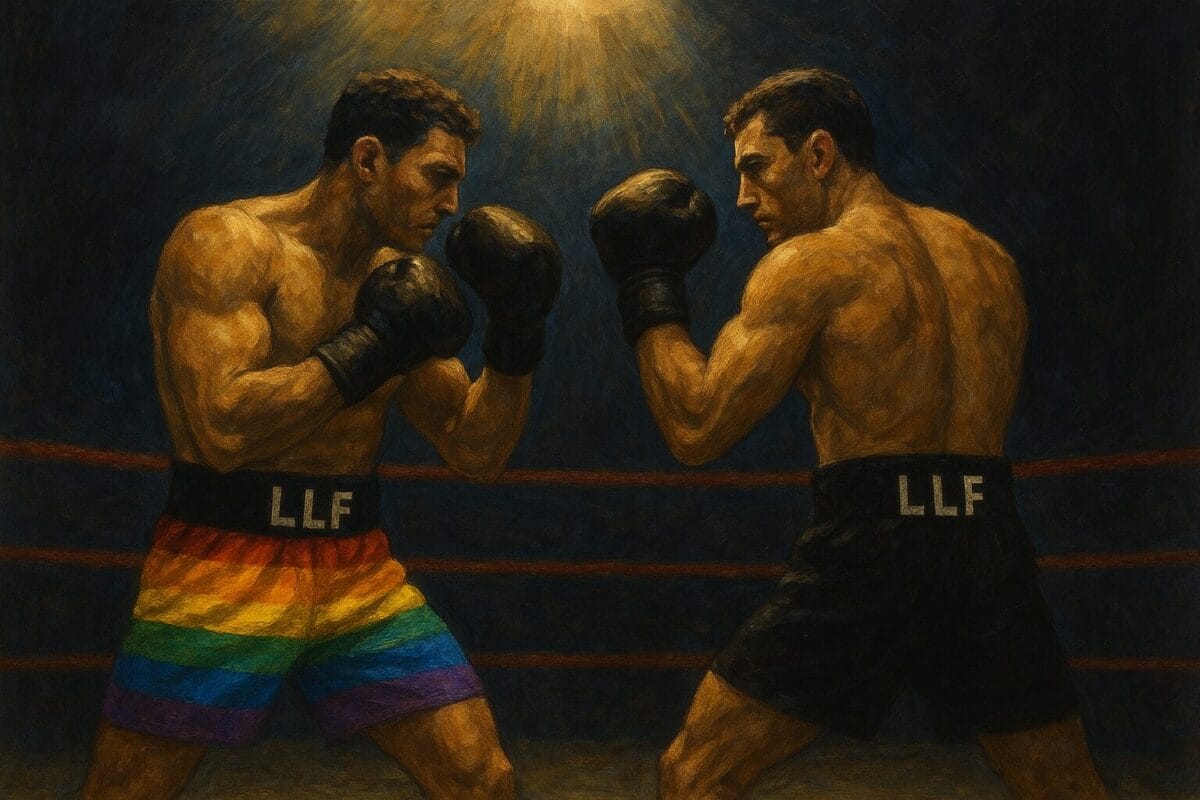
Joshua Penduck writes: On a cold and wet evening sometime in early 2021, my church’s ministry and management team met on Zoom to discuss the first chapter of the then new Living in Love and Faith material. I knew that that there were mixed opinions on the team. I didn’t realise just how mixed. The idea was that we would work through the book a chapter each week. Now remember, this was chapter one, the most uncontroversial chapter of the book. Exactly one hour later, I privately decided to scrap the whole procedure. Despite me outlining the rules for dialogue, and reminding people of those rules throughout, what abounded was shouting, hurtful and insensitive comments, dreadful theology, grandstanding, and talking past one another. I kept thinking, ‘Why are we doing this at this time? In the middle of a pandemic? When everyone’s emotions are high, where anxiety and fear abound, when we are having to communicate through that most impersonal format, namely Zoom?’
A little while later, after the Prayers of Love and Faith had been released, our Standing Committee met. We had a simple task: discuss the procedure of how to introduce this into discussion at the PCC. No discussion of theology. Yet another fight broke out. The words that most stuck out from the ensuing ‘conversation’ were ‘bigoted’, ‘abomination’, ‘fascist’, & ‘woke’. I kept thinking, ‘Why is this being recommended for discussion at a parish level before it has been properly formulated and debated on a national level? It is tearing my lovely team apart, a team who does not have the capacity to deal with such complicated issues.’ My excellent PCC Secretary left the church after that meeting, and it has taken two years to get a replacement.
Some—especially those in churches who have more-or-less one mind on the questions of sexuality—might criticise me for not introducing such matters properly. And I would agree. My retort is that my experience is symptomatic of the way the issue was dealt with in the Church of England as a whole (and of many a parish priest within it). The LLF process has been one of hurt, pain, mistrust, and division. And now, with the legal advice given to the House of Bishops finally being released, we can ask the question, ‘Whom has this benefited?’
Whom has LLF Benefited?
It certainly hasn’t benefited the LGBTQ+ community. So many of them bravely spoke up about their experiences, exposing their vulnerability to public commentary. Yet for so many it seems to have been thrown back in their face. This morning, I read about the experience of the Dean of Canterbury, David Montieth. I was deeply moved by the pain and desolation he feels after hearing the news of the apparent closure of the LLF process. His is the voice of many in the LGBTQ+ community who have hoped for a revision of the Church of England’s traditional teachings on marriage. So many of them feel let down by the bishops, are mistrustful of their authority. The LLF process has also been of much pain to ‘Side B’ Christians, LBGTQ+ Christians who have made great sacrifices in trying to live by the traditional teachings of the church, who have felt overlooked by both liberals and conservatives. Once again, mistrust of the episcopal bench has been the result.
The process hasn’t benefited those who have been looking to revise the church’s traditional teaching on marriage. After much effort and heartbreak, the result has been the pulling up the rug from under their feet with the discovery that all the promises made to them were false anyway: there were legal requirements that could never be met under the current circumstances. It has left them feeling mistrustful of episcopal authority, angrier, more vulnerable, and weary.
You may think that at this moment conservatives on the doctrine of marriage, like myself, are rejoicing. Far from it. The process has left us weary, exhausted and feeling vulnerable too. The most positive feeling is more ‘relief’ that we can talk about other things. There is a feeling that bishops were against us, were trying to introduce doctrinal change by stealth, that we were an inconvenience to the process. Much effort was poured into ways to help ensure that conservatives could remain within the structures of the Church of England, only to have that dismissed. Once again, it has broken trust with episcopal authority, where, for example, many churches now refuse to have bishops of revisionist views lead confirmation services in their churches.
It hasn’t benefited church discipline and unity. Alternative chapters have been set up, alternative ordinations have happened, the Ephesian Fund has been set up, canon law has been flouted in having services for same-sex couples which are for all intents and purposes weddings, other prominent clergy have entered same-sex marriages almost with a challenge to bishops to say, ‘What are you going to do now?’ Dioceses are now getting reputations for being ‘liberal’ or ‘conservative’. Episcopal collegiality is bruised and tender. There is now less cohesion in the Church of England than ever before. Episcopal authority has never been weaker since the 17th Century.
It hasn’t benefited the Church of England’s ability to evangelise or make the headlines. All the statistics of so-called Quiet Revival indicate that the benefits of this have gone mainly to Roman Catholics and Pentecostals. When the Church of England had its first female Archbishop of Canterbury, it didn’t even land on the front page of any national newspaper. When the Anglican Communion seemingly split, the media hardly mentioned it. Likewise with the stalling of the LLF process. We have ironically become less relevant to our nation, rather than more. I am not solely blaming the LLF process for this; nevertheless, the LLF process hasn’t been of benefit here.
And finally, it hasn’t benefited the Anglican Communion. Our rich treasury, of which the See of Canterbury has the honour of being the symbol of unity, has fallen apart. Whether the Communion has officially split or not is beside the question; the LLF process has been a large contributor to the end of Canterbury as the first among equals. Provinces from around the world have lost their trust in their English counterparts. They feel bruised and hurt.
So, who has benefited? From what I can see the only group to do so is Church House Publishing who has made something of a profit from their brightly coloured LLF materials.
What has gone wrong?
What has gone wrong? Although many may point in the direction of some other doctrinal loci, for me the issue is one of practical ecclesiology. And this can be summarised into two parts: ecclesial process, and bishops as symbols of ecclesial unity.
Process
First, process. LLF was very much in keeping with the zeitgeist of the 2010s, in which due process was overlooked for ideological reasons. Looking back, it is obvious that there was a rush to create a new settlement. Why obvious? Well, we were in the middle of a pandemic when most churches had other things on their mind – deaths of beloved congregation members, people being locked indoors, parish and diocesan finances spiralling downwards, political differences within churches of how best to ensure that people feel free to worship but also feel safe, anxiety and depression rates shooting through the roof. Historians will likely look back and think, ‘What an insane time to introduce such a predictably divisive discussion into the church.’ Then, because of the death of the Queen, the bishops could not meet to discuss LLF in more detail as originally intended. Rather than delaying discussion at General Synod, it was decided to skip an episcopal session. Once again, historians will likely look back and think, ‘What idiocy.’
Then, there was a lack of honesty about what such a process could achieve. The fact that the legal advice has only just been released is a mark of how needlessly painful the process has been. Were it released earlier, then revisionists could lower their high expectations, and conservative anxiety could have been reduced. Perhaps many in the LGBTQ+ community would have found safer places to talk about their experiences – if they chose to do so in the first place. Perhaps the bishops may have not even commended the proposed Prayers of Love and Faith knowing that it would lead to a legal quagmire that would inculcate mistrust and inflict untold pain.
I must confess – and I deliberately do not mince my words here – I agree with those future historians. It was stupidity and idiocy that led to the ignoring of good due process. It was arrogance of the highest degree that believed it could square a circle by having a circle with sharp edges, to quote the previous archbishop. In such a divisive matter for the church, honesty and openness was vital for monitoring of expectations, yet it was almost completely lacking. With such honesty, there would have been no need for a rushed process. We could have waited another year before even introducing the LLF materials for discussion. This would have allowed parishes to at least grieve their dead before getting into open debates with one another. The bishops could have had more meetings than their scheduled three (let alone the two they got). Because, at the end of the day, getting the process right was far more important than an early finish that would make the newspaper headlines. The anxious rush to get a quick resolution looked far more like a secular organisation than the Church of Christ rejoicing in his victory over sin, death, and Satan. And has not leisurely moderation been the Anglican way, or at least an ideal to aim towards?
Ecclesial Unity
So why the rush? This brings me to my second point—bishops have stopped being symbols of ecclesial unity. One of the main things that set the Church of England apart from the other churches of the Reformation was retention of episcopal authority. In part, this means that bishops can be trusted to be the symbol of ecclesial unity within their diocese. In an ideal world, the bishop’s throne—and the Cathedral that houses it—should be a place where all in the diocese can meet in fellowship. Naturally, the ideal has not always been met: from the 17th to the 20th Centuries, some bishops have been more concerned use their episcopal pulpit to spout their own views rather than maintain the theological unity of the church catholic—one thinks of a Bishop Hoadley in the 18th Century, or John A.T. Robinson in the 20th. Alternatively, bishops may try to enforce unity on a diverse diocese—like the Laudian bishops of the early 17th Century, the Evangelical legal actions in the 19th, or Bishop Kirk insisting that his Evangelical candidates wear stoles for their ordination. Nevertheless, in the main, bishops have been more focussed on being that symbol of unity (…Cathedrals less so).
What has changed recently is that many bishops have come to sound less like episcopal centres of unity and more like powerful activists. When bishops come to recommend highly inflammatory books which condemn groups within their diocese that hold a different opinion, they become bishops in name and status only. When bishops make contradictory promises to various groups in separate rooms, they lose the trust of all the groups. When bishops look like they are trying to find loopholes in the current legal framework in order to revise the currently held doctrine of marriage, they become centres of ecclesial division.
A bishop who considers him- or herself the centre of ecclesial unity in a diocese or province would never consider rushing through a complicated process and would protest at all attempts to do so. A bishop who has become an activist does not think in the same way. It is the difference between being a pragmatist and an ideologue. A pragmatist sees the reality before them and knows that all dialogue and conversation must be shaped by it, much like the way a good carpenter works with the grain of the wood. An activist feels it can shape reality according to their own needs and wants—like squaring a circle into a circle with pointy edges. This is not to say all activism is bad, nor that all pragmaticism is good. Rather it is to say that they both have their place in their correct locations. During the LLF process, that correct order was turned upside down, meaning that many bishops became activists, meaning that a parish priest like me had to turn into a pragmatist.
Yet this is not simply criticising the bishops. After all, one cannot be pragmatic regarding truth, as truth is the reality to which the carpenter must work with. But in many ways, it was the process itself that turned previously pragmatic bishops into activists. Bishops who had once held their tongue for the sake of their diocese found themselves having to speak out – especially in response to colleagues who broke with public collegiality. Because there was a rush to complete the process, there wasn’t thought given to how bishops would present it.
Conclusion
Which makes me wonder, where was this rush coming from? My worry is that it was not even activism, but rather something more worrying: legacy. Was it the case that there were bishops and archbishops who were coming up to retirement and wanted to quickly resolve the divisions of the Church of England? To have the legacy of being part of the generation that brought change? And when creating a legacy becomes more important than trustfully leaving one’s legacy in the hands of the Lord, all hell breaks loose (pun intended). Although this is my personal speculation, my fear is that there was much like that at work in the hearts of several bishops or an archbishop.
Whatever the truth might be, it has left the Church of England and the Anglican Communion more divided than it has been for centuries. It has left all sides of the debate bruised and wounded and mistrustful and hurt. A more thought-out process—less in a rush, more pragmatic, more realistic, more open, more honest, less concerned with legacy and more concerned with unity, less concerned with headlines and more concerned with the pastoral needs of the parishes and dioceses at the time—all this would helped make a difficult conversation more bearable and, dare I say it, even healing.
At the very least, I would have not been without a PCC Secretary for the last two years.

Joshua Penduck is the Rector of Newcastle-under-Lyme, St Giles with St Thomas, Butterton, in the Diocese of Lichfield. Prior to ordination he was a composer and has written music for the LSO, BCMG and Orkest de Ereprijs. He is married to Shelley, who is also an Anglican minister in Stoke-on-Trent.
 Buy me a Coffee











Very many thought things were too slow not too fast.
Among their number were many who had no real questions about where the process would end up, because they believed that history could only go in one direction (because they said so, and must be obeyed? or because history always goes in a straight line?)…
…and also secondly those who had not concern with analysis or thought or theological grounding, coherence within the wider Christian picture etc..
When growing up, we know at what ages of development we have been more and less impatient.
The legal advice is in the public domain at last? WHERE, please?
Idiocy is too kind a word for the LLF process. Mendacity is more accurate.
That 2/3 majority needed for bespoke services but not for prayers within services for same sex couples
Simon, but that is only because the bishops *claimed* that the PLF prayers were not ‘indicative of a change of doctrine’, based on legal advice they did not publish.
And a group of bishops disagreed, and said they thought the legal advice did not support that position.
So until that is clear and public, Synod’s marginal decision on this is not secure.
I think this article for all it’s cost/benefit analysis, starts in the wrong place. LLF was part of a long-game strategy, a process within a process by, for want of better terminology a combination progressives and secularists. Christian Theology is indivisibly central and structural to the pastoral. And the Gospel is the eternal welcome, the significance, the status, standing, acceptance, identity, in Jesus, God’s Son Saviour, in our Triune God.
Long game, because of drip drip normalisation (or jamming) – they hoped. Which is dishonest at the best of times.
Completely disagree with this article. The Church of England is established church of a nation where same sex marriage is legal, it therefore had to offer something to same sex couples in its parishes who wanted some recognition of their relationships.
LLF was the compromise that got a simple majority of Synod. It was conservative evangelicals who made clear they would not accept same sex marriages in C of E churches, or even bespoke services for same sex couples. Therefore the 2/3 majority required was not there yet, that 2/3 majority was required for remarriage of divorcees in churches or female clergy or on second attempt female bishops. The fact the Church of Nigeria, from a nation where same sex couples are jailed, has let a few Gafcon types in revolt should little concern us. Most provinces remain in the Anglican Communion and in any case the head of the Anglican Communion is likely to be rotated going forward amongst Archbishops globally of the Communion rather than always being the Archbishop of Canterbury.
From my conversations with local people and our C of E churches congregations Sarah Mullally has been warmly welcomed as next Archbishop too. She is seen as more pro Parish than Welby for starters and after male sex scandals amongst some clergy in the church a women Archbishop was needed.
As for the prayers authorised via LLF, they near identical to the non liturgical prayers for same sex couples Pope Francis authorised and Pope Leo and the Holy See have retained. So on this historic day of reconciliation between our Supreme Governor, the King and the Pope and their join prayers in the Sistine Chapel it actually brings some unity between the Church of England and the Roman Catholic church in their approach to same sex relationships
Legal?
Abortion is Legal in this country. The murdering of hundreds of thousands of babies every year should have …what do you suggest should be performed in its services in the Church of England? Open caskets on Sunday morning family services and ‘join the baby pieces’ activities for the children’s church?
If Assisted dying becomes law in this land perhaps the Church of England can open churches each evening with candles and soft music for suicide sessions with loved ones attending and the local priest blessing?
Blessing same sex couples in Sunday family services…invite drag queens to sing along.
(Do a parody blessing in a church I for one happen to be in and prepare to have tables overturned, evil confronted and people called to repentance.)
OR stop all of this right now and cleanse the Church of England of all evil which it has allowed and toyed with and infected the Church with for way too long.
Sorry you were lied to and hurt and led along the garden path….but the priority now is salvaging the C of E from the edge of darkness.
There must be A LOT pastoral care for healing and discipling for those who do want to recieve Christ and turn from Sin.
But not endless debates over the great wrongs that the C of E allowed itself to commit.
Sin is always wrong.
What God forbids he always forbids.
Snatch the genuine out of the fire and move forwards fast in cleaning up the mess.
It is God that matters most in all of this. The C of E forgot that. Shame on her.
Time to go in hard, Repent and clean up.
No but the Church of England doesn’t support making abortion illegal again but accepts the 24 weeks time limit. The C of E also already has women priests and bishops, which some say is unbiblical as St Paul opposed them. The C of E also remarries divorcees in Church, which some also say is unbliblical and certainly unless spousal adultery involved based on the word of Christ.
Same sex couples have only been approved for prayers in services by Synod, not even full remarriages in churches like 2/3 of Synod approved for divorcees.
The C of E is established church of England and supposed to represent all its parishioners and headed by the King on earth. That has always been just as important to it as supposed biblical purity on everything
Is the CoE as the ‘established church of England’ supposed to represent its parishioners or to serve them in Christ’s name? There’s an important difference….
Well said.
Simon
“The C of E is established church of England and supposed to represent all its parishioners and headed by the King on earth. That has always been just as important to it as supposed biblical purity on everything”
You appear to be confirming my point that the CofE is institutionally ‘serving two masters’….. God and the state.
“No one can serve two masters. Either you will hate the one and love the other, or you will be devoted to the one and despise the other. You cannot serve both God and money”.
Although Jesus refers specifically to money, the principle applies more widely to sny attempt to serve “God and….” And your somewhat derogatory reference to “…supposed biblical purity…” suggests that to you, God is not the primary master you serve. You cannot in the end serve both – please decide to serve God rather than the second master here…..
Of course if you disrupted services for same sex prayers in church in the way you describe you now risk being arrested for a hate crime in the UK by the police and for homophobia under the Public Order Act based on how the police and law enforcement and the courts under the Starmer government now interprets it
So-called ‘hate crimes’ (odd name, since they rarely involve immature ‘hate’, just mature opposition; and because they are not crimes) will not be pursued, is the latest advice from the Police Commissioners.
Simon, you keep on giving the same odd message that if something is legal the national church has to go along with it(!) There are, to the contrary, very many legal things that they do not agree with at all – as other contributors have mentioned. After all, there are many legal things in this country which are flat out opposed to Christianity.
Anyway, how do you tell if the Church agrees with it?
-By a headcount of all national church electoral roll members?
-By a single anonymous self-important spokesperson from Church House, Westminster?
-By the majority of the House of Bishops?
-By Synod vote? Votes are on proposals not stances.
-By asking the Archbishop?
A Church is not an agent. It cannot agree with anything.
There are plenty of times when the church disagreed strongly with its leadership- e.g., Brexit, death penalty.
Is it the leadership or the membership that you prioritise? Why? Isn’t that arbitrary?
So, you think Jeannie’s hysteria is “mature opposition”?
The police only said they will not investigate not crime hate incidents, eg tweets not inciting violence. They will still investigate breaches of the Public Order Act and disrupting a service containing prayers for same sex couples could still lead to arrest for harassment and criminal damage too if it led to tables being overturned and damaged.
As established church of course every parishioner and resident of a city, town or village parish is in effect a member of the Church of England. Its membership goes beyond its clergy and even those who regularly or even just occasionally attends its services. Anybody can be wed, have their children baptised in or a funeral in their local C of E Parish church even in they never attend its services by law. I also agree bishops should thus have not opposed Brexit once the English had by majority voted for it and parliament implemented it into law and to be fair Welby at least did accept the Leave vote
Anybody can be wed, have their children baptised in or a funeral in their local C of E Parish church even in they never attend its services by law.
Are you quite sure that such ceremonies are legally on demand alone?
That the vicar has no discretion whatsoever? Even if the parents are not baptised, or if they are Muslim (to claim a Muslim plot in the churchyard)?
Yes, you do not even need to be baptised to be married in your local Church of England church or have your child baptised. Muslims too can be married in C of E churches if their spouses are Christians and want a wedding in their Parish church. A Muslim can even be buried in their local C of E Parish churchyard if they wish but are unlikely to request that due to strict Muslim burial practices eg the body to be laid on the right side facing Mecca
Jeannie cares proportionately and to the appropriate degree. The lack of caring among most is both inaccurate and heretical.
Bring it on. Jesus Christ is Lord of All!
For the tape- There will be no literal turning of any tables by me.
I leave that to Jesus Christ himself; who is the best table-turner.
blimey
I agree that cold turkey is the most loving course of action, and since it is also the most effective AND the least messy in a situation where the others are very messy indeed, why consider other alternatives?
Simon, can I make an observation?
I find it odd that, in all your comments, you never once refer to what Jesus (or the New Testament, or the Bible) actually teaches.
Do you think that is at all important?
Hi Paul,
Jesus is very clear about marriage including divorce. Frustratingly (for me) St Paul is also clear about women teachers though that doesn’t seem to have been a major barrier in the CoE.
I accept the teaching of women and have benefitted as a divorcee from being able to remarry in the Church of England – though the marriage took place in a free evangelical church.
It has always seemed to me however that for gay people the bar is almost impossibly high. As a relative of a couple of gay men, I’ve seen their journey away from the church – and God – and it grieves me – as I feel sure it grieves God. I am torn on gay marriage because of what Jesus teaches, but I fear ultimate judgement will find that I – and many others – will be asked why we pushed so many gay people away from a faith in our loving Saviour.
Interestingly, Jesus talks about marriage between a man and a woman, but does not condemn – or even comment on – homosexuality.
If we are so determined to push gay people away from a faith – imagine being told to be gay if you’re heterosexual! – then I would love to hear some suggestions on how we can include them in our faith. Or are they forever bound to celibacy?
Hi Charles. The group Living Out address this explicitly. Do visit their website for lots of resources and teaching material.
The problem in the West is that we have idolised the exclusive nuclear family, so anyone outside that is ‘condemned’ to loneliness. We need to recover a vision for the extended household. For this reason, we live in a multigenerational (and multiethnic) household, with married and single (and engaged at the moment).
Paul is very clear in affirming women who teach, who lead, who are apostles, and who exercise authority by praying and prophesying in the assembly. He is also clear in 1 Cor 7.4 that a wife exercises authority over her husband, as he does over her in a reciprocal way. And Jesus, in Mark 10, rejects ‘any reason’ divorce, and not divorce for any reason. He is siding with Shammai against Hillel in the debate of the day.
God commends the nuclear family explicitly in Genesis 2:24. Be careful what you wish for, Ian. Clan – i.e. extended family – warfare has been the normover the rest of humanity since time immemorial. It is a great blessing to have grandparents nearby, as they would have been under ancient Israel’s land laws, but husband and wife should have their own household.
It’s of course Matt rather than Mark where Jesus touches on ‘any reason’. Mark’s Jesus opposes divorce and remarriage tout court, and his elaboration fits that picture. Matt’s Jesus opposes indiscriminate divorce (more angles are dealt with as Matt updates and elaborates on Mk) but because he reproduces. Mark, his elaboration does not fit his initial question but rather Mark’s initial question.
In other words, an example of Goodacrean fatigue; but since it is the intrinsic difficulty of the faithful updater’s task, and not fatigue, that means the editorial seams show and the editorial amalgam does not flow smoothly, ‘inconcinnity’ is a much better term than ‘fatigue’, and presupposes less.
Any study of the divorce and remarriage scriptures should heed two things: (1) divorce, in the Bible, is a matter for the couple, who must then inform the authorities (rather than petition them, as today); (2) Jesus treats divorce and remarriage separately and does not suppose that the former automatically confers the right to the latter – when he spoke he discussed the first issue and then moved on to the second. (Ancient Jewish certificates of divorce handed by the man to the woman state “you are now permitted to any man”; this was important for the woman to know in view of the penalty for adultery, but does not necessarily reflect God’s view.)
So, what did Jesus say?
“Anyone who divorces his wife and [kai] marries another woman commits adultery against [ep] her. And if a woman who divorces her husband marries another man, she commits adultery” (Mark 10:11-12).
“Anyone who divorces his wife and [kai] marries another woman commits adultery, and the man who marries a divorced woman commits adultery” (Luke 16:18).
“Anyone who divorces his wife, not for porneia, and marries another woman commits adultery” [and he who marries a divorced woman commits adultery – in some Greek manuscripts] (Matthew 19:9).
So Jesus is clear – remarriage after divorce (during the lifetime of the ‘ex’) constitutes adultery, with a possible rider relating to porneia in Matthew 19:9.
What about that rider?
Jesus never contradicts himself. In two of the gospels there is no exception, and each gospel writer has no certainty that his readers are going to read any other account. So there is no exception. But what then does Matthew 19:9 mean?
It means that Jesus is declining to discuss the particular situation in which a man divorces for porneia and then remarries. He is discussing only situations in which the divorce is for something other than porneia. He says in Matthew 19 that remarriage after such a divorce is adulterous, and he says nothing in that conversation about remarriage after a divorce for porneia.
Why did he do that? Because he is talking to Pharisees who tended to divorce for minor matters such as mispreparing food. (See the Midrash – ancient Jewish commentary on scripture – denoted Sifré Deuteronomy, part 269; also the Mishnah, tractate Gittin 9:10.) And also because porneia is related to erwat davar, which is a Hebrew phrase found in the Jewish divorce regulation in Deuteronomy 24:1-4. Jesus is not engaging in a scripture study with these Pharisees; he is in a heated discussion with them about their routine use of excuses in order to divorce unwanted wives. To preclude diversion, he narrows the discussion down at its beginning.
A further point: the Greek rendered as “if a man divorces, and marries another woman…” can equally well mean “if a man divorces in order to marry another woman…” But the latter meaning is excluded because the woman’s adultery in Mark 10:12 takes no account of whether she instituted the divorce in order to marry another man or not.
In Matthew 5:32, Jesus states that anyone who divorces his woman, except for porneia [illicit sexual relations], causes her to be adulterous, and anyone who marries a divorcee commits adultery. In the final clause we see that God takes marriage so seriously that a woman who is thrown out cannot remarry even if she is innocent of porneia!
These are the standards of the kingdom. But Jesus said that not everyone could bear such high standards (Matt 19:11), and an Established church that by default takes an entire nation to be Christian even though scripture warns that genuine believers will be a minority, is going to come unstuck here.
Thanks Anthony, but I think there are several key points where your argument does not hold up here.
‘Jesus treats divorce and remarriage separately and does not suppose that the former automatically confers the right to the latter’. I don’t think there is any evidence for this, and your immediately following comment contradicts it. In the NT, the word we translate ‘divorce’ simply means ‘put away’, and it only makes sense if it allows remarriage—not least because outside marriage, women have no economic security.
‘He is discussing only situations in which the divorce is for something other than porneia.’ Yes–but this highlights the ‘any reason’ question, and Jesus is here ruling with Shammai against Hillel.
One thing you do highlight, which is significant, is that the debate here is about Deut 24—and yet Jesus avoids debate about this text, and instead looks to Genesis. That is why his comments here bear on the same-sex marriage debate.
You cannot simply quote the individual texts on divorce without locating them in the historical context of the dispute between Hillel and Shammai on ‘any reason’ divorce. This was the debate Jesus is being drawn into, as the form of the question asked of Jesus shows.
‘In two of the gospels there is no exception, and each gospel writer has no certainty that his readers are going to read any other account.’ Not so. The evidence is that each of the gospels was written for the whole Christian movement, and that each knew of the others.
[For ‘reproduces. Mark’, read ‘reproduces Mark’.]
So you think, Ian, that Mark, Luke and Paul were in error in failing to state an exception? Keep in mind that for a generation those writings would not have been collected together with Matthew, and any believer might have been guided by any one of these alone.
Jesus is clear in Matthew 19:9 that if you divorce for a reason other than spousal porneia then you should not remarry – it would involve adultery. In logic, these words are silent about whether people who divorce for porneia are free to remarry; but Jesus’ inclusion of the words “not for porneia” is commonly held to mean that remarriage is acceptable in that case. Otherwise, why should he include that phrase?
That question can in fact be answered. Consider what would have happened if Jesus had said to the hostile Pharisees what he told his disciples, that anyone who divorces his wife and marries another woman commits adultery. In Jesus’ time the Jews needed permission to enact the death penalty from the Roman occupiers (John 18:31), whose own culture did not regard adultery as a capital offence. The Jews instead required divorce of a wife who had committed adultery (Mishnah, tractate Sotah 6:1). The Pharisees would have shot back at Jesus, “But God commands that a woman shall be put to death for adultery, after which her husband is free to remarry – yet our hands are tied by the Romans!” Even if Jesus reminded them that God had let the Romans invade the Holy Land because of Israel’s faithlessness (Deuteronomy 28), the Pharisees would have regarded other Israelites as at fault, not themselves. At this point we understand why Jesus spoke differently to the Pharisees and the disciples: he wanted to forestall this response. But he always speaks the truth even while tailoring his words to his audiences, and, although his statements are not identical, they must be mutually consistent. How can we reconcile his words to the Pharisees and to the disciples, with and without the phrase “not for porneia”?
An answer has already been given: Jesus did not actually say anything to the Pharisees about people who divorce for porneia; his words carefully restricted the discussion to criticise people who divorce for other, lesser reasons. Why would he do that? Because the Pharisees divorced for lesser reasons! By including the words “not for porneia”, Jesus also bypassed legalistic discussion of grounds for divorce, and struck at the Pharisees’ hard-hearted practice of serial monogamy (which might be termed consecutive polygamy); notice that it is Jesus, not the Pharisees, who brings remarriage into the exchange. His meaning is: “never mind about porneia” – which the Pharisees might have argued was ground for divorce, since it clearly constitutes erwat davar. Jesus does not tell the Pharisees whether it is acceptable to remarry after divorcing for porneia; he says only that it is not acceptable to remarry after divorcing not for porneia. It is, for example, adulterous to remarry after divorcing a wife who is a poor cook, as Hillel’s school advocated. This has been called the ‘no comment’ or preteritive view of Matthew 19:9 (from the Latin word praeter, which means ‘except’). Jesus also states that divorce stems from hard-heartedness, which was the trouble with the Pharisees and is what Jesus came to offer the solution for.
There is one alternative explanation. To try to justify their lax practice, Hillel’s school of Pharisees had legalistically divided up the phrase erwat davar, to speak of divorce relating to erwah and, separately, divorce for ‘a thing’ (davar), or anything. Attention has been called to this trick by David Instone-Brewer, who suggests that the Pharisees were asking Jesus about this latter category of divorce in Matthew 19:3 – “Is it legal for a man to divorce his wife for pasan aitian [every cause]?” Jesus would then be using the phrase “not for porneia” to restrict his criticism to men who divorce their wives on grounds other than the capital sin of adultery – taking in the Hillelite davar category. Mark, writing for gentiles, edits out the loaded phrase “for any cause” from the Pharisees’ question. If this is correct then the implications are unchanged, because Jesus promptly told the disciples without qualification that remarriage after divorce is adulterous (Mark 10:11-12). Please don’t assume I am ignorant of the context involving Hillel and Shammai. I simply disagree with Instone-Brewer’s pastoral conclusions.
The disciples’ are shocked at how much higher Jesus’ standards are than the Law of Moses. (Jesus is not adding to the Law, for Christianity is a volunteer movement.) This is not a disagreement within the Trinity, for if God had made the Law more stringent then it would have been unworkable; in ancient Israel God simply does not hold remarital adultery against people. (“Where there is no law, sin is not accounted” – Romans 5:13). The disciples do not yet know that believers in Jesus will be given the inner resources needed to conform to Jesus’ standards, via the Holy Spirit. They even think it might be safer not to marry (Matthew 19:10).
Ian, Always good to hear your sound and calm reasoning.
Charles,
What you call pushing people away from the church, I would call warning people about the ultimate consequences of their actions. What is the highest good here? And is not what you call a ‘journey away from the church’ really just the manifestation of a decision that had already been made in the heart?
Vaughan Roberts and Sam Allberry are men who experience sexual attraction to other men and believe the scriptures tell them not to act on it. Plenty of evangelicals can offer scriptural advice but they can in addition offer pastoral advice, to which you could refer some of your friends and relatives.
Jeremy Pemberton and Richard Coles are men who read scripture differently and can offer excellent pastoral advice to those who share their hermeneutics and have experienced hatred from fellow Christians.
I consider them to be in the same position as the bishops.
he does refer to what Jesus doesnt say…
Either you’re ignorant of what it actually means for the Church of England to be established, or you’re deliberately blurring the line between state and church to make your argument sound inevitable. The C of E is by law established, yes – but that means it serves the nation under God, not that it rewrites doctrine every time Parliament passes a new social policy. Its bishops swear to uphold Scripture and the historic formularies, not the prevailing mood of Westminster. So no, the Church didn’t “have to offer something” once same-sex marriage became legal. It had – and still has – the duty to teach what it believes to be true, even when that’s unpopular.
LLF wasn’t a harmless compromise. It introduced authorised liturgical prayers for relationships that the Church’s own Canon B30 says fall outside Christian marriage. That’s not compromise – that’s contradiction. And dismissing the Global South as a few “Gafcon types” ignores that they represent most practising Anglicans worldwide, who see this as a departure from biblical faith, not a local matter of taste. This smacks of ugly colonialist stereotypes and I think you need to prayerfully examine your thinking here about our brothers and sisters outside of the West.
As for the comparison with Rome, that’s simply false. Fiducia Supplicans permits informal blessings for individuals, not liturgical recognition of same-sex relationships. The C of E’s LLF prayers cross precisely that line, which is why this move widens, not closes, the gap with the catholic and apostolic tradition.
In short: establishment doesn’t mean surrender to the state. The Church’s task is to be faithful, not fashionable.
Simon
COFE priests could bless gay people before LLF. It’s a fake compromise – deliberately dishonest and now they’ve taken even that away.
Why should any gay person (A, B, X or Z!) ever trust anyone in the CofE ever again when this whole process has been abusive and dishonest from the outset?!
“The Church of England is established church of a nation where same sex marriage is legal, it therefore had to offer something to same sex couples in its parishes who wanted some recognition of their relationships”
So if slavery was legal, Church of England parishes should bless it? Or are you just special pleading?
The Church of England did invest in slave trading companies when it was legal centuries ago
Errrr no. Queen Anne’s Bounty invested in government bonds.
The simplest way to make reasonable people do bad things is to entice them into stupidity. We’ve certainly seen that in spades in the Church of England during the LLF years. And a central aspect of stupidity is lack of judgement. Once people have lost their judgement, their moral compass no longer works correctly. Thereafter it’s a short journey to wrongdoing and, possibly, outright wickedness. In the Christian’s context, that means unfaithfulness to the Lord Jesus Christ.
I have no idea who thought up LLF but I was shocked to see self proclaimed evangelicals (and those who sympathised with them on matters of sexual ethics) fall for what was patently an invitation to fight on the enemy’s turf. The will to fight was good, but the insidious pages of LLF were obviously a deadly trap and no place for God’s faithful people to venture. The mangled, obfuscatory and obsequious language by which it was publicly launched should have been enough to warn any sensible Christian of what was intended. My view at the time, not least in comment on Psephizo, was that evangelicals should refuse to engage and instead put their time and energy into producing a short but compelling account of God’s creative intention for the sexual coming together of men and women, and the requirement for obedience in respecting the boundary he set around it.
Later on at the fateful GS vote, the Cornes amendment (doubtless well meant) was another misjudgement: it allowed wavering evangelicals to vote in favour of what seemed like generosity of spirit on the correct basis that there would be a legal block to the whole dodgy business further down the line. The vote was excruciatingly tight – and Cornes’ ploy, along with Mountstephen’s assurance, swung it the wrong way! Had these things not happened, we might well have been spared the consequent blood letting. Putting up a fight, particularly for what’s right, is never best done by pulling your punches: it simply ensures greater pain to come later on. And so here we are with a great deal of wound licking on all sides.
May the C of E never again choose niceness over honesty, or unity over truth. It doesn’t work.
I agree mostly, but disagree on Cornes. Without that, we would have been much worse off, and it would still have scraped through. All those who voted for Cornes still voted against.
Not quite all – if they had, arithmetically, wouldn’t it have been defeated? My diocesan bishop voted for Cornes and voted in favour.
Not quite…but I still don’t think it would have been defeated.
But, again, a wake up: how could we have embarked on such a disastrous course on so slim a vote?
Could we retain the distinction between LLF – the theological process which produced a whole range of resources for reflection, discussion, and discernment?And which has often been ignored as a trove of theology and biblical scholarship.
And PLF – the prayers for gay people passed by a majority in Synod and available for use in CoE services. These are happening and will continue to happen in CoE churches, just as such prayers are happening in RC churches (as Simon B has noted).
Yes, the process has been lengthy and painful and some queer Christians opted out because their voices have not been heard. But two good things have emerged: the LLF resources and the PLF.
are such prayers for the individuals or for their sexual relationship?
Are the Prayers of Dedication After a Civil Marriage for the people or for their sexual relationship?
There aren’t prayers of dedication after a registry office marriage – all prayer is forbidden in the registry office.
Indeed. So if a gay couple is married or civilly partnered by a registrar, they can have the PLF in a church service.
Penny, except the two situations are not analogous. The doctrine of the Church allows the male-female couple’s relationship to be affirmed and blessed; it does not allow the gay couple’s relationship to be affirmed and blessed. The bishops, in commending PLF, claimed this was possibly and had integrity.
I think your analogy demonstrates that this claim is untrue.
Ian
I thought the PLF weren’t blessing the couple’s relationship?
‘I thought the PLF weren’t blessing the couple’s relationship?’ Er, that is what I just said…?!
For their relationship. Because it conforms to the teaching of Jesus as a marriage between one man and one woman.
So, you shouldn’t have a problem with them then!
PCD, given that ‘relationship’ is too vague to be defined, probably deliberately so, then it follows that the question is meaningless.
As to ‘Do you have a praahblem with that?’, it is an underhand way of trying to make the problem lie with the objector when it lies, by definition, with the thing objected to. (And it’s also a cliche that is perfectly conformist to the societal move that produced such horrors.)
Christopher
It’s quite clear that you’re not following the argument again. You stumble upon the word relationship when Ian and I are discussing what the PLF bless. Anthony doesn’t seem to have heard of the prayers of dedication after a civil marriage.
On a tangent, I don’t actually think about whether relationships are sexual or not, because I’m not prurient.
Penny, I don’t understand your comments at all. You seem to be confusing two things. I don’t have a problem with prayers for a male female couple after a civil ceremony.
The Prayers of Dedication after a Civil Marriage importantly have as a necessary part prayers of penitance. There is an acknowledgement of past failure in the area of marriage. So, there is no ‘blessing’ of sin. Rather, there is recognition that the circumstances are less than good. However, forgiveness of the sin is possible, and the prayers look to the couple not repeating the mistakes previous made.
So, there is a clear difference from this and formal prayers which affirm a sexual relationship which does not conform to the doctrine of the Church of England.
As for clergy in the CofE, I don’t think there has been any change in Canon C4. I presume that it is still the case that someone coming forward for ordination who is in a marriage where one party is divorced still needs to seek a Canon C4 dispensation, which is an intrusive process.
The penitential preface os not a necessary part and most couples choose not to use it.
The prayers for covenanter friendship are definitely not for a sexual relationship. The work proposed on singleness and celibacy was not for a sexual relationship (by definition).
Well said Penelope
Thanks but Im not a ‘Side B’ Christian! What a terrible way to refer to anyone.
Sounds like 45rpm single pop discs, which has an A side and a B side. A sides were aimed at top 20 popular sales, B sides were mostly fillers. Rarely there were double A side disks.
It’s a standard phrase, which I didn’t invent: https://en.wikipedia.org/wiki/Side_B_Christians
A fuller article can be found here: https://en.wikipedia.org/wiki/Side_A,_Side_B,_Side_X,_Side_Y
Fine but i choose not to refer to myself as such. I also don’t like ‘queers’ or ‘gays’ as if sexuality defines you. God forbid.
Yes, you are quite right to have that sensitivity. Unfortunately, these terms are used in the debate, and others in a similar position have decided to make use of those terms, albeit reluctantly, in order better to engage.
As Christians they should know better. The same commentators argue sexuality is just part of one’s being, yet go on to refer to ‘the gays’ as if their sexuality encapsulates their whole being. Christians should be different in their use of language, regardless of how others use it.
What would you prefer?
The Side A / Side B distinction they invented in the US was done so because it wasn’t seen as pejorative to either school. It’s somewhat artificial but limited to this debate.
Peter
The other problem is that basically all of the side B Christians are gay. There’s no wider support, because inevitably almost all straight Christians who oppose gay sex almost universally always reject the idea that people are created gay or intended to be gay and therefore they are side X, not side B.
Side A – there’s no difference between gay Christian ethics and straight Christian ethics
Side B – the only difference is that gay Christians can’t marry or have sex
Side X – gay Christians should be seeking to become straight.
I think this is a good article, as despite the celebratory tone of many comments on the previous article, including my own, it is also right to acknowledge the very real and sincere pain of people who were sold a lie, or who feel ignored, which is a great many, across all theological divides.
This article is framed well. One can be pleased about the decision to put the whole thing LLF process on ice, and take a more critical posture toward the process’ many failings, without relishing people’s pain on the one hand, or pretending that PLF is going away, when they’re not. Indeed, that was a major surprise of comments on the other article. PLF is here to stay, for now.
However while I agree with this reflection, one of the things Joshua doesn’t give time to, and perhaps should, is the damage to episcopal credibility outside the CofE.
For better or worse, as the established church in England the CofE has a de facto voice to speak on behalf of Christians in this country, to represent them in the Lords, and often in much media coverage. The CofE is the wider church’s representative in matters political and cultural, and there’s no escaping it. When your house is not in order, it speaks volumes to how others are perceived. Because of this, I think the damage to ecumenical relationships is yet unknown, as the dust is till very much up in the air and obscuring things (largely thanks to GAFCON) but I cannot imagine the relationship between the CofE and the wider church in the UK has bene helped by this process, and the lack of trust in the Episcopate is more wide-ranging than this acknowledges.
The division ripples out well beyond your own walls, and that is why even though the voice of CofE congregants and ministers remains the majority one here in these comments (to no one’s surprise) it is not the only voice.
Isn’t there a hint of the irrelevance of the CoE, in the UK, in the mention that the announcement of the ABoC was barely covered, if at all, by the media, notwithstanding that a female appointment is historic.
Are the main interest groups not lgb?
None of it is a promotion of the message of Christ and that is where the CoE as a whole, an institution is in apostate declension, notwithstanding some Gospel outliers.
The CoE lamp stand is being removed, without repentance.
Yes…to the increased irrelevance.
Lampstand? Is there such a thing for a denomination? Seems more that congregations are the gatherings that actually count.
I agree, Matt, not because I have close links outside the C of E but because my instinct is always to step back and look at the bigger picture which may be driving or in turn affected by any particular issue. So I tend to be somewhat alone, and even ridiculed, when I draw attention to the vehemently atheistic forces which lie behind what has been a slow burn (over decades) attack on Christians, Christianity in general, and the inherited social values which owe a great deal more to Christianity than most people in Western societies either realise or are prepared to admit.
In essence we seem to be on a one way path to dystopian, anti-human control. It’s a path along which respect for individual freedom, normal family life, social cohesion, stable economic systems, national borders, and global politics are being deliberately sabotaged. The ensuing chaos is then ripe for popular demand for strong leaders and reliable systems which promise to save people from their misery. But today’s strong leaders will turn out to be the very atheistic fascists (ideologically aligned state and corporate entities) who have been quietly sewing the destruction. Their remedy is indeed anti human (seeing population reduction and unyielding control as essential) and involves digital technology with the power to enslave whole populations much as has been evidenced in China for years. But today’s digital technology is powerful beyond anything that was available to former communist regimes, and its power in no way resembles the fearful blood letting of the past: it is convenient, clean and silent – but quite as deadly to human flourishing as anything seen in human history.
LLF has, for the Church of England, been a serious diversion from the vital task of being a pastor to Christians and an evangelist to the whole nation. Of course if you can plainly see how the sabotage that I described above is working, you will have no problem understanding how LLF fits into a picture which extends far beyond the internal politics of the C of E. The satanic forces which yearn for their own god-like control over the human race would clearly have a major problem with the Christian gospel and with people who serve the living God. They need to infiltrate the Christian church, capture the minds of good people and turn them into unwitting agents of the church’s own destruction from within. It makes for a truly destructive battle among Christians where mutual suspicion and hurt preclude the normal Christian’s instinct for turning to the Bible to find out God’s view on an issue.
So here we are in this wretched circular firing squad – how Satan must be cheering! And, as you say, the ramifications extend far beyond the inner misery of the Church of England.
AI uncontrolled could destroy its creators let alone the population it wants to control, hence it needs to be handled with care
AI cannot control a population that possesses judgement and perspective.
Yeah, I know…
Don,
Even among evangelicals there is a view that this whole sorry mess is a grotesque accident. It is time to state clearly that many of the bishops – and archbishops – have been letting themselves be used by Satan. The Bible could have told them this, but they chose to ignore it. That persons paid a good salary from the resources of the faithful (past and present) behave in such a manner is a very grave scandal in the body of Christ. Jesus will not let himself be so badly represented for long, and the withdrawal of His blessing is manifest in the dwindling of the Church of England before our eyes. He is always at work but He does not always act dramatically. If the bishops had any sense of their true standing with Him then they would cry out in fear, vacate their palaces and put their bank balances into a godly cause. They are in the gravest danger.
At the present time I believe it is a matter for personal prayer whether any believer should quit the CoE or stay put, although I do suspect the Lord is telling his people to quit its liberal congregations. I hope that those who leave inform (courteously but clearly) not only their vicars but all in the congregation why, after the manner of Matthew 18:17.
As for cleansing the hierarchy, embarrassment is a powerful weapon if evangelicals decide to organise themselves. But whether that is what God wishes, I have no idea.
Yes indeed. If anybody is under the illusion that acceptance of a predictable but inconvenient legal reality signals the C of E’s collective repentance for past rebellion and a return to biblical faithfulness, they could not be more wrong. And unless she publicly announces a radical break from her recent ideological stance, Sarah Mullaly will be standing for continuity Welby, albeit perhaps with a kinder manner. The unapologetic managerial style, the manipulation of language and political processes, and the incessant promotion of woke ideology may be softened but the underlying rebellious spirit will continue. That would be a disaster.
So any evangelicals and sympathisers who believe a corner has been turned need to face a more sombre reality: the battle to save the Church of England is not over. They need to make clear to the new archbishop that today’s sullen status quo cannot be accepted as an agreed position on which the C of E can go forward: the PLF are inherently deceitful; they have to be withdrawn. Till that happens they set division in stone across the church and within congregations. And there needs to be a new atmosphere of self discipline and adherence to former ordination and consecration vows.
Simple contemplation of the reaction we could expect to that kind of return to being a faithful church surely tells us immediately how deep-seated the rebellion is and what level of pain a restoration to spiritual obedience and organisational integrity would entail. Only God knows what the future holds for the C of E, but I think it’s pretty clear that those who are up for being his agents in trying to save it will have to find in themselves a daunting level of determination. For those who choose to remain, the will to try is what counts. Success will be in God’s hands.
Don, thank you for your contributions on this and former blogs. I always appreciate your comments.
There is an interesting parallel with the Conservative Party, which has likewise seen its membership and voter base decline substantially. As exposed particularly by the last election, members and votes feel let down by the Party’s ‘managerial style, the manipulation of language and political processes, and the incessant promotion of woke ideology’ – features of successive administrations from Cameron onwards. Perhaps the biggest difference is that the Conservative Party is being led by its female leader through a process of quite serious self-examination and repentance, even though the Party, like the Church of England, as a whole remains divided between liberals and conservatives. The Church of England, as an institution, has shown itself incapable of repentance.
Not that repentance has done the Conservatives a great deal of good as they trail both Reform and Labour in most polls with the LDsthout and Greens not far behind. The Conservatives cannot win without centrist swing voters as well as right-wingers, just as the Church of England as established church needs the support of the moderate small c Christians in England not just uber conservative evangelicals
Time to let LLF fade into retirement along with Justin. I am increasingly convinced that the LLF process was a visual aid of Justin’s own journey and leadership style. Although things look fragile at present there is resilience built into the CofE. As anxiety levels drop, the beauty and integrity of what we are called to be for the nation will re-emerge. We have come to hate ourselves over recent years, due to our divisions, lack of progress, embarrassment, decline and irrelevance. But we cannot love our neighbours until we learn to love ourselves again.
There would be civil war in Synod if LLF was withdrawn having been voted in by Synod. Liberal Catholics and open evangelicals would say that if even prayers for same sex couples in services were withdrawn that would be seen as a victory for conservative evangelicals and they would never accept that, it would lead to full civil war in the C of E
Simon, I don’t know how you manage so consistently to miss the point. the PLF were agreed by Synod (though they did not need to; they were commended) by the narrowest of margins *on the basis* that the legal advice, which we were not shown, supported their use.
If the published legal advice now shows that is not the case, Synod should be very angry, and Synod needs to think again.
Where is it published please, Ian?
It is not published yet
So as you confirm all three houses of Synod voted for PLF despite relentless opposition to it from conservative evangelicals like you. It was conservative evangelicals like you who were also obsessed by the legal advice and still voted against PLF anyway, the liberal Catholics and open evangelicals and a few moderate to conservative Anglo Catholics who voted for PLF were not obsessed by finding legal advice just to be used to stall PLF at every step!
Even the legal advice that has been published says only bespoke services may need a 2/3 Synod majority NOT the prayers for same sex couples within services PLF approved
Hi Simon. I am not a ‘conservative evangelical’. I am an Anglican.
Since the C of E is established by law—as you keep reminding us—then its doctrine is expressed in canon law. And no prayers can be indicative of a change of doctrine, as that would be illegal—by dint of establishment.
So, Simon, would you like the Church
a. to disestablish, or
b. to act illegally?
No Ian, you are a conservative evangelical who happens to be Anglican. You could be equally happy in a conservative evangelical Baptist church or conservative evangelical Pentecostal or free church or Independent church as in an Anglican one. You are far more committed to being in a church that does not allow same sex marriages or even bespoke services for same sex couples than you are to services that follow the Book of Common Prayer and having Bishops of apostolic succession and the King as your Supreme Governor.
If we ever got to 2/3 of Synod approving same sex marriages in C of E churches or bespoke services of blessing, in accordance with the canon law of its establishment you emphasise so much, you would almost certainly leave the Church of England
Simon ‘No Ian, you are a conservative evangelical who happens to be Anglican.’ For you to presume to tell me what I am and where I would be happiest is the most supreme arrogance.
Please eat some humble pie. Your comment is grossly offensive—particularly coming from someone who repeatedly shows that he does not understand the doctrine of the Church or the processes of Synod.
My comment is not grossly offensive it is fact. If Synod at some point in the future passed same sex marriage or bespoke services for same sex couples in C of E churches would you stay in the C of E or leave and become Baptist, Pentecostal or Independent? I for one would remain in the C of E even then as I am an Anglican who believes in services based on the Book of Common Prayer and having Bishops of Apostolic Succession and in the Church of England as established church with the King as its Supreme Governor
If Synod passed by the requisite two thirds majority same sex marriages or bespoke services for same sex couples would you stay in the Church of England or leave? We all know the answer
Yes, your comment is grossly offensive, because you are telling me to leave the Church.
Your question is meaningless. It is like saying ‘If the C of E voted that pigs could fly, would you leave?’ Voting for same-sex marriage would not only require a change in Canon B30, it would also require a change in Canon A5, which would detach the C of E from its historic roots—and probably even lead to disestablishment.
So what was left would not in any meaningful sense be the C of E.
As even you argue a two thirds majority of Synod is enough to change the format of C of E services and even its doctrine under its canons. That has been true since Parliament devolved to the C of E Assembly, now Synod, legislating for and managing the Church and its services and doctrine. So if Synod voted for bespoke services for same sex couples after saying a big win by liberal Catholics and open evangelicals in Synod elections in a decade or two that would be entirely in accordance with its powers as given to it by Parliament. Given Parliament passed same sex marriage a decade ago I am sure most MPs and peers far from proposing disestablishment would welcome such a move by the established church. With the exception of perhaps a few very socially conservative Reform MPs like Danny Kruger. Even Kemi Badenoch congratulated her party for passing same sex marriage a decade ago in her conference speech (passed with LD and Labour support)
But you appear to be missing the impact of that. Change in Canon B30 would also *require* change in Canon A5: ‘The doctrine of the Church of England is grounded in the Holy Scriptures, and in such teachings of the ancient Fathers and Councils of the Church as are agreeable to the said Scriptures.
In particular such doctrine is to be found in the Thirty-nine Articles of Religion, The Book of Common Prayer, and the Ordinal.’
because same-sex marriage cannot be found in those sources. ‘Established by law’ means the canons must be legally consistent.
If Canon A5 is changed, there is a good argument that this new organisation does not warrant the term ‘Church of England’ because of its historical discontinuity, and there would be a good case to say this new organisation has no right to the historic assets.
No, it wouldn’t, given the Church of England has already broken scripture when it approved remarriage of divorcees and female bishops and priests. So Canon A5 of the Church of England was broken long ago on a strictly conservative view of all scripture, just the C of E took a more liberal interpretation of scripture. As it is also doing with PLF while reserving holy matrimony to one man and one woman. So there is no same sex marriage proposed anyway.
A more liberal approach on same sex relationships by the established church of course has the support of both the Starmer government and the King as its Supreme Governor. So as long as the C of E implements LLF it can keep its historical assets, however conservative evangelical churches which reject LLF completely and decide to leave the C of E even despite their opt out could of course have their church and assets confiscated by the diocese and C of E authorities
Bring it on.
Jesus Christ is with the conservative evangelicals in this matter, of course (the Bible is obvious about it), and He never loses a battle – but it is possible that they will lose this one if He is calling time on Establishment. If it goes, let Free churchmen and women not gloat, but comfort their brethren in Christ from the Church of England. The book Farewell to Anglicanism by Herbert Carson will also provide comfort from a man who crossed that carpet several decades ago.
It might be that the Church of England’s assets – its buildings and its investment funds – end ujp in the hands of a number of church liberals so small that the government simply seizes its assets to help balance its books. There is historical precedent for that in England…
The idolatry of that opening sentence!
No, as that would be theft and open to legal challenge and no government could seize cathedrals and churches in England and prevent them being used for Christian worship and visits by tourists without open revolt and losing power.
More likely Starmer would just impose same sex marriage on the C of E via Parliament if LLF was withdrawn completely, he kept the C of E bishops in the Lords despite removing the remaining hereditaries as having a relatively liberal soft left established church suits him
Anthony
But evangelicals dont have a practical theology when it comes to gay people. You end up having to either make being gay a sin or a sickness and neither works in practical terms. I always think that if theology is correct then it should work in the real world.
Attempts to banish or cure gay people by the church have resulted in some of the worst abuse by the church in the last fifty years with people’s lives devastated. It’s beyond frustrating that there’s still no real repentance for this from the very people who consider themselves the best Christians.
It’s simple Peter. If a man want to have sex with other men, he is free to do so in this brave new (crumbling?) world. But in that case he should not be in the church. The rules are made by God and are in the bible. Why would you wish to be in such an organisation?
For Christians Jesus is God and he never said a word against faithful same sex couples having a sexual relationship with each other. He just reserved holy matrimony to one man and woman
Are you being disingenuous about what the biblical position is?
Peter ‘But evangelicals dont have a practical theology when it comes to gay people’. Of course we do.
a. Living Out post on this continually.
b. Jesus was single and never had sex. Is his life no model for us?
c. Paul was also single and celibate, and invited his readers to ‘imitate me’.
So are these examples not enough?
Anthony, but that’s exactly my point – the point you are making is almost irrelevant, because same sex sex is a behavior, not an orientation. How can church leaders claim to have any understanding of gay people when they dont even know this basic point?
Ian
But we’re not talking about assumed straight men called to celibacy for a specific ministry…and for those following that path within the CofE it has been a colossal disaster! The CofE isnt supportive of single men and certainly not supportive of gay single men. There isnt a “oh look you can be welcomed here as part of the family”, there’s balking at the queerness of them not having a family of their own. In a few, very few churches, there’s a secret support group for celibate gay people, but thats about it.
The failure of Welby was the failure to address the real problems with church thinking and theology when it comes to abuse, sex and relationships…and instead make it all about same sex marriage. It would have been far better to make sure gay people were genuinely welcomed as equals in the church than to discuss the possibility of marriage.
Just look at the comments in this thread – I can count only one person who thinks gay people are equal to straight people…even though that is what the Bible says!
Peter, the difficult with the conversation here is that you continually project assumptions on the biblical texts and the comments here.
The example of Jesus and Paul has never been read as ‘celibacy for a specific ministry’; it has been read as a new form of life of fruitfulness in the kingdom, and the vocation of all those who do not marry someone of the other sex. It is the [unchosen] vocation of many, many women in the Church.
Your claim ‘ I can count only one person who thinks gay people are equal to straight people’ is bizarre. What you mean is ‘I can only count one person who, against the teaching of Jesus and the consensus of the church in every age, thinks gay people should enter gay sexual relationships’. The idea that that is equivalent to ‘being equal’ is projection.
I think gay people are equal to straight people. As do many here.
Peter J, you write: “same sex sex is a behavior, not an orientation. How can church leaders claim to have any understanding of gay people…”
If it’s a behaviour not an orientation then you contradict yourself by referring to ‘gay people’.
Ian
So why didn’t you follow in Jesus pattern if you believe that its a new form of life of fruitfulness in the kingdom? Why have the vast majority of CofE priests and laity pursued marriage if they believe most Christians should not do so?
Peter, I did seriously consider it. As do many evangelical men.
And since when did ‘This is a possible fruitful pattern of life’ become ‘most Christians should do this’? Please listen more carefully, and try not projecting.
So many straight evangelical men consider it apparently (extremely quietly it must be said), but then consistently reject celibacy after ‘considering’ it. How much discernment is going on has to be a bit questionable when we consider just how many are getting married in the early/mid 20s. As someone who grew up in a big suburban evangelical church in the 90s, was an evangelical Christian in a University with a big Christian Union in 00s, regular at the big student Church in the city etc., I didn’t know any straight men who were considering lifelong celibacy. Where were they all hiding?
The counter-example who is often wheeled out is of course John Stott, but he retired from public ministry nearly 20 years ago (when he was well into his 80s) and died nearly 15 years ago.
Ian
But the fact of the matter is that single/celibate living is made impossible by the fact that church communities, especially evangelical church communities, promote marriage and kids as the highest ideal and pressure both young men and young women into relationships. Please please dont try to deny that this absolutely is a reality and is a major factor why most LGBT people feel excluded from evangelical churches
That is not ‘a fact of the matter’—it is your generalisation from I don’t know what knowledge.
I agree it’s a danger, but evangelical churches do all sorts of things, including hosting teaching from Living Out, working on community, and listening to people like Kate Wharton talking about being single.
Although I became a Christian in a Cheshire Anglican church, when the LLF process started I was attending a Baptist Church, evangelical Anglican churches being like hen’s teeth in our diocese. The process sparked a deep interest in the issue of sexuality – my wife would say “an obsession”! – that brought me to examine the doctrine of marriage, then the 39 Articles, which then opened me up to the resources provided by Psephizo and Living Out amongst others. The result was my gradually being drawn back to the Church of England – and thankfully a Bible faithful parish church! – where I have found a new home.
The whole LLF process, I agree, has been poorly thought out from the start and I find myself agreeing with the majority of this article. However much the picture is depressing, though, perhaps a small silver lining to the cloud that this process has been is that this particular sheep has found its way back to the flock. Just saying . .
I found Joshua Penduck’s account of his parish leaders’ meeting very interesting. The process seems to have brought to light deep fault lines that many in the church did not realise were there. But now they have realised this what can the church do next? People will go on thinking that the opposition is bigoted or woke etc even if there is no opportunity for them to say so. I’m not sure that this isn’t the key issue – most churches function on the ground rather than in any meeting of bishops. Do we avoid the controversial in our local churches in order to appear unified or is there another way forward? What price are we paying for unity?
From from very limited experience, I was a member of a PCC in the 90’s. It was noticeable that there was a clear difference between those who were believers and those who weren’t. It was also clear that a visiting Canon, wasn’t.
It is little wonder that PCC’s will be substantially divided, and that positions are not clearly articulated, but are emotionally, charged, even driven and dominated.
The article, from Joshua, more than covers the fall out in in the reality of his PCC. Not sure how it could be otherwise, at PCC level.
I think that is a very astute observation. LLF has now put enmity between members of individual congregations that may be impossible to heal. Hence the loss of Joshua’s much loved PCC secretary.
I think the divisions were already there but had not been articulated or not in this fashion. So is it better to articulate what divides us and look for common ground on which to stand or keep quiet so that we avoid creating wounds that might be difficult to heal? (Personally I would prefer to find ways to articulate division, especially in the light of safeguarding scandals. However, it easy to forget how fragile people are.)
Yes, l think you’re right.
Not sure fragile is the right word, biblically.
No it hasn’t, it received the votes of a majority of Synod. Our PCC also fully endorsed allowing prayers for same sex couples in services. Conservative evangelicals who hate gay relationships and LGBT activists who want full same sex marriages in churches would still have been around even with no LLF
What can they do next? Read the scriptures, understand the issues, and, with the help of bishops and others, understand why the Church of England believes what it does about marriage.
They could read, as many sadly haven’t, the vast number of LLF resources, one of the better outcomes of this process.
There are better resources out there.
There are additional resources.
Condemning a whole range of theology and biblical scholarship because you don’t agree with some of it is unworthy of a scholar.
I don’t reject stuff because I don’t agree with it. I reject stuff which is poor scholarship, biased, and driven by ideology.
Isn’t there a hint of the irrelevance of the CoE, in the UK, in the mention that the announcement of the ABoC was barely covered, if at all, by the media, notwithstanding that a female appointment is historic.
Are the main interest groups not lgb?
None of it is a promotion of the message of Christ and that is where the CoE as a whole, an institution is in apostate declension, notwithstanding some Gospel outliers.
The CoE lamp stand is being removed, without repentance.
Geoff
It was widely reported.
Fascinating theological discussion in this thread, for which many thanks. However, most people in this country are not Christian and most parishioners are not theologians. The British tend to be fair-minded, and public opinion is inclined to accept gay relationships and gay marriage out of this sense of fairness. This must be taken account of by the established Church. (If we wish to be a theologically conservative and radical Christ-focussed movement then get out of the Establishment).
Whatever the theology, a church hierarchy that identifies more with the London elite than its parishioners has no future. You and I can debate theology endlessly but the Anglicans amongst us will find we are debating on a remote scrapheap if things don’t change.
Our team of churches watched the LLF videos and most of us felt they gave the appearance of neutrality but were definitely loaded (see especially the final video). We felt they were Party Political Broadcasts by a party rather afraid of the electorate.
Re activist bishops: Liverpool diocese is politically leftish (not as much as the rest of the country – or our diocesan authorities – thinks) but largely of a conservative evangelical mind. Therefore, having Paul Bayes as bishop when all this started (he was proudly the chaplain of an LBQT+ community) didn’t go well, and he was not missed when he retired.
I don’t know about your dioceses but we have a metropolitan liberal clique in Church House that often offends the parishes (both clergy and laity). The recent Fit for Mission debacle has put this under a spotlight: they pushed it very hard but nearly every parish outside of the city voted heavily against it (even some that joined have now left) leaving the hierarchy hurt, confused and fuming. Not exactly the strongest base for a mission-focussed church!
Yes, and Bayes also bankrupted the diocese.
To be fair, it wasn’t just him (although he helped enormously). We are one of the poorest dioceses demographically and, as a Victorian creation, have no historic assets. There simply isn’t the money to pay our way (hence my support for merging dioceses as a way of helping national solvency).
To be fair, his name was Bayes, and I am concerned only for Nick Baines who might feel wronged by association.
Or indeed his name still IS Bayes. As Tim Kaine said on Saturday Night Live last November (raging against the dying of the light and his fate as a curiosity of history) ‘My name still IS Tim.’.
Or putting more church commissioner income from assets and investments into poorer parishes and dioceses as Marcus Walker proposed at the last Synod
The principal reason for so many church members being upset during and after the LLF process is the refusal by many to discuss the issue, and to stifle debate. In my student Christian circles in the early 1980s these issues were discussed openly and without embarrassment. But in the theologically conservative churches I’ve attended since, until LLF the issues were ignored on the assumption that ‘We all think the same way on such matters, don’t we?’ However LLF revealed a wide range of views our church, some of which probably would not have become so entrenched if people had discussed their views with other Christians years ago and looked at the evidence (theological and practical) to support or challenge different positions.
Regardless of what view we take towards PLF, it seems to me that LLF was long overdue in knocking rough edges off many extremist views on both sides of the spectrum. For example, before LLF some members of our church sincerely saw conversion therapy as effective and right. They no longer do. Conversely my brother, whom I’d regard as progressive but not particularly liberal, and a member of a church with a revisionist stance, benefited from being reminded of the Biblical basis for an orthodox position, and was surprised to hear that its support is not generally limited to church members aged over 60.
Unfortunately I think you are right. But:
a. It didn’t need the LLF process to highlight these issues. It could have been done a much better way; and
b. Churches believing the Church’s teaching have been overtaken not by LLF, but by the changes in culture travelling at light speed. Look at the way that trans issues changed from 2015 to 2020.
Re trans issues: from today’s Liverpool diocesan bulletin:
On Wednesday, 29th October 2025 at 8:00PM, acclaimed speaker and Church of England vicar Sarah Jones will bring her celebrated session Everyday Normal to St Bride’s Church, Liverpool (L8 7LT).
Part of a nationwide tour, Everyday Normal is a life-affirming, entertaining, and deeply personal exploration of trans realities in modern Britain. Sarah Jones – outed in 2005 as the first person to be ordained in the Church of England after a gender transition, offers a unique and compassionate perspective on identity, inclusion, and resilience.
If that is packed out, it will be almost exclusively by that demographic, it is suggested. Even if it it not well attended, again those who do will be from the self-referrencing and regarding cohort, it is suggested.
How theologically. scripturally it will be grounded is highly questionable at this stage as will be the openness to opposing debate.
Seems to be a rally for activists.
What is highly improbable is:
1. There will be a rallying call to the radical Gospel of Jesus, within the Trinity.
2. There will be a rallying call to CoE doctrine.
Trans ‘issues’ changed in those years due to a noisy GC minority and a salacious media.
Prior to that trans lives were largely unremarked and uncontroversial.
I dont think it is that trans issues have really changed. But society’s attitude certainly has. In 2016 Trump was the only Republican candidate to support trans equality, including bathroom usage. 8 years later his main campaign slogan was “Kamala is for they/them, Trump is for you.”
Re my comment above:
Sorry – Paul Bayes.
It would be great if editing were possible on this site.
I can edit. But you also need to put your name and email address in consistently, otherwise I have to approve you again.
The only thing I would add is that by and large LLF was of complete irrelevance to deprived areas. Gospel ministry in my part of the world has completely different priorities
As Tom Wright said long ago – half are trying to find where their next meal is going to come from, and ‘the other half’ live a life where their main priority is better sex. To caricature.
In the group of churches where I am I never once heard mention of it from any source. I considered that to be exactly how it should be. In the case of the clergy, what kind of shepherd would think it sensible to put the idea of crossing forbidden boundaries into the minds of his sheep?
Even Pope Francis approved non liturgical prayers for same sex couples, almost exactly the same as the prayers Synod approved via LLF. Pope Leo and the Holy See have confirmed such prayers for same sex couples can continue to be provided by Roman Catholic priests.
So scrapping LLF completely, despite a majority of Synod approving it and the Archbishops and bishops proposing it would effectively mean the Church of England would be taking an even more conservative and hostile line to same sex couples than the Roman Catholic church now does. Which would be completely ludicrous given the Church of England is established church of a nation where same sex marriage is now legal (and plenty of Roman Catholic plurality nations in the developing world do not allow same sex marriage or even civil unions). Plus given the Church of England replaced the Roman Catholic church as the English established church 500 years ago precisely to be a more liberal church on issues like divorce so King Henry VIII could divorce his first wife and remarry when the Pope refused him a divorce
Simon, it is not a question of ‘scrapping LLF completely’. It is a question of doing things legally and with transparency, which has not happened yet.
This sounds as if you think of the laity as people who are kept safely in the sheepfold and listen only to the shepherd. In reality they will have spent the week at work, meeting and talking to people, engaging with family members, watching the news/drama or online. They will make up their own mind on issues.
What was the “rush” about?
When you look at the PLF, it’s clear that the Bishops were simply trying to implement Pilling (hence, prayers for covenanted friendship are not only there in PLF, but were the first prayers on offer, despite no discussion of that being in LLF – it was there in Pilling). So from their perspective there wasn’t a huge amount to discuss. Quite why that was felt to be a good idea, when the whole reason we had LLF was because Pilling failed, is a different question.
But the Bishops weren’t alone in making this divisive and difficult. CEEC worked very hard to make the splintering as painful and confusing as possible. The Beautiful Story video was a masterful act of political sabotage designed to both muddy the waters and raise the stakes. It sidestepped all the questions gay people might have, ignored anything that had come from shared conversations, and then threatened to schism the Church. As we see on here, some people have always hated the idea of “episcopal authority” and only too eager to exploit this whole debate, which is why we’ll always see the Bishops singled out for ‘breaking trust’ etc., but every other actor is airbrushed from history.
I’ve long thought that the central problem has been that we’ve failed to recognise why this debate has come about. It is not a coincidence that Pilling and its working group came about around the same time as the ex-gay movement imploded here and in the US. Once you remove the fig leaf of saying gay people can have their sexual orientation changed by therapy or prayer you’ve got a different conversation, and when you listen to some of the bishops at least this was a big part of their rethinking the issue. Consequently jumping straight to the marriage debate, skips over the important earlier steps of going back over Issues in Human Sexuality and working out what we actually think about sexuality in general and homosexuality in particular. I continue to think that there is more consensus there than most realise (though it’s not unanimity, and suspect those who know they’d be in a minority are particular keen that this isn’t exposed). Whether that would have got us to a different answer on partnerships and marriage I don’t know, but it would have started us off with an agreeable foundation.
The more society normalises anything, the more pushback will implode. There is nothing anthropological or eternal about that: it is relative to where a culture is at, or where its activists have made it to be at.
Adam, blaming those who pointed out the problem the bishops were causing—that they were undermining the very doctrine of the Church that they had vowed to believe, uphold, and teach—has a term, I believe. It is ‘gaslighting’.
LLF was approved by majority in all 3 houses of Synod, not just the house of bishops
The PLF were approved by a slender majority, on the promise that the legal advice support them—which turns out not to be true. So this needs revisiting.
No, stand alone services for same sex couples were approved by slender majority on the basis that the legal advice supported them. Prayers within services for same sex couples, which was the basis of PLF, was never dependent on legal advice for majority approval
Simon, I wonder if you have followed the process at all?
‘Prayers within services for same sex couples, which was the basis of PLF, was never dependent on legal advice for majority approval’
Yes, they explicitly were.
Stand alone services were only experimental anyway, not the core of PLF which was prayers for same sex couples within services
No they weren’t, there was never any requirement for any legal advice for prayers for same sex couples within services. Except from Uber Christian evangelical conservative hardliners who have no interest in the Church of England’s role as established church and want an even more anti LGBT line for the C of E than the Vatican given the Pope allows RC priests to perform non liturgical prayers for same sex couples
As the pot said to the kettle…
Some people didn’t question episcopal authority when it was punishing men like Jeremy Pemberton. They questioned it when it showed the teeniest bit of empathy with men like Jeremy Pemberton.
Jeremy decided, in full knowledge that he was doing so, to defy the discipline of the Church and his bishop. When he was not given a licence (as he should not have been) he then took the bishop through a legal process, twice, which he lost both times. For what should we have shown sympathy?
My point stands. When Synod (including the Bishops) propose blessings for people like Jeremy, suddenly episcopal authority becomes optional.
Episcopal authority is never absolute. Bishops are not popes. We are obedient to them ‘in all things lawful and honest’. LLF has been neither.
On the contrary Adam, LLF was the maseterful act of political sabotage, with its deceit in claiming to be honest broker between tenable Christian positions, when it was clearly Welby’s latest move to get SSM into the Church of England. And it was introduced once Welby had got enough liberal (aka heretical) bishops appointed to make a clear majority in the episcopate.
It wasn’t, there was never the 2/3 Synod majority for SSM. All LLF has ended up doing is offering prayers for same sex couples within services, indeed it is no more liberal in reality than the non liturgical prayers for same sex couples by Roman Catholic priests the Pope and Vatican have now approved
Was Bishop Jill Duff tricked? I thought she’d said she was pleased with how the conservative side of the argument had been represented in the LLF resources.
If she thought that, why did she involve herself with ‘The Beautiful Story’?
“As one of the seven bishops who’ve been involved in the LLF process I would encourage you to engage with it. We’ve tried very much to ensure that arguments from different positions within the Church are heard coherently”
Bishop Jill Duff in The Beautiful Story.
As Basil Fawlty might have said..
‘They started it !’
I think one drawback of Joshua Penduck’s absorbing piece is that he writes as though ‘bigoted’, ‘abomination’, ‘fascist’ and ‘woke’ are words that should never be used. Which would mean that they refer to realities that do not exist… It would be dishonest to avoid using these words in cases where they were the most precise or apposite word to fit the case.
Diplomacy and accuracy rarely overlap. However, I would agree that some or all of these words are often used too hastily before the question of their accuracy or otherwise has been properly assessed.
The LLF debacle has left so much destruction in its wake. It took over PCC business and destroyed any vision for mission and ministry. It divided my previous parish. Key people left on both sides of the debate. It left me heartbroken and disheartened. I thought about early retirement but my meagre pension meant I couldn’t. I left the CofE and joined the Anglican Church and I’ve never looked back. There has been no political agenda and I’ve been able to talk about Jesus again. I feel reenergised. Not so my previous parish who couldn’t appoint and were reeling from those who left and a once thriving parish has become despondent and has lost its way. And that’s heartbreaking too.
That is a truly heartbreaking story at every level.
The Church of England IS the English Anglican established church
Thank you for acknowledging how hurtful this process has been to gay people in the church.
Since I’m an old boomer, basically everyone I knew growing up identified as Christian.
(Our dad was raised a Quaker, so we have that sort of ethos from birth)
What I see now is that Christians are obsessed with sex..
(Sex in other people that is)
Because I’m an old boomer I know why-thanks to a most excellent education-Classical liberal Arts as it was called back then.
One did not graduate without a working understanding of social & individual psychology.
Or of comparative religion, which is how I know there is no psychology or science in any of the Judaeo-Christian-Islamic books of scripture.
So my question is a sort of academic one: why do Christians today have such a fixation/obsession with human sexual behavior?
Hi Terry.
I don’t think Christians do have a fixation on these issues—it is our culture which does. Just check the headlines any week!
And because of that, when Christian disagree on this issue, it gets coverage. When we disagree on predestination, Communion, or baptism, it doesn’t.
If you want to know why this issue does actually matter, see my article here: https://www.psephizo.com/sexuality-2/why-is-sexuality-such-a-big-deal/
If it’s the topic at hand here many of us will discuss the subject- and as a bible believing Christ-follower (who knows that the bible is full to the brim of psychology and science!).
Things that threaten the integrity of The Church will understandably invite intense discussion.
Endless activism attempting to undermine the holiness of God’s people will provoke a defence by the soldiers of The Church.
The obsession is not from the orthodox but from the sin-choosers.
I’m a holy woman- a celebate, and generally don’t think about human sexual behaviour at all.
I’ve certainly got no fixation or obsession. It seems odd for you to accuse the holy people of God who are simply defending what is holy, rather than those who would bring unholiness and uncleanness into The Church and then insist we all call it Good. Stuff what God thinks about it, apparently.
Christians are simply standing up for Christ against the endless attacks upon The Church- from without and within.
Go ask that question of those who call themselves LGBT Christians. The rest of us are merely responding to them.
Anthony
I’m a gay Christian and Im more interested in seeing abuse of gay Christians stopped than talking about sex. A fundamental problem is that many straight Christians can only think about sex when they think about gay people
Are you kidding? Most straight men – Christians or not – think about sex when they see an attractive woman!
But i thought you guys *werent* obsessed with sex and were blaming gays for bringing it up?
We’re not obsessed with talking about it and we exercise self-control.
Anthony
So you think about sex virtually all the time, but also exercise self control…isnt that a contradiction?
No. The more you practice restraint, the easier it becomes. Do you not know this?
Just on aside:
Saw an interesting discussion on on YouTube between a group of gay Christians (I think in their 30s) who observed that it was when they were closeted that being gay was a massive part of their identity that overshadows everything, and when they came out was when they could relax and it wasn’t so all-encompassing.
Quite so. Staying in the closet consumes so much nervous energy, that it is not surprising that it can become an obsession which takes over some people’s lives. From my own observations, I would say that people who do that are likely to end up treating both themselves and others badly.
Adam, that is fascinating.
I think it’s very true. My friends who I’ve discussed it with so far agree. When you’re in the closet and trying to stop being gay it takes over your prayer life completely, and I don’t think people realise just how much work it is to maintain the filter going about your daily life – making sure not to give yourself away – especially within the Church. And if you do let anyone know then it’s a “very serious conversation” that has to be treated very importantly. There is a huge irony that when we’re trying to deny being gay is our identity that this is when being gay really does dominate everything. When we stop and allow our sexuality to be integrated and known, that’s when it becomes just another facet amongst others.
No psychology or science in the Bible?
There is no systematic exposition of the principles of either, to be sure. but the grasp of human psychology is unmatched. As for science, Genesis states that the universe had a beginning. It took science several thousand years to catch up with that, when the Big Bang was found to follow from Einstein’s general theory of relativity.
Terry
I think a more fascinating question is why the Church of England changed from being more supportive than general society of gay people in the 1960s to being far more hostile than general society by 2025. I dont know why that is – blaming gay people for the decline in attendance? Adoption of “AIDS is Gods punishment” theology? Failure to address growing problems with adultery and abuse within the church? Movement towards less honest bishops? Fear by the gay people in power that wider acceptance will force their outing?
a more fascinating question is why the Church of England changed from being more supportive than general society of gay people in the 1960s to being far more hostile than general society by 2025. I dont know why that is
I do. Society changed, the church didn’t. Not rocket science.
No, more like fewer members of the general public in England attended Church of England services each Sunday and those who still do are more likely to be conservative evangelicals than the more middle of the road Church of England average regular churchgoer of the 1960s.
However, that is only on the strictest definition of who is a member of the Church of England. As established church the C of E still on a broad definition has a membership including all residents of its parishes even if they hardly ever attend its parish churches. Synod too also voted by majority for LLF as did its bishops, even if the conservative evangelicals have the votes to block the 2/3 majority required for same sex marriages or bespoke services for same sex couples in C of E churches
Simon
“….membership including all residents of its parishes…”
– even atheists, Muslims, Hindus, Satanists… Oh, and Steve Langton presumably … ? That looks like the ultimate reductio ad absurdum of the idea of the national church….
And, I’d suggest, a demonstration of what has been wrong with the CofE as a supposedly Christian body from its very foundation…..
Certainly all who call themselves Christian in Church of England Parishes. Plus anybody else who wants a wedding or funeral or baptism for their children in a C of E church
Anthony
No, the Church of England *did* change. In the 1960s it campaigned for the decriminalization of homosexuality. Now its campaigning to keep conversion therapy legal, even when there has been no real consent. In one of his last interviews as archbishop, Welby spoke of the need to make room in church for Christians who wanted gay people executed.
Welby issued a vocal ban on exorcism and conversion therapy, but theres been no real attempt to stop it.
Yes, as I said conservative evangelicals became a higher percentage of the active membership of the Church of England. It is the regular congregation of the Church of England and electoral roll who elect Deanery Synod members who in turn elect members of Synod.
To be fair to Synod and Mullally though they have clearly rejected conversion therapy. Exorcism though is about possession by the devil and evil spirits, not an LGBT issue as such, the Vatican has long kept an exorcist for the Diocese of Rome and issued guidance and codified documents on exorcism rites
https://anglican.ink/2021/05/11/conversion-therapy-ban-comment-from-the-bishop-of-london/
Vatican exorcist?? I read a book from the Catholic tradition once about a Catholic who reckoned he had a demon and told his priest, who told his bishop, who said he wanted to convene a group to discuss it… tired of waiting, the man popped into the local charismatic church, and they had it out within half an hour.
Any banning of conversion therapy, because some persons who offer it are at the wild end of deliverance ministry, and because there is no guarantee of success (just as in many surgical operations that go ahead nevertheless), is a heinous denial of freedom betwen consenting adults, i.e. client and counsellor.
Simon
Saying they oppose it, while showing a blind eye to it still going on, is not opposing it. If they actually took measures to prevent it happening and discipline for priests who took part in it then that would be actually opposing it.
I agree legitimate exorcism has nothing to do with being gay, but there are priests currently active in the cofe who will try to convince gay people that their homosexuality isn’t innate, but demonic.
Conversion therapy is currently lawful in England, as it should be between consenting adults. Nobody should care what the discredited heretic Welby and the professional bodies of counselling, who have been captured by secular woke ideas, say.
I do not believe that homosexuality is invariably demonic, but when I read the testimony of Joseph Sciambra online I believe it would be rash to rule out a correlation. Anything of that sort should be dealt with scripturally and unhysterically.
Do you believe that homosexuality is part of God’s original design plan, or did it enter the world as a result of the events depicted in Genesis 3?
Anthony, you are mistaken here. ‘Conversation therapy’ is a misleading phrase, and by opponents means coercive and abusive practice. That is not lawful.
What is lawful is consensual prayer and counselling for those who have unwanted sexual desires. That is quite different.
Ian,
I believe you will find that those who oppose ‘conversion therapy’ are opposed to (in your words) “consensual prayer and counselling for those who have unwanted sexual desires” with the aim of modifying those desires. Some opponents might regard your phrase as a form of conversion therapy, some might not, but they are against it because it strikes directly at their view that homosexuality is part of creation/nature.
Of course there are good and bad forms and practitioners of therapy/counselling for *anything*, but that is a different point.
Terry
A Christian is someone who has repented of his sinfulness, surrendered his life to Jesus Christ and received the Holy Spirit. From that moment on the Spirit works in his life to conform him spiritually into the likeness of his Saviour. In the Bible, holiness is primarily a matter of being sexually pure, i.e. being abstinent except within the marriage relationship. Without God’s holiness (imputed, but also practised) no one will see the Lord (Heb 12:14).
There are two reasons why God places such emphasis on sexual purity. One is that sex is the power to procreate, the power of God himself to create life, delegated to his creation. We are to be holy – as God enjoins multiple times in Leviticus – “because I am holy”.
I Pet 1:15f.
The other reason is that the primary route by which Satan destroys the people of God as a community is through sexual sin. That is why unfaithfulness to God is typically characterised as spiritual adultery, especially in the Old Testament. Baal worship was Israel’s besetting sin, which it could not cure itself of, and Baal worship, a fertility religion, was like modern-day culture centred around fornication. Ezekiel 16 is graphic in portraying Israel’s unfaithfulness to God as sexual unfaithfulness. Jude is not much less graphic, while Revelation 2-3 give us the warnings of Jesus himself.
A Christian will take very seriously Jude’s words at Jude 19-20.
A lot of the dialogue on this site when LLF and PLF come up is between those who have the Holy Spirit and those who do not. That reflects a divide in the Church of England itself. But within the body of Christ proper there should be no division, no major difference of opinion. God is holy and he calls his followers to be holy.
I would here just encourage everyone to dig in deep into Romans 12:2.
If you were to spend a lot of time and focus on Renewing your Mind then a lot of things sort themselves out. It isn’t just a theory it actually works. When we actively renew our minds then over time we start to think and feel as God does about things and things that might have once mattered to or dominated us- wants, temptations and habits and the flesh in all sorts of ways get put in their rightful place- below our feet. This is how even death becomes something not to be shied away from if push comes to shove- because your mind is renewed enough to be on the same page as God.
When you renew your mind through study and recipt of The Word of God then you start wanting what God wants and want him to be primary in everything. A temptation becomes offensive to you and pleasing God is all.
Not just for those who are having struggles (or who aren’t struggling any more but who are defiant and comfy) with this current issue. For all who would follow him- renewing your mind is the way to start reducing all these constant struggles.
To be clear- yes of course Sin is still a daily thing which requires repentant and discipline.
But generally life in Christ is less struggle all round, if you focus on Renewing your mind as per Romans 12:2 .
Love that thought Jeannie, thanks
A further thought:
has any theological thought been given to the nature of ‘blessing’? Biblically it is a covenantal word, God covenanting.
What connotations does that have as applied to services of blessing, as it applies to the relationship, which will defacto attribute a marriage covenant status.
All services of blessing will consequently fall foul of the settled CoE Synod doctrine of marriage between man and woman.
Yes, there was a paper on the nature of blessing in 2023. But it was neither clear nor helpful!
A further thought:
has any theological thought been given to the nature of blessing?
In the Bible it is covenantal, God covenenting.
Consequently a two party service of blessing would be a defacto covenanting service and in breach of the CoE Synod doctrine of marriage, between man and woman, from the very inception of idea.
The best response yet!
https://m.youtube.com/watch?v=-kJjxtCGnxc&pp=0gcJCR4Bo7VqN5tD&fbclid=IwVERDUANpoK1leHRuA2FlbQIxMAABHuAp3KJZ7U_6MPFtROOURaKmd87xuSdou7ck8CpzHqb_l0CesE5tjv__2nCc_aem_YY_FwCJNcys-NhV01yHGng#bottom-sheet
I think your contempt of us ‘fucking…homophobic wankers’ was already writ large with every sentence you write, Penelope.
The dear gay friends I’ve had throughout my life would take issue with that pathetic slur.
If you consider that ‘the best response yet’ then there really is no point doing anything other than pray for your lost soul.
Apologies Ian- please delete. Pointless to engage.
Actually I think it is important to see this response for what it is.
Funny. Ironic. World weary. Parodic. Clever.
Lament turned into lyrics.
Not bullying.
Not triumphalist.
Not celebratory.
Not cruel.
I mean quite apart from the undisguised bile, it’s just bad at the most basic technical level of parody songwriting: making the syllables fit the notes.
(Of course if things had gone the other way, the pro-change side wouldn’t have worried about not being triumphalist or celebratory (quite the reverse), and if challenged on how that made their defeated opponents feel would have said, ‘people have suffered for so long, don’t they deserve a bit of joy?’ — so it’s a bit rich to criticise those on the side of tradition, who have been fighting for years and decades, for celebrating a significant victory against change.)
But look what you left out:
-Adopts uncritically the mainstream secularist conventional discourse, thus reinforcing all the studies that show liberals merging with secularists and not with Christians;
-That discourse is (certainly in part, and in what it sees as being a telling climax) almost irremediably shallow, trivial, and divorced from awe and gratitude. Which is the very point we have been making for so long. No sense of awe at the world we have been given. Least of all at its greatest aspects: humanity as designed, and human reproduction.
That secularisation (throwing away the pearl of great price in favour of the husks that were readily available and known about anyway, whose rejection becoming a Christian consists in) is one and the same with the impulse that wanted this kind of ‘change’ (which they arrogantly call ‘change’ per se, while also being oblivious to the fact that quite obviously some changes are good and others bad, some progress and others regress) in the first place.
And, additionally, the way that the shallowest and most aweless material is precisely that which is highlighted as being particularly telling and particularly witty. Says it all.
(At the level of style and of Wood parody it strikes me as very well written. Which shows the relative importance-level of style considerations.)
A little bit too liberal even for me but very cleverly done and much of it spot on
Fascinating. “Clever” was not the adjective that came to mind for me. “Snarky”, “profane”, and “superciliously mocking” would be more like it. If this truly is considered by someone to be “the best response yet”, then this is not a debate worth having. Time to
Profane? In what way?
Is calling an Archbishop elect a witch profane?
‘Not another pro-choice of- murdering- your- own- baby-bless-you-witch who promotes what God clearly stated he abhors.’
I withdrew ‘witch and replaced it with ‘wolf’ three weeks ago.
‘A witch may be described as a woman who uses her powers for ill…as in being a bishop and having the public attitude that it’s up to other women if they kill their babies or not, is a women in power and influence and using it for ill. If ‘witch’ offends your tender sensibilities then I hereby withdraw it and replace it with Wolf.’
Condoning the killing of babies is certainly profane.
She at least has now started to dial back somewhat from where she was.
https://www.churchtimes.co.uk/articles/2025/24-october/news/uk/archbishop-designate-mullally-resists-being-labelled-pro-choice
Anyway, with your education and standing, are you really going to play ‘she started it’ with an uncouth, oddball, fundamentalist hermit who only did the one year of undergrad theology?
Well, that has certainly shattered any pretence.
Pretence of what?
The masks are off.
I simply don’t understand your response. No idea what you’re talking about.
I should add that you won’t “get” the spoof unless you’ve seen the brilliant Victoria Wood original.
https://www.google.com/url?sa=t&source=web&rct=j&opi=89978449&url=https://www.youtube.com/watch%3Fv%3DlNU5KVa_Tu8&ved=2ahUKEwjO6M_O17-QAxWJXEEAHf0OI-IQwqsBegQISxAB&sqi=2&usg=AOvVaw1zGh0AyUzxWT4Bjt7YWjnp
Jude 1 vs 17 – 19
Jude 17-19
NIV
A Call to Persevere
17 But, dear friends, remember what the apostles of our Lord Jesus Christ foretold. 18 They said to you, “In the last times there will be scoffers who will follow their own ungodly desires.” 19 These are the people who divide you, who follow mere natural instincts and do not have the Spirit.
_____________________
1 Jude, a servant of Jesus Christ and a brother of James,
To those who have been called, who are loved in God the Father and kept for[a] Jesus Christ:
2 Mercy, peace and love be yours in abundance.
The Sin and Doom of Ungodly People
3 Dear friends, although I was very eager to write to you about the salvation we share, I felt compelled to write and urge you to contend for the faith that was once for all entrusted to God’s holy people. 4 For certain individuals whose condemnation was written about[b] long ago have secretly slipped in among you. They are ungodly people, who pervert the grace of our God into a license for immorality and deny Jesus Christ our only Sovereign and Lord.
5 Though you already know all this, I want to remind you that the Lord[c] at one time delivered his people out of Egypt, but later destroyed those who did not believe. 6 And the angels who did not keep their positions of authority but abandoned their proper dwelling—these he has kept in darkness, bound with everlasting chains for judgment on the great Day. 7 In a similar way, Sodom and Gomorrah and the surrounding towns gave themselves up to sexual immorality and perversion. They serve as an example of those who suffer the punishment of eternal fire.
8 In the very same way, on the strength of their dreams these ungodly people pollute their own bodies, reject authority and heap abuse on celestial beings. 9 But even the archangel Michael, when he was disputing with the devil about the body of Moses, did not himself dare to condemn him for slander but said, “The Lord rebuke you!”[d] 10 Yet these people slander whatever they do not understand, and the very things they do understand by instinct—as irrational animals do—will destroy them.
11 Woe to them! They have taken the way of Cain; they have rushed for profit into Balaam’s error; they have been destroyed in Korah’s rebellion.
12 These people are blemishes at your love feasts, eating with you without the slightest qualm—shepherds who feed only themselves. They are clouds without rain, blown along by the wind; autumn trees, without fruit and uprooted—twice dead. 13 They are wild waves of the sea, foaming up their shame; wandering stars, for whom blackest darkness has been reserved forever.
14 Enoch, the seventh from Adam, prophesied about them: “See, the Lord is coming with thousands upon thousands of his holy ones 15 to judge everyone, and to convict all of them of all the ungodly acts they have committed in their ungodliness, and of all the defiant words ungodly sinners have spoken against him.”[e] 16 These people are grumblers and faultfinders; they follow their own evil desires; they boast about themselves and flatter others for their own advantage.
A Call to Persevere
17 But, dear friends, remember what the apostles of our Lord Jesus Christ foretold. 18 They said to you, “In the last times there will be scoffers who will follow their own ungodly desires.” 19 These are the people who divide you, who follow mere natural instincts and do not have the Spirit.
20 But you, dear friends, by building yourselves up in your most holy faith and praying in the Holy Spirit, 21 keep yourselves in God’s love as you wait for the mercy of our Lord Jesus Christ to bring you to eternal life.
22 Be merciful to those who doubt; 23 save others by snatching them from the fire; to others show mercy, mixed with fear—hating even the clothing stained by corrupted flesh.[f]
Doxology
24 To him who is able to keep you from stumbling and to present you before his glorious presence without fault and with great joy— 25 to the only God our Savior be glory, majesty, power and authority, through Jesus Christ our Lord, before all ages, now and forevermore! Amen.
Jude1 vs 17-19 not accesible on previos post
Try JUDE17-19
OH well, try the paper version.
THANKS Jeannie !
This is a wonderful letter and is much clearer about the nature of the Gospel than either GAFCON or The Alliance. What a wonderful testimony
https://anglican.ink/2025/10/24/an-open-letter-on-gafcons-response-to-the-appointment-of-the-archbishop-of-canterbury-designate-sarah-mullally/
Thanks for this inspiring response to GAFCON. And thanks, Joshua, for your article. Good to see recognition of how many gay/same sex attracted people have felt bruised. But it’s not just by the LLF process but also some by the tone of many comments and the harshness of the language used. Too often judgmentalism seems to have replaced graciousness – so your article comes as a reminder that firm views can still be held with grace. Thanks. Whatever happened to recognising someone as an equal brother or sister in spite of profound differences? We manage it re the Eucharist, atonement, ordination, etc, let’s as as generous here .
Alongside the weaknesses of the LLF process and timescale the various pressure groups have sometimes also contributed to the current malaise by the tone of their public pronouncements and their tribalism. But I hear no acknowledgement of that let alone seeking forgiveness. But that will be needed if we are to move forward as one with those we up to now have regarded as wrong. The tone of the letter and of Joshua’s article give hope. Thanks.
Thanks Tim. I agree.
It’s also helpful to read the letter in the context of the Parish it comes from. I hadn’t seen that before but Amatu Christian-Iwuagwu is doing some excellent work in London
https://smss-bhp.church/an-open-letter-on-gafcons-response-to-the-appointment-of-the-archbishop-of-canterbury-designate-sarah-mullally/
I don’t think this can be said enough – not all Nigerians and people from the Global South think the same as those who are making the loud pronouncements
A very good letter. I hope it gets more widely read.
Our experience of the process was extremely positive. It gave members of the congregation a chance to encounter and think about issues they simply would not have got into without the process. Personally I thought the LLF book and other materials were lighter on theology than they should have been, but otherwise excellent. We remedied any deficiencies with a sermon series with balanced representation (our own bishop, Eeva John, Michael Volland and others), and with our home groups and ad hoc groups. We followed it up, after many months, with a questionnaire which gave us hard data as to the range of views in the congregation, and allowed us to contribute in an informed way to C of E surveys and debates. As I say, a positive experience, with much good discussion and learning on the way.
Incidentally, the contrast with the way conservatives approached LLF could not be more stark – what we saw was very clearly a retreat to pre-prepared trenches, no acknowledgement even of the possibility that they might be wrong, top down dictation of doctrine, bullying even in some ways, using highly partisan materials from the EA and others. This was doctrine by warfare, without any humility. What was needed was collaborative reading, studying and praying under the guidance of the Spirit. It was sad to see how it all played out. Those who led that warfare will be judged harshly I feel.
That’s encouraging to hear that it was a positive experience.
How many in your church were aware of the doctrine of the Church of England? And how many know the strong consensus of (liberal, critical) scholarship on the biblical texts and the teaching of Jesus about marriage and sexuality?
True, the teaching of the church is clear and there in the introduction to the CW marriage service .But as I read Simon’s comment it’s about the style and tone adopted by some as much as anything that made genuine dialogue more difficult. Some spoke with absolute, unquestionable certainty, almost as though there is no real debate to be had, ruling out in advance any possibility at all that at any point in the future change might ever be accepted. I still don’t get the sense that some of those supporting what I agree is the C of E’s teaching in this area realised how patronising they sometimes could sound to those who took a different view. The breadth of even evangelical views was sometimes hidden. E.g. some who opposed SSM did not regard it as a first order issue and were dismayed by demands for a third province, separate theological training,DDOs, etc. Building alliances across the Anglican Communion with some who supported very draconian legislation and terrible prejudices was also unhelpful and totally unnecessary.
This is not an argument for changing teaching but for some recognition of bad decisions , presentation and publicity.
I think Simon’s point about the way some approached the process needs an answer. Why did some adopt the approach he described?
Tim, I entirely agree with you that some ‘orthodox’ have been very unhelpful in their tone—and there are some clear examples in the comments here.
But what I also note is that some have quite reasonably said ‘But this is the doctrine of the Church, and when was believing that optional?’ and have been accused of being intolerant just because they have not bought into relativism.
‘True, the teaching of the church is clear.’
Well, thanks for noting that! Simon and others keep claiming that it is not clear. And when those of us point out how clear it is, the response is ‘You are sounding as though only your view is true.’
Well, either it is true that the teaching is clear, or it isn’t…! And if it is, it is not arrogance to point that out.
“Moses permitted you to divorce your wives because your hearts were hard. But it was not this way from the beginning. I tell you that anyone who divorces his wife, except for sexual immorality, and marries another woman commits adultery.”
-Jesus Christ
Yes, but I’m not quite making that point. The tone or style of presentation was what communicated as much or more than the content. Some specifics: alliances built with other parts of the AC sometimes seemed to support views that verged on prejudice. English bishop were roundly criticized in public but not those from other parts of the AC as long as they agreed on one issue. Where was the rebuke of some bishops in GAFCON? The demand for a third province was also unwise. Other evangelical positions among those opposed to any change were ignored. The commissioning of ‘ministers’ at 2 services in London was unnecessary and looked provocative. The campaign manual was extraordinary.
I hope that within the Alliance there is a review of all this but that requires the recognition of the issue. Sorry to be rather negative but I don’t pick up that the Alliance quite gets it yet.
This is not to question current teaching or argue for change, it’s a different point but it helps to explain the negative reaction to the Alliance – it was not just differences over the substantive issue.
I think you have lumped together a whole range of actions by different people which don’t belong together.
But, when the bishops themselves appear not to believe the doctrine of their own church, will not be open about decision making, refuse to release legal advice *from their own people* which should be in the public domain, and persist with damaging and divisive action despite repeated pleas, what should be done?
We will look back on this time as uniquely damaging—but driven by the very bishops who should be a focus of unity.
And will we see any statement of regret or repentance for this damage?
Everyone was aware of the doctrine of the C of E (making that clear was my job as incumbent) and of the breadth of theology, including the aspect you mention, not least because of the preachers we had – our bishop and Michael Volland took the traditional orthodox position.
Thanks Simon. But I think I am unclear what you mean by ‘breadth of theology’? You mean that some people did believe and others did not the doctrine of the Church?
And when you say ‘they took the traditional orthodox position’, you mean they believed the doctrine of the Church as all clergy are required to do…?!
My point is not to excuse or exonerate our bishops (and it’s for them to recognise their own failings.) Rather it is to suggest that the Alliance led approach at least contributed to the whole messy complex of problems and now makes good reconciliation and working together more difficult. I may be putting together things that different groups did but the umbrella group, the Alliance, was in conjunction with others very vociferous, high profile and confrontational; no one in it I heard expressed any contrary views.
I don’t understand why a simple admission of some of the mistakes made isn’t forthcoming from the Alliance and/or its constituent groups. For example, making common cause with some bishops in other parts of the AC who have expressed very damaging views about same sex attracted / gay people that we should all be vocal in opposing. I have heard no clear criticism of those bishops, yet C of E bishops are regularly and bluntly criticised. Are people not embarrassed about working with some of those in GAFCON against their own bishops? It’s not hard to apologise and the Alliance (or its partners) could lead the way here and give an example of contrition – it was very, very clear in its pronouncements and judgements of others, can it be as clear now in recognising its own mistakes? Not to do so suggests that it has been absolutely right in how it has conducted itself. Again, I don’t like using such direct terms but the issue I’m raising is not about the bishops and shouldn’t be deflected onto them.
But sometimes, Simon what happens is that people look at an issue and it seems to be one of the clear (or even tolerably clear) issues of which many of which exist in life.
Are you saying that people are forced to categorise issues as unclear?
Even if they would be lying in so doing?
This scenario seems not to be considered by you, and that vitiates your position.
I am not my own: I belong to the Lord.
https://youtu.be/yxCb6l3jkis
Do we really believe that the same Creator who allows 15,000 children under the age of five to die from starvation and malnutrition each and every day cares if Bob and Tom are enjoying each other’s bodies?
Confused and mixed categories of unbelief s of sovereignty and sin, and being given over to ungodly desires as God’s present day judgement.
It speaks volumes to deride a wonderful Christian worship song, which seems to have rattled Gary. Which God do you believe, if of any, other than self?
I believe there may well have been a creator but I’m more inclined to believe that he or she was some variation of mortal than an all-knowing supernatural being. What kind of genius creates an appendix?
Those who sneer at the idea that God created heaven and earth in six days and rested the seventh and that he created man at that time, ‘in the beginning’, are naturally disposed to regarding the appendix as a vestigial organ. However, that view has been in question for some time now. See the review paper by Kooij et al. ‘The immunology of the vermiform appendix: a review of the literature’ (2016).
For the most recent reviews see:
1) Andrea Ciarrochi’s book The Vermiform Appendix (Walter de Gruyter 2025) and
2) Sagor et al. ‘The functional landscape of the appendix microbiome under conditions of health and disease’, Gut Pathogens 17:38 (2025).
Sagor abstract:
Traditionally regarded as a vestigial organ, the appendix is now being reevaluated for its significant function in health and nutrition of humans. Serving as a “safe house” for beneficial, desired gut bacteria, the appendix is protected by resilient biofilms that create a secure environment. This makes the appendix a”basin” for gut microbiota (GM), replenishing the microbial population following disruptions from infections, antibiotic use, or inflammatory bowel disease (IBD). Beyond simply hosting bacteria, the appendix has an active role in functions of the immune system. Disruption of the Appendix Microbiome (AM), such as through appendectomy, was found to result in lowered diversity of gut microorganisms and an increased risk of various diseases. The potential therapeutic applications of the AM are a particularly promising area of research. The appendix’s unique microbial environment and its impact on immunity open new avenues for treatments. These include modulating GM to improve cancer treatment outcomes, mitigating IBD, regulating metabolic pathways in obesity and diabetes, influencing neurotransmitter production in neurological disorders, and addressing cardiovascular and autoimmune diseases. This review highlights the appendix’s transformation from a misunderstood organ to a critical component of gut health and immunity.
Regrettably, one can contradict any number of such false evidences for the Darwinian paradigm and still leave the Darwinist believing in miracle-working ‘Evolution’. The belief is essentially religious in nature.
Not true. Unlike religion, there are no sacred cows or inerrant scriptures in science, Steven. Scientists love to prove each other wrong. They nitpick each other’s research to find fault. Only if new research stands up to this intense scrutiny is a previously held theory or even “law” revised or abandoned. That is why science is the most-reliable method of truth discovery on the planet. That is why every government on the planet today relies on science for major issues and decisions and not divine revelation.
As I said, and as your further comment confirms (with no admission, moreover, that you were unaware of current scientific thinking about the appendix), belief in what you call science is essentially religious in nature.
Actually, people who have their appendix out do not suffer significantly worse ill health for it. But it does play a crucial role in development of the embryo.
Do you really believe the Creator allows 15,000 children under the age of five to die from starvation and malnutrition each and every day?
Google it, Ian. 15,000 children under the age of five die of starvation and malnutrition each and every day. If our Creator cares about justice and morality why would he allow this daily horror to continue?
How about answering the question? You set the context.
Because, rightly or wrongly, he gave you, Gary, free will.
OK Gary, a fair argument. But if Bob and Tom are convinced that the Creator doesn’t care, why would they bother to seek a blessing from the Creator’s representatives?
Probably because they want to remain part of your community. You are home and family to them. They do not want to be thrown out into the cold. Frankly, I do not understand why gay people want to be part of an institution that has hated and persecuted them for 2,000 years.
The whole community, from Bob and Tom through to the most intolerant conservative, are united in a set of peculiar beliefs, eg “Jesus was thoroughly dead, but rose from death to life 36 hours later” and “it matters to the Creator if I eat too much, or watch porn, or refuse to help the needy, or lie to X’s boss about what time X arrived in the office.” They are a bunch of stroppy individuals accustomed to making up their own minds about stuff. And if 75% of them already approve Bob and Tom’s relationship, the blessing will only push that 75% to 80%. And if 75% disapprove the relationship, the blessing will only reduce the 75% to 70%.
I fully support a private organization’s right to set standards of behavior to join and remain a member of that private organization. I would never support forcing the C of E to allow gay marriage.
Did The Creator not provide enough land for planting food? Seeds and edible plants? Fresh water for watering them? I think he actually provided plenty for everybody to have a full belly every day.
Did Bob and Tom contribute their skills and labour and generosity to make sure that 15,000 children a day got fed?
Perhaps if they spent less focus on themselves and more on obeying God and serving others then …
God created this planet and told Man to look after it and sort it out.
Instead man is busy doing what instead?
Looking after his own wants and desires, then blaming God for the fallout!
Who are you Gary, that you judge God Almighty?
You’re a braver man than me, for sure.
I think I’d be apologising to God round about now if I was you
Hi Jeannie,
Look at all the time and effort that is spent on this issue in your church and in others. I will bet that Jesus would prefer we all spent our time helping the hungry and the poor and less time worrying about what consenting adults do with their private parts.
FYI: I fear the wrath of your god as much as you fear the wrath of the Muslim god. I will bet my mortgage that neither one of us is losing a lot of sleep.
Are you not your own: do you belong to the Lord, Gary?
It is what it is to be Christian, not your own, belonging to the Lord.
The Church has always adapted to the culture in which it exists. Once upon a time in the Church, divorce was unheard of. Today, no one bats an eye if a priest or bishop has divorced and remarried. I predict that in 100 years or less, the same will be true of gay marriage.
No answer to the questions then Gary. Not a Christian then. Where will you be in 100 years? It’s not looking good for you. Hardly a matter of indiffence.
The Christian church belongs to Jesus. He lays down the parameters of salvation of sanctification, holiness, of life, today, life eternal. Not you and your unbelief.
Turn to Him .
You certainly have the right to set the rules of your private organization, Geoff, even if I don’t like them. But since your discussion is taking place in the public sphere, I felt it my duty to offer my two cents; for the advancement of human rights, equality, science, and social justice. I see myself as an evangelist of sorts for those causes.
Atheist Gary, you’ll be more than aware that this is a Christian blog site, though than less aware that Christianity, nor the CoE is a private organisation. Christianity is not merely a one of a personal belief system, involving, morals, ethics, science, social systems, politics, philosophy.
Even at the secular level, a registered charity is for a societal good.
A few years back, there were three strident atheist who. for a time, inhabited this site’s comments section. One was named Gary. Are you one and the same?
Maybe you can direct your comments to Ian Paul, so far as they relate to ssm/b, and the topic of the article.
Geoff, I don’t know who you are but I find your Pharisaical pronouncements seriously unpleasant.
Jesus has a parable for you. And it’s very carefully unpacked for you in this fabulous sermon from the Dean of Salisbury. Amen to it.
https://www.salisburycathedral.org.uk/a-terminal-uniqueness/
Andrew
Have you seen this? It’s beautiful and heartbreaking.
https://m.youtube.com/watch?v=LLM_J8YH8Fk&fbclid=IwVERDUANu-fZleHRuA2FlbQIxMAABHvMEj9GlcmR6JZz25O1satHF0yFXfelL0OoM399YQXeGNCxUzDtIRZCir5ZR_aem_qBmzoUPGkHjECaS1oBdKtQ
…but it is not really in the slightest Anglican.
Ian
It’s Christian.
Actually, it stands well outside the boundaries of orthodox Christian belief, not least in rejecting the consensus view of the church Catholic on marriage, but also discounting the consensus view of scholarship on what the New Testament actually says.
Once again this is the only pertinent reply to constant cry in this place that things aren’t Anglican. Thank you Penny for posting the sermon from Southwark. So moving.
https://smss-bhp.church/an-open-letter-on-gafcons-response-to-the-appointment-of-the-archbishop-of-canterbury-designate-sarah-mullally/
Ian
Consensus has become an idol in the CoE. And a rather foolish goal. There will never be a biblical, theological, anthropological, scientific, or sociological consensus on sex and sexuality. And if there were, what would it prove? Strength of numbers/feeling at a particular point in the history of the Global North?
Furthermore, Mark’s sermon is both Gospel orientated and orthodox (though orthodoxy is, of course, flexible).
Penny, I think Paul has the idea of consensus in mind when he talked about ‘one faith, one Lord, one baptism’, and so did Jesus when he talked of unity.
Do you think they were both wrong? I do find it odd when liberals play the consensus card (‘everyone thinks this nowadays! How can you not?’) when it suits them, and abandons it when it doesn’t.
Andrew
If anything good has come out of this debacle, it’s responses like Mark’s, and Charlie Bell’s, Simon Butler’s, et al. Ot has made me realise that the Church isn’t quite corrupt and condemned.
Ian
Do you think unity is the same as consensus?
I take your point about “everyone now believes this …” being used as a yardstick. I hope I don’t do that. I do actually believe, in an increasingly secular society, that equal marriage is a conservative ideal (even though this means that I agree with David Cameron on something).
Any use of the phrase ‘equal marriage’ condemns the point before it starts.
It treats the LGBTGIA+ (supposing that means anything) issue as the only issue.
It would by definition mean – equal for humans and animals; equal for old and young; equal for dead and alive; equal for any categories one can name. At the very least ‘equal’ applies to more – far more – than one category. Which is why I so often refer to LGBTQIA+ as a black hole that swallows all else. However, that which has the privilege of swallowing all else is treated as deprived.
Your struggles with basic comprehension do not “condemn the point before it starts”.
If I don’t understand, it would be more to the point to rectify that. And even more to the point to realise that it is not nearly so easy to know what others do and do not understand. Even when they accept the same premises, which they are of course by no means obliged to do, especially as it would be dishonest and pointless to pretend they accepted them when they didn’t.
The authentic church is always countercultural. But ever since the fourth century, the church in Europe has compromised with the culture. It contains within it the authentic church. Look to the persecuted house church movement in China for something more like the church described in the New Testament and in the first three centuries.
Yes, it’s me!
I saw an interesting (old) post of Ian’s on one of my google searches and thought I’d pop in to the home page and see what my ol’ C of E friends were up to. Still kicking, I see!
I’m glad to see it.
Take care. I will torment you no longer.
Your atheist buddy,
Gary
Thanks Gary. If I recall, you are a medic in the USA.
AG, let alone go back on your vow not to engage with people who are anonymous. Ian Paul, has my full name and email address, thanks.
I have deleted this exchange of insults. Please stop it.
Maybe the deletions could be balanced by starting with AG’s initial interjection between comments with Gary, directed at me of 28 Oct, 6:52 am.
Not sure how that comment is pertinent to the context of those comments. I’ll certainly not be listening to the linked Dean of Salisbury from A G, evidently directed to and ‘especially’ for me.
Gary has responded personally to me. It is more refreshing to hear from open atheist Gary from the past, thanks.
The controversial title for this article grabbed my attention, it makes very many excellent points, thank you.
As the priest in charge of 6 rural parishes at the time LLF materials were promoted, I would agree 100% that trying to persuade church members who were being battered by the worst pandemic in over 100 years to engage with a book which certainly looked bigger and thicker than the Bible itself was… let’s say a misjudgement, to say the least.
That is generous of you not to use harsher terms…!