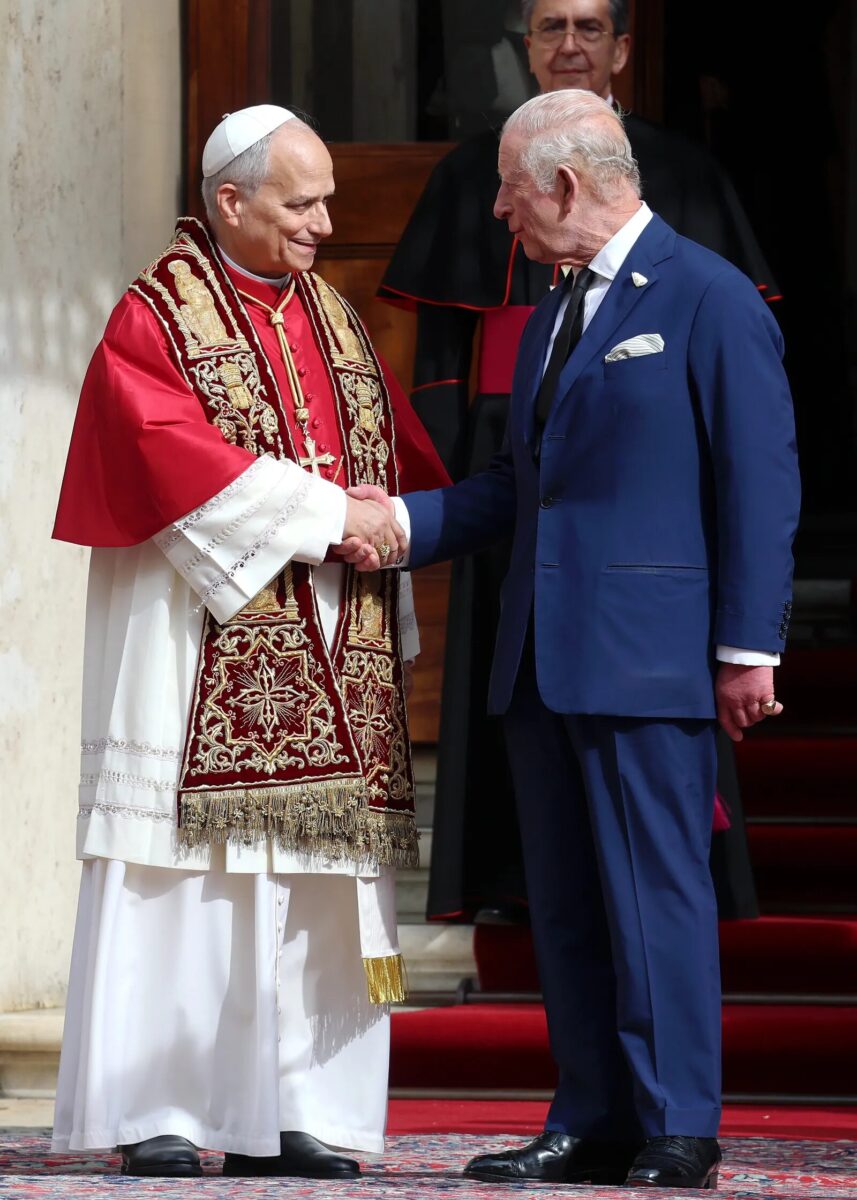
Last week, King Charles III and Pope Leo IV made history in the Sistine Chapel by praying side by side—’a first for the leaders of the Church of England and Catholic Church’ according to the BBC. For some, this seemed like a historical ecumenical move; Stephen Cottrell called it a ‘step towards the full visible unity that Christ himself prayed for’, and others were equally enthusiastic.
Fr Dominic Robinson SJ, Parish Priest of Farm Street Church, the Jesuit parish in Central London, who is currently in Rome, said: “This is such an exciting and potentially pivotal moment on the journey towards the full unity for which we are striving. Christ’s command is that all be one in Him, and we are painfully aware of the historic divisions which have been such an obstacle to this.
“An unprecedented State Visit of The King to the Holy See as Head of the Church of England is far from a mere gesture but a statement of an ardent desire for that unity which Christ commands.
“Praying alongside the Holy Father in the Sistine Chapel and being installed as a Confrater of the great basilica of unity St Paul’s outside the Walls as were the English monarchs of the pre-Reformation Church, is a major step on our ecumenical journey together.”
But others saw it rather differently! Dominic Steel, on his channel The Pastor’s Heart, was unequivocal:
I feel betrayed by my king. On the most important issue, I feel like King Charles has betrayed me and Protestant Christians around the world. But even more significantly, he has grieved the Lord Jesus.
He explains his own upbringing as a Catholic (as I was!), and his coming to personal faith in an evangelical Anglican church (as I did!) and so how he personally feels about this event.
So for me it has been a punch in the heart this week to see the Pope and the King and the Archbishop of York praying together—something that the office holders of Pope and King have not done since at least the 12th century. And I feel so sad.
But is either side correct in making this claim?
The idea that the Church of England and the Church of Rome might take steps towards ‘full visible unity’ had its hey day in the late 1960s, into the 70s and 80s. It was kicked off by the new openness the came following the Second Vatican Council (‘Vatican II’), which ran from 1962 to 1965, as a radical process of ‘updating’ (in Italian: aggiornamento) the Church to allow it to engage better with this modern world.
In terms of relations with the C of E, this led to the start, in 1969, of the Anglican–Roman Catholic International Commission (ARCIC), which had three phases, lasting respectively 14 years, 22 years, and in theory from 2011 to the present day (and you thought the LLF conversations were drawn out!). They produced a series of reports, which were duly debated (in General Synod and elsewhere), and were sufficiently significant that I remember having to read some of them as part of my ordination training in 1989.
The difficult with all this is that the reports of ARCIC actually had no formal authority on either side of the debate. Despite what they thought, the representatives of the Church of England in ARCIC had no authority from the Church to speak on its behalf. The final straw came with the second to last report, The Gift of Authority (1999), in which it was claimed that Anglicans do not, in principle, have a problem with the idea of having a Pope. Many Anglicans responded ‘Oh yes we do!’ and the indefatigable Colin Buchanan quickly produced a Grove booklet explaining to General Synod why we did. (You can still buy it here.) Similar concerns were raised about the final report on Mary (2005).
It seem to me that there are three major issues where the Church of England and the Church of Rome have fundamental disagreements, and, despite the establishment of improved personal relations, these differences do not appear to have changed.
The first is about what happens in the Lord’s Supper, also called Communion or the Eucharist, and in the Catholic Church, the Mass.
The Book of Common Prayer (and in particular the Ordinal, the service for ordaining clergy, together with 39 Articles) form the continuing doctrine of the Church of England, as set out in Canon A5. All later authorised liturgy has been authorised on the basis that it is consonant with the BCP, and should not be interpreted as contradicting it. The Prayer of Consecration opens as follows:
Almighty God, our heavenly Father, who of thy tender mercy didst give thine only Son Jesus Christ to suffer death upon the cross for our redemption; who made there (by his one oblation of himself once offered) a full, perfect and sufficient sacrifice, oblation and satisfaction for the sins of the whole world; and did institute, and in his holy gospel command us to continue, a perpetual memory of that his precious death, until his coming again:
Hear us, O merciful Father, we most humbly beseech thee; and grant that we receiving these thy creatures of bread and wine, according to thy Son our Saviour Jesus Christ’s holy institution, in remembrance of his death and passion, may be partakers of his most blessed body and blood:…
The emphasis here, reflecting Reformation concerns, and clearly rejecting Catholic understandings of the ‘sacrifice of the Mass’, is that Jesus’ death on the cross was a complete work, and that we cannot add to it. His sacrifice was made once and for all, and no further sacrifices are needed. (Note also that there is no language of the bread and wine ‘being for us’ his body and blood; these are modern developments which need to be understood in the light of the BCP. It is as we eat bread and wine in remembrance of him that we partake in him.) This is why Cranmer reshaped the service, and pushed any ‘sacrifice of praise’ right to the end, to avoid any confusion. Communion is not about what we offer to God, but all about what God, in his grace in the death and resurrection of Jesus, offers to us. (Perhaps the best study of this, also by Colin Buchanan, is the study What Did Cranmer Think He Was Doing which you can buy here.)
The additional comments after the liturgy (p 262 in the printed BCP), further clarifies what is understood to be happening, and the meaning of the bread and wine.
It is here declared, that thereby [kneeling to receive Communion] no adoration is intended, or ought to be done, either unto the Sacramental Bread or Wine that is bodily received, or unto any corporal presence of Christ’s natural flesh and blood. For the Sacramental Bread and Wine remains still in their very natural substances, and therefore may not be adored; (for that were idolatry, to be abhorred of all faithful Christians;) and the natural Body and Blood of our Saviour Christ are in Heaven, and not here; it being against the truth of Christ’s natural body to be at one time in more places than one.
Here we find an explicit rejection of the Catholic doctrine of transubstantiation, and of the elevation of the host, and adoration.
By contrast, the Liturgy of the Mass contains these words (which I still know by heart!):
Pray, brethren (brothers and sisters), that my sacrifice and yours may be acceptable to God, the almighty Father.
May the Lord accept the sacrifice at your hands for the praise and glory of his name, for our good and the good of all his holy Church.
And before the distribution of the elements:
After his private prayers of preparation the Priest genuflects, takes the host and, holding it slightly raised above the paten or above the chalice says aloud: Behold the Lamb of God…
These are significant differences!
And this leads to the second, closely related, area of difference: the nature of ordained ministry. If the Mass is about (re-)offering the sacrifice of Jesus, then those who officiate at it can rightly be called ‘priests’, since that is the term in English for those in the Old Testament responsible for temple sacrifices.
But, rather ironically and not a little confusingly, the etymology of the term ‘priest’ actually derives from the Greek presbyteros meaning ‘elder’, and not the term hiereus meaning ‘priest’ (from which we get our word ‘hierarchy’). So we have the strange situation that the term ‘priest’ translated a word it is unrelated to, whilst the word it derives from is translated by a different term altogether!
Cranmer chose to retain the English term ‘priest’ to demonstrate that the Reformation was not about inventing something new, but about reforming existing patterns of ministry in the light of the Scriptures, and in particular the New Testament, which he believed was the authority the Church must look to. And you can see this in the shape of the Communion service in both his 1552 text, and the revision that produced the 1662 BCP. All the language of sacrifice has gone; the sacrifice of Jesus is complete; Communion is a memorial; and whilst with our teeth we eat bread and with our mouth drink wine, we ‘feed on Christ in our hearts by faith and with thanksgiving’. As Article XXIX says:
The Wicked, and such as be void of a lively faith, although they do carnally and visibly press with their teeth (as Saint Augustine saith) the Sacrament of the Body and Blood of Christ; yet in no wise are they partakers of Christ: but rather, to their condemnation, do eat and drink the sign or Sacrament of so great a thing.
Now, the Church of England does recognise the validity of Roman orders and sacraments—so when I was received into the Church of England (just two months before my ordination!) all that happened was my vicar shook my hand in a public service and said ‘I welcome you into the Church of England’. My baptism and episcopal confirmation were recognised as valid.
By contrast, and because of this reformed understanding, the official stance of the Church of Rome is that Anglican orders are ‘null and void’. This was famously expressed in the document Apostolicae Curae issued by Pope Leo XIII (note the name!) on 13 September 1896. It declared Anglican priestly and episcopal orders “absolutely null and utterly void”; the papal judgment focused on defects of form and intention in the ordination rites of the Edwardian Ordinal—that is, Cranmer’s of 1552. Leo XIII held that the rites did not express a valid understanding of the sacrificial priesthood, and therefore broke the line of valid apostolic succession.
There was some hope that, more than 100 years on, this position might be relaxed—but far from it. The last pope but one, Benedict XVI did not issue a new decree, but he reaffirmed the judgment of Apostolicae Curae on several occasions, notably in official clarifications and documents addressing Anglican–Catholic relations. As Prefect of the Congregation for the Doctrine of the Faith (before he became Pope), as Cardinal Joseph Ratzinger, he oversaw Dominus Iesus in 2000. It described Anglican communities as “ecclesial communities” rather than “Churches” in the proper sense, since they lacked valid episcopal orders and therefore the Eucharist in the Catholic theological sense.
And as Pope, Benedict XVI issued Anglicanorum Coetibus (2009) an apostolic constitution to provide for Personal Ordinariates for Anglicans entering into full communion with Rome. The document implicitly reaffirmed the 1896 position by requiring the re-ordination of Anglican clergy entering the Ordinariate, acknowledging that their previous orders were not recognized as valid. And the Congregation for the Doctrine of the Faith under Benedict repeatedly confirmed that Apostolicae Curae “remains definitive” and “has not been revoked or reconsidered.”
And surely the ordination of women to the presbyterate and then the episcopate puts the final nail on the coffin of any possibility of recognition.
This relates to the final area of difference—that of sources of authority. For the Church of England, supreme authority is found in the apostolic testimony of the New Testament and the whole Bible. This is set out unambiguously in the Articles.
XIX. OF THE CHURCH
THE visible Church of Christ is a congregation of faithful men, in the which the pure Word of God is preached, and the Sacraments be duly ministered according to Christ’s ordinance in all those things that of necessity are requisite to the same.
As the Church of Jerusalem, Alexandria, and Antioch, have erred; so also the Church of Rome hath erred, not only in their living and manner of Ceremonies, but also in matters of Faith.
XX. OF THE AUTHORITY OF THE CHURCH
THE Church hath power to decree Rites or Ceremonies, and authority in Controversies of Faith: And yet it is not lawful for the Church to ordain any thing that is contrary to God’s Word written, neither may it so expound one place of Scripture, that it be repugnant to another. Wherefore, although the Church be a witness and a keeper of holy Writ, yet, as it ought not to decree any thing against the same, so besides the same ought it not to enforce any thing to be believed for necessity of Salvation.
By contrast, the Church of Rome believes that the Tradition which it preserves (primarily through the teaching office of the Pope) is a second source of authority. It claims that the two are compatible and coherent (Tradition and Scripture) but they are different, equal, and parallel sources.
The meetings last week have changed none of these differences.
So what did the meeting actually mean? Nothing has changed formally in the relation between the two churches—but this is an investment in good personal relationships. The Times report noted the studied ambiguity from the Roman side:
The Italian historian Alberto Melloni described the Vatican’s push for relations with the Church of England while not referring to Charles as its head as “wise ambiguity.”
By contrast, one of the discussion partners on The Pastor’s Heart video lamented:
Protestants have historically been viewed as separated brethren and Vatican 2 has been a call back into the fold to find points of unity and contact in order to accommodate them back into in some way the Roman Catholic Church. So the public prayer would be recognized by the Catholic Church as King Charles and Queen Camila and particularly King Charles as supreme governor of the Church of England coming under the authority of both the Roman Catholic Church and the Pope.
But that is manifestly not true! Leo took his name to honour the engagement with social ethics in an industrialised age that was the mark of his predecessor Leo XIII. But he also took it on as an indication that he was going to, subtly, move in a more conservative direction in contrast to his immediate predecessor Francis. There is no hint that his formal view of the Church of England has changed one jot. Indeed, the British Royalty’s own website depicted this clearly as a state visit, and not a visit of the supreme governor of the Church of England. And at his coronation, Charles committed to uphold ‘The Protestant faith of the Church of England’.
Jesus’ prayer for unity was not about ‘full visible union’ between two institutions. It was that God would unite his followers together by ‘sanctifying them in the truth; your word is truth’ (John 17.17). Until we can agree on the truth about the completeness of Jesus’ work on the cross, that in Communion we remember him and ‘feed on him in our hearts by faith’, and that it is Scripture as ‘God’s word written’ which is our authority, we will not be fully at one.
And that is all right. Let us in the meantime work together, pray together, and find as much in common as we can.
 Buy me a Coffee







Praying together is fine. Where rubber hits road is when Catholic and Anglican do Bible study together.
Provided I am not asked to affirm that transubstantiation has taken place, I am happy to share Communion with Catholics (if they will give it to me). My biggest concern with Rome is its claim, not that it hasn’t erred in any of its formal teaching, but that it *cannot* err (a claim that has extended to the Pope speaking ex cathedra since 1870). That is an end to all conversation, or at least a demand that all conversation be on its terms. Catholic theologians enter genuine dialogue only insofar as they are prepared to tacitly and temporarily ignore this claim.
Then of course there is what BCP correctly called “the idolatrous worship of Mary”. Every few centuries Rome has ascribed ever more of the extraordinary attributes of Jesus Christ to His mother: perpetual virginity, immaculate conception, sinless life, direct ascent into heaven. Now the push is to call her co-redemptrix. I do not doubt that Blessed Mary, saved from her own sins by her Son’s crucifixion, looks down from heaven in horror at all of this. Let there be no goddess-worship in His church.
When Pius XII in 1950 asserted Mary’s assumption into heaven, he went on to state of the dogma (in paragraph 45 of Munificentissmus Deus) that “if anyone… should dare willfully to deny or to call into doubt that which we have defined, let him know that he has fallen away completely from the divine and Catholic faith”. Yessir, that’s me.
The Church of Rome has two idols: itself and Mary. Canterbury has comprehensively wrecked all chance of reunion by appointing women bishops. That is the one good thing about the action.
The BCP is wrong. Roman Catholics and Orthodox do not worship Mary, they venerate her. Basically the difference between dulia and latria. Although Mary does get hyper dulia!
They SAY they do not worship her. Praxis tells another story.
I was RC. I know whereof I speak.
It’s a matter of degree. Words like ‘worship’ and ‘venerate’ are not precise or rigid enough to enable a clear-cut answer.
The distinction between dulia and latria is quite clear cut.
That’s correct. But it is a situation that applies crossculturally and crosslinguistically.
In England perhaps, Penelope. But in Latin America?
Why Latin America?
Catholicism is unmitigated in Latin America. In Britain it has had to reinvent itself in light of the critiques of the Reformers. The de facto Mariolatry has been toned down here.
I don’t know what unmitigated means here. It has been a powerful liberation for many who treasure the Magnificat.
My second sentence explains the first, if you wished to understand.
Ah yes. The tiresome anti Catholicism one encounters here.
Did you bother to read my first comment on this thread before saying that? I gladly pray and even (where permitted) take Communion with Catholics. It is Catholic doctrine that is intolerable.
I trust you don’t have a soft spot for goddess worship?
In Walsingham Anglicans certainly do
“The BCP is wrong”
Are you sure you’re in the right church? I say this gently, but the BCP is the doctrinal heart of the Church of England, and still the only formally authorised liturgy. To simply dismiss it as ‘wrong’ is, on one level fine. I acknowledge as brothers and sisters in Christ those who wouldn’t agree with it. But to dismiss it as ‘wrong’ whilst remaining a member of the Church of England is a little like someone playing cricket, declaring the laws of cricket ‘wrong’ and deciding to play rounders instead. At which point those who did want to play cricket might look confused; why not go play rounders with the rounders players? We have nothing against rounders players, but we’re here to play cricket.
And the distinction betwen worship and venerate gets very thin indeed, but I’m prepared to acknowledge it, even if I find it somewhat meaningless – what I can’t accept is the extra-biblical dogma surrounding Mary & the Saints.
Venerate is an even stronger term that worship arguably, so I think Penelope was respecting the BCP’s position that Anglicans do not worship Mary rather than the reverse
Oh, I agree about the extra biblical dogmas.
Though some of them may be helpful.
I would be interested to ask if you agree with everything in the BCP and Articles?
(I meant ‘wrong’ as inaccurate.)
Yes. I find no problem there for a reformed christian.
Mary is viewed as sinless, as someone to whom we pray, and is often referred to as co-redemtrix (though this latter is not official teaching.)
She was “preserved free from all stain of original sin from the first moment of her conception.” (Pius IX, Ineffabilis Deus, 1854)
Catechism of the Catholic Church (CCC 493): “By the grace of God Mary remained free of every personal sin her whole life long.”
Since only Jesus is sinless, and we only pray to God, it is getting pretty close.
Of course the notion (later ‘doctrine’) of the IC was not uniformly held in the church catholic. If memory serves, Origen, Tertullian, Hilary and others did not believe Mary was immaculately conceived. They held different ideas about her unique obedience. The issue divided the Dominicans and the Franciscans. Thomas was opposed and some say he modified his position. Bernard of Clairvaux was a No.
The 19th century idea turned on temporality and divine foreknowledge. Speculative metaphysics.
The East does not have the notion. Some Catholics would hold that it ought to remain at the level of theological speculation and was wrongly made a dogma.
Co-redemtrix is something of a different idea, strictly speaking. As theotokos, Mary’s Yes reversed Eve’s No, and the course of redemption followed.
At any event, the visit of Charles III to Leo was arguably about none of this.
You are correct . Only Jesus who is the second person of the Trinity is without sin. We must have had a different Catechism from the one you quote with regard to Mary being a deity. Unless the Pope speaks ex cathedra he is capable of error. What was the purpose of this meeting of the Pope and King Charles anyway. Burying the hatchet? The Catholic Church can never recognise the Anglican Church founded by Henry V111 as a true Christian Church. Maybe King Charles is considering becoming a Catholic ?
Catholics are not obliged to pray to the Saints. It is optional. There is no penalty for not doing so. Praying to Saints is asking them to intervene and communicate with God on our behalf. We only worship God.
It would be nice if it were that clean cut, however I believe dulia and latria are both used in reference to God as a translation of prosopo in numerous documents of the Roman Catholic curch such that the two are synonymous.
I did notice how Charles and +York snuck this jolly in, before +Sarah gets formally installed in the new year. Crafty.
Charles III is a much more high church King than his mother was. Notice the Orthodox chants and costume at his coronation, the prayers and blessings for the King at his coronation by the Roman Catholic Archbishop of Westminster and now his prayers with Pope Leo at the Vatican. Elizabeth II was more low church, indeed she was said to be happiest in the Church of Scotland church at Balmoral and she took her oath to preserve the Protestant faith seriously.
William is not particularly religious at all though, he will go to church with his family at Easter and Christmas still but I expect him more to be a C of E in name only King. His coronation will be less religious too I expect, beyond a few prayers, reflecting the more secular UK he will be head of state of
Charles is indeed more high church than his late mother, but also more syncretist. Oddly these often go together.
William and Kate wrote a prayer for ther wedding ceremony. What they actually believe, I have no idea and I don’t think many others know.
The photo shows a stark difference even as highlighted by clothing. It is between King and Pope, their roles and functions and scope and authority. One is concentrated on and delineated to church.
Neither take the place of Christ, who is Prophet, Priest and King in one.
Unsurprisingly I agree with much of this. The Anglican dilemma is that, leaving aside the muddling middle, it has two distinct streams. One is based on what is now realised to be the Cranmerian theology of the BCP (roughly Zwinglian) and sees the Church of England as a Reformed Church and the other based on a longer view of English history (Alban, Augustine, Anselm &c) in which the sixteenth century battles were an episode and the distortions of ecclesiology and sacramental theology gradually rectified. The problem with the second stream (of which I was a passionate member) is that it has been weakened by liberalism. So I left and am now a happy Catholic.
Thanks Andrew. The other problem with the second position is that it contradicts the doctrine of the C of E as it is defined in canon law.
And thank you for pointing out that Cranmer’s position, expressed unrevised in the BCP, and again the doctrine of the C of E, is ‘roughly Zwinglian’. This is where I am, and it is odd when people are surprised by that. Historical debates notwithstanding, it is hard to come to any other conclusion from the texts that we have.
Ian
When I was at theological college (over 50 years ago) I was like you happily Zwinglian (it was after all a majority Baptist college). Now I have changed. I would find it hard to find words to say how, but that is also the point. There is something going on which defies words. (subjective?? metaphysical?? sacramental??) – those words mean different things to different people, so let’s avoid them.
Perhaps we should think more Hebraically rather than Hellenistically, which is to say there should be a degree of mystery and deliberate ambiguity in “God-vocabulary”, rather than the forensic analysis loved by us Westerners.
Many folk would attest that sharing bread & wine in the context of a Messianic seder or shabbat meal, being part of the original setting in which Jesus instituted His command, brings a cultural depth of meaning which transcends mere scriptural analysis.
As I said, there is something more than words. But such is our Faith ?
Thanks. But thinking more Hebraically will take us away from Thomas metaphysics, and more towards a Seder-style memorial, won’t it?
Not for me.
“Hebraically” for me invokes a degree of unexplainable mystery, where words are inadequate, where ambiguity is always present in God-think.
Can I have a Seder-type memorial with an unexplainable depth?
Is it possible to be both Zwinglian and Thomist?
Why not? There is so often the tension of contradiction as well as the mystery of ambiguity at the heart of Hebraic thinking. “Both/and” is often (not always but often) a better bet than “either / or”.
Or as one Jewish scholar puts it, “the greater the revelation, the greater the mystery”.
And I am not sure what you mean by ‘gradually rectified’? The doctrine of the C of E has not actually changed…
The BCP’s view of the Eucharist is Zwinglian? Really? If it’s all simply symbolic why insist that the priest can’t throw away the remaining bread and wine?
Isn’t it actually about “decent disposal”. Much the same as the Holy Table is not about a change in substance?
What’s indecent about chucking it in the bin or down the sink if it’s just some bread and wine you were using symbolically to make a point?
We can await ‘official’ answers but in the meantime… when I have used bread and wine to remember Jesus by amongst two or three of us perhaps…once I have blessed the elements for their holy use….they are set-apart holy things. They need to be treated as such. They don’t become actual flesh and blood but they do become holy symbols and they are dedicated to God for this purpose.
So afterwards I would never just throw them away carelessly as they are set-apart things.
Same as olive oil if I bless it to use for healing and anointing people …it remains set-apart holy oil and it needs to be kept for that purpose.
If I spill any on a tissue for example I then burn the tissue.
I hope I’m not a heretic now!, but that’s what I’ve always done anyhow.
It’s just about being respectful and careful I think.
“symbolically to make a point” That’s a tad (!) shallow. I’m sure you know it’s more than this.
However I don’t think it does change substance and would not turn a hair at disposing of them. It doesn’t mean i want to be sloppy with what remains. Would my less abrasive practicality offend you? Jesus command was about eating and drinking not about tidying up.
Doesn’t seem more outrageous than insisting every molecule is eaten or drunk.
I am not sure that they specifically “prayed” together, although they certainly spoke the liturgical words of the service.
I do not envy the balancing act required of King Charles in the many walks of his royal life. However, I wonder how the Roman Catholic Church feels about his returning from his visit to the Pope only to then place flowers at an LGBT memorial. I have no problems in principle with either but they do seem somewhat incongruous.
Roman Catholic single male bishops and cardinals and priests are generally less bothered by LGBT than by female ordination. See the non liturgical prayers Pope Leo has said can continue for same sex couples. Women cannot even be Roman Catholic priests though, let alone bishops. There were some muted congratulations to Mullally from the Vatican after she became Archbishop but no recognition at all of her role as having true holy orders
I don’t know about that. There is a place for women who have a religious vocation – it’s just they’re nuns not priests. Gay men on the other hand are specifically barred from the priesthood. I’m not sure but I think that we’d be barred from all religious orders (no monks either). The reality of course has been different (see The Closet of the Vatican by Frederic Martel) where whole generations of young gay Catholic men interpreted their sexuality as meaning they ought to join the priesthood, but that has become more challenging now. One of the interpretations of why Pope Francis was more open minded about this than other voices in the College of Cardinals was because he definitely wasn’t gay (famously nearly marrying a woman before deciding to enter the seminary) so didn’t carry the baggage of a lifetime fighting against his own sexuality in that way.
Yes and of course the Vatican is still clear that holy matrimony is only reserved for one man and one woman for life, as indeed the C of E is. In general though the Roman Catholic church is more willing to offer some recognition to those in same sex relationships than conservative evangelicals are and that has been the case since Pope Francis
The King was certainly right to pray with Pope Leo. He is head of state of the UK where on some figures Roman Catholics are the largest denomination in terms of weekly church attendance. It was also a reflection of the links Anglicans do share with Roman Catholics as members of a Catholic but Reformed church.
I agree with the article though it does not mean there will be unity between the Church of England and Roman Catholic church either. As mentioned in the article there are still differences over transubstantiation and in terms of recognition of Anglican orders. The Vatican and Holy See also still do not recognise female clergy let alone bishops unlike the Church of England and most Anglican provinces now. Indeed, after Pope Francis approved and Pope Leo continued to allow non liturgical prayers for same sex couples by Roman Catholic priests, similar to LLF in some respects, there is arguably more unity between the RC church and C of E over same sex relationships than over remarriage of divorcees and female ordination. Whereas for most conservative Protestant Anglicans it is the opposite, they are more willing to accept remarriage of divorcees in church and female ordination than recognition of same sex couples.
More still are members of all Protestant denominations combined in the UK than are Roman Catholic so the King will still maintain his oath to protect the Protestant faith in these isles, even as he seeks to build bridges with the Vatican
Abp Fisher met with Pope John XXIII in 1961, as context (Vatican II and aggorniamento was mentioned above). Mere Christians have never been much interested in the self important view that any such thing is somehow momentous.
Or Dec 1960
In the late 60s at an ecumenical gathering at London University, a Brethren friend of mine, who was on the LIFCU committee, found himself standing next to a senior RC university chaplain. In the ensuing conversation the RC chaplain said something like: “you know you and we will soon be the only ones left together”. Surprised, and somewhat uncomfortable, my friend responded: “what do you mean?” The reply was: “Well we are the only ones left who believe the Bible”. I am no prophet – so no comment.
The RC’s have huge problems admitting how often they have actually changed their teachings, but, in real life changed they have. (I could list too many to fit into a comment).
No-one including the/any Pope now believes that the Pope has Universal Jurisdiction (even/especially in Italy, or…); or Infallibility (just check with whichever cardinals &… disagree with what he has just said on the Latin Mass, women, LGBT matters…). Nor does it really matter all that much if some RCs still believe in the Medieval (or older) distinction between Substance and Accidents. Nor if they think Mary was taken up into heaven, or think she can help answer their prayers.
It would matter if she were to be declared Co-Redemptrix, but as Ian points out that has not happened (yet).
What does really matter is that the ‘Immaculate Conception’ is contrary to the Athanasian Creed. If Christ is fully divine and fully human then he can save us sinful humans. If, however, his mother was born and remained sinless then she is not like us “for all have sinned…”. If Mary was sinless she was not human, and consequently we humans cannot be saved ‘in Christ’. Furthermore “If we claim to be without sin, we deceive ourselves and the truth is not in us.”
It may prove possible to achieve the unity that Jesus prayed for in his church (/congregation / assembly), but not until those trying to achieve unity start to base their conversations on what the Bible actually says “in such a language and orders as is most easy and plain for the understanding…”
Sorry! “orders” should read: ‘order’.
What if? What if the King were to swim the Tiber?
1688 and all that.
And there to meet Gavin Ashenden from his family’s past chaplain.
There is a popular misconception that Gavin Ashenden was a close spiritual confidant of the Royal Family. He has explained more than once that he was one of multiple persons who were Chaplains to The Queen at the same time, and I’m not even sure whether he ever actually got round to preaching before her (as they do) by the time he resigned. He says it was made clear to him that he could not retain the position and continue to speak out against the reading of the Quran in Glasgow episcopal cathedral (as he rightly did). He was told it would embarrass the Crown. I don’t know the details of what happened next, but in his place I would have resigned only if I had a letter stating in unambiguous words that Her Majesty was aware of the situation and preferred him to resign; I’d not have gone just because some palace flunky thought it best. I’d also have loved to know whether he ever considered the Frees rather than Rome when he quit the Church of England (and if not then why not)?
The newspapers know this, and the immediate rush to include the phrase ‘Queen’s Chaplain’ in their headlines – without clarification- and in the way they couch and frame their stories on e.g. G Ashenden is a classic example of their dishonesty.
I seem to recall John Stott was also at one time a Queen’s chaplain, and I believe they got on well together.
This is true.
Also listen to the Queen’s first televised Christmas speech 1957.
Lord Altrincham had a point about her elocution. In no way was he against the monarchy.
The Greek for ‘priest’ is ‘hiereus’, not ‘hieros’ (the adjective). We mustn’t have any grammatical hierosy here!
Hier Hier!
Thank you!
Why hasn’t anybody mentioned the killing off of the ARCIC process by the then Cardinal Ratzinger (later Pope Benedict)? This act made it abundantly clear that any unity between the Roman and Anglican Communions must be on Rome’s terms absolutely, accepting their doctrine and authority without qualification. (Incidentally, it blew the mustn’t-have-women-priests-because-it’ll-stop-unity-with-Rome argument out of the water, just in time for the 1992 vote.) And this is Rome’s theology, not just their attitude. Until and unless they change it, they can only unite with another Church or communion by taking it over.
Yes, Steve. Lesslie Newbigin called it Unconditional Surrender.
I don’t understand why serious Christians WANT unity with Rome.
So 1.4 billion Roman Catholics aren’t serious about being Christian? I assume you are joking….
I would be in favour of unity with Rome if and only if it renounces its claim of inerrancy, drops its Marianism and no longer demands that believers accept transubstantiation. The ball is in its court, not ours. Truth is not about numbers; it it were, Christianity would never have overtaken paganism in the ancient Greek world.
I didn’t ask any of that. I asked a very clear question.
Aren’t 1.4 billion Roman Catholics serious about being Christian?
Better ask them.
I don’t need to ask them Anthony. I’ve spent time with many over many years and I know they are very serious Christians. I was asking for your opinion – not that it is of any importance and seems to be based on prejudice.
I rest my case on the matter…..
Rest your case? This isn’t a courtroom, do drop your pretensions. And try reading my first comment on this thread stating that I am happy to share prayer and Communion with Catholics.
There can really be only two grounds for objection:
1) we don’t regard each other as Christians and therefore cannot pray together.
Or
2) although we regard each other as Christians there are some theological objections that mean we cannot pray together
Catholics do not rebaptise Anglicans, nor Anglicans Catholics. We hold to the same creeds. We are all Christians. So the question is whether the differences in views on the Virgin Mary or papal authority prevent praying. I fail to understand why they should unless we’re drawing a very restrictive line. For example are Baptists and the Salvation Army also out because they view the sacraments of baptism and Eucharist so differently from us?
As far as I can see Dominic Steele’s core objection is that he found the move from Catholic to Anglican incredibly painful and therefore thinks it should continue to be as painful as possible for everyone else. I cannot agree. Rather, I think the Pope and the King did a good thing by reminding everyone (who seem to need it) that Anglicans and Catholics do regard each other as Christians by praying together and hopefully reduce some of that pain for future generations.
The debates over some Anglican versus Catholic distinctives and differences (impatient of resolution) are a walk down church history lane. Fine.
But just what was this visit about? Whatever Charles thinks about himself, he is stylized as the Supreme Governor of the Church of England. And he is that, all the declensions notwithstanding.
Did he choose to meet the Pope as himself (arguably with mortality concerns), or as Supreme Governor of said CofE, and/or does he know the difference in some way that it matters?
So, e.g., is he distancing himself from the status quo in the CofE, even if he does not know the state of his soul? That is, he is feeling his way toward something?
(For historical contrast, his predecessor Charles II was not feeling his way toward anything; he and Loui XIV knew what they were doing, see Treaty of Dover).
I think to debate this on the grounds of ‘what do Catholics believe’ and ‘why Anglicans of some tribes don’t’ does not help us understand what this was about, on the ground. Perhaps we cannot know that. But I doubt it is something this thread is pursuing, with respect.
Charles would not be the only person to observe a CofE in disarray. One he was historically if now only notionally (whatever that means) ‘Supreme Governor’ of.
If this *was* a debate about the RC versus ‘some Anglican tribes’ then you might be right.
But the King is supreme governor of the Church of England, and what I hope I have set out is, specifically, what the Church of England believes in its doctrine, not of ‘some tribes’…!
Our main challenge is not our doctrine. It is having bishops who don’t know or believe the doctrine of the Church that they lead.
Dear Ian Paul, my comment was only an inquiry into the personality of Charles, and what he is up to, given 1) problems in the CofE (obvious to all, including himself), 2) the history of a role claimed by the monarch vis-a-vis the CoE, which has obviously changed since the 16th centiury, and 3) his own mortality.
I concur that one way of thinking about this has to do with the CofE and its identity in accordance with your remarks.
I simply doubt that whatever he is up to, has much to do with that.
Which returns us to 1) the role and place of a 16th century foundational claim of the CofE, and 2) has that so diminished that the CofE is no longer recognisably connected to what was its founding narrative (which obviously those outside the CofE, chiefly the Catholic Church, take at its word).
Grace and peace,
Chris, I agree with you that many practices in the C of E are not recognisably connected.
But its canon law is so explicitly, as are many Anglicans. Those who are not think that they can changes things on the ground with impunity—and then they run into the rocks and shoals of canon law and reality, and are scuppered.
I missed this reply thanks.
I was trying to figure out what Charles was doing and why, not so much what the CofE is doing.
Just to clarify.
Ian you only have to read about the development of the 1928 Prayer book, the various ‘Series’ of services that followed it, the ASB, and then Common Worship to realise that Eucharistic doctrine, for example, has developed considerably since 1662. Your idea that the doctrine of the CofE is fixed in the 16/17 C does not stand up to scrutiny. It has become an obsession that is troubling and has its origins in an obsession with something else.
Always fun to read cod psychology.
Andrew, I would be interested to know in what way specifically Eucharistic doctrine has developed considerably since 1662. Could you please indicate?
Andrew, I think you are mistaken on almost all the claims you make here:
‘Since 1928 there has been an epiclesis as part of the Eucharistic rite. A calling down of the Holy Spirit to effect the change in the significance of the Eucharistic elements.’
Not so. The epiclesis is implicitly or explicitly calling the Spirit down on the people. Hence in Prayer A ‘renew us by your Spirit ‘; in Prayer B: ‘Send the Holy Spirit on your people‘; and in Prayer D: ‘Send your Spirit on us now‘
‘Prayers over the gifts as part of the offertory are now a standard part of Common Worship.’
Nope. The wording was made quite clear that we are not offering these to God. Hence the offertory prayer goes:
Blessed are you, Lord God of all creation:
through your goodness we have this bread to set before you,
which earth has given and human hands have made.
It will become for us the bread of life.
‘There has also been since 1928 a sense of ‘offering’ the bread and wine – a word that was introduced in the 1928 book.’
No, that phrase was explicitly rejected in the debates about CW, which I think you and I both attended. You can see the language swerve around the language of ‘offering’ in Prayer B:
As we offer you this our sacrifice of praise and thanksgiving,
we bring before you this bread and this cup
‘Vestments came in to use as part of the Oxford Movement but in 1928 an official rubric permitted their use.’
And the C of E says explicitly that vestments have ‘no particular theological meaning’.
‘The fact that Common Worship has at least 8 different Eucharistic Prayers is because the various tribes in the CofE wanted to be able to emphasise different aspects of the Eucharist and the central mystery of the significance of the bread and wine.’
Not so. They express things in different ways, but all were only agreed on the grounds that they did not contradict the doctrine of the BCP. That was the stumbling block for the previous set, which were thrown out.
‘Since the ASB it has been quite possible for a CofE Eucharist to be virtually indistinguishable from the Roman Rite.’
Again not so. If it were, then people would not feel the need to use the Roman Rite, which people do up and down the land, including the language of the sacrifice the priest is offering that I highlight in the article.
Andrew, I love the fact that you quote the highly Conservative (and reactionary) David Phillips, previously chair of Church Society, as your authority!
The idea that the meaning of the actual words doesn’t matter is rather bizarre, but it does go with Tract 95. I don’t ‘ignore’ the Oxford Movement. I note that, with the defeat of the 1928 Prayer Book, it did not win the argument. 1928 was rejected specifically because it was not consonant with the BCP.
In the Roman Mass, the offertory says clearly: ‘Blessed are you, Lord God of all creation, for through your goodness we have received the bread we offer you‘, language that was rejected. The words ‘set before you’ mean just that: we are *not* ‘offering’ them to God. There was a whole debate in Synod about that.
It was blocked by evangelical lay Anglicans in Parliament, and high church and liberals in the C of E didn’t like it. But by the 1970s evangelicals had got involved in the process of liturgical revision.
And here are the precise words that were rejected: ‘we, thy humble servants, do celebrate and make here before thy Divine Majesty, with these thy holy gifts, which we now offer unto thee.’ And in Synod debating CW, these words were again rejected.
And, again, I note the clear differences between CW and the Roman rite in terms of what is happening and what the Spirit is doing.
And the epicleses in Prayers A and B are indeed clear: it is by the Spirit that they are ‘to us’ his body and blood; this is Anglican receptionist theology. If you are unclear about that, simply compare the epiclesis in the Roman Mass:
‘Be pleased, O God, we pray, to bless, acknowledge, and approve this offering in every respect; make it spiritual and acceptable…’
‘Make holy, therefore, these gifts, we pray, by sending down your Spirit upon them…’
‘Therefore, O Lord, we humbly implore you: by the same Spirit graciously make holy these gifts we have brought to you for consecration…’
‘may this same Holy Spirit graciously sanctify these offerings, that they may become the Body + and Blood of our Lord Jesus Christ’
The language in the Mass is clear and consistent: the Spirit comes upon the elements, and the elements are thus made into something. The Anglican prayers carefully avoid *both* the Spirit being invoked on the elements *and* the elements being made into anything.
Not sure whether this will fall in a place that responds to the discussion over the invocation of the Holy Spirit and whether it is done in respect of the receivers or the elements (or both).
ACNA and TEC are out of communion with each other.
For comparison, here are the relevant portions of their respective BCPs. While one is talking about liturgical developments in the CofE (and disagreements over their proper intention and interpretation), there is also a wider context into which said developments take place in Anglican circles.
So now, O merciful Father, in your great goodness, we ask you to bless and sanctify, with your Word and Holy Spirit, these gifts of bread and wine, that we, receiving them according to your Son our Savior Jesus Christ’s holy institution, in remembrance of his death and passion, may be partakers of his most blessed Body and Blood (2017 ACNA BCP)
And we most humbly beseech thee, O merciful Father, to hear us; and, of thy almighty goodness, vouchsafe to bless and sanctify, with thy Word and Holy Spirit, these thy gifts and creatures of bread and wine; that we, receiving them according to thy Son our Savior Jesus Christ’s holy institution, in remembrance of his death and passion, may be partakers of his most blessed Body and Blood. (1979 Episcopal Church BCP)
I think they both speak of invocation of the “Word and Holy Spirit” upon the gifts. Only then are the receivers in view.
PS. I am not a liturgical scholar. When Seabury was consecrated a Bishop by non-jurors in Aberdeen for the colonies, the Scottish Episcopalians, who had the epicleses, asked that it find into way into future eucharistic rites. My memory was that this distinctive of the SEC came from correspondence with the Eastern church in which it was found.
I never thought of it as a Catholic distinctive. That would have to be a later liturgical development in Catholic circles.
Oddly enough, when worshipping in French and hearing the epiclesis arise from time to time (they too have different rites), I always wondered if it didn’t conform to their own distinctive Catholic heritage which links ordination and eucharistic ‘change.’ To invoke the Holy Spirit in the Mass sounded on my ear as ecumenically open, and I wondered about its implications (perhaps unintended).
But in general I wouldn’t have thought the epiclesis as distinctly Catholic. And as noted, it exists in both ACNA and TEC BCP traditions.
For all the saints!
Mr Godsall,
I’ll leave you to the CofE.
My general wonderment was why anyone would think the Orthodox epiclesis, which made its way into the non-juror liturgy in Scotland, and via Seabury into TEC (and ACNA) might be thought distinctively Catholic in some sense.
The exchanges you are having make it sound like the CofE heard this and then worried about how to make it more subjective than objective in character. Perhaps I am not following things.
For you, it is apparently more ‘catholic’ — but that was not its historical usage in the TEC BCP (and also ACNA). I can’t speak for the wider Anglican Communion and whether its liturgies are more ‘catholic along these lines. I can’t follow that logic. As it reads, this is a confusion/debate inside the CofE?
‘But Reservation has become very normal practice.’ That is not the official position. It may, in exceptional circumstances, happen with the written permission of the bishop, but only for taking communion to the housebound.
‘The Eucharistic Doctrine of the CofE is, in practice, much broader than the BCP.’ That is only because clergy fail to uphold their ordination vows.
Mr Godsall, you wrote in the context of the epiclesis discussion, in response to me:
“It’s also worth noting that much of the Anglican Communion is more ‘Catholic’ liturgically speaking than the CofE.”
I was responding to that use of the word ‘Catholic,’ about a liturgical distinction rooted in the Orthodox Church (Liturgy of St James, of St John Chysostom, and of St Basil). This is a church in which the Cappadocian emphasis on the independent person of the Holy Spirit is captured in the original Creed of Nicaea, (who proceeds from the Father) prior to the filioque insertion (which they regarded as unscriptural).
In invocation of the Holy Spirit is an Orthodox distinctive, given this wider concern for the person and work of the Holy Spirit.
How the non-jurors got ahold of this distinctive has to do with correspondence between their Bishops and the Orthodox, the subject of a dissertation I helped supervise many moons ago at St Andrews (and whose precise details I do not recall).
You can carry on the debate within the CofE as you wish. I do not know the terrain and am unable to evaluate your position.
I am not ‘obsessed with the letter of the law’. I am interested in what C of E doctrine actually is.
I do not doubt that this takes place. I also do not doubt it is expressly prohibited by C of E doctrine, by canon law, by liturgy, and by specific statements of the bishops.
What you are pointing out is that many clergy simply disregard all four of these things. I think that might be a problem with the C of E, and not a virtue.
Oh, and note that the supposed ‘seat of the bishop’ has no accountability whatsoever to that bishop. I think that is another problem.
How many of the laity understand (or even care) about any of this (liturgical posturing) ? Less than 1% ? Would not most church members simply roll their eyes and change channels?
Most laity I know are quite happy to break bread in home groups without any of this over-intellectualised kerfuffle.
I find it extraordinary that three people of such great knowledge about the CoE’s position about Communion can have a lengthy discussion without going back to the Last Supper in the gospels and 1 Corinthians 11 (plus OT commands not to drink blood, which were still in uncontested force before the Crucifixion, plus the meaning of ordination in view of the priesthood of all believers). Surely that is where to start?
Mr Williamson, as I have said, I do not know the liturgical developments in the CofE being referred to here. I know something about them more generally, and in the SEC and TEC (and ACNA). I do not in general pit individual biblical texts against things like the Creeds or the Liturgies of the early church. It is more fruitful to understand their relationship, else something like “homoousia” gets declared “unscriptural” when in fact the exegetical trail leading to that gets left out of the discussion. Usually there is a conjunctive logic at work (Gen 1; John 1; Prov 8; et al). The Fathers knew they couldn’t just invent useful theological confession (Jesus can’t be a la Arius), but their language needed to be scripturally grounded and pressured from exegesis. I am a biblical scholar and historical theologian, but the same process applies to liturgical rites. The East had a high evaluation of the person of the Holy Spirit. That and texts to which you refer inform one another in the rites that emerge. You don’t have to have a ‘second source’ view of Tradition to see how the Rule of Faith works in conjunction with scripture to give rise to Creeds and Liturgy. And where they are not working in conjunction (Arius).
PS–if I am not being referred to as the 3rd interlocutor, I hope this explains my own position anyway. God bless.
‘Could you point out where the Canons forbid Reservation of the sacrament?’
Yes, Canon A5 says our doctrine is found in the BCP and formularies.
And the BCP says very clearly: It is here declared, that thereby no adoration is intended, or ought to be done, either unto the Sacramental Bread or Wine there bodily received, or unto any Corporal Presence of Chriſt’s natural Flesh and Blood. For the Sacramental Bread and Wine remain ſtill in their very natural subſtances; and therefore may not be adored; (for that were Idolatry, to be abhorred of all faithful Chriſtians;) and the natural Body and Blood of our Saviour Chriſt are in Heaven, and not here; it being againſt the truth of Chriſt’s natural Body, to be at one time in more places than one. (p 262).
Dear Professor Seitz,
I was attempting to pay a compliment to the scholarship of yourself, Ian Paul and Andrew Godsall over this subject – but also to encourage everybody to begin from holy scripture, and use all exegetical scholarship that has gone before as potentially valuable but not a straitjacket.
Dear Mr Williamson,
Thank you for your kind response.
I have spent most of my career working at understanding the relationship between scripture’s constructive force and theological expression in the church, and how that works itself out — prior to the categories of modernity. Especially the Old Testament’s Christian theological work gets foreshortened here.
The OT is ‘back there’ the NT is ‘right here’ and dogmatics are ‘out there.’
For Irenaeus none of this would make any sense. In the Demonstration of the Apostolic Teaching the OT is doing first-order Christian dogmatics.
Today one calls that ‘anachronistic’; previous generations spoke of the providence of God: the literal sense and the divine intention. This wasn’t ‘see what you want to see’ but operated with clear ‘rules’ one can view within the context of debate.
With good wishes, Professor Christopher Seitz
The King was simply recognising that he is head of a state of a nation where significant numbers are practising Roman Catholics, indeed on some estimates more Roman Catholics attend church regularly in the UK than any other denomination. Even if Protestants as a whole attend more. From the Reformation until the late 18th century openly practising Roman Catholicism in England and then GB was illegal.
He still affirmed his oath to defend the Protestant faith at his coronation and be Supreme Governor of the C of E, he just also had the Archbishop of Westminster bless him and say a prayer too
I watched The Pastor’s Heart video and found it quite depressing. If it had just been Dominic Steel sharing his hurt through his testimony, I could’ve understood that. But his guests were predictably narrow in their assessments. I thought it was sectarian, and I left a comment on the video to that effect. Charles’s Christian faith often seems quite muddled, but the image of the heads of two historically divided churches submitting to Christ in prayer was very powerful, and speaks of healing in our increasingly sectarian society. I am unequivocally Protestant and evangelical: Cranmer is my great ecclesiastical hero and the BCP is unparalleled as an expression of Protestant worship; I stand by every one of the 39 Articles. But sectarianism is an abomination and I will always call it out when I see it. Here’s what I wrote on The Pastor’s Heart:
“My wife is Catholic. I go with her to Mass a few times a year. Her parents were from Belfast, her mum Catholic, her dad Protestant. They would never have met there because of the horrific sectarianism in Northern Ireland. I’ve witnessed that first hand on the many occasions we’ve been over to visit. Also, I grew up around Liverpool in the 70s and 80s, and sectarianism was rife. So while I understand that you’ve been on a journey away from Catholicism, this comes over to me as naked sectarianism. Put bluntly, you have punched me in the gut every bit as much as you feel the King has done to you, and I feel the pain from that. I am an evangelical through and through. My dad was a clergyman, friends with Alec Motyer and Tim Dudley-Smith among others. I stand by everything I was brought up to believe. But we need to move beyond sectarianism and live out what we say we believe when we say the historic Creed: “we believe in one holy catholic and apostolic church”. That means taking a step towards our historic opponents and kneeling together before the cross of Jesus is one of the most powerful things we can do. It in no way has to signify going back to Rome. After the Toxteth riots in Liverpool in 1981, it was the Anglican Bishop of Liverpool, David Sheppard and the Catholic Archbishop, Derek Warlock who prayed and worked together to address the issues. Please, I implore you in the name of Jesus, think again about this and turn away from sectarianism. Sectarianism is what the devil wants. That is what grieves Christ, not praying together.”
Well said, Christians of all denominations have more in common than divides us
Standing up against False Doctrine isn’t all that important then?
Standing up for Christianity would be a start, Christians are about 29% of the global population and about 46% of the UK population. We are better able to project are voice where we are united than in endless division
Standing up for Christianity would be a start, Christians are about 29% of the global population and about 46% of the UK population. We are better able to project our voice where we are united than in endless division
Simon, Christians are not 46% of the UK population in any meaningful sense.
They are, unless you want Christianity in the UK to be basically a small sect of conservative evangelicals who oppose any recognition of same sex relationships. Which sometimes it seems you do
Whereas Jesus, the apostles and the saints and church leaders have always recognised such thing…..
Show me one passage from Jesus where he said a single word against faithful same sex relationships? He may have reserved holy matrimony to one man and one woman for life (which also excludes divorce except for spousal adultery) but he did not preach against same sex couples
Simon, show me one passage where Jesus taught against polyamory?
Polyamory is closer to pornea which Jesus taught against, unlike monogamous same sex couples who are closer to married heterosexual couples
Simon, they are only ‘closer’ in your modern, individualist, sexualised, conception. With any biblical text, we must first ask ‘What did the author mean in his context, and how would his listeners have heard it?’
You only need to spend five minutes reading about first century Jewish ethics to know that same-sex sexual relationships were very firmly in the category of ‘porneia’ for every first century Jew. And all the evidence is that Jesus sat right within that view.
When you say ‘Jesus reserved marriage for a man and a woman’, all through scripture, and certainly in first century Judaism, this also meant sexual intimacy, which only belonged in marriage, was also reserved for a married man and woman’.
So I do think you have answered your own question: in his teaching on marriage, Jesus rejected same-sex sexual relationships.
We know you interpret St Paul’s teachings that ‘women must not teach and have authority over men’ to nonetheless not prevent women from being priests, bishops and Archbishops in the Church of England. We know you also ignore Jesus’ preachings in Mark that a man and a woman must never divorce at all to approve of remarriage of divorcees under certain circumstances in the C of E (which the Matthew version of Jesus’ comments on divorce allows but again you being subjective in biblical interpretation).
So again your interpretation of faith lifelong monogamous same sex couples as committing ‘pornea’ like heterosexuals or homosexuals who have multiple sexual partners comes with some subjective interpretation on your part. As does your interpretation of sexual intimacy only being allowed for monogamous heterosexual but not homosexual couples.
I will allow you the fact that Jesus reserved marriage only to one man and one woman but LLF does not change that anyway
Simon, how many times do I have to repeat my views, despite them being published again and again? And how many times will you distort and misrepresent them?
Paul’s teaching is *not* that women cannot exercise authority or teach; the verb here does not mean ‘have authority’; as the AV correctly says, it is at least ‘usurp authority’, but the evidence is it means ‘take someone’s life by force’. Paul is speaking here against the cult of Artemis in Ephesus in which women can take control and have no need of men. And Paul clearly sees women as teaching, praying, prophesying (an exercise of authority) and being church leaders and apostles. I hope you are aware of all the evidence for all of this.
And, as you know well, I don’t ‘ignore’ Jesus’ teaching about divorce. I have, to you, repeatedly, pointed out that Jesus is siding with Shammai against Hillel in rejecting casual, ‘any reason’, divorce. Do you not know this?
The idea that ‘porneia’ includes same-sex relations is not ‘subjective’. It is set out clearly in Lev 18.22 and Lev 20.13. It is repeated by Paul in 1 Cor 6.9 and 1 Tim 1.10. It is evident in all the Jewish literature of the first century. And the idea that sex belongs in marriage is the consistent teaching of Scripture, was taken up by the followers of Jesus—and is the doctrine of the C of E, repeated in Synod by Sarah Mullally. (See the biblical evidence here: https://www.psephizo.com/sexuality-2/does-the-bible-prohibit-sex-before-marriage/ )
So your grudging agreement that Jesus reserved marriage only to one man and one woman *does* restrict sexual intimacy to that, which is C of E doctrine. And of course your statement also prohibits clergy entering same-sex marriage. Thank you for acknowledging that.
Ian, the context of 1 Timothy 2 regarding Artemis-worship is irrelevant; the situation in Ephesus might be what spurred Paul to write, but his justification for what he says runs right back to Adam and Eve, and therefore transcends all contexts.
Anthony, the issue isn’t the *justification* for what he says: it is *understanding* what he says. He says women should not be independent of men or assume power over their lives—because that was not how things were in the creation.
And he is right.
I agree about the meaning of AUTHENTIEN, and I’m not going to dispute the word of God! But there is also a prohibition on teaching (DIDASKEIN) in the same verse, which you mentioned but didn’t analyse.
Every episkopos is to be a ‘man of one woman’ according to the next chapter.
I am not distorting them. The Vatican at least has consistency when taking scripture literally and opposing remarriage of divorcees, women priests and bishops and same sex marriages and stand alone services in churches. You however pick and choose because you are ideologically opposed to same sex relationships above all.
Paul makes clear in black and white ‘I do not permit a woman to teach or to assume authority over a man; she must be quiet.’ So yes he is clearly stating a woman cannot have authority over a man, you have just completely subjectively spun it the way you want it to read to say ‘take someone’s life by force’ as you ideologically back female clergy. Paul says nothing whatsoever about women not having need at all for men, though he likely opposes that too.
Yes I know, you take the Matthew view against any reason divorce but Mark states Jesus does not allow divorce full stop. Yes the Old Testament dislikes same sex acts but that is the Jewish Bible mainly, Jesus never mentioned it. Provided you aren’t engaging in casual same sex acts but in a committed relationship Jesus does not oppose it. If you are going to quote Paul’s opposition to it, you also have to accept Paul’s opposition to female clergy, though again Jesus never opposed that.
Marriage remains reserved to one man and one woman anyway under LLF. However sexual intimacy in same sex unions is not forbidden by Jesus. Nor are clergy entering civil same sex marriages, Jesus said after all ‘render to Caesar and to God’ he had no problem with same sex marriages as long as not in churches therefore, even for clergy. So no I don’t acknowledge that either
Paul only ‘makes it clear’ if you rip the verse out of context, ignore the meaning of the Greek term (you do realise that Paul didn’t write in English?).
You again ignore the first century context of the debate about divorce. If you do, it is impossible to read Jesus’ statement as absolute.
But you don’t appear to be at all interested in reading the Bible well, and I am not sure why. You read with a dogmatic literalism, and as a result pit Paul against Jesus, both of which is prohibited by Anglican formularies. And I thought you were an Anglican?
‘The Queen is inseparable from the Church of England!’
‘Is she, and what about God?’
‘I think he’s what’s called an “optional extra”.’
https://youtu.be/m2dNCw0hPLs
You have just interpreted the Greek term in the way you wish. Plenty in the Vatican speak ancient Greek and they have interpreted it as is written in the New Testament, hence they continue to forbid female clergy and bishops.
What Jesus says is ultimately what Christians should be focused on, Mark made clear he forbade divorce even without the exemption Matthew gave whatever wider debates may have been held on divorce at the time.
I read the Bible based primarily on what Jesus says, as an Anglican Christian. If I was Jewish would mainly focus on the Old Testament, if I wanted to focus more on St Paul as well I would oppose female ordination as well as recognition of same sex couples in stand alone services, as the RC church does. You read the Bible with a dogmatic literalism to fuel you main cause, ensuring no recognition at all of same sex couples
‘You have just interpreted the Greek term in the way you wish.’ No, I am drawing on established scholarship. If you are not familiar with is, on what grounds do you disagree?
No, Mark does not make that clear. A text without a context is a pre-text. It is odd that you don’t pay attention to this basic principle of reading Scripture well.
It is bizarre that you proof text, ignore context, set aside scholarly consensus, and then accuse me of dogmatic literalism!
As an Anglican, you are committed by the Articles to read Jesus in context, and not in opposition to other parts of scripture, and to reading it all.
Do have a look at the consensus view of liberal, critical scholars on the teaching of Scripture and of Jesus here: https://www.psephizo.com/sexuality-2/is-the-bible-contradictory-on-sexuality/
The King now but yes some truth in that, the Church of England was founded as a church to have the King as its Supreme Governor. There are plenty of other churches which are not C of E in the UK though and plenty of other Christian denominations which are not Anglican worldwide
No, you are drawing on established scholarship that supports your view of it. The Vatican is full of scholars of Paul who know ancient Greek and interprets it still as opposing female ordination.
Mark makes quite clear Jesus said ‘Anyone who divorces his wife and marries another woman commits adultery against her. 12 And if she divorces her husband and marries another man, she commits adultery.”
Interpreting scripture well does not just include doing so in a way you agree with. The context you put it in is that you want to use to confirm your argument!
As an Anglican, I am committed to using the BCP as the basis of services and having the King as my SG in a C of E context. Not to interpret scripture only in a way Ian Paul wants me to.
To Richard H The “horrific sectarianism ” you witnessed in N Ireland has always contained a religious dimension. But at heart, it has always been political! Nowadays sectarianism in the strict sense (according to your own definition ) barely exists. Against the onslaught of growing secularism, church leaders of all the major (and many “minor”) denominations are keeping a low profile – ‘ the bland leading the bland’. Indeed,what is happening now in NI mirrors the divisions which appear to dominate the Christian scene in the rest of the UK.
I think the whole matter of the King meeting with Pope Leo is something for great encouragement. Charles has grown up with all kinds of prejudice and expectation. A particular prejudice against Roman Catholics would have been very much part of his inheritance. It was not until 2013 that the law was changed to allow a British Monarch to marry a Roman Catholic, even though they could marry a person of another faith altogether.
I grew up being told that Roman Catholics were somehow different. Even though I went to a state Grammar School that had no faith affiliation, Roman Catholics did not attend assembly, or RE lessons but had their own provision. My parents were very suspicious of Roman Catholics and when I married one they were worried I might convert. Prejudice was built in to society.
I think Charles is keen to break down prejudice. And I applaud that completely. And especially in this area. There are 1.4 billion Roman Catholics in the world. That number alone tells us something that members of the CofE need to heed. Our numbers are minuscule in comparison. And whilst numbers are not an indicator of everything, they are an indicator of something.
Charles spoke of himself years ago as a defender of faith. That’s crucial for the well being of all people. Not just narrow Protestants.
Indeed and even the C of E rightly recognises that, the Archbishop of York accompanied the King to the Vatican
Speaking of ‘narrow’, Jesus said-
Matthew 7:13-14 “Enter by the narrow gate; for wide is the gate and broad is the way that leads to destruction, and there are many who go in by it. Because narrow is the gate and difficult is the way which leads to life, and there are few who find it.”
Yes, and he was pretty clear the self righteous wouldn’t get through…..
There is an antinomian self righteousness.
There is only one true righteousness and that is in Christ Jesus.
Not only that, antinomians can only ever be self-righteous. It is unavoidably, indivisibly, integral to their beliefs.
Much of this discussion is pathetically irrelevant. The obvious elephant in the room is that the C of E is still established as the state church; if it were disestablished then the visit of Charles to Rome would be a simple matter of two heads of state meeting
The C of E should be definitively separated from these dubious links with the state, particularly as its so-called “governor” does not seem to have any clear religious beliefs at all, let alone a fundamental commitment to the BCP to which you keep referring – he has described himself as a defender of all faiths.
Let the C of E sink or swim on its own merits.
Actually he described himself as “defender of faith”, but after his accession to the throne, in a meeting with faith leaders, the King reaffirmed his commitment to the Church of England but also spoke of an “additional duty” to “protect the diversity of our country, including by protecting the space for Faith itself and its practice through the religions, cultures, traditions, and beliefs”. Amen to that.
“Protect the diversity even at the expense of his promise to defend The Faith”.
He would have been better to honour God and his Church rather than appease false gods.
He’s just not my king anymore.
From lifelong ardent royalist to ‘meh’ in one short reign.
Marxism has no place for real kings and he’s making it easy for them.
Hardly, making it easy for them would the King rejecting any links even to UK Roman Catholics, let alone citizens of the UK who are atheists or from other non Christian faiths
A King who fails to defend the Church of England, but who instead defends all faiths and all spaces for all faiths, has in effect left it undefended. He also abandons Jesus; who is The Way, The Truth and The Life; and not just one option of many.
As King of England and the Commonwealth, no-one is expecting him to be anything other than head of The Church of England. Defending the faith of atheists and Muslims just because they are increasing in number, makes him a benign universalist grandfather of the country, not a Christian king.
If he voluntarily becomes defender over all religions, then he effectively abandons The C of E AND Jesus Christ AND The truth of the gospel, for false gods.
And when this country has a Muslim majority, the King; who didn’t stand up for the C of E, will be cast aside. There won’t even remain tradition by then.
Interesting that he hasn’t had a day of health since his ascension.
Charles is making it easy for the Marxists to cancel the monarchy, because if kings are just wishy-washy defenders of faith, if a prince of the blood is defined by whether he is a ‘working royal’ (ridiculous) or not and can have his Prince title stripped (when he is a son born of a serving monarch) without due process and through trial by media bullying, then yes…he is making it very easy for them to cancel The monarchy altogether.
A strong King defending The Church of England and making sure its bishops speak up consistently for sound doctrine, instead of jumping to the god of this world’s dances, as it currently does, would be someone, and an institution, very difficult to sideline.
Standing up for The Church of England is required of him.
Who is ‘letting’ him have so much wiggle room?
The King keeps the Church of England as established church and respects decisions of its Synod which is all he is required to do. He is also head of state of the whole UK, including those of all faiths and no faiths within it.
54% of the UK population on the last census are not even Christian, let alone Church of England. So of course the King also has to defend the right of freedom to express their faith of Muslims, Jews, Hindus and Sikhs as well as Christians and of atheists not to have a faith.
The King is not an evangelical pastor whose job it is to spread Christianity, the King is head of state of the UK above all and just Supreme Governor of only one Christian denomination in the UK, the Church of England. 94% of the UK is not Muslim, that is just the language of the far right and nationalist right saying we will have a Muslim majority, the type of language from Tommy Robinson fans and the most nationalist supporters of ReformUK.
Marxists could far more easily cancel the monarchy if he ignores all but Christians and even ignores Roman Catholic Christians. As then a majority of the UK population and voters would now be ignored by their King. Andrew brought loss of his titles on himself by engaging with Epstein and the alleged sexual relations he had with trafficked young women. The King just rightly responded and stripped him of his titles.
The King does not control C of E Bishops either, they speak for themselves, the leader of the C of E is the Archbishop of Canterbury. The King is only Supreme Governor. The governance of the C of E is also decided by its Bishops and Synod not the King
No, being established church is a core part of the role of the Church of England. The fact the King recognises he represents Roman Catholics, Baptists, Pentecostals, Hindus, Sikhs, Jews, Muslims etc now in a UK where 54% are not Christian does not mean he does not take his role as head of state seriously. Other Christian denominations said prayers at his coronation, representatives of other faiths and humanists were present but it was still a C of E led service, with C of E liturgy and he was crowned by the Archbishop of Canterbury.
Keep some C of E Bishops in the Lords too but just reduce them to the Great Sees, Canterbury, York, Winchester, Durham and London and add some representatives of other denominations and faiths of right too to the now fully appointed Lords. Being established church also keeps the C of E and indeed Christianity as a whole in automatic link to the wider village, town or city in which it has parishes. As being established church gives parishioners automatic rights to weddings, funerals and baptisms for their children in their local parish C of E church
I’m fascinated by the many references to the BCP both in Ian’s original article and the comments. Time was when evangelicals were devoted to the BCP because it expressed ‘sound Protestant doctrine’ and were suspicious of the 1928 Prayer Book and even, much later, the ASB. My first experience of the BCP was at St Michael le Belfrey in York during David Watson’s time as vicar of a flagship evangelical parish.
Today, however, working with ordinands and curates across many years I found virtually no knowledge of or use of the BCP by evangelicals either in their parishes or at college; at college they might have had a ‘BCP weekend’ and that was about it and very few used it regularly in worship. It did not seem to be any kind of resource for them in current ministry, but viewed as an anachronism.
I’d be interested if others’ experience is the same or different. It seems to me to represent a really significant change in evangelical practice and theology over the past 40 years, possibly as the Reformation tradition weaken and doctrinal definitions vis a vis other traditions become less important.
Tim, I would agree with your observation here. The one group of evangelicals who still hold the BCP dear are those at the conservative/Reformed end of things.
I do think our ignorance here has been part of the problem we have had in engaging with the revisionist agenda. Many evangelicals lack any awareness of the detail of eg Canon Law and Anglican doctrine.
Colleges will vary. When I was teaching, every year we had half a term of using the BCP in all our services.
In non-residential training, I don’t know if they give it any time at all…
That’s interesting, thanks. Back in the 1980s my college used the BCP for whole term every year; I wonder if they do now? I had no idea at that point that more conservative evangelicals regarded it so highly – almost as outward and visible sign of an inward and invisible soundness? In my experience on some non-residential courses more training in worship (BCP included) is given than at some colleges, but practice is incredibly varied and probably shifts over time. As far as I can ascertain for some evangelicals today the BCP is more important as a safeguard for sound doctrine than as a living resource for worship, but again I may be wrong about that as I’m not really in touch with that constituency as I once was. Ironically it’s in use most regularly in cathedrals, Oxbridge colleges and larger, town centre civic churches which are among the least likely places to be Reformed.
But then, in those places they often read a lot of scripture, but can be the places where scripture is least well known devotionally. It’s a paradox.
Another paradox, at least in my fairly recent experience, is that many evangelical parishes only have one often quite brief Bible reading at their main service and it’s rarely lectionary based. Some of the more conservative of the brethren seem to prefer to hear from Paul rather than from the gospels, and if at all possible from the NIV for some reason.
Yes, it is bizarre. But so is the liberal practice of having three Bible readings, and paying no attention to any of them!
I grew up in a non-lectionary evangelical CofE church. I think the idea was to use the sermons as a kindof of mass bible study, so you’d go through say the Letter to the Romans week by week and you get a run of sermons that make a cogent series. But of course, if you really do that, you can easily find yourself preaching on Romans for 8 weeks straight, completely eliminating any actual Gospel reading from your services, and even then not actually covering everything in Romans…
My current church (which most on here would characterise as liberal) used to have the 3 lectionary readings. A few years ago we decided to drop to having 2 readings (plus a Psalm) – always the Gospel, usually accompanied by the New Testament, but sometimes the Old Testament (depending on what was being taken, or most appropriate, for the sermon). For us that seems to work as a sensible approach.
Adam, yes, that is a good mix. BUT the danger then is that you are not engaging with the OT enough.
The virtue of evangelical sermons series is that you can get into one book. We are currently in Nehemiah. But my plea is that we have a complementary reading to go with it each week.
The line by line ‘expository’ sermon beloved of many reformed types is neither interesting nor biblical. But you can set that aside and still take seriously working through a book in depth.
Our rural churches also have monthly BCP services
How many modern evangelicals use any form of authorised liturgy at all? Not for nothing has much modern worship been described as a Coldplay concert followed by a Ted Talk.
If they don’t use any authorised liturgy at all, in my view they are basically Pentecostal or independent evangelicals rather than Anglican
Dexter, and part of the problem here was the massive complexification introduced my Common Worship: instead of one text that we could use with some flexibility, we were given a million texts, one of which we had to stick to like the law. It was a crazy approach.
But with all the commended texts, and no core requirements, even those churches that do use authorised liturgy are often hardly recognisable as Anglican.
I agree that Common Worship is absurdly complicated. When it was introduced it was said by many that the number of options and variations it contained meant that worship in the C of E would no longer be common. But I don’t see much effort by charismatic evangelicals to use it at all – indeed, most seem to follow the approach to worship that I understand was encouraged by John Wimber – a mix of lengthy sung worship, some moralistic, therapeutic preaching and lots of extempore prayer, all of which can be found in any non-denominational protestant church. It seems rare to find evangelical Anglican churches using actual Anglican liturgy at all, whether Common Worship or BCP. I find it very odd that those who sit so lightly to the liturgical and devotional treasures of the C of E (treasures that Pope Benedict specifically mentioned when he set in place the process for the creation of the Ordinariate) then quote from those sources when it suits them.
Dexter, who are you thinking of when you refer to ‘those who sit so lightly’. I don’t. Whenever I visit other charismatic churches, I gently try to include just this challenge.
In my own church (where I am not incumbent) I urge the greater use of liturgy. And in our morning services we always use Anglican liturgy, particularly in Communion.
The fact that my evangelical colleagues often don’t do this leaves them exposed in all sorts of way—not least in having little to say on questions like this.
Alas, our dear King did abdicate his headship of the
Church In spirit if not in fact,
In one interview I heard him say on this matter
that he wanted to be Defender of FaithS;
which oath he wished to be his Coronation Oath.
However, the Lords Spiritual informed him that this would be
unconstitutional the oath is clearly stated, He conceded.
Forsooth I espy another windmill to tilt at.
Is anyone surprised by this and the said prayers?
On the matter of sectarianism, on all sides,
that fight to defend their lawns, they are fighting
on the wrong turf.
The Apostle Peter writing to the Scattered Saints,
those without a terrestrial locus and in the fires of tribulation,
learned a great lesson in Gethsemani, when Jesus
was facing His imminent demise, was instructed
to Watch and Pray.
Thus, Peter asks, “Seeing all things shall be dissolved, what manner of conversation ought ye to have?
And here it is answered, “Be sober, and watch unto prayer.”
We are called to be Sober [a great word study] excellently
preached by the Rev. Hugh Binning
“Be Ye Therefore Sober, and Watch unto Prayer”. @Biblehub
I am reminded of George Whitfield [Calvinist] who when asked
“will you see John Wesley [Arminian] in heaven”? replied,
“Certainly not, He will be so close to the Glory that I shall
be unable to see him”.
Christ will and can build His Church,Praise be to God.
Perhaps see C S Lewis’s “Weight of Glory “ classic sermon.
Shalom.
Is the matter simply that the monarch finds himself in the surprising position of being King of an England with a substantial Catholic population, outpacing the Church of England of which he is “supreme governor”? And so, he visits Leo in Rome.
His understanding of the “undisputed” doctrine of the CofE or of any rival accounts is dubious. Muddled is the term of use.
So, when headlines speak of Charles in a singular role (“Head of the Church of England”) as against Pope Leo (“Head of the Catholic Church”) they oversimplify the issue, given present day realties in England. Charles III is not Henry VIII, and the Catholic Church in England is not a recusant entity a la 16th-18th centuries.
Just as the place of CofE has changed since the 16th century, so too has the place of the Catholic Church. This is a cultural and sociological reality, which is likely the terrain where Charles is less muddled.
I think this is a pretty good assessment Chris. Thank you for it.
I think that the CofE itself is pretty muddled about doctrine. If the way we pray is the way we believe (lex orandi, lex credendi) then the history of prayer book revision over the last 100 years and more is very instructive. Our doctrine is by no means undisputed, and it didn’t take me many years on General Synod to come to such a conclusion. Your use of the term tribes is further up this page is very pertinent here as well.
Except that, doctrinally, the BCP is still our doctrine. And all the liturgical revision is both alternative to, not replacing of, the BCP, and done on the express understanding that it does not contradict the BCP.
Its additional and alternative. And certainly gives a varying perspective. Thankfully. That’s why you will find there are quite a number of different eucharistic prayers.
And then of course there are even greater perspectives around the Anglican Communion of which we are part.
All the Anglican Communion though shares the BCP as the basis of its doctrine, the BCP is what makes Anglicanism a unique Christian denomination. Roman Catholics and Orthodox also have bishops of apostolic succession, other Protestant denominations also have evangelicals but only Anglicans have BCP
Yes Simon you are correct but their liturgical expressions are quite varied and express perspectives on, for example, Eucharistic doctrine that some of the ‘tribes’ in the CofE don’t care for, and others especially prefer. And even quite conservative bishops have indicated that using Eucharistic prayers from other parts of the Anglican Communion is acceptable.
Our doctrine is not a two dimensional, flat thing. It has different ways of approaching it and is certainly three dimensional.
Andrew,
I like your comment about three dimensionalness.
Makes me think about scripture being two D and Jesus is Three D.
Until you remember we have ordination of women…
Primary or paramount?
In the throws of a heart attack, in an ambulance, I was asked firstly if I was CoE, Catholic, then tick box, others were offered.
Christian, I replied. That caused bafflement. No box no category.
But really, what is a Christian’s paramount identity. It is not CoE, not Anglican. not Catholic, not Methodist, not Baptist, Presbyterian; not any other but Christ himself.
An observation from someone who has had a Catholic aunt, and whose catholicism caused family division when it came to baptism, naming of children, my cousins, and their education.
The observation is this: rarely have I encountered RC self -refer as Christian, and that includes sometime commentator here, Happy Jack.
And yet, and yet, what is to be found in the comments, seems to be little more than entrenched denominations that exclude Christ as the determinator, of true faith, of his church.
That’s like when John Arlott entered South Africa long ago to cover a cricket tour and was given a form which required him to state his race. He wrote “human”.
To be clear, I am making a descriptive statement and not a prescriptive one. I don’t believe muddled anglicanism is commendable. It may be necessary in an established church, but I would not endorse that ecclesiology in any event, especially given our cultural moment.
That might also go a long way toward explaining Charles’s own muddledness. It’s with water he’s swimming in.
Defender of Faith was the sobriquet given to Henry VIII *by the Pope* in gratitude for his dissing of Luther on the number of sacraments. Expedience would quickly reverse that title.
So, to speak of oneself of being the “Defender of Faiths” is something like a strange upside-down cake.
I am not commenting on the “Godsall v Paul” disagreement over the CofE (with affiliate members above on this thread).
I am trying to understand what the King of England and “supreme governor of the C of E” might be doing. That’s all. This is a CofE Henry VIII would not believe. Fair enough.
I have just finished a book on Nicolas Fouquet in which the Treaty of Dover plays a role, given the ‘man in the iron mask’ who would become his valet.
I found myself wondering if Charles III was thinking along the lines of Charles II. But, my imagination was getting away from me…
Thanks Chris. I think Charles spoke of being defender of faith, not defender of faiths.
Equally ironic. Same strange upside-down cake. “Faith” abstraction vs initial bestowal on pre-reformation Henry VIII by the Pope.
Andrew Godsall: a distinction without a difference. Charles spoke of his desire to be ‘defender of faith’ rather than the actual title ‘Defender of THE Faith’ which obviously means the Catholic Faith.
Charles is a strange fellow with a mish mash of half-formed ideas about most things and a confused understanding of Christianity in particular. None of the Windsors are particularly bright, so that should not be a surprise. But his religious smorgasbord approach (which includes more than a dash of Islam and a misunderstanding of Orthodoxy) fits in to the sexual immorality of his life, resuming his affair with Camilla when – or as Diana alleged, before – his disastrous marriage with Diana collapsed.
Asserting ambiguity and mushiness in religion is a common move when people want to follow their own sexual desires without an inconvenient conscience.
The Windsors are a religious and moral calamity with a couple of exceptions., and Charles bears great responsibility for the mess.
Is that not a tad harsh? Camilla has been his one true love for over 50 years.
An arranged marriage to a completely unstable attention seeking selfish young woman didn’t dim that one love for Camilla.
Arranged marriage was the problem.
His sexual morality is way better than in most men.
Charles has always been way ahead of his time with regards to nature and the environment.
Also, to be fair, it appears that the Crown is surrounded by toxic advisors- a many headed foul thing fenced off better by his late mother.
For once I agree with James. The myth of Charles’ one true love is just that: a myth. Camilla’s one true love is her former husband whom she still sees frequently. Especially since she doesn’t really live with Charles. Charles had affairs with many women both before and after marriage to Diana and was pressured into living with her when her marriage to APB broke up due to the adultery becoming very public.
Diana was the wrong woman for him and his fragile ego, but she turned out to be far more mature and compassionate than his other women.
“Defender of faith” is meaningless unless you specify the object of that faith, i.e. faith in what? (Or, for atheists, faith that what proposition is true.)
Prince Edward is the one who seems to have run the race well, the only one in a faithful and happy marriage to a Christian woman. He took a lot of stick for being “the spare”. I wish them well.
Her Late Majesty should never have let herself be bullied into taking a half-year trip to the Antipodes when Charles was too young to understand that he wasn’t being deserted. Is Camilla not a mother substitute?
I suspect if he was to be asked – is Jesus the only way to God? his answer would be a straight no.
One could easily interpret ‘defender of faith’ to mean defender of any faith as ‘faith’ is the important bit.
Of faith. Which faith? In what in whom?
Faith in faith? Is it a deliberate ambiguation, that requires the disambiguation of the uniqueness Christian faith, as the true saving faith in the one and only Saviour, Jesus.
Anthony
‘If and only if …’ (your conditions for union with the RCC above). You’re OK, then, with indulgences, canonisation of miracle-working ‘saints’, the idea that was Peter was head of the Gentile Church and that every Pope stands in his shoes, holding the keys of heaven?
Not to mention the idea of Purgatory, though there I would not differ strongly.
Other Roman ideas that the Churches hold in common are infant baptism and Trinitarianism.
The BCP prayers regarding the former include ‘that this Infant may enjoy the everlasting benediction of thy heavenly washing’ and ‘Give thy Holy Spirit to this Infant, that he may be born again’ (i.e. no repentance and personal faith required – the infant is expected to receive the Spirit now).
Regarding Trinitarianism, the BCP’s praying ‘Give thy Holy Spirit’ is biblically correct. The Spirit is the Spirit of God – ‘his’ Spirit, not a separate person in a three-personed godhead. However, the BCP elsewhere says that the Holy Spirit is ‘worshipped and glorified together with the Father and the Son’. Just as one doesn’t find Mary-worship in the NT, nor does one find Holy Spirit worship. On the contrary, a major function of the Spirit is to foster worship of the Father and the Son and them alone.
For these reasons I don’t think the BCP should be advanced as the touchstone of sound doctrine.
Well you are a Baptist anyway, so no surprise you reject the fundamental foundation of the Anglican Communion. The BCP
‘nor does one find Holy Spirit worship.’
Except that Paul explicitly calls the Spirit Lord in 2 Cor, which is the language used of God and Jesus. And God’s promise is to pour out his Spirit, which happens at Pentecost.
That is a misunderstanding. 2 Cor 3:16–18 not only does not support worship and glorification of the Holy Spirit, it explicitly makes statements contrary to the notion that the Holy Spirit is a third person. I reproduce the verse below, together with my commentary:
‘But when one turns to the Lord [= Christ, as passim in both the gospels and the letters; Phil 2:11], the veil is removed. Now the Lord [= Christ] is the Spirit [so Rom 8:9], and where the Spirit of the Lord is, there is freedom [John 8:36, Gal 5:1]. And we all, with unveiled face, beholding the glory of the Lord [= Christ], are being transformed [Rom 8:29] into the same image [Rom 8:29, I Cor 15:49, II Cor 4:4, Col 1:15] from one degree of glory to another. For this comes from the Lord [= Christ] who is the Spirit.’
Christ is the Spirit.
Goodness.
You sound like a JW!
The Holy Spirit is definitely a person.
The third person of the holy Trinity.
Crikey.
I do hope you are not in any position of power in the C of E.
Lord have mercy
We believe in the Holy Spirit,
the Lord, the giver of life,
who proceeds from the Father and the Son,
who with the Father and the Son is worshipped and glorified,
who has spoken through the prophets.
The Holy Spirit is the third person of the Trinity. One God in three persons.
He is not just like an electric force. He has all the attributes of personhood.
You say that Christ is the spirit. So is The Father the spirit and so is The Holy Spirit, the spirit.
One God- in three persons.
1. The Holy Spirit teaches and reminds-
John 14:26, “the Helper, the Holy Spirit, whom the Father will send in my name, he will teach you all things and bring to your remembrance all that I have said to you.
1 Corinthians 2:13, “We impart this in words not taught by human wisdom but taught by the Spirit, interpreting spiritual truths to those who are spiritual.
2. The Holy Spirit speaks-
Acts 8:29, “the Spirit said to Philip, ‘Go over and join this chariot.’
Acts 13:2, “While they were worshiping the Lord and fasting, the Holy Spirit said, ‘Set apart for me Barnabas and Saul for the work to which I have called them.’”
3. The Holy Spirit makes decisions-
Acts 15:28, “it has seemed good to the Holy Spirit and to us to lay on you no greater burden than these requirements.”
3. The Holy Spirit can be grieved-
Ephesians 4:30, “do not grieve the Holy Spirit of God, by whom you were sealed for the day of redemption.”
4. The Holy Spirit can be outraged-
Hebrews 10:29, “How much worse punishment, do you think, will be deserved by the one who has . . . outraged the Spirit of grace?”
5. The Holy Spirit can be lied to-
Acts 5:3, 4, “why has Satan filled your heart to lie to the Holy Spirit? . . . You have not lied to men but to God‘”
6. The Holy Spirit can forbid or prevent human speech and plans-
Acts 16:6-7, “they went through the region of Phrygia and Galatia, having been forbidden by the Holy Spirit to speak the word in Asia. And when they had come up to Mysia, they attempted to go into Bithynia, but the Spirit of Jesus did not allow them.”
7. The Holy Spirit searches everything and comprehends God’s thoughts-
1 Corinthians 2:10-11, “the Spirit searches everything, even the depths of God. . . . no one comprehends the thoughts of God except the Spirit of God.”
8. The Holy Spirit apportions spiritual gifts-
1 Corinthians 12:11, “the same Spirit . . . apportions [spiritual gifts] to each one individually as he wills.”
9. The Holy Spirit helps us, intercedes for us, and has a mind-
Romans 8:26-27, “the Spirit helps us in our weakness. For we do not know what to pray for as we ought, but the Spirit himself intercedes for us with groanings too deep for words. And he who searches hearts knows what is the mind of the Spirit, because the Spirit intercedes for the saints according to the will of God.”
10. The Holy Spirit bears witness to believers about their adoption-
Romans 8:16, “The Spirit himself bears witness with our spirit that we are children of God.”
11. The Holy Spirit bears witness to Christ-
“But when the Helper comes, whom I will send to you from the Father, the Spirit of truth, who proceeds from the Father, he will bear witness about me.
12. The Holy Spirit glorifies Christ, takes what is Christ, and declares it to believers-
John 16:14, “He will glorify me, for he will take what is mine and declare it to you.”
You jump in without interacting with the substance of the comment you are reacting against. Of course the Holy Spirit is a person and not ‘an electric force’ – he is sent by and proceeds from the Father and the Son, they are persons and they give of their Spirit. Your quarrel is with Scripture, with which my reply to Ian was entirely in line. Reiterating what the Creed says – the very thing I was dissenting from in raising the issue – and doing so in the spirit of “Great is Artemis of the Ephesians” does not lead to greater understanding. Nor does sending out a barrage of scriptures that are beside the point . I was elucidating II Cor 3. If you disagree with how I read the passage, that is what you should focus on. And not, please, from the saddle of a high horse.
But no one has to accept it all totally unquestioningly – clergy have to affirm their loyalty to the C of E’s inheritance of faith which includes the creeds, the Articles, the BCP and the ordinal and commit themselves to only using the permitted forms of service in public worship. (So no self-written Eucharistic prayers based on 1 Corinthians 11, no Roman Missal, no re-baptisms.) What that exactly involves in all cases is not specified and has varied over time and how those texts are interpreted, as surely they must be, is not specified within them in every detail. All texts are historically shaped and may need to be further elaborated/ interpreted. I don’t think there’s any suggestion that a single, unchanging interpretation of every point is enforced on us for all time so we have to be very careful in demanding a specific, unchanging definition in all areas. E.g. Whitefield and Wesley could disagree strongly re election and both be faithful priests in the C of E. What they couldn’t do was reject e.g. infant baptism.
You keep forgetting that Canon B5 allows different forms of wordhip that don’t conflict with C of E doctrine: “The minister may at his discretion make and use variations which are not of substantial importance in any form of service authorized by Canon B1.”
So there is great latitude; the issue is substance (i.e. doctrinal content), not wording. There are liberal Anglican churches which are punctilious in following printed forms but then deny the doctrine in the sermon.
Evangelicals have also largely abandoned clerical dress in services, while liberals usually dress up to their nines.
For years I have observed that the less a minister believes, the more likely he or she is to stress written forms and clerical dress and titles. Compensatory behaviour, I think.
I haven’t observed that myself but it may be you have and, of course, evangelicals can also deny doctrine – being evangelical is no guarantee of correctness especially as evangelicalism has changed so much over the centuries and is now very, very diverse.
There is a risk that an incumbent who considers himself totally, 100% sound, takes it upon himself to decide unilaterally on liturgy and writes his own, but all priests are under the discipline of the church and don’t fly solo. I haven’t forgotten Canon B1 but no substantial difference does not mean that in normal use if a priest wants to dispense with the authorised services completely they can and write their own material or that ‘particular circumstances’ apply regularly every week. It is clearly and exception. Just as the incumbent is not free (in Ordinary Time only) to change the lectionary readings on his/her own – they must consult the PCC. Similarly a priest must preside over Holy Communion – we don’t get to choose. In any case, what’s wrong with the range of services available in the BCP, CW and a Service of the Word? Plenty of flexibility and good, sound doctrine there.
Tim,
You entirely missed my point. Nowhere above or on other times when you have made this complaint did you ever mention Canon B1. You complained about evangelicals breaking sacred vows to bishops by not following printed orders of services but the promise is to “use only such forms as are authorized”, and Canon B1 clearly allows great flexibility.
And an evangelical who denies doctrine isn’t an evangelical any more. She or he is a liberal.
Sometimes they continue to call themselves “evangelical” – as David Runcorn does – but this is just playing with words. When I knew David years ago at Trinity College it was clear to many of us that David’s “evangelicalism ” was cafeteria.
To be clear, I don’t like liturgical anarchy any more than you do, and I am a regular critic of the lack of Old Testament reading (and Psalm reciting) in evangelical churches – not to mention the general neglect of the Old Testament in Anglican churches at large. I say this not just because I’m an OT specialist and Hebraist but because the OT is fully part of our Scripture as it was for our Lord. Preaching from the OT and showing how it is an essential part of the Bible’s witness to Christ should be part of any evangelical church’s mission. Which is why sermon series covering whole books or grand themes that anticipate Christ are really formative in churches that see preaching as central. Lectionary readings are very far from sacrosanct.
James
An evangelical is one who believes in preaching the gospel, personal conversion, and in the authority of the Bible. This sums up David Runcorn.
One of the more unappealing aspects of Protestantism is its fissaporous policing of boundaries.
Penny, I have spent almost all my adult life as a member and leader of evangelical Anglican churches, including several years in All Souls Langham Place when John Stott was there and many years in the Tyndale Fellowship, so I have a pretty good idea of the historical and doctrinal meaning of evangelicalism. It’s a good deal more precise that your simple definition, which any Catholic or liberal Methodist could easily affirm. I also know that people switch around in their thinking.
When I knew David at Trinity it was already clear that he was sitting looser to traditional evangelicalism than most of his colleagues, primarily (I think) because his focus was “spirituality”, an inevitably rather subjective concern with one’s own religious life and experience, in which psychology can become just as (or even more) important than biblical doctrine. The individual, introspective subjectivity of spirituality has always loomed large in David’s outlook – even before he studied at London Bible College – and is really closer to Quakerism than historic evangelicalism.
Sometimes Quakerism has tacked close to the Reformation, at other times it has wandered into strange post-Christian territory. You get the same phenomenon with Moral Re-Armament which began in American evangelicalism and charted its own path since.
Some years ago a number of ex-evangelicals like Dave Tomlinson dubbed themselves “post-evangelicals” which is really where David Runcorn is, but some people like to keep the brand name in post-Christian Britain. Heck, there are even post-Catholics out there.
Andrew, please refrain from these puerile and insulting comments. Evangelicals actually believe things; to claim to be evangelical when you don’t is just hypocrisy.
Andrew Godsall: yes, we know how it ends. You get the Church of England. David Runcorn is pretty much like David Tomlinson, but DT is clearer about what he now believes.
And at least you don’t pretend to be an evangelical any more than I pretend to be a Roman Catholic. I’m old school – I think words have meanings.
If David Runcorn accepted the authority of the bible then he would not be preaching that sexual relations between persons of the same sex are are acceptable before God. He has written a book caiming to reconcile such relations with scripture, titled “Love Means Love”.
Jesus could not prevent his words being twisted even when he was present in the flesh…
Anthony
According to your own interpretation of scripture. But not according to David’s interpretation of scripture. You simply negotiate with the text in a different way.
And a Christian who so dismisses spirituality so cavalierly is, maybe, lacking some understanding of gospel truth.
Penelope,
The notion of intrepretation is the last refuge of a liberal when the meaning of scripture on the subject is perfectly clear. Do you think your car maintenance manual needs ‘interpretation’?
Anthony, what utter rubbish! You won’t get very far at all in maintaining your car if you don’t ‘interpret’ the Manual. And you had better not try reading any Shakespeare.
Bruce,
I don’t need to interpret a car manual. I need merely to understand what the terms mean, and then obey it. The notion of interpetation implies it is ambiguous. Yet if the author did a good job it is not amgiguous, for anybody who undertands the terms used.
So I disagree. Which is rather more courteous than it would be to say you were speaking utter rubbish.
Post-evangelicalism is the saddest of all positions. There are so many positive things in the world to believe in and promote, yet all they can do is say that their dominant belief and lodestone is merely their reaction against, or chippiness about, another group.
What did this group ever achieve positively? Apart from an increased in resentment?
We note that the Gay Liberation Front (as was) also defined itself against Christianity, as did 1960s secularism in general.
Anthony
It is so good to hear that you are an expert in biblical Hebrew, koine Greek, Akkadian and Ugaritic. That you have an in depth linguistic and historical knowledge of the cultures of ancient Mesopotamia and the Graeco-Roman empire. That you are an experienced archaeologist. That you have studied the early church extensively and understand how the biblical canon was formed. That you have a thorough understanding of the principles of translation and that you are familiar with every English translation of scripture and their strengths and weaknesses.
Penelope,
You (and Muslims) are correct that translation involves interpretation. That is why I have several bibles, and why in some passages I use biblehub to check the Hebrew and Greek.
God designed Christianity as a faith for all persons, not just scholars.
You would do well to read the book Myths and mistakes in New Testament textual criticism (edited) by Elijah Hixson and Peter Gurry (2019). They show how it is possible to live with uncertainty yet still have a church that can be confident in its beliefs – which are not your beliefs.
In John 18:37-8 Jesus states that he was born and came into the world is to testify to the truth, and Pilate retorts “What is truth?” Evidently you share Pilate’s view.
Anthony
You assume that I don’t share the Church’s core beliefs and that I believe Christianity is a religion for scholars. I don’t read biblical Hebrew, nor do I have an extensive knowledge of ancient Western Asian history. But I do read people who do and I read scholars who acknowledge that all belief is a negotiation with the scriptural texts – they do not ‘speak’ to us from some pristine ahistorical space. Like you, I love with uncertainty.
Anthony
I live with uncertainty too!
Anthony,
‘The notion of interpetation [sic] implies it is ambiguous’.
No, interpretation is required in _any_ communication not because of ambiguity but because of underdeterminacy (look it up!). Ambiguity _may_ be one part of the underdeterminacy but certainly not the only one. Your examples of ‘it’ as well as ‘interpetation’ and ‘amgiguous’ all show that we readers are to do quite a bit of inferring rather than ‘simply’??! read what your text said.
And is the _purpose_ of a car maintenance manual (what the author _intended_) simply that readers ‘obey’ it?
Apologies. ‘(look it up (if you need to))’ would have been more gracious’.
Jesus never bothered with philology did he? And the Pharisees were in no doubt what he meant.
Ian
I cannot for the life of me think what is puerile or infantile about Andrew’s comments. Especially when you let people like Jeannie publish vile slurs.
Anyway, Andrew is quite correct. James is simply planting a hedge around the law – in this case his own (quite narrow) definition of evangelicalism. Some would call it conservative evangelicalism – a particular sect (and I use the word advisedly, James is the definition of sectarian). I don’t know how old James is, but David has probably been an evangelical for even longer.
Penny,
Adjectives can be rather elusive and contested, so I situate my thinking as the evangelicalism espoused by Anglicans like John Stott, Michael Green and Jim Packer et al with a certain ecclesiastical indifferentism (or openness): so I am perfectly happy with the ministry represented by people like the Presbyterian Tim Keller or the Baptist Don Carson. I certainly don’t think bishops are necessary (or always helpful) but they can do a good job if they follow biblical guidelines (as the C of E’s bishops often don’t), and I think any mature and respected Christian is equipped to lead communion prayers.
So obviously I don’t subscribe to a Catholic understanding of the ministry or the sacraments. Maybe that makes me radical in the eyes of those who have a more institutional ‘pipeline’ doctrine of the church. I imagine liberal catholics would reject that view, but I might be wrong. I know conservative catholics do reject that because they think the Church of England is a ‘branch’ of Western Catholicism when plainly it isn’t.
David Runcorn has stated that he rejected evangelical teaching on homosexuality even before he went to Bible College and began academic biblical studies, but he kept his own counsel for a long time. Cafeteria evangelicalism? As I noted above, ‘spirituality’ and modern psychology have been David’s lodestars rather more than historical theology and they shape his approach to the Bible.
James
As I said, you are a sectarian. Your tribe is con evo. That’s fine. But you don’t get to decide what evangelicalism is tout court.
Penny, you’ve descended into insults again. Please stop.
Penny,
Actually we do. Nobody is compelled to belong. As to your religion and what your tribe currently believes, that is up to your tribe and its chieftains, and we evangelicals have no say in that matter (and don’t desire any). Good luck.
James
Your hubris is, as always, breathtaking.
James is offering a well-recognised understanding of what evangelicalism is in the Church of England. And he’s not claiming that there is only one way to be saved.
I agree with him that those who continue to claim the label ‘evangelical’ whilst demonstrating little continuity with any recognisable elements of that tradition are being economical with the verite. And I don’t see any reason why they should not point that out.
James’ comments are a good deal more objective and respectful than yours.
Ian
You always defend your tribe, no matter how subjective their views or rude their comments. It’s your blog of course, but we do see what you are doing and, as I’ve observed before, it does risk this space becoming nothing more than a smug echo chamber.
No, Penny, that is not true. You and Andrew are persistently rude, sarcastic, and combative, though I agree some others are too.
Threads end up being battles between a few voices at the extremes. I have repeated about 100 times that that is not what the comments are for. But you (and others) persistently ignore this.
I would like the comments to be a respectful exchange of a range of views. But interesting people, with things to stay, keep being drowned out by your private battles.
If you don’t like it, Penelope, nobody forces you to stay. You once threatened/promised to leave, but you broke your promise. Why?
Anthony
I didn’t say that I didn’t like it. I pointed out that it was skewed. Jeannie makes appalling comments, and … crickets.
I’m a little acerbic and people have the vapours. I suspect that, after years of being insulted here, I’m much more resilient than most of the Protestants who comment on this blog.
Penelope,
I don’t mind your style of rhetoric, although you would do well to learn the first law of blogs – don’t irritate the owner. Rather, it is your content with which I take issue.
For heaven’s sake No Steven, but I wasn’t going to give a shopping list of what I find uncceptable in the Church of Rome. It would have been too long for this blog, for a start. On this subject we can safely say we agree.
‘The BCP prayers regarding the former include ‘that this Infant may enjoy the everlasting benediction of thy heavenly washing’ and ‘Give thy Holy Spirit to this Infant, that he may be born again’ (i.e. no repentance and personal faith required – the infant is expected to receive the Spirit now).’
Experientially, who in their right mind would withhold their newborn child from God?
With the rates of infant mortality in centuries past, who wouldn’t ask God for The Holy Spirit to be given to their infant?
What Christ follower would ever expect their newborn to be able to follow Christ without the Holy Spirit indwelling them asap? Why delay in asking for God?
No repentance and personal faith required? Raising their child up in the love of The Lord in faith that repentance and faith will indeed follow.
In the Church of England a Confirmation service before the bishop to publicly own and declare for themselves what has already occurred.
You don’t find Mary worship in the NT because Mary is a saved sinner- who knew she needed a saviour.
You find Holy Spirit worship because he is The Lord God.
You cannot separate God from himself.
Well, the obvious answer is that Baptists would say all that should be delayed until adulthood. And the Catholics would say you won’t find Mary worship in the New Testament or in the Church today. Mary will be venerated, but that’s not the same thing. The challenge Catholics will sometimes throw down is that in John 19 at the crucifixion Jesus tells the disciple John that Mary is now to be regarded as his mother, which prompts the question whether that’s something literally just for St John himself, or has wider application for the Church. For me part, I think the Orthodox are onto something when they insist on using the title Theotokos – Mother of God – for Mary. They argue that we have to remind ourselves of this in order to get our understanding of the incarnation correct: that Jesus really was/is God all along, and he really was man and Mary gave birth to him (with all the implications that has for how he regarded his mother).
Charles is a religiously confused poetaster of ideas, the William McGonagall of thought. In order to justify his adultery as Supreme Governor of the Church of England, he decided to rewrite Christianity. He is a worthy descendant of Henry VIII.
To be fair to Henry, he didn’t have the benefit of hindsight- in knowing what a great queen his daughter- the wonderful Queen Elizabeth 1- would be. To think of the pressure that would have taken off him, and several ladies heads if he hadn’t felt under such continual pressure to produce a male heir.
Do you think Henry genuinely believed he was under a curse of having no living male heir because he had married his late brother’s wife? (Even though that is what you were supposed to do in ancient Israel, by command of the same God.) Or was it an ingenious excuse, to ditch Catharine of Aragon? Had she produced a son who lives, do you think Henry would have reckoned he was under such a curse, but manifesting in different ways?
Meanwhile the papacy had recently granted his siter Margaret an annulment, and another flagrantly political annulment to Louis XII of France in 1498. But Catharine of Aragon was aunt to the Holy Roman Emperor, whose support matterd greatly to the papacy. Nobody comes out well from this tale.
Has Charles committed adultery since he became King and Supreme Governor of the C of E? Not as far as I can see. His seeking closer ties with the Pope and Roman Catholic church and praying with the Pope in the Vatican is also the exact opposite of what King Henry VIII was doing at the Reformation
No. AFAIK. And it was very seemly to pray with the Pope. I also believe that he is serious about religion, albeit in a dilettantish way. However, the romantic love story of C and C is a myth.
Dear James T, as Dr Paul says in his introduction, “Do challenge others; please don’t attack them personally.” Therefore, I suggest that your comments about King Charles are inappropriate. Also, your comments should be subject to the instruction of 1 Peter 2:17 – Honour the King.
Christ is my King.
This seems to me to much vanity and vexation of spirit.
A dabbling of the fingers into other men’s souls.
We are counseled to watch and pray in these last days 1 Pet 4:7 and Rev 3:3.
What shall we Watch?
Seek those things which are above where Christ is seated.
Phil 4:8 Finally, brethren, whatsoever things are true, whatsoever things are honest, whatsoever things are just, whatsoever things are pure, whatsoever things are lovely, whatsoever things are of good report; if there be any virtue, and if there be any praise, think on these things
Jam 3:17 ….“the wisdom that is from above is first pure, then peaceable, gentle, and easy to be intreated, full of mercy and good fruits, without partiality, and without hypocrisy.
What shall we then Pray?
Well. a good start might well be the Gospel prayer of EZEKIEL 36 which concludes with:-
36:36 “Then the heathen that are left round about you shall know that I the LORD build the ruined places, and plant that that was desolate: I the LORD have spoken it, and I will do it.
36:37 Thus saith the Lord GOD; I will yet for this be enquired of by the house of Israel, to do it for them; I will increase them with men like a flock.
36:38 As the holy flock, as the flock of Jerusalem in her solemn feasts; so shall the waste cities be filled with flocks of men: and they shall know that I am the LORD. Shalom.
In my comment (many comments ago) I said It would matter if Mary were to be declared Co-Redemptrix, and: “Ian points out that has not happened”, to which I added a somewhat cynical – “(yet)”.
I am chastened by reading from the Catholic News Service: “Mary, mother of Jesus and all believers, is not co-redeemer, Vatican says”.
“With the approval of Pope Leo XIV, the Dicastery for the Doctrine of the Faith published a long document on the titles of love and respect Catholics have for Mary and her motherly assistance to believers, but it also explained the problems with referring to Mary as “co-redemptrix” or “co-mediatrix” with Christ.” [Titled: “Mater Populi Fidelis”]
It is interesting:
(1) that this comes from the Dicastery, with the “approval” of the Pope.
(2) that Mary, “the first redeemed, could not have been the mediatrix of the grace that she herself received.”
(3) “the title may be used when it does not cast doubt on “the unique mediation of Jesus Christ, true God and true man.”. [Note the ‘true God and true man’.]
The whole account, @ [https://www.usccb.org/news/2025/mary-mother-jesus-and-all-believers-not-co-redeemer-vatican-says], is worth reading.
Deciding where it is leading, and how it fits with the ‘Immaculate Conception’ I leave to others.
Was Mary, ‘the first redeemed’?
I agree with a lot of what was said BUT the rise of Islam in the West has changed everything. Wherever possible, w/o compromising beliefs, there has to be a coming together. The C.O.E is a good place to start. Islam is praying for a divided Christianity.