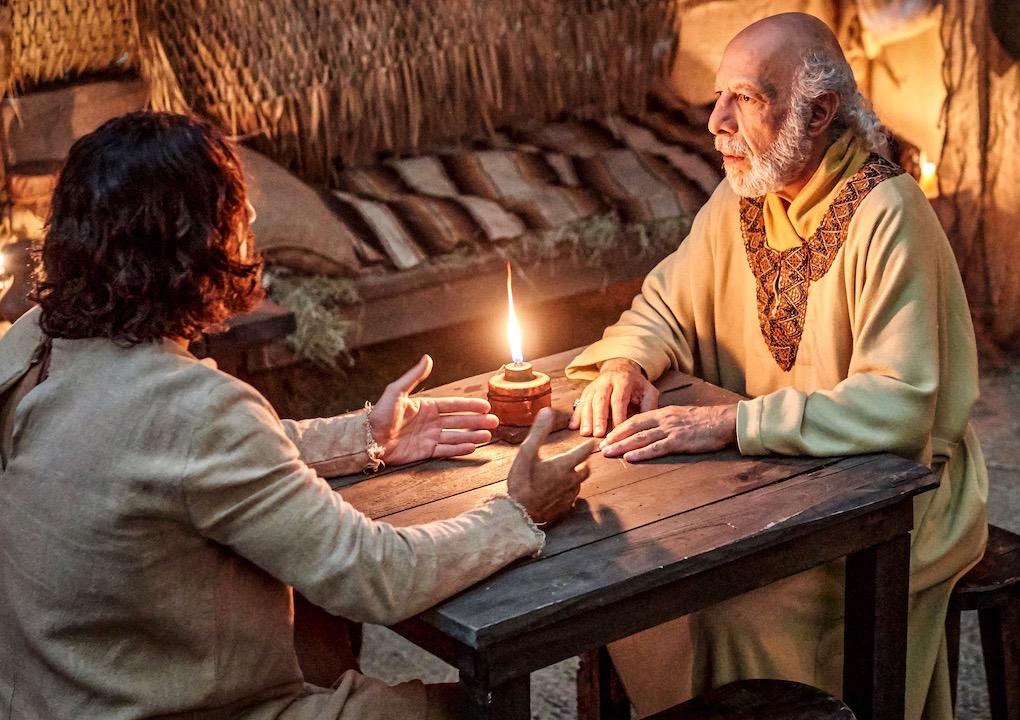
The Sunday lectionary gospel reading for Lent 2 in Year A is Nicodemus’ meeting with Jesus in John 3.1–17. The epistle is Romans 4.1-5 and 13-17. The video discussion of the epistle is here, and of the gospel reading from John 3 here. Both are also linked at the end.
Although we are supposed to be reading from Matthew’s gospel, and the RCL used ecumenically has continued to do so, the lectionary in Common Worship offers us a sequence of four encounters between Jesus and individuals from the Fourth Gospel:
- Lent 2: Jesus and Nicodemus (John 3.1–17)
- Lent 3: The woman of Samaria (John 4.5–42)
- Lent 4: The man born blind (John 9.1-41)
- Lent 5: The raising of Lazarus (John 11.1-45)
I understand that this sequence of passages offered the pattern of study in the early catechumenate, providing a framework for discipleship for those preparing to be baptised at Easter. Those composing the CW lectionary decided that we should follow this pattern and depart from the ecumenical lectionary—though I think without any explanation.
These four encounters do not particularly stand out as a sequence in the Fourth Gospel (for instance, in connection with the seven signs or the ‘I am’ sayings) but they are highly characteristic of the gospel’s narrative style. Whilst the gospel contains more detail of the names of both places and people than the Synoptics, it also features these close-up one-on-one encounters between Jesus and individuals, in which all the details of place and other people fade into the background, as if we are in a cinematic close-up. Some of these one-on-one encounters are also connected with each other; thus Mark Stibbe (in his 1993 Sheffield ‘Readings’ commentary, p 62) notes the prominent contrast between Jesus’ encounters with Nicodemus and the woman, in chapters 3 and 4:
| John 3 | John 4 |
| Takes place in Jerusalem | Takes place in Samaria |
| Location is the city | Location is the countryside |
| Happens at night | Happens at noon |
| Focuses on a man | Focuses on a woman |
| The man is a Jew | The woman is a Samaritan |
| He is socially respectable | She is a social outcast |
| Nicodemus initiates the dialogue | Jesus initiates the dialogue |
| Nicodemus descends into misunderstanding | The woman comes to faith |
| Nicodemus fails to see Jesus as the world’s saviour | The woman and her village see Jesus as the saviour of the world |
Both these dialogues also hinge on the use of double entendre, with a specific example (being born again, having water to drink) as well as the shared theme of light signifying understanding.
The setting of our passage continues in Jerusalem, in continuity with the previous episode, but is introduced in quite general terms ‘Now, there was a man…’ The gospel continues with both making assumptions about the Jewishness of its context, since Nicodemus addresses Jesus as ‘Rabbi’ (literally ‘my great one’, a term use for respected teachers) which was introduced in John 1.38, but also about the need to explain. Nicodemus is a ‘ruler of the Iudaioi‘, which could mean ‘the Jews’, though sometimes clearly refers to ‘Jews who were opposed to Jesus’, sometimes ‘the Jewish leaders’, or even ‘the Judeans’, those in the south as opposed to those living in Galilee.
Nicodemus comes to Jesus ‘by night’; there is no reason to doubt this as the time, since the cool of the evening would be a good time for conversation—but there are also hints that Nicodemus might be a secret enquirer or believer, and there are no street lights by which he can be seen. But here we have a striking example of John’s double meaning; he comes and sits before the one who is the light of the world, who has come to shine in the darkness, but he himself cannot see it, and continues to dwell (spiritually speaking) in the darkness. By contrast, the woman in chapter 4 sees Jesus in the light of day, and sees who he is.
There is no particular sense that Nicodemus is being insincere in his enquiry; it is clear that Jesus had followers at all levels of Jewish society, including those who were respectable leaders. And it is striking that he picks up the language of ‘signs’ that the gospel writer himself has introduced us to in John 2.11. But Jesus cuts across his comment, with the first of three ‘Amen, amen’ sayings—translated, wrongly in my view, as ‘Truly, truly’ in most ETs, which really ought to preserve the transliteration of the term ‘amen’. Although Nicodemus has initiated this conversation, it is Jesus who directs it.
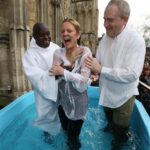
The phrase ‘to be born anothen‘ is again ambiguous, and continues with the double meanings throughout this narrative. The term can mean ‘from a higher place’ but can also mean ‘from the beginning’, or again. (Note that this reflects the sense in the ancient world that what is higher functions as the origin or source, hence the main meanings of the term ‘head’ in a metaphorical sense.) We don’t need to eliminate this ambiguity (Nicodemus’ response notwithstanding), since the gospel is here combining the spatial with the temporal in the same way that the rest of the New Testament does in relation to the kingdom of God, which is mentioned here for the first time, and without any explanation, assuming that we already know about this from the teaching of Jesus in the synoptic gospels. The coming of the kingdom from God signals the beginning of the end of this old age, and offers a new beginning, enacted in baptism (Romans 6) where our old life dies and we begin to live the new resurrection life as we emerge from the water.
This new birth comes about by ‘water and the Spirit’. The Spirit and water are closely associated in this gospel, particularly at John 7.38–39, though some think that ‘water’ refers to physical birth. Against this, though the Fourth Gospel is not particularly ‘sacramental’, we find baptism being mentioned in the very next chapter, so I think this is more likely to be a reference to the water of baptism and the parallel baptism of the Spirit. Jesus goes on to say, in effect, that the merely human can only give life to the merely human; to receive spiritual life, in the kingdom of God, requires a work of the Spirit. Here the gospel is being analeptic, that is, referring backwards to what has already been said: ‘to those who believed in him, he gave the right…to be born…of God’ (John 1.12–13). Note that ‘flesh’ here doesn’t have the negative sense that it has in Paul, of ‘sinful human nature’, almost a force oppose to God and the Spirit, but the merely human, so that in the incarnation, the ‘Word became flesh’.
The puzzle that Nicodemus finds in this is not really explained by Jesus, but is emphasised by yet another double meaning. The word pneuma means both ‘wind’ and ‘Spirit’ as well as ‘spirit’ and ‘breath’; English translations attempt to separate the terms, but we perhaps need to hold them together. The wind makes a ‘sound’, phone, but the shepherd’s voice, phone, is recognised by the sheep (John 10.27), and the words of Jesus comprise ‘what the Spirit is saying to the ekklesiae‘ (Rev 2.7 and passim).
The exchange that follows offers us another puzzle, particularly when we reach verse 11. On the one hand, we have a characteristic saying of Jesus: ‘Amen, amen I say to you…’ but it is followed by a statement on behalf of a group: ‘we speak of what we know and we testify but you (plural) do not receive our testimony’. Testimony is primarily that which is borne by Jesus’ followers about the life and teaching of Jesus (though Jesus does talk about himself as a witness in John 5.31), and the language here sounds very much like those Jews who follow Jesus talking to the Jews who rejected him. So it appears as though the gospel author is integrating his own reflection with the words of Jesus, and as the passage goes on, commentary seems to take over. In the remainder of the text, Jesus is referred to in the third person as the Son of Man, and the language has parallels with the prologue in chapter 1.
In John Goldingay’s second volume on reading and interpreting the Bible, Models for the Interpretation of Scripture, he explores the four different ways in which the four gospels do their theological work: Mark by his driving narrative; Matthew by his organisation and application of the teaching of Jesus; John by his addition of authorial comment; and Luke by his adding to his gospel the account of the continued ministry of Jesus in the early church (pp 73–76).
[In the Fourth Gospel] the point of the story is driven home by direct teaching material attached to the story to bring out its theological and ethical implications (p 75).
Critical scholarship has, in the past, assumed that the early Christian communities were projecting their concerns back into the gospel narratives—but if so, they did not do a very good job, since key concerns (such as the challenges of the Gentile mission) were left only obliquely addressed, and key features of the narrative (such as Jesus’ use of ‘Son of Man’) were not obviously taken up. The gospel author isn’t here making up Jesus’ teaching, but retelling it in a way that brings out its significance—just as any good preacher or teacher will do.
A second feature complements this insight. In the episode at Cana, there is explicit reference to the disciples ‘re-membering’, putting together the story of Jesus with the benefit of hindsight. We can see the same happening implicitly with the references to the Son of Man ‘ascending’ in John 3.13. The language here is similar to that of Paul in Eph 4.7 in his use of Ps 68: Jesus has ascended and so can send spiritual gifts. Looking through the Fourth Gospel, there are several times when the Son of Man language is associated with ‘ascending’—in the encounter with Nathanael in John 1.51, and in John 6.62 ‘if you see the Son of Man ascended to the place he was before’. This all points to the meaning of ‘lifted up’ in John 3.14: it is not just his being ‘lifted up’ on the cross, but also includes his resurrection and ascension—even though the ascension is not included in the events narrated, it is referred to as a theological theme. As we have seen before, in Mark (along with the other Synoptics) Jesus talks of himself as Son of Man to point to his humanity, his humiliation in death, and his exaltation to the right hand of the Father, using the language of ‘the coming of the Son of Man’ from Dan 7.13, where the ‘coming’ is from the earth to the throne of God, not the other way around. The Fourth Gospel does not use this language explicitly, but appears to understand the term in the same way.
The next part of the discourse, John 3.14, draws on a very brief and otherwise insignificant event in the desert wanderings—and by now Nicodemus himself has faded from view. Num 21.4–9 offers a concise account: the people are impatient at a detour in the journey; they complain against God and Moses; God sends ‘fiery’ (venomous) serpents amongst the people, who die when bitten; the people repent and ask Moses to intercede; God tells Moses to make a bronze serpent and put it on a pole; and all who look on it are forgiven and healed.
Some commentators suggest that there might be a further allusion to the figure of the serpent in the garden of Eden, but if that is the case, the allusion is both odd and obscure, since the ‘lifting up’ of Jesus is offered as a parallel to the mounting of the serpent on the pole, so Jesus is here taking the place of the serpent.
The pole offers an obvious parallel to Jesus’ being nailed to the cross, with its crossbeam fixed to an upright pole. The gospel here uses ‘lifted up’, a term which occurs nowhere in Numbers 21, and most usually means ‘to exalt’ (as in the song ‘Lord, I lift your name up high…’). Here we have the start of a long Johannine double meaning and paradox: though being hoisted on a cross is the most shameful thing possible in the first century world, because it expresses God’s love and provides the means of salvation, this giving of himself becomes the glory of Jesus and the revelation of the glory of God.
In the wilderness, the lifted serpent becomes the means of salvation from God’s judgement, the forgiveness of sins, and healing from deathly poison. The gospel is surely pointing to all these in the cross of Jesus. Those who ‘look to’ the bronze serpent will live; those who ‘look to’ Jesus in trust and faith will receive eternal life. The normal sense of ‘eternal’ (aionios) in other literature is ‘unending’, but here is must include the sense of ‘life of the age [to come]’. In contrast to the other gospels, the Fourth Gospel has a very ‘realised’ sense of eschatology, in which the certain events of the future (both life and judgement) project forward into the present and make sense of world as it is.
There is one curious feature of the Numbers 21 story: though the Hebrew talks of the serpent being fixed to a pole, the Greek version of the OT (Septuagint, LXX) uses the language of being fixed to ‘a sign’ (semeion Num 21.9). This is what might have suggested the parallel, and again points to Jesus’ death and resurrection as the eighth ‘sign’ in the gospel to which the other seven point.
And so we come to the pivotal verse in this passage—and the one that is widely misread. ‘God so loved the world’ in contemporary English naturally has the sense ‘God loved the world so much…’ that he sent Jesus. But we are locked into a tradition from 1611 and the Authorized Version, when this phrase meant something different: in this way God loved the world. The change in word order in the ‘Comfortable words’ of the Book of Common Prayer make this clear:
So God loved the world, that he gave his only-begotten Son, to the end that all that believe in him should not perish, but have everlasting life. St. John 3.16
And this is what the text says. The adjective houtos means ‘this’, and the related adverb, found here, means ‘thusly’ or ‘in this way’, something a number of modern translations now correctly point to. But it is a risky thing to challenge a tradition! This is the way that God loves the world—not merely by speaking, no longer merely by offering the ‘sign’ of the serpent, but by bringing his tabernacle presence amongst us in the person of Jesus, who not only is the temple presence of the holy God, but remarkably offers himself up for us as a costly sacrifice.
The ‘world’ that God loves is the world that was made through him (John 1.10) but it has not recognised or received him, and so it is also (as the gospel narrative unfolds) the world that ‘hates’ Jesus and will also therefore ‘hate’ those who bear testimony to Jesus (John 15.18). Here is the paradox of God’s generous love: it comes as a gift, but a gift must be received. If I see someone drowning in a river, and I reach out my hand, then that hand must be grasped if the salvation I offer is to be received.
There is a temptation to make something of the vocabulary of ‘love’, here the verb agapao related to the noun agape. But this gospel actually uses the term interchangeably with another ‘love’ word phileo. In fact, the exposition of that love—a costly gift of Jesus—is sufficient for our understanding. Older versions describe Jesus as ‘the only begotten son’, a term which has found its way into the creeds. But the emphasis here is not on the metaphysical relationship between the Son and the Father, but the uniqueness of the Son. Although (John 1.12) can become children of God, Jesus remains unique—a one-of-a-kind Son, offered for us.
The continuing narrative does not proceed in a linear, logical, way, but circles around, repeating and rehearsing what has been said before, but unfolding the consequences as it does so. Thus the ‘For God’ in John 3.16 is parallel with ‘For God’ in John 3.17. The purpose and intention behind God’s sending of Jesus was not condemnation but salvation—a reiteration in parallel terms of the stark contrast between ‘perishing’ and ‘having eternal life’. The language of ‘condemnation’ is similar to that used by Paul in Romans 8.1: ‘There is now no condemnation for those who are in Christ Jesus’.
Join Ian and James as they discuss all these issues and reflect on the challenge of preaching on them. The video discussion of John 3 is first, followed by the video discussion of Romans 4.
 Buy me a Coffee














“Those who ‘look to’ the bronze serpent will live; those who ‘look to’ Jesus in trust and faith will receive eternal life.”
Thank you Ian, here’s a well-known story on this theme, but one that’s worth retelling:
“LOOK UNTO ME, AND BE YE SAVED, ALL THE ENDS OF THE EARTH.”
“He did not even pronounce the words rightly, but that did not matter. There was, I thought, a glimpse of hope for me in that text. The preacher began thus: “My dear friends, this is a very simple text indeed. It says, ‘Look.’ Now lookin’ don’t take a deal of pain. It ain’t liftin’ your foot or your finger; it is just, ‘Look.’ Well, a man needn’t go to College to learn to look. You may be the biggest fool, and yet you can look. A man needn’t be worth a thousand a year to be able to look. Anyone can look; even a child can look. But then the text says, Look unto Me.’ Ay!” said he, in broad Essex, “many on ye are lookin’ to yourselves, but it’s no use lookin’ there. You’ll never find any comfort in yourselves. Some look to God the Father. No, look to Him by-and-by. Jesus Christ says, ‘Look unto Me.’ Some on ye say, ‘We must wait for the Spirit’s workin’.’ You have no business with that just now. Look to Christ. The text says, ‘Look unto Me.’
Then the good man followed up his text in this way: “Look unto Me; I am sweatin’ great drops of blood. Look unto Me; I am hangin’ on the cross. Look unto Me; I am dead and buried. Look unto Me; I rise again. Look unto Me; I ascend to Heaven. Look unto Me; I am sittin’ at the Father’s right hand. O poor sinner, look unto Me! look unto Me!”
When he had gone to about that length, and managed to spin out ten minutes or so, he was at the end of his tether. Then he looked at me under the gallery, and I daresay, with so few present, he knew me to be a stranger. Just fixing his eyes on me, as if he knew all my heart, he said, “Young man, you look very miserable.” Well, I did, but I had not been accustomed to have remarks made from the pulpit on my personal appearance before. However, it was a good blow, struck right home. He continued, “and you always will be miserable-miserable in life, and miserable in death-if you don’t obey my text; but if you obey now, this moment, you will be saved.” Then, lifting up his hands, he shouted, as only a Primitive Methodist could do, “Young man, look to Jesus Christ. Look! Look! Look! You have nothin’ to do but to look and live.”
I saw at once the way of salvation. I know not what else he said-I did not take much notice of it-I was so possessed with that one thought. Like as when the brazen serpent was lifted up, the people only looked and were healed, so it was with me. I had been waiting to do fifty things, but when I heard that word, “Look!” what a charming word it seemed to me! Oh! I looked until I could almost have looked my eyes away. There and then the cloud was gone, the darkness had rolled away, and that moment I saw the sun; and I could have risen that instant, and sung with the most enthusiastic of them, of the precious blood of Christ, and the simple faith which looks alone to Him. Oh, that somebody had told me this before, “Trust Christ, and you shall be saved.””
Charles Spurgeon
“The Spirit breatheth where he will…”
Once again, the Lectionary compiler dovetails this passage with the Epistle reading.
Here an eminent teacher void of Understanding.[see Romans 4 post]
“You are the [great and well-known] teacher of Israel, and yet you do not know nor understand these things [from Scripture]? AMP.
If I told you earthly things [that is, things that happen right here on earth] and you do not believe, how will you believe and trust Me if I tell you heavenly things?
Earthly things refer to spiritual truths explained using earthly metaphors such as the new birth or the wind representing the Holy Spirit which should be accessible, even to a teacher like Nicodemus.
Significantly Jesus is called Master to signify his authority, divine teaching, and leadership, acting as both an authoritative instructor (didaskalos) and a lord (kurios/despotes) over his followers and creation. This title recognized him as the ultimate authority, owner, and commander, worthy of respect and obedience.
Heavenly things are deeper, hidden, and profound mysteries regarding God’s kingdom, divine salvation, and the nature of Christ, which require faith to believe.
Jesus is pointing out that if the basic spiritual principles are rejected, further revelation will not be understood, as the heart is closed.
The need for Faith highlights the limitations of human intellect alone; one must have spiritual insight to accept heavenly truth.
Essentially, this is a rhetorical challenge from Jesus to Nicodemus regarding the necessity of faith over literal, human reasoning to understand spiritual realities.
Nicodemus was the acme of Orthodoxy, [Of course the Gold Standard of theological understanding{?} ] probably had a stack of commentaries [which by the Jews were highly venerated]
As Jesus might have said “I The Lord give Understanding”
Or as he did say -Rev 3:18
I counsel thee to buy of me gold tried in the fire, that thou mayest be rich; and white raiment, that thou mayest be clothed, and that the shame of thy nakedness do not appear; and anoint thine eyes with[healing] eyesalve, that thou mayest see.
Cf. I Kings 3 V 9-12a
Is being ‘born again’ related to the concept that John outlines in 1 John 3:8–12, which in turn reflects the Genesis 3:15 protoevangelium and the bifurcation of humanity into the ‘seed of Satan’ and the ‘seed of the woman’ — an understanding that underpins the concept that the essence of the gospel is to move from one family to the other.
That is, we need to move from the ‘seed of Satan’ to the ‘seed of the woman’ — i.e. the seed of Abraham, Jesus Christ (Galatians 3:16).
So, in John 3:7 we ‘must’ be ‘born again’ into the correct family. The marital imagery is employed to the same end, but in that imagery it is via the affinity union that we move from one family to another (thus Ephesians 5:31–32) — Scripture also employs ‘adoption’ to that same end.
Dorothy L. Sayers, in her radio play cycle “The Man Born To Be King”, translated “amen” as “indeed” (when it was “amen amen lego humin” she had “indeed and indeed I tell you”. Other variations/translations are “I tell you the truth” or (per Tom Wright) “I’m telling you the solemn truth”. Do you have any comment about this, Ian?
On the ‘so’ in v16, the Shorter OED, and the OED online, has as its first definition of ‘so’:
I.1 In the way or manner described, indicated, or suggested; in that style or fashion; that way.
Yes, I think we have a similar issue in Rom 11:26:
‘And in this way all Israel will be saved’ (ESV)
‘And so all Israel will be saved’ (KJV)
It’s primarily a matter of word order. If one writes, “For so (or “thus”) God loved the world, that …”, the meaning is clear enough. Certainly one does not want to say ‘thusly’, a word that does not even exist. For like instances, see Matt 2:5, 5:12 and passim. In modern English, ‘God so loved the world’ is simply a mistranslation, and a very misleading one, implying that God was overcome by a feeling. In my school days I was taught that using ‘so’ thus, as an affective intensifier, was poor style anyway, and I so agree. Accordingly, I doubt one will find it used thus anywhere in Scripture.
Beginning a sentence with ”so” is how a lot of young people (and not so young) speak today, anacoluthonistically.
I have long understood John 3.16 to mean “This is how God loved the world”, not “how much”.
“May God who loved the world so much
that he sent his Son to be our Saviour
forgive us our sins
and make us holy to serve him in the world,
through Jesus Christ our Lord.”
I tend to avoid the above Absolution, which uses the “so much” phrasing.
I’m a bit puzzled by the supposed departure from the RCL in using these passages from John. Simon Sarmiento
has a useful reference online (“Common Worship Changes to Revised Common Lectionary”), and the RCL itself is readily available (website of The Consultation on Common Texts). It looks to me as if there is no change for these weeks. Could you check/explain?