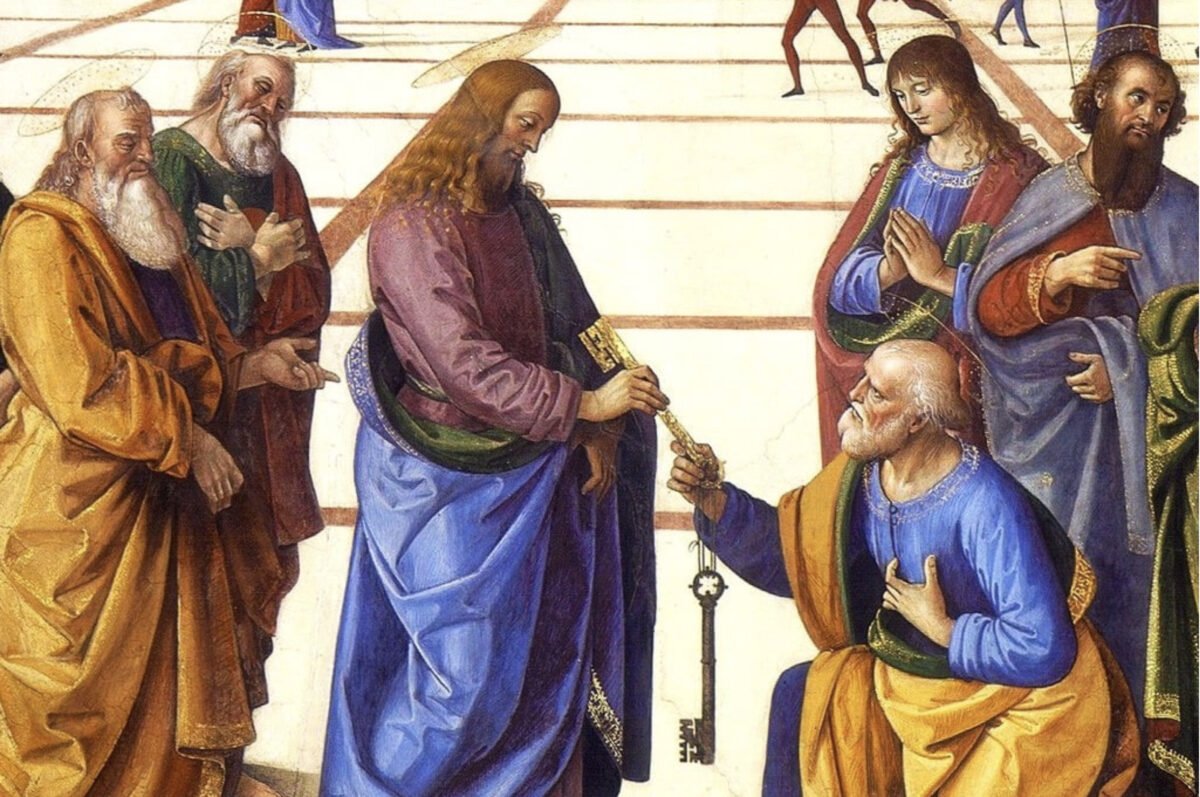
Peter’s confession of Jesus in Matthew 16.13–20 has some fascinating differences from the parallel accounts in Luke and Mark—and a unique Matthean comment addressed by Jesus to Peter. Video discussion can be found here and is also linked at the end of this article.
The reading for Trinity 12 in Year A is Matt 16.13–20, quite a short reading, but forming in Matthew, as the episode does in Mark, a pivotal moment in the gospel narrative, where, at the northernmost point of his ministry, Jesus turns from the adulation of the crowds in Galilee to the opposition of the authorities in Jerusalem. The event itself contains some highly suggestive language, and we need to work hard to distinguish what is being said from the way that it has been used in the subsequent history of its interpretation. It is hard work because it involves challenging the confirmation bias that we bring as we read this text, already having a view as to what the key phrases mean.
The organisation of their narratives with these two major focusses (adulation and opposition) in the first and second halves of their gospels must be understood as being theologically motivated by Matthew and Mark. Jesus has, in fact, already faced opposition from the authorities, and Matt 15.1 explicitly tells us that this opposition has come from Jerusalem. And the Fourth Gospel highlights that, as an observant Jew, Jesus must have been to Jerusalem numerous times before, and certainly for each of the three major pilgrim festivals in each year of his ministry. To the extent to which Matthew and Mark ‘artificially’ distinguish these two phases of Jesus’ ministry, they are making a theological point about the two paradoxical aspects of Jesus’ ministry—the power of ministry in the Spirit that draws crowds, and the opposition of others that brings suffering—and this surely is going to be a pattern for all those who follow him.
Matthew agrees with Mark in locating this episode after the feeding of the 4,000, testing by the Pharisees and Sadducees (two groups who would otherwise be at loggerheads with each other), and the dispute about bread and leaven. Mark additionally includes his unique story about the blind man who needs more than one touch from Jesus to heal him (Mark 8.22–26), offering a symbolic parallel to the disciples’ need for Jesus to keep teaching them about the true nature of his ministry. Luke approaches this episode quite differently, and it does not have the same pivotal place in his narrative, but all three follow it with Jesus’ passion prediction, teaching on the cost of discipleship, and the transfiguration. All this serves to heighten the paradox of Jesus’ suffering and glory.
The location is in the region of Philip’s Caesarea (known as such to distinguish it from Caesarea Maritima on the Mediterranean coast), a Roman town established on the site of previous settlements by Herod the Great’s son Philip, tetrarch of Batanea to the north-east of the country, and covering the northern part of what is now Jordan. Herod had built a marble temple to Caesar here, and it was also associated with the god Pan, giving rise to its modern name Banias. Apart from offering a physical turning point in Jesus ministry in the north (the site is still within the region of the northern tribe Dan), it also provides for Matthew another hint that the gospel which is for the ‘lost sheep of the house of Israel’ will ultimately reach well beyond Israel’s borders. As we have seen, this is a continuous counter-thread running through the gospel narrative, and not something revealed to Jesus as a surprise by gentiles he encountered!
Reflecting on this passage, I have also been struck by the fact that we have, yet again, an account of Jesus taking time out, either on his own or with his disciples, away from the pressing needs of the crowds. Jesus is not a slave to his own popularity, and the needs of the crowd are not the only important thing to make demands on his time. The evidence of his power and lordship are made manifest in his public ministry, but the reflection that leads to understanding happens in the quiet moments away from the action.
As happens often in the gospels, the exchange is provoked by Jesus asking a question. Luke follows Mark in recording it as ‘Who do people say I am?’ but most manuscripts of Matthew offer a different form: ‘Who do you say that the Son of Man is?’ (A minority of manuscripts offer ‘Who do you say that I, the Son of Man, am?’, harmonising the two forms).
The term ‘Son of Man’ has three senses. It begins life as a simple self-description; just as ‘son of Israel’ means Israelite, so ‘son of man’, in Hebrew ben adam, simply means human being. We can see the equivalence in the parallelism of Ps 8.4: ‘What is man, that you are mindful of him, the son of man that you care for him.’ (We need to note that ‘man’ here translates adam in Hebrew and anthropos in Greek, both of which refer to ‘human’ without any sense of sex distinction or ‘maleness’. Thus some translations render Ps 8.4 as ‘human beings…mere humans…’)
But within the biblical canon it then acquires a second sense, that of human mortality and fragility contrasted with the majesty and power of God—thus its repeated use as God’s address to Ezekiel is often translated as ‘mortal man’. This makes it an appropriate term for Jesus to use in the light of his anticipated suffering and death.
Yet thirdly, and in some contrast, it features as the centrepiece of the visionary apocalyptic narrative of Dan 7, where the ‘one like a son of man’ (that is, a human figure) is exalted, ‘coming on the clouds’ up to the throne of the Ancient of Days to inherit an eternal kingdom. Within Daniel, this figure symbolises the people of Israel, fragile and trampled by the various beasts from the sea, but ultimately exalted by God’s grace, power and faithfulness. As Jesus recapitulates the story of Israel, he experiences this victory in his resurrection and ascension. Recognising this holds the key to making sense of many of the later passages of the Synoptics such as Matthew 24 and Mark 13.
Thus it is that the term ‘Son of Man’ expresses within itself the paradoxes of Jesus’ ministry set out in the gospel narratives. No wonder that it is Jesus’ own favourite term to describe himself.
The idea that Jesus might ‘really’ be these other characters doesn’t suggest any notion of reincarnation. Herod Antipas fears that John the Baptist might have been resurrected in the person of Jesus, but for the most part this suggests a symbolic association—just as Jesus describes John as ‘Elijah, if you are willing to accept it’ (Matt 11.14).
It is striking that Matthew alone includes the mention of Jeremiah, not least as a contrast to Jesus’ own comparison of himself with the other major southern prophet Isaiah in Matt 13.13–15. Jeremiah was a prophet of doom, who spoke against both the temple itself and the trust of the people in the institution of the temple as a substitute for loving obedience to God. Jesus’ parables directed against the Jewish leadership in Matt 21.28–22.14 are followed by his denunciation of the scribes and Pharisees in chapter 23, and Matt 23.38 echoes Jer 22.5 in predicting the desolation of the temple.
Jesus then turns to the disciples themselves; his emphatic form ‘You, who do you say that I am?’ is expressed in the TNIV as ‘What about you?’ Jesus asks them a question that we must all respond to for ourselves. Matthew has already pointed to the growing understanding of the disciples, so we might expect a better answer from them—not least because ‘the secrets of the kingdom of heaven’ have been revealed to them (Matt 13.11, 16–17).
The language of ‘Messiah’ (in Greek christos) had a range of meanings in the Old Testament. Both priests and kings were anointed, but even foreign rulers like Cyrus in the second half of Isaiah could be described as ‘anointed’ for the task of rescuing God’s people and returning them from exile. By the time of the New Testament period, these diverse ideas had coalesced into a sense of expectation of God’s anointed one who would deliver the people from the oppressive foreign power that rules over them. The question that Jesus raises is who is the real oppressor: a foreign political power, or the ‘foreign’ power of sin that leads the people into disobedience to God?
Only in Matthew does Peter also declare that Jesus is ‘Son of the living God’. There is a sense in which these two declarations act as synonyms; after all, an important OT prophecy says of David’s future ‘son’ (descendant): ‘I will be a father to him, and he will be a son to me’ (2 Sam 7.14), and the messianic Ps 2.7 uses the language of sonship. Moreover, this ties in both with Matthew’s characteristic description of God as ‘Heavenly Father’ to Jesus and his followers, an emphasis that is amplified in the Fourth Gospel. And ‘Son of God’ is a particularly important title for Jesus all through this gospel; it is repeated again in Matt 17.5, and these two titles together form the accusation of the high priest in Matt 26.63. The qualifier ‘living’ might seem redundant, but it emphasises the source of Jesus’ authority.
The God with whom Jesus is here being connected is not a philosophical abstraction but the dynamic God of Israel’s faith and history. The supernatural dynamic of Jesus’ miracles derive from a God who is himself alive and active in his world. (R T France, NICNT p 619).
Jesus’ response to Peter is unique to Matthew, and his positive affirmation contrasts with the account in Mark and Luke where Jesus immediately charges the disciples to keep this secret for fear of misunderstanding. We have already seen this kind of special attention to the role of Peter in the episode of the walking on the lake two chapters earlier.
There is a curious reciprocity in this exchange: ‘You are Messiah, son of the living God’; ‘You are Peter, son of Jonah’. Elsewhere in this gospel, the apostle is mostly referred to as ‘Peter’, though Jesus will soon address him directly as ‘Simon’; only here in the gospel does he have his full title ‘Simon Peter’, and this exchange gives the explanation for the nickname that Jesus bestows on him. Using both his names gives a kind of formality to Jesus’ affirmation—but it also functions to remind Peter of his flesh-and-blood reality (it is this verse that gives us the phrase ‘flesh and blood’), not least in the emphatic ‘Simon son of Jonah’, alongside his spiritual destiny. The double name offers a kind of partially realised eschatology in personal form—what Peter was alongside what he is becoming in Jesus.
We find here some strong parallels with wording from the Fourth Gospel—the mention of Peter’s father (translated as the more common Greek name Ioannes, John 1.42), the notion that it is only the Father who reveals spiritual truths and draws people to Jesus (John 6.44) and the delegated power to ‘bind’ and ‘loose’ (parallel to John 20.23)—but the contrast between ‘flesh and blood’ and spiritual powers is also found in Paul, in Eph 6.12.
Jesus’ nickname, Petros in Greek, equivalent to Kepha in Aramaic (which we find in John 1.42, 1 Cor 1.12, 3.22 etc and Gal 1.18, 2.9 etc) appears to be a genuine neologism; the name is otherwise almost unknown in the ancient world. Peter is to be a foundational ‘rock’ for the new community, having a quite distinct role, and not merely one ‘stone’ (lithos) amongst many.
Roman Catholic exegesis would here point to the theological importance of the role of Peter and, by implication, his successors as Fathers (‘popes’) of the church. But that is difficult to sustain in the light of the description of Jesus himself as the foundation in 1 Cor 3.10–11 as well as 1 Peter 2.4–8 (which, if written by Peter, is rather telling!) or the slightly different configuration in Eph 2.20 of Jesus as the cornerstone to the foundation of the ‘apostles and prophets’ (compare Rev 21.14).
In fact, Peter is not the theological foundation of the community, but its narrative rock. He has already been named in first place in Matt 10.2, and is mentioned in the gospel more often than any other disciple, often taking the lead. In the first half of Acts, he appears to lead the Jerusalem group, often takes the initiative, and functions as spokesman. But, like Paul, he never works alone, and is frequently in partnership with John; leadership in the New Testament is always plural wherever it is fruitful.
The word ekklesia should not be translated by the English word ‘church’, with all its associations of buildings, institutions, establishment, and regulations. To do so would be to open the door wide, allowing us to march into the text bringing all our presuppositions with us, and march out again carrying confirmation of what we wanted to hear.
The Greek term ekklesia never denotes a physical structure in the NT [nor, I would add, an institution with regulations and structure] but always a community of people. The new temple is not a building of literal stones, but consists of ‘living stones’ (1 Peter 2.5). (R T France, NICNT, p 623)
In other parts of the NT, we need to bear in mind the Greek civic meaning of ekklesia as the ‘assembly’ of people to gather for decision-making, primarily the citizens of a polis making decisions about its governance, but also used for social and religious groups. But here its primary background is from the Greek Old Testament (the Septuagint, LXX) for the ‘congregation’ of the people of Israel, the people of God. That Jesus can, emphatically according to the Greek word order, talk of ‘my ekklesia‘ thus has strong Christological and theological implications; this new community is the Israel of God, a people who are constituted around neither ethnic identity nor the torah of God, but around the Messiah that Peter has just recognised. This is a (re)new(ed), international, Jesus-centred Israel.
The keys that Jesus metaphorically hands to Peter are not the keys to the front door that control admission, as depicted in the common idea of Peter standing at the pearly gates of heaven in the afterlife. Rather, they make use of the image of the new steward of the House of Israel in Is 22.20, explicitly referred to in Rev 3.7. Peter is to be chief steward in the household, bearing the keys of the storehouses which give appropriate provisions for the people of God.
‘Binding’ and ‘loosing’ are rabbinic terms denoting ‘forbidding’ and ‘permitting’ respectively, as we have seen already in Matt 5.19. This language therefore continues the idea of Peter as steward of the household, and we see him taking this role in Acts 10.1–11.18 in arguing that Gentiles should be permitted to join the community without converting to Judaism—as well as rendering judgement on those who have erred (Acts 5.1–11). But we must also note that this is explicitly a role of the whole community in Matt 18.18; whatever Peter’s distinctive historical role as a person, he remains first among equals in both the group of apostles and in the ekklesia as a whole. And Dick France highlights how the unusual grammar qualifies the authority Peter has:
The heavenly ‘endorsement’ of Peter’s decisions is expressed (both here and in Matt 18.18, twice in each verse) in the unusual syntax of future perfect passive verbs, ‘will have been tied up’, ‘will have been untied’…With simple futures, Peter would take the initiative and heaven would follow. But with future perfects the impression is that when Peter makes his decision it will be found to have been already made in heaven, making him not the initiator of new directions for the church, but the faithful steward of God’s prior decisions. [T]he saying becomes a promise not of divine endorsement, but of divine guidance to enable Peter to decide in accordance with God’s already determined purpose. (R T France, NICNT, p 626–7).
The recognition of Jesus as Messiah around whom the new Israel will be constituted will be set in striking contrast with his role as suffering servant in the following verses. But his authority is expressed in reciprocal partnership with Peter and the other disciples, as they are given real importance and trust in the formation of this new community.
Join Ian and James as they discuss all these issues:
 Buy me a Coffee







Perugino’s fresco (from the Sistine chapel) might be skilful but I wouldn’t want it in my lounge: Jesus looks effeminate and Peter looks like an OAP.
I have often thought that an video of this scene (with soundtrack) would assist in the exegesis of “on this rock I will build my church”. Did Jesus point to anything or emphasise any word?
On the RC use of Matt 16.18, it’s interesting that the Vulgate (and St Peter’s in Rome, round the base of the dome) retains the distinction made in the Greek: ‘tu es Petrus, et super hanc petram …’
The sentence is in the singular here (as non-Greek speakers can see in the Authorized Version). But it is in the plural in Mt 18 and Jn 20. As a minimum then it refers to the apostles and perhaps to all Jesus’s followers, all the ekklesia. The plural is also consistent with the words of the Lord’s Prayer (“as we forgive”).
Per my comment on the video posting, ‘rock’ here does refer to Peter (and perhaps by extension to the other 11 apostles) not Jesus. This aligns with Revelation’s picture of the Twelve being the foundation of the new Jerusalem. It seems some people are a little too defensive about this.
What is deeply shocking, disturbing, is the Jesus acceptance and approval of the exclamation, an exclamation the Jesus, himself is God, God the Rock.
Deuteronomy 32:4,
Psalm 18:2, Psalm 92:15, Exodus 17:6, (1 Corinthians 10:4),
And, Daniel 2:34-45, Ezekiel 11:19, Matthew 7:24-28.
There are more scriptural references (scripture interpreting scripture) if ‘rock’ is also ‘stone’. Cornerstone, stone of offence.
Thanks for the article, partially, ‘binding and loosing’ which became a ‘thing’ on which the books and prayers of Liberty Savard had significant influence on some sections of quasi church gatherings and teaching some years ago. They may continue to be of influence today, for all I know.
There is a curious reciprocity in this exchange: ‘You are Messiah, son of the living God’; ‘You are Peter, son of Jonah’.
Not quite…
Peter: “you are… Son of the living God.”
Jesus: “Blessed are you Simon Bar-Jonah [i.e. son of Jonah], … my Father in heaven [has revealed this to you].
Does Jesus use the rather formal address to Simon to reinforce that he is, indeed, the son of his father in heaven?
Then comes, “and I tell you, you are Peter…”
What is the motif of a Rock in Holy Scripture
In the life of a believer, the imagery of the rock encourages trust and reliance
on God amidst life’s challenges. It calls Christians to seek refuge in God’s unchanging nature and to stand firm in their faith, knowing that their foundation is secure in Christ. The rock metaphor also inspires believers to emulate the steadfastness and reliability of God in their own lives, becoming a source of strength and support for others.
Is the Church built on a Rock?
Peter an unreliable, ignorant, unstable soul is transformed on the day
of early rain.
A disorganised disjointed, divided, polarised church not unlike
The tribes of Israel; yet God has chosen these foolish things that “are not”
However, “Glorious things of thee are spoken Zion City of our God”
See the latter end of Israel, the centre of the Glory of God to all nations
in “This Mountain”
The latter end of the Church “All glorious within”
We await the day of “the Latter Rain” which will be far greater
than the Former Rains
It will not be a case of trying to grow the church it will be a case of
Kings flowing unto it’s light.
[Think the Queen of Sheba.] It is God who gives the increase, the Church
will be conformed to the image of Christ i.e.
“The Faithful and True Witness”.
Plant the good seed and water it faithfully and wait for the increase.
It is the experience of His Church at the individual level and will be at the corporate level.
Many are gravely unhappy with their Church, much like the re buildings
of Nehemiah,that was mocked for using broken reclaimed, blackened
burned stones that a fox might break down, yet the remnant persevered with, to the Glory of God.
The knowledge of the Glory of God will cover the earth. Her enemies
will be forgotten and never more remembered says the Lord.
As Paul would say “Rest with us”. Shalom.
Dive deeper see
“The Rock on Which the Church Is Built. [ Built on a rock the church shall stand, even when steeples are falling.]
@ https://mypastoralponderings.com/2021/11/09/the-rock-on-which-the-church-is-built/
Based around a hymn –
Built on a rock the church shall stand
even when steeples are falling;
crumbled have spires in ev’ry land,
bells still are chiming and calling –
calling the young and old to rest,
calling the souls of those distressed,
Concerning “Identification “ and the identity of Christ’s Ecclesia,
If you want to feast on the marrow of the fatness and imbibe the wine upon the leas?
See
“The Gospel of God Concerning His Son Jesus Christ Our Lord”
by T. Austin-Sparks
Chapter 8 – “The Eternal Purpose and Its Security” @ austinesparksnet.
Shalom.
P.S. ON MARROW
Job 21:24 His breasts are full of milk, and his bones are moistened with marrow.
Ps 63:5 My soul shall be satisfied as with marrow and fatness; and my mouth shall praise thee with joyful lips:
Prov 3:8 It shall be health to thy navel, and marrow to thy bones.
Isa 25:6 And in this mountain shall the LORD of hosts make unto all people a feast of fat things, a feast of wines on the lees, of fat things full of marrow, of wines on the lees well refined.
Heb 4:12 For the word of God is quick, and powerful, and sharper than any twoedged sword, piercing even to the dividing asunder of soul and spirit, and of the joints and marrow, and is a discerner of the thoughts and intents of the heart.
HIS breasts are full of milk?? Is this a new TRANSlation of Job 21:24?
depends on which translation you read. I suspect what the author was getting at is more like, he is well-fed. Either way, he was seemingly fit and healthy yet still died.
David,
Thanks, with a well considered, careful, yet rare, exegesis.
If we were to rewind to Jonah, we’d find a key text, ‘salvation is of the Lord’.
And in a different context, Peter, in effect, replicates that pronouncement as son of Jonah.
As to the builder of My House or even HIS House.
What are the qualifications for this task ?
The ability to build it according to a Plan and the
Purpose of the House?
Thus saith Jehovah, Heaven is my throne, and the earth is my footstool: what manner of house will ye build unto me? and what place shall be my rest? Is.66 v 1
David provided all the materials and all the wealth for the Building of the House. David also commanded all the princes of Israel to help Solomon his son, saying, Is not the LORD your God with you? and hath he not given you rest on every side?
David was dis-qualified from building it because he was a man of war,always contending with some enemy or other.
The actual builders must be chosen by God and endued
with a peculiar spirit Ex.35 v 32ff.
Solomon was chosen because he was a man of peace.[As the Christ]
. Derived from the Semitic root sh-l-m (meaning peace or completion).
The name Solomon comes from the Hebrew name Shlomo.
It translates to peaceful, peace, or whole and complete.
It shares the same root as the Hebrew word shalom.
As co builders with Christ each on is warned to take heed how they build and what materials they choose to use; as Paul also
re iterated-
1 Cor 3:10 According to the grace of God which is given unto me, as a wise master-builder, I have laid the foundation, and another buildeth thereon. But let every man take heed how he buildeth thereupon.
Are the “houses” that we build places where God Rests?
Where people find Rest and Peace, quiet resting places and
Still waters?
That psalm {23} ends with the delight of “….”and I will dwell in the House of the Lord- Forever. Shalom.
Psalm 127 vs,1&2
Says of building a house
Except the LORD build the house, they labour in vain that build it: except the LORD keep the city, the watchman waketh but in vain.
No matter how diligent we may be in detecting falsehood
and deceptions however sure in our thinkings and beliefs if we leave God out of the equation it is still God who keeps watch upon His own and His Purpose will stand-He is our Rock the wicked are on slippery places therefor “Stand Still and see the Salvation of God.
2 Chr 20:17. Shalom.
And what about the Glorious Prophetic climax as to the identity of His Church?
“I Will build My Church and the Gates of Hell shall not Prevail against it”!
What a glorious climax to this prophetic interlude!
Glorious things are spoken of thee O Zion City of our God!
Here Christ aligns his Church with all the prophetic utterances concerning
Jerusalem and Israel in the Holy Scriptures, in particular the Post Exilic prophets.
Why because God has engraved us on the palms of his hands and He is Jealous
for the place where He has written His Name.
For an exhilarating word study –
Google- What is the motif of Prevail in the bible ?
AND What is the motif of God’s Jealousy in the bible?
Why is God a burning Jealous God?
Shalom.