
The Sunday lectionary gospel for Trinity 13 in Year C is the first two of the three ‘parables of the lost’ in Luke 15, the parable of the lost sheep and the parable of the lost coin. We don’t go on to read the third, the parable of the prodigal son, since we read that earlier in the year on the fourth Sunday of Lent.
The epistle for this week is 1 Tim 1.12–17. You can find the video discussion of that passage here, and the video discussion of the gospel reading in Luke 15 here. Both are also linked at the end of this piece.
In contrast to some of the surrounding chapters, this looks like a clearly linked block of teaching filling the whole of chapter 15. There is no specific location or timing given, but a general introduction about Jesus’ practice, though there are some links with the material either side, not least in the mention of the theme of table fellowship.
I had an interesting discussion with a friend online about this passage, where he suggested that these parables should be understood the opposite way around from the traditional reading, with the thing that was lost and found being Jesus and the kingdom, and the one searching being the person who discovers faith. (You might pause for a moment, and consider the merits of this reading, and why it might or might not be persuasive, before reading on…) I don’t think this is a persuasive interpretation, but it highlights two things: first, as I have mentioned before, that Jesus’ teaching in parables is not always immediately clear to us, because of the implicit cultural assumptions that are often built in; and, second, that we need to check ‘traditional’ uses of these parables against what the text actually says.
‘Tax collectors’ would generally have been seen as the notorious element of Luke’s world, despised and dishonest people who collaborated with the occupying Roman power and exploited others for their own gain. But throughout Luke they are depicted as those who (surprisingly) respond to this spiritual renewal movement, both in John’s ministry (Luke 3.12) and Jesus’ (Luke 5.27). ‘Sinners’ refers to those who do not meet the demands of being ‘righteous’, and so are at the margins of religious society, and are probably ready to respond in repentance—but the term is use by Luke in quite general ways. Although it might on occasion have overtones of sexual sin (e.g. in Luke 7.37), that is not a necessary implication. It is striking that, just as Jesus has consistently drawn a crowd ‘along the way’, these kinds of people are ‘gathering to him’. They are instinctively drawn to his teaching and his presence.
The complaint of the ‘Pharisees and teachers of the law’ about the company Jesus keeps closely echoes their complaint against him in Luke 5.30. There is a hint in their accusation that Jesus does not merely accept invitations, but acts as host himself, in the language of ‘receives’ or ‘welcomes’ (προσδέχεται), but in fact the only meal at which Jesus is depicted explicitly as host is the last supper. In contrast to Luke 5.31–32, Jesus does not offer a direct answer, but instead tells the three parables.
All three have a similar structure, in which something is identified as ‘lost’, there is a searching, that which was lost is found, and the end result is rejoicing. The first two are tightly parallel, whilst the third is much more developed, and the question of ‘searching’ by the father is handled in a different way. But there is also a notable increase in the importance of the lost, from being 1 in a 100, to one in ten, to being one of two sons.
The term ‘shepherd’ is not mentioned in the first parable, but is implied by the presence of sheep. Although there is a popular reading of this story in which the despised and marginal shepherd is foolish enough to leave the 99 unprotected in order to find the one that is lost, none of this has foundation either in the text or in cultural reality. David Croteau explores the status of shepherds in relation to the Christmas story in Luke 2, and comments:
Besides Aristotle, a comment by Philo, and one statement in the Mishnah, the bulk of the quotes used to demonstrate that shepherds were despised were taken from the Babylonian Talmud. I was unable to find even one source from first-century Israel used to support the view that shepherds were societal outcasts. Therefore, this viewpoint is dated after the events being studied in Luke 2. It is unreliable information and should be discarded when interpreting the Gospels.
Given that the normal flock for an average family would be 10 to 15 sheep, this person is represented as extremely wealthy. I am writing this sitting in the desert in Jordan (as it happens), and even today it is not uncommon to see flocks of sheep and goats wandering apparently without a herdsman; the primary focus here is that the one has become separated off from the rest of the herd, and so would be distressed and in need of gathering back. And those whom Jesus is addressing, who see themselves as leaders of Israel, could hardly fail to see the connections with God’s rebuke to the failed ‘shepherds’ of Israel in Ezek 34.7–11. This, then, also gives Jesus’ teaching a Christological significance; in Ezek 34.11, where Israel’s leaders have failed, God himself shepherds his people. Where the Pharisees and teachers of the law have failed to seek the lost, Jesus himself become the Shepherd of Israel.
A possible inference from the parable is that the ‘one’ is more important than the 99 who have been left, and in fact the apocryphal Gospel of Thomas makes this explicit by straightening out the story’s logic; the lost sheep is the largest, and the shepherd tells it ‘I love you more than the ninety-nine’ (G Thom 107). But Mikeal Parsons (Paideia p 236) highlights the numerological significance of the 99 and 100. Counting on one’s fingers (flexio digitorum) was very commonplace in the Roman world, and was in fact seen as an indispensable skill for the educated (See Quintilian Inst 1.10.35). Up to 99, you would count on the left hand, but for three-digit numbers from 100, you would count on the right hand. In an age that preferred the right to the left, Luke’s Jesus is telling us that the whole flock is out of kilter as long as the one is missing—and the whole flock is ‘put right’ when the one returns. No wonder there is so much rejoicing!
The parallel parable of the woman searching for the coin forms one of the many male-female pairs in Luke’s gospel, and offers a surprising image of the searching of God for the lost in contrast to the more conventional images of the shepherd and the father.
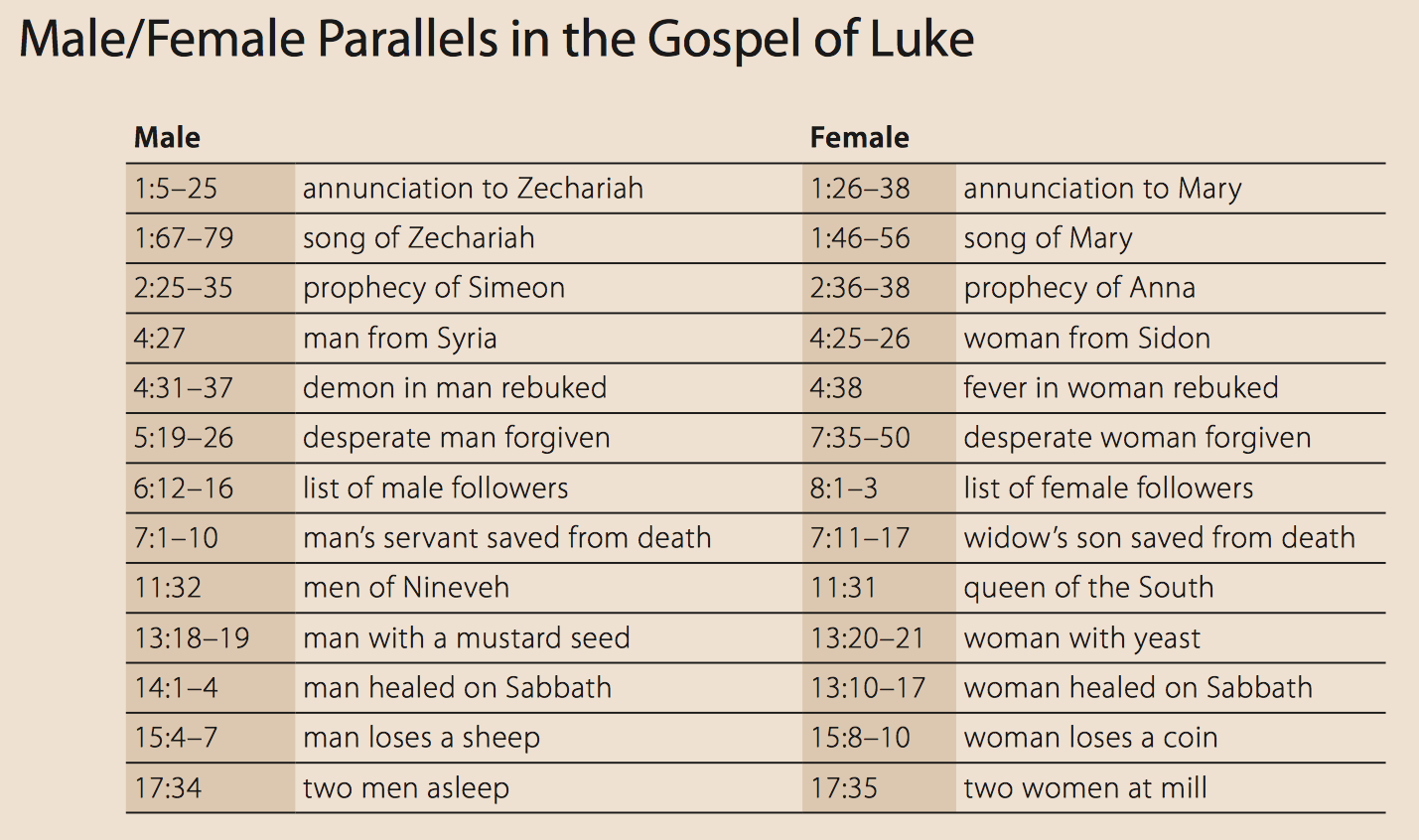 (from Mark Allen Powell)
Kenneth Bailey reminds us how unusual it would be to have coins in a peasant home:
The peasant village is, to a large extent, self-supporting, making its own cloth and growing its own food. Cash is a rare commodity. Hence the lost coin is of far greater value in a peasant home than the day’s labor it represents monetarily (Kenneth Bailey, Poet & Peasant and Through Peasant Eyes: A Literary Cultural Approach to the Parables in Luke, 1983, p 157).
 The set of ten coins was most likely either some family savings, or possibly the dowry given to the woman by her husband on her marriage. I took this picture on a recent trip to the museum of Jordanian culture in Amman; you can see the dowry coins worn around the neck, though they might have also been worn on the forehead for more prominent display.
There is a lovely modern depiction of the anxiety of losing something valuable in the opening scene of Lord of the Rings: the Fellowship of the Ring, when the old Bilbo temporarily forgets where the Ring is, only to find it in his waistcoat pocket.
Two keys things are worth noting in reading these parables. The first is the jarring discontinuity between the content of the stories and Jesus’ exposition of their meaning. In neither case does the thing that is lost show awareness of its lostness or play any role in its own recovery. And yet in both explanations, Jesus explicitly emphasises that rejoicing comes when ‘sinners repent’. And earlier, Luke has made explicit what is only implicit in Matthew and Luke, that Jesus has come to those sick in sinfulness to bring the medicine of forgiveness: ‘I have not come to call the righteous, but sinners to repentance‘ (Luke 5.32). Bruce Chilton comments:
Repentance, a turning back to what alone has value, is a necessary and inescapable aspect of entering the kingdom; it is implicit in much of Jesus’ discourse, and need not be named to be operative. (cited in Joel Green NICNT p 575)
This means that the reversal of the kingdom is not so much from exclusive to inclusive, but from established norms to the criterion of repentance and faith.
Secondly, we need not worry about this mismatch, since the focus is consistently theocentric. The concern here is less on what is needed from the individuals, but the priority and concerns of God. The opening question focusses primarily on Jesus; the focus in the parables is the joy of the one searching and finding that which was lost; and the rejoicing is ‘in heaven’ and ‘amongst the angels’. That is why the non-conventional reading I mentioned at the beginning is unconvincing.
There are implications for our own priorities and practice. Andrew Wilson offers fascinating reading of the parallel account in Matthew 18, where the searching of the shepherd appears to be an explicit lesson for the fellowship of believers. But here in Luke, the focus is on God himself; he is the pursing shepherd and the anxiously searching woman who longs for us to be found again.
Although Jesus’ final remarks do not develop it, the enhanced portrayal of the woman’s efforts as she attempts to locate what has been lost might also provoke reflection on the initiative taken by God in human recovery. (Joel Green, p 576)
Come and join Ian and James as they discuss this reading here, and the epistle from 1 Tim below:
 Buy me a Coffee

















There’s a gorgeous story – and it may well be true – of a schools inspector who visited a small primary school in a farming community in a remote corner of the Yorkshire Dales, and took part in an RE lesson in which the parable of the lost sheep was being discussed. When he asked the children why the shepherd should have left the 99 to search for the one that had wandered off, a small boy put his hand up and said,
” ‘Appen it were t’tup. “
Thinking about Jesus ‘welcoming’ in the sense of ‘receiving’ or acting as host, brought to mind the road to Emmaus. On the road, Jesus is the teacher but, in the home, technically Jesus is the guest, yet it is he who took bread, gave thanks and broke it. At any meal, even those not given in his honour, I suspect Jesus would have been so much the focus of attention before the meal that it would be natural for that to continue into the meal and for observers such as the Pharisees to say that he ‘welcomes’ sinners. Perhaps Luke deliberately phrases the Pharisees’ grumble this way (compared with 5:30) to emphasise Jesus’ welcoming of the lost-sinner-found at the heavenly banquet?
Perhaps the form of these first two parables of lostness needs taking seriously: a long and searching question: ‘Which of you…?’ But who would leave 99 for the sake of one – especially in the wilderness? Why do that? Who’d imagine they’d succeed? What flock would be left when they got back? Who’d dream of telling their friends they’d lost a sheep in the first place – let alone that they’d left a whole flock for the sake of just one? And if owning 100 sheep makes you a rich man, who’d ever imagine what it might be like to have just ten coins, let alone imagining yourself to be a woman?
If engaged with seriously, these two parables told as question invite the very feelings of confusion, disorientation, and perplexity that people experience when they are lost. ‘Which one of you?’ asks Jesus. So scribe and Pharisee are asked if that’s what they are like – and the honest answer is presumably ‘No, I’m not like that at all.’
Can a coin repent? Can a sheep? But ‘sheep’ is Israel’s confession – Psalm 95 is said every Sabbath – ‘we are the sheep of his pasture and the flock of his hand’. And it is possible to be lost without knowing it – and possible to confess lostness even if you are as diligent about law and covenant as scribes and Pharisees: the last verse of Psalm 119, the A-Z of long reflection in the meaning of covenantal faithfulness – ‘I have gone astray like a lost sheep seek your servant, for I do not forget your commandments.’
You have to wait to the third parable of lostness for the meaning of repentance to be spelt out – in the first two parables of lostness the question invites speculation that if my lostness is the perspective of heaven, the Lord is also the one doing the searching. And if I am lost it is he who takes responsibility. I cannot do the finding all by myself. That has to be done for me – and why ‘the Son of Man comes to seek and save that which is lost.’